



Abstract
The purpose of this study was to determine whether childhood animal cruelty is primarily a feature of family context or of externalizing behavior. Twenty measures of family context and proactive (fearlessness) and reactive (disinhibition) externalizing behavior were correlated with the retrospective accounts of childhood animal cruelty provided by 1,354 adjudicated delinquents. A cross-sectional analysis revealed that all 20 family context, proactive externalizing, and reactive externalizing variables correlated significantly with animal cruelty. Prospective analyses showed that when the animal cruelty variable was included in a regression equation with the 10 family context variables (parental arguing and fighting, parental drug use, parental hostility, and parental knowledge and monitoring of offspring behavior) or in a regression equation with the five reactive externalizing variables (interpersonal hostility, secondary psychopathy, weak impulse control, weak suppression of aggression, and short time horizon), it continued to predict future violent and income (property + drug) offending. The animal cruelty variable no longer predicted offending, however, when included in a regression equation with the five proactive externalizing variables (early onset behavioral problems, primary psychopathy, moral disengagement, positive outcome expectancies for crime, and lack of consideration for others). These findings suggest that while animal cruelty correlates with a wide range of family context and externalizing variables, it may serve as a marker of violent and nonviolent offending by virtue of its position on the proactive subdimension of the externalizing spectrum.
As one component of Macdonald’s (1961) triad of preadolescent precursors to interpersonal aggression, childhood cruelty toward animals has captured the imagination of mental health professionals interested in predicting and preventing future violent behavior. Macdonald believed that animal cruelty played a significant role in future adult violence by desensitizing the individual to the consequences of aggression and providing him or her with the opportunity to develop, practice, and refine aggressive skills. Whereas early uncontrolled studies often failed to detect a relationship between childhood cruelty toward animals and subsequent adult violence, several smaller scale studies in which both violent and nonviolent prisoners were interviewed showed evidence of a link between childhood animal cruelty and adult criminal violence (Felthous & Kellert, 1987). More recently conducted studies, several of which used a prospective or longitudinal design, have also enlisted support for the proposition that childhood cruelty toward animals and subsequent violent behavior are connected (Arluke, Levin, Luke, & Ascione, 1999; K. D. Becker, Herrera, McCloskey, & Stuewig, 2004; Hensley, Tallichet, & Dutkiewicz, 2009; Lucia & Killias, 2011; Walters, 2014b), although in several of these studies (Arluke et al., 1999; Lucia & Killias, 2011; Walters, 2014b), animal cruelty predicted nonaggressive crime as well as it did aggressive crime.
The fact that animal cruelty is capable of predicting nonaggressive and aggressive offending equally well runs counter to the violence graduation hypothesis proposed by Macdonald (1961). According to the violence graduation hypothesis, there is a direct link between childhood animal cruelty and subsequent violence toward humans. Given the nonspecific nature of the animal cruelty–future offending relationship, a more reasonable explanation is that animal cruelty is a marker for future offending behavior, nonviolent as well as violent. This viewpoint is formally expressed in the deviance generalization hypothesis which holds that animal cruelty is simply one of several manifestations of antisocial behavior likely to be observed in childhood (Arluke et al., 1999). If childhood cruelty to animals is, in fact, a marker for serious antisocial tendencies, we still need to know precisely what is being marked. Two possibilities suggest themselves based on prior research on the environmental and personal correlates of childhood animal cruelty: family context and externalizing behavior.
Family context is one of the more commonly studied environmental correlates of childhood animal cruelty. Research indicates that domestic violence (Currie, 2006; Duncan, Thomas, & Miller, 2005), child abuse (F. Becker & French, 2004; Flynn, 1999), parental alcoholism and parental unavailability (Duncan & Miller, 2002) all correlate with a history of animal cruelty. Although family context correlates with childhood animal cruelty, results from two different studies suggest that family context is less reliably associated with a history of animal cruelty than bullying (Vaughn et al., 2011) and general externalizing behavior (Dadds, Whiting, & Hawes, 2006). In terms of the specific externalizing behaviors that have been studied, lack of empathy (McPhedran, 2009), callousness/unemotionality (Dadds et al., 2006), and power-oriented criminal thinking (Schwartz, Fremouw, Schenk, & Ragatz, 2012) have all been found to correlate with animal cruelty. These preliminary findings suggest that childhood animal cruelty may be more a marker of externalizing tendencies than of family context.
Externalizing behavior is frequently broken down into its primary and secondary variants. Primary externalizing or psychopathic behavior is characterized by lower levels of anxiety, trauma, and behavioral inhibition, whereas secondary externalizing or psychopathic behavior is characterized by higher levels of anxiety, trauma, and behavioral inhibition (Kahn et al., 2013). Previous research has shown that animal cruelty may be more a function of the low anxiety, callous/unemotional interpersonal style of the primary variant than of the high anxiety, impulsive/irresponsible interpersonal style of the secondary variant (Dadds et al., 2006). Similar in many ways to the primary/secondary breakdown, Walters (2014a) divides Krueger, Markon, Patrick, and Iacono’s (2005) externalizing spectrum into its proactive or primary (fearlessness) and reactive or secondary (disinhibition) subdimensions. Based on preliminary research showing that animal cruelty is associated principally with the proactive features of externalization/psychopathy (bullying, weak empathy, callousness/unemotionality, power-oriented thinking: Dadds et al., 2006; McPhedran, 2009; Schwartz et al., 2012), it is speculated that the proactive subdimension may play a more active role in promoting animal cruelty than the reactive subdimension.
Two hypotheses were tested in this study. The first or cross-sectional hypothesis held that 20 family context and externalizing variables would correlate significantly with a history of prior animal cruelty. Ten family context variables (parental arguing, parental fighting, mother drug use, father drug use, parental knowledge, parental monitoring, maternal warmth, maternal hostility, paternal warmth, paternal hostility) and 10 externalizing variables (hostility, early onset behavioral problems, callous and egocentric psychopathy traits, social deviance-disinhibition psychopathy traits, personal rewards of crime, impulse control, suppression of aggression, consideration of others, moral disengagement [MD], future orientation) were used to test the first hypothesis. The second or prospective hypothesis was based on the notion that animal cruelty derives its predictive power from the fact that it measures proactive externalizing behavior. To test this hypothesis, the animal cruelty item was included in three different regression equations—(a) with animal cruelty and the 10 family context items as predictors, (b) with animal cruelty and the five proactive externalizing scales as predictors, and (c) with animal cruelty and the five reactive externalizing scales as predictors—with aggressive and income (property + drug) offending as outcome measures. It was reasoned that models in which animal cruelty failed to produce a statistically significant individual effect were the ones that best accounted for the influence of animal cruelty on subsequent aggressive and income offending.
Method
Participants
Data for this study came from the Pathways to Desistance sample (Mulvey, 2012), a 1,354-member cohort of youth who had been adjudicated delinquent in Philadelphia, Pennsylvania or Phoenix, Arizona sometime between 2000 and 2003. The mean age at baseline for participants in this sample was 16.04 years (SD = 1.14, range = 14-19) and the sample was predominately male (86.4%). The racial/ethnic breakdown was 41.4% Black, 20.2% White, 33.5% Hispanic, and 4.8% Other.
Variables
Independent variable
The independent variable in this study was childhood cruelty toward animals as measured by a single dichotomous question posed to participants during the baseline interview: “Did you ever physically hurt animals on purpose?” Respondents who responded affirmatively to this question were asked a follow-up question—that is, “What did you do?”—so that hunting and butchery were not counted as instances of animal cruelty. Another follow-up question asked respondents to identify the last time they physically harmed an animal on purpose: Close to half of the youths who reported harming an animal on purpose stated that they had done so in the last year (45.3%), 16.0% stated that they had last harmed an animal more than a year ago but no longer than 2 years ago, and 38.7% stated they had last harmed an animal more than 2 years ago.
Family context correlates
Two dichotomously scored parental discord items asked participants, “did your parents have arguments?” and “did your parents have physical fights?” (yes = 1, no = 0). Two trichotomously scored parental drug use items asked participants “does or did your mother have a drug problem?” and “does or did your father have a drug problem?’ (current problem = 2, past problem = 1, no problem = 0). One family context question asked participants how much their parents know about their daily activities (1 = doesn’t know at all, 2 = knows a little bit, 3 = knows a lot, 4 = knows everything) and another family context question asked participants how often their parents monitored their activities (1 = never, 2 = sometimes, 3 = usually, 4 = always). The last four family context items inquired about maternal warmth, maternal hostility, paternal warmth, and paternal hostility using the same four-point scale (1 = never, 2 = sometimes, 3 = often, 4 = always).
Externalizing correlates
The Brief Symptom Inventory (BSI; Derogatis & Melisaratos, 1983) Hostility scale is a five-item scale designed to measure feelings of anger and irritability, the urge to break things, and uncontrollable outbursts of temper. Respondents rate each item on a five-point scale: 0 = not at all, 1 = a little bit, 2 = some, 3 = quite a bit, 4 = extremely. The BSI-Hostility scale attained adequate internal consistency (α = .75) in the Pathways to Desistance study (Mulvey, 2012).
An early onset of behavior problems scale was created by summing a participant’s answers to three of the five dichotomous items provided in the Pathways study that appeared to measure proactive externalizing behavior: (a) in trouble for cheating before age 11, (b) in trouble for disturbing class before age 11, (c) in trouble for stealing before age 11. This three-item scale achieved below-average internal consistency (α = .49) but adequate inter-item correlations (Mr = .26) in the Pathways to Desistance study (Mulvey, 2012).
The Psychopathy Checklist–Youth Version (PCL-YV; Forth, Kosson, & Hare, 2003) is a 20-item scale used to rate psychopathy in persons 13 to 18 years of age. Each item on the PCL-YV is scored using a three-point scale (0 = absent, 1 = partially or possibly present, 2 = present) and items are combined to produce a total score and two-factor scores (core affective-interpersonal traits and social deviance-disinhibition). The total score is the sum of all 20 items (range = 0-40), Factor 1 is the sum of the affective and interpersonal items, and Factor 2 is the sum of the social deviance and disinhibition items. The two PCL-YV factor scores achieved good internal consistency (Cronbach’s α) and inter-rater reliability (intraclass correlation coefficient [ICC]) in the Pathways study (Factor 1: α = .76, ICC = .79; Factor 2: α = .78, ICC = .93; Mulvey, 2012).
The Personal Rewards of Crime scale measures positive outcome expectancies for crime and is based on items developed by Nagin and Paternoster (1994). Each item on the Personal Rewards of Crime scale (e.g., “How much ‘thrill’ or ‘rush’ is it to break into a store or home?”) is rated on an 11-point scale (0 = no fun or kick at all; 10 = a great deal of fun or kick). The Personal Rewards of Crime score was averaged across seven different crime situations. This scale achieved good internal consistency in the Pathways study (α = .88; Mulvey, 2012).
Three scales from the 84-item Weinberger Adjustment Inventory (WAI; Weinberger & Schwartz, 1990) also served as externalizing measures in this study: Impulse Control (WAI-IC), Suppression of Aggression (WAI-SA), and Consideration of Others (WAI-CO). Each WAI item is rated on a five-point scale (1 = false, 2 = somewhat false, 3 = not sure, 4 = somewhat true, 5 = true). Internal consistency was adequate for the WAI-IC, WAI-SA, and WAI-CO scales: .76, .78, and .73, respectively (Mulvey, 2012).
The 32-item MD score from Bandura, Barbarnelli, Caprara, and Pastorelli’s (1996) Mechanisms of Moral Disengagement scale measures a person’s tendency to rationalize and justify wrong-doing. Each item on the MD scale is rated on a three-point scale (1 = disagree, 2 = neither agree nor disagree, 3 = agree) and the score utilized in the current study consisted of the respondent’s average score per item. The MD scale showed evidence of good internal consistency in the Pathways study (α = .88; Mulvey, 2012).
The Future Outlook Inventory (FOI; Cauffman & Woolard, 1999) is a 15-item self-report measure on which respondents rate their time perspective, future orientation, and overall level of goal-directedness using a four-point scale (1 = never true, 2 = rarely true, 3 = often true, 4 = always true). Elevated scores on the FOI reflect good planning and organizational skills, whereas low scores indicate a reactive/impulsive approach to life situations. The FOI achieved adequate internal consistency in the Pathways study (α = .71; Mulvey, 2012).
Dependent variables
The dependent variables for this study were offending variety scores derived using Huizinga, Esbensen, and Weihar’s (1991) Self-Reported Offending (SRO) scale. A summed aggressive variety score was calculated by dividing the different types of aggressive offenses the respondent endorsed during the follow-up period (wave) in question by the total number of aggressive offenses considered (i.e., 11: destroyed/damaged property, set fire, forced someone to have sex, killed someone, shot someone, shot at someone, took by force with a weapon, took by force without a weapon, beat someone up, participated in a fight, beat someone up as part of a gang) and summing the 10 aggressive variety scores for Waves 1 through 10. A summed income variety score was calculated by dividing the different types of income and drug offenses the respondent endorsed during a particular wave by the total number of possible income (property + drug) offense types (i.e., 8: broke in to steal, shoplifted, bought/received/sold stolen property, used check/credit card illegally, stole car or motorcycle, paid by someone for sex, sold marijuana, sold other illegal drugs) and then summing the 10 income variety scores for Waves 1 through 10. Summed aggressive and income variety scores were prorated for participants with five or fewer waves of missing SRO data. Dependent variables with six or more missing waves of data were treated as missing. Internal consistency (α) for aggressive and income offending was .69 and .71, respectively.
Procedure
Initially, the independent variable (childhood cruelty to animals) was correlated with 10 family context variables and 10 externalizing variables using an adjusted alpha level to evaluate significance. The multi-stage Bonferroni procedure was used to compute this adjusted alpha level. During the first stage of the multi-stage Bonferroni procedure, the standard alpha level (i.e., .05) is divided by the total number of correlations (i.e., 20 in the current study) to produce an adjusted alpha level (i.e., .0025 in the current study). The next stage of the multi-stage Bonferroni procedure involves establishing a new adjusted alpha level by dividing the standard alpha level by the number of correlations that did not achieve significance during the first stage. This procedure continues until there are no more correlations achieving significance using the most recently computed adjusted alpha level.
The Pathways study is divided into 11 waves. The animal cruelty measure, 10 family context variables, and 10 externalizing variables were all measured at Wave 0 (baseline). Aggressive and income offending were measured during each of the 10 follow-up waves: Waves 1 (6 months post-baseline), 2 (12 months post-baseline), 3 (18 months post-baseline), 4 (24 months post-baseline), 5 (30 months post-baseline), 6 (36 months post-baseline), 7 (48 months post-baseline), 8 (60 months post-baseline), 9 (72 months post-baseline), and 10 (84 months post-baseline). Aggressive and income offending were then summed across the 10 follow-up waves and independently regressed onto three sets of predictors: (a) animal cruelty plus the 10 family context variables; (b) animal cruelty plus the 5 proactive externalizing variables; and (c) animal cruelty plus the 5 reactive externalizing variables. Separation of the proactive and reactive externalizing variables was accomplished a priori. Although it could be argued that some of the externalizing variables possessed features of both a proactive and reactive nature, the externalizing variables were fairly clearly aligned with either the proactive (early onset of behavioral problems, PCL-YV Factor 1, Rewards, WAI-CO, and MD) or reactive (BSI-Hostility, PCL-YV Factor 2 [excluding the animal cruelty item], WAI-IC, WAI-SA, FOI) patterns.
The animal cruelty item had been asked of all 1,354 members of the Pathways study. With the exception of the early onset of behavioral problems scale, however, there were missing data for all of the other variables included in this study. The number of participants with complete data on each of the family context variables can be found in the first column (labeled n) of Table 1 and the number of participants with complete data on each of the externalizing variables can be found in the first column of Table 2. There were 65 participants who completed fewer than five follow-up interviews and whose scores on the aggressive and income-offending dependent measures were treated as missing. All missing data in the prospective analyses were handled with Full Information Maximum Likelihood (FIML) and all prospective analyses were conducted with MPlus 5.0 (Muthén & Muthén, 1998-2007).
Descriptive Statistics and Correlations for the 10 Family Context Variables and the Animal Cruelty Measure.
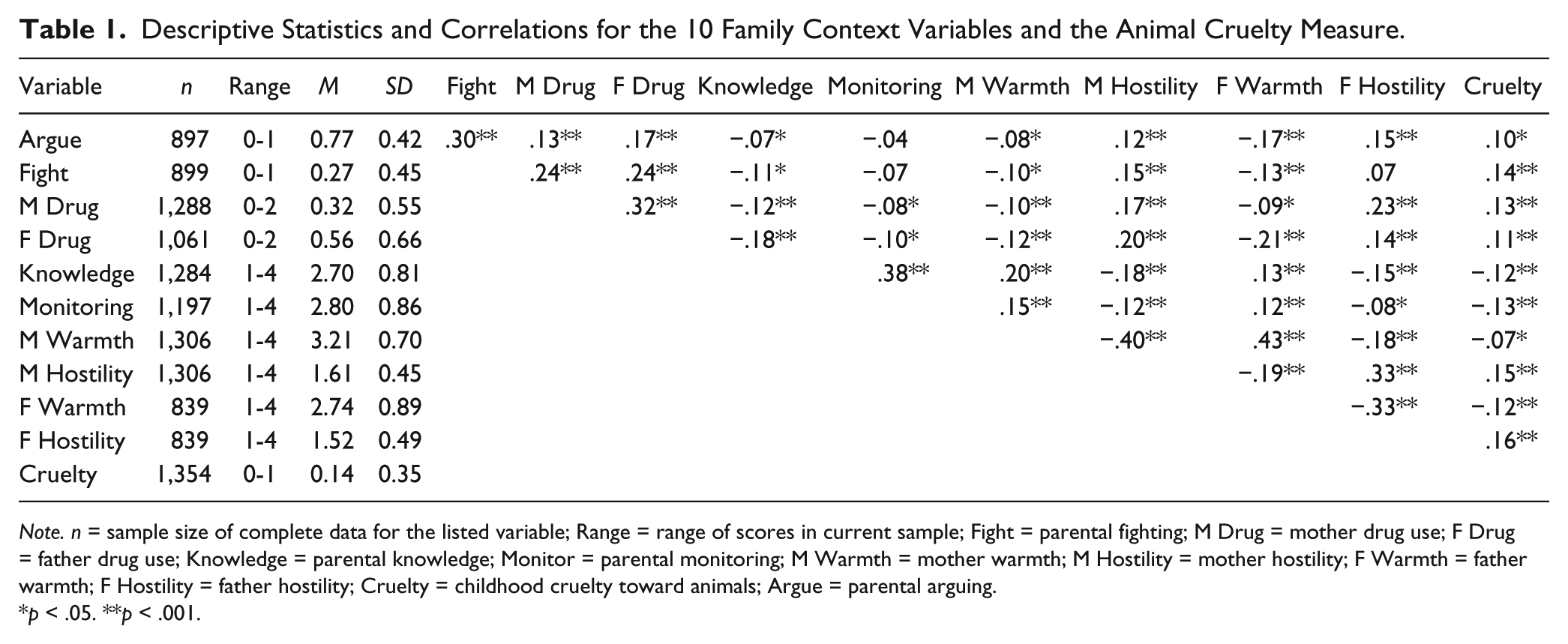
Note. n = sample size of complete data for the listed variable; Range = range of scores in current sample; Fight = parental fighting; M Drug = mother drug use; F Drug = father drug use; Knowledge = parental knowledge; Monitor = parental monitoring; M Warmth = mother warmth; M Hostility = mother hostility; F Warmth = father warmth; F Hostility = father hostility; Cruelty = childhood cruelty toward animals; Argue = parental arguing.
p < .05. **p < .001.
Descriptive Statistics and Correlations for the 10 Externalizing Variables and the Animal Cruelty Measure.
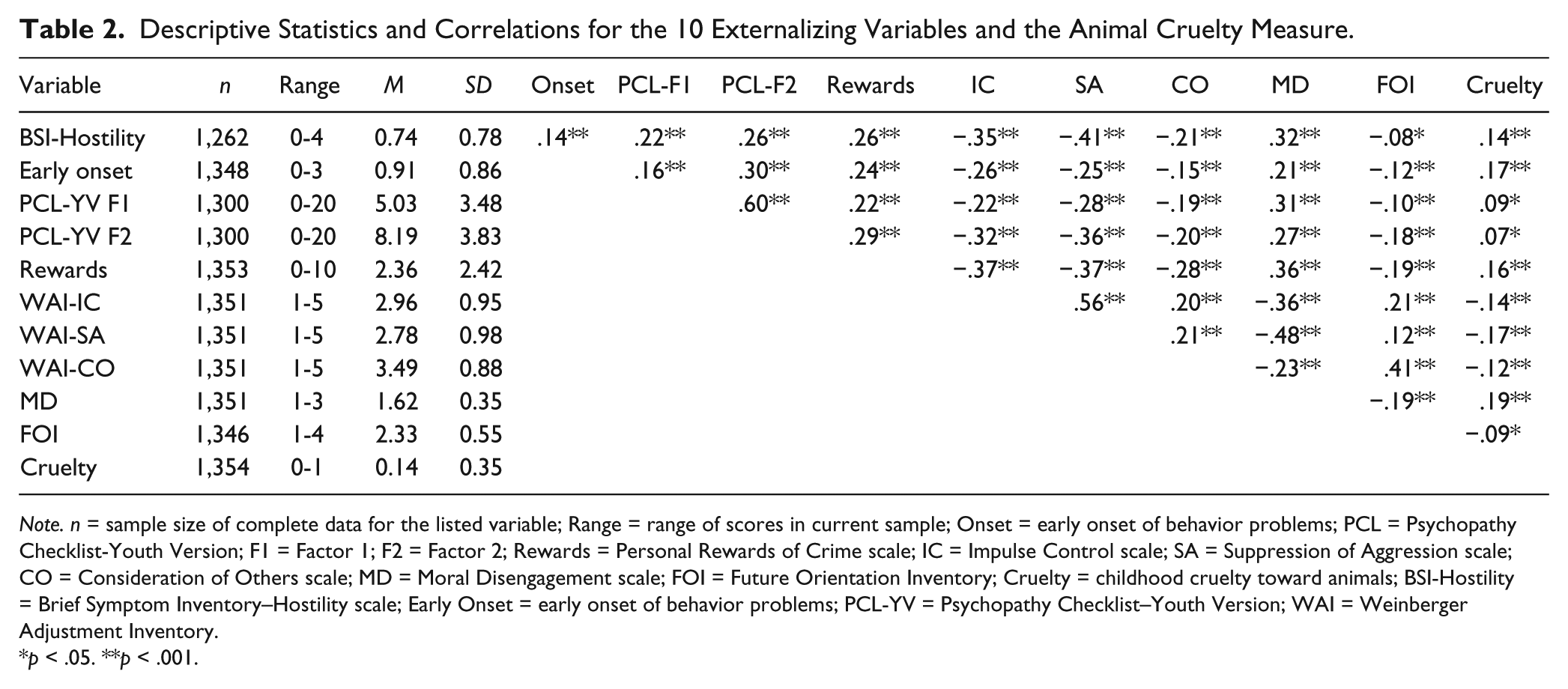
Note. n = sample size of complete data for the listed variable; Range = range of scores in current sample; Onset = early onset of behavior problems; PCL = Psychopathy Checklist-Youth Version; F1 = Factor 1; F2 = Factor 2; Rewards = Personal Rewards of Crime scale; IC = Impulse Control scale; SA = Suppression of Aggression scale; CO = Consideration of Others scale; MD = Moral Disengagement scale; FOI = Future Orientation Inventory; Cruelty = childhood cruelty toward animals; BSI-Hostility = Brief Symptom Inventory–Hostility scale; Early Onset = early onset of behavior problems; PCL-YV = Psychopathy Checklist–Youth Version; WAI = Weinberger Adjustment Inventory.
p < .05. **p < .001.
Results
Cross-Sectional Analyses
Descriptive statistics and correlations for the 10 family context variables and 10 externalizing variables are summarized in Tables 1 and 2, respectively. The final column of each table lists the correlation between animal cruelty and each of the 20 family context and externalizing variables. The first stage of the multi-stage Bonferroni procedure produced an adjusted alpha level of .0025 (.05/20 individual correlations). All but 2 of the 20 correlates achieved significance during this initial stage of the Bonferroni procedure. These two correlates (mother warmth and PCL-YV Factor 2) achieved significance during the second stage of the multi-stage Bonferroni procedure which produced an adjusted alpha level of .025 (.05/2 individual correlations).
Prospective Analyses
Regressing the summed variety scores for aggressive offending onto the childhood cruelty toward animals measure produced a significant predictive effect (t = 5.17, p < .001, β = .143[.089, .197]). Animal cruelty continued to predict aggressive offending when included in a regression equation with the 10 family context variables (see Table 3) and when included in a regression equation with the 5 reactive externalizing variables (see lower half of Table 4). However, animal cruelty failed to predict aggressive offending when included in a regression equation with the five proactive externalizing variables (see upper half of Table 4).
Family Context and Animal Cruelty as Predictors of Subsequent Aggressive Offending.
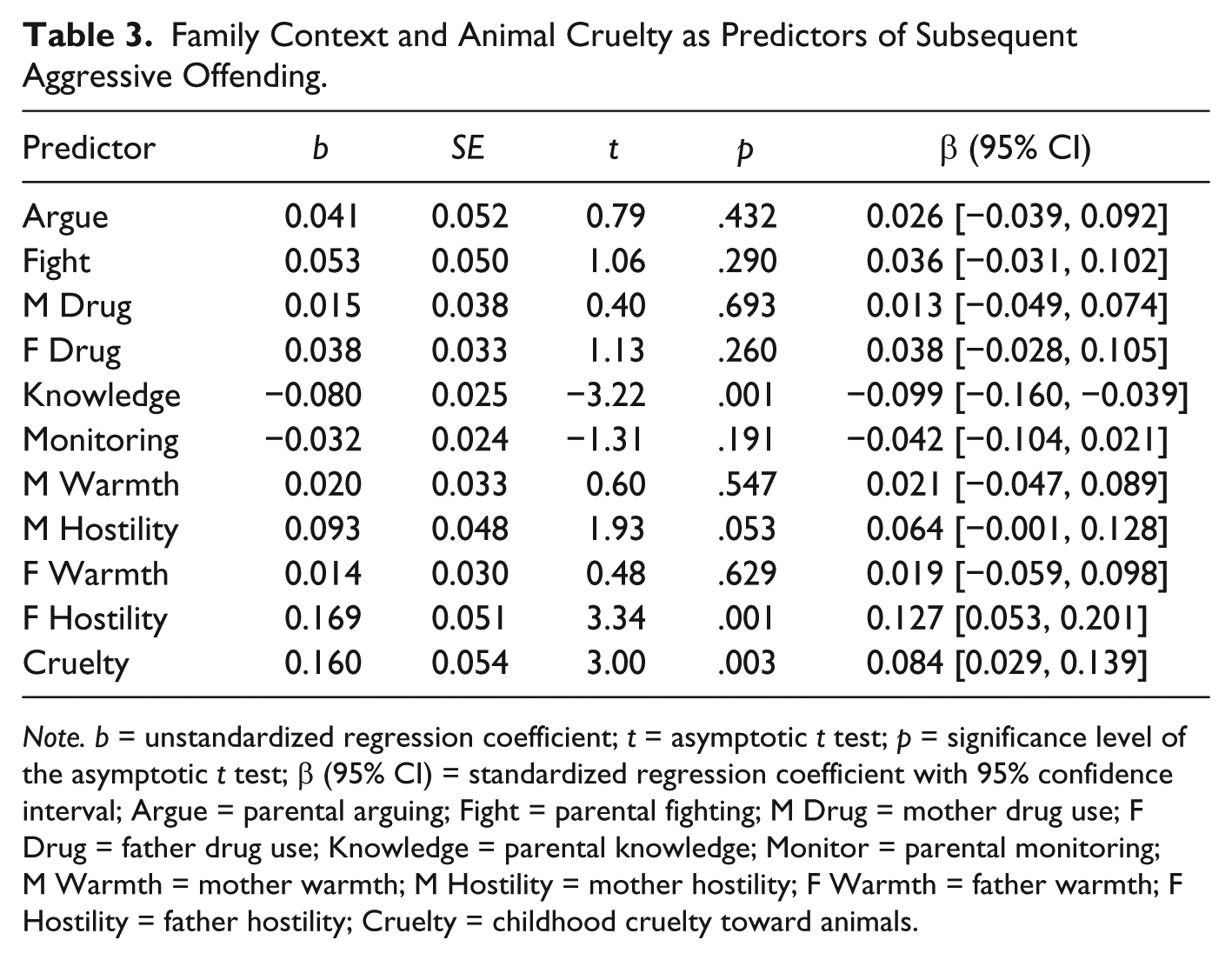
Note. b = unstandardized regression coefficient; t = asymptotic t test; p = significance level of the asymptotic t test; β (95% CI) = standardized regression coefficient with 95% confidence interval; Argue = parental arguing; Fight = parental fighting; M Drug = mother drug use; F Drug = father drug use; Knowledge = parental knowledge; Monitor = parental monitoring; M Warmth = mother warmth; M Hostility = mother hostility; F Warmth = father warmth; F Hostility = father hostility; Cruelty = childhood cruelty toward animals.
Proactive and Reactive Externalizing Behaviors and Animal Cruelty as Predictors of Subsequent Aggressive Offending.
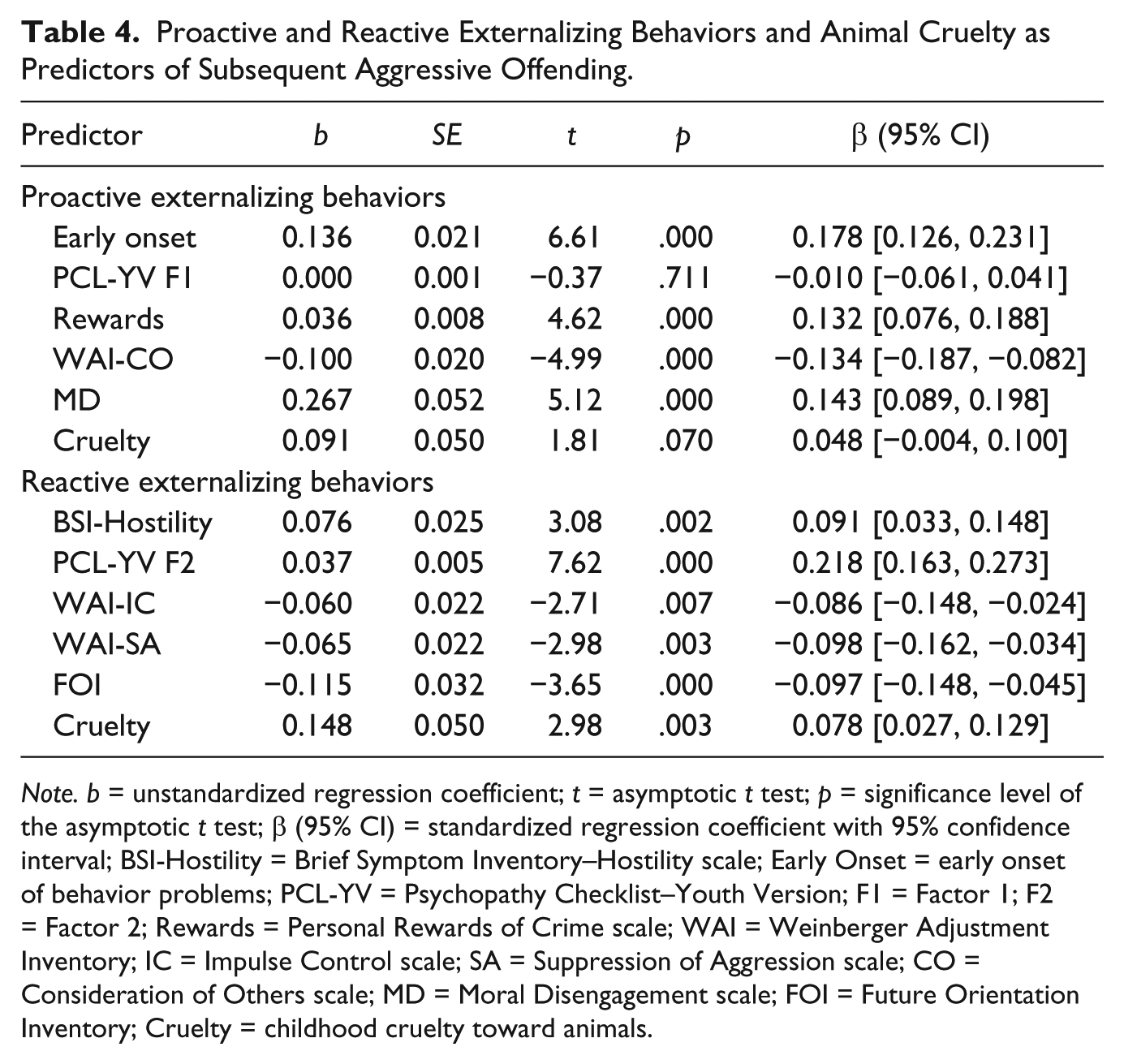
Note. b = unstandardized regression coefficient; t = asymptotic t test; p = significance level of the asymptotic t test; β (95% CI) = standardized regression coefficient with 95% confidence interval; BSI-Hostility = Brief Symptom Inventory–Hostility scale; Early Onset = early onset of behavior problems; PCL-YV = Psychopathy Checklist–Youth Version; F1 = Factor 1; F2 = Factor 2; Rewards = Personal Rewards of Crime scale; WAI = Weinberger Adjustment Inventory; IC = Impulse Control scale; SA = Suppression of Aggression scale; CO = Consideration of Others scale; MD = Moral Disengagement scale; FOI = Future Orientation Inventory; Cruelty = childhood cruelty toward animals.
Regressing the summed variety scores for income (property + drug) offending onto the childhood cruelty toward animals measure also produced a significant predictive effect (t = 4.85, p < .001, β = .135 [.081, .188]). As with the earlier results on aggressive offending, animal cruelty continued to predict income offending when included in a regression equation with the 10 family context variables (t = 2.13, p < .05, β = .059 [.005, .113]) and when included in a regression equation with the 5 reactive externalizing variables (t = 3.06, p < .01, β = .080 [.029, .132]). By contrast, animal cruelty was no longer a significant predictor of income offending when included in a regression equation with the five proactive externalizing variables (t = 1.63, p = .10, β = .043 [−.009, .096]).
Discussion
The first hypothesis tested in this study predicted that a history of animal cruelty would correlate with both environmental and personal factors. Given the prominence of family context and externalization problems in the animal cruelty literature and their availability in the Pathways to Desistance database, family context variables served as proxies for environmental factors and externalization variables served as proxies for personal factors. In testing the cross-sectional hypothesis, it was discovered that all 20 family context and externalizing variables included in this study correlated with the childhood cruelty toward animals measure. This suggests that animal cruelty is associated with a wide variety of environmental conditions and personal dispositions as represented in the current study by family context and externalization, respectively. Just knowing that animal cruelty is a correlate of family context and externalization, although interesting, does not tell us what it represents. To ascertain what animal cruelty signifies or marks, we would need to perform an analysis that contrasts alternate theoretical models using a prospective design and multiple predictor variables.
Using a prospective design and multiple predictor variables, the second hypothesis sought to determine whether animal cruelty was a marker for family context issues, proactive externalizing problems, or reactive externalizing problems. These analyses were based on the logic that a third variable (or in this case, a set of third variables) capable of eliminating the individual effect of animal cruelty on subsequent aggressive and income (property + drug) offending may offer clues as to what about animal cruelty makes it an effective marker of future offending. The results for both aggressive and income offending showed that animal cruelty achieved a significant effect when combined with the 10 family context variables and when combined with the 5 reactive externalizing variables but not when it was paired with the 5 proactive externalizing variables. This suggests that animal cruelty serves as a marker for the proactive (fearlessness) subdimension of the externalizing spectrum and earns its reputation as a predictor of future criminality by virtue of its association with behaviors that center on instrumental criminality and premeditated violence. Additional research is required to determine the direction, strength, and generalizability of these findings. In terms of direction, we need to ask whether animal cruelty precedes, follows, or co-occurs with proactive externalizing problems. In terms of strength, we need to gauge the strength of the relationship between animal cruelty and proactive externalizing behavior relative to the relationship between animal cruelty and reactive externalizing behavior. In terms of generalizability, we need to know how well these results generalize to other samples.
Beyond the direction, strength, and generalizability of the current findings, the results of this study have potentially important implications for both theory and practice. The theoretical implication of the current results is that childhood cruelty toward animals may owe its ability to predict subsequent violent and nonviolent offending to its association with variables that are part of a proactive subdimension of the externalizing spectrum. The capacity of animal cruelty to predict violent and nonviolent crime is well documented (Arluke et al., 1999; Lucia & Killias, 2011; Walters, 2014b). What the current study adds to our understanding of animal cruelty is the insight it provides on how early cruelty to animals achieves its effect on later criminality. By aligning itself with a series of variables that reflect a hostile, manipulative, calculated, and cold-blooded approach to criminal opportunities, animal cruelty is capable of predicting future offending. The proactive externalizing subdimension may be captured, to some extent, by the callous/unemotional specifier for conduct disorder diagnoses in the Diagnostic and Statistical Manual of Mental Disorders (5th ed.; DSM-V; American Psychiatric Association [APA], 2013) and the primary variant of externalization/psychopathy described by Kahn and colleagues (2013).
The current results also have implications for psychiatric diagnosis. Animal cruelty is 1 of 15 criteria used to diagnose conduct disorder in children and juveniles and the presence of conduct disorder before age 15 is a prerequisite for an antisocial personality disorder diagnosis in adults (APA, 2013). One of the first steps in creating a diagnosis is identifying markers (signs and symptoms) of the disorder. Results from previous research indicate that animal cruelty is a marker for conduct disorder and antisocial personality (Gleyzer, Felthous, & Holzer, 2002; Vaughn et al., 2011) and results from the current study revealed that animal cruelty is a marker for subsequent aggressive and income offending. It may be useful to group these signs and symptoms into thematically meaningful sections. According to the current results, animal cruelty may provide a better fit for the proactive subdimension of the externalizing spectrum than for the reactive subdimension of the externalizing spectrum. A third important consideration in constructing a diagnosis is determining whether the underlying disorder has a dimensional or categorical latent structure. One of the more reliable ways to determine latent structure type (dimensional vs. categorical) is with Meehl’s (1995) taxometric method (McGrath & Walters, 2012). Although conduct disorder has not been specifically studied with the taxometric method, the related constructs of juvenile psychopathy (Murrie et al., 2007) and childhood aggression (Walters, Ronen, & Rosenbaum, 2010) have been subjected to taxometric analysis, with results pointing to dimensional latent structure. What this means is that animal cruelty probably contributes to conduct disorder in additive fashion such that its presence increases the risk of future conduct problems in combination with a number of other variables.
A major limitation of this study is that animal cruelty was measured with a single dichotomous self-report item. Consequently, an individual with an extensive history of animal cruelty was classified the same as someone who engaged in a single isolated incident of cruelty. Researchers in the animal cruelty field, in fact, agree that a multi-dimensional assessment of animal cruelty, in which the reports of both the child and external observers, such as that provided by Dadds et al.’s (2004) Cruelty to Animals Inventory (CAI), is required to advance knowledge in this area of research (Ascione, 2007). Development of a more refined and comprehensive measure of animal cruelty that assesses the frequency, intensity, recurrence, motives, and onset of childhood cruelty to animals in a manner that does not rely exclusively on participant self-report would be of great value to future research in this area. It may also be productive to assess animal cruelty at its origin rather than relying on the retrospective accounts of participants who are 16 years of age, on average. Whereas the second part of this study (predicting aggressive and income offending) was prospective in nature, the first part (correlates of animal cruelty) was cross-sectional because the animal cruelty measure and 20 family context and externalizing variables were all assessed at baseline. This makes it impossible to draw any causal inferences from the data. Proper temporal order of variables is required to determine whether animal cruelty is a cause or an effect of the family context and externalization variables examined in this study or whether all of the correlations observed in the first half of this study were the result of their common association with some third variable.
In this study, we treated animal cruelty as a marker for a larger dimension that affects subsequent offending behavior rather than as a causal agent in future aggressive and income offending. It is quite possible, however, that animal cruelty, like age of onset, has a direct effect on future offending. This is why the animal cruelty, family context, and externalizing variables need to be temporally ordered, with multiple administrations throughout childhood, to determine whether a cause-and-effect relationship exists between animal cruelty and family context or externalizing behavior. Prior research indicates that general disinhibition precedes the onset of drug use and that it is disinhibition rather than early drug use that is responsible for the subsequent externalizing behaviors commonly observed in individuals who started using drugs at an early age (McGue, Iacono, Legrand, Malone, & Elkins, 2001). It is possible, however, that early onset drug use has a more direct effect on future internalizing and externalizing problems by disrupting social relationships, stunting psychological growth, and contributing to an emergent state of cumulative disadvantage (Sampson & Laub, 1993). The same argument could be made for animal cruelty to the extent that animal cruelty could also contribute directly to social problems, interfere with psychological maturation, and desensitize an otherwise normal individual to violence cues. Such a study, though, requires temporally ordered variables and a more sophisticated measure of animal cruelty than was possible in the current study.
Footnotes
Acknowledgements
The authors would like to thank those associated with the Pathways to Desistance study for publicly releasing their data.
Declaration of Conflicting Interests
The author(s) declared no potential conflicts of interest with respect to the research, authorship, and/or publication of this article.
Funding
The author(s) received no financial support for the research, authorship, and/or publication of this article.