



Abstract
The present study enriches our knowledge on the relationship between security personnel and situational cues that may provoke aggression, such as arms and uniforms. The study examined 259 security personnel who completed an aggression questionnaire (AGQ). The study aimed (a) to compare the tendency toward aggression of security personnel who carry or do not carry arms and/or wear a uniform and (b) to compare the tendency toward aggression of men and women security personnel who carry or do not carry arms and/or wear a uniform. The findings indicated no main effect for aggression cueing classification. However, uniformed men had higher scores of physical aggression than women, and women scored significantly higher on anger than men when not carrying any aggressive cues. The findings also revealed that in general, men security personnel reported much higher physical aggression than women, while women showed slightly higher means of verbal aggression than men. The findings are discussed in light of the gender theory and research.
Security organizations are characterized by strict discipline, order, and a clear hierarchy. Each level in this hierarchy knows its tasks and the work is performed from the highest to the lowest chain of command, so that each level must obey its superiors (Smeulers, 2004). Police training continually reminds recruits that coercive power is a central feature of police life. Recruits are trained to handle a variety of offensive weapons and are taught how to disable and kill people with their bare hands (Skolnick & Fyfe, 1993). Police respond to real, potential, or perceived threats to an officer’s safety (Crank, 1998; Skolnick & Fyfe, 1993). Military experience may also involve the learning of violent and deviant behaviors. Consistent with the arguments of the social learning theory, soldiers learn violent behaviors from constantly being exposed to a culture that is manifested by violence as a means of proving masculinity (Sun, Sung, & Chu, 2007).
It should therefore come as no surprise that security personnel sometimes find it difficult to draw the line between assertiveness and aggression (Martin, 1996). Moreover, there are scholars who claim that military and police services are characterized by their negative impact on their servants. For example, military service was found to increase criminal behavior such as drug use and subsequently arrest rates over the life course (Wright, Carter, & Cullen, 2005), involvement in domestic violence (Gerlock, 2004), intimate partner violence (Marshall, Panuzio, & Taft, 2005), and risk behaviors (Benyamini & Solomon, 2005). Similarly, the use of excessive force by police is frequently discussed in the literature on policing (e.g., Brandl, Stroshine, & Frank, 2001). Abuse of force, excessive force, police brutality, and other terms describe illegitimate and illegal police acts of force (e.g., Kania & Mackey, 1977).
Literature on social forces and job-related stresses focuses mainly on police work. These studies imply that police officers experience chronic physiological arousal (Carter, 1994; Skolnick, 1966; Walker, 1999). This may account for the research on police officer attitudes that has consistently shown that officers perceive their occupation as stressful (Collins & Gibbs, 2003) and dangerous (Lennings, 1997). This is in line with findings from the National Crime Victimization Survey (Bureau of Justice Statistics, 2001), which show that being in the police force is the most dangerous occupation. Within the context of the angry aggression theory (Bernard, 1990, 1993; Ogle, Maier-Katkin, & Bernard, 1995), police forces tend to interpret a wider variety of events as threatening than other people, due to the chronic stressful environment. Because of their inability to respond to the actual sources of stress, they may tend to use extralegal force when encountering situations that engender anger (Griffin & Bernard, 2003).
Another component that may explain security forces’ aggression is their formal signs, such as carrying arms, which can be considered as situational aggression cues, thus enhancing the probability of aggressive behavior. According to Berkowitz (1982, 1983), aggression that is exhibited by an angry person contains a strong impulsive component. It is thus most likely to be exhibited in situations with minimal cognitive inhibitory restraints. An environmental cue, for example, the presence of a gun, may automatically trigger aggressive thoughts and actions and may thus increase the level of impulsively expressed aggression. It has also been found that aggressive cues, such as weapons, lead to greater aggression among men than among women (Frodi, Macaulay, & Thome, 1977).
The presence of a uniform may also serve as a situational aggression cue, thus increasing the probability of aggressive behavior. Zimbardo’s (1971) Stanford prison experiment supports this contention by showing how college students who were randomly recruited to serve as “guards” dehumanized those chosen to serve as “prisoners,” while humiliating and tyrannizing them. Each group in this experiment was asked to wear a uniform, which enhanced their sense of anonymity and increased the probability of aggressive behavior. In another research, Zimbardo (1969) had participants wear large laboratory coats and hoods over their heads to increase anonymity. He then measured the intensity of the electric shocks they delivered as punishment to another “participant” (Zimbardo’s accomplice). The participants tended to release more aggression toward out-group individuals than toward a control group that wore ordinary clothes and name tags. These results are consistent with further research showing the same tendency (e.g., Rehm, Steinleitner, & Lilli, 1987; Silke, 2003). According to these findings, the anonymous group delivered more shocks than a nonanonymous control group. These experiments show how a uniform may increase people’s sense of anonymity, which lessens their sense of self-criticism and makes it easier for them to cast aside inhibitions and release aggressions. Although security personnel are surrounded by situational aggression cues, this issue has not been studied to date.
Security personnel may be exposed to large-scale situational aggression cues, especially in countries involved in conflicts and wars. Israel has become a “stress laboratory” for the study of war- and terror-related stress, due to its long-standing political and security situation. The Israeli population has been exposed to chronic terror attacks, for example, during the Palestinian Al-Aqsa Intifada (uprising). According to the Israel Security Agency (2014), Israelis were exposed to more than 20,000 terrorist attacks between 2000 and 2009, including shootings and suicide bomb attacks on buses and in markets, shops, and discotheques. During that period, more than 0.1% of the population was injured (physically and/or mentally) or killed. Attacks were carried out in major cities such as Tel Aviv, Jerusalem, and Haifa, as well as in rural areas. Such chronic stress associated with such a conflict could in turn lead, specifically in Israeli society, to problems of aggression (Baker, 1990).
Israel invests an enormous portion of its economic budget (about 15%) in security by, for example, recruiting thousands of police and military forces every year to cope with the threat of terror and other felonies. The security forces’ missions constantly involve them in situations in which they need to exhibit aggressive behavior. Israel is the only country in the world that recruits both men and women to military service. National military service in Israel is mandatory for all Israeli citizens older than 18 years of age. Men serve 3 years and women serve 2 years, and some of them develop a career as professional soldiers. In the police, between 10% and 20% of the manpower are women (The Association for Civil Rights in Israel, 1997). This is similar to other countries (Brown, 1997; Brown & Heidensohn, 2000).
Studies on gender differences and aggression among security personnel have focused mainly on police personnel. Policewomen were found to be much less likely to use extreme controlling behavior, such as physical restraint, than policemen (Garner & Maxwell, 2002; Schuck & Rabe-Hemp, 2005). This is compatible with the argument that policewomen do not possess the necessary masculine traits of aggressiveness required of good cops to fight crime and apprehend the enemy (Miller, 1999). When trying to explain this gender difference, scholars argued that policewomen “are less prone to fantasies of absolute authority” (Buchanan, 1968, p. 62) and do not expect deference from citizens (Black, 1980; Schuck & Rabe-Hemp, 2005), whereas policemen feel more compelled to act aggressively when disrespected by citizens. Based on the ethic of care theory, other scholars asserted that policewomen may not be as comfortable as policemen in exhibiting very forceful behaviors. Physically forceful behaviors are incongruous with empathy and negotiation. This may explain the fact that policewomen rely on less forceful behaviors, for example, advice and commands (Rabe-Hemp, 2008). This is in line with the argument that women’s socialization into nurturing roles and early experiences as caregivers may predispose them toward a broader conception of the police role, with less emphasis on crime control and more on order maintenance or social support functions (Worden, 1993).
The Present Study
To the best of our knowledge, the present study is the first to date that provides an opportunity to enrich our knowledge on the relationship between security personnel and situational cues that may provoke aggression. Based on the above information, the current study aims (a) to compare the tendency toward aggression of security personnel who carry and do not carry arms and/or wear a uniform, which are regarded as situational cues that may provoke aggression; and (b) to compare the tendency toward aggression of men and women security personnel who carry and do not carry arms and/or wear a uniform. The hypotheses were as follows:
Method
Participants
The sample included 259 security personnel, including police (n = 138, 38% female) and military personnel (n = 121, 36% female). The groups did not differ significantly in sociodemographic measures (gender, age, education, and family status). Their age ranged from 20 to 52 (M = 29.15, SD = 4.35), and their mean education level was above high school level (M = 13.69, SD = 2.20). Most participants reported being married (114; 44.01%) or living in a couple relationship (85; 32.82%). The rest reported being either bachelors (49; 18.92%) or divorcees (11; 4.25%). The total sample was divided into four groups, based on whether they wore uniforms and whether they carried arms, as follows: (a) both armed and uniformed (n = 67; 23 women); (b) armed (n = 68; 22 women); (c) uniformed (n = 70; 32 women); and (d) unarmed and nonuniformed (n = 54; 19 women).
Measures
The Aggression Questionnaire (AGQ)
This questionnaire (Buss & Perry, 1992) was translated into Hebrew by Zomer (2002). The aim of this inventory is to self-assess the various components of violence. The questionnaire consists of 29 items, which represent four factors of violent behavior: Physical aggression, 9 items, (e.g., “I have become so mad that I have broken things”), verbal aggression, 5 items (e.g., “I can’t help getting into arguments when people disagree with me”), anger, 7 items (“When frustrated, I let my irritation show”), and hostility, 8 items (“I am sometimes eaten up with jealousy”). The respondent is asked to evaluate each item using a 6-point Likert-type scale, ranging from 1 (completely disagree) to 6 (completely agree). The higher the score, the higher is the level of the individual’s violence. This questionnaire shows good internal consistencies (e.g., Morales-Vives & Vigil-Colet, 2010) also in Hebrew (Zomer, 2002). Cronbach’s alphas in the current study were as follows: physical aggression, α = .75, verbal aggression, α = .59, anger, α = .81, and hostility, α = .74.
Demographic information
Measures included demographic questions referring to the participants’ gender, age, socioeconomic and marital status, and formal education. This questionnaire included the following questions to determine whether the respondents did or did not carry arms and/or wear uniforms (situational cues): “Do you wear uniform on duty?” (1 = always, 2 = usually, 3 = rarely) and “Do you carry arms on duty?” (1 = always, 2 = usually, 3 = rarely). Participants who carried arms and/or wore uniforms “always” or “usually” were categorized as “armed and uniformed,” “armed,” or “uniformed” groups, and those who responded to both questions with the answer “rarely” were considered as the “unarmed and nonuniformed” group.
Procedure
Participation was on a voluntary basis. The questionnaires were delivered in a random order. The participants were recruited by research assistants from the Israeli police, the Israeli Defence Forces, or at Bar-Ilan University, where they studied in a program designed especially for security personnel. Those who agreed to participate (12 refused) signed an informed consent form and answered the questionnaires anonymously. The procedure took about 15 min. The study was approved by the Bar-Ilan University Institutional Review Board and the participants were guaranteed complete anonymity.
Results
Hypothesis 1 was that participants who carry more formal signs that can be considered as aggression cues (i.e., both armed and uniformed) would receive higher scores of aggression compared with the other three groups: armed, uniformed, and unarmed and nonuniformed. As the second hypothesis dealt with gender, a MANOVA was conducted with aggression cueing classification (armed/uniformed/armed and uniformed/unarmed and nonuniformed) and gender as independent variables and the four subscales of aggression as dependent variables. In discordance with Hypothesis 1, there was no main effect for aggression cueing classification (ps > .05). There were two main effects for gender. Men reported much higher physical aggression than women, F(3, 255) = 14.08, p < .001,
Hypothesis 2 was that male security personnel who carry more formal signs that can be considered as aggression cues (i.e., both armed and uniformed) would receive higher scores of aggression than females in this group. In line with this hypothesis, the abovementioned main effects were qualified by two interactions of Aggression cueing classification × Gender; one for physical aggression, F(3, 255) = 2.74, p < .05,

Means of physical aggression by aggression cueing classification and gender among security personnel.
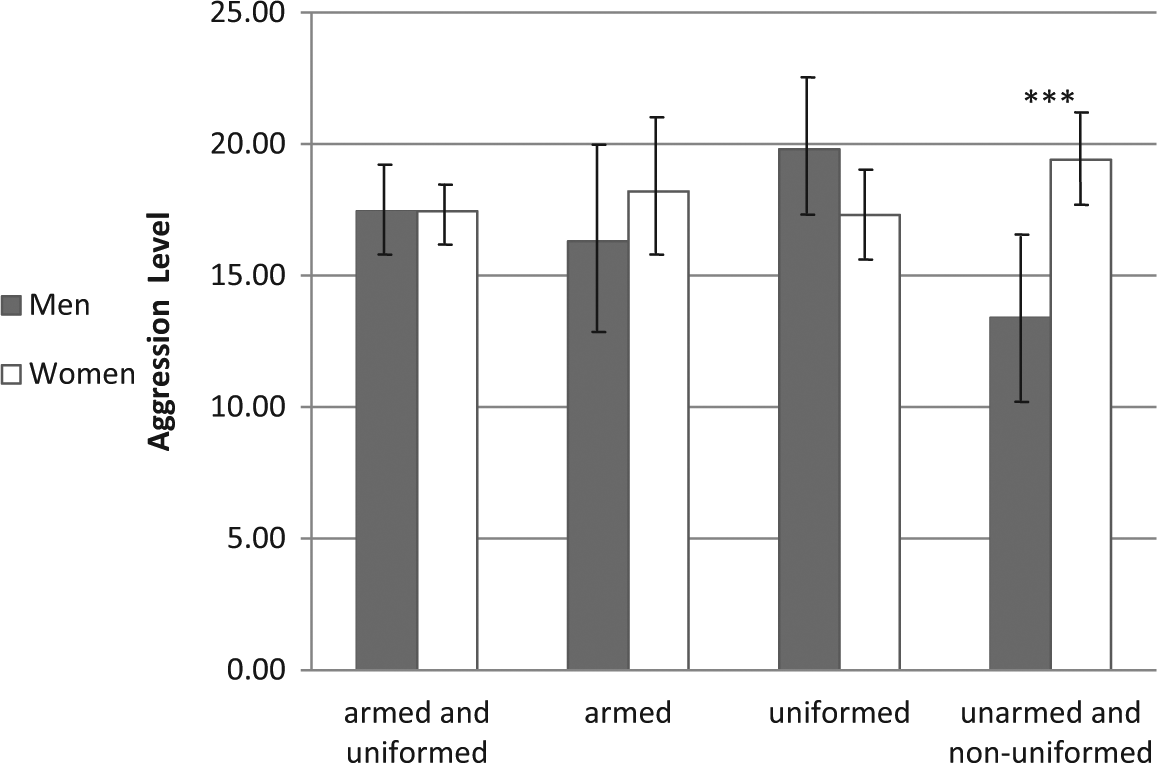
Means of anger by aggression cueing classification and gender among security personnel.
It seems that only the uniform had an impact on the differences between men and women’s scores of physical aggression. This conclusion stems from the fact that there were significant differences in physical aggression between uniformed men and uniformed women but not between armed men and armed women. Therefore, although the difference in physical aggression between uniformed and armed men and uniformed and armed women was significant, it was the uniform per se that had the main impact on the results and not the presence of a weapon.
As shown in Figure 1, men in the two groups of armed and uniformed and uniformed scored higher on physical aggression than women (M = 24.41, SD = 7.15 vs. M = 18.53, SD = 7.21, respectively, for the armed and uniformed group, and M = 25.35, SD = 8.36 vs. M = 17.74, SD = 5.06, respectively, for the uniformed group). Interestingly, as presented in Figure 2, women in the unarmed and nonuniformed group scored significantly higher on anger than men in this group (M = 13.52, SD = 3.79 vs. M = 19.41, SD = 6.77, respectively).
Discussion
The goal of the present study was to enrich the knowledge on the relationship between security personnel and aggression cues. The first hypothesis was that security personnel who are both armed and uniformed will receive higher scores of aggression compared with the following three groups: only armed, only uniformed, and unarmed and nonuniformed. In discordance with the hypothesis, no main effect was found for aggression cueing classification. However, significant findings stemming from the second hypothesis may clarify the picture.
The second hypothesis was that men security personnel who are both armed and uniformed will receive higher scores of aggression than women in this group. This hypothesis was based on previous findings showing that aggressive cues, such as weapons, lead to greater aggression among men than among women (Frodi et al., 1977) and on studies in which female security personnel were found to be much less likely to use extreme controlling behavior, such as physical restraint, relative to male security personnel (e.g., Schuck & Rabe-Hemp, 2005). The findings show that the main impact on the results was that of uniformed men who had higher scores of physical aggression than women. This means that wearing a uniform is associated with a gender difference as an aggressive cue, whereas carrying a firearm is not. This is in disagreement with a former finding showing that weapons lead to greater aggression among men and to less aggression among women (Frodi et al., 1977). However, the present study examined this issue among security personnel who are used to seeing and handling weapons and such an aggressive cue may therefore not affect men and women differently.
In line with our hypothesis mentioned above, a gender difference was found with reference to the uniform. The literature on policewomen’s views regarding uniforms is scarce. A search revealed only one such study, which briefly addressed this issue. Morash and Haarr (1995) found that security uniforms are better fitted to men’s physique, and women are troubled by the failure of the uniform to fit their physique. Morash and Haarr (1995) mentioned this as a very short example in their report of in-depth interviews with policewomen; unfortunately, they did not elaborate on this point. However, it may help explain the different concerns of male and female security personnel regarding uniforms. It suggests that women security personnel may perceive the uniform more as a clothing item that should meet societal expectations or norms for stereotypically feminine behaviors, rather than as a masculine object that may assist them in establishing authoritativeness and aggressiveness. This explanation is in accordance with scholars who assert that policewomen lack the authoritative presence to adequately deal with aggressive citizens (Balkin, 1988; Belknap, 1996; Bell, 1982; Remmington, 1981). However, it has not been proven that reluctance to use extreme controlling behaviors leads to negative outcomes. On the contrary, it has been reported that increased injury of citizens and police officers was associated with the use of excessive force, rather than with the use of too little force (Schuck & Rabe-Hemp, 2005) and that the underutilization of force by female officers may produce safer encounters between them and the citizens they encounter (Rabe-Hemp, 2008). These results support the assertion made by Lonsway, Wood, and Spillar (2002) that hiring more female officers might help reduce incidents of excessive use of force by the police.
The present study revealed that the absence of aggressive cues (the unarmed and nonuniformed group) was associated with significantly higher scores on anger among women compared with men. This gender difference is not in accordance with studies that show the absence of a gender difference in experienced anger (Archer, 2004; Fischer et al., 1993; Suter, Byrne, Byrne, Howells, & Day, 2002). However, it is possible that women security personnel face specific difficulties in maintaining the societal roles defined for both police officers and women (Rabe-Hemp, 2008). Influenced by the gender stereotype associating anger with men (Plant, Hyde, Keltner, & Devine, 2000), women may be drawn to the masculine occupation of security organizations to escape the societal expectations or norms for stereotypically feminine behaviors (Parsons & Jesilow, 2001). Perhaps, security organizations provide an opportunity for women to express anger as a characteristic that is stereotypically associated with masculine behavior (Rabe-Hemp, 2008). It should be noted that this gender difference relates to security personnel who were unarmed and nonuniformed. Such a situation, which does not provide the women with an exterior expression of their professional identity, may increase their need to express a masculine behavior such as anger.
Two main effects for the whole sample were found for gender. On one hand, men reported much higher physical aggression than women, on the other hand, women showed slightly higher means of verbal aggression than men. This pattern of aggression confirms past literature, which shows that men are, in general, more likely to engage in physical aggression than women (Archer, 2004) and women engage in verbal aggression more than men (Kuschel, 1992). These findings for security personnel are in line with the contention that policewomen usually exhibit a style of controlling citizen behaviors, which involves fewer physical behaviors and more verbal and psychological behaviors than policemen (Rabe-Hemp, 2008).
Although this study advances current knowledge on situational aggression cues among security personnel and its impact on their aggression, it does have a few limitations. First, the participants filled the questionnaires in their working places or at the university. This means that they may have worn different clothing or went with or without arms when at work and at the university. Although Buss and Perry’s (1992) AGQ does not measure the state of anger, the different environments may have had an impact on the findings. Second, it is possible that security personnel carry arms covertly, and this might have an impact on their feelings when encountering citizens. Unfortunately, the demographic questionnaire did not differentiate between security personnel who did or did not carry arms covertly. This limitation is also related to the absence of any experimental manipulation of the situational cues. When investigating aggression cues, it seems most effective to examine their effect in a laboratory environment, where all variables can be controlled. This should be investigated in future studies. Moreover, because Israel is a country continuously involved in conflicts and wars, future studies should compare the current findings with other countries. Last, the categorization of the four groups in this study (armed, uniformed, armed and uniformed, unarmed and nonuniformed) was made retroactively, based on the demographic questionnaire. This means that the sample was not representative, and therefore the possibility of generalizing the results is limited. Future studies should address this point, as well.
The current study suggests that the mere way in which security personnel are usually dressed in their workplace may be associated with their aggressive behavior. Specifically, it was found that uniformed men security personnel exhibit more physical aggression than women and that nonuniformed and unarmed women security personnel exhibit more anger than men. These findings may be valuable for security organizations when considering placing their members in different tasks. Moreover, the findings may assist security organizations in their endeavor to decrease their members’ aggressive behavior.
Footnotes
Declaration of Conflicting Interests
The author(s) declared no potential conflicts of interest with respect to the research, authorship, and/or publication of this article.
Funding
The author(s) disclosed receipt of the following financial support for the research, authorship, and/or publication of this article. The author thanks the Schnitzer Foundation for Research on the Israeli Economy and Society for supporting this research.