



Abstract
There is wide variation in how exposure to violence is conceptualized. Perceptions of ordinary violence are linked to people’s actual experiences, which may be direct, indirect, observed, or vicarious, and all through filters of gender, class, community, and culture. Event-recall interviews were conducted among a convenience sample of Swedish males (n = 132) and females (n = 202) aged 6 to 45 years. Respondents spontaneously recalled 703 events (averaging 2.3 events for males, 2.1 for females). For men, 93% of events were male(s)-on-male(s), 2% female-on-female, and 2% male(s)-on-female(s). For women, 42% of events were male(s)-on-male(s), 19% female(s)-on-female(s), 24% male(s)-on-females, and 10% female(s)-on-male(s). Interviewee’s roles differed. Of males, 17% were aggressors, 40% victims, and 43% observers. Of females, 12% were aggressors, 30% victims, and 58% observers. For males, there was a significant increase in degree of seriousness of events from junior-, to high school, to college. For females, events became more serious as interviewees progressed from aggressor to victim to observer. For males, violent events between strangers were significantly more serious than all other combinations of acquaintanceship. Most recently recalled events were the most serious for males (no effect for females). Participation in sports was linked to seriousness of events recalled by females, events being described as more serious by females who participated in sports, this effect being stronger for those females who participated in contact/collision and self-defense sports. The significant correlation between trauma and seriousness is nearly twice as strong for females which might be taken as an indication of stronger moral pathos.
Introduction
Most studies of violence deal with the phenomenon as an exceptional, deviant, pathological, or criminal event. The World Health Organization’s seminal World report on violence and health (Krug, Mercy, Dahlberg, & Zwi, 2002) deals with exceptional violence under headings such as “Child abuse,” “Collective violence,” “Elder abuse,” “Intimate partner violence,” “Self-directed violence,” “Sexual violence,” and “Youth violence.”
Case studies of exceptional violence usually involve clinical settings where interviews are used to uncover, for example, child sexual abuse (Levy, Markovic, Kalinowski, Ahart, & Torres, 1995), to investigate early family experiences of boys who later emerged as aggressive bullies or aggressive victims (Schwartz & Dodge, 1997), or, using qualitative content analysis, to explore how women’s vulnerabilities relate to their decisions to stay in their abusive relationships (Few & Rosen, 2005).
In a Scandinavian context, Flinck, Paavilainen, and Astedt-Kurki (2005) used loosely formulated open-ended interviews with seven battered women to describe women’s experiences of intimate partner violence and found that different forms of partner violence were interlinked.
Testa, Livingston, and VanZile-Tamsen (2011) discuss the importance of using mixed methods in advancing the study of violence. They integrated semi-structured interviews and qualitative analysis into a quantitative research program on women’s sexual victimization.
A similar approach by Lockwood (1997) used open-ended interviews to study violent incidents among school pupils (70 boys and 40 girls). The interviews yielded 250 incidents (2.3 events per interviewee, similar numbers for boys and girls), almost all of which (90%) occurred within 12 months of the interview. Interview content was converted to a quantitative database to enable event-level analysis. Incidents were analyzed for sequences of common events and each move in overall transactions was grouped to reveal typical patterns. Lockwood developed a scale of “least serious” to “most serious,” from kicking, hitting with a fist, to hitting with an object, to threatening with a gun or knife, to using a gun or knife. Lockwood found differences in the gender compositions of combatants. Boys tended to fight mainly with other boys, whereas girls were involved in almost as many fights with boys as with other girls. Only about half of the incidents came to the attention of adults. Peers, made up largely of friends and relatives, were present in about 60% of the incidents.
The goal of the present study was to replicate and extend Lockwood’s strategy for a sample of Swedish children, youths, and young adults. The aim was to generate a quantitative database of incidents of ordinary violence, using a structured key-event-recall interview with a target number of 300 Swedes, and to use incident-level analysis to search for patterns in experiences of violence.
Operationalizing “Ordinary Violence”
Research literature on violence is remarkably void of serious study of ordinary people’s actual experiences of everyday violence.
D’Cruze (2000), in Everyday Violence in Britain, 1850-1950, explored the small-scale, interpersonal violence that “eventuates out of people’s ordinary, routine and mundane social interaction” (p. 12) by locating such violence in familiar places such as “the home and the neighborhood, the pub or the workplace; the street or back yard” (p. 11). She could have included the school.
In the executive summary of their Framework for Interpersonal Violence Prevention, Butchart, Cerdá, Villaveces, and Sminkey (2002) outline a definition of interpersonal violence as “ordinary, everyday violence against children and women and the elderly, among young men in urban settings, and within institutions, including schools and workplaces” (p. 2). Scheper-Hughes (1992) invokes a notion of everyday, routine, or normalized violence that does not often appear within the ambit of research on violence because it does not fall within categories of law that are considered illegal. Howard et al. (2010) have remarked on the wide variation in how exposure to violence is conceptualized which leads to variability in how these constructs are measured. Kuwee Kumsa, Ng, Chambon, Maiter, and Yan (2013) contend “that subtle and blatant, ordinary and extraordinary forms of violence are inseparably related” (p. 851). Large and Nielssen (2011) defined less serious as physical violence against objects and assault not causing physical injury and more serious violence, along lines suggested by a violence risk assessment, as assault causing any degree of injury, any use of a weapon, or any sexual assault. Severe violence was defined as violence resulting in serious injury that required treatment in hospital or resulted in permanent physical harm to the victim (Large & Nielssen, 2011).
Straus (1983) was one of the first researchers to develop an index of ‘Ordinary Violence’ (his italics). He used his own Conflict Tactics Scale to separate “pushing, slapping, and throwing things” (i.e., ordinary violence) from the “more serious acts of violence listed in the Conflict Tactics Scale.” He found a clear link between violence that “is normatively legitimate (as in the case of physical punishment)” and “illegitimate (violence; as in the case of child abuse and wife-beating)” (Straus, 1983). McGoldrick (2002) wrote of a culture of “everyday violence” where “violence is a part of so many people’s everyday lives” and thus finds its way into the therapist’s office.
Wikström (1985), in his PhD thesis Everyday Violence in Contemporary Sweden, explored violent crime from situational and ecological perspectives, describing temporal patterns of urban–rural, interurban, and intraurban variation. A contemporary account by Ring (2013) examined trends in self-reported experience of crime in cohorts of Swedish 9th graders spanning 17 years (1995-2011). Taking bullying as an example of more everyday violence, Ring reported that proportions of boys and girls “never” having been bullied rose from 62% to 70% for boys and from 61% to 65% for girls. Violence among boys as victims (using a total index) had reduced from 32% to 24%, whereas girls as victims showed no change, stagnant at 21%.
Finally, Larsson and Gill (2013) used content analysis to explore lay or ordinary people’s definitions of violence (using the same participants as in the present study) and were able to show that this sample of Swedes conceived of violence as a behavior that is physical, immediate, and interpersonal.
Gender and Sports Participation as Context
Contextualization “is a precondition (to developing) counteraction, effective remedies and adequate prevention measures” (Ramberg, 2003, p. 5). This symposium, on youth policy responses to everyday violence, also noted how, “given the structurally based differences between the sexes, it is essential to have a consistent gender perspective when treating a topic such as violence” (Ramberg, 2003, p. 27). Klein (2006) in describing “an invisible problem,” namely, “everyday violence against girls in schools” concludes that “we now understand how normal, everyday dynamics based on typical gender role expectations can incite violence” (pp. 167-168) and how “violence becomes normalized “in the everyday performance of . . . gender identity” (p. 152).
Killias and Rabasa (1997) assessed the role of physical fitness and weapons in the genesis of violent behavior. They used self-report data from a national random sample of 513 Swiss male juveniles aged 14 to 21. They concluded that weapons and athletic constitution are related to violence and that violent juveniles have a high chance of being victims of violence. They described a “syndrome of violent involvement” where instrumental factors (such as weapons) contribute to the establishment and perpetuation of a “spiral of violence.”
Kreager (2007), wondering whether athletic involvement would inhibit male violence, found, on the contrary, a strong relationship between contact sports and violence, where footballers and wrestlers, compared with participants in baseball, basketball, tennis, and other athletes, were more likely than non-athletic males to be involved in a serious fight. He also found that males whose friends play football (American) were more likely to fight than other males.
Exposure to Violence
Estimating exposure to violence is inexorably linked to how the behavior is defined and categorized. Marcus (2005) considers that the most important discoveries “about youth violence over the past 20 years have been those related to the prevalence of it in their daily lives and close relationships” (p. 442). He argues that the group most vulnerable to violence is youth and that “in any given year, one third will physically fight with peers, more than one third physically fight with dating partners, and a majority of those who fight with either peers or partners will repeat this at least one more time” (Marcus, 2005, p. 442). Roberts, Gilman, Breslau, Breslau, and Koenen (2011) found that lifetime prevalence for exposure to “any assaultive violence” averaged about 26% in a representative sample of the U.S. civilians. Finkelhor, Turner, Hamby, and Ormrod (2011) found that the median number of lifetime exposures to violence (among victims of violence) was three events and that 49% of children and youth surveyed suffered two or more types of victimization (including both direct and indirect victimizations) in the past year. They also discovered that 72% of these children would qualify as lifetime poly-victims where a cutoff of 11 or more lifetime exposures to violence was used (Finkelhor et al., 2011).
In regard to a link between trauma and exposure to violence, Hickman et al. (2013) found that poly-victimization (defined as exposure to broad categories of violence rather than to specific types) was a consistently important predictor of trauma and stress. They suggested that neither total lifetime exposure nor any particular category of exposure to violence, after controlling for poly-victimization, was a strong predictor of post-traumatic stress disorder (PTSD) symptoms, with the single exception of sexual abuse. Zona and Milan (2011), in a longitudinal study of adolescents (aged 14 at Time1 and 17 at Time2), found that exposure to violence predicted increases in all types of symptoms. At Age 17, 85% of their sample reported witnessing at least 1 of 9 different violent acts over the previous year, and 30% reported being the victim of at least 1 of 5 violent acts. Stickley and Carlson (2010), in a random national sample of 30,000 Swedes aged 16 to 84 years, found that 3% had experienced physical violence between 2004 and 2007 (3.7% for men, 2.4% for women) with the prevalence being considerably higher for those aged 29 and below. They argued that being exposed to potentially traumatic events may result in gender-specific pathways to trauma-related psychopathology (Stickley & Carlson, 2010).
Thus, we can expect that ordinary Swedes, living in a relatively non-violent society, ought to be able to recall some incident, perhaps incidents, of everyday violence. The research question is not to estimate prevalence but to search for patterns, at incident level, in a pool of spontaneous retrospective reports of experiences of ordinary violence elicited through a series of event-recall interviews.
Method
Event-Recall Interviews
Where quantitative experience sampling and daily diary research methods are often used to describe patterns of everyday events, they are unlikely to capture a large enough samples of rare or less common events (Fisher & To, 2012). We expected our participants to spontaneously recall, at the most, a handful of incidents of violence. Event-recall interviews are more likely to elicit spontaneous retrospective recall. Such interviews, even with children as young as 4-years-of-age, are an effective method for eliciting everyday experiences (Howie, Nash, Kurukulasuriya, & Bowman, 2012). This method may also be extended to what Wegerif et al. (2010) and Pifarré, Cobos, and Argelagós (2014) have termed key event-recall interviews. Hoffman (1989) described a structured event-recall interview, similar to Roebers and Fernandez (2002). This interview strategy is very close to the method adopted in the present study.
Reliability of Recall
Rivers (2001) explored types of personal memories, linked to temporal landmarks, recalled across an individual’s life span. Raviv et al. (2001) found children to be accurate reporters of specific events, even after a long time period, and concluded that they were able to report accurately their experiences of violence “as witnesses or victims in everyday life.” In this study, “of exposure to everyday violence,” second graders reported being victims of “everyday mild violence at home” more often than fourth graders (Raviv et al., 2001). Orbach, Lamb, La Rooy, and Pipe (2012) compared a 9-year-old witness’ and the victim’s accounts and found that the witness was a very reliable informant. Jack, Leov, and Zajac (2014) compared children, adolescents, and adults using cognitive interview instructions to elicit free-recall accounts and found that accuracy did not differ with age.
Jones and Johnston (2011) have warned that retrospective accounts may be prone to bias because of the influence of an interviewee’s affective state, though Price (2006) found little evidence for a unique effect of anxiety on recall. Nevertheless, interviewers in the present study were coached in regard to creating a relaxed atmosphere for conducting the interview.
The interview strategy used is based on the concept of retrospective self-reports and autobiographical memory. Brewin (2007), in a special issue of the journal Memory, dedicated to autobiographical memory and emotional disorder, concluded that although memories of traumatic and non-traumatic events differ substantially for clinical samples, they do not differ in healthy populations. This is important because we could not be sure of the degree to which spontaneously recalled incidents might be traumatic for interviewees. Maisto, Sobell, Cooper, and Sobell (1979) proved the reliability of retrospective self-reports whereas Jobson and O’Kearney (2006), investigating cultural differences in autobiographical memory, found no differences in memories of personal trauma. In other words, when the target event being studied can be regarded as “everyday” and the planned cohort from which informants are to be gathered can be described as “ordinary,” in the sense that they are to be selected as non-deviant or exceptional in their experiences, then autobiographical methods using self-reports are likely to paint a fairly accurate picture of lived experience.
The structured event-recall interview protocol
A dedicated retrospective self-report interview protocol was developed. The goal was to elicit spontaneous recall of incidents of everyday violence that might have occurred among “ordinary” Swedes, that is, non-clinical or deviant interviewees. The research interview was bounded by a number of parameters. One goal was to devise a retrospective self-report protocol, based on a reasonable degree of structure, which would create consistency over multiple interviewers (approximately 60 interviewers were planned to be used) and at the same time allow for an open-ended procedure. University students carried out the interviews as a voluntary assignment in a final-year course on research methods (alternative assignments for those who might have been unwilling to participate were made available but were not required). The key to structuring the interview protocol was not to devise a series of detailed questions but rather a method for rapid recording of significant details of the violent incidents recalled by interviewees. The protocol built on a notational structure based on a taxonomy of interpersonal violence devised by Gill (2000). Critical to this procedure was devising a simple and comprehensive opening question. The question needed to make clear what the interview was about but not establish an expectation on the part of the interviewee of what was expected of him or her. In addition, it was important that the interview protocol could be used with interviewees ranging in age from junior school to adulthood (see Larsson & Gill, 2013, for details of the interview procedure).
The goal of the interview was to elicit the respondent’s lived experiences (personal or vicarious) of violence. Actual incidents were the target, that is, not general memories such as “I was bullied in school” or “I was in a lot of fights in my youth.” It was more a question of tying down actual incidents such as “I remember one day when two boys tripped me on my way to the classroom” or “I was in a pub and a man pushed against me.” This had to be made clear to interviewees. Also, it was important that they did not feel under pressure to either recall specific incidents or many incidents. The first one that came to mind was the important one.
On the basis of the data produced by Lockwood (above), where in-depth interviews were used, it was assumed that three recalled events would represent a maximum of spontaneous recall for most respondents (see also Finkelhor et al., 2011). Thus, the protocol was devised to elicit and record a maximum of three events.
Ethical permissions were granted by parents under the supervision of school principals (for interviews made in schools). Schools were chosen on the basis of the student interviewers’ practicum placements. Pupils were interviewed in all 10 schools within the town catchment of about 65,000 inhabitants (the local municipality has 33 schools and a population of 100,000). Provision was made for immediate counseling assistance for interviewees in cases where traumatic aspects of recalled incidents might have warranted it. This need arose in only one case.
The interview protocol was printed in folded A5 format. The cover-page contained the opening questions. A separate booklet was used for each interview. The A5 format was chosen so that interviewers could hold the booklet in one hand. Booklets contained eight folded pages, the front cover was used as described, and the back cover was used for recording background data on each interviewee. Between the covers were six pages, two each for three possible examples of spontaneous retrospective report of incidents of violence.
The left-hand page, of each couplet, was divided into four sections, with leading questions to remind interviewers to record the general “what, how, when and where,” and perhaps “why,” of each spontaneously recalled event. The “why” of observed and even experienced events is not always obvious. The right-hand page contained an array of taxonomic categories such as time-elapsed since incident, gender of participants, numbers of participants, perceived power-imbalance between participants, participant-roles, location of event, and so on. As part of preparation for interviewing, the final-year students had been instructed in and had time to discuss the idea of a taxonomic-based, structured research interview protocol.
After the opening statements, words, or associations had been noted, the interviewer was asked to repeat what he or she had written to confirm that the definition and/or spontaneous associations had been heard correctly. The repetition of the interviewee’s definition of violence was followed by an affirming statement. “Yes, violence can also be to use a weapon, to hit somebody, or to push somebody.” The probe-examples used in this sentence were decided as follows. A wide sample of interview protocols and questionnaires used in studying violence was gathered from international research literature (mostly in the English language). A lexicon of violence words (nouns and verbs) was devised and printed randomly on an A4 page. An interval rating scale, with the numbers 1 and 10 at each end was included under the list of words. Another class of university students (n = 29) was asked to rate the “degree of violence” inherent in each word by placing them on the scale. Assigned positions were then scored and averaged for each word and those words that occurred at the 25th (push somebody), 50th (hit somebody), and 75th (use a weapon) percentiles were used in the probe statement. This statement was repeated by all interviewers in each interview. Larsson and Gill (2013) have carried out a detailed content analysis of these spontaneous “lay definitions.”
After a first-recalled event had been described, interviewees were asked whether they could recall any other events. As each incident was being recounted, interviewers were asked to make a value-judgment, on a 3-point scale, as to the degree of trauma they felt interviewees were experiencing or expressing when recalling the event. Finally, each interviewer was asked to make a judgment about the veracity or believability of each recorded incident. The student interviewers had been coached (including carrying out pilot-interviews) for some months prior to the fieldwork. The training involved group discussions in regard to perceived trauma and judging the seriousness of recalled events.
The interview sample and incident sampling frame
The interview sample was a convenience sample based on a number of criteria. Different age groups were targeted by asking interviewers to select interviewees from different school-class cohorts in the schools to which they had been assigned for their practicum placements. Classroom teachers helped select school subjects. The target number of interviewees was about 300, that is, each interviewer was expected to carry out at least 5 interviews. Based on Lockwood’s and Finkelhor’s et al. estimates, these interviews were expected to yield about 700 incidents. Interviews with adults were based on actual street samples in the local town (population 65,000) and on corridor samples on the university campus. The final interview sample was 132 males and 202 females. Interviewees ranged in age from 6 to 45 for females (Mage = 20.7 years, SD = 8.5) and from 7 to 42 for males (Mage = 18.5, SD = 7.8). Three age subgroups were identified with age peaks at 10, 22, and 32 years for females and 10, 22, and 35 years for males with the number of older interviewees being considerably smaller.
Of 703 incidents recounted by interviewees, 99% were adjudged by interviewers to be “believable” (1% as “doubtful” or “unbelievable”).
Results
Incident-Level Analysis
Skubak Tillyer, Miller, and Tillyer (2011) are of the opinion that social processes, such as violence and victim injury, are often best studied at the event or incident level. The results presented below are based exclusively on incident-level analysis. Each incident was tagged with details about each informant. In keeping with Lockwood’s findings (above), interviewees recalled less second and third events. These are shown in Figure 1, where males and females are compared over types of incidents experienced. The major types are categorized, according to the taxonomy, as simple, cyclical, or historical events. A simple event involved an action by one person against another, without retaliation or spiraling. Cyclical events involved a cycle of reactive violence, typically, a fight or hitting back. An historical event refers to an incident of violence (simple or cyclical) where prior encounters between the protagonists are known to be part of the etiology. A spiral event refers to a cyclical event where the reactive violence is more intense than the precipitating violent event (within the same cycle). Interviewers were given a good grounding in being able to identify these different categories.
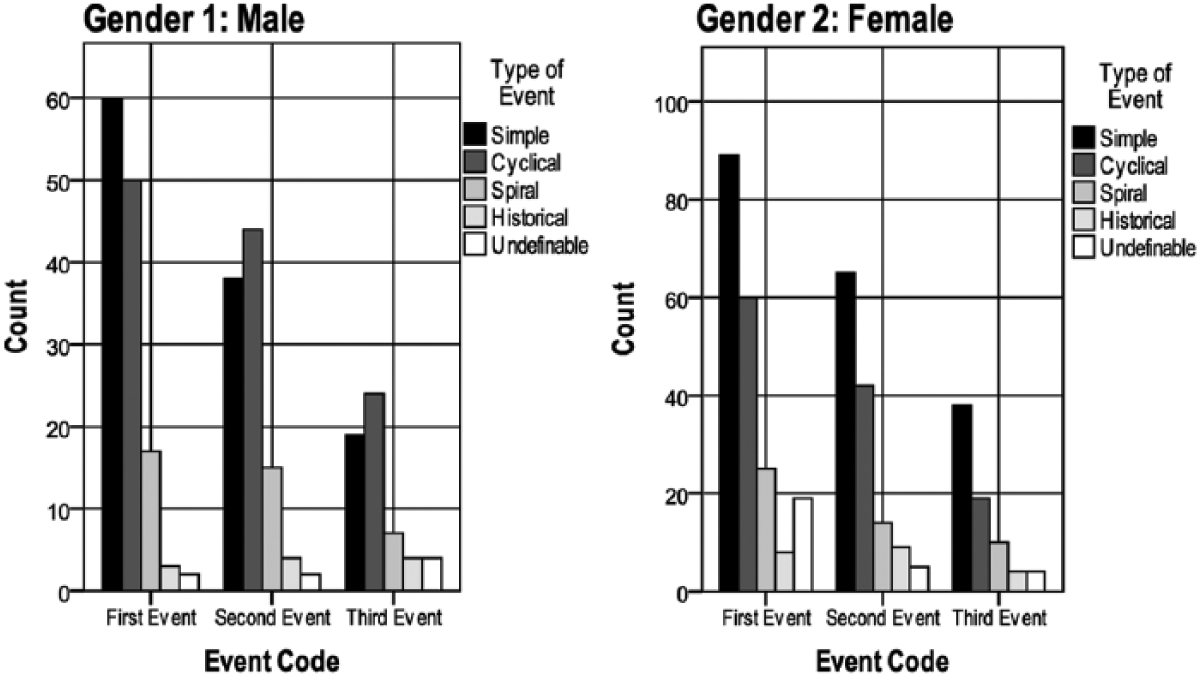
Type of event sorted after gender and sequence (raw counts).
The totals of incidents recalled, as shown in Figure 1, are by children, teenagers, and adults. One immediate gender difference is that females recalled proportionately more examples of simple violence, whereas males recalled more cyclical events and the proportion of these increased as a proportion of all second and third events. Very few events were deemed undefinable according to the taxonomic categories and very few events were noted as being historical.
Gender patterns in retrospective recall
Significant differences were found in regard to gender constellations of combatants. Events were categorized according to whether the incidents involved a male, or males, fighting with another male, or males, and others combinations of gender as indicated in Table 1, below.
Participant Constellation.

Note. The number of events in this table is less than 703 due to internal missing data.
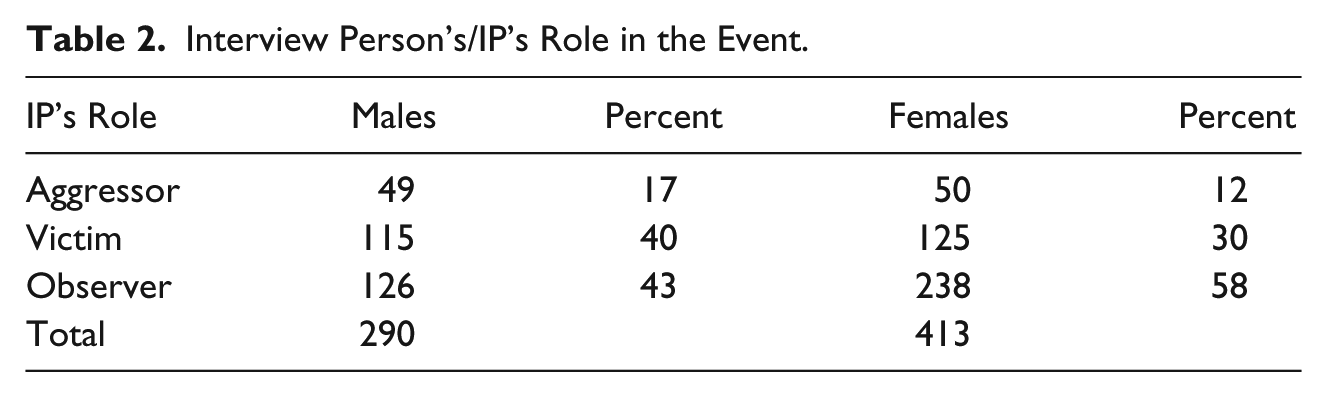
The vast majority of events recalled by males involved males, exclusively. The importance of this finding must be seen in the light of participants’ roles in the incidents recalled. Even though females recalled more events as observers (58%), a not insubstantial number of males (43%) recalled events where they had been observers rather than participants. Males, however, observed more or less exclusively male-on-male events. In other words, males, even as observers, were far more likely to be in the vicinity of males fighting males. Females, on the other hand, while recalling the majority of their events as male(s)-on-male(s) (44%), also had experience, not unexpectedly, of female(s)-on-female(s) (19%). However, the second largest category of females’ reported experience of everyday violence was of male(s)-on-female(s) (24%), an experience almost totally absent from the 292 events recalled by male interviewees.
This comparison of incidents relating to gender of actors, compared across interviewees’ gender, shows clear differences. Of recounted incidents, 67% were of male(s)-on-male(s). However, male-on-male events represented 92% of all first events recounted by males and 49% of all first events recalled by female interviewees. Although 12% of all first events were “female(s)-on-female(s),” female interviewees stood for 95% of these. Two other genderized categories of first events, where gender differences are clear, notwithstanding that these events represent a small part of the total number of events, are male(s)-on-female(s) (14% of total number of events) and female(s)-on-male(s) (5% of the total). For both these categories, female interviewees accounted for 90% and 95% of incidents, respectively. This pattern follows more or less exactly for the second and third events.
When interviewees were asked whether the events recalled were once-off occasions or whether they occurred with varying degrees of persistence (once or twice per annum, monthly, weekly, or daily), the breakdown was almost identical for males and females. About 70% of events were recounted as once-off with the rest of the events being more or less equally distributed between the other categories. For instance, 5% of males and 7% of females recounted events that occurred almost daily. In regard to time-elapsed since the recalled event (no gender difference), the tendency is for more immediate events to be recalled by younger interviewees.
Interviewees’ role in incident
Table 2 shows the differences mentioned above in males’ and females’ roles in the various incidents recalled. About 15% more females than males recounted their roles as that of observers. About 5% more males than females were categorized as aggressors.
Interview Person’s/IP’s Role in the Event.
Another gender similarity was how interviewees recalled the constellations of actors in the events. Events could be recorded as one-on-one or more-on-one and so on. Nearly 80% of all events, irrespective of whether they were recalled by males of females were recounted as one-on-one. Similar numbers were recounted for more-on-one (13% for males, 11% for females) as well as for the category more-on-more (13% for males, 7% for females).
Location of incidents and relationship between protagonists
Having in mind gender differences in whether interviewees were observers, there are interesting gender differences in terms of where the incidents took place. We can see that for males, schoolyard, the street and sporting events are locations where they experience more violence, whereas for females, the home, school classroom, and disco/concert are more common locations (see Table 3).
Location of Violent Events.

One interpretation of these differences would be that males’ experiences of violence arise in more public or open locations, whereas females’ experiences arise in more covert locations.
In regard to relationships between protagonists in the recalled incidents, there are some significant gender differences. Males experience more events where no relationship was perceived between protagonists (29% for males and 22% for females) and more events between friends and classmates (36% for males and 29% for females). Females, on the other hand, experienced significantly more events “within the family and between partners” (17% for females and 8% for males).
The seriousness and trauma of recalled incidents
The taxonomic categories allowed for the construction of an index of seriousness of each incident. Aspects such as virulence, amount of force used, whether weapons or implements were involved, were noted for each event and then used to construct a composite index of seriousness. An element of interpretation was required. To minimize bias, two judges were used and, where discrepancies arose, those events were reanalyzed and interpreted until agreement was reached. This procedure yielded an 11-point scale of seriousness with a mean value of 4.9 and standard deviation of 2.2 units in a finely rounded distribution.
The index of trauma was crude. Interviewers were asked to judge from interviewees’ retrospective recall of events whether they thought the interviewee had experienced each incident as traumatic or not, or whether they were unsure about some trauma being present in the description. This crude measure yielded a u-shaped distribution where 62% of events were judged not to be traumatic, 16% were categorized as doubtful, and 22% of events as traumatic. These categories were judged to yield an ordinal index of degree of trauma. The two index variables were used to make a more sensitive analysis of the meanings of the violent incidents.
The validity of the indices of seriousness and trauma is partly vindicated by significant positive correlations (using Spearman’s Rho) between them. There is also a significant gender difference in these correlations. Rho = 0.15 for males and 0.27 for females (both significant at p < .001). This would indicate that the link between trauma and seriousness is nearly twice as strong for females as for males, perhaps indicating a stronger moral pathos.
An expected correlation is that degree of seriousness of recalled incidents increases with the interviewee’s age. There is no gender difference here.
Comparison of degree of seriousness for event sequence, and seriousness and trauma for interviewee’s role in the event were very similar for males and females, the first-recalled event being the least serious.
In regard to interviewees’ roles in the incidents, aggressors experienced least trauma, victims most trauma, with observers somewhere in between (identical pattern for males and females).
Participant roles compared by age categories
A comparison of interviewees’ roles in each incident, compared over the crude age groupings (10-year-olds, 20-year-olds, and 30-year-olds), showed similar variations for males and females. For males, 15%, 17%, and 20%, respectively, were aggressors at junior school, junior high, and as college/adults. The percentages for females were 8%, 14%, and 13%, respectively. The only major deviation in these patterns was for more college/adult males (43%) to be victims. This meant that there were less college/adult, male observers (37%, 64% for females) and less college/adult female victims (22%).
Location and degree of seriousness of recalled incidents
Different patterns emerge when males and females are compared for degree of seriousness of incidents by location of events. For males and females, the most serious events were those observed in public places.
The next class of most serious events occurred going to and from school, that is, the “least owned” of the public spaces where school children congregate. Other locations show different experiences for males and females. Boys experience the home environs (not the home) as a location for more serious incidents, but not girls, the home environs being the place where females experience the least serious events. The home, on the other hand, is a place where females experience more serious violence than males; again this tendency is in keeping with expectations from patterns of domestic violence.
Seriousness of incidents and participation in sports
Analysis of variance was used to test for possible effects of participation in sports on the seriousness or trauma of the recounted incidents. Ninety percent of males and 84% of females indicated to interviewers that they participated in sports. The participation of males and females in types of sports classified as “team; non-contact,” “team; contact,” “self-defense,” or “individual” sports was quite different. Most males participated in team contact sports (71%, 29% for females). Three percent of males participated in self-defense sports; the number for females was 4%. Sixty-five percent of females participated in individual sports (25% for males). Very few participated in what were classified as team, non-contact sports, 0.4% for males and 2% for females. Participation in sport affected the seriousness of incidents recalled by females (participation in sport led to recalled events being more serious) with no effect for males. When type of sports participation was compared, in a one-way analysis of variance, there was no effect for males, whereas for females there was a tendency for participation in self-defense sports to increase the seriousness of the events recalled. The 11 events recalled by females who had participated in self-defense sports were the most serious of all events recounted by females. This phenomenon replicates Endresen and Olweus’ (2005) finding that participation in what they call “power or fight and strength sports” tends to increase the likelihood of violent antisocial behavior outside of sports. Their study was confined to males. This effect was not significant among the males in this study.
Discussion
The data analyzed in this study was generated through a series of open-ended structured interviews with convenience samples of “ordinary” Swedes, ordinary in the important sense that none of the individuals interviewed was drawn from deviant, pathological, or clinical samples. In addition, the interview was designed to be able to be administered to a wide age range of interviewees, in this study ages ranged from 6 to 45.
It proved difficult to find comparable studies of experience of violence in international research literature. Lockwood’s study was inspirational but targeted inner city, albeit mixed genders, of largely African American teenagers. His interview methodology, although different, generated similar types of experiences of everyday violence.
Most research into everyday violence has not been gender neutral, or even comparative. Violence and aggression studies over the last century have largely centered on boys, whether normal or deviant. Even bullying research began with an almost exclusive emphasis on male aggression. Endresen and Olweus (2005) is a typical example. In that text, they explain that “female students were not included owing to low frequency of participation in power sports” (p. 3). This means that a priori suppositions about female violence and aggression are flimsy. Studies that have had a focus on female aggression and violence have almost exclusively dealt with deviant females. Thus, in comparing males and females, it is difficult to generate expectations in any direction. The results reported here point to a number of similarities and differences, which ought to have a bearing on future research in this field.
In planning the practical implementation of data-gathering, interview protocols were printed to allow for recording of three separate events per interviewee. This restriction, based on Lockwood’s findings, proved relevant. The 334 interviewees recounted 703 incidents of violence. That males recalled more events (2.3 per male) than females (2.1 per female) did not come as a surprise. It may perhaps be surprising that females were able to recall so many events, proving that minor everyday violence is almost as much part of their world as it is of males.
However, within this world, that is, of violence that has occurred in one’s immediate vicinity, either to self, by self, or as an observed event, there are clear gender differences in the pathology of violence. The violent world of males is virtually exclusively of male origin. Males are aggressive toward males, are the victims of males and perhaps surprisingly, even as observers, observe largely male violence. On the other hand, this is what is true on a global scale. That it should also be true of ordinary Swedes, in an ordinary Swedish small town shows, perhaps, the ubiquity of the phenomenon. Nevertheless, within their male world there is little violence of females on females (2% of all recalled events) and of males on females (3% of all events). About one fifth of males admitted that, in the incidents they recounted for our interviewers, they had been the aggressors (17%). They had been victims in about two fifths (40%) and observers in two fifths of the events (43%).
The least that can be said of these females’ world of violence, however, is that it is different from men’s. Not even half of the violence they recounted was of males being violent to males (44%). In their world, one fifth of the violence, not unexpectedly, was of females on females. Whereas only a tiny minority of events described by males was of males on females, this category accounted for a quarter (24%) of the violence in the female world.
Not a single incident recalled by males was of a female or females attacking a male. This was not the case for females. In their world, a 10th (10%) of incidents was of this type—females being violent toward males.
Another difference between males and females was the ratio of aggressors, victims, and observers. Fewer females were aggressors (12%), less were victims (42%) whereas almost three fifths were observers (58%), that is, one tenth more than males.
There are other gender differences of note. For males, there was a significant increase in degree of seriousness of incidents whether they occurred within the junior school, junior high school, or adult categories. For females, events became more serious if interviewees were aggressors (less serious), or victims, or observers (most serious). In other words, the more females became removed from involvement in violence the more serious they perceived the violent incidents to be.
For males, violent events between strangers were significantly more serious than all other combinations of acquaintanceship. This is an understandable effect. Being in a fight with a stranger is likely to be more serious (either as victim or aggressor) and also more likely to be more serious if recalled as an event observed between strangers. It is difficult to explain why this effect was not visible for females.
Another phenomenon noted in males’ recollections was that the most recently recalled incidents were more serious for males (no effect for females), indicating perhaps a greater immediacy with violence than for females.
Participation in sports affected the seriousness of the violent events recalled by females, events being described as more serious by those who had participated in sports, this effect being increased by type of sport participated in. Incidents recalled by participants in self-defense sports were the most serious of all events recounted by females.
Similarities between males and females are also of particular interest. The findings that (a) seriousness increased from aggressor, to victim, to observer and that (b) trauma was greatest for victims, less for observers, and least for aggressors were identical for males and females would indicate that similar psychosocial, moral/ethical, experiential, and cultural mechanisms were involved in their perceptions. These are not gender specific, at least among this sample. There is also parity in regard to age effect, events being more serious the older the interviewee, irrespective of gender.
An important gender difference is implied in the different degrees of correlation between seriousness and perceived trauma for females and males. The fact that males recount more serious incidents as not being as traumatic as females would indicate a gender difference in what might be termed moral pathos, reflecting earlier findings by Gill (1979) in regard to gender differences in moral judgments of violence.
Limitations
The convenience sample used risked skewing the representativity of recalled events. The mechanisms that affect spontaneous recall are not well known and may vary significantly between individuals. Notwithstanding these limitations, it is moot point whether the pool of incidents generated by the interview procedure is representative of all incidents of everyday violence that might be experienced by ordinary Swedes.
Footnotes
Declaration of Conflicting Interests
The author(s) declared no potential conflicts of interest with respect to the research, authorship, and/or publication of this article.
Funding
The author(s) received no financial support for the research, authorship, and/or publication of this article other than as part of their normal duties as researching employees at the Faculty of Education and Business Studies, University of Gävle.