



Abstract
Sexual Assault Response Teams (SARTs) bring together sexual assault responders (e.g., police, prosecutors, medical/forensic examiners, rape victim advocates) to coordinate and improve the response to sexual assault. Ultimately, SARTs seek to improve sexual assault victims’ experiences of seeking help and sexual assault case outcomes in the criminal justice system. To date, there are hundreds of SARTs across the United States and yet, there has been no nationally representative study of how SARTs are implemented. Therefore, the current study used a multistep process to create the first sampling frame of SARTs and then studied how SARTs are structured and function within a random sample of SARTs. Findings reveal commonalities as well as variation across SARTs. Most SARTs rated improving legal outcomes, improving victims’ help-seeking experiences, and prevention/education as important goals, yet most prioritized their time and energy toward victims’ experiences. SARTs’ membership varied, with an average of 12 organizations involved in the SART, and 75% of SARTs having active membership from police, prosecutors, rape victim advocates, and medical/forensic examiners. SARTs were moderately formalized and most SARTs engaged in most collaborative processes (e.g., multidisciplinary cross-training, case review, policy/protocol development, and review) on an as needed basis. Finally, results revealed that some types of cross-system coordination in responding to victims/cases were quite frequent, whereas other types of coordination were quite infrequent. Implications for future research and supporting the development and sustainability of SARTs are discussed.
Sexual Assault Response Teams (SARTs) are collaborative groups that bring together multidisciplinary sexual assault stakeholders (e.g., police, prosecutors, medical/forensic examiners, rape crisis advocates) to improve the community response to sexual assault (Greeson & Campbell, 2013). SARTs are increasingly popular and are recommended for adoption by national agencies (Department of Justice, 2013; National Sexual Violence Resource Center [NSVRC], 2011). However, little is known about how these interventions are implemented in practice. The only prior national studies of SART utilized convenience sampling methods and therefore were unable to provide generalizable information about SARTs’ implementation as a field (Zajac, 2006, 2009). Therefore, the current study created the first national sampling frame of SARTs and used rigorous random sampling methods to understand how U.S. SARTs are implemented in practice.
SARTs were developed to address problems associated with the community response to sexual assault (Zajac, 2006). Such problems include low service utilization rates, negative treatment of victims by the legal and medical systems, failure to provide comprehensive medical services to victims, and low reporting and prosecution rates (for review, see Campbell, 2008). In addition, problematic relationships across sexual assault response systems were common. Lack of cross-system coordination and role confusion has led to sexual assault victims and cases “falling through the cracks” in some communities (Campbell & Ahrens, 1998; Martin, DiNitto, Byington, & Maxwell, 1992). In some instances, antagonistic cross-system relationships have resulted in interference with one another’s work in responding to victims (Martin, 2005).
To address these problems, communities developed SARTs to improve the response to sexual assault by creating positive relationships and collaboration among sexual assault responders (Zajac, 2006). Since their initial development, SARTs have spread such that there are now hundreds of teams across the United States (International Association of Forensic Nurses [IAFN], 2010) and there is considerable interest in supporting their successful implementation. However, SARTs were designed by multiple communities and disseminated in the absence of a standardized SART model. Given these conditions, it is not surprising that preliminary evidence suggests that SART implementation varies from community to community (Zajac, 2006, 2009).
While there is a vast “gray literature” based on practitioners’ experiences that provides guidelines for how SARTs should be implemented, there is limited social science empirical literature on how SARTs are actually implemented. Thus far, prior research on the structure and functioning of SARTs consists of studies of a small number of SARTs (Dandino-Abbott, 1999; Illinois Criminal Justice Information Authority, 2003; Johnston, 2005; Nugent-Borakove et al., 2006; Wilson & Klein, 2005) and two national surveys conducted by the NSVRC that utilized convenience sampling methods (Zajac, 2006, 2009). While valuable, the studies of a small number of SARTs are limited in their ability to provide insight into how SARTs generally are structured and function. Therefore, the remainder of the literature review will focus on practitioner guidelines (the gray literature) and the national studies by Zajac.
Guidelines reveal that SARTs have two primary goals: to improve the quality of victims’ experiences of seeking help (i.e., making systems more accessible and responsive to survivors) and to increase offender accountability by increasing reporting and conviction rates of sexual assault cases in the criminal justice system (NSVRC, 2011; Oregon Attorney General’s Sexual Assault Task Force [OAGSATF], 2009). SARTs may also be involved in sexual assault prevention and or community awareness activities, but this goal has received much less emphasis in the field. Research has yet to examine the prevalence and prioritization of these differences in goals across SARTs.
To achieve these goals, guidelines recommend that at a minimum, SART members include the four primary sexual assault responders (i.e., police, rape crisis center victim advocates, medical/forensic examiners, and prosecutors; OAGSATF, 2009; Pennsylvania Coalition Against Rape, 2002). However guidelines also suggest that SARTs should consider involvement from other groups that deal with sexual assault, such as the crime laboratory, local universities, and probation and parole (NSVRC, 2011; OAGSATF, 2009). Zajac’s studies found that approximately two thirds of SARTs have membership from all four of the primary response groups. The next most common members were social services and health care organizations. At present, little is known about the typical number of stakeholder groups or organizations that make up a SART.
A key dimension of SART functioning is how the SART brings these diverse groups together to work as a team. SARTs may range from informal to extremely formalized groups (NSVRC, 2011). The gray literature suggests that SARTs consider using various formal structures and resources that are frequently used in other types of collaborative groups, such as a formal leader, meeting agendas, and procedures for conflict resolution (OAGSATF, 2009). Prior empirical research examined four key structures and revealed these structures are frequently, but not universally, utilized by SARTs (regular meetings by 81%-82% SARTs; formal leader, 60%-82%; paid staff, 44%-49%; and formal funding, 61%-69%; Zajac, 2006, 2009). Other structures (e.g., bylaws, formal procedures for decision making; Allen et al., 2010; Nowell, 2006) have yet to be examined empirically within SARTs.
Practitioner writings have also recommended various collaborative processes for SARTs, including (a) the development and adoption of policies/protocols that delineate how different stakeholders groups should respond to sexual assault; (b) multidisciplinary cross-trainings in which different SART stakeholders train one another on their roles and limitations in responding to sexual assault; (c) multidisciplinary case review of sexual assault cases to review how different stakeholder groups responded to specific cases and identify areas for improvement; (d) trainings conducted by non-SART members to educate SART members about issues related to SARTs and effectively responding to sexual assault; and (e) the development or adoption of memoranda of understanding between different stakeholder groups (typically agreeing to work together collaboratively; NSVRC, 2011; OAGSATF, 2009). Zajac’s studies reveal variation in SARTs’ use of these processes in practice: 23% to 25% engaged in regular case review, 43% to 57% 1 had policies and protocols, and 64% held trainings for SART members. Other collaborative processes discussed in the gray literature have yet to be measured.
Together, the gray literature and Zajac’s studies reveal several key dimensions of SART functioning. However, empirical research in this area is limited due to the use of convenience sampling, and therefore, the field lacks a representative picture of how SARTs are implemented. This is an important research–practice gap, as governmental and non-for-profit organizations have created a variety of SART resources (e.g., guidelines, trainings, technical assistance) to help communities in creating effective SARTs (e.g., NSVRC, 2011; OAGSATF, 2009; Office for Victims of Crime [OVC], 2011; Sexual Violence Justice Institute, n.d.), and these resources have not been informed by rigorous information on how SARTs are implemented in practice. To best tailor and allocate resources to support SARTs, it is important to have an accurate understanding of the status of SARTs in the United States. Such information could ensure that resources are focused on issues that are the most salient to SARTs and the contexts they serve. Otherwise, resources that are not based on the actual status of SARTs in practice may be underutilized or ineffective.
Therefore, the purpose of the current study was to create a national sampling frame of SARTs and use random sampling methods to assess how U.S. SARTs are implemented in practice. Specifically, the current study examined SARTs’ membership, goals, use of formal structures and resources to organize their team (formalization), and their use of collaborative processes. In addition, because one of the primary goals of SARTs is to create coordination among primary sexual assault responders in responding to actual cases, the current study also examined the frequency of cross-system coordinated actions in responding to sexual assault victims and cases. Finally, to better understand the contexts in which SARTs are embedded, the study examined characteristics of the communities that SARTs serve.
Method
Sampling
The target population of this study was U.S. SARTs. At the inception of this project, there was no comprehensive list of U.S. SARTs to use as a sampling frame. Therefore, the research team developed a sampling frame through the use of five strategies. First, the research team was granted access to two national registries of organizations that are likely to participate in SARTs: IAFN’s registry of Sexual Assault Nurse Examiner (SANE) programs and SANE-SART.com’s registry of SANE-SART member organizations. Next, the research team contacted subscribers to the NSVRC’s SART list-serv. Subscribers who could be matched to a SART that was already identified were not contacted. State sexual assault coalitions were contacted to find out if they had a list of SARTs in their state. The research team also conducted a search of the academic literature and practitioner SART manuals to identify published material on existing SARTs. Finally, a Google search was conducted to identify SARTs that were promoted on the Internet. Across these methods, a total of 864 unique SARTs were identified and comprised the study’s sampling frame. Simple random sampling was used to select SARTs for recruitment until the target sample size (n = 170) was reached. To be eligible for the study, the SART had to engage in multidisciplinary coordination in the response to sexual assault and respond to adult sexual assault victims. SARTs were also required to meet as a multidisciplinary team to participate in the study, to ensure that a minimum level of collaboration was occurring among multidisciplinary stakeholders. They did not have to call themselves a SART. Out of a sampling frame of 864 teams, 268 were recruited to participate in the study. Of the 268 that were recruited, 81 were successfully reached and deemed to be ineligible, because they did not serve adult victims, the SART did not exist, or the SART had stopped meeting. Of the remaining 187 teams, 11 were not reached successfully (6%; either they were never spoken to or never able to schedule and complete an interview), 4 refused to participate (2%), and interviews were completed with 172 teams (response rate = 92%). The response rate was calculated based on the American Association for Public Opinion Research’s (2011) minimum response rate (response rate one). The response rate was calculated as follows:[the number of SARTs with completed interviews / (number of SARTs with completed interviews + number of SARTs with interviews scheduled but not completed + number of SARTs that refused participation + number of SARTs that were not successfully contacted and may or may not have been eligible)].
Procedures
Similar to prior studies of domestic violence coordinating councils, the leader or coordinator of the sampled SART was asked to participate on behalf of their team as a “key informant” (Allen, 2005, 2006; Allen et al., 2010; Nowell, 2006). However, when the SART leader was unavailable or unwilling to participate (e.g., they had become a member of the SART so recently that they felt they would not be a good informant), the most recent leader or a long-time member of the SART was recruited. To increase response rates, non-responders (who had been contacted six or more times without responding) received a recruitment mailing with a $5 cash incentive, a recruitment letter signed by the research team and the NSVRC, and a letter of support from the Director of the agency that funded the research.
Interviews were conducted over the phone and were audio-recorded with the participant’s permission. Interviews typically lasted a little over 1 hr (M = 68.08 min, SD = 16.74). At the end of the interview, participants were offered the opportunity to receive a brief summary of the results. Weekly team meetings were held to monitor recruitment and interviewing quality.
Measurement
There were no existing validated/standardized measures specific to SARTs. Therefore, the interview was created based on the research team’s experience working with multidisciplinary community stakeholders in the response to sexual violence, reviewing practitioner manuals and guidelines and empirical research on SARTs, prior studies of domestic violence coordinating councils (Allen, 2005; Allen et al., 2010; Nowell, 2006), and a national study that was conducted to assess the heterogeneity of SANE programs (Campbell et al., 2006). Feedback from a national community partner was solicited and incorporated into the interview and pilot interviews were conducted with 12 SART leaders. 2
SART contextual information
A series of questions captured the history of the SART, characteristics of the communities served by the SART, and the key informant’s role in the SART. See results for detailed information.
Goals
Key informants rated the importance of 11 different goals related to improving the response to sexual assault on a scale from 1 = not a primary goal to 4 = a primary goal. Goals related to improving victims’ help-seeking experiences were measured by 8 items (e.g., improving the quality and comprehensiveness of mental health services, reducing barriers to seeking help from the medical system; α = .785). Two items captured improvements in sexual assault case outcomes in the criminal justice system (increasing prosecution rates, increasing reporting of sexual assault cases to the police; α = .52). Finally, prevention education was captured by one item (to educate the general public about sexual assault/rape and the services that are available to victims in your community). In addition, participants ranked these three types of goals based on which goal(s) the team spent the most time and energy on.
Membership
Participants were asked to identify the number of organizations actively involved in their SART team. Then, to assess membership from different types of sexual assault responders, participants were asked to indicate (yes/no) whether each of 18 different stakeholder groups were currently represented as an active member of their SART team. An active member was defined as “someone who attends SART meetings or other functions reasonably frequently.” Sample stakeholder groups included rape crisis center staff, prosecutors, crime lab personnel, and clergy. See Table 1 for a full list of all 18 stakeholder groups that were measured.
Active Membership of Sexual Assault Stakeholder Groups in SARTs.
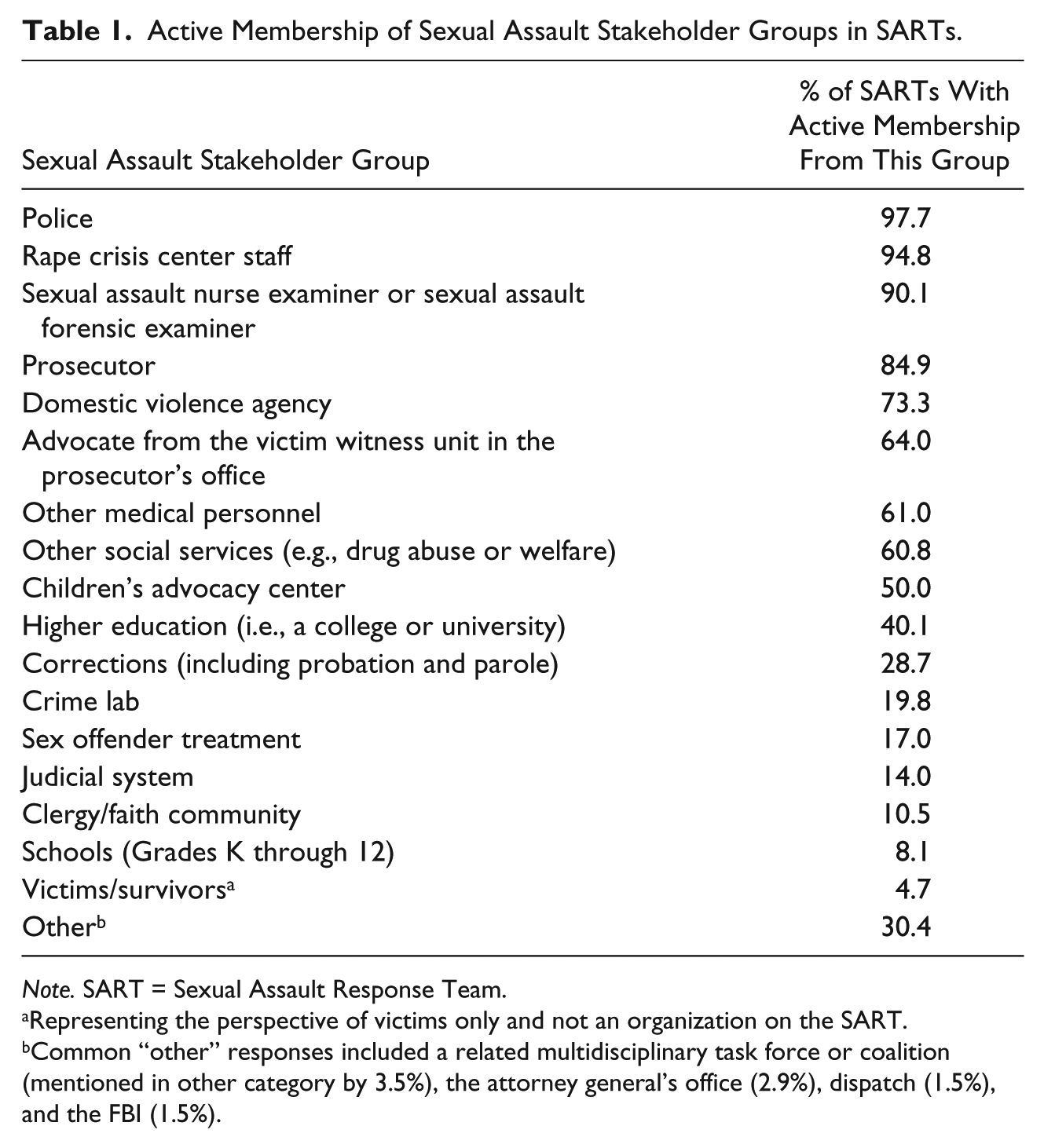
Note. SART = Sexual Assault Response Team.
Representing the perspective of victims only and not an organization on the SART.
Common “other” responses included a related multidisciplinary task force or coalition (mentioned in other category by 3.5%), the attorney general’s office (2.9%), dispatch (1.5%), and the FBI (1.5%).
Formalization and leadership
Formalization was measured by 13 yes/no questions that assessed the SART’s use of formal structures and resources to organize their team (e.g., subcommittees, a formal leader, etc.). This measure was adapted from a prior measure of domestic violence coordinating council structure (Allen et al., 2010). See Table 2 for a full list of all formalization items. For SART teams that had a formal leader who participated in the study, the leader’s stakeholder group was also captured.
SARTs’ Use of Formal Organizational Structures and Resources.

Note. SART = Sexual Assault Response Team.
Use of collaborative activities
Participants were asked about SARTs’ use of six key collaborative activities (e.g., policy/protocol development and review, multidisciplinary case review). For five activities, SARTs were asked whether their SART engaged in that activity (yes/no), and if so, whether the activity was utilized regularly or as needed. For the last activity—program evaluation—SARTs were asked whether they engaged in evaluation as a multidisciplinary team, and if so, were asked to describe their evaluation. Many SARTs that reported engaging in evaluation only engaged in practices that would not qualify as formal evaluation (e.g., attending to complaints from victims about how they were treated), and therefore the description of the evaluation practices was used to determine whether formal evaluation occurred. Based on their answers, a research assistant coded each SART as 0 = does not engage in formal evaluation as a team or 1 = does engage in formal evaluation as a team (involving systematic analysis of data).
Cross-system coordination
SARTs were asked to report on the frequency with which sexual assault responders engaged in 10 different cross-system coordinated actions in responding to sexual assault victims/cases on a scale from 1 = never to 4 = every time. Sample coordinated actions included giving victims the opportunity to have an advocate accompany them during the medical forensic exam and police consulting with medical/forensic examiners. See Table 3 for a full list of all 10 coordinated actions that were measured. In addition, within the field there is substantial disagreement over whether medical/forensic examiners and police should interview victims at the same time. Therefore, participants were asked whether medical/forensic examiners and police typically conduct joint victim interviews (yes/no).
Frequency of Cross-System Coordination in Responding to Victims and Cases.

Results
SART History and Key Informant Background
Since their initial formation, 86% of SARTs had been operating continuously, while 14% had stopped and then re-formed. On average, SARTs had been in operation continuously for 8 years (M = 8.08 years, SD = 5.63) and interview key informants had been involved in their SART for 5 years (M = 5.08, SD = 4.40). Over half of the participants were rape crisis center advocates/staff (55%), whereas approximately one fourth were medical/forensic examiners/SANEs (24%); 5% were advocates employed in the victim’s witness unit of the prosecutor’s office, 5% were prosecutors, 4% were police, and 7% identified as another stakeholder group (e.g., prevention educator, Child Advocacy Center director).
Characteristics of Communities Served
SARTs varied with respect to the number of counties they served. Some SARTs served a partial county (6.4%), the majority served one county (75%) and 19% served more than one county. Thirty-one percent of the SARTs were located in the South, 29% in the Midwest, 25% in the West, and 15% in the Northeast. Two thirds (66%) of teams served a rural community, defined as a population density of less than 500 people per square mile. Eight of the SARTs (4.7%) exclusively served a college population and three (1.7%) exclusively served a military base.
With respect to other community services, most SARTs were located in communities that also had a SANE program (81%) and a Child Advocacy Center (71.3%), but only one third had a specialized unit in the prosecutor’s office that responds to sexual assault crimes (32.7%). Over three fourths of SARTs reported that there were other councils or coalitions in their community that SART members were also involved in (75.4%).
Goals
Goals related to improving victims’ help-seeking experiences (M = 3.24, SD = .48) were rated highest, followed by prevention education (M = 3.05, SD = .82) and improving legal outcomes (M = 2.95, SD = .64). Participants were also asked to choose between these types of goals and select the goal that their team spent more time and energy working on. Improving victims’ help-seeking experiences tended to be the highest priority, followed by improving legal outcomes. In all, 84.2% of SARTs reported that they spent more time and energy on improving victims’ experiences than legal outcomes (7.6% said that they were equal); 86.5% spent more time on improving victims’ experiences than prevention education (5.3% equal) and 58.5% spent more time on improving legal outcomes than prevention education (5.8% equal).
Membership
On average, SARTs were comprised of members from 12 different organizations (M = 12.07, SD = 6.31, Min. = 3, Max. = 34), with most SARTs falling within the range of 5 to 15 organizations. To understand the different types of responders that were members of the SART, participants were asked whether 18 different sexual stakeholder groups were active members of their team. SARTs averaged 8.50 different stakeholder groups as active members of their team (SD = 2.65, Min. = 2, Max. = 15). The most common active members were police (98%), rape crisis center advocates/staff (95%), SANEs (90%), and prosecutors (85%). Three quarters of SARTs (75%) had active members from all four of these groups. See Table 1 for results for each of the 18 stakeholder groups that were measured.
Formal Organization and Leadership
SARTs were moderately formalized, utilizing an average of 6.26 out of 13 possible formal structures and resources from the modified formalization index (SD = 2.28, Min. = 1, Max. = 12). See Table 2 for information on each item. Of the 90.1% of SARTs that had a formal leader, most of the leaders were rape crisis center advocates or staff (55.5%) or medical/forensic examiners (24.7%). Interestingly, three (2.1%) SART leaders were neutral coordinators or facilitators (i.e., someone that was not a sexual assault responder in that community).
Collaborative Activities
The majority of teams engaged in each of the collaborative activities: policy/protocol development and review (82.5%), multidisciplinary cross-trainings (76.0%), multidisciplinary case review (73.8%), trainings conducted by non-SART members (74.3%), and the development or adoption of memoranda of understanding between different stakeholder groups (69.6%). However, these collaborative activities were not typically institutionalized as regular SART processes: 41.9% engaged in case review regularly, 38.0% had multidisciplinary cross-trainings regularly, 31.2% engaged in policy/protocol development or review on a regular basis, 23.2% engaged in memoranda of understanding adoption or review on a regular basis, and 22.8% had trainings conducted by non-SART members regularly. In addition, only 15% of SARTs engaged in program evaluation as a multidisciplinary team to assess their collaborative efforts.
Cross-System Coordination
Results also revealed significant cross-system coordination across the four primary response groups (advocates, medical forensic examiners, police, and prosecutors). Coordinated activities that were most common were informing victims who reported to the police about medical/forensic services and giving victims the opportunity to have an advocate accompany them to court hearings. Medical/forensic examiners conducting forensic suspect exams for the police and offering victims the opportunity to have an advocate accompany them to interviews with the detective were the least frequent. See Table 3 for results for each type of coordination. Finally, the study also asked participants whether medical/forensic examiners and police typically interview victims at the same time, and 29% of SARTs indicated that this was the case in their community.
Discussion
SARTs were designed to improve the community response to sexual assault by creating collaboration among sexual assault responders. These interventions have been widely adopted, yet there was no one standardized SART model, and as such SART implementation varies from community to community. The current study was the first to create a national sampling frame of SARTs and use rigorous random sampling methods to understand how SARTs are implemented in practice. The comprehensive sampling frame development and high response rate (92%) suggest that the information is likely to be representative of SARTs as a whole. Furthermore, the study provides a variety of information on SARTs’ structure and functioning.
The first finding that we wish to highlight pertains to SARTs goals. While the results indicate that improvements in victims’ help-seeking experiences, criminal justice system outcomes, and prevention/education are all important goals for SARTs, when asked to rank which outcomes the SART focused the most time and energy on, most SARTs prioritized victims’ help-seeking experiences. National SART resources have recommended that SARTs adopt a “victim-centered” approach in which the SART prioritizes meeting survivors’ needs and respecting their choices above other considerations (OAGSATF, 2009; OVC, 2011) and these findings are consistent with such an approach. However, it is also important to note that approximately one in six SARTs (16.8%) noted that their team spent as much or more time and energy on legal outcomes as compared with victims’ experiences. Therefore, the victim-centered approach, while predominant, is not necessarily universal.
The current study also found that SARTs are fairly structured: most have a formal leader and have moderate formalization. In addition, five of the six SART collaborative processes (except program evaluation) were adopted by the majority of SARTs. Overall, these findings reveal a higher degree of structure among SARTs than Zajac’s studies. For example, Zajac (2006, 2009) found that 60% to 82% of SARTs had a formal leader (current study = 90%) and 25% reported regular case review meetings (current study = 42%). There were several methodological differences between these studies that may account for these inconsistencies. The Zajac (convenience) samples included all SARTs that elected to participate, while the current study’s (random) sample included teams that did not use the name “SART” and excluded teams that did not have collaborative meetings. In particular, it is likely that excluding teams that did not have collaborative meetings resulted in the omission of SARTs that were generally quite unstructured and therefore contributed to the higher degree of structure in the current sample. Another possibility may be that since Zajac’s data were collected (in 2008-2009), SARTs have become more formalized (e.g., due to guidelines that assist them in implementing formal structures and collaborative processes). Thus, a combination of differences in sampling methods, eligibility criteria, and data collection time period may account for the differences between these studies.
In addition to a high degree of structure among SARTs, the current study also revealed a high degree of cross-systemic coordination. The study found that in most communities, survivor contact with the legal system regularly results in referrals to advocacy and medical/forensic services and consultation between the legal system and medical/forensic examiners is also common. Despite the myriad differences between these diverse sexual assault stakeholder groups, SARTs are associated with significant cross-system coordination in several key areas. On the other hand, gaps remain. In most communities, these coordinated actions—while common—were not systematically happening for all sexual assault cases. Moreover, other types of coordination (e.g., using forensic examiners as expert witnesses, giving victims the opportunity to have an advocate accompany them during contacts with the police) were less common, suggesting further coordination is still possible.
These findings should be considered in light of two key limitations. Although sampling frame development involved a careful, multistep process, it is possible that some U.S. SARTs were not identified by the current study. In particular, SARTs that are less connected to the field (e.g., are not connected to other professional organizations in the field) may have been inadvertently omitted from the sampling frame and therefore under-sampled. Although the study used multiple complementary strategies to identify SARTs—including directly contacting local organizations that were likely to participate in a SART—it is still possible that some SARTs were not identified. Thus, it is possible that under-sampling some SARTs could have led to over-estimation of the formality and use of collaboration activities within U.S. SARTs. Despite this limitation, this is by far the most comprehensive attempt to obtain a nationally representative sample of SARTs to date.
Second, the current study relied on self-report from SART leaders or long-time members. While SART leaders are able to provide valuable insight into the structure and functioning of their teams, they represent only one perspective in a multistakeholder group. In particular, their reports of their team’s goals and cross-system coordinated actions may not be representative of the views of the entire team. Due to the scale and scope of this study, this was a necessary methodological compromise. However, future research can address this limitation by using additional measurement strategies to validate leaders’ reports of their SART’s implementation, such as interviews with additional SART stakeholders or observations of SARTs’ activities.
The current study also has several implications for future research, policy, and practice. The large number of SARTs that were identified in the current study (more than 800) suggests that recommendations that communities create multidisciplinary groups to coordinate the response to sexual assault are working. Next, resources that focus on how to increase SARTs’ effectiveness at improving victims’ help-seeking experiences and criminal justice case outcomes are likely to be most beneficial. Such resources could include trainings, technical assistance, and written handbooks or toolkits that provide step-by-step information on developing and sustaining SARTs.
Indeed, some such resources already exist, but could benefit from further information about SARTs. What can research tell us about factors that promote SART effectiveness? The current study revealed heterogeneity in SART implementation. It is likely that some of the methods of implementing SARTs are more successful than others. Research that identifies different models of SARTs and then establishes which models are most effective at creating collaboration, improving victims’ help-seeking experiences, and improving case outcomes, will be particularly beneficial. Such findings can inform SART practice as well as be used to design resources that help communities implement SART models that are demonstrated to be effective.
Another potential area for improvement is to help SARTs implement more consistent cross-system coordination. Despite significant coordination in the response to sexual assault, in many instances coordination was not consistent across all cases, and some types of coordination were quite infrequent. Creating resources for SARTs that not only help teams learn how to create protocols, but also help them to create mechanisms for ensuring that the protocols are consistently implemented, may be especially helpful. For example, resources could help SARTs develop trainings to educate responders about what they are expected to do, how to do it, and why it is important (to improve their ability and willingness to implement the protocols). Resources could also help SARTs develop accountability systems that monitor whether the protocols are consistently followed for all cases, and when they are not, enable the team to take appropriate corrective action to ensure the protocol is followed in future cases (to create system-level procedures that increase implementation of the protocols).
In addition, resources that help promote SART sustainability are likely to be particularly beneficial to SARTs. The current study suggests that a sizable proportion of SARTs fall apart. In the current study, we found that 14% of SARTs in a sample of SARTs that currently engage in collaborative meetings had stopped working together and then re-formed. This sample cannot capture the proportion of SARTs that stopped working together and then never re-formed, so the statistic of 14% only represents one subgroup of SARTs that die off: those that are able to re-form. SARTs face difficult contextual conditions such as limited time and resources for collaboration and turnover in key SART members. Resources that provide SARTs with practical strategies for developing a solid SART infrastructure that is able to adapt and respond as a team when contextual factors change over time may help ensure that more SARTs are able to keep working together successfully in the long term.
Footnotes
Declaration of Conflicting Interests
The author(s) declared no potential conflicts of interest with respect to the research, authorship, and/or publication of this article.
Funding
The author(s) disclosed receipt of the following financial support for the research, authorship, and/or publication of this article: This research was supported by a grant from the National Institute of Justice awarded to the second author (2010-WG-BX-0010). The opinions or points of view expressed in this document are those of the authors and do not reflect the official position of the U.S. Department of Justice.