



Abstract
A measure of Facebook-related mate-retention tactics was developed to investigate the relationship between online behaviors and intimate partner aggression. One hundred and seventy-seven young adults (65 men, 112 women) completed questionnaires that included measures of online and offline mate-retention tactics, Facebook jealousy, Facebook surveillance, and intimate partner violence. A factor analysis yielded four subscales for the Facebook Mate-Retention Tactic Inventory (FMRTI): Care and Affection, Jealousy and Surveillance, Possession Signals, and Punishment of Infidelity Threat. The FMRTI total scores were positively correlated with Facebook jealousy, Facebook surveillance, and use of offline mate-retention tactics. The Jealousy and Surveillance subscale uniquely predicted intimate partner psychological and physical aggression over and above existing measures. Facebook mate-retention tactics fully mediated the relation between Facebook jealousy and both intimate partner psychological and physical aggression. The current study provides preliminary evidence for conceptualizing Facebook as an environment for the use of mate-retention tactics that have real-life implications for intimate partner violence.
With more than 90% of students logging on daily, Facebook is an integral component of everyday college life (Subrahmanyam, Reich, Waechter, & Espinoza, 2008). Part of the growing popularity of this social networking site is the ways in which users are able to stay connected by providing individuals (a) exact locations and activities of others, (b) greater access to personal information, and (c) an opportunity to track interpersonal communication (Tokunaga, 2011). Such surveillance behaviors may also provide a precipitant for intimate partner violence (Bowe, 2010; Elphinston & Noller, 2011; Muise, Christofides, & Desmarais, 2009).
Mate-retention tactics are behavioral responses to a perceived relationship threat or to prevent a threat from occurring (i.e., “mate guarding”; Buss, 2002). Buss and Shackelford (1997) identified 19 types of mate-retention tactics. These tactics range from less intrusive acts (e.g., vigilance, concealment of mate, and emotional manipulation) to more intrusive acts (e.g., verbal possession signals, possessive ornamentation, and violence against rivals). Mate-retention tactics may be beneficial for maintaining a partner, but extensive use and using more intrusive mate-retention tactics are associated with relationship dissatisfaction and intimate partner violence (Buss, Shackelford, & McKibbin, 2008). Research supports a relationship between the intensity of mate-retention tactics used and displays of intimate partner violence in offline contexts (Goetz & Shackelford, 2009; Kaighobadi, Starratt, Shackelford, & Popp, 2008). The relationship between mate-retention tactics and intimate partner violence exists, in part, because both types of behavior are elicited by jealousy (Kaighobadi, Shackelford, & Goetz, 2012). For example, men’s suspicions of partner infidelity (real or imagined) explained a significant portion of the variance in men’s physical violence toward their partners (Goetz & Shackelford, 2009; Kaighobadi et al., 2008), and this relationship was mediated in part by non-violent mate-retention behaviors (Goetz & Shackelford, 2009; Kaighobadi et al., 2008). These findings led researchers to hypothesize that perceived threats to the relationship (i.e., jealousy) initiate the path to intimate partner violence, followed by increasingly aggressive mate-retention behaviors, ending with acts of intimate partner physical violence (Buss & Shackelford, 1997; Kaighobadi et al., 2012; Kaighobadi et al., 2008). An individual placed in a jealousy-evoking environment, such as Facebook, may use mate-retention tactics in an effort to guard one’s partner. If mate-retention tactics are displayed in an online environment, it is likely that a similar linkage exists between the display of online mate-retention tactics, jealousy, and the display of increasingly aggressive intimate partner violence.
The detection of real or imagined threats to one’s established romantic relationship can come from a variety of sources including the presence of mate poachers (i.e., individuals who intend to attract someone who is already in a romantic relationship; Schmitt & Buss, 2001), cues to infidelity (e.g., spending time and resources away from one’s partner), or subtle signs that a partner is dissatisfied with the relationship (Buss, 2002). Evolutionary theorists suggested that ambiguous behaviors are especially likely to be interpreted as threatening because suspicion serves to maintain the relationship and is associated with survival and reproductive advantages (Buss, 2002; Haselton & Buss, 2000). Online behaviors are often ambiguous: meaning must be inferred by one’s partner without context, tone, or non-verbal cues. Many events on a partner’s Facebook page, such as “tags” (i.e., linking one’s Facebook page to a photo, status, link, or blog), an approved “friend” request, and “likes” (i.e., indicating that one likes something seen on Facebook by clicking a “like” icon, linking the user’s Facebook page to the liked item) can be interpreted as threats (Bowe, 2010; Elphinston & Noller, 2011; Muise et al., 2009) and may, for jealous individuals, provide a precipitant for offline aggression. Muise et al. (2009) found that more time spent on Facebook (specifically a partner’s Facebook page) predicted higher Facebook-related jealousy due to the information available. Although Muise examined emotional responses to a partner’s online behaviors, no such measure exists to assess the frequency with which individuals display online behaviors aimed to maintain a mate.
Research has examined the roles of offline mate-retention tactics in romantic relationships, but failed to examine how these tactics are used in online social networks (Buss & Shackelford, 1997; Buss et al., 2008). Buss et al.’s (2008) conceptualization of ornamental (i.e., symbols, such as a ring, that indicate a relationship exists), verbal (i.e., telling others that a relationship exists), and physical possession (i.e., physical touch to indicate an intimate relationship exists) signals may be displayed on Facebook. Asking a partner to display one’s relationship status as “in a relationship,” leaving romantic comments on a partner’s wall, commenting on other friends’ walls about one’s relationship with a partner, and posting pictures of oneself with a partner on Facebook may ward off potential mate poachers. These behaviors signify to others that a romantic relationship may exist. Vigilance or surveillance is a mate-retention tactic that is particularly applicable to Facebook interactions. Unlike vigilance offline, performing vigilant behaviors on Facebook (i.e., online surveillance) is generally anonymous and socially acceptable (Lampe, Ellison, & Steinfield, 2006). Buss et al. (2008) assessed vigilance with items such as “called to make sure my partner was where she said she would be,” and “snooped through my partner’s personal belongings.” Facebook provides the opportunity to track a partner’s physical location by showing where a partner was when a status update was made. Asking one’s partner to share a Facebook password allows one to see any information that a partner may not publicize (e.g., private messages, instant messages, wall posts, and comments).
We developed a measure of mate-retention tactics displayed on Facebook and investigated the association between the use of Facebook mate-retention tactics, Facebook jealousy, and perpetration of intimate partner violence. The present study sought to demonstrate that previously identified offline influences on intimate partner violence may also be operating in online social network environments. In addition to exploring which different subtypes of mate-retention tactics are most predictive of intimate partner violence, we also made several predications regarding the functioning of our newly developed measure and relations between mate-retention tactics, Facebook Jealousy, and intimate partner violence:
Our measure of Facebook mate-retention tactic use will demonstrate construct validity as evidenced by correlations with existing measures of offline mate-retention tactics, as well as with Facebook jealousy and surveillance measures.
Facebook mate-retention tactics will predict offline intimate partner psychological and physical aggression, after controlling for offline mate-retention tactics.
Facebook jealousy will be associated with intimate partner violence, and Facebook mate-retention tactics will mediate the relation between Facebook jealousy and intimate partner violence.
Method
Participants
Only participants who were 18 years or above, had an active Facebook account, and who were in a non-married romantic relationship (i.e., reported being in a dating relationship for any length of time and were not legally married) with someone who also had an active Facebook account were eligible for the study. One hundred and forty-one participants (53 men, 88 women) were recruited from introductory psychology courses at a small, public, liberal arts university in North Texas to complete a pencil-and-paper questionnaire. Thirty-six additional participants (12 men, 24 women) were recruited from class and campus announcements where they were given a link to complete an online version of the questionnaire. Participants’ ages ranged from 18 to 48 years (M = 20.45, SD = 4.14). The mean age of the men was 20.3 years (SD = 2.65), the mean age of women was 20.5 years (SD = 4.81), and 6 participants (3.4%) were above the age of 29 years. The mean relationship length was 18.2 months (SD = 22.89). The sample consisted of 115 European American (65%), 22 African American (12.4%), 26 Hispanic (14.7%), 7 Asian (4%), 6 Caribbean or West Indian (3.4%), and 1 American Indian (.6%). One hundred and seventy-two participants identified as heterosexual (97.2%), 3 participants identified as bisexual (1.7%), and 2 participants identified as gay male or lesbian (1.1%). The mean length of time spent on Facebook on a typical day was 50.8 min (SD = 54.11).
Procedure
The procedures used for the study were approved by the university’s committee for the protection of human subjects (IRB#120711701). Participants completed measures for the current study as part of a battery. Individuals provided informed consent to participate in the study prior to completing the questionnaire. Students participated to fulfill course requirements and could enter into a drawing for a gift card.
Data were collected in two waves. 1 The first wave of data collection used a packet of pencil-and-paper questionnaires and the second wave used online data collection via Survey Monkey. Participants who completed questionnaires individually were supervised by research assistants in a group setting. Length of time to complete the questionnaire was recorded in both live and online data collection. Data collected from participants who completed the questionnaires in less than 20 min (1 SD below the mean length of time to complete) were discarded from further analyses to ensure that items were responded to in a valid manner.
Measures
Demographic information
Participants provided basic demographic information (e.g., age, gender, and year in school), current relationship status, and reported the amount of time spent on Facebook during a typical day.
Facebook mate-retention tactics
The Facebook Mate-Retention Tactics Inventory (FMRTI) was developed for this research based on the Mate-Retention Inventory-Short Form (MRI-SF; Buss et al., 2008). The MRI-SF (Buss et al., 2008) identifies mate-retention tactics that individuals display in an offline context. The FMRTI was developed to identify similar mate-retention mechanisms that individuals display in an online environment over the past 12 months. Some of the items were created by modifying the MRI-SF items, whereas other items were developed after a series of focus group meetings. During focus group meetings, undergraduate and graduate students identified online behaviors that individuals display to maintain romantic relationships. Items were then pilot tested using an undergraduate and graduate sample to gain feedback on clarity, wording, and content relevance. Thirty-four items were used to represent various mate-retention strategies as conceptualized by Buss et al. (2008).
Responses to items (e.g., “Asked my partner to make our relationship status visible on Facebook”) on the FMRTI were reported on a 5-point scale ranging from 0 (never) to 4 (often) to indicate how often participants use various mate-retention tactics on Facebook. Responses were summed to indicate greater Facebook mate-retention tactics use.
Offline mate-retention tactics
A measure of offline mate-retention tactics was used to validate the new Facebook Mate-Retention Tactic measure. The MRI-SF (Buss et al., 2008) assesses the frequency with which one engages in behaviors to retain one’s mate in an offline environment. The 38 items reflect 19 various mate-retention tactics (e.g., vigilance, love and care, possessive ornamentation, and emotional manipulation). Items (e.g., “Called to make sure my partner was where he or she said he or she would be”) were responded to using a 4-point scale ranging from 0 (never) to 3 (often). Responses were summed to indicate greater display of mate-retention tactics. Analysis of the items indicated that the measure had adequate internal reliability (α = .87).
Facebook jealousy
Facebook-related jealousy was measured using the Facebook Jealousy Scale (Muise et al., 2009). Twenty-seven items assessed the experience of jealousy in the context of Facebook (α = .96). Responses were reported on a 7-point scale ranging from 0 (very unlikely) to 6 (very likely) to examine the likelihood that a participant will feel or act in certain ways toward jealousy-evoking situations on Facebook (e.g., “Become jealous after seeing that your partner has added an unknown member of the opposite sex to Facebook”). Responses were summed to indicate greater levels of Facebook jealousy.
Facebook surveillance
A measure of surveillance behaviors on Facebook was used to validate the new Facebook Mate-Retention Tactic measure. The Facebook-adapted version of the Interpersonal Electronic Surveillance Scale for Social Networking Sites (ISS; Tokunaga, 2011) assesses the extent to which an individual uses Facebook to gain information and awareness of a partner’s offline or online behavior. The 15-item scale demonstrated high internal reliability (α = .94). Responses to items (e.g., “I try to monitor my partner’s behaviors through his/her Facebook page”) were assessed using an 8-point Likert-type scale ranging from 0 (strongly disagree) to 7 (strongly agree). Responses were summed to indicate greater use of Facebook surveillance behaviors.
Relationship aggression
Participants completed the perpetration items on the psychological aggression (α = .81) and physical assault (α = .76) subscales of the Revised Conflict Tactics Scales (CTS2; Straus, Hamby, Boney-McCoy, & Sugarman, 1996) to measure the extent to which participants engaged in intimate partner psychological aggression and physical assault. Responses to the 20 items (e.g., “I insulted or swore at my partner,” and “I pushed or shoved my partner”) were summed to indicate the frequency of self-reported aggressive perpetration in one’s relationship within the past year, with items ranging from 0 (this has never happened) to 6 (more than 20 times in the past year). Respondents also had the option of selecting 7 (not in the past year, but it did happen before), but these responses were reset to 0 to maintain a consistent time period across measures.
Results
Descriptive Analyses
See Table 1 for results on gender comparisons. Results indicated that 87% of men and 73% of women reported displaying some form of aggression in their current relationships. Women reported displaying more psychological aggression than did men. Men and women did not differ significantly in terms of mean perpetration of physical assault. Men and women did not differ significantly in terms of total FMRTI scores, Care and Affection, Jealousy and Surveillance, Possession Signals, or Punishment of Infidelity Threat subscale scores. Men and women did not differ significantly in their reports of relationship length, offline mate-retention tactic use, Facebook jealousy, or Facebook surveillance. Women spent significantly more time on Facebook than did men.
Gender Comparisons Across the Variables.

Note. FMRTI = Facebook Mate-Retention Tactic Inventory; FBJ = Facebook Jealousy; ISS = Interpersonal Electronic Surveillance Scale for Social Networking Sites; MRI-SF = Mate-Retention Inventory-Short Form.
Examination of individual items on the FMRTI indicated that 90.1% of the sample reported looking at a partner’s Facebook page, 51.1% chose an attractive profile picture for a partner to see, and 48.8% included one’s partner in his/her profile picture. In terms of more invasive online behaviors, 40.3% told a partner not to friend a person on Facebook who was a threat to their relationship, 39.5% checked a partner’s statuses to see where he or she would be, 33.1% snooped through a partner’s private messages and/or chat, 19.8% asked a partner for his or her Facebook password, and 15.1% threatened to break up with a partner if he or she talked to a specific person on Facebook. Behaviors that were the least endorsed included making threats to people who posted on a partner’s Facebook page (6.9%), and leaving flirtatious posts on another person’s Facebook page to make a partner jealous (5.2%).
Measure Development
An exploratory factor analysis of the 34-item FMRTI was performed using principal components extraction with varimax rotation. The number of factors extracted required that a factor’s eigenvalue exceed 1.0 and was based on examination of the scree plot. This led to the decision to retain four factors that accounted for 69.29% of the variance. Subscales formed based on results of the factor analysis include the following: Care and Affection (α = .90), Jealousy and Surveillance (α = .88), Possession Signals (α = .88), and Punishment of Infidelity Threat (α = .69; see Table 4). Consistent with the MRI-SF, the FMRTI includes positive behaviors, such as items on the Care and Affection (e.g., “Left compliments for my partner on his/her Facebook page”) and Possession Signals (e.g., “Asked my partner to include me in his/her Facebook profile picture and/or cover photo”) subscales, as well as more intrusive behaviors, such as items on the Jealousy and Surveillance (e.g., “Asked my partner to unfriend or block someone on Facebook”) and Punishment of Infidelity Threat (e.g., “Posted pictures with another man/woman on Facebook to make my partner jealous”) subscales. FMRTI total and subscale scores positively correlated with scores for each of the measures of Facebook jealousy, Facebook surveillance, and offline mate-retention tactic display, lending support to Hypothesis 1 (see Table 2). These correlations ranged from r = .56 to r = .66, providing evidence of convergent validity for the FMRTI.
Correlations, means, and standard deviations among study variables.

Note. FMRTI = Facebook Mate-Retention Tactic Inventory; MRI-SF = Mate-Retention Inventory-Short Form; FBJ = Facebook Jealousy; ISS = Interpersonal Electronic Surveillance Scale for Social Networking Sites.
p < .05. **p < .01.
Prediction of Intimate Partner Aggression
Table 2 summarizes the descriptive statistics and intercorrelations for all the measures. Hierarchical multiple regression analyses were performed using each of the four FMRTI subscales and the MRI-SF scores as predictors of the subscales of the CTS2. Predictors of psychological aggression and physical assault were examined separately. MRI-SF was entered into the first block of the model because literature linked these behaviors with forms of intimate partner violence (Buss et al., 2008). Significant differences across genders prompted the inclusion of control variables (i.e., gender, and amount of time spent on Facebook during a typical day) into the first block of the model. The four FMRTI subscales were simultaneously entered as predictors into the second block of the regression model. Results are summarized in Table 3.
Hierarchical Multiple Regression Analysis Summary of Variables Predicting Unmarried Participants’ Display of Psychological Aggression and Physical Assault in Romantic Relationships (n = 177).

Note. FMRTI = Facebook Mate-Retention Tactic Inventory.
p ≤ .05.
Facebook Mate-Retention Tactic Inventory.

Note. All ps < .001.
The first model indicated that offline mate-retention tactics and control variables explained 25% of the variance in psychological aggression subscale scores, F(3, 151) = 16.81, p < .001. The addition of the FMRTI subscales to the model resulted in an R2 change that equaled .08, contributing to an overall prediction of 33% of the variance in psychological aggression, F(7, 147) = 10.34, p < .001. Offline mate-retention tactics and control variables explained 13.1% of the variance in physical aggression, F(3, 151) = 7.60, p < .001. The addition of the four FMRTI subscales resulted in an R2 change that equaled .04. The resulting model predicted 17.5% of the variance in physical assault, F(7, 147) = 4.46, p < .001.
Investigation of the individual standardized beta weights from the hierarchical multiple regression analyses indicated that use of offline mate-retention tactics (β = .28, p = .003) predicted the display of psychological aggression in romantic relationships. In support of Hypothesis 2, items on the Jealousy and Surveillance subscale significantly predicted the occurrence of both psychological aggression (β = .30, p = .003) and physical assault (β = .26, p = .02) over and above the effects of offline mate-retention tactics.
Following the suggestions of Preacher and Hayes (2008), we used a bootstrapping approach to test the mediation hypotheses and estimate indirect effects. We used a 1,000-replication bootstrap of the sample data to estimate bias-corrected 95% confidence intervals (CIs) for the indirect effects. The jealousy and surveillance subscale of the FMRTI was tested as a mediator of the relation between Facebook jealousy and relationship aggression. Separate models were computed predicting psychological and physical aggression. As indicated by the path coefficients in Figure 1, Facebook jealousy was associated with Facebook mate-retention tactics, which was in turn positively associated with psychological aggression. Tests of the indirect effect indicated that online mate-retention tactics mediated the relation between online jealousy and psychological aggression, point estimate of αβ = .053, 95% CI = [.0232, .0934]. The direct effect of Facebook jealousy on psychological aggression was not significant after controlling for online mate-retention tactics.
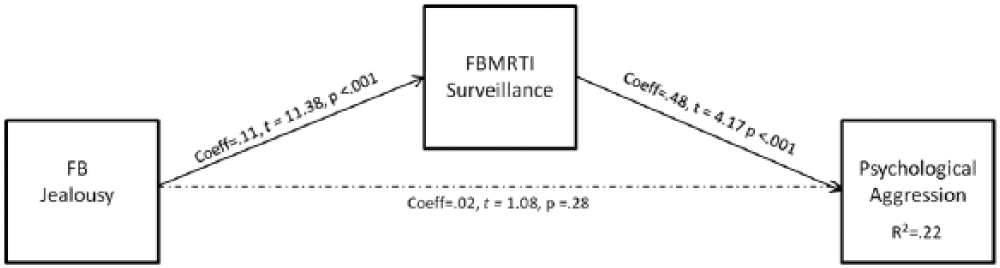
Path model testing Facebook mate-retention tactics as a mediator of the relation between online jealousy and offline psychological aggression.
As indicated by the path coefficients in Figure 2, Facebook jealousy was associated with Facebook mate-retention tactics, which was in turn positively associated with physical aggression. Tests of the indirect effect indicated that online mate-retention tactics also mediated the relation between online jealousy and physical aggression, point estimate of αβ = .0174, 95% CI = [.0058, .0364]. The direct of effect of Facebook jealousy on physical aggression was not significant after controlling for online mate-retention tactics.

Path model testing Facebook mate-retention tactics as a mediator of the relation between online jealousy and offline physical aggression.
Discussion
This is the first study to examine the display of mate-retention tactics in an online, social-networking environment and how these online behaviors are associated with relationship aggression. A measure of mate-retention tactics that individuals display on Facebook (FMRTI) demonstrated adequate internal consistency. The construct validity of the measure was supported by the relation of FMRTI total scores to existing measures of Facebook jealousy and online surveillance. A principal components analysis indicated four categories of mate-retention behaviors displayed on Facebook: Care and Affection, Jealousy and Surveillance, Possession Signals, and Punishment of Infidelity Threat. Men and women reported engaging in similar levels of Facebook mate-retention tactics. The results provide a foundation for conceptualizing the use and implications of online mate-retention.
Online versions of mate guarding captured a significant portion of the variance in displays of intimate partner violence that was not captured by existing measures of mate-retention tactics. The Jealousy and Surveillance subscale uniquely predicted displays of intimate partner psychological aggression and physical assault after controlling for offline mate-retention tactic use, and time spent on Facebook. These results draw attention to the need to examine how aggressive partners use Facebook in the context of a relationship. In contrast to existing measures of online surveillance that assess social information-gaining, items on the Jealousy and Surveillance subscale highlight mate-retention as the purpose behind the surveillance. Examination of surveillance behaviors alone may not be sufficient indicator of the presence of intimate partner violence because surveillance is a relatively common online behavior (Tokunaga, 2011). Instead, the function of online surveillance behaviors may be a useful area of investigation.
The Jealousy and Surveillance subscale of the FMRTI fully mediated the relationships between Facebook jealousy and both psychological and physical aggression. In other words, behaviors on the Jealousy and Surveillance subscale of the FMRTI explain why Facebook jealousy is related to psychological and physical aggression. In an attempt to explain this mediation, we postulate that online mate-retention is initiated by jealousy that results from information gathered online, and that progressively intrusive online mate-retention tactics coincide with offline displays of aggression. Tong (2013) found that individuals engage in online behaviors similar to those examined by the FMRTI following a breakup to reduce uncertainty about an ex-partner’s social and romantic activities. One interpretation of our results is that individuals who are in a relationship characterized by aggression use Facebook mate-retention tactics as a way to reduce uncertainty about a partner’s fidelity. More research is needed to explore the motivators of online behaviors in aggressive versus non-aggressive relationships.
Future Directions and Implications
Previous literature identified mate-retention tactics that could be used as warning signs for intimate partner aggression (Kaighobadi et al., 2012). Longitudinal data from married couples (Murphy & O’Leary, 1989) and data from young couples (Capaldi & Crosby, 1997) indicated that increased intimate partner psychological aggression predicted the occurrence of intimate partner physical violence. Results of the current study support the relationship between intimate partner psychological and physical aggression. Together, these findings suggest that the presence of psychological aggression in romantic relationships could predict the future occurrence of intimate partner physical violence in both younger and older couples. Longitudinal research is warranted to better understand the predictive utility of the FMRTI.
Clinical populations may benefit from continued research examining online predictors of intimate partner violence. Facebook use is common in college-aged populations suggesting that clients may benefit from discussing relationship boundaries in the context of Facebook (Subrahmanyam et al., 2008). Communication regarding a partner’s online behaviors may be a useful area of assessment in clinical practice. Preventative methods may refer to the link between online behaviors and intimate partner violence as a way to educate about healthy versus non-healthy relationships, and to draw attention to the importance of privacy settings on Facebook.
The current data provide preliminary evidence for the display of mate-retention online. The FMRTI may be associated with relationship satisfaction. Papp, Danielewicz, and Cayemberg’s (2012) supported the association between online mate-retention and relationship satisfaction in that certain behaviors on Facebook (e.g., displaying one’s partner in a profile picture) related to partner satisfaction in a romantic relationship. Future studies should examine types of online mate-retention tactics that contribute to relationship satisfaction.
The present study did not investigate gender differences in the ways in which online mate-retention tactics are used. The possibility of gender differences in relationship dyads across a wider age range with a larger, more equal sample is an area to be investigated (Buss & Shackelford, 1997). Facebook’s centrality in younger generations warrants further investigation into how adolescents use Facebook in the context of romantic relationships (Ellison, Steinfield, & Lampe, 2007).
The role of Facebook in married and long-term relationships is an area of future study as Facebook becomes increasingly popular in older populations. Future research examining the role of technology in intimate partner violence would benefit from examining the presence of online mate-retention tactics across social media sites. In addition, new social media sites and yet-to-be developed sites may add new ways for partners to monitor each other or just the opposite, and provide means to hide contact with possible relationship poachers. Research in this area will have to be sophisticated in assessing the current tools of social media sites. Replication of online mate-retention strategies over time will eventually build a solid understanding of which tactics are media site specific and which tactics are generalized across social media sites.
Limitations
An important limitation to address is the correlational nature of the study. Causal inferences cannot be made because the data were drawn from a single assessment. The relatively small size, restricted age range, and the unequal distribution of men and women in the data set suggest that caution should be taken when interpreting the results. Participants may be influenced by social desirability due to the sensitive nature of items. Men and women in our study were not romantically linked to one another, so it is possible that they have different romantic experiences. Future studies may benefit from examining both self- and partner-reports to better examine how these variables interact (Goetz & Shackelford, 2009).
Researchers are urged to consider the role of attachment-style differences in the relationship between online mate-retention behaviors and relationship aggression. Anxious attachment styles related to female-perpetrated partner aggression (Orcutt, Garcia, & Pickett, 2005), and Facebook jealousy and surveillance (Marshall, Bejanyan, Di Castro, & Lee, 2013). One should consider the possibility of attachment style as a third variable in the relationships among the present study’s variables.
Future research would benefit from assessing the participants’ IPV victimization history and assess whether this history impacts one’s willingness to engage in online mate-retention tactics as well as how intrusive one is willing to be. Past research found IPV victimization was related to IPV perpetration for both men and women, and women who perpetrate IPV may be striking back at their own victimization experiences (Houry et al., 2008). Future research is needed to explore IPV victims’ likelihood of using online mate-retention tactics to strike back against a partner. In addition, an individual difference measures of jealousy, anger, and related constructs (Buunk, 1997) may deepen our understanding of the internal process one deals with prior to or while choosing to engage in online mate-retention tactics.
Overall, the current study provides preliminary evidence for conceptualizing Facebook as an environment for the use of mate-retention tactics. The potential benefits and consequences for Facebook’s role in relationships deserve further consideration. Continued research is needed to explore this relatively new field as Facebook and other social networking sites continue to interact with our daily lives.
Footnotes
Declaration of Conflicting Interests
The author(s) declared no potential conflicts of interest with respect to the research, authorship, and/or publication of this article.
Funding
The author(s) received no financial support for the research, authorship, and/or publication of this article.