



Abstract
The role of women in the sex trafficking of minors in the United States has received limited research attention. Case study analysis of 49 female pimps from federal, state, and local cases were analyzed to explore whether there were differences in the penalties given to females when compared with their male co-defendants, and cross-case analysis was conducted to identify themes that represent female pimp typologies. Both prison sentence and probation sentences were significantly lower for female co-defendants when compared with their male co-defendants. Five discrete typologies were developed including Bottom, Madam/Business Partner, Family, Girilla, and Handler. Each of these had unique features regarding violence toward their minor victims, co-defendants, actions during the sexual exploitation of the minor, and sentencing outcomes. Implications for practice and future research were recommended.
Sex trafficking in the United States is a complex problem involving the force, fraud, or coercion of adults selling sexual services, and the commercial sexual exploitation of children (CSEC) who are often exposed to sex trafficking through a pimp or trafficker (Trafficking Victims Protection Act [TVPA], 2000). CSEC is comprised of three parts, including the supply (victims), the demand (customers), and the distributor or supplier (pimps/traffickers). These parts create a complex and widely varied network of people who form a business that is simultaneously collaborative (interdependent) and fragmented (with only two members actually participating in the sex trade act) and one that fluctuates and constantly adapts to changing market conditions that may affect it (Farr, 2005). Traffickers have been known to participate in large organized networks associated with many victims or smaller networks associated with fewer victims. In some instances, an individual trafficker may act alone, with one or more victims under his or her control.
Research has suggested that most sex trafficked minors and adults are pimp-controlled (Flowers, 1998; Giobbe, 1993; Williamson, 2002) with younger victims more likely to be pimp-controlled than older ones (May, Harocopos, & Hough, 2000). Traffickers use active recruiting techniques, often create a reason for engaging in prostitution for both minors and adult victims (i.e., fast money, exciting lifestyle, feeling empowered, a sense of belonging; Williamson & Folaron, 2003), and contribute to “locking” people into being victimized over a long period of time (May et al., 2000). However, studying pimp-controlled adults and minors is difficult for researchers because the victims are often under such control of the pimp that speaking to researchers would be unsafe and unlikely (Williamson, 2002). Tracking the prosecution of pimps has also been difficult because most research on pimps has been conducted through interviews of a small number of pimps (Raphael & Myers-Powell, 2009) or by interviewing sex trafficking victims (Dalla, Xia, & Kennedy, 2003; Dunlap, Golub, & Johnson, 2003; May et al., 2000; Norton-Hawk, 2004; Williamson, 2002). It has been assumed that pimps enter into pimping work voluntarily and although illegal, the actual work is not difficult or inherently risky and the financial payoffs are large (Raphael, & Myers-Powell, 2010).
Understanding pimps, their role, and the source of their power over victims is an important part of combating the CSEC. In the United States, pimps fall along a continuum of involvement in exploiting their victims. Some pimps have close relational ties to the victim such as a parent trafficking his or her child or a boyfriend coercing his girlfriend to have sex with others outside their relationship, whereas others may not have a prior relationship with the victim, such as a kidnapper who holds his victim hostage and forces him or her to have sex with strangers (May et al., 2000; O’Connell Davidson, 1998; Williamson, 2002). Regardless of the relationship, it is often assumed that pimping is a male-dominated role, and a majority of the research literature on this topic has proceeded from this perspective, further perpetuating the notion that pimps are men. While there is evidence to support that assertion (Raphael, Reichert, & Powers, 2010), the role of female pimps, including women who have transitioned from victim to victimizer throughout involvement in the sex industry, requires further study.
Developing a typology for female sex traffickers may be a useful framework for both understanding the role of female traffickers/pimps in sex trafficking victimization, and also for enhancing the understanding of the larger culture of sex trafficking, developing better criminal investigations through the integration of evidence-based research, understanding the role of each person involved in minor sex trafficking, and identifying service needs. The goal of this study is to identify the actions of female pimps in the sex trafficking victimization of minors, explore differences between the case results (i.e., sentences, fines) of the female pimps and their male co-defendants, and developing female pimp role categories based on 49 federally prosecuted cases of women sex trafficking minors in the United States.
Literature Review
In a study of 25 former traffickers interviewed by a sex trafficking survivor in Chicago, Raphael and Myers-Powell (2009) identified distinct methods used by the female (28%) and male (72%) pimps to recruit victims. The pimps’ specific targets often included the so-called “High Risk Victim” population of runaways, girls who craved love and attention they were not receiving in their personal or familial relationships, and girls who thought they were going to be a “star” (Raphael et al., 2010). Raphael et al. (2010) also found that the pimps reported feeling a sense of control and power and justified their actions by explaining that they were helping the girls by “teaching them not to give away their bodies for free” (p. 5).
Pimp/Trafficker Roles
In a study of pimping by May et al. (2000) in four cities in Great Britain, the majority of the pimps reported having knowingly sex trafficked a minor at some point in their pimping careers. The role of pimps in commercial sexual exploitation is complex. The roles of male pimps have been identified as (a) dictating and clarifying the rules of the game for the victims, (b) turning out or facilitating a victim’s entry into prostitution, (c) conducting the business of finding customers, (d) using violence to physically control their victim, and (e) maintaining an intimate and emotional relationship with the victim (Williamson & Cluse-Tolar, 2002).
Pimp Techniques
Pimps use violence and manipulative strategies involving “constriction of movement, controlling of money and creation of debt, substance dependency, threats and verbal manipulation and violence” (Raphael et al., 2010, p. 91). Dalla (2002) explained that male pimp relationships with female victims fell into two categories. First, a woman who is already involved in the sex industry begins a relationship with a man who pimps her as their romantic relationship progresses, and second, a younger woman who is pimped by a much older male who provides shelter and “nice” things and is expected to return the favor by exchanging sex for money and then giving the money to the pimp (Dalla, 2002).
Women as Pimps
A study by Heyl (1976) explored the phenomenon of a Madam, whose purpose is to “turn out” novice prostitutes by teaching them the tricks of the trade. The Madam profiled in the study was identified by her trainees as a mentor, a protector, and a teacher of technique as well as self-defense procedures and sexually transmitted disease (STD) awareness. The novices also reported that the Madam taught them how to hustle and strategize. A final role that the Madam filled for the novice sex workers was as an emotional supporter for the “post-turnout blues,” which is the depression that many of the novices experiences when questioning their decision to become sex workers (Heyl, 1976).
In May et al.’s (2000) study of pimps, the role of the female pimp was identified as a manager of off-street sex work (e.g., brothels) without significant involvement of other types of crime as opposed to male pimps who often had extensive criminal justice involvement. In some cases, they also sold drugs and routinely used violence in their pimping behaviors. Female pimp relationships with their “workers” were contractual whereas male pimp’s relationships were based on coercion (May et al., 2000).
Research Question
In case studies of women identified in a national search of indictments for sex trafficking of minors as female pimps,
What are the actions of the female pimps toward the minor victims?
Are there differences between the case resolutions (sentences and fines) between the female pimps and their male co-defendants?
Are there unique role categories of female pimping behaviors that emerge?
Method
Procedure
A database of all adults charged with crimes related to CSEC throughout the United States in federal, state, and local courts was collected by a journalist at the New York Times newspaper in 2009. The database included men and women identified as pimps in these cases (all involving the sex trafficking of a minor) and information was collected on all cases between 2002 and 2009. This database was provided to the first author on request. The authors included only cases that met the definition of a pimp, defined for the purposes of this study as one in which court documents identified the defendant or co-defendant as being charged with crimes related to the sexual exploitation of a minor. This study was conducted with the approval of the Arizona State University Institutional Review Board.
Of the 70 women in the database involved in cases as traffickers/pimps, searches of LexisNexis, Westlaw, and Google resulted in 49 complete case files, including media and court documents describing court proceedings, plea agreements, and sentencing. Data collected included specific information related to charges based on participation in criminal activity, dockets, plea agreements, appellate court opinions, and sentencing, as well as media reports about arrests, personal histories, and media releases from state and federal sources.
Plan of Analysis
A qualitative approach was used to analyze data, and to provide a descriptive picture of female pimps, their relationships with minor victims, and to compare female pimps with their male co-defendants. Specifically, a case study analysis approach was used as it provided the opportunity to incorporate multiple data sources and perspectives throughout the data analysis process (Padgett, 2008), and provided “analytic discretion to the researcher” (p. 34), which was necessary in this kind of exploratory study (Eisenhardt, 1989).
The first and second authors of this article conducted cross-case analysis, conducting several careful readings of the case files to allow themes related to female pimp types to emerge. Knowledge of the research literature on male pimp types, as well as the limited information on female pimp types, allowed for deductive content analysis wherein the descriptions of male “gorilla” pimps and the female “Madam” described in research on prostitution were brought into connection with the data (Kohlbacher, 2005), thus forming the first two categories of female pimps: “Girilla” and “Madam/Business Partner.” The rich textual data from these cases provided the opportunity to conduct further, inductive, content analysis and three additional female pimp types emerged: “Bottom,” “Family,” and the “Handler.” Following the identification of the five female pimp categories, interrater reliability was assessed by having two raters (the first and second authors) code the data. They initially disagreed on the categorizing of 6 cases resulting in agreement for 87.7% (n = 43) of the cases. The two raters then underwent a process of discussing discrepancies regarding interpretation of the remaining six cases they initially disagreed on until an agreement was reached for those cases (Brotto, Heiman, & Tolman, 2009). If a case file included descriptions indicating that a female pimp fit into multiple categories, raters sought to determine the primary role she played in her relationship with the victim. See Table 1 for differences related to the female pimps’ personal history and their role in the sex trafficking of minors.
Female Pimp Case Descriptive Information by Category.

Sample
The 49 women included in this ranged in age from 18 to 55 (M = 32.24, SD = 8.1) at the time of their arrest. Court records identified their races as 21 (42.9%) White, 15 (30.6%) African American, 7 (14.3%) Hispanic, 1 (2%) Mixed race, and 5 (10.2%) were not identified. They were charged with crimes throughout the country, with cases in 21 states. Charges included conspiracy to transport minors in interstate commerce to engage in prostitution (n = 34; 69.4%), conspiracy to commit money laundering (n = 4; 8.2%), child exploitation (n = 1; 2%), and interstate distribution of child porn (n = 1; 2%). A guilty plea was filed by 36 (73.5%) women and plea agreements were given to 20 (40.8%) women. Thirty-six women (73.5%) were identified as being part of trafficking rings with some having as many as 100 people involved in the sex trafficking of a minor. These trafficking rings averaged 14 people involved (SD = 25.89). Only 7 women (14.6%) were identified as trafficking a minor independent of a male pimp. Of the 38 cases where information about the relationship with the male pimp was available, 10 (26.3%) were relatives, 7 (18.4%) were business partners, 8 (16.3%) were also being prostituted by the male pimp along with the minor victim, another 5 (13.2%) were being prostituted by the male pimp and identified as his “Bottom” or most trusted or highest earning victim, and 8 (21.1%) were identified as a significant other (wife, girlfriend). In 20 (40.8%) of the cases, there were multiple female pimps involved. Eight women (16.3%) were reported to have children under age 18. Of the 27 cases where the female pimp’s trafficking and prostitution histories were found, 10 (37%) had been sex trafficked as minors. Prior arrests were found for only 8 women (16.3%).
Victimization Descriptions
All of the juvenile victims were identified as female and the number of victims involved ranged from 1 to 12 (M = 2.18, SD = 2.05). In cases where details of the victimization of minors were available, 6 minors (12.2%) were trafficked in street-level prostitution, 20 minors (40.9%) were sex trafficked using the internet through the pimp posting photos and ads online, 10 minors were sex trafficked as escorts through means such as postcards and setting up dates with known customers (20.4%), and 4 minors (8.2%) were sex trafficked at truck stops. Photo postcards of the minor victims were made for marketing in 12 (24.5%) cases. Thirty-four women (69.4%) were found to have crossed state lines with their minor victim. The pimping activities included the following: recruiting the minor victims (n = 27, 55.1%), training the minor victims (placing ads, what to charge for sex acts, how to perform sex acts) (n = 33, 67.3%), providing housing (n = 21, 42.9%), taking sexual photos (n = 12, 24.5%), posting online sex ads of minor victims (n = 17, 34.7%), and receiving money for financial gain (n = 41, 83.7%).
Female Pimp Case Outcomes Compared With Their Male Co-Defendants
Of the 21 cases with information about both the female pimp and male co-defendant’s sentences, when compared, the female pimps were sentenced to significantly shorter prison sentences, χ2(1, N = 21) = 5.92, p < .001. Overall, female pimp prison sentences ranged from no sentence to 480 months (M = 110.28, SD = 119.69) and their male co-defendants’ sentences ranged from 36 to 444 months (M = 182.54, SD = 113.63) with two of the male co-defendants receiving a life sentence. Probation sentences varied significantly between females and their male co-defendants with female pimps’ probation ranging from 1 month to 300 months (M = 70.2, SD = 68.4) and the male pimps’ probation ranging from 36 months to 1,200 months (M = 514.2, SD = 568.6).
Only two cases had information about the fines charged to both the female pimp and her male co-defendant in the same case but overall, the female fines were lower than the males. The fines charged to the female pimps ranged from no money to $250,000 (M = $25,458.67, SD = $75,722.52) whereas the male co-defendants’ fines ranged from no fine to $748,243 (M = $470,319.25, SD = $383,597.32).
Female Pimp Typologies
Madam/Business Partner
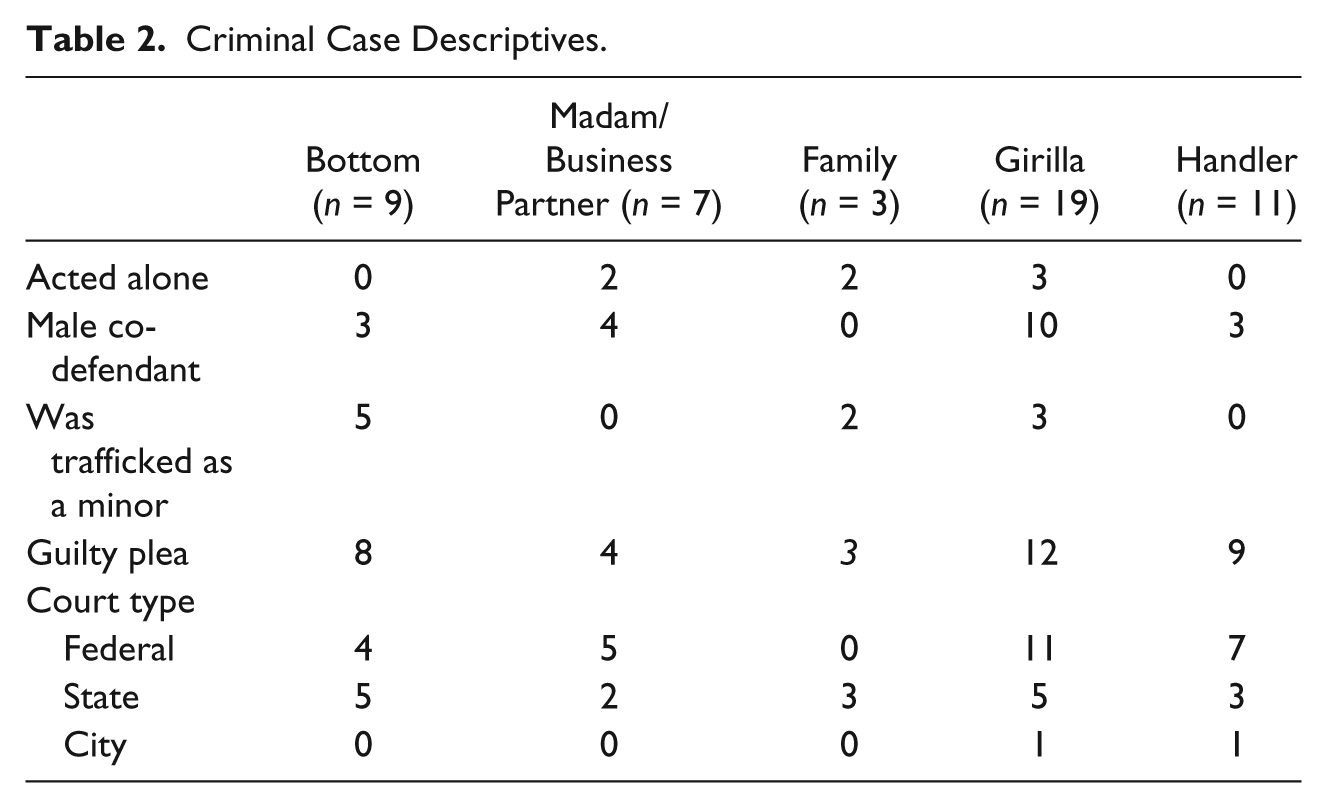
Madams have traditionally been considered the house manager of a brothel, in some cases, doing the training of new “square” girls (Heyl, 1976). In most cases, Madams managed the activity within a structured prostitution setting, and their role represented a business relationship with women who worked under them or alongside them to earn a profit in the sex industry, and also with other business partners in the sex industry. This role was demonstrated in the case files for 7 of the 49 women in this study who worked alongside a male pimp, acting as a madam or business partner by providing services such as answering customer’s phone calls; setting up customer “dates” with times, amounts, and locations; and transporting minors to the “date” in multiple states. Madam/Business Partners were the youngest group of female pimps at the time of arrest and were most often Caucasian (57.1%). Only two Madam/Business Partners’ case files included sentencing information, and neither received a sentence. They were also involved in cases with the fewest minor victims, with an average of 1.2 victims. One female pimp identified as Madam/Business Partner held bank accounts in her name and provided business support/bookkeeping for the trafficking ring, as well as assistance in the recruiting and transporting of minors. She also owned a home where some of the minors were trafficked. Another example of a madam/business partner was a former prostitute who called herself a “ho savior.” She was the middleman connecting customers to prostituted women/minors; she obtained false identification for a 14-year-old minor, and transported her across state lines for prostitution. She placed ads for the minor online and shared in the profits with a male co-defendant. A final case was a female pimp who assisted a male co-defendant in recruiting minors to work as escorts. She assisted in renting hotel rooms, gave the minors instructions on how much to charge, handled all telephone calls from customers, arranged appointments, drove the minor to the hotels, collected the money, and directed the minors to recruit others for the business. She also called potential recruits and talked to them about entering into prostitution. Please see Table 2 for details about the case details.
Criminal Case Descriptives.
Family
Another documented type of pimp found in the literature is described as an authority figure (Kennedy et al., 2007), most often a parent or family member including biological parents, foster parents, and older siblings. This type of pimp was represented in the data for this study, although we modified the category to include fill-in or pseudo-family members whose relationships included elements of authority and caretaking. Specifically, the three female pimps in this category included women who acted like a caring or nurturing adult toward the minors, and so this category is titled “Family.” Family pimps could be considered a “benevolent pimp” who does not force others into prostitution but provides them with a safe place to live, teaches them the rules of the game to keep them safe, and generally cares for them. All three of the Family pimps were Caucasian. One case involved a mother prostituting her daughter (age 13) and a 15-year-old girl. She and the girls engaged in sexual activities for hire, sometimes at her home. She supervised, managed, and set up dates for the two minors. A complex case in the Family category was a woman who was sexually abused at age 4 by a parent, intercourse was initiated at age 9, and she was diagnosed with herpes at age 10. She was sex trafficked at age 12 and was severely raped at age 15. Her mother allowed her to prostitute out of her house. Social services intervened but she ran away from foster homes to her mother’s house or to the streets to prostitute. When she was 19, she began housing other prostitutes and she told them they did not have to do anything that they did not want to do, and that she would take care of them and give them whatever they wanted. She identified having the minor girls work for her was like a family. Her co-defendant was her uncle who also profited from the sexual exploitation of the minors.
Girilla
Male pimps are known to use brute force to put a new woman on the streets and have been labeled gorilla pimps (Kennedy, Klein, Bristowe, Cooper, & Yuille, 2007). Gorilla pimps have been found to use techniques including threats, beatings, kidnapping, group/gang raping, and threatening violence against a victim’s family or loved ones. For female pimps, we modified this label to read “Girilla” illustrating a unique typology of intra-gender violence commonly found in female-to-female sex trafficking relationships. Nineteen of the 49 women identified as female pimps were classified as Girilla pimps. These cases were unique in their use of violence, threat of violence, and force in their treatment of the minor victims. The Girilla pimps were given the longest sentences of all categories and were 36.8% (n = 7) Caucasian and 31.2% (n = 6) African American.
An example of a Girilla case is two women who together kidnapped an 11-year-old girl and brought her from Canada into the United States to be prostituted. They abducted, beat, and drugged the victim with LSD, speed, caffeine, and ecstasy. They forced her to work 11 to 12 hours at a time as a street-level prostitute. In addition to mirroring the brute forced used by male Gorilla pimps, this case also demonstrates how female Girilla pimps participate in international sex trafficking, and nearly half (n = 8, 42.1%) of the 19 Girilla pimps were involved in international sex trafficking of minor victims. Another case involved two adult sisters whose crime was described by the judge hearing their case as the “most depraved” she had seen. The sisters, along with two of their brothers, lured Mexican girls from poverty-stricken areas between the ages of 14 and 18. They promised legitimate jobs, love, marriage, and a better life. Once the minors arrived from Mexico to the United States, they were confined to a brothel and forced to submit to sex acts six to eight times a day. They were not allowed to leave the house or speak to each other and were subjected to threats of harm, force, and psychological coercion with physical beatings by the female Girilla pimps if they disobeyed.
A case of a “Bottom” girl was categorized as a Girilla because of the violence and force she used against two minors (cousins aged 14 and 15 abducted on their way to get a frosty). She and her male co-defendant picked up the minors in their car and held them in their hotel room for 10 days where they were transported to other hotels to be prostituted. The Girilla pimp watched while her male co-defendant sexually assaulted them and together they forced the minor victims to engage in sex acts with customers she arranged.
Handler
A fourth category called the “Handler” involves what has most traditionally been considered trafficking behavior, including recruitment, harboring, and transportation of victims. The actions of 11 women in this study warranted inclusion in this category. Handler female pimps participated in (a) transporting victims, (b) being the significant other of a male pimp but only peripherally involved in the sex trafficking of the minors, (c) befriending the minor victim while they are being recruited and trained by the male co-defendants, (d) creating photographs for online sex ads of the minor victims, and (e) were mothers who assisted their sons in pimping minors. For example, one mother bought a bus ticket for the minor who was being forced to prostitute by her son, which enabled the minor to get to wherever her son was living. The other mother of the male pimp would occasionally drive the minor victim to the streets where the minor was to prostitute if the son was unavailable. She also allowed her son to use her computer to post ads for the minor on the internet.
Another example of a Handler was the manager of a hotel where her boyfriend (and co-defendant) operated his business of prostitution, harboring aliens who were working for him as prostitutes. The Handler supplied her co-defendant with a room key allowing him access to all of the hotel rooms. She also went on trips with him and the minor victims. A final example is the wife of a male pimp who traveled with him and the minor victims (aged 14 and 16) to four different cities but was not involved in the transactions or receipt of money.
Bottom
The final type of female pimp was identified as a “Bottom.” The terms “bottom,” “bottom bitch”,” or “main girl” have been used to describe a woman who works for or with a pimp who earned additional responsibilities including befriending other girls and recruiting them for their pimp; training other girls on how to post ads, dress, make deals, and how to do the acts requested by the customers; and providing discipline, including violence to keep the recruits in line for the male pimp (Kennedy et al., 2007). Typically, this person is one who fits one of three categories: (a) the longest-serving sex worker, (b) the highest earner, or (c) the most trusted associate of the pimp with an inclination to protect the pimp or advance his objectives before care of self. In this study, 9 of the 49 women were identified as being the Bottom. In some cases, they were identified in court documents specifically as the Bottom and described as co-conspirators or accomplices with a male pimp who together ran a prostitution business, recruiting minors to engage in commercial sex acts. The role of the Bottom in these cases related to the sexual exploitation of minors to include recruiting minors, training the workers recruited by the pimp, exerting physical or psychological control over the prostituted girls/women when the male pimp was not present, assisting in renting hotel rooms, posting ads online, and transporting minors across state lines. In all cases in which a woman was identified as a Bottom, there was also a male co-defendant, their trafficker, who prostituted the woman along with the minor victim. For example, one female pimp’s case file described her as a “Bottom” for a male pimp who ran a prostitution ring across the country and gained fame when he appeared in the documentary, “Pimps Up” and a daytime talk show. The woman met this male pimp during the filming of “Pimps Up,” and her role in his trafficking operation was to obtain backgrounds on his prostitutes’ lives and “program” them on his rules. She was also a prostitute under his employment.
Bottoms were involved in the largest sex trafficking rings when compared with the other female pimp categories and were most likely to be African American (55.5%). Bottoms received the longest probation sentences of all of the types. In one case, a 22-year-old woman was involved in the kidnapping of a 13-year-old girl with her co-defendant, her male pimp. Once the kidnapping was accomplished, the Bottom instructed the girl on the rules of prostitution and how much to charge for sex acts. She had the girl observe her and a customer engage in sexual activity to show her what to do. The 22-year old was often beaten and punched by her pimp for punishment, especially with regard to the 13-year-old kidnapped girl. The 22-year-old had a 6-year-old child with the pimp and had been prostituted by him for more than 7 years, beginning when she was a minor. This example demonstrates how female pimps in this category play a complex role within sex trafficking networks, as they are often women who have experienced significant victimization prior to becoming a participant in victimizing other girls. Although they often experienced prior victimization, and may have continued to be victimized by male pimps and customers even as they participated in trafficking minors, these women were included in the study because they received charges for trafficking-related crimes and there is no evidence that their experience with victimization was taken into consideration during sentencing.
Another case involving a woman categorized as a Bottom described her offense, along with her male co-defendant, in which they provided the minors with a place to live, a car for transportation to see customers, guidelines for pricing and sex acts, and instructions to lie about their age. She also provided the minors with drugs and alcohol (prior to engaging in sex with customers). In another nationwide prostitution case, a Bottom recruited minors to engage in commercial sex acts and collected the money directly from the customers. She also trained the minors on sex acts and exerted control over them when the male co-defendant was not present. She and her co-defendant rented more than 100 hotel rooms in three states and they recruited minors through friends, clubs, bars, and the internet. They posted more than 100 sex ads on the internet of the three minors they were charged with sexually exploiting.
Discussion
The main findings from this study include the actions of 49 female pimps during their involvement in the sex trafficking of minors, the differences in case resolutions when comparing male and female pimps, and the development of five categories of female pimp roles. Regarding the research questions, determining whether there were differences between case resolutions including sentences of jail/prison and probation, as well as fines assigned between the female pimps and their male co-defendants, this study found there were significant differences. Sentencing and fine data drawn from this study indicated that judges and prosecutors issued significantly shorter incarceration sentences for female traffickers overall, in some cases, in exchange for testimony in pending cases against their male co-defendants. However, there is little guidance available to courts and practitioners who are faced with the unique challenge of determining the culpability of female traffickers who were themselves, in some cases, violently exploited by their male co-defendants, particularly those categorized as “Bottoms.” Female pimps in some roles, particularly those whose first exposure to sex trafficking was well before the age of majority, are often subjected to a prolonged pattern of violence and abuse as well as psychological programming. In this study, among known histories, 10 female traffickers (20.4%) had been sex trafficked as minors. This process of early victimization may contribute to a female trafficker’s motivation to victimize other women due to her fear of violent reprisal at the hands of her male co-defendant, or because persistent psychological trauma and programming has altered her ability to fully understand the consequences of her actions.
Because so little is known about the experiences of female traffickers, the mitigating factors applied during sentencing vary tremendously even within the limits prescribed by law for trafficking-related offenses. Informal mitigation sometimes takes the form of charging defendants with lesser crimes, such as money laundering and, in one case, conspiracy to defraud the United States, which may reflect the prosecutor’s desire to encapsulate the defendant’s culpability in ways that are not possible using existing anti-trafficking statutes.
Perpetrators of sex trafficking offenses must face severe consequences for their actions to protect victims from future offenses and to demonstrate the community’s disapproval of commercial sexual exploitation. Further study of the roles that female traffickers play in the broader mechanisms of commercial sexual exploitation, however, may reveal nuances in culpability, which presently indicates the need for more flexible laws. For example, most jurisdictions do not acknowledge a defense of duress when the defendant is indicted for a violent crime, even in cases where the female trafficker was coerced to act by a male trafficker for fear of harm to herself or her immediate family and has limited or no opportunity to escape the situation. More information regarding the effects of prolonged sexual exploitation on an individual’s ability to refuse the demands of his or her abuser would be helpful to provide guidance to courts and prosecutors who handle trafficking cases. A uniform protocol to aid courts in determining which types of cases are appropriate for mitigated and alternative sentencing could create a more consistent body of anti-trafficking legal procedure.
Limitations
Several important limitations need to be considered when interpreting and applying the findings from this study. The information gathered for this study was from 21 states from both state and federal cases, and each of the 49 cases had varying amounts of detail in the court and media documents. This study used secondary data, which limits what we could explore but also did not always include information that would have assisted us in drawing more firm conclusions about the differences between the male and female co-defendants as well as the unique categories of female pimps. This was a cross-sectional sample of all known cases of females being charged in the United States between 2002 and 2009 with charges related to the sexual exploitation and trafficking of minors. There may have been sex trafficking cases that were filed in state and or local courts that were not included in this study because they did not include sex trafficking-specific charges. Given the secretive nature of this crime, this sample is not necessarily generalizable to women trafficking minors who go undetected by law enforcement, and have not been arrested and charged with a CSEC crime.
Implications
This is the first research study to explore the role of female pimps in the exploitation of minors in the United States. Several implications from this research are impactful for both criminal justice practitioners and service providers who are involved with both sex trafficking suspects and victims. By categorizing different roles, it demonstrates the distinct roles women play in the process of the sex trafficking of minors in the United States. Unlike much research that evaluates the role of women primarily as victims of sexual exploitation, this study identifies some of the resulting behaviors of a sex trafficking victim as she transitions from victim to victimizer. The awareness that women play multiple roles in sex trafficking situations is important for members of the criminal justice community regarding investigations, prosecution, and punishment. Recognizing that most, but not all, of the female pimps were themselves victims of severe violence at the hands of their co-defendant should be considered as they are prosecuted for their role in the victimization of a minor.
This information will be useful to law enforcement, prosecutors, and probation and parole workers, as well as to social service agencies serving victims of sex trafficking to better understand the roles of females in the sex trafficking of minors. Future research should include testing the inclusivity of these categories using additional sex trafficking of minor cases.
Footnotes
Declaration of Conflicting Interests
The author(s) declared no potential conflicts of interest with respect to the research, authorship, and/or publication of this article.
Funding
The author(s) received no financial support for the research, authorship, and/or publication of this article.