




Abstract
The co-occurrence of bullying and cyberbullying in a dual society like the present calls for specific measures of intervention to be able to forestall the emergence of new problems and slow the increase and diversification of violent behavior. This study’s objective was to determine whether the gender of those involved as well as the forms of aggression experienced both in presential and virtual scenarios are predictive indicators of the violent behavior of aggressive-victims. The participant sample was 1,648 adolescents aged 12 to 16 years (48.9% girls). The instrument used was a questionnaire. The results show the existence of four categories of aggressive-victims resulting from the co-occurrence of presential and cyber contexts: aggressive-victims of bullying, cyberaggressive-victims, aggressive-cybervictims, and cyberaggressive-cybervictims. Furthermore, three predictive indicators of the abusive behavior of the aggressive-victims in their different categories were identified: continuity between contexts, type of abuse suffered, and the gender of those involved. These indicators allow one to extract individual profiles of the different types of aggressive-victims, which facilitate, on one hand, the understanding of the processes of victimization and aggression that adolescents experience in both presential and cyber contexts, and, on the other, the design of programs and specific actions based on the characteristics of the adolescents and their previous experiences of victimization or cybervictimization.
Introduction
Continuous technological advances experienced in today’s society have caused major changes in the way we communicate and interact with others. To the mechanisms used in physical contexts, one must add those used to relate specifically with others in networked (virtual or cyber) environments. The growing role played by these virtual scenarios has raised new issues about the processes of bullying among adolescents (Bonano & Hymel, 2013). Traditional forms of bullying now co-exist with modes of aggression that use the resources of the Internet, and that come under the term of “cyberbullying,” a concept still under construction and a topic of major interest and ongoing debate among researchers (Law, Shapka, Domene, & Gagné, 2012). There is particularly great interest and uncertainty in determining the scope and implications of the co-existence of the two phenomena—bullying and cyberbullying—among youngsters (Laghi et al., 2013).
The study of the co-occurrence of these two phenomena is being approached from different perspectives. Some workers have examined the transfer of roles from physical to cyber contexts, looking in particular at the likelihood of the same roles being performed in virtual contexts as were taken in physical contexts. Among the early research in this line is that of Ybarra and Mitchell (2004). Their results on a sample of 1,501 U.S. students found 3% of the victims of bullying to also be victims of cyberbullying. Smith et al. (2008) report a much greater prevalence, with 14.1% of a sample of 533 adolescents aged 11 to 16 years having the victim’s role in both physical and cyber contexts. Juvonen and Gross (2008) found an even greater proportion in their study of 1,454 U.S. pupils aged 12 to 17 years—85% of the sample had experienced at least one episode of bullying and one episode of cyberbullying in the previous 12 months. However, their study reveals neither whether the roles of victim and cybervictim overlapped nor which came first.
Subsequent studies also present conflicting data. For example, Hemphill et al. (2012) find that few youngsters (7.3% of a sample of 696 adolescents) are involved simultaneously in situations of traditional bullying and cyberbullying. This is in line with the finding of Gradinger, Strohmeier, and Spiel (2009) that there was co-occurrence of these two roles in 6.2% of their sample of 791 adolescents aged 14 to 19 years. In contrast, Olweus (2012) reports that, of a sample of 65,000 U.S. pupils, very few youngsters have a purely cybervictim or cyberaggressor role. Instead, there is a very strong overlap of roles between the physical and the virtual contexts. In particular, 88% of the sample who had felt themselves victims of at least one situation of bullying in the past 2 months had also suffered episodes of cyberbullying. The statistic was similar in a sample of 9,000 Norwegian students, of whom 91% felt they had been victims of both bullying and cyberbullying (Olweus, 2012). Although these data demonstrate that the two phenomena co-exist, they do not provide any information about the types of aggression involved, which would help better understand the patterns of this co-occurrence.
Work on the transfer of roles from physical to other cyber contexts has focused on the processes of being victimized and of victimizing, although there have been fewer studies on the latter. Of these few studies, Smith et al. (2008) report that approximately 9% of teens are bullying and cyberbullying aggressors, and Gradinger et al. (2009) report a figure of 4.5%, although neither study gives the frequency or the modes of abuse. Likewise, although Raskauskas and Stoltz (2007) confirm this relationship between aggressor and cyberaggressor, they do not provide any additional information on the variability of the prevalence depending on the type of abuse committed.
Although the transfer of roles from physical to cyber contexts seems to be to a greater or lesser extent proven, despite doubts generated by the diversity of the samples studied, of the methods used, and of the analytical strategies followed, the inverse relationship, that is, the transfer of roles from the cyber to the physical context, remains largely uninvestigated. The only reports found in the literature merely indicate that there is little likelihood of a pupil first experiencing episodes of cyberbullying and subsequently being involved in bullying situations, regardless of the role played (Del Rey, Elipe, & Ortega-Ruiz, 2012; Hemphill et al., 2012; Riebel, Jäger, & Fischer, 2009; Schneider, O’Donnell, Stueve, & Coulter, 2012).
Another aspect of the study is the assumption of roles in cyberbullying situations that are different from those adopted in previous situations of bullying (Cuadrado & Fernández, 2014). The prevalence of the co-occurrence of the roles of victim of traditional bullying and victim of cyberbullying has been quantified by Ybarra and Mitchell (2004) as 7.7% and by Smith et al. (2008) as 7.9%. An even lower prevalence of co-occurrence of these roles—only 1% of the cases—is reported by Slonje and Smith (2008) from a sample of 360 Swedish students aged 12 to 20 years. Also, Raskauskas and Stoltz (2007) find no relationship between being a victim in physical contexts and playing a cyberaggressor role. In contrast, Olweus (2012) finds that 88% of pupils who have been bullying victims themselves become aggressors in cyber contexts. That author warns, however, that if other criteria are taken as the referent frequency (twice or thrice in the past 2 months, once a week, or more than once a week), this percentage is reduced considerably. Del Rey et al. (2012) lend support to this association by showing that victim roles in physical contexts can be a partial predictor of cyberaggression. Werner, Bumpus, and Rock (2010) and Hemphill et al. (2012) do not agree, but indicate instead that the role of cyberaggressive-victim should only be understood as something purely circumstantial, and that cyberaggressive behavior cannot be predicted from experiences of being the victim of traditional bullying. These authors advocate establishing a new mode—that of a cyberaggressive-victim—and note that episodes of being a cybervictim show, at least in part, a tendency to develop cyberaggressive behaviors.
Gender Differences in the Co-Occurrence of Bullying and Cyberbullying
An extensive review of the scientific literature revealed that studies addressing gender differences in bullying and cyberbullying have focused on determining the prevalence of boys and girls in the different modes in which these two phenomena occur. Variations in these prevalences in situations of traditional bullying have been extensively studied (Smith, Cowie, Olafson, & Liefooghe, 2002). But studies of the influence of gender on the roles involved in cyberbullying have often given contradictory results. Although some conclude that there are no significant differences (Álvarez-García et al., 2011; Livingstone, Haddon, Görzig, & Ólafsson, 2011; Ybarra & Mitchell, 2004), others do find gender differences while recognizing their complexity (Tokunaga, 2010). In particular, the differences reported (Calvete, Orue, Estévez, Villardón, & Padilla, 2010; Ortega, Calmaestra, & Mora-Merchán, 2008; Salmivalli & Pöyhönen, 2012) seem to indicate a greater prevalence of girls as cybervictims and boys as cyberaggressors. Other results indicate that, regardless of the role played, girls tend to be more involved in situations of cyberbullying than boys (Rivers & Noret, 2010; Wolak, Mitchell, & Finkelhor, 2007). Other studies provide more detailed data on gender differences found in the different modes of cyberbullying. In particular, Smith (2012) detects a greater prevalence of girls in indirect relational cyberaggression done through text messaging or telephone calls.
However, insofar as we have been able to determine, there has been little research examining gender differences in cases of the co-occurrence of roles involved in abuse suffered or committed in physical and cyber contexts. Moreover, the data provided by the studies that do exist in the literature are inconclusive and concern only some specific type of duality of roles.
With respect to the co-occurrence of roles in physical contexts, Cuadrado and Fernández (2009) confirm the predominance of boys over girls as aggressive-victims, but qualify this in the sense that, when the frequency of the abuse suffered and committed decreases, the prevalence of girls surpasses that of boys. There were also found to be variations in the prevalence according to the type of abuse suffered and committed.
In their examination of co-occurrence involving both physical and cyber contexts, Del Rey et al. (2012) conclude that gender is a variable with little predictive value, and is often even irrelevant. Livingstone et al. (2011), however, indicate that the co-existence of cases of cyberaggressor and cybervictim is more common among girls. The disparity of studies that have explored the possible mediation of the gender variable in the co-occurrence of bullying and cyberbullying and the contradictions that are often found in their results point to the need for further research to address these questions. First, there is a need to consider the different dualities of roles involved in co-occurrence situations, and second, one must inquire into the influence of gender in the involvement of specific forms of abuse suffered and committed in physical and cyber contexts.
The Present Study
Previous research has revealed the existence of a transfer from bullying to cyberbullying of the roles of aggressor and victim. However, the interaction of physical and cyber environments in adolescents not only fosters this transfer or co-occurrence but also accentuates the adoption of more complex roles such as that of aggressive-victim. This profile, simply defined in traditional bullying situations, takes on new dimensions with the many combinations that arise from the co-existence of the phenomena of bullying and cyberbullying. The few studies that have been published on this issue have not been able to provide conclusive data allowing one to gain a clear vision of these new and varied forms of bullying that teenagers face.
The objective of the present study was to determine whether the gender of those involved as well as the modes of aggression experienced in both physical and virtual scenarios are predictive indicators of the violent behavior of aggressive-victims.
Method
Sample
The sample consisted of 1,648 adolescents (48.9% girls; SD = 0.5) of ages from 12 to 16 years (M = 14.1, SD = 1.3) enrolled in compulsory secondary education in state secondary schools in the province of Badajoz (Spain).
Selection was by roughly proportional, stratified, multi-stage sampling by cluster, with a random selection of groups of pupils in the participating schools. The strata considered were the geographical zone and the population size of the towns included in each zone. The aim thereby was to incorporate adolescents from both rural and urban environments. The clusters were the schools. In each of these, the groups of participating pupils were selected by a random process of taking one of the classes of each year of ESO (ages 12-16 years).
According to the latest statistical yearbook published in Extremadura (2011-2012), there were 31,740 compulsory secondary education pupils enrolled in the region’s state schools. For a 95% confidence level, a 5% maximum sampling error, and given that p = q = .5, the minimum sample size would be 1,469. The actual sample size was 1,648, above that minimum threshold, allowing the study to be made satisfying those statistical criteria.
With respect to the demographic and socio-economic variables of the sample, it should be mentioned that the geographical area from which the participants were drawn has a very small number of immigrant families or of families with racial and cultural characteristics significantly different from those of the autochthonous population. For this reason, there is only a minimal representation in this sample of secondary school pupils with a different cultural, racial, or ethnic profile. Of the total study sample, only 15 had racial or ethnic profiles different from their peers. Such a small, and barely significant, group does not allow any comparative analysis to be made with the rest of the sample population. Also, in composing the sample, it was decided to exclude pupils with some kind of disability so as to avoid the inclusion of other variables that might have had a marked influence on the overall results. The definition of the strata by geographical zones encompassed both central urban populations whose families are of a relatively higher socio-cultural and economic level, and peri-urban and rural populations whose families are of a relatively lower socio-economic level. The final sample selection had a balance of the two types of profile, with analogous representations. We opted for overall analyses of the entire participant population, excluding any comparative analyses based on differential socio-economic profiles. The reason for this decision was that all of these teenagers, including those from socially, culturally, or economically disadvantaged backgrounds, have easy access to Internet technologies. They can use these tools in their schools, in their town libraries, or through their friends, when they do not actually have them in their own home. They all, therefore, have the sufficient means to commit or suffer episodes of cyberbullying. In addition, 98% of the teenagers surveyed stated on the questionnaire that they had a smartphone with Internet access. This datum implies that all of the participants, regardless of their socio-economic status, are susceptible to being subjected to or committing cyberbullying attacks.
Instrument
The instrument used for data acquisition was a revised version of the questionnaire applied by Cuadrado and Fernández (2009) to identify and define the profile of the aggressive-victim of bullying. The modifications made to this questionnaire consisted of the insertion of two new categories that corresponded to the phenomenon of cyberbullying: cybervictimization and cyberbullying itself. Thus, the final version of the questionnaire consisted of four categories: victimization, bullying, cybervictimization, and cyberbullying. The first two (corresponding to traditional bullying) comprised 26 items concerning behavior related to six modes of aggression: exclusion, verbal aggression, direct physical aggression, indirect physical aggression (damaging, stealing, or hiding personal belongings), threats, and sexual harassment. The last two (corresponding to cyberbullying) comprised 22 items concerning behavior related to four modes of cyberaggression (Nocentini et al., 2010): written–verbal aggression, visual aggression (publication of images or videos whose content is designed to embarrass, ridicule, or compromise a person’s moral integrity), impersonation, and exclusion. The response options to all the items were presented on a 4-point Likert-type scale indicating the frequency of the attack suffered or perpetrated in the preceding 2 months: 1 = never, 2 = once or twice, 3 = once a week, and 4 = various times a week.
An internal consistency analysis of each of these dimensions showed a high level of reliability, with the following values being reached: bullying, α = .88; victimization, α = .91; cyberbullying, α = .83; and cybervictimization, α = .84.
Procedure
The questionnaires were distributed by the researchers themselves during school hours, after prior approval on the part of the participating schools’ administrations and of the families of the participating adolescents. Before handing out the questionnaires, the researchers explained to the participants what was understood by bullying and cyberbullying, and how they could differentiate these phenomena from other episodes of aggression. It was also stressed that it was necessary to focus on behavior manifested and experienced in the past 2 months. These indications were also expressly set out in the wording of each of the questionnaire’s items.
Data Analysis
The data were analyzed using the SPSS 19.0 statistics software package. Descriptive statistics were used to determine the prevalence of the aggressive-victim in the various modes of aggression. To study the potential relationship between the mode and the frequency of the bullying suffered and perpetrated, we first performed a correlation analysis of the aggressive-victim categories identified, taking gender into account as a variable. Second, we performed a multiple regression analysis to confirm the possible relationships between abuse committed and abuse suffered, and to identify which experiences of being victimized were the best predictors of the teenagers’ aggressive behavior. The required confidence interval was set at 95%, so that the statistical significance level considered was α = .05.
Results
Classification of Aggressive-Victims
Depending on the type of bullying suffered and the means used for its perpetration, the role of victim acquires a twofold dimension: victim (when the abuse corresponds to traditional modes of bullying and is manifested in physical, classroom contexts) and cybervictims (when the abuse is experienced through the Internet, or by electronic or telephony devices). Similarly, the role of aggressor also has this twofold dimensionality: bullies (in traditional bullying) and cyberbullies (when Information Communications Technology are used to perpetrate the abuse). The combination of these dimensions yields four profiles of adolescents who are themselves bullied and then turn to bullying others of their peers (Table 1).
Correlation of Aggressive-Victims’ Profiles According to Gender.

p < .05. **p < .01.
The values of Pearson’s correlation coefficient and the level of significance found for these four types of aggressive-victim indicate that their presence in the school context is neither random nor extraordinary. Rather it is a reality that is becoming ever more complex.
Experience of Victimization as a Conditioner of the Type of Abuse Carried Out by Aggressive-Victims
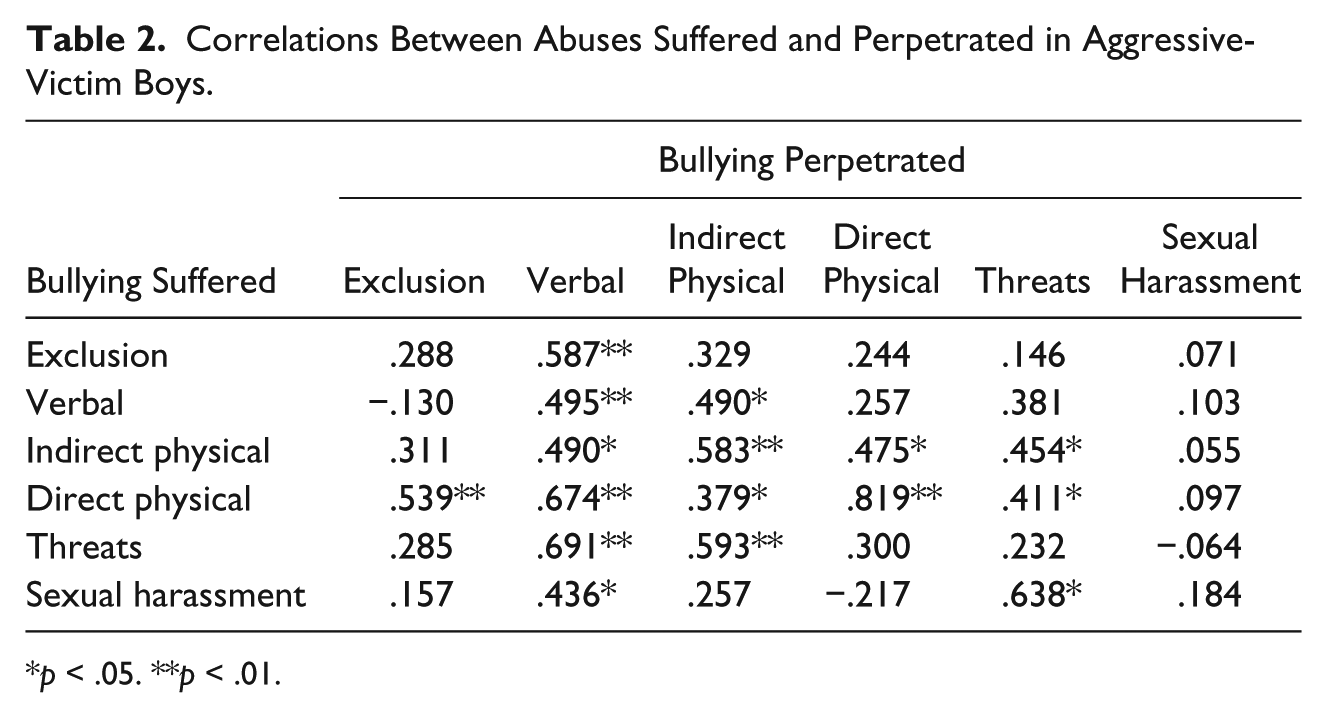
The results show that, regardless of the type of abuse suffered and the gender of the aggressive-victims, the type of aggression they usually perpetrate against their peers is that of a verbal character, followed by indirect physical character (hiding, breaking, or stealing personal items). They also show that sexual harassment is just a residual behavior among the totality of manifestations of violence (Tables 2 and 3). However, some differences were found between boys and girls in the aggressive behaviors that they manifest depending on the abuse they have suffered. This was confirmed by the correlation and regression analyses. The regression equations were significant for both the boys, R2 = .289, adjusted R2 = .265, F(7, 821) = 30.45, p = .001, and the girls, R2 = .225, adjusted R2 = .217, F(5, 784) = 26.19, p = .001. The results showed that boys who have been verbally and physically abused show a mimetic behavior when they attack their peers (Table 2). The regression analysis likewise confirmed this mimicry for the verbal (β = .32, p = .003), direct physical (β = .57, p = .000), and indirect physical (β = .29, p = .006) modes of abuse. In girls, however, this mimicry is only found in the case of direct physical abuse (β = .47, p = .000; Table 3).
Correlations Between Abuses Suffered and Perpetrated in Aggressive-Victim Boys.
p < .05. **p < .01.
Correlations Between Abuse Suffered and Perpetrated in Aggressive-Victim Girls.

p < .05. **p < .01.
Other gender differences indicate that boys who have been victims of direct physical aggressions diversify their own violent behavior, resorting to exclusion (.539** or p < .01), threats through anticipation of a possible aggression (.411**), verbal through insults and spreading false rumors (.674**; β = .32, p = .014), and physical (direct and indirect, .819** and .379*) aggression. In contrast, girls tend to abuse their peers through verbal (.755**; β = .29, p = .038), direct physical (.904**), and threat (.883**; β = .38, p = .035) aggression. When the aggression suffered corresponds to patterns of social exclusion, boys tend to resort to verbal abuse (β = .40, p = .031), whereas girls also incorporate into their behavior direct and indirect physical abuse (β = .47, p = .004; Tables 2 and 3). Finally, when the adolescents suffer threats, boys abuse their peers verbally (.691**; β = .34, p = .008) and with indirect physical aggression (.593**), and girls use verbal abuse (.645**; β = .53, p = .000) but not threats (−.712**).
Cyberaggressive-Victims
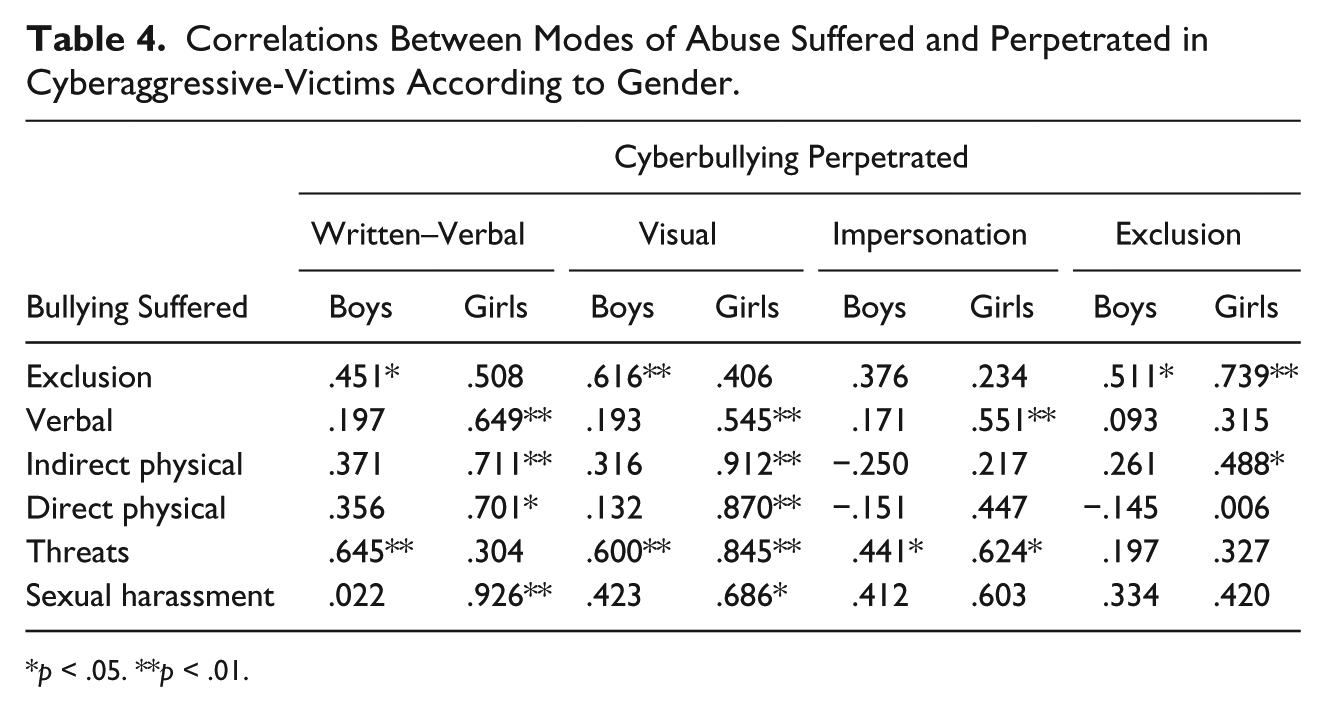
The cyber abuse that the cyberaggressive-victims mostly commit is verbal (spoken or written) and visual, independently of the aggression suffered (Table 4). The results also show that impersonation is a behavior that is often used by those who suffer intimidating threats from their peers. Similarly, exclusion from forums and virtual spaces tends to be behavior adopted by those who have suffered isolation in physical contexts.
Correlations Between Modes of Abuse Suffered and Perpetrated in Cyberaggressive-Victims According to Gender.
p < .05. **p < .01.
With regard to differences in gender, it appears that there is a stronger correlation between the modes of abuse suffered and perpetrated in the case of girls. Boys do not have a well-defined mode of cyberaggressive behavior, except for the cases in which they are victims of exclusion or threats (Table 4). The regression analyses showed that, in the case of the boys, R2 = .196, adjusted R2 = .173, F(15, 819) = 22.35, p = .003, visual aggressions can be predicted from previously experienced aggression in physical contexts, for example, exclusion (β = .322, p = .002) and threats (β = .238, p = .011). Also, when they receive threats, they tend to manifest verbal (spoken or written) aggressive behavior (β = .34, p = .042). For the girls, R2 = .152, adjusted R2 = .138, F(19, 778) = 19.74, p = .001, there was mimicry of the abuse committed with that suffered in the cases of exclusion (β = .52, p = .001) and verbal abuse (β = .287, p = .013). Experiences of being victims of threats and direct and indirect physical abuse were predictors of visual aggressive behaviors (β = .49, p = .000; β = .52, p = .000; β = .44, p = .002; respectively).
Aggressive-Cybervictims
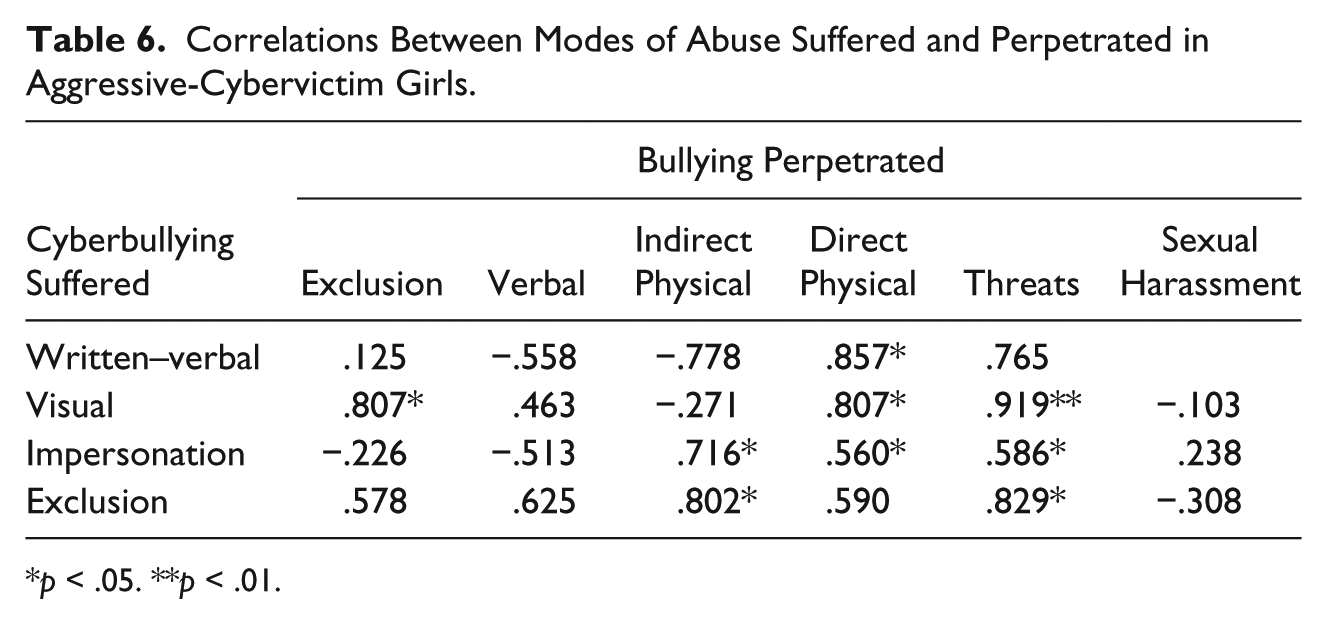
The analysis of the bullying behavior perpetrated by aggressive-cybervictims showed only three adolescents who turned to sexual abuse to hurt their peers, and that this manifestation was unrelated to any particular mode of cyberaggression suffered (Tables 5 and 6).
Correlations Between Modes of Abuse Suffered and Perpetrated in Aggressive-Cybervictim Boys.

p < .05. **p < .01.
Correlations Between Modes of Abuse Suffered and Perpetrated in Aggressive-Cybervictim Girls.
p < .05. **p < .01.
The results also showed significant gender differences in the synergistic relationship between the modes of abuse suffered and perpetrated. Overall, boys present more diversified aggressive behaviors than girls, except in the cases in which they are victims of impersonation (Table 5). In those situations, girls resort to threats (.586*) and indirect (.716*) and direct (.560*) physical aggression, whereas boys are inclined to abuse others mainly through social isolation (.554*).
A final result that stands out refers to the verbal abuse perpetrated by aggressive-cybervictims. In the case of boys, this behavior manifests itself when they are victims of verbal (.604*), visual (.790**), or exclusion (.794**) cyberaggression, whereas in girls, this behavior is uncorrelated with any of the modes of cyber abuse suffered (Table 6).
Prediction of aggressive behavior is more limited in the case of the girls, R2 = .087, adjusted R2 = .069, F(32, 726) = 11.62, p = .046, than in that of the boys, R2 = .118, adjusted R2 = .093, F(21, 807) = 17.89, p = .032. Threats are the commonest type of abuse used when the girls had been victims of cyber-exclusion (β = .29, p = .043) or visual aggression (β = .44, p = .005). For the boys, when the abuse suffered is verbal, they tend to attack others through both direct (β = .40, p = .002) and indirect (β = .36, p = .007) physical aggression. When the aggression suffered is visual, the boys’ aggressive behavior tends to consist of insults and spreading false rumors (categorized together under the verbal mode: β = .33, p = .021) or direct physical abuse (β = .29, p = .034). When the abuse suffered is cyber-exclusion, the boys manifest aggression in the form of threats (β = .38, p = .000).
Cyberaggressive-Cybervictims
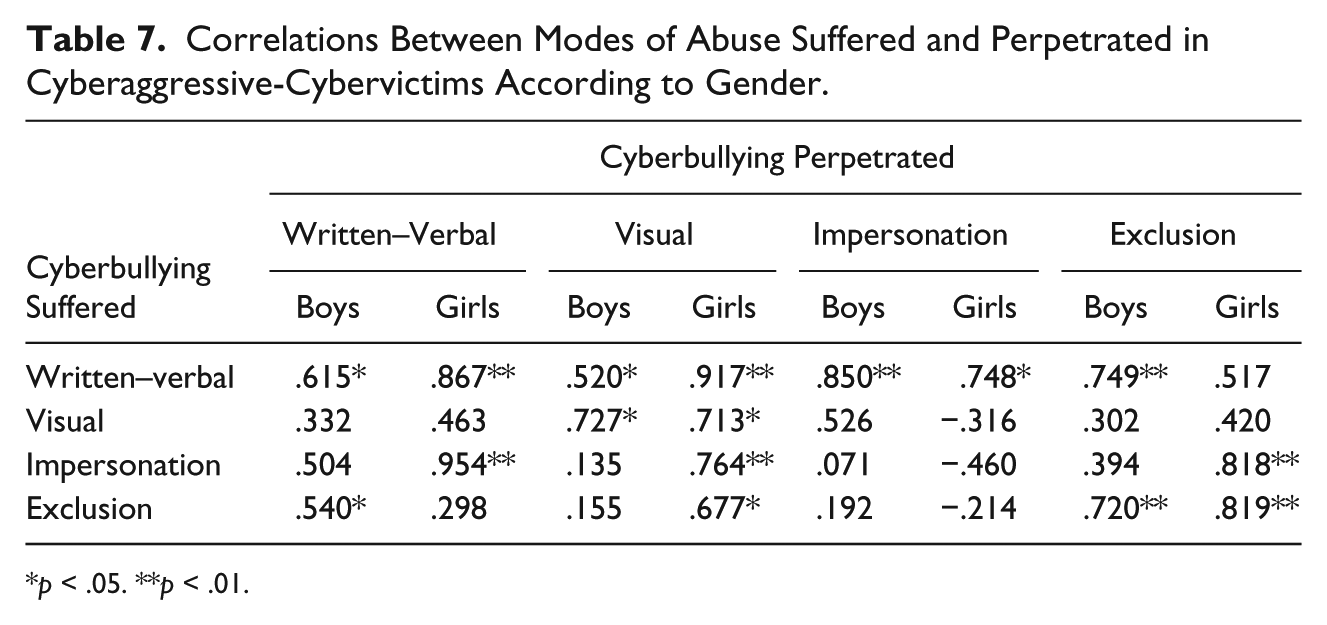
With respect to the cyberaggressive-cybervictim group, there was a certain mimicry between the types of bullying suffered and perpetrated in both the boys (R2 = .231, adjusted R2 = .208, F(16, 814) = 24.63, p = .003), and the girls (R2 = .209, adjusted R2 = .184, F(12, 783) = 19.71, p = .006), except in the case of those who had suffered impersonation who responded with other modes of aggression such as sending messages or making anonymous calls, exclusion, or dissemination of visual material that threatens the integrity of their victim. Regardless of the mode of bullying suffered, this group of teenagers used many modes of bullying to attack their peers. This was especially so of those who had been the object of intimidating or harassing messages or telephone calls (Table 7).
Correlations Between Modes of Abuse Suffered and Perpetrated in Cyberaggressive-Cybervictims According to Gender.
p < .05. **p < .01.
The analysis of gender differences showed that, when this group of adolescents suffers impersonation, while boys present no well-defined pattern of cyberaggression (Table 7), girls are strongly inclined to commit verbal (.954**; β = .48, p = .000), visual (.764**; β = .26, p = .018), or exclusion (.818**; β = .30, p = .005) modes of cyber abuse. Also, when the aggression suffered is related to cyber-exclusion, as well as the mimetic behavior presented by these cyberaggressive-cybervictims (β = .294, p = .026 in boys; β = .387, p = .000 in girls), boys also tend to commit verbal abuse (.540*), whereas girls opt for visual aggression (.677*).
The regression analysis showed that suffering verbal abuse is a predictor of boys’ aggressive behavior in the modes of impersonation (β = .35, p = .001) and cyber-exclusion (β = .30, p = .016). The aggressive behaviors that are predicted in the girls are visual (β = .38, p = .003) and verbal (β = .33, p = .02) modes of aggression.
Discussion
The present results show that the transfer of roles (aggressor and victim) from physical to virtual contexts and vice versa is a reality that is becoming steadily more complex due both to the diversity and simultaneity of the roles played in the two contexts (physical and virtual) and to the multiplicity of the modes of bullying that are suffered and perpetrated.
This reality is evidenced, for example, in the high number of adolescents identified in the present study as cyberaggressive-victims or aggressive-cybervictims, which appears to in part contradict the observations of Calvete et al. (2010) and Hemphill et al. (2012) that co-occurrences of the phenomena of bullying and cyberbullying are exceptional. Other studies have, however, confirmed the relationship between these two categories of aggressive-victims (cyberaggressive-victims and aggressive-cybervictims), adding that the existence of certain processes of victimization may be a predictor of the aggressive response of many of the teenagers who play these roles (Akbulut & Eristi, 2011; Del Rey et al., 2012; Wang, Iannotti, Luk, & Nansel, 2010).
The present results make it possible to improve and adjust predictions of adolescents’ bullying behaviors from knowledge of the specific aggressive behavior that each of the categories of aggressive-victims manifest depending on the type of abuse they themselves have suffered. In particular, one can extract a set of predictive indicators from the results, which will help orient prevention and intervention measures to combat violence among adolescents (Fung, 2012).
A first indicator corresponds to the high degree of continuity in the use of the same type of scenario or context. In this sense, the results show, as do those reported by Hemphill et al. (2012), that victims of aggression in physical or virtual environments tend to use the same resources to, in turn, abuse their peers. In the case of aggressive-victims, this continuity is stronger in boys than in girls. In the case of cyberaggressive-cybervictims, the gender differences are reversed, with a stronger correlation in girls than in boys. In line with the work of Del Rey et al. (2012), there is also strong continuity in the cyberaggressive-victim case, especially in girls. In this sense, Ybarra and Mitchell (2004) and Varjas, Talley, Meyers, Parris, and Cutts (2010) argue that this is largely due to the anonymity made possible by technological and virtual resources. By hiding their identity, victims no longer perceive the power imbalance that prevails in physical settings, and choose to retaliate by way of compensation for the hurt they have been caused.
A second indicator is the type of abuse suffered. In the four categories of aggressive-victims analyzed, a certain mimicry was found between the modes of abuse suffered and perpetrated, especially when the aggression suffered corresponds to indirect or verbal aggression. This mimicry has been described in previous studies (Cuadrado & Fernández, 2009), and some authors explain it on the basis of the perceptions that these adolescents have of the potential that the type of abuse they have suffered has to cause pain to their peers (Hughes & Trafimow, 2012; Vangelisti & Young, 2000). The experience of the harm that a certain mode of abuse has caused them can give rise to false beliefs about the potential of that behavior to hurt others, without their realizing that the others may not have the same vulnerabilities, and will not, therefore, necessarily suffer the same consequences. In the cases in which this mimicry does not occur, there is a synergistic relationship between exclusion suffered, in either physical or cyber contexts, and primarily verbal and indirect physical aggressive behavior perpetrated. Schwarzwald, Koslowsky, and Brody-Shamir (2006) explain the tendency toward these modes of aggression by referring to the imbalance of power criterion. The situations of victimization, which they had suffered previously, caused these adolescents to experience such a strong sense of inferiority that it is difficult for them to confront their peers directly.
A third indicator is the gender variable. The relevance of this indicator lies not only in the detection and identification of aggressive-victims and their subsequent classification into the four resulting categories (aggressive-victim of traditional bullying, cyberaggressive-victim, aggressive-cybervictim, and cyberaggressive-cybervictim) but also in its mediating role in determining the abusive behavior they demonstrate against their peers. With respect to identification and classification, there is a stronger correlation in the case of girls toward performing the roles of cyberaggressive-victim and cyberaggressive-cybervictim. Girls give greater importance than boys to the imbalance of power criterion in situations of bullying and cyberbullying (Cuadrado, 2012), which may in part explain that their aggressive behavior is preferentially committed in a cyber environment as a result of the anonymity that affords them when they are hurting their peers. In the same sense, the tendency of boys toward direct aggressive behaviors (Smith et al., 2002), more characteristic of physical than cyber scenarios (Erdur-Baker, 2010), could explain the strength of their correlations in the aggressive-victim and aggressive-cybervictim categories.
A study conducted in Spain by Bringué and Sádaba (2009) found that girls use social networks to a greater extent than boys, and that they are earlier owners and users of such cyber resources as smartphones. These circumstances could facilitate their greater prevalence of cyberbullying behavior, and consequently their adoption of roles in which cyberaggression is present.
With regard to the mediating or predictive role of the gender variable in the relationship between the modes of abuse suffered and perpetrated, the present results allow a series of profiles to be drawn that can contribute to matching anti-bullying and anti-cyberbullying programs to the reality of the aggressive behavior of boys and girls according to the abuse they have suffered previously.
The co-occurrence of bullying and cyberbullying in today’s dual society calls for specific intervention measures designed to forestall the emergence of new problems and to slow the increase and diversification of violent forms of behavior (Pearce, Cross, Monks, Waters, & Falconer, 2011). The predictive indicators provided in this study, together with the definition of the profiles of the different categories of aggressive-victims, may contribute to a deeper understanding of the processes of victimization and aggression that adolescents experience in both physical and cyber contexts. Such knowledge is considered to be one of the keys in the search for effective anti-bullying and anti-cyberbullying programs (Cassidy, Faucher, & Jackson, 2013; Felipe, León, & Bullón, 2013) because it will allow specific actions to be designed for the particular characteristics of those involved and their prior experiences of victimization or cybervictimization, instead of relying on the myths that have grown around these phenomena or on certain general notions that might explain them (Sabella, Patchin, & Hinduja, 2013).
Footnotes
Declaration of Conflicting Interests
The author(s) declared no potential conflicts of interest with respect to the research, authorship, and/or publication of this article.
Funding
The author(s) received no financial support for the research, authorship, and/or publication of this article.