




Abstract
Intimate partner violence (IPV) affects people connected to survivors as well as survivors themselves. Despite this, we do not have measures assessing IPV’s impact on others. The Impact on Friends measure was developed to understand the impact of disclosure of sexual assault (SA) on friends of survivors. In the present study, the Impact on Friends measure was modified to apply to IPV and administered to two separate online samples. Exploratory factor analysis in one sample (U.S.-based participants) revealed a very similar factor structure to the original Impact on Friends measure, consisting of Emotional Distress, Validation, and Confusion. This factor solution was then applied to the next sample (mostly Indian participants), resulting in an adequate model fit. The Impact on Friends-IPV measure has adequate reliability. One of its factors, Emotional Distress, is related to increased depression and post-traumatic distress disorder symptoms of friends, but only in the U.S. sample. These findings suggest that even though the same dimensions have been found in both a U.S. and an Indian sample, how disclosure of IPV on friends relates to psychological symptoms may differ. This study suggest that there is at least some overlap in the experiences of friends of IPV and SA survivors, but that certain dimensions of the measure may have different relationships to other phenomena in different cultures.
Social support is important to survivors of intimate partner violence (IPV). In addition to help from professionals, two thirds of IPV survivors in the United States seek some form of informal support (from friends and family; Goodman, Dutton, Weinfurt, & Cook, 2003; Levendosky et al., 2004; Rose, Campbell, & Kub, 2000). Any form of social support is associated with decreased mental health problems (Campbell, Sullivan, & Davidson, 1995; Carlson, McNutt, Choi, & Rose, 2002; Coker et al., 2002; Coker, Watkins, Smith, & Brandt, 2003; El-Bassel, Gilbert, Rajah, Folleno & Frye, 2001; Tan, Basta, Sullivan & Davidson, 1995; Thompson et al., 2000). Friends’ reactions to disclosure are especially salient to survivors, and positive reactions from friends are associated with better recovery (Campbell, Ahrens, Sefl, Wasco & Barnes, 2001; Filipas & Ullman, 2001; Ullman, 1996). Many survivors believe informal support to be more effective than formal help because friends and family know the situation and the people involved (Budde & Schene, 2004; Mancini, Nelson, Bowen, & Martin, 2006).
Despite the importance of informal support to survivors, the impact of IPV disclosure on others is poorly understood. Preliminary studies suggest a radiating impact of IPV on friends, family, neighbors, and coworkers of the survivor (Riger, Raja, & Camacho, 2002). Research on sexual assault (SA) suggests that distress and confusion about how to react are common among friends and family members of survivors (Ahrens & Campbell, 2000). The Impact on Friends measure was developed to assess how disclosure of SA impacts friends of survivors (Ahrens & Campbell, 2000; Banyard, Moynihan, Walsh, Cohn, & Ward, 2010). Currently, no such measure exists for friends of IPV survivors. In this study, the Impact on Friends measure was modified to understand how disclosure of IPV impacts friends, as well as to see whether SA and IPV similarly affect friends of survivors. Factor analysis was used in two separate samples to investigate whether impact on friends can be found across different contexts.
Impact on Friends
Little is known about how violence impacts persons connected to the survivor who are not directly victimized, sometimes known as secondary survivors (Christiansen, Bak, & Elklit, 2012; Remer & Ferguson, 1995). However, research on SA survivors has shown that friends and family may be distressed and confused about how to react (Ahrens & Campbell, 2000). Friends show more empathy and are less likely to blame survivors than family members (Ahrens & Campbell, 2000) and report feeling validated by helping the survivor (Banyard et al., 2010). Studies of SA disclosure show that the relationship between the supporter and survivor can predict impact on both of them. For example, family members and romantic partners of survivors report negative emotions and interpersonal problems after disclosure (Davis & Brickman, 1996) but friends report less distress (Ahrens & Campbell, 2000). Friends of SA survivors are therefore impacted by violence, but less negatively than family members or romantic partners.
Family members and friends of IPV survivors may also be affected by the violence, experiencing violence or fearing that perpetrators will target them as well (Riger et al., 2002). Consistent with studies of SA survivors, one qualitative study has shown that friends of IPV survivors report distress and confusion in how to help or engage with the survivor. However, friends also felt responsible to intervene, especially when they were close friends, and were disappointed that the survivor did not leave the abusive relationship or listen to their advice (Latta & Goodman, 2011). This qualitative study suggests that there may be overlap in the reactions of friends of IPV and SA survivors, such as distress and confusion, but that IPV may also impact friends in a way that is unique from sexual assault.
Current Study
Until now, no quantitative studies have examined how IPV impacts friends of survivors. Because IPV and SA have certain overlapping characteristics, SA studies can inform IPV research. For example, both IPV and SA have mostly male perpetrators and female survivors. In addition, survivors of both types of violence may experience stigma and shame following victimization and recovery can take a long time. Also, friends of IPV and SA survivors report a similar impact of violence, such as confusion and distress (Ahrens & Campbell, 2000; Latta & Goodman, 2011).
To understand how disclosure of SA impacts friends of survivors, Ahrens and Campbell (2000) used victimization perspective theory to develop a measure called Impact on Friends. According to this theory, friends believe that they should help the survivors deal with their unwanted sexual experience. If friends feel unsuccessful in that role, they often feel frustrated and helpless (Ahrens & Campbell, 2000). The Impact on Friends measure was shortened and further developed by Banyard et al. (2010) and administered to a sample of college students. They found three dimensions: Ineffectiveness/Confusion, Emotional Distress, and Validation. Both Banyard et al. (2010) and Ahrens and Campbell (2000) studied friends of SA survivors. In this study, we modify the Impact on Friends measure by adding four items specific to IPV that were developed based on qualitative information from a prior study of friends of IPV (Latta & Goodman, 2011). This study’s purpose is to develop a measure appropriate for friends of IPV survivors: to examine whether IPV and SA have a similar impact on friends.
Because IPV and SA share certain characteristics, we expect a similar factor structure to emerge for the Impact on Friends-IPV as in the Impact on Friends measure for SA (Banyard et al. (2010). However, the four new IPV items may form their own factor, as they address concerns that are specific to IPV, but not to SA.
Finally, to more precisely assess the impact of a friend disclosing IPV, psychological symptoms of the friend are measured, further adding to the field’s knowledge about the impact of such a disclosure. Depression symptoms and post-traumatic stress disorder (PTSD) symptoms are common among IPV and SA survivors (Golding, 1999; Nemeroff et al., 2006; Plichta, 2004; Temple, Weston, Stuart, & Marshall, 2008; White & Chen, 2002), so if violence does have a radiating impact, we may see similar problems in friends. The dimensions of Emotional Distress and Ineffectiveness/Confusion may have a negative impact and are expected to be connected with increased psychological problems, but Validation indicates positive impact, so it is expected to be related to decreased psychological symptoms.
Method
Participants
Participants were recruited from Amazon Mechanical Turk (Mturk), an online international survey service. Mturk is a fast way of gathering reliable data and its users are similar to the general population sample of Internet users and significantly more diverse than college samples (Buhrmester, Kwang, & Gosling, 2011). Inclusion criteria were that participants needed to be 18 years old and to have had a friend disclose IPV to them; participants also gave informed consent. Participants answered the Impact on Friends-Intimate Partner Violence (IOF-IPV) measure, demographics, and questions about psychological symptoms.
For this study, two different samples were recruited to examine the IOF-IPV measure. The purpose of using two samples was to investigate whether impact on friends could be found across different contexts. The first sample was recruited from the United States and participants were asked to confirm their location before taking part. Originally, 1,002 people were recruited to be in the study, but many of these were excluded (did not fit eligibility criteria, give informed consent or answer quality control items correctly). The final number of participants was therefore 245. Excluding such a large number of participants is not unusual in online data collection, where it is considered necessary to get accurate information (Goodman, Cryder, & Cheema, 2012; Oppenheimer, Meyvis, & Davidenko, 2009). The average age for this sample was 31.71 years. The sample was almost evenly split between the genders, with 53.9% indicating that they were male. The largest racial group was Asian (38.4%), followed by White (34.7%), Hispanic (11%), Black (7.3%), American Indian or Alaska Native (6.5%), and 4.1% identifying as some other race group. When asked about own victimization, 37.1% of the sample had some kind of IPV experience.
The second sample was recruited in the same way and asked to answer similar questions, but there was no location requirement, to examine whether the same factors would emerge in a different context. Similar to the first sample, 951 participants were recruited and 274 were used for analysis of the Impact on Friends measure. The average age of participants was 30.13 years. There were slightly more men in this sample, 57.66%. Racial breakdown was as follows: 66.55% Asian, 23.74% White, 3.65% Black, 1.80% Hispanic, 0.73% American Indian or Alaska Native, 0.36% Native Hawaiian or Pacific Islander, and 3.24% identifying as some other race. The majority of participants came from India (67.15%), the second largest group was in the United States (25.55%), and 6.60% were in some other country. In this sample, 28.47% had personal IPV victimization experiences.
When the two samples were compared, no significant age or gender differences were found. However, there were racial composition differences, which was not surprising considering that the first sample came from the United States and the second was mostly from India. The first sample was more likely to have participants who identified as White, Black, Hispanic, Pacific Islanders, American Indian, or “Other” race. The second sample was more likely to have participants who identified as Asian. Participants in the first sample were also more likely to have had their own IPV victimization experience (37.1% compared with 28.7% in the second sample). The survey was administered in English for both samples.
Measures
Impact on Friends-IPV
The three subscales identified by Banyard et al. (2010) in the IOF measure for SA are Validation, Ineffectiveness/Confusion, and Emotional Distress. The reliability of the IOF measure for SA is 0.87, but no data were reported on validity (Banyard et al., 2010). In this study, the IOF measure (Banyard et al., 2010) was modified for IPV and administered to friends. Four new IPV items were added including: “I feel angry at the perpetrator,” because IPV friends have reported anger against the perpetrator (Latta & Goodman, 2011) and that sentiment can be found among SA friends as well (Ahrens & Campbell, 2000). The second new item was: “I felt responsible to intervene,” because IPV occurs over time and therefore it is possible to intervene in the violence (see Latta & Goodman, 2011). The last two items were: “I was disappointed because my friend did not listen to me” and “I was disappointed that my friend put up with the violence,” both of which were prominent responses of participants in Latta and Goodman’s (2011) study. This item pool was submitted to a group of violence research experts who agreed that they should be added to this measure to adapt it for IPV. The measure therefore consisted of 26 items, which were answered on a 5-point Likert-type scale, 1 = strongly disagree, 5 = strongly agree.
To assess psychological symptoms, the following measures were administered:
Post-traumatic stress disorder
The Short Screening scale for PTSD was developed using population data from a diagnostic interview based on the 4th edition of the Diagnostic and Statistical Manual of Mental Disorders (DSM-IV; American Psychiatric Association, 1994). The measure consists of seven items, which participants answer yes or no (Breslau, Peterson, Kessler, & Schultz, 1999). This measure has adequate reliability and validity in both clinical and general population samples (in the general population, the sensitivity of the measure is 78%, specificity 97%, positive predictive value 75%, negative predictive value 98%, and 96% of participants were correctly classified; Boehnert & Breslau, 2011). For this study, participants were asked to focus on PTSD symptoms connected to a friend’s disclosure.
Depression
The Center of Epidemiologic Studies Depression Scale, modified by Mirowsky and Ross (1990), was used to screen for depression symptoms. Participants were asked to rate depression symptoms since the disclosure on a 5-point Likert-type scale with seven items. This is a shortened version of a 20 item Center of Epidemiological Studies Depression Scale (CES-D) instrument, which has good internal consistency in the general population (Cronbach’s α = 0.85; Devins et al., 1988). This measure correlates highly with other measures of depression, such as the Beck Depression Inventory (Beck, Ward, Mendelson, Mock, & Erbaugh, 1961; Santor, Zuroff, Ramsay, Cervantes, & Palacios, 1995). As discussed below, the PTSD and depression measures do not overlap with items measuring Emotional Distress (one factor of the measure).
Other measures included the following:
Victimization history
To determine whether the impact on friends differs between those who have and have not experienced violence themselves, participants were asked: “Have you ever experienced IPV yourself?
Demographics
Participants were asked to give information about their gender, age, race, and their geographic location.
Quality control
To ensure that participants were reading the questionnaire thoroughly, two items that measure quality were included in the survey. The first item, embedded within the Impact on Friends measure, is the following: “To monitor data quality, please select ‘strongly agree’ for this question.” The second item was placed in the CES-D depression scale: “To monitor data quality, please select ‘rarely or none of the time for this question.’” Such items may verify that participants are actually reading the items and can improve data quality (Meade & Craig, 2012).
Procedure
Participants were recruited to complete a brief online survey on the Mturk website. Before participating, Mturk users were asked whether they had reached the age of 18 and whether they consented to participate in the study, if not, they were excluded from analysis. Participants were presented with a broad definition of IPV and asked whether a friend had ever disclosed such an experience. The definition used was as follows:
Intimate partner violence is a pattern of purposeful coercive behaviors that may include inflicted physical injury, psychological abuse, sexual assault, progressive social isolation, stalking, deprivation, intimidation and threats. These behaviors are perpetrated by someone who is, was or wishes to be involved in an intimate or dating relationship with an adult or adolescent survivor and are aimed at establishing control of one partner over the other (Family Violence Prevention Fund, 1999, p. 17).
Participants answered questions about demographics, whether they were survivors themselves, relationship quality, and completed the IOF-IPV measure and measures of PTSD and depression symptoms. Participants were paid 10 cents for their time and took on average 5 minutes and 18 seconds to complete the survey. The study was approved by the University’s Institutional Review Board.
Analysis
Data from the first sample were used to perform an Exploratory Factor Analysis on the IOF-IPV scale to examine whether the same three factor structure emerged with this sample, as with SA survivors in Banyard et al. (2010). Factor analysis requires at least 10 participants per item (Cabrera-Nguyen, 2010); this sample is close to that, with 245 participants and 26 items. The factors derived were then used to examine psychological symptoms. A Confirmatory Factor Analysis was used for the second sample, to see how well the factor solution fit the data and psychological outcomes in that sample. The computer programs R (version 2.15.2) and SPSS (version 20) were used for these analyses.
Results
In this study, we investigated how IPV impacts friends of survivors using the IOF-IPV measure. We first performed an exploratory factor analysis in the first sample and then used that factor solution to carry out a confirmatory factor analysis in the second sample. Finally, we examined the relationship between factors derived from the IOF-IPV measure and psychological outcomes.
Exploratory Factor Analysis
The data collected are appropriate for factor analysis (Bartlett’s test of sphericity: χ2(325) = 1690.79, p < .001, Kaiser–Meyer–Olkin = 0.82). Parallel analysis suggested a three factor solution using Principal Axis Factor Analysis and Promax rotation. Items were excluded that cross loaded on multiple factors or did not reach a 0.3 loading (total of eight items, Numbers 3, 5, 7, 9, 14, 18, 19, and 24). Three of these, Items 3, 14, and 24, were the IPV-specific items. The factor solution with standardized loadings is presented in Table 1 and the final solution, in which most of the items loaded predominately on one factor, is presented in Table 2. The communality coefficient (h2) shows that the factors explain between 9% and 57% of the variance in each item. A chi-square test of model fit was significant, χ2(250) = 17835, p < .001. Together all of the factors explained 38% of the variance in the items.
Exploratory Factor Analysis, Standardized Factor Loadings of Items, and How Much Variance of Each Item the Factor Solution Explains (h2).

Standardized Factor Loadings of Items of Exploratory Factor Analysis.

The three factors extracted are similar to Banyard et al. (2010): Emotional Distress, Validation, and Confusion. Table 3 shows factor reliability, factor correlations, and variance explained by each factor. Individual factors have adequate reliability, and reliability of the whole measure is 0.81. Descriptive information on individual items, relationship quality, and differences by gender and victimization history are available from the first author on request.
Factor Correlations, Reliability, and Variance Explained.
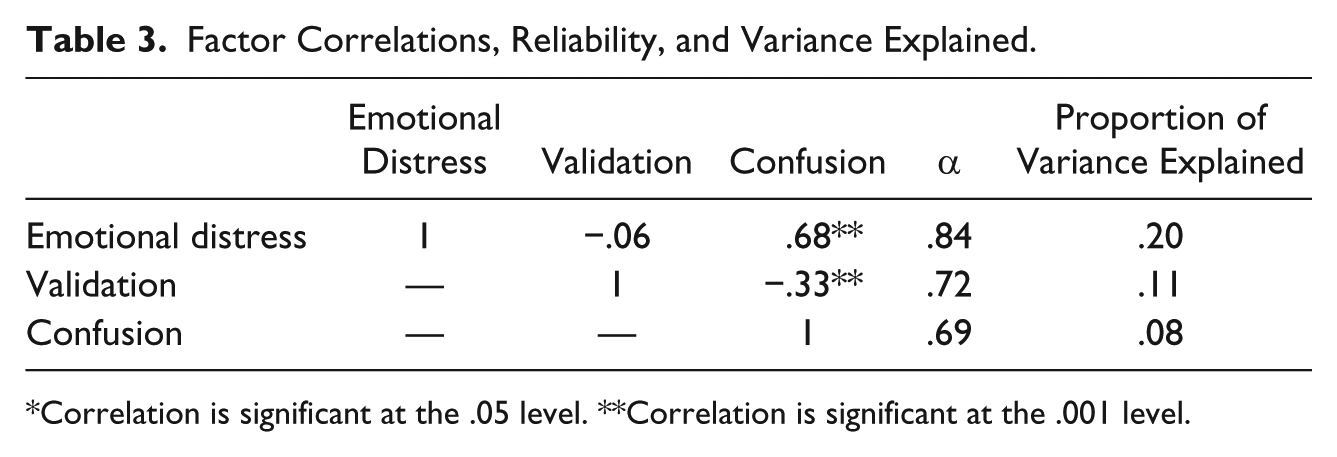
Correlation is significant at the .05 level. **Correlation is significant at the .001 level.
Confirmatory Factor Analysis
The second sample was then used to run a confirmatory factor analysis using the three-factor solution described in the previous section. The model fit was adequate, with root mean square error of approximation (RMSEA) of 0.07 (confidence interval [0.06, 0.08]), comparative fit index (CFI) of 0.83, and Tucker–Lewis Index (TLI) of 0.80. Table 4 shows how items in this sample loaded onto each of the factors. These results suggest that the three-factor structure fits the second sample data fairly well. In this second sample, the total reliability of the measure is 0.80, with subscale reliabilities ranging from 0.65 to 0.82. The relationships between the subscales are also similar to the first sample, with the exception that Emotional Distress and Validation are negatively correlated, but there was no relationship between the two in the original exploratory factor analysis.
Confirmatory Factor Analysis Loadings.
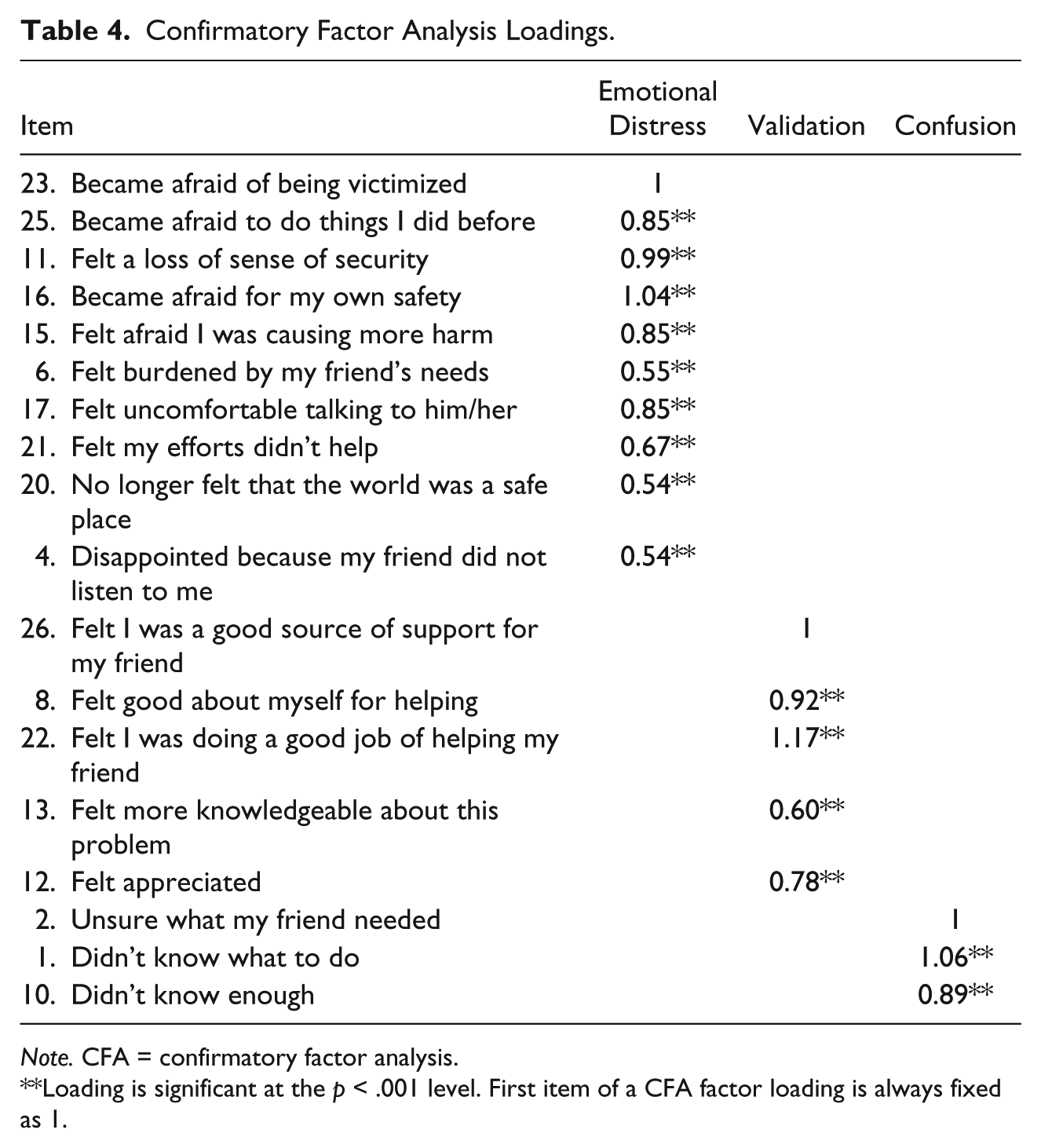
Note. CFA = confirmatory factor analysis.
Loading is significant at the p < .001 level. First item of a CFA factor loading is always fixed as 1.
Factor Scores and Psychological Symptoms
Next, we tested whether the identified factors are connected with psychological symptoms. We expected negative impact factors (such as Emotional Distress and Confusion) to be related to greater symptoms and positive impact factors (Validation) to be connected to fewer symptoms. We investigated this in the first sample. The hypothesis was partially confirmed, with both Emotional Distress and IPV connected to increased depression symptoms, β = 2.62, p < .001 and β = 1.49, p < .001, respectively. Contrary to our expectations, we found no relationship between Validation and depression symptoms. To understand how the different factors related to depression, we entered all factors into a multiple regression. We found that Emotional Distress uniquely predicted increased depression symptoms, β = 3.17, p < .001. Items on the Confusion factor may be impacting depression symptoms indirectly, through the Emotional Distress factor. With this in mind, we tested for mediation and found that Emotional Distress mediated the relationship between Confusion and depression symptoms (estimate of indirect effect = 1.49, p < .001). However, participants’ own victimization may explain some of the confusion and distress that they report. We therefore examined whether own victimization status moderated the relationship between Emotional Distress and depression symptoms and did not find that to be the case. This negative impact and its relationship to depression symptoms can therefore not be explained with the triggering of participants’ own victimization. Emotional distress appears to be significantly related to depression symptoms in the first sample, but the same factor was not connected with depression symptoms in the second sample.
For PTSD symptoms, results from the first sample were similar to what we had expected. Emotional Distress (β = 1.25, p < .001) and Confusion (β = .62, p < .001) were connected with increased PTSD symptoms, and Validation with decreased PTSD symptoms (β = −.46, p = .01). Multiple regression showed that Emotional Distress uniquely predicted increased symptoms, β = 1.78, p < .001, and that Validation uniquely predicted decreased PTSD symptoms, β = −.64, p < .001. Similar to depression symptoms, Confusion impacted PTSD symptoms through Emotional Distress, as a mediation analysis showed a significant indirect effect from Confusion through Emotional Distress to PTSD symptoms (estimate of indirect effect = 1.16, p < .001). Emotional Distress was not differently related to PTSD symptoms based on own victimization status. The subscales from the IOF-IPV measure are therefore connected with PTSD symptoms. However, these effects were not present for the second sample.
Discussion
The purpose of this study was to develop a measure of how IPV impacts friends of survivors. Results show that the impact measure consists of Emotional Distress, Validation, and Confusion. These factors are similar to those found among friends of SA survivors (Banyard et al., 2010). The impact remains similar, even though four IPV-specific items were added to the measure (only one of which was used in the final factor solution). Important differences exist between SA and IPV, such as IPV often being a more chronic experience by someone very close, whereas SA is sometimes perpetrated by strangers (Ullman, 2010). However, when it comes to the experience of the friend providing the survivor with support, the two forms of victimization appear to be quite similar. Furthermore, the three factor structure is not only similar to friends of SA survivors but was also found in two separate samples of IPV friends, indicating that Emotional Distress, Validation, and Confusion are important elements of being a friend of an IPV survivor.
To the knowledge of the authors, this is the first study to establish a potential relationship between being friends with a survivor of IPV and the mental health of a friend. In this context, Emotional Distress was especially salient, as it was uniquely related to increased depression and PTSD symptoms as well as a mediator between the Confusion factor and mental health symptoms. Because depression and PTSD are common among survivors, these results may indicate that the effects of violence are radiating from the survivor to others in their social network, as previous research has suggested (Riger et al., 2002). Also, because one’s own victimization did not moderate these results, this radiating impact cannot be explained with friends’ own personal experiences with IPV.
Despite being related, Emotional Distress is different from PTSD and depression. For example, PTSD symptoms generally fall into three categories: Re-experiencing the traumatic event, hyperarousal and avoidance of thinking of the event or things associated with it (Nemeroff et al., 2006). The Emotional Distress items (see Table 2) do not address re-experiencing trauma or avoiding to think about it. Some of the items do describe fear and a loss of sense or security, which may be related to hyperarousal, although none of the items directly tap into arousal connected to that fear. In a similar way, important parts of depression are depressed affect, positive affect, somatic complaints, and interpersonal problems (Berkman et al., 1986). None of the Emotional Distress items are similar to somatic complaints or positive affect. However, item 17, “Felt uncomfortable talking to him/her” could potentially be related to interpersonal problems. Finally, none of the items seem to explicitly describe depressed affect. Therefore, the Emotional Distress factor does not map well onto PTSD or depression symptoms, so it may be capturing something different from those concepts.
However, relationships between impact on friends and mental health outcomes were only found in the first sample, which included only participants from the United States. The second sample consisted mostly of participants from India, and these divergent relationships between the measure and mental health outcomes may be because of different expressions of distress or mental health problems in different parts of the world. Therefore, someone in India may feel upset that a friend is an IPV victim but show it in ways that are not adequately captured by Western measures of mental health outcomes (Brown, 1995). In addition, the IPV context may be very different in India and the United States. For example, extended families in India traditionally live together (often three to four generations under the same roof; Kumari, 2009) and arranged marriages are common (Nanda, 2000). How IPV is defined and addressed may be influenced by these factors. Parents may feel more responsible to intervene if their child’s partner is being abusive when the parents have arranged the marriage themselves. IPV may therefore be seen as more of a family or a community issue in Indian participants than a private matter just between intimate partners in a relationship, as is common in Western countries. Because of this, the community as a whole may intervene, making it less likely that individual members might feel responsible to intervene, be frightened of the perpetrator or burdened by the violence taking place. Alternatively, because male privilege and hierarchy is accepted within Indian culture (Derne, 1994), IPV may be seen as normal (especially non-violent, controlling aspects), and although disclosure of IPV may cause distress, it may not take a toll on the mental health of the friend. All of these factors may have influenced how participants responded to the questionnaire. Despite these potentially important cultural differences, it should be noted that the same model fit both samples adequately, suggesting that there are similarities in the experiences of being a friend of an IPV survivor that may cut across cultures.
Limitations of this study are that data collected were from self-reported, retrospective convenience samples. Also, because data were collected online, the questionnaire may only have reached those who are wealthy and educated enough to have a computer and Internet access. Survivor gender is also unknown, which may influence how women and men react to and are affected by IPV. Some participants may also have had family members disclose IPV to them at some point but unfortunately we do not have information about that. Another limitation is that even though the factors seem conceptually clear and the reliability of the scale is adequate, explained variance is not very high and model fit could be better. Despite these limitations, the factor solution was similar to that found in Banyard et al.’s (2010) study, suggesting that the sampling may not have drastically influenced the results.
In the future, it would be interesting to examine what important aspects may be missing from the measure, given the low explained variance. For example, few items address how the disclosure has impacted the friend’s life more generally. Knowing how IPV affects friends may be valuable because friends might be an important intervention target, both to improve their own outcomes as well as help them better support survivors. Future work in this field could involve developing a similar kind of measure for family members, as IPV survivors often disclose their experience to them (Rose et al., 2000). Also, documenting the mental health outcomes of family members of IPV survivors and comparing them with IPV friends may be useful to understand exactly how the impact of violence radiates differently for different informal social network members. In the meantime, this exploratory study provides some evidence of how IPV affects friends of survivors and shows that there is significant overlap in the impact of SA and IPV on friends of survivors.
Footnotes
Declaration of Conflicting Interests
The author(s) declared no potential conflicts of interest with respect to the research, authorship, and/or publication of this article.
Funding
The author(s) received no financial support for the research, authorship, and/or publication of this article.