




Abstract
The present study evaluates adolescent victimization and offending using cross-sectional survey data from 1,475 adolescents living in a disadvantaged Comuna in Medellin, Colombia, while paying particular attention to the ways in which both victimization and violent offending are operationalized. We find that 37% of respondents experienced no lifetime victimization, while 60% experienced vicarious, and 4% personal victimization. When restricting violent offending to behavior involving a weapon, the majority of offenders (81%) also experienced victimization while only 33% of victims were also weapons offenders. Our final analysis seeks to identify theoretical conditions which differentiate roles in a victim-offender typology, a result we determine varies significantly depending on how “violent offending” is measured.
Keywords
Introduction
Prior research has long established a link between adolescent offending and victimization (Chang, Chen, & Brownson, 2003; Jennings, Higgins, Tewksbury, Grover, & Piquero, 2010; Jensen & Brownfield, 1986; Lauritsen, Sampson, & Laub, 1991; Piquero, MacDonald, Dobrin, Daigle, & Cullen, 2005; Regoeczi, 2000; Reingle, Staras, Jennings, Branchini, & Maldonado-Molina, 2012; Savitz, Lalli, & Rosen, 1977; Schreck, Stewart, & Osgood, 2008; Wolfgang, 1958), acknowledging that each is more often found in disadvantaged contexts within which individuals are exposed to a lifestyle that exacerbates violent behavior (Daday, Broidy, Crandall, & Sklar, 2005; Gottfredson, 1984; Lauritsen & Laub, 2007; Lauritsen & Quinet, 1995; Mayhew & Elliott, 1990; Sampson & Lauritsen, 1990). However, general research exploring the victim-offender overlap provides evidence that distinct groups exist within this setting who experience neither victimization or offending, one but not the other, or both (Broidy, Daday, Crandall, Sklar, & Jost, 2006; Jennings, Reingle, Staras, & Maldonado-Molina, 2012; Klevens, Duque, & Ramirez, 2002; Reingle & Maldonado-Molina, 2012; Reingle et al., 2012). What remains unobserved is a thorough examination of this process among adolescents living in a context of urban disadvantage within a low-income country.
The primary goal of this article is to add to our understanding of how victim-offender groups are theoretically unique. We use survey observations collected among a group of high school students in a disadvantaged neighborhood, Comuna 13, of Medellin, Colombia, with a considerable history of violence to address the following objectives. First, we seek to establish the portion of overlap between adolescents both involved in and exposed to violence (i.e., victimized). Next, we establish theoretically derived conditions unique to the group experiencing neither victimization nor offending, those who are victims or offenders exclusively, and those involved in both. Finally, this study draws awareness to the ways in which both victimization and violent offending are operationalized. Specifically, our analysis differentiates between adolescents whose sole involvement in violence is fighting versus those who acknowledge offending associated with weapons (knives or guns).
Contextual Overview
Even by U.S. standards, strikingly violent ecological contexts are found throughout Latin America. At 67.5 per 100,000 and 49.5 per 100,000, respectively (Pan American Health Organization [PAHO], 2012), male homicide rates in Central and South America are 6 and 8 times those of North America in general and the United States specifically. Within Latin America, the male homicide rate for Colombia was 109.2/100,000 in 2009, the second highest in the Americas that year (exceeded by El Salvador). The leading cause of death among 10- to 19-year-olds (19.7% of Colombia’s population) remains homicide and 67% of deaths due to external causes among those aged 15 to 19 was violence in 2004. Like the United States, the Colombian phenomenon of adolescent violence is strongly correlated with urban disadvantage (Moser & Mcilwaine, 2006), and the threat is far greater among Colombian males as their homicide death rate is 6 times that of females (PAHO, 2012). When one considers additional sources of violent victimization, the situation remains bleak as there were 480/100,000 situations involving nonfatal wounds in 2004 and sexual crimes increased by 8.8% from 2003. These statistics illustrate considerable prevalence of exposure to violence (ETV) among Colombian residents, especially those residing in low-income urban Comunas.
Although high rates of violence are commonly found in urban environments, cities, even within the same nation, are quite unequal in their attractiveness. Throughout the world, few cities have experienced the level of violence and brutality that characterized Medellin, Colombia, during the 1980s and 1990s. The escapades of Pablo Escobar, Colombia’s preeminent drug lord until his death in 1993; Hollywood movie depictions (Clancy, 1989); and sensational news exposes of drug and guerilla-related murders in the city have built the perception among many that Medellin is one of the world’s most dangerous urban environments (Borrell, 1988). Between 1990 and 2002, there were 55,365 recorded homicides in Medellin, the overwhelming majority involving poor young men in the city’s slums (Cardona et al., 2005). During that 13-year span, the peak year for recorded homicides was 19/100,000 in 1991 compared with a “low” of 7/100,000 in 1998 (see Drummond, Dizgun, & Keeling, 2012 for additional contextual detail). However, under the leadership of the recent past President Alvaro Uribe Velez, a successful security policy has brought a reduction in road-side massacres, terrorist acts, kidnappings, as well as urban homicide (PAHO, 2012). These reductions were a result of confrontations with insurgents which included members of the Revolutionary Armed Forces of Colombia (known as Fuerzas Armadas Revolutionaries de Colombia—FARC), militia groups, and organized urban gangs (not always completely disassociated).
In 2002, the mountainside community Comuna 13—San Javier, which served as a site to the present research, experienced two such confrontations which bore particularly fruitful consequences. Working in close cooperation with the Colombian military and national intelligence services, Medellin’s local government and security forces took political and tactical advantage of governmental support in combating the guerilla-associated drug trade and paramilitaries. The success of the second such attempt, Operacion Orion (begun October 2002) allowed police and military units, for the first time in decades, to gain and maintain a physical presence in Comuna 13 (Demarest, 2011). So much so that by 2007, the city’s homicide rate had dropped to 28.6 per 100,000 and would remain at or near that level for much of the remainder of the decade. This recent amelioration of violence, allowed the present research, part of the ongoing Bowman Expedition of the American Geographical Society, to enter the Comuna and evaluate the impact of ETV among adolescents in arguably one of the most historically violent milieus in the Americas. The present article evaluates the influence of demographic variables alongside neighborhood, family, and peer contexts on ETV among adolescents. The literature review that follows examines how adolescent offending and victimization is understood, beginning with a focus on measurement.
Measuring Victimization and Offending
Several important early studies establish an overlap between adolescent victimization and offending (Lauritsen et al., 1991; Mawby, 1979). Mawby (1979) was one of the first to establish a significant association between adolescent victimization (mostly observed as theft) and property offending, particularly among males in a British sample of adolescents living in urban disadvantage. Next, using multiple waves of a nationally representative sample, Lauritsen et al. (1991) found that a delinquent lifestyle (participation in both violent and property crime) significantly increased four types of victimization whereas pro-social activities decreased the likelihood. These findings conclude that “victimization patterns among youths cannot be understood apart from criminal and deviant activities” (Lauritsen, Sampson, & Laub,1991, p. 265). With few exceptions, additional studies utilizing an adolescent sample also find a direct causal or associative relationship between victimization and offending, making this relationship one of the most robust in the criminological literature.
Although the majority of adolescent studies have measured victimization as interpersonal violence (Chang et al., 2003; Fagan, Piper, & Cheng, 1987; Jennings et al., 2010; Jennings & Komro, 2011; Jensen & Brownfield, 1986; Lauritsen & Quinet, 1995; Lauritsen et al., 1991; Mawby, 1979; Miller, 2012; Reingle & Maldonado-Molina, 2012; Schreck et al., 2008; Spano & Bolland, 2013), some have exclusively observed either homicide (Piquero et al., 2005; Regoeczi, 2000) or intimate partner violence (Jennings et al., 2012; Reingle et al., 2012). Beyond personal violence, a small number of studies have incorporated the broader concept of “exposure to violence” (ETV) into the victim-offender literature. For example, one study observed victimization as both personal victimization and being a witness to violence (Feigelman, Howard, Li, & Cross, 2000) while five additional studies evaluated victimization as either personal victimization, being a witness to violence, or the vicarious victimization experienced by hearing about the victimization of another—often a friend or family member (Maldonado-Molina, Jennings, Tobler, Piquero, & Canino, 2010; Maldonado-Molina, Piquero, Jennings, Bird, & Canino, 2009; Reingle, Jennings, Maldonado-Molina, Piquero, & Canino, 2011; Spano, Rivera, & Bolland, 2006, 2010). Although some argue that clarity is reduced by a broader conceptualization of victimization, the general strain theory asserts that many damaging life events occur vicariously (Agnew, 2001). The present research focuses on both personal and vicarious victimization.
When measuring adolescent offending, a large number of studies include diverse offending in one summative scale (Feigelman et al., 2000; Higgins, Khey, Dawson-Edwards, & Marcum, 2012; Jennings et al., 2010; Lauritsen & Quinet, 1995; Lauritsen et al., 1991; Maldonado-Molina et al., 2010; Maldonado-Molina et al., 2009; Mawby, 1979; Regoeczi, 2000; Reingle et al., 2011). An alternative approach is to provide separate analyses for different types of offenders (Chang et al., 2003; Fagan et al., 1987; Jensen & Brownfield, 1986; Miller, 2012), or focus exclusively on violent offending (Jennings & Komro, 2011; Jennings et al., 2012; Piquero et al., 2005; Reingle & Maldonado-Molina, 2012; Reingle et al., 2012; Schreck et al., 2008; Spano & Bolland, 2013; Spano et al., 2006). The present study analyzes two types of offenders: adolescents who simply fight, and those who admit to more serious behavior associated with a weapon (a knife or a gun). Placing special emphasis on the above distinctions in measuring victimization and offending, the first objective of the current research is to address the following questions:
Theoretical Framework and Empirical Research
Literature explaining adolescent victimization and violent offending has consistently underscored lifestyle and ecological conditions related to urban neighborhoods of concentrated disadvantage (Berg & Loeber, 2011; Fagan et al., 1987; Gottfredson, 1981, 1984; Lauritsen & Laub, 2007). Multiple criminological theories have been used to explain why populations living in urban disadvantage are uniquely vulnerable to victimization, offending, and the dual experience. Routine activities theory (RAT) and the associated lifestyle theory (Cohen & Felson, 1979; Felson & Gottfredson, 1984), extensions of social control theory (Hirschi, 1969), comprise a popular framework. Hirschi’s original control theory predicts increased likelihood of victimization and offending when bonds to conventional society are weak. A key mechanism identified by social control to enhance/develop attachment to society is involvement in conventional activities. The theory suggests that some such activities develop “conventional success goals” (Hirschi, 1969, p. 191) while others are conducive to pro-social behavior as they simply occupy time an adolescent could otherwise entertain by engaging in delinquency. Building on aspects of control theory, the routine activities/lifestyle approach argues that crime is most likely to occur when an attractive target, lack of capable guardian, and motivated offender exist together in the same time and space. When adolescents spend time in less structured environments (thus lacking capable guardianship), they are more likely to become attractive targets (i.e., victims) or motivated offenders (the latter exacerbated in accompaniment with peers).
In a careful review of the literature, several time-use effects are robust. Numerous studies indicate that positive parenting (time spent with parents, parental monitoring, parental attachment) decreases the likelihood of victimization, offending, or both (Jennings et al., 2010; Schreck & Fisher, 2004; Schreck, Wright, & Miller, 2002; Spano & Nagy, 2005; Wilcox, Tillyer, & Fisher, 2009), whereas poor parenting or risky behavior within families increases their likelihood (Higgins et al., 2012; Maldonado-Molina et al., 2010; Piquero et al., 2005; Reingle & Maldonado-Molina, 2012). Similar robust findings provide support for Hirschi’s assumption that riding around and engaging in unstructured socializing is a risky use of time as it is consistently associated with a higher likelihood of adolescent victimization (Jensen & Brownfield, 1986; Schreck & Fisher, 2004; Schreck et al., 2002) and a summative delinquency scale including property and violent offenses (Osgood, Wilson, O’Malley, Bachman, & Johnston, 1996). Unfortunately, evidence is less definitive regarding most time-use variables.
As an extension of Hirschi’s logic, one study (Osgood et al., 1996) found that relaxing alone at home is risky (associated with an increase in heavy alcohol/drug use) while working at home doing chores is protective (associated with a decrease in heavy alcohol and marijuana use). In a Kentucky sample (Wilcox et al., 2009), time spent in school-related extracurricular activities is risky as these activities increase the likelihood of both violent and property victimization. In contrast, Osgood et al. (1996) defined sport activity as neutral after finding no relationship with any delinquency measure. Time spent doing homework could be considered a proxy for the protective influence of school commitment as prior research has found a negative association with both victimization (Fagan et al., 1987; Jennings et al., 2010) and delinquency (Jennings et al., 2010). Unfortunately, the above findings are inconsistent with the Kentucky-based study in which time spent doing homework failed to predict the likelihood of either property or violent victimization (Wilcox et al., 2009). Finally, Jensen and Brownfield (1986) found that time spent at paid work, an activity identified as neutral using Hirschi’s framework, is in fact a risky use of time for their nationally representative and Arizona-specific respondents.
The RAT/lifestyle framework expects the likelihood of victimization and offending to increase in disadvantaged urban communities. Subcultural theories, such as the “code-of-the-street” (Anderson, 1999; Drummond, Bolland, & Harris., 2011), explain that such heightened risk is a product of structural disadvantage. These theorists argue that the spatial concentration coupled with the social, economic, and cultural isolation experienced in disadvantaged urban neighborhoods (most of which are populated by racial and ethnic minorities) provide a context for the emergence of an alternative set of cultural norms. Such norms deemphasize behavioral characteristics associated with mainstream society and, instead, prioritize physical toughness and violent retaliation as a way to attain and maintain the “little respect there is to be had” (Anderson, 1999, p. 75). By adopting a street persona, an individual has the chance at respect via involvement in violence. In the same context, adolescents seeking to develop a reputation for toughness might look for vulnerable targets. In sum, the ecological context of urban disadvantage creates a setting for displays of physical violence in which there are victims, offenders, and/or both.
Whereas prior research has established a quantitative link between the street code and either victimization or violent offending (Brezina, Agnew, Cullen, & Wright, 2004; Drummond et al., 2011; Higgins et al., 2012; Stewart, Schreck, & Simons, 2006; Stewart & Simons, 2010; Stewart, Simons, & Conger, 2002), research evaluating attachment to subcultural norms within the victim-offender framework is significantly underdeveloped in relation to a focus on routine activities, social and self-control, and social learning perspectives. Although one quantitative study (Klevens et al., 2002) based in Colombia did find that the victim-offender tried to appear tough and pretend to carry a weapon more often than the victim-only, it is a qualitative study from Canada which most integrates the subcultural theory into a victim-offender analysis. Throughout a 60-day period, Kennedy and Baron (1993) observed “punk” youth to be both victim and violent offender (including regular fighting and carrying weapons). In explanation, the youth in their study report that “having moved into a new cultural context with different norms, rules, and expectations, they accordingly followed a new set of routine activities. In turn, these routines appeared to shape and influence members’ behavioral choices” (p. 99). In other words, having adopted a punk persona and seeking similar others with whom to associate, the youth found themselves part of a minority group which was both frequently targeted by the normative other and itself encouraging of physical violence as a way to earn a “hard core” or tough persona. Kennedy and Baron (1993) concluded that “the escalation to violence is contingent on subcultural definitions of what is acceptable and tolerable within these interactions” (p. 108). It seems a natural extension that research focusing on routine activities and rational choice begin integrating subcultural reasoning as part of the process. Exploring a typology of victimization and offending within a context of urban disadvantage, we yield to the logic that attachment to subcultural beliefs should indeed be included in an understanding of role differentiation of adolescent victims and offenders.
In an approach similar to our own, several scholars (Broidy et al., 2006; Klevens et al., 2002; Reingle & Maldonado-Molina, 2012; Schreck et al., 2008) point to a few theoretical conditions unique to specific roles within the victim-offender typology (i.e., neither victim nor offender, victim-only, offender-only, and victim-offender). In a cross-sectional study of Colombian adults, Klevens et al. (2002) found that in contrast to the victim-only, the victim-offender is male, younger, single/divorced, lower class, spending more time in both solitary and congested areas, and drinking more frequently. Using a sample of homicide victims and offenders within the city of Albuquerque, New Mexico, Broidy et al. (2006) also found role-specific effects for gender and age in addition to race and social class (including a poverty measure). Schreck et al. (2008) conducted a comprehensive study utilizing the National Longitudinal Study of Adolescent to Adult Health data (Add Health), a representative study of U.S. adolescents. Despite including a number of demographic and RAT variables, only two effects are consistent; older adolescents are more likely to be victims while offenders drink more. Reingle and Maldonado-Molina (2012) used the Native American subsample of Add Health and find role-specific effects for alcohol/drug use, the desire to leave home, depression, prior violence and victimization, and gender. Our second objective extends this literature by establishing theoretically derived conditions which are role-specific within the victim-offender typology. In addressing this objective, we seek to answer the following additional questions:
Method
One of the two extremely disadvantaged Comunas in Medellin, Colombia, was selected as the ecological context to evaluate relationships between urban disadvantage and adolescent involvement in, and exposure to, violence in Latin America. In 2008, members of the research team traveled to Medellin 3 times to begin to understand Comuna 13 and its place in Medellin and Colombia. As part of this process, researchers toured Comuna 13, met with local governmental, police/security officials (including the mayor), representatives from the utilities organization Empresao Publica Medellin (EPM), and with local community groups in addition to collecting archival data from local university libraries, and geographic data within the Comuna. During several visits, the team also visited Universidad EAFIT to meet with social science faculty specializing in survey methodology. Two significant relationships emerged from these early visits. First, a political scientist at Universidad EAFIT shared survey items from a recent health survey he, and other local scholars, conducted among adults living in the four major cities of Colombia. He also entertained questions regarding our survey, under development at that time, and recommended that we recruit local Comuna residents to assist with data collection. Second, and perhaps most important, we established a partnership with a local non-profit organization in the Comuna whose goal is to provide socialization programs and opportunities for youth and their families. This organization helped identify appropriate public schools to contact for our adolescent survey for the following year.
During the summer of 2009, we surveyed three of six public high schools in the Comuna. Once the schools were identified, we sent a formal request to each during the spring and met with the principals in the summer to obtain the final permission. The community organization assisted in the recruitment of survey administrators who were trained in techniques of group administration. These community members read aloud the survey to classrooms and other group settings in an effort to reduce the impact of reading comprehension difficulties. It took approximately 1 hr (depending on the grade level), to administer the survey. After obtaining parental and subject consent, we collected data from 1,475 sixth to twelfth graders, approximately 62% of the total number enrolled.
Measures
Dependent variables
Victimization
Two questions were asked regarding violent victimization. The first assessed personal victimization (had the respondent ever been cut, stabbed, or shot; 0 = yes; 1 = no). The second question focused on “vicarious victimization” as conceptualized in the ETV literature (had a friend or family member ever been cut, stabbed, or shot; 0 = no; 1 = yes). Factor analysis indicated the two items loaded on the same factor; however, the reliability was extremely low (α = .11), likely due to personal victimization being such a rare event. To evaluate victim-offender overlap, a victimization typology was created which contrasted experiences of non-victims (0) to those of vicarious victims (1) and finally the extremely rare victim of personal violence (2). However, because the “2 code” (i.e., those who reported experiences with personal victimization alone) included only 56 cases (3.5% of the sample), a global victimization measure (contrasting adolescents who had experienced neither personal nor vicarious victimization = 0, to those who had experienced either personal or vicarious victimization = 1) was utilized in analysis intended to (a) identify distinct groups of victims and offenders and (b) identify demographic and lifestyle characteristics unique to each group.
Delinquency
Four questions regarding involvement in violence were included in the present analysis. These questions asked respondents whether they had ever (0 = no; 1 = yes) been involved in a physical fight, carried a weapon (knife or gun), brandished a weapon, or used a weapon. Factor analysis indicated that the three behaviors associated with weapons loaded together (α = .63) and fighting separately. Based on this information, a separate analysis was run for weapon-specific offending (contrasting those who have never carried, brandished, or used a weapon, coded 0, with those who admitted to at least one of those behaviors, coded 1; 26% of the sample) and the more general offending associated with fighting (contrasting those have never fought, coded 0, with those who have, coded 1; 77% of the sample).
Independent variables
Several questions were used to observe variation in personal characteristics. First, respondents were asked their age (range = 10-19) and gender (male = 1). 1 As a proxy for social class, respondents were asked whether she or he received free or reduced cost lunch at school (0 = no; 1 = yes reduced; 2 = yes free). Finally, neighborhood tenure (0 = <1 year; 1 = 1 year; 2 = 2 years; 3 = 3 years; 4 = 4 years; 5 = ≥5 years) captures variation in the length of time an adolescent has lived in Comuna 13.
Families as guardians
Beginning with variables about which our expectations are most definitive (based on the findings of prior research), three scales were used to assess parenting. First, parental rules consisted of five questions which inquired about rules regarding homework, dating, alcohol, drugs, and fighting/hitting other people (range = 0-5; α = .57). Next, the four questions assessing parental monitoring evaluated how much a parent knew about the behavior of their child after school and during the weekend (range = 0-8; α = .55). Finally, parental discipline was evaluated using three questions (range = 0-3; α = .46) which asked respondents what his or her parents did or did not do when a rule was violated (i.e., did calmly discuss what is wrong, did not yell and scream, and did not slap spank or hit). These parenting scales are included as a measure of guardianship and are expected to negatively correlate with offending and victimization. In contrast, one additional measure was included which captured the potential for the family context to be a corrupting influence as respondents were asked if a member of the household (excluding the respondent) was arrested in the last year (0 = no; 1 = yes).
Lifestyle
Six questions were asked about how respondents spent their free time during the school year (each measured as: 0 = none, 1 = 1-5 hr, 2 = 6-10 hr, 3 = 11-20 hr, 4 = >20 hr). First, we inquire about the amount of time the respondent spent hanging out unsupervised with friends, endorsed as a risk factor both theoretically and empirically, and expect this variable to be positively associated with both offending and victimization. For the five remaining time-use variables, we do state theoretically derived expectations while also acknowledging that the empirical literature testing such expectations is limited or inconsistent. First among those variables, respondents were asked separate questions regarding the amount of time each week (a) spent doing homework or (b) involved in “sports, clubs, or other extracurricular activities.” According to Hirschi’s Social Control Theory and the RAT extension, we argue that the above behaviors are consistent with “involvement in conventional activities” and as such should be considered protective characteristics, negatively associated with offending and victimization. While the prior two variables are theoretically considered “protective,” we also include three time-use factors, time spent doing housework, time spent alone at home, and time at a paid job, which we argue are neutral (having neither a priori expectation related to “success goals” nor expectation of a negative influence).
Street code as subculture
The final covariate included in analysis seeking to differentiate between victim and offender typologies seeks to measure internalization of norms consistent with Anderson’s Code of the Street. Eight questions, such as standing your ground when disrespected or finishing a fight when engaged, comprised the street code scale in the current analysis (range = 0-8; α = .62). This scale is expected to be positively associated with offending and victimization. 2
Results
Victim-Offender Overlap
The following analysis is divided into two phases, each addressing the two primary objectives of the present research, respectively. The first objective was to describe the prevalence and overlap of victimization and offending among youth living in Comuna 13. First, our data (Table 1) reveal that while 36.7% of the sample experienced no victimization and only 3.5% experienced personal victimization, approximately 60% reported experiencing vicarious victimization. Unsurprisingly, fighting is far more widespread (77.1% have been involved in at least 1 fight) than weapon-specific behavior (only 26% admit to ever carrying a weapon). To investigate victim-offending co-occurrence (overlap), we distributed cases into four distinct groups of victims and offenders: (A) adolescents who have been neither victimized nor involved in violence, (B) adolescents who have only been victimized, (C) adolescents who have only been involved in violence, and (D) adolescents who have experienced both. 3 This analysis reveals that victimization co-occurs (overlaps) with offending no matter how offending is measured, however the pattern of overlap is affected by how offending is measured (RQ2). Specifically, respondents were 3 times more likely to avoid both (i.e., 31.9% were categorized as neither victim nor offender) when weapons were involved than when fighting was the measure (i.e., only 11.3% of respondents were neither victim nor offender). In contrast, adolescents were twice as likely to be classified as both victim and offender in the fighting (51.6%) compared with the weapons model (20.9%). Furthermore, when restricting violent offending to behavior involving a weapon, fewer victims (33%) were also offenders in contrast to the fighting model where 82% of victims also fought. Addressing RQ3, additional analysis indicates both personal and vicarious victimization overlap with offending but the former is more pronounced. Specifically, among youth reporting no victimization, 69% had been in a fight while 14% carried a weapon. In contrast, 81% of those vicariously victimized had also fought and 31% had carried a weapon. Among the most extreme victims, 92% of those personally victimized had been in a physical fight and 73% reported carrying a weapon.
Univariate Statistics (N = 1,475).

In reflection of our first objective we conclude that most Comuna adolescents (63%) have been touched by victimization, though personal victimization (experienced by only 3.4%) is a rare event. When it comes to offending the majority, three out of four, have been in a physical fight though only one in four admit to carrying weapons. When violent offending is liberally measured as “fighting,” a greater portion of adolescents victimized were also fighters when contrasted to fighters who also experienced victimization. However, when violent offending strictly involved a weapon, the reverse is observed. Finally, victimization clearly escalates the likelihood of offending in a linear pattern, no matter how offending is measured. As expected, those personally victimized are most likely to also violently offend but even those vicariously victimized are substantially more likely to offend than non-victims. This finding provides support for the assumption that the victim-offender overlap exists even for youth experiencing vicarious victimization alone.
Covariates Associated With Victim-Offender Categorization
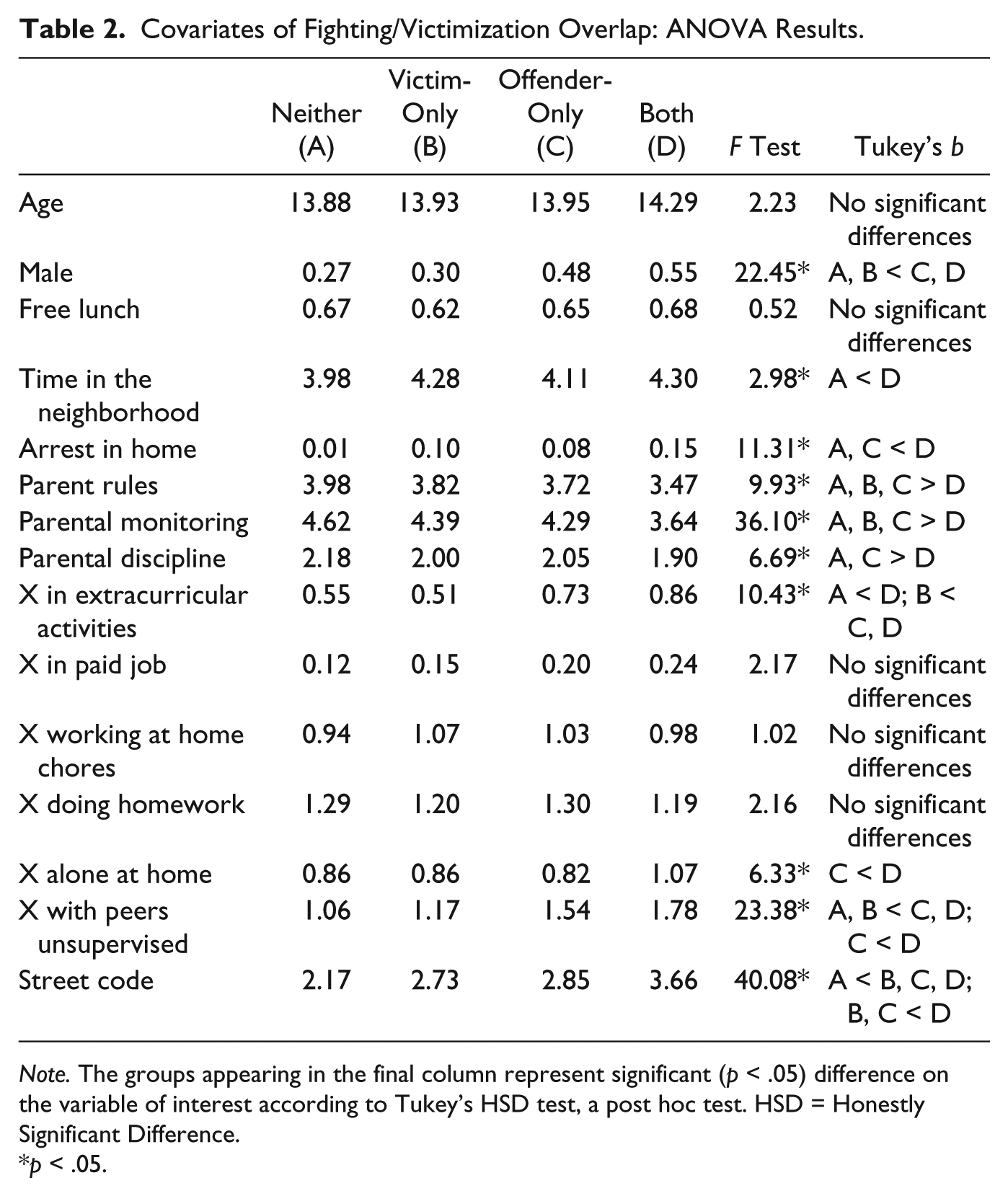
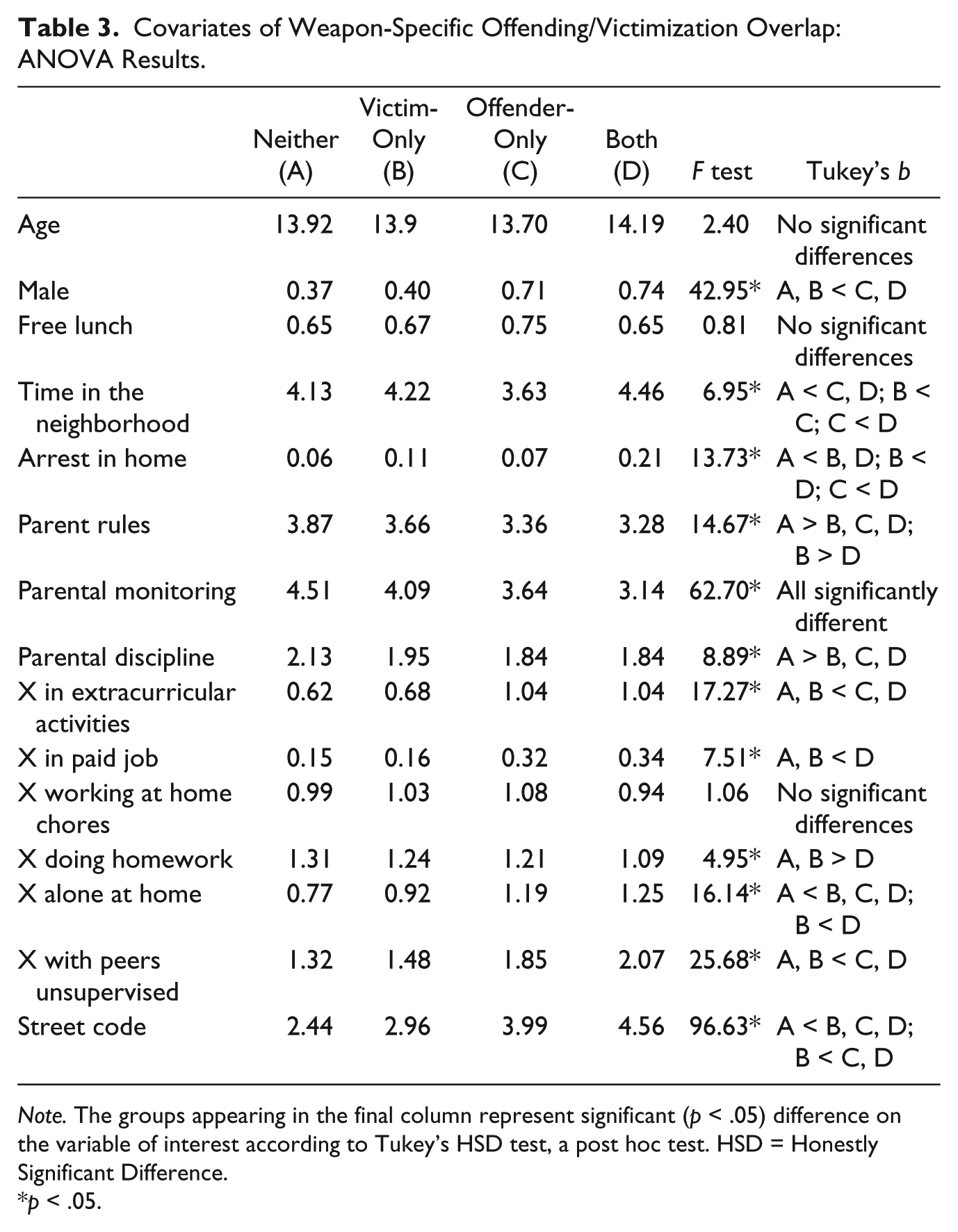
The second phase of the analysis evaluates whether the theoretical variables help differentiate membership within the victim-offender typology and whether their impact varies depending on the way in which violent offending is measured. To begin, one-way ANOVA models evaluate the ability of the variables of interest to distinguish between typology groups. When the F ratio is statistically significant, there is significant variation among the four groups on the variable of interest. Furthermore, the larger the F, the greater the between-group difference (Frankfort-Nachmias & Leon-Guerrero, 2015). Finally, this analysis also includes the post hoc test results (Tukey’s Honestly Significant Difference Test) which illustrate between-group differentiations as identified by the theoretical variables. Although these analyses were performed for fighting (Table 2) and weapon offending (Table 3) separately, results are discussed together to emphasize differences between the two measures of offending behavior. An initial examination of the post hoc tests reveals an expected pattern, the neither (A) and both (B) groups vary most consistently no matter how offending is measured. However, on further inspection of the F tests provided, associations are more evenly distributed across all groups in the weapon analysis in contrast to that for fighting where most associations are observed between the victim-offender and all other groups (i.e., most F tests for the weapons model are twice as large as those for fighting when significant variation among groups is observed).
Covariates of Fighting/Victimization Overlap: ANOVA Results.
Note. The groups appearing in the final column represent significant (p < .05) difference on the variable of interest according to Tukey’s HSD test, a post hoc test. HSD = Honestly Significant Difference.
p < .05.
Covariates of Weapon-Specific Offending/Victimization Overlap: ANOVA Results.
Note. The groups appearing in the final column represent significant (p < .05) difference on the variable of interest according to Tukey’s HSD test, a post hoc test. HSD = Honestly Significant Difference.
p < .05.
To address the question of what varies consistently and how, we turn to a more specific discussion of the post hoc test results (final columns of Tables 2 and 3). First, though adolescents who have lived in Comuna 13 longer are more likely involved in violence, this is especially true for involvement in weapons violence (F = 2.98 in the fighting model and 6.95 for weapons). Although males are more likely found among the offender groups no matter the measurement of offending, the between-group variance is more dramatic in the weapons model (F = 22.45 in the fighting and 42.95 in the weapons model). In assessment of guardianship variables, parenting diminishes victimization and offending in general. A more refined focus reveals more between-group differences in the weapons model (17) in contrast to the fighting model (10). For example, parental monitoring, the most protective guardianship variable in the weapons model varies significantly between all paths (six total) observed. This means that while youth in neither victim nor weapons offender (A) experience higher levels of parental monitoring than youth in all other groups (A > B, C, D), those in the victim-only group (B) experience the second highest level (B > C, D), while those categorized as weapons-only offenders (C) experience less than all but those admitting both victimization and offending (C > D).
Regarding time-use, all variables increased victimization and offending, with the exception of time spent doing homework which was higher in the weapons model among those neither victim nor offender or victim-only in comparison with those admitting both (this variable failed to affect group placement in the fighting model). Unsupervised time with peers (F = 23.38 and 25.68 for fighting and weapons, respectively) and time involved in extracurricular activities (F = 10.43 and 17.27) were risky in both models, whereas time spent alone at home was a greater risk in the weapons analysis (F = 6.33 and 16.14). Finally, street code beliefs was consistently associated with group placement in either model (F = 40.08 and 96.63). As expected, those less involved in victimization and/or offending reported lower internalization of these norms. In sum, while the post hoc results generally support our theoretical assumptions, they also affirm that when testing dissimilarity in victim-offender groupings, a more selective measure of violent offending results in sharper distinctions observed between typology groups.
Multinomial Logistic Regression (MLR)
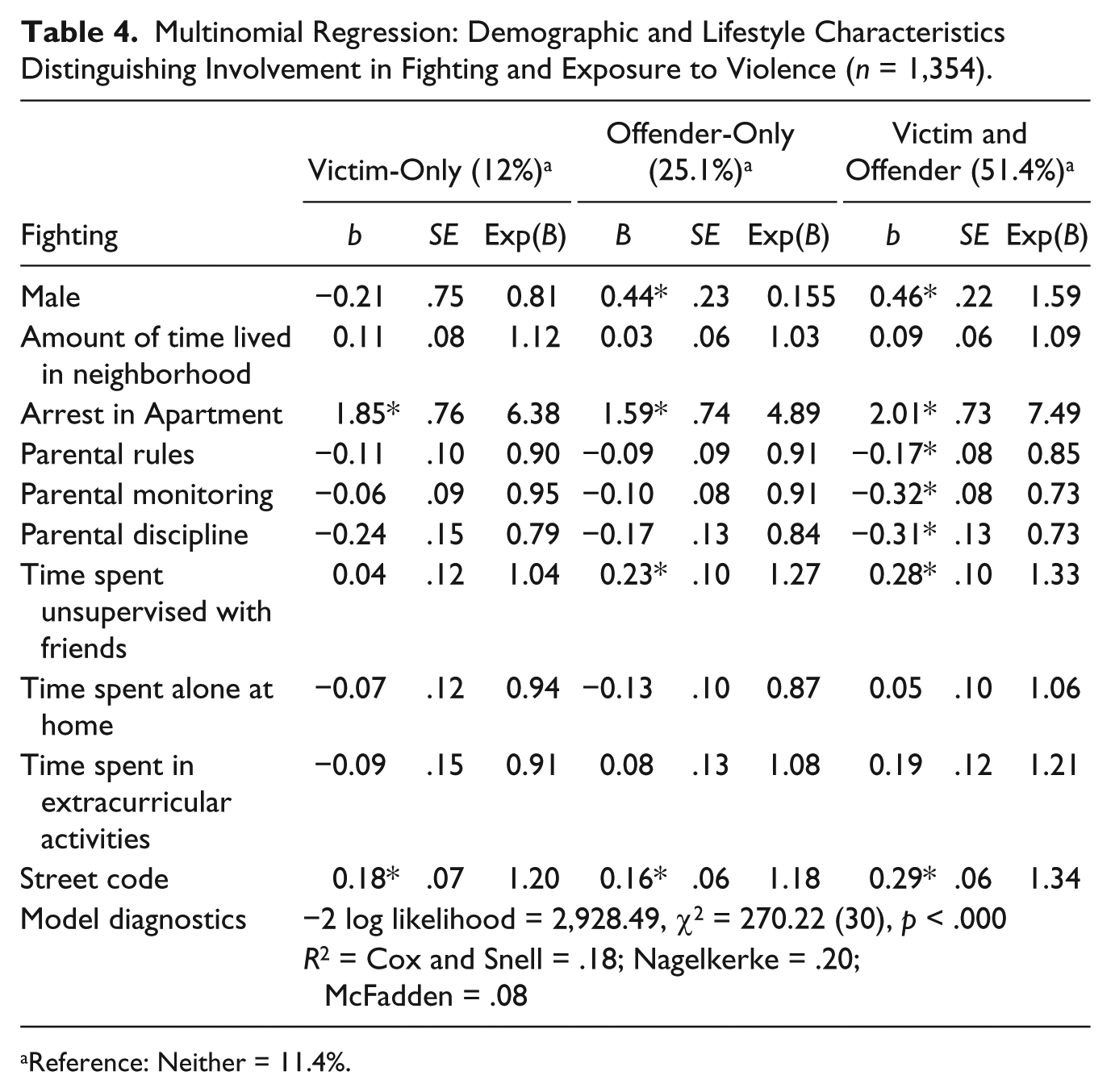
Next, including only variables significantly associated with one or more typology groups in the ANOVA and post hoc results, MLR models are presented in Tables 4 and 5 in an attempt to more conclusively differentiate life experiences among the four groups. 4 As expected, males had higher odds of being categorized in both offending categories (i.e., offender-only or victim-offender) in both models. Generally, the amount of time an adolescent had lived in his or her neighborhood did not help differentiate roles within the victim-offender typology. An exception is found in the weapon model alone, where for each 1 unit increase in neighborhood time, the odds of being an offender relative to the neither group decrease by 23% (1 − .77 = 0.23 decrease). This result could suggest that while adolescents new to the neighborhood have yet to experience personal or vicarious victimization, they are at the same time quickly swept up in negative behavior involving a weapon perhaps as protection from real or imagined threats.
Multinomial Regression: Demographic and Lifestyle Characteristics Distinguishing Involvement in Fighting and Exposure to Violence (n = 1,354).
Reference: Neither = 11.4%.
Multinomial Regression: Demographic and Lifestyle Characteristics Distinguishing Involvement in Weapons Violence and Exposure to Violence (n = 1,335).

Reference: Neither = 32%
Four variables were included to examine the impact of the family environment on the victim-offender typology. Results from both models show that individuals experiencing an arrest in their household within the last year or a lower amount of quality parenting had higher odds of membership in the victim-offender category in contrast to the individual neither victim nor offender. In the fighting model, individuals who lived with someone who had been arrested had a 5 to 7½ times greater likelihood of experiencing either victimization or offending while a 1 unit increase in positive parenting resulted in a 15% to 27% decrease in the offender group relative to the group neither victim nor offender. In the weapons model, the odds of being categorized as victim-offender increased when the adolescent was less exposed to positive parenting and the odds of being both victim and weapons offender was 2 times greater when someone in the household was been arrested in the last year.
Lifestyle characteristics, included in both models (Tables 4 and 5), were generally most illustrative in the weapons model. Spending time unsupervised with friends was the only time-use variable at all effective in differentiating roles in the fighting model as adolescents who spent time unsupervised with friends were 27% to 33% more likely found in the offender-only or victim-offender groups. In the weapons model, this time-use variable increased the likelihood of membership in the victim-offender group by 16%. Spending more time alone at home or engaged in extracurricular activities increased the likelihood of membership in both the weapons offender–only and victim–weapon offender categories by 38% to 47%. Finally, increased time at a paid job increased risk of membership in the victim–weapon offender group by 34%.
The final measure included in multivariate analysis provides an opportunity to assess the impact of subcultural norms in the process of adolescent victimization and offending. Inclusion of this variable did not disappoint. First, our eight-item street code measure captured the greatest amount of distinction between the four categories in the bi-variate ANOVA analysis (F = 40.8 for fighting and 96.63 for weapon). Next, the measure indicated that greater internalization of street code norms increased the likelihood of categorization as victim-only (by 20% in the fighting model and 13% in the weapon model), offender-only (by 18% and 42%), and victim-offender (by 34% and 60%) in contrast to the beliefs of those in neither the victim nor offender group.
Discussion
Our study sought to observe the cross-cultural applicability of U.S. theory and research on adolescent victimization and offending, while bringing awareness to the measurement of each. In light of our attempts, we feel it appropriate to begin our discussion by highlighting a few limitations. First, we acknowledge the restrictions of cross-sectional data which limits our ability to establish the causal process behind the tentative results we present here. In addition, though we sought advice and involvement from Native Colombians who were both academic and part of the neighborhood we examined, our survey remains vulnerable to criticisms of construct bias. We look forward to more in-depth collaborations with our Colombian colleagues in the future through which we can construct a more organic survey which not only tests processes established as important in North America, but also considers unique elements of the Comuna. Finally, given the measurement issues we chose to highlight, we remain interested in studying adolescent victimization and offending in a more varied way (i.e., more types and further discussion of the frequency of these events) than we felt we had the trust to do so in our initial effort. While it is important to acknowledge research limitations, we conclude by discussing the contributions made via analysis of our unique sample and the theoretical conditions examined.
Because much of the research on the victim-offender overlap observes each experience as a dichotomy (it happened = 1, it didn’t = 0), our study highlights the importance of paying close attention to the classification of an individual as violent victim or offender. While research evaluating victim-offender typologies often focuses on personal victimization, a number of studies find that vicarious victimization is the primary mechanism through which low-income urban communities experience a higher rate of ETV (Brandt, Ward, Dawes, & Flisher, 2005; Overstreet, 2000; Spano et al., 2010; Voisin, 2007). Sixty percent of our respondents experienced vicarious victimization in contrast to only 4% experiencing personal victimization. These results are not tremendously different from those of Spano, Vazsonyi, and Bolland (2009) who found that 63% of adolescents from disadvantaged urban neighborhoods in southern Alabama experienced vicarious while 13% experienced personal victimization. However, our analysis also reveals that vicarious victims in Medellin were significantly more involved in violent offending when compared with non-victims, though far less likely to offend with weapons (31%) than those reporting personal victimization (73%). We are thus fortunate that our unique sample of disadvantaged adolescents living in Medellin, Colombia, allows us to illustrate both the risky nature of vicarious victimization while also acknowledging that personal victimization is comparatively more risky.
Concerning measurement of adolescent offending, the present research focuses on two types of violent offenders: physical fighters (77% of those surveyed) versus those who have also used weapons (26%). In so doing, we stray from the fairly common practice (Feigelman et al., 2000; Higgins et al., 2012; Jennings et al., 2010; Lauritsen & Quinet, 1995; Lauritsen et al., 1991; Maldonado-Molina et al., 2010; Maldonado-Molina et al., 2009; Mawby, 1979; Regoeczi, 2000; Reingle et al., 2011) of using a summative delinquency scale to measure adolescent offending. In so doing, we find more similarity with a former Colombian-based study of adults (Klevens et al., 2002) only when we measure offending exclusively involving weapons (their dichotomous violent offending measure included individuals involved in mild as well as extreme violence). Again, our weapons analysis alone supports their findings that offenders are far more likely to also report victimization (81%) than victims report offending (33%). Finally, case distribution throughout our victim–weapon offender typology is similar, in that 32% of our respondents were neither victim nor offender (26% for them), 43% were victim-only (to their 39%), 5% were offender-only (to their 3%), and 20% were both (32% in their study). Our final analysis (Tables 4 and 5) supports our conclusion that more selective offender measurement results in a stronger discussion of role differentiation in the typology examined.
Whereas existing literature establishes overlap among these life experiences (Broidy et al., 2006; Lauritsen & Laub, 2007), our most substantial contribution is the investigation of guardianship, time-use, and subcultural beliefs on role differentiation within a victim-offender typology among a group which has historically experienced disproportionate exposure to victimization and offending. To be expected, given the substantiveness of prior gender and crime research and homicide risk among adolescents in Colombia specifically (PAHO, 2012), males were more likely found in either offending group when compared with the group neither victim nor offender. Also consistent with past research, we found positive parenting a protective effect in each model, though consistently so in the weapon model. Five prior studies (Jennings et al., 2010; Reingle & Maldonado-Molina, 2012; Schreck & Fisher, 2004; Spano & Nagy, 2005; Wilcox et al., 2009) evaluating victim-offender trajectories also found protective effects for positive parenting. Among those, two studies found that parental monitoring reduced enhanced experiences with victimization (Jennings et al., 2010; Spano & Nagy, 2005) and a summative delinquency scale (Jennings et al., 2010). Based on our results, we specifically conclude that when parents go beyond simply establishing rules and utilize effective monitoring and discipline, they are more likely to prevent their children from victimization and weapon-specific offending. In contrast to positive parenting, few prior studies have included measures which seek to understand the impact of risky behavior in the family, and when included the variable has had no effect among a sample of youthful offenders (Piquero et al., 2005) or Native American adolescents (Reingle & Maldonado-Molina, 2012), respectively. We find that a recent household arrest increases risk consistently in the fighting model and helps distinguish adolescents most at risk (i.e., those both victim and offender) in the weapons model.
Although our findings regarding guardianship are insightful, the time-use and street code effects are most exciting. First, spending time unsupervised with friends, the most robust risky time-use variable in prior research (Jensen & Brownfield, 1986; Osgood et al., 1996; Schreck & Fisher, 2004; Schreck et al., 2002), is the only time-use variable significant in both models. For both, it increased the likelihood of membership in the victim-offender category and also increased the likelihood of offending alone in the fighting model. However, other time-use effects were more consistent and larger in the weapons model. Specifically, the largest and most consistent effects were for spending time alone at home and involvement in extracurricular activities as likelihood of membership in the weapons offender–only and the victim-offender categories increased by 38% to 47% when contrasted to those experiencing neither victimization nor offending. Whereas few prior studies have included these time-use measures, our results add some consistency to past findings (Osgood et al., 1996; Wilcox et al., 2009). Unfortunately, we cannot confirm the findings from U.S. samples which observed that time spent at home working around the house (Osgood et al., 1996) or doing homework (Barnes, Hoffman, Welte, Farrell, & Dintcheff, 2007) has a protective effect, instead our study finds such time is neutral. Similarly, whereas one study (Jensen & Brownfield, 1986) found that time spent working at a paid job increased the likelihood of both property and violent victimization, we find this risky effect present only for the victim–weapon offender adolescent. While more replication is required before drawing definitive conclusions about some of the time-use effects discussed above, we believe the inclusion of a diverse range of time-use variables from a unique international context provides a foundation for future research to build on. Specifically, future research should explore the extent to which families in the Comuna depend on adolescent labor for survival, whether around the house or in the paid workforce, in a manner different from the U.S. samples referenced above.
Finally, we are most pleased by the performance of our street code variable. Not only did the average respondent endorsed at least three street code sentiments in our eight-item scale, adolescents who internalized these norms endorsing the use of violence to resolve conflict also had a far greater likelihood of membership in any of the victim-offender groups. We were especially pleased to observe the linear nature of this effect in the weapons model where the risk grew from a 13% likelihood of being victim-only to a 60% likelihood of being both victim and offender in comparison with the reference. Among those seeking to differentiate roles in a victim-offender typology, our study joins another Colombian-based study (Klevens et al., 2002) which found the victim-offender much more likely to “try and appear tough” when compared with respondents who were only a victim. Our results also validate prior research, focusing exclusively on African American adolescents in the United States, in which a relationship between victimization and offending among “street code” youth was observed (Stewart et al., 2006).
The findings of the current adolescent study are consistent with yet extend those of the only other Colombian study focusing on the victim-offender process among a representative sample of Bogota adults. As such, our effort is a good first step as it provides support for prior research regarding guardianship and RAT as well as norms consistent with the Street Code. Future research in urban areas of the developing world is necessary to verify the reliability of the current findings. As part of this process, collaboration with in-country scholars, sometimes difficult due to language barriers and distance, is vital to measurement success.
Footnotes
Declaration of Conflicting Interests
The author(s) declared no potential conflicts of interest with respect to the research, authorship, and/or publication of this article.
Funding
The author(s) received no financial support for the research, authorship, and/or publication of this article.