



Abstract
The present study investigated the impact of impeaching a rape victim with evidence of a simultaneous civil suit during a criminal trial. In three experiments, male and female undergraduates (Experiment 1) and community members (Experiments 2 and 3) read a rape trial summary in which the victim accused the defendant of raping her in a hotel. In the impeachment condition, the Defense mentioned that the victim simultaneously sued either the hotel (Experiments 1, 2, 3) or the alleged perpetrator (Experiment 3) for US$1 million. In the control condition, the Defense did not mention a civil suit. In all experiments, mock jurors were more likely to render not guilty verdicts and had higher pro-defendant ratings (e.g., defendant credibility) when the Defense impeached the victim than when the Defense did not impeach her. In addition, victim credibility (Experiments 1, 2, 3) and victim greed (Experiment 3) mediated the impact of impeachment on verdict. Results are discussed in terms of the prejudice rape victims may face in criminal court when they also seek justice in civil court.
Rape is a significant legal and societal problem across the world. According to the National Intimate Partner and Sexual Violence Survey (Black et al., 2011), more than 1 million adult women in the United States are raped in a single year. About 37% of reported rape cases are prosecuted in criminal court (for a review, see Campbell, 2008). However, an increasing number of women whose cases are being prosecuted in criminal court also choose to file a civil suit as an alternative path to justice (Bublick, 2006; Lininger, 2008). In many instances, the criminal and civil cases proceed simultaneously. When this occurs, the Defense in the criminal trial may impeach the victim during cross-examination by bringing up her civil suit (Lininger, 2008). In a review of published court decisions, Lininger (2008) found that most judges will allow this impeachment during the criminal trial and that it damages the victim’s credibility. The purpose of the present study is to investigate the impact of impeaching a rape victim with evidence of a simultaneous civil suit during a criminal trial.
Scholars have proposed several reasons for increased civil litigation as recourse for rape in recent years. These reasons include victims’ frustration with the criminal justice system (Bublick, 2006; Orenstein, 2007; Seidman & Vickers, 2005), the fact that civil suit allows a victim to have greater control over the case (Bublick, 2006), and that the odds of success in a civil case are greater than a criminal case as the standard of proof is lower in civil cases (i.e., preponderance of evidence vs. beyond a reasonable doubt; Lininger, 2008). In addition, there is a growing endorsement of civil litigation from victim advocacy groups and government agencies (e.g., National Center for Victims of Crime, 2008). Finally, civil suits may involve third parties that are not subject to criminal penalties (Bublick, 2006) and often have greater financial resources than an individual perpetrator (Manley, 1990).
On the surface, filing a simultaneous civil suit appears like a sound legal decision for a rape victim. However, the Federal Rules of Evidence permit impeachment of a victim with evidence of a civil suit, and judges typically allow it (Lininger, 2008). Thus, a defense attorney is free to inform the jury that the victim is filing a civil suit, regardless of whether it is against the same Defendant in a criminal case or a third party. In this way, “victims forfeit their credibility when they file civil suits” (Lininger, 2008, p. 1561). Impeachment can be problematic for victims in several ways, including reducing victim credibility. The belief that women frequently lie about rape and general cultural stigmas regarding rape (Raphael, 2013) can lead to problems with victim blame in the courtroom, including jurors’ negative perceptions of the victim. Many rapes are reduced to a he-said-she-said legal battle when the Defense claims that consensual sex occurred (Seidman & Vickers, 2005). This leads jurors to evaluate characteristics of the victim and defendant (e.g., credibility). During this process, the Defense often paints the victim in an undesirable way by using rape-supportive societal norms such as victim blaming that tend to cause re-victimization in court as the victim must once again experience the shame and trauma of the assault (e.g., Campbell & Raja, 1999; Kanter, 2005). Also dubbed as a “second rape” (Campbell, Wasco, Ahrens, Sefl, & Barnes, 2001), traumatic justice-related experiences such as rape trials have consequently been associated with poor mental health outcomes (e.g., Campbell & Raja, 1999; Campbell et al., 2001; Greeson & Campbell, 2011; Patterson & Campbell, 2010). Furthermore, reactionary blame from others, such as the criminal justice system, has been shown to be associated with future re-victimization (G. E. Mason, Ullman, Long, Long, & Starzynski, 2009). The perception of rape victims in court is further complicated by juror gender. A number of studies have shown robust gender differences in how mock jurors view sexual assault (e.g., Jimenez & Abreu, 2003; Lynch, Wasarhaley, Golding, & Simcic, 2013; Schutte & Hosch, 1997; Wasarhaley, Simcic, & Golding, 2012). In general, men are much more pro-defendant than women in rape trials (e.g., Hammond, Berry, & Rodriguez, 2011; Lynch et al., 2013) and are more likely to blame victims of rape than are women (see Suarez & Gadalla, 2010, for a review). Thus, victims of rape experience victim blaming, especially by men, in criminal court with dismal success in convictions (Campbell, 2008; Tjaden & Thoennes, 2006), and are now more often seeking justice in civil court. Due to a lack of empirical research on the topic, it is unclear how and why jurors use impeachment of the victim in a criminal rape trial and what variables may mediate the impact of impeachment on verdicts. To explore these questions, we presented undergraduates (Experiment 1) and community members (Experiments 2 and 3) with a summary of a criminal rape case, in which an adult woman accused a defendant of raping her in a hotel. We employed a mock juror paradigm (see Devine, 2012) and manipulated whether or not the Defense in the criminal trial mentioned that the victim simultaneously sued the hotel (Experiments 1, 2, 3) or the Defendant from the criminal trial (Experiment 3) for US$1 million. We tested three general hypotheses across the present experiments based on prior research. First, we predicted a main effect of impeachment such that participants would be less likely to render guilty verdicts and would have lower pro-victim judgments (e.g., victim credibility) when the Defense impeached the victim than when it did not (Hypothesis 1). Second, should we find these predicted associations, we expected that perceptions of the victim and defendant (e.g., credibility, victim greed) would mediate the relationship between impeachment and verdict (Hypothesis 2; see Lininger, 2008; Orenstein, 2007; see also Tanford & Cox, 1988). Specifically, we predicted that mock jurors would use their knowledge of the civil trial to make negative judgments about the victim and positive judgments about the defendant. Finally, we predicted a participant gender main effect such that men would be less likely to render guilty verdicts and would have lower pro-victim judgments than women (Hypothesis 3; for example, Hammond et al., 2011; Jimenez & Abreu, 2003; Lynch et al., 2013; Schutte & Hosch, 1997; Suarez & Gadalla, 2010).
Experiment 1
Method
Participants
The sample was comprised of 110 participants drawn from an Introduction to Psychology course, 74 of whom were women, at a large North American university. Student participants were awarded partial course credit for taking part in the study. All participants were at least 18 years old and U.S. citizens. The mean age was 19 years (range = 18-29 years); 2 participants had previously served on a jury. The racial composition of the sample was 87% White, 2% Asian, 8% African American, 1% Hispanic, and 2% mixed-race.
Design
The experiment included one independent variable hereafter referred to as “impeachment”; the Defense mentioned a victim’s concurrent civil case (impeachment) or not. We analyzed participant gender as a quasi-independent variable.
Materials
Criminal trial summary
The summary described a first-degree rape trial, in which the defendant allegedly engaged in forcible and non-consensual sexual intercourse with the victim in the victim’s hotel room. The victim stated she had never met the defendant, but the defendant said he had met the victim at a bar a few hours before the alleged incident. The summary included a general description, the Prosecution and Defense cases (with both direct and cross-examination of witnesses), judge’s instructions (from Cooper, 1999), and closing arguments. The trial summary varied only on what was necessary to manipulate the independent variable. The Prosecution’s case included testimony from the victim and a detective. More importantly, the victim, who was on a business trip, stated that the defendant knocked on her hotel room door. She said that when she opened the door the defendant forced his way inside, grabbed her very hard, held her down on her hotel room bed, and forced her to engage in sexual intercourse. The Defense’s case included testimony from the defendant. He stated that the victim invited him to her hotel room and that consensual sexual intercourse occurred that was a bit “rough.” Testimony for the Defense also included that of the victim’s friend (a hostile witness), the defendant’s friend, and the head of hotel security.
The trial summary in the impeachment condition stated that the victim had a simultaneous civil suit asking for US$1 million from the hotel. Moreover, the trial summary mentioned this detail at three points: general opening description, cross-examination of the victim, and Defense closing arguments. We should note that we selected the US$1 million amount based on two primary information sources: (a) the Personal Injury Valuation Handbook (2013) and (b) discussions with an attorney at the College of Law at the first author’s academic institution. Specifically, the Personal Injury Valuation Handbook cites that 39% of civil rape suits involve award amounts of more than US$1 million, with a median of nearly US$775,000 and a mean of nearly US$3,000,000 (probability range from US$193,000-US$1,462,500). Within the limitations of choosing an award suit that would be reasonable for both the low end of a corporate defendant and the high end of a perpetrator defendant, we decided an award value of US$1 million was a reasonable and accurate amount to seek in a civil rape suit. In addition, we made the decision of the award amount keeping in mind that the present experimental design required us to select an amount that could be the same for both the individual civil suit and third-party civil suit, as varying the award amount in the two different civil suits mentioned in Experiment 3 would add an additional level of variability to the results.
Trial questionnaire
Participants received various questions in a single order as there was no theoretical reason to believe the order of questions would significantly affect responses. They first rated the Defendant’s guilt on a scale from 1 (not at all) to 10 (completely) and then rendered a verdict. They then rated their confidence in their verdict from 1 (not at all) to 10 (completely). Finally, participants answered an open-ended question asking the reason(s) for their verdict. Participants then rated (on a 1 [not at all] to 10 [completely] scale) the honesty, believability, credibility, and responsibility of the victim. They rated sympathy and anger toward victim from 1 (none at all) to 10 (a lot). They also rated the credibility of the detective and the overall strength of the Prosecution’s case (1 [not at all strong] to 10 [very strong]). Participants evaluated the witnesses for the Defense and the Defense’s case using the same question order and scale format as those for the Prosecution’s case.
Procedure
Participants completed an online consent form that directed them to the experimental materials, administered online via Surveymonkey.com. Participants were unable to refer to the summary when completing the trial questionnaire. Also, participants were given a multiple-choice comprehension question after every witness testified to make sure they were attending to the summary (see Oppenheimer, Meyvis, & Davidenko, 2009). If they answered any question incorrectly, the subsequent web page instructed them to pay better attention to the text. Participants completed the survey at their own pace, and it took approximately 20 min to complete.
Results
We analyzed only the rating variables with theoretical relevance to our hypotheses. We created (a) a victim credibility subscale (victim credibility, victim honesty, and victim believability; Cronbach’s α = .87), and (b) a defendant credibility subscale (defendant credibility, defendant honesty, and defendant believability; Cronbach’s α = .92).
For the verdict analysis, we employed logistic regression. We used separate hierarchical linear regressions to investigate the predictive value of the independent variables on the rating variables. For all analyses, Step 1 of the hierarchical models included participant gender, Step 2 included the impeachment variable, and Step 3 included the two-way interaction term. Table 1 presents means and standard deviations across all conditions for the dependent variables. Table 2 presents correlations among the primary variables.
Experiment 1 Descriptive Data for Primary Variables for Complete Design.
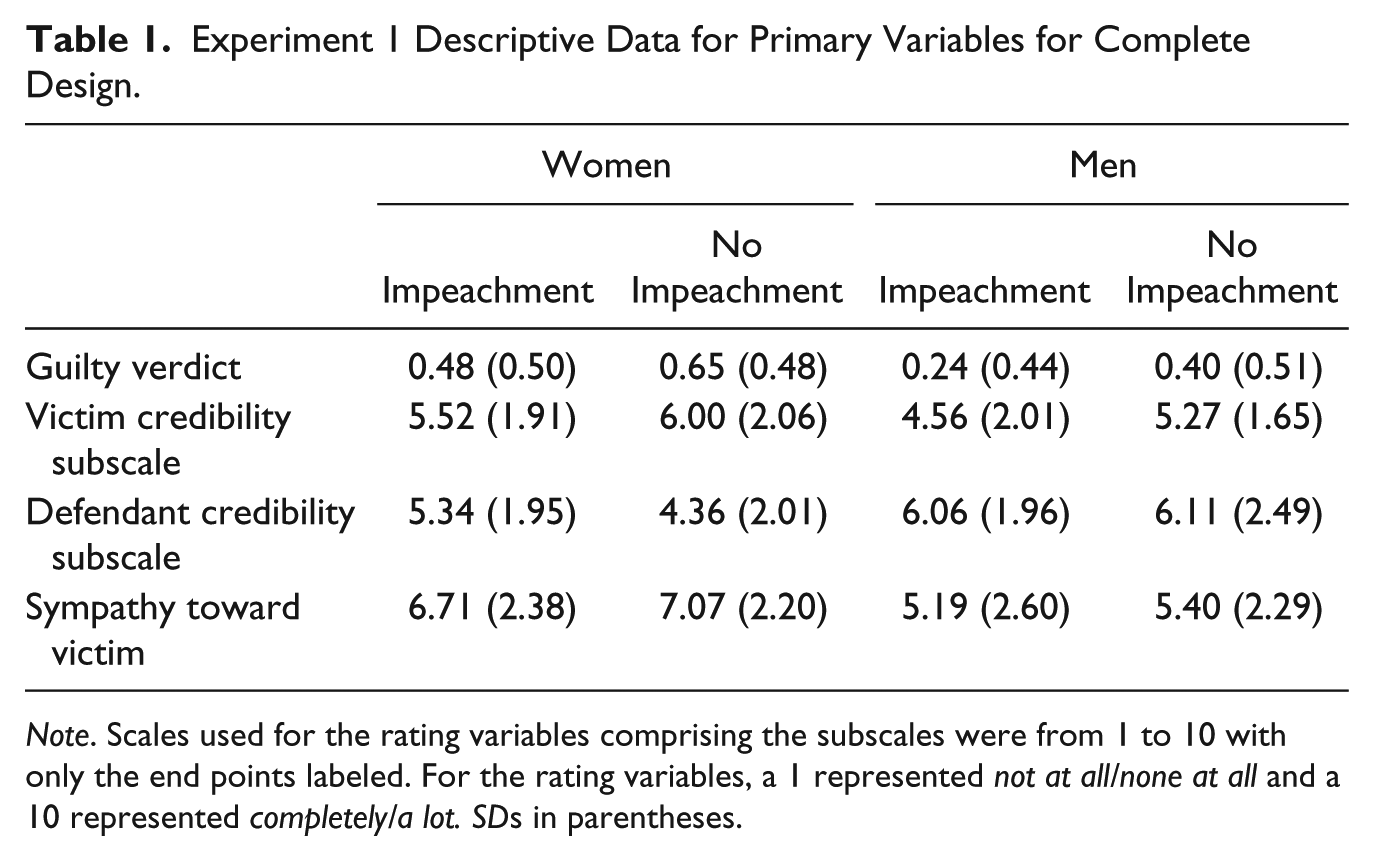
Note. Scales used for the rating variables comprising the subscales were from 1 to 10 with only the end points labeled. For the rating variables, a 1 represented not at all/none at all and a 10 represented completely/a lot. SDs in parentheses.
Experiment 1 Correlation Matrix of Primary Variables.
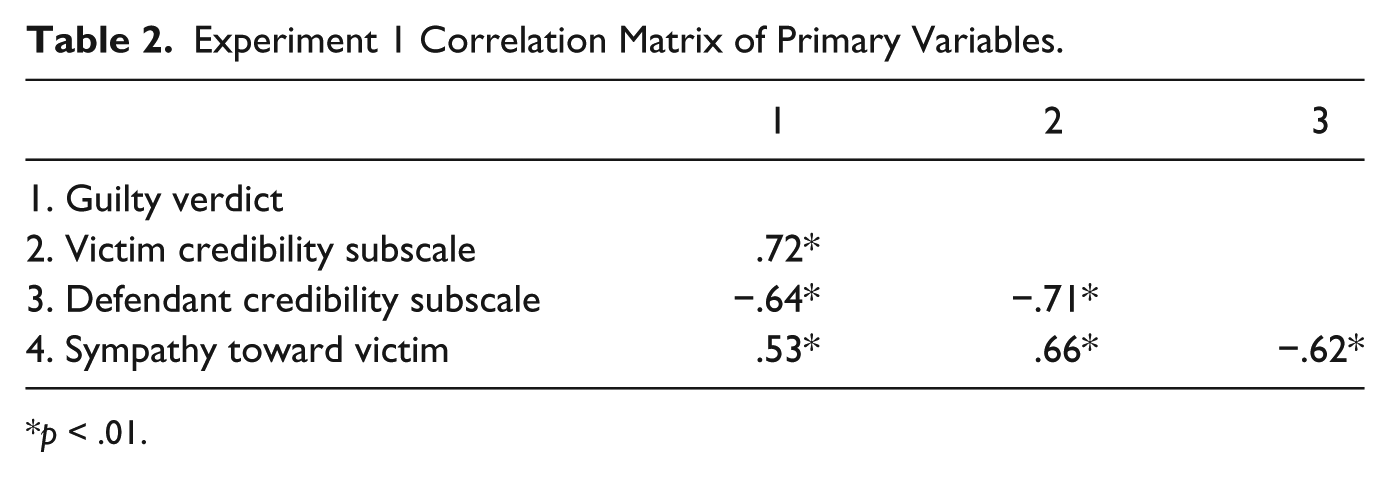
p < .01.
Hypothesis 1
The analyses yielded a significant effect of impeachment on verdict. The logistic regression model reached significance at Step 2, χ2(2) = 10.74, p = .005, indicating that participants in the impeachment condition were less likely than those who did not receive information about the concurrent civil trial (OR = .402, p = .024). With regard to the linear regression analyses, the models were significant at Step 2 for victim credibility subscale, R2 = .13, F(2, 107) = 8.29, p < .0001; defendant credibility subscale, R2 = .10, F(2, 107) = 6.00, p = .003; and sympathy toward victim, R2 = .103, F(2, 107) = 6.12, p = .003. The impeachment condition was significantly associated with lower ratings for the victim credibility subscale, β = −.23, p = 012. However, the impeachment variable was not significant for the defendant credibility subscale or sympathy toward the victim.
Hypothesis 2
We examined the victim credibility subscale as a potential mediator of the relationship between impeachment and verdict, as impeachment was significantly associated with this subscale. We used a bootstrapping procedure that tested whether or not the indirect pathway from impeachment, to the mediator, to verdict, was significantly different from zero (Preacher & Hayes, 2004). Significant mediation occurs when the upper and lower limits of the 95% confidence interval (CI) do not cross zero. The analysis revealed that the victim credibility subscale was a significant mediator (95% CI = [−3.11, −0.21]). Participants in the impeachment condition perceived the victim to be less credible, β = −.26, p = .006, which decreased their likelihood of rendering guilty verdicts.
Hypothesis 3
As predicted, the analyses yielded significant effects of participant gender for all rating measures. For verdict, the logistic regression model reached significance at Step 1, χ2(1) = 5.50, p = .019, such that men were less likely than women to render guilty verdicts (OR = .374, p = .022). With regard to the linear regression analyses, the model was significant at Step 1 for victim credibility subscale, R2 = .081, F(1, 108) = 9.49, p = .003; defendant credibility subscale, R2 = .08, F(1, 108) = 9.13, p = .003; and sympathy toward victim, R2 = .090, F(1, 108) = 11.79, p = .001. Women had higher scores than men for the victim credibility subscale, β = −.28, p = .003 and sympathy toward victim, β = −.31, p = .001. However, men had higher scores than women for defendant credibility subscale, β = .28, p = .003.
Discussion
Experiment 1 investigated the impact of impeaching a rape victim with evidence of a simultaneous civil suit during a criminal trial using a sample of undergraduates. The results supported all three hypotheses. Although the results were consistent with the predictions, there were two potential methodological problems. First, a college sample may not be adequate when investigating civil cases. Instead, a sample of community members may have more knowledge about civil trials than undergraduates and may have more life experiences to draw on when interpreting the information about a concurrent civil trial. Second, there was no manipulation check question that asked participants whether the Defense impeached the victim. To deal with these issues, Experiment 2 used a community sample, and it included a manipulation check question.
Experiment 2
Method
Participants
We recruited 111 community members online via Mechanical Turk, a participant recruitment service hosted by Amazon.com (www.mturk.com; Buhrmester, Kwang, & Gosling, 2011; W. Mason & Suri, 2012). Participants received 50 cents for participating. All participants were at least 18 years old and U.S. citizens. Two participants were excluded from data analyses because they failed to correctly answer the manipulation check question. Thus, our final sample consisted of 109 participants (66 women). The mean age was 36 years (range = 18-64 years); 16 participants had previously served on a jury. The racial composition was 76% White, 6% Asian, 15% African American, 3% Hispanic, and 1% mixed-race.
Design, materials, and procedure
Experiment 2 was exactly the same as Experiment 1 with regard to the methodology. However, we added a manipulation check question that asked participants whether the attorney mentioned the concurrent civil case after the Defense’s closing statement.
Results
The analytic plan was the same as in Experiment 1 except that we included the age of the participants in Step 1 of the regression analyses; age was not significant. The Cronbach’s alpha for the victim credibility subscale was .96 and for the defendant credibility subscale was .92. Table 3 presents means and standard deviations across all conditions for each of the primary dependent variables. Table 4 presents correlations among the primary variables.
Experiment 2 Descriptive Data for Primary Variables for Complete Design.

Note. Scales used for the rating variables comprising the subscales were from 1 to 10 with only the end points labeled. For the rating variables, a 1 represented not at all/none at all and a 10 represented completely/a lot. SDs in parentheses.
Experiment 2 Correlation Matrix of Primary Variables.
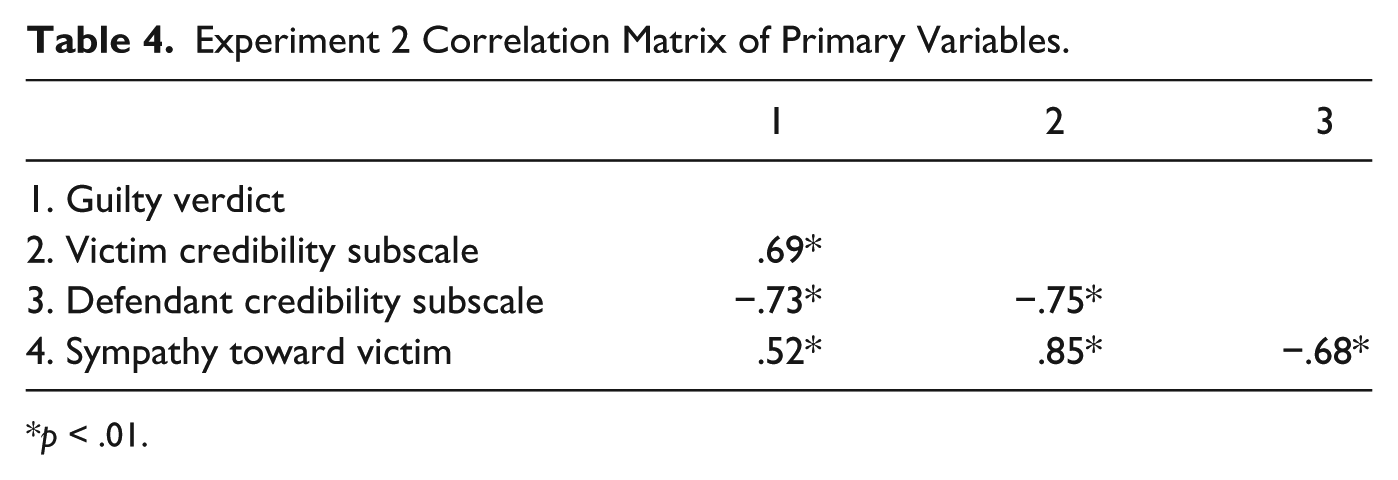
p < .01.
Hypothesis 1
The analysis yielded a significant effect of impeachment on verdict. The logistic regression model reached significance at Step 2, χ2(3) = 13.74, p = .003. Participants in the impeachment condition were less likely than those in the non-impeachment condition to render guilty verdicts (OR = .350, p = .015). With regard to the linear regression analyses, the model was significant at Step 2 for victim credibility subscale, R2 = .20, F(3, 105) = 8.90, p < .001; defendant credibility subscale, R2 = .14, F(3, 105) = 6.77, p < .001; and sympathy toward victim, R2 = .20, F(3, 105) = 8.48, p < .001. The impeachment condition led to lower ratings than the no impeachment condition for victim credibility subscale, β = −.29, p = .001, and sympathy toward the victim, β = −.32, p = .001. However, the impeachment condition led to higher ratings for the defendant credibility subscale than the no impeachment condition, β = .24, p = .008.
Hypothesis 2
The potential mediators were tested in separate models. The bootstrapping procedure revealed that the victim credibility subscale (95% CI = [−2.67, −0.42]) and defendant credibility subscale (95% CI = [−3.41, −0.21]) significantly mediated the relationship between impeachment and verdict. That is, when the Defense mentioned that there was a concurrent civil rape trial during the criminal rape trial, community sample mock jurors rated the victim as lower in credibility, β = −.31, p = .001, and the defendant as higher in credibility, β = .27, p = .004. These perceptions negatively affected their likelihood of rendering a guilty verdict.
Hypothesis 3
The analyses again yielded significant effects of participant gender for verdict and almost all of the rating variables. For verdict, the logistic regression model reached significance at Step 1, χ2(2) = 7.51, p = .023. Men were less likely than women to render guilty verdicts (OR = .313, p = .009). With regard to the linear regression analyses, the model was significant at Step 1 for victim credibility subscale, R2 = .12, F(2, 106) = 7.32, p = .001; defendant credibility subscale, R2 = .10, F(2, 106) = 6.18, p = .003; and sympathy toward victim, R2 = .10, F(2, 106) = 5.68, p = .005. Women had higher scores than men for victim credibility subscale, β = −.35, p < .001 and sympathy toward victim, β = −.31, p = .001. However, men had higher scores than women for defendant credibility subscale, β = .31, p = .001.
Discussion
Experiment 2, using a community sample and including a critical manipulation check question, replicated the results of Experiment 1. In the present experiment, the credibility of both the victim and defendant mediated the impact of impeachment on verdict. Although both Experiments 1 and 2 yielded consistent findings concerning the impact of impeachment in rape cases, we should explore alternative explanations for victim blaming during impeachment. First, the civil suit that was mentioned in the criminal trial for Experiments 1 and 2 was against the hotel where the alleged attack occurred. Potentially, participants may have had negative perceptions of the victim because the suit was against a corporate entity who has large cash holding (i.e., the victim may be trying to “get what she can” from this corporation). However, it is unclear whether participants would also blame the victim if they were told she was concurrently suing a person (i.e., the criminal defendant), rather than a corporation. Given that the criminal defendant allegedly committed the rape, participants may view him as more at fault than the hotel. However, it is possible that participants would hold more negative judgments about the victim if the Defense mentioned that she was concurrently suing the defendant, as participants may view her as a scorned ex-lover trying to ruin the defendant’s life. Additionally, participants may relate and then sympathize more when a perpetrator is a civil suit defendant versus a corporation, which can lack humility. Because it is possible that participants may sympathize differently with either the corporation or the perpetrator, Experiment 3 included a condition in which the defendant in the criminal trial was also the defendant in the civil suit mentioned. Experiment 3 also directly measured certain attributes about the victim that participants may make when presented with the concurrent suit information. Mock jurors may blame victims when impeached in a rape case due to dispositional attributions (Heider, 1958) they make about her, such as that she is greedy for suing for damages while her criminal trial is in session. Thus, Experiment 3 included measures of perceived victim traits that might serve to uncover mock jurors’ psychological processes as they think about the rape case.
Experiment 3
Method
Participants
The sample was comprised of 167 community members, 91 of whom were women, who were recruited online via Mechanical Turk. Participants received 50 cents for participating and were at least 18 years old and U.S. citizens. The mean age was 37 years (range = 19-74 years); 16 participants had previously served on a jury. The racial composition was 79% White, 2% Asian, 10% African American, 7% Hispanic, and 1% mixed-race (rounding led to a value less than 100%).
Design, materials, and procedure
Experiment 3 was exactly the same as Experiment 2 except that (a) the design included an impeachment condition in which the victim sued the Defendant in the criminal trial in civil court for US$1 million and (b) participants rated the victim on various traits: greedy, educated, appealing, likeable, selfish, and manipulative. Participants rated each question on a scale of 1 (not at all) to 10 (completely). The testimonies of the witnesses did not change for the condition in which the perpetrator was the civil suit defendant as the focal point was the impeachment manipulation (i.e., mention of the civil suit: whom the victim sued and for how much).
Results
An initial set of analyses compared both impeachment conditions on each of the dependent variables. No differences existed between these conditions, or interactions involving these conditions and participant gender. Therefore we collapsed the data for the impeachment conditions. In addition, we created a manipulative-greed subscale that included three traits: greedy, selfish, and manipulative (Cronbach’s α = .92). We tested the effect of impeachment on this subscale as part of Hypothesis 1 and the role of this subscale as a mediator as part of Hypothesis 2.
Analyses proceeded as in Experiment 2; age was not significant at Step 1. The Cronbach’s alpha for the victim credibility subscale was .97 and for the defendant credibility subscale, the Cronbach’s alpha = .96. Table 5 presents means and standard deviations across all conditions for each of the primary variables. Table 6 presents correlations among the primary variables.
Experiment 3 Descriptive Data for Primary Variables for Complete Design.
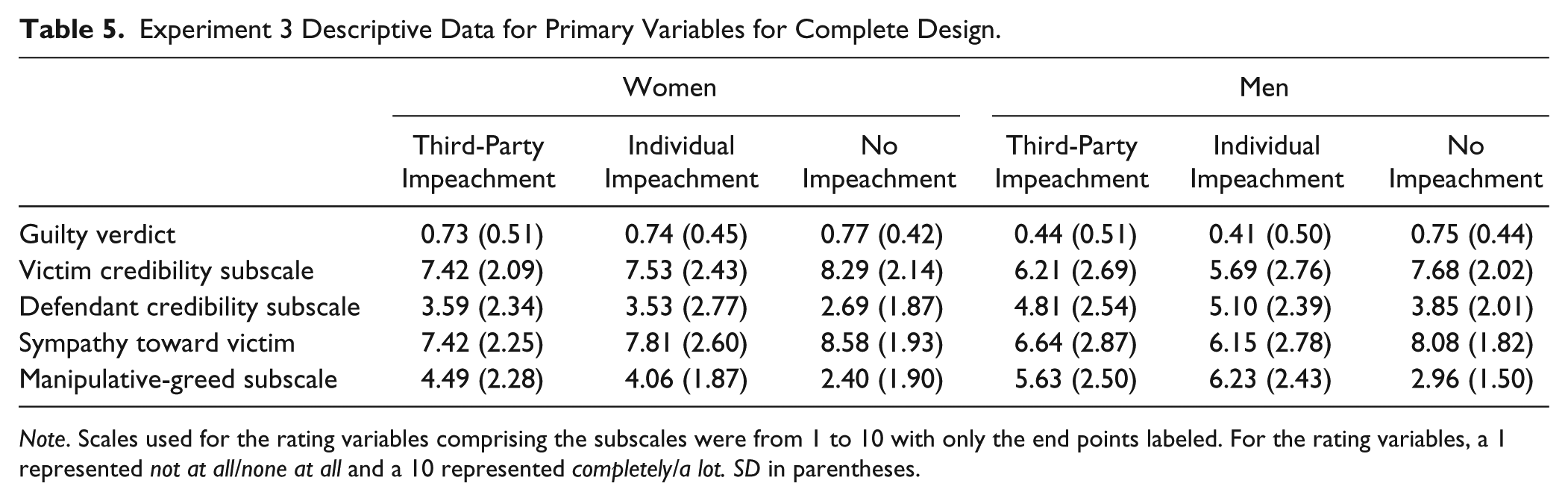
Note. Scales used for the rating variables comprising the subscales were from 1 to 10 with only the end points labeled. For the rating variables, a 1 represented not at all/none at all and a 10 represented completely/a lot. SD in parentheses.
Experiment 3 Correlation Matrix of Primary Variables.
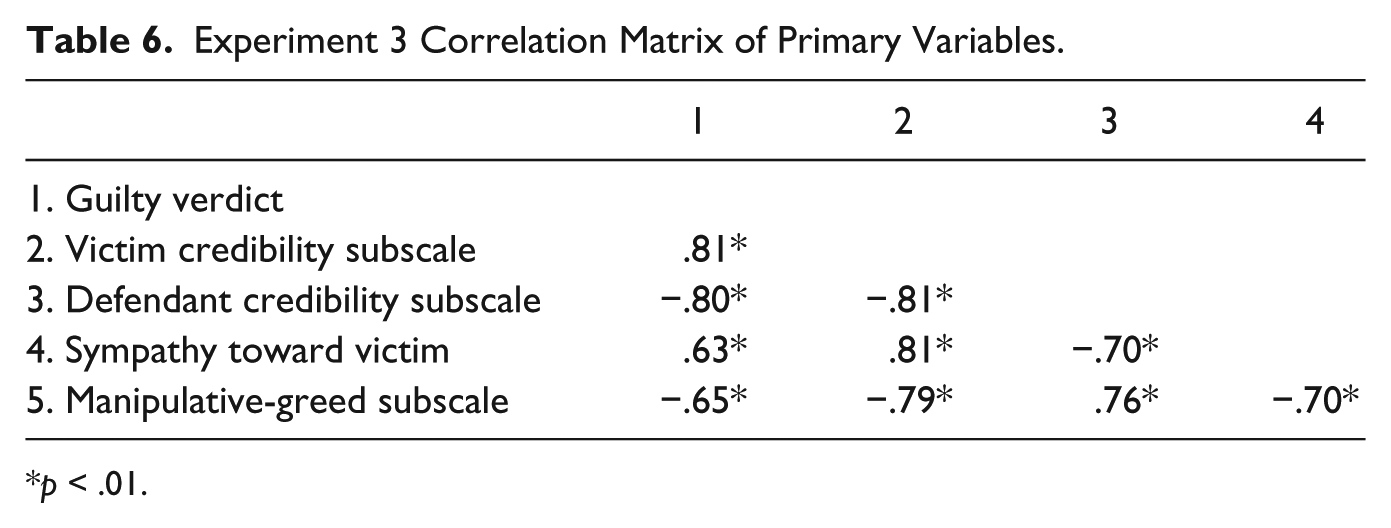
p < .01.
Hypothesis 1
Hypothesis 1 received support with the logistic regression analysis yielding a significant effect of impeachment on verdict. The model was significant at Step 2, χ2(3) = 13.93, p = .003. Participants in the impeachment condition were less likely than those in the non-impeachment condition to render guilty verdicts (OR = .436, p = .029). With regard to the linear regression analyses, the model was significant at Step 2 for victim credibility subscale, R2 = .10, F(3, 163) = 7.26, p < .0001; defendant credibility subscale, R2 = .11, F(3, 163) = 6.83, p < .0001; sympathy toward victim, R2 = .20, F(3, 163) = 6.25, p < .0001; and manipulative-greed subscale, R2 = .29, F(3, 163) = 22.21, p < .0001. The impeachment condition led to lower ratings than the no impeachment condition for victim credibility subscale, β = −.23, p = .002, and sympathy toward the victim, β = −.22, p = .004. However, the impeachment condition led to higher ratings for the defendant credibility subscale, β = .19, p = .01, and manipulative-greed subscale, β = .46, p < .0001, than the no impeachment condition.
Hypothesis 2
The potential mediators were tested in separate models. The bootstrapping procedure revealed that the victim credibility subscale (95% CI = [−2.97, −0.52]), sympathy toward victim (95% CI = [−1.41, −0.33]), defendant credibility subscale (95% CI = [−1.99, −0.30]), and manipulative-greed subscale (95% CI = [−3.75, −1.57]) significantly mediated the relationship between impeachment and verdict. That is, when the trial summary mentioned that there was a concurrent civil rape trial during the criminal rape trial, community sample mock jurors rated the victim as less credible, β = −.23, p = .004; had less sympathy for the victim, β = −.23, p = .004; and rated the victim higher on manipulative-greed subscale, β = .46, p < .0001, and the defendant as more credible, β = .20, p = .011 These perceptions negatively affected their likelihood of rendering a guilty verdict.
Hypothesis 3
Consistent with the prior two experiments, we found that participant gender yielded significant effects for all dependent variables. For verdict, the logistic regression model reached significance at Step 1, χ2(2) = 8.88, p = .012. Men were less likely than women to render guilty verdicts (OR = .376, p = .003). With regard to the linear regression analyses, the model was significant at Step 1 for victim credibility subscale, R2 = .05, F(2, 164) = 5.69, p = .004; defendant credibility subscale, R2 = .08, F(2, 164) = 6.75, p = .002; sympathy toward victim, R2 = .06, F(2, 164) = 4.93, p = .008; and manipulative-greed subscale, R2 = .08, F(2, 164) = 7.02, p = .001. Women had higher scores than men for victim credibility subscale, β = −.25, p < .001; and sympathy toward victim, β = −.23, p = .002. However, men had higher scores than women for defendant credibility subscale, β = .19, p = .016, and manipulative-greed subscale, β = .27, p < .0001.
General Discussion
The present study investigated the impact of impeaching a rape victim with evidence of a simultaneous civil suit during a criminal trial. Overall, across both undergraduate and community member samples, the results showed that impeaching a rape victim significantly affected juror perceptions of the case (regardless of whether the defendant was an individual or third party) compared with not impeaching her. Only following impeachment did mock jurors convict the defendant less often, rated the defendant as more credible, and rated the victim as less credible and had less sympathy toward her. The strong impact of impeachment in a rape case runs counter to other research involving impeachment about personal characteristics (e.g., prior convictions) in a non-rape context (e.g., Tanford & Cox, 1988). Furthermore, negative perceptions of the victim and positive perceptions about the defendant mediated the impact of impeachment on verdict. Finally, there was an overall impact of participant gender as women were more pro-victim and likely to convict the defendant than men.
The mediation results suggest that when the Defense revealed that the victim simultaneously pursued civil litigation, mock jurors viewed the victim as less credible and more manipulative and greedy. In this fashion, mock jurors used the knowledge of a simultaneous civil suit to view the victim’s accusation as an attempt to ultimately secure a substantial financial settlement. This perception of the victim possibly inflamed mock jurors’ instinctive prejudice against complainants who may be termed “gold diggers”—“a conniving female who underhandedly tricks men into sex for purposes of extortion or paternity payments” (Orenstein, 2007, p. 1605). This label can fuel false rape claim stigmas (Raphael, 2013). That is, mock jurors may have felt that the victim only claimed to have been raped so that she could file a lawsuit, which in turn could lead to a lucrative financial payday in civil court. Moreover, although women were more pro-victim than men overall, the lack of an interaction between gender and impeachment shows that impeachment negatively affected both women and men.
The results also confirmed the idea that mock jurors often rely on their generic prejudices when making decisions about certain types of cases (Vidmar, 1997). Many people hold false rape beliefs such that women can easily “use” rape claims to get revenge on a man in a he-said-she-said legal battle, and this contributes to the distrust of victims in court (Raphael, 2013). When a concurrent civil suit is brought up in a criminal case, these beliefs and distrust are heightened, and mock jurors use this information to justify their biases. The present results would thus argue that the use of impeachment in rape trials is prejudicial against the victim. These findings provide empirical support for Lininger’s (2008) claims that the “justice system is surprisingly hostile to civil suits by rape survivors” (p. 1557) and that a victim’s attempt at justice in criminal court will likely be thwarted by the revelation of her civil suit.
There are several real-world applications for the present findings. The negative impact of impeachment on perceptions of rape victims may deter victims from pursuing civil litigation. This is especially problematic because civil suits have the potential for offering a judicial remedy for some victims and may prompt third-party defendants to adopt safeguards that could prevent future victimization (Kanter, 2005). Impeachment may also discourage rape victims from cooperating with criminal justice officials. That is, a victim who is pursuing civil action may be less willing to participate in the criminal proceedings out of fear of embarrassment (M. J. Anderson, 2001). Lininger (2008) noted that the prejudicial effect of impeachment evidence often exceeds its probative value and suggests that it is necessary to limit the admissibility of this information during a criminal trial.
Although the present findings were consistent with the hypotheses, there are methodological concerns regarding this study that merit attention. First, we employed a mock juror paradigm in the present study to investigate how impeachment may further bias how jurors perceive a rape victim in court. There are notable limitations and criticisms to using the mock juror approach (see Devine, 2012; Weiner, Krauss, & Lieberman, 2011) and the vignette approach (see I. Anderson & Doherty, 2008), such as concerns with validity, constricting how participants may report their perceptions of rape using certain outcome measures, and providing limited information about the rape incident itself. However, while keeping in mind the limitations of this research, scholars still continue to employ this methodology and gain valuable information regarding how aspects of criminal acts may be viewed in a courtroom context (Devine, 2012). In addition, we consulted with local attorneys in developing the trial summary and included opening arguments, direct and cross-examination of both the Prosecution and Defense, closing arguments, and judge’s instructions, which is a vital component of mock juror research (Weiner et al., 2011). Second, we conducted the study using an online methodology that included recruiting participants using Mechanical Turk. However, research evaluating online studies with participants recruited from Mechanical Turk (Buhrmester et al., 2011) and from other sources (Gosling, Vazire, Srivastava, & John, 2004) concluded that data from online studies were consistent with findings from traditional methods. We also included an important safeguard (i.e., requiring participants to answer a multiple-choice question after each witness) to ensure that participants took the online study seriously. Third, the present study involved juror decision making with no jury deliberations. Diamond (1997; see also Weiner et al., 2011) has argued that deliberations may lead to a better grasp of the information presented at trial than would happen without deliberations. Still, she stated that “. . . the patterns of responses obtained from studies of individual jurors will generally predict jury outcomes . . .” (p. 565). The goal of the present experiment was to provide an initial investigation of impeachment in a rape trial, and future research should continue to investigate the impact of impeachment during rape trials using more ecologically valid paradigms.
We feel that it is vital to point out an important limitation regarding the award amount (US$1 million) in the present study. Although we decided on our award amount using statistics on sexual assault civil outcomes, we acknowledge that participants may have perceived this amount to be too high when the civil suit mentioned was against the criminal trial defendant or perhaps even too low when the hotel was the civil respondent. Although the focus of the present study was to investigate how knowledge of concurrent civil trials affect perceptions in a criminal rape trial, it may be valuable to gauge participants’ reactions to the award amount. Relatedly, future research should investigate the impact of impeachment by varying the award amounts as a further investigation of victim blame/intentions and greed. Finally, we would like to address the practical limitation of generalizing our findings to the blame and trauma that rape victims experience in court. Our goal was to investigate the biases in a criminal trial associated with a victim’s concurrent civil trial. However, our study did not take into account the role played by trial characteristics that only a real trial can capture (e.g., attorney style, number of witnesses). In addition, because we investigated only juror perceptions of impeachment in a First-Degree Rape trial, we must be careful in generalizing the results to how jurors may perceive impeachment in other felony crimes. It is not known how jurors may perceive a victim who is also simultaneously suing a third party for physical assault, for example. This is an avenue of further investigation, as there is little empirical research regarding perceptions of impeached victims of felony crimes.
There are several additional aspects of impeachment in rape trials that researchers should explore in the future. These future studies should acknowledge that although the present experiments showed consistency in results across undergraduates and community members (see Bornstein, 1999), a community sample offers important advantages, such as life experiences, compared with an undergraduate sample. Relatedly, given that previous research suggests that participant education is negatively related to victim blaming and perpetrator sympathy (Suarez & Gadalla, 2010), it would be helpful to measure participant socioeconomic status and education levels—particularly in non-collegiate samples. The field should examine how attorneys address the concurrent civil trial information in criminal court (Lininger, 2008). For example, the Prosecution may use rebuttal evidence after the Defense impeaches the victim, such as the victim’s strong financial standing. Also, details about a civil suit (e.g., amount of money requested) or lack of details about the civil suit (i.e., no award amount stated) may affect perceptions of the victim’s credibility. It would also be worthwhile to investigate participants’ knowledge about the differences between civil and criminal action (i.e., Government prosecuted vs. not) and whether this knowledge mitigates the impact of impeachment. For example, by determining whether participants understand the fundamental differences between a criminal trial and civil trial and the role that a rape victim plays in each, scholars will be able to make more sound conclusions regarding the bias and attributions of greed that impeachment may cause in rape cases. Finally, research should explore potential methods of reducing the impact of impeaching a rape victim with evidence of a concurrent civil trial, such as pattern jury instructions (Lininger, 2008; see Tanford & Cox, 1988).
In conclusion, the present results provide some of the first empirical information regarding juror perceptions of a victim, defendant, and overall case in a rape trial involving an impeached victim. Our findings confirm what the published court opinions indicate—Impeachment has a prejudicial impact on juries. Furthermore, we provided preliminary evidence as to how this prejudicial decision making occurs. In the current study, impeaching a victim perpetuated victim blaming and false rape beliefs in both men and women mock jurors. The continuation of empirical mock juror studies will provide knowledge regarding different avenues of justice for rape victims that is useful for scholars and criminal justice professionals. Understanding the processes involved in juror decision making in such cases will hopefully spark a change in legal polices that will reduce prejudicial treatment of rape victims and other barriers related to seeking justice.
Footnotes
Declaration of Conflicting Interests
The author(s) declared no potential conflicts of interest with respect to the research, authorship, and/or publication of this article.
Funding
The author(s) received no financial support for the research, authorship, and/or publication of this article.