



Abstract
Gender differences in externalizing and internalizing pathways from child abuse to adult crime were examined across four waves of an extended longitudinal study (N = 186 males and 170 females) using multiple-group structural equation modeling. Results show that child abuse was associated with both internalizing and externalizing behaviors in the elementary school years for both males and females. However, gender differences were found such that internalizing behaviors increased the risk of adult crime for females only, and externalizing behaviors increased the risk of adult crime for males only. Internalizing behaviors among males actually lessened the risk of adult crime, and externalizing behaviors were unrelated to adult crime among females. Findings confirm distinct pathways leading from child abuse to later crime for males and females, which is important for prevention and intervention strategies.
Introduction
Child abuse is a major public health concern that is linked to various negative outcomes later in life, including adult crime (Egeland, Yates, Appleyard, & Van Dulmen, 2002; Jonson-Reid, Kohl, & Drake, 2012; Zielinski & Bradshaw, 2006). The onset of internalizing and externalizing behavior problems in abused children has been documented in a number of studies (Anthonysamy & Zimmer-Gembeck, 2007; Maschi, Morgen, Bradley, & Hatcher, 2008), and possible gender differences in these consequences were also evidenced (Bongers, Koot, Van Der Ende, & Verhulst, 2003; Moylan et al., 2010).Yet, less well-documented are factors that help explain why adults abused as children are at risk for crime among other developmental consequences, and whether behavioral problems in childhood make those factors. This study examines whether internalizing and externalizing behaviors in abused children are indeed risk markers for later adult crime, and whether these internalizing and externalizing behaviors are similarly predictive of adult crime for males and females when analyzed in a model that places them between child abuse (early risk) and adult crime (a known consequence). Knowledge gained from this study is relevant to the tailoring of prevention and intervention programs.
Child Abuse and Later Crime Involvement
Being abused as a child can have serious and sometimes long-lasting adverse effects on development (T. I. Herrenkohl, 2011). Developmental outcomes of child abuse include a range of mental and physical health problems, including depression and anxiety (T. I. Herrenkohl et al., 2013; T. I. Herrenkohl, Klika, Herrenkohl, Russo, & Dee, 2012), substance abuse (T. I. Herrenkohl et al., 2013; Miller & Mancuso, 2004; Shin, Edwards, & Heren, 2009), and antisocial (criminal) behavior (English, Widom, & Brandford, 2002; Widom & Maxfield, 2001). Empirical evidence supporting a link between child abuse and adolescent and adult criminal behavior has emerged from a number of well-designed prospective longitudinal studies (English et al., 2002; Klika, Herrenkohl, & Lee, 2013; Smith & Thornberry, 1995; Widom & Maxfield, 2001). For example, Widom and Maxfield (2001) and Maxfield and Widom (1996) showed that individuals with officially recorded histories of child maltreatment were at higher risk than were controls for perpetrating violent crimes as juveniles and as adults. Participants who had a history of child abuse and neglect were also at higher risk for being arrested at least once by the time they reached adulthood. Smith and Thornberry (1995) found that being maltreated as a child was associated with later adolescent involvement in crimes of a moderate and more serious nature (e.g., robbery, burglary, theft, assault, etc.).
Child Abuse, Behavioral Problems in Development, and Later Crime
There is a well-documented link between child abuse and early onset internalizing and externalizing behaviors (Anthonysamy & Zimmer-Gembeck, 2007; Manly, Kim, Rogosch, & Cicchetti, 2001; Maschi et al., 2008). Anthonysamy and Zimmer-Gembeck (2007) found that children ages 4 to 8 years who had been referred to child protection agencies for concerns of child abuse exhibited higher levels of aggression as well as social withdrawal and interpersonal difficulties (e.g., fewer positive peer relationships), soon after the abuse was disclosed. Manly et al. (2001) found that physical abuse in preschool-aged children was associated with aggressive and disruptive behaviors and that emotional abuse was associated with teacher-rated aggression and frequent involvement in fights as early as age 6. In addition, Schneider, Ross, Graham, and Zielinski (2005) found that emotional abuse before age 8 was associated with externalizing behaviors and depression in children at that age. Studies consistently show that abused children exhibit problems, such as these, that interfere with their ability to form relationships and perform well in school.
Studies also show that early behavior problems can increase the risk of later antisocial behavior and crime (Clark & Muthén, 2009; T. I. Herrenkohl & Herrenkohl, 2007). Egeland et al. (2002) found that physical abuse in early childhood, before age 5, was predictive of externalizing problems in elementary school, and that these problems increased the likelihood of later and more serious conduct problems in adolescence. Similarly, Klika et al. (2013) found that physical abuse in preschool-age children predicted the onset of externalizing behaviors during elementary school and that these led, in turn, to similar problems in adolescence. Subsequently, externalizing problems in adolescence appeared to increase the risk of adult crime. However, these studies did not look closely at how gender influences this pattern and whether risk behaviors are, in fact, the same for abused boys and girls. Indeed, research has focused more on externalizing behaviors than on other behaviors possibly more common among girls—namely, internalizing behaviors.
Interestingly, Hay (2003) found that family strain—a composite measure of parents’ use of physical punishment, parental rejection, unfair discipline, and psychological control—was related to internalizing behaviors in girls, but less so for boys. Other researchers have similarly found this to be the case (e.g., Fanti & Henrich, 2010; Keiley, Lofthouse, Bates, Dodge, & Pettit, 2003). At the same time, research shows boys to be at higher risk than girls for externalizing behaviors (Bongers et al., 2003; Sterba, Prinstein, & Cox, 2007). Relatedly, Moylan and colleagues (2010) found higher levels of adolescent internalizing problems among maltreated females, whereas maltreated males exhibited more externalizing behaviors. Graham-Bermann and Hughes (2003) also showed that males abused in childhood were at higher risk than their female counterparts for adolescent externalizing problems. Widom (1998) found similar results in her prospective cohort study.
Most related to the current investigation, Topitzes, Mersky, and Reynolds (2012) examined developmental pathways from child abuse (before age 11) to adult crime (at ages 18-26) using measures of internalizing and externalizing behaviors in adolescence (ages = 12-17). Findings of their study show that the effect of child abuse on adult crime is explained in part by externalizing behaviors during adolescence for both males and females. However, there were some gender differences in the role of internalizing behaviors, and it was indicated that internalizing behaviors may actually have a protective effect against crime in some instances. It is important to note, however, that this study used a stratified sample and did not statistically test for gender differences in the coefficients for the variables in question. The lack of statistical evidence for gender differences requires caution in interpretation of such findings because they do not make sufficient evidence of gender-specific effects of child abuse. Besides, previous studies including this study of Topitzes et al. (2012) examined gender-specific associations of child abuse and internalizing and externalizing behaviors by focusing on either childhood or adolescence. It is warranted, however, to examine the sequential effects of behaviors from childhood to adolescence and also to analyze a unique effect of childhood behaviors. Moffitt (1993) proposed that childhood adversities including behavioral difficulties and harsh parenting are qualified as a predicting marker of life-course persistent criminal behaviors. Childhood problem behaviors may have a unique effect on adult crime outcome.
Theoretical Framework
Broidy and Agnew (1997) proposed that males are more inclined than females to externalize the negative emotions (e.g., anger, despair) caused by the strain of living in a stressful (abusive) home environment, whereas females internalize these emotions by becoming sad, depressed, and withdrawn. An assumption here is that males and females respond differently to stressful environmental influences because of the ways in which they are socialized. Whereas girls are socialized to channel their emotions inward, boys are socialized to express their emotions in an outward, sometimes hostile and aggressive manner (Broidy, 2001; Hay, 2003). A review by Bender (2010) on child maltreatment and adolescent development indicates that females tended to exhibit more “self-destructive” behaviors than males, and that males were more likely than females to “act out” in ways that draw attention from others (e.g., exhibit aggression, initiate fights, etc.). Others have suggested that gender may influence the developmental timing of internalizing and externalizing behaviors. Silverthorn and Frick (1999) proposed a delayed demonstration of externalizing, antisocial, or criminal behavior by females. Although externalizing behaviors are likely to increase in adolescence for both genders, the onset of those behaviors tends to be later at the beginning of adolescence for females. Internalizing behaviors in earlier childhood among females are likely to predict later emergence of externalizing behaviors in adolescence, when externalizing behaviors are generally more normative for both genders due to teen’s tendency to rebel against authority. Maschi et al. (2008) found that internalizing problems in girls were a precursor to later externalizing behaviors, suggesting that the two are related, but developmentally anchored, such that one precedes the other.
There are instances, however, when the strain caused by abuse and other forms of adversity may be severe enough that gendered patterns of socialization are overridden and females resort to acting out in ways that appear more similar to males (Broidy & Agnew, 1997). This would imply that girls are just as vulnerable as boys to externalizing behaviors that follow the disclosure of abuse. Less gender differentiation in externalizing behaviors as a consequence of abuse is consistent with social learning theory which posits that abusive and aggressive parenting behaviors are learned by children who see their parents modeling these behaviors (Akers, 1985; Bandura, 1977; Dodge, Bates, & Pettit, 1990). Thus, it is assumed that girls would be as likely as boys to learn to use violence and that neither gender would necessarily be more or less at risk for externalizing behaviors as a consequence of abusive parenting.
Still another important theoretical perspective is a theory of a developmental taxonomy which differentiates adolescent-limited and life-course-persistent antisocial behaviors (Moffitt, 1993; Moffitt & Caspi, 2001). The theory proposes that behavioral problems beginning in childhood, associated with childhood adversity, distinguish life-course-persistent antisocial behaviors from adolescent-limited delinquencies. It informs that adult crime may be predicted by childhood problem behaviors.
In sum, theories relevant to the topics under investigation provide mixed guidance on what to expect in gender differences in pathways linking child abuse to adult crime. Yet, certain theories and previous studies hint at the fact that gender differences are possible. Thus, we take the approach of exploring internalizing and externalizing behavior pathways linking child abuse to adult crime paying close attention to how, if at all, these pathways differ for males and females under two hypotheses stated below. Figure 1 shows the conceptual framework for the study, structured around these two hypotheses.
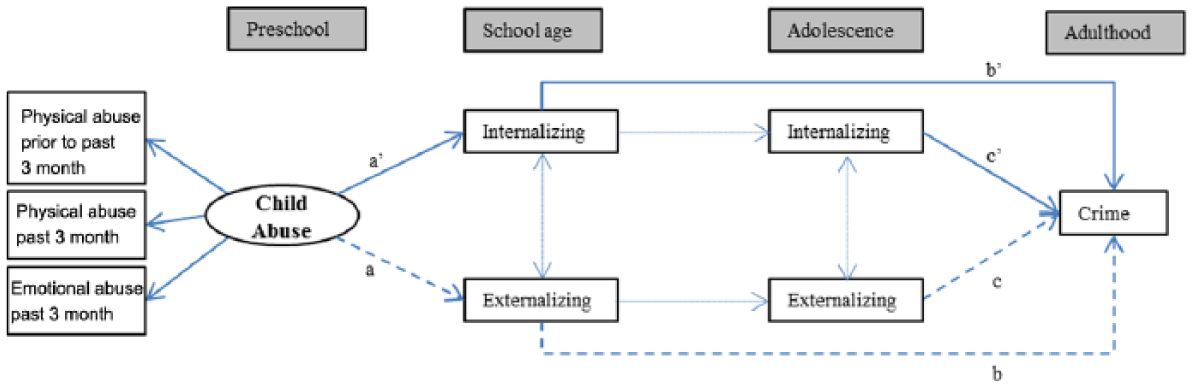
Conceptual research model.
Method
Data and Procedure
The data analyzed in this article were drawn from the Lehigh Longitudinal Study, which began in 1973-1974 as the evaluation portion of a child abuse and neglect treatment and prevention program in two counties of eastern Pennsylvania (R. C. Herrenkohl, Herrenkohl, Egolf, & Wu, 1991). Selection of the sample was accomplished over a 2-year period by referrals from two county child welfare agencies, of cases in which there was at least one abused or neglected child of age 18 months to 6 years present in the home. The children served by child welfare agencies participated in one of several group settings (e.g., day care, Head Start). It was from these other settings that children from outside of the child welfare system were enrolled in the study. The original sample totals 457 children and is composed of near equal numbers of males (n = 248) and females (n = 209). The racial and ethnic composition of the sample is consistent with the makeup of the two-county area from which participants were drawn: 1.3% (n = 6) American Indian/Alaska Native, 0.2% (n = 1) Native Hawaiian or Other Pacific Islander, 5.3% (n = 24) Black or African American, 80.7% (n = 369) White, 11.2% (n = 51) more than one race, and 1.3% (n = 6) unknown. Eighty-six percent of children were from two-parent households. About 61% of families were in poverty according to income-to-needs ratio in 1976 (n = 276).
The first “preschool” wave of the study took place in 1976-1977 when children recruited to the study were 18 months to 6 years of age. A second “school-age” assessment was conducted in 1980-1982 when the children were 9 years old on average (5-12 in age range). A third “adolescent” assessment of all youth participants was conducted in 1990-1992 when they were 14 to 22 years old (18 on average). 1 An adult wave of the study was completed in 2010, after intensive locating and interviewing efforts. Approximately 80% of the original sample still living (n = 356) was located and assessed via a comprehensive, interviewer-administered survey. In the adult assessment, participants were 36 years of age (range = 31-41) on average. The sample remains gender balanced: 170 (47.9%) females and 186 (52.1%) males.
Table 1 presents the descriptive statistics for the study sample. Analyses of the current sample showed that although more of the original child welfare group was lost to attrition, there were no statistically significant group differences in gender, age, childhood socioeconomic status (SES), or ratings of neglect or parent-reported physically abusive discipline (T. I. Herrenkohl et al., 2013). Study procedures were approved by the Human Subjects Division at the University of Washington and the Office of Research and Sponsored Programs at Lehigh University.
Descriptive Statistics.
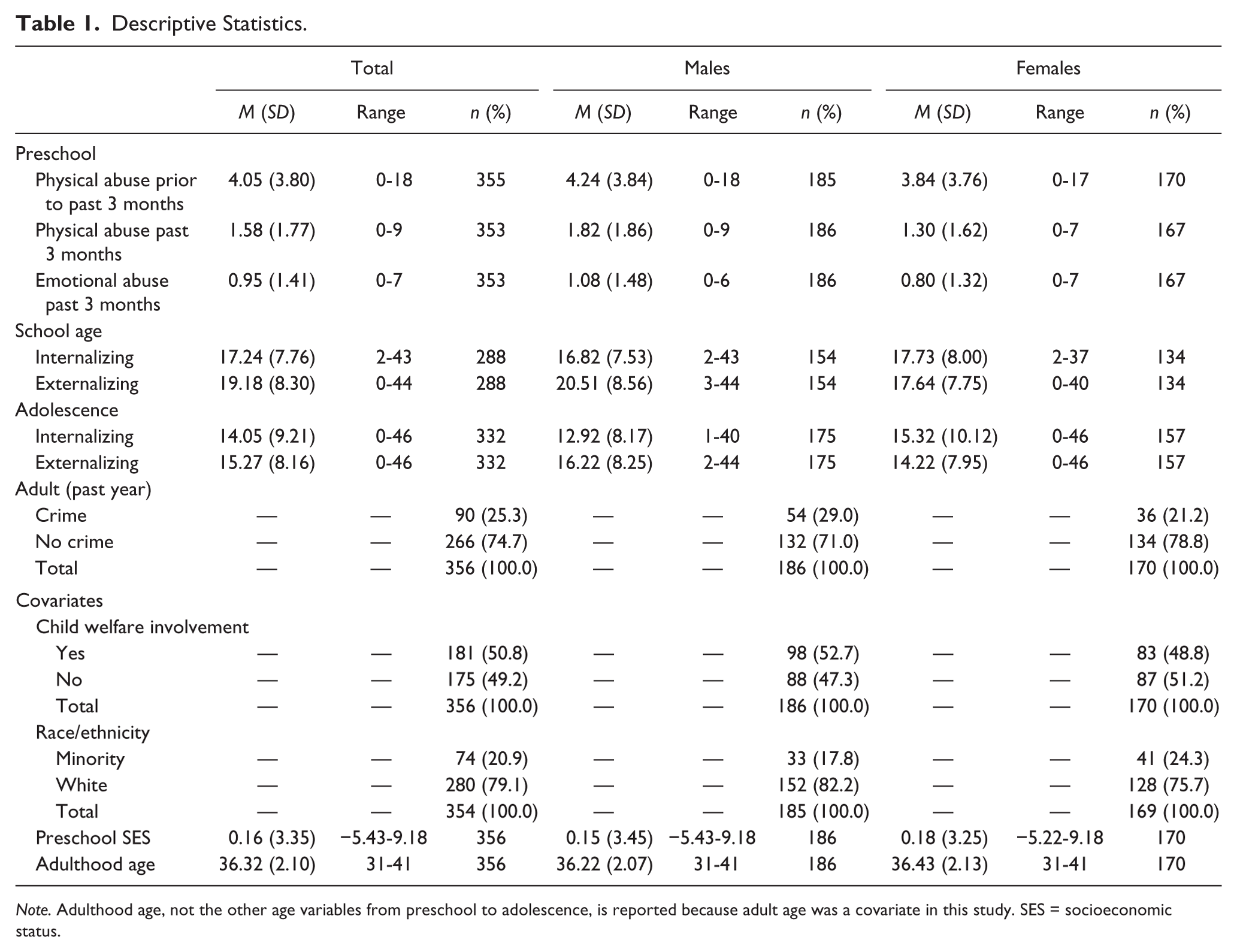
Note. Adulthood age, not the other age variables from preschool to adolescence, is reported because adult age was a covariate in this study. SES = socioeconomic status.
Variables
Child abuse
Physical and emotional abuse were measured in preschool assessment by the questions asked of parents on their and other caregivers’ use of physically (12 items) and emotionally (7 items) abusive disciplining strategies (see Appendix A for the list of items). Physical disciplining practices were measured (a) for the last 3 months and (b) prior to that last 3 months whereas emotional disciplining practices were measured for the last 3 months only. These items were defined as abuse in this study based on severity rating by a group of 41 child welfare workers on a 5-point scale (5 = abusive, 4 = severely punishing, 3 = mildly punishing, 2 = mildly rewarding, 1 = highly rewarding). The abuse items were all rated in the 4.0 to 5.0 (severely punishing to abusive) severity range. The number of disciplining strategies affirmed to have been used for corresponding periods was counted for each caregiver and summed across the three caregivers. Accordingly, possible ranges are from 0 to 36 for each assessment of physical abuse and from 0 to 21 for emotional abuse. Physical abuse in the last 3 months actually had a range of 0 to 9 with mean (M) = 1.58 and standard deviation (SD) = 1.77. Physical abuse for the period prior to that last 3 months had a range of 0 to 18 with M = 4.05 and SD = 3.80. Emotional abuse in last 3 months had a range of 0 to 9 with M = 0.95 and SD = 1.41. These three abuse variables were modeled as indicators of a latent construct of child abuse in the preschool period.
Internalizing and externalizing behaviors were assessed using mother reports on a version of the Achenbach Child Behavior Checklist (CBCL) for ages 4 to 16 years (Achenbach, 1978, 1988) for data collection at school age. In adolescence, these behaviors were measured using the Achenbach Youth Self-Report form of the CBCL (YSR; Achenbach, 1997). Both the CBCL and the YSR use a 3-point rating scale (0 = not true, 1 = somewhat or sometimes true, 2 = very true or often true) and have established reliability and validity across a variety of samples (Achenbach & Rescorla, 2001). The CBCL and YSR each measure both externalizing and internalizing behaviors, and items used are presented in Appendix B. Externalizing behaviors consist of aggression plus non-aggressive, rule-breaking, or antisocial behaviors (33 items for school age and 30 items for adolescence with Cronbach’s αs of .89 and .87, respectively), and internalizing behaviors are comprised of behaviors indicating withdrawal, depression, anxiety, and somatic problems (35 items for school age and 31 items for adolescence with Cronbach’s αs of .85 and .90, respectively).
Adult crime
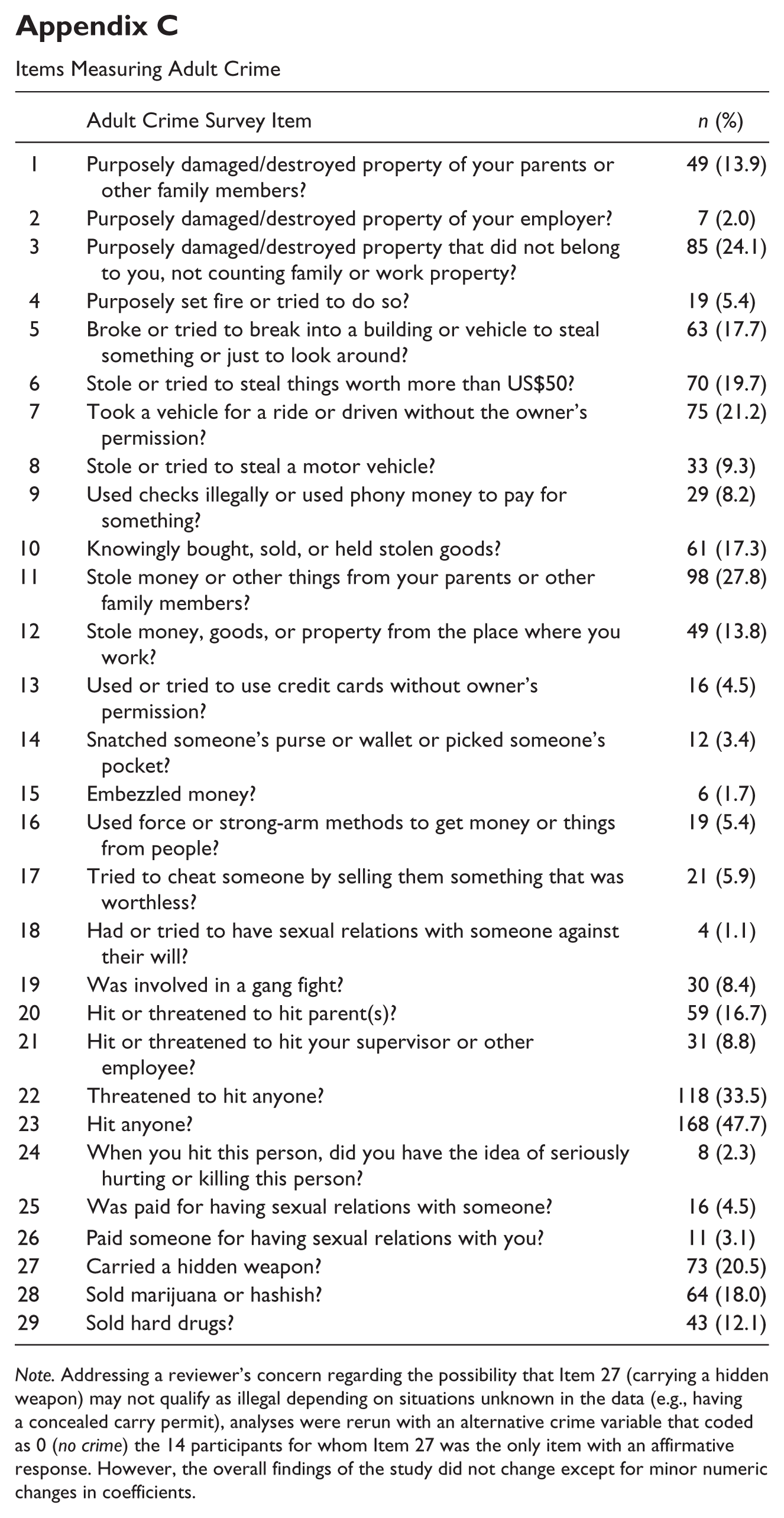
Participants were asked whether they had committed any of the 29 offenses listed in the adult survey during the past year (see Appendix C for the survey items). Affirmative responses to each queried behavior (0 = no, 1 = yes) were combined into a dichotomous variable that indicates crime commitment (0 = no crime, 1 = any crime committed). Ninety participants (25.3% of the analysis sample) reported having perpetrated at least one crime in past year.
Covariates included four variables: childhood SES, minority, age, and official child welfare involvement. Official child welfare involvement was included to account for the group composition of the sample, which distinguishes children involved with child welfare at the start of the study from those not involved: 1 = child welfare group (n = 181, 50.8%) and 0 = comparison (n = 175, 49.2%). Childhood SES is a standardized composite measure of parents’ occupational status, educational level, and family income, with a range of −5.43 to 9.18, M = 0.16, and SD = 3.35. Minority was coded as White = 0 (n = 280, 79.1%) and minority = 1 (n = 74, 20.9%). Age is a continuous variable with a range of 31 to 41 years, M = 36.32, and SD = 2.10.
Analysis
General structural equation modeling was performed. Structural equation modeling estimates models that contain both latent (or unobserved) and manifest (or observed) variables, making it possible to test overall fit of a hypothesized theoretical model to observed data accounting for error terms before probing each path coefficient (Kline, 2005). As the study model (Figure 1) shows, measures of physical and emotional abuse at preschool were modeled as indicators of a latent construct of child abuse.
Through a series of multiple-group structural equation models (MSEM), the hypothesized differences across genders were tested. In advance of testing the structural (in)variance of the model across genders, the measurement invariance of child abuse across genders was tested by a multiple-group confirmatory factor analysis. A measurement model with gender-separate estimation and the other model with equality constraints imposed on the factor loadings across genders were compared with a chi-square difference test (Satorra & Bentler, 1994). Subsequently, analyses of structural invariance across gender groups were conducted using weighted least squares with mean and variance adjustment (WLSMV) estimation in Mplus 7.11 (Muthén & Muthén, 1998-2012). The WLSMV estimator uses the probit model to estimate regression coefficients for binary dependent variables. It uses a diagonal weight matrix with standard errors and a mean- and variance-adjusted chi-square test statistic that uses a full weight matrix (Muthén & Muthén, 1998-2012). Structural models were compared for gender invariance with chi-square difference tests provided through the DIFFTEST option of Mplus 7.11 (Muthén & Muthén, 1998-2012). The fit of each model was determined based on multiple considerations, including an examination of the model chi-square, the comparative fit index (CFI), and the root mean square error of approximation (RMSEA). RMSEA values less than 0.05 and a CFI more than 0.95 indicate a good fit of the model to the data (Hu & Bentler, 1999; Kline, 2005).
Mplus provides missing data modeling using frequentist analysis (Muthén & Muthén, 1998-2012). In weighted least squares estimation used for categorical outcomes such as the outcome of this study (adult crime), missingness is allowed to be a function of the observed covariates (Muthén & Muthén, 1998-2012). Observations with missing data on covariates are deleted because models are estimated conditional on the covariates (Muthén & Muthén, 1998-2012). One of the study covariates—minority—has two missing observations, so these were not included in the model estimation, resulting in a total sample size of 354 for the general structural equation modeling (SEM).
Results
Measurement Invariance Tests
The measurement invariance of child abuse across gender was tested by comparing the invariance model where factor loadings of the three physical and emotional abuse variables and their intercepts were constrained to be equal across gender groups with the comparison model allowing the factor loadings to vary across groups. The constrained model did not statistically differ from the comparison model, Δχ2(3) = 6.04, p = .11, which indicated measurement invariance of the child abuse construct across gender groups. In the measurement model, standardized factor loadings varied for the three indicators from 0.43 to 0.82 for the total sample, but all were statistically significant (p < .001), suggesting that each indicator contributes to the meaning of the latent factor of child abuse (Figure 2).
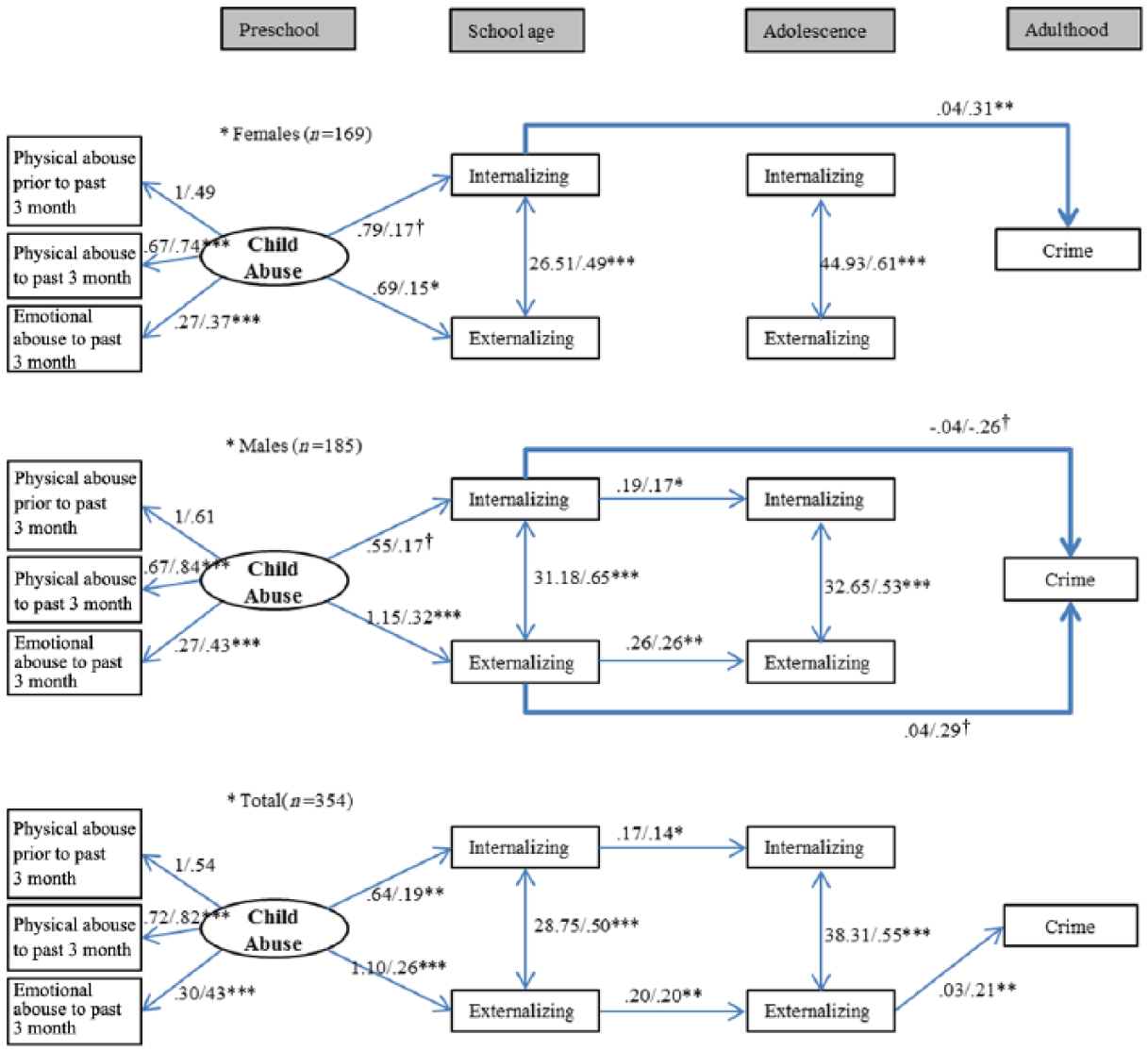
Baseline model for females (above, n = 169) and males (middle, n = 185).
The conceptual model shown in Figure 1 had good fits for both males, χ2(27) = 34.49 at p = .15, CFI = 0.95, and RMSEA = 0.04 with 90% confidence interval (CI) of 0 to .07, and females, χ2(27) = 30.41 at p = .30, CFI = 0.97, and RMSEA = 0.03 with 90% CI of 0 to .07. Given the fit of the conceptual model to both male and female data as well as the confirmed invariance of the measurement model of child abuse across gender, a series of structural invariance tests were subsequently performed.
Structural Invariance Tests
Structural models were tested and compared with the baseline model to examine gender differences in pathways from child abuse to adult crime. The baseline model, shown in Figure 2, which combines two separate tests of the conceptual model among males and females into one model with paths freely estimated across genders, fits the data well, χ2(58) = 67.90 at p = .18, RMSEA = 0.03 with 90% CI of 0 to .06, and CFI = 0.96.
Structural invariance across gender groups was examined by comparing the baseline, freely estimated model to one in which six structural paths were constrained to be equal according to the study hypotheses that these paths are differentiated by gender groups. Results are shown in Table 2. A chi-square difference test revealed that the two models were significantly different, Δχ2(6) = 12.68, p < .05, indicating the possibility of gender differences in one or more of the six path coefficients that were estimated. From this point, we tested each path coefficient individually by constraining it to be equal across the two groups, and allowing all others to vary freely. These tests showed that path b′ from school-age internalizing behaviors to adult crime significantly differed for males and females, Δχ2(1) = 8.54, p < .01. The path b from school-age externalizing behaviors to adult crime also differed across gender groups with marginal significance, Δχ2(1) = 3.24, p = .07. The other coefficients, although appearing to differ in some cases, were not different with statistical significance across the two gender groups.
Multiple-Group SEM: Path Variance Across Males and Females.
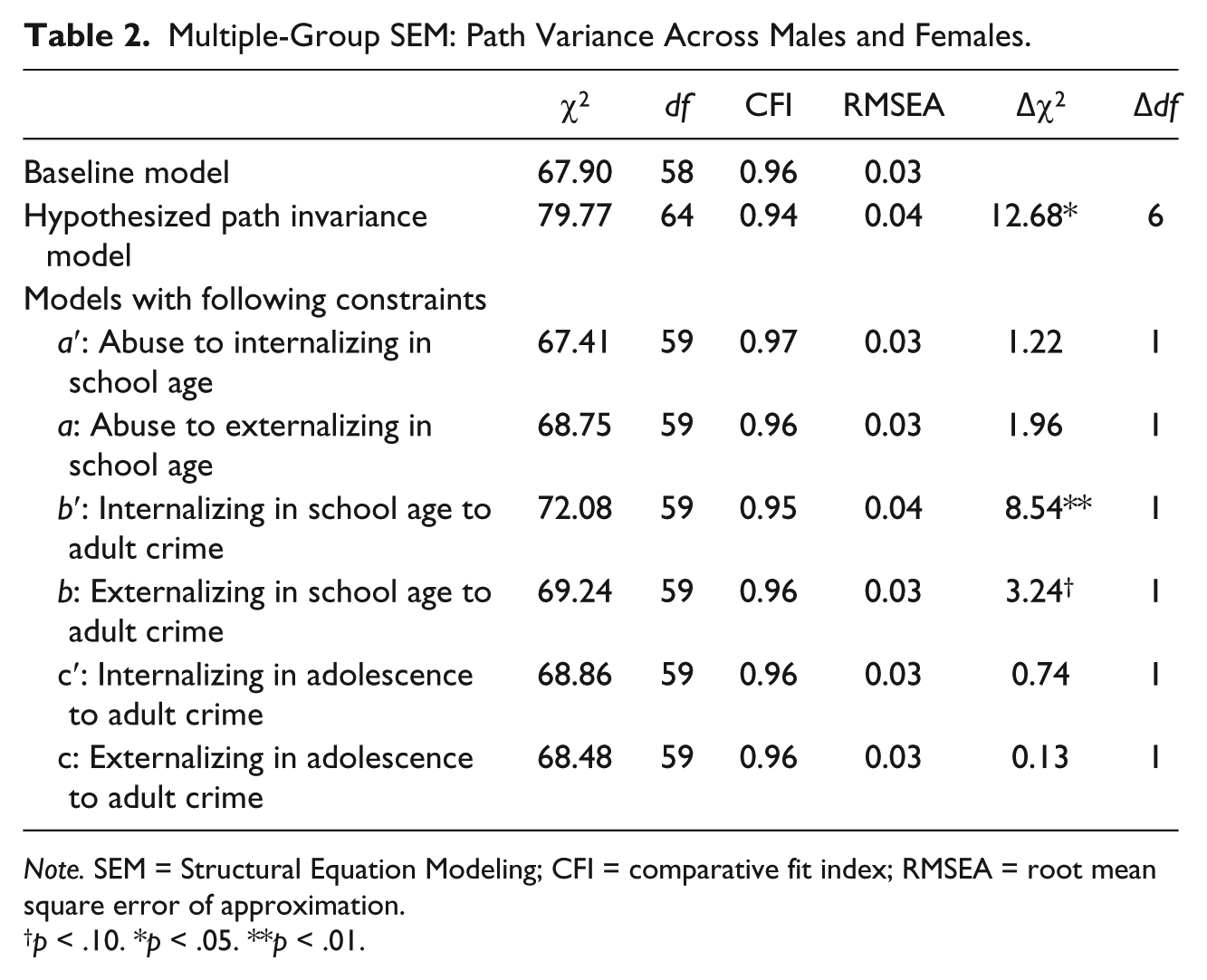
Note. SEM = Structural Equation Modeling; CFI = comparative fit index; RMSEA = root mean square error of approximation.
p < .10. *p < .05. **p < .01.
Hypothesis 1: Gender differences in the paths from child abuse at preschool to internalizing and externalizing behaviors at school age
As shown in Figure 2, child abuse was associated with increased levels of both internalizing and externalizing behaviors at school age for both genders. The standardized coefficients and corresponding p values for the path to externalizing behaviors (a) were 0.32 for males (p < .001) and 0.15 (p < .05) for females. Coefficients for the path from abuse to internalizing behaviors (a′) were 0.17 (p < .10) for both males and females. Tests for invariance in these paths indicated no significant gender differences despite some variation in these standardized values, Δχ2(1) = 1.96 at p = .16, for the effect on externalizing behaviors and Δχ2(1) = 1.22 at p = .27, for the effect on internalizing behaviors.
Hypothesis 2: Gendered paths from internalizing and externalizing behaviors in school age and adolescence to adult crime
As shown in Figure 2, internalizing behaviors at school age (b′) predicted adult crime for females (β = .31 at p < .01), whereas, for males, school-age internalizing behaviors appeared to inhibit crime involvement in adulthood (β = −.26 at p < .10). The statistical test of the gender difference in this path was significant, Δχ2(1) = 8.54 at p < .01. The path from school-age externalizing behaviors to adult crime (b) was marginally significant for males (β = .29, p < .10) but no effect was found for females (β = −.05, p = .72). A subsequent test revealed a marginally significant gender difference in the effect of school-age externalizing behaviors on adult crime, Δχ2(1) = 3.24 at p < .10. Adolescent internalizing (c′) and externalizing (c) behaviors did not predict adult crime for both gender groups: β = .08 (p = .60) and β = .21(p = .12) for females and β = −.07 (p = .49) and β = .16 (p = .15) for males, and invariance tests revealed no gender differences in these coefficients, Δχ2(1) = 0.74 at p = .39, for the effect of adolescent internalizing behaviors and Δχ2(1) = 0.13 at p = .72, for the effect of adolescent externalizing behaviors.
Because there were only two paths where gender difference was statistically significant based on these tests of structural invariance, the model was re-estimated for the full analysis sample with males and females combined. Results were shown to resemble the models for males and females analyzed separately although the two gender-variant paths lost their statistical significance due to gender-specific effects canceling each other by being merged into the total sample (Figure 2). Coefficients from child abuse to externalizing and internalizing behaviors at school age were 0.26 (p < .001) and 0.19 (p < .01), respectively, and adolescent externalizing behaviors were linked to adult crime in the full sample (β = .21 at p < .01).
Discussion
This study examined pathways from child abuse to adult crime through internalizing and externalizing behaviors in school age and adolescence. Gender differences in the pathways were tested using MSEM. Findings show that abuse during early childhood (preschool) is related to both internalizing and externalizing behaviors in later childhood (school age) regardless of gender. However, from that point forward (through adolescence and into the adult years), pathways leading to adult crime appear to differ by gender. Specifically, analyses revealed that internalizing behaviors in school age were positively associated with adult crime for females, whereas these same behaviors were negatively associated with crime in adulthood for males. Furthermore, externalizing behaviors in school age among males were positively associated with adult crime although these same behaviors did not predict adult crime among females.
The fact that we did not find emerging gender differences in the association of child abuse with internalizing and externalizing behaviors stands in contrast to earlier published studies that show gender differences even at this early stage of development (e.g., Dulmus & Hilarski, 2006; Maschi et al., 2008). For example, Maschi and colleagues (2008) showed in a longitudinal study of 300 children (age = 7-12 years) a stronger association between officially recorded child maltreatment and internalizing behaviors for females than for males, whereas maltreated males were more strongly associated with externalizing behaviors than counterpart females. Although other studies found similar patterns of behavior among boys and girls following disclosure of child abuse (e.g., Fagan, 2001; Widom, 2000), those similarities were based on measurement of problem behaviors in adolescence such that abused female adolescents are as likely to show externalizing problems as abused male adolescents. This study adds to the current knowledge by demonstrating statistical evidence of gender invariance in emerging problem behaviors following child abuse, not only that girls are as likely to manifest externalizing behaviors as boys but also that boys are as likely to manifest internalizing behaviors as girls in school age. It supports the proposition of general strain theory with respect to gender differences (Broidy & Agnew, 1997) in that child abuse experiences are strains that are severe enough for the gendered socialization of problem behaviors to be overridden. Nonetheless, whether or not these contrasting findings are attributable to anything more than variations in methods and measures (e.g., official records vs. parent self-report measures of abuse) used in these various studies is an issue requiring further investigation.
In the current study, we found that, for females, there was a positive association between school-age internalizing behaviors and adult crime, whereas for males, the association was negative. Among males, a positive association was found between school-age externalizing behaviors and adult crime whereas for females, the association was not significant. More importantly, these gender-based differences were statistically evidenced. These findings support the theoretical framework suggested by Silverthorn and Frick (1999) of gendered pathways to deviant behaviors such that early internalizing behaviors among females were a precursor for later criminal behavior. For males, later criminal behaviors were linked to externalizing behaviors in school age for those on the early onset and persisting pathway of deviant behaviors.
A particularly interesting finding of our study is the seemingly protective influence of school-age internalizing behaviors for males. Miettunen et al. (2014) found that internalizing problems at age 8 predicted less risk for later substance abuse among males. It is speculated that internalizing symptoms, including depression, social withdrawal, and somatic complaints, lessen crime by decreasing an individual’s susceptibility to peer influences and a modeling of antisocial behaviors (Farrington, 1995; Hay, 2003). Why this effect was present for males and not females in this study raises the possibility that peers play a different role in crime among females (Bender, 2010), although further investigation of the issue is required.
In addition, this study found that behavioral problems in school age rather than in adolescence predicted adult crime, supporting the theory of a developmental taxonomy differentiating adolescent-limited and life-course-persistent antisocial or criminal behaviors (Moffitt, 1993; Moffitt & Caspi, 2001). The theory attests that behavioral problems beginning in childhood, associated with childhood adversity, distinguish life-course-persistent antisocial behaviors from adolescent-limited delinquencies. Presumably, those with adolescent problem behaviors in this study include both life-course-persistent and adolescence-limited delinquents, which weaken the predictability of adult crime by adolescent problems. However, problem behaviors in childhood make rigorous predictors for crime continuing into adulthood according to the Moffitt’s taxonomy. Moffitt and Caspi (2001) also provided evidence that the theory applies to both males and females. The significant effects of school-age behavioral problems on adult crime support the theory although the channel of manifestation is differentiated across gender.
Limitations of this research include we having focused on certain forms of child maltreatment (parent-reported physical and emotional abuse) and not others (e.g., sexual abuse, neglect). Our analyses did, however, control for measurement differences in child abuse studies by including data on child welfare involvement, which was collected at the start of this 35-year study. Child welfare reports were made not only for abuse but also for neglect among those enrolled in the study (T. I. Herrenkohl et al., 2013). Another limitation is that parents were the sole reporters on abuse measures. Multiple reporters may provide different accounts of abuse occurrences and therefore produce measures that are potentially more comprehensive. Third, although this study included important control variables—age, childhood SES, minority status as well as child welfare involvement—additional covariates in adulthood such as occupational and marital status and education level were not included in the analyses. Our rational for excluding them is grounded in our focus on variables that could be conceptualized as confounds in the sense that they operate as common background predictors of both child abuse and adult crime (Sauer, Brookhart, Roy, & VanderWeele, 2013). Failing to account for such variables can lead to spurious relationships. However, the adulthood variables we considered as potential covariates, although correlated with the outcome, did not meet our definition of a potential confounding influence. Finally, the findings are not generalizable because the sampling was not random but based on referral and matching from a region even though it was an optimal sample for child maltreatment study. In addition, of note is that a substantial portion (46.6%) of the adolescent survey participants was 19 to 22 years old. Although measures were taken so that age did not influence findings (see a note in Appendix B), replication studies with “adolescent” data of conventional ages will be helpful in corroborating the findings. Despite limitations, this study adds to extant research literature by the design to analyze the prospective four-wave data to examine pathways from child abuse to adult crime. Traditional notions of females demonstrating responses to traumatic experiences, that is, child abuse here, with internalizing behaviors as opposed to males with externalizing behaviors was statistically tested, advancing research on gender differences.
Implications
This longitudinal study of the pathways from child abuse to adult crime through school-age and adolescent internalizing and externalizing behaviors highlights the importance of testing gender differences in analyses of child abuse effects. Males and females may have different pathways to adult crime, which suggests a need to consider different prevention and intervention strategies tailored to each gender. Internalizing behaviors among girls should be attended carefully because internalizing behaviors are more likely to be overlooked than externalizing behaviors. Problem behaviors need to be treated from therapeutic perspectives. Externalizing and internalizing behaviors in adolescence might represent temporary difficulties for teenagers, but in cases where such problem behaviors are displayed among those with child abuse history, it is possible that those symptoms have persisted from childhood and may lead to crime in adulthood. Replications of the current findings will help inform development of tailored strategies.
Footnotes
Appendix
Items Measuring Adult Crime
| Adult Crime Survey Item | n (%) | |
|---|---|---|
| 1 | Purposely damaged/destroyed property of your parents or other family members? | 49 (13.9) |
| 2 | Purposely damaged/destroyed property of your employer? | 7 (2.0) |
| 3 | Purposely damaged/destroyed property that did not belong to you, not counting family or work property? | 85 (24.1) |
| 4 | Purposely set fire or tried to do so? | 19 (5.4) |
| 5 | Broke or tried to break into a building or vehicle to steal something or just to look around? | 63 (17.7) |
| 6 | Stole or tried to steal things worth more than US$50? | 70 (19.7) |
| 7 | Took a vehicle for a ride or driven without the owner’s permission? | 75 (21.2) |
| 8 | Stole or tried to steal a motor vehicle? | 33 (9.3) |
| 9 | Used checks illegally or used phony money to pay for something? | 29 (8.2) |
| 10 | Knowingly bought, sold, or held stolen goods? | 61 (17.3) |
| 11 | Stole money or other things from your parents or other family members? | 98 (27.8) |
| 12 | Stole money, goods, or property from the place where you work? | 49 (13.8) |
| 13 | Used or tried to use credit cards without owner’s permission? | 16 (4.5) |
| 14 | Snatched someone’s purse or wallet or picked someone’s pocket? | 12 (3.4) |
| 15 | Embezzled money? | 6 (1.7) |
| 16 | Used force or strong-arm methods to get money or things from people? | 19 (5.4) |
| 17 | Tried to cheat someone by selling them something that was worthless? | 21 (5.9) |
| 18 | Had or tried to have sexual relations with someone against their will? | 4 (1.1) |
| 19 | Was involved in a gang fight? | 30 (8.4) |
| 20 | Hit or threatened to hit parent(s)? | 59 (16.7) |
| 21 | Hit or threatened to hit your supervisor or other employee? | 31 (8.8) |
| 22 | Threatened to hit anyone? | 118 (33.5) |
| 23 | Hit anyone? | 168 (47.7) |
| 24 | When you hit this person, did you have the idea of seriously hurting or killing this person? | 8 (2.3) |
| 25 | Was paid for having sexual relations with someone? | 16 (4.5) |
| 26 | Paid someone for having sexual relations with you? | 11 (3.1) |
| 27 | Carried a hidden weapon? | 73 (20.5) |
| 28 | Sold marijuana or hashish? | 64 (18.0) |
| 29 | Sold hard drugs? | 43 (12.1) |
Note. Addressing a reviewer’s concern regarding the possibility that Item 27 (carrying a hidden weapon) may not qualify as illegal depending on situations unknown in the data (e.g., having a concealed carry permit), analyses were rerun with an alternative crime variable that coded as 0 (no crime) the 14 participants for whom Item 27 was the only item with an affirmative response. However, the overall findings of the study did not change except for minor numeric changes in coefficients.
Authors’ Note
The content of this article is solely the responsibility of the authors and does not necessarily represent the official views of the funding agencies. The funding agencies played no role in the study design; in the collection, analysis, and interpretation of data; in the writing of the report; or in the decision to submit the article for publication.
Declaration of Conflicting Interests
The author(s) declared no potential conflicts of interest with respect to the research, authorship, and/or publication of this article.
Funding
The author(s) disclosed receipt of the following financial support for the research, authorship, and/or publication of this article: Funds for this project were provided by the National Institute of Child Health and Human Development (RO1 HD049767) and the National Institute of Justice (2012-IJ-CX-0023).