




Abstract
Use of pornography is common among adolescents and young adults, with most men and a growing number of women viewing regularly. A vast body of research suggests pornography use is associated with multiple attitudinal and behavioral variables. One of those associations, for both men and women, is higher pornography use is correlated with a lower likelihood of intervening to prevent sexual assault. The present study explored how motives for viewing pornography related to male (n = 139) and female (n = 290) college students’ willingness and efficacy to intervene to help prevent a sexual assault from occurring. We found that several motivations to view pornography were associated with suppression of willingness to intervene as a bystander, even after controlling for frequency of pornography use. This study joins others in suggesting an association between pornography use and callousness toward sexual violence.
College students, both men and increasingly women, report viewing pornography at high rates. Research has shown that between 76% and 87% of college men view pornography every year, and 48% view it weekly (Boies, 2002; Carroll et al., 2008). As for college women, one third now view pornography annually, although weekly use remains rare (3%, Carroll et al., 2008; Yoder, Thomas, & Amin, 2005).
Over the past few decades, experimental and correlational research has focused on variables associated with pornography exposure. The most prominent of these is sexual aggression. In their review of more than 50 experimental studies and meta-analyses, Malamuth, Addison, and Koss (2000) conclude pornography exposure has a causal but complicated relationship with aggressive behavior; the link between pornography and sexual aggression is much stronger in men with predisposing risk factors such as high rape myth acceptance and low empathy. The associations between pornography and sexual aggression are also present in women. In experimental studies with women, violent pornography exposure, especially in combination with alcohol intoxication, is associated with increased ratings of blame for rape victims, decreased assignment of responsibility to male sexual assault perpetrators, and the belief that victims should accept sexual victimization (Davis, Norris, George, Martell, & Heiman, 2006; Norris, Davis, George, Martell, & Heiman, 2004). Moreover, both men’s and women’s use of pornography has been associated with a decreased self-reported likelihood that they will intervene to prevent sexual assault (Brosi, Foubert, Bannon, & Yandell, 2011; Foubert, Brosi, & Bannon, 2011). Taken together, results support decades-old assertions that pornographic media contribute to a culture of sexual callousness, especially toward violence against women (Zillmann & Bryant, 1982).
Although much is known about the effects of pornography, there is scant research documenting the specific reasons why people view pornography and whether men and women differ in these motives. The present study sought to describe the various motives men and women report for viewing pornography. In addition, we sought to extend the research on the connection between pornography and sexual aggression by determining whether pornography use motives were associated with bystander willingness and/or efficacy to intervene in a potential sexual assault situation. We focused on two research questions:
The Effects of Pornography
Research using a variety of experimental and correlational methods has shown pornography use is both highly common and may be associated with multiple harms in adult men and women (Carroll et al., 2008; Kingston, Malamuth, Fedoroff, & Marshall, 2009). Yet, despite legal restrictions against minors accessing sexually explicit material, exposure to Internet pornography prior to the age of 18 is normative in the United States. Among today’s college students, 93% of men and 62% of women report that they were exposed to Internet pornography before they turned 18 (Carroll et al., 2008). In a 2-year longitudinal study of 13-year-olds, 66% of boys and 39% of girls had seen pornography during the last year (Brown & Engle, 2009). Consistent with this finding, a study with an older sample of urban adolescents age 12 to 22 found that 86% of boys and 50% of girls had been to an Internet pornography site during the previous year (Braun-Courville & Rojas, 2009). In adolescents, boys are more likely to see pornography, see it at a younger age, view more extreme images such as rape and child pornography, and do so more frequently than girls, while girls are more likely to have had involuntary exposure to pornography than boys (Sabina, Wolak, & Finkelhor, 2008).
Many researchers have studied the particular patterns and associations of pornography exposure in adolescents. In a qualitative study, teen girls reported that when they watch pornography, they feel their bodies are inferior in comparison with those they see; while boys reported worrying that they will not be able to perform as well as the male actors (Owens, Behun, Manning, & Reid, 2012). Adolescents who view pornography tend to engage in sexual behavior at an earlier age (Owens et al., 2012). Both girls and boys who watch pornography become more likely to have oral sex and intercourse in their youth (Brown & Engle, 2009). Pornography use was also associated with a history of sexual harassment perpetration in boys (Brown & Engle, 2009). In addition, boys’ use of violent pornography is correlated with histories of more severe levels of sexually aggressive behavior, more conduct problems, more juvenile delinquency, and higher levels of depression than boys who avoid violent pornography (Owens et al., 2012).
The links between sexual aggression and pornography use are hypothesized to emerge because sexualized media that includes violence or degradation of women contributes to a cultural climate where such violence is normalized (Krafka, Linz, Donnerstein, & Penrod, 1997). As such, a prominent concern in many studies of pornography is determining the content of what early adolescents see. Bridges, Wosnitzer, Scharrer, Sun, and Liberman (2010) found that violence against women is now commonplace in today’s most popular pornography films. When adolescents view this combination of violence and sex, they may develop sexual scripts that infuse the two (Wright, 2011).
Once college begins, most students have seen, and are likely affected by, pornography with nearly all men and two thirds of women having been exposed (Brown & Engle, 2009). Experimental and correlational research has shown that use of Internet and other types of pornography is associated with a variety of sexually violent behavior (Kingston et al., 2009). A meta-analysis found that men’s use of pornography is strongly associated with acceptance of sexual violence (Hald, Malamuth, & Yuen, 2010). In addition, a comprehensive literature review of more than 50 studies found that men who frequently use pornography are more likely to have perpetrated rape and other forms of sexual aggression (Malamuth et al., 2000). High pornography use adds significant predictive capacity to the ability to determine whether men will be sexually aggressive, over and above other predictive factors (Vega & Malamuth, 2007). It appears that men who have attitudes supporting sexual violence seek out violent pornography and that the two are mutually reinforcing (Malamuth, Hald, & Koss, 2012).
Effects on Women
Traditionally considered a strictly male phenomenon, the once pronounced gender gap found in pornography consumption has diminished (Carroll et al., 2008; Yoder et al., 2005). Some people attribute increased use by women to widespread accessibility and greater anonymity permitted through the Internet (W. A. Fisher & Barak, 2001). Like in men, greater pornography use in women is associated with increased assignment of responsibility to victims and less responsibility to male perpetrators of rape (Davis et al., 2006; Norris et al., 2004) In addition, pornography use in women is associated with greater acceptance of personal sexual victimization (Davis et al., 2006; Norris et al., 2004).
Notably, research has shown that when actresses in popular mainstream pornographic movies experience physical aggression, 95% of the time they provide either a response of pleasure or no response at all (Bridges et al., 2010). Given that the content of pornography today reinforces the script that women do not resist when hit during a sexual encounter (Bridges et al., 2010), it stands to reason that exposure to pornography sends the message that women enjoy physical aggression during sex. If women internalize the messages that women enjoy violence, it raises a barrier for potential intervention to help another woman who is at current risk of sexual assault (McMahon & Banyard, 2012). It also raises a barrier for men to help women if they internalize the script that women enjoy being aggressed against.
Reasons for Pornography Use
There is scant literature on what motivates people to use pornography, aside from a limited number of studies (Frable, Johnson, & Kellman, 1997; Stack, Wasserman, & Kern, 2004), and no studies to date that examine how motives to view pornography relate to similar concepts, including sexual behaviors. Common sense would suggest pornography is used primarily for sexual stimulation; indeed, many definitions of pornography emphasize that it is material created with the intention of arousing viewers (Dines, Jensen, & Russo, 1998). However, use may occur for myriad reasons, beyond just sexual stimulation. Recent research on why adolescents use Internet pornography found that they visit such sites because they are sexually curious (50%), by accident (46%), and to seek information (17%; Braun-Courville & Rojas, 2009). Using an Italian sample of adolescents, the majority of boys (70%) and girls (82%) first watched pornography because their friends were watching. Other reasons cited by boys were that it was sexually exciting (53%) and that they liked it (44%). Girls were more likely to say that they were curious (37%). Both boys (49%) and girls (36%) watched to get “information about sex” (Romito & Beltramini, 2012). In a sample of U.S. adults, Bridges and Morokoff (2011) found the primary reason why men used pornography was for solitary sexual stimulation (i.e., masturbation), while for women, the primary motive was as part of sexual activity with a romantic partner. Additional motives for pornography use in both men and women included to satisfy curiosity, relieve boredom, and reduce stress and loneliness. We suspect that with increasing kinds of motivations to use pornography in an individual, that person would have lower bystander intervention scores. Although this is an exploratory question, it stands to reason that with more rather than fewer reasons one cites to view pornography, the odds that they will experience a known impact of pornography viewing will also increase (Foubert et al., 2011).
Bystander Intervention
Initial research has found that the use of pornography, particularly violent pornography, is associated with decreased bystander intervention intentions and efficacy in both male and female college students (Brosi et al., 2011; Foubert et al., 2011). This is particularly concerning given that encouraging bystander intervention is the prevailing prevention approach used on college campuses for sexual assault education, with a wide variety of programs demonstrating its efficacy (Foubert, 2011; Katz, Heisterkamp, & Fleming, 2011; McMahon & Banyard, 2012). Confirming the relationship between bystander intervention and pornography holds promise for those seeking to encourage an end to sexual violence. If in fact pornographic media create a cultural climate that permits violence against women (Krafka et al., 1997), then perhaps reducing pornography use would help reduce the acceptability of sexual violence against women, just as experimental evidence suggests reducing use increases commitment to a romantic partner (Lambert, Negash, Stillman, Olmstead, & Fincham, 2012). In addition, it is important for the scholarly community to understand whether and how men and women differ in their motivations to use pornography, so educational efforts can be targeted to address such motivations. Therefore, the purpose of the present study was to investigate the degree to which motives for engaging in pornography use, above and beyond frequency of use, related to bystander efficacy and willingness to intervene in a bystander sexual assault situation. Furthermore, we sought to determine whether these relations were moderated by gender. Considering prior research in the arena of pornography use and bystander intervention (Foubert et al., 2011), we made the following hypotheses:
The study also included two exploratory aims. First, we asked whether various motives for engaging in pornography use were associated differentially with bystander efficacy and willingness to intervene. Second, we asked whether the associations between pornography use (frequency and motives) and bystander variables (efficacy and willingness to intervene) were moderated by gender.
Method
Participants
Participants were students from a large Midwestern public university and a large Southern research university. Participants were recruited through each university’s human participant’s pool of students during the spring, summer, and fall 2011 semesters. A total of 450 surveys were collected through volunteers who signed up for course credit from an online research participation system. Eighteen surveys (4.0%) were discarded because the participant did not provide sufficient data (missing more than 50% of data points), and three surveys (0.7%) were removed for failing a consistency check. The remaining sample of participants consisted of 139 (32.4%) male and 290 (67.6%) female participants. The sample included 143 (33.3%) first year, 69 (16.1%) sophomore, 89 (20.7%) junior, 58 (13.5%) senior, and 69 (16.1%) graduate students. One student did not report her year in school. The race/ethnicity of participants was 355 (82.8%) White, 32 (7.5%) African American, 21 (4.9%) Native American, 11 (2.6%) Hispanic/Latino, and 9 (2.1%) Asian. One person did not report her race/ethnicity. Participants’ mean age was 21.85 years (SD = 5.37), and ages ranged from 18 to 53.
Procedures and Materials
Participants completed measures including scales measuring bystander efficacy, bystander willingness to intervene, use of Internet pornography, reasons for use of pornography, and a brief demographic questionnaire. These measures were as follows.
Bystander Efficacy Scale
Perceived ability to intervene as a bystander was measured by the bystander efficacy scale developed by Banyard, Plante, and Moynihan (2005). This measure asks participants to indicate their confidence in performing each of 18 bystanding behaviors. Participants rate items on a scale of 0% to 100%, indicating their percent confidence that they believe that they know how to intervene in the scenario described. A score of 0 indicates no confidence; a score of 100 indicates complete confidence. A total efficacy score is created by averaging the percent confidence ratings for each of the 18 items. Strong criterion and construct validity data are reported by Banyard (2008). Cronbach’s alpha in this study was .93.
Bystander Willingness to Help Scale
The Willingness to Help Scale was developed by Banyard et al. (2005) and measures participants’ degree of likelihood of engaging in 12 bystanding behaviors on a 5-point Likert-type scale ranging from 1 (not at all likely) to 5 (very likely). For example, participants rate their willingness to do such things as “Enlist the help of others if an intoxicated acquaintance is being taken upstairs at a party.” Items came from research literature and from discussions with advocates and professionals working in the field of sexual violence. Responses are averaged to create a total score, with higher numbers indicating greater willingness to intervene as a bystander. Strong criterion and construct validity are reported by Banyard (2008). A Cronbach’s alpha of .86 was found in the present study.
Exposure to Sexual Materials Questionnaire (ESMQ)
Respondents’ use of pornography was measured with Frable et al.’s (1997) ESMQ. Respondents indicated how many times in the past year they had been exposed to each of 44 different sexually explicit materials, such as viewing hardcore videos, purchasing pornographic magazines, or accessing adult Internet websites. Responses were coded on a 7-point ordinal scale (1 = 0 times; 2 = 1-2 times; 3 = 3-5 times; 4 = 6-10 times; 5 = 11-50 times; 6 = 51-100 times; 7 = more than 100 times). One item (purchased Playgirl magazine) was discarded because no participant endorsed it. A total sexual material consumption score was calculated by averaging scores across the remaining 43 items. An alpha of .93 was found in the present study.
Reasons for Consuming Pornography Scale (RCPS)
Respondents’ reasons for consuming pornography was measured with 17 items used by Frable et al. (1997) in their study of motives for sexual material use. To establish the validity of six subscales, participant responses were analyzed with a principal components analysis with varimax rotation. Authors note that in an unconstrained solution, six factors had eigenvalues greater than 1, explaining 63% of the variance in responses. In our study, rather than have respondents indicate simply “yes” or “no” to each motive, respondents endorsed each item on a 5-point scale from 1 (strongly agree) to 5 (strongly disagree). Thus, lower scores indicate a stronger degree of having that particular motive. Six subscale scores were created by averaging items, according to Frable and colleagues’ original study. Higher scores equate to a greater variety of motives to view pornography. Subscale names and reliabilities were (a) for sexual thrills (α = .82), (b) to turn on a sexual partner (α = .86), (c) to learn about sex (α = .80), (d) to relieve sexual tension (α = .92), (e) to enjoy a social event (α = .71), and (f) to make sex more interesting (α = .75). Bivariate correlations revealed all subscales were significantly and highly related to one another (r = .37-.80), so the 17 items were averaged to form a total score. Cronbach’s alpha for the total motives score was .95.
Results
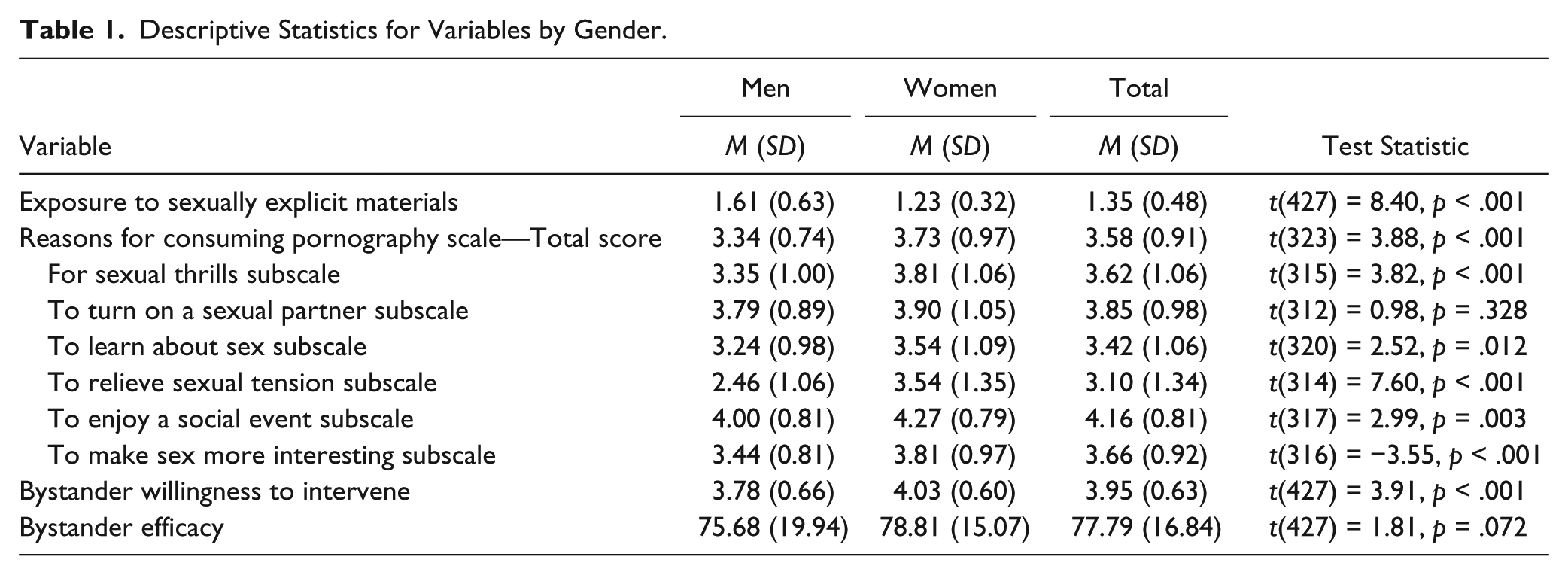
Prior to evaluating study hypotheses, we calculated descriptive statistics and correlations among variables. Results are summarized in Tables 1 and 2. Not surprisingly, men viewed pornography more frequently than women (p < .001; Table 1). When examining reasons for pornography use (which included for sexual thrills, to turn on a sexual partner, to learn about sex, to relieve sexual tension, to enjoy a social event, and to make sex more interesting), men endorsed all reasons to a greater extent than did women, with the exception of use to turn a partner on sexually, where men’s and women’s reasons were statistically equivalent (p > .30). The most common reasons why both men and women used pornography were to relieve sexual tension, to learn about sex, and for sexual thrills. Reasons were all significantly correlated with each other (Table 2). When examining bystander variables, men and women reported statistically equivalent levels of bystander efficacy (p > .05), but women reported greater willingness to intervene than did men (p < .001).
Descriptive Statistics for Variables by Gender.
Correlations Among Study Variables.

Note. ESMQ = Exposure to Sexual Materials Questionnaire; RCPS = Reasons for Consuming Pornography Scale.
p < .05. **p < .01. ***p < .001.
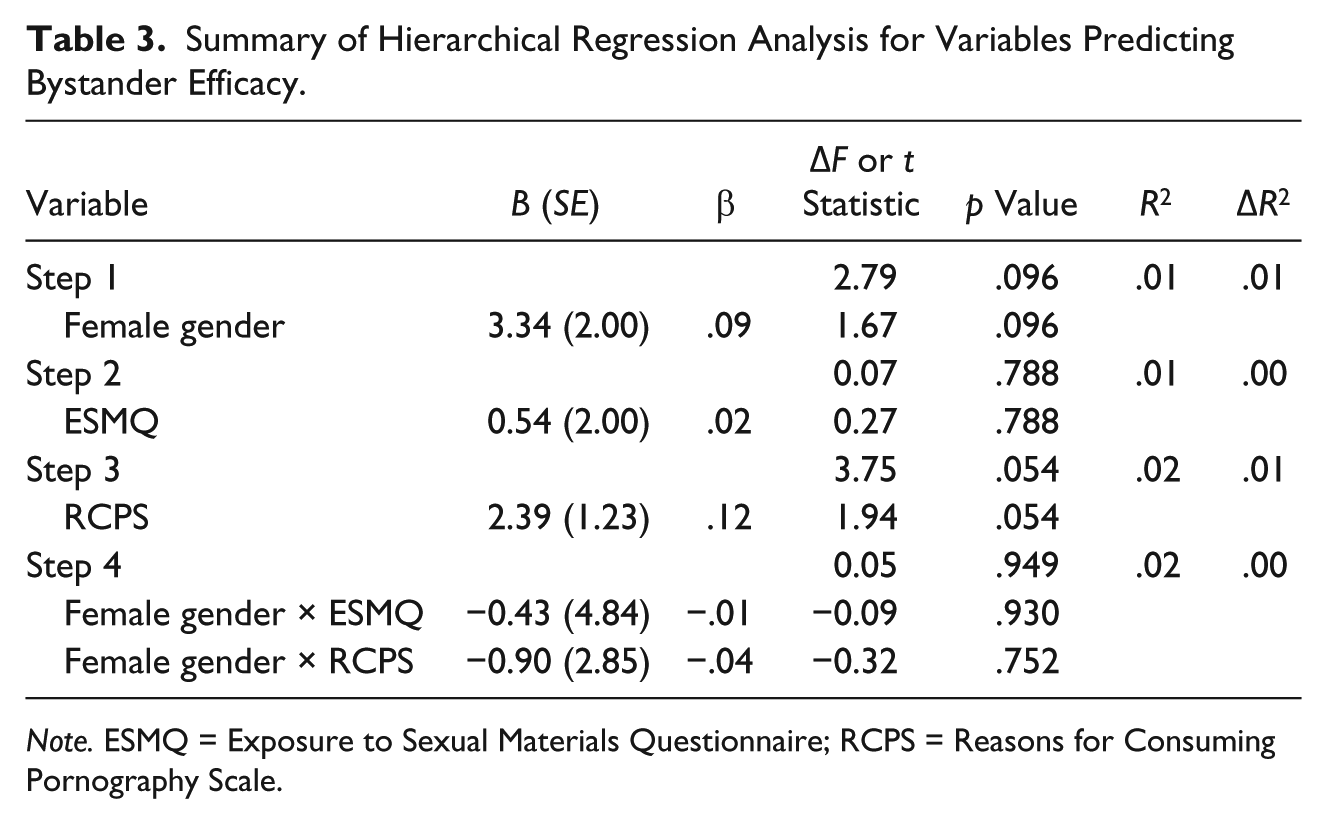
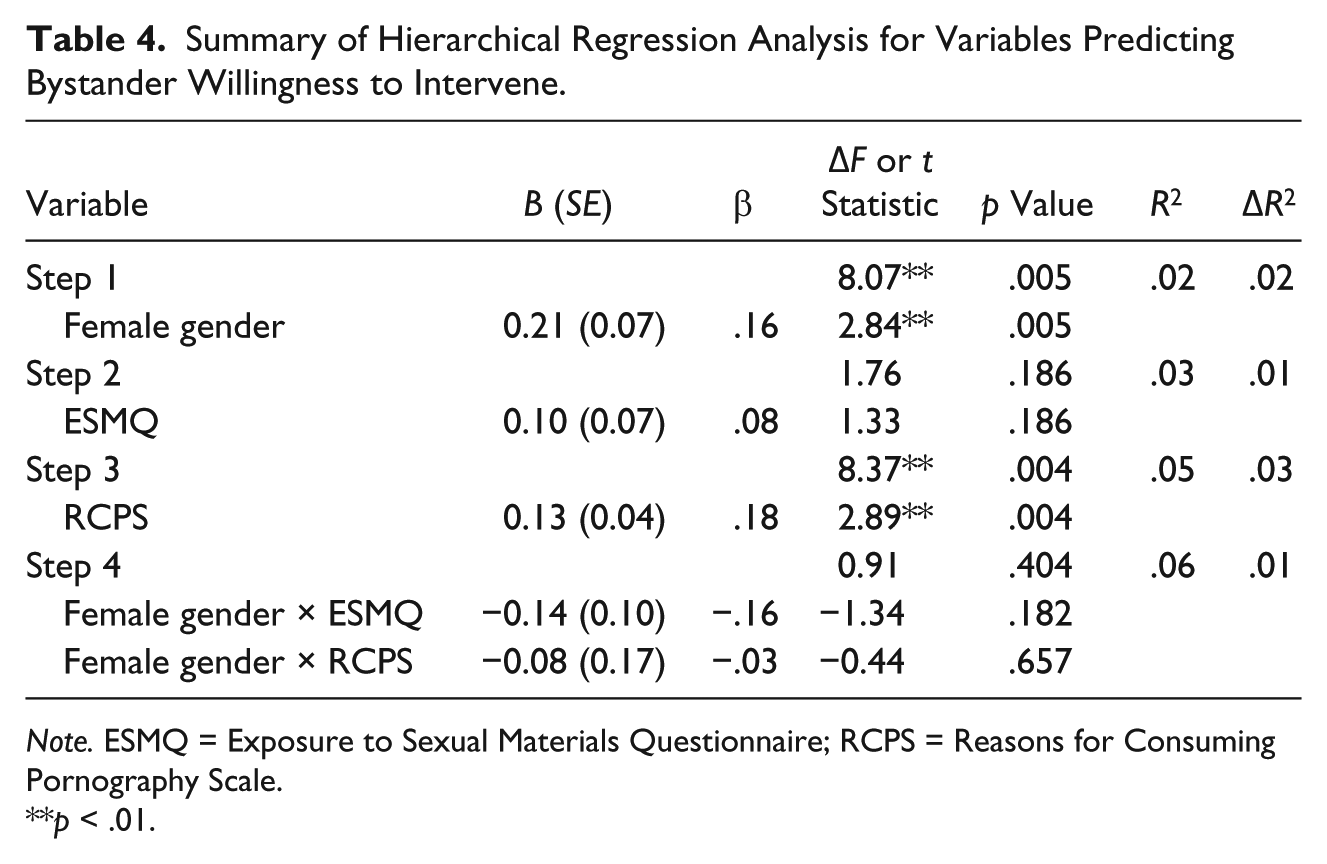
To evaluate the hypotheses, we analyzed the data using a series of hierarchical linear regressions with bystander efficacy and willingness to intervene as dependent variables and gender (Step 1), pornography use frequency (Step 2), motives for pornography use (Step 3), and the interactions between gender and the pornography use variables (Step 4) as the predictors. In all analyses, evaluations of statistical assumptions relevant to hierarchical regression were evaluated and were satisfactory. Results are summarized below for each of the dependent variables.
Bystander Efficacy
Table 3 provides a summary of regression results. None of the steps and none of the variables (gender, pornography use, reasons for pornography use, and the interactions) significantly predicted the dependent variable. Therefore, none of the hypotheses were supported for bystander efficacy.
Summary of Hierarchical Regression Analysis for Variables Predicting Bystander Efficacy.
Note. ESMQ = Exposure to Sexual Materials Questionnaire; RCPS = Reasons for Consuming Pornography Scale.
Bystander Willingness to Intervene
Table 4 provides a summary of regression results for the model predicting bystander willingness to intervene from gender (Step 1), pornography use frequency (Step 2), motives for pornography use (Step 3), and the interactions between gender and the pornography use variables (Step 4). Confirming Hypothesis 1, a main effect of gender was observed, with women showing greater bystander willingness to intervene than men. Contrary to Hypothesis 2, there was no main effect of the frequency of pornography use after controlling for gender. The third hypothesis was confirmed for bystander willingness to intervene. Total motivation for using pornography added significant predictive value to the regression equation. Specifically, participants reporting a greater variety of motives for engaging in pornography use showed lower willingness to intervene in a bystander situation than participants with fewer motives, after controlling for gender and pornography use frequency. The fourth step was not significant, indicating gender did not moderate the relations between bystander willingness to intervene and the pornography variables. The set of variables, as a whole, explained 6% of the dependent variable.
Summary of Hierarchical Regression Analysis for Variables Predicting Bystander Willingness to Intervene.
Note. ESMQ = Exposure to Sexual Materials Questionnaire; RCPS = Reasons for Consuming Pornography Scale.
p < .01.
Bystander Willingness to Intervene by Pornography Use Motives
Hierarchical regressions were also computed to determine which, if any, motivations to use pornography predicted bystander willingness to intervene, controlling for gender and frequency of using pornography. The motivation “to make sex more interesting” added significant variance when controlling for gender and frequency of pornography use (β = .19, ΔR2 = .03, p = .003). The motivation “to enjoy a social event” also added significant variance when controlling for gender and frequency of pornography use (β = .15, ΔR = .02, p = .007). The motivation “to learn about sex” added significant variance when controlling for gender and frequency of pornography use (β = .14, ΔR = .02, p = .024). The motivation “to enjoy sexual thrills” added significant variance when controlling for gender and frequency of pornography use (β = .18, ΔR = .02, p = .008). Two motivations, “to relieve sexual tension” (β = .11, ΔR = .01, p = .113) and “to turn on my sexual partner” (β = .10, ΔR = .01, p = .108) did not add significant variance when controlling for gender and pornography use. None of the gender interactions were significant in any of the regressions that explored specific motives.
Discussion
As pornography use becomes more common, researchers are increasingly examining associations between consumption and other variables, including attitudinal and behavioral intention variables related to sexual assault (Brosi et al., 2011; Davis et al., 2006; Foubert et al., 2011; Malamuth et al., 2000; Norris et al., 2004). In this study, we extended this research to ask how diverse motives for pornography use related to bystander intervention variables for potential sexual assaults. We also examined two exploratory questions regarding whether various motives for engaging in pornography use were associated differentially with bystander efficacy and willingness to intervene and whether the associations between pornography use (frequency and motives) and bystander variables (efficacy and willingness to intervene) were moderated by gender.
We first examined gender differences in bystander efficacy and willingness to intervene. Consistent with our first hypothesis, women reported more willingness to intervene in a potential rape situation than did men, though there was no difference in bystander efficacy. Contrary to Hypothesis 2, there was no main effect of the frequency of pornography use on bystander variables, after controlling for gender. With regard to Hypothesis 3, there was a main effect for motivations to use pornography. Specifically, participants reporting a greater variety of motives for engaging in pornography use showed lower willingness to intervene in a bystander situation than participants with fewer motives, after controlling for gender and pornography use frequency.
Our first research question was whether there would be differential effects on bystander intervention based on participant motives for viewing pornography. We found that greater endorsement of the following motives was associated with lower willingness to intervene: “to make sex more interesting,” “to enjoy a social event,” “for sexual thrills,” and “to learn about sex,” after controlling for gender and frequency of pornography use. However, no association between “to reduce sexual tension” or “to turn on my partner” motives and bystander willingness to intervene was observed. There are a variety of potential explanations for why four motives predicted bystander willingness to intervene while two did not. A willingness to intervene implies a desire to help others regardless of the consequences to the perceptions of others. For example, others could view someone intervening to prevent rape as a person who is out to ruin the good time of others. The four motives that predicted willingness all have an element of risk or enhanced sensation seeking beyond a typical sexual experience. The two that did not predict willingness relate to the more mundane. We believe that this opens the door to further research exploring whether variables such as sensation seeking have a (negative) relationship with bystander willingness to intervene.
Regarding our second research question, we found that none of the associations between motives and bystander willingness were moderated by gender. The relationships were the same for both men and women. Although men and women have been shown to differ in a variety of ways when it comes to pornography (Carroll et al., 2008; Sabina et al., 2008), they seem to have no greater or lesser degree of association between their motives for viewing pornography and how that affects bystander willingness. Women report less intensity in their motives for viewing pornography, though this decrement does not differentially affect willingness to intervene. Willingness to intervene as a construct, thus, does not seem to have differential impacts through motivation to use pornography concerning gender.
The finding that four different motives for using pornography were associated with a lower likelihood for both men and women to intervene in a potential rape situation suggests that when people view pornography to make sex more interesting, to enjoy a social event, for sexual thrills, and to learn about sex, the climate on campus for women may be more dangerous. If the knowledge about sex that college students gain through pornography includes the very common theme of violence (Bridges et al., 2010), it comes as no surprise that these students would report being less likely to intervene to prevent similar behavior in their daily lives. That several motivations to use pornography are associated with lower willingness to intervene extends prior research showing associations between pornography use and bystander variables (Brosi et al., 2011; Foubert et al., 2011). However, given pornography use itself was not associated with bystander variables, after controlling for gender, is inconsistent with prior work. It is possible that our inclusion of both men and women in this study, compared with only men (Foubert et al., 2011) or only women (Brosi et al., 2011), masked main effects of pornography. In the present study, as in nearly all others (Braun-Courville & Rojas, 2009; Bridges & Morokoff, 2011; Brown & Engle, 2009; Carroll et al., 2008), men endorsed significantly higher frequency of pornography use than women. Another possible reason for the lack of association between pornography use and bystander variables is the relatively low overall means for viewing various forms of pornography in the present study.
Although we found some associations between motivations to use pornography and bystander willingness, we did not find any such associations with bystander efficacy. Bystander willingness and bystander efficacy are separate concepts. Efficacy focuses on whether someone believes they have the skill set to step up and stop violence before it starts. Willingness, however, is a measure of whether one believes it is necessary to intervene and whether they predict that they will indeed do so. Someone high on bystander willingness believes that they not only have the tools to intervene, but they are favorably disposed to use them. From the results of the present study, it seems that one’s motivation to use pornography can affect an individual’s disposition on whether intervening needs to occur. By contrast, the strength of his or her reasons for using pornography are independent of whether the individual has the skill set to intervene at all. It is logical that viewing violent media of a sexual nature could affect whether one is favorably disposed to intervene in a sexually violent situation. If one is bombarded with messages that sex and violence go together, why would they believe stopping such behavior is necessary? However, watching sexually violent media would do little to change whether an individual has the knowledge of what to do and the skills to carry it out—efficacy. We suggest further research explore the interplay between bystander willingness and efficacy, and how learning more about these constructs can affect prevention programming.
In contrast to the Bridges and Morokoff (2011) study, in the present study, the most common motives stated by both men and women for consuming pornography were remarkably similar. The most common reasons both men and women reported were as follows: “to relieve sexual tension,” “to learn about sex,” and “for sexual thrills.” However, men endorsed most motives at a higher rate than did women. The one exception was in the motive “to turn on a sexual partner,” which was endorsed at similar rates by men and women.
Wright (2011) describes a causal model by which pornography sexual scripts are applied in real life. He notes that these scripts, which are marked by frequent violence against women (Bridges et al., 2010), are acquired through viewing, activated in sexual situations, and applied with real life partners. Our results suggest greater motivations for engaging with pornography, above and beyond frequency of use, is associated with decreased willingness to help a potential sexual assault victim. It is not evident from this study whether people who already are more calloused toward violence against women seek out pornography for more reasons than people less calloused (Malamuth et al., 2000), or whether, as Wright argues, pornography actually cultivates increased callousness regarding violence against women. Nevertheless, the messages contained within much popular pornography are consistent with the high rates of sexual violence experienced by many young women (B. S. Fisher, Cullen, & Turner, 2006). Today’s pornography, with its emphasis on men’s violence against women, is used by both men and women in an attempt to arouse a sexual partner. In using such violent media, men and women are encouraging each other to be sexually stimulated by images where men hit women and women seem to enjoy it. If in fact users are sexually stimulated by this material, the arousal can serve to reinforce the desirability of men’s violence against women in the minds of both men and women.
Limitations
This study should be considered in light of several limitations. Participants were college students from two large public universities. A broader sample of people of different ages and environments could provide a more generalizable study. This study is further limited by the nature of using self-report measures and the fact that a scale of social desirability was not included. Given the nature of the study, it could have been valuable to measure the degree to which participants were answering truthfully, and to selectively remove responses from participants who appeared to be answering in a deceptive manner. The bystander variables measured attitudes and behavioral intentions. It is unclear whether, faced with an actual potential sexual assault, participants would have responded similarly. In addition, we only assessed pornography use frequency, not intensity, nor did we assess the content of pornography commonly consumed by the participants. These would be important variables to include in future studies that intent to draw links between potentially violent or degrading sexually explicit media and bystander intervention in sexual assault situations.
Footnotes
Declaration of Conflicting Interests
The author(s) declared no potential conflicts of interest with respect to the research, authorship, and/or publication of this article.
Funding
The author(s) received no financial support for the research, authorship, and/or publication of this article.