



Abstract
Prior research typically focuses on a single child (“index” victim) when measuring child abuse and neglect (CAN) using Child Protective Services (CPS) records. However, excluding siblings has the potential to underestimate estimates of the prevalence, severity, and chronicity of CAN in the household, which includes all children in the family. CPS maltreatment records were searched in 2005 for 366 “index” victims who were surveyed for 5 consecutive years (from 1998 to 2002) for the Mobile Youth Survey (MYS) as well as other siblings in the household. The estimate of prevalence of CAN in the household increased by 10% when sibling(s) in the household were included in the CPS search. In addition, prevalence of sexual abuse in the household increased by 38% when siblings were included in the broader search of CPS records. More importantly, including sibling victims of CAN uncovered incidents of maltreatment that occurred before the birth of the targeted MYS “index” victim. In short, the inclusion of abuse and neglect of siblings is a straightforward and intuitive way to improve estimates of abuse and neglect in the household. More importantly, the age of onset of CAN of sibling victims provides a wider window of opportunity to identify at-risk families for targeted interventions and may represent a critical stepping stone toward the primary prevention of CAN in the household.
Keywords
Child abuse and neglect (CAN) has been identified as a public health threat facing youth (e.g., Whitaker, Lutzker, & Shelley, 2005), which has an estimated cost of US$103 billion per year for the one million confirmed victims of CAN in the United States (Wang & Holton, 2007). In addition, the World Health Organization (WHO) has called for investment in epidemiological studies to expand our knowledge about the magnitude, effects, and prevention of maltreatment (Gilbert et al., 2009). Typically, one child in a household becomes the targeted “index” child for data collection (Hines, Kantor, & Holt, 2006). More importantly, the level of precision of estimates of CAN based on targeted searches using a single child in a household is based on two implicit assumptions. One assumption is that specific types of CAN (e.g., physical and sexual abuse) are limited to one child in the family. The second (related) assumption is that more targeted searches that exclude siblings and focus on a single child in the household do not underestimate the prevalence, severity, and/or chronicity of CAN in the household.
More specifically, although incidents of neglect (e.g., physical neglect, failure to provide, and lack of supervision) documented by Child Protective Services (CPS) typically include all the children in the household as victims (Goldman, Salus, Wolcott, & Kennedy, 2003), few studies have determined the extent to which neglect is child-specific or a family-level phenomenon (Hines et al., 2006). More importantly, it is unclear whether physical abuse or sexual abuse is limited to one child versus a broader pattern of abuse that engulfs other children in the household. Early CAN research documented that siblings were also at increased risk for maltreatment (Manly, Cicchetti, & Barnett, 1994), but few studies have systematically incorporated siblings into data collection to examine the prevalence of CAN within the household (Hamilton-Giachritsis & Browne, 2005). One notable exception is Finkelhor, Turner, Ormrod, and Hamby’s (2009) cross-sectional national telephone survey of 4,549 children aged 0 to 17, which found that 2.1% of these youth witnessed physical abuse of siblings in the past year and 4.9% witnessed physical abuse of siblings during their lifetime. Stockhammer, Salzinger, Feldman, Mojica, and Primavera’s (2001) more nuanced examination of 100 physically abused 9- to 11-year-olds from New York State CPS records found that 34% witnessed abuse of other children in the household based on a broader search of CPS records that included siblings in the household. However, it is unclear how the broader search of CPS records (that includes siblings) contributes to key dimensions of estimates of CAN in the household (see Campbell, Bogen, & Berger, 2006).
The purpose of this article is to specify the independent effects of CAN of siblings on the prevalence, severity, and chronicity of CAN in the household in a high poverty sample of minority youth. First, abuse and neglect of siblings (sibling CAN) will be defined. Second, the key findings and limitations of previous studies that have examined sibling CAN will be described. Third, sibling CAN within families will be connected with a large body research on exposure to violence in the family and the community to illustrate the potential theoretical and empirical relevance of including other siblings in the family to more accurately measure the prevalence, severity, and chronicity of CAN in the household. Finally, CPS records for 366 targeted “index” youth living in 12 high poverty neighborhoods who were part of an ongoing community-based survey (Mobile Youth Survey [MYS]) will be used to examine how the inclusion of siblings affect the prevalence, severity, and chronicity of CAN in the household.
Defining Sibling CAN
As noted above, estimates of CAN based on CPS records typically focus on a single “index” child in the household. In contrast, sibling CAN are incidents where a sibling of the “index” child is the CAN victim, but the incident does not involve the “index” child. Since sibling CAN is based on a broader search of CPS records that includes all children in the household, sibling CAN is used to examine the independent contribution of sibling victims of CAN on the prevalence, severity, and chronicity of CAN compared to previous studies that typically focus on a single “index” child in the household. In other words, what is the independent effect of sibling CAN compared with more focused estimates of CAN that are limited to a single “index” child in the household? The next section will overview the key findings and limitations of previous studies that have incorporated siblings as victims when collecting CAN data as these studies illustrate how sibling CAN represents a straightforward way to improve estimates of CAN (compared with more focused searches based on a single “index” child in the household).
Key Findings and Limitations of Previous Studies That Examined Sibling CAN
Manly et al. (1994) combined the CPS reports of sibling CAN with CPS reports of the “index” child since previous research had found that the majority of children from families with a history of CAN were also maltreated (e.g., Cicchetti & Manly, 1990). Manly et al. (1994) also used their clinical experience as an additional rationale for including CPS incidents involving siblings in their search of CPS records since their clinical experience suggested that maltreatment is typically not limited to one child in the household. One key finding from Manly et al.’s (1994) broader search of CPS records was the discovery of an additional 22% of the CPS incidents that had only siblings for victims.
Jean-Gilles and Crittenden (1990) conducted a more systematic examination of impact of sibling CAN in 28 families with children who were under investigation by CPS and found little support that the maltreatment was limited to a single child in the household. More specifically, they found that 58% of their siblings had at least one incident of CAN that would mandate court intervention, 38% of siblings of targeted children were considered at-risk for maltreatment (i.e., CAN not severe enough to mandate CPS investigation), and only 4% (1 case) where a sibling was not maltreated. Jean-Gilles and Crittenden found that the type of maltreatment for children from the same family was largely limited to neglect, which is consistent with CPS documentation of incidents of neglect as a family-level versus a child-specific phenomenon.
Hines et al.’s (2006) followed up on Jean-Gilles and Crittenden’s (1990) earlier research by focusing on specifying the extent of sibling neglect within households. Child reports from 59 sibling pairs drawn from both clinical and community samples were used to determine whether siblings within families have equivalent risk of parental neglect. They found a high correlation between sibling neglect and neglect of an “index” child for both the clinical and community groups. In short, it was most common for all children to experience parental neglect even if only one child in the household reported parental negligence.
Hamilton-Giachritsis and Browne (2005) conducted the most extensive study of sibling CAN within families by examining 795 siblings derived from a sample of 400 “index” children who had been referred to police child protection units in England for abuse and/or neglect. They found that the majority (57%) of families with a history of CAN of an “index” child also include sibling abuse, which suggests that the safety of all children in the household is in jeopardy when a single case of CAN is found within a household. As a result, Hamilton-Giachritsis and Browne suggested modifying the measurement of abuse and neglect in the household to include all children in the household for at-risk families (i.e., families with children with severe medical conditions, intellectual disability, and/or behavioral difficulties).
Limitations of Previous Studies of Sibling CAN
Although insightful, the handful of studies that have focused on including siblings when estimating abuse and neglect within families have several limitations. First, previous studies are based on small samples of siblings of “index” youth from families who were under investigation by CPS or the police (Hines et al., 2006; Jean-Gilles & Crittenden, 1990). Second, previous studies have not examined the impact of sibling CAN for specific subtypes of CAN (e.g., physical abuse and sexual abuse). This is a critical oversight since physical abuse and sexual abuse of siblings represent a more clear cut opportunity for identifying differences in reporting practices by CPS because the definition and documentation of physical abuse and sexual abuse in CPS records typically focus on specific victim(s) in the household. In contrast, the documentation of neglect is skewed toward including siblings since all children in the household are typically included as victims of neglect (Hines et al., 2006).
Third, previous research has not disaggregated measures of CAN within the household to distinguish incidents that involve only siblings, but not the targeted “index” child, as victims (sibling CAN) from CPS incidents where the “index” child is the victim. As a result, it is unclear how sibling CAN will affect the prevalence of specific types of maltreatment (neglect, physical abuse, sexual abuse) as well as the severity and chronicity of CAN in the household.
Sibling CAN and Exposure to Family Violence: Vicarious Victimization and the Measurement of CAN in Families
Finkelhor, Ormrod, and Turner (2007) argued that partitioning CAN victimization into narrow subtypes may substantially underestimate the magnitude of estimates of CAN. More generally, the fragmentation of research on youth violence has resulted in the partitioning of research on child maltreatment, exposure to family violence, and exposure to violence in the community (Margolin et al., 2009). However, child maltreatment is one dimension of family violence that includes a wide range of domestic violence, such as sibling violence and intimate partner violence that occur in the household (Smith & Ireland, 2009). On a similar note, the measurement of exposure to violence in the community includes both violent victimization (i.e., direct experience as a victim of violence) and vicarious victimization, which includes indirect exposure to violence by witnessing violence in the community (Brandt, Ward, Dawes, & Flisher, 2005). Three decades of research on exposure to violence in the community have established that indirect exposure to violence in the community (or vicarious victimization by witnessing violent acts) is more common than violent victimization for at-risk youth and adolescents (e.g., Overstreet, 2000). For example, 17% of youth were victims of violence, but almost 30% had witnessed someone (including family members or friends) being shot or stabbed in the past year in a longitudinal sample of minority youth living in extreme poverty (Spano et al., 2012, 2013).
As the family represents a key developmental context for youth (Margolin & Gordis, 2000), maltreatment represents a threat to the child’s personal safety that is inconsistent with the notion of the family as a safe haven for youth growing up in extreme poverty. Given the high prevalence of indirect exposure to family violence and vicarious victimization by witnessing acts of violence in the community in high poverty settings (Spano et al., 2010), the exclusion of siblings from estimates of CAN could dramatically underestimate the prevalence of CAN in the household. If the first step in advancing our knowledge about the epidemiology of maltreatment is to specify the extent of the problem (Fallon et al., 2010), then it is essential to determine the contribution of sibling CAN to the prevalence, severity, and chronicity of CAN in the household.
Research Questions
This study will examine two research questions.
Method
Description of the Sample
The MYS is an ongoing community-based study of adolescent risk behavior in 12 high poverty neighborhoods with 1990 poverty levels between 57% and 97% (Spano et al., 2006). Half of these neighborhoods were public housing. The Mobile and Prichard Housing Authorities provided a list of addresses where youths between age 10 and 18 were listed on the lease. The MYS targeted 50% of these apartments and contacted the leaseholder in each of these public housing residences over an 11-week period to verify that appropriately aged youths were living in the residence. As there was no list to guide the selection of youth living in non-public housing, half of the residences (e.g., rental housing and apartments) in the other six neighborhoods were randomly selected to determine if youth lived there. The youth(s) was (were) asked to participate, and the caregiver was asked to sign a consent form. Non-targeted residences were permitted to participate with parental consent.
Youths were then scheduled to attend a group-administered survey that was administered annually during the afternoon and early evenings. Parents or caregivers were not allowed in the room during the administration of the survey. Questions were read aloud to younger respondents to enable respondents with poor reading ability to complete the survey. When respondents did not understand a question, it was explained to the group by a survey administrator or to the individual by monitors in the room. Older respondents who appeared to have difficulty reading were invited to a separate area where questions were read to them individually or in a very small group. Participants were promised confidentiality and paid US$10 for their participation.
The MYS uses a community epidemiology framework (Kellam & Van Horn, 1997) that limits the effects of neighborhood and individual-level poverty by focusing on youth living in high poverty neighborhoods. This sampling procedure is well-suited for epidemiological studies of violence both inside and outside of the home given the concentration of violence and violent victimization in high poverty, urban neighborhoods (Fitzpatrick & Boldizar, 1993; Tolan & Gorman-Smith, 2003). More importantly, unlike other longitudinal studies (e.g., Rochester Youth Development Study), the MYS is a community-based sample that does not require school attendance for inclusion in the sample.
This study focuses on a subsample of 366 respondents from the MYS who were surveyed for 5 consecutive years (from 1998 to 2002). One benefit of focusing on these 366 youth is the stability of their residence in the 12 high poverty neighborhoods that are also in the jurisdiction of the Mobile County CPS for the search of CPS records for incidents of maltreatment within the household, which is discussed in more detail in the next section. However, the 366 MYS youth who are the focus of the current study are not a representative sample of youth who participated in the MYS. Sample attrition analyses examined dropout between 1998 (T1) and 2002 (T5) and found that older respondents were more likely to drop out. However, additional analyses indicated that gang membership in 1998 (T1), lifetime prevalence of exposure to violence in 1998 (T1), violent behavior in 1998 (T1), parental monitoring in 1998 (T1), and gender were unrelated to sample attrition (Spano et al., 2006). Table 1 provides the descriptive statistics for the MYS youth who were used as “index” victims in the search of CPS records, which will be described in the next section.
Descriptive Statistics for the Mobile Youth Survey.

Measurement of Abuse and Neglect in the Household
As noted above, measures of maltreatment were derived from a search of CPS records in 2005 from the Mobile County (Alabama) Department of Human Resources, which provide child welfare services including the investigation of allegations of CAN in Mobile County. There were two stages to the search of CPS records. First, the 366 MYS respondents in Table 1 were used as “index” victims to search CPS records for incidents of maltreatment that involved MYS respondents. In the second stage, a broader search of CPS records was conducted to identify sibling CAN. Sibling CAN are incidents of abuse and neglect that involved siblings (but not MYS respondents) based on the family-based method of tracking cases used by CPS that linked incidents of abuse and neglect for all children in the household. For all 366 MYS respondents and their siblings, the CPS search included all reports of indicated or not indicated (i.e., substantiated or unsubstantiated) maltreatment that occurred before 2005 to mitigate against the potential procedural biases between allegation and substantiation of CAN (e.g., Drake, 1996). The youngest MYS respondents in 1998 (T1) were 9 years old so the MYS youth were 17 years old or older when the search of CPS records was conducted in 2005.
Measurement of the Prevalence, Severity, and Chronicity of Maltreatment Using CPS Records
The incident date, case disposition (indicated or not indicated), descriptions of the incidents in the CPS case records, and the list of victims of abuse and neglect in the household were to identify the age at time of maltreatment, maltreatment type (e.g., sexual abuse, physical abuse, emotional maltreatment, physical neglect, failure to provide, and moral/legal/educational maltreatment), and severity of maltreatment using the coding procedures established by Barnett, Manly, and Cicchetti (1993). The measure of neglect used in this study included incidents of physical neglect (i.e., failure to provide), lack of supervision, and emotional and/or educational neglect. The data sharing agreement negotiated with CPS included 24-hr access to the CPS incident files for siblings as well as “index” victims. Due to time constraints, a random subsample of 83 out of the 598 CPS incident reports was used to estimate interrater reliability between coders using Cohen’s kappa, which was 0.83.
Analysis Plan
The overarching goal of the analyses is to examine the impact of sibling CAN on estimates of CAN in the household. The first part of the analysis will describe the difference between the measurement of CAN in the household (which includes all children in the family) with estimates of CAN that are based on targeted “index” youth (i.e., MYS youth), which are used as a baseline as most studies search CPS records based on a single “index” child in the household. The second part of the analysis will quantify the impact of sibling CAN on the prevalence of CAN in the household (which includes all children in the family) for each type of maltreatment (sexual abuse, physical abuse, and neglect). The third part of the analysis will examine the impact of sibling CAN on several measures of the severity and chronicity of CAN in the household. In addition, the second stage of the analysis will illustrate how the inclusion of sibling CAN to estimate the chronicity of CAN dramatically affects the estimates of age of onset of CAN in the household.
Results
Using CAN of a Single Child in the Household (MYS “Index” Victim) as a Baseline
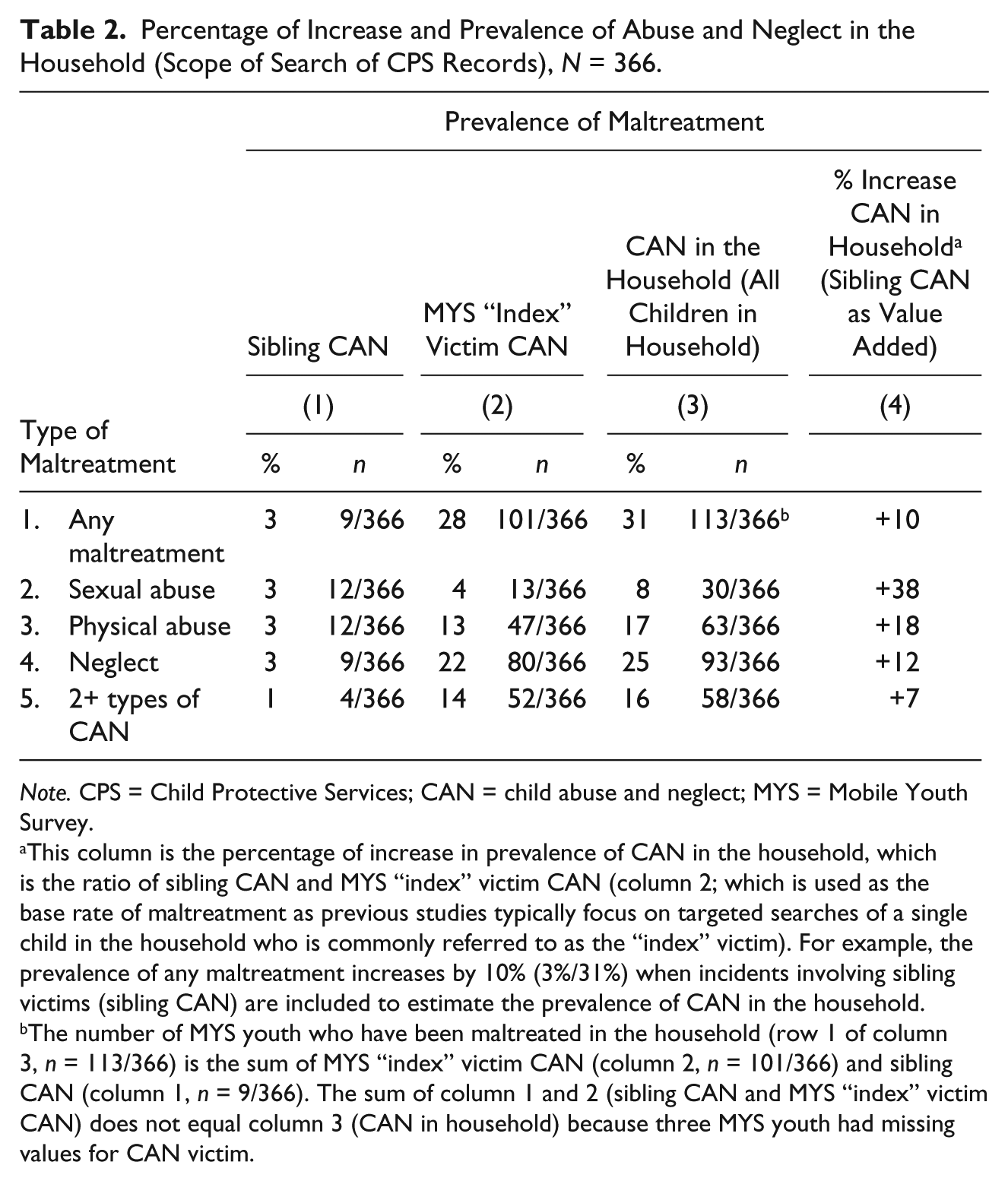
As noted above, most studies focus on a single targeted (“index”) child when estimating CAN using CPS records. As a result, most studies do not include incidents of CAN that involve siblings, but not targeted (“index”) youth. Estimates of CAN in the household that include all children in the family are a result of a broader search of CPS records. More specifically, Row one in Table 2 illustrates how CAN in the household (31%) is the sum of sibling CAN (3%) and MYS “index” victim CAN (28%). As previous studies typically focus on a single targeted (“index”) victim, estimates of CAN that involve MYS “index” victims are used as a baseline. More importantly, the percentage of increase in CAN in the household (+10%) represents the value added by conducting a broader search of CPS records that includes sibling CAN (3%/31%).
Percentage of Increase and Prevalence of Abuse and Neglect in the Household (Scope of Search of CPS Records), N = 366.
Note. CPS = Child Protective Services; CAN = child abuse and neglect; MYS = Mobile Youth Survey.
This column is the percentage of increase in prevalence of CAN in the household, which is the ratio of sibling CAN and MYS “index” victim CAN (column 2; which is used as the base rate of maltreatment as previous studies typically focus on targeted searches of a single child in the household who is commonly referred to as the “index” victim). For example, the prevalence of any maltreatment increases by 10% (3%/31%) when incidents involving sibling victims (sibling CAN) are included to estimate the prevalence of CAN in the household.
The number of MYS youth who have been maltreated in the household (row 1 of column 3, n = 113/366) is the sum of MYS “index” victim CAN (column 2, n = 101/366) and sibling CAN (column 1, n = 9/366). The sum of column 1 and 2 (sibling CAN and MYS “index” victim CAN) does not equal column 3 (CAN in household) because three MYS youth had missing values for CAN victim.
The Impact of Sibling CAN on the Prevalence of Sexual Abuse, Physical Abuse, and Neglect in the Household
Table 2 also presents the prevalence of sexual abuse, physical abuse, and neglect that involve sibling(s), the MYS “index” victim, and CAN in the household, which is the sum of column 1 and 2. In short, the prevalence of sexual abuse in the household (8%) is double the estimate of prevalence of sexual abuse involving the MYS “index” victim (4%). More importantly, sexual abuse of siblings (3%) increases the prevalence of sexual abuse in the household by 38% (3%/8%). On a related note, the prevalence of physical abuse in the household (17%) is 18% larger compared with the estimate of prevalence of physical abuse based on a targeted search of MYS youth (13%). Physical abuse of siblings (3%) increases the prevalence of physical abuse in the household by 18%. The prevalence of neglect in the household (25%) is 12% larger compared with the estimate of prevalence of physical abuse based on a targeted search of MYS youth (22%). Neglect of siblings (3%) increases the prevalence of neglect in the household by 12% (3%/25%). Finally, the prevalence of MYS youth who have been victims of two or more types of CAN (sexual abuse, physical abuse, or neglect) is examined in Table 2. The inclusion of siblings who were victims of two or more types of CAN (1%) increases the estimate of the prevalence of (two or more types of) CAN in the household (16%) by 7%.
The Impact of Sibling CAN on the Severity and Chronicity of CAN in the Household
Panel A in Table 3 focuses on the severity of CAN in the household, which is measured by whether the incident of CAN was indicated. As noted above, CAN data collection focused on a range of case dispositions that included indicated and not indicated CPS incidents. The key distinction between indicated versus not indicated CAN is that indicated incidents were categorized by CPS investigators as having a preponderance of evidence (e.g., eye witness accounts, observations by CPS investigator, medical reports) that support the allegation of CAN. In addition, CPS investigators are also required to make a distinction between poverty and neglect. More specifically, if poverty is the sole reason for an incident of neglect, then the CPS case disposition would be “not indicated” (CPS Policies and Procedures, 2003). In short, CAN that is indicated is more severe than CAN that is not indicated based on the level of evidence from the CPS investigation.
Severity and Chronicity of Maltreatment by Victim Type (Scope of Search of CPS Records), N = 366.

Note. CPS = Child Protective Services; CAN = child abuse and neglect; MYS = Mobile Youth Survey.
The percentage of increase in the severity or chronicity of maltreatment in the household is the ratio of sibling CAN and MYS “index” victim CAN (which is used as the base rate as previous studies typically conduct targeted searches of a single child in the household that is commonly referred to as the “index” victim). For example, the estimate of the severity of maltreatment increases by 5% (1%/19%) when incidents involving sibling CAN are included to estimate the severity of CAN in the household (19%).
The number of MYS youth who have age of onset of CAN in household (column 3 of Panel B, n = 78/366) is the sum of age of onset of MYS “index” victim CAN (column 2, n = 68/366) and sibling CAN (column 1, n = 6/366). The sum of column 1 and 2 (sibling CAN and MYS “index” victim CAN) does not equal column 3 (CAN in household) because four MYS youth had missing values for age of onset of CAN.
About 19% of the incidents were indicated when focusing on all children in the household, which is the sum of 1% that involved sibling CAN and 18% where MYS “index” youth were the victim. The estimate of severity of CAN in the household (19%) is 5% larger than the estimate of severity of CAN based on a targeted search of MYS youth (18%). In addition, the inclusion of severity of sibling CAN (1%) increases the estimate of severity of CAN in the household by 5%.
Panel B in Table 3 focuses on the chronicity of maltreatment. The date from the CPS report was used to categorize the developmental stage of MYS youth when the incident of CAN occurred (before MYS youth was born, childhood, and adolescence). In other words, how old was the MYS youth when the first incident of CAN occurred? One key finding is that 3% of MYS youth had siblings who were abused before the MYS youth was born. Not surprisingly, MYS “index” victims (who were not born at the time) make no contribution to this measure of chronicity of CAN in the household (3%). About 3% of MYS youth had a history of CAN involving siblings that occurred before they were born, which would not be detected if chronicity of CAN focused exclusively on MYS “index” victims. In contrast, age of onset of sibling CAN during childhood (2%) increases the prevalence of age of onset of CAN in the household during childhood by 10% (2%/21%). On a similar note, sibling CAN that first occurs during adolescence (1%) increases the estimate of CAN in the household that first occurs during adolescence (7%) by 17% (1%/7%).
Panel B includes two additional measures of chronicity of CAN (3 or more years of CAN and 3 or more CAN incidents, respectively). The chronicity of CAN from both measures indicate that chronicity of sibling CAN (1%) increases both measures of chronicity of CAN in the household (13%) by 8% when using chronicity of CAN for MYS “index” youth as a baseline (12%).
Discussion
Since only a handful of studies have focused on sibling CAN, the overarching objective of this study was to examine the unique contribution of sibling CAN to key dimensions of CAN in the household. Previous studies typically focus on a single child within the family. As a result, targeted searches of “index” victims have the potential to underestimate CAN in the household since it is unclear whether abuse and neglect is limited to a single child in the household rather than a common set of parenting practices that are used for all children in the household.
Key Findings
A search of CPS records was conducted for 366 youth living in extreme poverty (MYS) who were used as targeted “index” victims. A parallel search of CPS records was conducted to uncover incidents of sibling CAN, which involved siblings as victims but not targeted MYS “index” youth, to examine the impact of sibling maltreatment on the prevalence, severity, and chronicity of CAN in the household. The findings clearly indicate the value of broadening the search of CPS records to include siblings as well as targeted MYS youth. More specifically, the inclusion of sibling CAN increased prevalence of any maltreatment in the household by 10%. In addition, sibling CAN increased the prevalence of sexual abuse in the household by 38%. In addition, the prevalence of physical abuse and neglect in the household increased by 18% and 12%, respectively, when incidents of sibling CAN were used to supplement estimates based on a search of CPS records for a single targeted “index” child in the family.
A second key finding is that the inclusion of measures of both severity and chronicity of sibling CAN increased the estimate of severity of CAN in the household by 5%. Targeted searches focused on “index” victims truncate the chronicity of CAN (age of onset of CAN) by not accounting for maltreatment that occurred before the “index” victim was born. Chronicity of CAN in the household (3 or more years of CAN, three or more incidents of CAN) increases the prevalence of chronicity of CAN in the household by 8% compared with targeted searches of a single “index” child in the family.
Limitations of Current Study and Directions for Future Research
Although the current study included a broader search of CPS records for CAN that involved siblings to highlight the contribution of sibling CAN to key dimensions of CAN in the household, several limitations of the current study should be noted. First, CAN was measured using official data from CPS records, which has been described as the “tip of the iceberg” (Sedlak et al., 2010), since the estimates of CAN are partially a function of reporting practices (i.e., child vs. family-based tracking of CPS cases; Fallon et al., 2010). The MYS youth who were the focus of the current study were all living in high poverty urban neighborhoods between 1998 and 2002, which has the advantage of providing nuanced insights into local norms for parenting and CPS reporting in high poverty settings, but the findings may not be generalizable to larger scale national- or state-level studies of official CAN (Wulczyn, 2009).
A second limitation of the current analysis is that a small number of respondents with sibling CAN could dramatically affect the percentage of change in the prevalence and chronicity of CAN in the household. For example, 1% of MYS youth had 3 or more years of CAN, which increased the estimate of the chronicity of CAN in the household by 8% (see Table 3). However, 1% of MYS youth translates is a handful of respondents (3/366). Exploratory bivariate chi-square analyses examined the impact of family structure and gender on sexual abuse and physical abuse (results available upon request) since sexual abuse and physical abuse of siblings had the largest percentage of increase in CAN in the household (+38% and +18%, respectively, in Table 2). The results should be interpreted with caution because a handful of youth with sibling CAN could account for the pattern of findings. Given this caveat, the preliminary analyses indicated the following: (a) sexual abuse in the household was not statistically significant for males versus females (χ2 = .007, df = 1, p = .932), and sexual abuse involving siblings only was not statistically significant (χ2 = 2.548, df = 1, p = .110) and was more likely to involve males; and (b) physical abuse in the household was more likely to involve females (χ2 = 2.78, df = 1, p = .097), but physical abuse of siblings was not statistically significant for males versus females (χ2 = .005, df = 1, p = .946).
Given the small number of MYS youth with sibling CAN in the current study, future research should incorporate additional data sources (e.g., trauma registries, child fatality reviews, hospital and emergency room records, Special Supplemental Nutrition Program for Women, Infants, and Children) to supplement official CPS reports (Whitaker et al., 2005). More generally, future research should focus on improving the measurement of sibling CAN as well as CAN in the household. Although beyond the scope of the present article, future studies should also examine the following: (a) the level of co-occurrence or overlap between sibling and “index” victim CAN within families (Higgins & McCabe, 2000; Manly, Kim, Rogosch, & Cicchetti, 2001), (b) the sequencing and timing of CAN within families to provide additional insight into the stability of CAN within families over time (Fluke, Shusterman, Hollinshead, & Yuan, 2008; U.S. Department of Health and Human Services, 2010), and (c) how exposure to violence in the community, CAN of siblings, and “index” victim maltreatment can be incorporated into a cumulative risk model to account for stability of CAN within at-risk households over time (Foster & Brooks-Gunn, 2009; Herrenkohl, Sousa, Tajima, Herrenkohl, & Moylan, 2008).
Implications for Policy and Practice
Devaney and Spratt (2009) overviewed the changes in policy and practice guiding CPS in the United Kingdom for the past four decades and argued that CPS should focus on identifying and intervening with at-risk children and families experiencing multiple adversities (e.g., intimate partner violence, parental substance abuse) that fall beyond the traditional mandate of CPS, which typically intervenes when families are in crisis and children are in harm’s way. More generally, CPS needs to target at-risk children and families before the parenting practices and family problems escalate and become more entrenched over time (Devaney & Spratt, 2009). This approach dovetails with the underlying rationale for primary prevention of CAN in public health as well established patterns of behavior are more difficult to change (Whitaker et al., 2005). As a result, both policy makers and practitioners need to systematically identify warning signs of CAN as a stepping stone toward primary prevention of CAN (Stagner & Lansing, 2009). Over the past three decades, neonatal home visitation by nurses or other trained professionals has been identified as a key policy initiative to reduce (and possibly prevent) CAN for at-risk families (e.g., Krugman, 1993). The findings from this article suggest that a broader search of CPS records, which includes sibling maltreatment, can be used as an early warning system to identify at-risk families since the broader search of CPS records uncovered CAN that occurred before the “index” victim was born. One promising avenue for future research is to conduct randomized clinical trials to determine if home visitation by nurses or other paraprofessionals during pregnancy for at-risk families with multiple children reduce (and possibly prevent) abuse and neglect in the household (e.g., Olds et al., 1997, 2002). In other words, if the oldest child in the household is a victim of CAN as an infant, will the additional support from home visitation reduce the likelihood of CAN for younger siblings in the household (who are born during the next 5 years)?
In conclusion, reorienting measurement of CAN from targeted searches of CPS records to a broader focus on CAN in the household (that includes all children in the family) represents the most optimal utilization of CPS records to specify the extent of CAN as a public health threat facing youth. The results clearly indicate that more focused searches of CPS records that target a single child in the family systematically underestimate the prevalence, severity, and chronicity of CAN in the household. More importantly, the inclusion of all children in the family (i.e., siblings) also increases the window of opportunity for intervention for at-risk families by providing a more complete history of CAN in the household with an earlier age of onset (i.e., before “index” victim was born) to accelerate the identification of at-risk families. In short, this study is an example of an epidemiological study that improves our understanding of the magnitude and extent of CAN in the household (Gilbert et al., 2009) by shifting the focus of data collection from a single child in the household to all children in the family. If early intervention has become the overarching objective for policy and practice, then incorporating sibling CAN into measures of CAN based on CPS records in future studies is a cost-effective way to identify CAN in at-risk families during the prenatal period (Daro & Donnelly, 2002; Kelley, Thornberry, & Smith, 1997) and a convenient yet critical stepping stone toward the primary prevention of CAN in the household.
Footnotes
Declaration of Conflicting Interests
The author(s) declared no potential conflicts of interest with respect to the research, authorship, and/or publication of this article.
Funding
The author(s) disclosed receipt of the following financial support for the research, authorship, and/or publication of this article: This research was partially supported by a grant from the Center for Disease Control’s Comprehensive Youth Violence Center.