



Abstract
Intimate partner violence (IPV) is a serious and widespread form of gender-based violence that disproportionately affects women. It is well established that IPV victimization contributes to depression and posttraumatic stress disorder (PTSD), and that many partner-abusive men continue to perpetuate abuse even after their relationship with the victim ends. In addition, when men harm their partners, they are more likely to harm their children, and evidence suggests that this harm continues post-separation. However, scant research has been conducted on men’s harm to their children as an extension of IPV perpetration, with even less known about the mental health impact this form of abuse has on mothers. For this longitudinal cohort study, 40 partner-abused mothers who had separated, or were planning to separate, from an abusive partner with whom they shared children were recruited. Women were interviewed 4 times over 1 year. Results confirmed that, in addition to men’s physical abuse perpetration relating to subsequent increases in mothers’ depression and PTSD symptoms over time, their harm to the children predicted both mothers’ depression and PTSD symptoms as well.
Keywords
It is well established that intimate partner violence (IPV) is a pervasive social problem affecting millions of women 1 in the United States (Black et al., 2011). Physical, sexual, and psychological IPV victimization is associated with depression and posttraumatic stress disorder (PTSD) symptoms or diagnoses for many survivors (Dutton et al., 2006; Golding, 1999; Jones, Hughes, & Unterstaller, 2001). There is also a high co-occurrence of IPV and child abuse, with millions of children being victims of abuse and neglect by their mothers’ assailants each year (Herrenkohl, Sousa, Tajima, Herrenkohl, & Moylan, 2008). Past research has found that partner-abusive fathers use or harm children, sometimes as a means to abuse their partner or ex-partner (Beeble, Bybee, & Sullivan, 2007). What has yet to be investigated, however, is whether partner-abusive fathers’ harm to children uniquely affects mothers’ depression and PTSD symptoms.
IPV is a pattern of ongoing abuse in which one partner seeks and maintains control over their partner (Stark, 2007). This power and coercive control is central to the understanding of IPV (Davies, Ford-Gilboe, & Hammerton, 2009). Abusive partners perpetrate intimidation, threats, economic abuse, psychological abuse, and harm to children—typically with the purpose to gain and maintain control in their intimate relationships (Johnson, Leone, & Xu, 2014; Stark, 2007). Coercive control distinguishes IPV from other forms of aggression that may occur within interpersonal relationships (e.g., physical aggression that does not alter relationship power dynamics; Davies et al., 2009; Stark, 2007).
The potentially deleterious impact of physical, sexual, and psychological IPV on women’s mental health is well-documented (Beydoun, Beydoun, Kaufman, Lo, & Zonderman, 2012; Dutton et al., 2006; Golding, 1999; Jones et al., 2001). Depression and PTSD are the most common mental health symptoms among survivors (Nathanson, Shorey, Tirone, & Rhatigan, 2012), with prevalence rates of depression at 48% and PTSD at 64% among IPV survivors (Golding, 1999). A recent meta-analysis found that the odds of major depressive disorder were 3.26 times higher for women survivors compared with women who did not report IPV (Beydoun et al., 2012).
As the frequency, duration, and combination of multiple forms of violence increases, so too do women’s reports of depression or PTSD symptoms (Black et al., 2011; Matlow & DePrince, 2013; Nathanson et al., 2012). Recent victimization may be more related to current depression or PTSD symptoms than historical occurrences of IPV (Bonomi et al., 2006). Still, IPV can have long-lasting effects, especially when a variety of stress factors are considered (D. K. Anderson, Saunders, Yoshihama, Bybee, & Sullivan, 2003). Furthermore, particular forms of violence may be more related to depression or PTSD than others (Becker, Stuewig, & McCloskey, 2010; Matlow & DePrince, 2013). For example, depression is predicted by psychological abuse more so than physical abuse (Nathanson et al., 2012). Also, sexual violence may be particularly related to PTSD (Coker, Weston, Creson, Justice, & Blakeney, 2005) and depression (Pico-Alfonso et al., 2006). In addition, women who have been physically assaulted and stalked by an intimate partner are more likely to report PTSD than those who have not been assaulted or stalked (Logan, Shannon, Cole, & Walker, 2006). One study found that psychological abuse and stalking predict depression and PTSD even after controlling for sexual violence, physical violence, and injuries (Mechanic, Weaver, & Resick, 2008).
Thus, the impact of IPV victimization on depression and PTSD among women is well-documented. Current research, however, tends to focus on the impact of physical, sexual, psychological, or stalking violence on women’s mental health. Little is known about how other forms of abuse, such as men’s use of children, affect women’s PTSD and depression.
Co-Occurring IPV and Child Abuse
Child survivors of abuse are often exposed to IPV (Herrenkohl et al., 2008). Using a nationally representative sample of dual-parent families, McDonald, Jouriles, Ramisetty-Mikler, Caetano, and Green (2006) estimated that approximately 15.5 million children (nearly 30% of the child population) are living in a household where IPV exists (McDonald et al., 2006). Children not only witness IPV, but many men who abuse their partners also abuse their children (Gewirtz & Edleson, 2007; Hamby, Finkelhor, Turner, & Ormrod, 2010; Herrenkohl et al., 2008; Kelleher et al., 2006). Some research has demonstrated that when women have children, partner-abusive men are more likely to perpetrate violence as compared to when there are no children (Karin Bø Vatnar & Bjørkly, 2010). In addition to perpetrating both child abuse and IPV, abusive partners may also use the children as a means to harm the other parent.
Using or Harming Children to Control Women
Some abusive partners use children to gain or maintain control of women within the relationship. Examples of men’s use of the children as an extension of IPV perpetration include threatening to harm or kill the children, harming or killing the woman in front of the children, and/or fighting for custody or kidnapping the children if victims do not cede to their demands (Douglas & Walsh, 2010; Meyer, 2012; McCloskey, 2001). Still, many women who experience IPV end their intimate relationships and often cite IPV as an important contributor to that decision (Baly, 2010). Unfortunately, it is well-documented that many abusive men continue, or even escalate, their violence after intimate relationships end, referred to in this study as post-separation violence (PSV; Beeble et al., 2007; Davies et al., 2009; DeKeseredy & Joseph, 2006; Harrison, 2008; Johnson et al., 2014; Theran, Sullivan, Bogat, & Stewart, 2006). Attempting to end the relationship is a direct threat to abusive partners’ control, and PSV is a way to regain that control or to punish their ex-partners for leaving (Hardesty & Ganong, 2006).
One way that partner-abusive fathers are able to perpetrate PSV against their ex-partners and children is through court-ordered child contact (Bemiller, 2008; Hardesty & Ganong, 2006; Kaye, Stubbs, & Tolmie, 2003; Shalansky, Ericksen, & Henderson, 1999; Slote et al., 2005; Wuest, Ford-Gilboe, Merritt-Gray, & Berman, 2003). Custody orders provide abusers with access to their children and, often by extension, to their ex-partners during child exchanges. Abusive men use this access to physically, sexually, and emotionally harm their children (Bemiller, 2008; Hardesty, Khaw, Chung, & Martin, 2008; Kaye et al., 2003; Slote et al., 2005; Straus, 1979; Wuest et al., 2003), or to use their children as intermediaries to perpetrate ongoing PSV against their ex-partners (Hardesty & Ganong, 2006; Harrison, 2008; Kaye et al., 2003; Wuest et al., 2003).
Abusers’ use of children often involves subtle threats or manipulation that may be difficult to detect by third parties. For instance, abusive men have sent threats to their ex-partners through their children (Hardesty & Ganong, 2006; Kaye et al., 2003) or have used their children to obtain information about, track, and monitor their ex-partners’ activities, sometimes in attempts to gain information about mothers to use in future court hearings (Wuest et al., 2003). Abusers also lie to and manipulate their children into blaming their mother for the family dissolution (Wuest et al., 2003).
Little is known about the impact of men’s harm to children on mothers’ depression and PTSD symptoms. A number of descriptive studies have suggested that such harm is extremely stressful to mothers (e.g., Wuest et al., 2003). However, none have examined whether harm to the children is a unique predictor of either women’s depression or PTSD symptoms.
The Current Study
The purpose of the present study was to examine the longitudinal impact of abusive men’s harm to children on mothers’ depression and PTSD symptoms. The following hypotheses were tested:
Method
Procedures
The current study included 40 women who participated in a larger study designed to investigate the safety of child custody orders in cases of IPV. Domestic violence (DV) staff from three agencies recruited women from June 2011 to March 2012. Women were eligible for the study if they met the following criteria: (a) were at least 18 years old; (b) spoke English; (c) shared at least one minor child with an emotionally, physically, financially, and/or sexually abusive partner or ex-partner; and (d) were about to proceed through family court for a divorce or custody/parenting time court order for the child(ren) shared with the abusive partner.
In total, 77 referrals from agencies were received, 71 of whom were reached by telephone, and 52 (68%) of whom were eligible for study participation. Twelve of the eligible women were unable to complete a baseline interview for various personal reasons. Thus, 40 women (77% of those eligible) completed a baseline interview.
The baseline interview was conducted as soon as possible after recruitment, and typically lasted between 1 and 2 hrs. Women signed the informed consent at the baseline interview. Women completed four interviews over the course of 1 year (one every 3-4 months). Interviews were conducted by highly trained women research assistants, and participants received compensation (US$25, US$30, US$35, and US$40 across the 4 interviews). The research was approved by the institutional review board at Michigan State University.
Participant Demographics
Detailed demographics are provided in Table 1. At the time of the first interview, most women did not live with the assailant and most women were, at some point, married to their assailants. At the time of the baseline interview, a total of 37 women (93%) reported being separated from their assailants. Most women had been separated for 6 months or less.
Participant Demographics and Relationship Information at Baseline (N = 40).
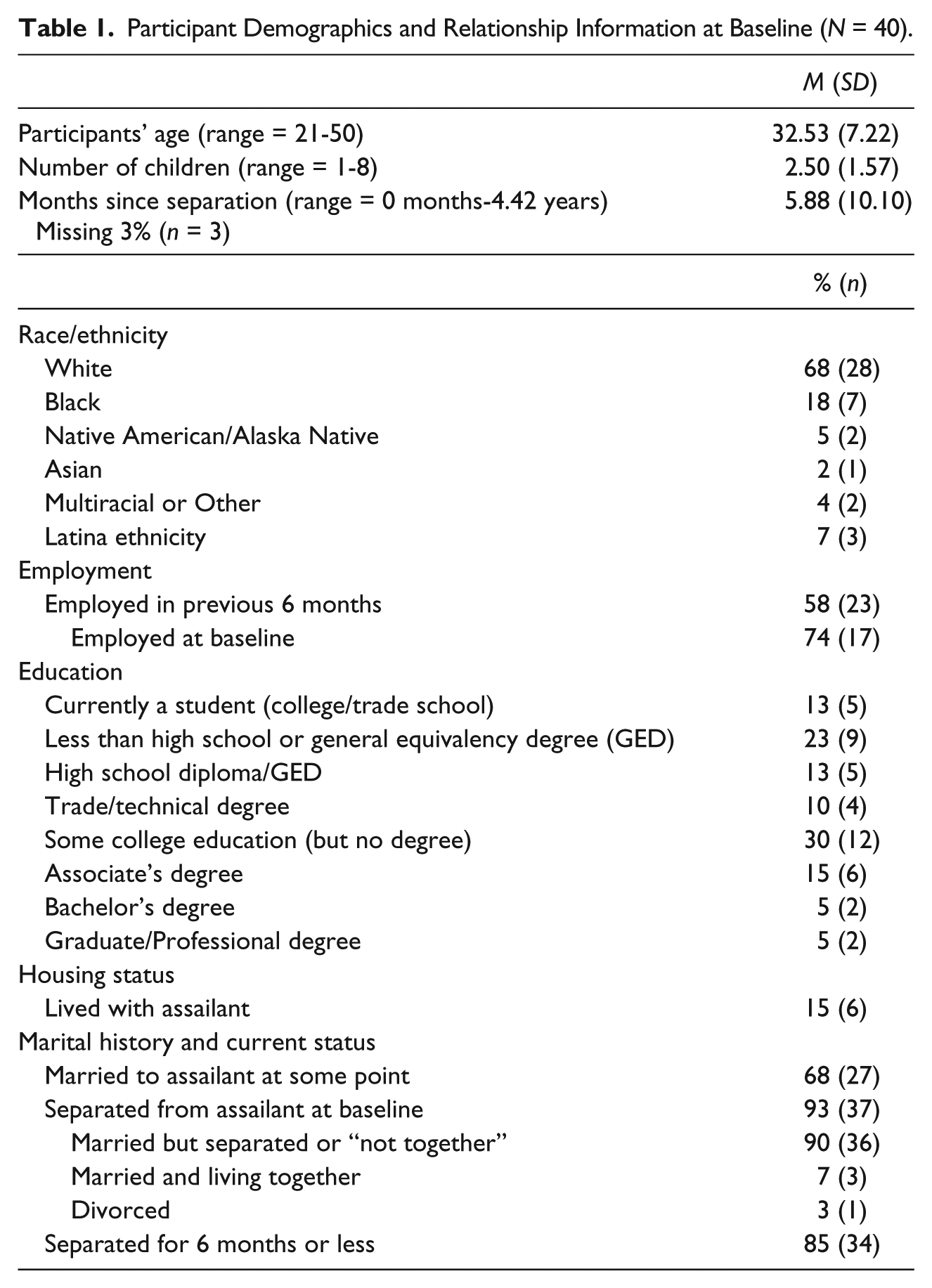
The mean number of children in this sample was 2.50 (SD = 1.57), with a range from 1 to 8 children. Women’s ages ranged from 21 to 50 years old (M = 32.53, SD = 7.22). Most women were White (n = 28, 68%), with the remaining sample being Black (n = 7, 18%), Native American/Alaska Native (n = 2, 5%), Asian (n = 1, 2%), Multiracial (n = 1, 2%), and Other (n = 1, 2%). Three women (7%), including the one who reported “Other” for her race, identified as Latina. Just more than half were employed in the previous 6 months before the first interview. Finally, about a third of the women had some college education, and some were current students.
Participant Retention
Study retention rates were 90% (n = 36) for the second interview, and 85% (n = 34) for the final two interviews. Chi-square and t tests for significant differences between women who stayed in the study (n = 34) and women who dropped out (n = 6) were conducted, and three significant differences were found: (a) women who dropped out reported a shorter period since separation (M = 1.33 months, SD = 0.61) compared with women who stayed in the study (M = 6.76 months, SD = 10.83); t(30.93) = −2.677, p = .009; (b) women who dropped out reported a higher frequency of child–father contact at baseline (M = 4.83, SD = 0.98) compared with women who stayed in the study 2 (M = 2.71, SD = 2.17); t(15.53) = 3.89, p = .001; and (c) women who dropped out of the study reported a slightly higher mean score of emotional abuse at baseline (M = 3.64, SD = 0.21) than women who stayed in the study (M = 3.03, SD = 0.58); t(21.51) = 4.61, p ≤ .001.
Measures
The first interview elicited information about the last 6 months, whereas the reference period for the remaining interviews was “since your last interview,” or about 4 months.
IPV victimization
Abusers’ physical IPV perpetration (including physical abuse, threats of harm, stalking, and sexual assault) was measured with six items on a 6-point frequency scale (0 = never to 6 = more than 4 times a week). Items were adapted from the 24-item conflict tactics scale (CTS; Straus, 1979; Straus, Hamby, Boney-McCoy, & Sugarman, 1996). Cronbach’s alpha for this study ranged from .58 to .66 across all time points. Scores were log transformed to reduce positive skew.
Threats were measured with three items that asked women how often their partner or ex-partner threatened to harm them, kill them, or kill their friends or family. Cronbach’s alpha ranged from .59 to .69 across all time points.
Stalking was measured using a modified and shortened version (six items) of the National Violence Against Women Survey stalking assessment (Tjaden & Thoennes, 1998), as calculated by Basile, Arias, Desai, and Thompson (2004). Women rated how often their partner or ex-partner did things such as “followed or spied on you” or “stood outside your home, school, or workplace.” Cronbach’s alpha ranged from .72 to .86 across all time points. Consistent with the literature on stalking, women were coded as “stalked” only if they reported their assailant as perpetrating at least two actions and reported feeling “very frightened” by these actions at least once.
Psychological abuse was measured using the short-version 14-item Psychological Maltreatment of Women Inventory, which has two subscales—Emotional/Verbal Abuse and Domination/Isolation; both subscales have demonstrated good internal consistency (α = .92, .88, respectively; Tolman, 1999). Women rated how often their partner or ex-partner did things such as “call you names” and “monitor your time and make you account for your whereabouts” (0 = never to 4 = very frequently). Cronbach’s alpha ranged from .75 to .96 across all time points.
Procedural abuse involves the use of legal means, systems, or procedures to perpetrate abuse (Miller & Smolter, 2011). Procedural abuse is an understudied topic with no existing scale; therefore, the research team developed a measure for this study. The seven-item scale asked women how often their ex-partner did things like “file a motion with family court about child support, custody, or visitation,” “tried to get/received custody or visitation to stay in your life,” “tried to get/received custody or visitation to get back at you,” and “threaten to take you back to court for support, custody, or visitation.” Cronbach’s alpha ranged from .84 to .92 across all time points.
Economic abuse includes tactics that threaten women’s economic security (Adams, Sullivan, Bybee, & Greeson, 2008). The research team developed a five-item scale to measure the ways in which batterers might use the family court system or custody to harm women’s economic security. For example, women were asked how often their ex-partner did things like “refused to pay child support or spousal support.” Cronbach’s alpha ranged from .59 to .70 across all time points.
Harm to and neglect of children
The Use of the Children scale (Beeble et al., 2007) includes seven items, and on a 5-point scale (0 = never to 4 = very frequently), women reported how often the assailant used their children to stay in their life, harass, intimidate, and frighten them. In addition, women were asked how often the assailant tried to turn their children against them, or threatened to take their children away. The authors reported an internal consistency coefficient of .88. Cronbach’s alpha ranged from .88 to .94 across all time points.
The research team also created an index of men’s harm to or neglect of their children during contact. Based on a 5-point scale (0 = none of the times to 4 = more than ¾ of the times), women whose children had contact with the father reported a range of neglectful (e.g., children not being fed or going hungry) to abusive behaviors of which they were aware. Cronbach’s alpha ranged from .87 to .89 across all time points.
IPV and child harm composite scores
To reduce model complexity in light of the small sample, the eight abuse scales were averaged and combined to create three final composites. Specifically, the Physical IPV scale is the mean of the following: (a) physical and sexual abuse, (b) stalking, and (c) threats. To reduce the impact of extreme scores, this scale was log transformed. The Nonphysical IPV scale is the mean of the following: (a) emotional abuse, (b) financial abuse, and (c) procedural abuse. Finally, the Child Harm scale is the mean of the following: (a) use of their children and (b) harm to children during child–father contact.
Depression
Depression symptoms were measured using the nine-item Patient Health Questionnaire–9 using a 4-point scale (0 = not at all to 3 = nearly everyday; Kroenke, Spitzer, Williams, & Lowe, 2010). A summed score of 10 or greater indicates clinical depression. A total of 36 (90%) women met this criterion at baseline, and then 26 (72%), 25 (74%), and 19 (56%) at the follow-up interviews. Cronbach’s alpha ranged from .85 to .93 across all time points.
PTSD
Mean PTSD symptoms were measured using the seven-item Breslau PTSD scale (0 = not at all to 3 = nearly everyday; Breslau, Peterson, Kessler, & Schultz, 1999). A summed score of 4 or greater indicates PTSD. Most (90%) women met this criterion at baseline, and then 24 (67%), 16 (47%), and 31 (54%) at the follow-up interviews. This scale is typically used as a screening measure, and has a test–retest reliability of .84 (Kimerling et al., 2006).
Control variable
Months since separation, reported at the baseline interview, was tested as a control variable because relationship dissolution has been shown to be related to mental health distress (Mearns, 1991; Rhoades, Kamp Dush, Atkins, Stanley, & Markman, 2011).
Analysis
Correlations among variables, with means and standard deviations, are presented in Table 2. Multilevel modeling (MLGM; Raudenbush & Bryk, 2002; Singer & Willett, 2003) was used to examine the effects of IPV on mothers’ depression and PTSD symptoms over time. This method is appropriate for repeated measures data, can accommodate missed or mistimed interviews, and has been successfully used with small samples (e.g., Goodkind, 2005; Hauser-Cram et al., 1999).
Baseline Means, Standard Deviations, and Correlations for Mental Health, Abuse, and Time Since Separation.

Note. PTSD = posttraumatic stress disorder; IPV = intimate partner violence.
p ≤ .05. **p < .01.
Conceptually, MLGM estimates a level (or intercept) and a trajectory across time (or slope) on the dependent variable for each person and then models these as functions of a set of independent variables. In this study, individual intercepts (set at the baseline interview) and slopes on the two dependent variables—depression and PTSD symptoms—were estimated and modeled as functions of three forms of abuse—physical, nonphysical, and harm to children—controlling for the effect of time since separation as of the baseline interview. Because women began the study near the start of their custody process, we wanted to separate the effects of their experience of abuse in the 6 months before this point from changes over the course of the study. To accomplish this, we centered the independent variables at the baseline interview. This allowed us to model baseline levels of abuse as between-person effects and change in abuse levels relative to baseline as within-person or time-varying effects. This also allowed us to examine whether baseline levels of abuse affected the trajectories of change in depression and PTSD (i.e., whether the interaction of baseline abuse and time had a significant effect on the slope of change in depression and PTSD symptoms). This procedure has been successfully utilized in a variety of other studies (Beeble, Sullivan, & Bybee, 2011; Brennan, Kim, Wenz-Gross, & Siperstein, 2001; Hauser-Cram et al., 1999; Horney, Osgood, & Marshall, 1995).
The analysis was conducted using Stata 13.0, using the mixed command and full information maximum likelihood (FIML) estimation. The intercept and time slopes for each woman were estimated as random effects (i.e., estimated separately for each person) and the baseline interview was set as the intercept. Time slopes were estimated as random effects because there was significant variability in women’s trajectories over time on both depression and PTSD symptoms. As there was no significant correlation between individuals’ intercepts and slopes, the model covariance structure was specified as independent. Modeling was conducted in steps, beginning with simple models examining the effects of a single independent variable, controlling for time since separation, and progressing to full models containing all independent variables. In light of the small sample size, full models included only Baseline Abuse × Time interactions that had been found as significant in the simple models.
Results
Initial analysis showed that depression and PTSD symptoms declined significantly over the 12-month period of the study, according to unconditional MLGM models containing no independent variables except time. For depression symptoms, the coefficient for months was −.02 (SE = −.01, p < .001), and for PTSD, −.03 (SE = −.01, p < .001), indicating average drops of .24 points for depression and .36 for PTSD symptoms over the 12-month period. Simple models, each including the control variable and one independent variable—physical IPV, nonphysical IPV, or harm to the children—are presented in Table 3, with coefficients for depression in the first panel and coefficients for PTSD in the second. Months since separation was positively related to baseline depression but not PTSD. In separate models, baseline levels of all three forms of abuse were positively related to baseline levels of both depression and PTSD. Women who had experienced higher levels of any form of abuse reported worse depression and PTSD symptoms initially. However, nonphysical IPV was the only form of abuse for which baseline levels had an effect on the trajectory of women’s depression over time. The negative coefficient (−.02) indicates that higher baseline levels of nonphysical abuse were associated with greater declines in depression over the ensuing 12-month period. No form of baseline abuse was related to trajectories of PTSD over time. For all forms of abuse, change across time was positively associated with change in both depression and PTSD symptoms. This indicates that reductions in abuse were linked to declines in depression and PTSD symptoms, and increases in abuse were linked to increased depression and PTSD symptoms.
Fixed Effects for Simple Models Predicting Depression and PTSD Symptoms Over Time: Between-Person and Within-Person Effects.

Note. N = 144 observations at Level 1; N = 40 participants at Level 2. PTSD = posttraumatic stress disorder.
p ≤ .05. **p < .01. ***p < .001.
Full models for both depression and PTSD symptoms, which incorporate all forms of abuse, are presented in Table 4. Baseline time since separation remained significantly associated with depression but not PTSD. Accounting for the effects of all forms of abuse together, baseline level of harm to the children was the only abuse variable significantly related to baseline level of both depression and PTSD symptoms. As in the simple models, higher levels of baseline nonphysical abuse were predictive of greater declines in depression but not PTSD symptoms. Although change in all forms of abuse was significantly related to change in depression and PTSD symptoms in the simple models, only change in physical abuse remained significant when examining all of them together.
Fixed Effects for the Full Model Predicting Depression and PTSD Symptoms Over Time: Between-Person and Within-Person Effects.
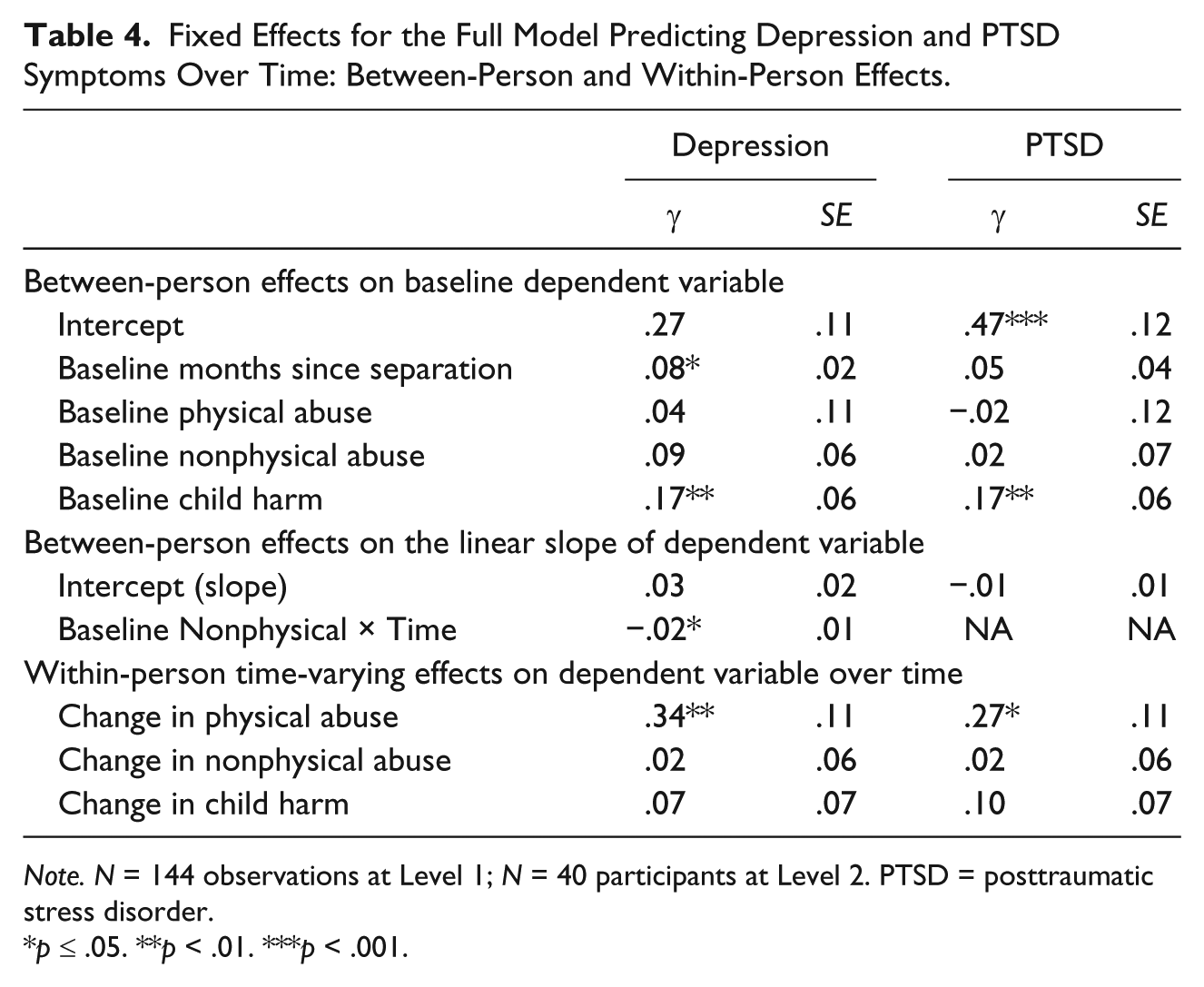
Note. N = 144 observations at Level 1; N = 40 participants at Level 2. PTSD = posttraumatic stress disorder.
p ≤ .05. **p < .01. ***p < .001.
Discussion
The purpose of this longitudinal study was to address a gap in the literature regarding how abusive men’s harm to children affects the depression and PTSD symptoms of the children’s mothers. Consistent with prior research, ongoing physical violence was related to women’s depression and PTSD symptoms over time. This study also contributes to the literature by providing initial evidence that men’s use of or harm to their children contributes to mothers’ depression and PTSD symptoms. To date, this is the first known study that has demonstrated these relationships among IPV survivors quantitatively and longitudinally.
Relationships Among IPV Victimization, Time, and Symptoms of Depression and PTSD
The findings of this study provide further empirical evidence regarding the relationship between IPV victimization and negative mental health outcomes. That IPV is detrimental to survivors’ mental health, however, is well established. Therefore, recent efforts have focused on establishing a multidimensional understanding of IPV that considers the (a) short- and long-term impact of abuse, and (b) relative or cumulative impact of different types of IPV.
The timing of abuse is an important factor to measure when studying IPV. When abuse desists, depression and/or PTSD may decrease or remain stable over time (Hedtke et al., 2008). In this study, initial exposure to IPV did not significantly relate to women’s reports of PTSD symptoms over time. Surprisingly, however, higher nonphysical abuse at the first interview was significantly related to decreases in depression symptoms over time. For many women, the first interview captured information during a recent separation, or a time leading up to women’s decision to leave. For others, it may have been a time of increased or ongoing abuse that influenced women’s decisions to pursue a family court order. Although ongoing abuse continued over the course of the study, many women were no longer in an intimate relationship with the assailant during the follow-up interviews, and/or were taking civil action to deal with the problems caused by the assailant. Thus, depression symptoms over time may have decreased because the nonphysical abuse was particularly high or stressful at the first interview, and began to abate over time. However, although this effect was statistically significant, the effect size was less than small. Thus, this finding should be interpreted with caution.
In this study, increases in nonphysical and physical IPV over time were each related to subsequent increases in depression and PTSD symptoms over time, when only accounting for time since separation. This supports previous research, which found that recent victimization had a stronger impact on mental health outcomes than more distal victimization experiences (e.g., Bonomi et al., 2006). Once abuse ends, the negative mental health outcomes tend to be short-lived (D. K. Anderson et al., 2003; Beeble et al., 2011), although this is not always the case (D. K. Anderson et al., 2003; Bogat, Levendosky, Theran, von Eye, & Davidson, 2003).
Physical and nonphysical abuse were both studied because abusive men use a variety of tactics to maintain power and control over their partners and ex-partners. In this study, when all forms of abuse were included in the model, only changes in physical abuse were related to subsequent changes in depression symptoms over time—nonphysical abuse was no longer related to change in depression over time. Previous research on the relative impact of different forms of abuse is mixed. Some researchers found that physical and nonphysical abuse are independently related to depression (Becker et al., 2010; Bonomi et al., 2006; Theran et al., 2006), and that once nonphysical abuse is accounted for, physical abuse is no longer a significant predictor of depression (Mechanic et al., 2008; Pico-Alfonso et al., 2006). Furthermore, stalking and sexual violence have been particularly linked to PTSD symptoms (Coker et al., 2005).
Current relationship status with the assailant may be important to consider when investigating the relative impact of different types of abuse. Theran and colleagues (2006) found that emotional and physical abuse contributed to survivors’ reports of depression among women who were currently in a relationship with their assailant. For women who were no longer in the relationship, however, only physical abuse was related to their reports of depression symptoms. This may be because nonphysical abuse, especially controlling tactics and insults, may have less impact after the relationship has ended. Physical abuse, however, may maintain a significant impact regardless of relationship status. This may explain why, in this study, women’s reports of nonphysical abuse were related to depression and PTSD symptoms for the first interview, but were not significant over time.
Partner-Abusive Men’s Harm to the Children
This study demonstrated that abusive men’s harm to their children negatively affected women’s depression and PTSD symptoms. This relationship was particularly evident when women entered the study, as women who reported higher levels of harm to their children at the first interview also reported higher levels of depression and PTSD symptoms. This is the first known quantitative study of this relationship to date. Importantly, this relationship remained significant even after accounting for physical and nonphysical IPV, suggesting that harm to children may be a critical dimension of abuse to include in future research. Future research is needed to identify the mechanisms of how men’s harm to children affects mothers’ mental health symptoms. Research in other related areas, however, may indicate promising or related factors to consider.
Some research has shown that men’s IPV perpetration can negatively affect the mother–child relationship (Wuest et al., 2003), although this is not always the case (Jarvis, Gordon, & Novaco, 2005). Additionally, some studies provide insight on how men’s harm to children post-separation affects mothers’ mental health, even if this relationship was not the focus of investigation (Rhodes, Cerulli, Ditcher, Kothari, & Barg, 2010; Wuest et al., 2003).
There is a general deficit-oriented attitude toward women with children who also have an abusive partner (McMullan, Carlan, & Nored, 2010). However, survivors engage in a rational choice and moral reasoning process when deciding how to respond to their partner’s abuse (Meyer, 2012). The strategies that women employ, including attempting to leave or adjusting their parenting, are heavily affected by concerns for their children and designed to buffer the effects of abuse (Lacey, Saunders, & Zhang, 2011; Greeson et al., 2014).
Study Limitations
The results of this study must be considered within the context of its limitations. First, this study had a small sample size, which has several implications for interpretation. Power analysis showed that there was only enough power to find very large effects for between-women differences and large effects for within-woman changes over time. It is possible that some of the nonsignificant findings were due to lack of power. Because men’s IPV victimization tactics are highly related, multicollinearity is a concern and there was not enough statistical power to fully parse out the unique effects among all forms of abuse. In addition, having such a small sample could cause issues with overfitting the model. Furthermore, a small sample also has implications for calculating effect sizes, particularly with MLGM. Effect size calculations are not as precise or reliable in smaller samples, as compared with larger samples (Slavin & Smith, 2008).
Another study limitation is that the sample was not large enough to examine differences by race or ethnicity, and all participants had sought services from DV agencies. Women who seek services are more likely to have lower incomes and higher rates of IPV than women who do not seek services (D. K. Anderson et al., 2003; Dutton, Kaltman, Goodman, Weinfurt, & Vankos, 2005). They may also be more likely to experience intimate terrorism than other forms of violence (Johnson et al., 2014). The majority of study participants were either White (68%) or Black (18%); it is unknown how the findings and experiences identified in this study generalize to other populations, especially traditionally marginalized populations such as women of color, women with disabilities, or women who are lesbian, gay, bisexual, transgender, queer or questioning, and intersex (LGBTQI).
Implications for Future Research
This study provides support for the call that an integrated multidimensional approach to gender-based violence is needed (Klevens, Simon, & Chen, 2012), particularly between the child maltreatment and IPV fields. We know that when men abuse their partners, they are more likely to harm their children, and this study provides preliminary evidence that this may affect mothers’ depression and PTSD symptoms. Yet, child maltreatment research too often neglects to account for multidimensional IPV (e.g., only physical IPV is measured). Furthermore, child maltreatment studies typically apply a deficit, blaming approach to understanding mothers’ strategies and responses to IPV victimization.
Similarly, while research on IPV often includes demographic information such as whether women share children with their assailant, there is little quantitative measure of men’s harm to their children. While IPV research has become increasingly multidimensional, including economic abuse and stalking, men’s harm to children remains understudied and should be included as an important dimension in future child maltreatment and IPV research.
There is also a need for additional research on post-separation periods. The assumption that ending intimate relationships is the most effective solution for addressing IPV persists. Although evidence indicates that PSV is a problem, it still remains an under- or narrowly-researched topic. The field would benefit from an in-depth investigation of how men’s harm to children changes over time to identify policies and practices that can keep women and children safe and promote their long-term well-being.
Conclusion
Gender-based violence is a social problem that researchers, advocates, and policy makers must continue to address. Although this study focused on the impact of victimization on women’s depression and PTSD symptoms, we provide preliminary evidence of an under-researched abusive tactic that may lie at the center of many survivors’ lives—harm to their children. Ongoing violence, particularly as it relates to children, can threaten mothers’ recovery from abuse and make it more difficult to move on (Wuest et al., 2003). Partner-abusive men’s harm to children as a form of PSV must be researched further to generate knowledge that will allow us to provide more adequate support and resources for mothers and their children to live free of intrusion by their abusive ex-partners.
Footnotes
Authors’ Note
The content is solely the responsibility of the authors and does not necessarily represent the official views of the National Institutes of Health or USDA.
Declaration of Conflicting Interests
The author(s) declared no potential conflicts of interest with respect to the research, authorship, and/or publication of this article.
Funding
The author(s) disclosed receipt of the following financial support for the research, authorship, and/or publication of this article: This study was funded by a grant from NIMH (R24MH75941); by the USDA National Institute of Food and Agriculture, Hatch project number MICL02202; and by Award Number K12HD065879 from the Eunice Kennedy Shriver National Institute Of Child Health and Human Development.