



Abstract
This study manipulated the race of the defendant (wife) and the victim (husband)—White/White, White/Black, Black/Black, and Black/White—in a murder case involving a history of intimate partner violence (IPV) to examine the potential prejudicial impact of race on juror decision-making. A total of 244 jury-eligible American community members read a trial transcript of a murder case in which the defendant claimed self-defense using evidence of battered spouse syndrome. Participants provided a verdict, responsibility attributions, and their perceptions of the scenario. Findings revealed that the Black defendant (wife) was more likely to be found not guilty by reason of self-defense, and female jurors were overall more likely to acquit the defendant (wife) than were men. These results contribute to the scarce literature on the influence of race on perceptions of legal proceedings involving IPV.
Keywords
There was a large surge of literature published on battered spouse syndrome (BSS) in the 1980s and 1990s, but a dearth of recent research has investigated this topic. Thus far, no studies have examined the influence of the couples’ racial composition in the jury decision-making process of a BSS case. Given the potential differences in how race is perceived and stereotyped, it is possible that intimate partner violence (IPV), and the ultimate act of murder involving BSS, would be viewed differently by jurors as a function of the racial composition of the couple involved in the incident. The current project sought to test the effects of defendant (the woman being abused, who eventually kills her partner) and victim (the male batterer, who is killed by his partner) race in a BSS mock trial, with White and Black as target races. The study also aimed to examine the role of responsibility attributions and juror perceptions in BSS trial decision-making. Below, we discuss and explore the assumptions and perceived stereotypes of race and gender, and their intersection, as they pertain to BSS.
IPV and BSS
IPV involves different forms of abuse, mistreatment, or neglect that adults may experience in their intimate or family relationships. Although it is now treated as a criminal offense, rates of IPV still persist (Breiding et al., 2014; Catalano, 2013), with lifetime prevalence rates of an estimated 31.5% among women in the United States (Breiding et al., 2014). Recent statistics suggest that 41.2% of Black women and 30.5% of White women in the United States have experienced IPV during their lifetimes (Breiding et al., 2014); however, rates may be even higher for Black women, as they often do not report IPV due to concerns that the police and criminal justice system will intensify the problem rather than solve it (Conwill, 2010). Specifically, given the history of mistreatment of Black persons by the criminal justice system, Black women may expect increased discrimination and elevated incarceration rates (Conwill, 2010; Sokoloff, 2004).
In the United States, between 1998 and 2002, spousal homicides accounted for 8.6% of all solved homicides and more than 40% of all family-related homicides (Durose et al., 2005). Of the 3,032 homicides against women in the United States in 2010, 39% were committed by an intimate partner, and of the 10,878 homicides against men, only 3% were committed by an intimate partner (Catalano, 2013). In the rare instances where women kill their spouses, discussions often surround the idea of BSS. BSS is one of the most relevant conceptualizations that captures the troubling dilemma of women who are assaulted by their intimate partners (Russell & Melillo, 2006). BSS makes reference to a pattern of responses and perceptions that are characteristic of being subjected to continuous and severe IPV (i.e., becoming depressed or unable to take any independent action that would allow her to escape the abuse; Schuller & Vidmar, 1992). The legal system refers to BSS when a battered spouse claims to have murdered his or her abuser in response to a partner’s aggression or threat (often as an act of self-defense; Regehr & Glancy, 1995; Russell & Melillo, 2006). Although it is recognized that men can also be victims of IPV, the focus of the present study is on women as victims of IPV who enter the courtroom as defendants in murder trials.
BSS in Court
The application of BSS in legal cases has not been without controversy. As mentioned above, the typical primary claim in BSS cases involves self-defense. By legal definition, self-defense requires that at the time of the killing, the woman had reasonable fear of death or serious bodily harm, and she believed on reasonable grounds that she could not have otherwise avoided this harm (Model Penal Code, 1985). Therefore, as Schuller, Wells, Rzepa, and Klippenstine (2004) suggested, the battered woman who has killed her husband must convince the jury of the “reasonableness” of her lethal action. The amount of violence against the wife before she kills her husband is rather variable, and case law has differed as to whether an objective or subjective interpretation of reasonableness should be applied when juries consider the woman’s decision to use force (Follingstad et al., 1989; Follingstad, Rogers, Welling, & Priesmeyer, 2015; Report on Sentencing for Manslaughter in Cases Involving Intimate Relationships, 2003). Another common debate surrounding this involves cases where the woman kills her husband when there is no immediate danger (e.g., while his back is turned or when he is sleeping). Under these circumstances, the reasonableness of her actions is questioned even further. In Canada, precedent was set with the Regina v. Lavallee (1990) case, in which the husband was shot and killed when he turned his back to leave the room, and the ruling of self-defense was initially declared by the courts and later upheld at appeal (Lavallee v. Regina, 1990). Similar cases in other countries have since demonstrated the acceptance of evidence about BSS by the courts (e.g., in Australia: R. v. Hickey, 1992; in the United States: State v. Yusuf, 2002).
Perceptions and Attitudes About BSS
Typical BSS characterizations suggest that women are very emotional, submissive, excitable in a minor crisis, passive, and gentle (Gillespie, 1990). These characterizations reflect the traditional views of what society considers stereotypically appropriate behavior for “normal” women (Allard, 1991). In addition, the public generally embraces a number of misconceptions regarding battered women. For example, some believe that battered women are passive and dependent, that women provoked their own beatings, that women enjoy the violence, and/or that women could easily leave an abusive relationship (Dodge & Greene, 1991; Russell & Melillo, 2006, Walker, Thyfault, & Browne, 1982). Beliefs such as these may make it difficult for jurors to understand how a woman might feel like she lacks options and perceives imminent fear. Refutations of these mistaken beliefs initially stemmed from the work of Leonore Walker (1979, 1984), which describes the pattern of violence whereby the cyclical nature of the victimization and its impact on the woman psychologically traps her in the relationship. However, more recent work has evidenced that rather than being passive and dependent, women often exhibit active resistance (e.g., fight back physically or verbally, briefly leave home to get away from abusive spouse), even when remaining in the abusive relationship (Goodman, Dutton, Weinfurt, & Cook, 2003; Haselschwerdt, Mitchell, Raffaelli, & Hardesty, 2015). That being said, these types of strategies are often done in private (vs. getting formal public help; Haselschwerdt et al., 2015) and have been found to be the least successful in actually stopping violence or preventing abuse (Dutton, Goodman, Lennig, Murphy, & Kaltman, 2005; Goodkind, Sullivan, & Bybee, 2004; Riddell, Ford-Gilboe, & Leipert, 2009). Thus, in terms of juror perceptions of BSS, while the woman may be privately resisting the abuse, ultimately, her perceived failure to escape the situation or leave the relationship earlier may influence the jurors’ evaluations of the reasonableness of her actions (Follingstad et al., 2015; Schuller & Vidmar, 1992).
Intersection of Race and Gender in Experience and Perceptions of IPV and BSS
To be found not guilty, a battered woman needs to convince a jury that she is a “normal” woman according to the construct of BSS—that is, weak, passive, and fearful (Allard, 1991; Gillespie, 1990)—and if she deviates from these characteristics, the jury may not associate her situation with that of the stereotypical battered woman. In contrast to the stereotypes associated with BSS women noted above, stereotypes about Black women tend to focus more on strength, assertiveness, and promiscuity (Allard, 1991; Miller, 2001). Thus, the BSS defense may implicitly dismiss Black women from its construction (Allard, 1991), and Black women are left with a battle of dual stereotypes of race and gender when it comes to how IPV is perceived. The theoretical concept of intersectionality (Bograd, 1999; Sokoloff & Dupont, 2005) explains the reality of battered women who experience simultaneous oppression beyond just gender violence. Specifically, other dimensions, such as race and socioeconomic status (SES), play a role in the experience of IPV. The intersectional perspective suggests that it can be difficult for poor women and women of color who are victims of domestic violence to be seen as worthy or entitled to help, and thus, they can have a hard time being perceived as victims by the criminal justice system and community service providers (Allard, 1991; Bograd, 1999). These are both individual and structural challenges (Sokoloff & Dupont, 2005) that are of particular importance to note given stereotypical perceptions of battered women in BSS cases.
Some research has shown that battered women who kill their abusers receive different treatment of their defenses based on their race (e.g., Black women having less success than White women in asserting the BSS defense; Ruttenberg, 1994; Walker, 1990). Allard (1991) suggested that a jury would likely believe a prosecutor’s story that a battered Black woman acted out of revenge and anger, as opposed to fear, and would therefore not meet the criteria for self-defense. When investigating the controversial nature of a defendant’s passivity, Schuller and Hastings (1996) found that the defendant’s motives are more intensely scrutinized when her characteristics deviate from the “norm.” Terrance and Matheson (2003) similarly found that the further the defendant moved away from jurors’ beliefs of what a “typical” battered woman should be, the harsher their verdicts became. It is thus worthwhile to examine the intersection of race and gender in the experience of IPV and how it may be perceived (Bograd, 1999).
Extra-Legal Characteristics and Juror Decisions
Juror Decision-Making
Legal trials involve a large amount of information, including arguments from the defense and the prosecution, as well as witness testimonies, presentations of evidence, and instructions from the judge. When individuals are in positions of high cognitive demand, such as a trial, they tend to unconsciously rely on heuristics (cognitive shortcuts) to aid them in reducing complex tasks (Tversky & Kahneman, 1973, 1974). Although these shortcuts are effective in most circumstances, they can also lead to systematic errors in reasoning, also known as cognitive biasing or stereotyping (Evans, 1984; Tversky & Kahneman, 1974). While jurors are expected to remain impartial, the formation of positive or negative stereotypes about a person or group has the potential to interfere in decision-making and influence verdicts (Colwell, 2005; Esqueda & Harrison, 2005; Jones, 1997; McKimmie, Masters, Schuller, & Terry, 2013). Considering the potentially detrimental effect of stereotypes on juror decision-making, it is worthwhile to explore areas in which jurors may be biased.
Juror Gender and Decision-Making
Jurors’ demographic characteristics can be related to their decisions (i.e., juror race, juror gender). Typically, women are more empathic and emotionally sensitive (Eisenberg & Lennon, 1983). Accordingly, female jurors tend to sympathize more with the victim and have been found to be harsher in their verdict decisions in a variety of cases as compared with male jurors (ForsterLee, ForsterLee, Horowitz, & King, 2006; Pozzulo, Dempsey, Maeder, & Allen, 2010). This finding is particularly pronounced in cases involving child abuse, sexual assault, or IPV (e.g., Bagby, Parker, Rector, & Kalemba, 1994; Burke, Ames, Etherington, & Pietsch, 1990; Kern, Libkuman, & Temple, 2007; Quas, Bottoms, Haegerich, & Nysse-Carris, 2002). These results are likely driven by women’s ability to relate to these cases and the increased emotionality they may elicit, and by men’s more traditional sex role attitudes (Finn, 1986). In IPV cases, women are less likely to blame the female victim and more likely to attribute responsibility for the incident to the male abuser (Locke & Richman, 1999). In terms of cases of BSS where a female is charged for killing her abusive husband, the findings are analogous (Schuller & Hastings, 1996; Schuller, Smith, & Olson, 1994). In BSS cases, the victimized woman becomes the defendant, and as such female jurors seem to demonstrate similar relatedness and sympathy toward the defendant as they do in cases where women are the victims. Another aim of the current study was to explore this idea further by examining it in the context of the couple’s race.
Defendant Race and Decision-Making
In addition to juror-centered characteristics, research has shown that defendant-centered extra-legal factors, such as defendant gender and race, can also influence jury decision-making in a variety of cases (e.g., Bornstein & Rajki, 1994; Pozzulo et al., 2010; Sommers & Ellsworth, 2001). The disproportionate incarceration of minorities is one of the criminal justice system’s most established problems, and this has led to research examining the effects of defendant race in legal decision-making. Past research examining defendant race in various case types has identified racial bias, with Black defendants being treated more harshly than White defendants (see Bagby et al., 1994; ForsterLee et al., 2006; O. Mitchell, 2005; Rachlinski, Johnson, Wistrich, & Guthrie, 2009). This racial bias has also been found toward female defendants, whereby Ruttenberg (1994) suggested that Black women are generally treated more negatively by the justice system (e.g., police do not take a Black woman’s rape case as seriously as when the victim is a White woman; Black women addicted to drugs are more likely to be convicted of a crime than are similarly situated White women). In an IPV context, Esqueda and Harrison (2005) found that Black women are seen as more culpable for their own abuse compared with White women. Overall, meta-analyses have suggested that there is a small effect of racial bias in decision-making present across studies and that the effect increases when certain moderators are considered (e.g., race of the participants or victims; Devine & Caughlin, 2014; Mitchell, Haw, Pfeifer, & Meissner, 2005). Thus, a primary aim of the present study was to contribute to the psycho-legal literature by investigating how the race of the victim and defendant interacts as extra-legal characteristics of a BSS case.
Interracial/Intraracial Crimes and Jurors
The racial composition of the perpetrator–victim relationship has the potential to affect juror perceptions and legal decisions. Saucier, Hockett, Zanotti, and Heffel (2010) examined the features of intra- and interracial crimes that affect individuals’ perceptions and responses to those crimes. Results demonstrated that participants recommended longer sentences for vignettes depicting aggravated assaults between individuals of different races, which suggests that interracial crimes may be perceived as more severe than intraracial crimes (Saucier et al., 2010). In terms of the racial composition of the couple in IPV cases, Willis, Hallinan, and Melby (1996) examined the effects of gender and race on IPV perceptions, and found that all participants rated the defendant as less responsible when the victim was Black (Willis et al., 1996). Locke and Richman (1999) also examined the interactive effects of racial bias and IPV in verdict and sentencing discrepancies. They alternated defendant and victim race (Black/White) in an IPV incident. Surprisingly, Black defendants were given lower responsibility ratings, and wives of White defendants were given more sympathy. Locke and Richman suggested that this could be due to stereotypes of patterns in IPV in minority groups, where Black men are expected to be more violent as a culture and therefore receive less blame for a violent crime (Locke & Richman, 1999). The findings described above further reinforce how Black men and women tend to be treated more harshly or are negatively perceived by the justice system in the context of racial composition of defendants/victims.
Findings by Locke and Richman (1999) further highlight the issue of interracial couples in jurors’ perceptions of IPV. In this study, regardless of victim race, participants had more sympathy for the wife and placed more blame on the husband in interracial couples. Similar results were found in a study by Maeder, Mossière, and Cheung (2013) that examined the racial composition of couples (Asian/White) in an IPV case. Specifically, jurors in this study found the defendant guilty more often in cases involving interracial couples, compared with cases involving same-race couples. The final aim of the current study was to expand on these findings by examining the influence of the racial composition (Black/White) of the couple in BSS cases.
Present Study
While the composition of the couples’ race has been shown to influence juror perceptions of blame in IPV cases, no known studies to date have explored how these findings might relate to decisions in BSS cases. Linking the current literature on the battered women syndrome and self-defense, perceptions of race and IPV, and the influence of race in juror decision-making, the proposed study aimed to explore these topics in combination by examining jurors’ decisions in BSS cases involving interracial and intraracial couples.
Method
Participants
Participants were 244 jury-eligible community members (120 men and 124 women) from the United States, recruited through Amazon’s Mechanical Turk (MTurk). MTurk is a website that allows “workers” to sign up for tasks that are posted by “recruiters” to obtain compensation; research has demonstrated that MTurk samples are more demographically diverse than are college student samples (and therefore more representative of the general population), and the data from these samples are similarly reliable to those gathered from more traditional methods (Buhrmester, Kwang, & Gosling, 2011). Participants were screened for jury eligibility in the United States—They were American citizens, 18 years of age or older, and had not been convicted of a felony. Their ages ranged from 18 to 69 (M = 33.0, SD = 11.33). The majority of participants (78.3%) identified themselves as White, with small numbers of Black persons (9%), Latinos/Latinas (5.3%), Asian Americans (4.9%), and those who identified themselves as “Other” (2.5%).
Procedure
Data were collected through the online survey tool, Qualtrics. Upon signing up for the study through MTurk, participants completed a questionnaire to ensure jury eligibility. Eligible participants were presented with a link that randomly assigned them to one of the four trial conditions before completing the jury questionnaire. Participants were then debriefed and thanked for their time, and given a completion code to obtain payment through MTurk. Average completion time for the study was 38.71 min (SD = 15.78).
Materials
Trial transcript
Participants read a 23-page trial transcript adapted from Schuller and Hastings (1996), which was modeled after the Lavallee v. Regina (1990) case. The case involved a murder in which the wife/defendant claimed self-defense using evidence of BSS resulting from continued and severe IPV. The defendant and her husband were holding a small party at their home the night of the killing. At some point in the evening, people at the party heard the wife/defendant and husband/victim arguing upstairs. The argument escalated as the partygoers also heard yelling, banging, and gunshots; the wife/defendant had shot the husband/victim as he was leaving the room. The case highlighted the court proceedings consisting of opening and closing statements, witness evidence, an expert witness for the Defense that testified about BSS, and questioning from both the Prosecution and the Defense regarding the previous abuse and the defendant’s charge. The transcript ended with jury instructions regarding the verdict options of second-degree murder, manslaughter, and not guilty on the grounds of self-defense (including legal definitions of these categories), as well as instructions regarding burden of proof and reasonable doubt.
The race of the victim and defendant was manipulated using photographs and names. Photographs of age-matched individuals were obtained from the Park Aging Mind Laboratory (Minear & Park, 2004). A pilot study was conducted (n = 35) to ensure that all photographs were matched on perceived likability and attractiveness.
Jury questionnaire
Participants were asked to determine whether they thought the wife/defendant was guilty of second-degree murder, manslaughter, or not guilty on the grounds of self-defense. Participants then indicated the degree to which they thought the defendant and victim were responsible for the crime on 1 (not at all) to 7 (very much) scales.
Perceptions of the defendant’s claims
Participants were then asked to indicate their level of agreement on a series of statements concerning the wife’s/defendant’s BSS claim on a 1 (strongly disagree) to 7 (strongly agree) scale, as per Schuller and Hastings (1996). This 17-item scale was comprised of five measures assessing the woman’s claim: (a) the defendant thought her life was in danger (e.g., “The defendant truly feared for her life the night of the killing”; α = .88 in this sample), (b) other options were available (e.g., “The defendant was capable of leaving rather than shooting the deceased”; α = .88 in this sample), (c) the defendant was trapped in the relationship (e.g., “The defendant was trapped because of psychological factors”; α = .79 in this sample), (d) her mental state/level of intention (e.g., “The defendant committed the killing in anger”; α = .77 in this sample), and (e) the overall plausability of the woman’s claim (e.g., “The defendant’s actions were justified”; α = .83 in this sample) on a 1 (strongly disagree) to 7 (strongly agree) scale.
Design
This study employed a 2 (wife/defendant race: Black/White) × 2 (husband/victim race: Black/White) × 2 (juror gender: man/woman) between-subjects factorial design.
Data Analysis
Data screening and cleaning was conducted prior to carrying out all analyses using SPSS 20. Because verdict is a categorical variable, we chose to analyze this dependent variable using hierarchical loglinear analysis. Defendant and victim responsibility was measured on continuous scales, and so we selected ANOVA to analyze these dependent measures. Finally, the subscales of Schuller and Hastings’s (1996) perceptions of the BSS claim measure were correlated with one another (rs ranging in magnitude from .46 to .80), and so we elected to analyze these collectively with a MANOVA.
Results
Verdict
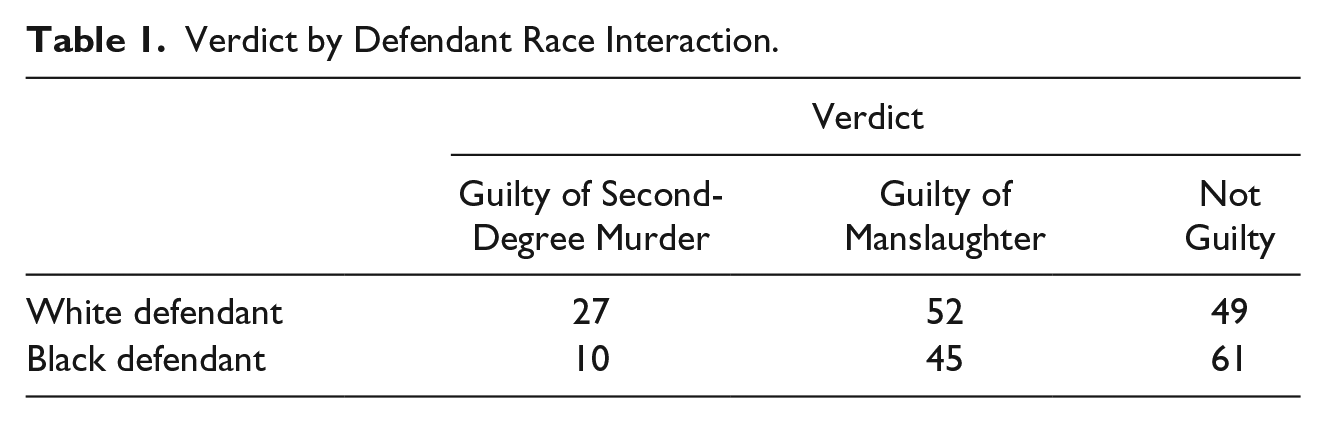
Overall, 15% (n = 37) of participants found the wife/defendant guilty of second-degree murder, 40% (n = 97) believed her to be guilty of the lesser charge of manslaughter, and 45% (n = 110) accepted the defendant’s self-defense claim and voted not guilty. To determine whether verdict decisions differed as a function of defendant race, victim race, or juror gender, we performed a 2 (wife/defendant race: White, Black) × 2 (husband/victim race: White, Black) × 2 (juror gender: man, woman) × 3 (verdict: guilty of second-degree murder, guilty of manslaughter, not guilty) hierarchical loglinear analysis. No significant interactions were found between defendant and victim race, suggesting no observed effect of the couple’s racial composition on verdicts. This analysis did reveal a significant interaction between the wife/defendant race and verdict, χ2(2, N = 244) = 9.06, p = .01, Cramer’s V = .19. Follow-up tests revealed that participants selected a guilty of second-degree murder verdict significantly more often when the wife/defendant was White (21%) rather than Black (9%), χ2(1, N = 244) = 7.36, p = .007, Cramer’s V = .17. Participants were equivalently likely to select a guilty of manslaughter verdict for a White and Black wife/defendant. However, participants who read about a Black wife/defendant were more likely to acquit her (53%) than those who read about a White wife/defendant (38%), χ2(1, N = 244) = 5.03, p = .03, Cramer’s V = .14. See Table 1 for a breakdown of verdict decisions as a function of the wife’s/defendant’s race.
Verdict by Defendant Race Interaction.
The analysis also revealed a significant interaction between juror gender and verdict decision, χ2(2, N = 244) = 13.17, p = .001, Cramer’s V = .23. Follow-up tests revealed that men and women voted the wife/defendant guilty of second-degree murder at roughly equivalent rates. However, men (48%) were more likely than women (31%) to vote for a manslaughter conviction, χ2(1, N = 244) = 7.26, p = .007, Cramer’s V = .17. Conversely, women (56%) were more likely to acquit the wife/defendant than were men (33%), χ2(2, N = 244) = 13.17, p = .001, Cramer’s V = .23. See Table 2 for the verdict breakdown for male and female jurors.
Verdict by Juror Gender Interaction.

Responsibility
Defendant responsibility
We conducted a 2 (juror gender: man, woman) × 2 (wife/defendant race: Black, White) × 2 (husband/victim race: Black, White) ANOVA using mock jurors’ perceptions of the wife’s/defendant’s responsibility for the incident as the dependent variable. This analysis revealed no significant main effects or interactions.
Victim responsibility
We repeated this analysis with the husband/victim responsibility as the dependent variable. There were no significant interactions in terms of the racial composition of the couple on victim responsibility. This analysis did reveal a significant main effect for juror gender, F(1, 243) = 4.76, p = .03, η2 = .02. Overall, women (M = 5.68, SD = 1.19) found the husband/victim to be more responsible for the incident than did men (M = 5.29, SD = 1.41).
However, this effect was qualified by a significant Juror Gender × Defendant Race interaction, F(1, 243) = 5.04, p = .03, η2 = .02. Simple effects tests revealed that there was no effect of the wife’s/defendant’s race on the husband/victim responsibility ratings for male mock jurors, t(118) = −1.26, p = .21. However, for women, the husband/victim responsibility ratings were much higher when the wife/defendant was White (M = 5.89, SD = 1.14) than when she was Black (M = 5.46, SD = 1.22), t(121) = 2.03, p = .04. Looking at the interaction in another way, male and female mock jurors assigned identical husband/victim responsibility ratings when the wife/defendant was Black, but women assigned much higher husband/victim responsibility ratings than did men when the wife/defendant was White. See Figure 1 for a summary of these results.
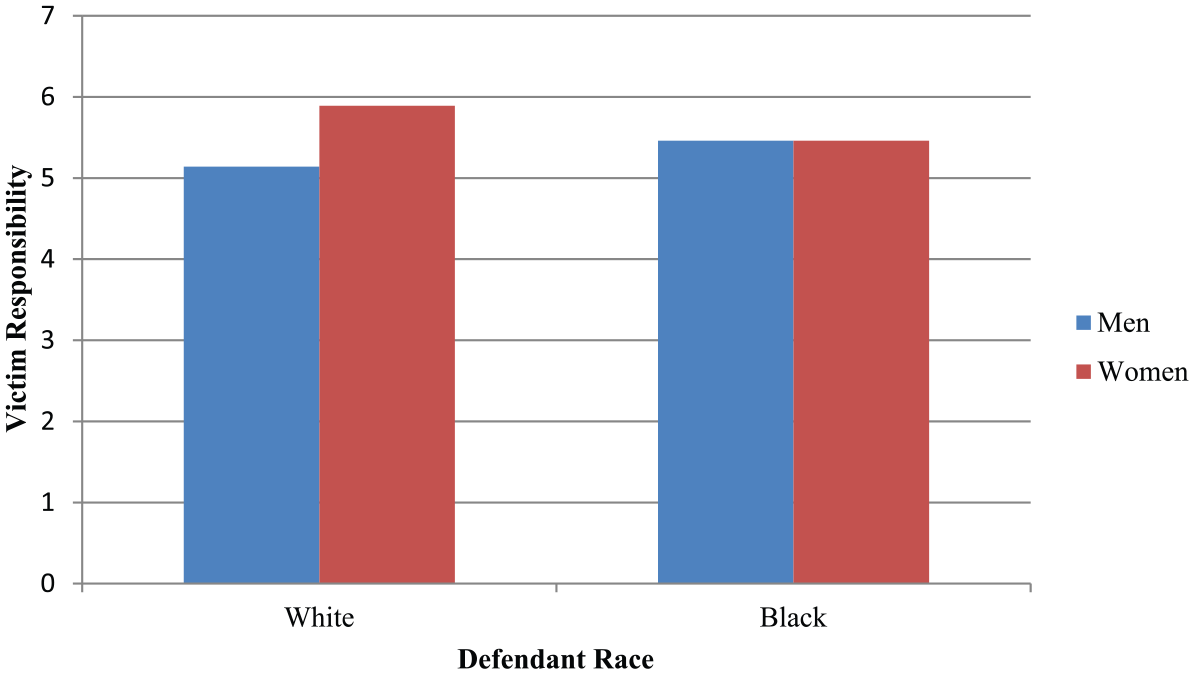
Interaction between juror gender and defendant race on participant ratings of victim responsibility.
Perceptions of the Defendant’s Claim
The subscales from Schuller and Hastings’s (1996) perceptions of the BSS claim measure were correlated with one another (rs ranging in magnitude from .46 to .80), and so a MANOVA was conducted with these subscales as the dependent variables, and juror gender, wife/defendant race, and husband/victim race as the independent variables. This analysis revealed a main effect for wife/defendant race on two of the subscales, and a main effect of juror gender on each subscale. No other main effects or interactions emerged.
Defendant race
There was a significant main effect of wife/defendant race on perceptions that the wife/defendant had no other options available, F(1, 236) = 5.40, p = .02, η2 = .02, such that participants felt that the Black defendant (M = 3.42, SD = 0.98) had fewer options available to her than the White defendant (M = 3.74, SD = 1.08). In addition, wife/defendant race had a significant main effect on perceptions of the wife’s/defendant’s mental state, F(1, 236) = 3.76, p = .05, η2 = .02. Participants viewed the White defendant (M = 3.20, SD = 1.10) as being in greater control of her actions than the Black defendant (M = 2.94, SD = 0.90).
Juror gender
Juror gender significantly influenced each of the perceptions we measured. Women (M = 3.75, SD = 0.78) were more likely to believe that the wife’s/defendant’s life was in danger than men (M = 3.30, SD = 0.95), F(1, 236) = 16.23, p < .001, η2 = .07; women (M = 3.39, SD = 1.07) were less likely to believe that the wife/defendant had other options available to her than men (M = 3.79, SD = 0.98), F(1, 236) = 9.70, p = .002, η2 = .04; women (M = 2.84, SD = 0.98) believed the defendant to be less in control of her actions than men (M = 3.33, SD = 1.00), F(1, 236) = 13.01, p < .001, η2 = .05; women (M = 4.07, SD = 0.76) were more likely to see the wife/defendant as being trapped in a relationship than men (M = 3.77, SD = 0.95), F(1, 236) = 6.76, p = .01, η2 = .03; and women (M = 3.25, SD = 0.91) overall found the wife’s/defendant’s claim to be more plausible than did men (M = 2.90, SD = 0.97), F(1, 236) = 7.98, p = .005, η2 = .03. See Figure 2 for a summary of these results.

Perceptions of the defendant’s claim by juror gender.
Discussion
The purpose of this study was to determine whether defendant and victim race had an effect on mock juror decision-making in BSS cases, and to explore the effect of juror gender and juror perceptions on verdict decisions.
The Influence of Race on Juror Decision-Making
We expected that participant decisions and perceptions would be influenced by the racial composition of the couple—specifically, that interracial and intraracial couples would be perceived differently. Because we observed no interactions between defendant and victim race, this suggests that the racial composition of the defendant/victim pairing did not influence perceptions in this study as expected. This may be because of the effect of overall wife/defendant race, in that the wife’s race seems to have been driving the verdict decisions regardless of the race of the husband (discussed next). Specifically, we had predicted that the typical characteristics of women under the construct of BSS would serve as a disadvantage to the Black wife/defendant, whereby the Black defendant would not fit the “typical” BSS norms, and would therefore be treated more harshly (Allard, 1991; Ruttenberg, 1994). This hypothesis was expected to be further substantiated by the tendency for men and women of color to be treated more harshly in the justice system compared with White men and women (Bagby et al., 1994; Esqueda & Harrison, 2005; ForsterLee et al., 2006; O. Mitchell, 2005). Results, however, revealed that the Black defendant was treated less harshly than the White defendant, and findings suggested that other perceptions about Black women shaped the perceived reasonableness of her actions. Specifically, the finding that participants perceived the Black defendant to not have other options available to her is in line with the intersectionality perspective of race, SES, and gender in IPV (Bograd, 1999), and seems to be related to marginalization of Blacks in the United States and the lack of helpful resources available for Black female victims of IPV (Donnelly, Cook, Van Ausdale, & Foley, 2005; Martinson, 2001). Poverty is disproportionately high among Blacks in the United States, and thus, Black women with limited finances may lack other options and remain in abusive relationships for economic reasons (Bell & Mattis, 2000).
Women in this study were also more likely to see the White defendant as more in control of her actions compared with the Black defendant. These findings provide additional support for the idea that perceptions of limited options available to the Black defendant were driving verdict decisions in the unexpected direction. In other words, self-defense may have been viewed as the only option for the Black defendant to escape her circumstances, and therefore participants perceived it to be reasonable for her to have taken lethal action against her husband. This finding is consistent with Swan and Snow’s (2006) theory of women’s use of violence in interpersonal relationships. It also suggests that racial inequality is still deemed to be a significant issue and speaks to societal racism present on a larger scale. It is worth noting that the majority of the sample was White, and therefore the fact that the marginalization of Blacks is recognized by this sample is particularly interesting. This could be viewed as somewhat encouraging in that if this is brought to light and becomes more widely acknowledged as a problem in society as a whole, then perhaps further steps could be taken to address racial inequalities.
The Influence of Juror Gender on Decision-Making
Male and female mock jurors assigned equivalent victim responsibility ratings when the defendant was Black, but women assigned much higher victim responsibility ratings than did men when the defendant was White. It is possible that the women who participated in this study (of which the majority were White) identified more with the White female defendant, and so assigned higher responsibility ratings to the (abuser) victim in those conditions. This is in line with previous research in which women are more punitive than men in IPV cases (Burke et al., 1990). The White women participants may not have identified as strongly with the Black female defendant, bringing those levels down to the same level as men (who do not ordinarily identify with the abused party; Locke & Richman, 1999); however, we were not able to assess this directly in the current study. It is possible that, in addition to their gender, juror race contributed to perceptions of responsibility in this case. It would be of interest to explore the effects of participant gender and race further in future research.
Results highlight that, compared with the women, the male mock jurors were less likely to believe that the defendant was in danger, and were more likely to believe that she had other options, that she was in control of her actions, that she could have left the relationship, and that her claim was not believable. Beyond these differences in perceptions about IPV and the woman’s situation, there were also important gender differences in verdict decisions, whereby female jurors were more likely to vote not guilty on the grounds of self-defense than were male jurors. This significant gender disparity in mock jurors’ perceptions about IPV is consistent with prior research (Locke & Richman, 1999; Schuller et al., 1994). Given what it is known about IPV, the cycle of abuse (Walker, 1984), and prevalence rates of IPV (Breiding et al., 2014; Durose et al., 2005), it appears that men’s perceptions about IPV continue to be skewed. These misperceptions seem to be persisting amid efforts such as Violence Against Women Acts passed by the U.S. Congress and the media’s running of antidomestic-violence campaigns (e.g., commercials during the Superbowl). The gender differences found in this study suggest that perceptions about IPV still need to be addressed on a national level.
Limitations
Participants in the study were recruited online and completed the study online. While manipulation and attention checks were used to ensure that participants attended to the material, the method of online data collection may be limited in that participants are not accountable for their decisions like they would be in a real trial. While the feelings of civil duty or legal responsibility may potentially be reduced using simulation methods, the more removed nature of the online approach might actually allow participants to respond more honestly (i.e., social desirability is less of a factor), and therefore this approach might provide more accurate participant perceptions than in-lab research. In addition, the online nature of the study made it feasible to gather a national sample comprised of community members, which adds to the generalizability and ecological validity of the findings.
This study may also have been limited by not involving jury deliberations. Deliberations offer jurors a platform to discuss the instructions, evidence, and verdicts. While this discussion and participation have the potential benefit of counterbalancing individual biases that jurors may have, it is worth noting that jury biases may persist on the group level, with individual juror characteristics and contextual factors affecting deliberations and jury decisions (Cornwell & Hans, 2011; Devine, Clayton, Dunford, Seying, & Pryce, 2001). Another potential limitation is that the current study used a trial transcript of a murder case rather than having a live trial reenactment or a trial video. That being said, the trial transcript was modeled after a real case (Lavallee v. Regina, 1990) in which the defendant claimed self-defense using evidence of BSS, and there is some research supporting the idea that jury research can be conducted using trial transcripts without sacrificing the validity (Pezdek, Avila-Mora, & Sperry, 2010). Although the ecological validity of this study is somewhat limited, the findings should not be undermined. This is the first study to look at racial composition of the couple in BSS cases, and this article offers preliminary findings that would be worth exploring further in future research.
Finally, this study was also somewhat limited in the sense that we were not able to examine the effect of juror race on perceptions and decisions. The intersection of race and gender is indeed important, and juror race may have contributed to perceptions in this BSS case. While we were able to get a fairly equal gender split in our sample, we unfortunately were not able to assess the intersection of race and gender, as we did not have the adequate cell sizes to conduct analyses on juror race. This was mostly a result of the feasibility of data collection for the purpose of this study, as we did not have inclusion/exclusion criteria for the race of the participants. The high proportion of White participants limits the diversity of our findings beyond what we were able to report on here. Future research could, and should, attempt to get a sample of participants with appropriate race representation in the sample to conduct the analyses to examine both juror gender and race.
Implications
Although this study is somewhat limited, as described above, it is the first to look at gender, race, and their intersection in the context of juror decisions in BSS cases. Tang (2003) asserted the importance of examining “how the BSS testimony is applied to minority women in North America” (p. 624), and the findings from the current study shed some light on this and provide some significant information from which numerous implications can be drawn. The finding of less harsh verdict decisions and lower responsibility ratings given for the Black defendant/wife, and the inference that the Black defendant had fewer options available to her, provides evidence toward the intersectionality of race and gender in IPV in the United States. Our findings highlight that White Americans are aware of the marginalization of Blacks and suggest the need for more resources provided to minorities to rectify this on a national level. Even in the event of having resources available, past research has found that Black women are significantly more likely to report using prayer as a coping strategy and significantly less likely to seek help from mental health counselors (Dutton et al., 2005), suggesting that steps must also be taken to address systemic inequalities such that its perceived legitimacy can be increased for this group. Therefore, according to Goodman and Epstein (2005), the “next step for the battered women’s movement must be to revisit its roots by refocusing on supporting women and incorporating an individualized responsiveness into government and community programs” (p. 483), and this will be even more pertinent for racial minorities.
Given that perceptions of IPV differed among men and women in this study, these findings provide support for the need of continued efforts to enhance education and understanding about IPV on a national level. While the focus has largely been on sending messages to the abusers (e.g., mandatory arrest policies, and campaigns to stop IPV), the victims also need to feel empowered and safe in accessing resources. Therefore, while education initiatives continue, it will also be increasingly important to listen to individual women’s voices, promote supportive communities, and facilitate economic empowerment (Goodman & Epstein, 2008). These steps could result in substantial progress in efforts to protect and help battered women.
In terms of implications regarding jury decision-making, the findings from this study are consistent with prior research highlighting gender differences in juror decisions. This is relevant for lawyers and the courts to consider during jury selection and trial in IPV or BSS cases. Specifically, these gender differences persist even in the presence of expert testimony regarding BSS, suggesting that the testimony in this case did little to mitigate male juror perceptions of IPV. While the effect of race found in the current study was not in the expected direction, the findings still demonstrate the influence that race can have on juror decision-making. Therefore, in addition to gender bias, racial bias is also in need of future research, both in terms of juror and defendant extra-legal characteristics.
Conclusion
This study demonstrates that American mock jurors may be influenced by race in BSS cases and that gender-based perceptions of interpersonal violence can be influential in these cases. This intersectionality of race, social class, and gender, therefore, has real-life consequences for many battered women who take lethal action against their partners. Further research is needed to explore these relationships and to explore possible methods for reducing bias in trial decision-making in BSS cases. It would be of interest for future studies to examine the race of the jurors, as well as the racial composition of other race couples (e.g., Native American, Latino, Asian), and the potential effects of these on juror decisions in BSS cases. A particular emphasis on racial and cultural contexts is needed in future research studying perceptions of women’s violence to expand our understanding of juror decisions in these cases.
Footnotes
Declaration of Conflicting Interests
The author(s) declared no potential conflicts of interest with respect to the research, authorship, and/or publication of this article.
Funding
The author(s) received no financial support for the research, authorship, and/or publication of this article.