



Abstract
This study examined the relationships between two functions of aggression (i.e., reactive and proactive) and delinquency, including the moderating effects of parent criminality and friends’ gang membership, in a sample of 1,027 Singaporean adolescents from Grade 7 to Grade 9, with age ranging from 12 to 19 years (M = 14.10, SD = 1.15). Findings suggested that both reactive aggression and proactive aggression significantly and positively predicted delinquency (after controlling for proactive aggression and reactive aggression, respectively), with proactive aggression being a stronger predictor. Friends’ gang membership was found to moderate the relationship between reactive aggression and delinquency, and proactive aggression and delinquency, with stronger moderator effects for the latter. Those who were aggressive proactively and who had friends in a gang appear to be impacted most negatively with respect to delinquency. Parent criminality did not moderate these relationships. These findings highlight the need to effectively address the issues of child and adolescent aggression. Also, developing positive peer relations early is crucial for delinquency prevention.
Keywords
Adolescent delinquency is a common issue that produces adverse outcomes in different societies, and it is not uncommon to have a reasonably large number of individuals engaging in delinquent behaviors at some point during their lives (Johnson & Menard, 2012). In the United States, about 1.3 million juvenile arrests were made in 2012, accounting for 10.7% of the total arrests that year (Snyder & Mulako-Wangota, 2014). In England and Wales, juvenile arrests accounted for 13.6% of the total arrests in 2011/2012 (Ministry of Justice, 2014), and in Singapore, youth arrests accounted for 10.2% of the total crime rate in 2013 (Singapore Police Force, 2014). The prevalence of youth delinquency is of universal concern because younger offenders are more likely to offend again compared with older offenders as they have more time and opportunities to repeat their criminal behavior (Katsiyannis & Archwamety, 1997). However, there remains limited research especially with respect to understanding the underlying mechanism of adolescent delinquency. In addition, the use of Asian samples in understanding this phenomenon is uncommon. In Singapore, because of the restriction on use of firearms and guns, adolescent delinquency finds expression through gang participation, fights, and rioting, and theft, among other types of activities (National Crime Prevention Council, 2015). The objective of this study is to examine parent criminality and friends’ gang membership as moderators of the relationship between functions of aggression and delinquency. These are especially relevant to the adolescent population being studied because parents and friends are key socialization agents.
Functions of Aggression and Delinquency
Reactive aggression and proactive aggression, representing different motivations and functions of aggressive behavior, have been recognized as distinct and distinguishable, despite their moderate to high correlation (Raine et al., 2006). Reactive aggression is more strongly related to internalizing characteristics such as depression and anxiety, whereas proactive aggression is more strongly related to externalizing behaviors such as fighting and violence (Raine et al., 2006). Rooted in different theoretical frameworks, reactive aggression has been characterized as impulsive, hot-blooded, and emotional in nature, whereas proactive aggression has been characterized as intentional, cold-blooded, and instrumental in nature.
Delinquency includes a variety of mild to serious rule-breaking behaviors and encompasses theft, truancy, vandalism, and substance use, for example (Trucco, Villafuerte, Heitzeg, Burmeister, & Zucker, 2014; Vitaro, Pedersen, & Brendgen, 2007). Adolescent delinquent behaviors lie on an entire spectrum; some behaviors such as lying are not law-violating acts, but other kinds of delinquent behaviors such as assault with a deadly weapon, arson, or theft will likely lead to arrest and police charges (Hasking, Scheier, & Abdallah, 2011). Prior studies have revealed a positive link between general aggression and delinquency (e.g., Lynne-Landsman, Graber, Nichols, & Botvin, 2011), but few have distinguished between different functions of aggression and fewer still have discussed the relationships between these different functions of aggression and delinquency in Asian samples. Few studies have investigated this relationship, and in those studies that have examined this, the findings are inconclusive. For example, Vitaro, Gendreau, Tremblay, and Oligny (1998) indicated that proactive aggression uniquely predicted adolescent delinquency, while Fite, Raine, Stouthamer-Loeber, Loeber, and Pardini (2010) found that reactive aggression was also predictive of delinquency. Further examination of the association between different functions of aggression and delinquency is required and would contribute toward the existing knowledge base.
Although reactive aggression and proactive aggression have been found to predict delinquency, there are still factors that may adjust the relationship between functions of aggression and delinquency under certain conditions as both reactive and proactive aggression are susceptible to social influence (Sijtsema, Veenstra, Lindenberg, Hawley, & Little, 2010). For example, parent criminality (Connor, Steingard, Cunningham, Anderson, & Melloni, 2004) and friends’ delinquency (Ang, Huan, Chua, & Lim, 2012) could increase the likelihood of adolescent delinquency, given that family and peer groups are primary settings in which behaviors are taught, learned, and reinforced (Bahr, Hoffmann, & Yang, 2005). However, little is known about how parents and peers affect the relationship between different functions of aggression and delinquency. To our knowledge, only Fite, Colder, Lochman, and Wells (2008) have discussed the mediating mechanism between specific functions of aggression and delinquency (i.e., substance use), while no study has explored possible moderators of the relationship between functions of aggression and delinquency in adolescents. To address this research gap, the moderating mechanisms between different functions of aggression and delinquency would be explored in this study.
Parent Criminality
Parents are children’s behavioral models and children learn social behaviors through observation, imitation, and reinforcement (Bandura, 1983). Bandura’s (1983) work showed that exposure to aggressive models (e.g., aggressive parents) may increase children’s proactive aggression because the instrumental use of aggression can be learned. Therefore, parents have strong and direct influences on children’s development and acquisition of aggressive and delinquent behaviors (Aseltine, 1995). Parents’ violent behaviors leading to arrest (Connor et al., 2004) and imprisonment (Murray & Farrington, 2005) have been shown to increase the likelihood of adolescents engaging in aggressive and delinquent behaviors and committing crimes. A systematic review and meta-analysis has further confirmed that parents’ conviction and incarceration have a remarkable and significant impact on children’s antisocial behaviors throughout their lives (Murray, Farrington, & Sekol, 2012). Not surprisingly, Duman and Margolin (2007) found that children were inclined to use an aggressive problem-solving style rather than an assertive style if they had a mother who usually adopted aggressive solutions. Other researchers such as Merikangas, Dierker, and Szatmari (1998) found that children of substance-abusing parents were more likely to be involved in substance use. Parents’ externalizing behaviors, such as poor anger control and impulsive behaviors, were found to be positively associated with child aggressiveness in a longitudinal study (Wahl & Metzner, 2012). Collectively, there is empirical evidence to suggest that parent criminality, specifically, and parents’ aggressive and delinquent behaviors, more generally, affect children and adolescents’ delinquent behavior.
Friends’ Gang Membership
Although parents play an especially important role in children’s development during infancy and childhood, friends become increasingly important as children spend more time with peers rather than parents during the phase of adolescence (Pardini, Loeber, & Stouthamer-Loeber, 2005). From childhood to adolescence, adolescents’ networks gradually diversify as they build more connections with people besides family members. Researchers have identified social contexts, and in particular the peer context and peer influence, as being particularly salient and powerful during the period of adolescence (Barber & Olsen, 1997; Kiesner, Cadinu, Poulin, & Bucci, 2002). In a large representative sample of Dutch adolescents, Helsen, Vollebergh, and Meeus (2000) found that perceived parental support declined and perceived friends’ support increased during adolescence. This was expected because adolescents spend a substantial amount of time with their peers, and compared with friendships in childhood, adolescents have a greater need for intimacy in relationships with peers. More specifically, Larson and Richards (1991) found that the time spent with family declined by half in adolescence compared with childhood. Further evidence showed that the average time adolescents spent with friends was 23.3 hr per week, more than double the time spent with family (Barnes, Hoffman, Welte, Farrell, & Dintcheff, 2007). Comparatively, during adolescence, interaction with parents is reduced and intensive interaction with friends encourages and facilitates learning among peers (Bahr et al., 2005). Against this research background, friends can be argued to be an essential source of influence on adolescent behaviors as adolescents have greater exposure to friends during this developmental phase (Aseltine, 1995). Although parents continue to be a key socialization agent even in the lives of adolescents, it cannot be denied that peers play a prominent role especially during these adolescent years.
There is research support showing that friends with conventional behavior serve as a positive and protective factor against problematic adolescent behavior (Jessor, van den Bos, Vanderryn, Costa, & Turbin, 1995), whereas friends with delinquent behaviors encourage adolescent delinquency through a reinforced network of friends (Herrenkohl et al., 2007; Thornberry, Lizotte, Krohn, Farnworth, & Jang, 1994). The association between delinquent friends and adolescent delinquency has been elucidated in an early work by Sutherland and Cressey (1978), who argued that friend networks provide an environment for behavioral learning and reinforcement as adolescents tend to conform to friends’ behaviors for acceptance and approval. In particular, peer socialization without parental supervision is closely associated with deviant behaviors (e.g., criminality, drug use) because adolescents are more likely to be involved in delinquency and receive greater rewards in the presence of peers and in the absence of parents (Osgood, Wilson, O’Malley, Bachman, & Johnston, 1996). If friends have favorable attitudes to delinquency or engage in delinquent acts, adolescents tend to imitate and internalize these behaviors through positive social reinforcement (Bahr et al., 2005; Petraitis, Flay, & Miller, 1995). Moreover, due to the instability of adolescent friendships, adolescents are inclined to follow friends’ normative orientations and behave in the same way to maintain the friendship (Brauer & De Coster, 2015). Therefore, through affiliation with delinquent peers, adolescents increase their tolerance and acceptance of delinquency, which in turn increases their antisocial and aggressive behaviors (Pardini et al., 2005).
Prior studies have found that if aggressive adolescents are involved with aggressive friends in a peer network, their aggression would be sustained over time (Sijtsema et al., 2010). Moreover, adolescents high in both reactive and proactive aggression usually have more deviant friends (Vitaro et al., 1998) and tend to affiliate with gangs (Barker, Tremblay, Nagin, Vitaro, & Lacourse, 2006). Even if youth offenders are not gang members themselves, but have friends in a gang, they are more likely to commit offenses than youth offenders without gang friends (Ang et al., 2012). Increased interaction with delinquent peers or gang friends, indeed, drives adolescents to engage in more delinquent behaviors (Barker et al., 2006).
There are generally two types of gangs in Singapore—traditional gangs and street gangs. Traditional gangs exist mostly for economic gains, and for this reason, members of traditional gangs tend to be older, prefer to keep a low profile, and generally stay out of the attention of the eyes of law enforcement. On the contrary, street gangs in Singapore are defined as loosely organized structures with fluid membership, and members often get involved in fights and resort to violence at the slightest provocation (Singapore Police Force, 2015). Street gangs tend to attract younger members and students (Singapore Police Force, 2015). Hence, for the present study, the term gang refers specifically to street gangs in Singapore.
Present Study and Hypotheses
To the best of our knowledge, few studies have assessed the relationships between specific functions of aggression and adolescent delinquency especially in an Asian context, and no study has examined the moderating mechanism of familial and peer influence in these relationships. To address this research gap, two research questions were proposed.
Method
Participants
A total of 1,027 students (576 males, 414 females, and 37 did not report gender) from Grade 7 to Grade 9 at three secondary schools in Singapore participated in this study. These three schools are public schools under the governance of the Ministry of Education, Singapore; these schools are the most common types of schools in Singapore. The students’ age ranged from 12 to 19 years (M = 14.10, SD = 1.15). There was a relatively even spread of participants across the three grade levels (Grade 7 = 36.7%, Grade 8 = 30.4%, Grade 9 = 32.9%) in the sample. Of these students, the majority were Chinese (65%), followed by Malay (20.6%), Indian (6.6%), and Eurasian (1.1%), whereas 6% endorsed others, and 0.6% did not report their ethnicity.
Measures
Reactive-Proactive Aggression Questionnaire (RPQ)
The RPQ (Raine et al., 2006) is a self-report scale with 23 items measuring reactive aggression (11 items; e.g., “I get angry when frustrated”) and proactive aggression (12 items; e.g., “I use force to get others to do what I want”). Responses were given on a 3-point scale ranging from 0 (never) to 2 (often), with a higher score indicating a higher level of aggression. Cronbach’s alpha reliability estimates for reactive aggression and proactive aggression were .82 and .87, respectively, in this sample.
Self-Report Delinquency Scale (SRDS)
The SRDS (adapted from Elliott, Huizinga, & Ageton, 1985) with 18 items (e.g., “I left school without telling anyone when I wasn’t supposed to leave”) was used to measure adolescents’ involvement in a wide range of juvenile acts from minor ones to more serious ones and with offenses that range from stealing and running away from home to actions that cause hurt to another person. In our study, adolescents were asked to report whether they have ever committed the behaviors listed in each of the items (yes = 1; no = 0). The delinquency score was calculated by summing the total number of affirmative (i.e., yes) responses to the 18 items. The Cronbach’s alpha was .90 in this sample.
Demographic variables and information on parent criminality and friends’ gang membership
Adolescents provided information on their age, gender, ethnicity, and educational level. To obtain information about parent criminality, adolescents were asked two dichotomously scored (yes/no) questions: “Has your father ever been arrested by the police for an offense?” and “Has your mother ever been arrested by the police for an offense?” Parent criminality was scored by combining the responses indicating yes to either question. To obtain information on whether adolescents have friends in a street gang, they were asked to indicate yes or no to the question: “Do you currently have friends in a street gang?”
Consent and Procedures
Institutional review board approval for this study was obtained from Nanyang Technological University, Singapore, and additional approvals for data collection at schools were also received from Ministry of Education, Singapore, and respective school principals. Three schools were randomly selected for this study, and students from these schools were invited to participate. Parental consent and adolescent assent were obtained, and participation in the study was completely voluntary. Response rate was 84.6%, and this comprised adolescents for whom we have parental consent and adolescent assent. Adolescents could refuse or discontinue participation at any time, without penalty. The anonymous questionnaire was administered in English as English is the main language of instruction for all schools in Singapore, and the study took place in an organized classroom setting.
Data Analytic Plan
Multiple regression analyses were used to examine the relationships between both functions of aggression and delinquency. Hierarchical multiple regression analyses were conducted to further investigate the moderating effects of parent criminality and friends’ gang membership on the relationship between each function of aggression and delinquency. Prior to calculating the product terms, continuous variables such as reactive aggression and proactive aggression were standardized. The two dichotomous moderators, parent criminality (−.08 = No and 1 = Yes) and friends’ gang membership (−.25 = No and 1 = Yes), were weighted-effect coded (West, Aiken, & Krull, 1996). All independent variables and moderators were entered in Step 1, and all interaction terms were entered in Step 2 of the analyses. In the first run of the hierarchical multiple regression analysis, the interaction terms were “Reactive Aggression × Parent Criminality” and “Reactive Aggression × Friends’ Gang Membership.” In the second run of the hierarchical multiple regression analysis, the interaction terms were “Proactive Aggression × Parent Criminality” and “Proactive Aggression × Friends’ Gang Membership.” Significant interaction effects were probed following the methods of Aiken and West (1991).
Results
Descriptive Analyses
We tested Hypothesis 1 using correlations and multiple regression analyses. The intercorrelations among different functions of aggression, delinquency, parent criminality, and friends’ gang membership are reported in Table 1. Results showed that reactive aggression (r = .38, p < .001; Cohen’s d = .82) and proactive aggression (r = .51, p < .001; Cohen’s d = 1.19) were significantly correlated to delinquency. We further found that both reactive aggression (β = .16, p < .001) and proactive aggression (β = .43, p < .001) were still significantly predictive of adolescent delinquency after controlling for the other function of aggression, but proactive aggression was a stronger predictor.
Means, Standard Deviations, and Correlations of Investigated Variables.
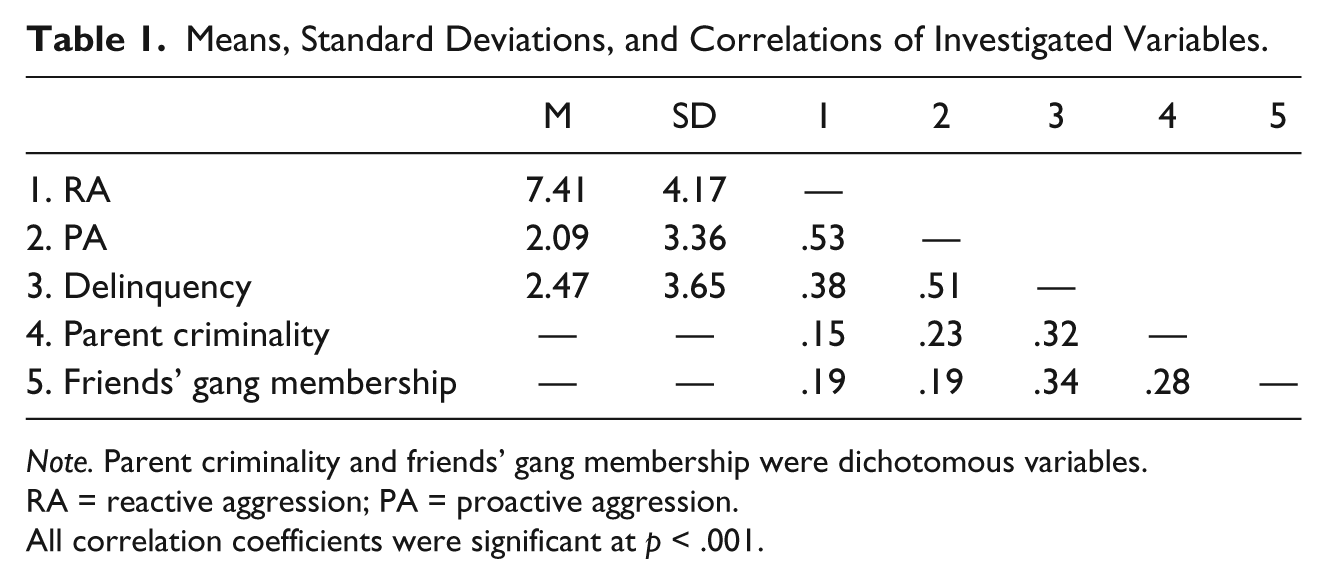
Note. Parent criminality and friends’ gang membership were dichotomous variables. RA = reactive aggression; PA = proactive aggression.
All correlation coefficients were significant at p < .001.
Relationship Between Reactive Aggression and Delinquency: Friends’ Gang Membership as a Moderator
We tested Hypothesis 2 using hierarchical multiple regression analysis (see Table 2). We checked and determined that multicollinearity was not an issue because the values of Variance Inflation Factor (VIF) of all predictors (including the interaction terms) ranged from 1.051 to 1.444 and the values of tolerance ranged from .692 to .952. We examined possible moderators in the relationship between reactive aggression and delinquency. At Step 1, the independent variable, reactive aggression, and hypothesized moderators including parent criminality and friends’ gang membership were entered; at Step 2, the two-way interaction variables (i.e., Reactive Aggression × Parent Criminality and Reactive Aggression × Friends’ Gang Membership) were added. Step 1 showed that reactive aggression had a positive main effect on delinquency (β = .30, p < .001), and both parent criminality and friends’ gang membership were significantly related to delinquency (β = .76, p < .001; β = .45, p < .001, respectively). The increase in the amount of variance explained by the interaction terms at Step 2 was significant: ΔR2 =.006, ΔF(2, 985) = 3.798, p < .05. Although the interaction between reactive aggression and parent criminality did not reach statistical significance (β = −.08, p > .05), the interaction effect between reactive aggression and friends’ gang membership on adolescent delinquency was statistically significant (β = .17, p < .01). This suggested that the interaction of reactive aggression and friends’ gang membership could significantly predict delinquency. To interpret the interaction effect, we plotted two separate regression lines for adolescents with friends in a gang and adolescents without friends in a gang (see Figure 1). It was found that the relationship between reactive aggression and delinquency was statistically significant for both groups with and without friends in a gang, but the association was stronger for adolescents with friends in a gang (b = .41, p < .001) than for adolescents without gang friends (b = .23, p < .001).
Hierarchical Multiple Regression Analysis: Parent Criminality and Friends’ Gang Membership as Moderators of the Association Between Reactive Aggression and Delinquency.
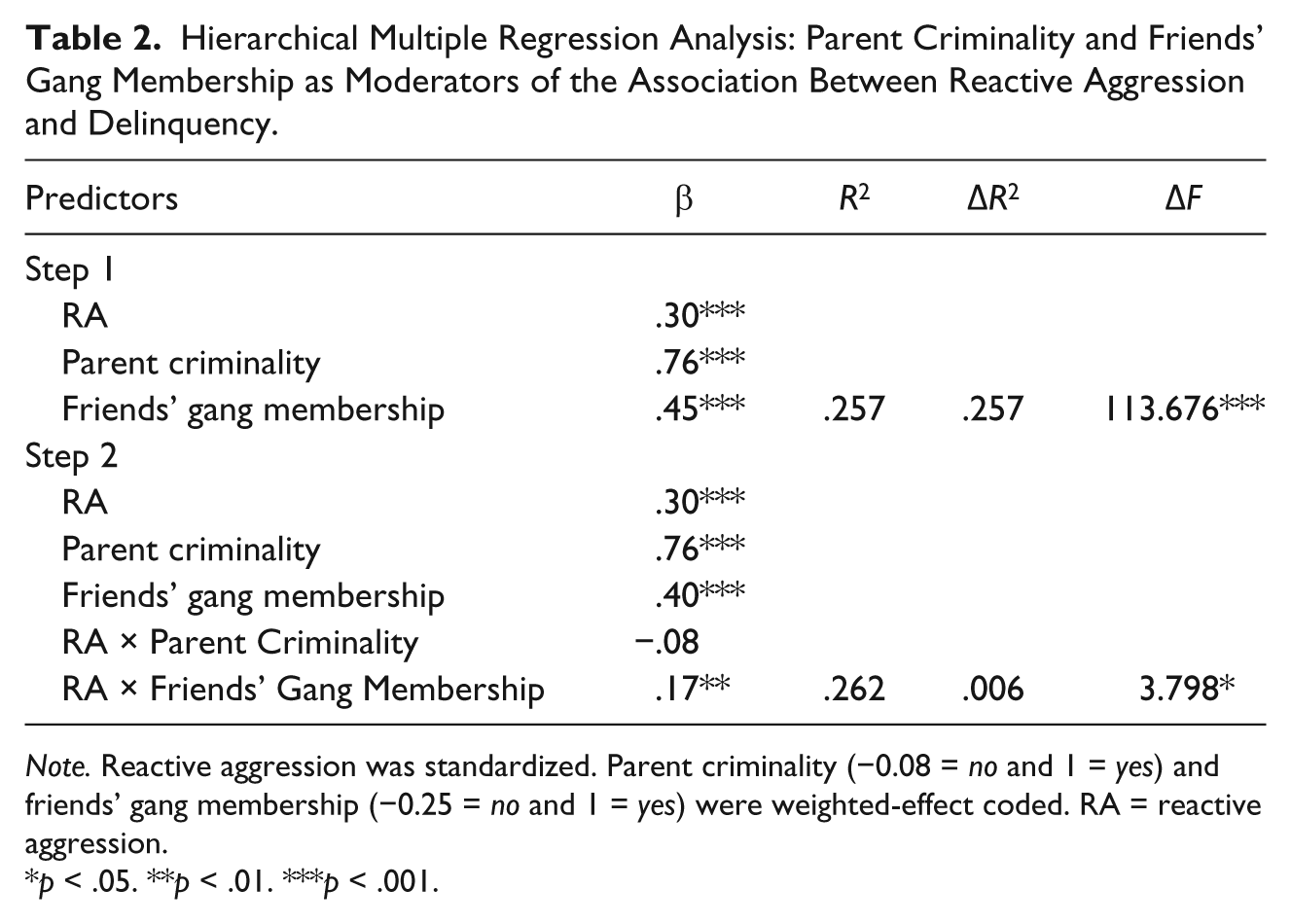
Note. Reactive aggression was standardized. Parent criminality (−0.08 = no and 1 = yes) and friends’ gang membership (−0.25 = no and 1 = yes) were weighted-effect coded. RA = reactive aggression.
p < .05. **p < .01. ***p < .001.
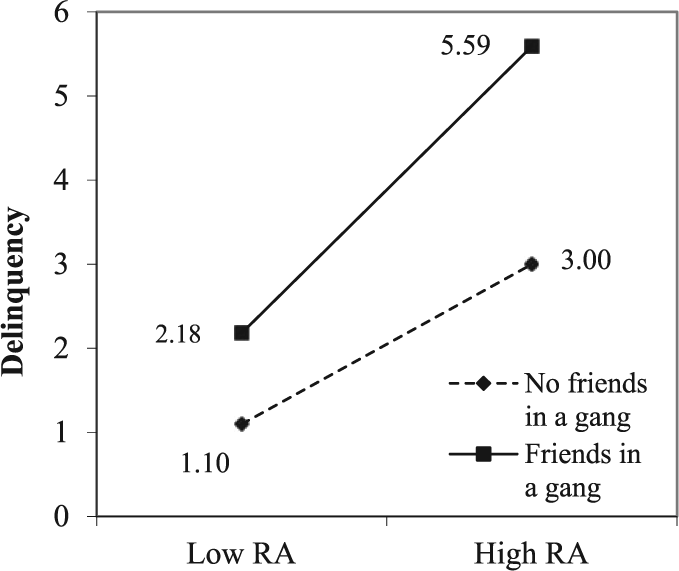
Regression lines for the association between reactive aggression and delinquency as moderated by friends’ gang membership.
Relationship Between Proactive Aggression and Delinquency: Friends’ Gang Membership as a Moderator
We continued to test Hypothesis 2 using hierarchical multiple regression analysis. We checked and determined that multicollinearity was not an issue because the values of VIF of all predictors (including the interaction terms) ranged from 1.078 to 1.614 and the values of tolerance ranged from .619 to .928. To examine whether the relationship between proactive aggression and adolescent delinquency was moderated by parent criminality and friends’ gang membership, hierarchical multiple regression analysis was performed (see Table 3). In Step 1, proactive aggression showed a positive main effect on delinquency (β = .43, p < .001), and both parent criminality and friends’ gang membership significantly predicted delinquency (β = .57, p < .001; β = .43, p < .001, respectively). The increase in the amount of variance explained by the interaction terms at Step 2 was significant: ΔR2 = .011, ΔF(2, 985) = 8.484, p < .001. Results further showed that the interaction between proactive aggression and parent criminality was not statistically significant (β = .12, p > .05), whereas proactive aggression interacted with friends’ gang membership (β = .13, p < .01) significantly in predicting delinquency. This suggested that friends’ gang membership exacerbated the influence of proactive aggression on adolescent delinquency. To interpret the interaction effect, two separate regression lines for adolescents with friends in a gang and adolescents without friends in a gang were depicted in Figure 2. The simple slopes for adolescents with friends in a gang (b = .56, p < .001) and adolescents without friends in a gang (b = .38, p < .001) were statistically significant. These results suggested that the association between proactive aggression and delinquency was stronger for adolescents with friends in a gang.
Hierarchical Multiple Regression Analysis: Parent Criminality and Friends’ Gang Membership as Moderators of the Association Between Proactive Aggression and Delinquency.

Note. Proactive aggression was standardized. Parent criminality (−0.08 = no and 1 = yes) and friends’ gang membership (−0.25 = no and 1 = yes) were weighted-effect coded. PA = proactive aggression.
p < .01. ***p < .001.

Regression lines for the association between proactive aggression and delinquency as moderated by friends’ gang membership.
Discussion
The present study examined the relationships between specific functions of aggression and delinquency in an Asian adolescent sample. First, the relationships between two functions of aggression and delinquency were investigated. Second, two moderating factors in the above relationships, parent criminality and friends’ gang membership, were examined. As predicted in Hypothesis 1, both reactive aggression and proactive aggression were associated with delinquency, with proactive aggression emerging as a stronger predictor. Moreover, both parent criminality and friends’ gang membership have positive main effects on adolescent delinquency. As expected in Hypothesis 2, although parent criminality was not a moderator between both functions of aggression and delinquency, friends’ gang membership was found to be a moderator in the association between reactive aggression and delinquency, as well as between proactive aggression and delinquency. In addition, friends’ gang membership was found to be a stronger moderator for the proactive aggression-delinquency link, compared with the reactive aggression-delinquency link.
In line with prior studies (e.g., Fite et al., 2010), our results from an Asian sample also showed that reactive aggression and proactive aggression were significantly related to delinquency. Our study findings further disclosed that both functions of aggression were still significantly predictive of delinquency, even after controlling for the other function of aggression. Proactive aggression appeared to be a stronger predictor. A possible reason accounting for this is that the predatory trait of proactive aggression is also the main characteristic of most delinquency acts (Vitaro et al., 1998). This observation lends credence to the finding that, in particular, proactive aggression was related to severe forms of delinquency in adolescence and predicted antisocial outcomes (e.g., criminality) in adulthood (Fite et al., 2010).
Both parent criminality and friends’ gang membership showed strong positive main effects on delinquency in both the reactive and proactive aggression-delinquency links. Adolescents tend to consciously or unconsciously imitate and follow the behaviors exhibited by people around them, and they would be most influenced by key socialization agents such as parents and friends. In this study, parents’ criminality was significantly related to delinquent behavior. It is plausible that parents could be setting a negative example for adolescents to model after. This result corroborated a previous finding (Murray & Farrington, 2005) that children who had parents with delinquent behavior were more likely to commit delinquency. Besides, parents who get into trouble with the law were likely to have less time to monitor and supervise their children’s and adolescents’ behaviors (Murray & Farrington, 2005), which may increase the likelihood of these young people being involved in delinquency. Friends’ gang membership was also found to predict adolescent delinquency; having gang friends was associated with increased delinquent behaviors, and this could be due to peer networks providing an environment in which adolescents reinforce each others’ behaviors. This is not surprising as previous research found that having friends in a gang was related to the increased likelihood of committing violent offenses (Ang et al., 2012).
In addition to the main effects of parent criminality and friends’ gang membership on delinquency, this study advanced existing research by exploring the moderating effects of parent criminality and friends’ gang membership in the association between different functions of aggression and delinquency. Parent criminality did not interact with either reactive aggression or proactive aggression in predicting delinquency, suggesting that parent criminality influenced delinquency through its main effect rather than through its interaction effect with different functions of aggression. Friends’ gang membership, however, served as a moderator in both the reactive aggression–delinquency link and the proactive aggression–delinquency link. The increased peer influence and the corresponding decreased parental influence at the stage of adolescence (Barnes et al., 2007) may account for the fact that friends’ gang membership has both main effects and interaction effects on delinquency.
With respect to the reactive aggression–delinquency link and the significant moderator effect found, post hoc probing analysis indicated that the simple slopes of the regression lines (see Figure 1) were statistically significant in both adolescent groups with and without friends in a gang, but the association between reactive aggression and delinquency was stronger for adolescents with gang friends than for their counterparts without gang friends. Similarly, friends’ gang membership was found to be a moderator of the relationship between proactive aggression and delinquency. The significant simple slopes of the two regression lines (see Figure 2) suggested that the association between proactive aggression and delinquency was significant for both adolescent groups, with the moderating effect being stronger for adolescents with friends in a gang than for adolescents without friends in a gang. For the reactive aggression–delinquency link, at a high level of reactive aggression, adolescents with gang friends displayed much higher delinquency than their counterparts without gang friends. The same effect was observed for the proactive aggression–delinquency link in that adolescents with gang friends displayed much greater delinquency than their counterparts without gang friends at a high level of proactive aggression.
Even though the association between two functions of aggression and delinquency was significant, friends’ gang membership functioned as a stronger moderator for the proactive aggression–delinquency link. Reactive aggression, an emotionally driven behavior in a provocative situation, is generally explained by frustration aggression theory (Berkowitz, 1978). On the contrary, proactive aggression, generally explained by social learning theory, is a learned behavior through observing and imitating others’ behaviors. Thus, it would be logical for proactive aggression to interact more strongly with friends’ gang membership and can be strengthened by learning and reinforcement. Some researchers argue that compared with adolescents with reactive aggression who are less preferred by peers (Prinstein & Cillessen, 2003), adolescents with proactive aggression are more popular among peers and have more friends (Vitaro et al., 1998), therefore making proactive aggressors more vulnerable to peer influence. In contrast, limited friend networks could reduce social interaction with friends for adolescents with reactive aggression, and this could protect them to some degree from the adverse influence of friends with delinquent behaviors. Compared with reactive aggressive adolescents who may not have a clear purpose for delinquency, proactive aggressive adolescents’ delinquent acts are usually purpose-driven. These adolescents with proactive aggression with increased opportunities to interact with delinquent peers could therefore be more inclined to engage in delinquent activities (Thornberry et al., 1994).
Implications
The current findings could shed light on the planning of prevention and intervention programs in schools and other community settings. There are two key implications and recommendations arising from findings of the present study. First, an adolescent who displays aggressive behavior has a high chance of continuing along the aggression pathway as well as to develop other antisocial and delinquent behaviors. One recommendation is to prevent an early foray into crime by seriously considering programs and interventions that effectively address and remediate issues of child and adolescent aggression. Second, at this stage of adolescence, developing positive peer relations is critical in preventing adolescents from entering or being further entrenched in delinquent activities. Those who are aggressive proactively and who have friends in gang appear to be impacted most negatively with respect to delinquency.
Taken together, it would be necessary to intervene at the individual, familial, and school levels in an attempt to break intergenerational cycles of crime, develop strong social emotional skills in adolescents, as well as build positive peer relations. For example, Browne and Herbert (1997) argued that social skills and anger management training paired with positive parenting training could be implemented to support families. Similarly, Henggeler and Schaeffer (2010) have consistently shown that multisystemic treatment, delivered in a family and community context, is effective in reducing violence, adolescent delinquency, and recidivism. Finally, helping adolescents to find meaningful platforms for interaction (e.g., through school-based activities) and helping them to develop positive ways to interact with peers would be just as important (Rohrbeck & Gray, 2014).
Limitations
Despite our findings advancing knowledge of the association between two functions of aggression and delinquency as well as its underlying moderating mechanisms, several limitations should be noted. First, the current study recruited only school-based adolescents, and this restricts generalization to clinical samples. Second, this study is a cross-sectional investigation, which only allows us to understand associations, not causality, between each function of aggression and delinquency. A longitudinal study would be helpful in understanding causal relationships. Third, the information obtained in this study relied only on single informants (i.e., adolescents themselves), and the results may be biased due to shared-method variance. To overcome this drawback, informants such as parents, teachers, and peers could be invited to provide relevant information in future studies. Finally, we used dichotomous variables to measure parent criminality and friends’ gang membership in this study. These are not sufficiently nuanced and cannot fully differentiate the severity level of parent criminality and the degree of closeness with gang friends, which may preclude our further exploration of the relationship between each function of aggression and delinquency. Thus, more nuanced information about parent criminality and friends’ gang membership will be helpful in future studies.
Conclusion
Arnett (2008) argued that there is a need for a broader, more inclusive understanding of psychology and the social sciences, beyond knowledge obtained from largely Caucasian samples. This study contributes toward cross-cultural work and to the literature on the association between different functions of aggression and delinquency by revealing the main effect of parent criminality and the main and interaction effects of friends’ gang membership in an Asian Singapore sample. Undoubtedly, new knowledge concerning the predictors of delinquency and the underlying mechanisms can help us design more effective prevention and intervention programs in an effort to contain and reduce adolescent delinquency.
Footnotes
Declaration of Conflicting Interests
The author(s) declared no potential conflicts of interest with respect to the research, authorship, and/or publication of this article.
Funding
The author(s) disclosed receipt of the following financial support for the research, authorship, and/or publication of this article: This research was supported by the Ministry of Education Academic Research Fund (MOE AcRF) Tier 2 grant (MOE2012-T2-1-079) awarded to Principal Investigator, Rebecca P. Ang.