



Abstract
Extant research on school bullying has largely focused on the incidence rather than the modality of the experience, leaving key questions about impact unexplored. With a nationally representative sample of more than 3,000 cases, the present study explores the utility of expanding the classification scheme of bullying victimization to include limited victimization and persistent victimization experiences. By examining the differences in victimization, fear of victimization, and avoidance behaviors, the present study establishes that significant differences in fear of future victimization and adaptive avoidance behaviors do exist between the groups classified as limited and persistent. Furthermore, the present study explores the potential differences in the moderating influence of fear of future victimization on the relationship between limited/persistent bullying victimization and adaptive avoidance behavior. Ultimately, the evidence suggests that differentiating between limited and persistent bullying victimization is important for understanding the impact of bullying on students.
Introduction
The discussion regarding the harm of bullying victimization for students is detailed and thorough, yet ongoing. A variety of negative impacts on school performance have been identified, and the effects of school bullying victimization have even been linked to teenage suicide (Esbensen & Carson, 2009; Hay & Meldrum, 2010; Hinduja & Patchin, 2010; Ybarra, Diener-West, & Leaf, 2007). The research evidence to date also reveals a general consensus that bullying victimization is related to delinquency, and this finding has been replicated at several age levels and across gender categories (e.g., Cullen, Unnever, Hartman, Turner, & Agnew, 2008; Hay, Meldrum, & Mann, 2010). Yet, as a matter of fundamentals, there is a particular lack of clarity regarding the effects of limited victimization experiences versus prolonged, persistent, or repeated victimization experiences.
The most prominent and commonly accepted definitions of bullying victimization include three core components. First, bullying is aggressive behavior that involves unwanted, negative actions. Second, bullying involves a pattern of behavior repeated over time. Third and finally, bullying involves an imbalance of power or strength (Olweus, 1993; see also Gladden, Vivolo-Kantor, Hamburger, & Lumpkin, 2014; Olweus, 1991, 1999). Generally speaking, such inclusive definitions of bullying behavior addressing context, quantity, and quality of behavior capture the core of bullying. Interpretation of victimization given these views on bullying behaviors, however, would be limited to a functional dichotomy: either something experienced or not. Thus, it seems as though a dogmatic interpretation of inclusive definitions precludes the possibility that differential exposure may be associated with differential impacts. The purpose of the present study, therefore, is to examine how expanding the dichotomy of bullying victimization into more discrete categories of limited victimization and persistent victimization experiences might aid victimologists, caregivers, and policy makers alike in their efforts to improve student quality of life and the school experience overall.
Literature Review and Theoretical Framework
The present study builds on a body of research including literatures related to bullying and cyberbullying victimization, repeat victimization, fear of crime, and related adaptive behaviors to answer three primary research questions.
Bullying and Cyberbullying Victimization: Definitions and Repercussions
A frequently cited definition of bullying provided by Olweus (1991) characterizes bullying victimization as repeated negative or aggressive actions, accompanied by a power imbalance (e.g., physical strength, social capital) between the parties that persist over time. These negative behaviors include, but are not limited to teasing, taunting, name calling, spreading rumors, shoving, hitting, kicking, spitting, stealing, extortion, and social exclusion. A related, but more recent, uniform definition of bullying published by the Centers for Disease Control and Prevention (CDC) explains,
Bullying is any unwanted aggressive behavior(s) by another youth or group of youths who are not siblings or current dating partners that involves an observed or perceived power imbalance and is repeated multiple times or is highly likely to be repeated. (Gladden et al., 2014)
This CDC publication also highlights the harmful effects of bullying victimization and notes that it may have physical, social, educational, or psychological dimensions. The latter are the focus on the present study.
With reference to cyberbullying, the physical and temporal separation between the bully and the victim changes both the bullying behaviors themselves as well as the psychological mechanisms through which harm is inflicted on the victim. These differences between traditional and cyberbullying are still the source of scholarly debate as to the classification of cyberbullying (e.g., Randa, Nobles, & Reyns, 2015). Yet, the core of these accepted bullying definitions can essentially be retained and adapted to cyberbullying. That is, cyberbullying victims experience repeatedly, and over time, negative actions communicated by their bullies through the Internet or digital devices. These actions include behaviors such as exclusion, teasing, taunting, name calling, spreading rumors, threats, or other communications that are meant to harass, bother, annoy, or torment the victim (Kraft & Wang, 2010; Li, 2007; Patchin & Hinduja, 2006; Tokunaga, 2010).
Researchers from diverse fields of study have investigated the nature and extent of bullying (e.g., Dake, Price, & Telljohann, 2003; Esbensen & Carson, 2009; Hay & Meldrum, 2010) and cyberbullying (e.g., Hinduja & Patchin, 2012; Holt, Chee, Ng, & Bossler, 2013; Popp, 2012; Randa, 2013). The resulting research has often utilized disparate definitions and methodologies, and examined populations of victims from different states or countries, but studies tend to converge on the finding that these forms of victimization are experienced by a substantial portion of young people. For example, estimates of traditional bullying victimization in the United States have reported that 17% of students had been bullied “sometimes” and that 8% had been bullied at least once a week. Furthermore, 19% of students had bullied others “sometimes” and 9% had bullied other students at least once a week (Nansel et al., 2001). The current study features a diverse and, through weighting, a nationally representative sample of students in the United States in which approximately 28% of respondents reported some form of traditional bullying victimization experience and 6% reported a cyberbullying victimization experience. Hinduja and Patchin (2012) discussed the prevalence of cyberbullying in their review of the literature and concluded that across 35 studies of cyberbullying, on average 24% of students had been bullied whereas 17% had bullied others. However, not all researchers agree on this estimated range, with some research reporting rates as low as 4% (e.g., Olweus, 2012).
One of the potential criticisms of previous studies, however, is that bullying victimization has been operationalized as what could best be described as an “exposure variable.” In general, these studies create a multi-item construct of several indicators of bullying victimization and create one variable where a higher score reflects exposure to a greater number of items (e.g., Cullen et al., 2008). Other studies that include both traditional and cyber forms, as well as measures of exposure and frequency, have similarly combined elements to ultimately rely on a single construct relating to exposure (e.g., Hay et al., 2010). Although these works have featured bullying victimization in accordance with the commonly accepted definitions of bullying, they do not address the differential impacts associated with differential levels of bullying victimization. Therefore, the current study focuses on the psychological and behavioral consequences of fear of future victimization and adaptive avoidance/protective behaviors, and specifically to what extent repeated (persistent) bullying victimization contributes to these outcomes.
Repeat Bullying and Cyberbullying Victimization
By definition, bullying and cyberbullying are forms of victimization that are repeated over time (see, for example, Gladden et al., 2014; Olweus, 1991; Patchin & Hinduja, 2006). Yet, the frequency of the bullying and cyberbullying behaviors may vary dramatically from victim to victim. Although all bullying and cyberbullying victimizations are experienced two or more times (and therefore, repeated), for some victims the experience will be limited in frequency (e.g., only 2 times), whereas for others it will be repeated more frequently (e.g., weekly or daily). These groups are herein referred to as limited victims and persistent victims, respectively.
This pattern related to degree of exposure to bullying victimization has been reported in prior research, although the prevalence of bullying victimization is affected not only by how often it is repeated but also by measurement choices. For example, Esbensen and Carson (2009) reported that when a single item measure of bullying was used, 71.9% of students were classified as having never been bullied, 24.8% were identified as intermittent victims, and 3.3% as repeat victims. However, when they utilized a composite measure of bullying, these figures changed to 18.4%, 33% and 48.5%, respectively. Esbensen and Carson (2009) also reported that the degree of exposure to bullying yielded differential consequences for victims with respect to mental health and social adjustment. In other words, the nature of the repeated behaviors, especially how frequently they were repeated, can be considered a primary determinant of how they affect victims (e.g., Esbensen & Carson, 2009; Evans, Smokowski, & Cotter, 2014).
Esbensen and Carson’s findings related to social adjustment among victims, which are the most comparable with the focus of the present study, suggested that intermittent victimization was positively related to perceived risk of school victimization, and that repeated victimization was positively related to perceived risk of school victimization, lack of school safety, and negative peer commitment. This reinforces the hypothesis that the degree of exposure to bullying yields differential effects for victims. Therefore, we hypothesize that within the context of bullying and cyberbullying, limited victimization and persistent victimization will yield variable consequences for victims. Specifically, persistent victimization is hypothesized to boost both fear of crime and adaptive behaviors among victims, whereas limited victimization will still influence these outcomes, but to a lesser extent. There is a large body of fear of crime research that speaks to possible explanations for fear and adaptive/protective behaviors, including within school contexts.
Fear of Crime, Protective Behaviors, and Avoidance Behaviors
Research suggests that the relationships between fear of crime, protective behaviors, and avoidance behaviors are complex (e.g., Ferraro, 1995; Rader, 2004). This general fear of crime literature indicates, first, that fear of crime is common. Indeed, as Warr (2000) stated, “Fear of crime affects far more people in the United States than crime itself” (p. 451). It is not uncommon for research to uncover population estimates of fear of crime as high as 40% (see, for example, Hindelang, Gottfredson, & Garofalo, 1978; Skogan, 2011; Skogan & Maxfield, 1981). Second, the causes of fear are numerous and varied. Early research investigated the effects of individuals’ characteristics such as gender and age on fear (e.g., Clemente & Kleiman, 1977; Warr, 1987), and later, the vulnerability and environmental perspectives emerged as useful explanations of fear of crime (e.g., Hale, 1996; Henson & Reyns, 2015; LaGrange, Ferraro, & Supancic, 1992).
The vulnerability and environmental perspectives arguably represent the contemporary state of fear of crime research, and are, therefore, logical for application to fear of bullying and cyberbullying victimization. Briefly, the vulnerability perspective explains fear of crime as a result of physical or social vulnerability in the face of victimization. Those who are physically vulnerable, such as young children or the elderly, may have greater fear because they perceive their chances of defending themselves from attack to be low. Social vulnerability refers to one’s ability to marshal resources in response to crime or victimization, should it occur. The environmental perspective explains fear of crime as a consequence of physical and social incivilities or a lack of social integration in the environment. Typically studies conceptualize these concepts with respect to neighborhood conditions such as presence of graffiti or homeless people sleeping on the streets, but research has also applied the concepts to school contexts (e.g., May & Dunaway, 2000; Melde & Esbensen, 2009; Schreck & Miller, 2003).
These two perspectives are not mutually exclusive, and multilevel research taking into consideration both individual-level vulnerability and characteristics of the environmental context has also been valuable in explaining why individuals are fearful (e.g., Swartz, Reyns, Henson, & Wilcox, 2011; Tillyer, Fisher, & Wilcox, 2011). Yet, despite the hundreds of fear of crime studies that have been undertaken (Hale, 1996; Henson & Reyns, 2015), important questions remain unanswered, especially related to how and why individuals constrain their behavior in relation to fear of crime. Fewer studies have investigated the causes of adaptive or constrained behaviors in the form of protective behaviors, such as weapon carrying, or avoidance behaviors, such as staying away from dangerous places. The research that has been published indicates that fear of crime and constrained behaviors are intertwined (e.g., Ferraro, 1995; Liska, Sanchirico, & Reed, 1988; Rader, 2004; Rader, Cossman, & Allison, 2009; Rader, May, & Goodrum, 2007).
Still fewer studies have examined these phenomena within schools or among victims of bullying and cyberbullying. However, specific studies inform the current research and warrant discussion. With respect to protective behaviors, Wilcox and Clayton (2001) reported that in their multilevel study of students and schools in Kentucky, weapon carrying was explained by both individual and school factors. For instance, males and those who had previously been victimized were more likely to carry weapons. School-level variables, notably school socioeconomic status (proportion on free lunch) also predicted student weapon carrying.
Another study by Melde, Esbensen, and Taylor (2009) examined student weapon carrying via the “fear and victimization hypothesis” (p. 349), which hypothesizes that prior victimization and fear of victimization are correlates of carrying weapons for protection. In partial support of the hypothesis, they reported that perceived risk of victimization, not fear, was the driving force behind students’ decisions to carry weapons. Moreover, a study by Nobles, Reyns, Fox, and Fisher (2012) discussed differences in self-protective behaviors for a nationally representative sample of stalking and cyberstalking victims, concluding that cyberstalking was associated with a greater overall number of self-protective behaviors, including avoidance behaviors such as changing/quitting a job or school. In research specifically examining these protective behaviors as they relate to bullying victimization, DeVoe (2007) reported that bullying victims were 3 times more likely to carry weapons to school and avoid certain places at the school than students who were not bullied. Although student protective behaviors have received some limited research attention, more research is needed to investigate these behaviors through the lens of bullying and cyberbullying victimization.
Previous research is also useful in considering influences on student avoidance behaviors. First, Randa and Wilcox (2010) explored the nexus of fear and avoidance behaviors among high school students from a national sample in the United States. Their results indicated that disorder, which they operationalized as perceived gang presence, and previous bullying victimization were significant predictors of fear of crime. As theoretically expected, fear explained both general avoidance behaviors (i.e., avoiding activities, avoiding classes) and place-specific avoidance behaviors (i.e., hallways, restrooms, cafeteria). Further investigating this issue, Randa and Wilcox (2012) estimated the possible interactive effects of perceived disorder and previous bullying victimization on student avoidance behaviors, concluding that such interactions—in this study, having been bullied interacted with perceiving gang presence and having been bullied interacted with peer drug use—are important influences on avoidance. Research by Hutzell and Payne (2012) also examined a national sample of U.S. students in their study of bullying victimization and school avoidance. They reported that bullying victimization generally was a significant predictor of avoidance, as were several specific types of bullying (e.g., exclusion, threats, spreading rumors). These three studies support the hypothesis that bullying is predictive of avoidance (see also DeVoe, 2007; Meyer-Adams & Conner, 2008; Parault, Davis, & Pellegrini, 2007; Randa & Reyns, 2014), but generally absent from the literature are investigations of the effects of cyberbullying or the frequency of victimization on avoidance.
The current study addresses these previously referenced issues by taking into account existing explanations of fear of crime, protective behaviors, and avoidance behaviors. First, the present study establishes a mutually exclusive classification of victim status in developing the distinctions between persistent and limited victims of bullying (both traditional and cyberbullying). Second, the present study explores several potential relationships between persistent victimization, fear of future victimization, and avoidance.
Data and Method
The data analyzed in the current study were collected as part of the 2009 iteration of the National Crime Victimization Survey–School Crime Supplement (NCVS-SCS). The 2009 NCVS-SCS provides national-level survey data for 3,592 students aged 12 to 18 who had attended a qualifying school in the 6 months prior to the survey administration date (between January 2009 and June 2009). Table 1 provides the descriptive statistics of the sample, indicating that the sample was primarily White (82%), more than half female (54%), with a mean age of nearly 15 years, and comprised of students predominantly attending public schools (81%). The remaining variables utilized in the analyses are discussed in the following sections.
Descriptive Statistics.
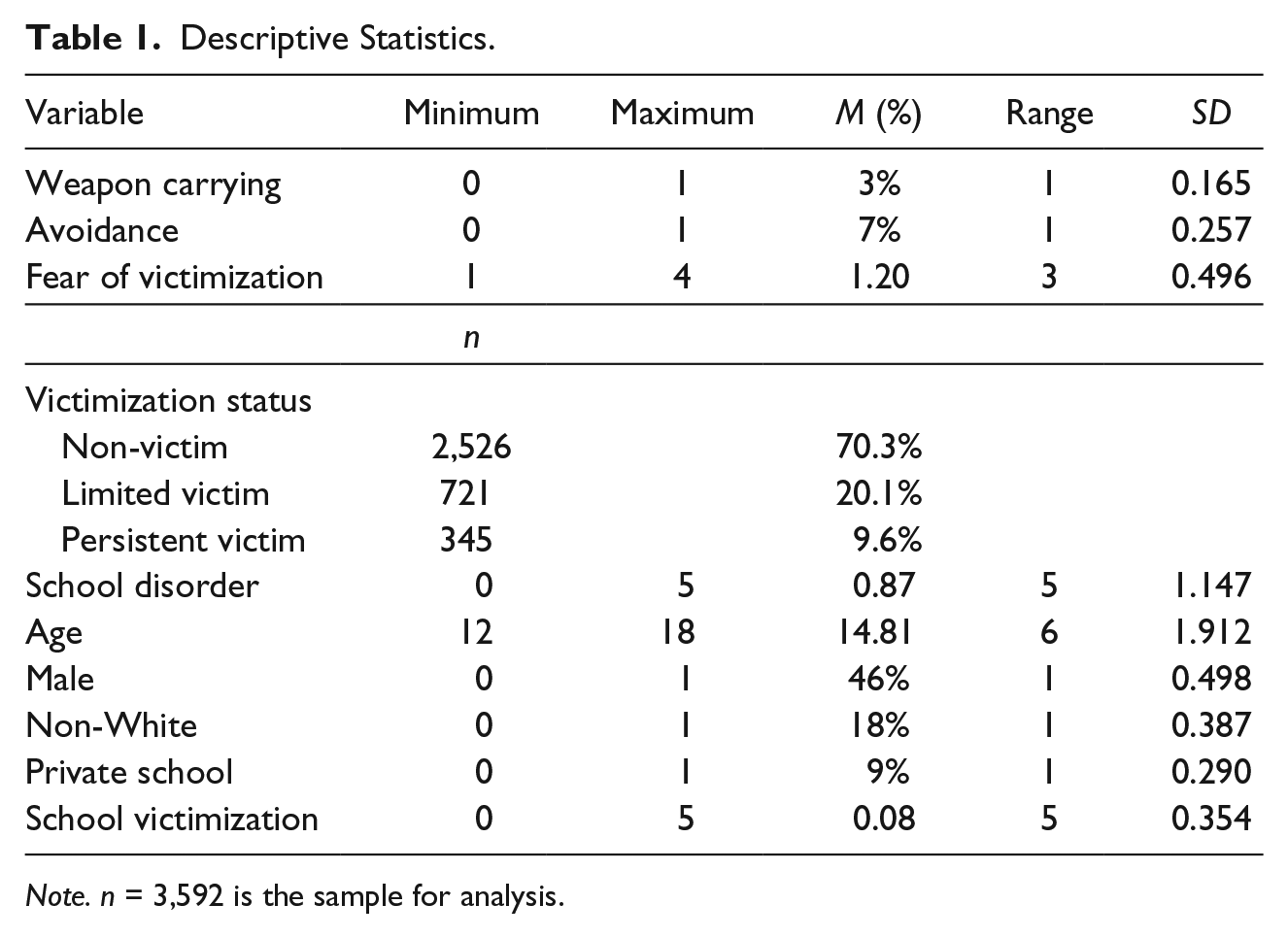
Note. n = 3,592 is the sample for analysis.
Dependent Variables
Fear of victimization
Fear of victimization is both a dependent variable and a control variable. Primarily, fear of victimization is a dependent variable, yet for proper model specification in the avoidance and protective behavior models, fear of victimization is included as a control variable. Student fear of victimization was operationalized as a single item measure containing responses to the SCS item, “How often are you afraid that someone will attack or harm you at school?” Responses to these items fell into one of four categories (never = 1, almost never = 2, sometimes = 3, and most of the time = 4).
Avoidance behaviors
A measure of school avoidance was created using several items, which independently addressed whether or not a student had avoided a particular place within the school or on school grounds in the past 6 months. There are 10 such places addressed in the School Crime Supplement (SCS) questionnaire including hallways or stairwells, restrooms, entryways, the cafeteria, the school parking lot, other places within the school, and other places on school grounds. Additional items asked the respondents about the broader nature of their avoidance behaviors. These items were, “Did you AVOID any activities at your school because you thought someone might attack or harm you?” “Did you AVOID any classes because you thought someone might attack or harm you?” and “Did you stay home from school because you thought someone might attack or harm you in the school building, on school property, on a school bus, or going to or from school?” Importantly, these additional general avoidance questions focus on the context surrounding the behavior, emphasizing the reason that a student avoids as “because you thought someone might attack or harm you.” Ultimately the avoidance measure is a single dichotomy representing any positive responses to any of these individual locations or the three additional questions where higher scores represent greater than average avoidance behavior.
Protective behaviors
In addition to the avoidance variable, we modeled student weapon carrying as a protective measure as an adaptive consequence of victimization. The variable weapon carrying is a composite of three measures capturing responses to the following SCS items: “Some people bring guns, knives, or objects that can be used as weapons to school for protection. During this school year, did YOU ever bring the following to school or onto school grounds?” (a) “A gun?” (b) “A knife brought as a weapon?” (c) “Some other weapon?” Positive responses to any of these items were rare and subsequently the measure was dichotomized to capture any weapon carrying by an individual respondent. Among members of our sample, approximately 3% reported bringing any weapon to school.
Independent Variables
Bullying victimization/victimization status
The focal point of the present study is the exploration of differential (limited vs. persistent) bullying victimization. To address this, we have created a categorical variable to capture non-victims, limited experience victims, and persistent victims of traditional bullying and cyberbullying. Students were identified as bullying victims based on a number of survey items, each addressing a particular act of traditional bullying. These items include, “. . . has another student . . . ” (a) “made fun of you, called you names, or insulted you?” (b) “spread rumors about you?” (c) “threatened you with harm?” (d) “pushed you, shoved you, tripped you, or spit on you?” (e) “tried to make you do things you did not want to do, for example, give them money or other things?” (f) “excluded you from activities on purpose?” or (g) “destroyed your property on purpose?” In addition to these categories of bullying victimization, the questionnaire asked respondents about the frequency of victimization. The follow-up item asks respondents, “You just indicated that someone had bullied you during this school year. Thinking about all of the ways in which you were bullied, how often did all of those things happen?” Possible responses included “once or twice this school year,” “once or twice a month,” “once or twice a week,” and “almost every day.”
In addition, the SCS includes a multi-item measure of cyberbullying victimization experiences. Similar to the measures of traditional bullying, each of these individual items is introduced to the respondent through the following statement:
Now I have some questions about what students do that could occur anywhere and that make you feel bad or are hurtful to you. You may include events you told me about already. During this school year, has another student . . .
Each of the individual items that followed was specifically meant to capture cyberbullying victimization. These items are a continuation of the question above and are dichotomous in nature (yes/no), including (a) “Posted hurtful information about you on the Internet, for example, on a social networking site like MySpace or Facebook?” (b) “Threatened or insulted you through email?” (c) “Threatened or insulted you through instant messaging?” “Threatened or insulted you through text messaging?” (d) “Threatened or insulted you through online gaming, for example, while playing a game, through Second Life, or through Xbox [Live]?” (e) “Purposefully excluded you from an online community, for example, a buddy list or friends list?” And, as in the traditional bullying segment, a follow-up item asks respondents about the frequency of their experiences.
Together these two dimensions of bullying (traditional and cyber) victimization comprise the total student bullying victimization experience as the NCVS-SCS captures it. To create the classifications of limited and persistent victimization, experiences recorded on both scales were combined such that those reporting the fewest types and frequency of victimization are categorized as limited victimizations and those experiencing greater variety and frequency are categorized as persistent victimizations. To create a unified victimization measure, we combined all individuals who had experienced either form of victimization, then using the SCS frequency measure, we isolated those individuals responding that they had only experienced victimization “once or twice this school year” versus those reporting experiences “once or twice a month” and more frequently (0 = no victimization, 1= limited victimization, and 2 = persistent victimization).
Control variables
Additional measures related to victimization, fear of victimization, and behavioral adaptations at school are included in the models to assure proper specification. Among these control measures, we address non-bullying victimization experiences as school victimization. This variable is the number of NCVS incidents reported by the respondent to the interviewer that have occurred in the past 6 months (e.g., criminal incidents such as theft or assault). Responses ranged from zero to five, where more than 90% of the respondents had not reported any criminal victimization incidents in the past 6 months.
We have included a number of additional controls to address other physical and social experiences at school (i.e., vulnerability and environmental perspectives). In particular, there is a growing body of literature that suggests that in addition to personal victimization experiences, physical and social disorder may have a direct impact on avoidance behaviors net of the possible effects of school fear (e.g., Randa & Wilcox, 2010, 2012).
The social disorder variable included in the analyses addresses the presence of gangs, guns, and drugs at school through the use of a number of SCS items. Gang presence is a single item measure based on the question, “Are there any gangs at your school?” Twenty-four percent of students reported that there were gangs in their school. The disorder measure assessing the peer weapon carrying corresponds to the SCS item, “Do you know of any other students who have brought a gun to your school during this school year?” Five percent of respondents reported knowing that a student had brought a gun to school. Peer drug use is a single item measure asking respondents, “During this school year, did you know for sure that any students were on drugs or alcohol while they were at school?” Approximately one third of the respondents reported that they knew for sure that another student used drugs or alcohol at school. Responses to each of these disorder measures were dichotomized (0 = no, 1 = yes). The school disorder variable also includes the SCS item, “Did anyone offer to sell/give you any illegal drugs other than alcohol or tobacco?” Finally, there are 11 separate items that asked the respondent about the availability of a specific drug (examples include marijuana and cocaine). These 11 items are reduced to an average score (ranging between 0 and 1) and included as one of the five total elements of school disorder.
Finally, four different respondent characteristics were included to ensure that the model was appropriately specified. These measures include age, sex, race, and a control for attending private school. Respondent age was reported in years and ranged from 12 to 18, with a mean of approximately 15 years. Although serving as a control variable in this analysis, there is evidence to suggest that age will have a significant impact on the complex relationships between fear, victimization, and avoidance (see Hepburn & Monti, 1979; May, 2001; May & Dunaway, 2000; Randa & Wilcox, 2012; Wayne & Rubel, 1982). Sex is reported in the dichotomous variable male (0 = female, 1 = male). Whether or not a respondent reported attending a private school is measured dichotomously in the private school variable (0 = public school, 1 = private school). Race is reported as non-White (0 = White, 1 = non-White) with all respondents self-identifying as other than White being scored as non-White.
Plan of Analysis
The exploration of limited/persistent bullying victimization takes place in two stages. First, we examine the means of outcome variables across the categories of victimization status (non-victims, limited experience victims, and persistent victims) in an effort to establish that meaningful differences exist across groups. Second, we explore relative strengths of limited and persistent victimization status in regression models of fear of victimization, avoidance behavior, and protective weapon carrying. 1
Results
Exploration of means across victim status categories, although simplistic, provides important information about the relative distribution of scores in each category: fear of victimization at school, adaptive avoidance behaviors, and weapon carrying behaviors (See Table 2). A review of Figure 1 highlights some of the characteristics of bullying victimization. Of the analytic sample, 29.7% or 1,066 students experienced some form of bullying victimization. Among students reporting victimization, 1,019 experienced traditional bullying and 233 experienced cyberbullying. For classification purposes, 68% were classified as limited victimization and 32% were classified as experiencing persistent victimization. In each case, the persistent victim group had the highest proportion of respondents indicating any adaptive avoidance behavior, protective behavior, or more frequent fear of victimization.
Means of Outcome Measures Over Victimization Status With t Tests (Unequal Variances; n = 3,592).
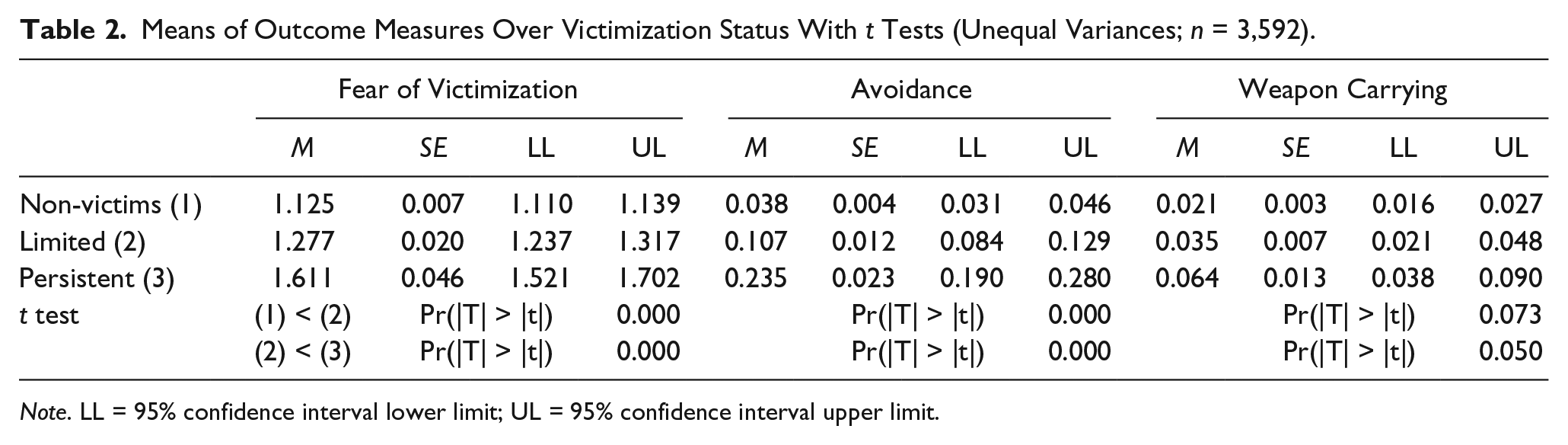
Note. LL = 95% confidence interval lower limit; UL = 95% confidence interval upper limit.

Distribution of bullying victimization.
In each of the tables presented below, the categorical mean for each of the corresponding outcomes is higher, and notably beyond the preceding categories’ upper limit. Furthermore, those students in the persistent victimization category have the highest reported mean levels of fear of victimization, avoidance behavior, and protective behaviors at school. These results, in conjunction with significant t tests suggest that group distinctions (limited victimization and persistent victimization) are meaningful in understanding the nature of bullying victimization responses and behavioral adaptations.
Logistic Regression
Given the results of the first stages of analysis, each suggesting that the categorical distinction between non-victims, limited experience victims, and persistent victims of bullying are meaningful, a final multivariate assessment is presented in Table 3. 2 Each of the three different outcome models parses out victim status such that limited victimization and persistent victimization are operating as dichotomous variables. Notably, the effect size (odds ratio) related to persistent victimization is greater than that of limited victimization across all models. For each of the outcome measures, we present two models, one which sets the non-victims as the reference group and one which presents the limited victims as the reference. The combination of these presented models will provide the information required to assess the significant differences that exist between all groups.
Ordered Logistic Regression Models (n = 3,592).
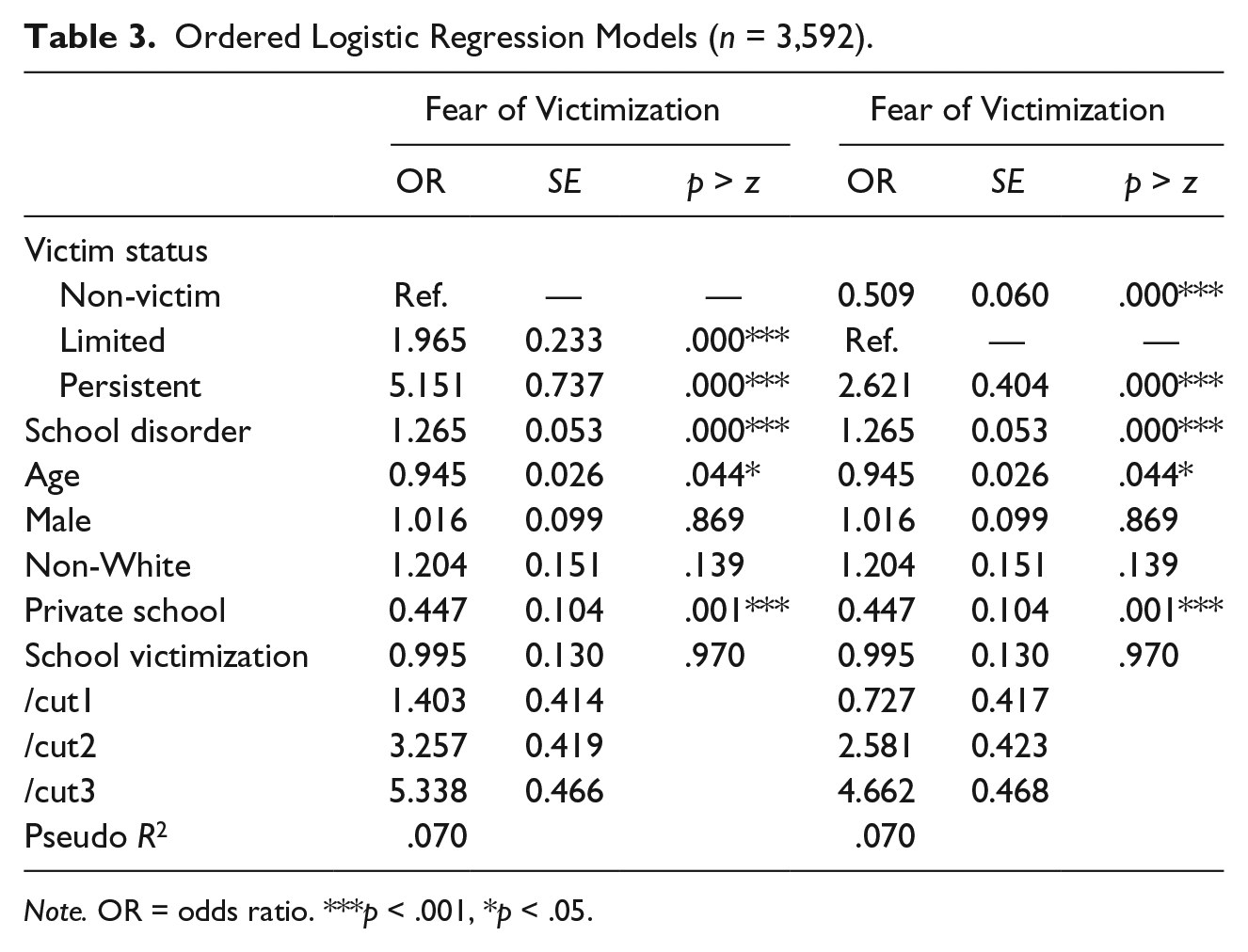
Note. OR = odds ratio. ***p < .001, *p < .05.
In the ordinal regression model addressing fear of victimization, both limited and persistent victimization status are related to increased odds of reporting more frequent fear of victimization. Specifically, whereas the limited victimization group is nearly twice as likely to report more frequent fear of victimization relative to their non-victim counterparts, those students reporting persistent victimization are 415% more likely than non-victims to report greater frequency of fear of victimization. These relative odds account for the significant effect of school disorder and attending a private school, which increase the odds by 26.5% and decrease the odds of reporting more frequent fear of victimization by 55.3%, respectively. Furthermore, we find that there is a significant difference between those experiencing persistent victimization and those reporting limited victimization. Those respondents reporting persistent victimization are 162.1% more likely than limited victims to report increased frequency of fear of victimization at school.
When addressing avoidance behaviors, we find that after controlling for the impact of fear of victimization, school disorder, and other pertinent controls, both limited and persistent victimization increase the relative odds of reporting avoidance behaviors. Those students reporting limited victimization experiences are 78.1% more likely to report avoidance behavior, and those students experiencing persistent bullying victimization are 207.2% more likely to report avoidance behavior than their non-victim counterparts. We also find a significant difference in reporting any avoidance at school between persistent victims and limited victims to the extent that repeat victims are 72.6% more likely to report an avoidance behavior than their limited victimization counterparts. Likewise, students reporting increased school disorder are 34.8% more likely to report avoidance behaviors. Finally, as it relates to reporting avoidance behavior, older students are less likely, and minority students, more likely to avoid school locations. Specifically, for every one-unit increase in age, the students are 17.5% less likely to report avoidance behavior.
Finally, the model of weapon carrying at school suggests that the most relevant of the included factors is that of school disorder. For each unit change on the school disorder measure, students report they are approximately 90% more likely to carry a weapon to school for protection. 3 When subsequent models were explored excluding the school disorder variable, the relative importance of limited and persistent victimization emerged. In this case, those students reporting limited victimization experiences were 47.8% 4 more likely to carry a weapon to school for protection and those students experiencing persistent victimization were 148.7% as likely to carry a weapon to school for protection. In addition, in this model (without school disorder), frequency of fear of victimization was a factor such that a one-unit increase in frequency of fear of victimization at school resulted in a 47.4% increase in the likelihood of reporting carrying a weapon for protection. Furthermore, additional models were explored that did not control for fear of victimization at school, and eliminated the component of school disorder that examined peer weapon carrying. 5 When fear of victimization was left out of the weapon carrying model, the measure of persistent victimization became significant at the .1 level (with more than 3,500 cases, this is arguably not a substantive change). Cumulatively, these modifications to the presented models in Tables 3 and 4 produced only minor variation.
Logistic Regression Models (n = 3,592).

Note. OR = odds ratio. ***p < .001, **p < .01, *p < .05.
Discussion
The results presented here articulate the differences between groups as they relate to both fear of future victimization and behavioral adaptations, such as avoidance and protective weapon carrying. In many respects, simply articulating the two groups mirrors findings in the repeat criminal victimization literature, which identify a smaller group of individuals experiencing a disproportionate amount of victimization. Roughly 30% of our sample has experienced some form of bullying victimization at school (either traditional bullying or cyberbullying victimization), with 20% of the sample being classified as limited victims and the remaining 9.6% of the sample experiencing persistent victimization. Although this distinction may not seem important at face value, when exploring the differential outcomes across the groups, the importance of classifying victims’ experiences as either limited or persistent becomes clearer. Beyond this distinction, it is important to note that in our national-level sample, nearly one third of the respondents have reported some level of bullying victimization, and nearly one in 10 are experiencing persistent victimization in a school.
Among those students classified as persistent victims, there are a greater proportion of individuals experiencing fear of future victimization, a greater proportion of students reporting avoiding places at school, and a greater proportion of students reporting carrying a weapon for protection. Furthermore, among persistent victims, the level of fear and number of places avoided at school are greater than among the limited victimization group. Through more sophisticated analysis of the differential relationships between victim status and our outcome measures, our results further illustrate that classification matters in understanding the relationship between bullying victimization and fear of future victimization at school. Among the differences measured across outcomes, two stand out as particularly interesting. First, persistent victimization expressed a strong relationship with avoidance behaviors at school net of the effects of fear of future victimization at school. This suggests a more potent or lasting effect among those experiencing persistent victimization versus limited victimization, and possibly a deeper level of self-protective adaptation. Alternatively, the significant relationship between limited victimization and avoidance behavior at school seems to be heavily influenced by fear of victimization, suggesting a possible indirect relationship, which should be explored in future research. Second, there is evidence here to support the exploration of potential interactions between persistent victimization and fear at school. Should they exist, the effects of persistent victimization may amplify the relationship between fear of victimization and avoidance behaviors at school.
These findings suggest that persistent and limited victims process fear of victimization differently. Although definitions of bullying and cyberbullying that suggest that repeated exposure to this sort of victimization is fundamental, our results provide evidence that differentiating limited victimization from persistent bullying victimization serves a purpose in understanding precisely how, and to what extent, victimization experiences can affect student behavior. Furthermore, there is some evidence here to suggest that persistent victimization has an amplifying effect on the ancillary consequences of victimization, particularly fear of future victimization and avoidance behavior. Persistent victimization, more so than limited victimization, is associated with a greater volume and magnitude of negative consequences. Further research is needed to better explore just how much more potent persistent victimization is relative to limited bullying victimization experience. Relatedly, further research is needed to explore the factors that lead to the delineation between persistent victimization and limited victimization. How is it that such a large proportion of bullying victims are able to escape the cycle of lasting victimization? The present study cannot answer why some will experience persistent victimization—only that those who do are also experiencing all the measured negative correlates of victimization in greater volume and frequency.
These findings have a number of implications for fear of crime/victimization researchers as well as school policy makers. Regarding fear of crime and victimization, the present study reinforces the notion that the relationship between fear and victimization is a complex one. Fear has been hypothesized as a precursor to victimization, as well as a response to victimization. Our findings suggest that persistent victimization has a significant role in understanding and exploring fear of victimization as well. Specifically, those students reporting having experienced persistent victimization also report experiencing significantly more frequent fear at school relative to their limited victimization and non-victim counterparts. Future research related to fear of crime should further explore the possibility repeat criminal victimization may have a differential impact among other (adult, non-student) populations. Future research on the differential impact of limited and persistent bullying victimization should continue to explore how limited and persistent victimization could differentially mediate, or moderate, the relationships between fear and its known consequences (e.g., Randa & Wilcox, 2012). Of further interest are the implications of our findings relative to protective measures, specifically avoidance behaviors at school. We find here that differential victimization corresponds to significantly different levels of activation (avoidance, weapon carrying). Subsequently, we believe persistent victimization is a critically important dimension of understanding the fear–behavior relationship.
Turning to policy implications, our findings suggest that bullying intervention is not an all or nothing proposition. Schools and communities with the resources to approach bullying victimization should conclude that reduction along with prevention are necessary efforts. Although the exact mechanism for producing an end to bullying victimization is not explored here, we find that those students reporting only limited victimization are significantly less likely to report the negative consequences measured here. Roughly 345 of the bullying victims in our sample (9.5%) experienced persistent victimization over the course of the school year and as such, any reduction in victimization that results in transitioning from “persistent” victim to “limited” victim is meaningful.
The findings presented in this study are not without limitations. First, our analysis relies on cross-sectional data, which have well-known limitations for establishing a causal order. Also, key variables in the fear and victimization literature such as risk assessment (see Ferraro, 1995) are not available in the NCVS-SCS, suggesting that the findings may be accountable primarily to perceptual variations and biases rather than objective risk. As such, future work addressing these relationships would do well to use more inclusive and longitudinal data to explore correct time-ordering of the established relationships between bullying and victim behavior. In addition, there is a growing body of research that identifies a third category of individuals involved in bullying: the bully/victim. These individuals are both a victim and perpetrator at various times throughout the school year. The SCS does not collect data that would allow the researcher to classify individual respondents into this group. As such, this important group of individuals are not separate from those who only experience victimization in any analysis conducted using the NCVS-SCS data.
Despite these limitations, the present study contributes to the growing body of literature on the impact of bullying and cyberbullying at school by addressing the utility of classifying victimization status. The process of classification has underlined a smaller group of individuals who are the subject of persistent victimization. Whereas operational definitions of bullying and cyberbullying suggest that victimization must be repetitive to qualify as bullying, our work suggests that even limited bullying experience is related to fear and avoidance behavior at school, and that there is a differential impact between limited and persistent victimization.
Footnotes
Declaration of Conflicting Interests
The author(s) declared no potential conflicts of interest with respect to the research, authorship, and/or publication of this article.
Funding
The author(s) received no financial support for the research, authorship, and/or publication of this article.