



Abstract
The present research employed a mixed-methods approach and quasi-experimental design to examine perceptions and experiences of intrusive behavior (comprising 47 individual intrusive activities) within individuals identifying as lesbian, gay, bisexual, transgender, intersex, or queer (LGBTIQ) with a matched (in terms of age, sex, and income) sample of individuals identifying as heterosexual (N = 214). Despite only minor differences between the LGBTIQ and heterosexual groups concerning perceptions of the acceptability of intrusive behavior, the LGBTIQ group was more likely to report experiencing a range of individual intrusive activities and to report experiencing stalking victimization (self-reported rates of 35.5% vs. 15.0%). Participant sex and personal experience of being stalked were minimally associated with perceptions of the acceptability of intrusive behavior. Sexual orientation significantly predicted whether a person had experienced stalking victimization, whereas participant sex did not. The qualitative analysis revealed that the two groups shared some experiences of intrusive behavior, whereas others represented a unique subset of intrusions that related to sexual orientation.
Keywords
Introduction
Unlike most criminal activities, stalking comprises a series of often-legal behavior. As such, it can be difficult to define, and targets of stalking are often unaware of their victim status (Garcia, 2010). In a typical stalking case, behavior that is not anxiety provoking in isolation (e.g., phone calls, the giving of gifts, and e-mailing) can be considered threatening when examined within the context of a multitude of intrusive activities that collectively equate to stalking (Sinclair & Frieze, 2002). Legal definitions in Western populations suggest that stalking comprises a series of intentional and repeated behavior directed by one person toward another that is unwanted and would be viewed by a reasonable person as fear provoking and/or threatening (Spitzberg & Cupach, 2007).
Prior studies of stalking victimization have examined stalking as it relates to various factors that include sex (e.g., Sheridan, North, & Scott, 2014), age (e.g., Sheridan, Scott, & North, 2014), culture (e.g., Chapman & Spitzberg, 2003), prior relationship status (e.g., Sheridan & Lyndon, 2012), and lifestyle factors (e.g., Reyns, Henson, Fisher, Fox, & Nobles, 2015). However, research to date has not examined a potentially at-risk group, namely, individuals identifying as lesbian, gay, bisexual, transgender, intersex, or queer (LGBTIQ). The present research will therefore compare two matched samples of LGBTIQ and heterosexual individuals on their perceptions and experiences of intrusive behavior. It should be noted that some of the intrusive behavior examined in this work, and covered in the literature review, does not necessarily equate to stalking when considered in isolation, but may be constituent of a course of conduct that represents stalking. A qualitative measure of stalking will also be included in the present research, allowing for a comparison of the nature of actual stalking experiences between the two groups.
Perceptions
Several factors have been demonstrated to influence perceptions of stalking, including sex and personal experience. Most of the relevant works report that women are more likely than men to perceive intrusive situations to constitute stalking and/or to be serious (Dennison & Thomson, 2002, employing vignettes and an Australian community sample; Finnegan & Fritz, 2012, employing vignettes and a U.S. student sample; Hills & Taplin, 1998, employing vignettes and an Australian community sample; Lambert, Smith, Geistman, Cluse-Tolar, & Jiang, 2013, employing a survey and a U.S. student sample; McKeon, McEwan, & Luebbers, 2015, employing a measure of stalking myths and Australian police and community samples; Scott, Rajakaruna, Sheridan, & Gavin, 2015, employing vignettes and Australian, U.K., and U.S. community samples; Sinclair, 2012, employing vignettes and a U.S. student sample; and Yanowitz, 2006, employing a list of intrusive activities and a U.S. student sample). A smaller number of works have recorded no, or minimal, sex differences in perceptions of what constitutes stalking (Cass, 2011; Cass & Rosay, 2012; Kinkade, Burns, & Fuentes, 2005, all employing vignettes and U.S. student samples). How can this reasonably consistent pattern of findings be explained? A potential interpretation is provided by the defensive attribution bias (see, for example, Elkins, Philips, & Konopaske, 2002), which concerns the tendency of people to identify with targets they judge to be similar to themselves. In the context of stalking, it has been argued that women identify with the role of the victim more so than men because they are more likely to be victimized (Dunlap, Hodell, Golding, & Wasarhaley, 2012; Scott et al., 2015; Sinclair, 2012). As such, the apparent sex differences reflect women’s use of self-protective defensive attributions in which the victim is perceived to be less blameworthy and the situation is perceived to be more serious.
Additional research by Sheridan and colleagues (Björklund, Häkkänen-Nyholm, Sheridan, & Roberts, 2010; Chiri, Sica, Roberts, & Sheridan, 2009; Jagessar & Sheridan, 2004; Pereira, Matos, Sheridan, & Scott, 2015; Sheridan, Davies, & Boon 2001; Sheridan, Gillett, & Davies, 2000, 2002) has found that non-representative student and community samples of U.K. men, Portuguese men, U.K. women, Italian women, Finnish women, and Trinidadian women hold similar perceptions regarding the unacceptability of 47 intrusive activities. Although this finding appears contrary to the aforementioned defensive attribution bias explanation of sex differences, it is likely a consequence of participants providing context-free judgments of the unacceptability of intrusive behavior in the absence of an intrusive situation, a perpetrator, or a target. With regard to personal experience, research suggests that personal experience of being stalked influences perceptions of stalking (Fairchild, 2010; Yanowitz, 2006). For example, Yanowitz found that men who had either personally experienced, or who were familiar with someone with experience of stalking victimization, were more likely to perceive intrusive behavior as constituent of stalking than men without personal experience or familiarity.
The present research adopted the methodology developed and adopted by Sheridan and colleagues. Participants were presented with the same list of 47 intrusive activities on two occasions. On the first occasion, they were asked to indicate whether they perceived each individual behavior to be acceptable or unacceptable. On the second occasion, they were to indicate whether or not they have experienced each individual behavior.
Experiences
Several factors have been demonstrated to increase the likelihood of experiencing harassment and unwanted pursuit, including minority group status and sex. It is important to note that harassment tends to refer to a situation where a variety of aggressive verbal or non-verbal activities are engaged in with the aim of annoying, bothering, or otherwise causing stress to the target (see Spitzberg & Cupach, 2007). Unwanted pursuit, by comparison, tends to refer to a situation where one person seeks to obtain or restart a romantic relationship with the target of their pursuit, which may develop into stalking (see Cupach & Spitzberg, 2004). For example, Derlega et al. (2011) used unwanted pursuit to refer to behavior that comprised seemingly innocuous intrusions and stalking to refer to dangerous and threatening behavior.
Members of minority communities tend to be smaller in terms of their population size (i.e., numerical minority) and are generally noted to experience higher rates of harassment compared with the wider population (see Simpson & Eriksson, 2011). Given Simpson and Eriksson’s proposal that rates of harassment are influenced by the size of communities, it may be extrapolated that minority communities lack the ability to deflect stalking behavior due to the deficiency of power implied by their numerical minority. In the context of a minority sexual orientation, Katz-Wise and Hyde (2012) examined 386 studies relating to prevalence and types of victimization among individuals identifying as lesbian, gay, or bisexual (LGB), and found that LGB individuals reported experiencing high rates of harassment (e.g., 55% experienced verbal harassment, 45% sexual harassment, 44% relational victimization, and 44% discrimination). In the 65 studies that made comparisons between LGB and heterosexual groups, LGB individuals were significantly more likely to be bullied, discriminated against, physically and sexually assaulted, verbally and emotionally abused, and threatened than heterosexual individuals. The studies covered a variety of settings, including school, the family, the workplace, public spaces, and health care settings. Overall sex differences were small, but women, regardless of sexual orientation, were more likely to experience sexual harassment than men.
In addition to the aforementioned external stressors, individuals identifying with a minority sexual orientation may experience internal stressors, including internalized homophobia, concealment of individual sexual orientation, and fear of rejection (Derlega et al., 2011). Due to these stressors, particularly fear of rejection and membership of the minority social group, it has been suggested that individuals engaged in intimate relationships may be more likely to exhibit aggressor behavior, or become victim to them, when the relationship breaks down (Carvalho, Lewis, Derlega, Winstead, & Viggiano, 2011; Derlega et al., 2011). Derlega et al. examined unwanted pursuit following relationship breakdown in a sample of 165 individuals identifying as lesbian, gay, bisexual, or transgender (LGBT). Only 12 individuals indicated they had not been the target or perpetrator of post-relational pursuit. Furthermore, Dank, Lachman, Zweig, and Yahner (2014) found that in a sample of 5,647 youth, LGB individuals reported higher levels of victimization and perpetration for all types of dating violence examined compared with heterosexual individuals. One suggestion to arise from Derlega et al.’s (2011) research was that controlling behavior is more consistent with male as opposed to female views of relationships. In support of most stalking-related research with heterosexual participants, they found that men were more likely than women to engage in unwanted pursuit behavior (see also Katz-Wise & Hyde, 2012).
Although men appear to engage in stalking more often than women, women do stalk and men are victimized. It has been suggested that between 10% and 25% of stalking cases involve female stalkers, many sharing similar motives and behavior with their male counterparts (see, for example, Baum, Catalano, Rand, & Rose, 2009). Research also suggests that the effects of victimization are similar in same- and opposite-sex cases (e.g., McEwan, Mullen, & Purcell, 2007, Sheridan, North, & Scott, 2014), although men are less likely than women to report feeling fearful or report their victimization to the police (e.g., Englebrecht & Reyns, 2011). Rates of male–male stalking range from 50% to 62% in subsamples where all victims are men, and female–female stalking rates range from 9% to 25% in subsamples where all victims are women (Australian Bureau of Statistics, 2010; Baum et al., 2009). What remains unknown from these studies is the proportion of individuals identifying as LGBTIQ among both perpetrators and victims. After examining 52 Swedish and 42 Australian stalking cases of same-sex stalking and comparing them with larger numbers of opposite-sex stalking, Strand and McEwan (2011) concluded that opposite-sex stalker motivations often stem from a prior-intimate relationship, whereas same-sex stalker motivations often stem from a grievance against the victim. The stalkers in this work came from a non-random, selective pool of criminal and mental health-based samples. Furthermore, it is unknown how much of the stalking was engaged in by or directed toward LGBTIQ individuals.
Aim and Hypotheses
Perceptions of stalking have been examined in the wider population and have been found to be broadly similar within and between sample groups. However, no works have directly investigated perceptions or experiences of intrusive behavior among LGBTIQ individuals. Neither have rates of stalking victimization been examined within this group. The aim of the present research therefore is to examine perceptions and experiences of intrusive behavior with matched samples of LGBTIQ and heterosexual individuals. The following five hypotheses were formulated to guide the analyses:
Consideration is also given to whether participant sex or participant sexual orientation best predicts rates of stalking victimization.
Method
Research Design
The present research employed a mixed-methods approach and quasi-experimental design to examine perceptions and experiences of intrusive behavior among individuals identifying as LGBTIQ and heterosexual. Analyses initially explored whether LGBTIQ and heterosexual individuals differ with regard to their perceptions and experiences of 47 intrusive activities. Analyses then explored whether LGBTIQ and heterosexual individuals differ with regard to their rates of stalking victimization. Finally, analyses explored whether men and women differ in their perceptions of 47 intrusive activities and whether there is a relationship between experiences and perceptions of intrusive behavior. A concurrent, fixed mixed-methods approach enabled the use of qualitative data to describe participants’ worst experiences of intrusive behavior. The qualitative and quantitative data were analyzed separately and then related during interpretation.
Participants
Participants comprised a convenience sample of individuals identifying as LGBTIQ and heterosexual. Issues affecting LGB people are often the same for individuals identifying as transgender and intersex, especially regarding harassment and discrimination (Comfort & McCausland, 2013), and as such no individuals identifying with any particular sexual orientation were excluded. The initial sample comprised 354 Australian residents, 70 of which were excluded from the study because more than 5% of their data were missing, long strings of consecutive “yes” or “no” responses were observed, and/or responses to the qualitative section of the questionnaire were bizarre or non-genuine. The remaining sample comprised 284 Australian residents (107 LGBTIQ individuals and 177 heterosexual individuals), from which a subsample of heterosexual individuals was matched to the LGBTIQ individuals according to sex, age, and income. The final sample therefore comprised 107 LGBTIQ individuals and 107 heterosexual individuals (N = 214). The sample, broken down by sex, age, and income, is displayed in Table 1.
Participant Demographics.

Note. Age groupings and income brackets (rather than precise figures) were requested to assure anonymity and remain as unobtrusive as possible. LGBTIQ = lesbian, gay, bisexual, transgender, intersex, or queer.
Australian dollars. National mean earnings in November 2014 = $76.562, with 70% of adult Australians earning or receiving less than this figure (ABS, weekly earnings update 6302.0, November 2014).
Materials
Participants completed an online version of the “Stalking: Perceptions and Prevalence Questionnaire,” originally developed by Sheridan et al. (2001). An original version of the questionnaire containing 42 intrusive activities has been employed in four previous studies (Jagessar & Sheridan, 2004; Sheridan et al., 2001; Sheridan et al., 2000, 2002), and a modified version containing 47 intrusive activities has been used in three previous studies (Björklund et al., 2010; Chiri et al., 2009; Pereira et al., 2015). The samples associated with these previous works comprise a Trinidadian community sample of 354 women; U.K. community samples of 348 women, 80 women, and 210 men; a Finnish student sample of 615 women; a Portuguese student sample of 91 men; and an Italian student sample of 195 women. All these samples, like the present sample, were non-representative of their broader populations.
The questionnaire comprised four sections. Section 1 asked participants to provide demographic details concerning age, sex, income, and sexual orientation. Section 2 contained a list of 47 intrusive activities, and asked participants to indicate whether they perceived each of the activities to be unacceptable or acceptable. The activities are designed to represent a continuum from mildly intrusive behavior (e.g., agreeing with your every word) to serious intrusive behavior that would be considered criminal offences (e.g., forced sexual contact). Section 3 contained the same list of 47 intrusive activities, and asked participants to indicate whether or not they have experienced each of the activities. Section 4 asked participants who have experienced one or more of the 47 intrusive activities to write about their worst experience, with particular reference to the behavior of the person. A total of 116 participants completed Section 4 of the questionnaire (67 LGBTIQ, 49 heterosexual), responding to the following question: “If you have experienced any of the 47 intrusive activities, could you please tell us some more about what you would consider to be the most serious incident?” Rates of stalking were determined by two published experts on stalking, one of whom was independent of the study, who categorized participants as having been “stalked” or “not stalked.”
Procedure
The study was promoted online through the social media networks Facebook and TUMBLR. Four radio interviews with specialist LGBTIQ themed stations in Perth, Sydney, and Melbourne were conducted to help promote the survey. LGBTIQ advocacy and community groups (e.g., GLBTI Rights in Ageing Inc., The WA AIDS Council, Living Proud, The Queer Department of the Curtin University [Perth] Student Guild, and Freedom Centre) were asked to promote the study via posters that contained an URL and a QR code that linked Internet users to the survey. The promotional advertisement for the research requested 15 min of the reader’s time to “complete a survey on harassment,” irrespective of whether they had ever experienced this type of activity.
The website that participants were directed to provided an information page that stated the purpose of the research (i.e., to better understand both attitudes toward and experiences of intrusive behavior in individuals identifying as LGBTIQ and heterosexual) and their rights when participating. Contained in the information page were instructions to find a quiet and private area to complete the questionnaire. Upon completion of the questionnaire, participants were debriefed regarding the use of the data and provided with details of local, national, and international counseling services and help services for stalking victims. Participants could exit the questionnaire at any time without fear of penalty or judgment.
Results
Hypothesis 1: Sexual Orientation and Perceptions of Intrusive Behavior
Chi-square analyses compared LGBTIQ and heterosexual group perceptions of the 47 intrusive activities, and five were significant. Table 2 shows that LGBTIQ individuals were more likely to perceive five activities to be unacceptable than heterosexual individuals. None of the activities were serious. One activity was less likely to be perceived as unacceptable by the LGBTIQ group.
Significant Chi-Square Analyses Comparing LGBTIQ (n = 107) and Heterosexual (n = 107) Group Perceptions of the 47 Intrusive Behaviors as Unacceptable.
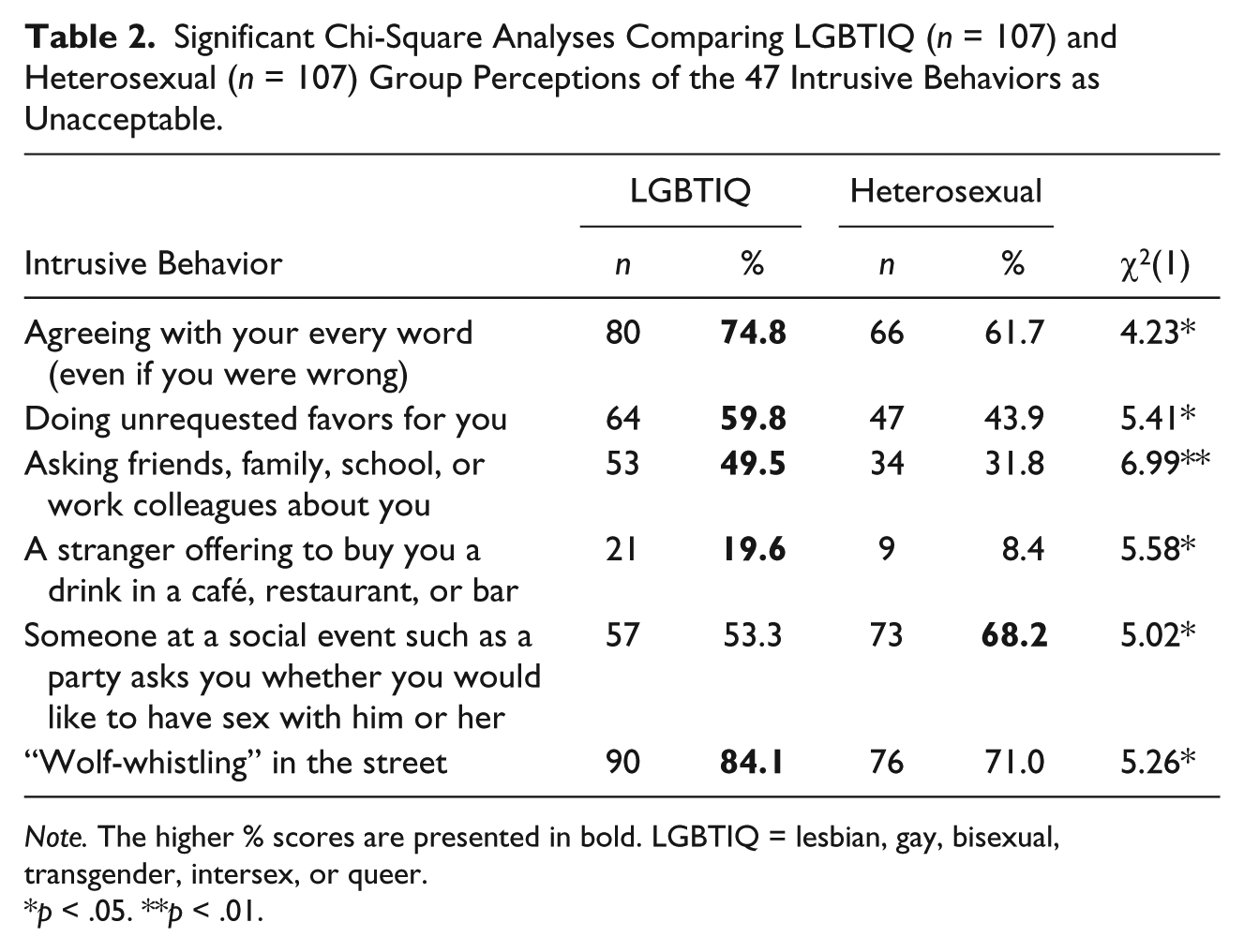
Note. The higher % scores are presented in bold. LGBTIQ = lesbian, gay, bisexual, transgender, intersex, or queer.
p < .05. **p < .01.
Hypothesis 2: Sexual Orientation and Experiences of Intrusive Behavior
Chi-square analyses compared LGBTIQ and heterosexual group experiences of the 47 intrusive activities, and 22 were significant. Table 3 shows that LGBTIQ individuals were more likely to have experienced all 22 activities than heterosexual individuals. These activities were at the more serious end of the scale. When the 47 intrusive activities were rank ordered according to the proportion of the total sample that perceived them to be unacceptable, the average was 78.01% (SD = 28.18), ranging from 6.1% to 100.0%. When this procedure was repeated for the 22 intrusive activities that were more likely to be experienced by LGBTIQ individuals, the average was 89.99% (SD = 15.87), ranging from 45.3% to 100.0%.
Significant Chi-Square Analyses Comparing LGBTIQ (n = 107) and Heterosexual (n = 107) Group Experiences of the 47 Intrusive Behaviors.

Note. The higher % scores are presented in bold. Percentages in parentheses following each behavior indicate the proportion of the total sample who judged the behavior as “unacceptable.” LGBTIQ = lesbian, gay, bisexual, transgender, intersex, or queer.
p < .05. **p ≤ .01. ***p ≤ .001.
Hypothesis 3: Sexual Orientation and Rates of Stalking Victimization
Chi-square analysis compared LGBTIQ and heterosexual group rates of stalking victimization and was significant, χ2(1) = 11.99, p = .001. LGBTIQ individuals were more likely to report experiencing stalking victimization than heterosexual individuals (35.5% vs. 15.0%). A binary logistic regression examined which of the variables, participant sex or sexual orientation, best predicted whether a participant had experienced stalking victimization. The significant predictive model explained between 4.9% (Cox and Snell R2) and 7.3% (Nagelkerke R2) of variance in rates of stalking victimization, χ2(2, N = 208) = 10.39, p = .006, and sexual orientation was the only significant predictor, b = 1.06, Wald χ2(1) = 9.48, p = .002.
Hypothesis 4: Participant Sex and Perceptions of Intrusive Behavior
Chi-square analyses compared male and female group perceptions of the 47 intrusive activities, and three were significant. Women were more likely to perceive all three activities to be unacceptable than men: “Someone at a social event such as a party asks you whether you would like to have sex with him/her” (68.0% vs. 48.8%), χ2(1) = 7.61, p = .006; “Finding out information about you (phone numbers, marital status, address, hobbies) without asking you directly” (78.1% vs. 63.8%), χ2(1) = 5.11, p = .024; and “Seeing him/her at the same time each day” (50.8% vs. 36.3%), χ2(1) = 4.20, p = .040. Data from the 5.6% of LGBTIQ individuals who did not identify with a binary sex category were excluded from these analyses because the associated cell sizes were too small.
Hypothesis 5: Experience of Stalking Victimization and Perceptions of Intrusive Behavior
Finally, chi-square analyses compared stalked and not stalked group perceptions of the 47 intrusive activities and two were significant. Participants with experience of stalking victimization were more likely to perceive “Agreeing with your every word (even if you were wrong)” to be unacceptable than participants without experience of stalking victimization (83.3% vs. 63.1%), χ2(1) = 7.61, p = .006. In contrast, participants with experience of stalking victimization were less likely to perceive “Someone at a social event such as a party asks you whether you would like to have sex with him/her” to be unacceptable than participants without experience of stalking victimization (38.9% vs. 68.1%), χ2(1) = 14.47, p < .001.
Qualitative Analysis of Worst Experiences
A thematic analysis was conducted on all 116 qualitative responses to Section 4 of the questionnaire. Following general familiarization, initial (topic) codes were assigned to repeating topics observed in these responses. These initial codes were then arranged into themes (analytical codes) and possible sub-themes. The themes and sub-themes were reviewed to ensure their relevance and the existence of supporting evidence before being defined and named. Responses from the LGBTIQ and heterosexual groups were coded separately and resulted in three overarching themes: heterosexual experiences, shared experiences, and LGBTIQ experiences. Themes and the corresponding sub-themes are presented in Figure 1.

Thematic map: Personal experiences of stalking victimization.
Heterosexual experiences
Heterosexual individuals believed intrusive behavior was acceptable if it presented no risk to their safety (n = 11): “. . . none cross any lines that would make me feel unsafe” (Heterosexual 1, explaining that she had experienced verbal abuse from strangers, but was not concerned as no direct threats were made), “People have been calm and non-threatening so none of them bothered me” (Heterosexual 2, describing several unrelated incidents of verbal abuse experienced while traveling in public transport), and “. . . he was very polite and friendly although he was a stranger” (Heterosexual 13, describing an occasion when a man was pressuring her for sex). Heterosexual individuals also described experiences as acceptable or safe if they felt in control: “. . . as a practicing martial artist I felt I could take care of myself” (Heterosexual 1, explaining that she was not afraid when strangers insulted her appearance), and “I was old enough to deal with it maturely” (Heterosexual 51, describing how she handled an unwanted sexual touch from an acquaintance). A second theme concerned the need of heterosexual individuals to fulfill social obligations (n = 18) even when experiencing intrusive behavior: “. . . decided it would be rude/dangerous to say nothing” (Heterosexual 36, explaining why she responded to several [of hundreds of] unwanted and sexually themed text messages from an acquaintance), “. . . while I like getting things I felt uncomfortable because I felt like I owed him something” (Heterosexual 31, describing why she was pleasant to her former partner even though she would have preferred not to have contact with him), and “He would buy me unwanted gifts all the time making me feel obliged to be nice back to him” (Heterosexual 68, explaining why she spoke with her neighbor, after he had harassed her for several years, performed sexual acts in her garden, and she had reported him to police). Although the gift giving was present in the responses of LGBTIQ individuals, the perceived social obligation to return “kindness” was unique to heterosexual individuals.
LGBTIQ experiences
LGBTIQ individuals experienced threats to self-harm (n = 11) if they did not meet the demands of their stalker: “She threatened to go and kill herself if I didn’t stay the night” (LGBTIQ 4, describing her former partner who was controlling during the relationship, initiated unwanted sexual liaisons, hid in her garden to spy on her, and phoned her for hours each day), “They threatened suicide and to hurt me if I didn’t go on a date with them” (LGBTIQ 24, talking about an acquaintance who wanted a relationship and who would regularly follow him), and “the person involved threatened to kill themselves if I didn’t respond” (LGBTIQ 45, describing a similar experience to LGBTIQ 24; his stalker would send photographs of himself self-harming). A second theme concerned intrusive behavior that related to LGBTIQ individuals’ sexual orientation (n = 14): “. . . I would still get messages from him asking if I wanted to meet up and make sure I was really gay” (LGBTIQ 27, describing a work colleague who would sexually touch her at work on a daily basis), “she did this in spite of my openness about being a gay man” (LGBTIQ 39, an animal lover, detailed how his stalker would kill small animals in a food blender and send him evidence of having done so, to prove her love for him), “The stalker came up to the driver’s window and started to bang on the glass, he was shouting out my name and asking who knew that I was gay and having sex at beats” (LGBTIQ 49, describing a threatening stalker who targeted her on a daily basis for more than 18 months).
Shared experiences
Heterosexual and LGBTIQ individuals described experiences where the intrusive behavior related to unreciprocated attraction (n = 81): “Once rejected again it was queried if we could hang out as ‘friends’ which was obviously a no no and that’s when the verbal abuse occurred” (LGBTIQ 3, talking about her ex-partner who became aggressive if ignored), “I had told her I was not interested but she would not stop” (Heterosexual 19, describing how a school friend would write to him daily and frequently webcam him and perform sexual acts on screen), and “I told him I just wanted to be friends however he would not take no for an answer” (Heterosexual 22, who went on one date with a man, and he then sent letters and money to her and made frequent home visits).
A second theme concerned internalization and self-blame (n = 14) to explain the intrusive behavior: “I never pursued the matter, thinking it was my fault” (Heterosexual 13, recounting a 14-month stalking experience) and “I suffered guilt and shame, people around me didn’t know what to do” (LGBTIQ 100, recounting a serious sexual assault). A third and final theme concerned sexual assault (n = 16), which was one of the most common of the 47 intrusive activities to be described in response to Section 4 of the questionnaire.
Discussion
Hypothesis 1, that LGBTIQ individuals would perceive intrusive behavior similarly to heterosexual individuals, was supported. It is unclear whether this finding would remain, however, if a vignette were presented rather than a list of 47 intrusive activities. Studies using vignette methodologies to describe stalking situations have tended to produce more marked between-group findings than those employing the present methodology (e.g., Dennison & Thomson, 2002; Phillips, Quirk, Rosenfeld, & O’Connor, 2004). This issue is explored further below.
Hypothesis 2, that LGBTIQ individuals would report having experienced more intrusive behavior than heterosexual individuals, was also supported; and the findings are consistent with previous works that identified higher than general population rates of relational violence, post-relational violence, and harassment for LGBTIQ individuals (see, for example, Katz-Wise & Hyde’s, 2012, meta-analysis). Furthermore, the behavior experienced at higher rates by LGBTIQ individuals tended toward the more serious end of the scale (e.g., verbal abuse, physical harm, forced sexual contact, and threats). As such, although perceptions of the acceptability of the 47 intrusive activities varied little according to sexual orientation, LGBTIQ individuals experienced nearly half of these activities at higher rates.
Hypothesis 3, that LGBTIQ individuals would report higher rates of stalking victimization than heterosexual individuals was supported. The thematic analysis further revealed substantive differences in the experiences reported by LGBTIQ and heterosexual groups. Although unable to relate their conclusions to sexual orientation, Strand and McEwan (2011) found opposite-sex stalker motivations to be mainly rooted in prior-intimate relationships, with same-sex stalkers being more motivated by a grievance against the victim, and consequent anger and self-righteousness. One of the themes pertaining to the LGBTIQ group concerned victimization associated with the failure of others to accept the target’s sexual orientation. Future work should examine whether this finding reflects Strand and McEwan’s grievance motivation. The characteristics of LGBTIQ and heterosexual stalkers and their respective victims (e.g., prior relationship status, absence or presence of mental disorders) need to be recorded to better understand both past and present findings. The role of gender (including non-binary identifications) also needs to be assessed as sex of the perpetrator and victim are well-known predictors of stalking (with the modal stalker being a man and the modal victim being a woman; for example, Meloy, 1999). However, some works have concluded that factors such as stalker motivation are more important when examining predictors of the processes and consequences of stalking (e.g., Pathé, Mullen, & Purcell, 2000; Sheridan, North, & Scott, 2014; Strand & McEwan, 2012).
Hypothesis 4, that men and women will hold similar perceptions regarding the unacceptability of intrusive behavior, was supported. This finding is consistent with previous works that have employed the present methodology, but contrasts with findings from studies employing vignettes. A possible explanation is provided by the defensive attribution bias (see, for example, Elkins et al., 2002). In comparison with studies employing vignettes, the present methodology is less context dependent and, therefore, less likely to result in identification with the gender stereotyped roles of victim or perpetrator. Furthermore, it has been argued that the vignettes used by prior works often depict behavior typically engaged in by male stalkers toward female victims (Langhinrichsen-Rohling, 2012). As such, the findings from studies employing vignettes versus studies employing a list of intrusive activities should be differentiated rather than combined; and, future research should employ vignettes that depict behavior typically engaged in by female stalkers.
Hypothesis 5, that individuals with experience of stalking victimization will perceive more intrusive behavior to be unacceptable than individuals without experience of stalking victimization, was not supported. Similar to Hypotheses 1 and 4, this finding could be an artifact of the methodology used. That is, it may be that the list of 47 intrusive activities does not reflect gender scripts to the same degree as vignettes that describe an intrusive situation, because the activities are less extreme and less stereotypically male, and because participants identify less closely with the roles of victim or perpetrator. To further ascertain the impact of methodological variations, future research employing lists of intrusive activities could produce more discriminate findings by using ordinal as opposed to dichotomous response measures.
Implications
The findings have both practical and research-related implications. It is important to study perceptions of stalking and intrusive behavior because stalking is notoriously difficult to define. As such, identification of intrusive activities perceived to be unacceptable provides valuable insight into the types of intrusions (that may or may not constitute stalking in isolation) that are likely to be brought to the attention of the police or other authorities. Furthermore, work regarding perceptions of unwanted pursuit has identified myths (e.g., the widely held belief that ex-intimate and/or female stalkers are less dangerous than stranger and/or male stalkers) that lead to the minimization of criminal acts, victim blaming, and favorable outcomes for perpetrators (e.g., Suarez & Gadalla, 2010). Work regarding perceptions of victimization has also identified that beliefs exist among majority populations that members of minority groups can be overly sensitive, playing the “bias card” and wrongly labeling everyday interactions as victimization (see, for example, Nadal, Davidoff, Davis, & Wong, 2014). Although our findings suggest that LGBTIQ individuals are not overly sensitive in this regard (given the similarity between LGBTIQ and heterosexual group perceptions of intrusive behavior), further research is necessary as there is a surprising lack of research on this issue among LGBTIQ populations.
Given the nebulous and chronic nature of stalking, investigators and victim supporters need to be equipped with specific knowledge concerning the course and nature of stalking. It is often not easy to elicit comprehensive responses from victims, who may describe their victimization in piecemeal terms (see Copson & Marshall, 2002). There is no shared language for experiences of stalking victimization, and describing something that is chronic and ongoing is more difficult than reporting a single (and obviously) criminal act. Furthermore, it would appear that motivations for stalking and its manifestations differ according to minority group status. There is a need therefore, for stalking victims to recognize their victim status and for the police to be aware that stalking victims will frequently report many individual activities that will only be recognized as aberrant once they are examined collectively. Increased recognition of this issue by victim advocacy groups represents an important step in developing productive dialogues between victims, their support network, and the criminal justice system.
Limitations and Further Research
It is important to acknowledge that the present research utilized self-selected samples of LGBTIQ and heterosexual individuals. There is always a risk that any work advertising itself as stalking, or harassment, focused will over recruit individuals with experience of stalking victimization, and it is not known whether this self-selection bias applies equally to LGBTIQ and heterosexual individuals. However, the two groups were matched on three demographic variables in an attempt to control for discrepancies. Furthermore, the present research used a well-established measure and took a mixed-methods approach to better understand the stalking experiences of both LGBTIQ and heterosexual individuals. Mixed-methods research is rarely applied to stalking, and the present research demonstrated that use of a mixed-methods approach facilitated a better understanding of this complex phenomenon than a purely quantitative approach.
With regard to further research, the qualitative findings indicate that some LGBTIQ people are targeted because of their sexual orientation. Research is necessary therefore on larger, culturally diverse samples to further explore the experiences of LGBTIQ individuals. Furthermore, although the present research has investigated LGBTIQ individuals as victims, it did not determine who the perpetrators were or the prior relationship status and (non-binary) sex of the perpetrator. Research is necessary in this area therefore, as different interventions and advice may be appropriate for LGBTIQ individuals who experience inter-personal intrusions and stalking.
Conclusion
Taken together, present and previous findings indicate that stalking victimization is not uncommon, that it is more common among members of the LGBTIQ community, that people are unlikely to recognize stalking as such if they perceive no immediate risk to their safety (despite experiencing negative psychological, financial, and social consequences), and that victims experience self-blame. Along with widespread belief in stalking myths, these factors will likely decrease the likelihood that many victims will report their experience to the police and other agencies. As such, victims should be encouraged to recognize their victimization and make official complaints. This is particularly the case among members of the LGBTIQ community, given that their risk of stalking may be greater and also because there is considerable evidence indicating that rates of reporting to police are particularly low within the LGBT population (see, for example, Chakraborti, Garland, & Hardy, 2014).
Footnotes
Declaration of Conflicting Interests
The author(s) declared no potential conflicts of interest with respect to the research, authorship, and/or publication of this article.
Funding
The author(s) received no financial support for the research, authorship, and/or publication of this article.