



Abstract
Sexual victimization has been shown to positively relate to both engagement in risky behavior and subsequent sexual victimization. Research has focused on the degree to which women consider the risks or costs of engaging in risky behaviors. The purpose of the current study was to examine the degree to which women weigh the costs and benefits of engaging in risky behaviors. Using self-report data from 113 female undergraduates, two separate hierarchical regression analyses were performed to examine the contributions of number of sexual victimization experiences, emotion dysregulation, cost expectations of risky behavior, and benefit expectations of risky behavior to latency to exit a risk perception vignette involving a stranger and frequency of engagement in risky behavior. Regression analyses revealed that the full set of predictors accounted for 13% of the variance in latency to exit the risk perception vignette involving a stranger, with emotion dysregulation and benefit expectations making significant and independent contributions. Regression analyses revealed that the same set of predictors accounted for 34% of the variance in frequency of engagement in risky behavior, with number of sexual victimization experiences and benefit expectations making significant and independent contributions. The current findings suggest that sexual victimization risk may be influenced by perceived benefits of risky behavior. Implications of the current findings will be discussed in the context of sexual victimization risk reduction.
Introduction
Health care costs associated with violence and abuse have been estimated to be approximately $750 billion annually, accounting for 37.5% of total health care costs in the United States (Dolezal, McCollum, & Callahan, 2009). As only 27% to 28% of sexual assaults are reported to police, the cost of sexual victimization is likely underestimated (R. M. Walsh & Bruce, 2014). Rates of sexual victimization are particularly high among college women. Approximately 20% of women experience sexual victimization while in college (Krebs, Lindquist, Warner, Fisher, & Martin, 2007). Furthermore, women’s sexual victimization history prior to college has been shown to positively predict sexual revictimization during college (J. Katz, May, Sörensen, & DelTosta, 2010).
Due to the cost, prevalence, and recurrence of sexual victimization, a significant amount of research has been conducted to identify variables that are predictive of revictimization. In his comprehensive review of the sexual victimization research published between 1979 and 1999, Breitenbecher (2001) identified seven often-cited risk factors for sexual revictimization: trauma-related symptomatology, spurious factors, situational or environmental variables, disturbed interpersonal relationships, cognitive attributions, coping skills, and perception of threat. Based on his review, Breitenbecher concluded the identified factors were insufficient predictors of sexual revictimization. Perception of threat (also referred to in the literature as risk perception, risk responding, and risk appraisal) was among the risk factors identified by Breitenbecher as requiring more research. The risk perception theory for sexual victimization asserts that individuals with a history of sexual victimization may have an impaired ability to perceive and respond to threats in their immediate environment, and this impairment may make them more vulnerable to revictimization (Wilson, Calhoun, & Bernat, 1999).
Since the Breitenbecher (2001) review, a number of investigations have examined the relation of impaired risk perception to lifetime sexual victimization. Many studies in the sexual revictimization literature utilize written vignettes or audiotaped scenarios that describe a woman and a man in situations of varying sexual victimization risk (Gidycz, McNamara, & Edwards, 2006). Some studies focus on how participants appraise their personal risk in a given scenario (risk appraisal), whereas other studies focus on how participants respond to a given scenario (risk response; Hoyt & Yeater, 2009; Messman-Moore & Brown, 2006; VanZile-Tamsen, Testa, & Livingston, 2005; Wilson et al., 1999). Findings from studies of the relation of risk appraisal to revictimization are mixed, with the majority of these findings supporting the relation of impaired risk perception to increased revictimization risk. Revictimization studies that operationalize risk perception based on behavioral responses to a risky scenario have produced the most consistent findings. In generating behavioral responses to the risk vignettes, women with more severe histories of sexual victimization generated responses that involved less direct verbal resistance, less immediacy, and less effectiveness than the responses of women with less severe victimization histories or no victimization history (Hoyt & Yeater, 2009; VanZile-Tamsen et al., 2005; Yeater, McFall, & Viken, 2011). It appears that sexual victimization history increases the likelihood that women will remain in risky situations, which, in turn, may increase women’s likelihood of experiencing sexual revictimization.
The research literature also suggests that sexual victimization history is related to engagement in a variety of risky behaviors. Risky behaviors can be broadly understood as voluntary and purposive behaviors that carry the potential for harm (Zuckerman, 1994). Studies indicate that women’s lifetime sexual victimization history is both predicted by and predictive of increased engagement with alcohol and other illicit substances and increased engagement in risky sexual behaviors (Messman-Moore & Long, 2002; Messman-Moore, Walsh, & DiLillo, 2010; Van Bruggen, Runtz, & Kadlec, 2006). Messman-Moore and Long (2002) examined alcohol-related and substance-related diagnoses as potential risk factors for sexual revictimization in a community sample of 300 women. Findings indicated that women who had been victimized during childhood were more likely to meet criteria for both an alcohol-related diagnosis and for a substance-related diagnosis and that both alcohol and substance-related diagnoses were predictive of women experiencing sexual victimization and/or sexual coercion. McCauley, Calhoun, and Gidycz (2010) examined the relation between binge drinking and rape experiences in a sample of 228 undergraduate women. Findings revealed that participants who reported binge drinking one or more times a month were at a significantly elevated risk of experiencing sexual victimization than undergraduate women who did not binge drink. Van Bruggen et al. (2006) examined sexual behaviors (i.e., number of sexual partners from a single occasion and the predicted number of sexual partners in the next 5 years) among 402 undergraduate women and found that sexual behaviors positively predicted sexual victimization. It appears that sexual victimization is predictive of higher rates of engagement in a variety of risky behaviors that are themselves associated with a heightened risk of sexual victimization.
Recent studies have examined the ability of emotion dysregulation to predict sexual victimization beyond other variables that have been identified in the literature (i.e., risky behaviors). Emotional dysregulation is characterized by an unawareness of emotions, difficulty identifying and labeling emotions, misinterpreting bodily sensations associated with emotions, and avoidance of negative emotions (Gratz & Roemer, 2004). Using data from a sample of 751 undergraduate women, Messman-Moore et al. (2010) found higher levels of emotion dysregulation to predict higher rates of risky sexual behavior (i.e., risky sexual behaviors with a stranger and the number of lifetime sexual partners) and risky sexual behavior predicted higher rates of adult sexual victimization. In the same sample, K. Walsh, DiLillo, and Messman-Moore (2012) found impulse control problems and limited access to emotion regulation strategies to partially mediate the positive relationship between lifetime victimization and decision latency to exit a risky scenario which ended in forced intercourse.
While the relations among risky behavior, emotion dysregulation, and sexual victimization history are well documented, other studies have suggested that knowledge of the perpetrator influences all women’s responses to scenarios involving sexual victimization risk. In a sample of 318 undergraduate women, VanZile-Tamsen et al. (2005) found that as knowledge of the perpetrator increased, participants reported lower risk appraisals of a risky vignette and reported being significantly less likely to use direct resistance. In a sample of 101 undergraduate women, Hoyt and Yeater (2009) found that participants displayed greater verbal immediacy to leave low risk vignettes with a lesser known acquaintance perpetrator than a perpetrator with whom they had a relationship. Collectively, these findings suggest that knowledge of the perpetrator may influence women’s risk perception and risk responses and increase their likelihood of experiencing sexual victimization.
Research has begun to investigate the mechanisms underlying the relation of risk appraisal to risk response and the relation of these constructs to revictimization. Yeater, Viken, McFall, and Wagner (2006) instructed 211 undergraduate men and women to rate dating vignettes based on the risk of the woman having an unwanted sexual experience. Participants were divided into two instructional conditions, one in which they were given risk instructions and asked to rate response effectiveness in terms of reducing sexual victimization and one in which they were given risk instructions and asked to rate response effectiveness in terms of increasing popularity. Risk instructions emphasized behaviors and situational factors that influence risk of victimization. Popularity instructions emphasized behaviors and situational factors that predict higher levels of social value and acceptance. Findings from the study indicated that the popularity instruction group rated vignettes as less risky than the risk instruction group. Using a similar protocol with 194 undergraduate women, Yeater, Treat, Viken, and McFall (2010) found that participants who received popularity impact feedback (i.e., feedback describing the impact decision making in the dating context has on one’s popularity) utilized significantly more popularity information when evaluating vignettes in terms of sexual victimization risk than women who received sexual victimization feedback (i.e., feedback describing the impact decision making in the dating context has on one’s sexual victimization risk). These findings suggest that expectations about increased popularity may predict sexual victimization risk.
Benefit expectations, also referred to as positive outcome expectancies, refer to the belief that one will experience a positive consequence after engaging in a particular behavior (see Fromme, Katz, & Rivet, 1997). The expectation that engaging in a behavior will result in increased popularity is an example of a benefit expectation. Conversely, the expectation that a behavior will result in increased risk of sexual victimization (i.e., sexual victimization risk perception) is an example of a cost expectation. Benefits expectations have been determined to influence decision making in other risky contexts (e.g., gambling and binge drinking; Leeman, Kulesza, Stewart, & Copeland, 2012; Wickwire et al., 2007). Benefit expectations have not been evaluated in the context of other behaviors that are associated with increased risk of sexual victimization nor has the larger category of benefit expectations been examined in the contexts of sexual victimization risk appraisal and sexual risk responding. Together, cost and benefit expectations may be part of a cost-benefit analysis performed when an individual is deciding whether to enter and/or remain in a sexually risky situation.
The current study aims to provide information regarding the factors that best predict female college students’ responses to risky situations. Specifically, the study aimed to examine the separate and additive contributions of sexual victimization history, emotion dysregulation, cost expectations, and benefit expectations to (a) latency to exit a risk perception vignette involving an acquaintance, (b) latency to exit a risk perception vignette involving a stranger, and (c) frequency of engagement in risky behavior. It was hypothesized that, after accounting for the influence of sexual victimization history and emotion dysregulation (i.e., variables already determined to influence risk of revictimization), cost expectations and benefit expectations would account for unique and significant proportions of the variance in latency to exit risk perception vignettes and frequency of engagement in risk behaviors. These relations were examined in a sample of undergraduate women, with this sample deemed particularly appropriate due to the high rate of sexual victimization observed among college women.
Method
Participants
Participants were eligible for the study if they were female and between 18 and 29 years of age. Participants consisted of 160 female undergraduates selected from the psychology subject pool at a large Western university. The mean age of the sample was 20.25 (SD = 1. 20). The sample was primarily Caucasian (n = 108, 67.1%), with an additional 13.7% (n = 22) of participants identifying as Hispanic, 9.3% (n = 15) identifying as Asian or Pacific Islander, 4.9% (n = 8) identifying as “other,” and 4.3% (n = 7) identifying as African American. The majority of participants reported a family income of $50,000 or more annually (n = 84, 52.2%), with an additional 14.9% (n = 24) reporting $39,000 to $49,000, 11.2% (n = 18) reporting $29,000 to $39,000, 11.8% (n = 19) reporting $19,000 to $29,000, and 9.3% (n = 15) reporting $19,000 or less. In regard to sexual victimization history, 38.8% (n = 62) of the sample reported no sexual victimization, 17.5% (n = 28) reported one experience of sexual victimization, 40.0% (n = 64) reported two or more experiences of sexual victimization, and 3.8% (n = 6) chose not to respond to any sexual victimization questionnaire items. Of those who reported sexual victimization, 18.5% (n = 17) reported exposure to sexual material or the perpetrator’s genitals, 16.3% (n = 15) reported sexual touching, 33.7% (n = 31) reported attempted penetration, and 31.5% (n = 29) reported penetration. Of those who reported sexual victimization, 20.7% (n = 19) reported experiencing sexual victimization during childhood, 40.2% (n = 37) reported experiencing sexual victimization during adulthood, and 39.1% (n = 36) reported experiencing sexual victimization during both childhood and adulthood.
Measures
The Wyatt Sexual History Questionnaire (WSHQ; Wyatt, Gutherie, & Notgrass, 1992) is a 478-item measure that assesses women’s consensual and coercive sexual experiences from childhood to adulthood. The WSHQ assesses both the frequency and severity of unwanted sexual experiences including exposure to sexual content, sexual touching, attempted penetration, and penetration prior to 14 years of age. The current study utilized nine items from the WSHQ, which assess sexual victimization prior to 14 years of age. The nine items used to assess unwanted sexual experiences prior to age of 14 have also demonstrated high internal consistency (α = 0.85; Thomas, DiLillo, Walsh, & Polusny, 2011).
The Sexual Experiences Survey–Long Form Victimization (SES-LFV; Koss et al., 2006) is a 14-item, self-report measure of sexual victimization including sexual touching, attempted penetration, and penetration after age 14, after age 18, and in the last 20 months. The SES-LFV assesses both the frequency and severity of sexual victimization experiences. The SES-LFV also provides information about knowledge of the perpetrator and number of perpetrators associated with sexual victimization. The SES, which shares with the SES-LFV all 14 items assessing the frequency of sexual experiences, has demonstrated high internal consistency (α = .74; Koss & Gidycz, 1985).
Previous studies have utilized sexual victimization frequency (e.g., Yeater & O’Donohue, 2002) or sexual victimization severity (e.g., Yeater et al., 2010) as the sexual victimization history variable for study analyses. The current study aims to explore the relation of repetitive sexual victimization experiences to female college students’ likelihood of entering risky situations and engaging in risky behavior, which increases their risk of sexual revictimization. For this reason, sexual victimization frequency was selected as the sexual victimization history variable for analyses. Frequency of sexual victimization across participants’ life span, including childhood, adolescence, and adulthood, was obtained by combining experiences reported across the WSHQ and the SES-LFV. Consistent with Yeater and O’Donohue (2002), this information was used to create a sexual victimization variable (i.e., number of sexual victimization experiences) comprised of three categories (i.e., no victimization history, one experience of sexual victimization, two or more experiences of sexual victimization). This categorical variable was created because, consistent with population findings, study participants’ reports of sexual victimization experiences were not normally distributed in the study sample. There was a high degree of correlation observed between number of sexual victimization experiences and sexual victimization severity (r = .85, p < .001). Only number of sexual victimization experiences was included in the hierarchical regression analyses as inclusion of both variables would violate multiple regression’s assumption of no multicollinearity among predictors (Tabachnick & Fidell, 2013).
The Difficulties With Emotion Regulation Scale (DERS; Gratz & Roemer, 2004) is a 36-item self-report measure that assesses multiple aspects of emotional dysregulation. The DERS is comprised of the following six subscales: non-acceptance of emotional responses, difficulties engaging in goal-directed behavior, impulse control difficulties, lack of emotional awareness, limited access to emotion regulation strategies, and lack of emotional clarity. The measure employs the following 5-point Likert-type scale to assess the extent to which participants experience each item: 1 = almost never; 2 = sometimes; 3 = about half the time; 4 = most of the time; and 5 = almost always. The DERS has demonstrated high internal reliability (α = .93; Gratz & Roemer, 2004). In the current study, the DERS demonstrated high internal reliability (α = .95). The DERS contains 11 reverse-scored items, which also demonstrated a high internal reliability (α = .90) in the current study.
The Cognitive Appraisal of Risky Events Scale–Revised (CARE-R; Fromme et al., 1997; E. C. Katz, Fromme, & D’Amico, 2000) is a self-report measure that assesses unsafe sexual behavior, illicit substance use, and alcohol-related risky activities. The CARE-R is comprised of four independent scales that assess the following: (a) past frequency of behaviors over previous 6 months, (b) expected involvement in behaviors, (c) expected benefits of behaviors, and (d) expected risks of behaviors. Katz et al. (2000) recommend that, in addition to Subscales 3 and 4, researchers administer Scale 1 or Scale 2 for a maximum administration of three scales. This recommendation aims to reduce potential biases that may result from participants reporting past actual behavior and behavioral intentions on the same questionnaire. In the current study, participants completed Scales 1, 3, and 4. The measure employs the following 7-point Likert-type scale to assess frequency of engagement in each behavior: 0 = 0 engagements; 1 = 1 engagement; 2 = 2 to 4 engagements; 3 = 5 to 9 engagements; 4 = 10 to 20 engagements; 5 = 21 to 30 engagements; and 6 = 30 or more engagements. For Scales 3 and 4, participants rated the likelihood that they would experience positive or negative outcomes if they were to engage in each behavior (i.e., 1 = not at all likely; 7 = extremely likely). The scales have demonstrated high internal reliability (α = .81-.84; E. C. Katz et al., 2000). For the current study sample, CARE-R scales demonstrated high internal reliability (α = .81-.96). CARE-R Scale 3 scores were used as the measure of benefit expectations, and CARE-R Scale 4 scores were used as the measure of cost expectations.
The Risk Perception Survey–Modified (RPS-M; Messman-Moore & Brown, 2006) assesses participant’s latency to exit written vignettes. The original RPS consists of two vignettes that end in forced sexual intercourse; one vignette involves a male acquaintance in a social setting and the other vignette involves a male stranger in a nonsocial setting. Participants are asked to project themselves into the written vignette as the female protagonist. Both vignettes consist of 25 chronological statements. With each progressive statement, the risk for sexual victimization is increased. For example, the fifth statement in the RPS acquaintance vignette is “In a joking voice, Ted says, ‘Man you look sexy tonight in that outfit’” and the 20th statement is “Ted begins to untuck your shirt and reach for your bra.” The progressive risk captured by the RPS statements has been validated by expert raters; for a review of all RPS statements and the procedures employed to establish the psychometric strength of RPS statements, see Messman-Moore and Brown (2006). The original version of the RPS referenced locations in Boston. For the current study, the measure was modified to include references to locations familiar to study participants. Previous studies have modified the original RPS statements to increase their relevance to study participants (see Franklin, 2010). Consistent with K. Walsh et al. (2012), the current study administered the computerized format of the RPS-M. Participants were asked to select one of the following options after each statement: continue, uncomfortable and continue, leave, or uncomfortable and leave. Participants were assigned a leave score depending on when they choose to exit the vignette. Leave scores ranged from 1 (exited vignette earlier) to 26 (exited vignette later). A leave score (henceforth referred to as latency to exit risk perception vignette) served as the primary variable of analysis. Greater latencies to exit risk perception vignettes have been shown to predict rape and revictimization among college women during an 8-month follow-up period (Messman-Moore & Brown, 2006). Questions assessing participants’ experiences and reactions to the vignettes were administered following the full presentation of the vignettes. Approximately 98% and 94% of participants reported the acquaintance and stranger vignettes were somewhat real and very real, respectively. Perceived realness, perceived interpersonal risk, and level of anxiety provoked by the vignettes were not significantly correlated with latency to exit the risk perception vignettes.
Procedure
This study was approved by a university institutional review board. All participants accessed the online questionnaire through a link on the university’s website and were advised to complete the questionnaire in a private location. The questionnaire took approximately 45 minutes to complete. The questionnaire assessed sociodemographic information, sexual victimization history, difficulties with emotion regulation, cost expectations of risky behavior, benefit expectations of risky behavior, frequency of engagement in risky behavior over the previous 6 months, and latency to exit two risk perception vignettes. To control for order effects, the survey items were programmed to present in one of the following four ways: (a) acquaintance vignette, stranger vignette, CARE-R Scale 3, and CARE-R Scale 4; (b) acquaintance vignette, stranger vignette, CARE-R Scale 4, and CARE-R Scale 3; (c) stranger vignette, acquaintance vignette, CARE-R Scale 3, and CARE-R Scale 4; and (d) stranger vignette, acquaintance vignette, CARE-R Scale 4, and CARE-R Scale 3.
Data Analysis
The SPSS System (version 22) for Windows (IBM Corp., 2013) was used for all analyses. Before data analysis, data cleaning procedures recommended by Tabachnick and Fidell (2013) were used to determine the accuracy, completeness, and normality of all relevant study variables. The sample consisted of 160 participants. Of the total participants, 115 completed all questionnaire items. Thirty (67%) of the 45 participants identified as having missing data completed all questionnaire items except for the item assessing age. The more conservative decision was made to exclude participants who failed to report their age from study analyses rather than to assume these participants met the age requirement for study participation. Data cleaning procedures identified two univariate and multivariate outliers. These outliers were deleted from the data, resulting in a final sample of 113 participants. Comparisons were performed between the sample of 113 participants included in study analyses and those 30 participants excluded from study analyses due to missing age data. There were no significant group differences in sociodemographic variables (i.e., ethnicity or annual family income) or sexual victimization experiences (i.e., number of sexual victimization experiences and severity of sexual victimization experiences).
Pearson product–moment correlations across age, ethnicity, annual family income, number of sexual victimization experiences, emotion dysregulation, cost expectations, benefit expectations, frequency of engagement in risky behavior, and latencies to exit risk perception vignettes were calculated. Three separate hierarchical regression analyses were planned to examine the independent and additive contributions of number of sexual victimization experiences, emotion dysregulation, cost expectations, and benefit expectations to (a) latency to exit a risk perception vignettes involving an acquaintance, (b) latency to exit a risk perception vignette involving stranger, and (c) frequency of engagement in risky behavior. The final set of predictors used in each model was determined based on both the existing literature and the significance of bivariate correlations between sociodemographic and predictor variables and the outcome variables observed in the current sample. Bivariate correlations revealed no significant relations between potential predictors and latency to exit the acquaintance vignette; therefore, the planned regression analyses testing the contribution of predictors to latency to exit the acquaintance vignette were not performed. Number of sexual victimization experiences, emotion dysregulation, cost expectations, and benefit expectations were included as predictors in the models predicting latency to exit the stranger vignette and frequency of engagement in risky behavior. Across both regression analyses, predictors were entered and tested in the following order: number of sexual victimization experiences (Step 1), emotional dysregulation (Step 2), cost expectations (Step 3), and benefit expectations (Step 4). The ordering of predictor variables reflects the strength of their relation to the outcome variables as established within the sexual victimization literature. Given the number of significance tests conducted, consideration was given to potential for commission of Type I error; it was decided that the exploratory nature of the study and the limited predictors in each model justified the use of a significance level of α = .05.
Results
Descriptive statistics for age, ethnicity, annual family income, number of sexual victimization experiences, emotion dysregulation, cost expectations, benefit expectations, latencies to exit risk perception vignettes and frequency of engagement in risky behavior are presented in Table 1. Intercorrelations among these variables are presented in Table 2. Age was significantly negatively correlated with annual family income. Annual family income was significantly positively correlated with latency to exit the acquaintance vignette. The number of sexual victimization experiences was significantly positively correlated with emotion dysregulation and frequency of engagement in risky behavior. Emotion dysregulation was also significantly positively correlated with frequency of engagement in risky behavior. Cost expectations were significantly negatively correlated with emotion dysregulation and benefit expectations. Benefit expectations were significantly positively correlated with frequency of engagement in risky behavior. Latencies to exit the stranger and acquaintance vignettes were significantly positively related to one another.
Descriptive Statistics for Sociodemographic Variables and Variables Included in Primary Analyses.
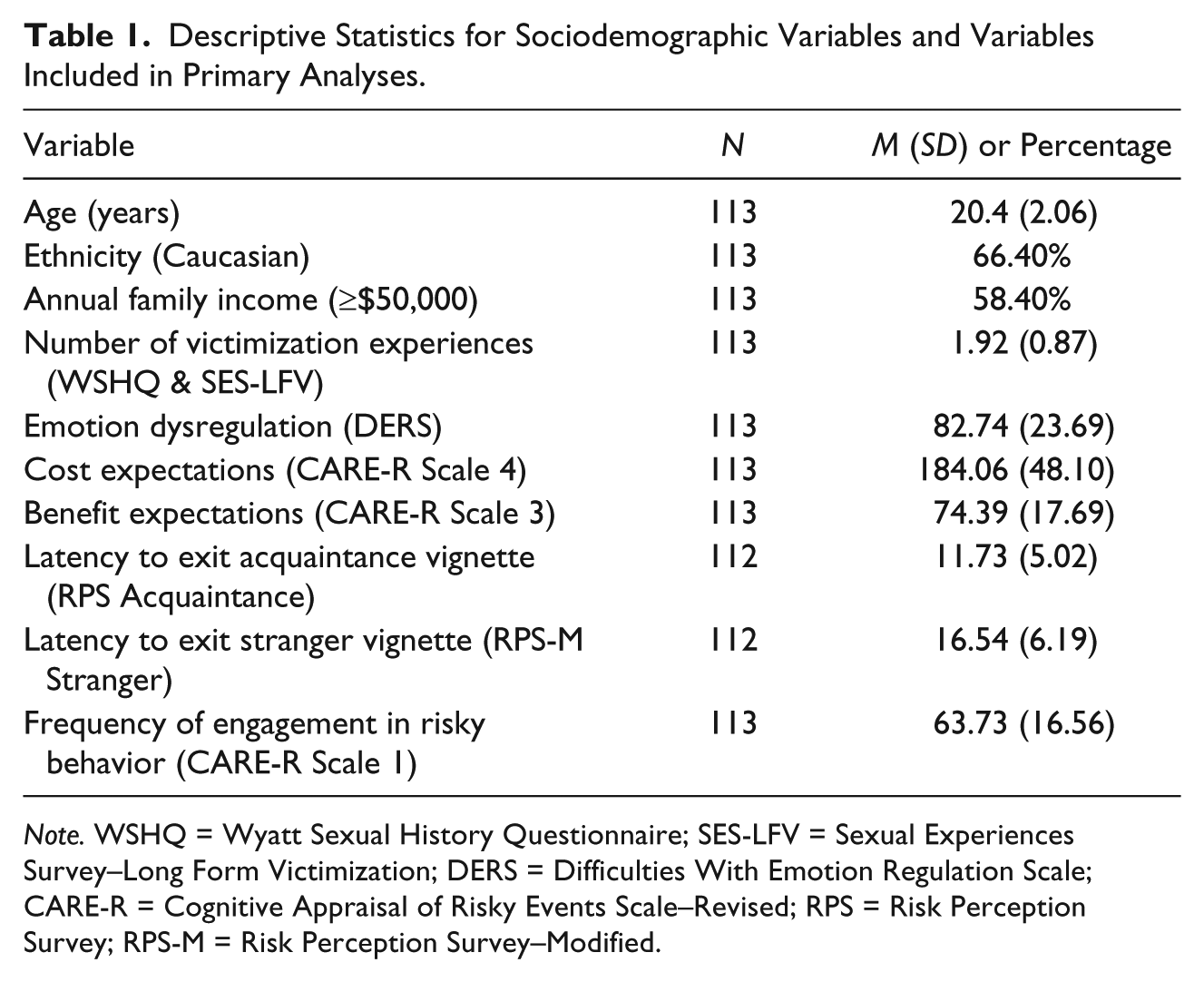
Note. WSHQ = Wyatt Sexual History Questionnaire; SES-LFV = Sexual Experiences Survey–Long Form Victimization; DERS = Difficulties With Emotion Regulation Scale; CARE-R = Cognitive Appraisal of Risky Events Scale–Revised; RPS = Risk Perception Survey; RPS-M = Risk Perception Survey–Modified.
Correlations for Sociodemographic Variables and Variables Included in Primary Analyses.

Note. WSHQ = Wyatt Sexual History Questionnaire; SES-LFV = Sexual Experiences Survey–Long Form Victimization; DERS = Difficulties With Emotion Regulation Scale; CARE-R = Cognitive Appraisal of Risky Events Scale–Revised; RPS = Risk Perception Survey; RPS-M = Risk Perception Survey–Modified.
p < .05. **p < .01.
Multiple regression analyses were performed to evaluate the unique and additive contributions of number of sexual victimization experiences, emotion dysregulation, cost expectations, and benefit expectations to the prediction of latency to exit the stranger vignette. The full model of predictors accounted for a significant proportion of the variance in latency scores, R2 = .13; F(4, 107) = 3.86, p = .006, with only emotional dysregulation (6%) and benefit expectations (4%) accounting for unique and significant proportions of the variance in these scores. Results of analyses testing the contribution of number of sexual victimization experiences, emotion dysregulation, cost expectations, and benefit expectations to the prediction of latency to exit the stranger vignette are presented in Table 3.
Hierarchical Regression Analyses of Number of Sexual Victimization Experiences, Emotion Dysregulation, Cost Expectations, and Benefit Expectations Predicting Latency to Exit a Risk Perception Vignette Involving a Stranger and Frequency of Engagement in Risky Behavior.

Note. p values in table refer to significance levels for F(Change). WSHQ = Wyatt Sexual History Questionnaire; SES-LFV = Sexual Experiences Survey–Long Form Victimization; DERS = Difficulties With Emotion Regulation Scale; CARE-R = Cognitive Appraisal of Risky Events Scale–Revised; RPS = Risk Perception Survey; RPS-M = Risk Perception Survey–Modified.
p < .05. **p < .01.
Multiple regression analyses performed to evaluate the unique and additive contributions of number of sexual victimization experiences, emotion dysregulation, cost expectations, and benefit expectations to the prediction of frequency of engagement in risky behavior revealed the full model of predictors to account for a significant proportion of the variance in frequency of engagement in risky behavior, R2 = .34; F(4, 108) = 13.97, p > .001, with only number of sexual victimization experiences (20%) and benefit expectations (13%) accounting for unique and significant proportions of the variance in frequency of engagement in risky behavior. Results of analyses testing the contribution of number of sexual victimization experiences, emotion dysregulation, cost expectations, and benefit expectations to the prediction of frequency of engagement in risky behavior are presented in Table 3.
Discussion
The current study aimed to provide information regarding the factors that best predict female college students’ entrance into risky situations and engagement in risky behavior. We hypothesized that variables previously identified in the literature as relevant to sexual victimization risk (i.e., number of sexual victimization experiences, emotion dysregulation, and cost expectations) would predict latency to exit risk perception vignettes and frequency of engagement in risky behavior. We also hypothesized that benefit expectations would significantly add to the explained variances in latency to exit a risk perception vignettes and frequency of engagement in risky behavior.
Study findings revealed that number of sexual victimization experiences, emotion dysregulation, cost expectations, and benefit expectations all evidenced the expected bivariate relations to latency to exit the risk perception vignette involving an acquaintance; however, none of these relations reached significance. Findings from previous studies have provided support for the influence of both sexual victimization history and emotion dysregulation on latency to exit risk perception vignettes involving an acquaintance. One possible explanation for the non-significant associations observed for the current study is the relative restriction in the range of latency scores obtained by participants in the context of the acquaintance vignette. While response latencies for both the acquaintance and stranger vignettes were normally distributed, 76.8% of participants exited the acquaintance vignette by Statement 15. Only 27.7% of participants exited the stranger vignette by Statement 15.
Findings from the current study provided mixed support for the influence of number of sexual victimization experiences, emotion dysregulation, cost expectations, and benefit expectations on latency to exit the stranger vignette. Number of sexual victimization experiences did not influence latency to exit the risk perception vignette that involved a stranger. This finding is unique in relation to previous studies in which women with more severe victimization histories have been found to perceive less risk and to remain in risk perception vignettes longer than women with less severe victimization histories (Hoyt & Yeater, 2009; Yeater et al., 2011). Study findings regarding the relation of sexual victimization history to risk perception are consistent with findings reported by VanZile-Tamsen et al. (2005). Although these authors found sexual victimization history to have no effect on women’s risk perception, sexual victimization history was found to influence risk responding, with more frequent experiences of sexual victimization associated with generation of less assertive behavioral options for exiting risk perception vignettes. Together, these findings related to risk perception and risk responding highlight the complexity of the process involved in effectively reducing the risk of victimization and revictimization.
Emotion dysregulation was determined to contribute significantly and independently to the prediction of latency to exit the stranger vignette. Higher levels of emotion dysregulation were associated with reduced latency to exit the stranger vignette. The current study represents the first test of the influence of emotion dysregulation on latency to exit a risk perception vignette that involved a stranger. In their study examining emotion dysregulation and sexual victimization risk perception, K. Walsh et al. (2012) found higher levels of emotion dysregulation predicted increased latency to exit a vignette that involved an acquaintance. Together, findings from the current study and from the K. Walsh et al. study suggest that emotion dysregulation may be differentially predictive of latency to exit a risk perception vignette that involves an acquaintance versus one that involves a stranger. For college-aged women, perceived knowledge of another person, or perceived quality of the social interaction, may moderate the relation of emotion dysregulation to latency to exit risk perception vignettes. When evaluating the risk posed by an acquaintance relative to that posed by a stranger, young women may predict that an acquaintance will be more responsive to their experiences of distress and may remain in a risky situation longer. While research supports the influence of emotion regulation strategies on the quality of social interactions (Lopes, Salovey, Côté, Beers, & Petty, 2005), the perceived quality of the social interaction may influence young women’s use of emotion regulation strategies in attempting to negotiate situations that involve risk of victimization.
Cost expectation did not significantly contribute to the prediction of latency to exit the stranger risk perception vignette. Cost expectations (i.e., total score on Scale 4 of the CARE-R) have never been examined as a predictor for latency to exit a sexual victimization risk perception vignette. The insignificant relationship between cost expectations and latency to exit the stranger risk perception vignette is of particular interest given that a closely related construct to cost expectations, risk appraisal, is an alternative way to assess impaired risk perception (i.e., instead of latency to exit risk perception vignettes; Gidycz et al., 2006). Risk appraisal is measured by asking participants to rate the degree of sexual victimization risk present in the context of a vignette, with impaired risk appraisal associated with less effective responses to vignettes (Yeater & O’Donohue, 2002; Yeater et al., 2010). Cost expectations were measured in the current study by asking participants to rate the likelihood of experiencing a variety of negative consequences (e.g., be injured, embarrassed, feel bad about yourself, etc.) after they engage in risky behavior. It may be that broadly defined cost expectations of risky behavior have little predictive value in the context of sexual victimization risk perception vignettes. Cost expectations specifically pertaining to college women’s likelihood of experiencing sexual victimization following engagement in risky behavior may be more predictive of college women’s responses to sexual victimization risk perception vignettes.
Benefit expectations were determined to contribute significantly and independently to the prediction of latency to exit the stranger vignette, with greater benefit expectations predicting longer latencies to exit the stranger vignette. Although no previous studies have examined the relation of benefit expectations to latency to exit a risk perception vignette, this finding can be considered to mirror findings related to the influence of popularity impact on responses to risk perception vignettes. When engaged with a stranger, young women may expect benefits from the engagement and may extend the time spent with the stranger to allow those expected benefits to manifest. While popularity impact assesses a more circumscribed, social benefit of engagement, the current findings can be interpreted as pointing to a larger category of possible benefits (e.g., intrapersonal, economic, and social) that are relevant to a young woman’s decision to remain in a risky situation.
Findings from the current study provided mixed support for the influence of number of sexual victimization experiences, emotion dysregulation, cost expectations, and benefit expectations on frequency of engagement in risky behavior. Sexual victimization history was determined to make a significant and unique contribution to frequency of engagement in risky behavior. The observed findings regarding the positive relation of sexual victimization experiences to frequency of engagement in risky behavior are consistent with findings from a large number of empirical examinations of this relation (Messman-Moore & Long, 2002; Messman-Moore et al., 2010; Van Bruggen et al., 2006). While emotion dysregulation did not account for a significant portion of the explained variance in frequency of engagement in risky behavior, its relation to frequency of engagement in risky behavior was in the expected direction. College women who reported higher levels of emotion dysregulation also reported higher rates of risky behavior. This is consistent with previous studies that have noted the positive relation of emotion dysregulation to risky behavior (Messman-Moore et al., 2010; K. Walsh et al., 2012).
Cost expectations were not determined to influence frequency of engagement in risky behavior; however, benefit expectations did contribute to the prediction of frequency of engagement in risky behavior. Greater benefit expectations predicted more frequent engagement in risky behavior. This finding is at odds with findings from Combs-Lane and Smith (2002), in which the authors reported no observed relation between either benefit or cost expectations and frequency of engagement in risky sexual behavior. This discrepancy in findings may be due to differences in the categories of risk behaviors sampled across the two studies. While Combs-Lane and Smith utilized a modified version of the CARE and evaluated the influence of expectations on risky dating and social behaviors specifically, the current study utilized the CARE-R and examined the influence of expectations on a larger set of risk behaviors including substance use, driving, and sexual risk behaviors. More research is needed to determine the influence of both cost and benefit expectations on young women’s engagement in the singular and often interacting categories of behaviors that translate to increased risk of sexual victimization.
The current study added to the sexual victimization literature in a number of ways. This study was the first to examine the influence of benefit expectations on the tendency to remain in risk perception vignettes. In addition, this study was an extension of previous protocols as it examined responses to risk perception vignettes as well as self-reported frequency of engagement in risky behavior. There were limitations associated with the study that will need to be addressed in future studies. The current study used across-sectional design and study participants were disproportionally Caucasian and of higher socioeconomic status. Replication of the current study using a longitudinal research design that incorporates a more diverse sample of women, particularly in regard to socioeconomic status, would permit statements regarding the causal relations among study variables and would increase the generalizability of study findings. While the current study analyses were adequately powered, the sample was smaller than previous studies that have utilized sexual victimization risk perception vignettes. Future studies should include larger samples to ensure the replicability of current findings. While high Cronbach alphas on forward and reverse-scored items suggest participants were attending to the online questionnaire in the current study, the validity of future study findings incorporating online questionnaires would be strengthened by including items specifically aimed at assessing participants’ attentiveness. The CARE-R does not provide information regarding specific types of cost and benefit expectations. Future studies would also be strengthened by a more context-specific measure of the perceived costs and benefits of entering and remaining in situations that involve risk.
Findings from the current study indicate that different variables contribute to latency to exit risk perception vignettes and frequency of engagement in risky behavior. Benefit expectations was the only significant, independent predictor of both latency to exit the stranger vignette and frequency of engagement in risky behavior. The current findings suggest that benefit expectations regarding engagement in risky behavior and entrance into potentially risky situations may be an important target in preventative risky behavior interventions. Sexual victimization prevention programs may be enhanced by highlighting the benefits of protective behavior or contradicting the perceived benefits of risky behavior rather than exclusively emphasizing the potential costs of risky behavior. Because of the cost, prevalence, and reoccurrence of sexual victimization, it is important to determine and understand the variables that contribute to women’s sexual victimization risk.
Footnotes
Declaration of Conflicting Interests
The author(s) declared no potential conflicts of interest with respect to the research, authorship, and/or publication of this article.
Funding
The author(s) received no financial support for the research, authorship, and/or publication of this article.