



Abstract
We comment on The Witch-Hunt Narrative (TWHN) by Cheit. As its first hypothesis, TWHN argues that most of the famous ritual child abuse cases of the 1980s and 1990s were not really witch-hunts at all. In response, we criticize the TWHN definition of a witch-hunt as overly narrow and idiosyncratic. Based on the scholarly literature, we propose 10 criteria for identifying a witch-hunt. We rate four well-known ritual child abuse cases with these criteria and show they were classic witch-hunts. As its second hypothesis, TWHN argues that most defendants in child ritual abuse cases were guilty or probably guilty. In response, we point out many instances in which TWHN has omitted or mischaracterized important facts or ignored relevant scientific information running contrary to its hypotheses. We conclude that TWHN is often factually inaccurate and tends to make strong assertions without integrating relevant scholarly and scientific information. Scholars should approach the book with caution.
The authors of this article—a psychologist, an investigative journalist, a writer on cultural issues, and a criminal defense attorney—have close familiarity with many ritual child abuse cases that erupted in America in the 1980s and early 1990s. We thank the editors of this Special Section for inviting us to share our impressions of Cheit’s (2014) The Witch-Hunt Narrative (TWHN). Because the book is 500 pages long, we can discuss only a fraction of its content. However, we hope our comments will help scholars evaluate the book’s claims.
Key Hypotheses of Cheit’s The Witch-Hunt Narrative
Although TWHN advances several hypotheses, two appear central to its arguments. First, it rejects the widely held view that during the 1980s and early 1990s, a rash of witch-hunts broke out across the United States involving bizarre accusations against child care workers and other individuals. Instead, the book argues that most of these prosecutions were not really witch-hunts (although it makes notable exceptions for the prosecutions of Bernard Baran and of elderly women in the McMartin Preschool case). Second, TWHN contends that there is extensive evidence that defendants in most of these cases were guilty of sexually abusing children. According to the book, many guilty defendants went free because of tragic errors by prosecutors or other professionals.
As Cheit acknowledges (TWHN), his book is swimming against a strong counter-current. Most psychologists, sociologists, and journalists who have written about these cases have reached much different conclusions than TWHN (Beck, 2015; Bottoms & Davis, 1997; Ceci & Bruck, 1995; De Young, 2004; Frankfurter, 2006; Hicks, 1991; Jenkins, 2004; Lanning, 1992; Levack, 2006; Nathan & Snedeker, 1995; Rabinowitz, 1990, May; Schreiber et al., 2006; Shaw, 1990; Victor, 1993; Wood, Nathan, Nezworski, & Uhl, 2009; but see Faller, 2003; Kelley, 1989; Snow & Sorensen, 1990; Summit, 1994). We find the mainstream views of scholars to have much better evidentiary support than the counter-theories proposed by TWHN. First, like most scholars, we think that defendants in these cases were victims of “moral panics” (De Young, 2004; Jenkins, 2004). Swept up in classic witch-hunts, they were falsely accused of involving children in “ritual abuse,” a term referring to witchcraft and Satanic practices. Second, we think that nearly all defendants in these cases were factually innocent, accused of crimes they did not commit. In this article, we critically examine both hypotheses of TWHN and explain why they are contradicted by a substantial body of historical fact and scientific evidence.
TWHN Hypothesis 1: Most Ritual Abuse Cases Were Not Witch-Hunts
Why does TWHN conclude that the day care cases were not really witch-hunts whereas most scholars have reached the opposite conclusion? Two reasons can be identified. First, TWHN adopts an idiosyncratic definition of “witch-hunt” that is inconsistent with how scholars typically use the term. Second, the descriptions of these cases in TWHN are often one-sided and omit evidence that contradicts its arguments.
The TWHN Definition of a Witch-Hunt
We will begin with the definitional issues. The preface of TWHN provides the definition used by the author to decide whether a particular case was a witch-hunt: I looked to see whether there was evidence that appeared credible to me, and if so, I described its nature. My having concluded that there was credible evidence in a case does not mean the defendant was necessarily guilty. But it does mean that in my opinion, as documented by evidence I reviewed, there was sufficient reason for authorities to have investigated and brought charges. This means, by definition, that the case was not a witch-hunt. To the contrary, it is the state’s duty to take action when there is credible evidence of child sexual abuse, as with any crime. (pp. xiv-xv; emphasis added)
According to this definition, a prosecution is not a witch-hunt if (a) there was evidence that at least one individual committed at least one crime, and (b) the author of TWHN found this evidence to be “credible” enough to justify bringing criminal charges. There are several problems with this definition. An obvious one is its subjectivity and vagueness, with so much depending on what the author finds “credible.” In addition, the definition is overly narrow and disconnected from the way the term “witch-hunt” is used in the scholarly literature and everyday speech. By “overly narrow,” we mean that, according to the TWHN definition, many famous witch prosecutions of the past were not really witch-hunts. For example, many deadly prosecutions in the great European witch-hunt (approximately 1450-1750) were “credible” in the minimalist sense adopted by TWHN. Specifically, they were supported by accusations from co-conspirators, physical evidence, or even freely given confessions (Levack, 2006). According to the TWHN definition, such cases should not be considered witch-hunts although the defendants were tried and burned as witches.
The second major problem with the TWHN definition is its disconnection from historical and sociological scholarship. The book presents its idiosyncratic definition of witch-hunts without citing any scholarly work to support it. Although supposedly about witch-hunts, TWHN seldom draws on the established literature on this topic and generally disregards (or rejects) the insights this literature provides into the ritual child abuse panic of the 1980s and 1990s.
Our Proposed Criteria for Identifying Witch-Hunts
In Table 1, we propose 10 criteria for deciding whether an investigation or prosecution is a witch-hunt. These criteria are based on the scholarly literature on witch-hunts, including monographs by Cohn (1993), Frankfurter (2006), and Levack (2006), and a firsthand description of the great European witch-hunt by Spee von Langenfeld (1631/2003).
Criteria for Identifying a Witch-Hunt.
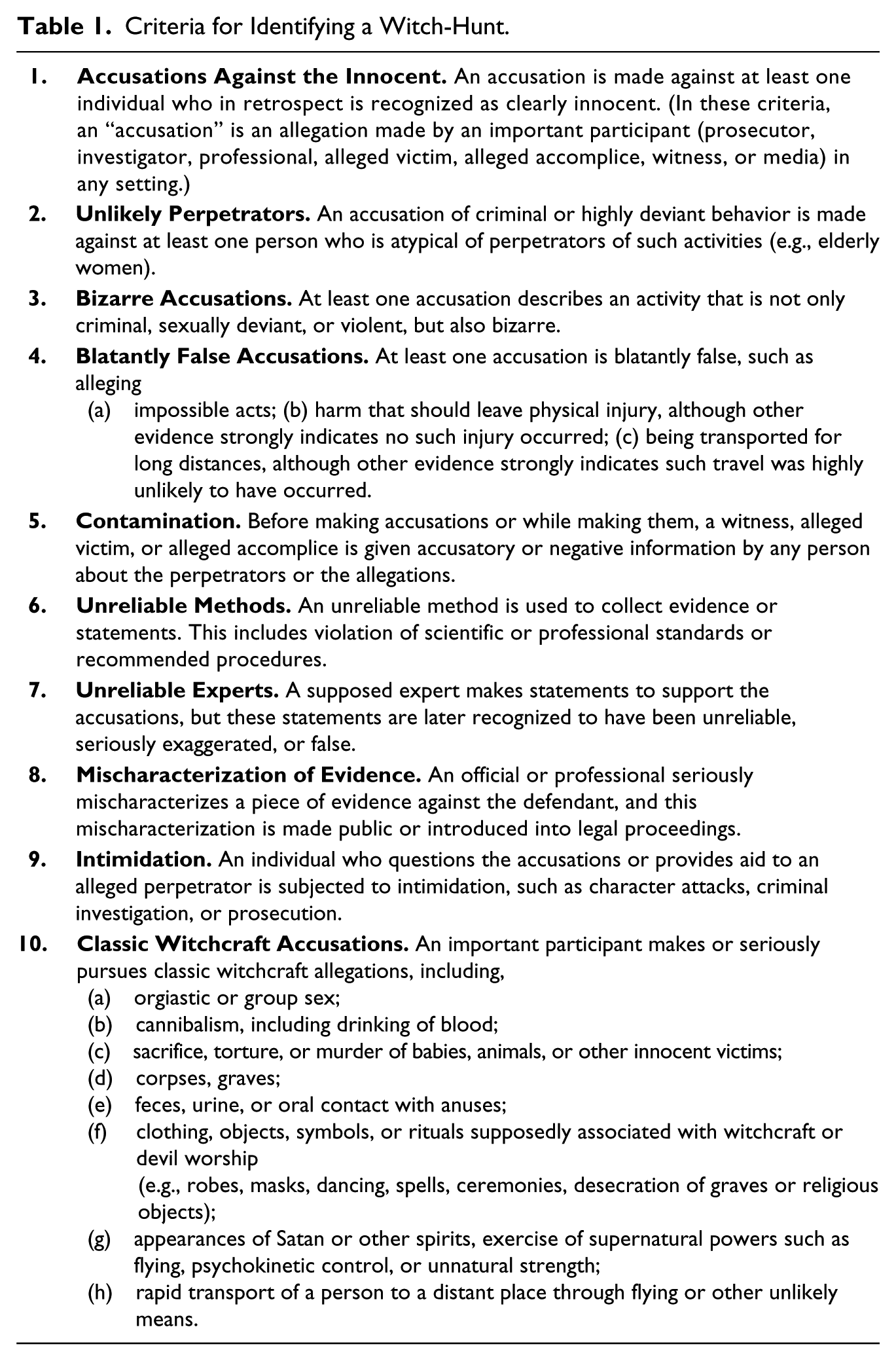
The criteria in Table 1 can be found in both historic and recent witch-hunts. For instance, during witch-hunts, accusations of extremely deviant behavior are often made against defendants who are unlikely perpetrators of such behavior (Criterion 2). This criterion can be seen in the great European witch-hunt, in which elderly women were accused of engaging in wild orgies (Levack, 2006). It can also be found in the McMartin case, in which women (some elderly) were accused of engaging in group sex with small children, which is extremely rare among females.
The first nine criteria in Table 1 focus on how prosecutors, investigators, professionals, and accusers behave during witch-hunts. This focus on social and legal processes is consistent with the way that scholars typically talk about moral panics and witch-hunts (Frankfurter, 2006; Levack, 2006). Criterion 10 focuses on the content of allegations. Its eight sub-items assess the degree to which the allegations in a case are those of a classic witch-hunt (i.e., they resemble those leveled against purported witches during the great European witch-hunt).
Some ordinary sexual abuse prosecutions that are not witch-hunts will meet a few of the criteria in Table 1. Therefore, to avoid mislabeling, a case should meet a substantial number of criteria before being considered a witch-hunt. We suggest that a case qualifies as a witch-hunt if it (a) meets at least four of the nine criteria concerned with social–legal processes, and (b) involves three or more of the classic witchcraft allegations in Criterion 10. Furthermore, a case should not be considered a witch-hunt unless it (c) results in important negative consequences for the accused, such as arrest, prosecution, or loss of employment or income.
Applying Our Criteria to Four Famous Child Abuse Cases
In Table 2, we use our witch-hunt criteria to rate four famous child abuse cases with which we are closely familiar: the McMartin Preschool case, the Kelly Michaels case, the Dan and Fran Keller case, and the Frank Fuster case. Supporting evidence for these ratings is available from the first author on request. According to TWHN, none of these four cases was a witch-hunt because the book’s author found what he considered “credible” evidence in each one. In contrast, all these cases meet our criteria for a classic witch-hunt.
Ratings of Witch-Hunt Criteria in Four Famous Abuse Cases: McMartin Preschool, Kelly Michaels, Dan and Fran Keller, Frank and Ileana Fuster (Country Walk).

Witch-Hunt Characteristics of the Keller Case Omitted From TWHN
One reason why TWHN finds few witch-hunts in the ritual child abuse cases of the 1980s and 1990s is definitional. However, there is also a second reason: The book frequently omits facts that clearly show a witch-hunt was underway. For example, such omissions can be seen in its description of the prosecution of Fran and Dan Keller in Austin, Texas, in 1992 (TWHN, pp. 144-147), a case that easily meets our criteria for a classic witch-hunt (see Table 2).
Cathy Collins, the 3-year-old who made the first accusations and testified at the Keller trial, reported that she had seen a child sacrificed and attended rituals where participants dressed in robes (Keller trial transcript, 1992, Vol. 11, pp. 30-33, 43, 57; Vol 12, p. 131).
Five-year-old Bobby North testified he was taken to a cemetery where the Kellers dug up a corpse and sexually abused children (Keller trial transcript, 1992, Vol. 13, pp. 202-221).
Three-year old Victor Stoessel told police that large drill bits were inserted into his anus and small ones into his penis (Austin Police Reports, 1992). Victor did not testify at trial, but his claims were accepted as true by mental health professionals and law enforcement.
Police diligently searched without success for the disturbed graves, sacrificed baby, and mutilated animals described by the children (Keller trial transcript, 1992, Vol. 11, pp. 69-91).
Cathy’s therapist concluded that the children were victims of Satanism. She testified at the trial about the characteristics of ritual abuse (Keller trial transcript, 1992, Vol. 11, pp. 27-51).
Prosecutors also called psychologist Randy Noblitt, a supposed authority on Satanism, as an expert witness. He told jurors, among other things, that ritual abuse has been a problem in the United States and elsewhere for centuries (Keller trial transcript, 1992, Vol. 12, pp. 116-119, 158-159).
As can be seen, classic witchcraft accusations permeated the Keller case. They involved not only children but also credulous prosecutors, police, and mental health professionals. However, TWHN portrays these allegations as merely peripheral. After vaguely acknowledging that “some number” of children made ritual abuse allegations and that “five parents” repeated these claims to newspapers, TWHN concludes that such statements came from a handful of outlying individuals and have been over-interpreted by commentators: The outlandish claims were not part of the original criminal case against the Kellers, and they apparently involved only a small number of the parents and children who were interviewed in the case. (p. 145)
TWHN fails to fully inform readers how pervasive the ritual abuse allegations were in the Keller case. It claims (a) that only “some” children made ritual abuse allegations, without mentioning that these were the three key children in the case, including the only two to testify at trial, (b) that the Satanic claims involved “only a small number of the parents and the children,” without mentioning the deep involvement of police, prosecutors, and mental health professionals, and (c) that the ritual abuse allegations “were not part of the original criminal case,” without mentioning that two mental health professionals were called to testify that witchcraft (which they called “ritual abuse”) is a serious problem in modern America.
The book’s omissions are important because, by leaving out key facts, TWHN creates a false impression that the Keller case was not really a witch-hunt and that the ritual abuse allegations were an aberration involving a few over-zealous parents. Furthermore, these omissions illustrate one of the book’s most serious faults—its persistent failure to report relevant facts, even when they are readily available in its own sources. Although TWHN has been praised as exceptionally “careful,” “painstaking,” and “well-documented” (Faller, 2017, pp. 785-786), such commendations are misplaced. As will be shown, TWHN is marked by many omissions, raising serious questions regarding the adequacy of its factual reporting and conclusions.
TWHN Hypothesis 2: There Is Strong Evidence That Defendants in Most Ritual Abuse Cases Were Guilty
When evaluating the day care cases of the 1980s and 1990s, TWHN almost always finds substantial evidence that one or more defendants were guilty of sexually abusing children. However, such conclusions must be approached with great caution because TWHN often omits important evidence that contradicts its conclusions, misstates facts, or fails to consider relevant scientific knowledge. In the rest of this article, we analyze three ritual child abuse cases that illustrate the book’s shortcomings. Additional examples are available on the website of the National Center for Reason and Justice (n.d.).
The Dan and Fran Keller Case
The classic witch-hunt that descended on Dan and Fran Keller has already been described. TWHN concludes there was “substantial evidence” against the Kellers (p. 144) and that “the conviction in this case was solid” (p. 146). The book identifies three key pieces of evidence: (a) testimony by a doctor that he found physical evidence of sexual abuse in the 3-year-old whose allegations initiated the case, (b) the statements of the child accusers, and (c) a confession by a friend of the Kellers that he had joined them in an orgy involving two children. The summary of facts as presented in TWHN appears damning, and the book questions the objectivity of journalists who have argued that the Kellers were innocent. In fact, the evidence is on the journalists’ side.
Dr. Mouw’s testimony
Particularly damaging at the Kellers’ trial was the testimony of Dr. Michael Mouw, who reported signs of sexual abuse in the little girl at the center of the case. However, 18 years later, Mouw told a reporter that he had learned more about normal children’s genitalia and “wasn’t sure” he would still come to the same conclusion that he had at the Keller trial (Smith, 2009a). TWHN quotes Mouw’s statement to the reporter but dismisses it because “it does not make sense” and “there is no reason to think that a conversation about the case eighteen years after the fact should be given any weight” (pp. 145-146).
Although TWHN dismisses Dr. Mouw’s second thoughts, Texas courts have taken a different view. In August 2013, Mouw testified at a habeas corpus hearing that his testimony at the Keller trial had been in error. In light of later research on children’s genitalia, he currently had “no doubt” the hymen of the little girl in the Keller case was normal (Smith, 2013). Primarily on the basis of Mouw’s recantation, the Kellers’ conviction was overturned, and they were released from prison in November, 2013, after serving 22 years. The Texas Court of Criminal Appeals affirmed this decision, with one justice declaring the Kellers to be factually innocent. The majority did not find the exonerating evidence strong enough to support such a firm conclusion, however, and ruled that the Kellers could be re-tried (Lindell, 2015). As of this writing, prosecutors have not chosen to do so.
The medical evidence in the Keller case has been discredited by a careful judicial process. However, readers will not learn of this development from TWHN. The book simply does not mention Mouw’s recantation in the habeas corpus case or the reversal of the Kellers’ convictions. TWHN was published in April, 2014, whereas the press reported Mouw’s recantation more than a year earlier, in January, 2013, and the reversal of the Kellers’ conviction in November, 2013 (Lindell, 2013a, 2013b; Smith, 2013a; 2013c; see also Smith, 2013b). TWHN can be criticized for omitting these developments, for dismissing Mouw’s change of opinion when it became public in 2009, and for assuring readers that the evidence against the Kellers was “solid.”
The child witnesses in the Keller case
TWHN concedes that “some number” of children in the Keller case made ritual abuse allegations that were “impossible to believe,” and that there were “difficulties” with their testimony (p. 145). Specifically, in court, the little girl at the center of the case “alternately denied and admitted that anything bad had happened to her.”
However, TWHN fails to inform readers of the reason for the children’s unreliability. As already discussed, all three children at the center of the case made bizarre allegations that were blatantly false (e.g., sacrificing babies, exhuming corpses). Extensive documentation shows that these allegations emerged in response to intense, highly suggestive questioning by police, parents, and a therapist. A critical analysis of this questioning (Wood, 2013), along with a supporting letter signed by 21 experts, was filed with the Kellers’ habeas corpus petition in March, 2013, and reported in the Austin Chronicle (Smith, 2013d). However, this analysis, like other important aspects of the Keller case, goes unmentioned in TWHN.
Four years previously, an exposé on the Keller case in the Austin Chronicle included a lengthy discussion of the suggestive child interviews, with video excerpts that can still be viewed on the Internet (Birchum, 2009; Smith, 2009b). TWHN cites the Chronicle exposé but not its discussion of suggestive interviewing or the video-recorded interviews. In fact, TWHN nowhere mentions that suggestive interviewing was an issue in the Keller case.
The confession of Doug Perry
According to the children, uniformed police officers took part in the Kellers’ Satanic ceremonies. Suspicion soon fell on Janise White, a Deputy Constable who was a friend of Fran Keller. In July 1992, White’s former husband Doug Perry was questioned by Texas Rangers. After a 4-hr unrecorded interview, Perry signed a detailed confession that about a year earlier, he, the Kellers, his ex-wife White, and White’s fellow constable Raul Quintero had engaged two children in multiple sex acts (Smith, 2009a; Keller trial transcript, 1992).
Within days, Perry retracted his confession. A month later, he signed a formal recantation. He claimed he had made a false confession because the Rangers threatened him with prison and told him there were witnesses confirming his guilt (Keller trial transcript, 1992).
Perry was never tried for his part in the supposed orgy with the Kellers. Instead, he pled guilty to child molestation and received 10 years’ probation. He later violated the terms of his parole by failing to register as a sex offender, and for this offense received a 10-year prison term. All charges against his ex-wife Janise White and her fellow constable Raul Quintero were eventually dropped (Smith, 2009a).
In our opinion, Perry’s confession is false. However, we also believe it must be accorded some evidentiary weight: A recanted confession is stronger evidence of guilt than no confession at all. Compared with other recanted confessions, however, Perry’s falls at the weak end of the spectrum, for the following reasons:
Perry’s confession was uncorroborated, and he repudiated it immediately. Thereafter, he consistently denied it was true—at a grand jury investigation, again at the Keller trial, and again in 2009 (Smith, 2009a).
Roger Wade, an investigator in the Keller case who is now public spokesman for the Austin sheriff’s department, told a reporter in 2009 that he completely disbelieved Perry’s confession: “I never understood why he would confess, when, obviously, he didn’t have any involvement and none of that happened. It came out afterward that [White and Quintero] had nothing to do with it” (Smith, 2009a).
Perry was eventually allowed to plead guilty to child molesting with no prison time. His sentence—10 years’ probation—was very light considering the heinous nature of the original charges. This outcome strongly suggests a plea bargain, in which prosecutors reduced the charges because the evidence against Perry was not strong enough to convict.
The charges against Perry’s ex-wife Janise White and her fellow Deputy Constable Raul Quintero were dismissed because, as prosecutors admitted, they could not obtain convictions based on Perry’s confession (Ward, n.d., as cited by Cheit, 2014).
Perry’s confession involved a highly improbable scenario: He claimed that two deputy constables with otherwise clean records had engaged in an inter-generational orgy. Given the implausibility of the accusation, it should not be accepted without very strong evidence. Perry’s recanted accusation does not constitute strong evidence, as prosecutors acknowledged when they dropped the charges against White and Quintero.
The McMartin Preschool Case
Judy Johnson was the mother of a 2.5-year-old boy, “Matthew,” who briefly attended the McMartin Preschool. Her allegation that Ray Buckey had sodomized her son launched the police investigation into the school in late summer of 1983. Journalists and historians have concluded that Johnson’s mental health problems, which contributed to her death from alcohol poisoning in 1986, were a key factor in the early, rapid expansion of the McMartin investigation (Beck, 2015; Fischer, 1989; Nathan & Snedeker, 1995).
TWHN challenges this conclusion. It claims that journalists have made Judy Johnson a “scapegoat” and that “there is no evidence in the record of the McMartin case that Johnson was mentally unstable when she took her son to the emergency room on August 12, 1983” (pp. 25-26). While acknowledging that Johnson’s mental health deteriorated by the time of her death, TWHN contends that her difficulties developed as a result of the McMartin case. The book quotes former McMartin prosecutor Glenn Stevens to show that Johnson was psychologically healthy during the early part of the case. It further argues that Johnson’s accusations were well-founded because they reflected the opinion of pediatricians in August, 1983, that Matthew had been sodomized.
Judy Johnson’s mental Illness
Key facts omitted from TWHN contradict its contention that Judy Johnson was psychologically healthy at the beginning of the McMartin case and developed paranoia only in response to stress. In late 1984, approximately 2 years before her death, Johnson called Glenn Stevens, the McMartin prosecutor, and told him she was in a hospital in Seattle. Apparently in the midst of a psychotic episode, Johnson seemed disoriented and said she had been pursued across several states by a sinister marine who had also sodomized Matthew. She later denied being hospitalized (Cody, 1986c; Glenn Stevens interviews, Tape No. 7). The following year, she barricaded herself in her home. After threatening her brother with a shotgun, she was forcibly taken to a hospital where she was diagnosed with paranoid schizophrenia (Manhattan Beach Police Department, n.d.).
TWHN fails to mention Johnson’s call to Stevens, her involuntary hospitalization, or that doctors diagnosed her with schizophrenia. Schizophrenia is a serious mental disorder characterized by severe loss of contact with reality, disordered thinking, and prominent delusions (Comer, 2014). Its causes are mainly biological. According to current views, psychosocial stressors during adulthood such as those experienced by Johnson (e.g., involvement in the McMartin case) do not cause schizophrenia. However, such stressors can play a precipitating role, bringing on delusions or other psychotic symptoms in a person with the disorder. Often, the erratic behavior of an individual with schizophrenia causes such stressful experiences.
Schizophrenia has characteristic phases (Comer, 2014). In the active or psychotic phase, the individual experiences severe symptoms that typically require hospitalization. As already indicated, Judy Johnson went through the psychotic phase in 1984 and again in 1985. However, she displayed delusional thinking long before that. In September 1983, approximately 6 weeks after making her initial allegations against Ray Buckey, Johnson added a new accusation: that Buckey, wearing a mask, had pushed Matthew’s head into a toilet and sodomized him. In October, she reported that Buckey had dressed like a minister while sexually assaulting the boy. In November, she claimed a man named Dave had taken Matthew to a far-away ranch where the boy rode naked on a horse. In December, she identified two gym employees as Buckey’s accomplices and alleged that one of them had sodomized Matthew (Manhattan Police Department Supplemental Report, 1983). Johnson also reported that Buckey had molested Matthew while dressed as a fireman, a clown, and Santa Claus (Fischer, 1989).
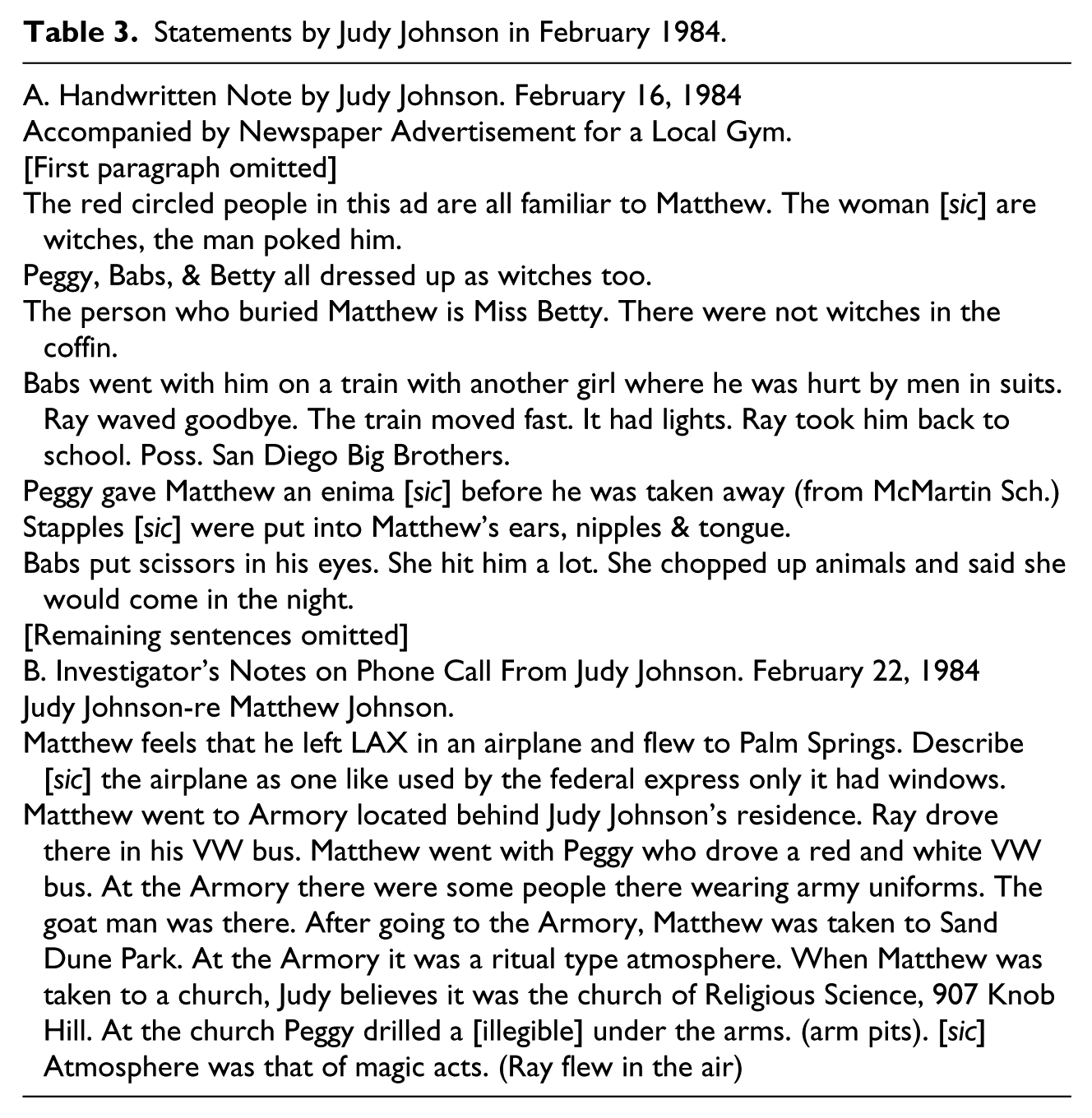
In February, 1984, months before she was called to testify in the McMartin case, Judy Johnson delivered a strange note, attached to a newspaper ad for a local gymnasium, to the Los Angeles District Attorney’s Office. Shortly afterward, she made a phone call to an investigator there. Johnson’ handwritten note and the investigator’s notes on her call are quoted in Table 3 (Judy Johnson statements, 1984; see also Cody, November 27, 1986c; Glenn Stevens interviews, Tape 6). As can be seen, Johnson made clearly delusional allegations against gym employees, Ray Buckey, and other individuals. TWHN only briefly refers to these two documents, which it describes as “fanciful” (p. 430, endnote 188). Johnson’s earlier bizarre allegations—for instance, that Matthew was sodomized by a gym employee and made to ride naked on a horse at a far-away ranch—are not even mentioned in the book.
Statements by Judy Johnson in February 1984.
Before entering the psychotic phase, individuals with schizophrenia typically pass through the prodromal phase, which is characterized by thought disturbance less severe than in the psychotic phase (Comer, 2014). Because the symptoms are subtle, a person in the prodromal stage may still seem relatively normal to the people around them.
The evidence from police reports and other documents is very strong that Judy Johnson entered the psychotic phase of schizophrenia by September, 1983, or even earlier. In August, when she made her initial allegations against Ray Buckey, she was almost certainly in either the psychotic or the prodromal phase. Her thought processes and interpretation of her son’s statements are likely to have been severely distorted. TWHN claims there is “no evidence” (p. 26) that Johnson was unstable in August, 1983. In fact, the evidence is overwhelming but is omitted from the book.
Glenn Stevens’ statements about Judy Johnson
In summer of 1986, former prosecutor Glenn Stevens was interviewed at length about the McMartin case by filmmaker Abby Mann (Cody, November 13, 1986a; November 20, 1986b; November 27, 1986c; Glenn Stevens interviews, 1986). By quoting select excerpts from these interviews, TWHN gives the impression that Stevens, who had considerable contact with Johnson in 1984 and 1985, saw her as normal during the early stages of the McMartin case but then disintegrating under stress. For instance, Stevens is quoted by TWHN as denying that Johnson had “a suspect personality” and concluding that “the McMartin case pushed Johnson over the edge.”
As the book correctly reports, Stevens firmly denied that Judy Johnson had a “suspect personality.” However, what TWHN fails to report is that Stevens clarified this statement by calling Johnson “cuckoo,” “crazy,” and a “screwball” (Glenn Stevens interviews, Tape 22, pp, 8, 13-14). In denying that Johnson had a “suspect personality,” Stevens meant that she did not have a personality disorder (i.e., she was not a liar or manipulative). Instead, Stevens indicated, her real problem was that she was “paranoid” (Tape 7; Tape 22), a fact that became apparent “really early” in the McMartin case (Tape 6).
TWHN seriously mischaracterizes the way that Stevens viewed Judy Johnson. Furthermore, it falsely claims that “Stevens eventually criticized most aspects of the state’s case, but not Johnson’s mental health in August 1983. . .” (TWHN, p. 26). In fact, Stevens told a New York Times reporter, “Judy Johnson was psychotic before she filed the first police report” (Reinhold, 1990).
The medical findings on Matthew Johnson
Although TWHN erroneously claims that Judy Johnson was psychologically normal at the start of the McMartin case, the book is correct that Johnson did not simply imagine that her son had a significant medical condition. In August, 1983, a doctor reported that Matthew had a band of redness encircling his anus, and two other doctors made similar observations (TWHN). Based on this symptom and a statement by Johnson that her son reported penetration by Ray Buckey, a pediatrician at the Marion Davies Children’s Clinic at the University of California Los Angeles (UCLA) concluded that “the victim’s anus was forcibly entered several days ago” and notified police. TWHN asserts, “the constellation of evidence described on August 12, 1983, would still support a report for suspected child abuse today” (p. 25).
However, TWHN fails to consider what many pediatricians today would consider a likely diagnosis for Matthew’s symptoms: perianal streptococcal dermatitis, a common but often unrecognized disorder in children from 6 months to 10 years of age, but most frequently in children 3 to 4 years old, particularly boys (Adams, 1999; Brilliant, 2000). The most common presentation is “a bright pink, moist erythema extending 2 to 4 cm from the anal verge” (Adams, 1999, p. 2066; see also Block, 2013). The disorder is caused by Group A betahemolytic streptococci, not sexual abuse, and its presence can be confirmed by a streptococcus test (Brilliant, 2000). As it happens, the records of the UCLA laboratory tests on Matthew Johnson show that a streptococcus test was administered and the results were positive for both his anus and his penis (UCLA Medical Laboratory Report, 1983). TWHN refers to the UCLA medical records but not the results of the strep test.
In 1983, a diagnosis of perianal streptococcal dermatitis was likely to be overlooked. However, the condition has received considerable attention during the past two decades (Adams, 1999; Block, 2013; Brilliant, 2000; Jongen, Eberstein, Peleikis, Kahlke, & Herbst, 2008). The conclusions in TWHN regarding Matthew Johnson’s medical condition are based on the state of medical knowledge in 1983. If the boy were seen today by an up-to-date pediatrician, the likely diagnosis would be perianal streptococcal dermatitis.
The Frank and Ileana Fuster Case (Country Walk)
Research psychologists have been intensively studying the strengths and limitations of children as legal witnesses since the 1980s. Early studies highlighted children’s strengths, with the work of Gail Goodman of the University of California at Davis being prominent. In the late 1980s, a “new wave” of research (TWHN, p. 283) began to explore children’s limitations as witnesses, especially their susceptibility to suggestion and improper interviewing. Maggie Bruck of Johns Hopkins University and Steven Ceci of Cornell were leaders in this work. In the past three decades, dozens of researchers have published hundreds of studies on child witness issues.
Chapter 6 of TWHN, “Going to Extremes: State v. Fuster,” asks a rhetorical question: “Did the ‘new wave’ of research on child suggestibility mean a broader and unjustified attack on the credibility of children would follow?” According to TWHN, the answer is “yes.” Goodman is contrasted with Bruck and Ceci, who have supposedly purveyed theories “so malleable they could be offered in defense of any defendant, no matter how powerful the evidence of guilt” (TWHN, pp. 283, 355). In support of its judgment, the book presents the “Country Walk” ritual child abuse case of Frank and Ileana Fuster in Miami, Florida, in 1984 and 1985 (see Table 2). According to TWHN, “there was overwhelming evidence of guilt against Frank Fuster” (p. 285). Ceci and Bruck have concluded otherwise, the book contends, only because they have “distorted or overlooked the vast evidence to the contrary.”
In the present section, we consider the evidence against the Fusters. However, before doing so, we will briefly comment on two issues. First, in our opinion, the book’s approach of unfavorably contrasting Ceci and Bruck with Goodman is inappropriate in a scholarly work, over-personalizing differences in perspective that are a normal part of the scientific process. All three of these researchers are idealistic psychologists who have made major contributions to the field’s understanding of child witnesses.
Second, the central line of reasoning in Chapter 6 of TWHN is unsound. Even if it were true that Frank and Ileana Fuster are guilty and that Ceci and Bruck have unwisely concluded otherwise, this fact would not discredit the “new wave” of child suggestibility research. As already indicated, this field includes hundreds of studies, with independently replicated findings that have gained general acceptance in the scientific community. Any credible attempt to discredit this body of research would require a thorough review of the relevant scientific literature—something TWHN does not even attempt.
We turn now to the question of the Fusters’ guilt. TWHN discusses the evidence in the case at length, but four pieces of evidence are presented as especially strong: (a) the prior criminal record of Frank Fuster, (b) the confession of Ileana Fuster, (c) the positive gonorrhea test of Frank’s son Noel Fuster, and (d) the children’s allegations against the Fusters. We will evaluate all four and explain why we find them far less compelling than TWHN does.
Frank Fuster’s criminal record
Frank Fuster had two criminal convictions prior to 1984, the year he was accused of ritually abusing children at the Country Walk Daycare run by his wife Ileana. Frank Fuster’s first prior was a first-degree manslaughter conviction 15 years earlier for which he received a 10-year sentence, serving four. The second conviction was for lewd and lascivious assault on a minor in 1982. The 9-year-old victim credibly reported to her mother that Fuster had fondled her through her clothing while driving her to her home.
The account of Fuster’s prior criminal record in TWHN is mainly accurate, and we have no doubt he was rightfully convicted in both cases. We agree with TWHN that a defendant with Fuster’s record is substantially more likely to be guilty than a defendant with no such record. However, we disagree with the book’s assessment of the other evidence against him. TWHN expresses disbelief that anyone could question whether Fuster was guilty of the charges brought against him in 1984. In the following sections, we will show why reasonable, well-informed professionals have found this evidence unconvincing.
Ileana Fuster’s confession
In August, 1985, Ileana Fuster pled guilty to multiple counts of sexually abusing children at Country Walk. At the same hearing where she entered her plea, she declared that she was innocent and was pleading guilty “to get all of this over” (Hollingsworth, 1986, pp. 422-424). Ileana later gave riveting testimony against Frank Fuster. She said he once threatened her with a knife, forcing her to strip in front of children and have oral sex with a little boy (Hollingsworth, 1986). She described how he spanked her with a snake and laid it on her vagina (Depositions of Ileana Flores, 1985). She said that he once suspended her from the ceiling by her hands, beat her with a chain, and smeared her legs with feces. Another time, he sucked her blood and penetrated her rectum with a crucifix (Hollingsworth, 1986).
Although Ileana’s bizarre accusations were highly publicized in 1985, subsequent events—combined with information that became public only after Frank Fuster’s trial—have seriously diminished their credibility. What follows is a chronology of Ileana’s accusations.
Frank Fuster and Ileana Fuster were arrested and charged with sexual abuse in August, 1984, shortly before Ileana’s 18th birthday. During the next 12 months, much of which she spent in solitary confinement, Ileana adamantly denied the allegations against her and Frank, both to investigators and to a prison chaplain with whom she developed a close relationship (Interview of Ileana Flores, 2001; Deposition of Shirley Jean Blando, 1985).
In 1985, Ileana’s attorney concluded she could avoid a lengthy prison sentence only by testifying against Frank. When she resisted, the attorney arranged to have her seen by two psychologists from a company called “Behavior Changers.” When Ileana said she had no memories of Frank abusing children, the psychologists had her “visualize” the crimes (Flores, 1994; Interview of Ileana Flores, 2001). For instance, they read her abuse allegations by children in the case and encouraged her to imagine them. When she developed nightmares of these scenes, the psychologists told her they were real. One of the psychologists later confirmed he spent “hours and hours” with Ileana (a fact corroborated by billing records) and that his approach was “almost like a hypnotic thing” (Behavior Changers Inc. Billing Records, 1985; Nathan & Snedeker, 1995, p. 174; see also Nathan, 1993a). Ileana’s ambivalent guilty plea of August 1985 came afterward.
When Ileana testified against her husband, she was usually accompanied by one of the psychologists (Behavior Changers Inc. Billing Records, 1985; Flores, 1994; Hollingsworth, 1986). Transcripts show that, while testifying, Ileana sometimes reported she could not remember what had happened. The psychologist would then help her recover her memories (Depositions of Ileana Flores, 1985).
After serving 3.5 years in a juvenile prison program, Ileana returned to her native country of Honduras, changing her name to Flores. In 1994, she gave a statement to an attorney recanting her accusations against Frank. She subsequently repudiated this recantation. In 2001, in an interview with the PBS program Frontline, Ileana recanted a second time and said the allegations against Frank were false (Interview of Ileana Flores, 2001).
Although TWHN disputes a few details presented here, it agrees that Ileana has shown impressive inconsistency. She began by adamantly denying all charges, then confessed and made allegations against Frank. She later recanted those accusations, then repudiated the recantation, and then recanted again.
Whenever a story changes this many times, it is difficult to determine the truth. The authors of the present article believe Ileana’s initial confession was made in response to severe pressure and controversial recovered memory techniques, and we find her recantation to Frontline convincing. However, TWHN dismisses her Frontline recantation. In such a confusing situation, different points of view are understandable. Probably the wisest approach is to acknowledge that Ileana Fuster’s contradictory statements about Frank Fuster have little if any evidentiary value. They neither clearly support nor clearly refute his guilt.
Noel Fuster’s positive gonorrhea test
Early in the Country Walk case, Noel Fuster, Frank’s 6-year-old son by an earlier marriage, was tested for gonorrhea. The results from the boy’s throat came back positive and were presented at trial. A physician testified that the gonorrhea findings were based on a testing system (RapID/NH) with perfect accuracy (Testimony of Judith Lederhandler, 1985). Citing a single 1983 study by Robinson and Oberhofer, which found near-perfect accuracy for the RapID/NH system, TWHN concludes, “The single most incriminating piece of evidence against Frank Fuster was that his six-year-old son tested positive for gonorrhea of the throat” (pp. 328-329).
However, the gonorrhea findings in the Fuster case were far less compelling than what TWHN leads readers to believe. They were thoroughly critiqued in a 1999 affidavit by W. L. H. Whittington, a respected expert on sexually transmitted diseases who formerly served as chief of epidemiology for the Venereal Disease Control Division at the Center for Disease Control (CDC) and as adjunct instructor at the Emory University School of Medicine.
Whittington’s affidavit (1999) severely criticized the physician at the Fuster trial who claimed that the gonorrhea findings were 100% accurate. According to Whittington, this testimony “seriously misrepresented the likely accuracy of the testing performed on Noel Fuster’s throat sample.” Whittington described the 1983 study, cited in TWHN, which found the accuracy of RapID/NH to be near-perfect in some circumstances. However, he pointed out that two later studies (unmentioned in TWHN) reported lower accuracy. Philip and Garton (1985) found that RapID/NH misidentified between 4.5% and 11.7% of non-gonorrhea specimens as gonorrhea. Boyce and Mitchell (1985) found that Neisseria cinerea, an organism that may colonize the throat, has the same RapID/NH profile as gonorrhea. They recommended supplemental testing in legal cases involving suspected child sexual abuse.
Whittington (1999) explained that several non-sexually transmitted organisms commonly found in children’s throats yield laboratory test results identical to those for gonorrhea. For this reason, the false positive rate of gonorrhea tests is higher for children than for adults. To illustrate the potential unreliability of gonorrhea testing with children, Whittington (1999) described a study in which he participated at the CDC (Whittington, Rice, Biddle, & Knapp, 1988). Forty isolates were collected from laboratories across the United States. All 40 came from children and had been identified as gonorrhea by the laboratories. However, the CDC found that 35% (14/40) of the isolates were not gonorrhea. These laboratory errors had serious consequences: In the 35% of cases misidentified as gonorrhea, the findings were apparently used as evidence in child sexual abuse prosecutions and investigations.
Whittington (1999) pointed out additional problems with the Fuster test results. He found many indications that the testing in the Miami laboratory had not been done properly and did not conform to accepted standards for forensic testing. Furthermore, contrary to long-standing CDC recommendations, the sample from Noel was destroyed a few days after testing, so defense experts had no opportunity to confirm the results. In summary, Whittington concluded that the gonorrhea findings in the Fuster case were unreliable.
Any credible evaluation of the gonorrhea findings for Noel Fuster must address Whittington’s critique. However, TWHN ignores it. In a previous article (Cheit & Mervis, 2007), the author of TWHN attempted to refute Whittington (although we would say unconvincingly). The book’s approach is different: Whittington’s critique simply goes unmentioned, except in a vague endnote with no citation (p. 470, endnote 136).
Similarly, TWHN ignores much of the relevant medical research. As Whittington pointed out, three studies since 1983 have examined the accuracy of the RapID/NH system. TWHN mentions only the one with the most favorable findings. TWHN discusses Whittington’s CDC study that found problems with gonorrhea testing in children but dismisses it as irrelevant because “None of the children with false-positive results were reported as having been tested with the RapID/NH system” (p. 329). However, RapID/NH depends on the same underlying methods as other gonorrhea tests (e.g., rapid carbohydrate degradation, enzyme-substrate; see Robinson & Oberhofer, 1983; Whittington et al., 1988). The main advantage of RapID/NH is its speed, not its superior accuracy compared with other gonorrhea tests (Philip & Garton, 1985), and it is vulnerable to the same false positive problem identified in the CDC study. Furthermore, RapID/NH cannot yield accurate results unless it is applied according to recommended standards, which Whittington did not find in the Fuster case.
There is substantial reason to doubt the accuracy of the gonorrhea testing in the Fuster case. Also relevant are the statements of the supposed victim. In 1984, 6-year-old Noel initially denied sexual abuse by his father but then made allegations after being pressured (Ceci & Bruck, 1995; TWHN). As a teenager, Noel (now called Noel Goodman) recanted his allegations in a 1992 deposition and a 1994 sworn statement (Noel Goodman Deposition, 1992; Noel Goodman Sworn Statement, 1994). In 2001, 24-year-old Noel repudiated the allegations again on the PBS Frontline television program: I know he’s innocent . . . It just comes down to that one simple truth, that I said when I was seven and I’ll say now, and if I have to, I’ll say it when I’m 50: My father’s innocent of what he’s been charged with. (Noel Goodman Interview, 2001)
TWHN responds to Noel’s recantations by claiming that they do not exist: “The assertion that Noel has provided an unequivocal retraction simply is not supported by the evidence” (p. 331). The book dismisses Noel’s 1992 recantation as possibly due to memory deficiencies or hypnotic influence and makes no mention of the 1994 recantation. The 2001 televised recantation likewise goes unmentioned, although TWHN repeatedly refers to the Frontline program in which it appeared.
The children’s statements
The suggestive techniques used by interviewers Laurie Braga and Joseph Braga in the Fuster and similar Miami cases have been well documented and repeatedly criticized, although TWHN discounts the criticisms. At the Fuster trial, psychiatrist Lee Coleman testified that the children were “brainwashed,” but TWHN calls Coleman’s testimony “discredited” because it “lacked a solid foundation in the scientific literature” (p. 341).
It is true that Coleman had few studies to back up his opinions in 1985. However, a large body of research on child suggestibility and child interviewing accumulated during the following years, providing support for his basic impression that the children in the Fuster case were subjected to strong pressure to make accusations. In a 54-page affidavit, Maggie Bruck (1999) reviewed that literature and the Fuster interviews and provided numerous examples of how the Bragas used discredited suggestive techniques to elicit accusations from children
TWHN dismisses Bruck’s (1999) analysis on the grounds that it was based on “picking and choosing brief snippets of disparate interviews” (p. 342). However, the book goes on to do the same thing, analyzing the Fuster child interviews while picking and choosing brief snippets to illustrate its points. In fact, it is impossible to discuss these interviews without picking and choosing. The only alternative is to present them in their entirety, which is generally impractical.
In the 1990s, the first author of the present article obtained and transcribed video recordings of 14 child interviews in the Fuster case. The transcripts were later provided to the author of TWHN. Given space limitations, we cannot present a detailed analysis of the interviews. Instead, the first author will address five general questions about them.
Q1. In the Fuster interviews, did the interviewers use suggestive techniques that have been shown to substantially increase the probability of false statements from children?
A1. Yes. Suggestive techniques were pervasive. Nearly all interviews were conducted by Dr. Laurie Braga, occasionally joined by Dr. Joseph Braga. Laurie Braga typically made heavy use of suggestive techniques during her first interview of a child. In later interviews, after the child had begun making allegations, her use of such techniques often became less intense.
Q2. Which suggestive techniques were used?
A2. As Bruck (1999) reported, Braga used a wide range of suggestive techniques, which she varied from one child to the next. Research has shown that all these techniques can increase the risk of false statements by children (Ceci & Bruck, 1995; Duke, Uhl, Price, & Wood, 2016; Poole & Lamb, 1998; Wood et al., 2009). One technique used in nearly all Fuster interviews was “Introducing Information” or what lawyers call “leading questions.” Specifically, Braga commonly introduced information or concepts that the child had not previously mentioned, for instance, introducing the topic of penises, being hurt, or being scared, although the child had not mentioned that topic. Braga also used the special kind of Introducing Information that Bruck (1999; see also Ceci & Bruck, 1995) calls “Stereotype Induction.” Specifically, Braga would tell a child about bad things that the Fusters had supposedly done, even if the child had already denied seeing such things.
Braga sometimes used the suggestive technique called “Other People” (Duke et al., 2016; Schreiber et al., 2006; Wood et al., 2009). That is, she told the child what other children had alleged against the Fusters. In at least one interview, when the child disagreed with what the other children were saying, Braga responded by explaining that the other children were probably right. Braga also used the reinforcement technique called “Positive Consequences,” which involves giving children praise or rewards, or indicating they can receive them, for making allegations. There are several instances of Braga offering such incentives to children, telling them they can “help” by describing the bad things done by the Fusters.
A distinctive technique used by Braga was “Inviting Speculation” (Duke et al., 2016; Schreiber et al., 2006). Specifically, she would commonly introduce anatomically detailed dolls, encourage the child to take off his or her clothes, and invite the child to “pretend” the dolls were Frank and Ileana Fuster (in one interview, we counted 11 times when Braga used the word “pretend”). Not surprisingly, when children were encouraged to pretend, their statements often included elements that were obviously made up.
Q3. Did the children deny they had been abused?
A3. Yes, some children denied that Frank and Ileana had done anything bad. These denials tended to come early in interviews, before intensive suggestive interviewing techniques were applied. The children appeared relaxed and spontaneous when they denied being abused.
Q4. Did the children make statements indicating they had been abused?
A4. Yes, although (with one exception) clear allegations arose only after the interviewer had applied suggestive techniques, either within the interview or in a previous interview. The exception concerns statements made by 5-year-old “Jason Cramer” on August 9, 1984, as discussed in TWHN (pp. 293-294). In the interview transcript, Jason made clear allegations of abuse very early in the questioning, before suggestive questioning began.
TWHN has called this August 9 interview with Jason Cramer “arguably the single most important interview in the case” (p. 293). However, this was Jason’s second interview by Laurie and Joe Braga that day (Hollingsworth, 1986; TWHN), and the reliability of his allegations cannot be determined without evaluating his first interview. Laurie Braga typically applied intensive suggestive techniques during her first interview of a child, and there is evidence that she and her husband Joseph did so with Jason Cramer. A partial, informal transcript of this first interview appears in a book by Hollingsworth (pp. 53-56). Although it seems to be heavily redacted, the transcript contains several dozen examples in which the Bragas used suggestive techniques to question Jason, sometimes causing him to change his story and contradict himself.
According to TWHN, the author possesses a full transcript (and possibly a video) of Jason’s first interview on August 9. We requested copies of both, offering to pay for the expense of copying, but have not received them. We hope that they will eventually be made available so that we and other scholars can evaluate the reliability of Jason’s statements and the role of suggestive interviewing in eliciting them.
Q5. Do the interviews constitute convincing evidence the children were abused?
A5. In our opinion, they do not. The use of suggestive techniques was pervasive and seems to have been responsible for all the accusations made by the children, with the possible exception of Jason Cramer. Furthermore, several children made spontaneous statements denying they had been harmed by the Fusters. As noted by TWHN, the allegations of Jason Cramer on August 9, 1984, during his second interview by the Bragas, are of great interest. However, their reliability cannot be determined without examining the first interview of that day.
Readers who want to learn more about the child interviews in the Fuster case will find extended excerpts from one interview posted on the Internet (Nathan, 1993b). Excerpts are also presented and discussed by Ceci and Bruck (1995). Furthermore, the website of Frontline provides the transcript of a full interview by Laurie Braga in another Miami prosecution at about the same time as the Fuster case (“Braga Interview of Leslie,” 1998). The suggestive techniques in that interview are similar to what we have described here.
Conclusion
The examples we have presented speak for themselves. TWHN has two main weaknesses. First, it often omits or misrepresents key facts. In the Keller case, it misleadingly portrays the ritual abuse allegations as peripheral. In the McMartin case, it omits Judy Johnson’s many delusional allegations and mischaracterizes prosecutor Glenn Stevens’ views regarding her psychiatric problems. In the Fuster case, it falsely claims that Noel Fuster has never recanted and ignores a critique of the gonorrhea testing by a nationally recognized expert. Similar omissions and errors occur throughout the book and not only in the cases discussed here. To reach valid conclusions, readers need to know all relevant facts, not just those that fit the favored hypotheses of TWHN.
The second major shortcoming of TWHN is its tendency to make strong, confident pronouncements while ignoring relevant scholarship and scientific knowledge. The book purports to deal with witch-hunts but barely considers the historical and sociological literature on that topic. It speculates about Judy Johnson’s psychiatric problems without considering her schizophrenia and its effects on her thinking. It dismisses the “new wave” of child suggestibility research without considering the hundreds of relevant studies and their empirically validated conclusions.
The flaws of TWHN undermine confidence in its factual accuracy and scholarly conclusions. We recommend that readers approach this book with great caution.
Footnotes
Declaration of Conflicting Interests
The author(s) declared no potential conflicts of interest with respect to the research, authorship, and/or publication of this article.
Funding
The author(s) received no financial support for the research, authorship, and/or publication of this article.