



Abstract
The primary aim of this study was to examine the direct and indirect links of rejecting/neglecting parenting, sibling victimization, and friendship quality with peer victimization using a convenience sample of 584 Korean children in Grades 3 to 6. In addition, we tested whether these associations differed between male and female students. Structural equation modeling was performed to analyze the data. The results revealed rejecting/neglecting parenting indirectly influenced peer victimization through sibling victimization for both males and females, although such effects were stronger for females than males. Sibling victimization had a direct effect on peer victimization across both sexes, although it indirectly influenced peer victimization through poor friendship quality only for males. Therefore, bullying prevention and intervention programs must involve parents to make them aware of the important role they play in this process and to improve their parenting styles and involvement in sibling conflicts. Furthermore, while the role of friendship quality needs to be highlighted to prevent peer victimization among males, future research continues to explore other peer variables that are related to decreased peer victimization for females.
In recent years, scholars have highlighted the necessity of examining bullying in multiple contexts, including home and school (Monks et al., 2009). However, little is known about whether the experience of victimization at school is specific to the school setting or whether those victimized at school have previous experiences of sibling victimization at home (Bowes, Wolke, Joinson, Lereya, & Lewis, 2014). In addition, there is less research on how parenting influences negative sibling relationships, and how, in turn, this may be associated with friendship quality and peer victimization at school (Wolke & Skew, 2012). As such, the present study was designed to examine the associations between parenting and both sibling and peer victimization as well as the associations between sibling and peer victimization. In addition, we analyzed the indirect effect of friendship quality on the link between sibling and peer victimization.
Peer victimization refers to children being the target of physical, relational, or emotional harm or threat from a peer(s) over time (Olweus, 1991). It is observed around the world, and approximately 10% to 38% of school-aged children are victimized by peers, and 10% to 20% are chronic victims (Rigby & Smith, 2011). According to the Korean Adolescent Bullying Prevention Institute (2013), 14.8% of Korean elementary school students were victimized by their peers in 2012. Peer victimization has serious negative consequences on children’s academic, psychological, and social adjustment (Arseneault, Bowes, & Shakoor, 2010). Not surprisingly, victims of bullying are likely to display academic difficulties, psychosomatic problems, low self-esteem, loneliness, trait and social anxiety, depression, and suicidal ideation (Cash & Bridge, 2009).
Empirical evidence supporting social learning of modeling and reinforcement and attachment theories implies that negative interactions with parents, including lack of parental support/warmth, exposure to and witness of parental aggression, and inconsistent and harsh parenting are associated with aggressive and bullying behaviors among children (Elliot & Cornell, 2009; Espelage, Bosworth, & Simon, 2000; Kuppens, Grietens, Onghena, & Michiels, 2009; Walden & Beran, 2010). Korean literature also supports the notion that parenting practices that have been characterized as rejecting, neglectful, or psychological controlling are significantly associated with children’s peer aggression (Kim, Kim, Koh, & Leventhal, 2010).
Although parenting has been examined in relation to aggression and bullying behaviors, far less is known about how it is associated with peer victimization. Moreover, findings have been mixed across the small number of studies that have explored this topic (Wolke & Skew, 2012). One group of researchers has found that children who are bullied by peers often come from families characterized by high violence, lack of support/warmth from parents, maltreatment by parents, and harsh parenting (Gibb, Abramson, & Alloy, 2004; Spriggs, Iannotti, Nansel, & Haynie, 2007). Similarly, Finnegan, Hodges, and Perry (1998) and Mohr (2006) found that mothers of victimized children were emotionally abusive, controlling, and rejecting/neglecting. In addition, Cook, Williams, Guerra, Kim, and Sadek’s (2010) meta-analysis supported that harsh parenting without adequate support/warmth increases the risk of children being the target of peer victimization.
In contrast, another group of scholars has found that parents of victimized children are overly involved and protective, which inhibits the child’s development of independence and problem-solving skills (Duncan, 1999). In addition, in a Korean study by Ro and Shim (2004), permissive parenting and lack of discipline were significantly correlated with children’s peer victimization. Due to such inconsistent findings, the first purpose of the present study was to examine whether negative parenting practices would be associated with peer victimization. Of the various types of negative parenting characteristics, we focused on rejecting/neglecting parenting, as perceived by children, to clarify the mixed findings in the literature regarding whether victimization is correlated with rejecting/neglecting or overprotective parenting (Boel-Studt & Renner, 2013). In addition, rejecting/neglecting parenting has been found to be related to how closely parents monitor children and attend to sibling relationships, which determines how early sibling bullying is caught and how much it is tolerated at home (Menesini, Camodeca, & Nocentini, 2010).
In the literature, rejecting/neglecting parenting has been defined as encompassing three components: denial of care, lack of emotional involvement, and poor supervision (Baumrind, 1991). This type of parenting contributes to the development of the characteristics of bully victims via several pathways. First, failure to provide, including not meeting, a child’s needs predicts children’s delinquent and aggressive behaviors (Knutson, DeGarmo, & Reid, 2004; P. M. Sullivan & Knutson, 2000), which, in turn, increases the risk for peer rejection and peer victimization. Second, denial of care and lack of emotional involvement are manifested in such child attributes as poor hygiene, inadequate clothing, decreased self-confidence, and withdrawal behaviors, which could lead to peer rejection and peer victimization (Bolger, Patterson, & Kupersmidt, 1998; Knutson, DeGarmo, Koeppl, & Reid, 2005). In addition, poor supervision is related to children’s affiliation with deviant peers, and it is a risk factor for being involved in bullying as perpetrators and victims (Bank & Burraston, 2001).
Rejecting/neglecting parenting also contributes to the increased risk of peer victimization through sibling conflicts. As Hines, Kantor, and Holt (2006) noted, rejecting/neglecting parenting behavior is a function of the parent or the family environment, and, therefore, rejected/neglected children tend to have siblings who are also experiencing the same behaviors. Siblings with rejecting/neglecting parents often do not have appropriate role models from whom to learn social skills in the home and are likely to engage in frequent conflicts to compete for their parents’ love and support or as an expression of their hurt and rage. Moreover, lack of parental supervision and involvement in sibling conflicts is likely to intensify sibling conflicts (Brody, 2004), which might lead to sibling bullying.
Although sibling bullying is often minimized or dismissed as a normative experience of childhood, it is the most common form of family violence and perpetrated more often than peer bullying (Hoetger, Hazen, & Brank, 2015). Increasing empirical evidence suggests that sibling bullying has long-term adverse effects on children’s psychosocial adjustment (Menesini et al., 2010; Tucker & Finkelhor, 2015). According to the longitudinal study by Bowes et al. (2014), children who are bullied by siblings are twice more likely to suffer from depression, anxiety, and self-harm compared with those who are not bullied by siblings. This is especially significant because unlike peer groups, sibling relationships endure throughout development, with few opportunities for victims to escape (Bowes et al., 2014).
One of the most serious consequences of sibling bullying is that children often carry these behaviors into peer contexts (Ostrov, Crick, & Stauffacher, 2006). Research has documented that victims of siblings bullying learn aggressive behaviors from their siblings, and those who rely on aggressive behaviors to cope with stressors have limited opportunities to learn more adaptive conflict-resolution and problem-solution skills (T. Sullivan, Farrell, & Kliewer, 2006) and, therefore, are vulnerable to peer victimization at school (Brody, 2004; Helstela, Helenious, & Piha, 2000). In particular, children who are bullied by their siblings tend to respond to peer conflicts with aggressive behaviors and show lack of empathy, and victimization is more common in the context of high levels of conflict and low levels of empathy (Menesini et al., 2010). Similarly, Wolke and Samara (2004) reported that children who were bullied by their siblings had a higher probability of repeating the role of victim in peer relationships. Sibling bullying victims have learned from their siblings that they have little value and they are powerless to stop being mistreated by powerful others. As a result, they develop a submissive, nonassertive, and socially withdrawn interpersonal style, which, in turn, makes them more likely targets for peer bullies (Duncan, 1999; Menesini et al., 2010).
Despite such empirical support for a significant association between sibling and peer victimization, this topic has rarely been examined outside of Western countries. In particular, evidence linking sibling and peer victimization is absent in the Korean literature. As such, the second purpose of this study was to examine whether sibling victimization would be related to peer victimization. Given that sibling bullying is associated with power differences that exist between siblings, and the hierarchical structure of sibling roles is emphasized in South Korea (hereafter Korea), it is especially important to examine sibling bullying in a Korean context.
In addition to a direct link between sibling and peer victimization, sibling victimization may indirectly influence peer victimization through the poor quality of friendship. The victims of sibling bullying display low self-esteem and submissive and withdrawn traits, and, thus, have difficulty forming new friendships and often engage in conflicts with friends (Dunn & Munn, 1986). Chronic friendlessness and a poor quality of friendship worsened the severity of internalizing problems (e.g., loneliness, social isolation, and depression; Ladd & Troop-Gordon, 2003), which is a significant predictor of peer rejection and plays a role in stabilizing a child’s victim role (Perren & Alsaker, 2006). Given that bullies prefer to attack those children who are in a “low-power position in the peer group” and have few friends, victims of sibling bullying could be an “easy target” (Hodges, Boivin, Vitaro, & Bukowski, 1999; Salmivalli & Isaacs, 2005).
Alternatively, in contrast to the classical view that victims are submissive or withdrawn, Poulin and Boivin (2000) spoke of counteraggression in the bullying situations, meaning that some victims are rather aggressive as a response to bullying. This subgroup of victims is referred to as bully victims or aggressive victims (Salmivalli & Nieminen, 2002), and they exhibit more externalizing problems than internalizing problems. Although they differ from typical victims, they are also vulnerable to peer rejection and poor quality of friendship, as they behave in such a way as to provoke negative reactions (e.g., irritation) from their peers (Cook et al., 2010; Hodges & Perry, 1999). Based on the research discussed thus far, we examined the quality of friendship as a mediator for the relation between sibling and peer victimization.
Gender has also been cited as a significant factor in the bullying literature. In general, the prevalent rate for being involved in bullying as perpetrators and victims is higher for males than females (Pellegrini & Long, 2002). However, females perceived various forms of bullying to be more severe than males did (Maunder, Harrop, & Tattersall, 2010). The nature of bulling is also different in terms of gender. Research has suggested that male bullies are more likely to engage in physical aggression but less in indirect (e.g., verbal and relational) aggression than female bullies (Carbone-Lopez, Ebensen, & Brick, 2010). In addition, Ledwell and King (2015) found that the adverse effect of experiencing bullying on internalizing problems was stronger for females than males, and the authors attributed this gender difference to the socialization practices that place greater emphasis on interpersonal relations for girls. In a sample of Korean children, Lee (2009) also found that the negative association between friend support and bullying involvement was significant for boys, but not for girls. She attributed such a gender difference to girls reporting higher levels of peer support and lower levels of bullying perpetration than boys. Based on these gender differences found in previous studies, the examination of gender in bullying studies is critical.
Taken together, major theories on family–child interactions (e.g., social learning and attachment theories) and empirical findings have implied a spillover process, such that negativity in parent–child relationships is linked to sibling violence (Menesini et al., 2010; Ostrov et al., 2006), which, in turn, is associated with poor quality of friendship. Therefore, as Ostrov et al. (2006) suggested, it is important to take a multi-contextual approach in understanding children’s victimization and providing a guide for future interventions. However, to date, research on victimization has been exclusively studied at school, and a majority of the previous studies have failed to bridge the negativity at home with bullying at school.
To address such a gap in the literature, the present study examined how family factors would relate to peer victimization in a sample of Korean children. This topic is particularly relevant during middle childhood because of the following reasons: (a) sibling bullying is most prevalent among children (Caspi, 2012); (b) as children in this age group begin to form long-standing friendships and understand the roles of friends, friends play an increasing role in their lives; and (c) during middle childhood, concerns about social status arise (Rodkin, Ryan, Jamison, & Wilson, 2013) and the pressure to obtain status in the peer group is associated with an increase in teasing and bullying (Espelage & Holt, 2001).
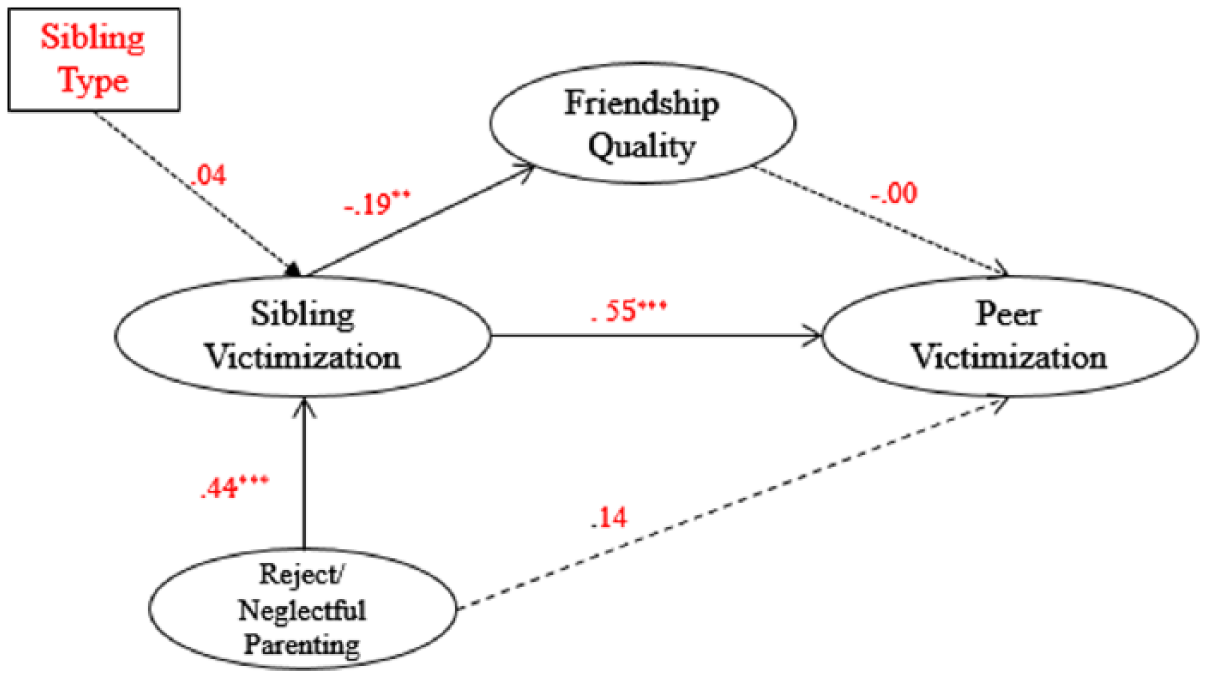
Special emphasis was given to the investigation of the functions of rejecting/neglecting parenting and sibling victimization. More specifically, we tested the model (as shown in Figure 1) where rejecting/neglecting parenting was related to sibling victimization, which, in turn, was directly associated with peer victimization and indirectly through poor friendship quality. In addition, we tested if there were gender differences in these associations. An examination of these variables allows for a better understanding of how family and school contexts interact, and ultimately facilitates multidimensional research and intervention directed at individuals, families, and schools.
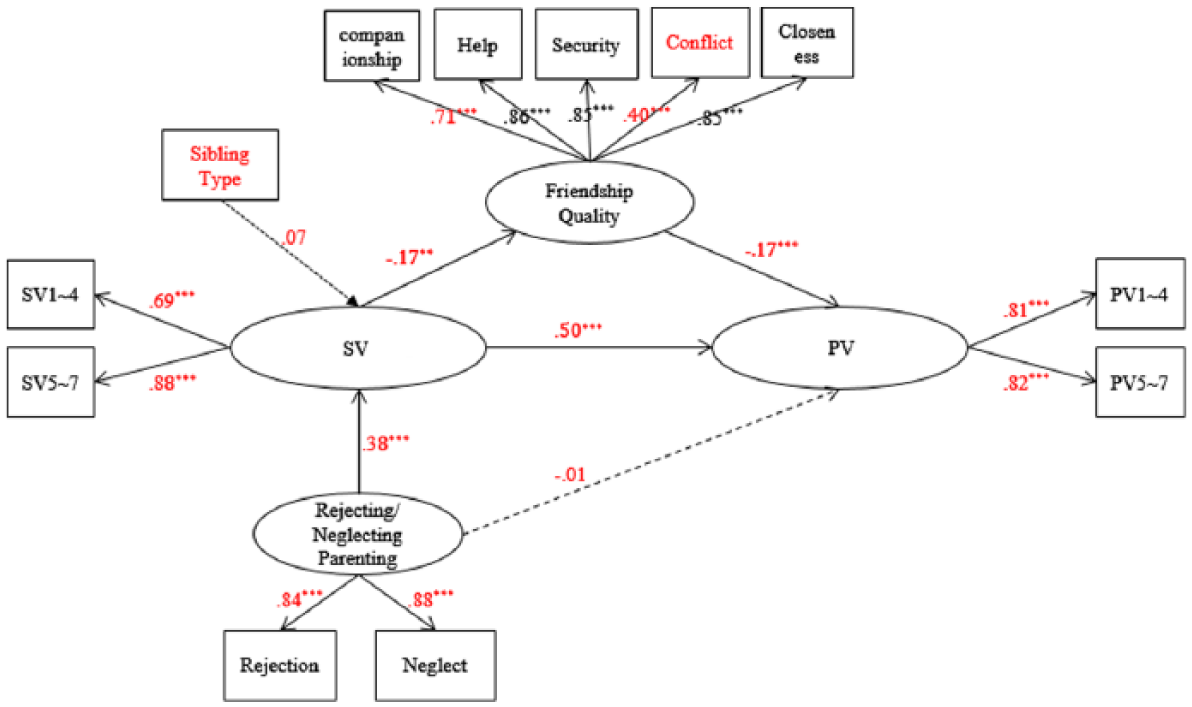
Structural equation model.
Method
Participants
A total of 676 students, Grades 3 to 6, in one elementary school in Korea, participated in this study. This school was located in the city of Bundang, which covers areas of middle-class socio-economic backgrounds (Choi, 2015; Seongnam City, 2013). Of the 676 students, however, 87 were removed because they did not have any siblings. In addition, those children who had siblings more than 4 years apart were excluded because large age gaps (more than 4 years) might not be related to bullying/victimization dynamics (Menesini et al., 2010). A final sample of 584 students (n = 293 female, n = 291 male) was retained for subsequent analyses. There were no missing data in the final sample. Of 584 participants, 228 (39%) had a younger sibling, 303 (51.9%) had an older sibling, and 53 (9.11%) had both younger and older siblings. All participants identified themselves as Koreans and lived in the same middle-class neighborhood.
Measures
We used an online survey consisting of the following measures: the (a) demographic questionnaire, (b) Parental Acceptance–Rejection Questionnaire (PARQ; Rohner, Saavedra, & Granum, 1980), (c) revised Olweus Bully/Victim Questionnaire (OBVQ; Olweus, 1991), and (d) Friendship Quality Scale (FQS; Bukowski, Hoza, & Boivin, 1994).
Demographic questionnaire
The demographic questionnaire included questions regarding the participant’s age, grade, and sibling type (younger, older, or both). In addition, we asked whether they had siblings who were 4 years younger or older than them.
Rejecting/neglecting parenting
The Korean version of the PARQ was used to measure the participants’ perception of how rejecting/neglecting their parents were. The PARQ consists of 28 items and yields four subscales. The four subscales are Warmth/Affection (10 items), Hostility/Aggression (six items), Undifferentiated Rejection (six items) and Indifference/Neglect (six items). While the first two subscales (i.e., Warmth/Affection and Hostility/Aggression) measure the level of perceived acceptance, the latter two subscales (i.e., Undifferentiated Rejection and Indifference/Neglect) measure the level of perceived reject/neglect. In this study, we only measured the Undifferentiated Rejection (e.g., “They often forget things that they need to do for me”) and Indifference/Neglect (e.g., “They are indifferent about me”) subscales to create a total score of perceived rejecting/neglecting parenting. Each item was rated on a 4-point rating scale (1 = never, 4 = always). Total scores ranged from 12 to 48, with higher scores indicating greater perception of rejecting/neglecting parenting. A coefficient alpha in the present study was .87 for total scores (.76 for undifferentiated rejection and .77 for indifference/neglect).
Sibling and peer victimization
The Korean version of the revised OBVQ was used to measure the frequency that the participants had been bullied by their siblings and/or peers. The OBVQ consists of seven items corresponding to different methods used in bullying (e.g., hitting/kicking, calling names, excluding/ignoring, spreading rumors, stealing, damaging belongings). The same seven items were asked to assess the frequency of victimization at home with the sibling and at school with the peer. The participants first read a definition of bullying and rated each item on a 5-point scale (1 = never, 5 = several times per week). Total scores ranged from 7 to 35 for sibling and peer victimization, with higher scores indicating greater frequency of experiencing sibling bullying at home or peer bullying at school. A coefficient alpha in the present study was .80 for sibling victimization and .83 for peer victimization.
Friendship quality
The Korean version of FQS was used to measure the participants’ perception regarding their relationship with their best friend. The FQS consists of 23 items and assesses five dimensions of the friend relationship, including companionship (four items), help (five items), closeness (five items), security (five items), and conflict (four items). The companion dimension measures a composite of behaviors involving play, close associations, and company (e.g., “My friend and I spend a lot of our free time together). Help measures the participants’ perception that their friend will help and protect them (e.g., “My friend would help me if I needed it”). Closeness evaluates the participants’ feeling of being appreciated and loved by their friend (e.g., “I feel happy when I am with my friend”). Fourth, security assesses the participants’ perception about the stability of their friendship in spite of conflicts and their trust in friend (e.g., “If I have a problem at school or at home, I can talk to my friend about it”). Last, conflict assesses the participant’s perception about how much conflicts that they have with their friend (e.g., “I can get into fights with my friend.”). Each item was rated on a 5-point scale (1 = never, 5 = always). Scores on conflict were reverse-coded. All scores ranged from 23 to 115, with higher scores indicating higher quality of relationship with a best friend. A coefficient alpha in the present study was .77 for companionship, .86 for help, .88 for closeness, .74 for security, and .78 for conflict.
Procedure
The first author contacted the school principal and explained the goal, procedure, and implications of the study. The principal and teachers decided to include the measures relevant to the current study in their regular biannual student survey assessment package to assess the levels of bullying and victimization at their school for their own data collection purposes. At the start of the school year, a letter was sent home to parents informing them about the biannual student survey, giving the parents the option to decline their child’s participation in the survey. No parents declined consent. Teachers conducted the biannual student survey (which included the measures of this study) and provided the first author with a portion of the de-identified data to be used for this study. According to the Korean Elementary and Secondary Education Act (2011), “the head of the school (e.g., school principal) can disclose student-related materials without the consent of the student’s guardians or parents when materials are used for the purpose of compiling statistics and conducting a research study in a manner that makes it impossible to identify any specific individual”.
Data were collected in the following ways. First, students were informed that participation in the survey was voluntary and the information they supply would be treated as confidential. They were also reassured that their grades will not be affected by their decision to participate in the survey and that they can withdraw from the survey at any point. Second, those students who agreed to participate in the survey completed the survey online at the school computer lab during their extracurricular classes under the supervision of class teachers. All students agreed to participate in the survey, leading to 100% response rate. After completing the survey, participants were debriefed and given contact information of the principal in case they or their parents had any questions or concerns.
Results
Preliminary Analyses
As Table 1 shows, the correlations among all the study variables were significant. Rejecting/neglecting parenting was positively related to sibling victimization and peer victimization while it was negatively related to friendship quality. Sibling victimization was negatively related to friendship quality but positively related to peer victimization. Friendship quality was negatively related to peer victimization.
Means, Standard Deviations, and Intercorrelations of Study Variables.
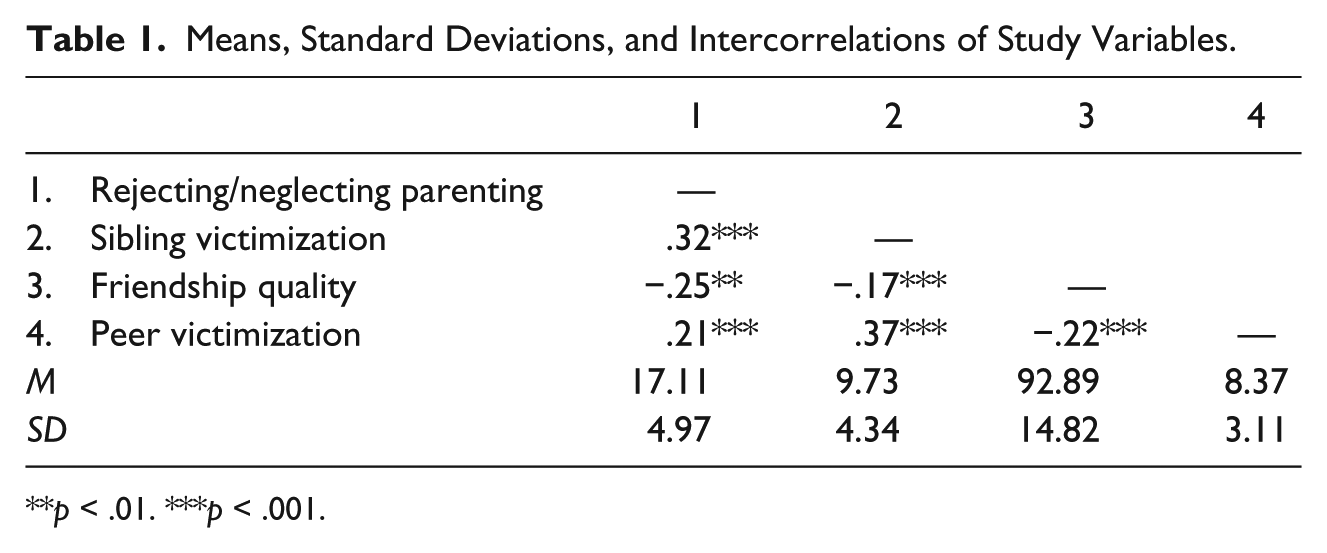
p < .01. ***p < .001.
A series of independent t tests were conducted to explore gender difference on the study variables. Results indicated that there were significant gender differences on rejecting/neglecting parenting (t = 3.72, p < .001) and friendship quality (t = −2.78, p < .01). Male students reported significantly higher rejecting/neglecting parenting than their female peers whereas female students reported significantly higher friendship quality than their male peers. Male students reported more sibling and peer victimization than female students, but these differences were not statistically significant. In addition, we performed one-way ANOVAs to test whether there were differences in sibling and peer victimization by sibling type (younger, older, or both). Results indicated that there was a significant difference on sibling victimization by sibling type (F = 4.30, p < .05) in that those students who had older siblings reported experiencing sibling victimization more frequently than those who had younger siblings. However, no significant differences were found in rejecting/neglecting parenting, friendship quality, or peer victimization.
Testing of the Hypothesized Model
We tested the measurement and structural models using structural equation modeling with M-plus 7.4 (Muthén & Muthén, 2012), applying maximum likelihood estimation, and sibling type (younger, older, or both) was included as a control variable. As suggested by Hu and Bentler (1999), we evaluated the fit of the model using χ2 statistics, the root mean square error of approximation (RMSEA), the standard root mean square residual (SRMR), the comparative fit index (CFI), and the Tucker–Lewis Index (TLI).
Because the OBVQ has a single factor, item parceling was used to develop indicators of two latent variables (i.e., sibling victimization and peer victimization). Results indicated that the fit of the measurement model was good, χ2(38, N = 584) = 172.44, p < .001, CFI = .95, TLI = .93, RMSEA = .08 (90% confidence interval [CI] = [.07, .09]), SRMR = .05. In addition, all measured variables in the measurement model loaded significantly (p < .001) on their latent factors. The fit of the structured model was also good, χ2(39, N = 584) = 198.83, p < .001, CFI = .95, TLI = .93, RMSEA = .07 (90% CI = [.06, .08]), SRMR = .06.
Figure 1 presents the structural model with the standardized path coefficients and their level of significance. All paths were significant except rejecting/neglecting parenting → peer victimization. In addition, the indirect effect of sibling victimization on the relation between rejecting/neglecting parenting and peer victimization was significant (β = .19, p < .001). The indirect effect of friendship quality on the link between sibling and peer victimization was also significant (β = .03, p < .01).
Gender Difference Analysis
To test for possible gender differences on the structural model, we performed multi-group analysis in the following three phases (Yuan & Bentler, 2004): (a) we tested an unrestricted model where factor loadings and structural paths were freely estimated between males and females, (b) in a semi-restricted model, we constrained factor loadings to be invariant between males and females while structural paths were freely estimated, and (c) a fully restricted model was tested, assuming equal factor loadings and structural paths between males and females.
As shown in Table 2, the indices indicated a good fit for both the unrestricted and semi-restricted models. According to a χ2-difference test, the unrestricted and semi-restricted model were not significantly different from each other, χ2(7) = 14.06, p = .05. This finding confirmed measurement invariance between males and females, which allows gender group comparison. Furthermore, the indices indicated a good fit for the fully restricted model. Another χ2-difference test was conducted to compare the semi- and fully restricted model, and test reached significance, χ2(5) = 19.20, p < .001. Such result indicates that the semi-restricted model fits the data better than fully restricted model. As such, the interrelations among the study variables were different for males and females, which implies structural differences across sexes (Loehlin, 1992).
Fit Indices for Three Steps in Multi-Group Analysis.
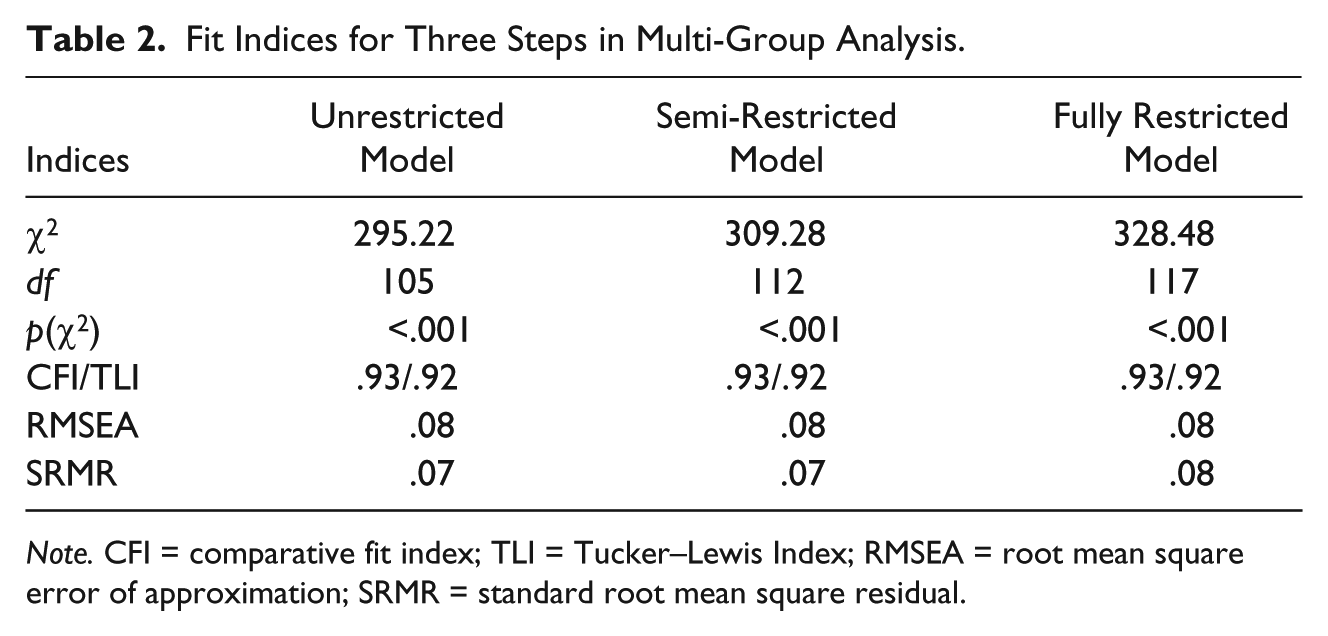
Note. CFI = comparative fit index; TLI = Tucker–Lewis Index; RMSEA = root mean square error of approximation; SRMR = standard root mean square residual.
As shown in Figures 2 and 3, rejecting/neglecting parenting significantly predicted sibling victimization for both males and females. In addition, sibling victimization significantly predicted friendship quality and peer victimization. However, rejecting/neglecting parenting did not significantly predict peer victimization for either male or female. Consistent with original SEM model, indirect effects of rejecting/neglecting parenting (β = .15, p < .001 for males; β = .24, p < .001 for females) on peer victimization through sibling victimization were significant for both males and females.
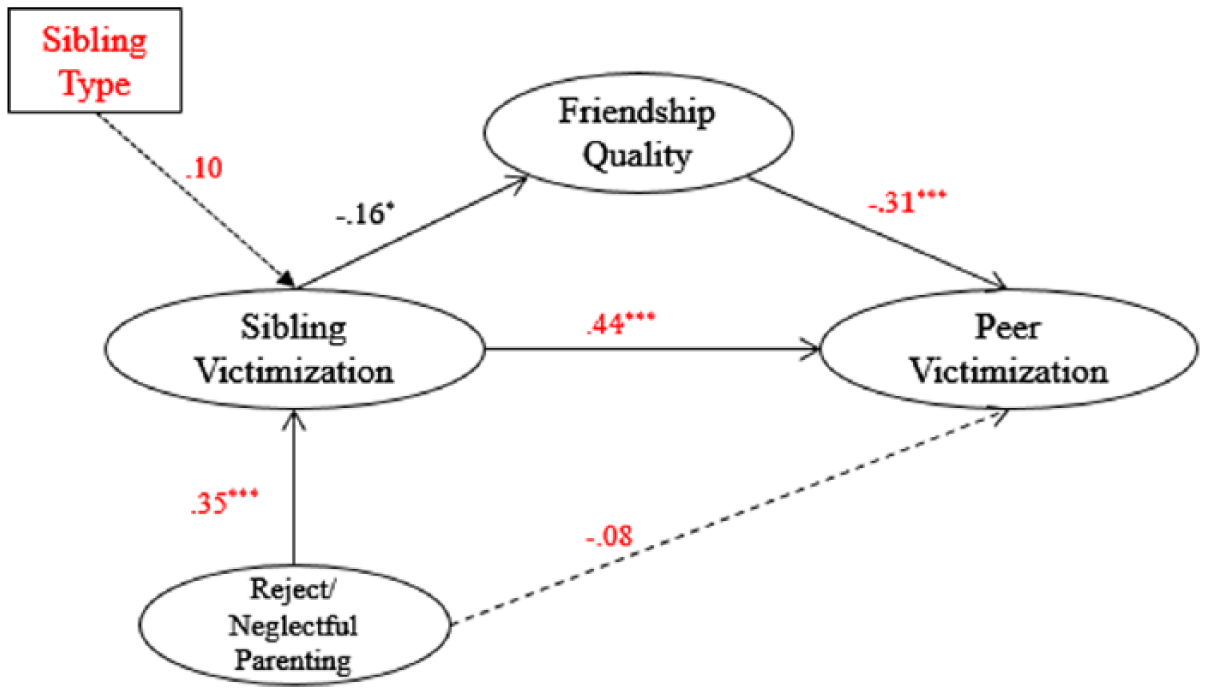
Structural equation model for males.
Structural equation model for females.
The main structural differences between the models for males and females were found for the direct path from friendship quality to peer victimization and for the indirect path from sibling victimization to peer victimization through friendship quality. For males, friendship quality negatively influenced peer victimization while this relationship was not significant for females. In addition, for males, the mediating effect of friendship quality on the relation between sibling victimization and peer victimization was significant (β = .05, p < .05) while it was not for females (β = .00, p = .97).
In addition, we compared all the significant path coefficients between males and females by constraining each path coefficient equal. There were two significant χ2 fit changes: (a) the path from rejecting/neglecting parenting to peer victimization was stronger for females than males, χ2(1) = 4.50, p < .05, but both paths were not significant; and (b) the path from friendship quality to peer victimization was stronger for males than females, χ2(1) = 9.99, p < .01, and the path was significant for males only.
Finally, to better understand the moderating effect of gender on the relationship between friendship quality and peer victimization, we conducted hierarchical multiple regression, with friendship quality as a predictor, gender as a moderator, and peer victimization as an outcome variable. As shown in Table 3, the interaction term of friendship quality and peer victimization was significant (β = .14, t = 2.56, p < .01) and added a significant amount of the variance (ΔR2 = .01, ΔF = 6.30, p < .01). This finding suggests that gender significantly moderated the relationship between friendship quality and peer victimization. More specifically, the (negative) relationship between friendship quality and peer victimization was significantly stronger among males compared with females. In terms of mean differences, when friendship quality was low, males reported higher peer victimization than females, and when friendship quality was high, females reported higher peer victimization than males (see Figure 4).
Hierarchical Regression Results With Peer Victimization as Outcome.

Note. Model fit: F(2, 581) = 21.44, p < .001, R2 = .07, second block ΔR2 = .01, ΔF(1, 580) = 6.30.
p < .01. ***p < .001.
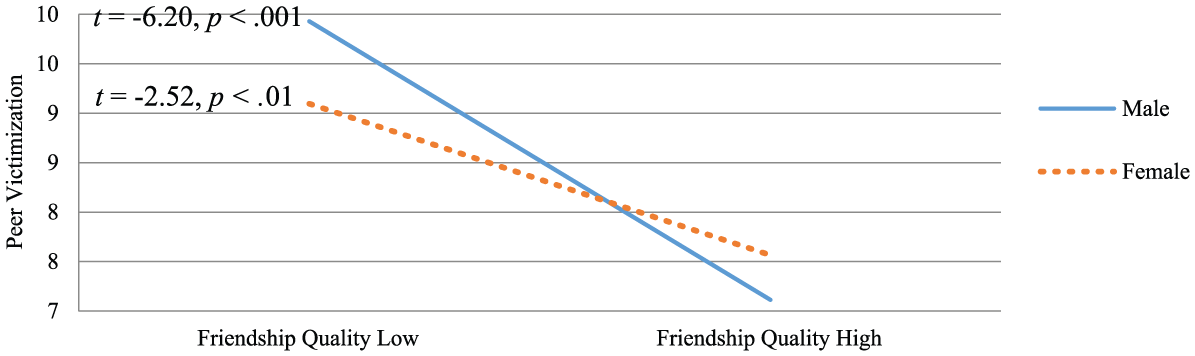
Moderating effect of gender on the relationship between friendship quality and peer victimization.
Discussion
The present study examined to what extent rejecting/neglecting parenting, sibling victimization, and friend quality would be associated with peer victimization in a sample of Korean children. The significant findings in this study are that sibling victimization had no direct effect on peer victimization, but indirectly influenced peer victimization through rejecting/neglecting parenting. In addition, friendship mediated the association between sibling victimization and peer victimization, and this effect of friendship quality was significant only for males.
Although the bullying literature includes several decades of empirical examinations on risk factors for peer victimization, it tends to emphasize the roles of schools in dealing with peer bullying (Monks et al., 2009). As a result, it offers little guidance to parents striving to prevent their children from being bullied at school (Wolke & Skew, 2012). This lack in the literature is somewhat surprising in light of evidence that parent–child and sibling relationships play a crucial role in a child’s social development (Tucker & Finkelhor, 2015) as well as a significant link between sibling experiences and peer problems (Menesini et al., 2010; Ostrov et al., 2006). Attempting to prevent peer bullying without effective collaboration between parents and schools is likely to be ineffective. By identifying family risk factors for poor quality of friendship and peer victimization in the present study, we hoped to provide parents and teachers with a greater focus, through which they can collaborate to prevent peer victimization.
More specifically, our results indicated that rejecting/neglecting parenting, as perceived by Korean children, was not directly related to peer victimization, but it did have an indirect effect on peer victimization through greater frequency of sibling victimization. That is, rejecting/neglecting parenting exerts a direct effect on sibling victimization, which, in turn, contributes to the risk of peer victimization. A significant link between rejecting/neglecting parenting and sibling victimization is consistent with previous research showing that negative parent–child interactions (e.g., rejection and neglect) predicted negative and aggressive sibling relations (Bryant & Crockenberg, 1980; MacKinnon-Lewis, Starnes, Volling, & Johnson, 1997), and that parents who often had conflicts with their children were likely to have offspring who engaged in sibling bullying (Wolke & Skew, 2012). Our findings are especially important, because they highlight the importance of understanding sibling victimization when predicting peer processes from parenting, and the family, including both interactions with parents and siblings, which serve as a training ground for children’s social behaviors with their peers.
Considering the previous research, two major mechanisms might contribute to the relationship between rejecting/neglecting parenting and sibling victimization. One mechanism may be through insecure attachment (Elliot & Cornell, 2009; Walden & Beran, 2010). From an attachment theoretical perspective, when parents are rejecting/neglecting, their children develop insecure attachment and display undesirable traits (e.g., low self-esteem, lack of social competence, a need to get approval and please others, and a lack of concern or empathy for other’s feelings; Ainsworth & Bowlby, 1991). Siblings with such traits are likely to have increased conflicts and a risk for sibling bullying and victimization (Elliot & Cornell, 2009; Whiteman, McHale, & Soli, 2012). Another mechanism is through the lack of parental supervision and involvement in sibling conflicts. Children in homes marked by poor parental monitoring spend much time with each other in the absence of an adult, which provides significant opportunities for one sibling to bully the other (Espelage et al., 2000). Moreover, rejecting/neglecting parenting is associated with low parental involvement in sibling conflicts (McHale, Updegraff, Tucker, & Crouter, 2000) and, therefore, increases the risk of sibling bullying and victimization (Hoetger et al., 2015).
It is important to note that the relationship between rejecting/neglecting parenting and peer victimization was stronger for females than males. This finding is in line with the notion that a lack of parental monitoring and control is linked to bullying involvement only in girls (Boel-Studt & Renner, 2013). Similarly, Finnegan et al. (1998) found that perceived maternal rejection was associated with female victimization, whereas maternal protectiveness was associated with male victimization. As Ehnvall, Parker, Hadzi-Pavlovic, and Malhi (2008) noted, these findings are interpreted as females being more sensitive to rejection from parents than males who tend to dismiss negative emotions.
Consistent with recent investigations on the close association between sibling experiences and peer problems outside the family (e.g., Criss & Shaw, 2005; Menesini et al., 2010; Wolke & Skew, 2012), the findings from this study lend support to the “carry-over” effects from sibling victimization to peer victimization (Wolke & Samara, 2004; Wolke & Skew, 2012). Victims of sibling bullying tend to demonstrate behavioral and internalizing problems (Wolke & Samara, 2004), which increases the risk of having poor communication and problem-solving skills. It has been suggested that such problems of victims make them vulnerable to peer rejection and peer victimization (Olweus, 1991).
Results also pointed to the indirect effect of friendship quality on the relationship between sibling victimization and peer victimization. This result is similar to findings from other studies that indicate it is the quality of friendship rather than the presence of friends that determines whether the friendship will serve as a protective factor against peer victimization (Bollmer, Harris, & Milich, 2006; Hodges et al., 1999; Woods, Done, & Kalsi, 2009). This finding adds empirical evidence to support the effects of a low quality of friendship on increased risk for peer victimization in a Korean school context.
It is particularly interesting that the indirect effect of friendship quality on the association between sibling victimization and peer victimization was found only for males. This could be attributed to the fact that the (negative) relationship between friendship quality and peer victimization was significant only for males. Similarly, our multiple regression (post hoc) analysis revealed that the relationship between friendship quality and peer victimization was significantly stronger among males compared with females. One possible explanation for this finding is that research has shown that females, in general, report a higher quality of friendship and less peer victimization than males (Crick & Zahn-Waxler, 2003; Lee, 2009). As such, for females, having a high-quality friend would not make a significant difference on the risk of peer victimization. In particular, given females are more likely to be bullied with covert and “invisible” forms of aggression that are difficult for others (e.g., friends) to detect (Garandeau & Cillessen, 2006), a high-quality friend would not significantly change the risk of peer victimization.
However, it was found that, for males, high levels of friendship quality had a protective effect against the risk of peer victimization. This might be related to the fact that males tend to use bullying behaviors to obtain power and status in the peer group (Espelage & Holt, 2001) and that victims of peer bullying tend to have the lowest social status (Berger & Rodkin, 2009). Considering these characteristics of bullying among males, it can be inferred that males who have a high-quality best friendship can convey a message that there is at least one friend who can defend them against an attack, which discourages potential bullies. Another interpretation is related to how males and females respond to conflicts in a different way. Research has shown that whereas females are likely to use a mitigating strategy (e.g., changing a topic, asking the other person’s feelings, or proposing a compromise), males tend to use physical force or threat to resolve conflicts (Black, 2000). In other words, compared with females, males are likely to respond to peer bullying with increased aggression and externalizing behaviors, and this might be because they have observed older males coping with their stressors with aggression (Lamarche, Brendgen, Boivin, Vitaro, & Perusse, 2006). In addition, as physical victimization is more closely associated with loss of status in the peer group for male than females, males tend to attempt to get back at those who have bullied them (T. Sullivan et al., 2006). Such responses to peer bullying may put males at a higher risk for continued peer victimization. However, having a high-quality friendship could prevent males from fighting back as a response to peer provocation, which, in turn, decreases aggressive interactions with peers and discontinues peer victimization (Kochenderfer & Ladd, 1997). However, as to gender differences, given the limited literature on this topic, our explanations on these dynamics are speculative. Future research should examine gender differences in considering the potential peer factors that account for the relationship between sibling victimization and peer victimization.
The present study has several limitations. First, we used a convenience sample from one school of Korea, which limits the generalizability of the current findings to all Korean children or children in other countries. In particular, the participants of the study came from middle socio-economic class so our findings could only be generalized to Korean children in middle-class, suburban school districts, and perhaps not to poor or rural Korean children. Second, a cross-sectional design and the use of only self-report data are further limitations of the present study. Future studies are needed to include more representative samples of Korean children from more diverse socio-economic backgrounds. Collecting longitudinal data that involve reports from siblings, peers, and parents about bullying and friendship quality would also be important areas of future research. In particular, although some evidence suggests that regardless of whether or not parents are actually rejecting/neglecting, merely perceiving parents as such influences a child’s future experiences (Young, Lennie, & Minnis, 2011), it is critical to include parent report of parenting. Third, we assessed rejecting/neglecting parenting and sibling victimization without considering parental aggression/hostility or inter-parental factors (e.g., parental marital dissatisfaction and conflict management style; Milevsky, 2004). It is recommended that future studies of bullying examine the mechanisms through which parental aggression/hostility and marital dynamics are associated with sibling and peer victimization. Fourth, our study focused on victims of sibling and peer bullying but considering rejecting/neglecting parenting, sibling bullying, and friendship are also related to peer perpetuation (Spriggs et al., 2007), future studies need to examine whether this study’s findings would be replicated in a Korean children sample of peer perpetrators. Fifth, while the current study only considered rejecting/neglecting parenting, examination on positive aspects of parenting (e.g., warmth/affection) would help to illuminate what types of parenting might be beneficial to prevent or decrease sibling bullying. As such, we suggest that future research include both negative and positive parenting styles. Finally, we did not examine the possible differences regarding passive victims and aggressive victims. As to the latter subgroup, research has indicated that aggressive victims are more likely to be rejected by peers and show more externalizing and internalizing problems than passive victims (Schwartz, 2000; Schwartz, Dodge, Pettit, & Bates, 1997). Therefore, future research needs to examine whether children who are both aggressive and victimized in the context of sibling relationships differ from those who are just victimized in terms of friendship quality and experiences of peer victimization.
In spite of these limitations, a particular strength of this study is the inclusion of both parental and sibling factors as predictors of peer victimization. Although some studies have examined the links between parenting practices and children’s peer relationship and between sibling interactions and peer relationships, the current study extends those lines of research by simultaneously examining rejecting/neglecting parenting and sibling victimization, which have been relatively neglected in the family and bullying literature. Our findings suggest that it is crucial for parents to understand how their behaviors and a child’s experience with siblings in the home can determine the risk for victimization in peer contexts. In addition, anti-bullying programs need to involve parents and address not only peer bullying but also rejecting/neglecting parenting, sibling bullying, and friendship quality.
Footnotes
Declaration of Conflicting Interests
The author(s) declared no potential conflicts of interest with respect to the research, authorship, and/or publication of this article.
Funding
The author(s) received no financial support for the research, authorship, and/or publication of this article.