




Abstract
Traditionally, most dating violence research has focused on physical aggression and has left stalking behaviors largely unexamined, despite evidence that stalking of an intimate partner occurs with high frequency. Moreover, the extent to which stalking victimization has the same negative mental health consequences as other forms of dating violence is unclear. Thus, using a sample of male and female undergraduate students in current dating relationships (N = 357), the association between stalking victimization and alcohol and drug use was explored. Results indicated that for both men and women, stalking victimization from a dating partner was related to alcohol and drug use, even after controlling for age, gender, length of dating relationship, and physical aggression victimization. These preliminary findings suggest that stalking victimization is associated with deleterious consequences; thus, additional research is needed to better understand the longitudinal, long-term consequences of stalking victimization. Additional implications and directions for future research are discussed.
It has been well documented that dating violence among college students occurs at an alarming rate (e.g., Shorey, Cornelius, & Bell, 2008). Historically, physical aggression has been the primary focus of dating violence research in college populations. Compared with other types of violence, physical aggression is relatively easier to operationalize and represents a significant problem within the college dating population. Approximately 30% of students will experience physical aggression perpetrated by a dating partner annually (Bell & Naugle, 2007), and this rate is similar across men and women (Straus, 2008). The consequences of such victimization can be severe, with many victims reporting lower self-esteem, lower cognitive functioning, and mental health problems, including depressive symptoms, increased anxiety, and alcohol and drug use (e.g., Ansara & Hindin, 2011; Davis, Coker, & Sanderson, 2002; Shorey et al., 2008; Shorey, Stuart, & Cornelius, 2011). Although there has been a proliferation of research on the prevalence and impact of physical aggression, there has been a dearth of research on a different form of dating violence that occurs among intact relationships: stalking. Thus, the purpose of the present study was to examine whether stalking victimization from a current dating partner was associated with substance use (alcohol and drug) among dating college students.
Stalking
In the current article, stalking in the context of a dating relationship is defined as a willful, malicious following and/or harassing of one’s partner that can be perceived as unwanted or engenders fear. This conceptualization is similar to previous definitions of stalking (e.g., Douglas & Dutton, 2001; Duntley & Buss, 2012; Shorey, Cornelius, & Strauss, 2015; Tjaden & Thoennes, 1998). While some authors contend that behaviors will only constitute stalking if it is repetitive and engenders fear in the victim (Prucell, Pathe, & Mullen, 2002; White, Kowalski, Lyndon, & Valentine, 2000), we believe that stalking in the context of any relationship does not necessarily need to engender fear to meet the definition of stalking, as fear is a narrow outcome that will vary across situations and behaviors. Indeed, other researchers have indicated that fear is not an integral component to the definition of stalking (Duntley & Buss, 2012). The authors contend that by excluding those who do not feel fear, but may still perceive the behavior as unwanted, a portion of victims of stalking would be missed because they may not yet be at a point where they have become fearful. Thus, we have similarly made this part of the definition of stalking in the current study optional. Furthermore, stalking has often been defined as a “discrepancy in the level of contact desired by the two parties when one desires more contact than the other” (White et al., 2000, p. 374), which some believe can only occur after relationship termination. However, this discrepancy can also occur in the context of a current dating relationship, as it is plausible that not all of the contact between partners is consensual or wanted. In sum, for the purposes of this investigation, stalking is defined as purposeful following and/or harassing that engenders fear or is perceived as unwanted.
It is also important to briefly discuss how stalking may be similar or different from another type of dating violence, namely, psychological aggression. Psychological aggression can be defined as “aggressive behaviors such as ridiculing, verbal threats, isolating one’s partner from family and friends, and attempting to control one’s partner and attack his or her self-worth by making him or her feel guilty, upset, or inadequate” (Lawrence, Yoon, Langer, & Ro, 2009, p. 20). Although there is some conceptual overlap between stalking and psychological aggression, there are also distinct differences. As has been noted elsewhere (Shorey, Cornelius, & Strauss, 2015), psychologically aggressive behaviors typically arise out of direct interactions between partners. However, stalking does not necessarily occur within the context of a direct interaction between partners, and stalking can be perpetrated without the immediate awareness of the victim. Thus, these constructs, though similar in some respects, can encompass behaviors that are quite distinct.
The small body of literature on stalking in the context of a dating relationship has demonstrated that stalking victimization is associated with other forms of violence victimization, and occurs at similar rates to physical aggression (Slashinski, Coker, & Davis, 2003; Spitzberg & Cupach, 2007). According to a recent study by McNamara and Marsil (2012), 42.5% of college students (45.4% of women and 35.7% of men) reported being the victim of at least one instance of stalking, though the respondent’s relationship with perpetrators (i.e., stranger, romantic partner) was not reported. However, other studies have demonstrated that not only are general stalking victimization rates high, but the rates of being victimized by a previous or current romantic partner are high as well. The National Intimate Partner and Sexual Violence Survey (Black et al., 2011) found that of the 27.9% of men and 34.3% of women who reported being stalked for the first time between the ages of 18 and 24, 66.2% reported being stalked by a current or former partner. Similarly, in a large-scale investigation of a national sample of college women, findings demonstrated that of the women who knew their stalker, 42.9% were victims of stalking by a boyfriend or ex-boyfriend (Fisher, Cullen, & Turner, 2002).
Although these findings make it clear that romantic partners perpetrate stalking behaviors in their relationships, the majority of studies do not examine intact dating relationships exclusively. Indeed, it is more common for researchers to combine current and formers partners in their assessments as opposed to examining them separately, thus making it difficult to determine the prevalence of stalking victimization by a current partner. In an attempt to disentangle these statistics, in a recent study (Shorey et al., 2015), we documented the prevalence of perpetration and victimization of stalking among college students in current dating relationships. Specifically, our findings showed that across various types of stalking behaviors, 38.2% of participants reported perpetrating at least one act of stalking, and 36% reported victimization of at least one act of stalking by their current dating partner in the previous 6 months. Thus, it is clear that stalking occurs in intact relationships, making this an important form of dating violence to examine.
Stalking and Substance Use
Although the occurrence of stalking among intact dating couples is a prevalent problem, the impact of being stalked by a current partner on one’s mental health has not been examined. However, previous research has demonstrated that, in general, stalking victimization is associated with numerous negative outcomes. For example, in a sample of female undergraduate students who had been stalked, approximately 30% reported being “injured emotionally or physically” by the experience (Fisher, Cullen, & Turner, 2002, p. 36). Furthermore, Amar (2006) found that in a sample of college women, those who had experienced stalking were more like to report increased somatic symptoms, depression, hostility, and psychological distress.
Prior research also suggests that increased alcohol and drug use after violence victimization may be one especially salient outcome for college students. Indeed, it is well established that college students consume alcohol at high rates, and drug use among college students has increased in recent years (Johnston, O’Malley, Bachman, Schulenberg, & Miech, 2014). Thus, not surprisingly, previous research has demonstrated that other forms of dating violence victimization, including physical aggression, is associated with increased alcohol and drug use among male and female college students (see review by Shorey, Stuart, & Cornelius, 2011). Similarly, in a sample of participants who were involved in dating relationships drawn from the National Violence Against Women Survey (Tjaden & Thoennes, 1998), Slashinski and colleagues (2003) found that lifetime stalking victimization was associated with drug use for women, but not men. Recent stalking victimization (within the last 5 years) was also associated with heavy alcohol use (Slashinski et al., 2003) in women, though this association was not calculated for men due to insufficient power. However, these limited results were based on a sample of participants between the ages of 18 and 65, making the generalizability of findings to college students difficult. Thus, additional research is needed to determine whether stalking victimization is related to alcohol and drug use among dating college students.
Stalking Outcomes and Gender
One important consideration for research on the relationship between stalking victimization and substance use is whether this relationship is similar or different for men and women. Previous research on gender similarities and differences in outcomes following other forms of victimization has yielded mixed results. For example, Archer (2000) found that women experience more severe physical injury following physical victimization from an intimate partner. Similarly, Caldwell, Swan, and Woodbrown (2012) found that women generally experience more fear, posttraumatic stress, and greater relationship dissatisfaction than men following dating violence victimization. However, Próspero (2007) found that there were no differences in reports of various mental health problems (e.g., anxiety, depression) between men and women in college who had reported being victims of dating violence. Likewise, Shorey, Rhatigan, Fite, and Stuart (2011) found no gender difference in the relationship between physical victimization and alcohol use among dating college students. As it relates to stalking victimization specifically, it has been consistently reported that women tend to have more fear as a result of being stalked (Bjerregaard, 2000; Slashinski et al., 2003), and it is therefore possible that women may consume alcohol and/or drugs in an attempt to cope with their increased fear. Therefore, there is a need for research to determine whether there are gender differences in the association between stalking victimization and substance use. This information will provide researchers with a solid base from which additional research on the association between stalking, mental health, and gender can be developed.
Current Study
Given the dearth of research on correlates of stalking victimization within intact dating relationships, the aim of the present study was to examine the relationship between stalking victimization and substance use (alcohol and drug) in dating college students. Based on the research on stalking victimization in nondating couples and the literature on other forms of dating violence victimization, it was hypothesized that more frequent stalking victimization would be positively associated with drug and alcohol use, even after controlling for physical victimization, which is also associated with greater substance use. Age and relationship length were also controlled for, as these factors are also associated with dating violence among college students (e.g., Marcus & Swett, 2002; Moore, Elkins, McNulty, Kivisto, & Handsel, 2011). Furthermore, because there is a dearth of research on gender differences in correlates of stalking victimization, we examined whether the association between stalking victimization and substance use differed for men and women. However, due to limited research in this area, we had no a priori hypotheses concerning possible gender differences.
Method
Participants
Men (n = 67) and women (n = 290) from a large Midwestern university who were at least 18 years old and reported being in a dating relationship for 1 month or longer at the time of the study participated. Participants who reported that they were married, engaged, or not between the ages of 18 and 25 were excluded from analyses (n = 14), as they were not representative of the typical dating college student. Most respondents had completed an average of 1.24 years of college (SD = 0.68) and were, on average, 18.64 years old (SD = 1.13). The average length of time participants had been dating their partner was 16.89 months (SD = 16.11), most were not living with their partner at the time of the study (94.1%), and the majority of students identified as heterosexual (94.4%). Most students also identified as Caucasian (91.3%), with the remainder of the sample identifying as African American (4.8%), Hispanic (1.7%), Asian (0.6%), and Native American (0.6%). This sample is a subsample of participants that has been reported on elsewhere (Shorey et al., 2015).
Measures
Demographics
A brief questionnaire was completed by participants that gathered information about their gender, age, sexual orientation, dating status, length of dating relationship, cohabitation status, and race.
Stalking
To assess experiences with stalking, a 32-item stalking measure was created and validated in the larger study from where the current data originate (Shorey et al., 2015). Items were derived from a conglomerate of other measures used previously to examine stalking (e.g., Amar, 2006; Basile, Swahn, Chen, & Saltzman, 2006; Bjerregaard, 2000; Chaulk & Jones, 2011; Coleman, 1997; Finn, 2004; Jordan, Wilcox, & Pritchard, 2007; Kraft & Wang, 2010; Menard & Pincus, 2012; Tjaden & Thoennes, 1998). In a manner consistent with other well-researched dating violence assessment instruments, this measure inquires about 16 different stalking behaviors and has respondents indicate how many times they were a perpetrator and victim of each item on a 7-point scale (0 = never, 1 = once, 2 = twice, 3 = 3-5 times, 4 = 6-10 times, 5 = 11-20 times, 6 = more than 20 times) in the past 6 months. Example of items examined on the measure include “Your partner went to your house even though you did not want him or her to” and “Your partner tried to monitor or find out about your behavior and/or activities by checking your Facebook/Myspace or other social networking site.” Other items include “Your partner spread false rumors about you through Facebook/Myspace or another social networking site” and “Your partner spied on you.” No items related to physically aggressive behaviors. A total victimization score was calculated by adding the midpoints for each item (e.g., 6-10 times would be scored as an 8), with higher scores indicating more frequent experiences with stalking victimization. For this sample, the internal consistency was .70.
Physical violence victimization
Physical violence was assessed using the Physical Assault subscale of the Revised Conflict Tactics Scales (CTS2; Straus, Hamby, Boney-McCoy, & Sugarman, 1996; Straus, Hamby, & Warren, 2003). Respondents endorsed the frequency of their physical victimization from their current dating partner using a 7-point scale (0 = never and 6 = more than 20 times) in the past 6 months. Sums of the midpoint of each item were calculated in the same way as the stalking measure (e.g., 6-10 times would be scored as an 8), and higher scores are indicative of more frequent physical violence. For the current sample, the internal consistency of this subscale was acceptable (α = .68).
Alcohol use and problems
Alcohol use and associated problems were assessed using the Alcohol Use Disorders Identification Test (AUDIT; Saunders, Aasland, Babor, de la Fuente, & Grant, 1993). This brief 10-item measure assesses frequency of alcohol use and severity of alcohol-related consequences in the past year. A sum score of items is calculated to yield a range of scores from 0 to 40. Higher scores indicate higher endorsement of alcohol use and alcohol problems. This measure demonstrated good reliability, with an internal consistency of .81 in the current sample.
Drug use and problems
Drug use was measured using the Drug Use Disorders Identification test (DUDIT; Stuart, Moore, Kahler, & Ramsey, 2003; Stuart, Moore, Ramsey, & Kahler, 2004). Similar to the AUDIT, this 14-item measure assesses how often the respondent used specific drugs (i.e., marijuana, opiates, cannabis, cocaine, hallucinogens, stimulants, sedative/hypnotics/anxiolytics, and other drugs) in the past year, as well as consequences associated with their reported drug use. Responses were summed and used to create a total score from 0 to 73, with higher scores indicating more frequent drugs use and drug-related problems. This measure also demonstrated acceptable internal consistency (α = .63).
Procedure
Participants were recruited from a university research participation system specific to the psychology department. After signing-up for the study through this online system, respondents were given access to an anonymous link to the study on SurveyMonkey.com. After confirming that they were at least 18 years of age and completing an informed consent, students were able to participate. Following their participation, students were debriefed and provided with contact information for the university counseling center and local domestic violence resources. Students also received partial course credit for their psychology course. These procedures were approved by the university’s institutional review board.
Data Analysis Plan
Using SPSS Version 18.0, we first examined bivariate correlations between all study variables and whether men and women differed on study variables using independent-samples t tests. To examine whether stalking victimization was associated with substance use above and beyond physical victimization and demographic control variables, as well as whether this association varied by gender, hierarchical regression analyses were conducted. Prior to conducting the regression analyses, a comprehensive evaluation of normality assumptions was conducted. No outliers were found and, once all relevant study variables were log-transformed, the data were observed to be acceptably normal, linear, homoscedastic, and showed evidence of independence of errors. Similarly, the tolerance and variance inflation factors (VIFs) for each predictor were close to 1, indicating that there was no presence of multicollinearity. The only exception was within the last step, in which the moderator (gender) was found to be correlated with stalking victimization. It should also be noted that all participants included in the analyses had no missing data for the variables of interest.
In the first regression analysis, alcohol use was the outcome variable, with age, gender, the length of the participant’s dating relationship, and physical aggression victimization entered into the first block, and stalking victimization entered into the second block. In the final step, an interaction term between stalking victimization and gender was entered into the model. Another hierarchical analysis was conducted in the same fashion with drug use as the main outcome of interest. All predictors were mean-centered prior to running these analyses (Aiken & West, 1991).
Results
Descriptive Statistics
Because of the skewed and kurtotic distribution of age, length of dating relationship, alcohol use, drug use, and both stalking and physical aggression victimization, these variables were log-transformed prior to analysis. Bivariate correlations between all study variables were then conducted separately for men and women (Table 1). For men, drug use was significantly and positively associated with alcohol use, and significantly and negatively related to age. For women, stalking and physical aggression victimization were positively related to each other and to alcohol and drug use. Drug use and alcohol use were also positively and significant associated in women. Furthermore, length of dating relationship and age and length of dating relationship and stalking victimization were positively correlated in women, whereas length of dating relationship and alcohol use were negatively related.
Bivariate Correlations Among Study Variables for Men and Women.
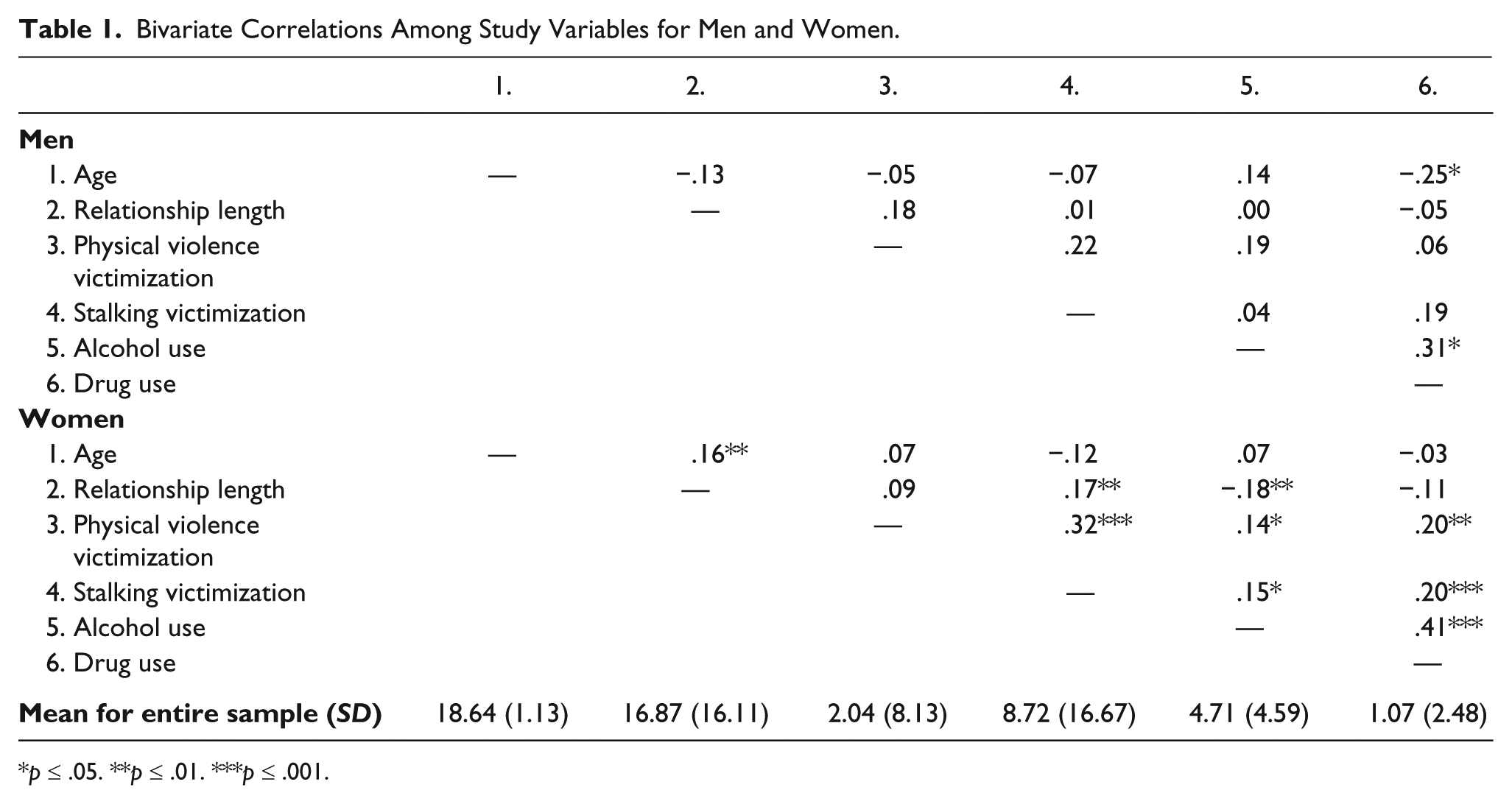
p ≤ .05. **p ≤ .01. ***p ≤ .001.
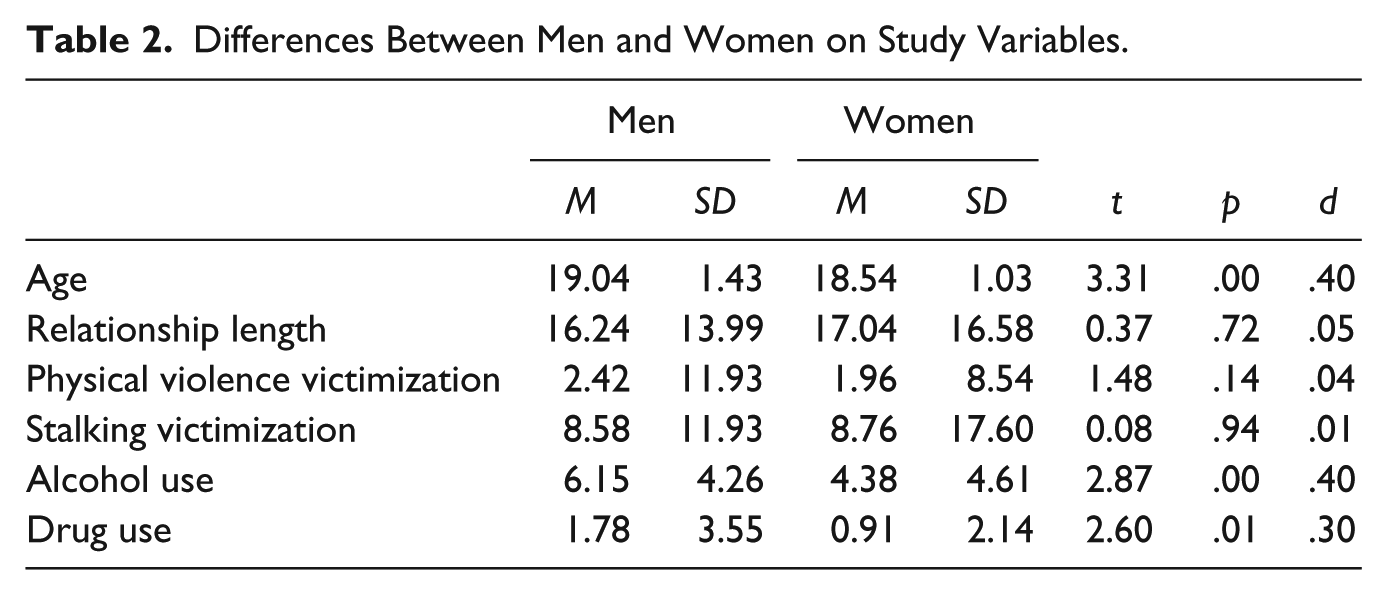
To determine whether there were significant differences between men and women on all study variables, a series of independent-samples t tests were conducted (Table 2). Men reported more alcohol and drug use and related problems, and were older than women. All remaining variables yielded no significant differences between men and women.
Differences Between Men and Women on Study Variables.
Hierarchical Regression Analyses
As displayed in Table 3, gender, the length of the participant’s dating relationship, and physical aggression victimization were significantly associated with alcohol use. Furthermore, in the second model, the addition of stalking victimization accounted for a significant amount of variance above and beyond the aforementioned variables. That is, stalking victimization was positively and significantly associated with alcohol use. Finally, the third model results indicated that gender did not moderate the relationship between stalking victimization and alcohol use.
Hierarchical Multiple Regression Analyses Predicting Alcohol Use.
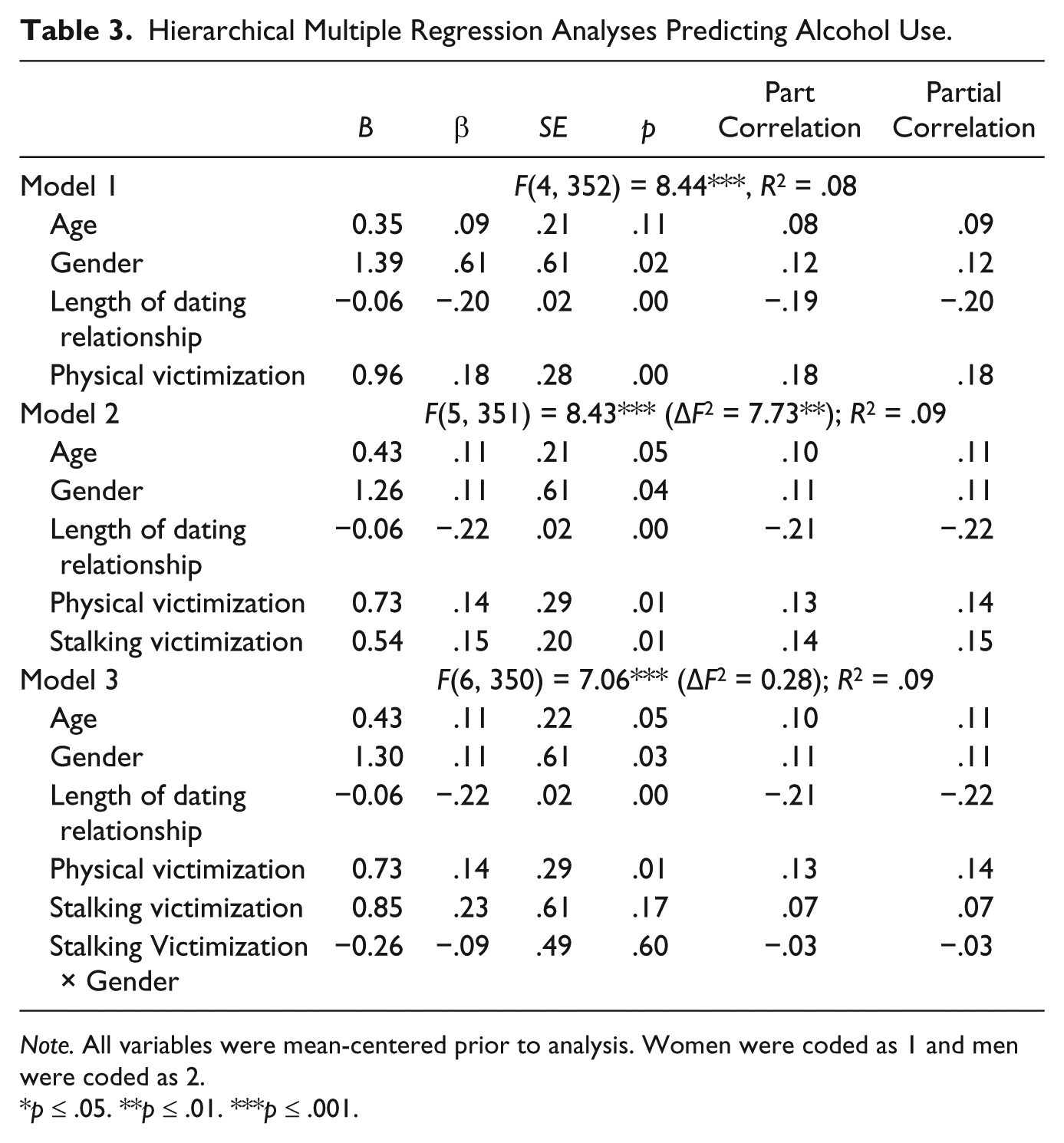
Note. All variables were mean-centered prior to analysis. Women were coded as 1 and men were coded as 2.
p ≤ .05. **p ≤ .01. ***p ≤ .001.
Similarly, gender, length of the participant’s dating relationship, and physical aggression victimization were related to participant’s drug use (Table 4). The results also indicated that stalking victimization significantly predicted drug use above and beyond demographic controls, such that more frequent stalking victimization was associated with more drug use and problems. Once again, results demonstrated that gender did not moderate the relationship between stalking victimization and drug use.
Hierarchical Multiple Regression Analyses Predicting Drug Use.
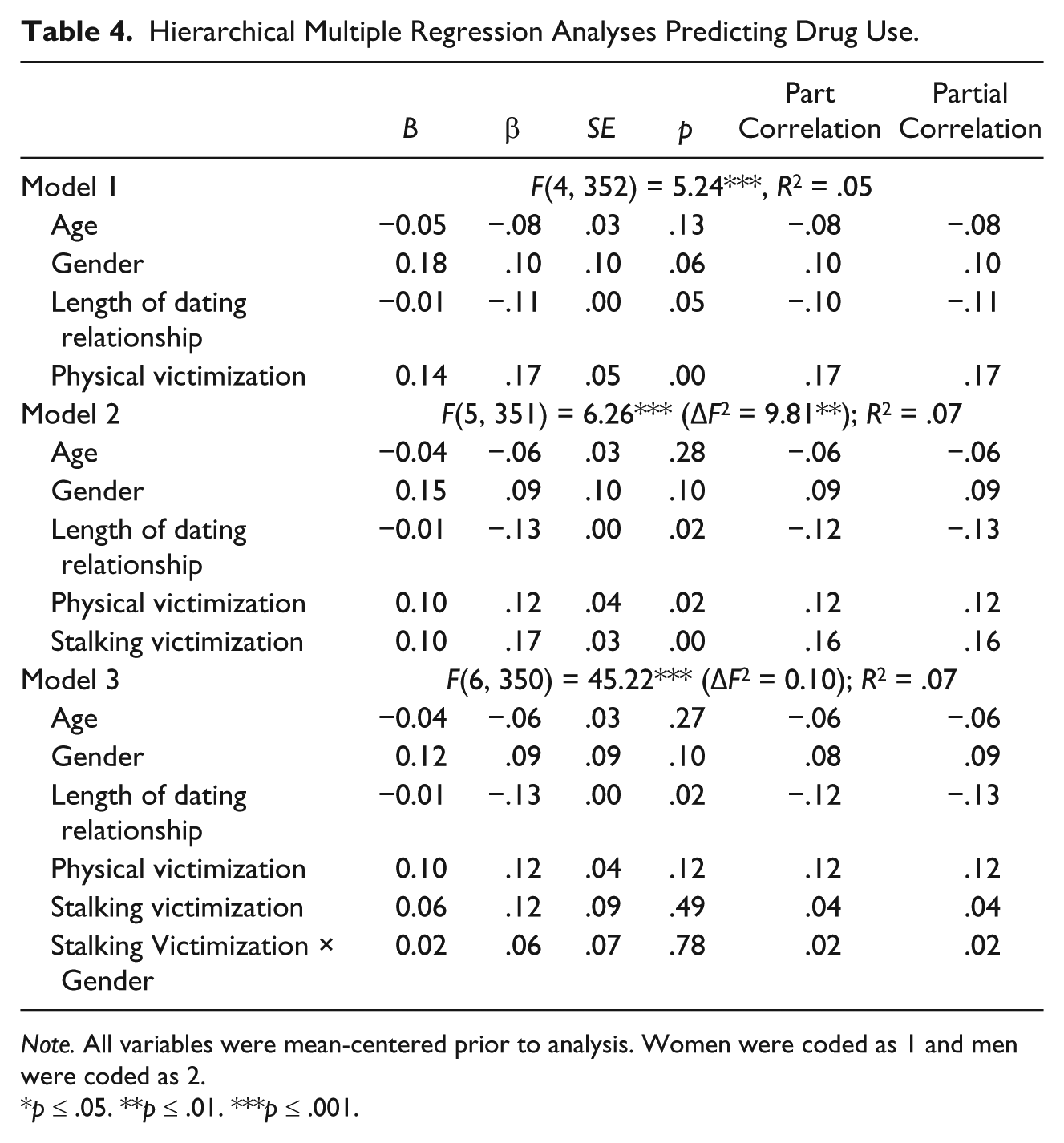
Note. All variables were mean-centered prior to analysis. Women were coded as 1 and men were coded as 2.
p ≤ .05. **p ≤ .01. ***p ≤ .001.
Discussion
Previous research has largely neglected to explore stalking that occurs in the context of current dating relationships. Moreover, despite research demonstrating victims of other forms of dating violence (e.g., physical victimization) are at increased risk for alcohol and drug use, we are unaware of any research that has examined whether stalking victimization is associated with alcohol and drug use among currently dating college students. Therefore, the goal of this study was to examine this association in a sample of currently dating college students, as well as to determine whether this association varied across men and women. Overall, findings supported our hypothesis that stalking victimization would be associated with alcohol and drug use.
Stalking victimization was associated with alcohol use and related problems for both men and women in the regression analyses after accounting for physical victimization, age, gender, and relationship length. Overall, these findings are not surprising, as other forms of dating violence have been shown to be associated with poor outcomes, including increased alcohol use (e.g., Shorey, Stuart, & Cornelius, 2011). These findings are also consistent with the results of Slashinski and colleagues (2003), which demonstrated that stalking victimization was associated with alcohol use for women, and extended these findings by demonstrating this association for men in the regression analyses. Although our study is preliminary, these results add to a large body of research demonstrating victims of various types of violence are at risk for substance use.
Findings also extended previous research by demonstrating that stalking victimization was associated with drug use and problems even after controlling for physical victimization and demographic controls. Drug use as an outcome of dating violence victimization has received less attention relative to alcohol use (Shorey, Stuart, et al., 2011), which is likely due to the lower prevalence of drug use among college students relative to alcohol use. However, as drug use appears to be increasing among college students (Johnston et al., 2014), the examination of drug use is increasingly important. Although this finding should be considered preliminary and replicated in future studies, it suggests that research is needed to understand the mechanisms behind this association, such as whether victims of stalking use drugs (or alcohol) in an attempt to cope with their victimization experiences.
Our findings also demonstrated that gender did not moderate the relationship between stalking victimization and alcohol and drug use. This is consistent with findings from previous research that violence victimization affects both men and women in similar ways (e.g., Shorey, Rhatigan, et al., 2011), although there are additional studies that suggest the impact of victimization may be more severe for women (e.g., Caldwell et al., 2012). Thus, our preliminary results suggest that the relationship between stalking victimization and substance use is similar for men and women, and support the notion that dating violence victimization is associated with negative outcomes regardless of the gender of the victim. However, additional research is needed to replicate our findings before firm conclusions regarding gender similarities and differences can be made.
Directions for Future Research
There are a number of directions for future research on the association between stalking victimization and substance use, or other mental health outcomes. First, our findings were not able to determine whether substance use was being used by victims as a method to cope with their victimization, which has been one explanation provided for why substance use is increased among victims of dating violence (Shorey, Rhatigan, et al., 2011). Thus, future research that uses longitudinal designs should attempt to determine whether coping motives is one mechanism responsible for this association. It will also be important for future research to determine whether the development of other mental health outcomes, such as depression and anxiety, may be associated with stalking victimization by a romantic partner. This is especially imperative given the previous research that has shown that other forms of dating violence victimization are associated with a variety of poor outcomes (e.g., Shorey et al., 2008) and research with nondating samples has demonstrated negative mental health outcomes associated with stalking (Fisher et al., 2002; Kuehner, Gass, & Dressing, 2007).
Related to the above areas of future research, factors associated with reduced risk for the development of mental health problems following stalking victimization, such as substance use, should be investigated. That is, previous research has demonstrated a number of factors may protect individuals from developing mental health problems after experiencing other forms of dating violence, including perceived social support (Shorey et al., 2011), adaptive coping skills (Macy, 2007), and having healthy levels of self-esteem (Carlson, McNutt, Choi, & Rose, 2002). Research in this area with stalking victimization will advance our understanding of how to help victims cope in the aftermath of victimization experiences.
Finally, our findings, combined with prior research documenting the problem of stalking by both current and former romantic partners suggests that dating violence intervention and prevention programs should include a focus on reducing stalking perpetration. As dating violence intervention and prevention programs have largely focused their efforts on reducing physical aggression (Cornelius & Resseguie, 2007; Shorey et al., 2012), it is likely that the vast majority of these programs fail to address stalking. Therefore, it will be important for future research to examine the intervention components that will be most effective at reducing stalking perpetration.
Limitations
There were a few notable limitations to this study. First, there is a lack of agreement in the literature on (a) the definition of stalking and (b) the most appropriate assessment tool to examine this complex construct. Thus, our study is limited in that some may not agree with our definition of stalking and measure utilized to assess this construct. However, we contend that the data collected in the study are a solid foundation from which to build future research on this important topic. Second, even though our analyses showed that stalking victimization was associated with both alcohol and drug use, the effect sizes were small. Thus, more research should be done on the nature and impact of stalking in this very specific context. Third, the study design was cross-sectional, and thus causality between substance use and victimization cannot be established. Longitudinal studies should be utilized in the future to address these issues. Furthermore, the sample was fairly homogeneous in regard to demographic characteristics, therefore making the results difficult to generalize to more diverse populations. Investigations in the future may specifically want to sample college students at different ages and with diverse cultural backgrounds to understand what impact these factors may have on the relationship between stalking victimization and substance use. In addition, the sample size for men was relatively small, and future research should utilize larger samples of men. Finally, although stalking victimization was associated with drug use, the base rate of drug use was relatively low in this sample, precluding the examination of individual types of drugs (e.g., cannabis, stimulants, opioids). Future research with larger samples should attempt to examine whether stalking victimization is associated with different types of drugs.
Conclusion
Historically, researchers have left the issue of stalking in the context of current dating relationships mostly untouched. However, not only do recent findings show that stalking does in fact occur in intact relationships, but our findings indicate that stalking victimization is associated with increased alcohol and drug use, after controlling for physical victimization and demographic factors. Moreover, the relationship between stalking victimization and alcohol and drug use was not moderated by gender. Thus, it is our hope that our study spurs additional research in this area to better understand the mental health correlates and outcomes of stalking victimization by a current dating partner.
Footnotes
Declaration of Conflicting Interests
The author(s) declared no potential conflicts of interest with respect to the research, authorship, and/or publication of this article.
Funding
The author(s) received no financial support for the research, authorship, and/or publication of this article.