



Abstract
Intimate partner violence (IPV) has many negative outcomes for women, children, and families. However, researchers have opposing perspectives and findings with respect to the effects on mothering for abused women. The assumption by some service providers that abused mothers are compromised in their parenting generally ignores the larger issue of male violence and women’s and children’s safety. The question examined in this study was whether there were differences in reported positive parenting responses with children between women who have experienced IPV and those who have not experienced IPV. The sample consisted of 1,211 mothers and came from two studies: The National Longitudinal Survey of Children and Youth, and The Healing Journey: A Longitudinal Study of Mothers Affected by Intimate Partner Violence. The Positive Interaction and Rational Parenting scales, adapted from Strayhorn and Weidman’s Parenting Practices Scale, were used to measure parenting interactions. Bivariate correlations between the outcome variables and maternal age, maternal education, child age, and child sex were calculated to determine whether any of these variables were significantly related to the Positive Interaction Scale or Rational Parenting Scale. This was followed by ANCOVA to determine whether mothers who had experienced IPV differed in their scores on the two parenting scales from mothers who had not experienced IPV. Findings did not support the notion that abused women are compromised in their parenting responses with their children in regard to positive interactions and behavior management. Recommendations include a greater focus on the prevention of IPV, addressing the source of violence and providing appropriate support for mothers who experience IPV.
Intimate partner violence (IPV) includes violent behavior of a physical, psychological, or sexual nature and is common worldwide (World Health Organization, 2013). In Canada, current or ex-spousal partners (married or common-law) perpetrated about half the incidents of violent crime reported by police in 2011, and the vast majority (approximately 80%) of the police-reported spousal violence victims were women (Statistics Canada, 2013).
IPV has many negative outcomes for women, children, families, communities, and societies. However, researchers have documented opposing perspectives and research findings with respect to the effects on mothering for women whose partners abuse them. Being a mother is associated with an increased risk of being abused by an intimate partner (Hazen, Connelly, Kelleher, Landsverk, & Barth, 2004), as is being younger and of childbearing age (Statistics Canada, 2013; Thompson et al., 2006). As mothers are generally more responsible for child-rearing than are fathers (Statistics Canada, 2013), the mother’s role in the child’s life is likely central and, therefore, anything that affects the woman and her mothering will likely impact the child. Furthermore, women abused by intimate partners might not receive support for the mothering role from their partners (Jouriles et al., 2000). In fact, many abusers try to undermine women’s parenting and/or destroy their relationships with their children as methods of control (Beeble, Bybee, & Sullivan, 2007).
While it is generally accepted that growing up in a violent home can negatively affect child development in ways such as increased aggression and externalizing problems (Margolin, 2005) and increased social withdrawal (Howell, 2011), some researchers query whether mothers whose partners abuse them may in turn be more sensitive and responsive to their children than mothers in nonabusive relationships (Haight, Shim, Linn, & Swinford, 2007; Letourneau, Fedick, & Willms, 2007; Levendosky, Huth-Bocks, Shapiro, & Semel, 2003). Conversely, others are concerned that the negative effects associated with IPV, such as posttraumatic stress disorder (PTSD) and depression, can interfere with a woman’s capacity to be a good mother as she may not have the emotional resources to nurture her children or may discipline them harshly (Malta, McDonald, Hegadoren, Weller, & Tough, 2012; Ritchie & Holden, 1998).
If service providers, especially those working in child protection agencies, assume that mothers affected by IPV are less able to nurture and positively guide their children, they may respond in unhelpful ways, including removing children from the home. Researchers have raised concerns that children are sometimes apprehended under faulty assumptions, such as abused mothers not being able to parent their children because of the violence perpetrated against them. The concept of “failure to protect” has been identified in cases of IPV, where children have been removed because of concerns that their mothers “fail to protect them,” by virtue of being in a violent relationship (Ewen, 2007; The “Failure to Protect” Working Group, 2000; Hartley, 2004; Magen, 1999; Miccio, 1995; Nixon, 2009; Strega, Krane, Lapierre, & Richardson, 2013; Trepiccione, 2001). A class action suit in New York provides an example where child protection workers removed children from the home without sufficient evidence that abused mothers pose a significant risk of harm to their children (Nicholson v. Scoppetta, 2004).
In the current study, we address the issue of mothering in the context of IPV by comparing responses on two positive parenting measures between mothers who experienced IPV and those who did not.
Parenting and Its Influences
The critical importance of positive and nurturing parenting and the effects on healthy child development are well established and documented. Such parenting involves sensitive child-rearing practices in which children are carefully monitored in a warm, caring, and responsive environment. Effective parenting also involves discipline and guidance within a nurturing environment to effectively encourage appropriate behavior. Parenting behaviors that involve inappropriate disciplinary responses (such as physical punishment and belittling behaviors) and low nurturance are associated with aspects of child maltreatment (Azar, Lauretti, & Loding, 1998; Budd, 2001). Although parenting behaviors are considered to be inclusive of both mothers and fathers, the focus in this article will be on mothers’ parenting behaviors or mothering behaviors.
Belsky’s (1984) model of the Determinants of Parenting describes the interrelationships of three sources of influence on parenting behaviors: (a) the parent’s personal history, psychological resources, and functioning; (b) contextual sources of stress and support; and (c) the child’s characteristics and individuality. Belsky’s theory includes the proposition that a deficit in one area may be buffered by strength(s) in another. Therefore, because parental functioning is influenced by many factors and their interrelationships, how IPV affects mothering is not straightforward. While the stress and hardships experienced by women in abusive relationships could understandably affect their emotional and physical availability to their children, individual personal resources and/or support from friends, family, or available social services can mitigate, if not eliminate, such negative effects. Therefore, it was of interest to examine how women whose partners have abused them respond to their children.
Parenting in the Context of IPV
Many children who live in homes in which IPV occurs have also been physically and/or sexually abused, usually by the perpetrator of the IPV (Davies & Krane, 2006; Herrenkohl, Sousa, Tajima, Herrenkohl, & Moylan, 2008; Jouriles, McDonald, Smith Slep, Heyman, & Garrido, 2008). Nonetheless, abused women are sometimes the perpetrators of the child maltreatment (Coohey, 2004; Magen, 1999). Covell and Howe (2009) suggested that the experience of IPV creates a problem with conflict resolution and control in the family, which makes it difficult to “disentangle” the effects of child physical abuse and IPV (p. 105). However, Lapierre (2010) found no clear evidence that women affected by IPV necessarily parent children in ways that are more negative or punitive than women not affected by IPV. Lapierre reported that abused women typically strive to be “good” mothers and develop a range of strategies to achieve “good” mothering both within and subsequent to the abuse. Other researchers have identified protective strategies specific to women abused by intimate partners, used in an effort to mitigate the negative effects on children of exposure to the abuse (Davies & Krane, 2006; Haight et al., 2007; Nixon, Bonnycastle, & Ens, 2017; Nixon, Tutty, Radtke, Ateah, & Ursel, 2017). For example, women may attempt to protect their children from direct violence by temporarily removing them from the violent situation or by avoiding situations that may lead to violent outcomes. As an attempt to reduce the emotional impact, women may also be more nurturing and attentive (e.g., spend more time with their children, provide positive affirmations to them, etc.) as a way to overcompensate for the violence to which their children are exposed.
However, there is evidence that in cases of IPV, child protection workers more often focus on the mother’s parenting capacity rather than providing safety and support for the abused mother and her children (Douglas & Walsh, 2010; Johnson & Sullivan, 2008; Nixon, 2002). This is reflected in the routine use of mandated parenting assessments and parenting programs for such women (Nixon, 2009). Focusing on the mother’s parenting capabilities not only ignores the direct perpetrator of the abuse (Strega et al., 2008), but it constructs the defining problem as women’s inability to parent or care for their children. By assuming that abused mothers are compromised in their parenting and unfit to care for their children, the larger issue of male violence (and women’s and children’s safety) is not addressed, and inappropriate, ineffective, and perhaps detrimental interventions may occur. Of significant concern is that abused mothers may be reluctant to disclose their abusive situations to helping professionals if they believe they could be perceived as “bad mothers” and subsequently that their children are at risk of apprehension (Nixon, 2009).
The current research examines the parenting behaviors of mothers whose partners had abused them by comparing responses of these mothers with responses of mothers who had not been abused. Belsky’s (1984) model of the Determinants of Parenting proposes that parenting behavior is influenced by many factors and, therefore, cannot be predicted by any particular circumstance, such as the experience of IPV. Parenting behavior is shaped by many factors, for example, education (Ateah & Durrant, 2005), and therefore, the presence/absence of abuse may not be a critical factor. The research question was: Are there differences in reported positive parenting responses with children between women who have experienced IPV and those who have not experienced IPV?
Method
The data for the current analyses came from two sources: The National Longitudinal Survey of Children and Youth (NLSCY; Statistics Canada, 2010) and The Healing Journey: A Longitudinal Study of Mothers Affected by Intimate Partner Violence (Healing Journey; DeRiviere, 2014). The NLSCY is a survey of a nationally representative sample of more than 30,000 Canadian children that tracks their development and well-being from birth to early adulthood. The survey, which began in 1994, is jointly conducted by Statistics Canada and Human Resources and Social Development Canada (HRSDC; Statistics Canada, 2010) and yearly cycles have been completed since 1994. The NLSCY is designed to collect information about factors influencing a child’s social, emotional, and behavioral development over time and includes data collection from both parents and children.
The NLSCY follows its sample at 2-year intervals and also adds new children at each cycle, who will be followed in the subsequent 2-year intervals. Interviews conducted by trained Statistics Canada staff are used to collect data from parents regarding their parenting behaviors and their children’s functioning (Statistics Canada, 2010). NLSCY data were accessed through a Statistics Canada Research Data Centre at the University of Manitoba following application and approval for data access, which included a security clearance through Statistics Canada in conjunction with the Royal Canadian Mounted Police.
The Healing Journey is a tri-provincial (Alberta, Saskatchewan, and Manitoba) Canadian longitudinal study of women who have been abused by their intimate partners and who have variously experienced assistance through shelters, counseling programs, and other services and resources (DeRiviere, 2014). The initial, convenience sample included more than 600 women recruited through agencies providing services to abused women. A purposive sampling strategy was employed to ensure the inclusion of diverse women from target groups that are underrepresented in research on IPV, namely, Aboriginal women, immigrant women, and disabled women. This project was funded by Social Sciences and Humanities Research Council; Alberta Heritage Foundation for Medical Research; Alberta Centre for Child, Family, and Community Research; and PrairieAction Foundation.
The Healing Journey research team included both academics and community partners in designing the research, recruiting the participants, and interpreting the results. Data were collected in seven waves between 2005 and 2009. The participants were interviewed in person by a trained interviewer. The interviewer read the questions aloud and recorded the participants’ responses to minimize the impact of variability in literacy levels. Participants were surveyed about their abuse experiences, parenting practices and concerns, mental and physical health, and utilization of resources and services. Due to the large number of questions, two packages of questionnaires were constructed to divide up the questions asked at each interview, and the questionnaire packages were alternated across the seven waves of data collection. Waves 1, 3, 5, and 7 included questions about participants’ demographic background, their histories of abuse, general functioning, and service utilization. Waves 2, 4, and 6 included questions about participants’ physical and psychological health and their parenting experiences. Measures used for this study are discussed below. The waves were approximately 6 months apart. Participants received a Can$50 honorarium for each interview.
Ethics review boards in the relevant universities in all three provinces approved the research protocol. Efforts made to safeguard confidentiality included using number codes in place of participants’ names and having the participants complete a “safe contact” sheet that outlined their preferred method of contact and details regarding where interviewers could leave messages. Participants were assured that their names or any identifying information would not be shared during dissemination of findings. In addition, during data collection, names and contact information were limited to the project principal investigator, the provincial academic coordinators and project managers, and the interviewers who had direct responsibility for a limited list of participants.
Measures
Both the NLSCY and the Healing Journey research projects examined numerous aspects of parenting. The outcome measures used for the current study are the Positive Interaction Scale and the Aversive and Nonaversive Behavior Parent Management Techniques or Rational Parenting Scale. Statistics Canada (2006) reports that an extensive evaluation of the parenting scale data was conducted and “. . . a complete factor analysis was done on the parenting scales to evaluate the psychometric properties of these scales for the NLSCY population” (p. 82) and reliability measures for all scales (or subscales) were completed. The Positive Interaction Scale and the Rational Parenting Scale measures were used in both the NLSCY and Healing Journey projects. Selection of these particular parenting measures for inclusion in the Healing Journey study was intended to provide a basis for comparison with NLSCY data.
The Positive Interaction scale was adapted from Strayhorn and Weidman’s (1988) Parenting Practices Scale. The five-item scale measures the frequency of mothers’ self-reported positive actions with her child, namely, spending time laughing (“How often do you and he or she laugh together?”), praising (“How often do you say something like ‘what a nice thing you did’ or ‘that’s good going’?”), focusing attention when talking/playing for 5 min or more, playing sports/games, and doing special things (“How often do you do something special with him or her that he or she enjoys?”). Responses are based on a 5-point Likert-type scale ranging from 0 (never) to 4 (many times a day). Scores can range from 0 to 20, with higher scores reflecting more positive interactions. Cronbach’s alpha for this measure is reported at ranging from .686 to .721 for different age groups (Statistics Canada, 2006).
The Rational Parenting Scale was also adapted from Strayhorn and Weidman’s (1988) Parenting Practices Scale. This four-item scale measures mothers’ self-reported nonaversive (teaching, encouraging) and aversive (negative) responses with their child when that child breaks the rules or does things he or she is not supposed to do. Examples of nonaversive responses are calmly discussing the problem, describing alternate acceptable behaviors; and aversive responses are raising voice/scolding/yelling, or using physical punishment. Responses are based on a 5-point Likert-type scale ranging from 0 (never) to 4 (always). The aversive responses (raising voice and using physical punishment) are reverse-scored and scores can range from 0 to 16 with higher scores reflecting use of more nonaversive techniques. Cronbach’s alpha for this measure ranged from .544 to .547 for different age groups (Statistics Canada, 2006).
Although Cronbach’s alphas provided by Statistics Canada for these measures can be considered lower than recommended, a decision was made by Statistics Canada, and subsequently by the researchers in the current study, to include these measures in their data collection, as these measures fit theoretically. In addition, Statistics Canada suggests that the scores for the Cronbach’s alpha for these measures were computed using SAS, which are typically lower than those calculated using SPSS.
Study Sample
Data on the women who experienced IPV are from the Healing Journey study Wave 2 (collected in 2006) and included only mothers with a child between the ages of 2 and 11 years as this was the age group for which the NLSCY parenting measures were validated. In total, 282 mothers were included from the Healing Journey study for this analysis.
Data on the women who did not experience IPV are from the NLSCY data Cycle 7 (collected in 2006-2007) for which the total national sample size was 31,250. To decrease variation between groups, data were extracted from the provinces Alberta, Saskatchewan, and Manitoba (for comparison with the Healing Journey study data) and included only cases where the mother was the respondent (deemed person most knowledgeable about the child), and where the child under review was between the ages of 2 and 11 years. In addition, only respondents who answered “Never” to the question “How often does the child see adults or teenagers in your house physically fighting, hitting or otherwise trying to hurt others?” were included in the analysis. Approximate proportional sampling was conducted on the NLSCY data to match the distribution of mothers in the Healing Journey data in terms of age, education, and province. The final sample included 929 women in the nonabused (NLSCY) group and 282 women from the abused (Healing Journey) group, resulting in a total sample size of 1,211.
Analysis
Descriptive statistics were completed to summarize the sample characteristics. Bivariate correlations between the outcome variables and maternal age, maternal education, child age, and child sex were calculated to determine whether any of these variables were significantly related to the Positive Interaction Scale or Rational Parenting Scale. This was followed by ANCOVA using IBM SPSS Statistics Version 21 to determine whether mothers who had experienced IPV differed in their scores on the two parenting scales from mothers who had not experienced IPV.
Results
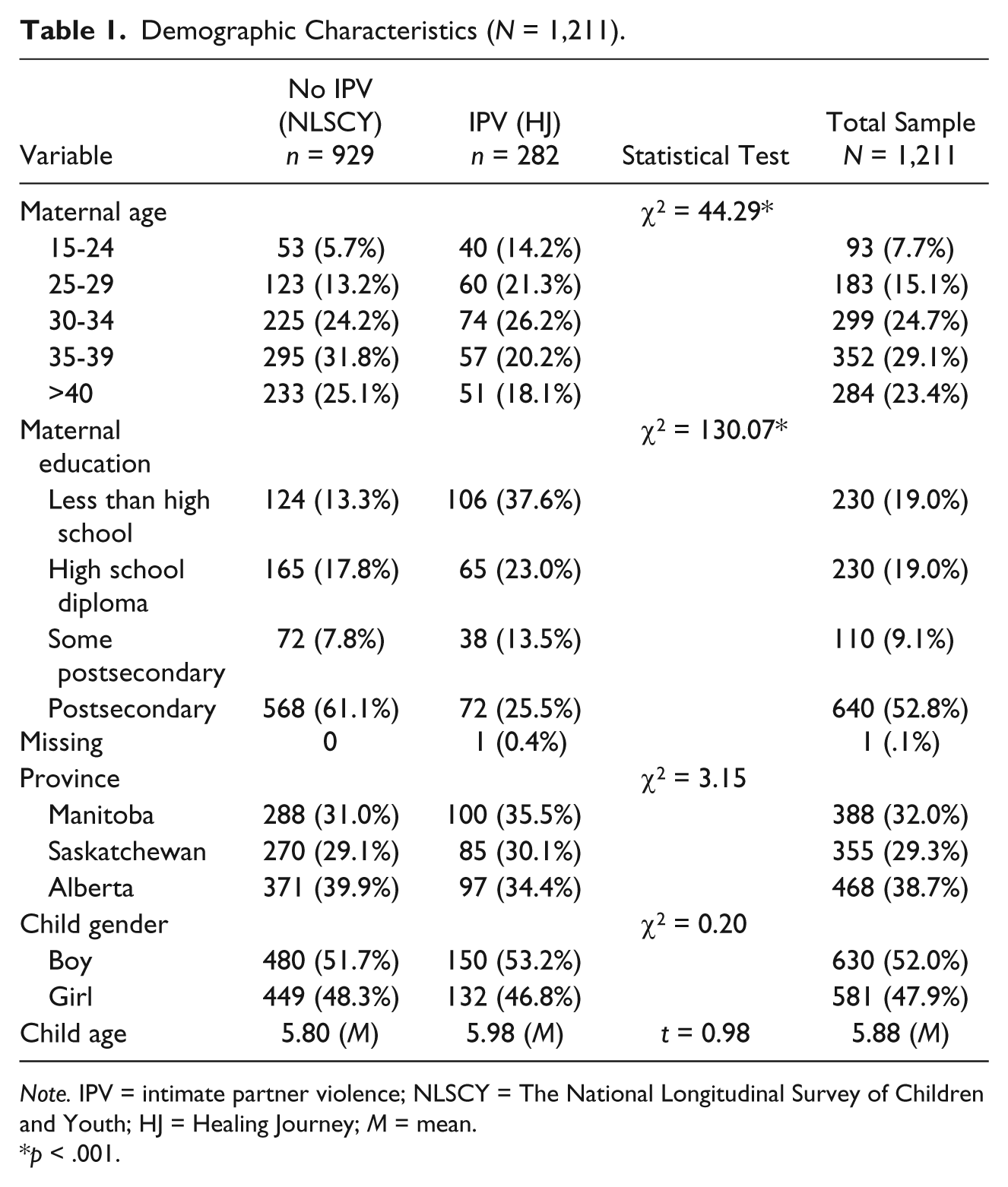
A comparison of the demographic characteristics of participants in both groups is presented in Table 1. As a total group, the mothers’ ages ranged from 15 years to more than 40 years. Over two thirds of the total sample (68.8%) were between the ages of 25 and 39 years of age (n = 834). Approximately 8% were younger than 25 years of age, and almost a quarter (23.5%) were 40 years of age or older. Over one third (38%) reported their highest level of education as completion of high school or less. In addition, 9.1% had completed some postsecondary education, and just over half (52.9%) had completed postsecondary education (college or university).
Demographic Characteristics (N = 1,211).
Note. IPV = intimate partner violence; NLSCY = The National Longitudinal Survey of Children and Youth; HJ = Healing Journey; M = mean.
p < .001.
There were statistically significant group differences for maternal age with a weak effect size (χ2 = 44.29, p = .000; Cramer’s V = .19) and maternal education with a moderate effect size (χ2 = 130.07, p = .000; Cramer’s V = .33) (Rea & Parker, 1992). Specifically, a larger proportion of mothers who had been abused by their partner were in the younger age and lower education categories compared with the mothers who had not experienced IPV. There were no group differences for child age, child gender, or province.
As noted, the children to whom the survey questions referred were all between 2 and 11 years at the time of data collection, and their mean age was 5.9 years. The sex of children was reported as 48% female and 52% male. There were no group differences for province (χ2 = 3.15, p = .21), child age (t = 0.98, p = .33), or child sex (χ2 = 0.20, p = .65).
To determine whether the parenting scales (dependent variables) were associated with any of the demographic variables, bivariate testing was completed. The Positive Interaction Scale had a weak, positive correlation with maternal age (r = .217, p = .000); a weak, negative correlation with maternal education (r = −.07, p = .016); and a moderate, negative correlation with child age (r = .51, p = .000). The Rational Parenting Scale had a weak, positive correlation with maternal education (r = .12, p = .000). Due to these significant correlations, maternal age, maternal education, and child age were subsequently included as control variables in ANCOVA for the Positive Interaction Scale, and maternal education was included as a control variable for the Rational Parenting Scale analysis.
Positive Interaction Scale
An ANCOVA comparing the two groups of mothers on Positive Interaction scale scores with maternal age, maternal education, and child age as covariates indicated no statistically significant difference between the groups after adjustment for the covariates (see Table 2). Mothers whose partners used IPV had an adjusted mean score of 14.41, 95% confidence intervals (CIs) = [14.098, 14.723], compared with the adjusted mean score of 14.57, 95% CIs = [14.40, 14.73], for mothers who had not experienced IPV (p = .40).
ANCOVA Examining Positive Interaction Scores (N = 1,211).

p < .001.
Rational Parenting Scale
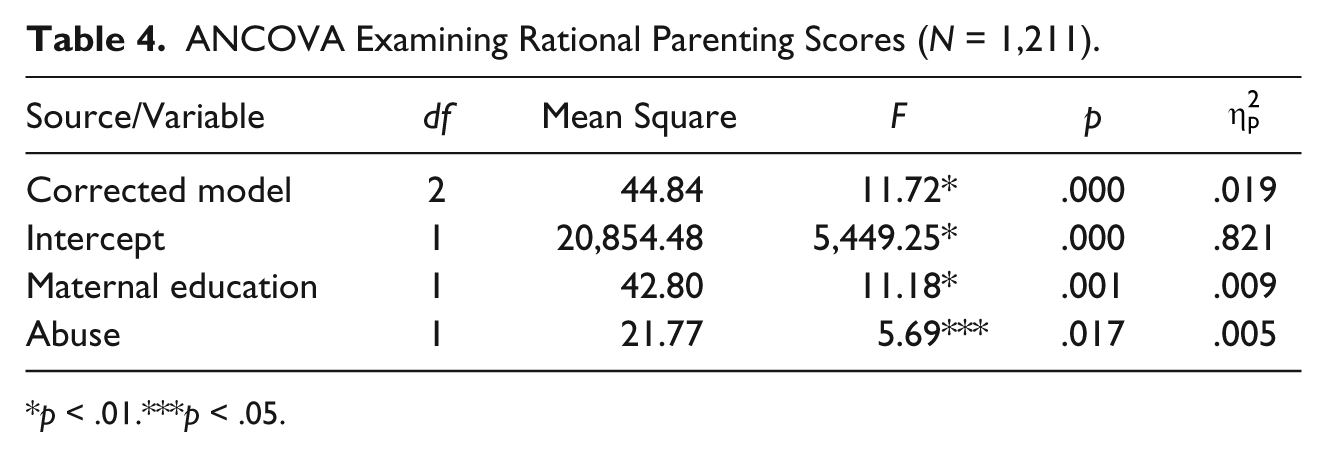
An ANCOVA comparing the two groups on the Rational Parenting Scale scores using maternal education as a covariate indicated a statistically significant difference such that mothers who experienced IPV had a lower adjusted mean score of 11.46 compared with the adjusted mean score of 11.80 for mothers who had not experienced IPV (p = .010; see Table 3). However, although the p value indicates a significant group difference, an overlap in lower and upper bound CIs suggests that statistical significance cannot be clearly determined. The effect size is negligible (ηp2 = .005). Maternal education was significantly related to Rational Parenting scores (F = 11.18, p = .001), regardless of whether or not their partners had abused them (see Table 4). Specifically, the lower the level of maternal education, the lower the mean score on the Rational Parenting Scale.
Adjusted Means and Confidence Intervals on Rational Parenting Scores and Overall Means (N = 1,211).

Note. IPV = intimate partner violence.
ANCOVA Examining Rational Parenting Scores (N = 1,211).
p < .01.***p < .05.
Discussion
The analyses from the current study support those of some others (e.g., Ford-Gilboe, Wuest, & Merritt-Gray, 2005; Letourneau et al., 2007) in concluding that women who have endured IPV are generally nurturing and caring with their children as evidenced in their scores on the Positive Interaction Scale. It may be that women whose partners abused them compensate in interactions with their children by being more attentive and sensitive (Levendosky et al., 2003), or that their parenting improves when they live safely away from the batterer (Edleson, Mbilinyi, & Shetty, 2003). Furthermore, the fact that the age of child was positively correlated to mothers’ scores on the Positive Interaction scale could reflect mothers’ awareness of the needs of younger children for proximity and comfort regardless of whether or not the mothers had been abused by partners.
Because the mean scores of the Rational Parenting Scale are so close, the effect size is negligible, and an overlap exists between lower and upper bound CIs, statistical significance cannot be clearly determined. Inconclusive findings in the comparison of the Rational Parenting Scale between abused women and nonabused women further suggest that mothering in the context of IPV does not predict negative mothering behaviors. However, it may be that experiencing violence affects mothers in diverse ways that are difficult to capture in this measure. Some women experiencing abuse may make a concerted effort to respond in nonaversive ways with their children, such as teaching and encouraging, rather than aversive or punishing types of responses. Other women may choose to assume the primary role of disciplinarian to protect their children. As only one example, an examination of other data from the HJ study indicates that abused women may discipline their child(ren) before their abusive partner does so to protect them from a more severe disciplinary response from their fathers (Nixon et al., 2017).
In the total sample, regardless of exposure to IPV, mothers’ scores on the Rational Parenting Scale increased with education level. These findings support those of Ateah and Durrant (2005) who found that for each level increase in maternal education (less than high school, high school graduate, and completion of postsecondary education), respondents were almost half as likely to have used physical punishment than the previous level. Women with less education who come to the attention of child protective services may be more vulnerable to more intrusive intervention, which could also result in biased perceptions on the part of workers. A blanket assumption that women experiencing intimate violence either have or do not have parenting issues is unwarranted. Rather, an individually focused assessment of how women are parenting remains important and may result in recommendations for parenting support or intervention.
Concluding that mothers who have been the victims of IPV automatically have difficulty parenting their children is stigmatizing and may result in unnecessary, inappropriate, and intrusive interventions, including taking children into protective care when this is not warranted. Being a victim of IPV does not mean that one’s parenting is necessarily negatively compromised, and children are at risk of maltreatment. Therefore, more effective responses by professionals working with abused women and their children, especially child protection workers, would be informed by the point of view that mothering in the context of domestic violence is complicated and may be mediated by a number of factors. Indeed, some abused mothers may not need assistance or support for their parenting, as living safely away from their abusive partner may be sufficient in this regard (Edleson et al., 2003). However, if service providers become involved, they should be encouraged to focus their attention on identifying abused mothers’ strengths and supporting them in their interactions and relationships with their children.
As the societal recognition of the serious nature of IPV has grown, a number of institutions and community agencies have revised their policy and practices to address the issue. These include changes to the criminal justice response (Tutty & Koshan, 2013; Ursel, Tutty, & LeMaistre, 2008), civil justice in the form of emergency protection orders (Burgess-Proctor, 2003; Koshan & Wiegers, 2007), and special agencies to monitor child custody exchanges (Stark, 2009; Tutty, Barlow, & Weaver-Dunlop, 2010). The shelter system specific to abused women is generally considered the major intervention to assist abused mothers and their children (Sauvé & Burns, 2009) in conjunction with specialized community support programs (Abel, 2000; Tutty, Bidgood, & Rothery, 1996). Shlonsky, Friend, and Lambert (2007) characterized these as the “domestic violence” system. However, the child protection system has increasingly become concerned with children’s exposure to IPV, with significant policy and practice changes occurring, including the widening of statutory legislation to include exposure to violence in the home as a form of maltreatment (Nixon, Tutty, Weaver-Dunlop, & Walsh, 2007).
These two systems are often at odds with each other as one focuses primarily on the safety of the woman and the other primarily on the safety of the children, both of which may ignore the interconnectivity of mothers and their offspring (Beeman, Hagemeister, & Edleson, 1999). The psychological harm of witnessing IPV and the risks of child maltreatment ought to be given full attention and consideration during case review by the child protection system. When trying to assess relative risk to children, however, there is no foolproof formula to determine potential benefit or harm in leaving them in their home versus potential benefit or harm of removing them from their mother’s care. As Lapierre (2010) suggested, rather than focusing on the negative experiences of women who are or who have experienced IPV, service providers should help women build on their strengths and the strategies they have developed to care for their children.
Belsky’s (1984) model of the Determinants of Parenting stresses that parents’ personal history, psychological resources and functioning, and contextual sources of stress and support are important. We do not know the study participants’ personal resources and to what extent women’s resources and supports are related to their responses with their children. For example, Levendosky and Graham-Bermann (2000) found that experiencing psychological abuse is the more significant type of abuse in negatively affecting a woman’s parenting. However, it is reasonable to consider that abused women’s resources and social supports could offset this effect. This would be an important focus for future study as Belsky’s framework proposes that a deficit in one area may be buffered by strength in another. Not being able to examine participants’ supports in the current study is limiting because the two data sets have different measures that are not directly comparable. Another limitation of the current study is that the parent measures examined were those that had been selected for use in the NLSCY when it began two decades ago. There may be other measures that are more sensitive in depicting maternal responses with their children.
Strengths of this study are that participants are from the same region in Canada, and data on the same outcome measures for this study were collected during the same time period. The findings contribute to the perspective that responding to women and children who are experiencing violence in the home is complex and it should not be assumed that children experience additional hardship and are, therefore, more at risk of harm by remaining under the care of their mothers. Further research is needed to determine the kinds of resources and supports that are of greatest help to these women and their children.
Conclusion
The findings from this study indicate that it should not be assumed that women who have experienced IPV will in turn exhibit less positive parenting responses with their children than women who have not experienced IPV. Clearly, experiencing IPV can be devastating in many ways, but each situation should be uniquely viewed and assessed before conclusions are drawn. One way to help mothers who are experiencing IPV may be to relay to them that assumptions will not be made regarding their parenting skills and that the needs of both them and their children will be taken into consideration. Rather than assuming that abused women’s mothering skills will be negatively affected, more focus should be on preventing IPV, addressing the source of the violence in the home, and providing support and protection for mothers experiencing abuse.
Footnotes
Declaration of Conflicting Interests
The author(s) declared no potential conflicts of interest with respect to the research, authorship, and/or publication of this article.
Funding
The author(s) disclosed receipt of the following financial support for the research, authorship, and/or publication of this article: Funding for this research was provided by the Social Sciences and Humanities Research Council (SSHRC) of Canada and the PrairieAction Foundation (PAF)—Community Action, Research and Education (CARE) Grant.