



Abstract
Although cyberbullying, a new type of aggressive behavior via electronic means, has been found to be strongly linked with individuals’ personality characteristics, few studies to date have investigated its relationship with narcissism, especially overt and covert narcissism. The current study tested the associations between overt and covert narcissism on one hand and cyberbullying perpetration and victimization on the other. To explain these differences further, self-esteem was tested as a mediator through which the two types of narcissism may exert their influences on cyberbullying. An anonymous questionnaire was completed by 814 Chinese adolescents aged 11 to 18. Results of multiple regression analyses indicated that after controlling for gender and student status (middle or high school students), covert narcissism positively predicted both cyberbullying perpetration and victimization, whereas overt narcissism had no association with either perpetration or victimization. Furthermore, when gender and student status were controlled, self-esteem mediated the relationships between overt/covert narcissism and cyberbullying perpetration and victimization, highlighting the possibility that self-esteem is an explanatory mechanism for the associations between the two types of narcissism and cyberbullying. These findings suggest that interventions aimed at reducing engagement in cyberbullying may be more urgent and important for individuals with high levels of covert narcissism. Boosting self-esteem needs to be particularly highlighted in developing anti-bullying measures and policies.
Keywords
Bullying, an established topic in research on school violence, is considered a subtype of aggressive behaviors among adolescents and is thought to have serious consequences for both victims and perpetrators (Farrington & Ttofi, 2011; McGee et al., 2011). In recent years, Internet and mobile phones are gradually shaping new means for adolescents to communicate and socialize. Adolescents can use the Internet to overcome shyness and build online friendships (Peter, Valkenburg, & Schouten, 2005; Valkenburg, Schouten, & Peter, 2005). However, the Internet also appears to provide convenient access for adolescents to engage in antisocial behaviors, a typical form of which is defined as “cyberbullying” or “electronic bullying.” Specifically, these terms refer to “an aggressive, intentional act carried out by a group or individual, using electronic forms of contact, repeatedly and over time against a victim who cannot easily defend him or herself” (Smith et al., 2008, p. 376). For instance, people can humiliate or hurt others by posting embarrassing photos online, sending hurtful emails, or spreading rumors online.
China is a useful setting in which to study cyberbullying. First, a previous meta-analysis of English-language studies on the prevalence of cyberbullying documented it as a widespread phenomenon in many countries (Modecki, Minchin, Harbaugh, Guerra, & Runions, 2014), and these behaviors have been identified in China and recognized as problematic (Zhou et al., 2013). It is also important to study these behaviors in a non-Western context because conclusions about cyberbullying may differ from culture to culture. For example, the divergent findings concerning gender differences in cyberbullying in the United States and China may be due to culture differences (Zhou et al., 2013). The present study will further explore potential predictors of cyberbullying perpetration and victimization in a sample of Chinese adolescents.
As with school bullying, both perpetrators and victims of cyberbullying suffer from internalizing and externalizing problems (Cénat et al., 2014; Chang et al., 2013; Goebert, Else, Matsu, Chung-Do, & Chang, 2011; Hay & Meldrum, 2010; Mitchell, Ybarra, & Finkelhor, 2007). Some unique features of the cyber environment (e.g., anonymity, potentially large breadth of audience) may make the negative impacts of cyberbullying especially strong for some young people and in some circumstances (Slonje, Smith, & Frisén, 2013). To provide the basis for formulating preventions and interventions, increasing attention has been paid to identifying what kind of person tends to bully others online, and what kind of person is more inclined to be attacked via electronic means.
Several risk factors for cyberbullying have been identified, including technology use, parental involvement, and school climate (Kowalski, Giumetti, Schroeder, & Lattanner, 2014). The role of personality characteristics cannot be neglected. Amichai-Hambuger (2002) noted that personality was a highly relevant factor in determining people’s behaviors on the Internet. As an important personality factor correlated with aggression in adolescents (Barry, Kauten, & Lui, 2014; Golmaryami & Barry, 2010; Lau & Marsee, 2013), narcissism or narcissistic exploitativeness has been found to significantly predict cyberbullying perpetration (Ang, Tan, & Mansor, 2011; Ekşı, 2012). However, other research has provided mixed evidence. In two studies, higher scores on narcissism did not predict individuals’ cyberbullying behavior, although there was a trend toward a positive association (Fanti, Demetriou, & Hawa, 2012; Goodboy & Martin, 2015). Gibb and Devereux (2014) also found no significant difference in narcissism between individuals who engaged in and did not engage in cyberbullying behavior. These inconsistent findings may be because of the different samples recruited, or because of the divergent measuring tools adopted in these studies.
Narcissism may also play a role in cyber-victimization. In research on traditional bullying, narcissistic persons have been shown to be more likely than less narcissistic persons to perceive themselves as victims of others’ interpersonal transgressions (McCullough, Emmons, Kilpatrick, & Mooney, 2003), and they tend to report higher levels of peer victimization (Fanti & Henrich, 2015; Fanti & Kimonis, 2012). One possible explanation for these findings is that narcissistic youth may show inflated, unstable, or tentative beliefs in their own superiority, and they might be prone to encounter threats from others (Baumeister, Smart, & Boden, 1996). One study concerning the effect of narcissism on cyber-victimization found that higher levels of narcissism were cross-sectionally and longitudinally associated with being bullied online (Fanti et al., 2012). To date, however, studies addressing this sort of relationship are relatively few.
An important limitation in the research to date is a lack of attention to the distinction between two types of narcissism, namely, overt and covert narcissism. Conceptually, overt and covert narcissism share certain core features of narcissism, such as grandiose fantasies and expectations about the self, a sense of entitlement, self-indulgence, and disregard of others (Okada, 2010; Wink, 1991). In the overt form of narcissism, grandiosity is thought to result in the direct, observable manifestation of exhibitionism, self-importance, and preoccupation with receiving attention and admiration from others. By contrast, in the covert form of narcissism, feelings of grandeur are largely unconscious and the outward presentation is vulnerability, hypersensitivity, lack of self-confidence, and an absence of zest for work (Wink, 1991).
In terms of the theoretical support for the two subtypes of narcissism, Masterson (1993) proposed that inflated and depleted aspects of narcissism constitute two separate disorders of the self: the exhibitionistic and closet narcissistic disorders, based on the fusion of a grandiose self-representation with an omnipotent object-representation. Specifically, the exhibitionistic narcissist has an inflated, grandiose self-perception that is maintained by receiving attention and admiration from others. By contrast, the closet narcissist has a deflated, inadequate self-perception that is derived from the dependency on and admiration of those idealized others (Cain, Pincus, & Ansell, 2008). In this sense, the covert narcissist, unlike the overt narcissist, may have more maladaptive features, including a shy demeanor, hypersensitivity to criticism and failure, and a lack of self-confidence. Empirical evidence supports the conceptual distinction between overt and covert narcissism as well. For example, in a principal components analysis on six self-reported measures of narcissism, Wink (1991) found that all these measures loaded on two orthogonal factors: grandiosity-exhibitionism (overt narcissism) and vulnerability-sensitivity (covert narcissism). In a recent research, the two-factor structure of narcissism was also revealed by conducting an exploratory factor analysis of three prominent self-report measures of narcissism (Miller et al., 2011).
Using this literature on overt and covert narcissism as a framework, the current study tested the distinct roles of these two types of narcissism in relation to cyberbullying perpetration and victimization in a sample of Chinese adolescents. According to the theory of threatened egotism, aggression is a means of defending a highly favorable self-view against someone who seeks to undermine or discredit that view (Baumeister, Bushman, & Campbell, 2000). Hence, individuals with either overt or covert narcissism are more likely than others to act aggressively against people (Fossati, Borroni, Eisenberg, & Maffei, 2010; Lobbestael, Baumeister, Fiebig, & Eckel, 2014). These aggressive behaviors appear in different forms, one of which is bullying others via electronic means. Given narcissists’ frequent disrespect and disregard of others, their behaviors may engender negative behaviors from others in kind (McCullough et al., 2003), and they are also more likely to be retaliated against or excluded in the cyber context due to their tendency to bully others. Similarly, narcissistic cyber-bullies may be attacked online by victims, as those victims have learned the bullying behaviors and need to externalize the strain resulting from the experiences of victimization (Jose, Kljakovic, Scheib, & Notter, 2012). In brief, overt and covert narcissism may be associated with both cyberbullying perpetration and victimization.
The framework of hostile attribution bias also sheds light on possible connections between narcissism and aggression. A hostile attribution bias is a tendency to interpret others’ intent as hostile when social cues fail to indicate a clear intent (Milich & Dodge, 1984), and individuals with hostile attribution of intent tend to display more aggressive behaviors (De Castro, Veerman, Koops, Bosch, & Monshouwer, 2002). In the cyber environment, there is a lack of facial expressions and verbal emotional cues, and this lack of information may be more challenging for covert narcissists, who are more sensitive about their interpersonal relationships compared with overt narcissists (Miller et al., 2010). Covert narcissists may be more likely to perceive the information they receive as being aggressive and their antisocial behaviors are more likely to be motivated by this hostile attribution bias (Miller et al., 2011). In addition, due to the anonymity and elimination of physical strength in virtual space, covertly narcissistic individuals can easily utilize different media online to retaliate against those who bully them. In contrast, covert narcissists are introverted, vulnerable and emotionally unstable, lack confidence, and have socially avoidant interpersonal styles (Dickinson & Pincus, 2003; Given-Wilson, Mcllwain, & Warburton, 2011; Miller & Campbell, 2008; Miller et al., 2010). Hence, it might be difficult for them to find success in the process of interpersonal communication and easier for them to be bullied online. From this perspective, we hypothesize that both overt and covert narcissism are positively associated with cyberbullying perpetration and victimization, but covert narcissism produces a stronger effect on cyberbullying than overt narcissism.
Why might the two types of narcissism be differentially associated with cyberbullying perpetration and victimization? The key may be self-esteem. Based on a previous study, overt narcissists are self-confident and tend to consistently use self-enhancement strategies to improve their self-esteem (Paulhus, 1998), which may result in high and stable self-esteem. By contrast, covert narcissists lack self-confidence and are not inclined to employ overt strategies to modulate self-esteem (Besser & Priel, 2010), which may result in low and unstable self-esteem. Numerous studies also have found that individuals with overt narcissism have high levels of self-esteem whereas individuals with covert narcissism have low levels of self-esteem (Miller & Campbell, 2008; Rohmann, Neumann, Herner, & Bierhoff, 2012; Rose, 2002; Watson, Hickman, & Morris, 1996). These divergent relations between two forms of narcissism and self-esteem are indicative of fundamental differences in the nature of other constructs (Miller et al., 2011), such as satisfaction with life, depressive symptoms, and social adjustment.
Furthermore, some traditional theories in the social sciences posit a link between low self-esteem and externalizing problems. According to social-bonding theory, low self-esteem weakens ties to society (Rosenberg, 1965), which decreases conformity to social norms and increases delinquency (Hirschi, 1969). Rogers (1961) argued that a lack of unconditional positive self-regard is linked to aggression. Finally, neo-Freudians such as Tracy and Robins (2003) suggested that individuals tend to be hostile, angry, or aggressive toward others to get rid of feelings of inferiority and shame by externalizing blame for their failures. Given that cyberbullying is a subtype of aggressive behaviors and there is co-occurrence between perpetration and victimization (Kowalski et al., 2014), we predict that people with lower self-esteem are more likely to engage in cyberbullying. The existing studies have indicated that lower self-esteem is a significant predictor of both cyberbullying perpetration and victimization (Brewer & Kerslake, 2015; Modecki, Barber, & Vernon, 2013; Yang et al., 2013).
Self-esteem has been identified as a mediator of the relationship between narcissism and happiness (Rose, 2002), psychological health (Sedikides, Rudich, Gregg, Kumashiro, & Rusbult, 2004), and social adjustment (Zhou, Zhang, & Zheng, 2009). Cyberbullying by its very nature is a kind of adjustment problem, and whether its associations with the two forms of narcissism are mediated by self-esteem will be tested in this study. We hypothesize that overt narcissism is positively associated and covert narcissism is negatively associated with self-esteem, which in turn negatively predict cyberbullying perpetration and victimization. In short, self-esteem will mediate the relationships between two types of narcissism on one hand and cyberbullying perpetration and victimization on the other.
Method
Participants
Students (n = 814) were recruited from two schools in a city in central China during the spring semester of 2015. Of the participants, 434 (53.3%) were male, and 380 (46.7%) were female. Due to the upcoming entrance examinations for high school and college, those in the ninth and 12th grades were not selected to participate in this study. Thus, participants were in the seventh (27.8%), eighth (27.5%), 10th (22.9%), and 11th (21.9%) grades. Their ages ranged from 11 to 18 years (M = 14.67, SD = 1.58). The sample investigated in the present study is equivalent to the students in secondary school in the United States or Britain. Based on the Chinese school system, students in the seventh and eighth grades are grouped into middle school (analogous to middle or junior high school in the United States), whereas those in the 10th and 11th grades are grouped into high school (analogous to senior high school in the United States). Differences in study variables depending on student status, namely, middle school students (n = 450) versus high school students (n = 364), were also explored in this study.
Procedure
Institutional Review Board (IRB) approval was granted by the Central China Normal University, and approval for data collection was obtained from the Ministry of Education of China. Consent to participate in this study was obtained from all adolescents involved. This research was conducted by trained graduate students majoring in psychology, and it lasted about 20 min. Before collecting data, these graduate students were trained to be proficient in the whole process of this survey, such as elaborating on the instructions, explaining obscure items to some students, and checking participants’ completeness in the questionnaire. During the survey, voluntariness and confidentiality were clearly explained and ensured as participants were informed that they could refuse or discontinue participation at any time without penalty. Participants were also instructed not to write their name or student number on their questionnaire. In addition, adolescents were not allowed to discuss questions with students around them. They were instructed to raise their hand if they had any question about the survey, and timely help was offered by the experimenters. Last, participants completed a questionnaire that measured their demographic characteristics, cyberbullying experiences in the past year, narcissistic traits, and levels of self-esteem.
Measures
Cyberbullying perpetration
Participants completed a Chinese version of the Cyberbullying Inventory (CBI; Erdur-Baker & KavŞut, 2007), which had two subscales measuring cyberbullying perpetration and victimization. The perpetration subscale consists of 18 items that describe 18 forms of cyberbullying behaviors, such as “sending anonymous text messages to threaten or intimidate someone” and “spreading rumors online about someone.” Respondents were asked to indicate the number of times that they had engaged in specific cyberbullying activities in the past year on a 4-point Likert-type scale (1 = never, 4 = more than 5 times). The mean score was calculated for each participant, with higher values representing higher incidence of cyberbullying perpetration. This subscale has shown good reliability and validity in Chinese high school students (Zhou et al., 2013). Cronbach’s alpha for the cyberbullying perpetration scale in the present study was .80.
Cyberbullying victimization
Participants’ experiences of being cyberbullied were evaluated by the Chinese version of the 18-item cyberbullying victimization subscale of the CBI (Erdur-Baker & KavŞut, 2007). A total of 18 different forms of cyber-victimization are depicted in this subscale, such as “someone sent anonymous text messages to threaten or intimidate me” and “someone spread rumors about me online.” The response options and scoring method from the cyberbullying perpetration scale (reported above) were used in this version as well. Cronbach’s alpha for the cyberbullying victimization scale in the present study was .78.
Overt narcissism
Overt narcissism was measured using a 20-item subscale of the Narcissistic Personality Questionnaire (NPQ) developed by Zheng and Huang (2005). They extracted four dimensions (authority, superiority, entitlement, and self-admiration) to evaluate individuals’ levels of overt narcissism. Example items include “I want to be a leader” and “I have the talent to influence others.” Participants were asked to give a response on a 5-point Likert-type scale (1 = strongly disagree, 5 = strongly agree). The mean score was calculated for each participant, with higher scores indicating higher levels of overt narcissism. Cronbach’s alpha for the overt narcissism scale in the present study was .85.
Covert narcissism
To measure individuals’ levels of covert narcissism, the 15-item subscale of the NPQ developed by Zheng and Huang (2005) was used. The subscale consists of three dimensions: vulnerability, entitlement, and self-admiration. Example items include “I want to be the focus of others” and “I am often dissatisfied with everyone and everything around me.” Each item was rated on a 5-point Likert-type scale (1 = strongly disagree, 5 = strongly agree). The mean score was calculated for each participant, with higher scores indicating higher levels of covert narcissism. Cronbach’s alpha for the covert narcissism scale in the present study was .84.
Self-esteem
Self-esteem was measured by the Rosenberg Self-Esteem Scale (Rosenberg, 1965), which was translated and revised into a Chinese version by Ji and Yu (1999). This scale includes 10 items that evaluate people’s positive and negative feelings about the self. Example items include “I feel that I have a number of good qualities” and “On the whole I am satisfied with myself.” Each item was rated on a 4-point Likert-type scale (1 = strongly disagree, 4 = strongly agree). The mean score was calculated for each participant, with higher values representing higher levels of self-esteem. Cronbach’s alpha for the self-esteem scale in the present study was .82.
Statistical Analyses
First, descriptive analyses were conducted with SPSS 19.0 to understand the general condition of the variables in this study (e.g., the prevalence of cyberbullying perpetration and victimization). Two-way ANOVA was employed to examine the main effects of gender and student status as well as their interactive effects on all of the research variables. Pearson’s correlation analyses were adopted to examine the potential relationships among the independent variables (overt and covert narcissism), the mediator (self-esteem), and the dependent variables (cyberbullying perpetration and victimization).
Second, hierarchical linear regressions were performed to compare the distinct effects of overt and covert narcissism on cyberbullying perpetration and victimization, controlling for gender and student status. Results from the test for multicollinearity indicated that there was no evidence of multicollinearity for overt narcissism (Tolerance = .48, Variance Inflation Factor [VIF] = 2.10) or covert narcissism (Tolerance = .47, VIF = 2.10).
Finally, to test for the hypothesized mediation models, we adopted the procedure proposed by Preacher and Hayes (2008). The criteria they suggested to justify a mediation effect include the following: (a) the independent variable should be significantly correlated with the mediator; (b) the correlation between the mediator variable and the dependent variable should be significant, controlling for the independent variable; and (c) the indirect effect of the independent variable on the dependent variable must be significant. Bias-corrected bootstrap confidence intervals (CIs) derived from 1,000 bootstrap resamples were used to test for the significance of the indirect path. The indirect effect is considered significant if the CI values do not include zero. All mediation analyses were conducted with the PROCESS macro for SPSS (Model 4) provided by Hayes (2013). Z scores of the research variables were used to test for the mediation effects, and the standardized coefficient (β) for each regression equation is reported.
Results
Descriptive and Correlational Analyses
In the current sample, 58.7% (n = 478) of the participants reported that they had bullied someone online, and 74.8% (n = 609) reported that they had been bullied by someone online at least once in the past year. To detect the effects of gender and student status on the research variables, we used the mean score of each of the variables to perform a 2 (Gender: male vs. female) × 2 (Student Status: middle school students vs. high school students) between-participants ANOVA (see Table 1). Analyses revealed main effects of student status on overt narcissism, covert narcissism, and self-esteem, F(1, 810) = 10.56, p < .01; F(1, 810) = 24.87, p < .01; F(1, 810) = 17.20, p < .01. High school students had higher levels of both forms of narcissism than middle school students, whereas middle school students had higher levels of self-esteem than high school students. As shown in Table 1, the main effects of gender and student status on cyberbullying perpetration were significant, F(1, 810) = 7.05, p < .01; F(1, 810) = 13.56, p < .01. Boys and high school students were more likely to bully others online than girls and middle school students. Furthermore, significant differences in cyberbullying victimization across gender and student status were also revealed, F(1, 810) = 18.96, p < .01; F(1, 810) = 12.79, p < .01. Compared with girls and middle school students, boys and high school students were more likely to be bullied online. No significant interactive effects of gender and student status were found in any variable in this study.
Differences of All Variables by Gender and Student Status.

Note. MSS = middle school students; HSS = high school students.
p < .01.
The bivariate relationships among cyberbullying perpetration, victimization, overt narcissism, covert narcissism, and self-esteem were examined (see Table 2). All of the variables were significantly correlated in the predicted directions, and the correlation coefficients ranged from .18 to .72. Both cyberbullying perpetration and victimization were positively associated with overt narcissism (r = .26, p < .01; r = .27, p < .01) and covert narcissism (r = .35, p < .01; r = .38, p < .01), and both were negatively associated with self-esteem (r = −.18, p < .01; r = −.20, p < .01). Cyberbullying perpetration was also positively associated with victimization (r = .60, p < .01). In addition, overt narcissism was positively correlated with self-esteem (r = .18, p < .01), whereas covert narcissism was negatively correlated with self-esteem (r = −.23, p < .01).
Bivariate Correlations Between Variables.
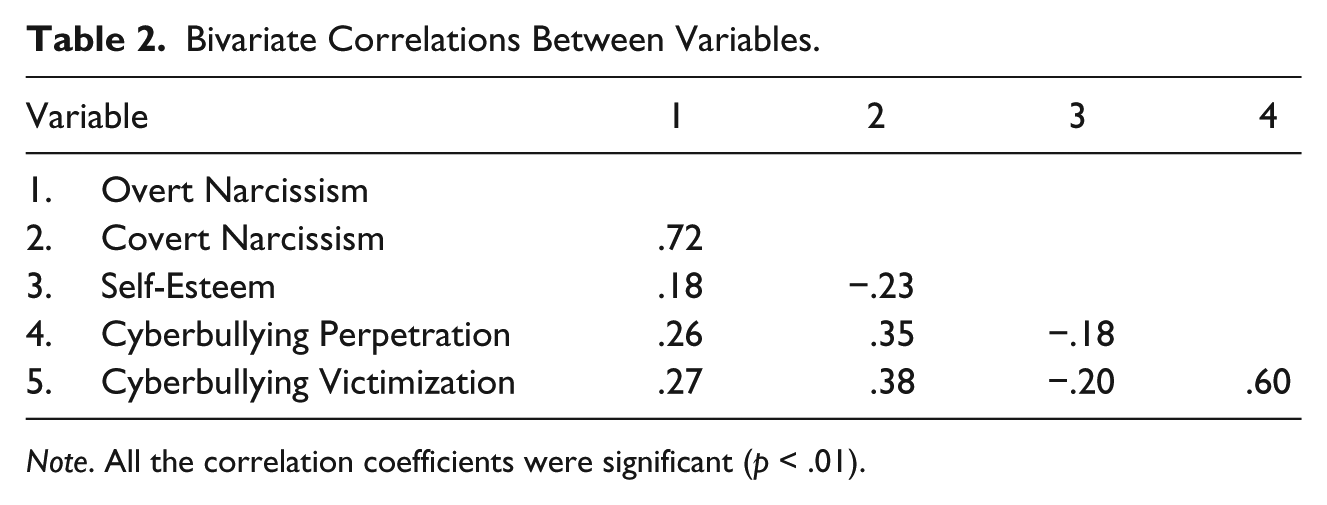
Note. All the correlation coefficients were significant (p < .01).
Hierarchical Linear Regressions
Two independent two-step regressions were employed to examine how overt and covert narcissism uniquely predicted cyberbullying behaviors. Due to the significant differences in cyberbullying based on gender and student status, these variables were controlled in the first step. In the second step, overt and covert narcissism were entered as two predictors of cyberbullying perpetration and victimization. These multiple regression models and their main findings are summarized in Table 3. The overall model for cyberbullying perpetration, F(4, 809) = 31.58, p < .01, R2 = .14, and victimization, F(4, 809) = 41.42, p < .01, R2 = .17, were both statistically significant. The results indicated that overt narcissism and covert narcissism together explained 12% of the variance in cyberbullying perpetration and 13% in victimization. In these two models, covert narcissism served as the strongest predictor for cyberbullying perpetration (β = .33, p < .01) and victimization (β = .39, p < .01). However, overt narcissism did not uniquely predict either cyberbullying perpetration (β = .02, p = .70) or victimization (β = −.02, p = .67), controlling for gender and student status. These results suggest that covert narcissism has a stronger effect on cyberbullying perpetration and victimization than overt narcissism.
Effects of Overt and Covert Narcissism on Cyberbullying Perpetration and Victimization.

p < .05. **p < .01.
Mediation Analyses
To understand the distinct effects of overt and covert narcissism on cyberbullying perpetration and victimization, self-esteem was entered as a potential mediator between these two forms of narcissism and cyberbullying. Gender and student status were also controlled during mediation analyses. A series of multiple regression equations is displayed in Table 4 and Table 5. In the first hypothesized mediation model (see Figure 1), overt narcissism positively predicted self-esteem (β = .73, p < .01), whereas covert narcissism negatively predicted self-esteem (β = −.74, p < .01). After controlling for either overt or covert narcissism, self-esteem still had a negative effect on cyberbullying perpetration (β = −.14, p < .01). Testing the mediation effect, the indirect relationship between overt narcissism and cyberbullying perpetration through self-esteem was significant, 95% CI = [−.16, −.05]. Also, the indirect relationship between covert narcissism and cyberbullying perpetration through self-esteem was significant, 95% CI = [.05, .16].
Regressions Testing Self-Esteem as a Mediator of the Relationship Between Overt/Covert Narcissism and Cyberbullying Perpetration.

p < .01.
Regressions Testing Self-Esteem as a Mediator of the Relationship Between Overt/Covert Narcissism and Cyberbullying Victimization.

p < .01.
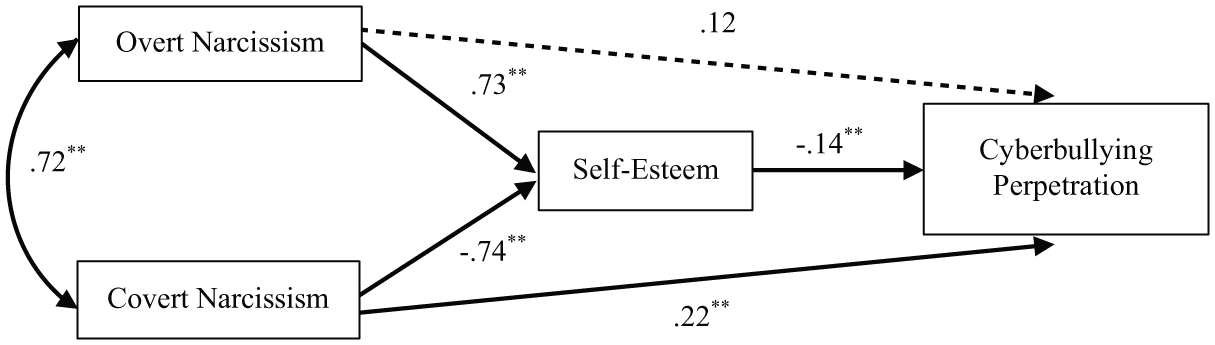
Mediation effects of self-esteem on the relationships among overt narcissism, covert narcissism, and cyberbullying perpetration.
The mediation effects of self-esteem on the relationship between overt/covert narcissism and cyberbullying victimization are shown in Figure 2. In this hypothesized model, overt narcissism positively predicted self-esteem (β = .73, p < .01), whereas covert narcissism negatively predicted self-esteem (β = −.74, p < .01). When either overt or covert narcissism was controlled, self-esteem negatively predicted cyberbullying victimization (β = −.15, p < .01). Bias-corrected bootstrap CIs for the indirect paths indicated that self-esteem significantly mediated the relationships between overt narcissism and cyberbullying victimization, 95% CI = [−.17, −.05], as well as covert narcissism and cyberbullying victimization, 95% CI = [.05, .17].

Mediation effects of self-esteem on the relationships among overt narcissism, covert narcissism, and cyberbullying victimization.
Discussion
An important contribution of this study is to demonstrate that when overt and covert narcissism were entered together in regression models, and after controlling for gender and student status, covert narcissism positively predicts cyberbullying perpetration and victimization whereas overt narcissism predicts neither perpetration nor victimization. Previous studies on aggression have produced similar results, showing that covert narcissism was a stronger predictor of aggression than overt narcissism among Chinese samples (Li & Gao, 2011; Song, Cai, Hu, & Chen, 2013). Individuals with high levels of covert narcissism are sensitive to others’ evaluations and more likely to express indirect forms of aggression, such as anger and hostility (Okada, 2010). Without a physical presence, cyberbullying happens in chiefly covert and indirect ways (e.g., excluding someone in chat rooms), which may help to explain why covert narcissists are aggressive in the cyber environment. However, due to some of their personal characteristics, such as high neuroticism, lack of confidence, vulnerability, and socially avoidant interpersonal styles, covertly narcissistic individuals may be easily bullied online. In addition, covert narcissists might perceive themselves as victims of cyberbullying to soften the negative implications of poor performance in various domains of life (e.g., they might justify a poor academic performance by believing that they would have performed better if no one attacked them), to make their accomplishments seem more impressive (e.g., they could emerge victorious against all odds, although they were frequently bullied), or to justify treating people with similar disregard (e.g., they might justify bullying other people by attributing this behavior to others’ bullying behavior toward them; McCullough et al., 2003). Hence, they may become a relatively high-risk group in cyberspace, and efforts toward prevention or intervention should be targeted to this group.
Although overt narcissism was significantly correlated with aggression in some studies (Fossati et al., 2010; Lobbestael et al., 2014; Wink, 1991), it did not predict cyberbullying in the current sample. The results of the present study are consistent with some previous studies (Fanti et al., 2012; Gibb & Devereux, 2014; Goodboy & Martin, 2015), which might reflect some uniquely positive features of overt narcissists that are not tied to cyberbullying. More specifically, individuals with high levels of overt narcissism tend to be extraverted, emotionally resilient (Miller & Campbell, 2008; Miller et al., 2010), and socially charming at first sight (Back, Schmukle, & Egloff, 2010; Paulhus, 1998). These characteristics may make them likely to develop good interpersonal relationships both offline and online. The fewer interpersonal problems or conflicts experienced by overt narcissists might reduce the likelihood of involvement in cyberbullying that is by its very nature the potential result of troubled relationships. From another point of view, the results in the current study diverge from studies addressing the relation between narcissism and traditional aggressive behaviors (Lau & Marsee, 2013; Reidy, Foster, & Zeichner, 2010), which may imply different patterns of narcissism in relation to aggression of traditional and cyber forms. Future research should examine this assumption further and explore the factors that can contribute to this difference, such as anonymity and publicity in the virtual environment.
Another important contribution of the present study is that self-esteem is revealed as a mediator to explain the distinct effects of overt and covert narcissism on cyberbullying. These results are conducive to understanding the relationships among narcissism, self-esteem, and bullying or aggression. According to previous views, low self-esteem is positively linked to aggression (Donnellan, Trzesniewski, Robins, Moffitt, & Caspi, 2005; D’Zurilla, Chang, & Sanna, 2003), which is also documented in the present study. Some researchers, however, argue that high levels of self-esteem predict aggression (Salmivalli, 2001) because aggressive behaviors are often risky and need courage and confidence, which are typical features of individuals with high self-esteem. Others hold that there is no significant relationship between self-esteem and aggression. For example, Baumeister et al. (1996) suggested that the factor that really matters for aggression is narcissism, based on threatened egotism theory. As to cyberbullying, a relatively indirect and covert form of aggression, we found that both perpetration and victimization can be predicted by two forms of narcissism through the mediating role of self-esteem, which may provide a new perspective of the relationships among narcissism, self-esteem, and aggression. Moreover, one possible explanation for the above conflicting results concerning the relationship between self-esteem and aggression is to consider different forms of aggression. Therefore, future research should examine whether self-esteem mediates the relationship between narcissism and other direct or overt forms of aggression, such as physical bullying.
Regarding gender differences in cyberbullying, boys were more likely to be both perpetrators and victims of cyberbullying in this sample. Although these results are consistent with some previous studies (Chang et al., 2015; Huang & Chou, 2010; Zhou et al., 2013), some other studies did not find significant gender differences in cyberbullying (Didden et al., 2009; Slonje & Smith, 2008; Smith et al., 2008), or revealed that only girls were more likely to be bullied online (Heiman & Olenik-Shemesh, 2015; Kowalski & Limber, 2007; Wang, Iannotti, & Nansel, 2009). These conflicting findings may be due to differences in gender roles expected by different cultures. In traditional Chinese culture, boys are encouraged to be more brave, strong, and powerful, and, thus, they may be more aggressive both offline and online. Furthermore, boys are told that bullying girls is not a right way to enhance self-worth, which may lead to fewer girls being bullied than in other cultures. These expectations for gender roles may not be the same in individualistic cultures, which probably focus on independence and equality between male and female students.
Consistent with the findings of previous studies (Hinduja & Patchin, 2013; Kowalski & Limber, 2007; Smith et al., 2008), we found that older youth were more likely to engage in cyberbullying behaviors. However, nonsignificant age and grade differences were demonstrated in some other studies (Didden et al., 2009; Juvonen & Gross, 2008; Smith et al., 2008). Williams and Guerra (2007) even showed that cyberbullying peaked in middle school and declined in high school. In the present study, a higher prevalence rate of cyberbullying was found in high school students. With regard to Chinese adolescents, as they grow older, they gradually move away from parental control and become independent, and, thus, have more opportunity to access the Internet and to engage in cyberbullying.
Although a significant association between cyberbullying perpetration and victimization was found in this study, these cross-sectional data could not indicate whether cyber-victimization led to cyber-perpetration or vice versa. One point of view is that cyberbullying victimization may precede perpetration, in some cases. From the perspective of social learning theory, victims in the cyber context may become more aggressive as they have learned these behaviors as a result of their victimization (Jose et al., 2012), and they are also inclined to attack people online as a form of retaliation or defense mechanism (König, Gollwitzer, & Steffgen, 2010). The general strain theory is another framework to explain the predictive effect of cyber-victimization on cyber-perpetration. As a source of strain, cyber-victimization may result in adolescents’ negative experiences and emotions (e.g., angry, frustrated, and hostile), leading them to utilize poor coping strategies to externalize the strain, such as bullying others electronically (Patchin & Hinduja, 2011; Wright & Li, 2013). However, Jose et al. (2012) conducted a 2-year longitudinal study and found that cyberbullying perpetration predicted victimization over 1 year, but not vice versa. This may be because adolescents who bullied others in cyberspace invite retaliation or exclusion and, thus, become cyber-victims in turn. We deem the relationship between cyberbullying perpetration and victimization as being bidirectional or cyclic. Specifically, cyber-victims might become cyber-bullies because of their retaliation or externalization of strain, whereas cyber-bullies might become cyber-victims because of others’ revenge or exclusion. However, this possibility requires further examination.
Some limitations of the present study need to be considered. First, the data were collected using the self-report method, which may be subjected to response bias. In this study, several measures were taken to deal with this problem, such as providing clear instructions to the participants, asking them to complete the questionnaire independently according to their own conditions, highlighting that their answers were not revealed to anyone, and emphasizing that there was no wrong or right answer to the questions. Future research should employ self-report, peer nomination, teachers’ or parents’ ratings, and other methods to measure the variables in this study. Second, the present research relied on a sample of Chinese adolescents, so the generalization of the findings might be limited. The levels of narcissism may vary across different age groups and cultures, which might have different impacts on cyberbullying. Thus, the age range of the participants should be expanded, and comparative studies from a cross-cultural perspective need to be conducted in the future. Finally, it is important to note that this study employed a cross-sectional study design, and the results cannot speak to causal connections among the constructs of interest. Future researchers could conduct longitudinal studies to explore whether individuals with high levels of narcissism in childhood will engage in more cyberbullying behaviors in adolescence or in adult life, controlling for demographic factors (e.g., race, socioeconomic status), Internet use (e.g., time, place), and contextual factors (e.g., harsh parental discipline, unsafe school climate).
Despite the above-mentioned limitations, the results obtained from the present study have some important implications for cyberbullying prevention and intervention efforts. Specifically, more attention should be paid to the role of personality risk factors in developing anti-bullying interventions, especially with regard to grandiosity, vulnerability and hypersensitivity, and self-confidence. Adolescents should have a clear sense of their personality characteristics (e.g., vulnerability, self-abasement) and learn effective strategies of emotion management for avoiding engagement in aggressive behaviors in cyberspace as they encounter interpersonal stressors in daily life. Adults can teach youth alternative ways to address ego threats or concerns over their social status to help them cope with or reduce cyberbullying. Based on covert narcissists’ characteristics, parents or teachers ought to frequently communicate with children to understand their thoughts, attitudes, and potential internalizing problems (e.g., symptoms of depression and anxiety). Schools can provide different ways for students to fulfill their status goals, such as by engaging in extracurricular activities, which may build status for the victims and redirect bullies away from bullying incidents (Fanti & Henrich, 2015). In addition, teachers should implement positive attribution training among students, create an inviting class environment, and constantly focus on students’ psychological changes and abnormal behaviors for the early detection and timely intervention for their cyberbullying behavior.
The significant mediation effect of self-esteem on the relationship between narcissism and cyberbullying suggests that efforts to reduce cyberbullying can aim to enhance self-worth. For example, adolescents can boost their self-confidence or improve their self-evaluation by focusing on their existing merits and working to their capacity. Parents and teachers should often praise youth about their progress in study and life, instead of criticizing them in some aspects by comparing them with others (a phenomenon that is especially common in China). In this way, adolescents might experience fewer feelings of inferiority or shame and show increased conformity to social norms, which may reduce the possibility of involvement in aggressive behaviors online as perpetrators or victims. Because cyberbullying is a social phenomenon with potentially large breadth of audience, uninvolved adolescents or bystanders should be encouraged not to achieve their status goals through this type of behavior. They also need to avoid negative emotions (e.g., feeling of distress or depression) or self-cognitions resulting from their continuous exposure to cyberbullying behavior to reduce the risk of being perpetrators or victims.
Footnotes
Authors’ Note
Cui-ying Fan and Xiao-wei Chu are joint first authors.
Declaration of Conflicting Interests
The author(s) declared no potential conflicts of interest with respect to the research, authorship, and/or publication of this article.
Funding
The author(s) disclosed receipt of the following financial support for the research, authorship, and/or publication of this article: This work was supported by the National Social Science Fund Project of China (Grant 11&ZD151) and the Humanities and Social Sciences Planning Fund of Ministry of Education of China (Grant 15YJA190001).