




Abstract
Although research is becoming increasingly nuanced by exploring differential risk factors linked with types of youth offenders, typological distinctions have rarely been made between youth rapists and other serious youth offenders. This study tests the relative effects of intra- and extra-familial victimization—while holding other theoretically driven variables constant—on membership in three mutually exclusive youth offending groups: non-serious non-sexual offenders (n = 4,013), serious non-sexual offenders (n = 2,571), and rapists (n = 489). Data were drawn from the Survey of Youth in Residential Placement (SYRP). Incarcerated youth (N = 7,073) were surveyed on multiple constructs. Using appropriate weights in analyses, a multinomial logistic regression (referencing serious offenders) revealed youth who were victims of intra-familial physical abuse (22%) and intra-familial forced sex (42%) had a decreased risk of being in the non-serious offender category relative to the serious offender category. Furthermore, intra-familial emotional abuse (75%) and intra-familial forced sex (202%) demonstrated an increased risk of being in the rapist category relative to serious offender category. Although extra-familial victimization was statistically significant, victimization within the family had larger effects when predicting rape group membership. The research and practice implications are discussed.
Introduction
No single risk factor has been conclusively linked to youth offending; rather, correlates of offending behavior can be explained through complex interactions between individual, family, and social influences (Maas, Herrenkohl, & Sousa, 2008). Associations with antisocial peers (Steinberg, 2010), poor academic achievement (Cruise, Evans, & Pickens, 2011; Katsiyannis, Ryan, Zhang, & Spann, 2008), living in violent neighborhoods and communities (McDonald, Wiebe, Guerra, Thomas, & Richmond, 2011), substance abuse (McClelland, Elkington, Teplin, & Abram, 2004; Robertson, Dill, Husain, & Undesser, 2004), and mental and emotional health problems (Robertson et al., 2004) have all been indicated as etiological pathways to offending. Studies are becoming increasingly nuanced in explorations of differential risk factors linked with types of youth offenders (Driemeyer, Spehr, Yoon, Richter-Appelt, & Briken, 2013; Mulder, Vermunt, Brand, Bullens, & van Marle, 2012; van Wijk, Mali, Bullens, & Vermeiren, 2007; Wanklyn, Ward, Cormier, Day, & Newman, 2012). This level of specificity spawns an intersectional outlook regarding the propensity for initiating criminal misconduct and the likelihood for recidivism. In addition, it informs many public and community safety initiatives.
Despite such informative research, typological distinctions have rarely been made between youth rapists and other serious youth offenders. In fact, there is a dearth of updated research altogether on youth rapists (see Hagan & Gust-Brey, 1999; Hsu & Starzynski, 1990; Vinogradov, Dishotsky, Doty, & Tinklenberg, 1988), and current matched-design studies only compare youth rapists with non-violent delinquents (Busch et al., 2009). Few research studies have compared youth violent sexual offenders with violent non-sexual offenders (van Wijk, Loeber et al., 2005; van Wijk et al., 2007; van Wijk, van Horn, Bullens, Bijleveld, & Doreleijers, 2005), often coalescing rapists with sexual assaulters. Conceivably, rape is an especially unique subset of serious offending, which necessitates inquiry into disparate risk factors.
The family system has been expansively indicated as a significant ecological influence in youth offending (Bronfenbrenner, 1989). Family factors such as family criminality (Aaron & Dallaire, 2010; Farrington, Jolliffe, Loeber, Stouthamer-Loeber, & Kalb, 2001), family functioning (Henderson, Dakof, Schwartz, & Liddle, 2006; Mack, Leiber, Featherstone, & Monserud, 2007), and attachment (Hoeve et al., 2009) are noted as risk factors for both serious and non-serious offending. The family system has even been explored as a discriminating factor among offending typologies (Driemeyer et al., 2013; Wanklyn et al., 2012). However, when it comes to differentiating youth rapists from other serious youth offenders, there is a shortage of evidence supporting family factors such as household structure and intra-familial victimization. These family factors may explain offending typologies to a greater degree than other risks. As such, there is an eminent obligation for research to further refine investigations of offending typologies (Hunter, Figueredo, Malamuth, & Becker, 2003). The current study tests the relative effects of family victimization—while holding other theoretically driven variables constant—on membership in three mutually exclusive youth offending groups: non-serious non-sexual offenders, serious non-sexual offenders, and rapists.
Offending Groups
Youth offending subgroups can be categorized in many different ways. The Federal Bureau of Investigation (FBI; 2015) Crime Reporting has classified groups according to the severity of criminal misconduct, subsequently labeling them “violent” and “non-violent.” Violent crime, regarded as the most serious offense, includes murder, rape and sexual assault, aggravated or simple assault, or robbery (U.S. Department of Justice, Bureau of Justice Statistics, 2015; FBI, 2015). Juveniles account for a relatively small percentage (12%) of overall violent or serious crime (U.S. Department of Justice, Office of Juvenile Justice and Delinquency Prevention [OJJDP], 2012). However, serious youth offenders may face increased risk of becoming persistent adult offenders (Kempf-Leonard, Tracy, & Howell, 2001; Moffitt, 2006), particularly in the presence of early significant risk factors (Barrett, Katsiyannis, & Zhang, 2009; Moffitt, Caspi, Harrington, & Milne, 2002).
Sexual offending specifically has been contextualized parsimoniously alongside general delinquency; youth sexual offenders are criminally versatile in that they concurrently or sequentially commit sexual and non-sexual crimes (Lussier, Proulx, & LeBlanc, 2005). Furthermore, recidivism studies yield low sexual re-offense base rates, suggesting youth sexual offenders are more likely to re-commit a non-sexual crime (Caldwell, 2010; Carpentier, Leclerc, & Proulx, 2011). Consequently, a specialization debate has emerged regarding the uniqueness of sexual offending, as many scholars suggest that sexual offending may not be a mutually exclusive phenomenon (Caldwell, 2002; Smallbone, 2006). For example, some research suggests that the risk for committing a sexual crime increases synchronously with the committal of non-sexual crimes (Tracy, Wolfgang, & Figlio, 1990), and that sexually offending in adulthood is more closely associated with the number of criminal justice interactions rather than the occurrence of a sexual crime during adolescence (Zimring, Piquero, & Jennings, 2007). Even if youth who commit sexual crimes also commit non-sexual crimes, the question remains, are there unique or stronger indicators associated with sexual violence perpetration?
Youth Rapists: A Serious Offending Subtype
Disentangling risk factors associated with youth rape is especially challenging. Overall, there is limited research on youth rape as either a subcategory of sexual criminality or of other serious criminality. Indeed, the evidence-base includes a few studies (Busch et al., 2009; Hsu & Starzynski, 1990; Simons, Wurtele, & Durham, 2008) that compare youth rapists with both general youth delinquents and youth sexual offenders. However, research has yet to exclusively compare youth rapists with serious youth offenders and presents difficulties in ascertaining distinct or shared risk factors.
Some noteworthy conclusions can be drawn from the available published research. One seminal study examined differences in frequency and type of risk factors between youth rapists and non-violent juvenile delinquents. The results indicated that the rapist group had more and higher incidences of risks relative to the non-violent offenders (Busch et al., 2009). Prior sexual offenses were also identified as a reliable predictor of rape (Busch et al., 2009). A different study examined childhood experiences of adult rapists as compared with those convicted of assault on a child, revealing that rapists reported more frequent childhood histories of physical abuse (68%), parental violence (78%), emotional abuse (70%), and cruelty to animals (68%; Simons et al., 2008). Research has also compared youth child molesters with youth who rape peers and/or adults (Hendriks & Bijleveld, 2004; Hunter et al., 2003). Child molesters were found to be more socially isolated (van Wijk, van Horn et al., 2005), reported a negative self-image, and had been bullied more often at school than their peers who sexually assaulted same-age or older victims (Hendriks & Bijleveld, 2004).
Minimal research has compared rapists and violent non-sexual offenders. Research on violent youth sexual offenders (rapists and sexual assaulters) and violent non-sexual offenders suggests that the groups share many child, family, peer, and demographic risks (van Wijk, Loeber et al., 2005). Other studies by van Wijk and colleagues indicated contradictory evidence, finding differences on demographics, personality traits, and externalizing problem behaviors when aggregating rapists with other sexual offenders (violent sexual offenders) and comparing them to violent and non-violent non-sexual offenders (van Wijk, van Horn et al., 2005). Moreover, a longitudinal matched-samples design indicated differences between the same groups on criminal profiles, where serious sex offenders (rapists and sexual assaulters) were likely to be one-time-only offenders (van Wijk et al., 2007). These studies aggregate rapists and sexual assaulters in one category; certainly, studying rapists as a discrete group can enhance the research base.
There are various factors to consider when making typological distinctions. Typology research has largely focused on severity of offense or modus operandi (van Wijk et al., 2007), victim characteristics including age and gender of victim (Hunter et al., 2003), deviant arousal (McCann & Lussier, 2008), antisociality or conduct disorder (Lussier, Leclerc, Cale, & Proulx, 2007), and substance use (Marini, Leibowitz, Stickle, & Burton, 2014). Family system theories have posited families as the most influential system in the development of attitudes, beliefs, and behaviors (Brofenbrenner, 1989), and specific research has acknowledged the critical influence of family in sexual offending behaviors (Yoder, Leibowitz, & Peterson, 2016). So, with research mounting on typologies, and with family victimization being indicated as a critical discriminating factor between sexual offenders and non-sexual offenders, the question remains, notwithstanding other victimization, could family experiences stand out in differentiating rapists from other serious non-sexual offenders?
Intra-Familial Victimization and Offending Typologies
Theorists and researchers have linked early victimization to later youth offending (Cuevas, Finkelhor, Turner, & Ormrod, 2007; Finkelhor, Ormrod, Turner, & Hamby, 2005; Ford, Chapman, Mack, & Pearson, 2006; Lin, Cochran, & Mieczkowski, 2011). Childhood victimization can include sexual, physical, or emotional abuse; exposure to domestic violence; abandonment; or neglect (Costello, Erkanli, Fairbank, & Angold, 2002; Finkelhor et al., 2005; Ford et al., 2006). Forty percent to 60% of delinquent youth have been victimized (Currie & Tekin, 2006; Ford, Chapman, Hawke, & Albert, 2007; Stahl, 2006), and victimization rates among incarcerated youth have been suggested to be 2 times higher than those among the general population (Coleman, 2005; Coleman & Stewart, 2010).
Victimization frequency may influence offending typology. Researchers have indicated associations between physical abuse, sexual abuse, and a composite score of trauma with more serious offenses (Robertson & Burton, 2010). Longitudinal research has confirmed that more frequent and prolonged abuse experiences are associated with lengthier offending trajectories (Stewart, Livingston, & Dennison, 2008). Frequent abusive experiences can be paralleled with a related concept referred to as complex trauma, or multidimensional, repetitive, and recurring abusive experiences (Ford, Chapman, Connor, & Cruise, 2012). Research has denoted victimization as a risk factor for offending (Ford, Elhai, Connor, & Frueh, 2010), and found incarcerated youth to have higher rates of complex trauma (Ford, Hawke, & Chapman, 2010).
Explicit research on intra-familial abuse has indirectly tested the impact of complex trauma on offending typology. For example, one study examined cumulative intra-familial victimization in differentiating between youth sexual offenders, violent non-sexual offenders, and status offenders and found that youth sexual offenders in the sample had greater parental violence and were victimized more sexually and physically than other groups (Ford & Linney, 1995). Another related study revealed that versatile violent sexual offenders had more intra-familial victimization than sex offender only and violent non-sexual offenders (Wanklyn et al., 2012). Furthermore, one large meta-analysis found youth sexual offenders had experienced more intra-familial sexual and non-sexual violence relative to non-sexual offenders (Seto & Lalumière, 2010). The same study indicated that youth non-sexual offenders had greater non-family violence than sexual offenders (Seto & Lalumière, 2010). Youth rapists as an independent group were not outwardly denoted in any of the aforementioned studies.
Nevertheless, research has yet to determine if types of intra-familial relative to extra-familial victimization may distinguish offending groups, particularly rapists and violent non-sexual offenders. In fact, in a comprehensive screen of available research, most studies ambiguously operationalized victimization or failed to extricate types of intra-familial from extra-familal abuse (Seto & Lalumière, 2010), suggesting there may be a rationale for advancing specificity in research. In other words, identifying the victimization source and the form of victimization may be especially salient in explaining rape as a specialized subset of serious offending. Rape has been perceived as a particularly serious form of sexual abuse perpetration (Hendriks & Bijleveld, 2004; Hunter et al., 2003), yet very little research has been done on explanatory factors. Certainly, as linkages between family victimization to types of youth offenders (Seto & Lalumière, 2010), there is a great need to understand relative victimization experiences as a developmental pathway to rape.
Current Study
The current study assesses the ability of family victimization to differentiate, first, non-serious youth offenders from serious youth offenders, and second, youth rapists from serious youth offenders. The aim of this study is to target the gaps in research through these explicit research questions:
This study is the first research of its kind to test interactions between family victimization and household structure in differentiating between offender groups.
Method
Sample and Procedures
Data from the Survey of Youth in Residential Placement (SYRP) were used to inform this study (Sedlak, 2003). The SYRP was a sponsored research priority by OJJDP. The SYRP was the third part in a series of surveys aimed at capturing facility and juvenile-specific information to inform national knowledge of custody statistics. The self-report survey was nationally representative, anonymous, and taken by pre- and post-adjudicated youth, who were aged 10 to 20 and housed in juvenile facilities. The SYRP used a probability proportional-to-size sample design, drawn directly from the Census of Juveniles in Residential Placement (CJRP) and the Juveniles in Residential Facility Census (JRFC). A total of 204 facilities, housing 7,073 youth, participated in the survey (Sedlak, 2010). Non-participating youth failed to receive parental consent, refused, or were unavailable (Sedlak, 2010). The aim of SYRP was to glean perspectives and life experiences rarely sought in large surveys (Sedlak, 2010).
Surveys were completed between March and June of 2003. The survey was administered on computers using an audio-assisted self-interview (ACASI) methodology. Weights have been assigned to the data. Design effects were used to adjust for the nested structure of the data, and youth and facility non-response rates. These methods included weight trimming, final weighting adjustments, and sampling variance calculations via jackknife replication. Once data were secure with minimal risk for participant detection, survey responses were made available to the public. The data have been distributed through the Inter-University Consortium for Political and Social Research (ICPSR) at the University of Michigan. Access to the data was granted through approvals from the University Institutional Review Board and the National Archive of Criminal Justice Data (NACJD) through the ICPSR Data Access Request System (IDARS). The overall sample (N = 7,073) averaged 16.5 years of age (SD = 1.5), were primarily male (n = 5,378; 76.0%), with slightly more Hispanic youth (n = 2,368; 33.5%) than Black youth (n = 2,068; 29.2%) or White youth (n = 2,005; 28.3%).
Measures
Several measures for this article were created by cumulating items. There were two independent variables of interest that included household structure, family victimization, and other victimization. Other control variables included prior conviction and victim status. Demographics included gender, age, and ethnicity. The dependent variable includes one category, labeled Type of Offender, with three unordered levels, serious offenders, non-serious offenders, and rapists. The variables with specific items and relative bivariate relationships (χ2 or ANOVA) are provided in Table 1.
Sample Characteristics, Chi-Squares, and One-Way ANOVAs.
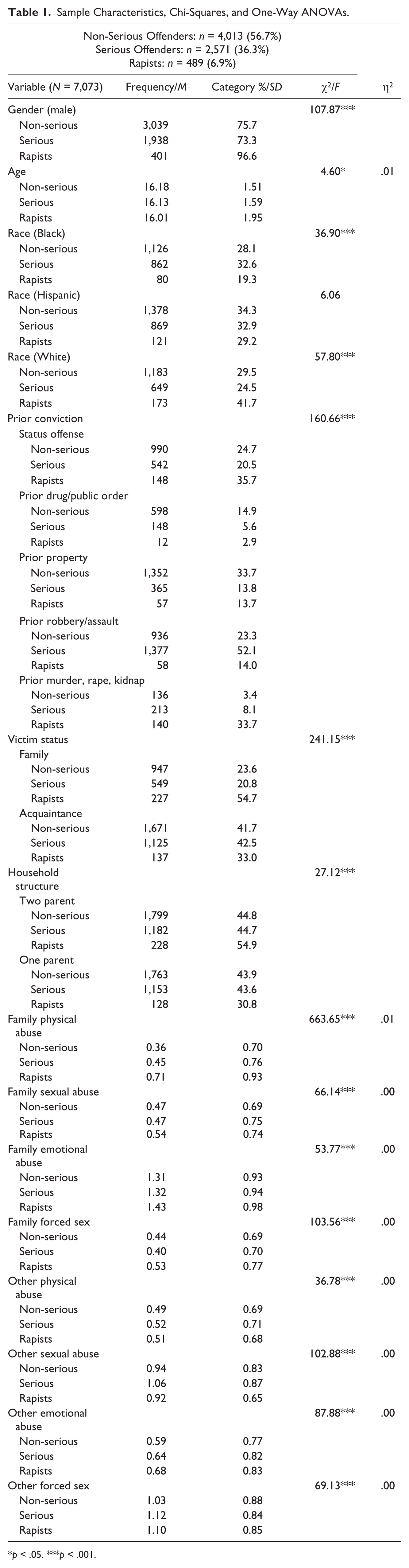
p < .05. ***p < .001.
Independent variables: Intra-familial and extra-familial victimization
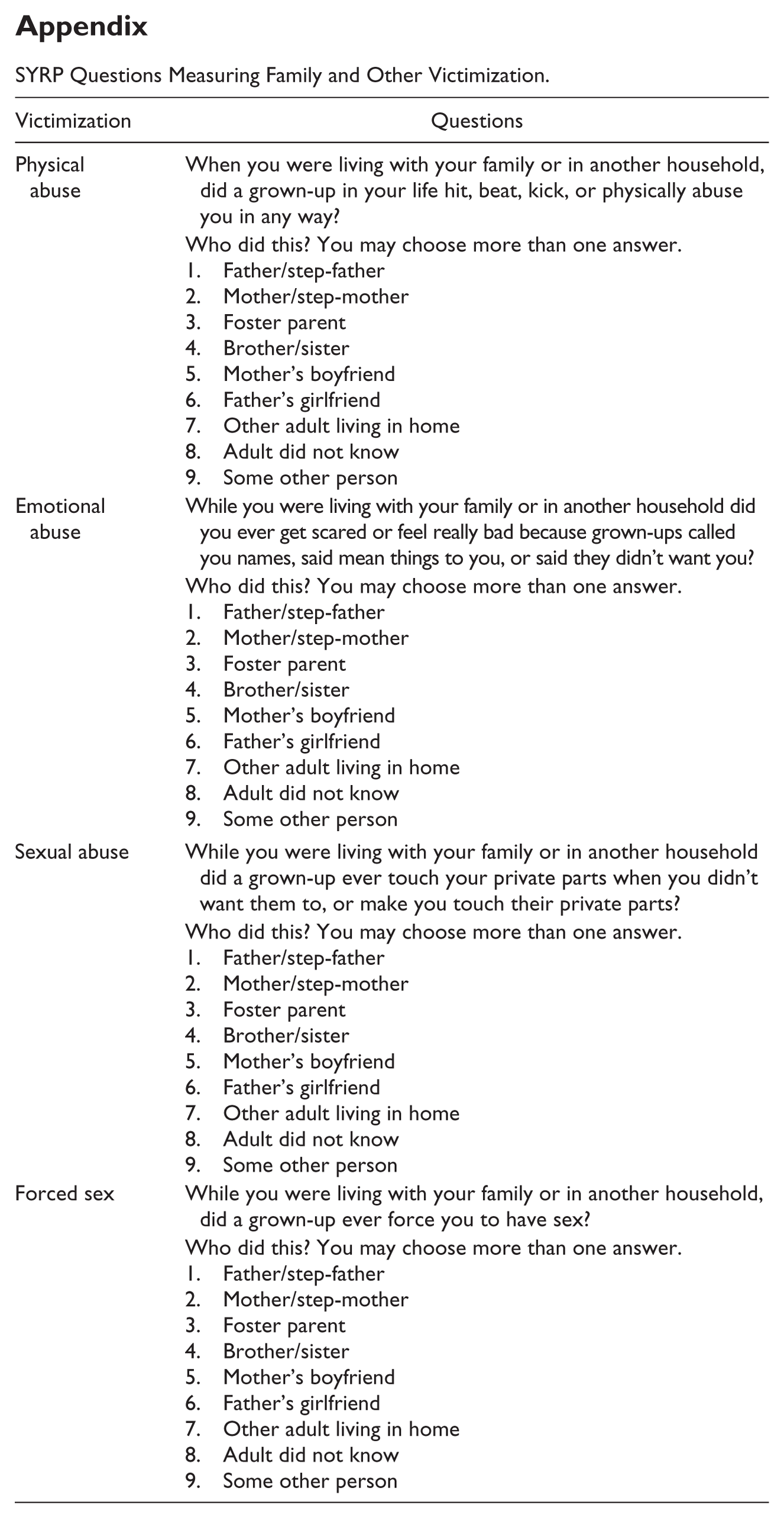
Intra-familial victimization consists of four different types of victimization (physical, sexual, emotional, or forced sexual). These variables were created by aggregating youth scores derived from their reports of family perpetrators (father/step-father, mother/step-mother, foster parent, or brother/sister). Youth had the option to identify more than one perpetrator of the abuse(s). See the appendix for the exact questions. The perpetrators were counted, yielding a score ranging from 0 to 4 (0 = none, 1 = 1 family member, 2 = 2 family members, 3 = 3 family members, and 4 = 4 family members) for each type of victimization.
Similarly, extra-familial victimization consists of four different types of victimization (physical, sexual, emotional, or forced sexual) committed by five different identified other individuals (mother’s boyfriend, father’s girlfriend, other adult living in home, adult did not know, or some other person). Youth had the option to identify more than one perpetrator. See the appendix for the exact questions. The perpetrators were counted yielding a score between 0 and 5 (0 = none, 1 = 1 type, 2 = 2 types, 3 = 3 types, and 4 = 4 types) for each type of victimization.
Covariates
Additional covariates were included in the models and are theoretically associated with the outcome. Household structure encapsulated the biological family home when youth were growing up. The variable was created using three dichotomous items (0 = no, 1 = yes) that applied only to biological or step-parents. Youth had the option to pick more than one individual. These items included mother cared for youth, father cared for youth, and step-parent cared for youth. The items were cumulated to create one 3-level ordered variable (0 = no parent, 1 = 1 parent, 2 = 2 parents). In creating prior conviction, 21 individual items, detailing the type of prior conviction a youth received (ranging from probation violation to murder) were rank ordered according to severity of offense. The final variable included 5 = murder, rape, and kidnapping; 4 = robbery or assault; 3 = property offense; 2 = drug or public order offense; and 1 = status offense, technical parole violation. Victim status was created by categorizing the relationship a youth indicated with their victim. Six individuals were identified as family victims (parent, step-parent, foster parent, grandparent, sibling/step-sibling, or other relative); four individuals were identified as acquaintance victims (friend/ex-friend, boyfriend/girlfriend, teacher, or student at school); or youth could indicate they were not acquainted with the victim. The final variable consisted of a dummy coded variable (0 = else, 1 = family).
Demographics
Demographic variables were included in the models. Gender was dummy coded to indicate (0 = male, 1 = female). Youth’s race was measured as (a) Black, (b) Any Hispanic, (c) American Indian/Alaska Native/Asian/Native Hawaiian/Other, and (d) Two or More Groups (non-Hispanic). Three different race dummy variables (Black, Hispanic, and White) were created to better understand the relative influence of each race. Age was the number of years old at the time the survey was administered.
Dependent variable: Type of offense
Type of Offense was an unordered categorical variable that indicated three mutually exclusive types of convictions for which the youth were currently charged and subsequently incarcerated. The overall variable was created by using the FBI uniform crime index as a guide to classifying serious offenders as those committing murder, assault, or robbery. Rape, while also classified as serious, was pulled out as an independent group. The non-serious offenses included all other types of crimes (violating curfew, public order, selling drugs, etc.). Two items were included in each category: current offense as probation/parole violation or non-probation/parole violation. These items were aggregated to yield an overall number of youth who committed that type of offense. To account for concurrent offenses, only the most serious offense indicated was used in analyses; if youth reported they committed a rape, but may have also committed a serious crime, they were included in the rape category. The final variable consisted of 0 = non-serious offenders (n = 4,013; 56.7%), 1 = serious offenders (n = 2,571; 37.4%), and 2 = rapists (n = 489; 5.9%).
Analyses
Complex survey methods were used to analyze the data using Stata 13.1 (StataCorp, 2013). Two types of sampling weights were used in the analysis. The final youth weight (FYWT) was used due to the complex sampling design in the SYRP survey, while the 74 replicate weights (R_FYWT1-R_FYWT74) generated in the SYRP database were used in the variance estimation methods. Specifically for our analyses, a balanced repeated replicate (BRR) variance estimator was used to generate standard errors used in the development of p values and confidence intervals. BRR is a variance estimation technique used with complex designs with two primary sampling units (facility and youth; McCarthy, 1966). It provides reasonable variance and standard error estimations that would otherwise be artificially inflated. The authors of the original project (see Sedlak et al., 2010) require the use of survey weights for all analyses to account for nesting of youth within facilities and oversampling of females and Hispanic youth. The base option specified the reference category as serious offenders (=1) to compare and contrast serious offenders with non-serious and with rapists, and the rrr option was selected to generate relative risk ratios. For the purposes of interpretation, these are converted to percentages to interpret risk increase or decrease relative to the serious offender group. After running bivariate tests using chi-squares and one-way ANOVAS, one multinomial logistic regression was run to test the theoretically driven independent variables on the type of offense committed. Due to potential issues of multicolinearity between the variables of interest, we also conducted tolerance and variance inflation statistics.
Results
The results from the bivariate statistics revealed statistically significant differences between rapists, serious offenders, and non-serious offenders on demographics including gender (χ2 = 107.87, p < .001), age (F = 4.6, p < .05), and ethnicity including identifying as Black (χ2 = 36.9, p < .001) and White (χ2 = 57.8, p < .001). The results also revealed statistically significant differences between groups on having had a prior conviction (χ2 = 160.66, p < .001), victim status (χ2 = 241.15, p < .001), and household structure (χ2 = 107.87, p < .001). Finally, the results revealed statistically significant differences between groups on family physical victimization (F = 663.65, p < .001), sexual victimization (F = 66.14, p < .001), emotional victimization (F = 53.77, p < .001), and forced victimization (F = 103.56, p < .001), with youth rapists having higher mean scores relative to non-sexual non-serious and serious offenders on all types of family victimization. The results also revealed statistically significant differences between groups on extra-familial physical victimization (F = 36.78, p < .001), sexual victimization (F = 102.88, p < .001), emotional victimization (F=87.88, p<.001), and forced victimization (F = 69.13, p < .001), with non-sexual serious youth offenders having higher mean scores relative to the other groups on all types of family victimization except emotional victimization, which was higher for rapists. The results from the multinomial logistic regression are organized first by non-serious offenders and then rapists. Only the significant independent variables of interest will be reported in text; please refer to Table 2 for additional results.
Multinomial Logistic Regression (Reference Group Serious Offenders).

Note. CI = confidence interval.
p < .05. **p < .01. ***p < .001.
Research Question 1: Non-Serious and Serious Offenders
Intra-familial victimization
Overall, the model revealed that youths’ offending type was significantly predicted by the independent variables in the model, F(40, 34) = 202.70, p < .001. In the overall model, there were no problems of multicolinearity; the tolerance statistics ranged from .24 to .85 and the variance inflation factors ranged from 1.17 to 4.19. Youth who were victims of intra-familial physical abuse (22%) and intra-familial forced sex (42%) had a decreased risk of being in the non-serious offender group relative to the serious offender group. Intra-familial sexual abuse and emotional abuse increased the risk of being in the non-serious offenders relative to serious offenders at 32% and 45%, respectively.
Extra-familial victimization
Comparatively, all types of victimization outside of the family were indiscriminate; extra-familial sexual victimization marginally decreased risk of being in the non-serious offending group (15%) and extra-familial emotional victimization was not statistically significant. Extra-familial physical and forced sex victimization marginally increased risk (14% and 9%, respectively) of being in the non-serious group.
Research Question 2: Serious Offenders and Rapists
Intra-familial victimization
Youth who were victims of intra-familial emotional abuse had 75% increased risk of being in the rapist group relative to the serious offender group. Victims of intra-familial forced sex had 202% increased risk of being in the rapist group relative to the serious offender group. Interestingly, youth who had intra-familial sexual victimization experiences had a 78% decreased risk of being in the rapist group relative to the serious offender group, and intra-familial physical abuse was not statistically significant.
Extra-familial victimization
Comparatively, only sexual victimization and forced sex victimization outside of the family differentiated serious offenders from rapists; extra-familial sexual victimization had a 63% decreased risk of group membership in the rapist category and forced sex outside of the family increased risk of rapist group membership by 117%. Extra-familial physical and emotional victimization were insignificant.
Discussion
This study reveals nuanced findings pertaining to differences in types of intra-and extra-familial victimization associated with offending group membership. Such family factors help better understand the systemic etiology underlying the manifestation of criminal typologies. Family violence and abuse has long been postulated as an ecological determinant to offending behavior. Family victimization is not only associated with long-term sequelae such as posttraumatic stress, neurological deficits, or hormonal dysregulation (Cicchetti & Rogosch, 2001; Cloitre et al., 2009), but theorists have conjectured that violence begets violence (Widom, 1989). Enduring renderings of victimization can engender internalizations that reinforce delinquent behaviors (Ford, Connor, & Hawke, 2009). This internalization process can be understood through a neurobiological lens. Certainly victimization, particularly more severe or chronic forms, alters the neurological response to fear such that youth become “sensitized” and apply like behaviors when victimization reminders are present (Perry, Pollard, Blakley, Baker, & Vigilante, 1995, p. 278). Ascertaining developmental pathways from victimization to offending typology is imperative, as research consistently documents that victimization histories of delinquent youth (Currie & Tekin, 2006; Ford et al., 2007; Ford et al., 2009; Stahl, 2006) are 2 times higher than the general population (Coleman, 2005; Coleman & Stewart, 2010).
Furthermore, testing types of victimization may contribute to a more comprehensive understanding of typologies. Overall, findings reveal that relative to serious offenders, non-serious non-sexual offenders have some intra-familial experiences that increase risk for being in a non-serious non-sexual offender group and others that decrease the risk. Physical abuse and forced sex, for example, are indicators that decrease risk for non-serious offending group membership, and subsequently increase risk for serious offending group membership. Conversely, intra-familial sexual and emotional victimization increases risk for membership in the non-serious offending group. This finding, while surprising, may relate to the nature, severity, and frequency of victimization experience in linking to the type of criminal behavior. The findings suggest that perhaps with more physically harsh forms of family victimization experiences, there is a greater propensity to commit a serious offense. Extant research has recognized the deleterious effects of intra-familial victimization (Seto, Babchishin, Pullman, & McPhail, 2015) and multiple victimization experiences on youth (Finkelhor, Ormrod, & Turner, 2007a, 2007b; Finkelhor, Ormrod, Turner, & Holt, 2009), going so far to suggest that polyvictimization within family contexts is a significant risk factor for offending (Busch, Zagar, Hughes, Arbit, & Bussell, 1990; Ford, Hawke & Chapman, 2010). Studies have documented that criminally violent family members can differentiate serious from non-serious offenders (Busch et al., 1990; Rivera & Widom, 1990), where serious offenders have greater family neglect, greater physical abuse, and more overall family violence (Mulder, Brand, Bullens, & van Marle, 2010; Spaccarelli, Coatsworth, & Bowden, 1995).
Similarly, results from this study revealed there are very minor differences between non-serious and serious offenders in extra-familial victimization experiences. Group comparison studies have suggested that non-serious offenders have more non-family trauma exposure relative to serious offenders (Spaccarelli et al., 1995). Perhaps differentiating intra-familial from extra-familial abuse is critical for a more idiosyncratic explanation of the developmental pathways in offending typologies. Research has revealed substantial differences on levels of dissociation between intra-familial versus extra-familial abuse among youth offenders (Plattner et al., 2003), implying that maybe dissociative psychopathology plays a role in offending severity (Carrion & Steiner, 2000).
Probably the most robust findings from this study are the differences yielded between serious offenders and youth rapists. As research has demonstrated that there may be typological distinctions among families of youth who commit sexual crimes, where they fall on the spectrum between closed (rigid and enmeshed) or open (defused sexual boundaries; Yoder, Ruch, & Hodge, 2015), understanding dynamics within families in contributing to offender typologies becomes imperative; there may be vulnerabilities within the context of the family that translate to actions supportive of rape offenses. The findings revealed that youth with family forced sex experiences were predictive of membership in the rapist category. Although research shows that victimization experiences (Hutton & Whyte, 2006; McMackin, Leisen, Cusack, LaFratta, & Litwin, 2002), particularly sexual victimization (Burton, 2008; Burton, Duty, & Leibowitz, 2011; Mallie, Viljoen, Mordell, Spice, & Roesch, 2011), have been studied as a precarious correlate to youth sexual offending (Burton, Leibowitz, Eldredge, Ryan, & Compton, 2011; Burton & Meezan, 2007; Seto & Lalumière, 2010), it may be important to distinguish the severity of the sexual victimization (i.e., forced sexual victimization relative to non-force) in assessing offending typologies. As this study shows, sexual victimization reduced risk for membership in the rapist category; yet, forced sex dramatically increased risk, which was further exacerbated within the context of the family. Sexual victimization has been conceptualized as a function of social learning theory, such that youth learn maladaptive sexualized behaviors from their own victimization experiences (Burton & Meezan, 2004). An emphatic argument can be made, as this study partially demonstrates, that youth who have been harshly sexually abused may be at an increased risk for perpetuating more severe sexual offenses, such as rape, and the severity of the victimization experiences may contribute to the severity of crime committed.
Family abuses may in fact be a greater risk factor for rapists due to the nature, frequency, and closeness of abuse. Among broader trauma research, betrayal trauma has been widely studied. Betrayal trauma is commonly referred to as a defilement of implicit or explicit trust in a caregiver or family member, with whom the most vulnerable (especially children) rely on for basic necessities (Freyd, 1996). Every type of trauma is a betrayal to some degree, but trauma perpetrated by a family member can be considered the biggest violation (Freyd, 1996). Perhaps because families are the foundation from which youth are nurtured, develop, and learn (Bronfenbrenner, 1989), the presence of abuse within that context may profoundly alter developmental trajectories more than other any other system. When this type of victimization occurs, it affects the youth/child’s cognitive and neurological processing as well as the psychological and behavioral response (Perry, 2009; Perry et al., 1995). In essence, a child’s underdeveloped brain activates the fight or flight response and signals fear as a response to trauma. Persistent traumatic experiences can habituate youth, permanently altering the neurological response (Perry et al., 1995). As a result, youth can have extensive impairments in their behavioral and psychological functioning (Perry et al., 1995). Some youth may adopt like responses, where they mimic their own victimization by offending against others. As such, it can be theorized that as the frequency and duration of victimization experiences perpetrated by family increase (Carpentier & Proulx, 2011), youth imitate and act out with greater sexual severity (Burton et al., 2011).
Furthermore, although intra-familial physical abuse was an indiscriminate factor, emotional victimization was a salient factor for membership in the rape category; research can continue to explore the compounding effects of multiple forms of victimization on youth’s own offending pathways. Perhaps physical abuse was a determining factor in severity of crime, but not necessarily one predictive of rape. Unquestionably, duration and frequency of risk factors are integral in predicting behavioral outcomes (Jenson & Fraser, 2006). Research has even documented that compounded risk is associated with delinquent behaviors (Hay, Fortson, Hollist, Altheimer, & Schaible, 2007). With increased discourse around specialization of sexual criminality that encompasses both versatility and uniqueness (Skilling, Doiron, & Seto, 2011), it is important to consider developmental factors that divert youth from a general, albeit, serious offending trajectory to commit rape. The factors that predict rape may be especially unique, and this is one of the first to test specificity of family victimization to partially account for typological distinctions.
Implications
This study has many implications for practice and research. With the emergence of research investigating victimization experiences among youth who commit sexual crimes, there is a great need to disseminate trauma-informed models in treatment. Trauma-informed care has been noted as an obligatory approach to increase evidence-based strategies for youth who commit sexual crimes (Rasmussen, 2013). Confronting trauma reminders in a comfortable and safe setting, while linking victimization to offending patterns, may lead youth to more adaptive and healthy coping strategies (Rasmussen, 2012). Furthermore, modifying malleable neurological zones through narrative processing may alter psychological responses (Perry, 2009). Although research indicates trauma as a significant risk factor for sexual behavior problems, only 1% of residentially based male sexual offender programs (5% for females) around the country actually implement trauma approaches (McGrath, Cumming, Burchard, Zeoli, & Ellerby, 2010). Furthermore, in the McGrath survey, only sexual trauma programs were indicated, and no other trauma-informed care models were documented (McGrath et al., 2010).
Nevertheless, the findings from this study suggest an entirely different treatment approach that may be necessary. Trauma-informed care might not be enough for youth rapists, who can be deemed an especially distinctive subset of youth sexual offenders (van Wijk et al., 2007). Currently, many models such as Trauma Focused-Cognitive Behavioral Therapy (TF-CBT) suggest working with a parent or caregiver who was not the perpetrator of the trauma (Cohen, Mannarino, & Murray, 2011). The complex nature of victimization within the family has been illustrated by our findings; the prominent role of family victimization in rape offenses leads to a conclusion that trauma-informed models ought to be revised to infuse a family trauma component. Developing models that allow for family perpetrators—by partnering with them to repair the system—could be a worthwhile investment. Integrating family therapy in a trauma-informed context may better address the dynamics that contribute to the victimization, while working to restore harm through a victim-centered approach. This semi-restorative justice model ought to be delivered within a safe setting and with both parties (family members and youth) motivated toward healing.
Certainly, a model like this would mandate that families and youth undergo multiple dosages of concentrated treatment. First, this treatment could address the victimization through narrative processing. Then, it could target plastic neurological zones to alter physiological and cognitive responses. Second, the treatment would aim to connect the newly altered physiological and cognitive responses to behaviors. Ultimately, harmful rape behaviors would be replaced with more adaptive responses. This type of family work draws from multiple evidence-informed services such as restorative justice, and cognitive-behavioral and multi-systemic therapy to comprehensively target the serious and harmful behavior patterns embedded in the family.
Implementation of any model also requires some adaptation to fit with a youth’s current living situation. Combined efforts in research that support the risk principle (matching a youth’s risk level to the judicial response; Andrews, Bonta, & Wormith, 2011), and across states that stress alternative initiatives (The Annie E. Casey Foundation, 2015), have led to a substantial reduction in the number of incarcerated youth. Although the youth in this study were all incarcerated for their offenses, rather than limiting services, this could be an opportunity to re-evaluate the current service-delivery structure within juvenile detention centers or jails. Conceivably, jails and detention centers can begin providing family trauma screening and work toward implementing well-defined and evidence-informed trauma models. Youth who commit the most serious crimes may have time-limited sentences. To better prevent recidivism, these youth ought to be offered rehabilitative services that more comprehensively address the risk factors that led to the commission of their crimes.
Further research in this area ought to delineate categories of abuse and study the associations between individual and combined forms of family abuse and criminal typology. Such a detailed analytic approach can elucidate forms of family abuse linked to differential outcomes. Further research on offending typologies can investigate various other family risk factors such as family functioning, criminal histories, attachment and relationship characteristics, or intergenerational abuse patterns. Longitudinal studies ought to be developed that study long-term effects of family trauma on repeat offenses. Intervention studies can also test the effects of the aforementioned family trauma model in reducing risk for recidivism or increasing community safety.
Limitations
This study used cross-sectional survey data gathered on a subset of incarcerated youth. Because an experimental design was not used in data collection, findings do not imply causation. The findings suggest that there is a relationship between the independent variables and the dependent variables. The authors of this manuscript did not have any role in data collection or organization of the dataset. Youth offending groups were classified according to the offense for which they were currently incarcerated. To account for concurrent offenses, the offense categories were created according to the most serious offense, which does not account for the versatility in offending, or the need to explore specialization or versatility as a function of family victimization.
While the study accounted for perpetrator of victimization, it should be noted that extra-familial victimization did not include a specific response item to account for peer or other youth perpetrated violence. Statistical test assumptions are easily violated in survey data. We accounted for the assumption that observations are independent and identically distributed through specification of sampling weights and a balanced repeated replicate variance estimator used to estimate standard errors. Furthermore, there are certainly other variables that could likely predict membership status that were not accounted for in this study. For example, youths’ relative risk level was not included in the survey and was subsequently not available for inclusion in the analyses. The researchers drew from extant research and theory to define models, and it should be noted that there are many other factors that could be included.
Footnotes
Appendix
SYRP Questions Measuring Family and Other Victimization.
| Victimization | Questions |
|---|---|
| Physical abuse | When you were living with your family or in another household, did a grown-up in your life hit, beat, kick, or physically abuse you in any way? |
| Who did this? You may choose more than one answer. 1. Father/step-father 2. Mother/step-mother 3. Foster parent 4. Brother/sister 5. Mother’s boyfriend 6. Father’s girlfriend 7. Other adult living in home 8. Adult did not know 9. Some other person |
|
| Emotional abuse | While you were living with your family or in another household did you ever get scared or feel really bad because grown-ups called you names, said mean things to you, or said they didn’t want you? |
| Who did this? You may choose more than one answer. 1. Father/step-father 2. Mother/step-mother 3. Foster parent 4. Brother/sister 5. Mother’s boyfriend 6. Father’s girlfriend 7. Other adult living in home 8. Adult did not know 9. Some other person |
|
| Sexual abuse | While you were living with your family or in another household did a grown-up ever touch your private parts when you didn’t want them to, or make you touch their private parts? |
| Who did this? You may choose more than one answer. 1. Father/step-father 2. Mother/step-mother 3. Foster parent 4. Brother/sister 5. Mother’s boyfriend 6. Father’s girlfriend 7. Other adult living in home 8. Adult did not know 9. Some other person |
|
| Forced sex | While you were living with your family or in another household, did a grown-up ever force you to have sex? |
| Who did this? You may choose more than one answer. 1. Father/step-father 2. Mother/step-mother 3. Foster parent 4. Brother/sister 5. Mother’s boyfriend 6. Father’s girlfriend 7. Other adult living in home 8. Adult did not know 9. Some other person |
Declaration of Conflicting Interests
The author(s) declared no potential conflicts of interest with respect to the research, authorship, and/or publication of this article.
Funding
The author(s) received no financial support for the research, authorship, and/or publication of this article.