



Abstract
This study examines the portrayal and affective framing of workplace bullying behaviors on the popular American television show The Office. Quantitative and qualitative content analyses were conducted on 54 episodes spanning the show’s nine seasons. Results revealed 331 instances of workplace bullying, for an average of 6.13 bullying behaviors per episode. Workplace bullying behavior on The Office was grouped into five categories: sexual jokes, public humiliation, practical jokes, belittlement, and misuse of authority. In general, instances of workplace bully were scripted as humorous and lacking significant consequences, which could further contribute to social discourses that perpetuate the problem of bullying in real-life workplaces.
Workplace emotional abuse is recognized as an important issue that can influence both organizational and interpersonal outcomes (Fineman, 2005). Unfortunately, the concept of workplace emotional abuse has lacked a dominant terminology, and relevant policies are often unclear or nonexistent (Meares, Torres, Ginossar, Oetzel, & Derkacs, 2004). This phenomenon has been referred to as emotional abuse (Lutgen-Sandvik, 2003), psychological aggression (Greenbery & Barling, 1999), workplace mistreatment (Meares et al., 2004), mobbing (Leymann, 1996), and workplace bullying (Einarsen, Hoel, Zapf, & Cooper, 2003; Lutgen-Sandvik, 2006). The present study follows Tracy, Lutgen-Sandvik, and Alberts’s (2006) suggestion to unite these forms of emotional abuse under the label of workplace bullying.
Workplace bullying research has primarily focused on describing bully and target characteristics while examining the prevalence and effects of the bullying process (Einarsen et al., 2003). Within the literature, workplace bullying is typically framed as an individual or dyadic phenomenon, leaving the organizational and societal nature underexplored (Lutgen-Sandvik, 2006). Broader interpretive work is necessary to consider the social structures that shape larger discourses about workplace bullying (Fineman, 2005). Mainstream media is known to effect social discourses and cultural values (Bandura, 2001), and might therefore be one of the many social structures that influence people’s beliefs about workplace bullying. Relatively little research, however, has explored how media frames and displays workplace aggression such as bullying (Planalp, Metts, & Tracy, 2010).
In this study, we explore the portrayal of workplace bullying on the popular American television show The Office. The show achieved critical and popular success due to its humorous yet poignant portrayal of nine-to-five office life. Workplace bullying research suggests that targets struggle to communicate the seriousness of their experiences to supervisors and coworkers who perceive bullying as a childish and silly problem (Tracy et al., 2006). If The Office portrays bullying as a humorous and insignificant issue, then it may serve as an illustrative media text that reinforces the discourses that stigmatize workplace bullying. Existing research reveals that exposure to verbal aggression on fictional television is related to increased verbal aggression among viewers (Chory-Assad, 2004; Chory-Assad & Tamborini, 2004; Glascock, 2015). Similar logic implies that repeated exposure to media narratives of workplace bullying might influence audience perceptions and normalize bullying behaviors. Hence, we will examine the prevalence and discursive framing of workplace bullying behaviors on The Office.
Literature Review
Existing research suggests that workplace bullying is a common occurrence, with 30% to 40% of workers personally experiencing it (Lutgen-Sandvik & Tracy, 2012; Namie & Lutgen-Sandvik, 2010) and 80% of workers witnessing it at some point during their careers (Keashly & Neuman, 2005). Workplace bullying is defined as a form of emotional abuse typified by persistent verbal and nonverbal attacks, and other hostile behaviors aimed at ridiculing, ostracizing, or otherwise harming the target’s emotional state and/or job performance (Kassing & Waldron, 2014; Tracy et al., 2006). Examples of workplace bullying include yelling, spreading rumors, abusive language, excessive criticism, and public humiliation (Lutgen-Sandvik & Tracy, 2012), and might also involve cyberbullying that occurs via email, instant messaging, text messages, or social media (Privitera & Campbell, 2009; Snyman & Loh, 2015). To be considered bullying, these aggressive behaviors must “persist over long periods of time and result in adverse effects” (Cowan, 2011, p. 308). The presence of intensity and persistence enables workplace bullying to be distinguished from less severe forms of workplace incivility such as isolated acts of rudeness (Andersson & Pearson, 1999).
Workplace bullying is often framed as an individual and/or dyadic phenomenon. Such research has linked workplace bullying with negative psychological consequences (e.g., feelings of despair, anger, and helplessness) and health problems (e.g., chronic fatigue) for both targets (Keashly & Neuman, 2005; Mikkelsen & Einarsen, 2002) and witnesses (Lutgen-Sandvik, 2006). Workplace bullying can also hinder an individual’s job performance, and is related to increased medical claims (Rayner, Hoel, & Cooper, 2002), as well as greater absenteeism, higher job-turnover, and reduced productivity (Hoel, Einarsen, & Cooper, 2003). Prolonged bullying can even lead to job burnout, a psychological syndrome in which employees become cynical and disconnected from their work due to a continuous sense of emotional, psychological, and physical exhaustion (Maslach, Schaufeli, & Leiter, 2001).
An individual and dyadic focus provides great understanding of the personal consequences associated with workplace bullying, yet overlooks the organizational and systemic factors that perpetuate the problem (Lutgen-Sandvik & McDermott, 2008). Many organizations draw upon Western cultural discourses suggesting that wealth and success are earned based on individual merit and work ethic. Unfortunately, these individualistic discourses can provoke a “blame-the-target” mentality by implying that bullied workers deserve the poor treatment they receive (Tracy et al., 2006). Managers often fail to treat workplace bullying seriously because they equate the term “bully” with silly schoolyard shenanigans, and believe that the target should simply confront the bully (Lutgen-Sandvik & Tracy, 2012). Framing bullying as an individual problem therefore allows organizational leadership to blame targets for being overly sensitive and unable to handle the realities of adult workplace dynamics.
Adopting a broader approach reveals that individual acts of workplace bullying always occur within a larger social context that involves “multiple harassers, support for harassers, organizational inaction, or upper managers’ exacerbation of the abuse” (Namie & Lutgen-Sandvik, 2010, p. 361). Organizational power structures play a prominent role in the facilitation and persistence of workplace bullying. Bullies are often in more powerful organizational positions than targets (Namie & Lutgen-Sandvik, 2010), and the worst outcomes are evident when targets of low status are too afraid to confront or report bullies in higher power positions (Lutgen-Sandvik & McDermott, 2011). In situations of peer bullying, the bully usually has a high degree of referent power or “charismatic power” which attracts other employees to gang up on the target (Namie & Lutgen-Sandvik, 2010), leaving the target to feel helpless and socially isolated. Indeed, bullying is common in emotionally abusive organizational climates where fear, intimidation, criticism, and harassment are widespread behaviors rather than individual or isolated acts (Lutgen-Sandvik & McDermott, 2008).
The innocuous and hard to define nature of bullying often produces an organizational climate of fear in which targets who speak up are portrayed as weak, overly sensitive, or uncommitted to the organization. Individual and collective resistance efforts therefore involve a high risk of stigmatization, further abuse, and retaliation from bullies who tend to hold a position of greater legitimate power or social status (Lutgen-Sandvik & Tracy, 2012). Moreover, coworkers who witness their peers being bullied are often silenced when they realize that organizational norms and discourses are set up in ways that assist the bully, and that helping the target might attract the bully’s wrath (Lutgen-Sandvik & McDermott, 2008; Tracy et al., 2006). Workplace bullying thus presents a double bind in which resisting could provoke increased mistreatment, yet remaining silent reinforces the systemic issues that perpetuate the abuse (Lutgen-Sandvik, 2006; Meares et al., 2004).
In sum, blame-the-target beliefs enable organizations to latch onto popular individualistic discourses and absolve themselves—and larger society—of collective guilt. If these individualistic discourses enable workplace bullying to continue and serve as a barrier to resistance efforts, then it is important to explore the large-scale social and cultural structures that shape popular discourse. One entry point to examine popular discourses regarding workplace bullying is to explore how the phenomenon is portrayed in mainstream media.
Media Narratives and Verbal Aggression
Television narratives are one of many socialization tools that shape cultural discourses and systems of belief. Although the exact effects of media differ based on various mediating and moderating variables (e.g., education, income, and other life experiences), media narratives have nonetheless been found to affect viewers’ perceptions of the world (Potter, 2014). As summarized by O’Guinn and Shrum (1997),
exposure to the world as it is portrayed on television has the potential to influence consumers’ perceptions of the very existence or incidence of things . . . If unchallenged, these perceptions can become part of enduring mental and social representations. (p. 280)
Hence, media narratives offer viewers a conceptual explanation of how the world works.
Despite the importance of media narratives, relatively little research has sought to understand bullying as portrayed by media. In one exception, Dillon (2015) examined the fictional presentation of bystander intervention to high school bullying on the television show Glee. Relatedly, a small body of research has examined acts of verbal aggression as displayed via media. Verbal aggression “involves attacking the self-concept of another person instead of, or in addition to, the person’s position on a topic of communication” (Infante & Wigley, 1986, p. 61). Verbal aggression can include sarcasm, name-calling, insults, threats, and other similar behaviors (Coyne & Archer, 2004; Infante & Wigley, 1986). Existing research reveals that situational comedies (sitcoms) actually contain more verbal aggression that other television genres (Greenberg, Edison, Korzenny, Fernandez-Collado, & Atkin, 1980). Moreover, exposure to verbal aggression in sitcoms has been found to predict more verbally aggressive thoughts among viewers (Chory-Assad, 2004). The humorous nature of sitcoms therefore does not appear to lessen the genre’s ability to effect viewers’ thoughts regarding aggression. Given that workplace bullying includes similar types of behaviors as verbal aggression, the portrayal of televised workplace bullying could have a similar impact on viewers.
A diverse body of research has sought to explain why media narratives might influence viewers’ perceptions of behaviors such as verbal aggressiveness and bullying. Social cognitive theory posits that people indirectly learn behaviors by observing models in their environment, such as the media (Bandura, 2001). Bandura (1977) claimed that aggression can be learned vicariously when observing someone else who is engaging in aggressive behavior. Hence, social cognitive theory helps explain how patterns of aggression might be created, enacted, and perpetuated via media (Bandura, 1978). Other research suggests that media narratives can influence viewers as a result of heuristic processing (i.e., cognitive short-cuts) in which exemplar messages that have been vicariously observed and gathered become readily available as explanatory mental models (Busselle, 2001; Shrum & O’Guinn, 1993). A message that is regularly portrayed via media becomes more accessible in the viewer’s memory and is therefore more likely to be drawn upon to explain real-world events (Shrum, 1995).
To summarize, media narratives can influence how viewers perceive the real world. As explained by social cognitive theory, observation is a powerful learning tool, and television viewers are prone to draw upon media narratives as heuristic models for real-world events. The present study focuses on the portrayal of workplace bullying behaviors on The Office, with the assumption that these portrayals might influence general discourses and perceptions of the topic. This study provides an in-depth of exploration of the types and affective framing of workplace bullying behaviors that might be observed and learned by viewers of The Office.
The Office
The Office is a popular American sitcom that ran for nine seasons (2005-2013) on NBC. The show is an adaptation of a British Broadcasting Company (BBC) sitcom with the same name, starring Ricky Gervais. The Office attracted an average of 8 to 11 million viewers over its nine seasons, which demonstrates the show’s widespread appeal and popularity (Wikia, 2016). The Office portrays the lives of workers at the fictional Dunder Mifflin paper company in Scranton, Pennsylvania. At times, the cameras operate as flies on the wall that passively capture employee interactions. The characters also break the fourth wall by engaging in direct conversations with the camera, which enables characters to narrate how they make sense of events. The “mockumentary” format of the show provides a parodied space in which narratives might appear more realistic than other more visually and conceptually orchestrated programs. Although the show is entirely fictional, viewers are therefore invited into the characters’ lives in ways that feel quite real. The Office’s comedic portrayal of office life sometimes borders on absurdity, yet remains focused on real organizational issues, and therefore serves as an interesting source to analyze media discourses regarding workplace bullying.
The Office features an ensemble cast that shifts over the course of the series. The central character, Michael Scott (portrayed by Steve Carrell), is Dunder Mifflin’s regional manager until leaving the show after seven seasons. Michael is portrayed as an enthusiastic yet completely inept manager. Michael views himself as an inspirational boss who uses humor to earn the respect and friendship of his employees, and proudly displays a “World’s Greatest Boss” coffee mug that he purchased for himself. He maintains an unshaken sense of confidence in his managerial abilities despite his frequently poor performance. Michael is joined by a somewhat revolving ensemble of Dunder Mifflin employees. Dwight Schrute and Jim Halpert are main characters who begin the show as sales representatives before rising to hold various managerial positions. Dwight and Jim maintain a friendly yet highly competitive working relationship. Throughout the show, Jim develops a romantic relationship with the office’s receptionist and eventual office administrator, Pam Beesly. Other key characters include Andy Bernard and Ryan Howard, both of whom begin in low-ranking positions before moving upward; Andy to replace Michael as regional manager, and Ryan to hold a position at the corporate office. The cast is rounded out by a number of other Dunder Mifflin employees (e.g., Angela Martin, Kelly Kapoor, Oscar Martinez, Darryl Philbin, Toby Flenderson, Kevin Malone, Phyllis Lapin, Meredith Palmer, Erin Hannon, and Todd Packer) who attempt to work together despite their unique character traits and personal backgrounds, much like a real group of office employees.
The employee interactions and workplace narratives portrayed on The Office are fictional, yet based on the framework of social cognitive theory, they have the potential to shape cultural discourses and thereby influence viewers’ perceptions about real-world events. Rather than testing for cause-and-effect relationships, the present study’s interpretive methodology will provide important understanding of the in-depth messages that the show adds to our cultural discourses regarding workplace bullying.
Data Collection and Analytic Methods
The present study examines fictional portrayals of workplace bullying as seen on the popular American television show The Office. One difficulty in exploring television portrayals of workplace bullying involves deciphering whether behaviors are enduring enough to qualify as a pattern of bullying; a problem that real-life targets also face when asked to provide proof of their mistreatment (Lutgen-Sandvik, 2006). For this reason, the decision was made to focus on individual aggressive behaviors that might comprise a pattern of bullying. Behavioral patterns always emerge out of smaller individual behaviors, so focusing on said behaviors provided us with a clear-cut unit of analysis for coding purposes. Each episode was therefore analyzed to identify instances of typical workplace bullying behavior such as “public humiliation, constant criticism, ridicule, gossip, insults, and social ostracism—communication that makes work tasks difficult or impossible, and social isolates, stigmatizes, and discredits those targeted” (Lutgen-Sandvik, 2006, p. 408). Patterns of workplace bullying emerged between certain character dyads (e.g., between Dwight and Jim, and between Michael and Pam); however, analysis remained focused on the portrayal of individual behaviors that typify bullying.
A representative subsection of 54 episodes were selected for qualitative and quantitative content analysis. All six episodes of The Office’s first season were included in analysis, as were six episodes—selected using a random number generator—from the remaining eight seasons. Each episode was viewed with the goal of identifying any behaviors that would qualify as workplace bullying if they persisted. Each instance of bullying was transcribed and/or paraphrased to produce a list of 331 instances of bullying behavior.
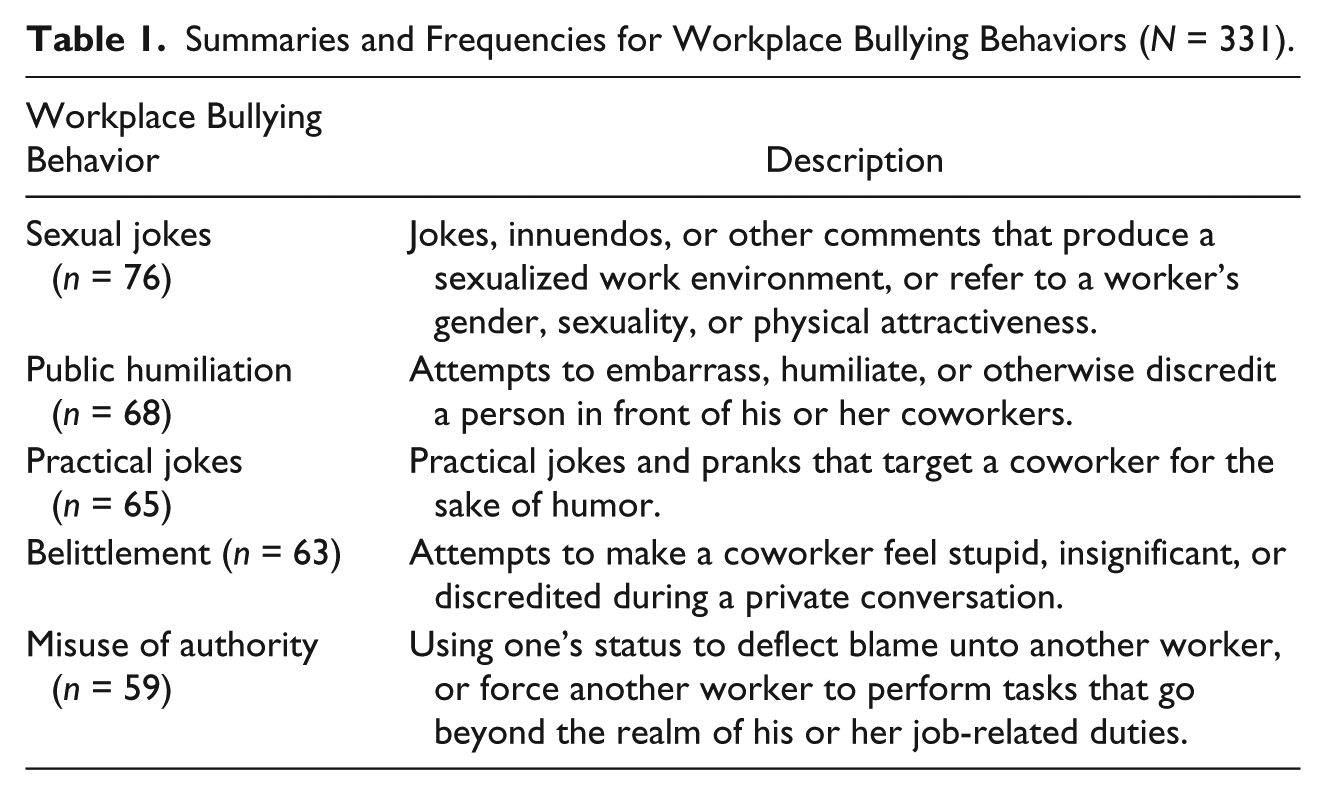
The comprehensive list of workplace bullying instances was analyzed for themes using a constant comparison approach, resulting in five categories of workplace bullying behavior: sexual jokes, public humiliation, belittlement, practical jokes, and misuse of authority (see Table 1). A constant comparative approach involves comparing the data with each applicable code and then modifying the code definition (Glaser & Strauss, 1967). The approach is iterative and reflexive. Inter-coder reliability between two of the researchers was conducted on a subset of 33 bullying instances (10% of all observed instances) to ensure the transparency of the five categories, with results revealing 85% simple agreement on placement. Diverging placements were discussed among the researchers to refine the categories before final frequencies were tabulated. Each bullying instance was then coded into one of the five themes.
Summaries and Frequencies for Workplace Bullying Behaviors (N = 331).
Analysis of Workplace Bullying on The Office
Bullying behaviors were prevalently portrayed in the 54 examined episodes of The Office. A total of 331 bullying instances were identified as meeting the criteria of workplace bullying; an average of 6.13 bullying behaviors per 21-min episode. Five specific categories surfaced as prevalent examples of bullying on The Office: sexual jokes, public humiliation, practical jokes, belittlement, and misuse of authority.
Sexual Jokes
Sexual jokes were the most prevalent workplace bullying behaviors, and were portrayed 76 times in the examined episodes. Examples included inappropriate comments regarding a coworker’s attractiveness or sexual orientation, and behaviors that sexualized the work environment. These sexually oriented behaviors overlap with notions of sexual harassment, yet also fit the definition of bullying because they were used to ridicule, ostracize, or otherwise harm the target’s emotional state or job performance (Kassing & Waldron, 2014; Tracy et al., 2006).
The relationship between Michael and his secretary Pam was highly illustrative of sexually oriented workplace bullying. For example, Michael introduced Pam to the cameras by saying, “If you think she’s cute now you should have seen her a couple years ago . . . rawr,” (1.1) 1 and made similar comments later in the series by saying, “I’d like a nice slice of Pamcake” (3.14). During Episode 2.6, when Pam asked Michael whether he had signed the papers she gave him, he attacked her by saying, “Chilax Pam, stop Pam-M-S-ing”; implying that her request was unreasonable and driven by female hormones. This pattern of sexual comments between Michael and Pam continued in other episodes as he regularly commented on her appearance and at one point tried to physically remove her bra.
Many of the other female characters were also targets of sexual jokes throughout the examined episodes, with male characters commenting about their bodies and attempting to touch, hug, or even kiss the women. For example, Dwight and another character engaged in an in-depth debate regarding Angela’s level of physical attractiveness, ultimately determining that on a 10-point scale, she was a “Scranton 9” (9.18). Conversely, Meredith and Phyllis were often singled out and made fun of for being masculine and unattractive.
Although sexual jokes were most commonly directed at the female characters, many male characters also experienced this form of bullying by having their gender identity or sexuality questioned. For example, during Episode 2.2, Todd Packer greeted Jim by saying “what’s up Halpert, still queer?” Todd later undermined Michael’s masculinity by suggesting that Michael hike up his skirt and remove his tampon (6.19). During Episode 3.1, Michael jokingly referred to Oscar, a gay man, as “faggy” and forced him to publically announce his sexuality to the entire office. Michael continued to make innuendos about Oscar throughout the series, referring to him as an “Oscar Meyer Weiner lover” (4.10), and telling him “that’s enough with the girl talk” (5.2).
Sexual jokes also occurred on The Office when workers engaged in public behaviors that did not target a particular person, yet nonetheless resulted in a sexualized working environment. The men of the office regularly sent each other emails portraying sexual situations and then laughed at them in front of the entire office. During Episode 2.2, several women informed Michael that they found these jokes and emails offensive; however, Michael simply made fun of them and continued his behavior. Indeed, one of Michael’s favorite jokes was to add “that’s what she said” to the end of statements to imply that a woman might make the remark in regard to sexual intercourse. The phrase “that’s what she said” became a trademark of the show and is now widely used in popular discourse, substantiating the show’s potential to influence viewer’s thoughts and behavior.
In sum, many of the portrayed behaviors on The Office qualified as clear acts of targeted sexual jokes, while others involve relatively small and nontargeted sexual innuendos that facilitated an ongoing sexualized working environment. Regardless of this distinction, sexual jokes were framed as lacking any real long-term consequences. For instance, during Episode 2.2, Michael was informed that he needed to be aware of the sexual harassment policy, and he responded, “What are we supposed to do scrutinize every little thing we say and do all day? I mean come on?” When a human resources worker explained that the current disregard for sexual harassment policy was a legal liability, the following exchange occurred:
“What’s the lawyer gonna come in and tell us? To not send out hilarious emails or not tell jokes?”
“Maybe not some of them, maybe not inappropriate ones.”
“There is no such thing as an appropriate one, that’s why it’s a joke.”
In this example, Michael seemed to incur a short-term scolding for his behavior, yet this reprimand did not translate to any real behavioral change. The top-down disregard of sexual jokes displayed on the show appeared to encourage other employees from engaging in the harassing behavior. Indeed, Pam explained to the camera, “Usually the day that we talk about sexual harassment is the day that everyone harasses me as a joke.”
Public Humiliation
The examined episodes included 68 instances in which an employee was publicly humiliated, which is a commonly cited workplace bullying behavior (Lutgen-Sandvik & Tracy, 2012). On The Office, public humiliation involved a target being singled out, harassed, ridiculed, or otherwise embarrassed in front of other workers.
Public humiliation was particularly evident in the relationship between Michael and Dwight. For example, Michael humiliated Dwight during Episode 1.5 by first denying him a position on the company basketball team, and then mocking him in front of everyone, by saying “NERD! That is why you are not on the team!” Later, during Episode 2.6, Michael attempted to prove his toughness by asking Jim to punch him in front of the entire staff. When Jim refused and suggested that Dwight punch him instead, Michael exclaimed, “I know 14-year-old girls that could kick Dwight’s ass!”
In other cases, employees sought to publically embarrass each other, or even their boss Michael. For example, during Episode 3.18, Darryl found out that Michael earned a low salary, and proceeded to send other employees a copy of Michael’s paystub. Likewise, Dwight singled out Phyllis, Kevin, and Stanley as being overweight in front of the entire office, and told that they needed liposuction and would have to pay for it themselves (5.2). At other times, workers engaged in public taunting by calling each other names such as an “idiot,” “dumbass,” “little girl,” “stupid son-of-a-bitch,” and “the anti-Christ.” This form of taunting was seen during Episode 9.20 when the receptionist Erin beat another worker at a paper airplane contest and proceeded to humiliate him by getting in his face and yelling “Eat it pig,” while he quietly protested that her actions were mean and unnecessary.
Similar to other workplace bullying behaviors on The Office, public humiliation was framed as amusing and lacking any lasting consequences for targets or bullies. On an emotional level, targets did not appear to enjoy being humiliated, and often protested their mistreatment. Despite this, the characters all tolerated it and did not display any lasting psychological distress. Dwight, for example, was scripted to appear resilient to repeated humiliation, and even idolized his tormentor Michael. Dwight seemed to almost embrace his role as Michael’s mistreated lackey, and used it to his advantage in an effort to get promoted.
The lack of formal consequences was also seen during Episode 6.25 when Toby attempted to lead a required meeting about the safety concerns of radon poisoning. Michael interrupted the meeting by snoring loudly as though he had fallen asleep. When Toby asked Michael to stop, Michael leapt to his feet and yelled “You know what, we’re not going to die of radon. We’re gonna die of boredom!” When several employees laughed, Michael stepped up his humiliation by adding, “And if I had a gun with two bullets, and I was in a room with Hitler, Bin Laden, and Toby . . . I would shoot Toby twice.” Several employees groaned, and Dwight replied, “You were being really funny but then you went too far.” Dwight’s comment implies that everyone was amused by Toby’s humiliation until Michael suggested that he wanted to literally kill Toby. Dwight’s criticism of Michael’s remarks served as a momentary social reprimand, but its effectiveness was undercut by the lack of formal punishment and fact that the group enjoyed Michael’s bullying until he crossed a proverbial line.
Michael was shown to justify his use of humiliation as a necessary managerial tactic by asserting,
We’re all best friends. I love everybody here but sometimes your best friends start coming into work late and start having dentist appointments that aren’t dentist appointments, and that is when it is nice to let them know you could beat them up.
Michael’s attitude seemed to trickle down into other character’s actions and created a culture that allowed and even encouraged humiliation. For example, when the intern Ryan accidentally started a small fire with the toaster oven, Dwight jeered “Apparently they don’t teach you to run a toaster oven in business school” and then danced around singing, “Ryan started the fire.” Rather than stopping Dwight’s humiliation of Ryan, Michael laughed and joined in the singing and dancing.
Practical Jokes
The third most prevalent workplace bullying behavior on the examined episodes of The Office involved the 65 instances in which a character was targeted for a practical joke. Referred to by the characters as “prank wars,” these behaviors were framed as comical despite the fact that they fit the bullying criteria of provoking emotional discomfort and preventing the targeted employees from accomplishing their job tasks (Kassing & Waldron, 2014; Tracy et al., 2006). In many cases, characters engaged in practical joke wars out of desire to relieve the boredom of office life and viewed then as an amusing and inconsequential activity.
The bullying nature of practical jokes was clearly evident when Michael decided to play a joke on Pam by telling her that she was being fired without severance for stealing post-it notes, which is something that she did not do (1.1). Long after Pam burst into tears, Michael finally exclaimed, “You got X-Punked!” and laughed at his joke while Pam called him a jerk and ran out of the office, still crying.
Practical jokes as a form of bullying were most clearly evident in the relationship between Jim and Dwight. Over the course of the examined episodes Jim hid Dwight’s desk in the men’s bathroom, replaced his desk with a desk made of Legos, locked Dwight in a conference room, placed his office supplies inside the vending machine, and set his stapler inside a mold of Jell-O. Jim even made Dwight fly to Hollywood by convincing him that he had gotten a role on a popular television show (8.13). During Episode 2.5, Jim and Pam actually told the cameras that they were trying to drive Dwight out of the workplace, and went as far as to create a resume for Dwight and post it on Monster.com without his knowledge.
Dwight was not scripted as an innocent target, however, and regularly responded with his own pranks. For example, Dwight disrupted Jim’s ability to work by loudly shredding paper and smiling while Jim struggled to communicate with a client on the phone (1.2). Dwight pulled a similar prank many seasons later by loudly playing music to disrupt Jim’s sales call (6.19). Likewise, Dwight put a laxative into Toby’s coffee (4.1), and committed many other pranks that involved taking joy in his ability to disrupt another worker’s productivity.
Like sexual jokes and public humiliation, practical jokes were framed as relatively innocuous. Jim’s pranks were portrayed as extremely humorous and did not lead to any managerial punishment. Dwight clearly indicated that he did not appreciate being pranked, and during Episode 2.6, he angrily yelled, “This is not funny. This is totally unprofessional.” To which Jim replied, “Okay well you’re the one who lost the desk.” Likewise, during Episode 1.1, Dwight directly demanded that Michael discipline Jim for setting his stapler in a Jell-O mold, but Michael downplayed his request by replying, “Oh discipline, kinky.” Upon further pleading from Dwight, Michael finally gave the staff a lecture by saying,
Here’s the deal you guys. The thing about a practical joke is you have to know when to start as well as when to stop. And yeah Jim, now is the time to stop putting Dwight’s personal effects into Jell-O.
This reprimand immediately lost its power when Michael laughed at Jim’s fake apology, “Sorry Dwight I’ve always been your biggest flan.” Michael’s managerial attitude therefore reinforced the notion that it is okay to hinder a coworker’s productivity as long as it is done in a funny manner.
Belittlement
The forth most frequent form of workplace bullying on The Office involved acts of belittlement, which occurred 63 times in the examined episodes. Examples of belittlement included situations in which the perpetrator’s actions sought to make targets feel small, stupid, insignificant, or otherwise belittled during a private conversation. Belittlement occurred in many forms and between many characters on The Office, and often involved the use of insults, ridicules, and patronization of an employee’s ideas.
Michael was a prime perpetrator of belittlement, and regularly mocked or disregarded input from his staff. For example, during Episode 1.6, Dwight offered his thoughts on a topic, only to have Michael respond by saying “no one cares what you think.” Michael later (2.4) belittled Dwight by telling him that Ryan “knows more about business than you ever will.” Michael also regularly demeaned Pam by talking over her while she spoke, referring to her as “the receptionist,” and acting surprised when she said something intelligent. Michael went as far as to throw a pen at Toby’s face, seemingly for no reason other than to make Toby feel bad (5.11). Other employees followed Michael’s lead by picking on Toby, with Dwight calling him “the most forgettable man on the planet” (8.13), and the new boss Andy interrupting Toby to say “now I know why Michael hated you so much” (9.1).
The women of the office were often displayed as belittling each other. For example, Angela told Pam that her party decorations were “whorish” (1.4). Later in the series (Episode 6.1), Pam revealed that she was pregnant, and Angela asked her, “Did you know that a baby conceived out of wedlock is still a bastard?” This comment was unrelated to work, and demeaned Pam by implying that her upcoming nuptials were a ruse to cover up her pregnancy. Angela upped her mistreatment two seasons later when Pam was pregnant with another child, and Angela stated that she should report Pam to social services for drinking herbal tea from a coffee cup with trace amounts of caffeine that might hurt her unborn child.
Belittlement is less embarrassing than public humiliation because other workers are not present to witness the mistreatment, but it is nonetheless harmful to the target’s psyche. In real life, being ridiculed might lead targets to doubt themselves and avoid full engagement in workplace conversations. On The Office, the repercussions appear to be nonexistent, with targets either passively accepting the belittling remarks, or firing back with their own form of counter-mistreatment; both of which would create an extremely hostile environment for workers.
Misuse of Authority
The final category of workplace bullying behaviors evident on The Office involved 59 situations in which a character misused their long-term or temporary positions of authority. These behaviors reiterate the prominent role that power dynamics play within workplace bullying (Namie & Lutgen-Sandvik, 2010). For example, when Phyllis was chosen to plan a company party, she forced Angela to engage in unpleasant activities such as wearing a hair net, taking down the Christmas tree, and serving appetizers to the other workers (5.11). When Angela was given a leadership role on a task, she got revenge by making Phyllis fill out a large stack of forms, and then immediately asking her to shred those forms.
Michael was the most frequent perpetrator of this bullying behavior, and regularly misused his authority for personal gain. For example, Michael made Ryan complete personal tasks such as cleaning his car, driving his friend around town, and bringing him breakfast prior to the start of the workday. Michael also made Pam update his subscription to the men’s magazine Maxim, which was an obvious breach of her work responsibilities. Furthermore, Michael regularly used Dwight’s desire for recognition to persuade him to perform unpleasant tasks such a firing employees, cutting health benefits, and assigning weekend shifts.
In many cases, Michael seemed to abuse his authority simply to prove that he could do so. For example, the workers complained that the office was like a prison, so Michael locked them all inside the conference room to show them what prison feels like (3.9). He later gathered all of the employees in the conference room and tried to force everyone to state their religious beliefs, which was a clear violation of both social norms and the law (4.1). Michael also coerced his employees into helping his romantic life by telling them that he would fire anyone who did not give him the contact information of a woman who might date him (4.10).
When Andy took over as regional manager during Season 8, he began to misuse his authority in ways similar to Michael. During Episode 9.1, Andy nicknamed the two new employees “plops” and “farts,” and threatened another employee by saying “I don’t like to toss out the b-word, but I will be a huge bitch to you!” He then proceeded to make this employee complete personal chores for him, and placed the office’s waste bins around her desk.
Given that Michael and Andy were the bosses, there were few formal consequences for their obvious misuses of power in the examined episodes. The corporate officials were occasionally called in to address their inept management, yet Michael and Andy were never actually fired for their behavior. Likewise, employees sometimes directly questioned Michael’s authority; however, they eventually gave in and only a few actually quit their jobs. The employees mostly took it all stride and even sought ways to passive aggressively get revenge. Moreover, even though the employees showed disdain for his tactics, many seemed to have an underlying sense of affection for Michael and even defended him on multiple occasions.
Discussion and Implications
The present study explored the portrayal of workplace bullying behaviors on the popular television show The Office. Research Question 1 asked what types of workplace bullying are portrayed on The Office. Analysis of 54 episodes revealed 331 instances of workplace bullying that were broken down into the categories of sexual jokes, public humiliation, belittlement, practical jokes, and the misuse of authority. These frequencies reveal an average of 6.13 bullying instances per episode, which equates to one act of workplace bullying every 3.43 min of the show’s average 21-min run-time. The shear frequency of workplace bullying on The Office is alarming, and this concern is amplified by the way that bullying behaviors were affectively framed on the show.
Research Question 2 asked how various types of workplace bullying are affectively framed on The Office. Analysis revealed that instances of workplace bullying were routinely framed as comedic behaviors lacking tangible consequences for employees or the organization. Each inappropriate behavior was typically left unresolved or had implications that were contained within a single episode. On an organizational level, characters that committed bullying behaviors were rarely punished for their disruptive actions, and any repercussions appeared to be relatively small scale. For example, Michaels’ desire to be seen as the “World’s Best Manager” was not validated by his employees or corporate leaders, yet he was able to continue on as manager of Dunder Mifflin despite his problematic behavior. Likewise, although characters were occasional questioned or verbally scolded for their bullying behavior, the overall office seemed downplay the seriousness of the behavior despite the fact that the behavior hindered employees’ ability to perform their job tasks.
Power disparity is often a key element of bullying (Namie & Lutgen-Sandvik, 2010), and this fact was somewhat evident on The Office. Certain characters such as Michael, Dwight, and Andy certainly seemed to engage in bullying due to their legitimate authority. That said, other employees such as Jim were highly likeable, and therefore possessed a degree of referent power that allowed them to get away with reciprocal bullying. In this way, an implication of the present study is that The Office seemed to portray the democratization of bullying; everyone was a target and everyone was a bully. The democratization of bullying might reduce the role of power dynamics in bullying, but it creates an emotionally abusive organizational climate that should provoke a host of negative individual and organizational outcomes (Lutgen-Sandvik & McDermott, 2008; Lutgen-Sandvik, Namie, & Namie, 2009). That said, the characters on the show appeared to be unfazed, and displayed amicable and even friendly coworker dynamics, thereby furthering the harmful message that bullying is simply an amusing and nonserious element of work life. This portrayal actually implies that targets of bullying should simply laugh it off with their tormentors, or perhaps form a collegial and friendly relationship by reciprocating in a funny way. This is troubling because it downplays the challenges that real targets of bullying face to overcome the individual, health, and psychological consequences of being a target.
On a personal level, bullied workers on The Office rarely displayed any lasting harm from their mistreatment. So in some cases, the harmful affective nature of bullying was briefly acknowledged (i.e., when the target expressed that the behavior was offensive and hurtful), yet these negative immediate emotional reactions were overridden by the lack of any lasting psychological distress throughout the series. Indeed, many employees were scripted to appear numb or impervious to their mistreatment. As a whole, the effects of being bullied were thus framed as nonexistent or short-lived, which directly conflicts with the literature showing the negative long-term effects of being bullied at work (e.g., Keashly & Neuman, 2005; Mikkelsen & Einarsen, 2002).
Theoretical Implications
Media representations of office life are not a new phenomenon. Movies such as Office Space, In Good Company, and Horrible Bosses have centered on workplace issues such as aging in the workforce and difficult management. Media representations of workplace communication—in general and on The Office specifically—are important because “presumably ‘real’ people consume these representations, drawing on and/or resisting them in the performance of everyday organizational life” (Ashcraft & Mumby, 2004, pp. 18-19).
Research has established that it is easier than most people believe for viewers to accept the reality of television as similar to the real world (O’Guinn & Shrum, 1997). Social cognitive theory (Bandura, 2001) suggests that viewers might vicariously learn from media representations of workplace bullying. Some people might question whether the satirical nature of bullying on The Office reduces the show’s power as a source of observational learning. However, exposure to verbal aggressiveness on sitcoms has been found to increase viewers’ level of verbally aggressive thoughts (Chory-Assad, 2004). As a result, the problematic bullying discourses that were described in the present study could trickle down into viewer’s perceptions of real-world workplace bullying. This likelihood increases due to the fact that The Office attracted large audiences for nine seasons and is still highly syndicated.
The present study named five specific types of workplace bullying behavior: sexual jokes, public humiliation, practical jokes, belittlement, and misuses of authority. Although similar types of bullying behavior have been mentioned in past research (Lutgen-Sandvik & McDermott, 2008; Lutgen-Sandvik & Tracy, 2012), the present study extends the literature in key ways. First, we noted that sexual jokes and practical jokes—while not clearly identified in past bullying research—fit the criteria of bullying (see Kassing & Waldron, 2014; Tracy et al., 2006) if they are used to harm another individual’s emotional state, create a hostile working environment, or otherwise impede targets ability to complete job tasks.
Second, the present study provided examples that differentiate public humiliation from belittlement. As mentioned, public humiliation occurs when one employee degrades another employee in front of other workers, whereas belittlement occurs when one employee degrades another employee privately. Public humiliation could turn into forms of mobbing (Leymann, 1996) if multiple workers were to gang up on a single worker. The distinction between public humiliation and belittlement is important because public humiliation inherently involves witnesses, and these witnesses could provide much-needed support when a worker reports being bullied. However, in cases when bullying is persistent within an organization’s culture, as was the case on The Office, real-world witnesses might be silenced because they fear becoming the next target (Lutgen-Sandvik & Tracy, 2012). Belittlement targets, on the contrary, might face even more difficulty when attempting to make claims of workplace bullying. The lack of witnesses could provoke a he-said/she-said battle between targets who feel mistreated and bullies who claim that the target is being overly sensitive or taking statements out of context.
Practical Implications
The present study found workplace bullying behaviors to be rampant on The Office. The normalization of workplace bullying has potential implications on resistance efforts. The present study did not seek to test whether viewing The Office can actually cause any effects on viewers, but the theoretical backing of social cognitive theory implies that discourses discussed within the present study might, indeed, filter into viewer’s perceptions. One practical implication of the present study is that individuals who watch workplace bullying on The Office might use the representations as “discursive resources” (Cheney, Zorn, Planalp, & Lair, 2008, p. 165) to make sense of their own workplace bullying situations. As the show typically frames bullying behaviors as amusing and trivial, it might serve as one of many social scripts that prevent organizations from treating bullying as a serious problem (Lutgen-Sandvik & Tracy, 2012).
If employers and policy makers rely on discourses such as those seen on The Office when approached by targets reporting a pattern of workplace bullying, then it is unlikely that they will take the targets’ complaints seriously. The present study cannot be used to imply that The Office is responsible for these effects, however, if the show is in any way contributing to a discourse that normalizes workplace bullying and desensitizes the public to the harmful truth of the issue, then this show and other media outlets are deserving of increased research attention. If nothing else, The Office illustrates a common discourse and set of assumptions about workplace bullying; it is childish, meant to be funny and does not have any lasting effects.
Managers and administrators can attempt to combat the humorous representations in popular media by offering training sessions for employees. The first step in the reduction of workplace bullying is to teach employees what it is, create a common language for experiences through the use of terms like target instead of victim (Lutgen-Sandvik & Tracy, 2012), and set up strict policies that forbid bullying behaviors. Through training and lunch and learn sessions, employees can be educated about the seriousness of workplace bullying and the potential devastating physical, psychological, and job-related consequences.
Limitations and Conclusion
This study provides a basis for future research, yet is not without limitations. One limitation was that we were unable to make larger claims regarding diversity. For example, sexual jokes often seemed to occur between men bullying women or women bullying other women. When aimed at men, sexual jokes often sought to question the targets’ sexuality. Our research questions did not seek to focus on identity dynamics, and therefore did not facilitation in-depth consideration of gender or sexuality. Future research should seek to explicate how these issues of diversity might play a role in workplace bullying narratives, especially given that these identity markers might influence the way that television audiences (and real-life workers) interpret acts of bullying.
A second limitation is that measuring and coding bullying behaviors proved to be a difficult task due to the innocuous nature of many instances portrayed on the show. Likewise, focusing on individual behaviors that typify bullying provided a coherent unit of analysis, yet did not fully reveal the patterned nature of workplace bullying. This procedural difficulty is enlightening, however, because it mirrors the problems that targets confront (e.g., proving that they have been objectively harmed, and demonstrating that the behavior was persistent) when attempting to document their mistreatment.
The need to rationally and empirically demonstrate the presence of workplace bullying cannot be ignored because this evidence is often necessary to convince employers and policy makers to take action. There is a need for continued efforts at both producing qualitative and quantitative data concerning workplace bullying. In particular, additional work is needed to examine the various sources (such as media) of the social discourses that people draw upon when interpreting their experiences. Future research might test whether viewing shows such as The Office can provide measureable effects on viewers’ perceptions of bullying. Scholars might also gain increased understanding of workplace bullying and other similar phenomenon by incorporating elements of violent behavior research to further understand the social discourses that impact norms regarding violent behavior. The present study might serve as a springboard for this type of research.
Footnotes
Declaration of Conflicting Interests
The author(s) declared no potential conflicts of interest with respect to the research, authorship, and/or publication of this article.
Funding
The author(s) received no financial support for the research, authorship, and/or publication of this article.