




Abstract
The present study examined relations among attachment, aggression, and anxiety sensitivity (AS) in a sample of male and female undergraduates. Given that some individuals may use aggression to modulate negative emotional states, it was predicted that AS dimensions would mediate relations between attachment anxiety (vs. attachment avoidance) and certain forms of aggression, particularly impulsive aggression. Moreover, it was hypothesized that the relations among attachment, aggression, and AS would be moderated by gender. Participants (N = 1,042) completed measures of attachment (Experiences in Close Relationships–Revised [ECR-R]), aggression (Aggression Questionnaire [AQ]; Impulsive/Premeditated Aggression Scales [IPAS]), and AS (AS Index–3 [ASI-3]). Results indicated that AS mediated relations between attachment dimensions (both anxiety and avoidance) and most forms of aggression, with each of the AS dimensions playing a unique role differentially by gender. Cognitive concerns emerged as a significant mediator, particularly for men; physical and social concerns played more of a mediating role for women. Interestingly, none of the AS dimensions played a significant mediating role between attachment (either anxiety or avoidance) and physical aggression for men. Results are discussed in terms of their clinical implications and directions for future research.
The present study investigated the links among attachment, aggression, and anxiety sensitivity (AS; fear of arousal-related somatic sensations) in a sample of undergraduates. Specifically, we explored whether a personality factor (i.e., AS) linked to attachment (Watt, McWilliams, & Campbell, 2005; Weems, Berman, Silverman, & Rodriguez, 2002) and found to mediate relations between formative experiences and adult outcomes (e.g., anxiety; see Watt & Stewart, 2000, 2003) would mediate the effect of attachment style on aggressive behavior (Tweed & Dutton, 1998); also, whether mediation would vary by gender.
Attachment
According to attachment theory, attachment formation in childhood serves as a prototype for adult attachment relationships (Bowlby, 1988). Brennan, Clark, and Shaver (1998) found that individual differences in adult attachment could be organized along two dimensions: anxiety (i.e., sensitivity to rejection and abandonment) and avoidance (i.e., reluctance to be dependent or intimate with others). This two-dimensional model of attachment has been linked to a number of individual difference variables, including gender, with men tending to report more attachment avoidance and less attachment anxiety than women (Del Giudice, 2011), and AS (Watt et al., 2005; Weems et al., 2002).
Anxiety Sensitivity
AS refers to the fear of arousal-related somatic sensations due to beliefs that these sensations portend negative consequences (“fear of fear”; Reiss, 1991). High AS is a known risk factor for not only anxiety disorders, including panic and posttraumatic stress disorders (see Naragon-Gainey, 2010), but also related conditions, such as depression (Taylor, Koch, Woody, & McLean, 1996), substance use disorders (Stewart & Kushner, 2001), and suicidal ideation (Capron et al., 2012). Subsumed within the global construct of AS are three inter-correlated, lower order factors: physical concerns (e.g., fear of having a heart attack due to a racing heart beat), cognitive concerns (e.g., fear of “going crazy” due to difficulty concentrating or dizziness), and social concerns (e.g., fear of embarrassment due to openly displaying symptoms of anxiety such as trembling; see Taylor et al., 2007). These dimensions have been found to associate uniquely with different types of psychopathology; for example, physical concerns with panic, cognitive concerns with depression, and social concerns with social anxiety (Olthuis, Watt, & Stewart, 2014). Research shows that women tend to be more anxiety sensitive than men (Bernstein, Zvolensky, Stewart, Comeau, & Leen-Feldner, 2006).
Anxiety Sensitivity and Aggression
People with high AS are unduly sensitive to somatic sensations associated with fear and anxiety, such as an elevated heart rate (e.g., Stewart, Buffett-Jerrott, & Kokaram, 2001). Consequently, they tend to avoid stimuli and situations that evoke the feared sensations, such as physical activity (Sabourin, Hilchey, Lefaivre, Watt, & Stewart, 2011) but also physical aggression. Broman-Fulks, McCloskey, and Berman (2007) found an inverse relationship between AS levels and physical aggression, even in the face of provocation (i.e., shock administered by a competitor). This relationship was moderated by gender with men behaving more aggressively (i.e., administering more frequent, intense shocks) than women. This finding fits with violent crime statistics across cultures, research on interpersonal conflicts, and laboratory studies of gender differences in aggressive responding (see Broman-Fulks et al., 2007). Such gender differences could be attributable to biological factors (e.g., testosterone levels in men, differences in physical size) or social influences (e.g., socialization of aggression), including relevant learning experiences in the context of attachment relationships (Watt, Stewart, & Cox, 1998). Women (vs. men) may avoid aggressing due to experiencing more anxiety, fear, and guilt after aggressing (Eagly & Steffen, 1986). High AS women may be even less prone to act aggressively fearing the consequences of the attendant sensations (Broman-Fulks et al., 2007). Whether certain consequences are more aversive than others remains to be seen.
Anxiety Sensitivity, Attachment, and Aggression
Two studies have linked high AS to insecure attachment in adults (Watt et al., 2005; Weems et al., 2002), with attachment anxiety positively correlated with AS levels. Weems et al. (2002) found no relationship between attachment avoidance and AS in the context of romantic relationships specifically, although Watt et al. (2005) did find an association between the two when attachment in all close relationships was considered.
Attachment, in turn, has been linked to aggression. Early studies found that attachment styles characterized by high anxiety—fearful (high anxiety, high avoidance) and preoccupied (high anxiety, low avoidance)—correlated positively with aggression in intimate relationships (see Dutton, 1995). In a sample of men referred for intimate partner violence treatment, Tweed and Dutton (1998) found preoccupied attachment to be linked to both impulsive (emotionally volatile acts) and premeditated aggression (instrumental acts), whereas fearful attachment was linked to impulsive aggression only. They suggested that premeditated aggression is used instrumentally to establish control in relationships, whereas impulsive aggression is used to modulate aversive emotional states. Dutton (2007) later characterized the anger displayed by these individuals as a reaction to fear originating from an anxious attachment style.
Present Study
In summary, attachment anxiety (vs. avoidance) has been linked to impulsive and premeditated aggression, as well as high AS. AS, in turn, has been linked to low physical aggression. Little else is known about relations among these variables. The present study sought to redress this gap by exploring the effects of attachment on both types (impulsive, premeditated) and forms (verbal, physical, anger, hostility) of aggression, and whether these effects were influenced by AS and gender. Given the literature, it was expected that (a) high AS (especially physical concerns, which is linked to panic) would mediate relations between attachment anxiety (vs. avoidance) and all forms of aggression, except physical. Given the literature, it was expected that (b) men (vs. women) would reveal more aggression, overall, and that (c) AS would play a more potent mediating role for women (vs. men).
Method
Participants
Participants were 1,042 (693 women, 349 men) undergraduates enrolled in introductory psychology courses at an undergraduate university in Eastern Canada. Participants ranged in age from 17 to 45 years (M = 18.67, SD = 1.87) and were predominantly of European descent (81%). Pursuant to approval from the Research Ethics Board (REB), participants completed a series of counter-balanced questionnaires. Students received credit points for participating but were free to decline participation at any time and without penalty.
Measures
Experiences in Close Relationships–Revised (ECR-R)
The ECR-R (Fraley, Waller, & Brennan, 2000) is a 36-item self-report measure of adult attachment. It conceptualizes adult attachment as consisting of two dimensions: (a) attachment anxiety (e.g., “I worry a lot about my relationships”) and (b) attachment avoidance (e.g., “I prefer not to be too close to others”). Respondents rate each item on a 7-point Likert-type scale ranging from 1 (disagree strongly) to 7 (agree strongly). Cronbach’s alphas were .91 (anxiety) and .93 (avoidance).
Anxiety SensitivityIndex–3 (ASI-3)
The ASI-3 (Taylor et al., 2007) is an 18-item measure that assesses three dimensions of AS: (a) physical concerns (e.g., “It scares me when my heart beats rapidly”), (b) cognitive concerns (e.g., “When my thoughts seem to speed up, I worry that I might be going crazy”), and (c) social concerns (e.g., “It is important for me to not appear nervous”). Respondents rate the extent to which they believe that anxiety symptoms are indicative of harmful consequences on a 5-point Likert-type scale ranging from 0 (very little) to 4 (very much). Cronbach’s alphas were .77 (social), .84 (physical), and .87 (cognitive).
Impulsive/Premeditated Aggression Scales (IPAS)
The IPAS (Stanford et al., 2003) is a 26-item, self-report questionnaire designed to categorize aggression as either predominantly impulsive (e.g., “When angry, I reacted without thinking”) or premeditated (e.g., “I feel my actions were necessary to get what I wanted”). Respondents are asked to think about aggressive acts they have committed in the last 6 months and respond to each item using a 5-point Likert-type scale ranging from 1 (strongly disagree) to 5 (strongly agree). Cronbach’s alphas were .78 for premeditated aggression and .76 for impulsive aggression.
Aggression Questionnaire (AQ)
The AQ (Buss & Perry, 1992) consists of 29 items measuring four manifestations of aggression: (a) physical aggression (PA; for example, “If somebody hits me, I hit back”), (b) verbal aggression (VA; for example, “I can’t help getting into arguments with people”), (c) anger (e.g., “I sometimes feel like a powder keg ready to explode”), and (d) hostility (e.g., “Other people always seem to get the breaks”). Respondents rate the extent to which each statement is characteristic of them using a 5-point Likert-type scale ranging from 1 (extremely uncharacteristic of me) to 5 (extremely characteristic of me). Cronbach’s alphas were .73 (hostility), .76 (verbal), .80 (anger), and .86 (physical).
Results
Descriptive Statistics and Gender Differences Across Measures
Means, standard deviations, and effect sizes appear in Table 1. ANOVA revealed no gender differences in attachment anxiety, but men (vs. women) reported significantly more attachment avoidance. Women reported more physical concerns than men, but there were no gender differences in cognitive and social concerns. Men (vs. women) reported significantly more aggression, with the exception of impulsive aggression and hostility.
Means and Standard Deviations for all Study Variables by Gender.
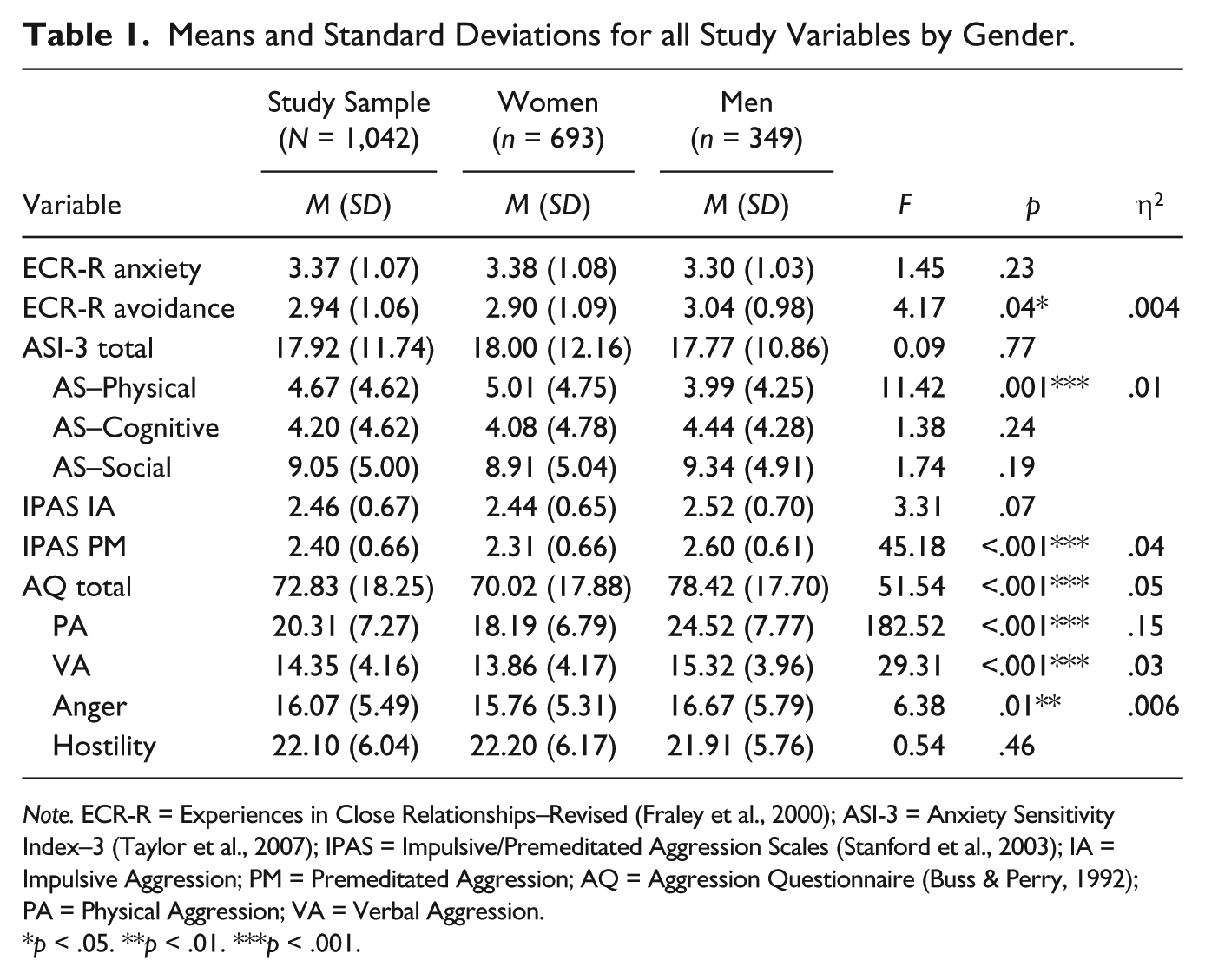
Note. ECR-R = Experiences in Close Relationships–Revised (Fraley et al., 2000); ASI-3 = Anxiety Sensitivity Index–3 (Taylor et al., 2007); IPAS = Impulsive/Premeditated Aggression Scales (Stanford et al., 2003); IA = Impulsive Aggression; PM = Premeditated Aggression; AQ = Aggression Questionnaire (Buss & Perry, 1992); PA = Physical Aggression; VA = Verbal Aggression.
p < .05. **p < .01. ***p < .001.
Correlational Analyses
Pearson product–moment correlations were computed separately by gender (see Table 2). For both women and men, attachment anxiety correlated positively with avoidance and all three ASI-3 dimensions. Attachment avoidance correlated only with social and only for women. All of the aggression measures were highly correlated, with shared variance ranging from 5% (impulsive and premeditated) to 20% (impulsive and anger).
Bivariate Correlations Among all Subscales by Gender.
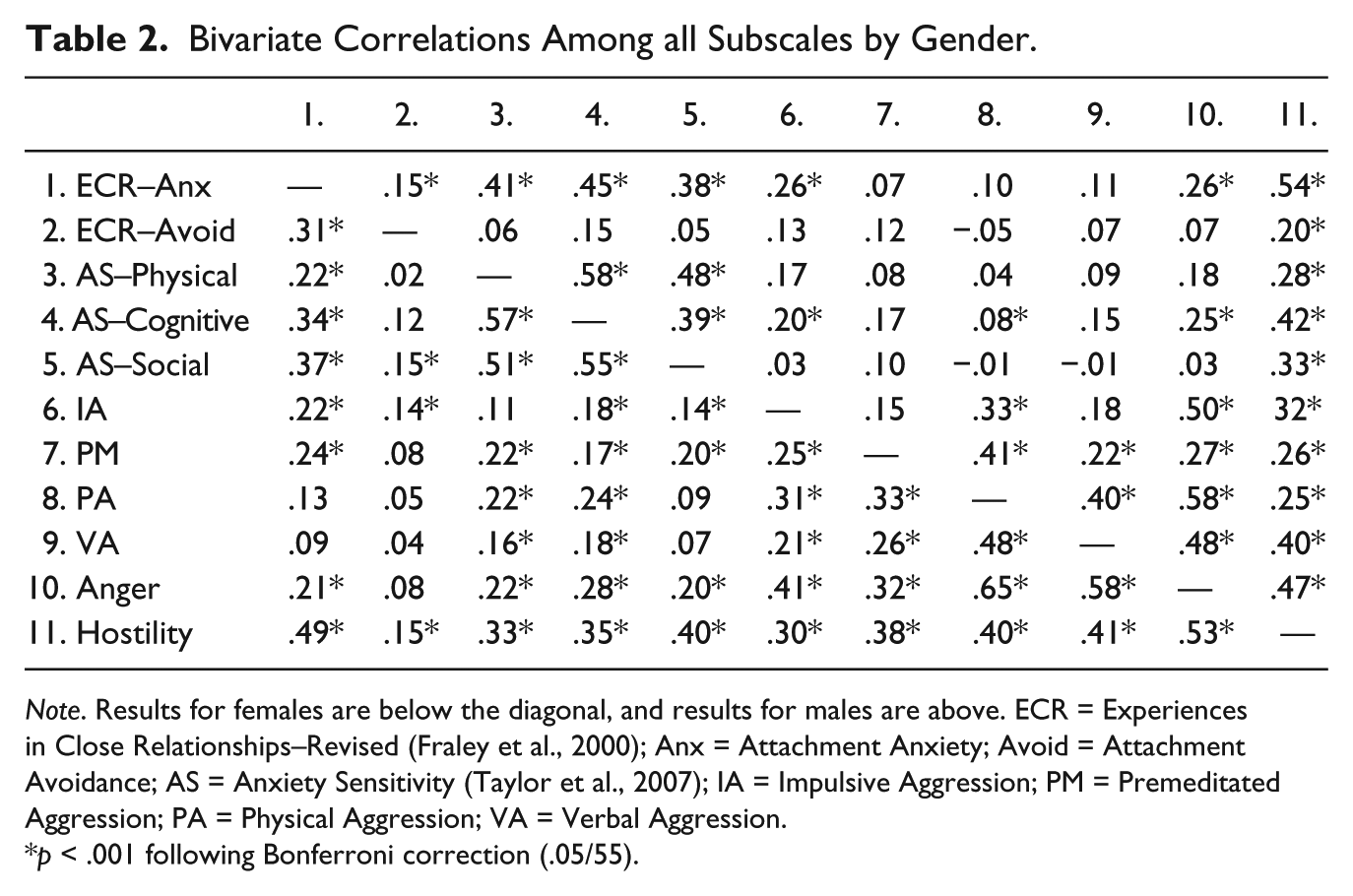
Note. Results for females are below the diagonal, and results for males are above. ECR = Experiences in Close Relationships–Revised (Fraley et al., 2000); Anx = Attachment Anxiety; Avoid = Attachment Avoidance; AS = Anxiety Sensitivity (Taylor et al., 2007); IA = Impulsive Aggression; PM = Premeditated Aggression; PA = Physical Aggression; VA = Verbal Aggression.
p < .001 following Bonferroni correction (.05/55).
Mediation Analyses
Multiple mediation analyses (see Figure 1) utilizing non-parametric bootstrapping were performed using the SPSS macro, Process (Hayes, 2013) to examine whether dimensions of AS mediate (i.e., indirectly effect) the relationships between attachment and aggression. In the present study, 10,000 samples were drawn with replacement to generate a distribution of indirect effects, coefficients (point estimates), and bias-corrected 95% confidence intervals (BC 95% CIs). Indirect effects are considered statistically significant when CIs do not contain zero.
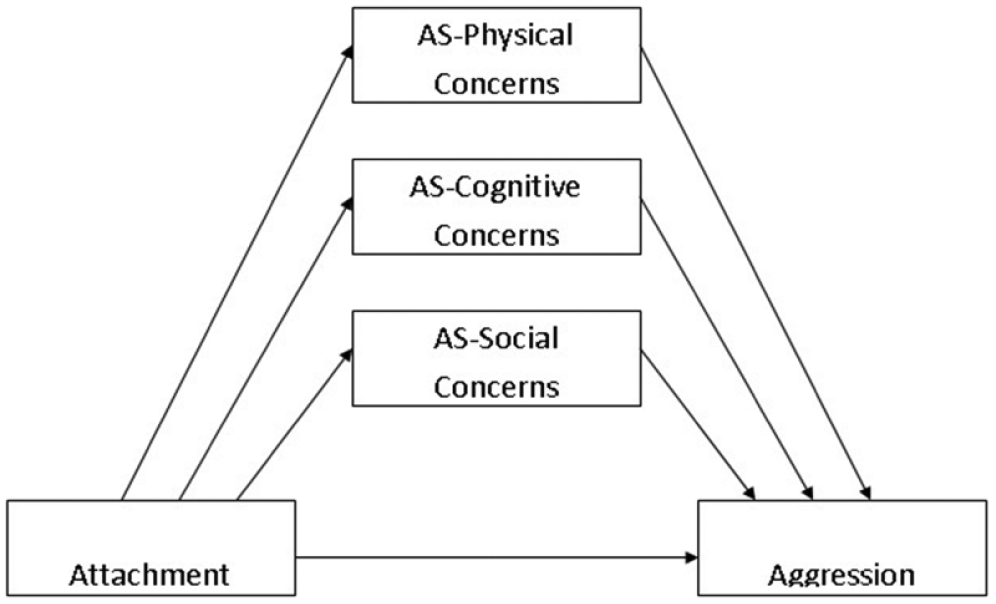
Conceptual model for multiple mediational analyses.
Effects of attachment anxiety on aggression
Table 3 presents a summary of the results for the effects of attachment anxiety on aggression. There was a significant effect of attachment anxiety on premeditated aggression through the combined dimensions of AS with no specific indirect effects. There was a significant effect of attachment anxiety on impulsive aggression through the combined dimensions of AS, with cognitive accounting for 21% of the total effect (P M = ab / c). Similarly, there was a significant indirect effect of attachment anxiety on physical, verbal, and anger through the combined dimensions of AS, with cognitive accounting for 70%, 69%, and 24% of the total effect, respectively. Finally, there was a significant indirect effect of attachment anxiety on hostility through the combined dimensions of AS, with each of the dimensions exerting a unique indirect effect but none accounting for more than 10% of the total effect. Pairwise contrasts revealed no significant differences in the strength of the specific indirect effects across the three dimensions.
Multiple Mediation of the Effect of Attachment Anxiety on Aggression Through Anxiety Sensitivity Dimensions.

Note. Point Est. = point estimate; BC 95% CI = bias-corrected 95% confidence interval; IV = Independent variable; DV = Dependent variable; ECR = Experiences in Close Relationships–Revised; Anxiety = Attachment Anxiety; AS–Phys = Physical Concerns; AS–Cog = Cognitive Concerns; AS–Soc = Social Concerns; PM = Premeditated Aggression; IA = Impulsive Aggression; PA = Physical Aggression; VA = Verbal Aggression.
p < .05. **p < .01. ***p < .001.
Effects of attachment avoidance on aggression
Table 4 presents a summary of the results for the effects of attachment avoidance on aggression. There was a significant effect of attachment avoidance on premeditated aggression through cognitive and social, with each accounting for 11% of the total effect. There were significant effects on impulsive aggression through cognitive and social, with a significant specific indirect effect through cognitive accounting for 14% of the total effect. Similarly, there was a significant effect of attachment avoidance on anger and both physical and verbal through cognitive and social, with cognitive uniquely accounting for 58%, 37%, and 36% of the total effect, respectively. There was a significant indirect effect of attachment avoidance on hostility through cognitive and social, with each uniquely accounting for 15% and 16% of the total effect, respectively, with no significant difference in the strength of the specific indirect effects.
Multiple Mediation of the Effect of Attachment Avoidance on Aggression Through Anxiety Sensitivity Dimensions.

Note. Point Est. = point estimate; BC 95% CI = bias-corrected 95% confidence interval; ECR = Experiences in Close Relationships–Revised; Avoid = Attachment Avoidance; AS–Phys = Physical Concerns; AS–Cog = Cognitive Concerns; AS–Soc = Social Concerns; PM = Premeditated Aggression; IA = Impulsive Aggression; PA = Physical Aggression; VA = Verbal Aggression.
p < .05. **p < .01. ***p < .001.
Moderated Mediation Analyses
To test whether the mediational models differed by gender, moderated multiple mediation analyses were conducted (see Figure 2). When the BC 95% CI does not contain zero, the indirect effect is significant. The magnitude of an indirect effect, however, can vary at different levels of the moderator variable, in the present study, by gender (Preacher, Rucker, & Hayes, 2007).
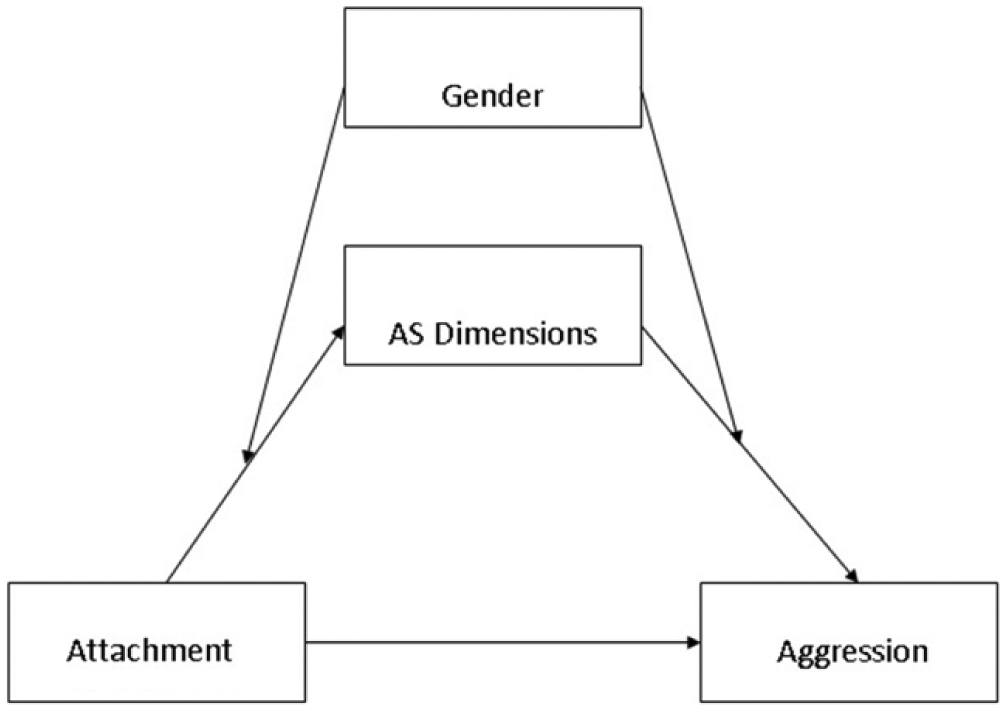
Conditional process model for moderated mediation.
Gender effects of attachment anxiety on aggression
Table 5 presents a summary of the results for gender effects on attachment anxiety on aggression. The effect of attachment anxiety on premeditated through the AS dimensions was significantly moderated by gender. The mediating effect through physical was significant for women only; the effect through cognitive was significant for men only; the effect via social was significant for neither. The effect of attachment anxiety on impulsive through cognitive was significant for women only; the effect of physical and social was not significant for either.
Conditional Indirect Effects of Attachment Anxiety (IV) on Aggression Through Anxiety Sensitivity Dimensions By Gender.

Note. AC = Anxiety Sensitivity; BC 95% CI = bias-corrected 95% confidence interval; PM = Premeditated Aggression; AS–Phys = Physical Concerns; AS–Cog = Cognitive Concerns; AS–Soc = Social Concerns; IA = Impulsive Aggression; PA = Physical Aggression; VA = Verbal Aggression.
p < .05.
The effect of attachment anxiety on physical through all AS dimensions was found to be significantly moderated by gender, with all three dimensions significant for women only. The strength of the specific indirect effects was stronger for physical and cognitive than social. The effect of attachment anxiety on verbal through physical was found to be significant for women only. The effect via cognitive was significant for both; the effect through social was not significant for either.
The effect of attachment anxiety on anger through physical was significant for women only. The effect via cognitive was significant for both; the effect through social was significant for men only and in the opposite direction (i.e., low vs. high social concerns). The strength of the physical (vs. social) effects in women was not significantly different, but that the effect of cognitive (vs. social) was stronger for men. In other words, high attachment anxious women with either high physical and/or cognitive concerns were more prone to be angrily aggressive, whereas for high attachment anxious men, high cognitive and/or low social concerns were more associated with anger. The effect of attachment anxiety on hostility via physical was significant for women only, via cognitive for men only, and via social for both. The strength of the specific indirect effects was not significantly different across dimensions for either men or women.
Gender effects of attachment avoidance on aggression
Table 6 presents a summary of the results for the gender effects of attachment avoidance on aggression. The effect of attachment avoidance on premeditated aggression through cognitive was significant for men only; the effect through social was significant for women only. The effect of attachment avoidance on impulsive aggression through cognitive concerns was significant for both men and women. The effect through social was not significant for either gender (see Table 6).
Conditional Indirect Effects of Attachment Avoidance (IV) on Aggression Through Anxiety Sensitivity Dimensions by Gender.
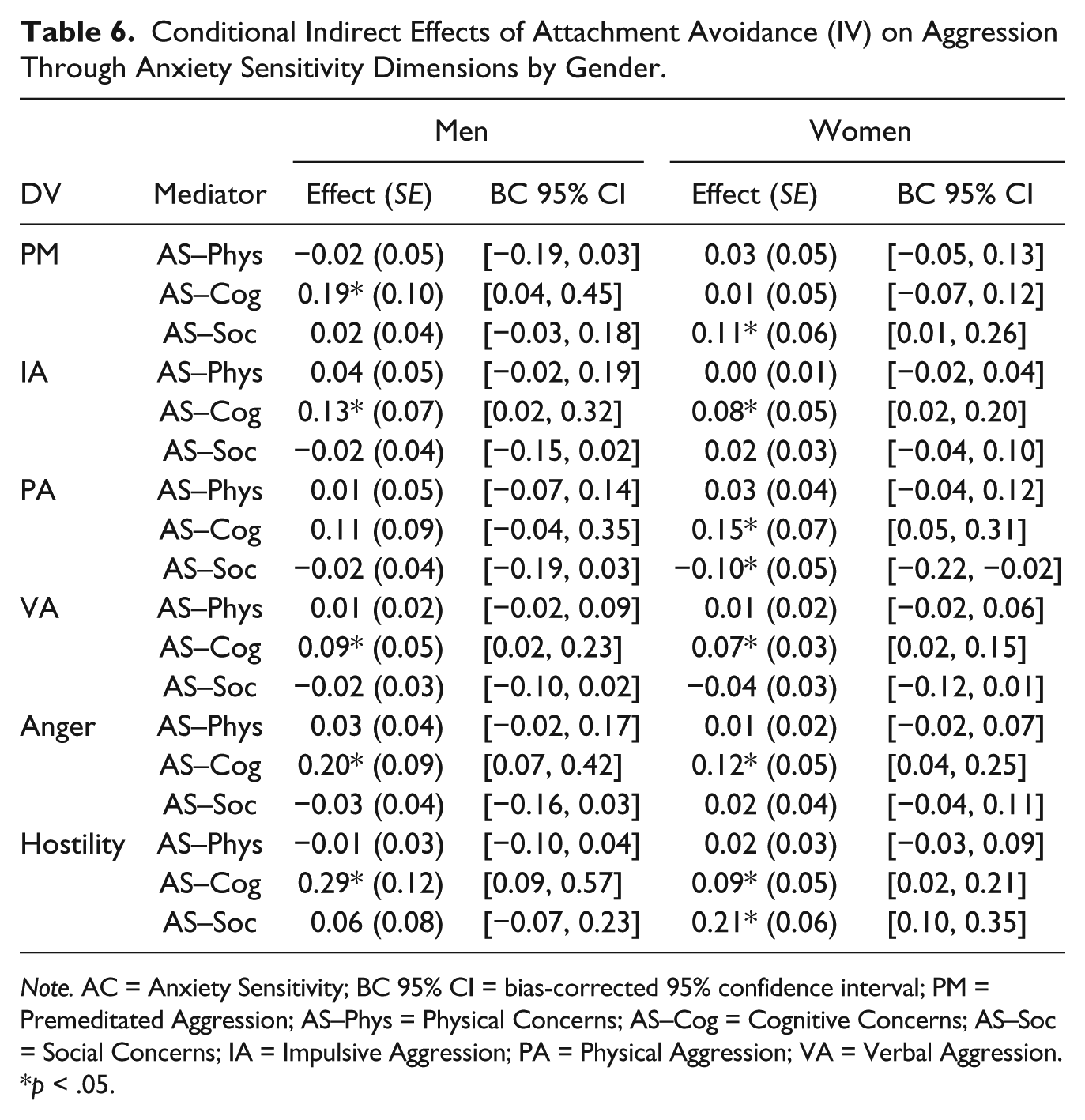
Note. AC = Anxiety Sensitivity; BC 95% CI = bias-corrected 95% confidence interval; PM = Premeditated Aggression; AS–Phys = Physical Concerns; AS–Cog = Cognitive Concerns; AS–Soc = Social Concerns; IA = Impulsive Aggression; PA = Physical Aggression; VA = Verbal Aggression.
p < .05.
The effect of attachment avoidance on physical through cognitive and social concerns was significant for women only. The effect of attachment avoidance on verbal through cognitive was significant for both; the effect through social concerns was significant for neither. The effect of attachment avoidance on anger through cognitive concerns was significant for both men and women; the effect via social was significant for neither. The effect of attachment avoidance on hostility through cognitive concerns was significant for both men and women; the effect through social concerns was significant for women only.
Discussion
Depending on formative attachment experiences and individual differences, people may use aggression for different reasons, including to alter aversive emotional states (e.g., fear, anxiety). Results show that attachment, particularly attachment anxiety (vs. avoidance), has a direct effect on both types (impulsive and premeditated) and certain forms (anger and hostility) of aggression; this effect is mediated by dimensions of AS (“fear of fear”) and operates differently for men and women.
Consistent with previous findings, men reported more attachment avoidance than women (Del Giudice, 2011), as well as higher levels of nearly all forms of aggression (except impulsive and hostility; Haden, Scarpa, & Stanford, 2008). Men and women may experience similar frequency of anger and hostility (Archer, Kilpatrick, & Bramwell, 1995); however, it seems men are more apt to act aggressively as a result of these feelings.
Types of Aggression—Premeditated and Impulsive
Consistent with previous research, women revealed greater fear of the physical consequences of experiencing anxiety than men. For women, physical concerns (e.g., fear of having a heart attack) accounted for relations between attachment anxiety and premeditated aggression, whereas social concerns (e.g., fear of social sanction) accounted for relations with attachment avoidance. In contrast, for men, cognitive concerns (e.g., fear of losing control) explained relations with both attachment anxiety and avoidance. These findings suggest that women’s calculated acts of aggression may be more complicated (i.e., different attachment profiles interacting with different arousal aversion patterns) than men’s. It is possible that women’s premeditated acts are more situation-specific (e.g., intimate partner violence), whereas men’s, regardless of attachment profile, are used more generally to gain and maintain control. This would fit with Tweed and Dutton’s (1998) proposal but raises the question as to whether women’s premeditated acts may be more difficult to predict.
With impulsive aggression, cognitive concerns emerged as the key mediator for women with attachment anxiety, and for both men and women with attachment avoidance. This suggests that, for insecurely attached men and women, the fear of losing control or “going crazy” can trigger a reactive response. For men in particular, when it comes to acting aggressively, whether deliberately or impulsively, the fears of the cognitive consequences of arousal seem to trump any somatic or social concerns.
Forms of Aggression—Physical, Verbal, Anger, Hostility
For women only, physical and cognitive concerns emerged as important mediators between physical aggression and both attachment anxiety and avoidance. These findings suggest that, for women, aggressing in a physical manner may serve to alleviate arousal-activated fears of pending somatic and psychological harm. This contradicts the proposition that high (vs. low) AS women might be less prone to act aggressively but highlights the importance of examining the specific feared consequences (dimensions) of AS. For men, however, physical aggression appears not to be an arousal-regulating response.
Gender differentiated fears of arousal-related sensations emerged for VA, as well. Although physical concerns mediated relations between attachment anxiety and VA for women only, cognitive concerns mediated relations between verbal and both attachment types, for both men and women. Interestingly, social concerns played no mediating role with either PA or VA suggesting that the fears of possible physical or mental consequences of arousal are paramount to fears of social sanction or humiliation in these contexts.
An interesting pattern emerged with anger. For women, physical and cognitive concerns again emerged as playing important mediator roles between attachment anxiety and anger. For men, however, anger was linked to attachment anxiety via high cognitive concerns and low social concerns. This intriguing finding suggests that men prone to anger-fuelled aggression (e.g., “fly off the handle with no good reason”) are really unconcerned with social sanctions on their behavior (e.g., public humiliation or embarrassment), likely because it is more acceptable or stereotypic of male behavior.
However, high social concerns (along with cognitive) emerged as a mediator between attachment anxiety and hostility for men. This finding makes sense insofar as hostility tends to include elements of suspicion or paranoia about what others think (Anderson & Bushman, 2002). For both men and women, cognitive concerns accounted for relations between attachment avoidance and both anger and hostility. For women only, the effect of attachment avoidance on hostility was mediated via social concerns. This fits with research showing that avoidantly attached women tend to suppress anger but are quick to attribute hostile intentions to others, including intimate partners, and to react with enmity (Rholes, Simpson, & Orina, 1999).
General Discussion
Cognitive concerns (i.e., fears of mental incapacitation or losing control of mental processes in the context of stress or anxiety symptoms) emerged as an important mediator between attachment and aggression in this study. Interestingly, this dimension of AS has been linked to depression (Olthuis et al., 2014) and suicidality (Capron et al., 2012). It has been proposed that the association between cognitive concerns and suicide arises from a positive feedback loop wherein catastrophic cognitions triggered by anxiety (e.g., “I might lose control of my mind”) get amplified and lead to suicidal ideation. Over time, the combination of limbic–autonomic arousal and suicidal ideation may result in the individual attempting suicide so as to stop the escalating distress (Katz, Yaseen, Mojtabai, Cohen, & Galynker, 2011). It is possible that Katz et al.’s model of suicide could apply to the discharge of emotion in acts of aggression against others. Further research is needed to test this postulation.
Overall, the findings of the present study suggest more specificity across arousal-related fears for men than women. Although fears about losing one’s mind or losing control seem to be important activators of aggression for both men and women, such fears seem particularly key to men’s aggression. Research shows that men tend to be higher in both attachment avoidance (Del Giudice, 2011) and cognitive concerns (Osman et al., 2010) than women. Given that highly attachment avoidant individuals try to deactivate their attachment system via emotional suppression (Mikulincer, Florian, Cowan, & Cowan, 2002), and that suppression can increase the frequency of thought (Wegner, Schneider, Carter, & White, 1987), it is possible that individuals high in cognitive concerns are less successful at regulating their anger and are more likely to respond in an aggressive manner. Clearly, more research is needed.
Limitations
Whereas the IPAS assesses types of aggression (i.e., motivation—impulsive or premeditated), the AQ assesses forms of aggression (i.e., how the aggression is manifested—physically, verbally, with anger or hostility). Forms of aggression can be either impulsive or premeditated, and it is possible to have multiple motives. The present study investigated singular motivations only; however, future research would benefit from probing possible combinations of motivations as suggested by the general aggression model (Anderson & Bushman, 2002). Other limitations include the use of a fairly homogeneous (e.g., age, ethnicity) undergraduate sample and self-report measures. It is difficult to generalize the findings to older, more diverse, clinical populations. The investigation of these constructs with offender populations, including domestic violence offenders, would be informative. Because self-reports of aggression may be limited by impression management biases, more objective measurements of aggression via behavioral observations on experimental tasks or assessing implicit cognitions could be helpful. In addition, qualitative, longitudinal, and event sampling methodologies could provide rich data allowing for the assessment of causal relations between these variables.
Future research could examine other potential mediators, such as aversion to other emotions beyond fear and anxiety, and other constructs, such as distress tolerance (ability to tolerate negative emotions; Simons & Gaher, 2005). Tests of hierarchical relations suggest the presence of a higher order latent variable related to both AS and distress tolerance (perhaps, attachment) that may account for the ability to tolerate negative emotions in general (Bernstein, Zvolensky, Vujanovic, & Moos, 2009). Other possible mediators include negative affect and maladaptive emotion regulation (Donahue, Goranson, McClure, & Van Male, 2014), and executive functioning (e.g., cognitive flexibility, problem solving, disinhibition).
Implications
Present findings carry important clinical implications. Better understanding the role of arousal regulation in men’s and women’s aggression could guide us toward more targeted approaches to prevention and treatment. For example, interventions reducing AS (see Watt & Stewart, 2008) have been found to yield benefits across a range of outcomes, including anxiety and substance misuse. It is possible that such an approach could be effective in curbing interpersonal aggression generally, intimate and domestic violence more particularly, especially if designed to target specific individual differences (e.g., gender, AS dimensions). Research shows that the presence of certain factors increases an individual’s risk to commit violence (e.g., low socioeconomic status, high degree of acculturation stress, antisocial attitudes; see Capaldi, Knoble, Shortt, & Kim, 2012, for review). Further studies are, therefore, necessary to extend this investigation to populations who may be at increased risk of violence.
Footnotes
Declaration of Conflicting Interests
The author(s) declared no potential conflicts of interest with respect to the research, authorship, and/or publication of this article.
Funding
The author(s) received no financial support for the research, authorship, and/or publication of this article.