



Abstract
Sexual-minority women (SMW) are believed to experience comparable or higher rates of intimate partner violence (IPV) than heterosexual women. In this study, we expand upon existing research by examining the intersectional relationships among self-perceptions of femininity and masculinity, race/ethnicity, socioeconomic status (SES), and IPV. Data are obtained from the most recent wave of the longitudinal Chicago Health and Life Experiences of Women study that included a diverse sample of SMW (N = 608). We use multivariate generalized linear models to investigate self-perceptions of femininity and masculinity, race/ethnicity, and SES differences in multiple types of IPV, including moderate IPV, severe IPV, and a sexual-minority-specific measure of IPV, threat of “outing” one’s partner. Results suggest no differences across self-perceptions of femininity and masculinity in SMW’s reporting of victimization but clear differences based on race/ethnicity and SES. Implications for providing support to SMW who experience IPV and suggestions for future research are discussed.
Introduction
Sexual-minority, or non-heterosexual, women experience higher rates of victimization and violence in childhood, adolescence, and adulthood as compared with their heterosexual counterparts (Carvalho, Lewis, Derlega, Winstead, & Viggiano, 2011; Drabble, Trocki, Hughes, Korcha, & Lown, 2013; Edwards, Sylaska, & Neal, 2015; Friedman et al., 2011; Hughes, Johnson, Steffen, Wilsnack, & Everett, 2014; Hughes, McCabe, Wilsnack, Boyd, & West, 2010; Katz-Wise & Hyde, 2012; Walters, Chen, & Breiding, 2013). Within the study of sexual-minority victimization, much less research has investigated sexual-minority women’s (SMW) experiences of intimate partner violence (IPV). This is problematic, not only because of the high rates of IPV among SMW but also because the negative effects of IPV on SMW’s health and well-being may be exacerbated by their already stigmatized and marginalized status (Baker, Buick, Kim, Moniz, & Nava, 2013; Carvalho et al., 2011; West, 2012).
In addition, existing research on IPV often employs gender-based explanations for IPV that focus on misogyny, patriarchy, and the influence of gender on relationship violence (Ristock, 2002). Such explanatory models have been criticized, however, because they rely heavily on heterosexual assumptions of male violence against women and ignore same-sex IPV (Dutton, 2012; McClennen, 2005; Ristock, 2002). Same-sex IPV has been cited as a challenge to the gendered nature of IPV by demonstrating that it is an abuse of power that can occur in any type of relationship, between individual of any gender (Rohrbaugh, 2006). However, even within studies of same-sex IPV, self-perceptions of femininity and masculinity or gender presentation are rarely examined (Brown, 2008). No studies to date have used non-dichotomous measures of femininity and masculinity to critically examine how these constructs relate to SMW’s experiences of IPV.
Finally, scholars have pushed for an intersectional understanding of IPV that includes an analysis of the relationship between race, socioeconomic status (SES), and gender (Baker et al., 2013; Edwards et al., 2015) to better understand the social and cultural nature of gendered violence (Sokoloff & Dupont, 2005). Currently, we know very little about the intersections among femininity/masculinity, race, and SES in SMW. Multiple studies of heterosexual couples have documented that racial/ethnic minority women and women with lower SES are more likely to experience IPV (Black et al., 2011; Honeycutt, Marshall, & Weston, 2001; Sokoloff & Dupont, 2005; West, 2004, 2012). However, to our knowledge only one study (Turell, 2000) has examined racial/ethnic differences in IPV among sexual minorities. This study showed higher rates of physical abuse among Native American sexual minorities and lower rates of coercive behaviors among Latino/a and Asian American sexual minorities. Further research is needed to better understand racial/ethnic differences in IPV among sexual minorities.
Sexual-Minority Status, Gender, and IPV
Sexual minorities report similar (Carvalho et al., 2011; Edwards et al., 2015; Seelau & Seelau, 2005; Walters et al., 2013) or higher (Graham, Jensen, Givens, Bowen, & Rizo, 2019; West, 2012) rates of IPV compared with their heterosexual peers. Similarities also exist across same-sex and opposite-sex relationships in types of violence, including physical, sexual, emotional, and financial abuse and the cyclical nature of abuse (McClennen, 2005). SMW experiencing IPV, however, must contend with additional sources of stress and stigmatization. Indeed, minority stress (Meyer, 2003), the unique source of stress experienced by sexual minorities due to their stigmatized status, has been identified as a risk factor for victimization within same-sex relationships. Specifically, research findings suggest that internalized homophobia (i.e., possessing negative feelings about one’s sexual orientation) is a risk factor for IPV (Balsam & Szymanski, 2005; Edwards et al., 2015). In addition, stigma consciousness, or the expectation of stigmatization or prejudice, is associated with increased risk of victimization based on the desire to keep abuse hidden, avoiding potential discrimination when reporting abuse (Carvalho et al., 2011). Feelings of social isolation (Carvalho et al., 2011; Hardesty, Oswald, Khaw, & Fonseca, 2011) and stigma (Calton, Cattaneo, & Gebhard, 2016) reduce the likelihood that SMW will seek help when they experience IPV. Furthermore, heterosexist interactions in IPV support systems (Baker et al., 2013; Ford, Slavin, Hilton, & Holt, 2013), discriminatory experiences accessing legal services (Aulivola, 2004), and expectations of social barriers to seeking help (Eaton et al., 2008) are additional challenges to seeking help among SMW.
The unique sources of isolation and discrimination experienced by SMW are also linked to distinct forms of IPV within sexual-minority populations, particularly the threat of “outing” (Balsam & Szymanski, 2005; Ristock, 2002). This specific form of IPV, a partner threatening to disclose one’s sexual orientation to family members, coworkers, or other persons, stems from the lack of legal protections for sexual-minority persons and/or the fear of rejection by family members or in other personal relationships (Ristock, 2002; Rohrbaugh, 2006). Sexual minorities may need to weigh the threat of ongoing IPV against the threat posed by disclosure of their sexual identity (Hardesty et al., 2011).
Gender, Sexual Orientation, and IPV
An important area of contention within the study of IPV involves the role of gender (Anderson, 2010). Starting with the feminist movement in the 1960s and 1970s, scholars began to develop theories that root IPV in unequal social structures of gender (Elliot, 1996; Sokoloff & Dupont, 2005). These explanations rely on social or cultural explanations linking relationship violence to larger systems of patriarchy and misogyny (Dutton, 2012; Ristock, 2002), resulting in socially accepted and sanctioned gender inequality (Sokoloff & Dupont, 2005). Although authors using these gender-based theoretical explanations have made important contributions to the literature, they have been criticized for essentializing the role of gender in IPV (Elliot, 1996; McClennen, 2005; Renzetti, 1992; Ristock, 2002; Sokoloff & Dupont, 2005). Research on IPV among SMW has also confronted essentialized notions of gender within a butch/femme dichotomy. Balsam and Szymanski (2005), for example, found no correlations between recent or lifetime verbal or physical victimization, and butch or femme identity in a sample of SMW. These findings support the move from the stereotypical analysis of masculinity as associated with aggression and femininity as associated with victimization. However, as Balsam and Szymanski note, results must be interpreted cautiously given their use of a single-item butch/femme measure.
Some scholars have argued for a “gender symmetry” approach, given similar rates of reported perpetration and victimization among men and women in heterosexual relationships (Archer, 2000; Dutton, 2012; Fergusson, Horwood, & Ridder, 2005; Straus, 2008). While this research has been criticized for relying on flawed data (Kimmel, 2002), theoretical perspectives on gender symmetry have encouraged scholars to rethink the role of gender in IPV and move beyond simple causal relationships between male supremacy, gender inequality, and IPV (Anderson, 2005; Baker et al., 2013). In line with these critiques, research on same-sex IPV has been used to disprove the foundationally gendered nature of intimate partner violence (Renzetti, 1992; Ristock, 2002; Sokoloff & Dupont, 2005). Using theories of power and control not based on gender ideologies, researchers have argued that IPV can occur in any intimate relationship, regardless of the gender of individuals within the relationship (Rohrbaugh, 2006).
In response to debates about the relationship among gender, power, and IPV, scholars have called for more nuanced measures of IPV to capture different dimensions of violence (Johnson, 2005, 2011). The Conflict Tactics Scale (CTS; Straus, 1979; Straus, Hamby, Boney-McCoy, & Sugarman, 1996) is one example of a validated and widely used measure that assesses various types of threatening and/or assaultive behaviors. This scale distinguishes among a wide range of behaviors, including negotiation, aggression, sexual coercion, and physical assault (Straus et al., 1996). Aggressive behaviors are thought to be less gendered than violent behaviors (Johnson, 2011). Miller, Greene, Causby, White, and Lockhart (2001) suggested that lesbian relationships are more likely characterized by physical aggression, that is, the threat of violence, rather than actual physical violence. This study, however, did not explicitly measure gender and relied on a primarily Caucasian sample. Investigation of SMW’s experiences with IPV using nuanced measures of gender and IPV is needed to better understand SMW’s experiences of IPV and the relationship between gender and violence.
SES, Race/Ethnicity, and IPV
SES has consistently been linked to IPV in previous research, with lower SES individuals reporting higher rates of IPV in both heterosexual (Honeycutt et al., 2001; Sokoloff & Dupont, 2005; West, 2012) and sexual-minority (Edwards et al., 2015) samples. Abusive partners may fail to support or may actually prevent women from furthering their education and obtaining employment (Tolman & Raphael, 2000), increasing the likelihood of women staying in or returning to abusive relationships to meet financial needs (Adams, Tolman, Bybee, Sullivan, & Kennedy, 2012). In one study of heterosexual welfare recipients, IPV was found to create employment instability, affecting women’s overall economic stability and their ability to meet basic needs (Adams et al., 2012). Race/ethnicity has also been consistently linked to IPV with multiple studies finding higher rates of IPV among Blacks than among Whites (Benson, Wooldredge, Thistlethwaite, & Fox, 2004; Black et al., 2011; Sokoloff & Dupont; 2005; Straus, Gelles, & Steinmetz, 1981; Taft, Bryant-Davis, Woodward, Tillman, & Torres, 2009; West, 2004, 2012). Less research has examined IPV within Latina populations, but extant research has shown comparable rates of IPV with Whites in nationally representative and university samples (Caetano, Field, Ramisetty-Mikler, & Lipsky, 2009; West, 2012). Very little research has examined SES or racial/ethnic disparities in IPV among SMW. Turell (2000) found significant differences across racial groups in levels of physical abuse and coercive techniques; however, these reported patterns are for the lesbian, gay, bisexual, and transgender (LGBT) population as a whole and warrant further research.
Examinations of the intersections of sexual identity, race/ethnicity, and SES are needed to provide additional insights into patterns of IPV. Indeed, multiple forms of oppression such as those based on race, gender, SES, and sexual-minority status affect experiences of victimization (Anderson, 2010; Richie 2000). Furthermore, race, SES, and gender function as interrelated and connected systems of oppression to produce unique experiences (Collins, 1998, 2000; Crenshaw, 1991; McCall, 2005). Intersectional scholarship attempts to represent multiply marginalized people while recognizing culturally specific forms of abuse (Sokoloff & Dupont, 2005). Given the dearth of existing research on SMW’s experience of IPV, the role of intersecting identities in IPV within sexual-minority communities is needed (Edwards et al., 2015).
Current Study
Previous studies on IPV among SMW often rely on problematic assumptions about gender within these relationships, either conceptualizing gender as a butch/femme continuum (Balsam & Szymanski, 2005) or relying on the assumption that gender identification is the same for both individuals in same-sex couples (Brown, 2008). Disentangling the effect of self-perceptions of femininity and masculinity on IPV among same-sex female couples can advance theoretical explanations of the gendered nature of violence in intimate relationships.
We employed measures of both self-perceived femininity and masculinity, and examined their relationship to two types of interpersonal violence—moderate IPV and severe IPV (Straus et al., 1996), as well as a sexual-minority-specific measure of IPV: threat of outing. In addition, by using a racially and socioeconomically diverse sample, we were able to examine racial/ethnic and SES indicators as in the following research questions:
Data and Method
Sample
Data are obtained from the Chicago Health and Life Experiences of Women (CHLEW) study, a 17-year, three-wave longitudinal study of adult SMW. Data collection began in the greater Chicago metropolitan area in 2000-2001 using a broad range of recruitment sources and strategies to obtain a diverse sample of 447 English-speaking women, aged 18 and older, who self-identified as lesbian. Concerted efforts were made to maximize sample representativeness by including subgroups of SMW underrepresented in most health studies, such as those aged below 25 and above 50, those with a high school education or less, and those from racial/ethnic minority groups. The study was advertised in local newspapers on Internet listservs, and using flyers posted in churches and bookstores. Other recruitment sources included clusters of social networks (e.g., formal community-based organizations and informal community social groups) and individual social networks, including those of women who participated in the study. Interested women were invited to call the project office to complete a short telephone-screening interview. Although participants who reported being heterosexual, mostly heterosexual, bisexual, or transgender, in the telephone screening were not eligible to participate, 11 women identified as bisexual in the actual interview. In Wave III of the study, conducted in 2010-2012, an additional sample of 372 women was added to the existing longitudinal sample. Recruitment of the new study panel, using an adaptation of respondent-driven sampling, oversampled Black, Latina, and younger lesbians (ages 18-25) as well as women who identified as bisexual. The CHLEW had an overall retention rate of 85.9% at Wave II and 79.2% at Wave III. In the current study, we used data from women who identified as exclusively lesbian, mostly lesbian or bisexual at Wave III (N = 608).
Measures
Dependent Variables
Measures of IPV are a modified version of the CTS (Straus, 1979), a well-known and validated scale designed to measure the extent to which couples engage in physical or emotional abuse or violence (Straus et al., 1996). The CTS measures concrete acts and events of conflict within a relationship but not the causes or consequences of such events. Questions were used to create three scales: total IPV, moderate IPV, and severe IPV behaviors. We assessed severe IPV with the following items: “Thinking about the last/most recent person you were dating or in a committed relationship with, has this person ever done the following?: 1) thrown something at you, pushed you, or hit you, 2) threatened to kill you with a weapon or in some other way; 3) prevented you from doing things, for example seeing friends, going to work, seeking medical attention” (yes/no, range = 0-3). Moderate IPV was measured with the following items: “Thinking about the last/most recent person you were dating or in a committed relationship with, has this person ever done the following?: 1) insulted or sworn at you, 2) sulked or refused to talk about a problem; 3) stomped out of the house, room or yard, 4) done or said something to spite you” (range = 0-4). Both variables were treated as continuous count variables in all models.
A sexual-minority-specific variable, threat of outing, was created using the question, “Thinking about the last/most recent person you were dating or in a committed relationship with, has this person ever threatened to out you or reveal your sexual orientation to family, friends or co-workers?” (0 = no, 1 = yes).
We measured total IPV by creating a summed score for all of the above questions (range = 0-8).
Independent Variables
Self-perceptions of masculinity and femininity were assessed using the questions, “In general, how masculine do you think you are?” and “In general, how feminine do you think you are?” Responses ranged from 1 to 7 with higher scores indicating higher levels of masculinity or femininity.
Race/ethnicity was assessed using a categorical measure derived from questions asking participants to indicate their race/ethnicity and whether they were of Hispanic or Latina origin or descent. Responses were categorized into White (referent), Black, and Latina.
We examined two indicators of SES: household income and level of education. The measure of self-reported household income (from all sources) for the last tax year was coded categorically into three income brackets: less than US$10,000, US$10,000 to US$49,999, and US$50,000 or more per year. Participants with missing income responses were dummy coded to avoid case-wise deletion and retain an extra 5% of the sample. Level of education was measured by asking participants their highest grade or year of school completed. Responses were coded as high school graduate or less (referent), some college, and bachelor’s degree or higher.
Controls
Controls for respondent’s sexual identity, age, and level of education were added to all models. Sexual identity was coded as a categorical variable of lesbian (referent), mostly lesbian, or bisexual. Age was treated as continuous (range = 18-82 years).
In line with previous research (West, 2012), we controlled for childhood sexual abuse (CSA) in all models. This dichotomous measure asked participants, “Do you feel that you were sexually abused when you were growing up?” with no CSA as the referent. Those who had missing data on the CSA variable were dummy coded to avoid case-wise deletion. Based on findings from Balsam and Szymanski (2005), we also controlled for internalized homophobia. Participants were asked whether they strongly agreed, somewhat agreed, somewhat disagreed, or strongly disagreed with 10 statements about their sexual identity (e.g., “I have no regrets about being lesbian/bisexual,” “If someone offered me the chance of being heterosexual, I would accept the chance,” “As a lesbian/bisexual, I am lovable and deserving of respect”). Responses were combined (alpha = .83). We also controlled for the level of sexual identity disclosure, given that impact of the threat of disclosing a person’s sexual orientation likely depends on how out the individual already is. This measure assessed the proportion of immediate family members to whom the participants reported having disclosed their sexual identity.
Analytic Strategy
We first present descriptive statistics for the analytic sample (summarized in Table 1), and then present results from negative binomial regression models (Table 2) that account for overdispersion in our “total IPV” and severe IPV-dependent variables. Poisson models were used when assessing moderate IPV, a count variable in which overdispersion was not present. The baseline models (Model 1 for each type of violence) controlled for age, race/ethnicity, income and education, sexual-orientation identity, and self-perceptions of femininity and masculinity. In Model 2 for each dependent variable, we added controls for CSA and internalized homophobia, and added the threat of outing as a covariate to severe IPV and moderate IPV models. Threat of outing is included in our “total IPV” dependent variable, and was therefore not used as a control in that model.
Descriptive Statistics (N = 608).

Source. Chicago Health and Life Experiences of Women study.
Note. IPV = intimate partner violence; HS = high school.
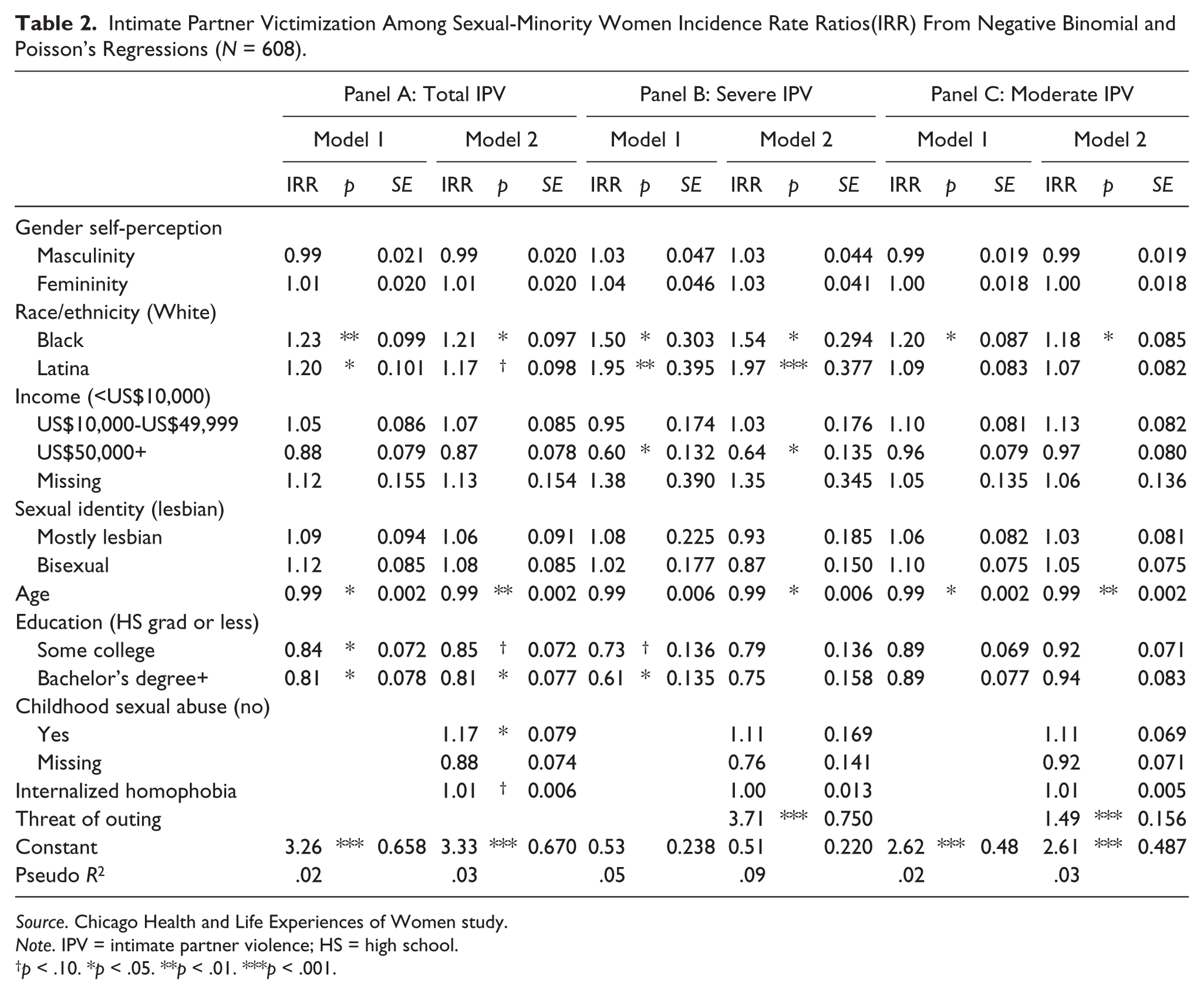
Intimate Partner Victimization Among Sexual-Minority Women Incidence Rate Ratios(IRR) From Negative Binomial and Poisson’s Regressions (N = 608).
Source. Chicago Health and Life Experiences of Women study.
Note. IPV = intimate partner violence; HS = high school.
p < .10. *p < .05. **p < .01. ***p < .001.
Finally, we present results of the logistic regression model that examined the threat of outing (Table 3). Model 1 controlled for self-perceptions of femininity and masculinity, race/ethnicity, income, sexual-orientation identity, age, and education, and Model 2 added controls for childhood sexual abuse, internalized homophobia, and sexual identity disclosure. For all four dependent variables, we also tested for the interaction effects of gender self-perception, race/ethnicity, and SES on IPV.
Threat of Outing Odds Ratios From Logistic Regression (N = 608).

Source. Chicago Health and Life Experiences of Women study.
Note. HS = high school.
p < .10. *p < .05. **p < .01. ***p < .001.
Results
Descriptive Statistics
Participants reported an average of 2.75 types of IPV, including 0.48 types of severe IPV, 2.2 types of moderate IPV, and just more than 5% of the sample reported having partners who threatened to out them. Participants reported a mean masculinity score of 3.8 and a mean femininity score of 4.3 (range on each = 1-7).
The sample was quite diverse in regard to race/ethnicity (37.0% White, 37.8% Black, 25.2% Latina). The majority (57.1%) of participants identified as exclusively lesbian; 17.1% identified as mostly lesbian and 25.8% as bisexual. Age ranged from 18 to 82 years, with a mean age of 39. Income was well distributed, with 31.3% of participants reporting an annual household income less than US$10,000, 26.0% reporting between US$10,000 and US$49,999, and about 38.0% reporting incomes of US$50,000 or greater (income data were missing for 4.8% of the sample). In terms of education, 21.4% of the sample reported high school graduation or less, 31.7% reported some college, and 46.9% reported having bachelor’s degree or higher. More than one third (37.3%) of the sample reported CSA. On a scale of 0 to 28, the mean score for internalized homophobia was 4.6 (SD = 5.3), and the mean family disclosure score was 0.8 (SD = 0.3).
Supplementary analyses were also conducted to examine mean differences in reported femininity and masculinity across the two SES variables (education and income). These results showed higher levels of both self-perceived femininity (p < .01) and masculinity (p < .05) among participants with a high school education or less compared with those with higher levels of education. We also found lower levels of femininity (p < .01) and masculinity (p < 0.001) among participants with bachelor’s degrees or higher versus those with lower levels of education. Women who reported annual household incomes of less than US$10,000 per year reported significantly higher levels of masculinity than those with higher incomes, and women with incomes of US$50,000 or more reported significantly lower levels of masculinity. No mean differences in self-perceived femininity were found based on income.
Multivariate Results
Table 2 summarizes experiences for total types of IPV (Panel A), severe IPV (Panel B), and moderate IPV (Panel C).
Results for total IPV showed no effect for self-perceptions of either femininity or masculinity. However, in Model 1, both Black (IRR = 1.23, p < .01) and Latina (IRR = 1.20, p < .05) participants reported higher rates of IPV than White women. Furthermore, women with some college (IRR = 0.84, p < .05) and those with bachelor’s degrees or higher (IRR = 0.81, p < .05) were less likely to report any IPV compared with those reporting high school graduation or less. As shown in Model 2, CSA (IRR = 1.17, p < .05) and internalized homophobia (IRR = 1.01, p < .10) were each significantly associated with IPV; however, these variables did not fully explain the elevated risk of IPV among Black (IRR = 1.21, p < .05) and Latina (IRR = 1.17, p < .10) women, or the association between having a bachelor’s degree or higher and lower rates of IPV (IRR = 0.81, p < .05). Interaction results, not shown here, indicated no significant differences in IPV across race/ethnicity and income, gender self-perception and income, or gender self-perception and race/ethnicity.
Results for severe IPV are presented in Panel B. Similar to the results for all IPV, there was no relationship between self-perception of masculinity or femininity and severe IPV. In Model 1, Black (IRR = 1.50, p < .05) and Latina (IRR = 1.95, p < .01) participants reported higher rates of severe IPV than Whites. Household income more than US$50,000 was associated with fewer reports of severe IPV (IRR = 0.60, p < .05) compared with those reporting a household income of less than US$10,000. Compared with women with high school education or less, those with some college (IRR = 0.73, p < .10) and those with a bachelor’s degree or higher (IRR = 0.61, p < .05) were less likely to report severe IPV. Model 2 shows no difference in reports of severe IPV based on CSA or internalized homophobia. Black (IRR = 1.54, p < .05) and Latina (IRR = 1.97, p < .001) women reported higher rates of severe IPV than White women, and women with incomes more than US$50,000 (IRR = 0.64, p < .05) reported lower rates of severe IPV than women with income less than US$10,000. Threat of outing (IRR = 3.71, p < .001) was a predictor of severe IPV. Education differences were no longer significant after adding additional covariates in Model 2. Similar to the results for all IPV, interaction results (not presented) were not significant.
Results for moderate IPV presented in Panel C are consistent with those for all IPV and severe IPV. The relationship between self-perceptions of femininity or masculinity and moderate IPV was not statistically significant, but Black women reported higher rates of moderate IPV than Whites (IRR = 1.20, p < .05). These results persisted even after controlling for internalized homophobia, CSA, and threat of outing (IRR = 1.18, p < .05). Again, threat of outing was associated with moderate IPV (IRR = 1.49, p < .001). Interaction results showed no significant differences in moderate IPV across race/ethnicity and SES, gender self-perception and SES, or gender self-perception and race/ethnicity.
Threat of Outing
Table 3 presents results for threat of outing. Model 1 shows that self-perceptions of femininity and masculinity were not associated with threat of outing. Unlike the previous models, race/ethnicity was not associated with threat of outing. However, higher level of income was associated with lower rates of threatened outing. Model 1 shows that women with household incomes more than US$50,000 were marginally less likely to report threat of outing (OR = 0.30, p < .10) compared with those with household incomes less than US$10,000. Women who had bachelor-level education or higher were less likely than those with a high school diploma or less to report having a partner who had threatened to out them (OR = 0.14, p < .01). Bisexual women were more likely than exclusively lesbian women to report being threatened with outing (OR = 3.28, p < .01). Household income more than US$50,000 and bisexual identity were not associated with lower rates of threat of outing in Model 2 but being a college graduate remained significant (OR = 0.13, p < .01). Women who reported CSA were more likely to report the threat of outing (OR = 3.01, p < .05), and higher levels of internalized homophobia were associated with threat of outing (OR = 1.07, p < .05). Sexual identity disclosure was marginally associated with lower rates of threat of outing (OR = 0.32, p < .10). Interaction results (not shown here) indicated no significant differences in threat of outing by race/ethnicity and SES, gender self-perception and SES, or gender self-perception and race/ethnicity.
Discussion
This study builds on previous work by expanding on the possibility that IPV is not a gendered phenomenon but involves power and control, and is influenced by racism, classism—and for SMW, heterosexism (Edwards et al., 2015; Sokoloff & Dupont, 2005). We found no significant effect of self-perceived femininity or masculinity for total, severe, or moderate IPV. Similarly, we found no effect for the threat of outing. Our findings suggest different possibilities for the role of masculinity and femininity in understanding IPV. First, although there are a broad range of gender identity and presentation in the sexual-minority community, SMW report greater gender non-conformity than heterosexual women in attitudes, behaviors, and gender presentation (Bailey & Zucker, 1995; Lippa, 2005; Zucker, 2008). One possible explanation for our null results is rather than gender being irrelevant to the risk of IPV, it could be that breaking heteronormative scripts in same-sex relationships renders traditional, gendered models of IPV less applicable. This does not suggest that SMW are “genderless,” but rather that these traditional models are less useful in understanding IPV among SMW. As such, our findings may not be generalizable to heterosexual couples. Alternatively, the findings provide support for less gender-based explanations of violence. Indeed, they are consistent with research indicating that understanding IPV among SMW cannot rely on stereotyped notions of perpetrators and victims within a butch/femme dichotomy (Balsam & Szymanski, 2005) and support theoretical perspectives of IPV as an issue of power and control (Rohrbaugh, 2006), which are linked to SES and race/ethnicity. Although we treat self-perceived masculinity and femininity as fixed in this study, gender self-perceptions likely vary across contexts, relationships, and time.
We found that Black and Latina SMW reported significantly more IPV than White SMW. These results are consistent with previous research findings that Black and Latino heterosexuals report higher rates of IPV than their White counterparts (West, 2012). However unlike some studies of heterosexuals, racial/ethnic disparities in our study did not disappear when controlling for SES and CSA. Little work has been done to examine racial/ethnic differences in IPV among SMW and men, and few explanations exist for these differences. In her review article on heterosexual IPV, West (2012) reports higher rates of female-perpetrated violence within African American partnerships compared to other races/ethnicities. One possibility is that elevated victimization within Black SMW’s relationships is being driven by factors similar to those in female-perpetrated IPV (West, 2012). Another possibility is that the structural location of being both racial/ethnic minority and a sexual minority increases vulnerability to IPV. Interestingly, we did not find racial/ethnic differences in the threat of outing. This null result, however, may be due to the high levels of being “out” in our sample (i.e., to an average of 80% of their immediate family members), which obviously reduces the possibility of using outing as a threat. Studies of SMW with lower levels of identity disclosure may offer different insights into sexual-minority-specific violence.
Higher SES, measured by income and education, was associated with lower risk of IPV, particularly severe IPV and threat of outing. This is consistent with previous research in both heterosexual (Honeycutt et al., 2001; Sokoloff & Dupont, 2005; West, 2012) and sexual-minority samples (Edwards et al., 2015). This likely has to do with the fact that women with greater economic resources are less likely to remain in, or return to, abusive relationships to meet their economic needs (Adams et al., 2012). For example, Davies and colleagues (2015) suggest that economic vulnerability places women at a greater risk of discrete experiences of interpersonal violence as well as cumulative abuse over the life course. While research is needed to better understand revictimization at various developmental stages among SMW, our findings suggest that poverty increases risk of IPV in both women of color and White women.
We found no interaction effects across race/ethnicity and SES, femininity/masculinity and SES, or race/ethnicity and femininity/masculinity. Although it is possible that the absence of interactional effects was due to inadequate statistical power, we believe that it is likely that the higher rates of IPV among Black and Latina SMW actually do not vary by SES, masculinity, or femininity. In some studies of IPV among heterosexual couples, race/ethnicity is conceptualized as a proxy of SES with the effects of race/ethnicity diminishing or disappearing when SES is taken into account (Malley-Morrison & Hines, 2007; Rennison & Planty, 2003; West, 2012). Our results suggest that although race/ethnicity and SES are interrelated, they each make unique contributions to understanding IPV among SMW. Moore (2008, 2009) notes the particular salience of blackness as a structural context for lesbians, which includes but cannot be reduced to issues of class. Her work highlights important differences in family and relationship dynamics between Black and White lesbians, particularly the importance of financial independence. Whereas previous family research has shown that White lesbians tend to value feminist egalitarian models of equal distribution of household labor in relationships, Black lesbians in Moore’s (2009) study placed much greater significance on financial independence. Among Black lesbians who grew up in poverty or working-class household, the importance of economic self-sufficiency was seen as a tool necessary to escape unhealthy relationships (Moore, 2008). Moore’s findings support the interpretation that SES is not a proxy for racial differences in our study. While her work explains some of the structural context of our findings, further research is needed to fully understand the dimensions of SMW of color, especially Latina’s, contextual experiences.
Although this study expands understanding of the lives and experiences of SMW, there are limitations that should be considered. First, the CHLEW sample was recruited using non-probability methods and was limited to women living in or near the Chicago metropolitan area at the time of recruitment. Even with concerted efforts to recruit underrepresented groups, the level to which this sample represents SMW in the Chicago metropolitan area cannot be determined. Generalizability to populations of SMW outside of the Chicago metropolitan area is also not known. Second, although we used tested measures of IPV the CHLEW study did not assess frequency or severity of IPV. In addition, sex of partners was not assessed. Although we controlled for the sexual identity of participants, it is possible that some of the women in the sample, particularly those who identified as bisexual, may have had male partners. It is important that future research on IPV among SMW ask questions about the sex of perpetrators to tease out patterns and characteristics that may be unique to same-sex IPV. Also, more nuanced measures of the frequency and severity of violence would contribute to greater understanding of the relationships among sexual identity, femininity/masculinity, race/ethnicity, SES, and IPV. In addition, White participants in our sample were significantly less likely to report any type of victimization, which affects the differences seen between racial groups. Next, our measures of self-perceptions of femininity and masculinity are not comprehensive measures. We do, however, think these measures provide an interesting and innovative way to move the discussion forward. Finally, while we acknowledge that it is possible that the lack of interactional results across masculinity, femininity, race/ethnicity, and SES may be due to a data limitation in sample size, we believe that there was sufficient statistical power to see interactional effects, had they been present.
Despite these limitations, our findings provide new insights into SMW’s experiences of IPV. SMW of color, compared with White women, reported higher rates of IPV, particularly severe IPV. Efforts to reduce IPV and increase support for SMW who experience IPV need to take these racial/ethnic differences into account. For some time, research has shown racial/ethnic and SES disparities in heterosexual relationships, and this study adds to our understanding of these differences in SMW. Lower SES was not a proxy for racial/ethnic disparities in our sample. Victim advocates and educators must keep these racial/ethnic and economic disparities in mind, making space for different cultural norms and influences. In addition, this study supports a move away from cultural assumptions of masculinity, femininity, and victimization within populations of SMW. Gendered stereotypes of perpetration and victimization based on gendered presentation or identification should be avoided when providing support to SMW victims of IPV. Future research on SMW should continue to examine within-group racial/ethnic differences in predictors of IPV to further understanding of structural and cultural influences on risk of victimization. In addition, future research may benefit from employing more varied measures of gender identity in studies of IPV among sexual-minority men.
Footnotes
Declaration of Conflicting Interests
The author(s) declared no potential conflicts of interest with respect to the research, authorship, and/or publication of this article.
Funding
The author(s) disclosed receipt of the following financial support for the research, authorship, and/or publication of this article: This study is supported by the National Institutes of Health and Office of Research on Women’s Health (ORWH) Grant K12HD055892, and by the National Institute of Alcohol Abuse and Alcoholism (NIAAA) Grant R01 AA13328-10.