




Abstract
Many researchers have studied the prevalence and content of men’s aggressive sexual fantasies, including their link with rape-supportive cognition. However, little to no research has examined the link between imaginal ability and the use of such fantasies. Based on existing research and theory, we propose that men who hold hostile beliefs toward women will use aggressive sexual fantasies more often if they possess a greater ability to engage in a “rich fantasy life.” Operationally, we argue this involves (a) a proneness to fantasize in general, (b) an ability to vividly envision mental imagery, and (c) frequent experiences of dissociation. To test this, the present study hypothesized that a latent variable termed “rich fantasy life,” via “hostile beliefs about women,” influences the use of “aggressive sexual fantasies.” A sample of 159 community males was recruited. Each participant completed a measure of fantasy proneness, dissociation, and vividness of mental imagery, along with two measures that assess hostile beliefs about women. Assessing how often the participants fantasized about rape-related and sadistic themes provided a measure of aggressive sexual fantasies. Structural equation modeling (along with bootstrapping procedures) indicated that the data had a very good fit with the hypothesized model. The results offer an important contribution to our understanding of aggressive sexual fantasies, which may have implications for clinical assessment and treatment. The limitations of the study are discussed, along with suggestions for future research.
Introduction
A considerable proportion of nonoffending males report using sexual fantasies about nonconsensual sex or forcing a woman to have sex (Crépault & Couture, 1980; Gold & Clegg, 1990; Greendlinger & Byrne, 1987; Joyal, Cossette, & Lapierre, 2015; Larue et al., 2014; Williams, Cooper, Howell, Yuille, & Paulhus, 2009). For example, Crépault and Couture (1980) found that 33% of males (N = 94) reported using sexual fantasies about raping a woman. Similarly, Larue et al. (2014) found that 33% of their male sample (N = 107) fantasized about nonconsensual violence. Williams et al. (2009) found that 68% of male undergraduates (N = 103) reported using sexual fantasies about “sexual assault.”
These findings are concerning because the rates far exceed the cutoff for being statistically rare (<2.3%) or statistically unusual (<15.9%; Joyal et al., 2015). Moreover, these kinds of sexual fantasies are thought to be an etiological factor for rape. Indeed, in their unified model of sexual coercion against women, Knight and Sims-Knight (2003) argued that “aggressive sexual fantasies” are a core component in two of their three proposed etiological pathways. In Pathway 1, “callous/unemotional traits” (influenced by early physical/verbal abuse) disinhibit males’ sex drive, which in turn, disinhibits aggressive sexual fantasies, leading to sexual coercion. In Pathway 2, “sexual abuse” directly disinhibits males’ sex drive, which again disinhibits aggressive sexual fantasies. This model has been empirically supported using structural equation modeling (SEM) with both adult and juvenile offender samples (Knight & Sims-Knight, 2003, 2004), as well as community males (Knight & Sims-Knight, 2003).
Although this model offers an account for why aggressive sexual fantasies are used, it provides less insight into the origin of aggressive fantasy themes. However, Marshall and Barbaree (1990)—in their integrated theory—argue that some males form hostile beliefs about women due to feelings of inadequacy that result from an inability to form close relationships with women. As a result, they introduce themes of power, control, dominance, and even aggression into their sexual fantasies as a way to bolster their sense of masculinity. Put simply, negative beliefs about women are a source of some men’s aggressive sexual fantasies. As such, one would expect to see a relationship between hostile beliefs about women (including rape-myth endorsement) and the use of dominant, forceful, and coercive sexual fantasies.
Indeed, a number of studies have reported such findings using nonoffending males (Aromäki, Haebich, & Lindman, 2002; Bartels & Gannon, 2009; Dean & Malamuth, 1997; Greendlinger & Byrne, 1987; Plaud & Bigwood, 1997; Smeaton & Byrne, 1987; Zurbriggen & Yost, 2004). Also, in Knight and Sims-Knight’s (2003) unified model, an attitudinal factor termed “negative masculinity” loaded on to the “callous/unemotional traits” latent variable, which, as mentioned, strongly influenced aggressive sexual fantasies in community males. Similarly, using SEM, Aromäki et al. (2002) found that the latent factor “hostile masculinity” (defined by hostile attitudes toward women, sexual dominance, and rape myths) had a direct influence on men’s “imagined sexual aggression,” a latent variable partially defined by coercive sexual fantasies.
Combining these two theoretical accounts, aggressive sexual fantasies appear to be an important factor for some men as they function as both a coping strategy and a source of sexual gratification. However, this view does not take into account the individual differences associated with imaginal ability, in this case, the ability to create, envision, and effectively use aggressive sexual fantasies. Sexual fantasies are a form of mental imagery (Leitenberg & Henning, 1995), and mental imagery can be affected by numerous factors. This was noted by Richardson (1984) who stated that “those who have the ability to absorb themselves into objects, events, and activities, to the exclusion of extraneous stimulation, should achieve more vivid and, therefore, more functionally effective images of whatever is required” (p. 121). Thus, extrapolating from Richardson’s quote, aggressive sexual fantasies are likely to be influenced by a male’s (a) general proneness to fantasize, (b) ability to form vivid mental imagery, and (c) frequency of dissociative experiences.
Fantasy Proneness
“Fantasy proneness” refers to a group of personality traits and experiences related to a frequent and absorbed involvement in fantasy (Wilson & Barber, 1981). In their review on sexual fantasy, Leitenberg and Henning (1995) made reference to fantasy proneness but highlighted that it is unknown whether fantasy-prone individuals are also prone to using sexual fantasies. Curnoe and Langevin (2002) suggested that deviant sexual fantasizers may be fantasy prone, but also acknowledged that this has not been empirically tested. To the authors’ knowledge, there are currently still no empirical studies directly investigating whether general fantasy proneness is linked to sexual fantasies. However, Wilson and Barber (1981) did find that, of the 27 fantasy-prone women in their sample, 75% reported using vivid sexual fantasies. Unfortunately, Wilson and Barber did not test any men in their study. It has also been found that frequent/habitual general daydreaming is associated with frequent use of sexual fantasies (Knafo & Jaffe, 1984) and greater richness of sexual fantasy content (Carlson & Coleman, 1977). These findings are pertinent because daydreaming is an experience closely related to fantasy proneness (Aleman & de Haan, 2004). Thus, although there are no studies directly examining fantasy proneness and sexual fantasies, these few studies provide some tentative support for the link.
Vividness of Mental Imagery
Vividness is a factor that contributes to the richness of a sexual fantasy (Carlson & Coleman, 1977). Moreover, research with community males has shown that sexual arousal from sexual fantasizing is influenced by the ability to produce vivid mental imagery. For example, Smith and Over (1987a, 1987b, 1988) found that men who are able to generate vivid mental imagery in general experience more subjective and physiological arousal toward their sexual fantasies. Smith and Over (1990) also found that, for men who are unable to form vivid mental imagery, fantasy-induced sexual arousal (both subjective and physiological) increased following sexual imagery training. There is currently a dearth of research on the vividness of sexual fantasies used by sexual offenders. However, Prentky and Burgess (1991) proposed that the vividness of sexual fantasies will vary among sexual offenders. Some support for this was provided by Gee, Ward, Belofastov, and Beech (2006). They found that “clarity” was an important property of sexual offenders’ sexual fantasies; that is, how clearly and vividly an offender experiences a particular sexual fantasy. Based on the above research, it can be argued that the use of aggressive sexual fantasies will be associated with a greater ability to form vivid mental imagery.
Dissociation
Dissociation is a state characterized by a lack of integrating various aspects of an experience (i.e., feelings, identity, perception of the environment) into consciousness (Carlson et al., 1993). Common forms of dissociation—collectively termed “absorption and imaginative involvement”—are often reported within the general population and include vividly remembering past events and being so deeply involved in fantasy that it feels real (Ross, Joshi, & Currie, 1991). Based on this, it could be argued that those who readily dissociate from the present situation also experience absorption and deep involvement in sexual fantasies. However, no studies have examined this. A search of the literature did result in some theoretical assertions regarding sexual offenders’ sexual fantasies. For example, Becker-Blease and Freyd (2007) argued that dissociation may influence intense deviant sexual fantasies, helping offenders to dehumanize their victims and behave “normally” in everyday life. Similarly, others have argued that sexual fantasies allow sexual offenders to dissociate from the realization of a particular situation (Gee, Ward, & Eccleston, 2003; Giannangelo, 1996). Despite the lack of research on sexual fantasy and dissociation, dissociative experiences have been found to correlate with the tendency to generate mental imagery (Vannucci & Mazzoni, 2006). Since sexual fantasies are a form of mental imagery, it can be argued that the frequent use of aggressive sexual fantasies will be associated with a greater frequency of dissociative experiences.
The Present Study
The three constructs described above have been found to interrelate. For example, dissociation has a strong relationship with fantasy proneness (Merckelbach, Campo, Hardy, & Giesbrecht, 2005; Pekala, Angelini, & Kumar, 2001), and fantasy-prone individuals experience more vivid mental imagery than less fantasy-prone individuals (Aleman & de Haan, 2004). On this basis, we propose that these three factors underpin a single latent factor that we termed “rich fantasy life”; that is, the proclivity to engage in vivid fantasies without being distracted by extraneous stimuli. We argue that this construct will influence the use of aggressive sexual fantasies in men. However, this influence will work indirectly through hostile beliefs about women as existing theory suggests such beliefs affect the content. The present study aimed to use SEM to test this proposition.
Method
Participants
A sample of 159 male participants (Mage = 23.5 years, SD = 6.5 years, range = 18-60 years) was recruited from a student population and the general community. Initially, 20 participants completed the study in a lab setting, whereas the majority (n = 139) completed the study online (88 via the university research participation scheme and 51 via an online survey software called SurveyMonkey®). 1 To take part, participants responded either to an advert posted on the research participation scheme or by clicking on the SurveyMonkey link. This link was distributed through social media sites (e.g., Facebook), websites that advertise online psychology studies (e.g., www.onlinepsychresearch.co.uk), or forwarded emails (snowball sampling). The majority of the sample were White (76%), with 8.8% identifying as Asian, 3.8% as mixed race, and 2.5% as Other, with the remaining 8.8% not providing ethnicity data.
Materials
Creative Experiences Questionnaire (CEQ)
The CEQ (Merckelbach, Horselenberg, & Muris, 2001) is a 25-item self-report measure designed to assess fantasy proneness. Each item requires a “yes” or “no” response. “Yes” responses are summed to produce a total score (ranging from 0 to 25), with higher scores indicating greater fantasy proneness. Eight of the items specifically refer to fantasy proneness during childhood. In the present study, only fantasy proneness in adulthood was of interest. Therefore, the childhood items were omitted in the analysis. According to Saucier and Skrzypińska (2006), this 17-item measure of “current fantasy-proneness” has a good internal consistency (α = .77).
Vividness of Visual Imagery Questionnaire (VVIQ)
The VVIQ (Marks, 1973) is a 16-item measure designed to assess individual differences in the vividness and clarity of visual mental imagery. It is comprised of four general scenes that the respondent must visualize (e.g., the rising sun). For each scene, four additional elements (e.g., “A rainbow appears”) must then be visualized and rated in terms of vividness. Each item is scored on a scale from 5 (no image at all) to 1 (perfectly clear and as vivid as normal vision). The 16 vividness ratings are traditionally made while the participant’s eyes are open and then again while they are closed, with the total representing the sum of both scores. However, in a meta-analysis, McKelvie (1995) found there was no difference between ratings made with eyes open and those made with eyes closed. Based on this, we removed the “eyes closed” instructions from the VVIQ so that only ratings made with eyes open were required. This also allowed us to reduce the length of the study somewhat. Higher VVIQ scores typically indicate less vividness. However, we reversed the scores so that higher total scores indicated greater vividness. The VVIQ has been shown to have good internal consistency (e.g., α = 85; D’Argembeau & Van der Linden, 2006).
Dissociative Experiences Scale–II (DES-II)
The DES-II (Carlson & Putman, 1993) is a 28-item measure designed to assess dissociation in nonclinical and clinical populations. Each item describes a different dissociative experience and asks respondent to indicate the percentage of time spent experiencing the same phenomenon, using a scale ranging from 0% to 100%. Internal consistencies have been shown to be very good, with αs ranging from .83 to .93 (Bruce, Bruce, Hancock, & Lynch, 2010).
Women Are Deceitful Scale (WDS)
The WDS (Offending Behaviour Programmes Unit, 1995) is a five-item questionnaire assessing the extent to which women are believed to be devious and manipulative. Each statement is responded to using a 5-point scale (ranging from 0 = strongly disagree to 4 = strongly agree). The WDS has been found to have a good level of internal consistency (α = .79; Webster, Bowers, Mann, & Marshall, 2005).
Calloused Sex Attitude Toward Women Scale (CSATW)
The CSATW is one of three subscales that make up the Hypermasculinity Inventory (Mosher & Sirkin, 1984). The Hypermasculinity Inventory is an assessment of “macho personality” and the CSATW subscale specifically measures the belief that sex with women establishes masculine power and female submission, with little concern for the woman or her experience. The CSATW is comprised of 10 items comprised of two statements, one of which supports callous sex attitudes. Responses that support a callous sex attitude are given a score of 2, whereas the alternative answer is given a zero. The CSATW has been shown to account for most of the variance related to forceful sex in college students (Mosher & Anderson, 1986). According to Mosher and Sirkin (1984), the subscale has a good internal consistency (α = .79).
Aggressive sexual fantasies
Rape-related sexual fantasies were measured using four items from the Sexual Fantasy Questionnaire (Gray, Watt, Hassan, & MacCulloch, 2003). These four items specifically relate to rape-related acts (e.g., “Forcing somebody to have sex against their will”). For each item, respondents must rate how often they use that particular fantasy theme, using a 4-point Likert-type scale (ranging from 0 = no sexual interest to 3 = I can’t get it out of my mind). On the same measure, 10 items reflect sadistic acts (e.g., “Physically hurting the person you are having sex with”). Using the same 4-point scale as above, respondents rate how often they use each sadistic fantasy theme.
Procedure
All participants were asked to take part in a study investigating the attitudes, thoughts, and experiences related to sexual fantasies. Participants first read a brief describing the nature and requirements of the study. After providing their informed consent, each participant completed all questionnaires in a randomized order. Following the study, the participants were debriefed and thanked for their help.
Analytic Plan
As this study used SEM, our hypothesis is depicted as a model (see Figure 1). As shown, the hypothesized model is comprised of a structural component (indicated by etched arrows) and a measurement component (indicated by solid arrows). The structural component consists of three latent variables (i.e., rich fantasy life, hostile beliefs about women, and aggressive sexual fantasies), one of which was exogenous (rich fantasy life) and two of which were endogenous (hostile beliefs about women and aggressive sexual fantasies). The measurement component relates to the link between indicator variables and their associated latent variable, as well as the error variances. As shown in Figure 1, the indicator variables associated with rich fantasy life were fantasy proneness (CEQ), vividness of visual imagery (VVIQ), and dissociation (DES-II). The hostile beliefs about women latent variable was comprised of CSATW and the belief that women are deceitful (WDS). Finally, aggressive sexual fantasies was made up of both rape-related and sadistic sexual fantasies (see Knight & Sims-Knight, 2003).
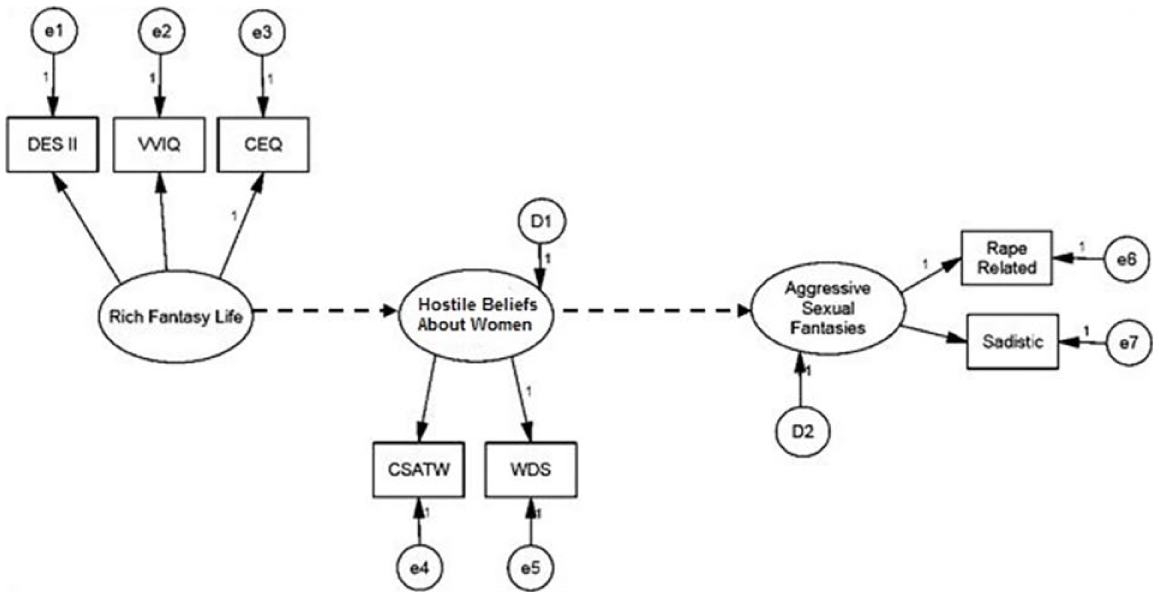
Hypothesized model.
Having specified the model based upon theoretical assumptions (see “Introduction” section), the model must be identified. Model identification is the extent to which the parameters of the model (i.e., the paths being estimated) correspond to the available data points. The aim is to specify a model that has more data points than parameters so that it has positive degrees of freedom (i.e., known as an “over-identified” model). This makes the model scientifically useful as it can be rejected (Byrne, 2010). The present model had 16 parameters: that is, seven error variances, four indicator paths (the other three are fixed to the value of one to set the scale for each latent factor, and so are not estimated), two structural paths (between latent variables), two disturbances (i.e., error term associated with the two endogenous latent variables), and one factor variance (for the exogenous variable). As there were seven measured variables, the number of data points was: 7(7 + 1) / 2 = 28. Therefore, the model was overidentified as there were more data points than parameters (28 vs. 16, respectively).
The next step involved evaluating the fit of the hypothesized model. Based on recommendations within the SEM literature (e.g., Businelle et al., 2010; Byrne, 2010; Hu & Bentler, 1999; Schreiber, Nora, Stage, Barlow, & King, 2006), various goodness-of-fit indices were consulted to determine how well the model fit the observed data. Specifically, a chi-square goodness-of-fit index (χ2) was used to test the hypothesis that the model significantly differs from the data. Thus, a good model will not differ (p > .05). In addition, the Comparative Fit Index (CFI) and Tucker–Lewis Index (TLI) were used, both of which compare the hypothesized model with a null (i.e., worst-fitting) model. According to Hu and Bentler (1999), scores >.95 indicate an excellent fit. Also, root means square error of approximation (RMSEA) was also used. RMSEA essentially measures the error of approximation in the population, expressed per degree of freedom (Byrne, 2010). Because degrees of freedom are related to the number of parameters in the model, RMSEA is sensitive to model complexity and favors models with less parameters. An RMSEA value of 0.8 or more indicates greater error of approximation and, therefore, poor fit, whereas an RMSEA below 0.5 is considered excellent fit. However, a cutoff value of 0.6 (Hu & Bentler, 1999), or a stringent upper limit of 0.7 (Steiger, 2007), can suggest a reasonably good-fitting model.
Results
Table 1 displays the descriptive statistics for each of the indicator variables, as well as the internal consistencies for each measure (which range from good to excellent). On average, the sample scored low on the CEQ and DES-II. However, these findings are in accordance with previous studies using nonclinical samples (e.g., Giesbrecht, Geraerts, & Merckelbach, 2007). On the VVIQ, the mean nonreversed score was 38.6, which matches previous research using nonclinical samples (e.g., M = 38.5; Allbutt, Ling, Rowley, & Shafiullah, 2011). This score indicates that, on average, the sample evidenced a moderate ability to envision vivid visual mental imagery. On the WDS and CSATW, the sample appeared to score low. However, in an unpublished study using a sample of pretreated sexual offenders (N = 3,773; comprised of both rapists and child sexual abusers), Wakeling (2015) reported mean scores of 8.10 (SD = 3.92) on the WDS and 1.41 (SD = 1.38) on the CSATW. Thus, the present sample scored similar to (on the WDS) and greater than (on the CSATW) incarcerated sexual offenders. Finally, the samples’ use of rape and sadistic sexual fantasies were both low. Arguably, this would be expected in a student/community sample. Moreover, these data mirror previous research findings using similar populations (Gray et al., 2003; Larue et al., 2014). As shown in Table 1, the sample reported using sadistic sexual fantasies more frequently than rape fantasies. This was also reflected by the number of men reporting to use such fantasies, with 22% (n = 35) admitting to using rape fantasies and 72.3% (n = 115) reporting to use sexual fantasies containing sadistic themes.
Means, SDs, and Internal Consistencies for Each Indicator Variable.
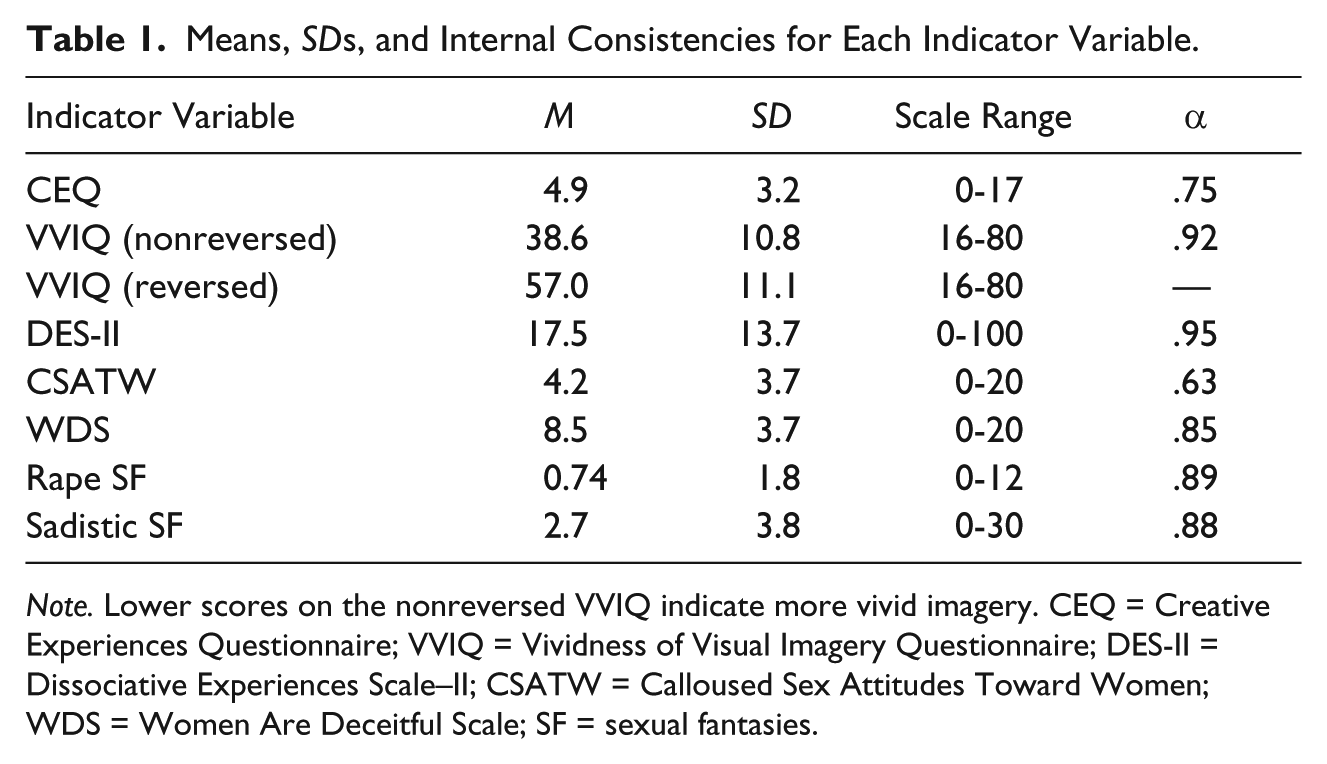
Note. Lower scores on the nonreversed VVIQ indicate more vivid imagery. CEQ = Creative Experiences Questionnaire; VVIQ = Vividness of Visual Imagery Questionnaire; DES-II = Dissociative Experiences Scale–II; CSATW = Calloused Sex Attitudes Toward Women; WDS = Women Are Deceitful Scale; SF = sexual fantasies.
To confirm that the indicator (observed) variables (e.g., WDS, CSATW) that defined a specific latent variable (i.e., hostile beliefs) were associated, Spearman’s rho correlations were conducted. This also enabled multicollinearity to be checked as this can have negative effects on the regression analyses that occur in SEM, rendering results uninterpretable (Pedhazur & Schmelkin, 1991). From Table 2, it can be seen that the strongest correlations were between indicators associated with a specific latent variable (with the exception of VVIQ and DES-II). For example, in relation to rich fantasy life, the CEQ showed a positive relationship with the VVIQ (rs = .26) and the DES-II (rs = .49); in relation to hostile beliefs about women, the CSATW and WDS were moderately correlated (rs = .39); and in relation to aggressive sexual fantasies, the two sexual fantasy subscales were strongly associated (rs = .61). In accordance with previous research on beliefs about women and aggressive sexual fantasies, the WDS positively correlated with both rape (rs = .25) and sadistic sexual fantasies (rs = .18), as did the CSATW (rs = .36 and .25, respectively). It is also important to note that the CEQ positively correlated with rape (rs = .19) and sadistic sexual fantasies (rs = .26), as did the DES-II (rs = .18 and .21, respectively). None of the correlations exceeded .80, ruling out multicollinearity.
Spearmen’s Rho Correlations Between All Indicator Variables.
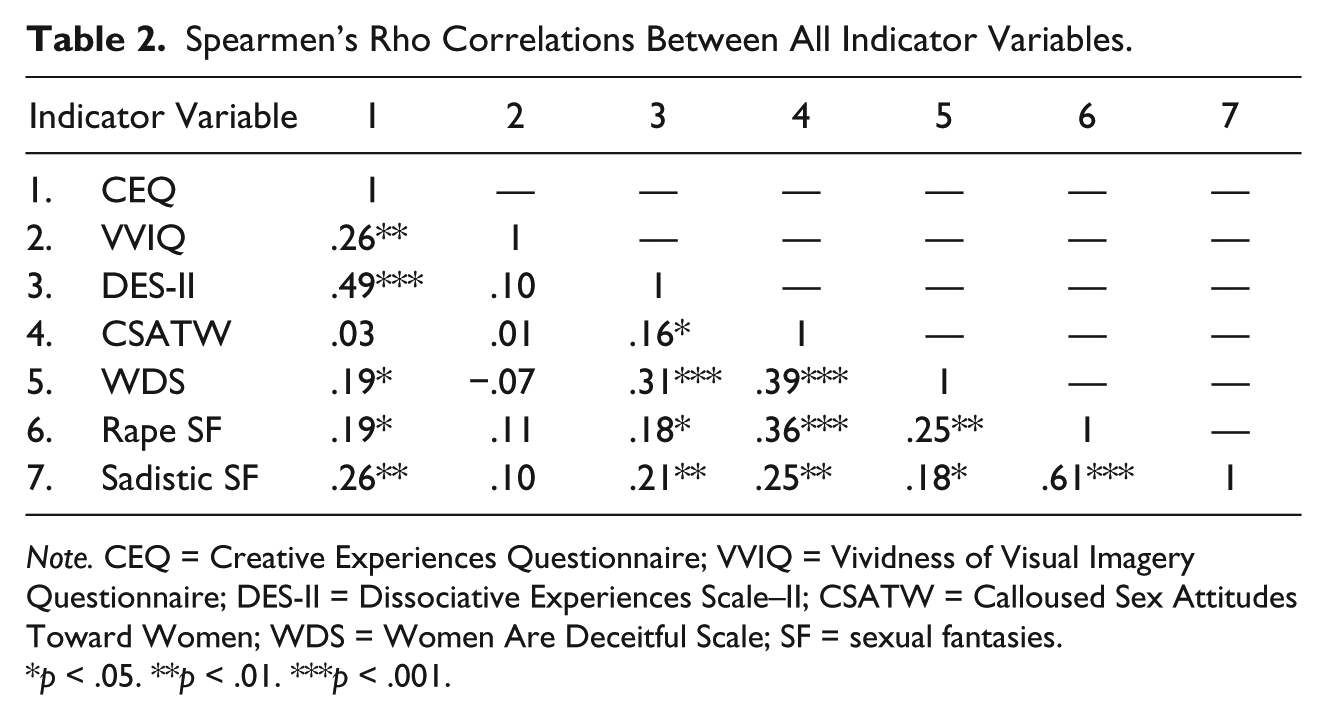
Note. CEQ = Creative Experiences Questionnaire; VVIQ = Vividness of Visual Imagery Questionnaire; DES-II = Dissociative Experiences Scale–II; CSATW = Calloused Sex Attitudes Toward Women; WDS = Women Are Deceitful Scale; SF = sexual fantasies.
p < .05. **p < .01. ***p < .001.
Testing the SEM Model
SEM was run using AMOS 21. Maximum likelihood (ML) was the chosen method of parameter estimation because it can be appropriately used with sample sizes ranging from 100 to 150 (Schreiber et al., 2006). Figure 2 shows the final SEM model with the standardized coefficients derived from the analysis. As shown, the two paths between the latent variables were significant. The specific details of these two paths’ coefficients are as follows: rich fantasy life → hostile beliefs about women (standardized β = .50; unstandardized β = .52; SE = .15, p < .001); and hostile beliefs about women → aggressive sexual fantasies (standardized β = .58; unstandardized β = .40, SE = .09; p < .001). Also, all the nonfixed indicators significantly loaded on to their corresponding latent factor.
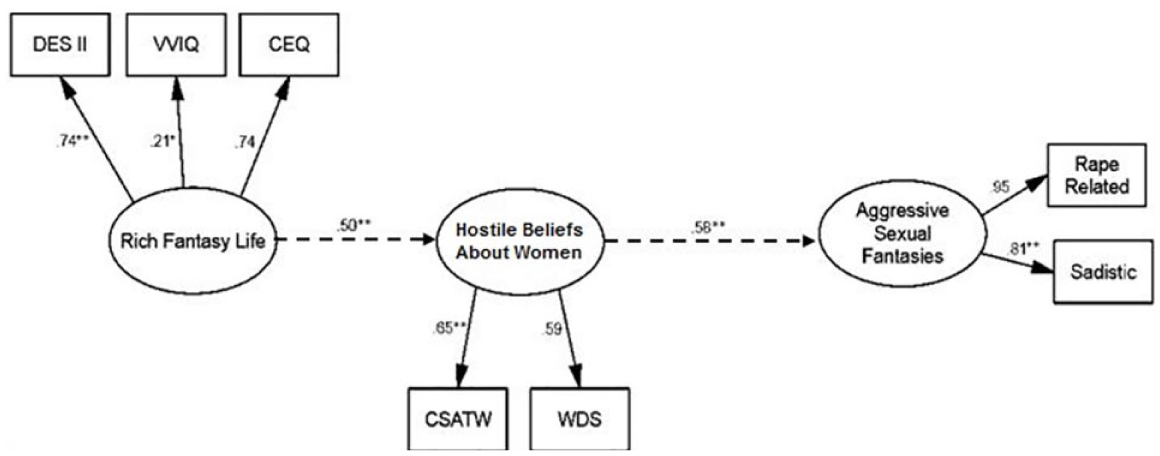
Final structural equation model.
The goodness-of-fit indices showed the model had a reasonable-to-good fit with the data; χ2(12) = 20.43, p > .05; CFI = 0.97; TLI = 0.95; RMSEA = 0.067. Taken together, no further adjustments or model modifications were deemed necessary to improve the model (Byrne, 2010). Although these results were encouraging, the indices were susceptible to inflation by the sample size (Ievers-Landis et al., 2011). Moreover, as predicted, the data were found to be nonnormally distributed, indicated by a high multivariate kurtosis value (z statistic = 16.76). For normality to be established, this value should be <5.00 (Bentler & Wu, 2005). Thus, bootstrapping procedures were applied to test the validity of the model.
Bootstrapping Procedures
Bootstrapping was used to examine the stability of the model and determine whether it was unbiased. This was done via two steps (Ievers-Landis et al., 2011). The first involved comparing the bootstrap regression weight means derived from the 1,000 bootstrap samples (unstandardized and standardized) with those produced from the original sample. If they did not considerably differ, it would provide evidence of an unbiased model. As shown in the fourth column of Tables 3 and 4, the difference between the weights of the mean bootstrap sample (unstandardized and standardized, respectively) did not greatly differ from those of the original sample. This provided the first indication that the model was unbiased.
Comparisons Between the Original Sample and Mean Bootstrap Sample of 1,000 (Using Unstandardized Regression Weights).

Note. CEQ = Creative Experiences Questionnaire; VVIQ = Vividness of Visual Imagery Questionnaire; DES-II = Dissociative Experiences Scale–II; CSATW = Calloused Sex Attitudes Toward Women; WDS = Women Are Deceitful Scale; SF = sexual fantasies.
Comparisons Between the Original Sample and Mean Bootstrap Sample of 1,000 (Using Standardized Regression Weights).

Note. CEQ = Creative Experiences Questionnaire; VVIQ = Vividness of Visual Imagery Questionnaire; DES-II = Dissociative Experiences Scale–II; CSATW = Calloused Sex Attitudes Toward Women; WDS = Women Are Deceitful Scale; SF = sexual fantasies.
The second step to determine whether the model was unbiased involved comparing the SE of the mean bootstrap with the SE bias (i.e., the difference between the SE of the original sample and the bootstrap sample) for all paths. An unbiased model is indicated whether the SE bias is less than the SE of the mean bootstrap. As shown in Tables 3 and 4, each SE bias was less than that derived from the mean bootstrap. This corroborated that all paths were unbiased.
A final test of the model’s validity was conducted using the Bollen–Stine method. This bootstrapping procedure involves transforming the data so that they perfectly match the model. Multiple samples are then drawn from the transformed sample. Essentially, it uses the chi-square statistic to assess whether the bootstrap-derived model significantly differs from the original model. In this study, the Bollen–Stine χ2 = 0.126 (p > .05), indicating that two models do not significantly differ. This provided further validation of the original model.
Discussion
The aim of this study was to examine whether males’ aggressive sexual fantasies are influenced by individual differences in the ability to engage in a rich fantasy life. We defined a “rich fantasy life” as involving three factors associated with general imaginal ability: (a) being fantasy prone, (b) having frequent experiences of dissociation, and (c) an ability to envision vivid visual mental imagery. Using a sample comprised of student and community-based adult males (N = 159), we found fantasy proneness to be positively correlated with both dissociation and vivid mental imagery, supporting previous research (Aleman & de Haan, 2004; Pekala et al., 2001). In addition to this, fantasy proneness and dissociation each correlated with both rape and sadistic sexual fantasies. To the authors’ knowledge, this marks the first empirical evidence showing fantasy proneness and dissociation are associated with the use of sexual fantasies. It also provided good grounds to test our main hypothesis: that a “rich fantasy life” influences the use of aggressive sexual fantasies.
Because previous theories state that negative cognitions about women lead to aggressive sexual fantasies (e.g., Marshall & Barbaree, 1990), we hypothesized that a “rich fantasy life” would influence aggressive sexual fantasies indirectly through hostile beliefs about women. Using SEM, a good-fitting model with all pathways showing significant coefficients was obtained. Thus, the results support the idea that if a male, with a greater proclivity to dissociate and spend much of his time engaged in vivid fantasies, develops hostile beliefs about women, he is more likely to create and use aggressive sexual fantasies. These results offer a novel addition to the literature on the relationship between hostile beliefs about women and sexual fantasies involving dominance, coercion, and force (e.g., Greendlinger & Byrne, 1987; Zurbriggen & Yost, 2004). First, because SEM is a test of theoretically informed causal assumptions (Bollen & Pearl, 2013), the results correspond with existing accounts that propose distorted cognitions influence deviant sexual fantasies (Beech & Ward, 2004; Marshall & Barbaree, 1990). Second, in the context of our study, this link primarily applies to men with a greater ability to create and engage in a rich, internal fantasy world. It is important to note, however, that, because this study was not experimental, no conclusions can be made regarding causality.
Although this research offers novel insights, it is not without limitations. First, although the model was a good fit with the data, the model is by no means conclusive. The model only provides a test of theoretically derived causal assumptions, not causality itself (which would require experimental manipulation). Furthermore, the inclusion of other latent variables may contribute to a better fitting model. For example, it has been found that some of the same developmental antecedents that Knight and Sims-Knight (2003) found relate to aggressive fantasies—namely, physical abuse—are also linked to the development of fantasy proneness (Rhue & Lynn, 1987). Thus, future researchers could look to expand the present model by examining whether early physical abuse is associated with the “rich fantasy life” construct. Second, the sample size was small and, as predicted, the data were found to be nonnormally distributed. However, following the recommendations of Ievers-Landis et al. (2011), the results from two bootstrapping procedures verified that the model was valid and unbiased. Nevertheless, “SEM is still a large sample analysis technique” (Schreiber et al., 2006, p. 334) and so the model should be tested with a larger sample. Third, two latent variables were comprised of only two indicators. Although Violato and Hecker (2007) stated that most SEM models tend to use two indicators per latent variable, it can sometimes cause estimation problems (Kline, 2004). Thus, it would be beneficial to run a model with three indicators for the hostile beliefs about women and aggressive sexual fantasies latent factors. Note that this would mean adding more parameters to the model, which would require a larger sample.
Fourth, there was very little diversity with regard to race/ethnicity, limiting our ability to investigate the influence of race or cultural background in our study. Also, we did not examine diversity in terms of other demographic information, such as sexual orientation, education level, and relationship status. This can be seen as a limitation because these factors may have exerted an influence on the findings. For example, if there were any homosexual participants in the sample, it is possible that their attitudes about women would have no bearing on their aggressive sexual fantasies (as the content would most likely involve men). Furthermore, higher education level has been shown to be associated with less sexist attitudes toward women (Glick, Lameiras, & Castro, 2002), while relationship status can affect the use of sexual fantasies (Hicks & Leitenberg, 2001). Thus, each of these factors may have had an effect on the frequency of hostile attitudes toward women and/or aggressive sexual fantasies, respectively. It would be beneficial, therefore, to include these factors in future extensions of this study. Fifth, the VVIQ did not correlate with a greater use of aggressive sexual fantasies. This may imply that vividness is more associated with the effects of sexual fantasies (e.g., how arousing they are) than how often they are used. Indeed, using a different vividness measure, Smith and Over (1987a, 1987b) found vividness was associated with greater fantasy-induced sexual arousal. Alternatively, the VVIQ primarily measures how vividly one can envision static scenes. Given that sexual fantasies typically involve scenes of oneself in movement, a measure that assesses how vividly one can envision movement imagery may be more appropriate for future research (e.g., the Vividness of Movement Imagery Questionnaire–2; Roberts, Callow, Hardy, Markland, & Bringer, 2008). Finally, the majority of participants were recruited online. This method of data collection is now widely conducted and offers numerous advantages (e.g., easy distribution, time efficiency, large samples). Also, it can be argued that online participation reduces socially desirable responding (although we found no significant difference between those who took part in the lab and those who completed the study online). In spite of these strengths, online research also has limitations. This can include not being in control of who takes part (e.g., it cannot be determined that all participants were nonoffenders), restricting participation to those who have access or are inclined to take part in online research and research associated with sex, and reduced quality control (i.e., not being able to determine whether participants are fully and seriously engaged in the study). Thus, future extensions of this study should consider these issues within the methodology.
Despite these limitations, the findings offer novel theoretical insights. For example, as discussed in the “Introduction” section, Marshall and Barbaree (1990) argued that aggressive sexual fantasies (influenced by hostile beliefs about women) are a means for some men to bolster their sense of masculinity. Combining this view with the data from the present study, it can be speculated that men—who can dissociate and experience vivid, absorbing general fantasies—will find their aggressive sexual fantasies highly reinforcing. This may increase their engagement in the fantasy, which in turn may increase the likelihood of acting upon the fantasy (particularly if used as a masturbatory fantasy). Furthermore, some researchers argue that deviant sexual fantasies can provide individuals with an offense script (Gee et al., 2003; Ward & Hudson, 2000). Thus, it is possible that if an individual has the ability to experience sexual fantasies as highly vivid, absorbing, and less affected by extraneous stimuli, they may be more likely to produce offense scripts, increasing the risk of engaging in the fantasized behavior. Alternatively, it could be that, for men with a rich fantasy life, aggressive sexual fantasies may be so vivid and “real” that they satiate any desire to enact the fantasy (i.e., in the form aggressive sexual behavior). Unfortunately, the present study was aimed solely at trying to understand the relationship between factors associated with imaginal ability and the use of aggressive sexual fantasies. Therefore, we did not ask whether our participants engaged in sexual aggression of any kind in this initial study. Given the theoretically important implications of this study, it would be interesting and beneficial to examine in further research whether sexually aggressive behavior plays a role within the empirical model presented in this study.
The findings of the study also offer some tentative implications for the treatment and prevention of sexual offending behavior. For example, if an individual is having issues with using highly absorbing and vivid aggressive sexual fantasies, it may indicate that they have a strong imaginal ability (i.e., rich fantasy life). Thus, clinicians could consider using strategies that help reduce the vividness of their sexual fantasy imagery (Bartels, Beech, & Harkins, 2013). Also, mindfulness techniques may also be useful for such individuals, as it can help improve their ability to shift their attention to the present situation, rather than dissociating into an internal fantasy world. Indeed, Zerubavel and Messman-Moore (2015) recently argued that dissociation can be treated using mindfulness therapy by helping clients “stay present.” They state that “if therapy can create a link between awareness of dissociation and intentional harnessing of attention on the present moment, mindfulness can be used to counteract dissociation” (p. 309). This is a novel avenue to pursue in future research, which may result in a novel strategy for managing the frequent use of powerful aggressive sexual fantasies.
In conclusion, the results of this study provide empirical evidence for the link between imaginal ability and aggressive sexual fantasies in men. As such, they contribute to our understanding of why some men use sexual fantasies involving coercion and sadism. Although the results are in accordance with the causal assumptions derived from prior theory and research, they do not speak to causality. Thus, further research using experimental and longitudinal designs should be conducted to confirm that a “rich fantasy life”—in conjunction with hostile beliefs about women—influence the use of aggressive sexual fantasies. Future research could examine whether a “rich fantasy life” also influences other forms of deviant sexual fantasy (e.g., involving children), as well as nonaggressive sexual fantasies. This would help confirm the general hypothesis that imaginal ability is associated with sexual fantasizing.
Footnotes
Declaration of Conflicting Interests
The author(s) declared no potential conflicts of interest with respect to the research, authorship, and/or publication of this article.
Funding
The author(s) received no financial support for the research, authorship, and/or publication of this article.