



Abstract
Violence against women is considered a serious public health problem. It is estimated that about 30% of women who have been in a relationship in the world have experienced some form of physical or sexual violence from their intimate partners. In sub-Saharan Africa, one of the regions in the world with the highest prevalence of intimate partner violence, there have been studies of factors associated with intimate partner violence. However, few studies have explicitly examined the influence of the normative social context on women’s accepting attitudes toward spousal abuse and their risk of experiencing intimate partner violence in the region. Using data from the 2011 Demographic and Health Survey in Mozambique, we employ multilevel logistic regression to examine the influence of area-level normative social context factors on 4,864 women’s accepting attitudes toward spousal abuse and their likelihood of experiencing intimate partner physical violence in Mozambique. Our findings revealed the importance of religious norms in geographic areas as key predictors of women’s acceptance of intimate partner violence. Specifically, area-level normative religious predictors were negatively associated with women’s acceptance of spousal abuse. The prevalence of early marriages in a given geographic area was positively associated with both acceptance of spousal abuse and experiencing intimate partner physical violence. The level of female education in a geographic area was negatively associated with accepting spousal abuse and having experienced intimate partner physical violence. As intimate partner physical violence in sub-Saharan Africa continues unabated, programs and interventions to address the problem will need to consider the normative context of geographic areas.
Introduction
Violence against women is considered a serious public health problem (Heise, Ellsberg, & Gottmoeller, 2002; World Health Organization [WHO], 2006, 2013). Studies indicate that the most prevalent form of intimate partner violence in the world is husband–wife violence (Mugoya, Witte, & Ernest, 2015). It is estimated that about 30% of women who have been in a relationship in the world have experienced some form of physical or sexual violence from their intimate partners (WHO, 2013). Intimate partner violence is associated with negative consequences on various aspects of women’s health and well-being (Campbell, 2002; García-Moreno, Jansen, Ellsberg, Heise, & Watts, 2005). Studies indicate that, when compared with their counterparts, women who have experienced intimate partner violence are more likely to have mental health disorders (Deyessa et al., 2009; Ludermir, Schraiber, D’Oliveira, França-Junion, & Jansen, 2008), low use of prenatal health care services (Koski, Stephenson, & Koenig, 2011), adverse pregnancy outcomes (Coker, Sanderson, & Dong, 2004; Johri et al., 2011), and suicide attempts (Devries et al., 2011).
In sub-Saharan Africa, one of the regions in the world with the highest prevalence of intimate partner violence (WHO, 2013), several studies have identified factors associated with intimate partner violence (e.g., Amoakohene, 2004; Annan & Brier, 2010; Dery & Diedong, 2014; Jewkes, Levin, & Penn-Kekana, 2002; Jewkes, Penn-Kekana, & Rose-Junius, 2005; Koenig et al., 2004; Kouyoumdjian et al., 2013; Mugoya et al., 2015; Tlapek, 2015; Uthman, Lawoko, & Moradi, 2009). However, few studies (Linos, Slopen, Subramanian, Berkman, & Kawachi, 2013; Pulerwitz et al., 2015; Trott, Harman, & Kaufman, 2017) have explicitly examined the influence of the normative social context on women’s attitudes toward spousal abuse and their risk of experiencing intimate partner violence. This appears to be an important gap in understanding the fundamental drivers of intimate partner violence in sub-Saharan Africa, especially in light of the claim that social norms influence social behaviors (e.g., Cialdini, Reno, & Kallgren, 1990; Montgomery & Casterline, 1996). The scarcity of studies on relationships between social norms and intimate partner violence has led Linos and Kawachi (2012) to call for more research on this important subject particularly in regions such as sub-Saharan Africa, where the prevalence of acceptance of spousal violence is high.
The few studies that have explicitly explored connections between the normative social context in areas of individuals’ residence and intimate partner violence in sub-Saharan Africa made important revelations. In a study in Nigeria, Natalia Linos and colleagues (2013) examined the relationship between social norms toward spousal violence and a woman’s exposure to physical and sexual violence perpetrated by her husband. The authors found that “permissive social norms toward spousal violence were positively associated with a woman’s exposure to sexual and physical violence perpetrated by her husband in Nigeria, controlling for individual characteristics” (Linos et al., 2013, p. 152). Also in sub-Saharan Africa, a quasi-experimental intervention study with the objective of promoting “gender-equitable norms” and reducing intimate partner violence among young men in Ethiopia reported that positive changes in views toward gender norms were associated with reductions in perpetration of violence over time (Pulerwitz et al., 2015). There have been similar studies in other developing countries outside of sub-Saharan Africa. For example, a study in Bangladesh found that women residing in areas with permissive norms toward wife beating were more likely to justify husbands’ abusive behavior (Jesmin, 2015).
Although these few studies have advanced our understanding of connections between normative social context factors and intimate partner violence, we believe that there is still a need for more research on the issue in sub-Saharan Africa, especially considering that the occurrence and acceptance of intimate partner violence remain pervasive in the region. Therefore, we examine the role of area-level normative social context factors in married (or in union) women’s attitudes toward spousal abuse and their likelihood of having experienced physical violence from husbands or intimate partners in Mozambique.
Mozambique, a country of about 29 million inhabitants (United Nations Statistics Division, 2017) located in southern Africa, typifies most sub-Saharan African countries where intimate partner violence is prevalent, yet studies of intimate partner violence are scarce. Mozambique’s 2011 Demographic and Health Survey (DHS) report indicated that about 32% of married (or in union) women in the country have ever experienced some form of physical violence from their husbands or intimate partners (Ministério da Saúde [MISAU], Instituto Nacional de Estatística [INE], & ICF International [ICFI], 2013). At the same time, the report showed variation across provinces concerning levels of women’s physical violence as perpetrated by husbands or intimate partners (MISAU, INE, & ICFI, 2013). This suggests that factors influencing the occurrence of intimate partner physical violence in Mozambique may vary across geographic areas. Therefore, the study of the normative social context relating to intimate partner violence is important as it may indicate protective normative social factors, which may need to be encouraged, and negative ones, which may need to be addressed.
Theoretical Framework
The present study is informed by theories of normative social behavior (Cialdini et al., 1990; Montgomery & Casterline, 1996; Rimal & Real, 2005). Theories of normative social behavior argue that social norms influence individuals’ behaviors (Cialdini et al., 1990; Rimal & Real, 2005). Social norms are defined as “ . . . codes of conduct that either prescribe or proscribe behaviors that members of a group can enact” (Rimal & Real, 2003, p. 185). There may be descriptive or injunctive social norms (Cialdini et al., 2006; Cialdini et al., 1990). Descriptive social norms are said to express what is perceived to be typical—for example, what many people do (Cialdini et al., 2006; Cialdini et al., 1990). Injunctive norms refer to what individuals perceive as being approved or disapproved of in their communities (Cialdini et al., 2006; Rimal & Real, 2003).
This study is also guided by the ecological framework of violence (Heise, 1998), according to which intimate partner violence is a product of relationships involving “personal, situational, and sociocultural factors” (Heise, 1998, p. 263). Thus, there is a possibility that the normative social context found in a geographic area may be associated with attitudes which individuals living in that area may hold about spousal abuse and the likelihood that women living in the area will experience physical violence from their husbands or intimate partners. The level of acceptance of spousal abuse in an area has been considered one of the key drivers of intimate partner physical violence against women (Flood & Pease, 2009; Jesmin, 2015; Linos et al., 2013; Tlapek, 2015; Uthman, Lawoko, & Moradi, 2009; Uthman, Moradi, & Lawoko, 2009). Therefore, it is important to understand not only how the normative social context in a given area influences actual intimate partner physical violence but also how it affects attitudes toward spousal abuse (Jesmin, 2015). Studies have argued that in places where social norms encourage women to accept mistreatment by husbands or intimate partners, they are at an elevated risk of being physically abused by their husbands or intimate partners (Boyle, Georgiades, Cullen, & Racine, 2009; Jewkes, 2002; WHO, 2009). For example, Boyle et al. (2009) found that women living in places where tolerance for women’s mistreatment was high were at elevated risk of experiencing intimate partner violence than their counterparts who reside in places with a low tolerance for women’s mistreatment. Recently, a study in the Democratic Republic of Congo found that women with an accepting attitude toward spousal abuse were 1.5 times more likely to report physical violence than their peers (Tlapek, 2015).
The area-level normative social context may influence attitudes toward spousal abuse and actual intimate partner physical violence through several ways. One of them is area-level prevalence of religious norms. Research has indicated that religious beliefs and practices are important on people’s lives in sub-Saharan Africa (Pew Research Center, 2010; Trinitapoli, 2006). Thus, area-level religious norms may have influence on intimate partner physical violence in sub-Saharan Africa. Religious norms prevailing in a given area may have a protective effect on intimate partner physical violence as it has been argued that religion tends to promote marital satisfaction (Maton & Wells, 1995) and marital satisfaction is negatively associated with intimate partner violence (Byrne & Arias, 1997; Stith, Green, Smith, & Ward, 2008). However, according to Flood and Pease (2009), religious norms may also legitimize the perpetration of violence against women in circumstances where religion encourages wife submission to husband’s authority.
Social norms governing area-level women’s autonomy are also potentially important. Most studies have found that lower levels of women’s autonomy were associated with women’s acceptance of wife mistreatment (e.g., Uthman, Moradi, & Lawoko, 2009). However, findings about the influence of area-level women’s autonomy on women’s risk of being physically abused by their intimate partners are mixed. In some situations, higher levels of area-level women’s autonomy were associated with decreased likelihood of women being physically abused by intimate partners (Koenig, Ahmed, Hossain, & Mozumder, 2003). In other circumstances, however, higher levels of area-level women’s autonomy increased the risk of women being physically abused by intimate partners (Koenig et al., 2003).
The normative context of marriage or union in sub-Saharan Africa may also influence the likelihood that women in the region will experience intimate partner physical violence. Previous studies in developing countries have indicated that women who marry at a young age are more likely to experience intimate partner violence than their peers (Abramsky et al., 2011; Jensen & Thornton, 2003; Jesmin, 2015; Shamu, Abrahams, Temmerman, Musekiwa, & Zarowsky, 2011). Therefore, there are reasons to believe that living in a geographic area with a high prevalence of women who married at a young age could be associated with their high likelihood of experiencing physical violence. There is also a possibility that living in an area with a high prevalence of individuals who married at a young age could be associated with a high propensity for accepting women’s mistreatment by their husbands or intimate partners.
Another potentially important normative pathway through which area-level social context could influence levels of intimate partner physical violence in a geographic area is the area-level of education. As Boyle et al. (2009) have argued, “Higher education is aligned with more liberal norms and values pertaining to women’s rights and less acceptance of violence as a mean of resolving conflicts” (p. 692). Therefore, men with higher levels of education could be more likely to avoid perpetrating physical violence to their wives or intimate partners. Women with a high level of education could be less likely to accept women’s physical mistreatment by their intimate partners, as well. For example, Hindin (2003) in a study in Zimbabwe reported that women with primary schooling and those with secondary education or more were less likely to believe that spousal abuse is justified compared with women with no education. It is possible that an elevated prevalence of educated women in a geographic area in sub-Saharan Africa could relate to a lower acceptance of women’s abuse by their intimate partners in that area. In fact, some studies have identified women’s illiteracy in a geographic area as a community factor, which relates to intimate partner violence (Kouyoumdjian et al., 2013).
Area-level exposure to media is another possible important normative pathway, as well. Nowadays, there is growing information channeled through the media promoting gender equality that could contribute for decreasing male’s attitudes toward physical violence against their intimate partners. For example, in Mozambique, many nongovernmental organizations have been promoting equality between men and women through television, radio, and written press and educating people against gender-based violence (Noticias, 2014; República de Moçambique, 2008; Taela, 2006). Thus, in sub-Saharan Africa, the level of exposure to the media could be a factor influencing the distribution of intimate partner physical violence across geographic areas (UN Women, 2014). However, studies in other settings have indicated that exposure to the media in some circumstances may act in ways that encourage violence toward women (Flood & Pease, 2009).
Hypotheses
Figure 1 shows the hypothesized relationships between area-level normative social context factors, women’s accepting attitudes toward intimate partner violence, and women’s intimate partner physical violence in Mozambique. The expected relationships indicated in Figure 1 are based on the theoretical framework outlined above. Thus, we expected to find an association between area-level normative social context factors (area-level religious context, area-level context of women’s autonomy, area-level marriage context, area-level media exposure context, and area-level educational context) and women’s accepting attitudes toward spousal abuse, on one hand, and women’s experience of intimate partner physical violence, net of demographic and socioeconomic characteristics, on the other hand. Moreover, we expect women from areas with higher levels of women who have married at a young age to be more likely to accept spousal abuse and also to be more likely to report having experienced intimate partner physical violence. We further expect that women from areas with higher levels of female education will be less likely to accept spousal abuse and to report experience of intimate partner physical violence compared with those residing in geographic areas with a high prevalence of women with lower levels of female education. Finally, we expect a residence in an area with a high prevalence of women who accept spousal abuse to be positively associated with reporting having experienced intimate partner physical violence, net of other factors. Figure 1 also shows women’s individual-level factors that are likely to modify relationships between area-level normative social context factors and our outcomes. For example, despite living in an area with permissive social norms toward spousal abuse, women with higher levels of education may be less likely to tolerate violence against women (Jesmin, 2015) and less likely to experience intimate partner violence (Linos et al., 2013) than their counterparts. Although women’s intimate partners’ characteristics are crucial for women’s intimate partner violence (Heise, 1998), we were not able to specifically assess the role of those characteristics, due to limitations in our dataset.

Hypothesized relationships between area-level normative social context factors, women’s acceptance of intimate partner violence, and women’s intimate partner physical violence in Mozambique.
Data and Method
Data
Data for this study come from the 2011 DHS in Mozambique. A nationally representative and probabilistic population-based survey, the Mozambique’s 2011 DHS has a sample selected in three stages which, first, involved the selection of 611 enumeration areas (survey clusters). Then, in each enumeration area, 20 to 25 households were selected. Finally, in each household, an eligible woman was chosen for interview. The survey interviewed 13,745 women aged 15 to 49 years covering demographic and health-related topics including those on household characteristics and domestic violence. The survey response rate for women was considered high—98.9% (further details may be found in MISAU, INE, & ICFI, 2013). This study uses a subsample of 4,864 married (or in union) women aged 15 to 49 years found in 610 enumeration areas. In the 2011 Mozambique’s DHS, enumeration areas are defined geographic areas which, in this study, are considered to approximate geographic areas or communities of women’s residence. The geographic areas (survey clusters) had a maximum of 20 women in urban areas and 25 in rural areas. In our analytic subsample, the minimum number of women in geographic areas was eight with an average of 23. Although the most desirable situation could be to have all geographic areas with many individuals, as reported in previous studies (e.g., Chiao, 2010), such a situation is often difficult to get. However, given that in the present study we have many geographic areas (610), we believe that any bias to estimates, owing to the fact that some geographic areas have relatively a few individuals, is likely to be minimal.
Measures
Outcome variables
In this study, we have two outcome variables. The first variable is whether a married (or in union) woman accepts spousal abuse. Women were asked whether wife beating or hitting is justified if a wife “goes out without telling him,” “neglects children,” “argues with him,” “refuses to have sex with him,” or “burns the food.” Women’s answers to this question were used to create a dichotomous variable which takes a value of 1 if the reply is “yes” and 0 if it is “no.” The second outcome variable is whether or not a married (or in union) woman aged 15 to 49 years was subjected to any form of physical violence by a husband or intimate partner in 12 months before the survey. A woman was considered to have suffered physical violence from a husband or intimate partner if she responded that within that time range she has been “many times” subjected to one or more of the following: (a) spouse ever pushed, shook, or threw something; (b) spouse ever slapped; (c) spouse ever punched with fist or something harmful; (d) spouse ever kicked or dragged; (e) spouse ever tried to strangle or burn; (f) spouse ever threatened with knife/gun or other weapon; (g) spouse ever attacked with knife/gun or other weapon; and (h) spouse ever twisted her arm or pulled her hair.
Main predictor variables
Measures of area-level normative social context were obtained from averaging individual-level data to the survey cluster (a proxy for the geographic area of women’s residence) considering all the 13,745 interviewed women where possible. The area-level normative social context predictors of interest in this study are area-level religious affiliation (a proxy for area-level religious norms), area-level female autonomy, area-level age at first marriage or union, area-level women’s exposure to media, and area-level female education. Area-level religious affiliation has five measures: the percentage of women in the geographic area with Catholic affiliation, the percentage of women in the geographic area with Protestant affiliation, the percentage of women in the geographic area with Evangelical or Pentecostal affiliation, the percentage of women in the geographic area with Zionist affiliation, and the percentage of Muslim women in the geographic area. In this study, a woman was considered as having a high autonomy in the family if she alone in the family has a final say on three or four of the following: “respondent’s health care,” “making large household purchases,” “visits to family or relatives,” or “what to do with money husband earns.” Women who have a final say on one or two of the above items were considered as having a low autonomy in the family and those who do not have a final say on any of the four items were classified as having no autonomy in the family. Thus, the percentage of women in a geographic area with a high autonomy was considered as a measure of area-level female autonomy.
Area-level age at first marriage or union expresses the percentage of women in each geographic area who had their first marriage or union before 16 years of age. The area-level women’s exposure to media was obtained from averaging individual female exposure to media in each geographic area (those who at least once a week listen to radio, watch television, or read newspaper or magazine). The area-level female education was computed through averaging female years of education in each geographic area. Due to limitations in our dataset, we were not able to use the average level of men’s education in a geographic area as a predictor in the study.
As we argued above, attitudes toward spousal abuse are considered key predictors of the likelihood of a woman having experienced intimate partner physical violence (Linos et al., 2013; Uthman, Moradi, & Lawoko, 2009). Thus, for the second outcome, area-level women’s acceptance of spousal abuse was used as one of normative area-level predictors. The area-level women’s attitudes toward spousal abuse has five measures: the percentage of women believing that wife beating is justified if the wife goes out without telling him, the percentage of women believing that wife beating is justified if the wife neglects the children, the percentage of women believing that wife beating is justified if the wife argues with him, the percentage of women believing that wife beating is justified if the wife refuses to have sex with him, and the percentage of women believing that wife beating is justified if the wife burns the food.
As controls, the study uses all individual-level variables that were used to create area-level normative social context predictors. In addition, woman’s age, place of residence (urban or rural), and woman’s household wealth position were also used as controlling variables.
Statistical Analysis
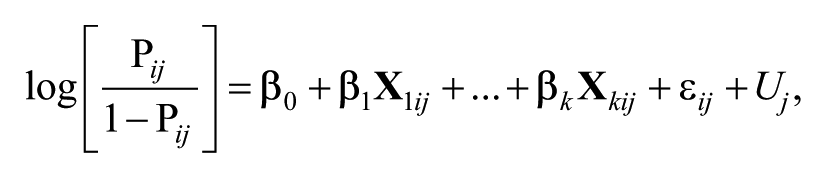
For the study, interviewed women are nested within geographic areas. Because of the hierarchical structure of data and the binary nature of outcome variables, we used random-intercept logistic regression for analysis. Given the hierarchical nature of the data and the fact that our main predictor variables are characteristics of geographic areas, random-intercept logistic regression was an appropriate analytical tool to avoid underestimating effects of our predictor variables on individuals’ outcomes (Steele, 2010a). For each of the two outcomes, we fitted one model estimating effects of normative social context predictors controlling for demographic and socioeconomic characteristics of the respondents. The model we fitted may be generally expressed in the following way:
where
To assess the level of unexplained variance between geographic areas, we examined the area-level random intercept
Results
Table 1 shows descriptive characteristics of the study sample. Of the 4,864 married (or in union) women in the study, about 20% hold favorable attitudes toward spousal abuse and approximately 5% experienced physical violence from husbands or intimate partners many times within 12 months before the survey. More than half of the women in the sample were aged between 20 and 39 years (73%), had 1 to 7 years of education (52%), and belonged to Catholic (25%), Zionist (21%) or Muslim (19%) religious affiliation. Twenty-six percent of the women in the study sample had their first marriage or union before 16 years of age and 8% had a high decision-making autonomy on own health care, making large household purchases, visits to family or relatives, or what to do with the money that the husband earns. Approximately half of the women in the study sample were more exposed to media and one third lived in urban areas. With respect to area-level normative social context characteristics, their prevalence across geographic areas varies substantially. Considering area-level religious context, for example, the highest percentage of women in geographic areas belonged to the Catholic affiliation (26%), followed by the Zionist affiliation (20%) and the Muslim affiliation (19%; Table 1).
Descriptive Characteristics of the Sample, Mozambique’s Demographic and Health Survey, 2011.

Note. M = Mean; SD = Standard Deviations.
Multivariate results are presented in Tables 2 and 3. Table 2 shows random-intercept logistic regression results of normative social context factors associated with women’s acceptance of spousal abuse. The results reveal an importance of the normative religious context, the normative marriage context, and the normative educational context in geographic areas. In particular, living in a geographic area with a high percentage of women with Protestant affiliation, Evangelical or Pentecostal affiliation, Zionist affiliation, or Islamic religious affiliation has a significant negative effect on accepting spousal abuse net of other factors. Compared with women living in an area with a high percentage of women who married at the age of 16 years or more, those residing in a geographic area with a high percentage of women marrying at an age below 16 years are significantly more likely to accept spousal abuse, adjusting for other factors. Women living in a geographic area with a high percentage of women with 1 to 7 years of education or those residing in an area with a high percentage of women with 8 years of education or more are significantly less likely to report positive views about spousal abuse, net of other factors.
Random-Intercept Logistic Regression Results of Normative Social Context Factors Associated With Women’s Acceptance of Intimate Partner Violence, Mozambique’s Demographic and Health Survey, 2011.

Note. SE = Standard Errors; Statistically significant coefficients are bolded.
Area-level random intercept is in standard deviations.
p < .1. *p ≤ .05. **p ≤ .01.
Random-Intercept Logistic Regression Results of Normative Social Context Factors Associated With Women Experiencing Physical Violence From Husbands or Intimate Partners in 12 Months Before the Survey, Mozambique’s Demographic and Health Survey, 2011.

Note. SE = Standard Errors; Statistically significant coefficients are bolded.
Area-level random intercept is in standard deviations.
p < .1. *p ≤ .05. **p ≤ .01.
The results in Table 2 suggest that women’s acceptance of spousal abuse varies substantially from a geographic area to another. Exponentiating the area-level random intercept, we get 2.4—exp(0.8773) = 2.4043—which means that a woman living in a geographic area which is one standard deviation above the mean is more than 2 times likely to accept spousal abuse compared with her counterpart residing in an average geographic area, net of other factors. The result from estimating the VPC (VPC = 0.8773 / [0.8773 + 3.29] = 0.2105) suggests that controlling for the factors in the model, about 21% of the variance which still exists in the women’s likelihood for accepting spousal abuse is due to unobserved characteristics of geographic areas.
Table 3 presents random-intercept results of normative social context factors associated with women experiencing physical violence from husbands or intimate partners within 12 months before the survey. We find that residing in a geographic area with a lower percentage of women marrying with 16 years of age or more significantly increases the likelihood of reporting having been physically abused by a husband or intimate partner, net of other factors. Women residing in an area with a high percentage of women exposed to media are significantly and positively more likely to report having suffered physical violence from husbands or intimate partners, adjusting for other factors. Women living in a geographic area with a high percentage of women with 1 to 7 years of education and those living in an area with a high percentage of women with 8 years or more of education are significantly less likely to report physical violence from husbands or intimate partners, controlling for other factors (p < .1).
In this study, we argued that the area-level normative context of women’s acceptance of spousal abuse could be linked with the likelihood of women experiencing physical violence from husbands or intimate partners. To assess this hypothesis, we included measures of area-level acceptance of spousal abuse as predictors of the likelihood of women experiencing physical violence from husbands or intimate partners. Unexpectedly, we find that the higher the percentage of women in a geographic area believing that spousal abuse is justified if wife argues with him, the lower the likelihood of women living in such an area reporting having suffered physical violence from husbands or intimate partners, net of other factors (p < .1).
The standard deviation of 0.6527 in the area-level random intercept in Table 3 suggests that the odds of experiencing physical violence from a husband or intimate partner for a woman living in a geographic area standing at one standard deviation above the mean are about 92% higher compared with a woman residing in an average geographic area, controlling for the factors in the model. The VPC from this model was 0.1655 indicating that, adjusting for the factors in the model, about 17% of the residual variation in the likelihood of women experiencing physical violence from husbands or intimate partners is due to unobserved characteristics of the geographic areas.
Discussion and Conclusion
This study contributes to the growing body of research on the role of social norms in intimate partner violence against women, particularly in sub-Saharan Africa, a region where intimate partner violence is prevalent (WHO, 2013), and yet where studies of effects of social norms on spousal abuse are rare. The study has thus tried to answer the call made, for instance, by Linos and Kawachi (2012) and VanderEnde, Yount, Dynes, and Sibley (2012), for more studies about the issue in developing regions. To our knowledge, only few studies have explicitly examined the role of normative social context factors on intimate partner violence in sub-Saharan Africa (Linos et al., 2013; Pulerwitz et al., 2015; Trott et al., 2017).
Our analysis first sought to examine normative social context factors associated with women’s acceptance of spousal abuse in Mozambique. Our findings revealed the importance of religious norms in geographic areas as key predictors of women’s acceptance of intimate partner violence. Specifically, we found a negative effect of religious norms on women’s acceptance of spousal abuse net of other factors. With the study, we are unable to pinpoint the precise mechanisms through which religious norms may be negatively influencing attitudes in favor of spousal abuse. However, previous studies have argued that religion tends to promote marital satisfaction (Maton & Wells, 1995), and marital satisfaction was found to be negatively linked to spousal abuse (Byrne & Arias, 1997; Stith et al., 2008). Furthermore, it is likely that religious organizations may be encouraging specific religious norms in favor of gender equity, resulting in less spousal violence acceptance. A report documenting results from an initiative intended to improve the capacity of religious leaders and faith-based organizations for combating gender-based violence in sub-Saharan Africa indicated that participating religious leaders were able to identify religious texts in favor of gender equity (for instance, scripts to love each other and for husbands to honor and respect their wives; Herstad, 2009). As Herstad’s (2009) study suggests, encouraging religious leaders and religious communities to explore and preach gender-equitable religious teachings may contribute for fighting women’s acceptance of mistreatment from husbands or intimate partners in communities. It could also contribute for reducing occurrences of spousal abuse.
This study also found that a normative marriage context characterized by early marriages encourages women’s acceptance of intimate partner violence. The finding that there is a significant connection between the normative social environment permitting early marriages and women’s acceptance of spousal abuse raises a concern particularly in sub-Saharan Africa where early marriages are still prevalent (United Nations Children’s Fund [UNICEF], 2014). Policies and programs to delay girls’ marital unions (e.g., through promoting girls’ schooling) in the region not only may generally contribute for women’s empowerment but also may particularly have the advantage of reducing spousal abuse permissiveness in communities. Our study also confirmed findings from previous research that noted that the level of female education in geographic areas is negatively associated with positive views toward intimate partner violence (e.g., Boyle et al., 2009; Hindin, 2003; Uthman, Moradi, & Lawoko, 2009). This finding reaffirms the importance of female education as a key vehicle for combating positive attitudes toward spouse abuse. Unfortunately, in many sub-Saharan countries, the proportion of illiterate women is still high in communities (United Nations Educational, Scientific, and Cultural Organization [UNESCO], 2013). For example, reports from the most recent DHS indicate that nearly 52% of females (against 38% of males) in Ethiopia, 47% of women (vs. 31% of men) in Gambia, and 33% of females (against 19% of males) in Mozambique have never attended to school (Central Statistical Agency & ICFI, 2012; Gambia Bureau of Statistics & ICFI, 2014; MISAU, INE, & ICFI, 2013). The difference in the illiteracy rate between females and males in sub-Saharan Africa is likely to be even higher in rural areas where, for most countries, the majority of the population is located. There is a need for strengthening efforts to reduce illiteracy especially among girls in sub-Saharan Africa for communities to reap the benefits of female education in decreasing tolerance for spousal abuse.
Our analysis also sought to investigate normative social context factors associated with the likelihood of married (or in union) women experiencing physical violence from husbands or intimate partners in Mozambique. The normative context of marriage in communities emerged as a key factor. Women who live in areas with a high percentage of women who married below the age of 16 years were significantly more likely to report having suffered physical violence from husbands or intimate partners. The prevalence of early marriages in itself may mean that communities still hold onto views, which are generally in favor of women’s lower status. It could also mean that women in communities characterized by early marriages are less equipped with tools to defend themselves (Shamu et al., 2011). As we argued above, efforts to reduce the prevalence of early marriages in communities across sub-Saharan Africa could have a beneficial effect of decreasing the prevalence of acceptance and occurrence of spousal violence. This study also found that the level of exposure to the media in geographic areas was positively associated with the likelihood that women living in those areas will experience physical violence from husbands or intimate partners. Given that in Mozambique, there have been media campaigns promoting equality between men and women and discouraging gender-based violence (República de Mozambique, 2008; Taela, 2006), this finding may, on one hand, mean that women’s increasing awareness about their rights through the media is being resisted via intimate partner physical violence. For example, a study in India indicated that women who threaten their husbands’ dominant status were likely to experience violence from them (Weitzman, 2014). On the other hand, this finding may be expressing the influence of messages and images of violence against women, which also circulate through the media (Flood & Pease, 2009; UN Women, 2014). More studies of the influence of media exposure on attitudes toward gender equality and intimate partner violence could shed a light on this finding.
When examining the effect of the normative context of acceptance of spousal abuse in geographic areas on the risk of women experiencing physical violence from husbands or intimate partners, we found an interesting result. Living in a geographic area with a high percentage of women believing that spousal abuse is justified if a wife argues with a husband or partner was less associated with experiencing physical violence from a husband or partner (p < .1). We interpret this intriguing finding in line with Linos and colleagues (2013). These authors have suggested that if women living in areas with “more conservative legal and social contexts” “more readily fulfill traditional gender roles,” then “less spousal violence motivated by a desire to ‘punish’ transgression” could be expected (p. 153). Further studies, particularly qualitative ones, could shed more light on this apparently paradoxical finding.
This study has limitations. First, the study sample was cross-sectional. This makes it difficult to ascertain the right ordering of events between predictors and outcome variables, as both predictors and outcome variables were measured at the time of the survey. Second, the possibility of underreporting physical violence has been raised in the literature (e.g., Stephenson, Koenig, Acharya, & Roy, 2008). Furthermore, although there are reasons to believe that educated men may hold liberal views on women’s equality (Boyle et al., 2009), in the present study, we were not able to have the average level of men’s education in geographic areas as a predictor. Although Mozambique’s 2011 DHS collected data on 4,127 males (MISAU, INE, & ICFI, 2013), about 76% of survey clusters had a number of males lower than 10. Computing a measure of an average level of men’s education with such a few males in the majority of the survey clusters would not be appropriate. The role of the level of men’s education in the community on intimate partner violence is an issue that deserves attention by future studies in sub-Saharan Africa. Despite the above limitations, this study contributes for expanding previous research in the field by bringing additional evidence of the role of normative social context factors in shaping the dynamics of intimate partner violence in sub-Saharan Africa. As intimate partner violence in sub-Saharan Africa continues unabated (WHO, 2013), programs and interventions to address the problem in the region will need to consider the normative social context of geographic areas.
Footnotes
Acknowledgements
I am thankful to Dr. Carlos Manuel for language editing to the article. The insightful comments from the anonymous reviewers are greatly acknowledged.
Author’s Note
The initial draft of this article was presented at the XV Health Conference, 16-18 September 2015, Joaquim Chissano Conference Center, Maputo, Mozambique.
Declaration of Conflicting Interests
The author(s) declared no potential conflicts of interest with respect to the research, authorship, and/or publication of this article.
Funding
The author(s) received no financial support for the research, authorship, and/or publication of this article.