



Abstract
Police officers are often the first responders to intimate partner violence. The aim of the study was to examine the association between structured police assessments on-site in cases of intimate partner violence, and decisions about immediate arrest of the perpetrator and/or relocation of the victim. Data were extracted from police reports on 124 emergency visits in cases of intimate partner violence perpetrated by men toward women. Six out of totally 15 items of the intimate partner violence risk assessment measure B-SAFER were used by the front line police officers as the basis for decisions on whether or not to arrest the perpetrator or relocate the victim. The six items: perpetrator violent acts, violent threats or thoughts, escalation of violence, substance use problems, mental health problems, and breach of no-contact order, were selected on the basis of their utility in emergency situations. There were increased odds of arrest on-site if the perpetrator was physically violent (adjusted odds ratio [AOR] = 2.8, 95% confidence interval [CI] = 1.0-7.7) or had substance problems (AOR = 2.3, 95% CI = [1.0- 5.2]). There were increased odds of victim relocation if the perpetrator had mental health problems (AOR = 7.4, 95% CI = [2.4-23.1]) or if children were present on-site (AOR = 3.1, 95% CI = [1.1- 8.6]). In contrast, escalation of violence was associated with reduced odds of the perpetrator being arrested (AOR = 0.4, 95% CI = [0.1- 0.9]) or the victim being relocated (AOR = 0.4, 95% CI = [0.1- 1.3]). The finding that the police did not immediately respond to escalation, potentially signaling lethal violence needs to be addressed.
Background
Intimate partner violence is a worldwide problem, and a recent systematic review indicated that about 39% of female homicides were committed by an intimate partner (Stöckl et al., 2013). It has been identified by the World Health Organization as a priority in the global strategy for reducing interpersonal violence and two thirds of countries around the world now have a national action plan targeting intimate partner violence (World Health Organization [WHO], 2014). Both women and men are exposed to intimate partner violence and perpetrators can be of either gender. However, women victims of male perpetrators are more likely to be subjected to severe violence than male victims of female perpetrators (Stöckl et al., 2013) and it is legitimate to study the two sets of relationships separately where appropriate. This study focuses exclusively on female victims of violence from their partner for this reason.
Lethal intimate partner violence often occurs after a period of escalating aggression (Campbell, Glass, Sharps, Laughon, & Bloom, 2007; Dobash, Dobash, & Cavanagh, 2009; Stöckl et al., 2013). There is evidence to suggest that women exposed to potentially lethal violence are more likely to seek help from police or health services and the police have an important role to play in reducing the risk of harm by removing the male perpetrator through arrest and acting as a “gate-keeper” for the female victim to access immediate protection and further help (Barrett, St. Pierre, & Vaillancourt, 2011). Social support and concrete help such as immediately relocating the female victim away from the home may be a measure to protect her from further violence which can be used as an alternative or in addition to arrest (Capaldi, Knoble, Shortt, & Kim, 2012). But a Canadian study reported that in only 6% of cases of did the police put the women in contact with community services and supports in this way (Barrett et al., 2011).
The importance of police action is reflected by the large body of research on the risk assessment and management of intimate partner violence by police since the 1980s (Aas, 2014; Barrett et al., 2011; Belfrage & Strand, 2008, 2012; Belfrage et al., 2011; Exum, Hartman, Friday, & Lord, 2014; Garner, Fagan, & Maxwell, 1995; Sherman & Berk, 1984; Sherman, Schmidt, Rogan, & Smith, 1992; Storey, Kropp, Hart, Belfrage, & Strand, 2014; Tauchen & Witte, 1995). This research has had a significant impact on policies governing how the police should respond to intimate partner violence. For instance, the results from one study indicated that arrest of a male perpetrator on the premises reduced the risk of future intimate partner violence by 50% during a 6 months follow-up period and this was more effective than separating the couple or the police just providing advice (Sherman & Berk, 1984). This led to mandatory arrest laws in many American states. Later U.S. studies, however, found more variable and time limited effects of arrest on further violence toward a female intimate partner which varied according to characteristics of the perpetrator such as race and employment status (Exum et al., 2014; Garner et al., 1995; Sherman et al., 1992; Tauchen & Witte, 1995). It is thus of importance for societal agencies, including the police, to have awareness and skills which enable them to identify perpetrators at high risk of serious offending. Current intimate partner violence risk assessment procedures provide an evidence-based approach to identify the level of threat a perpetrator poses to the potential victim(s) and can help professionals to estimate violence risk, make appropriate safety plans for the victim, and manage the perpetrator effectively in the situation (Nicholls, Pritchard, Reeves, & Hilterman, 2013).
There are a number of factors influencing the decision by the police officers dealing with a case of intimate partner violence whether to arrest the perpetrator or not. These include the policy in the jurisdiction (mandatory or discretionary arrest), incident severity, perpetrator violence history, and perpetrator flight from the scene (Hirschel & Buzawa, 2013; McLaughry et al., 2013).
To determine the level of risk for new violence in each case of intimate partner violence, several individual and contextual factors need to be assessed. A systematic review in 2012 found that important risk factors for intimate partner violence perpetration and victimization were younger age, unemployment, and low income, being a member of an ethnic minority group, substance use, couple conflicts, and divorce proceedings (Capaldi et al., 2012). Also, depressive symptoms were related to intimate partner violence perpetration and victimization, but the relationship is complex (Capaldi et al., 2012). Research on risk assessment and management in intimate partner violence cases has also indicated a need to focus interventions on high-risk cases and away from low-risk cases to minimize over-intervention (Belfrage et al., 2011; Nicholls et al., 2013). The use of structured risk assessment procedures could aid the police in this process (Serie, van Tilburg, van Dam, & de Ruiter, 2015; Storey et al., 2014), and the Brief Spousal Assault Form for the Evaluation of Risk (B-SAFER) is one tool that might be particularly suitable for this purpose (Kropp, Hart, & Belfrage, 2010). The B-SAFER is a 15-item structured risk assessment tool which incorporates static and dynamic factors in relation to an intimate partner violence perpetrator’s risk for new violence toward an identified partner or others. The B-SAFER items are divided into three domains: perpetrator intimate partner violence risk factors, the perpetrator’s psychosocial adjustment, and victim vulnerability factors (see Table 1). The perpetrator and victim risk factors are to be considered both for the current situation (within the last 4 weeks) and in the past. The assessor is asked to describe individual case specific risks and risk scenarios concerning the nature, severity, imminence, and frequency of the intimate partner violence. Finally, a risk rating of low, medium, or high is estimated, and a suggestion of needed protective actions is made (Belfrage & Strand, 2012; Kropp et al., 2010). Also, acknowledging the effect distress may have on the capacity for decision making by the victim (Heise & Garcia-Moreno, 2002), items relating to the victim’s ability and willingness to engage in a protection plan are included in the B-SAFER (Belfrage & Strand, 2008).
The Brief Spousal Assault Form for the Evaluation of Risk (Kropp, Hart, & Belfrage, 2010).
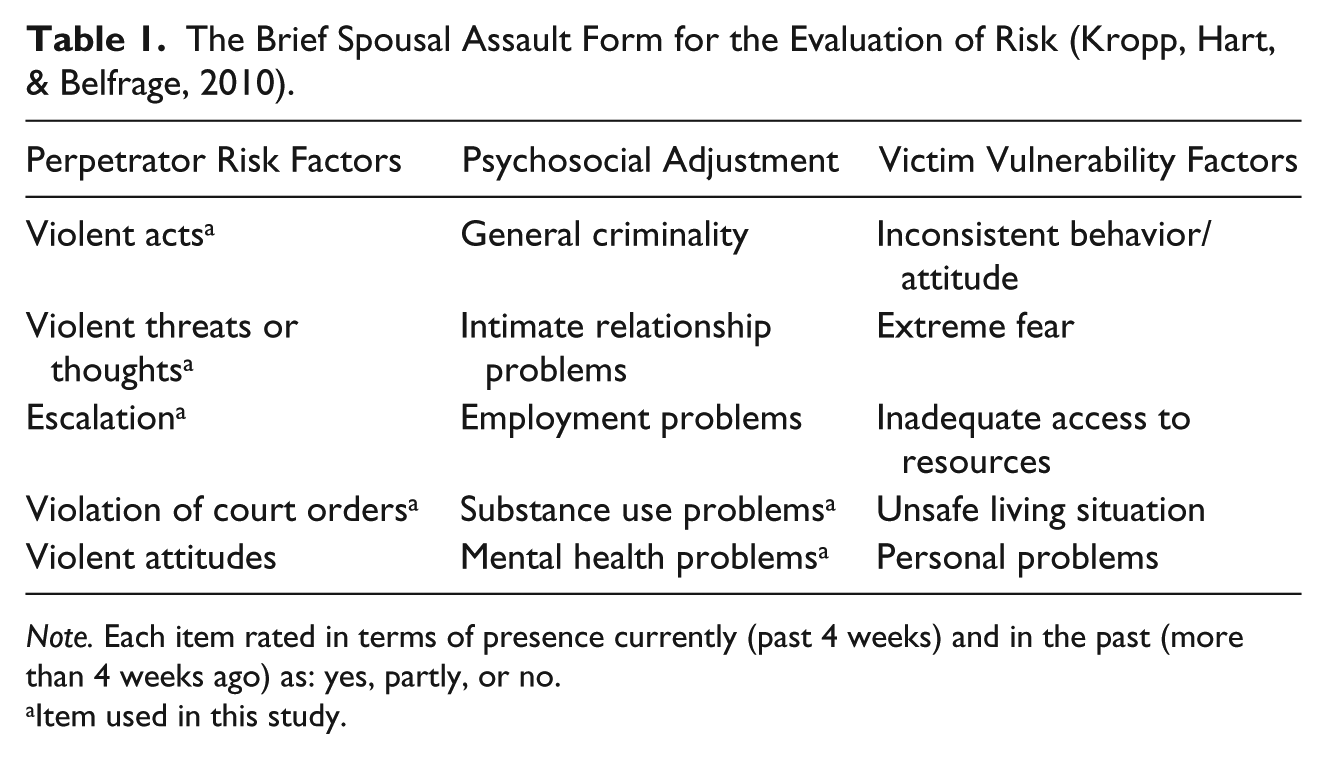
Note. Each item rated in terms of presence currently (past 4 weeks) and in the past (more than 4 weeks ago) as: yes, partly, or no.
Item used in this study.
Studies on the B-SAFER have suggested that it is useful in identifying partnerships at high risk of intimate partner violence (Belfrage & Strand, 2008; Belfrage et al., 2011; Storey et al., 2014) and differentiate between various categories of perpetrators (Serie et al., 2015; Thijssen & de Ruiter, 2011). There is sparse published research available on validity and reliability of the B-SAFER but the evidence which is available shows promising results regarding predictive, construct, and concurrent validity (Au et al., 2008); interrater reliability (Serie et al., 2015; Thijssen & de Ruiter, 2011); and feasibility for police officers in decisions on management and recidivism predictions in intimate partner violence cases (Belfrage & Strand, 2012; Storey et al., 2014). A Swedish study (Belfrage & Strand, 2008) indicated a relationship between the number of risk factors identified by the police officers and the level of risk they estimated, and that the level of risk was associated with implementation of violence prevention measures.
Although the full 15-item version of the B-SAFER appears to be emerging as a robust tool for intimate partner violence risk assessment, it has practical limitations when applied in emergency situations such as those faced by police officers called to a domestic disturbance. In this context, when studying the relationship between risk factors and police decisions, it is useful to identify those items from the overall B-SAFER pool with the most credibility among police officers and use them as a shortened assessment.
The aim of this study, therefore, was to explore the associations between a restricted number of on-site risk items and the choice of immediate protective actions made by police in cases of intimate partner violence, that is, arrest of male perpetrators and/or relocation of a female victim (defined as putting the victim in contact with community services, for example, a woman’s shelter).
Ethics
The study was approved by the Office of the Public Prosecutor for Norway and the Norwegian Social Science Data services (Project Number: 27189).
Method
Setting and Sample
The study was conducted in Stovner police district, a part of Oslo Police County in Norway, as part of a project initiated by the Norwegian National Police Directorate. The district has a population of around 134,000 inhabitants with a high proportion of people born outside of Norway (about 50%).
Data were extracted from reports on 124 emergency visits by police to domestic premises in response to intimate partner violence perpetrated by men toward women. These data corresponded to all cases of intimate partner violence registered at Stovner police station over a 12 months’ period. As expected from the high prevalence of people born outside of Norway in the district, the sample consisted of a high proportion of immigrants (Table 2).
Continent and Country of Origin Norway and Other, Perpetrator and Victim.

Measures and Procedure
A Norwegian translation of the original Swedish version of the B-SAFER was used (Kropp, Hart, & Belfrage, 2011) as the basis for the main measure. Following initial consultation with police service representatives, six items were selected from the overall set of 15 on the basis of their utility in emergency situations for use in the study. These six items were perpetrator violent acts, violent threats or thoughts, escalation of violence, substance use problems, mental health problems, and breach of no-contact order. Each item was rated with regard to the current situation (i.e., the past 4 weeks) and the past (more than 4 weeks prior), and was dichotomized into present (yes/partly) or absent. Ratings were based on a brief interview with the perpetrator and victim and other sources such as police files. In addition, the police noted whether children were present or not and whether the victim was influenced by substances. Partly based on this information, the officers made a decision on perpetrator arrest and/or victim relocation.
Independent and Dependent Variables
The six dichotomized B-SAFER items at the two time points (currently and in the past) were used as independent variables (IVs). In addition, the perpetrator’s age and birthplace (in Norway or not) were used as IVs plus the presence/absence of children on the premises and whether or not the victim was influenced by substances. Arrest of the alleged perpetrator (or not) and relocation of the victim (or not) were used as dependent variables (DVs).
Statistical Procedures
Descriptive statistics on all IVs and DVs from the 124 cases are presented in Table 3. The percentage of perpetrators arrested and victims relocated was calculated for the B-SAFER IVs and the presence of children on-site (Figures 1 and 2). The B-SAFER item “breach of no-contact order” was omitted from this calculation and the logistic regression described below due to the low number of positive responses.
Description of Variables.

Note. N = 124. B-SAFER = Brief Spousal Assault Form for the Evaluation of Risk.
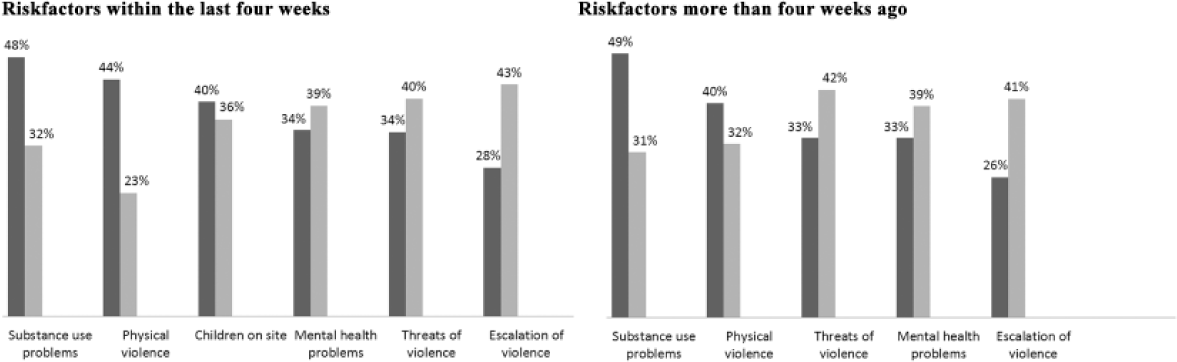
Perpetrators arrested on-site.
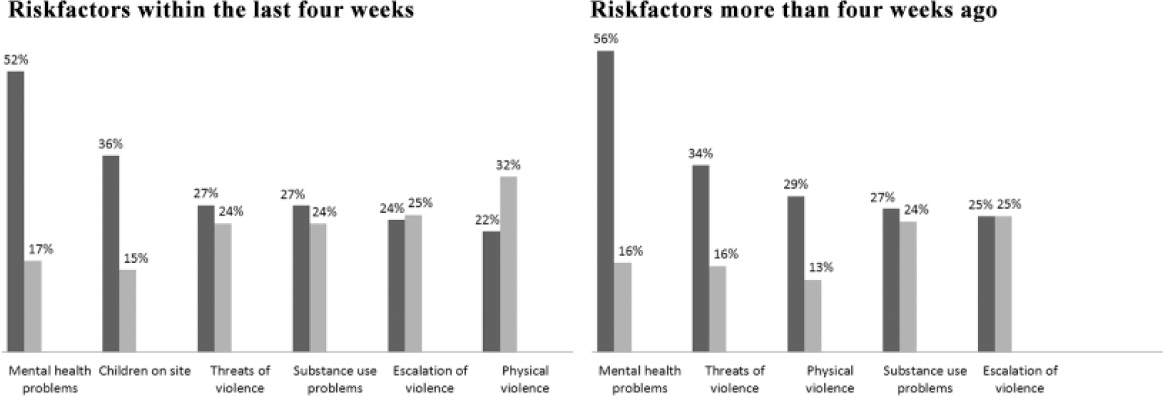
Victim relocation.
We also performed logistic regression analyses to assess the association between the IVs (the five remaining B-SAFER items assessed on-site in addition to perpetrator’s age, perpetrator birthplace, child presence, and victim substance use) and the two DVs (perpetrator arrest and/or victim relocation). We first analyzed each IV’s association with the two DVs separately for both time periods (“unadjusted” columns in Tables 4 and 5). Next, we entered all IVs into a fully adjusted model (“adjusted” columns in Tables 4 and 5), separating between current and past B-SAFER items. Precision was estimated within 95% confidence intervals (CIs). All analyses were performed with the Statistical Package for the Social Sciences (SPSS Version 21) and Microsoft Excel.
Logistic Regression of Arrest of Alleged Perpetrator According to B-SAFER Items, Age, Nationality, Presence of Children, and Victim Influenced by Substances.

Note. N = 124 cases of police emergency visits. In 47 cases, the perpetrator was arrested. OR = odds ratio; CI = confidence interval.
Separate analyses for each independent variable.
All variables in column included in the model.
Logistic Regression of Relocation of Victim According to B-SAFER Items, Age, Nationality, Presence of Children, and Victim Influenced by Substances.

Note. 124 cases of police emergency visits. In 31 cases, the victim was relocated. OR = odds ratio; CI = confidence interval.
Separate analyses for each independent variable.
All variables in column included in the model.
Results
Descriptive Statistics
The alleged perpetrators’ ages ranged between 19 and 76 years. A large proportion of the perpetrators were born outside Norway with birthplaces in 33 different countries (see Tables 2 and 3).
A total of 47 (38%) of the perpetrators were immediately arrested with no victim relocation, and in 31 cases (25%), the victim was relocated with no perpetrator arrest. In another 11 (9%) cases, the victim was relocated and the perpetrator was taken into custody as well. In the remaining 35 cases (28%), there was no arrest or relocation. The likelihood of perpetrator arrest was highest if he had an ongoing substance misuse or had been physically violent, and the lowest in situations where the police identified an escalation of violence. The presence/absence of each B-SAFER item was similar for ratings of both the current and past situation (see Figure 1).
The likelihood of victim relocation was highest if the perpetrator was considered to have a mental health problem and lowest in situations involving a physical violent act. The presence/absence of each B-SAFER item was again similar for ratings of both the current and past situation apart from physical violence. The victim was most likely to be relocated if the perpetrator had a mental health problem in the past as indicated by the B-SAFER historical information and least likely to be relocated if there had been an escalation of violence in the past (see Figure 2).
Results From the Logistic Regression Analyses
The trends presented in Figures 1 and 2 were largely confirmed by the results of the logistic regression analysis (Tables 4 and 5). The fully adjusted odds of perpetrator arrest were 2.8 (95% CI = [1.0- 7.7]) times higher when present physical violence was present compared with when it was absent. Also, a current perpetrator substance use problem was associated with a twofold increased odds of arrest (odds ratio [OR] = 2.1, 95% CI = [0.9- 5.1]) as compared with an absence of such a problem. Perpetrator age and birthplace were only marginally associated with arrest. On the contrary, escalation of violence was associated with a 60% reduced odds (fully adjusted) of arrest (OR = 0.4, 95% CI = [0.1- 0.9]) as compared with no such escalation. The B-SAFER assessments of past factors were in line with these ORs for the present situation.
With regard to relocation, perpetrator’s current mental health problems were associated with a fully adjusted OR of 7.4 (95% CI = [2.4- 23.1]) with victim relocation compared with absence of such problems. Also, the presence of children on-site was associated with an increased fully adjusted odds of victim relocation (OR = 2.7, 95% CI = [0.9- 7.6]). Perpetrator age and birthplace were not associated with relocation of the victim. Again, on the contrary, current escalation of violence was associated with a 60% reduced odds of victim relocation in the fully adjusted analyses (OR = 0.4, 95% CI = [0.1- 1.3]) as compared with absence of such escalation. The results from the past situation were in line with these results from the present situation, with the exception of a tendency toward higher odds of relocation following historical presence of violent acts.
Discussion
Main Findings
This article reports on the immediate actions of police (arrest and/or relocation) directed toward male perpetrators and female victims of intimate partner violence. We found increased odds of perpetrator arrest following physical violent acts and substance use problems. Surprisingly, escalation of violence, however, was associated with reduced odds of being arrested. The presence of perpetrator mental health problems and children on-site was associated with victim relocation.
Strengths and Limitations
The study enabled police to systematically gather information about emergency situations using components from a standardized instrument in “real time” and thus has high ecological validity. It also has very valuable applications for understanding and ultimately improving the management of what can be a life or death situation. However, while it included all reported incidents over a set time period, the sample could be seen as relatively small and hence the precision of the results was low although we believe that presenting results that are close to no association will be of clinical relevance.
Also, there will be reporting and measurement issues because the data file did not provide any information on the availability of historical information in the relevant police files. Knowledge of previous arrests, charges, sentences, and breaches will have influenced the officers’ expectations before arriving on the scene and subsequent decisions on arrest and/or relocation. The study sample was highly diverse in terms of country of origin and this reflected the diversity of the population from which it was drawn. Perpetrators were also drawn from across the adult age range up but, in contrast, were restricted to male gender by the study inclusion criteria and involved only in heterosexual relationships.
The focus on male perpetrators and female victims prevents us from drawing conclusions about the full complexity of the intimate partner violence problem because the overall phenomenon encompasses female violence to male partners as well.
Interpretation of results in the context of previous literature
Police are usually the first responders to reports of intimate partner violence. The complexity of intimate partner violent cases is a real challenge to the officers when assessing violence risk and considering preventive actions (Aas, 2014; Barrett et al., 2011). In this study, there was a strong association between the perpetrator being physically violent toward their partner and subsequent police arrest, supporting recent research with other Norwegian police officers which indicates that they mainly are more preoccupied with physical violence and less with psychological aggression like hostility and verbal abuse when facing intimate partner violence (Aas, 2014). A reason for this may be that the police understand the case at hand from a criminal justice point of view and that physical violence is a more clearly criminal act. It is also obviously more imminently dangerous. The focus specifically on physical violence is also reflected in earlier studies on intimate partner violence (Garner et al., 1995; Sherman et al., 1992; Tauchen & Witte, 1995). As the police in our study used only a limited part of the B-SAFER to assist their personal observations on-site, one may speculate that they arrested the perpetrator to secure the safety of the victim while they made a full risk assessment and a management plan to prevent further violence. The police on-site made a preliminary risk assessment, then wrote a report which was used by other officers who made the full judgment (B-SAFER) after the perpetrator and victim had been interrogated. The management plan was part of the police’s preventive work and did not interfere with the criminal case/prosecution trial.
If the police had knowledge about the perpetrator’s current or past substance use problem, there was an increased likelihood of immediate arrest. This indicates an awareness among them of the association between substance use and intimate partner violence as evidenced in previous research (Capaldi et al., 2012) and what has been found in Sweden in a similar study (Belfrage & Strand, 2012).
The B-SAFER item “Mental health problems” includes an assessment of the perpetrator’s apparent emotional problems (i.e., anxiety, depression, and extreme anger), disturbances of thought and perceptions (i.e., delusions), intellectual or cognitive deficits, and disorganized behavior like suicidality, impulsivity, or extreme jealousy Kropp et al., 2011). In this study where the perpetrator had either a known history of mental health problems or the police on-site suspected him to have such problems, the victim was likely to be relocated (e.g., to a women’s shelter). Follow-up of an initial police assessment of the perpetrator’s mental status by a psychiatrist or a psychologist has been recommended (Nicholls et al., 2013) and victim relocation should be considered while this assessment is conducted.
The most interesting and troublesome finding here is that escalation of violence within the last 4 weeks was associated with a reduced likelihood of perpetrator arrest and/or relocation of the victim. It seems as though the police did not consider escalation of violence as a key factor when deciding about arrest and/or relocation, and in fact, were less likely to relocate the victim when faced with an escalating situation. Similar, rather counter-intuitive, findings have been reported in previous research on police responses to domestic violence (Barrett et al., 2011; Kane, 2000).
The lack of police action on the perceived escalation of violence could be explained by the high number of immigrants represented in our study (80%) and the police’s interpretation of the situation in these particular cases. Being an immigrant is regarded a vulnerability factor for intimate partner violence (Capaldi et al., 2012), and it has been reported that lack of police action could be because police officers perceived recurrent episodes of intimate partner violence as “normal” for victims and perpetrators who belong to minority groups (Barrett et al., 2011; Buzawa & Buzawa, 2003).
At the same time, some studies have reported that female victims are more likely to seek help from the police or contact health care providers in an escalating situation and thus are those in greatest danger of serious violence (Barrett et al., 2011; Ramsay et al., 2009; Vatnar & Bjørkly, 2013). Also, when fatal consequences of intimate partner violence occur, they are likely to be the culmination of assaults over a long term. This is an important factor to consider and take precautions against especially because research on partner homicide highlights that repeated violence against the victim is a risk factor for later homicide and escalation of violence is a warning sign (Campbell et al., 2007; Dobash et al., 2009). Given this, the apparent lack of immediate action by the police in these situations is worrying. Further research should examine the possible explanations for why escalation was not acted upon. This could be done by replicating this study with a larger sample size and in addition interview police officers about their responses to intimate partner violence. It would be useful to learn more about which risk factors in cases of intimate partner violence the police officers find most important to consider, and which risk factors that are possible to act upon. It should be noted that police officers’ ability to relocate the victim only is an option if the victim accepts this offer. It is possible that victims in cases of escalation of violence do not wish to be relocated. It should be further investigated to what extent this is the case. If this would be a common finding, it should be considered if there are other options to protect women who either are not willing or able to be relocated.
Conclusion
How police officers interpret the situation when called to an intimate partner violent incident scene is decisive for the kind of action that is taken. In this study, the decisions by police officers to either arrest the perpetrator, relocate the victim, or do both were influenced by their awareness of the perpetrator being physically violent toward the partner, whether children were present at the scene and whether the perpetrator had ongoing problems of substance misuse or mental instability.
Conversely, their awareness of any escalation of violence recently or in the past resulted in neither perpetrator arrest nor victim relocation. On the contrary, such escalation of violence resulted in a reduced propensity to take any immediate action of this type.
Escalation of violence is clearly a warning sign for possible lethal violence, so systematic risk assessment of this phenomenon, in particular on-site, is highly relevant to decisions about necessary precautions. Arresting the alleged perpetrator and/or moving the victim to a safe location may represent a rational first step to stop further violence from occurring and provide the police with time to get a fuller overview of the severity of the situation. The apparent lack of police immediate action after assessing the situation as escalating found here though is alarming and should be addressed with both further research as well as reflections on how these women could be protected in other ways.
Footnotes
Declaration of Conflicting Interests
The author(s) declared no potential conflicts of interest with respect to the research, authorship, and/or publication of this article.
Funding
The author(s) disclosed receipt of the following financial support for the research, authorship, and/or publication of this article: The study was funded by the Norwegian Health Directorate, the Norwegian Police University College, and St. Olav’s University Hospital, Forensic Department and Research Centre Brøset.