



Abstract
Despite the importance of studying sexual assaults perpetrated by women, the field knows very little about female sexual offenders’ (FSOs) use of violence or physical injury resulting from these assaults. This study draws more than 20 years of National Incident-Based Reporting System (NIBRS) data reported to police (1992-2014) to identify factors that distinguish between female perpetrated incidents of sexual assault that result in severe, minor, or no physical victim injuries above and beyond the sexual assault itself. Using a multinomial logistic regression model (MNLM), 15,928 incidents of FSO-perpetrated sexual assault were analyzed from the NIBRS. The results showed that the extent of victim injuries sustained during the sexual assault incidents was associated with a number of factors, including the presence of a female victim, the age of victim, a greater number of offenders, and the presence of weapons. In particular, incidents that resulted in major victim injuries were significantly associated with alcohol and drug use by the perpetrator. In general, incidents with young children were at increased risk of a sexual assault resulting in a major or minor victim injury. Although further investigation is needed to continue to better understand female sexual offending behaviors, these findings suggest that certain incident characteristics increase the likelihood of the assault to involve the use of violence by an FSO against her victims.
Introduction
Female perpetrators of sexual abuse are often minimized or overlooked in the broader policy and scholarly discourse surrounding sexual assault (Cortoni, 2010; Cortoni & Gannon, 2013). This is driven, in part, by cultural resistance to the notion that women sexually offend, the perception that “women don’t do such things” (Denov, 2001, 2003, 2004; Wijkman, Bijleveld, & Hendriks, 2010, p. 135). Although research does show women sexually offend less often than men, their prevalence is far from trivial. In the most recent meta-analysis, which drew on data from across 12 countries, the proportion of sexual offenders who were female ranged from approximately 2% in official records to 12% in victimization surveys (Cortoni, Babchishin, & Rat, 2016). The continued persistence of denying that women sexually victimize others contributes to endemic problems, such as neither believing victims nor socially recognizing the resulting trauma of victimization, such as substance abuse problems, self-injury or suicidal ideation, and difficulty in romantic relationships (Boroughs, 2004; Deering & Mellor, 2011; Denov, 2001, 2003, 2004; Hetherton, 1999; Tsopelas, Tsetsou, Ntounas, & Douzenis, 2012). Given the prevalence of female sexual offending and resulting victim harm, the field has seen consistent calls for more research on this specific group of offenders (see, for example, Cortoni et al., 2016; Denov, 2003, 2004; Gannon & Cortoni, 2010).
Moreover, the belief persists that if women do commit sexual assault, these assaults lack characteristics that are associated with more “serious” features of sexual offending, such as aggression, the use of force, and/or physical injury (Anderson & Savage, 2005; Anderson & Struckman-Johnson, 1998; Denov, 2001, 2003, 2004; Knoll, 2010). This mischaracterization hampers policy makers from crafting legislation, resourcing agencies, and otherwise responding appropriately to this public health concern. Likewise, they inhibit scholars in the development of gender-informed theories of female sexual offending (Cortoni, 2010). By better understanding sexually violent behavior committed by women, especially sexual offending that further exacerbates victim trauma during an assault, we can help tailor social and criminal justice responses to this group.
Thus far, prior research has primarily been descriptive in nature about the types of violence (e.g., injury or force) that women use during sexual assaults; also, prior research has not investigated correlates of this violence. According to available evidence, although not all sexual assaults committed by women result in such violence being used against victims (see, for example, Moulden, Firestone, & Wexler, 2007; Nathan & Ward, 2002), a substantial minority of these assaults do have such acts of violence (Atkinson, 2000; Budd, Bierie, & Williams, 2015; Ferguson & Meehan, 2005; Kaufman, Wallace, Johnson, & Reeder, 1995; Wijkman et al., 2010; Wijkman, Bijleveld, & Hendriks, 2011; Williams & Bierie, 2015). Although discrepancies are likely tied to data sources (e.g., clinical vs. criminal justice) and measurement issues (e.g., how violence is defined), the literature as a whole indicates that sexual offending by females represents a pressing social concern, and that the use of force against victims is an important aspect that should be studied to further knowledge on the sex offending behavior of women.
Force Used by Female Sexual Offenders (FSOs)
According to Denov (2001, 2003, 2004), there has been a lack of acceptance that women can commit violent sexual offenses due to traditional sexual scripts that are ascribed to women and their sexual behavior. When interviewing police officers and psychiatrics, Denov (2001) found that violence used by female perpetrators during a sexual assault was constructed as “non-violent” using three techniques: constructing female perpetrators as harmless (e.g., male victims were “taught” a sexual education by the female perpetrator), constructing the female perpetrator as not dangerous (e.g., through comical depictions of women who sexually assault), and by blaming the victim. According to one police report summarized by Denov (2001), a 16-year-old boy who delivered groceries to a 41-year-old female suspect was sexually assaulted: Despite the victim’s protests, the female suspect removes the victim’s clothing, and touches his penis. At some point, the victim touches the suspect’s cat, which makes the suspect very angry. The suspect reacts by grabbing a nearby knife and threatens to castrate the victim. She puts the knife on his penis . . . A short time later, the victim manages to take hold of the knife and throw it out of reach. The suspect gets very angry and grabs the victim by the neck and attempts to strangle him, causing bruising on his neck. (p. 319)
Although the sexual assault was a very traumatic and fearful experience for the victim, which involved a weapon and resulted in physical injury, the experience was transformed by professionals and the male victim became a “willing and consenting partner in the sexual ‘encounter’” (Denov, 2001, p. 320). Regardless of the violence used by the female perpetrator, the violence seemed to be forgotten and the victim to blame.
Qualitative work, such as Denov’s (2001), illustrates the violent nature of sexual offenses that are committed by some women. Quantitative work on female sexual offending has also provided evidence in this regard. Prior research has typically studied violence perpetrated by FSOs using three indicators: (a) the use of physical or verbal violence, (b) weapon use, and (c) victim injuries. For example, Wijkman and colleagues (2010) examined all FSOs (N = 111) that were known to criminal justice authorities in the Netherlands between 1994 and 2005. They found 25% of the female perpetrators used (severe) physical and/or verbal violence during the commission of their sexual offense. Given that the types of violence were reported together, unknown is the percentage of women who used physical violence (e.g., hitting, strangling) versus those who used verbal violence. When Wijkman and colleagues (2011) investigated registered FSOs in the Netherlands (1994-2005; N = 135), physical violence (18%, n = 24) and verbal violence (24%, n = 32) were used by these women during the commission of their sexual offense. Neither study detailed injuries that resulted from this use of violence.
Looking at the United States, research using the National Incident-Based Reporting System (NIBRS) found approximately 5% of sexual assault incidents reported to police (n = 43,018) were committed by females (Williams & Bierie, 2015). The majority of these sexual assaults were forcible in nature, defined as the use or threat of violence during the commission of a sexual assault (FBI, 2012b). In total, 88% of the sex crimes committed by females in these incidents were classified as forcible sexual assaults by police (Williams & Bierie, 2015). 1 Whereas approximately 79% of the incidents resulted in no injury, about 8% resulted in minor victim injury (e.g., lacerations) and 2% resulted in major victim injuries (e.g., major lacerations, unconsciousness, internal bleeding, or broken bones). Additional research that used the NIBRS found similar patterns when investigating females who offended alone versus in other groupings (e.g., coed offending, all female groups), although injury and weapon use were significantly more likely to be used when women offended with men (Budd et al., 2015). Because of the structure of their data though, one cannot tell whether it was the female perpetrator or male perpetrator who used the weapon or caused the victim’s injury (Budd et al., 2015).
In perhaps the most detailed quantitative study to date on this aspect of female sexual offending, Ferguson and Meehan (2005) deployed a cluster analysis to group FSOs in terms of their behavior or characteristics associated with their sexual assault. First, they found that their sample of female perpetrators were particularly violent. Of the 279 convicted FSOs they analyzed in Florida, 93% used threat of force or some type of physical force against their victims. Furthermore, a sizable proportion of these resulted in injury: simple assault (64%), aggravated assault (4.4%), mutilation/disfigurement (17%), or death (about 1%). Based on their cluster analysis, differences in use of force were most apparent when comparing the ages of the female perpetrator. Compared with younger FSOs, older females typically used the highest level of force (i.e., aggravated assault) against their victims, although those who killed their victims ended up in a separate cluster with younger perpetrators. Finally, their analyses showed criminal history, measured by number of convictions, appeared to be more important in predicting the use of force used against a victim versus perpetrator age (Ferguson & Meehan, 2005).
These studies each provide useful information on the prevalence and nature of the violence used by females during the commission of their sexual assault; however, they do not focus explicitly on the factors that contribute to the use of violence against victims. That is, they do not tell us which features of offenders, victims, or crime characteristics correspond to less or more violence used against victims by women who commit these crimes. The notable exception is work by Ferguson and Meehan (2005), which indicates perpetrator age and criminal history are indicators of the level of violence used against victims. Overall, explicit analyses of this nature are mostly absent from the field, especially analyses that focus on resulting victim injury. Nevertheless, there is a category of scholarship that offers some insight into this question of distinguishing between sexual assaults in terms of female’s use of violence: sex offender typologies.
Female Sex Offender Typologies and Violence
FSO typology research attempts to group subtypes of FSOs together based on certain shared characteristics, such as solo versus co-offending, the age of the victim, offending motivation, and the FSOs abuse history (e.g., history of substance abuse or having a history themselves of being a victim of physical, emotional, and/or sexual abuse). Ultimately, the goal of grouping FSOs is to identify distinct offending etiology and/or differences with respect to sexual offending behavior. To date, a number of typologies have emerged, which include or distinguish FSOs based on their propensity for violence. This includes, for example, Vandiver and Kercher’s (2004) categories of “female sexual predator” and the “aggressive homosexual offender.” Likewise, it includes categories such as “angry-impulsive” proposed by Syed and Williams (1996) and the “forced assault” type as described by Sarrel and Masters (1982). However, two typologies are especially prominent in discourse on FSO use of violence.
Mathews, Matthews, and Speltz (1989), even with its small clinical sample size (N = 16), is one of the most discussed typologies due to the richness of their data. By clustering FSOs together qualitatively, they identified three subtypes of FSOs: teacher-lover, intergenerational predisposed type, and the male-coerced type. The intergenerational predisposed type was linked to using physical assault during sexual assaults. According to Mathews and colleagues (1989), the intergenerational predisposed FSO had been a victim of sexual abuse in childhood and throughout her life. Sexual abuse often spanned multiple generations. These FSOs independently initiated sexual abuse with their victims, often using physical violence. They hypothesized that this might be due to anger that triggers sadistic fantasies against the victim (Mathews et al., 1989). Hence, their sexual offenses tended to be violent in nature.
Wijkman and colleagues (2010) created a typology that speaks specifically about FSO’s use of violence. They investigated characteristics of FSOs using a sample of adult FSOs from the Netherlands and found that a quarter of their sample used some type of “(severe) physical and/or verbal violence” during the perpetration of the sexual assault (Wijkman et al., 2010, p. 145). Their analysis generated four prototypes of FSOs, but the “young assaulters” are particularly relevant here. They found that the young assaulters were prone to use physical violence against their victims. Important to note is that these violent FSOs did not offend with a male. Rather, motivation and active use of violence was characteristic of the female offenders themselves and/or the situations in which their crimes emerged.
The Current Study
Prior research has offered important insights into violence used by FSOs. However, significant limitations persist. Few studies focus on deconstructing FSOs use of violence. Instead, violence is discussed only as it emerges from analyses focusing on other aspects of FSO-perpetrated sexual assault (e.g., snapshots of offense characteristics, solo vs. coed offending, typology building). Second, prior studies tend to have small sample sizes. One of the largest studies to date on this specific aspect of FSO offending behavior had a sample size of roughly 280 participants (Ferguson & Meehan, 2005). Most have far smaller samples. Although informative, small samples sizes can result in reduced variance, power, and stability in estimates. For these reasons, they can miss important patterns in the data. Third, much of the prior empirical work is somewhat dated. To the degree that offending, victim behavior, or the justice system itself may change over time, more contemporary data become increasingly valuable.
Finally, on this particular aspect of FSO offending, FSO samples have been primarily selected from medical/treatment settings or the back end of the justice system (e.g., prison-based samples, registrants). Research that analyzes behavioral patterns of FSOs who have been convicted of sexual assault may overestimate FSO violence because the violence itself likely correlates with whether an offender is arrested, prosecuted, convicted, and sentenced to prison. Likewise, models of incident outcomes (e.g., use of violence) may see coefficients biased downward due to reduced variation in sample characteristics and selection on the dependent variable. Currently, there is no study that assesses FSO violence against victims that uses cases identified by the criminal justice system but prior to adjudication.
The current study attempts to address these limitations by investigating victim injuries sustained during FSO-perpetrated sexual assault incidents that are then reported to the police. We do so by assessing whether the sexual assault incident resulted in a major injury to the victim, a minor injury to the victim, or no injury to the victim. By focusing on victim injuries in incidents as a measure of the use of violence by FSOs, we address the following research question:
Method
This research used 23 years of NIBRS data that spanned from the beginning of 1992 through the end of 2014 to understand patterns of victim injury, or the use of violence, by FSOs in sexual assault incidents that are reported to the police. The NIBRS, managed by the FBI, collects incident-level crime data in the United States. As of 2012, approximately 33% of police agencies submitted crime data to the NIBRS (FBI, 2012a). These data capture incident-level sexual assault characteristics that include demographic information of the sexual offender, types of force used during the incident (here, weapons), type of victim injury sustained during the incident, and other victim characteristics, such as age, sex, and the relationship to the offender. Because this data source relies on reports to the police, it is important to note here that sexual assaults, particularly those perpetrated by women, are underreported (Becker, Hall, & Stinson, 2001; Bunting, 2007; Center for Sex Offender Management, 2007 Cortoni et al., 2016; Denov, 2003, 2004; Vandiver & Kercher, 2004).
Incidents where the offender’s sex was unknown were dropped from the analysis. All incidents that had a male sex offender (MSO) present were dropped (i.e., co-offending males and females). The rationale for this strategy was linked to the structure of the NIBRS data. If a male and female offender were both present in the incident, there was no way to identify which offender (i.e., the male or the female) used violence that caused the victim injury. Therefore, for clarity, only incidents were analyzed that had female perpetrators. In addition, as our goal in this study is to isolate and model female sexual offending behavior, it was important to exclude these coed incidents. Finally, because juvenile and adult FSOs are heterogeneous and unique offending populations (Frey, 2010), this research only analyzed incidents with adult FSOs aged 18 years or older. Juvenile FSOs were excluded from the analysis. 2
Pertaining to types of sexual assaults, the NIBRS collects incident-level data on six sexual offenses: forcible rape, forcible sodomy, forcible sexual assault with an object, forcible fondling, nonforcible incest, and nonforcible statutory rape. Because this research is focused on violence used by adult FSOs, we excluded nonforcible sex crimes from the analysis. After defining the scope of the research using the above criteria, there were 23,022 incidents of FSO-perpetrated sexual assault.
Dependent Variable
Given that the percentage of victims who sustain an injury as a result of a rape or sexual assault has been increasing since 1994 and that approximately 60% of female victims reported injury between 2005 and 2010 (Planty, Langton, Krebs, Berzofsky, Smiley-McDonald, 2013), we used the outcome measure of injury to the victim as a proxy measure for FSO violence in an incident of sexual assault. The NIBRS classifies injury into seven categories: minor injury, broken bones, major injury, internal injury, loss of teeth, severe laceration, and unconsciousness. 3 We created a categorical variable to capture this incident characteristic: no injury to the victim (approximately 89% of incidents), minor injury to the victim (approximately 9% of incidents), and major injury to the victim (approximately 2% of incidents). The minor injury measure was used directly from the NIBRS codes. Because of low frequencies in some cells, major injury was created by collapsing major injury, broken bones, internal injury, loss of teeth, severe laceration, and unconsciousness into one measure.
Independent Variables
The following independent variables were included in the models based on prior empirical work that also investigated sexual offending by and sexual offending behavior of adult females (see, for example, Budd et al., 2015; Ferguson & Meehan, 2005; Vandiver, 2006; Wijkman et al., 2010; Wijkman et al., 2011; Williams & Bierie, 2015). Note that all analyses were conducted at the incident-level. Because we analyzed data at the incident-level, individual-level attributes were averaged for incidents that had more than one person in a given category of variable. For example, if there was more than one offender, then offender-level variables were averaged to generate an incident-level representation. In these data, approximately 92% of the incidents had one FSO, 7% had two FSOs, and less than 1% had three or more FSOs.
Offender characteristics
Four measures were used to capture offender characteristics: the number of FSOs in the incident (a continuous measure), if the FSO was under the influence of drugs or alcohol, offender age (continuous), and offender race. Three binary variables captured substance use: alcohol use (0/1), drug use (0/1), and no use (0/1; omitted comparison category) in the incident. Race was a series of mutually exclusive binary variables (0/1): White/Hispanic (omitted category), Black, and Other. The underlying structure of the NIBRS race code assigns White and Hispanic to the same category; therefore, one cannot disentangle these measures. We also included a variable that captured incidents where there was more than one offender and the offenders were different races (0/1).
Victim characteristics
Six measures were used to capture victim characteristics: the number of sexual assault victims in the incident (continuous measure), gender, if both male and female victims were present, the age of the victim, race, and the relationship between the victim and the offender. Victim gender (female) and if both a male and female victim were present in the incident were binary measures (0/1). Victim age was conceptualized to correspond to risk of injury either due to frailty of victims or a presumed situation, which led to the assault. Victim age categories included infant/toddler (0-5 years), elementary aged (6-12 years old), teenager (13-17 years), and adult (18 and above; omitted comparison category). Victim race was measured as a series of mutually exclusive binary variables (0/1): White (omitted category), Black, Other, and Hispanic. Due to low cell size, we could not include the measure that captured whether more than one victim of different races was present in the incident. We included the relationship of the victim and offender. These categories were created using the more than 20 victim–offender relationship categories in the NIBRS. To capture the complexities in sexual assault incidents, we left certain victim–offender relationship categories as detailed as possible when the data allowed: child (e.g., child, stepchild, grandchild), sibling (sibling or stepsibling), significant other (e.g., boyfriend/girlfriend, spouse, ex-spouse), homosexual relationship, other intrafamilial (e.g., parent, stepparent, grandparent), acquaintance, extrafamilial (e.g., neighbor, employer; omitted category), and stranger.
Crime characteristics
Three measures were used to capture crime characteristics: weapon use in the incident, the location of the sexual assault incident, and the type of sexual assault committed in the incident (described above). Although the NIBRS tracks a multitude of weapons used in sexual assault incidents, we collapsed weapons into a categorical measure given the rarity of use of some of the weapons: personal weapons, physical weapons, and no weapon. Approximately 55% of the incidents involved the use of personal weapons (i.e., hands, feet, teeth; omitted category), about 5% involved physical weapons (e.g., blunt objects, knives, guns), and roughly 40% of the incidents involved no weapon. We included “no weapon” in the model because of (a) the likelihood of weapons to produce a victim injury and (b) to see whether sexual assault incidents that were absent a weapon were associated with victim injury. The NIBRS tracks more than 50 location categories. Due to the rarity of sexual assault incidents in many of the locations, we created five umbrella categories: home 4 (omitted category), school (college/university and K-12 school), other indoors (e.g., day care, hotels, malls), outdoors (e.g., woods, roads, rest areas, camps), and service locations (e.g., churches, community centers, shelters, hospitals). A measure was also included to capture whether the location moved from one location to another (0/1).
Analytic Strategy
To begin exploring the data, bivariate comparisons were estimated to assess the relationship between the minor and major victim injury and offender, victim, and crime incident characteristics (see Table 1 for descriptive statistics and bivariate comparisons, N = 23,022). The research question was then addressed using the multinomial logistic regression model (MNLM). 5 Given the data are unordered categorical data, the MNLM is ideal given that it simultaneously fits separate models for each pair of outcome categories in relation to a reference category, and the use of this model also avoids potential bias if there are concerns about the ordinality of the model (Long & Freese, 2006). Here, the model compared the probability of membership in each outcome category in the incident (major or minor injury) with the probability of membership in the reference, or base, category (no injury). Because MNLM regression models produce log-odds that lack substantive meaning (Pampel, 2000), log-odds were transformed into odds ratios to detect effect size. Odds ratios, an effect size measure for categorical models (Fleiss, 1994), were interpreted as follows: For each additional unit change in xk (p ≤ .05), the odds of m versus n are expected to change by a factor of exp(βk,m | n), holding all other variables constant. After listwise deletion of missing data, the MNLM analyzed 15,928 incidents of sexual assault committed by adult FSOs.
Descriptive Statistics and Bivariate Comparisons of FSO Sexual Assault Incidents Resulting in a Victim Injury, N = 23,022 (Reference Category: No Injury Incidents).
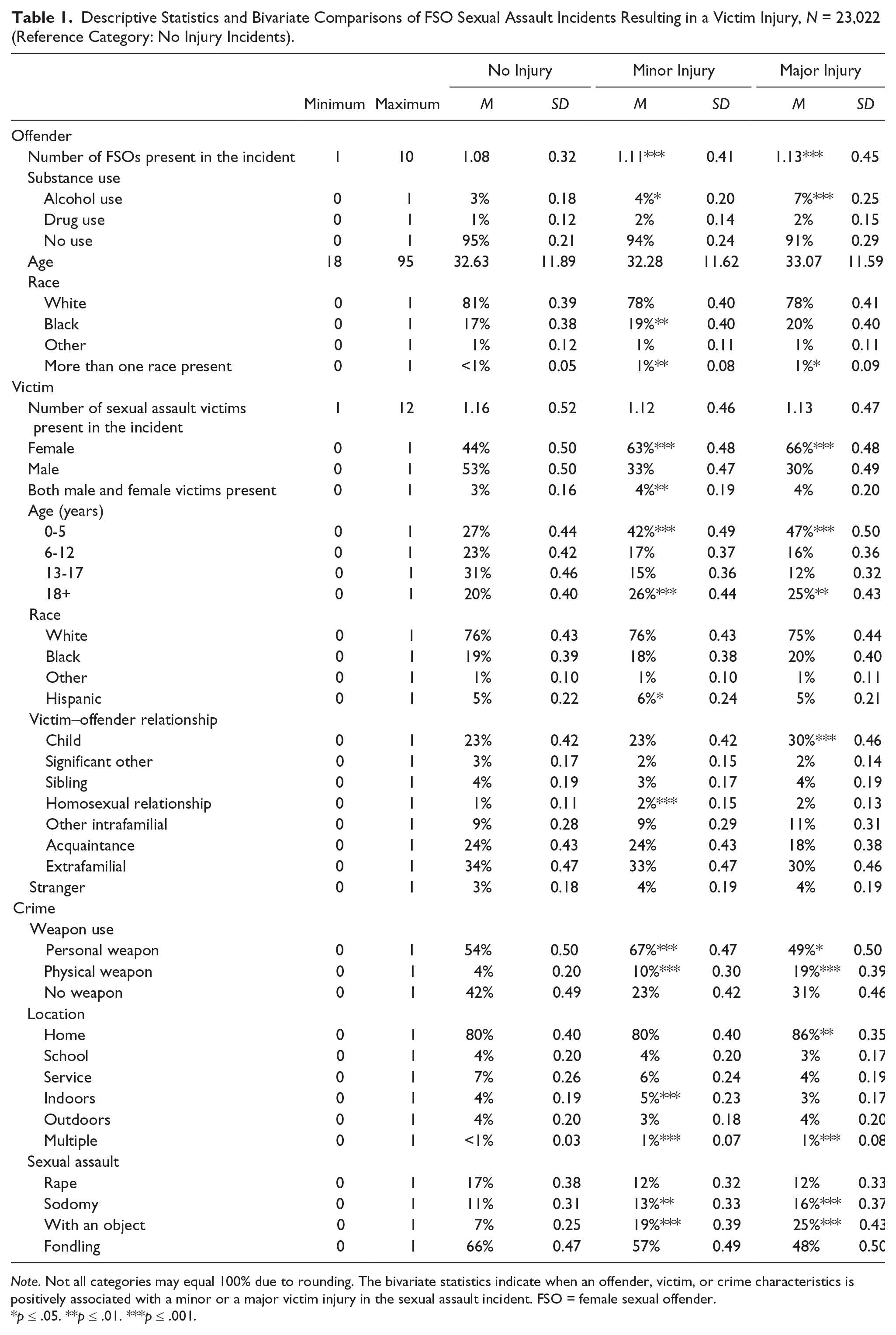
Note. Not all categories may equal 100% due to rounding. The bivariate statistics indicate when an offender, victim, or crime characteristics is positively associated with a minor or a major victim injury in the sexual assault incident. FSO = female sexual offender.
p ≤ .05. **p ≤ .01. ***p ≤ .001.
Because of the complexity of the model, the tables only show the results in regard to the reference category, no injury, although there is discussion of two significant findings that compared major injury with minor injury. This was done using a user-written command by Long and Freese (2006) and these results are available on request. The “Results” section proceeds first by presenting factors distinguishing “minor injury” from “no injury.” The section “Major Injury” discusses items distinguishing “major injury” from “no injury.”
Results
Minor Injury
The MNLM analysis revealed numerous offender, victim, and crime incident characteristics increased the odds that the sexual assault would result in a minor victim injury. Compared with incidents with no injuries, sexual assault incidents resulting in minor injuries increased the odds that there were multiple perpetrators and that the FSO was under the influence of alcohol. For each additional FSO in the sexual assault incident (e.g., duo or female group offending), the odds the victim sustained a minor injury relative to no injury were 1.21 times greater, holding all other variables constant (p ≤ .05). If the FSO was under the influence of alcohol, the odds the victim sustained a minor injury relative to no injury were 1.35 times greater, holding all other variables constant (p ≤ .05).
Victim characteristics played the greatest role in predicting whether incidents resulted in minor injuries. If the incident involved a female, the odds the victim sustained a minor injury relative to no injury were 1.77 times greater, holding all other variables constant (p ≤ .001). The presence of victims of both genders also signaled risk. If the incident had both male and female victims present, the odds of sustaining a minor injury relative to no injury were 2.53 times greater, holding all other variables constant (p ≤ .001). The youngest victims were most vulnerable to injury. For victims who ranged from infant to 5 years old, risk of injury was 1.44 times greater compared to adult victims, holding all other variables constant (p ≤ .001). In contrast, risk posed to elementary-aged and teenaged victims was significantly lower compared to adult victims (p < .001). Three victim–offender relationships increased the odds that the sexual assault incident resulted in minor victim injury relative to no injury: significant other (1.47 times greater), homosexual relationship (1.56 times greater), and acquaintance (1.20 times greater; p ≤ .05).
Finally, several crime characteristics also distinguished minor injury incidents from no injury incidents. Incidents without weapons were the least likely to result in minor injury, followed by those involving personal weapons (i.e., fists, feet), and the highest risk was associated with physical weapons (e.g., gun, blunt object). Location was also related to injury risk. The data showed “service” areas had the least risk of injury (e.g., churches, community centers, shelters, hospitals). The majority of locations showed no difference in risk, other than incidents that spanned multiple locations. That category demonstrated a significant increase in odds of a minor injury. The odds the victim sustained a minor injury relative to no injury were 4.56 times greater if the sexual assault took place at multiple locations, holding all other variables constant (p ≤ .001). Risk of injury was the same across all sexual assault acts, except one. Forcible fondling had lower odds of a minor injury relative to the other categories (see Table 2).
Multinomial Logistic Regression Model Predicting FSO Sexual Assault Incidents Resulting in a Minor or Major Victim Injury, n = 15,928.
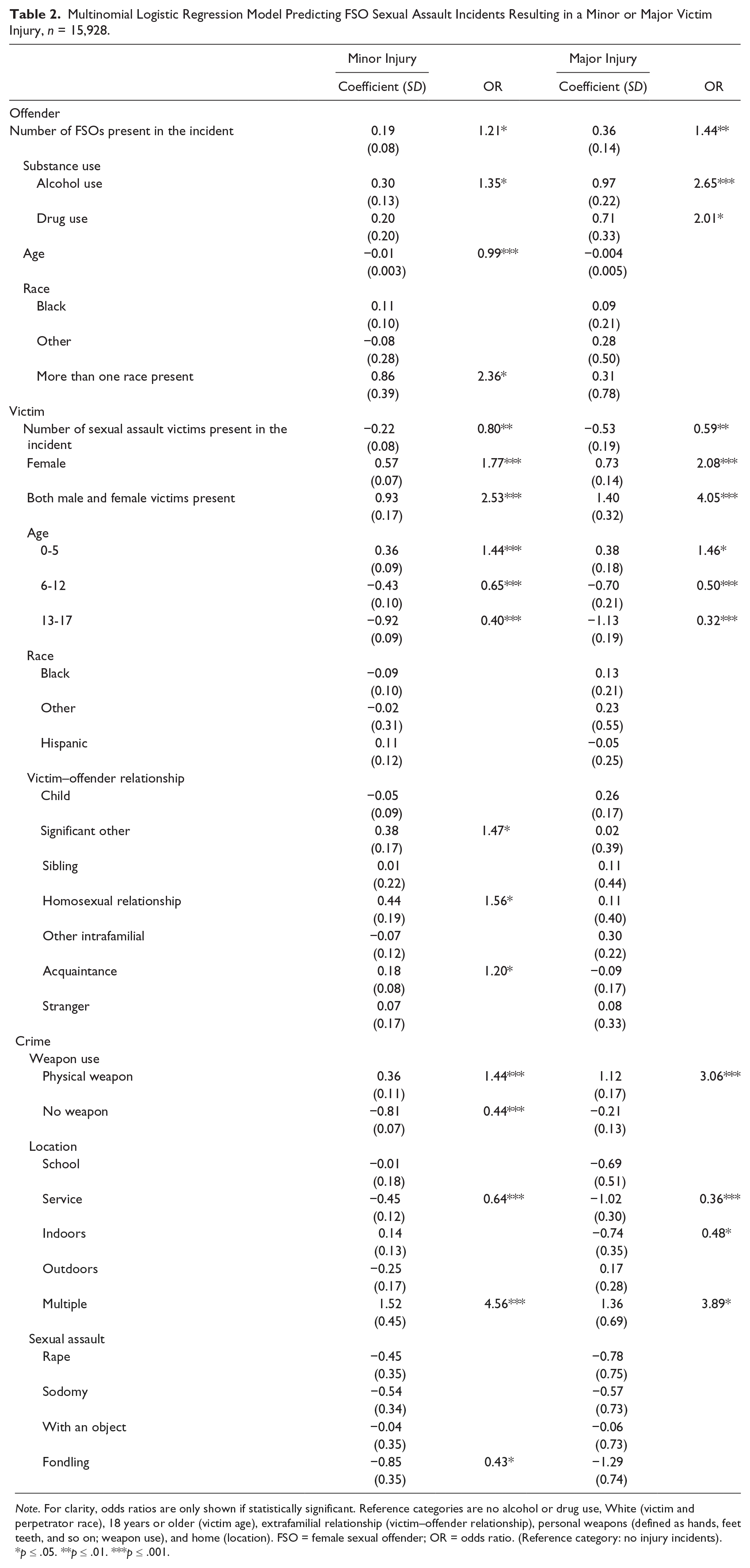
Note. For clarity, odds ratios are only shown if statistically significant. Reference categories are no alcohol or drug use, White (victim and perpetrator race), 18 years or older (victim age), extrafamilial relationship (victim–offender relationship), personal weapons (defined as hands, feet, teeth, and so on; weapon use), and home (location). FSO = female sexual offender; OR = odds ratio. (Reference category: no injury incidents).
p ≤ .05. **p ≤ .01. ***p ≤ .001.
Major Injury
As with incidents that resulted in minor injury, offender, victim, and crime characteristics significantly influenced the odds of an incident resulting in major victim injuries. For each additional FSO in the sexual assault incident, the odds the victim sustained a major injury relative to no injury were 1.44 times greater, holding all other variables constant (p ≤ .01). For incidents that had perpetrator substance abuse, alcohol and drugs mattered in relation to major victim injuries. If the offender was using alcohol in the sexual assault incident, the odds the victim sustained a major injury relative to no injury were 2.65 times greater, holding all other variables constant (p ≤ .001). Furthermore, alcohol use also significantly predicted incidents resulting in a major versus a minor injury. If the offender was under the influence of alcohol in the sexual assault incident, the odds the victim sustained a major injury relative to a minor injury were 1.97 times greater, holding all other variables constant (p ≤ .01). Drug use by the offender also increased the odds the incident resulted in major victim injury compared with no injury (2.01 times greater, p ≤ .05).
Echoing to some extent minor injury incident findings, the data showed incidents involving a female victim had more risk of injury with a 2.08 increase in the odds, holding all other variables constant (p ≤ .001). Incidents that had both male and female victims in the incident increased the odds slightly more than 4 times that the victim sustained a major injury relative to no injury (p ≤ .001). Victim age again mattered. For victims who ranged from infant to 5 years old, the odds the victim sustained a major injury relative to no injury were 1.46 times greater, holding all other variables constant (p ≤ .05). Like minor injuries, the odds of major injury in an incident decreased for elementary-aged children and teenagers when compared with adults.
Pertaining to crime characteristics, “physical weapons” (e.g., blunt objects, knives) continued to increase the odds that a sexual assault incident resulted in major injuries to the victim. There was no difference in odds of major injury relative to no injury between incidents with no weapons and those involving use of hands and feet as weapons (i.e., personal weapons). A point to note is that even though “no weapon” did not predict incidents with major injury versus no injury, there was a significant association in that, if no weapon was used in the sexual assault incident, the odds the victim sustained a major injury relative to a minor injury were 1.85 times greater, holding all other variables constant (p ≤ .001). In other words, when comparing incidents that resulted in major injury relative to minor injury, major injuries were more likely in the incident when no weapons were used by the FSO. Pertaining to location, the odds the victim sustained a major injury relative to no injury were 3.89 times greater if the sexual assault incident took place at multiple locations, holding all other variables constant (p ≤ .05). The sexual assault strategies themselves did not distinguish between incidents that produced a major, minor, or no injury to the victim.
Discussion
Despite the importance of studying sexual assaults perpetrated by women, the field knows very little about FSOs’ use of violence and incident characteristics that are associated with victim injury. This study attempted to advance knowledge on this aspect of female sexual offending behavior using one of the largest existing repositories of sexual assault incidents drawn from the front end of the U.S. criminal justice system. The NIBRS represents crimes reported to police from more than 6,000 police departments across the United States, regardless of whether the incident resulted in an arrest. All the FSO sexual assault incidents investigated here were classified as forceful sexual assaults (FBI, 2012b), and a significant minority involved some form of major or minor victim injury. Several victim, offender, and crime features distinguished incidents that involved major or minor injury compared with those that did not.
First, unlike Ferguson and Meehan (2005), we did not find that perpetrator age played a significant role in predicting the use of violence against a victim during the commission of a sexual assault. There was no relationship between FSO age and major victim injuries and it appears aging slightly decreased the odds of the incident resulting in minor victim injuries. This might be in part because Ferguson and Meehan’s (2005) use of force spectrum included only two injuries, mutilation/disfigurement and death (death was very rare), neither of which was available within the NIBRS coding of victim injury. Our studies also used two distinct methodologies to assess these relationships: hierarchical cluster analysis versus an MNLM.
The number of female offenders present in the sexual assault incident seems to matter in relation to the level of violence. As the number of female perpetrators present in the incident increased, a minor or major injury was more likely to be sustained by victims. Prior work has found that additional co-offenders, specifically males, increased the use of violence in sexual assault incidents (Budd et al., 2015). Due to the findings here, we propose a possible alternative to a male presence driving the use of violence. Perhaps, it is the number of offenders present in the sexual assault incident in general versus whether co-offenders are male or female. Work has indicated that in addition to sexual motivation, group-perpetrated rape likely contains elements of competition or displays of aggression for other offenders in the group (Horvath & Woodhams, 2013). Although aggression and violence has typically been linked to MSOs (see, for example, Berger’s, 2000, rapist typology), with sexual assaults perpetrated by females, there is still societal resistance to recognize their potential to be sexually violent (Denov, 2001, 2003, 2004). This may be due to “gender-biased views” on females who sexually offend, such as the schoolteacher who has a “love affair” with her student (Knoll, 2010, p. 371). Even with these cultural perceptions, this research shows that violent outcomes are more likely as the number of female perpetrators present in an incident increases. This extends the use of violence in sexual assault incidents beyond male and female co-offending pairs or multisex groups to FSOs who offend with one or more women.
Another key offender characteristic emerged in relation to violent incidents of sexual assault: Injuries were far more likely in an incident if the FSO was under the influence of substances, especially alcohol. Although alcohol has been linked to playing a prominent role in certain sexual assault contexts, such as campus sexual assault (Krebs, Lindquist, Warner, Fisher, & Martin, 2009), we see here that alcohol plays a prominent role in victim injury in the context of sexual assaults perpetrated by women. In regard to the role of alcohol in the incident, possibly victim injury was more likely in these incidents because alcohol use is an indicator of FSOs’ lack of self-control or lowered self-constraint during the sexual assault (e.g., Gottfredson & Hirschi, 1990; Rice & Harris, 1997). However, prior work has found that FSOs do tend to suffer from substance abuse problems (Faller, 1995; Matthews, Mathews, & Speltz, 1991; Vandiver & Walker, 2002; Wijkman et al., 2010). This, in combination with low self-control or lowered self-constraint, may increase the risk that victims will suffer physical injuries. Unfortunately, these data cannot illuminate why FSO substance abuse influenced injury although these may be potential explanations.
Several victim characteristics were associated with increased odds of minor or major injury relative to no injury. First, there was a bimodal age impact. Bivariate and multivariate analyses showed that very young victims (infant/toddler, 0-5) and adult victims (18+) were more at risk of injury compared with elementary or teenaged victims. Incident injuries among the very young likely had to do with the fragility of victims given their small physical size compared with an adult FSO. The increased risk of injury among adults is harder to explain. Perhaps, more violence was used by a female perpetrator because adult victims had a greater ability to resist or defend themselves. In addition, given that research shows that using protective actions, specifically physical protective actions (e.g., using physical force against the perpetrator, threatening the perpetrator with a weapon or using a weapon), can significantly decrease the likelihood of a completed rape (Clay-Warner, 2002), physical self-protective actions may increase the likelihood for victim injury.
A second pattern was related to victim gender. Compared with male victims, female victims were significantly more likely to suffer a minor or major injury in an incident. Here, again, physical self-protective actions may play a role (Clay-Warner, 2002). Given that girls and women in general are typically the targets of safety training (Brecklin, 2008; Brecklin & Ullman, 2005), such as self-defense training, this may increase females’ propensity to “fight back” and be injured in the process. An alternate explanation is that the nature of attacks against male and female victims may be different. Because the level of offender violence is an important determinant of victim injury (Ullman, 2002), perhaps incidents of sexual assault that have a female offending against another female are more violent in nature compared with incidents where females are perpetrating sexual assault against male victims. FSOs may instead use more coercion toward male victims instead of tactics that result in victim injury (e.g., see Black et al., 2011). Finally, in regard to victim gender, there could be the possible influence of homosexual relationships. Although homosexual relationships were rare in these data (<2% overall), this relationship status significantly increased the victim’s risk (here, a female) of minor injury during a sexual assault. In general, additional research with the NIBRS is needed to better understand the sexual violence dynamics in homosexual relationships (e.g., comparing sexual assault incident characteristics involving gay, lesbian, or bisexual relationships and/or comparing them with sexual assault incident characteristics heterosexual relationships). We know that intimate partner sexual violence (IPSV) does affect a substantial number of lesbian and bisexual women’s relationships with prevalence rates ranging from 2% to 45% (median 12.6%; Rothman, Exner, & Baughman, 2011). It also seems that lesbian and bisexual women are more likely to report their IPSV compared with gay men (Rothman et al., 2011). The findings here emphasize the continued need to recognize and be aware of IPSV that occurs within these homosexual relationships, especially if victim injury is a resulting trauma from IPSV.
A third pattern that emerged from the data analysis was tied to assault location. The multinomial model showed the category “location multiple,” that is, the sexual assault incident spanned multiple locations, was associated with significantly more risk of injury. This has two implications. First, it means that incidents can escalate to, or otherwise include, serious injury in nearly any location type. This is striking because we originally presumed that locations would differ in the types of sexual assault opportunities that routine activities implied—opportunity or motivation for violent sexual assaults. For example, service locations, such as hospitals or community centers, would likely have more potential witnesses or people who may intervene (e.g., guardians such as trained staff or security guards) than would be found in a home or outdoor area (e.g., woods, rest area). We hypothesized that these incident characteristics would change the likelihood that violence was used as a means to control victims. The fact that injuries emerged in all sorts of settings implies that there are likely many pathways to the use of violence. Therefore, a deeper study of locations will likely lead to important etiological insights about perpetrator behavior and their use of violent tactics, including whether a victim will be injured. The second implication is that sexual assaults that emerge within enduring sex crimes are more dangerous. These would include incidents, for example, in which a victim is kidnapped from one location and then taken to a home to be sexually assaulted there. The enduring sexual assault incident that spans multiple locations may result in injury because it is a tool to control a victim over a large period of time and, thus, injury occurs, or because the nature of criminals who are interested in or willing to engage in protracted offenses have more violent tendencies. To be clear, incidents that moved between two or more locations were extremely rare (1% or less of incidents). As such, these findings are somewhat tentative and should be interpreted with caution.
A final pattern of note was that injury was positively associated with weapon use. At first, this may seem obvious given the potential for weapons to cause victim injury. However, this is not always the case in criminal encounters. For example, a classic research finding with respect to robbery is that the presence of a firearm tends to decrease the level of injury to the victim (Cook, 1986), primarily due to the declining odds of resistance when a victim is faced with a weapon. Our findings run counter to this because physical weapons (e.g., guns, knives) were associated with far more injury—particularly in incidents resulting in major injury relative to no injury. It is unclear whether this is because female perpetrators who bring weapons to an incident of sexual assault have more propensity for, or interest in, enacting violence. Or, however, if this is because sexual assault itself may be substantively different from robbery. That is, a victim may be willing to give up a wallet when faced with a firearm because a wallet relatively has little value in when faced with the potential of grave injury if resisting a theft. In contrast, one’s body, sexuality, and ability to willingly consent to sexual activity likely has inherent and extraordinary value to most individuals such that the value of resistance is not offset if faced with a weapon and potential physical injury.
Limitations
This analysis is not without limitations. Although the NIBRS represents the largest data set in the United States recording incident details of female perpetrated sexual assault reported to police, it is not representative of the United States as a whole given that currently only about 33% of U.S. police departments submit data to the NIBRS. In addition, given that this is official criminal justice data and that sexual assault is underreported, these findings cannot be generalized to all females who sexually offend. Likewise, the data system, comprised of operational data taken from more than 6,000 police departments, may have data entry errors over time or definitional differences between police agencies. Although the FBI provides uniform definitions and training for data providers and also audits the NIBRS contributors requiring an error rate below 3% to retain accreditation, there remains a possibility that differences in local police policy or culture could lead to some data entry errors.
There are also some limitations with respect to measurement and modeling. Injury within the NIBRS is only defined as physical injury to the victim and, therefore, does not address psychological injury that occurs during or as a result of the sexual assault victimization. Although the NIBRS contains a wealth of information, it also does not contain all the possible factors that may be related to FSO use of violence. First, it does not record criminal history of offenders or victims. Criminal history may provide additional indicators of FSO use of violence as a sexual assault tactic, as suggested by Ferguson and Meehan (2005). Similarly, there is no way to tell whether a perpetrator is a repeat offender. Second, the NIBRS groups White and Hispanic offenders together—an error that cannot be corrected in the underlying file. It is plausible that ethnicity could correlate with injurious incidents, but due to the structure of the NIBRS, we cannot disentangle these measures. If that is the case, these models would contain some omitted variable bias. Finally, we cannot disentangle the meaning or emergence of injuries here. We do not know how much force was used, or intended, by FSOs or whether the victims used self-protective measures. In addition, it is plausible that some injuries occurred by sheer accident or that some uses of intense force resulted in lesser injury than might be expected. Therefore, these findings should be interpreted cautiously for those wishing to apply them in theoretical development on FSO use of violence or on women using force in general when committing crime.
Future Directions
Looking forward, questions remain and new puzzles emerge for future research. Because there was no measure for psychological injury in the data set, future research should strive to include injury measures such as this to see how offending behaviors, including offender, victim, and crime characteristics, influence the level of psychological trauma suffered by victims during and after sexual assault incidents. This could provide important information for treatment providers given that sexual abuse has been documented to have a vast array of lifelong psychological consequences (Chen et al., 2010).
Second, given that masculinity has been one proposed explanation for the use of physical violence in sexual assault incidents where there is co- or group offending (see, for example, Budd et al., 2015; Kelly, 2013), how do we explain the role of violence perpetrated against the victim as the number of female perpetrators increase? Future research should continue to explore the gendered nature of these offending dynamics, particularly when women sexually offend with other women. Although there has been continued growth in the literature that compares females with males who sexually offend, we are unaware of any existing studies that compare solo females who sexually offend with females who offend with other women (i.e., co-offending females or groups of females). What gendered dynamics are in play when women offend with other women? Are there substantive differences in offending behaviors when women offend alone versus when they offend with other women?
Third, additional research is needed to better explain the role of victim age, victim gender, and their relation to FSO’s use of violence and the resulting severity of the victims’ injuries. There seems to be a protective effect from injury for elementary-aged victims, teenage victims, and also male victims, but not for very young victims, adult victims, or female victims. Does this have something to do with the types of sexual assault strategies or offense styles deployed by women against different age groups or genders (see, for example, Gannon, Rose, & Ward, 2008; Gannon et al., 2014)? Is it related to opportunity (e.g., planned or impulsive) or grooming strategies?
Finally, a continued examination of weapon use, the rationale behind weapon use, and the rationale behind choice of weapon will prove fertile ground to those studying the emergence of injuries in these kinds of sexual assaults committed by females. Are weapons a way for females to assert power and dominance over their victims or to humiliate victims? Are they used for some other rationale? Qualitative research with women who have committed sexual assault using weapons would shed light on this offending behavior.
Two final points of note are as follows: sexual assaults in homosexual relationships and incidents of sexual assault occurring at multiple locations. Although incidents of sexual assault that involved homosexual relationships were rare, when present, they did signal a heightened risk of minor injury to victims. Given the importance of understanding sexual violence among same-sex partners (Turell, 2000; Waterman, Dawson, & Bologna, 1989), this finding may provide another piece of information for treatment providers or counselors who work with sexual assault survivors and perpetrators of sexual assault. Future research should continue to focus on sexual violence within same-sex relationships so that we can better understand offending behavior as it relates to this population. Although very rare, we did find that a percentage of incidents of sexual assault spanned multiple locations meaning that the same sexual assault incident moved from one location to another. Within these incidents, victims were approximately 4 to 5 times more likely to be injured if the sexual assault incident moved locations. Given this large increase in risk for victim injury above and beyond that of the sexual assault itself, future research should investigate these “mobile” sexual assaults to better understand their etiology and develop crime prevention strategies to address victimization that spans multiple locations. This may be especially pertinent in relation to combating human trafficking and sexual slavery.
Conclusion
This research contributes to the overall discussion on violent sexual offending behavior by women by adding another layer of context with another subset of FSOs—adult FSOs reported to the police in the United States. We found that a percentage of FSOs are violent in nature, measured through victim injury, and more important, we uncovered that certain factors influenced the level of violence that was used within the sexual assault incidents. Left remaining is the answer to the following question: Are violent FSOs a myth or are they reality? Accumulating evidence suggests that violent sexual assaults are committed by some women (i.e., using physical or verbal force, using weapons, and inflicting injuries upon victims beyond the sexual assault). Although societal resistance remains to recognize sexual offending by females in general (i.e., the perception that “women don’t do such things”; Wijkman et al., 2010, p. 135), and in particular with a resistance to recognize violent sexual offending by females, this research indicates that there is a subpopulation of women who “do do such things.”
Footnotes
Acknowledgements
We would like to thank Paul J. Detar for his feedback on a prior version of this manuscript.
Authors’ Note
The views and opinions of this research do not necessarily represent those of the U.S. Department of Justice or any component therein.
Declaration of Conflicting Interests
The author(s) declared no potential conflicts of interest with respect to the research, authorship, and/or publication of this article.
Funding
The author(s) received no financial support for the research, authorship, and/or publication of this article.
Notes
Author Biographies
