



Abstract
This study aimed to revise and validate a Chinese version of Psychological Maltreatment of Women Inventory (C-PMWI). In the preparation phase, the PMWI was first revised for the possible cultural differences between Chinese and non-Chinese women. Supplementary items on use of electronic devices as a contemporary form of monitoring were added. Forward and back translated items were reviewed by a panel of intimate partner violence (IPV) experts, resulting in the scale-level content validity index of 0.94. Cognitive debriefing was conducted to confirm comprehensibility. The newly revised measure was administered to the sample of 1,198 Chinese women, recruited from community centers and shelters in Hong Kong. Exploratory factor analysis conducted on data from half the sample revealed a two-factor structure similar to the original English version: emotional-verbal and dominance-isolation. This structure was verified by confirmatory factor analysis with the other half of the sample. Known-groups validity was demonstrated by significant differences in scores between women with different relationship histories. Moderate-to-strong correlations of the C-PMWI with other forms of IPV, controlling behaviors, relationship satisfaction, and depression established convergent validity. The C-PMWI showed good internal consistency, with Cronbach’s alpha >.9 for the entire scale and each subscale. The intraclass correlation across administrations 2 weeks was >.9, demonstrating test–retest reliability. The use of the comprehensive validation procedures in the present study provided evidence for both cultural appropriateness and satisfactory psychometric properties of the C-PMWI. The C-PMWI shows promise as a useful instrument for research and clinical practice with Chinese women.
Intimate partner violence (IPV) is a serious, highly prevalent, global public health (World Health Organization, 2016) and human rights concern (United Nations, 2000) with wide-ranging economic and social costs to society (Garcia-Moreno et al., 2015). Although physical violence, psychological abuse and sexual assault often coexist, studies have consistently found psychological abuse to be the most common form of IPV (see, for example, Black et al., 2011; Breiding, Chen, & Black, 2014; Chan, 2005) and as harmful as or even more so than physical violence (Coker et al., 2002; Garcia-Moreno, Jansen, Ellsberg, Heise, & Watts, 2005). Specifically, women who experience psychological abuse are at higher risk for chronic pain, even when physical violence is absent (Wuest et al., 2010). Furthermore, it is a significant predictor of functional limitations (Yoshihama, Horrocks, & Kamano, 2009), sleep disruption, suicidal thoughts, fear of the partner (Issahaku, 2015), posttraumatic stress disorder, and depressive symptoms (Mechanic, Weaver, & Resick, 2008). Studies have also demonstrated that psychological abuse predicts occurrence of physical violence in intimate relationships (O’Leary & Maiuro, 2001; Stith, Smitha, Penn, Ward, & Tritt, 2004).
Compared with the dramatic nature of physical violence which is easier to identify, detecting psychological abuse is more challenging. The insidious and gradual nature of psychological abuse in intimate relationships often leaves “invisible marks” that are difficult to detect (Queen, Brackley, & Williams, 2009). Identification of psychological abuse is further confounded by disagreements over what constitutes the phenomenon. For example, acts that cause psychological harm are regarded by some as psychological abuse irrespective of whether or not the intent is to harm (Marshall, 1994); others, however, argue that contextual variables (such as frequency, severity, and duration of the abuse; intent to harm; and reactions to, outcomes of, and vulnerability to psychological abuse) should also be taken into account (Follingstad & DeHart, 2000; Follingstad & Rogers, 2012).
While the term “psychological abuse” is often used to describe non-physical, psychologically abusive actions (Marshall, 1999; Rodenburg & Fantuzzo, 1993; Sackett & Saunders, 1999; Shepard & Campbell, 1992; Sullivan & Bybee, 1999), other terms have also been adopted, for example, “emotional abuse” (Hegarty, Bush, & Sheehan, 2005; Murphy & Hoover, 1999), “controlling behaviors” (Graham, Christian, & Kiecolt-Glaser, 2006), “psychological aggression” (Follingstad, Coyne, & Gambone, 2005; Straus, Hamby, Boney-McCoy, & Sugarman, 1996), “verbal abuse”(Rodenburg & Fantuzzo, 1993; Tang, 1999), “nonphysical abuse” (Hudson & McIntosh, 1981), and “psychological maltreatment” (Jezl, Molidor, & Wright, 1996; Tolman, 1989). The wide range of terms used to describe psychological abuse reflects its diverse manifestations. As such, Follingstad (2007) asserts that the term “psychological abuse” should only be used when a certain degree of severity has been reached while “aggression” or “maltreatment” should be adopted to describe a continuum of behaviors below the threshold of psychological abuse (e.g., from sulking to doing something to spite the partner). Tolman (1992) also advocates the use of a continuum to describe psychological maltreatment in intimate relationships with isolated wounding behaviors on one end (e.g., withdrawing emotional resources and acting insensitively) and the more severe psychological tormenting behaviors on the other end (e.g., extreme intimidation and degradation).
Not only do different forms of psychological abuse vary in severity, some have demonstrated more severe impacts on the victims than others. For example, Follingstad, Ruteledge, Berg, Hause, and Polek (1990) and Sackett and Saunders (1999) found ridicule to have the most devastating effect on abused women among various forms of psychological abuse. In studies of Chinese women reporting IPV, the detrimental effects of repeated ridiculing by the partner were also reported (Leung, Leung, Lam, & Ho, 1999; Tiwari et al., 2008; Tiwari et al., 2005). It was suggested that in a shame-oriented Chinese culture (Bedford & Hwang, 2003), expectation of woman as a virtuous wife is paramount (Tang & Lai, 2008). Thus, being ridiculed by the husband about her personal character would inflict varying degrees of shame on the woman (Tiwari et al., 2009). She may feel diu lian (loss of face) for not living up to the expected standard; xiu kui (internalized guilt) because her failing as a wife has harmed her husband; and xiu chi (externalized shame, the strongest of the shameful emotions, similar to having a stain on her face) as anyone who sees her will recognize her inadequacy (Bedford, 2004). The cultural context within which psychological abuse occurs should therefore be an important consideration when conceptualizing this complex phenomenon.
Given the wide range of definitions and conceptualizations, measurement of psychological abuse is challenging (Follingstad, 2007; Manso, Alonso, Sánchez, & Barona, 2011; O’Leary & Maiuro, 2001). Among the measuring tools, some assess IPV in general with psychological abuse as one of the domains (e.g., Revised Conflict Tactics Scales [CTS-2], Index of Spouse Abuse) while others only focus on psychological forms of IPV (e.g., Psychological Maltreatment of Women Inventory [PMWI], Follingstad Psychological Aggression Scale). Among the instruments which assess psychological forms of IPV alone, the PMWI is perhaps the most widely used gender specific measure of psychological maltreatment (Hamel, Jones, Dutton, & Graham-Kevan, 2015). The Cronbach’s alpha coefficient of the PMWI was found to be over .9 (Tolman, 1989), and construct validity was supported (Tolman, 1999). Although the PMWI has been applied across several cultural groups (Hazen & Soriano, 2007; Hedin & Janson, 1999; Saito, Creedy, Cooke, & Chaboyer, 2012) over the past, it is yet to be culturally adapted and validated for use in Chinese populations.
In the last two decades, the scope of psychological maltreatment has expanded with the advent of information technology (e.g., cell phones, the Internet, global positioning system devices, etc.). The latter has provided the perpetrators new ways of monitoring, controlling, and frightening their victims (Southworth, Finn, Dawson, Fraser, & Tucker, 2007). As a result, through the use of the latest information technology, perpetrators are increasingly able to reach their victims at a distance, infiltrate even more deeply into their daily lives and deprive them of a sense of privacy, control, and safety (Fraser, Oslen, Lee, Southworth, & Tucker, 2010). It is therefore important that measurement of psychological abuse should include the use of information technology by the perpetrator to monitor, control, and frighten the victim.
The purpose of this study was to (a) update items in the PMWI to ensure that it captures psychological maltreatment perpetrated through the use of information technology, (b) adapt the updated PMWI as a culturally appropriate measuring tool for Chinese women, and (c) validate the Chinese PMWI (C-PMWI).
Method
Participants
Participants were recruited from 13 community agencies and two shelters for abused women in Hong Kong. The agencies and shelters were selected from a wide range of districts including those where high rates of IPV were reported (Social Welfare Department, 2014). Women were included in the study if they were Chinese, 18 years old or above, and in intimate relationships during the 12 months preceding recruitment. Those who were unable to communicate in Cantonese or Putonghua (the two main dialects in Hong Kong) were excluded. The study was approved by the institutional review board of the principal investigator’s university. Participants with and without abuse histories were recruited because psychological maltreatment might occur on a continuum (Tolman, 1992) and vary in severity in abusive and nonabusive intimate relationships.
The sample size was computed primarily based on the number of items on the C-PMWI. The suggested ratios of subjects-to-variables range from a minimum of 5:1 (i.e., 5 times the number of items) (Gorsuch, 1983) to a preferable 10:1 (i.e., 10 times the number of items) (Everitt, 1975). Because of the estimation that about 60 items would be included in the Chinese version of the updated PMWI and that the data had to be divided into two halves for exploratory factor analysis (EFA) and confirmatory factor analysis (CFA), it was estimated that the sample size should be at least 600 and ideally 1,200. Therefore, to perform full psychometric testing of the Chinese version of the Revised PMWI, it was decided that the sample size would be 1,200.
Measures
PMWI
The original PMWI was developed in 1989 to measure nonphysically abusive behaviors exhibited by male partners against women (Tolman, 1989). Consisting of 58 items, the PMWI assesses the pervasiveness of psychological maltreatment in the preceding 6 months using a 5-point Likert-type scale (1 = never; 5 = very frequently). EFA of the PMWI identified a two-factor structure: emotional-verbal (EV; behaviors that hurt partners emotionally and verbally) and dominance-isolation (DI; acts that isolate partners from resources and demand subservience of partners) (Tolman, 1989). In subsequent analysis, satisfactory reliability and construct validity were established (Tolman, 1999).
CTS-2
The CTS-2 is a widely used tool with sound psychometric properties (Straus, 1979; Straus et al., 1996). It measures physical, sexual, and psychological partner violence during the previous 12 months. The Chinese version of the CTS-2 used in the current study was previously validated with satisfactory validity and reliability (Chan, 2005). Three subscales (psychological aggression, physical assault, and sexual coercion) with a total of 27 items were used in the study. The responses are rated on a 8-point Likert-type scale (with 1 = 1 time in past year, 2 = 2 times in past year, 3 = 3-5 times in past year, 4 = 6-10 times in past year; 5 = 11-20 times in past year, 6 = more than 20 times in past year, 7 = not in past year but happened before, and 0 = never happened). Higher scores indicate more frequent acts of partner violence in the preceding 12 months. The internal consistency of the subscales ranged from 0.79 to 0.95 (Straus et al., 1996).
Revised Controlling Behaviors Scale (CBS-R)
The CBS-R, a 32-item instrument with seven subscales (economic control, threatening control, intimidating control, emotional control, isolating control, using children, and minimizing), was developed to assess controlling behaviors in intimate relationships over the previous 12 months (Graham-Kevan & Archer, 2005). The Chinese version of the CBS-R in this study was previously validated with good psychometric properties (Tiwari et al., 2015). Each of the controlling behaviors was rated using a 5-point Likert-type scale ranging from 0 (never) to 4 (always). The internal consistency of the instrument was shown to be 0.87 (Graham-Kevan & Archer, 2005).
Beck Depression Inventory Version II (BDI-II)
The 21 item BDI-II assesses depressive symptomatology (Beck, Steer, & Brown, 1996; Beck, Steer, & Garbin, 1988). The Chinese version of the BDI-II demonstrates good psychometric properties, with internal consistency over 0.9 and satisfactory construct validity (Byrne, Stewart, & Lee, 2004). The summary score ranges from 0 to 63, with higher scores indicating higher depressive symptoms.
Dyadic Adjustment Scale (DAS)
The 32-item DAS assesses the quality and adjustment of relationships as perceived by couples (Spanier, 1976). The Chinese version has good reliability and validity, with Cronbach’s alpha over .9 and evidence of convergent and discriminant validity (Shek, 1994). The summary score ranges from 0 to 151, with higher scores indicating better relationship adjustment as perceived by the couple.
Demographics Questionnaire (DQ)
The investigator-designed DQ questionnaire was for collecting participants’ background information, including marital status, age, number of children, employment status, education level, immigration status, social support received, and problems encountered in the preceding year (i.e., financial hardship, chronic illness, parenting problems).
Four of the measures (the CTS-2, CBS-R, BDI-II, and DAS) were used to examine the C-PMWI’s convergent validity (i.e., the degree to which measures of constructs are theoretically related; Streiner & Norman, 2002). The rationale for choosing the four measures for testing convergent validity is as follow. First, abuse history (as measured by the CTS2) should be correlated with psychological maltreatment (as measured by the C-PMWI) because there is empirical evidence that majority of women who report physical or sexual violence also report psychological maltreatment (Coker, Smith, McKeown, & King, 2000). Second, depression (as measured by the BDI-II) has been found to be associated with psychological maltreatment (Marshall, 1999; Mechanic et al., 2008). Third, marital satisfaction (as assessed by the DAS) was previously found to be lower in women who experienced psychological maltreatment (Tolman, 1999; Williams & Frieze, 2005). Fourth, behavioral control (as assessed by the CBS-R) was reported by women who experienced psychological maltreatment (Carney & Barner, 2012; Walker, 1984). Thus, convergent validity was tested by examining the correlation of the C-PMWI with the four measures.
Procedures
Adapting the PMWI
Updating the measure with respect to digital technology
In view of the increasing trend of using electronic forms of communication technologies (e.g., cell phones, the Internet, global positioning system devices, etc.) in psychological maltreatment of the partner as reported in the Western literature (Finn & Atkinson, 2009; Southworth et al., 2007), the original PMWI was critically assessed by two of the researchers (Cheung and Tiwari) for its relevance in the context of a digital era. Of the 58 items in the original PMWI, all but one was assessed to be still relevant. Revision was made to the one item in question: from “My partner restricted my use of the telephone” to “My partner restricted my use of the computer and/or telephone and/or cell phone.” And four new items were added: “My partner repeatedly made unwanted calls and/or sent harassing text messages or e-mails to me,” “My partner checked my computer (e.g., email, MSN, Facebook, QQ) and/or cell phone to monitor my communication with others,” “My partner threatened to post my private pictures on websites or send them to others,” and “My partner looked at my private information on a computer or cell phone without my permission.” With the high percentage of households in Hong Kong with personal computers connected to the Internet and the prevalence of 3G/4G mobile phone users (Census and Statistics Department, 2013), it is reasonable to assume that the new items in the updated PMWI would also be applicable to Hong Kong.
Several steps were taken to ensure that the updated PMWI was culturally appropriate for measuring psychological maltreatment among Chinese women including item revision, forward and back translation, content validity by experts, cognitive debriefing, and test–retest reliability assessment.
Item revision with respect to Chinese culture
The items of the updated PMWI, in English, were modified to ensure that the instrument was appropriate for the Hong Kong Chinese context where it would be used subsequently. Iterative rounds of critical debates among members of the research team, with cross references to the local databases, resulted in a modification of the updated PMWI for the targeted Chinese population. The modification, in English, included three revised items and four new items, making a total of 66 items: (a) “My partner did not do a fair share of the household tasks” was revised to “my partner did not help me with household tasks, even if I were extremely busy” (Rationale: Under the patriarchal remnants of Chinese society, majority of Chinese women may not expect their husbands to take on an equal share of family responsibility because men, as the breadwinners, are not expected to share the household chores; Lee, 2002); (b) “my partner did not do a fair share of child care” was revised to “my partner did not help me with child care, even if I were extremely busy” (Rationale: It is generally expected that it’s a woman’s duty to take care of the children in traditional Chinese families; Zuo & Bian, 2001); (c) “my partner restricted my use of car” was revised to “my partner restricted my use of transport” (Rationale: With the well developed and convenient public transport system in Hong Kong, private car is not the major means of transport in Hong Kong especially for women; Transport Department: The Government of the Hong Kong Special Administrative Region, 2013). The four new items added were as follows: (a) “My partner forbade me to disclose our family matters to others” (Rationale: To Chinese men, disclosure of private family matters to others, especially to outsiders, is seen as a weakness; Tiwari et al., 2009). By forbidding the partner to talk to others about such matters, he may also deprive her of the opportunity to seek help. (b) “My partner gave me a menacing look” (Rationale: Putting on a menacing look, rather than showing anger, is a subtle Chinese behavior to show one’s displeasure and was repeatedly mentioned by abused women in our earlier studies as a form of psychological maltreatment; Tiwari & Yuen, 2010). (c) “My partner made me feel that he had a means to monitor me” (Rationale: Chinese women have also told us that they were made to feel that their abusive partners would be able to know what they were doing wherever they were; Tiwari et al., 2015). (d) “My partner threatened to spread unfavorable rumors about me” (Rationale: By spreading such rumors, the abuser would succeed in defaming the woman, making her feel shameful and thereby isolating her from those who could offer help, according to researcher’s experience of interviewing abused women in shelter).
Translation and back translation
The modified updated PMWI (E2) was forward translated into Chinese (C1) and then back translated to English (E3) by another translator who did not have knowledge of the English original (E2). The two English versions of the instrument, that is, E2 and E3, were examined by two of the researchers (Cheung and Tiwari) and found to have no major discrepancies.
Content validity by experts
An expert panel, consisting of three social workers and a nurse, with expertise in conducting IPV research and/or providing services to abused Chinese women, was invited to independently review the Chinese version (C1) and English version (E2) of the PMWI for content validity. The experts rated the relevance of the items of the C-PMWI (C1) on a 4-point Likert-type scale (1 = not relevant, 2 = unable to assess relevance without item revision, 3 = relevant but needs minor alteration, 4 = very relevant) (Lynn, 1986). Item-level content validity index (CVI) was calculated as the number of experts rating the item as either 3 or 4 divided by the total number of experts. Then the scale-level CVI was computed by averaging the item-level CVI and found to be 0.94, which was of an above-standard-scale level (Polit & Beck, 2006). In addition, based on the panel’s feedback, one item “my partner was jealous of other men” was revised to “my partner felt jealous when I looked at or spoke with other men.” One new item “my partner used different ways to make me feel guilty” was added as this was reported by the experts to be very common in the local context. The revised Chinese version of the updated PMWI (C2) now featured 67 items (Appendices A and B).
Cognitive debriefing
Ten Chinese women who met the inclusion criteria as previously stated, completed the measure before being interviewed individually by our researcher (Cheung) for cognitive debriefing. Based on the results of the debriefing interviews, minor revisions were made to improve comprehensibility and reviewed again by the experts who conducted the content validity before validation of the instrument.
Test-retest reliability
A preliminary examination of the test–retest reliability of the instrument was conducted prior to validation. Thirty-seven women who met the inclusion criteria completed the updated PMWI twice, in a 2-week interval. The intraclass correlation coefficient (ICC) was found to be .899 for the entire scale, which was higher than the recommended value of .8 (Streiner & Norman, 2002).
Validation of the Chinese version of the updated PMWI
The C-PMWI was subjected to psychometric testing between July 2012 and April 2013. Advertisement of the study was made by the staff of the community agencies/women’s shelters or through posters. Potential participants were referred to the research team and assessed for eligibility. Those who were eligible were provided information of the study and their rights as research participants. For those who expressed an interest to participate, written consent was obtained. A composite instrument containing the C-PMWI, C-CTS 2, C-CBS-R, C-BDI-II, C-DAS, and DQ was administered to each of the participants by researchers (Cheung, Law, Wong, and Lee) who had undergone training for this purpose. All participants were made aware that they had the right to quit the study at any time without having to give an explanation and that the services they were receiving from the community agencies or shelters would not be affected. The completed instrument was immediately checked for missing data or mistakes. Information on community resources for abused women was also given as appropriate.
Data Analysis
Descriptive statistics, reliability, and validity of the C-PMWI were analyzed using SPSS 20, except for CFA, which was performed using AMOS 16.0. The sociodemographic characteristics of the participants were reported by descriptive analysis. The floor and ceiling effects were further assessed in terms of the percentage of respondents with the minimum (1) and maximum scores (5).
Regarding reliability assessment, Cronbach’s alpha coefficient was used to estimate internal consistency, which indicated the extent to which items in a test were correlated (Waltz, Strickland, & Lenz, 2010). Alpha values of ≥.8 were acceptable, with ≥.9 recommended (Nunnally & Bernstein, 1994).
Construct validity was assessed in three ways: (a) factor analysis, (b) known-groups methods, and (c) convergent validation. To perform factor analysis, the data obtained in the full psychometric testing were randomly split into two halves for EFA and CFA, respectively. EFA was first performed through principal components analysis with promax rotation. The number of factors was determined based on the scree plot and eigenvalues greater than one. Factor structures of both outputs were examined for appropriateness. For items with communalities smaller than 0.4, the underlying reason was explored and considered for deletion if necessary. Finally, the factor structure was analyzed on the basis of the factor loadings of each item. A CFA was then conducted with the other half of the data to verify the factor structure identified by EFA. CFA parameters was reported, including classic goodness of fit chi-square (χ2) statistics and its degrees of freedom, comparative fit index (CFI), Tucker–Lewis index (TLI), and root mean square error of approximation (RMSEA). Since χ2 statistics is highly sensitive when the sample size is large, goodness of fit is assessed with the fit indices, that is, CFI, TLI, and RMSEA (Hu & Bentler, 1998). A CFA model is regarded as acceptably fit when CFI and TLI are close to or above 0.90 and RMSEA is close to or below 0.06 (Hu & Bentler, 1999).
To establish known-groups validity, the C-PMWI scores of women with different recruitment sources (shelter as opposed to community center) and abuse histories (physically or sexually abused in past year, not abused but in distressed in relationships, or not abused in satisfactory relationships) were compared using independent samples t tests and one-way ANOVA.
Convergent validity is supported if the tested tool is found to be correlated with other variables to which it is considered related (Streiner & Norman, 2002). It was hypothesized that the scores for the CTS2, CBS-R, BDI-II, and DAS would be significantly correlated with those for the Revised Chinese PMWI. Pearson correlation coefficient (r) smaller than .01 was considered trivial; an r value between .1 and .3 indicated a weak relationship; an r value between .3 and .5 indicated a moderate correlation; and an r value larger than .5 supported a strong correlation (Cohen, 1988).
Results
Participant Characteristics
In all, 1,201 participants completed questionnaires, but two were eliminated because of incomplete data in PMWI, and one that indicated not applicable for 31 items of the C-PMWI was also deleted, leaving 1,198 questionnaires in the final data analysis. Regarding floor and ceiling effects, 35 of the 1,198 participants (2.9%) had the lowest mean score on the PMWI of 1. Only one of the 1,198 participants (0.08%) had the highest mean score on the PMWI of 5. These results indicated that no floor or ceiling effects were observed. Demographic characteristics of the participants are summarized in Table 1.
Demographic Characteristics of the Participants (N = 1,198).

Permanent residence after 7 years of living in Hong Kong.
Validity
Factor validity
The data obtained from validity testing were randomly split into two halves for EFA (n = 585) and CFA (n = 613). Before the extraction of factors, two tests were performed on the data set for EFA to confirm the suitability of using factor analysis. Bartlett’s Test of Sphericity was found significant (p < .0001), and the Kaiser–Meyer–Olkin measure of sampling adequacy was 0.965. These two values support the use of factor analysis in this data set (Barlett, 1954; Kaiser, 1970).
EFA using maximum likelihood with Promax rotation was run for extraction of factors. 10 factors (explaining 64.033% of the total variance of the data) with eigenvalues greater than 1.0 were identified. However, the scree plot indicated two factors because the slope of the curve of eigenvalues leveled off after Factor 2. Both factor structures were considered, and it was found that the two-factor structure was more appropriate in this instrument in terms of semantic meaning and factor loadings. Therefore, the two-factor structure that accounts for 46.623% of the variability of the data was used.
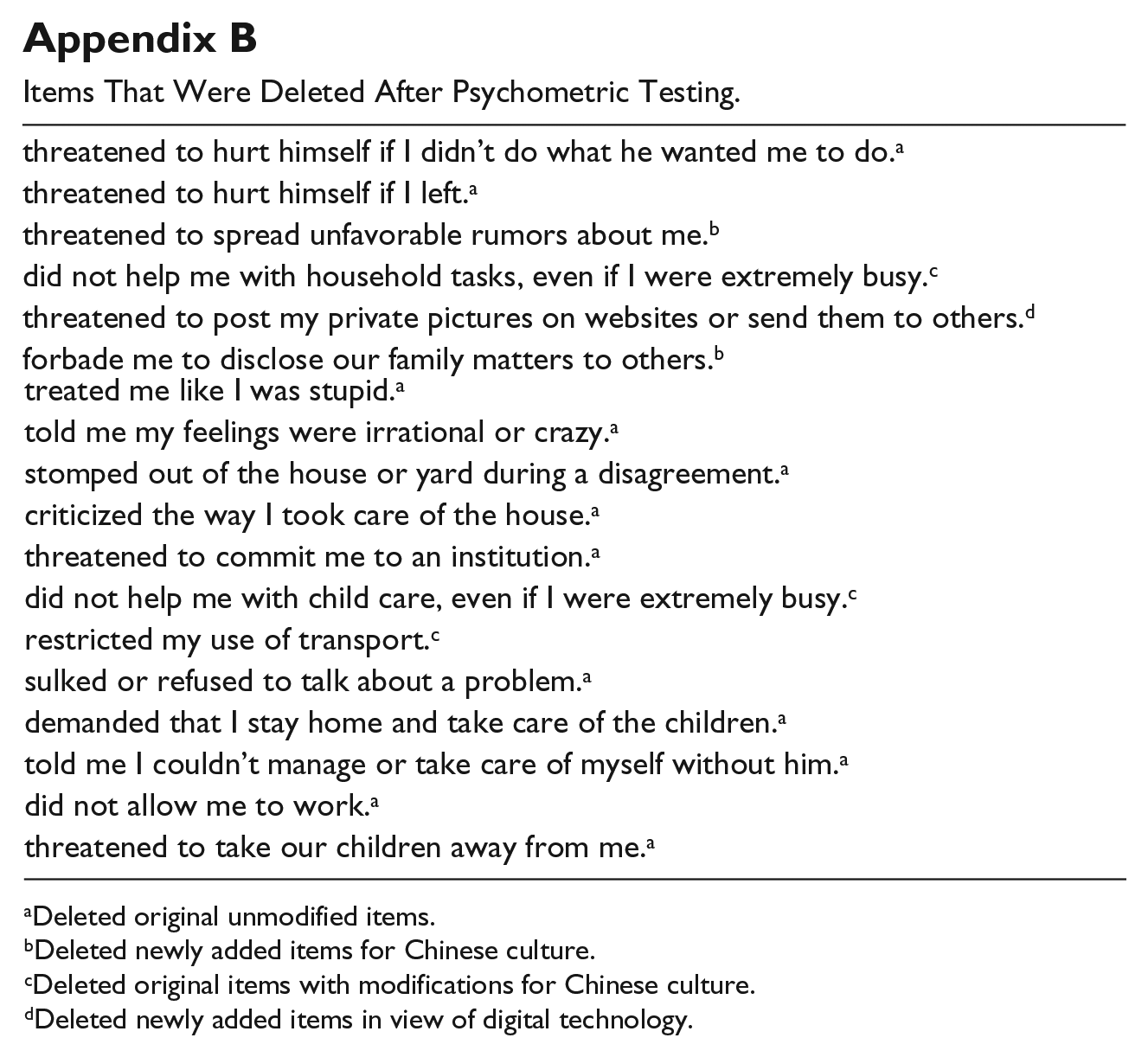
Items with communalities below 0.4 and proportion of respondents answering “never” higher than 90% were considered for removal. Finally, 18 items were removed (Appendix B) because (a) more than 90% of the participants answered never (e.g., “My partner threatened to commit me to an institution”) or (b) the items were not commonly regarded as psychological maltreatment in Chinese culture (e.g., “My partner demanded that I stay home and take care of the children”). Among the items updated with respect to digital technology, “my partner threatened to post my private pictures on websites or send them to others” was deleted because 98% of respondents answered “never.” Other items on monitoring or controlling through technological devices were reported by more than 30% to 40% of women who were physically or sexually abused. Therefore, 49 items remained in the final questionnaire (Appendix A).
The EFA was run again, using the reduced 49-item measure. The percentage of the total variance explained by the two factors increased from 46.623% to 51.923%. The corrected item-total correlation ranged from .516 to .765. Because the factor structure of the C-PMWI basically followed that of the original PMWI, the two dimensions were referred to as emotional-verbal and dominance-isolation as with the original version. Items with higher loadings on Factor 1 were assigned to Factor 1, and vice versa. Items with similar factor loadings for the two factors were assigned to the corresponding factor according to their semantic meaning. Factor 1, EV, consisted of 29 items about “verbal attacks, behavior that demeans the women, and withholding of emotional resources.” Factor 2, DI, included 20 items on “isolation from resources, demands for subservience, and rigid observance of traditional sex roles.” The factor loadings are shown in Appendix A.
CFA was used to cross-validate the factor structure of the instrument. With respect to the two-factor structure identified by EFA, modification indices were considered, and correlated errors for 24 pairs of items were allowed in the final model. The correlated errors were conceptually acceptable because these pairs of items reflected related behaviors. For example, “my partner gave me the silent treatment or acted like I wasn’t there” and “my partner withheld affection from me” both measure experiencing emotional withholding behavior. The statistics were improved after allowing these correlated errors in the model, and the model fit was standard (Table 2).
Goodness-of-Fit Statistics of the C-PMWI in Confirmatory Factor Analysis.
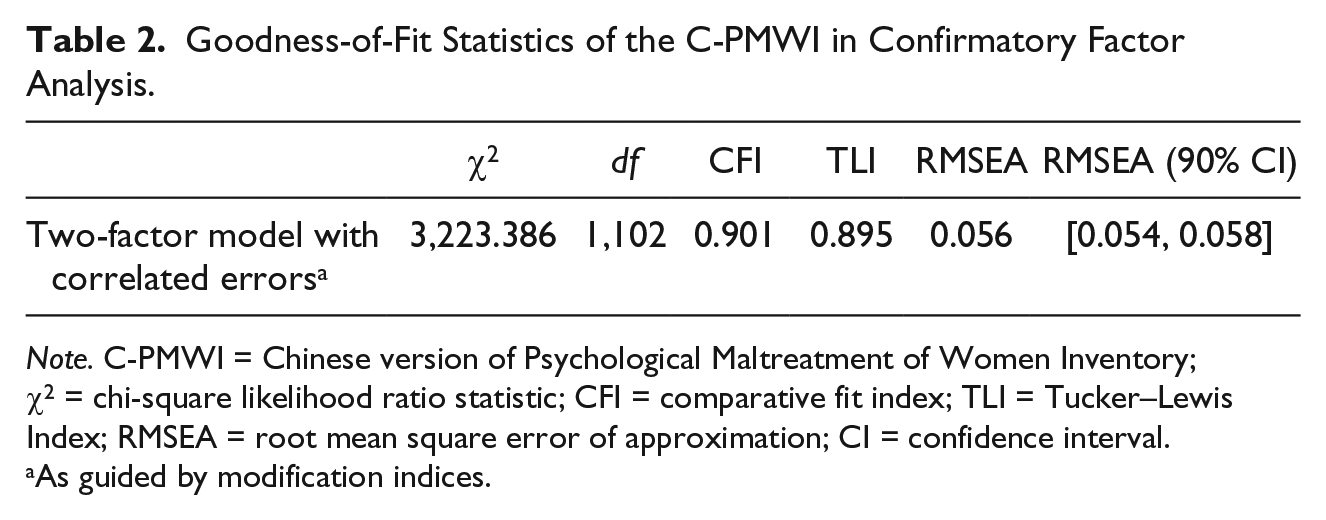
Note. C-PMWI = Chinese version of Psychological Maltreatment of Women Inventory; χ2 = chi-square likelihood ratio statistic; CFI = comparative fit index; TLI = Tucker–Lewis Index; RMSEA = root mean square error of approximation; CI = confidence interval.
As guided by modification indices.
Known-groups validity
To establish known-groups validity, C-PMWI scores of different subgroups of women expected to report having experienced different levels of psychological maltreatment were compared. First, regarding abuse history, as shown in Table 3, both the EV and DI subscale scores were found to be the highest among abused women and lowest among those in nonabused and satisfactory marital relationships. Differences for all possible group combinations were found to be statistically significant (p < .001). Second, with respect to source of recruitment, the C-PMWI scores of participants recruited from shelters for abused women were significantly higher than those of participants recruited from community centers (p < .001; Table 3).
Known-Groups Validity.
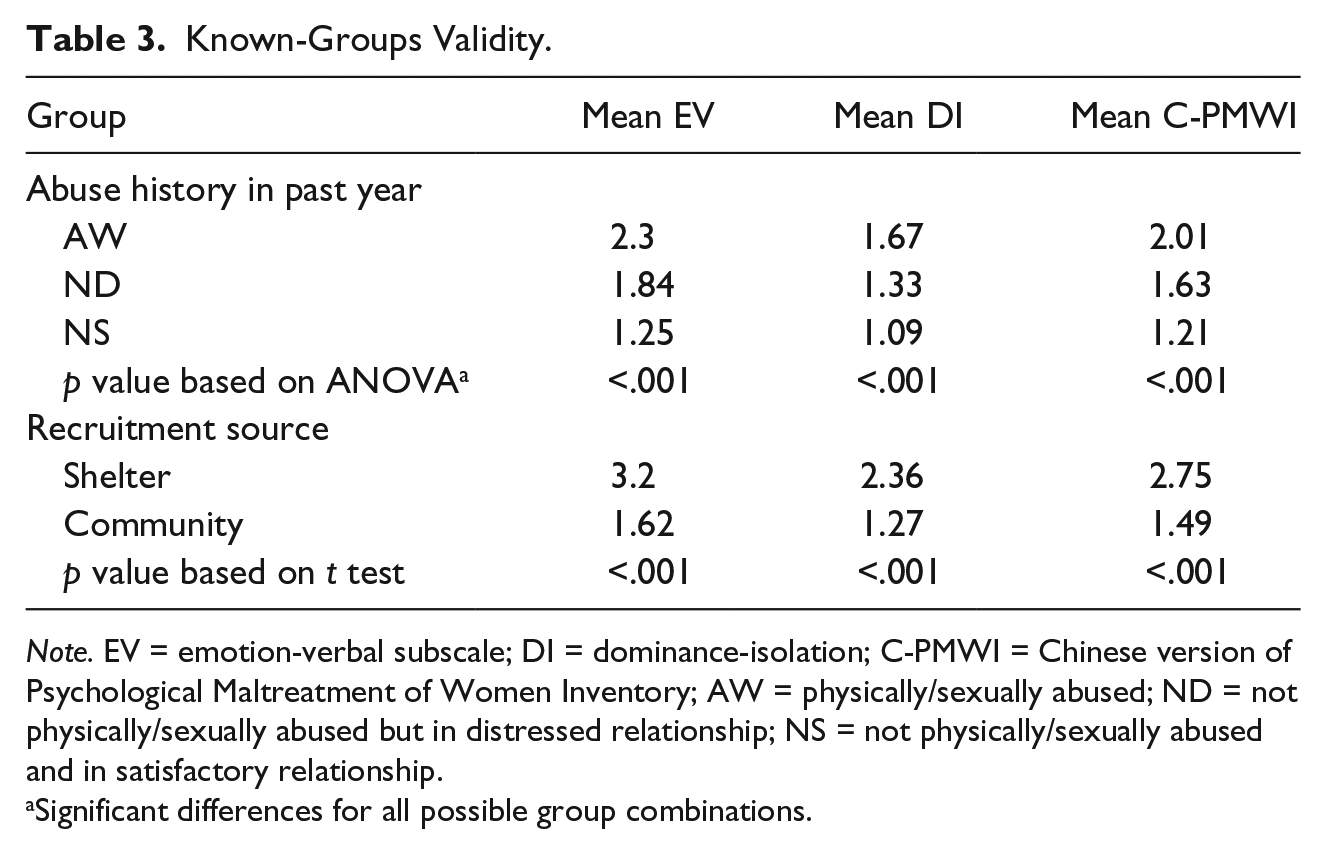
Note. EV = emotion-verbal subscale; DI = dominance-isolation; C-PMWI = Chinese version of Psychological Maltreatment of Women Inventory; AW = physically/sexually abused; ND = not physically/sexually abused but in distressed relationship; NS = not physically/sexually abused and in satisfactory relationship.
Significant differences for all possible group combinations.
Convergent validity
Evidence of convergent validity was examined by comparing participants’ scores of PMWI and other measures that assess related variables (Table 4). Both the EV and DI subscales of the C-PMWI were positively correlated with CTS2 subscales of physical abuse, psychological abuse, and sexual abuse, controlling behaviors as measured in CBS-R, as well as depressive symptoms as measured in BDI-II (p < .01). The C-PMWI was negatively correlated with marital satisfaction (p < .01). All correlations were consistent with the theoretical estimation, with magnitudes ranging from moderate to strong.
Convergent Validity-Association of Mean EV, DI, and C-PMWI With Related Variables.
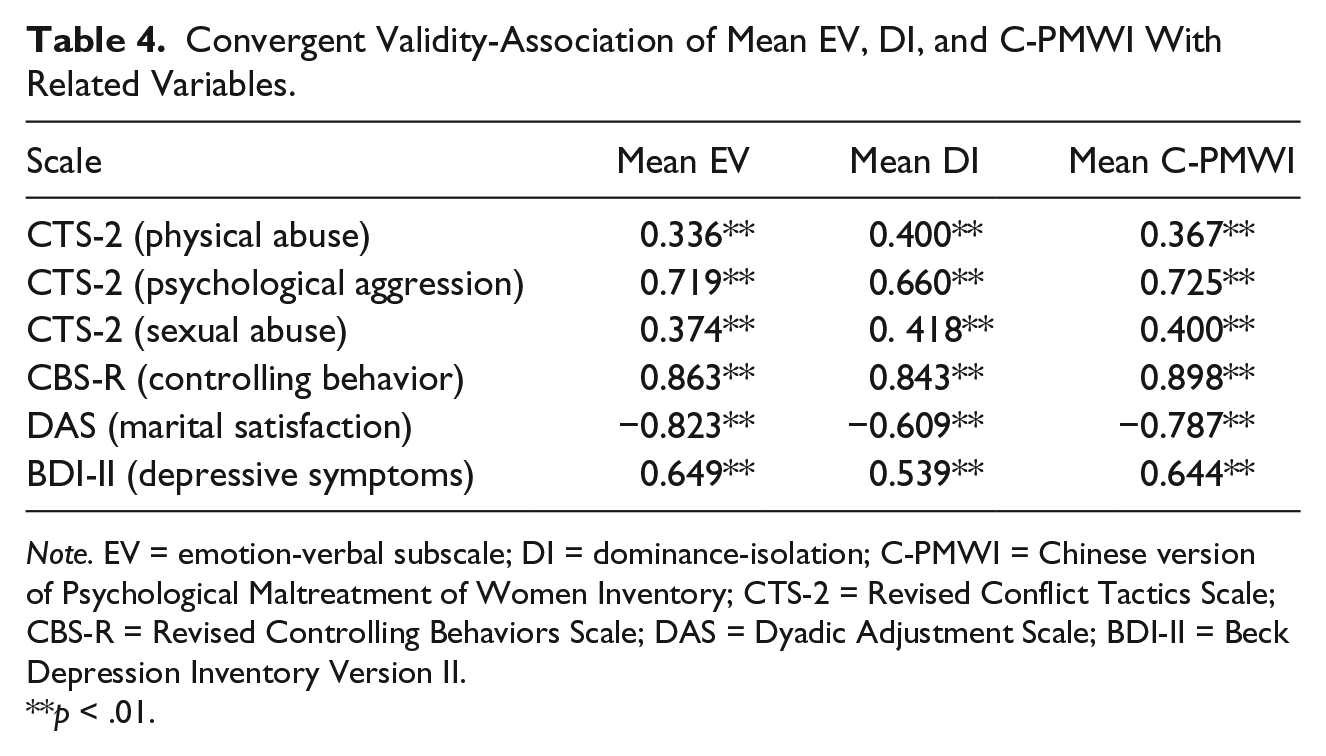
Note. EV = emotion-verbal subscale; DI = dominance-isolation; C-PMWI = Chinese version of Psychological Maltreatment of Women Inventory; CTS-2 = Revised Conflict Tactics Scale; CBS-R = Revised Controlling Behaviors Scale; DAS = Dyadic Adjustment Scale; BDI-II = Beck Depression Inventory Version II.
p < .01.
Reliability
Cronbach’s alpha for the entire scale was .975 while that of the EV and DI subscales were .966 and .947, respectively. Test-retest reliability analysis was performed on the reduced C-PMWI. Represented by the ICC, the entire scale showed excellent consistency across the two administrations 2 weeks apart (ICC = .912). The ICCs of the EV and DI subscales were .908 and .888, respectively.
Discussion
To create a culturally appropriate and updated PMWI to measure psychological maltreatment of Chinese women, we used item revision, forward and back translation, expert review, cognitive debriefing, and test–retest reliability assessment before conducting full psychometric testing. Results indicated that the adapted measure was easy to comprehend, clear, and stable over time. EFA provided the basis for item reduction. A two-factor structure (EV and DI), consistent with previous PMWI studies was verified by CFA. Other psychometric findings of the C-PMWI were comparable to those reported in the original validation study (Tolman, 1989, 1999), indicating satisfactory internal consistency, known-groups validity, and convergent validity.
Although C-PMWI, like the original PMWI includes two subscales—EV and DI, some of the items within the subscales vary. For example, “My partner put down my physical appearance”—is included in the DI factor in the original English version but loads on the EV factor for the C-PMWI. To Western women, this act may undermine a woman’s judgment about her own attractiveness and thereby lower her desire to meet others (Tolman, 1989). However, to Chinese women, being criticized about one’s appearance may carry an emotionally harmful nature worse than isolation. Tiwari et al. (2009) suggested that ridiculing personal traits of women may induce a shameful feeling, which is particularly hurtful to Chinese women because they are more sensitive to being shamed by actions than Western women are. Thus, this item may load on different factors between the Chinese and English versions. The slight difference in the factorial structure of the English and Chinese versions of the PMWI reinforces the need to culturally adapt the measure before introducing it in a new setting.
In this study, participants were classified as physically or sexually abused (AW), nonabused but in distressed relationships (ND), and nonabused in satisfactory relationship (NS) over the previous year. The mean score of the AW group was higher than that of the ND group as well as NS group while the ND group scored higher than the NS group. This finding further supported the notion that psychological maltreatment should be construed as a continuum. At one end, there is a very small degree of psychological maltreatment, which may be present even in satisfactory relationships without abuse history; along the continuum, varying degrees of psychological maltreatment may happen in distressed relationships; and at the other end, pervasive psychological maltreatment may be experienced by women with histories of physical or sexual violence. This finding supported the idea of continuum as proposed by Tolman (1992) and Follingstad (2007) with empirical evidence from the Chinese participants.
The findings of this study added weight to the importance of pragmatic methodological work to ensure cultural appropriateness of the C-PMWI and the expanded scope of psychological maltreatment in the digital age. Such work was not reported in the Thai and Spanish version of the PMWI. In the present study, items considered culturally inappropriate for Chinese women were modified. The revised item “my partner did not help me with household tasks, even if I were extremely busy” was one of the examples. From the full psychometric testing, it was found that the communality of this item was low according to results of the EFA, probably because this item, even after modification, is still not culturally appropriate to be considered as psychological maltreatment by Chinese women. Therefore, this item was removed. Although the process of cross-adaptation may take time and require repeated refinement of items, it is a better way to achieve cultural relevance of the measure for the target cultural setting (Beaton, Bombardier, Guillemin, & Ferraz, 2000). Thus, the current study sheds new light on measurement of psychological maltreatment in Chinese women.
Another unique feature of this study was the revision of the PMWI in view of the rising use of technology in psychological maltreatment (Finn & Atkinson, 2009; Fraser et al., 2010). Doing so can help to ensure that the C-PMWI will keep pace with changes in the digital age. In the past, abused woman’s whereabouts might be monitored by her partner through following and waiting outside her house (Rodenburg & Fantuzzo, 1993), reading her letters, and continuously calling her (Shepard & Campbell, 1992). Nowadays, perpetrators are able to monitor and control their partners more invasively with digitally based devices such as cell phones, the Internet, and cameras (Finn & Atkinson, 2009). Therefore, items like checking the computer, repeatedly calling or sending messages, and restricting the use of digital devices were added to the C-PMWI. In the present study, a proportion of women experienced being monitored or controlled by their partners through digital devices. The proportion is likely to become higher in the digital era. This finding confirms that new information technology is providing abusers easier and more intrusive ways to monitor and control their partners.
Limitations
First, the use of self-report measures runs the risk of recall and social desirability biases. The responses from the women may be influenced by their memories and also “face issues” related to the need to protect their family. Thus, some of the women may have underreported the actual experience. Second, the data were only elicited from the women. The single-source approach may result in an incomplete understanding of a phenomenon as complex as psychological maltreatment. Third, the study used a convenience sample. Majority of participants were recruited from the community. Although the participants were recruited from community centers in different districts in Hong Kong, the sample only included those seeking community and/or shelter services for abused women. Also, most participants were immigrants and not employed, who may be more vulnerable to IPV (Ahmad, Driver, McNally, & Stewart, 2009; Capaldi, Knoble, Shortt, & Kim, 2012). Thus, the representativeness of the sample and applicability of the adapted measure were limited.
Recommendations
First, future studies should integrate information about abuse and relationships from multiple sources, such as caseworkers, to avoid recall and social desirability biases and reveal aspects of the phenomenon that are not reflected by a single report of the victim. Second, future research on psychological maltreatment should recruit a more representative sample by adopting a random and more systematic sampling strategy whenever possible to maximize the representativeness of the sample. Future steps in research could be development of a shorter version of the C-PMWI based on the data on item descriptives and identified subscales in the present study, to foster inclusion in subsequent studies.
Research, Clinical, and Policy Implications
The findings of the present study yield a validated tool for measuring psychological maltreatment in Chinese women. In clinical settings, the tool can assist professionals such as physicians, nurses, family therapists, and social workers in eliciting a comprehensive picture of psychological maltreatment for informing the selection of interventions. Furthermore, data on prevalence of cyber forms of psychological maltreatment, hitherto unknown, allow issues of technology safety in the context of domestic violence to be addressed.
Footnotes
Appendix
Items That Were Deleted After Psychometric Testing.
| threatened to hurt himself if I didn’t do what he wanted me to do. a |
| threatened to hurt himself if I left. a |
| threatened to spread unfavorable rumors about me. b |
| did not help me with household tasks, even if I were extremely busy. c |
| threatened to post my private pictures on websites or send them to others. d |
| forbade me to disclose our family matters to others. b |
| treated me like I was stupid. a |
| told me my feelings were irrational or crazy. a |
| stomped out of the house or yard during a disagreement. a |
| criticized the way I took care of the house. a |
| threatened to commit me to an institution. a |
| did not help me with child care, even if I were extremely busy. c |
| restricted my use of transport. c |
| sulked or refused to talk about a problem. a |
| demanded that I stay home and take care of the children. a |
| told me I couldn’t manage or take care of myself without him. a |
| did not allow me to work. a |
| threatened to take our children away from me. a |
Deleted original unmodified items.
Deleted newly added items for Chinese culture.
Deleted original items with modifications for Chinese culture.
Deleted newly added items in view of digital technology.
Acknowledgements
We are grateful to the involved community agencies and shelters for assisting recruitment of participants and allowing us to conduct surveys, to Kallie Law, Polly Wong, and Margaret Lee for helping with data collection.
Declaration of Conflicting Interests
The author(s) declared no potential conflicts of interest with respect to the research, authorship, and/or publication of this article.
Funding
The author(s) disclosed receipt of the following financial support for the research, authorship, and/or publication of this article: The study was funded by the Small Project Funding, The University of Hong Kong (2011-2013).