



Abstract
Studies of informal support dyads are lacking to understand the disclosure of sexual assaults and social reactions informal supporters make to survivors. This study of 19 informal support dyads using interview data examined how three relationship types—significant others (i.e., romantic partners), family, and friends—differ in social reactions to sexual assaults in the context of drinking or alcohol problems. It was expected that alcohol’s role in responses to such disclosures would differ depending on relationship type as well as role alcohol played in the assault and/or in the survivor’s life or those in her social network, including the perpetrator. Results show that alcohol has mixed effects and that alcohol-related assaults as well as contexts where survivors, perpetrators, and/or their support networks have alcohol problems need further study to understand how such disclosures and social reactions occur and the impact they have on survivors, their relationships, and recovery.
At least half of sexual assaults involve drinking prior to the assault (Abbey, Zawacki, Buck, Clinton, & McAuslan, 2004). Most survivors disclose eventually to informal support sources, such as family, friends, and partners (Fisher, Daigle, Cullen, & Turner, 2003). Research shows differences in alcohol-related assaults (i.e., assaults with survivor and/or offender drinking), as compared with non-alcohol-related assaults, in terms of less acknowledgment of incidents as rapes, more drinking to cope with assault-related distress, less reporting to formal authorities, and more negative social reactions (e.g., blame, disbelief) when telling others (see Lorenz & Ullman, 2016a). Despite the prevalence of alcohol-related sexual assaults, most research examines assault disclosure and reactions generally without considering how pre-assault drinking or disclosing alcohol use influences the social reactions made to survivors. Given the prevalence of rape myths associated with drinking and sexuality (Grubb & Turner, 2012), alcohol-related assaults are likely to be much more complex than those not involving alcohol for survivors to disclose and support providers to respond effectively. This is because survivors who were drinking at the time of the assault are viewed as more blameworthy for their assaults (than those who were not) due to stereotypes regarding women who drink (i.e., rape myths) as loose and deserving of victimization. In addition, survivors may feel the assault is at least partially their fault having internalized stereotypes of women who drink as “asking for it” (Edwards, Turchik, Dardis, Reynolds, & Gidycz, 2011; Hammock & Richardson, 1997; Stormo, Lang, & Stritzke, 1997; Suarez & Gadalla, 2010).
Survivors who engage in pre-assault alcohol use to the point of incapacitation are more likely to disclose to informal, but not formal, support sources than survivors who were drinking but were unimpaired (Littleton, Grills-Taquechel, & Axsom, 2009). Both formal (e.g., police) and informal (e.g., family) sources might react negatively to survivors who were drinking. Whereas most survivors report receiving a mixture of both positive and negative social reactions, survivors of alcohol-related assaults report receiving more negative responses (Ullman & Filipas, 2001; Ullman & Najdowski, 2010) than those who were not drinking. In particular, women who experience alcohol-related assaults report more blaming, controlling, stigmatizing, and distracting responses from formal and informal support sources than survivors of non-alcohol-related assaults (Ullman & Filipas, 2001; Ullman & Najdowski, 2010). Thus, survivors who were drinking prior to assault may get fewer positive social reactions and face a more complicated recovery than survivors who did not drink. Although there is a considerable amount of research on social reactions received by survivors of alcohol-related assaults, there is little research that examines social reactions specific to pre-assault alcohol use (e.g., alcohol-specific social reactions), and even fewer studies that examine these social reactions through qualitative research methods. This research is needed, as there are notable differences in the experiences, disclosures, and social reactions of alcohol- and non-alcohol-related assaults (Ullman & Najdowski, 2010).
There are few qualitative studies that include an analysis of social reactions to survivors who engaged in pre-assault substance use including drinking. One study of social reactions from formal support providers such as law enforcement and prosecutors found that blaming reactions stemming from the survivor’s substance use can still be interpreted as supportive if the responder also provides emotional support (Dworkin, Newton, & Allen, 2018).
Research to date assesses only social reactions in general for survivors disclosing alcohol-related assaults (see Macy, Nurius, & Norris, 2006; Ullman & Filipas, 2001; Ullman & Najdowski, 2011). These results are largely mixed and fail to examine social reactions specific to survivors’ pre-assault drinking. Few studies to date have examined social reactions that specifically comment on the survivor’s pre-assault drinking, termed alcohol-specific social reactions (Relyea & Ullman, 2015). In a study of the larger database of survivors who completed mail surveys and from which the qualitative sample of the present study was drawn, those who drank prior to assault, who had more education and greater alcohol impairment or resistance during assault were more likely to disclose pre-assault drinking (Lorenz & Ullman, 2016b). Of women who disclosed their drinking, more educated women with more violent assaults received more negative social reactions specific to pre-assault drinking, especially from parents, police, or doctors. Less educated women received more positive and negative social reactions specific to pre-assault drinking. Disclosing pre-assault drinking in greater detail was related to positive social reactions specific to pre-assault drinking, and greater alcohol impairment during assault was related to more positive and negative social reactions specific to pre-assault drinking. Other analyses of the same data showed that alcohol-specific reactions were not related to depression, posttraumatic stress symptoms, binge drinking, or intoxication, but were related to greater characterological self-blame and alcohol problems (Relyea & Ullman, 2015). The link between alcohol-involved assault and social reactions highlights the importance of exploring the correlates of reactions related to pre-assault alcohol use. By understanding the disclosure and social support received following alcohol-involved assault, researchers can begin to develop and evaluate interventions aimed at improving social responses to survivors of alcohol-involved assault that may enhance the recovery process.
Present Study
Extant research highlights the influence of social reactions on recovery (see Orchowski, Untied, & Gidycz, 2013; Ullman, 2010; Ullman & Najdowski, 2011) and shows worse post-assault adjustment for survivors of alcohol-related assault who receive negative social reactions (Littleton et al., 2009; Ullman & Najdowski, 2010). Given the prevalence of alcohol-involved assaults, it is important to establish what factors lead to receipt of certain alcohol-specific social reactions. The present exploratory study examined processes involved in dyadic matched pairs of family, friends, and significant others disclosing and receiving social reactions related to alcohol and sexual assault. Although some important past qualitative research examined differences in social reactions from family, friends, and significant others in general (Ahrens & Aldana, 2012; Dworkin, Pittenger, & Allen, 2016), that work has not specifically focused on alcohol-related sexual assaults.
Quantitative findings of studies that examine alcohol-specific social reactions suggest more examination of disclosure and social reactions to alcohol-related assaults is needed and in greater depth than statistical analyses can provide. In addition, no studies to our knowledge have been published using dyadic matched pairs of survivors and informal support providers in relation to alcohol-related sexual assaults, disclosures, and social reactions.
Method
Participants
A sample of adult female sexual assault survivors were recruited through advertisements in the Chicago metropolitan area and had previously participated in a 3-year longitudinal mail survey study (N = 1,863) regarding their unwanted sexual experience and the social reactions they received when disclosing these experiences (see Peter-Hagene & Ullman, 2018, for study description). For the present study, women who indicated interest in being recontacted for interviews were asked to provide contact information for a friend, family member, or significant other who they told about an unwanted sexual experience. The support providers were contacted later for a separate interview that focused on their experiences helping survivors cope with unwanted sex. Interviews with survivors and support providers took place over 2 years, resulting in a sample of N = 45 matched pairs of survivors and support providers.
The present study included only matched pairs involving alcohol-related or alcohol- and drug-related assaults (n = 19). Survivors of this subsample were an average of 40 years old, and ethnicity was 42.1% African American, 31.6% White, 21.1% Other, and 5.3% unknown. Just less than half (47%) had children, 89% had attended or graduated from college, 26% were in school, and 37% were employed. Of the 19 matched pairs in the subsample, the majority described their relationship as friend (n = 13), followed by family (n = 4), and significant other (n = 2). Support providers were 39 years old on average, 68% female, and 31.6% African American, 31.6% White, 15.8% Other, and 21.1% unknown ethnicity. Half of support providers had children, 83% had attended or graduated from college, and 56% were employed.
Procedures
Face-to-face semistructured interviews were conducted by one of three trained interviewers on the research team, with length ranging from 30 min to 3 hr (average 1 hr). All survivors and support providers interviewed received US$30 for participation. After each interview, interviewers created brief summaries with noteworthy points, questions, thoughts, and feelings emerging from the interview. Interviews were audio recorded, transcribed, and checked by other members of the research team. The transcription process included adding brief summaries and lists of patterns. Interviewers did the final reviews of their transcripts, and following transcription, interviewers met to discuss emerging themes and patterns later used to develop a coding scheme.
Measures
Interview protocols for survivors and support providers focused on disclosure of the unwanted sexual experience, social support provided/received, social reactions and appraisals of those reactions, appraisals of the relationship, and the impact of disclosure on survivor’s recovery as well as on providers. Survivors were asked to tell the story of their unwanted sexual experience, at which point pre-assault alcohol use was disclosed to the interviewer. For the current study, we focused on just one aspect of the interviews: social reactions (positive, negative, mixed) to disclosure and appraisals of the reactions specifically related to the survivor’s alcohol or substance use/abuse. We also looked at social reactions codes (positive, negative, mixed) that may have had allusions to substance use and/or abuse in general among matched pairs where the survivor engaged in pre-assault alcohol use. We used these codes to try to get at any and all material that interviewees talked about that related to how others responded to their disclosures that included references to substance use/abuse.
Data Analyses
Each interview transcript was summarized to identify patterns and themes. Identified themes were discussed, as several trials of interview coding and refinement were used to develop a codebook covering individual interviews and themes reflecting the matched pair relationship. The codes were descriptive and summarized the primary topic of the excerpt (Saldana, 2012). We focused on substance use–related social reactions codes applicable to survivors and support providers, where they described the social reaction they received or gave, and how they appraised the quality of the reaction. We examined the context of codes by reviewing the transcripts and interviewer summaries when identifying relevant quotes.
Atlas.ti Version 7 qualitative analysis software was used for coding and analysis. We identified codes that made the most analytic sense of the data (termed “focused” coding; Charmaz, 2006) and used them to code transcript segments. We coded the data separately and compared interpretations to achieve consensus (Eisikovits & Koren, 2010) in several phases. First, pairs of coders coded each interview matched pair using the codebook. Second, one coder in the pair reviewed both coded transcripts to identify inconsistencies in assigned codes. Third, coders met to discuss interpretations until reaching a joint consensus version (Patton, 2002). In cases where agreement could not be reached or more than one code applied, we used double coding (i.e., simultaneous coding; Saldana, 2012). Fourth, coded transcripts were reviewed by the original interviewer for any further corrections to assignment of codes, which were discussed with coders until consensus was reached. During the coding process, coders created memos within transcripts to highlight relationships or inconsistences within interviews or between interview pairs, or to capture unanticipated themes (Charmaz, 2006). Including memos allowed us to pay attention to the relationships between and among matched pair interviews.
Analysis took place using an iterative process in several stages at both the individual level and matched pair level. First, queries were conducted in Atlas.ti software to identify the number of times each interviewee endorsed codes. Second, we individually reviewed quotes for each query to search for patterns. Third, we met several times to discuss identified themes and patterns, looking for similarities and contrasts within matched pairs and across the 19 dyads.
Results
Sample Characteristics
This sample of alcohol-related assaults was based on survivors who drank alcohol and/or used other substances prior to the assault (N = 19). Sixty-eight percent (n = 13) were using alcohol at the time of the assault, and 32% (n = 6) used both drugs and alcohol at the time of the assault. Forty-two percent (n = 8) were not incapacitated, 11% (n = 2) had difficulty speaking, 11% (n = 2) had difficulty moving limbs, 11% (n = 2) had difficulty walking, 5% (n = 1) were asleep, 5% (n = 1) were unconscious or blacked out, and three (15%) did not respond.
Of survivors who were drinking at the time of the assault, 82% (n = 14) of respondent/support providers knew about it and discussed this during the interview. Of the 14 survivors with support providers who knew about their pre-assault alcohol use, only 11 survivors actually disclosed to the support provider (i.e., three support providers found out about the survivor’s pre-assault alcohol use in another way). Among these 11 survivors, 9% (n = 4) mentioned it briefly to the support provider, 18% (n = 2) discussed it a little, 18% (n = 2) talked in a general way, and 27% (n = 3) talked about their pre-assault alcohol use in great detail. Ten survivors discussed during interviews that they were under the influence of alcohol or drugs at the time they disclosed their unwanted sexual experience. Thirteen (68%) survivors received social reactions specific to their alcohol use and discussed these social reactions during the interview. Twelve support providers (63%) discussed their social reactions with the survivor specifically based on pre-assault alcohol use.
Social Reactions From Different Relationship Types
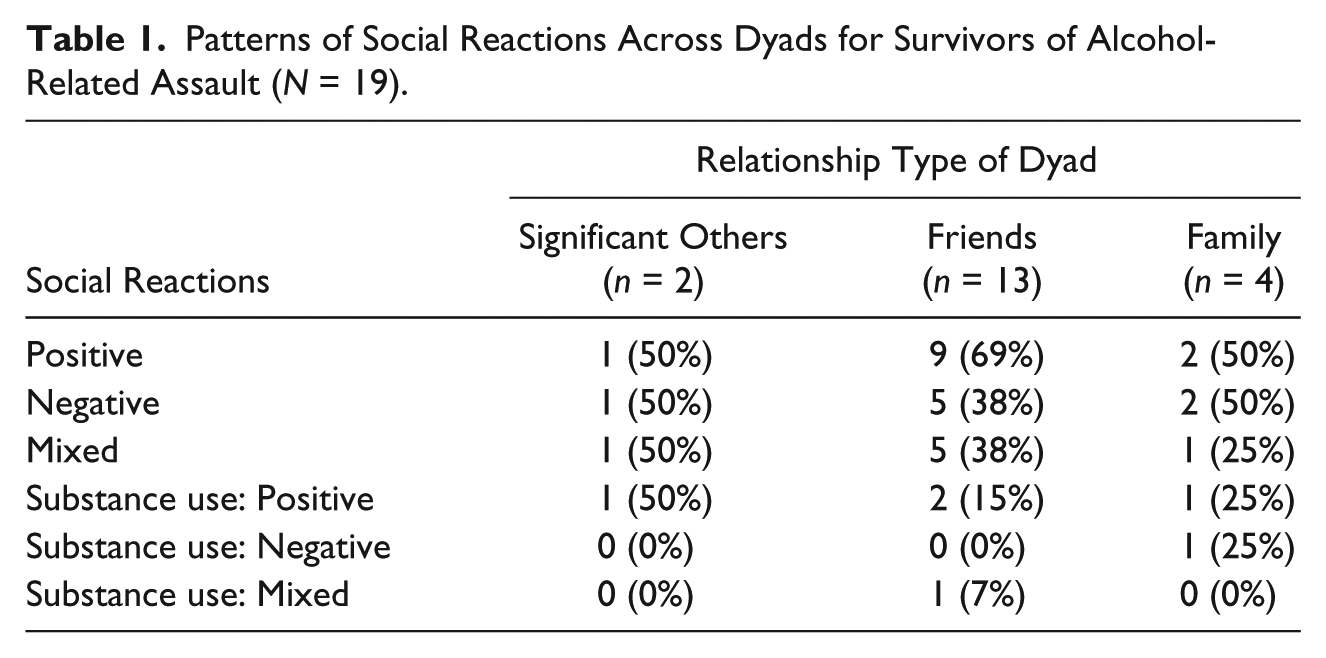
The sections that follow describe the social reactions (positive, mixed, negative) received by survivors in different types of relationships (significant others, family, friends). For counts of each social reaction pattern across the different relationship types, see Table 1.
Patterns of Social Reactions Across Dyads for Survivors of Alcohol-Related Assault (N = 19).
Significant others
Significant others included spouses and romantic partners at the time of the interviews, or in the past, in cases of ex-husbands or ex-partners told about assault in the past.
Positive reactions
Only two support providers of survivors of alcohol-related assaults were significant others. Of these two support providers, both responded to the survivor in a positive way, discussing in their interview how their past experiences allowed them to relate to the survivor and provide positive support. For example, one support provider witnessed his father abusing his mother when he was growing up. He explained in his interview that it is because of this experience that he knew how to approach his girlfriend when she disclosed her unwanted sexual experience. Another married matched pair discussed the positive support provided to one another related to the survivor’s unwanted sexual experience and leaving her previously abusive relationship but also in terms of providing support to one another for alcohol-abuse recovery. In this case, assault was viewed later on through the lens of assault risk being due to the survivor’s drinking in the past, which was no longer a risk at the time of the interview.
Since I’ve been sober, and I kind of brought some of these things back up, sometimes, a few times, his reaction was like, “What? You did what?” I say, “yeah, don’t you remember I told you?” (laughs) “Remember I told you that?” and, um, what did he say, but he’ll end it with “ok, but that was in your past,” you know, so “as long as you don’t . . . start back getting high anymore. I can, I know those things are not gonna happen.” You know so. (S)
Mixed reactions
One survivor discussed the mixed and nonverbal reaction she received from her long-term romantic partner, where he reacted with little emotion, as the survivor recalls, and did not do or say much after the disclosure except hug the survivor at the end of the conversation. The survivor also recalled his body language communicating disgust at what she had told him. However, the support provider characterized his immediate reactions as shock, so this might explain the discrepancy between the pair.
. . . He was just like, and he had an unpleasant look like, like a distasteful look, like not like I’m distasteful or anything but like it’s such a horror and that’s when I told him I was like telling him all these things and I was like kind of remembering and just spewing off stuff and then afterwards when we got out of the car he just hugged me and I was like sorry you had to listen to that . . . (S)
The survivor remembered being drunk during their first discussion of her victimization history and that she wanted to shock her partner with her disclosures. But she characterized him as someone who also has a history of drug and alcohol abuse and, therefore, he was not shocked by her disclosure. The pair has not had many follow-up discussions about the assault and the support provider expressed that he feels more discussions are not necessary. While her partner listened and asks some questions, which is positive, when the survivor becomes upset, he seemed to view this with a mixture of empathy and exasperation. He tried to deflect attention away from the unwanted sexual experiences when the survivor brought them up as a way to redirect what he perceives as rumination on a subject that is stressful to the survivor.
. . . F (survivor) likes to talk about her experiences, in general. She likes an audience. She is an actor. And so she likes that, and I am kind of used to it. Umm, and the only times I might question her a little bit more are probably more when I think she’s getting sad or upset. Ummm, which does happen from time to time. And then I might, you know, also try to change the topic. (SP)
Negative reactions
Many of the blaming reactions this survivor received centered on her history of drug and alcohol abuse. She was intoxicated at the time of one of the assaults, and many family members blamed her for this. Her significant other, the interviewed support provider, believed he does not need to tell the survivor that the assault was not her fault because he does not think she blames herself. At the same time, her significant other recalled a conversation in which he gave the survivor a blaming reaction. He believed the survivor would be able to tell that he did not mean to blame her but that he is merely expressing surprise at her actions.
And I mean I was stunned, I was like “how the fuck could you go to C (neighborhood) at night and why would you do something like that?” I don’t think I said that . . . But if I had, she would have, understand the context that I meant that in. You know, that’s dangerous. It’s not worth a bag of crack or whatever to do it. So I mean, I don’t think even if I had phrased it that way, that that would have been particularly surprising to her cause she would know what I meant by that. (SP)
This appraisal by her significant other may or may not be the case, as when the survivor was asked in her interview if he told them about the drinking when talking to others about this experience, she said,
They knew, there’s always alcohol present. I didn’t stop drinking until I met [current partner] really in 2001, other than that, I was drunk every day. I: Do you think that had any impact? S: Oh yeah, they think I was drunk, put myself in that position, I got what I asked for. (S)
Significant others relied on their own experiences with abuse to provide positive social reactions to survivors. Blaming reactions were commonly focused on survivor substance use during the assault. These reactions could also be accompanied by supportive reactions and could be communicated (and interpreted) through nonverbal actions, highlighting the complexity of how both positive and negative reactions can actually be intermingled in the same response.
Friends
Friends included current and past friends, a couple of whom had been romantic partners or spouses in the past but were now friends. Thirteen (68%) survivors of alcohol-related sexual assault disclosed to friends.
Positive reactions
One survivor described several unwanted sexual experiences, beginning when she was 18. When the survivor first disclosed to her friend about the most recent assault, the friend hugged her and responded positively. The support provider knew that alcohol was involved in the assault, and did not respond differently knowing that the survivor had been drinking. The support provider explained that she provided a positive reaction to the survivor, simply by being a person that the survivor could tell about her experiences.
Another support provider discussed her reaction and, following disclosure, her seeking of religious guidance about how to best support the survivor after the survivor disclosed her history of alcohol/drug-facilitated assault, child sexual abuse (CSA) and intimate partner violence (IPV).
I just basically tried to listen and ummm make her as comfortable as I could. I actually started praying for God to use me to help her, whatever way I could . . . all I wanted her to see was that I wasn’t judging her and trying to make her as comfortable as I possibly could, that was my objective and I don’t know if I was successful but that’s what I was trying to do. (SP)
This is the reaction from a support provider who was an Alcoholics Anonymous (AA) sponsor of the survivor, but they became friends.
Another survivor described how she disclosed to her friend while they were out with other friends at a bar. A casual conversation about date rape drugs led to her disclosing that she had been the survivor of a drug-facilitated sexual assault. The support provider was shocked and sad (see paragraph below). This pair had a long history of friendship and the support provider seemed sad at how easily the survivor was able to discuss the assault, almost as though she was desensitized to it. The survivor picked up on her friend’s genuine empathy for her, and while she and her friend talked about getting revenge, it was almost light hearted or joking. The survivor appreciated all her friend’s responses and interpreted them as the support provider caring for her in a way she had not previously realized.
Yeah, I was just like really sad. I remember wanting to cry . . . a lot because like, um, I don’t know. Just somebody so close that happened . . . to, just, and she was like completely like matter-of-fact about it. I was like “Ugh, ah, ahhhh!” Yeah. (SP)
The support provider did not remember his “revenge response” and even said there is no way he would have thought about revenge (not prompted by interviewer—all responses were confidential). The support provider also downplayed his response as being unremarkable and even “filler supportive stuff.” This could be because he said he was shocked at the time, but did not treat her differently due to her drinking. Still, perhaps he felt his response was not adequate even though it had a profound positive impact on the survivor. This could be due to the context of their friendship in that they were not spending very much time together when this interview was conducted. The disclosure occurred while both people were intoxicated, so intoxication could explain why the two diverged in their accounts of the disclosure.
Um, I, I’m sure I said, like the, the regular filler stuff just to like, you know, stall or pause for time or something so I could kinda collect myself, but it’s like “oh, that’s terrible, I’m so sorry, like. Who did blank, blank, blank, blank?” I’m sure it wasn’t anything that I remember so . . . it must not have been that, um, remarkable. Or, it’s just the regular, you know, filler supportive stuff. (SP)
This survivor appeared to perceive only getting positive reactions related to drinking, as when asked whether anyone blamed her because of alcohol, she said,
Fortunately, no and I’m really grateful for that. If someone would have said that to me I would have lost it (laughs). I would have went off [gotten angry] on them. (S)
Mixed reactions
Several (n = 5) survivors of alcohol-related assault received mixed reactions from the friends they disclosed to. One friend described his surprise that the survivor was able to remain composed during the disclosure.
It was kind of weird how she portrayed the story to me. I was like “wow was it really that bad?” [ . . . ] cuz I would be a little more traumatized by it. (SP)
Another support provider explained in his interview that he was unsure of how to react to the survivor’s disclosure because they had both been drinking at the time, and the support provider was “very drunk.” One friend discussed in her interview that her reaction was upsetting to the survivor because she provided a harsh response to her friend that she felt would help her in the end.
I told her somethin’ she didn’t wanna hear. I was like that’s probably touched you because it’s probably something you needed to hear. And she thought about it, oh she was so mad. She was mad at me. [ . . . ] They say the truth hurts. And it was something she needed to hear. (SP)
In this case, something that may have been viewed negatively in the literature was ultimately interpreted positively by the survivor—even though it upset her at first, because she understood her friend was well intentioned.
Negative reactions
Five survivors of alcohol-related assault received negative reactions when disclosing to friends. There were some friends who had what they perceived were negative social reactions specific to the drinking however. In one case, a friend was even aware of the possible harm of asking her friend about the alcohol aspect of what was a violent alcohol-related assault where the survivor, a teenager at the time, was choked by the offender into unconsciousness and did not know what had happened to her when she woke up in the house where they had both been partying with friends. The friend said,
I had to get myself together to ask her the next question, cuz you know I didn’t know if I should or if I shouldn’t, but I did it anyways. Cuz I’m her friend and I’m concerned. And I asked her you know, was like uh, I asked her, do you remember or can you recall anything happening before you blacked out? Do you remember like coming to during? You know and she just, she was like no. She didn’t ask any questions [about what happened to her]. She didn’t want to even think about it. And she just picked up her stuff and left. (SP)
This sounds like she not only had good motivations of concern for her friend but also knew asking her friend such questions might not be the right thing to do given the sensitivity of alcohol-related assault. The fact that the survivor left certainly does not indicate this was a positive reaction or at least not that she was willing or able to dialogue about it at the time.
This friend also said in her interview that she does not try to be her friend’s counselor and that the survivor is a caring, giving person, but being young did dumb things, but that that [assault] should not have had to happen. Then, she said what sounded like a more positive nonblaming social reaction to the survivor:
I was trying to explain to her that no matter what you done or what’s going on between you or your mother, this is not your fault because you want to go out and have a good time, you get a few drinks in you, and men take advantage of that, that’s not . . . your fault. And I think she was having a hard time understanding that cuz it was maybe if I didn’t go out, maybe if I didn’t get drunk, or smoke marijuana maybe this wouldn’t have happened to me. (SP)
Interestingly, some friends said “no” when asked by interviewers whether the alcohol part of the assault affected how they reacted, but then they would say things that showed in fact it may have affected their reaction, or said it affects other people’s reactions in general or how others responded to the survivor, but not their own reactions. According to the survivor, this one friend of many years was very supportive to her, more than anyone else in her life. Given that the survivor experienced a lot of self-blame and had negative reactions from others (e.g., police) or could not get really good support from others (e.g., family), having her friend not blame her and say it was not her fault was hopefully helpful.
For example, according to the support provider,
I mean I would guess for other people in her life that probably did make a difference (overlap) in their reactions. I think, um, probably, especially like with her dad. And, um, probably with her ex-boyfriend. I would probably like sort of like illegitimize some of her part of, I mean people who have that reaction like my dad, that’s like “Well, you were drinking with a guy alone.” (SP)
Another friend explained how the combination of her friend’s assault being by a mutual male friend of theirs and the assault being alcohol involved led her to initially disbelieve the survivor and give a negative reaction.
I think if like she hadn’t been drinking and he had been drinking though I do think that I would have believed her a lot sooner and been more supportive. (SP)
In her interview, the survivor explained she would not tell anyone she thought would blame her.
I feel like if I’m gonna tell somebody I was like assaulted, if I was gonna tell a person that means I trust them. And a person I trust would never be the type of asshole to be like “oh well, you were drinking” so I would not even be friends with them. I would hate that kind of person. (S)
She also said that her friend (the support provider) was supportive, saying that drinking is not an excuse, that is, just because someone is drinking does not mean you can assault them. She also did not think others blamed her for drinking either.
She said of another guy friend,
He knew that we were drinking, yeah, he knew. And I don’t think he had a problem with it. Like I don’t think he was like oh, you shouldn’t have been drinking. Because he knew he (the offender) was coming over and he knew that we were gonna drink because it was like summer and just sitting in the backyard drinking, like whatever. It really wasn’t something; it wasn’t even a concern. Like the concern was she just did this. You know what I mean? It wasn’t like “oh, well.” (S)
So, drinking was normative in her milieu, or the situation where the assault occurred, and was not something out of the ordinary that would have been used to blame her for being assaulted.
When the interviewer asked more about discussing alcohol’s role, the survivor spoke of her friend’s reaction of anger but then interpreted it as caring about her:
I don’t know, I’ve never really thought about it and now that I am thinking about it, it makes me nervous because what if he didn’t bring it up because he thinks I’m an asshole. Well maybe, cuz actually, I know this is a terrible thing to do, but after that happened and I talked to him, like it was like seven o’clock in the morning where he is so I like woke him up and after I went to a bar by myself and drank a beer. And when I told him that he was mad at me for like going out and drinking alone, like again. Like not again, but just going out like right after that [the rape] happened and like drinking. So I don’t, with (fiancé) I don’t feel like hurt by the fact that, I’m sure he knew, but the fact that he wasn’t like “oh, so what you were drinking,” like to me obviously he doesn’t care. He more cares like oh, are you okay, are you hurt, what happened, like what’s going on, how are you feeling? Like that’s caring more about like me than—you know what I mean? (S)
Finally, another friend emphasized that the relationship was more important than alcohol to the social reactions she received, saying,
I think the relationship history really outweighed that [alcohol], so I don’t really think that but, I know like, people weren’t validating enough, like, you know what I mean cause of my relationship history with him they were like, invalidating, like that was what they were the worst about. (S)
Overall, friends’ reactions to disclosure were perceived by survivors as mostly positive (n = 9), even if their reactions contained elements of blame (verbal or nonverbal). More friends provided positive (n = 2) than negative (n = 0) social reactions specific to pre-assault alcohol. Support providers were almost always aware of the ways in which alcohol could play a role in their reaction. Although not every support provider explicitly tried to mitigate the potential harm of survivors’ heightened self-blame due to alcohol use prior to the assault, many tried to communicate positive support to survivors who they knew had been drinking or under the influence at the time of the assault.
Family
Family included parents and now adult children, some of each who were survivors and in other cases support providers.
Positive reactions
In a mother–daughter pair, both the survivor and support provider described their relationship positively and explained how they were open with one another about most aspects of their lives. The survivor experienced several unwanted sexual experiences throughout her life, many of which involved drugs and/or alcohol, as the survivor had struggled with drug addiction issues in the past. In the interview, it seems that the survivor’s mother was there to help and care for the survivor throughout her life, but their relationship was better with the survivor recovered from her substance abuse issues. However, the survivor did not disclose her unwanted sexual experience to her mother until years later. The survivor described when she first told her mother about her unwanted sexual experience:
You know, she just tried to console me as much as she could . . . she had a really strong reaction. (S)
Similarly, the survivor’s mother not only explained the pain she felt hearing about her daughter’s unwanted sexual experience but also expressed that what happened was in part due to her daughter’s substance abuse issues:
It hurt me to see her like that . . . And then I cried about it, because I told her thank god that did nothing [more serious] happen to her . . . it was a very serious experience that she went through. And I hate this so bad, but there’s nothing I can do, but talk to her about that and tell her don’t get in that kind of situation. (SP)
Within another mother–daughter pair, the daughter recalled feeling angry and wanting to retaliate on behalf of her mother, but it does not seem as though she expressed these feelings to her mother based on her description below and how her mother understands the disclosure in the above quotes that she deliberately did not express those feelings to her mother. This showed remarkable presence of mind. The daughter was able to respond in the moment by stopping the conversation when her mother seemed overwhelmed and moved on to reassurance, empowerment (“don’t be ashamed”), and telling her that being on drugs did not make her mother more blameworthy.
The supportive, positive reactions from the young daughter to her mother fit within the larger context of their mother–daughter relationship. The mother struggled for years with drug abuse and the daughter took care of her other family members during that time, finally helping her mother stay sober for the last 5 years. The daughter remained supportive and loving of her mother and did not seem to have resentment toward her. There may have been elements of parentification in this pair, too, as having a drug-addicted parent is also a risk factor for children being parentified, or taking on more responsibility for their family members than is appropriate for the child’s age and role within the family (Stein, Riedel, & Rotheram-Borus, 1999).
And I love my brother to death no matter where he came from, he my brother. You know, and I always told my mother don’t be ashamed. You know, don’t hide in the corner and ball up. You know, you didn’t ask for that. That’s something that somebody does to you that you didn’t ask for. You know, whether if you was under the influence, under drugs or whatever happened, you shouldn’t have got that done to you. (SP)
In another case, the son was very supportive to his mother who told him about her assault saying,
He was like, I told him I was drinking and then he was like “that doesn’t matter.” He was like, you know, even if you were drinking that doesn’t give someone the right to touch you. He was like you still have rights as a human being. (S)
Mixed reactions
Other survivors had reactions that were more ambiguous and perhaps mixed in nature or indirectly blaming, such as a daughter who turned 21 and was drinking when she was assaulted. She had told her mother about prior assaults and did not want to tell her about the most recent one as she did not feel comfortable talking to her. This daughter also had mental illness that may have left her more vulnerable to repeated assaults she had experienced.
Regarding not telling her mother about the recent assault, she said,
You know, so but I don’t think she would say anything too bad, just like you shouldn’t have been drinking before you (overlap) 21, but not anything specific, just more so the same sort of thing like “oh, you know, you think she would have said you should have been at your grandma’s house. Not that it was your fault that it happened to you, but you still should have been at your grandma’s house.” (S)
In the interview, discussion focused on how the expected negative reaction was not directly blaming of the survivor, yet as a form of indirect blame or double message (e.g., it is not your fault it happened but you should have been in a different place at the time) led her to refrain from disclosing.
Negative reactions
In other cases, social reactions were not based on the assault but other factors such as the survivor’s drinking history. One survivor was not a drinker, so disclosing an alcohol-related sexual assault led to disbelief by most people she told, including her husband.
I told him [husband] that we had been, you know, and that was, like I said, that was one, the first reaction was, “You don’t even drink.” (S)
Other questioning from her (now) ex-husband appeared to be reappraised positively by the survivor to be him being supportive and/or perhaps she was rationalizing and/or defending the support provider, now her friend.
The only thing my ex-husband said was, we had been together, friends, we had been, you know, on and off friends, only thing he said was like, “Did he give you the alcohol? Did you drink it on your own?” You know, “Where did you-where did the alcohol come from?” And you know, questions like that, stuff like that, crazy stuff like that, then . . . (S)
When the interviewer queried why do you think he was asking those kinds of questions? The survivor replied,
At first I thought he was like attacking me, but then when we kept talking, I knew that he was just trying to get to the bottom of, to straighten it out in his own mind, you know, and I always respected him about, he never blamed, you know, he never—if he did, he never said it, and after that he just tried to make it easier for me. (S)
The survivor appears here to be struggling to make sense of his negative reaction to her, which was inconsistent with her generally positive feelings about him and that he never blamed her and was supportive afterward.
In some cases, negative reactions were avoided that survivors knew they would get from family if they disclosed, as one survivor explained.
The alcohol and the drugs didn’t make a difference with the family . . . with him [emphasized], you know, cuz I said, I never did discuss it with them [the family], the other stuff. You know, they don’t wanna know I was doing drugs and in an alley and got raped. That would make you looking worser. (S)
Similar to the previous types of relationships, familial pairs had mixed reactions that were mostly interpreted as positive by the survivors. Family members, who tended to have long histories with one another, were more likely than other relationship types to view the role of alcohol in the assault and their subsequent response to disclosure as linked to survivors’ longer struggles with addiction and substance abuse. These long, familial relationships also change over time, thus, the way survivors perceive alcohol-related social reactions is a dynamic process that unfolds over time within the context of the relationship.
Discussion
The present study was the first to examine dyads of ethnically diverse survivors and informal support persons (friends, family, significant others) they told about alcohol-related assaults. Dyadic data can yield greater insight into social reactions from both survivor and supporter perspectives, a growing area of qualitative interview research (see Eisikovits & Koren, 2010, for a review regarding qualitative dyadic research methods).
This qualitative study illuminates prior work in various ways by examining alcohol-related assaults separately according to relationship between survivors and supporters (family, friends, significant others). Although results showed both positive and negative reactions to these assaults, specific responses related to drinking of survivors were salient in some cases, with some asking survivors about why they were drinking, and supporters articulating the idea that if women take risks, such as drinking, they can expect to be assaulted. This is consistent with societal rape myths that shift blame from the perpetrator to the survivor (Suarez & Gadalla, 2010), and suggest the presence of rape myths specific to alcohol use where survivors are blamed for engaging in pre-assault drinking (e.g., suggesting that women who drink are behaving in ways that lead to victimization; Edwards et al., 2011).
Given the small ns, it is not possible to determine whether friends were more supportive in their responses to alcohol-related assaults. Past research shows that female friends are most supportive to survivors in general (Ahrens & Aldana, 2012), especially those who had experienced sexual assault themselves. However, this was not specific to alcohol-related assaults, so more research is needed to determine whether friends, and female friends in particular, are more supportive than family and significant others in response to these assaults. Support providers in this sample were largely female friends of survivors and provided no negative reactions directly related to the survivor’s pre-assault alcohol use. Conversely, family and significant others were more upset, angry, and questioning of survivors. Although overt blame was uncommon, implied blame and mixed messages about blame (mixed social reactions) occurred. Significant others did not provide any reactions specific to pre-assault alcohol use, but there were only two significant others in this sample. Survivors may not disclose pre-assault alcohol use to significant others and family members as frequently as friends, perhaps over concerns of receiving hurtful responses, which was the case of one survivor who discussed her fears of being blamed by her family for having been under the influence at the time of the assault. So, although the present study found differences in social reactions based on the relationship type—in support of previous research—future research should examine relationship differences in these types of reactions using a larger sample. With friends and significant others, relationship history of the survivor and perpetrator appeared to outweigh alcohol in judgments that were made, although this was only explicitly mentioned by one support provider. Negative reactions may have resulted in that case from the survivor being friends with the perpetrator or involved with him previously. Interestingly, when drinking was normative for the survivor or their social milieu, it was not used to blame the survivor in particular or at least that was the survivor’s perception. It makes sense that contextual factors are considered in making judgments about sexual assault, as survivors and support providers attempt to make sense of what occurred and why. Unfortunately, rape myths may influence how people view whether victims are blameworthy, even though supporters and survivors themselves may not always be conscious of this occurring (Edwards et al., 2011). On the positive side, survivors may give the benefit of the doubt to their close relationship partners and positively appraise what appear to be negative reactions in light of their knowledge that the person cares for them and wants what is best for the survivor. In some cases, support providers mentioned this explicitly in framing their negative reactions as not being harmful because the survivor knew what they meant or knew they had good intentions toward the survivor. In close relationships, the relationship history and inferred intentions of the support provider are likely to overwhelm the actual social reactions they make, as survivors look at them in light of all they know about their loved one or close friend (Dunkel-Schetter & Skokan, 1990).
Family dyads, that were mostly parent–child relationships in this study, were particularly illuminating in that children with parents who were survivors struggled to deal with the impact of the assault on themselves and to put on a strong face and be supportive to their parents, which appeared to lead to parentification or role reversal in some cases. In cases with parent supporters of their adult children who had been assaulted, they struggled to support their daughters but often also made judgments of their drinking behavior and/or coping post-assault, so support was perceived as mixed at best in some of these relationships. More research is needed to understand not only long-term effects on parents and children of disclosure and reactions to sexual assault but also how this traumatic event may alter the dynamics of these relationships in ways that has deleterious effects on both survivors and supporters.
Some negative reactions were reappraised as positive by survivors, confirming past research showing that survivor’s perceptions of the support provider’s intentions and/or simply seeing negative reactions in a positive light was common (Ahrens & Aldana, 2012). It is possible that reappraisals occur on an ongoing basis as disclosures unfold over time and more than one discussion occurs following the assault, which may also be influenced by how the survivor feels about herself and the assault and whether she was to blame. Given that we know that self-blame generally declines over time in sexual assault survivors (Koss & Figueredo, 2004), which then drives recovery (i.e., symptom reduction), we need further research on the process of disclosures, social reactions, and appraisals of both to better understand the dynamic, unfolding process over time within the context of different interpersonal relationships.
Some support providers talked about other people’s attitudes about alcohol-related rape and rape myths while not endorsing those attitudes themselves. Sometimes, it was hard to know how accurate they were about their social reactions to survivors, especially when survivors told us there were negative reactions that their support provider did not discuss in their interview. This finding makes sense in light of Davis and Brickman’s (1996) research showing that significant others and rape survivors rated levels of supportive behavior (from significant others to survivors) the same, but survivors rated unsupportive behavior as higher than significant others’ ratings of their own unsupportive behavior.
Some of the survivors seemed to get negative reactions and/or engage in self-blame due to their own drinking history or alcohol abuse, which was also discussed as being part of what led to some assaults. In such cases, there may be a double stigma with survivor blame by others including support providers and survivor self-blame for such assaults being compounded. This was often rather subtle, but could be seen when reading between the lines in some of the interview transcripts. For example, a survivor would be told “it’s not your fault that the assault happened,” but was also told they should not have been at the bar or been drinking, implying her behavior did make her culpable for the assault. Likely, the experience for these survivors is worse or at least different than for others, especially as they may have also experienced more assaults, due to their higher risk behavior. One spouse was particularly angry at his partner who told him about her assault but then went right back to the bar after being assaulted, as drinking was not only normative for her but also her way of coping with the assault. Anger at survivor’s risk taking and coping behaviors may have been evoked in those close to survivors where support providers lacked control over the survivor’s behavior that increased their risk of being assaulted. This is consistent with research showing that how survivors are coping and how symptomatic they are affects how they are treated by social network members (Silver, Wortman, & Crofton, 1990; Winkel & Koppelaar, 1991).
Limitations and Future Directions
While survivors were drinking, it is not clear in all cases how impaired survivors actually were when assaulted, so level of impairment should be assessed to understand how that affects survivors’ memories both of their assaults, disclosures, and social reactions. This is vital as past research has shown from survivors (Littleton et al., 2009) that some may simply not recall what happened, including who they told and how they reacted due to poor memory, even if they no longer drink and/or because it was long ago. It is important to say that just because memory is fuzzy or absent, does not mean survivors are not traumatized by being sexually assaulted, and some data suggest more self-blame and posttraumatic stress disorder (PTSD) over time for those who drink prior to assault (Kaysen et al., 2010; Read, Bachrach, Wright, & Colder, 2016; Peter-Hagene & Ullman, 2018).
Appraisals of social reactions may also change and be reflected in discussions of the assault over time between the survivor and support provider, as some interviewees alluded to. This is part of the process of recovery but may also reflect her relationship with the support provider and feelings about the person and the relationship at the time of the interview. This is part of why collecting dyadic data is so important to provide a more dynamic portrait of disclosure and reactions in the context of relationships that are dynamic over time (Eisikovits & Koren, 2010).
This study was limited by being a small, volunteer, convenience sample of dyadic matched pairs that most certainly were more positive in their relationships, disclosures, and social reactions by virtue of still being in relationships and willingness to do an interview on this topic. Support providers were contacted through survivor-provided contact information to do an interview about the survivor’s sexual assault experience and the disclosure and reactions she received from others, so the interview was primarily about their relationship with the survivor and her experience and not centered on their own experiences beyond helping survivors, given the nature of how they were recruited. Future research is needed of dyadic matched pairs of survivors and supporters recruited simultaneously with more balance of asking supporters about their own experiences. In addition, only one support provider was interviewed, but survivors often told multiple sources and may have received different reactions specific to their pre-assault alcohol use. However, limiting interviews to one support provider allowed for the survivor to provide more depth in responses related to the single support provider. This study is also limited by the retrospective design. Lapses in memory/recall could have influenced accounts of social reactions received and provided by matched pairs. Time elapsed since the assault and participating in this research may influence how women interpret these reactions and how support providers recall reacting to the disclosure. Most assaults occurred quite a while ago, with an average of 12 years since the assault (M = 12.3 years, SD = 11.7 years).
Although survivors and support providers were willing to talk about social reactions related to drinking prior to sexual assault and/or survivors’ problem drinking, this is a loaded topic and some interviewees, typically support providers, were likely highly sensitized to even the appearance of blaming the survivor or perpetuating rape myths. Given that they knew they were being interviewed about survivors’ experiences and brought in via the survivor, they may have also been more apprehensive and cautious about what they said, even though confidentiality was promised to both survivors and supporters. Naturally, some pairs may have talked to each other prior to or after interviews and participating may have affected their future discussions about sexual assault and their relationships. However, given that talking about sexual assault appears to be helpful to survivors with few reporting negative effects of participation and some positive effects on help seeking (Kirkner, Relyea, & Ullman, 2019), such a study may be an opportunity for dyadic matched pairs to reflect on this topic as well as their relationships.
Footnotes
Acknowledgements
The authors thank Mark Relyea, Rannveig Sigurvinsdottir, Amanda Vasquez, Liana Peter-Hagene, Meghna Bhat, Cynthia Najdowski, Saloni Shah, Susan Zimmerman, Rene Bayley, Farnaz Mohammad-Ali, Shana Dubinsky, Diana Acosta, Brittany Tolar, and Gabriela Lopez for assistance with data collection.
Declaration of Conflicting Interests
The author(s) declared no potential conflicts of interest with respect to the research, authorship, and/or publication of this article.
Funding
The author(s) disclosed receipt of the following financial support for the research, authorship, and/or publication of this article: This study was supported by a grant from the National Institute on Alcohol Abuse and Alcoholism (AA 17429) to Sarah E. Ullman, principal investigator.