



Abstract
Homicides by juvenile offenders have been of great interest to the public and policymakers in the United States for four decades. Despite the concern over young murderers, many analyses have been limited to small clinical samples. Empirical studies using Supplementary Homicide Report (SHR) data, a national database maintained by the Federal Bureau of Investigation, have largely concentrated on analyzing basic victim, offender, and offense data or exploring gender differences. Racial differences, when explored with respect to juvenile homicide offenders (JHOs), largely have concentrated on White and Black offenders, given the low percentage involvement of American Indians and Alaskan Natives, and Asian and Pacific Islanders. This article used 37 years of SHR data (1976-2012; n = 52,916) to investigate differences between the four racial groups (White, Black, American Indian/Alaskan Native, and Asian American/Pacific Islander). This article focused on three questions: First, did the offender and offense characteristics of all JHOs arrested during the study period vary by race? Second, did the characteristics of victims, weapons used, crime circumstances, and offender count in incidents in which JHOs killed single victims differ across racial groups? Third, are offender, victim, and offense characteristics predictive of racial classification? Bivariate and multivariate analyses were conducted. The findings revealed more similarities than differences across the racial groups. Multinomial regression analyses revealed, however, that several variables were found to distinguish racial groups of JHOs in a predictive way: region, location, White victim, family victim, gun use, and homicide circumstance. Importantly, American Indian/Alaskan Native and Asian/Pacific Islander JHOs significantly differed from White and Black JHOs. In contrast to media depiction, gang-related homicides were significantly more likely to involve Asian/Pacific Islander juveniles than juveniles from the other racial groups. Implications of the findings and directions for future research are discussed.
Murders committed by children and adolescents have been a topic of widespread interest in the United States since the mid-1970s (Heide, 1986; Morgan, 1975; Zimring, 2013). Dramatic increases in arrests of youth below 18 during the periods 1960-1975 and 1984-1993 raised great concern that killing by juveniles was reaching near epidemic proportions. Experts predicted “a bloodbath of violence” by youth as we approached the 21st century if the violent crime trend did not abate (Fox, 1995). The nation was warned about the threat of young “superpredators” (Dilulio, 1995), who were “so remorseless that they could kill, rape, maim without giving it a second thought” (“The ‘Superpredator’ Scare,” 2014). All too often the term “criminal predator” was used as a euphemism for “young Black male” (Welch, 2007). The term has been viewed as a contributing factor to mass incarceration policies enacted in the United States, including the 1994 Violent Crime Control and Law Enforcement Act, and became a focus of attention in the 2016 presidential campaign (Gearan & Phillip, 2016).
Fortunately, the predictions of continuing youth violence were wrong. Zimring (2013) concluded from his review of homicide arrests from 1960 to 2011 that homicide arrests of juveniles were no longer outpacing adults, and that arrests of both groups were close to a 45-year low (Zimring, 2013). In 2012, a total of 11,075 individuals in the United States were arrested for “murder or non-negligent murder” defined as “the willful (nonnegligent) killing of one human being by another” (Federal Bureau of Investigation [FBI], 2013). The age of the offender was known for 77% (n = 8,514) of these arrestees. Juveniles (youth below age 18) comprised 6.6% (n = 560) of these arrests. The ratio of juvenile to adult arrests in 2012, 1:15, was in stark contrast to the corresponding ratio 20 years earlier in 1993, 1:6.
Despite the attention given to juvenile homicides and inferences made about offender race, little is known about racial differences beyond White and Black youth, despite the fact that the Federal Bureau of Investigation (FBI) has historically compiled data on four racial groups in accordance with federal standards provided by the Office of Management and Budget: White, Black, American Indian or Alaskan Native (AI/AN), and Asian or Pacific Islander (A/PI). This lack of focus on racial differences is not surprising, given the racial distribution of juvenile homicide arrestees. In 2012, for example, of the 559 juvenile homicide offenders (JHOs) for whom race was known, approximately 98% were either White (47.2%) or Black (50.8%). Only 2% were AI/AN (1.8%) or A/PI (0.2%). The numbers of arrestees in the two smallest racial groups, 10 and 1, respectively, in 2012 pale in comparison with the numbers of White and Black offenders, 264 and 284, respectively, and make statistical analysis across the four racial groups impossible on an annual basis (FBI, 2013). This article utilizes 37 years of arrests of JHOs to examine racial differences among the four racial groups.
Literature Review
The literature on JHOs has been extensively reviewed (see Gerard, Jackson, Chou, Whitfield, & Browne, 2014; Heide, 2013; Heide, Roe-Sepowitz, Solomon, & Chan, 2012). Most of what is known about JHOs is about male teenagers who kill as they constitute the overwhelming majority of young killers. Analyses of more than 42,000 cases of juveniles arrested for murder in single-victim offender incidents during the 32-year period 1976-2007 revealed that 98% were 13 to 17 years old and 92% were males (Heide, Solomon, Sellers, & Chan, 2011).
Prior research with respect to race in the area of juvenile homicide has primarily focused on differences between Black and White JHOs (see, for example, Messner, Raffalovich, & McMillan, 2001; Ousey, 2000). Due to their low representation among JHOs in the United States, the vast majority of prior research has not devoted adequate attention to young homicide offenders of either Asian or American Indian origin. Numerous prior studies combined Asians and Native Americans, as well other racial/ethnic groups, into a single category and did not include them in the discussion of findings (see Busch, Zagar, Hughes, Arbit, & Bussell, 1990; Cornell, 1993; Cornell, Benedek, & Benedek, 1987; DiCataldo & Everett, 2008; Hughes, Zagar, Busch, Grove, & Arbit, 2009). Other studies excluded Asian and Native American JHOs, and limited their analyses to White and Black homicide offenders (see Chan, Heide, & Myers, 2013; Darby, Allan, Kashani, Hartke, & Reid, 1998).
Accordingly, very little is currently known regarding the characteristics of Asian/Pacific Islander and Native American/Alaskan Native JHOs. The inclusion of Asian and American Indian offenders in empirical analyses of JHOs is necessary for several reasons: First, prior juvenile violence research has demonstrated that greater acculturation to American society contributed to higher levels of violence among Asian youth (Lai, 2009; Mayeda, Hishinuma, Nishimura, Garcia-Santiago, & Mark, 2006). It is important to examine whether patterns of the most severe type of violence, homicide, have experienced change.
Second, the likelihood of living in structurally disadvantaged communities has been shown to vary by race. While American Indian youth are much more likely to grow up in impoverished and disadvantaged communities than Whites and almost as likely as Blacks to live in these types of communities, Asian youth, in contrast, have been found to be just as likely to live in higher class neighborhoods as Whites (McNulty & Bellair, 2003). Structural disadvantage has been consistently found to be a predictor of violence and homicide in prior research (Lanier & Huff-Corzine, 2006).
Third, available studies indicate that there are differences between American Indians involved in homicide relative to other racial groups. Bachman (1992) reported that compared with White and Black homicide offenders, American Indians were more likely to commit homicide using a knife or a shoulder gun and more likely to kill an acquaintance. Another study that examined both juvenile- and adult-perpetrated killings over a 20-year period indicated that homicide incidents involving American Indian victims differed from those that involved victims of other racial groups. American Indians were more likely to be killed by a stranger, a White offender, and in conflict-oriented homicides (in contrast to crime-oriented homicides), and less likely to be killed by a firearm (Greenfeld & Smith, 1999). Furthermore, in a study that assessed gender differences among JHOs, Heide and colleagues (2012) found that female JHOs were more likely to be White and American Indian. Conversely, male JHOs were more likely to be Black and Asian.
This study is designed to assess whether there are statistically significant differences across the four racial groups using Supplementary Homicide Report (SHR) data, which are collected and maintained by the FBI. The use of 37 years of national data makes it possible to assess to what extent there are meaningful differences in victim, offender, and case correlates among JHOs from varying racial groups. In the United States, the concept of Hispanic origin is separate from the concept of race. It was not possible to analyze ethnicity, such as Hispanic/non-Hispanic group membership, using SHRs because this database does not report ethnicity.
In light of the limited information currently available on racial differences among juveniles arrested for murder, this study is best categorized as an exploratory investigation. This research aimed to address three research questions using variables that are frequently used in homicide research to define the incidents and the victims and offenders involved. The first question was targeted at all juveniles arrested for homicide. The second and third questions were limited to JHOs arrested for killing a single victim due to limitations in the data set used, as explained further below:
This question was basically descriptive. The aim was to see if the races differed from one another on some basic offender correlates, such as age and gender. We were interested in seeing whether there was significant variation across the races with respect to incident characteristics, such as in what region of the country or in what setting (urban, suburban, rural) the murders occurred, in what time period did the killings happen, and what situations predominated with respect to the numbers of victims and of offenders. These analyses helped determine whether there were both significant and meaningful patterns across the racial groups.
This question was more targeted toward identifying the dynamics in murders by juveniles across racial groups. It was also empirically driven rather than theoretically based because no theory to our knowledge, for example, predicts which racial groups of juveniles are more likely to kill younger versus older victims, male versus female victims, family versus other victim types, and known victims versus strangers. In addition, no theory posits on the basis of race what weapons JHOs will use or the circumstances under which they will be involved in murder. Limited information that is available on weapon use comparing weapons used by 30 American Indian homicide offenders with the national percentages used by White and Black homicide offenders, for example, is not sufficient to make substantive predictions. The circumstances behind why different racial groups of juveniles kill appear to be based more on media depictions than hard data.
Analyses based on this question were undertaken to determine if offender, victim, and offense correlates significantly differentiated the JHO racial groups in a meaningful way. If patterns were observed, this research could be used to guide policy decisions with respect to prevention and intervention.
Method
As noted previously, inspection of Uniform Crime Report arrest data for any particular year reveals the difficulty of analyzing arrestees for all four racial groups due to the very limited number of cases of American Indian/Alaskan Natives and Asian/Pacific Islander offenders. Analyses of all four racial groups are only possible by combining multiple years of data. As such, we used a data set that included 37 years of arrests for murder and nonnegligent manslaughter, defined by the FBI (2013), as “the willful (nonnegligent) killing of one human being by another.”
This data set was constructed by James A. Fox from the SHR database for the period 1976-2012. SHR data are compiled from homicide reports, which are voluntarily submitted by local law enforcement agencies across the United States. Data from law enforcement agencies for cities of varying sizes, suburban areas, and rural areas for all 50 states and the District of Columbia are available in the SHR database. The participation rate of agencies is more than 90%; based on the data submitted, national estimates of murder are computed. Although a small percentage of murders go undetected or unreported, SHR data are widely regarded as the best source of information available on arrests for murder in the United States.
The FBI records arrests of individuals as young as 6 years old. Although JHOs are tried in different ways across the states and the age of majority varies, it is unlikely that jurisdictional practices or policies would affect whether a child who kills another person is arrested by police. Accordingly, arrests of individuals between the ages of 6 and 17 were selected to investigate racial differences among juveniles arrested for murder.
The race of the offender was known in more than 99% of cases involving juveniles, yielding a sample size of 52,916 JHOs. Although AI/AN and A/PI juveniles constituted less than 3% of all JHOs arrested during the 37-year period, a sufficient number of cases of these two racial groups were available for analysis: 469 American Indian and Alaskan Native juveniles, and 886 Asian and Pacific Islander youth below age 18. White and Black youth constituted 97.4% of all juvenile homicide arrestees during this period: 47.1% (n = 22,299) were White and 55.3% (n = 29,262) were Black.
The sample of nearly 53,000 cases represents national estimates of known arrests. Using imputed data was unnecessary because information for 10 of the 13 variables investigated was available for more than 99% of the cases. The remaining three variables, weapon used, homicide circumstance, and victim–offender relationship, had data available for 97.2%, 87.1%, and 85.7% of the cases, respectively. Cases with missing data were removed from only those analyses of the variable under examination.
Analytic Plan
Analyses of juveniles arrested for murder over the 37-year period proceeded in three steps consistent with the study’s objectives: The first set of analyses aimed to compare the characteristics of all JHOs arrested during the study period by offender’s race with respect to seven variables in two broad classes. These descriptor variables pertained to the offender and his or her arrest (age, gender, region, location, and time period) and offense characteristics (victim count and victim–offender situation). Region of the country in which the incident occurred conformed to the four values (Northeast, Midwest, South, and West) used by the U.S. Census Bureau to reflect Census Regions and Divisions of the United States (U.S. Census Bureau, n.d.-a). Location of the incident, as coded by the FBI, had four values (large city, small city, suburban, and rural). Arrests of JHOs were classified into three time periods, taking into consideration the continuous escalation in the percentages of juveniles arrested for murder from 1984 through 1993. Arrests that occurred from the beginning of 1976 to the end of 1983 were coded as occurring in the pre-epidemic period; those from 1984 through 1993, in the epidemic period; and those from 1995 to 2012, in the post-epidemic period. Victim count reflected the number of victims killed in the homicidal incident. Victim–offender homicide situation had four values to capture broadly the numbers of victims and offenders involved in the incident: single victim-single offender; single victim-multiple offender; multiple victim-single offender; multiple victim-multiple offender. The second set of analyses was designed to test for racial differences with respect to seven variables that pertained to victim and offense characteristics that might be related to offender race. These seven variables included victim age, victim sex, victim race, victim–offender relationship, weapon used, homicide circumstance, and offender count. The authors recoded the circumstances initially coded by local law enforcement agencies into four values: crime-related, to capture if the killing occurred during the commission of another crime; conflict-related, to reflect if the killing was the result of an interpersonal conflict, such as an argument or drunken brawl; gang-related, to indicate that the homicide was perceived by police as involving some type of gang activity; or other, meaning that the killing could not be classified into the other three categories.
Cross-tabular analyses were performed to test for significant relationships using the chi-square statistic for the first and second set of analyses. The probability level was set at .05. The Bonferroni correction factor was used to determine which values of the variables differed significantly from one another across the racial categories. Measures of association were computed in recognition that significance is easier to achieve in very large data sets. Given the nominal nature of the variables, phi and Cramer’s V were selected, and the strength of the association was interpreted in terms of the degrees of freedom. 1
The third set of analyses used multinomial logistic regression to determine whether certain variables distinguished different racial groups of JHOs. Logistic regression is an appropriate analytic technique to use when the dependent variables are nominal or categorical and the independent variables are continuous, ordinal, or nominal, including dichotomous (Champion & Hartley, 2010).
For the second and third sets of analyses, cases involving multiple victim situations were removed because inclusion of these cases in the analyses would confound the results given the construction of the SHR data set, which links a particular offender to only one victim. As shown in Table 1, during the 37-year period under review, more than 96% of the 52,911 JHOs for whom homicide situation data were available were arrested in connection with the killing of one victim. After the 2003 cases of JHOs involved in the killing of more than one victim alone (1.4%) or with accomplices (2.4%) were removed, 50,908 juvenile homicide arrestees remained.
Offender Demographic and Incident-Related Variables by Offender Racial Groups, All Incidents, 1976-2012.

Note. Racial group differences significant at the .05 level are denoted by different subscript letters (a, b, c, or d). Similar letters mean that differences are not significant.
Model fit statistics:
Offender’s age: χ2(3, 52916) = 23.87, Cramer’s V = .021, p < .001.
Offender’s sex: χ2(3, 52905) = 94.52, Cramer’s V = .042, p < .001.
Region arrested: χ2(9, 52910) = 5,429.67, Cramer’s V = .185, p < .001; south versus other: χ2(3, 52909) = 964.94, Cramer’s V = .135, p < .001.
Location arrested: χ2(9, 52914) = 3,804.06, Cramer’s V = .155, p < .001; large city versus other: χ2(3, 52915) = 2,547.5, Cramer’s V = .219, p < .001.
e Period arrested: χ2(6, 52916) = 475.28, Cramer’s V = .067, p < 0.001; 1984-1993 versus other: χ2(3, 52916) = 73.23, Cramer’s V = .037, p < .001.
Victim count: χ2(6, 52917) = 217.632, Cramer’s V = .045, p < .001.
Situation: χ2(9, 52911) = 322.09, Cramer’s V = .045, p < .001.
SV/SO = single victim-single offender; SV/MO = single victim-multiple offender; MV/SO = multiple victim-single offender; MV/MO = multiple victim-multiple offender.
Single-victim, multiple-offender situations can be kept in the analysis, provided care is used in interpreting results because victim data are inflated. Results should be reported in terms of the offender count and not the victim count. In this article, tables are constructed, and results are reported in terms of percentages of the different racial groups of offenders.
Results
All JHOs Compared on Descriptor Variables
As shown in Table 1, significant racial differences were found on the seven offender demographic and incident-related variables. The strength of the relationships on four of the seven variables (offender age, offender sex, victim count, and situation) was too low, however, as to be essentially meaningless even when degrees of freedom were considered. We identified these relationships in the manuscript as “technically significant, but with no real effect,” so that the reader would not be misled into thinking that these significant relationships were important differences. The effect sizes of two variables (arrest location, period arrested) were small. The remaining variable (region arrested) had a medium effect size. The descriptive data are valuable and reveal some interesting patterns worthy of note.
Offender age and offender sex by offender race (technically significant, but with no real effect)
More than 98% of JHOs were aged 13 to 17, and approximately 92% were male. White and American Indian/Alaskan Native JHOs more closely resembled each other with respect to age and sex. Conversely, Black and A/PI JHOs were more similar to each other than to the other racial groups on these two variables. American Indian/Alaskan Native and White JHOs were significantly more likely to be between ages 6 and 12 (3.4% and 2.1%) than Black and A/PI JHOs (1.7% and 0.7%). AI/AN and White JHOs were significantly more likely to be female (12.0% and 9.3%) than Black and A/PI (7.2% and 5.1%).
Arrest region by offender race (significant, medium effect size)
Arrests of JHOs were greatest in the South, 2 followed by the West 3 and Midwest, 4 and lowest in the Northeast. 5 Black youth (43.7%) were significantly more likely to be arrested for homicide in the South than the other racial groups. AI/AN juveniles (50.6%) were significantly more likely than White and Black youth to be arrested for murder in the West. A/PI youth (63.7%) were significantly more likely than all three other racial groups to be arrested in the West. AI/AN juveniles (2.6%) were significantly less likely than Black, White, or A/PI youth to be arrested for murder in the Northeast.
Arrest location by offender race (significant, small effect size)
Nearly 80% of JHOs were arrested in large cities (59.5%) or suburban areas (19.9%). The remaining 20% were arrested in small cities (12.6%) or rural areas (8.1%). Black and A/PI youth (68.7% and 66.9%) were significantly more likely to be arrested in large cities than their White and AI/AN counterparts (47.8% and 25.9%). White youth (26.7%) were significantly more likely than the other three racial groups to be arrested in suburban areas. AI/AN juveniles were significantly more likely to be arrested in rural areas (42.7%) compared with White youth (12.6%), and Black and A/PI youth (4.2% and 3.4%).
Period arrested by offender race (significant, small effect)
Nearly 46% of JHOs were arrested in the longest time period, the post-epidemic period, which spanned 19 of the 37 years. Approximately a third were arrested in the 10-year epidemic period, and about a fifth were arrested in the 8-year pre-epidemic period. Black youth became significantly more involved in homicide arrests during the 37-year time frame than White youth, although both increased across the three time periods. A/PI juveniles stood apart from the other three racial groups in significant statistically ways. Their involvement in the pre-epidemic period (6.5%) was far lower than the involvement of the three other groups. In contrast, arrests of Asian and Pacific Islander youth skyrocketed during the post-epidemic period relative to their counterparts. Nearly 64% of A/PI JHOs were arrested between 1994 and 2012, compared with less than 50% of JHOs in the three other racial groups.
Victim count by offender race (technically significant, but with no real effect)
Slightly more than 96% of JHOs were arrested for killing one victim. White and Asian and Pacific Islander juveniles (5.1% and 5.5%) were significantly more likely to kill multiple victims than Black youth (2.7%).
Homicide situation by offender race (technically significant, but with no real effect)
The percentage of lone JHOs who killed a single victim (47.0%) was close to those who acted with accomplices in killing a single victim (49.3%). A/PI JHOs were significantly more likely to be involved in single-victim, multiple-offender incidents (61.2%) than the other three racial groups (all less than 50% of all arrests).
Victim and Offense Characteristics in Single-Victim Homicides
Significant racial differences were found pertaining to victim and offense characteristics. Factoring in Cohen’s guidelines for degrees of freedom, there were no effects for three of these variables (victim age, victim sex, offender count) with respect to offender race. Effect sizes of three variables (relation with victim, weapon, circumstance) in relation to offender race were small. The effect size of victim race to offender race, however, was large. Observations that differentiate the groups are noted below.
Victim age by offender race (technically significant, but with no real effect)
As depicted in Table 2, 5% of JHOs were arrested for killing victims aged 5 or less. Approximately 50% of juveniles arrested for murder killed victims aged 13 to 24. The percentages of youth arrested for killing victims 25 and older decreased as the victim age category increased.
Victim and Offense-Related Variables by Offender Racial Groups, Single-Victim Incidents Only, 1976-2012.
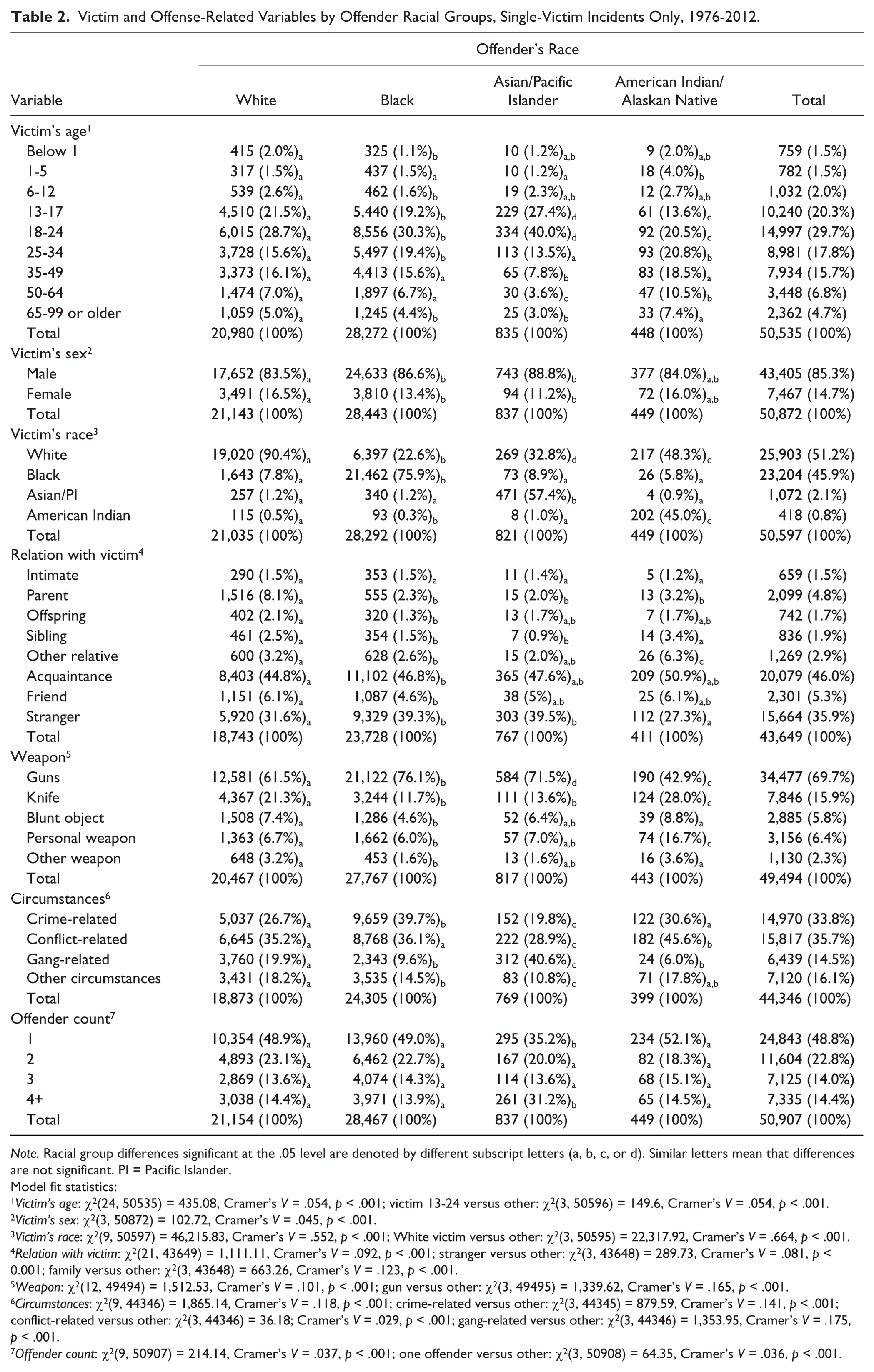
Note. Racial group differences significant at the .05 level are denoted by different subscript letters (a, b, c, or d). Similar letters mean that differences are not significant. PI = Pacific Islander.
Model fit statistics:
Victim’s age: χ2(24, 50535) = 435.08, Cramer’s V = .054, p < .001; victim 13-24 versus other: χ2(3, 50596) = 149.6, Cramer’s V = .054, p < .001.
Victim’s sex: χ2(3, 50872) = 102.72, Cramer’s V = .045, p < .001.
Victim’s race: χ2(9, 50597) = 46,215.83, Cramer’s V = .552, p < .001; White victim versus other: χ2(3, 50595) = 22,317.92, Cramer’s V = .664, p < .001.
Relation with victim: χ2(21, 43649) = 1,111.11, Cramer’s V = .092, p < .001; stranger versus other: χ2(3, 43648) = 289.73, Cramer’s V = .081, p < 0.001; family versus other: χ2(3, 43648) = 663.26, Cramer’s V = .123, p < .001.
Weapon: χ2(12, 49494) = 1,512.53, Cramer’s V = .101, p < .001; gun versus other: χ2(3, 49495) = 1,339.62, Cramer’s V = .165, p < .001.
Circumstances: χ2(9, 44346) = 1,865.14, Cramer’s V = .118, p < .001; crime-related versus other: χ2(3, 44345) = 879.59, Cramer’s V = .141, p < .001; conflict-related versus other: χ2(3, 44346) = 36.18; Cramer’s V = .029, p < .001; gang-related versus other: χ2(3, 44346) = 1,353.95, Cramer’s V = .175, p < .001.
Offender count: χ2(9, 50907) = 214.14, Cramer’s V = .037, p < .001; one offender versus other: χ2(3, 50908) = 64.35, Cramer’s V = .036, p < .001.
AI/AN juveniles were significantly more likely to be arrested for killing children aged 1 through 5 than the other racial groups. All groups differed significantly from one another in killing victims aged 13 to 17 and 18 to 24. A/PI JHOs (67.4%) were significantly more likely to be arrested for killing victims aged 13 to 17 and 18 to 24 than their Black (49.5%), White (50.2%), and AI/AN (34.1%) counterparts.
Victim sex by offender race (technically significant, but with no real effect)
More than 85% of JHOs were arrested for killing male victims. White juveniles were significantly more likely to kill female victims (16.5%) than their Black (13.4%) or A/PI (11.2%) counterparts.
Victim race by offender race (significant, large effect size)
As clearly shown in Table 2, nearly 97% of JHOs were arrested for killing White or Black victims. Notwithstanding this distribution, there is a large victim race effect. Each of the four racial groups was significantly more likely to kill members from their own racial group. However, there is considerable variation in the percentages of intraracial homicide. The percentages of JHOs arrested for killing victims within their own race were 90.4% for White JHOs, 75.9% for Black JHOs, 57.4% for A/PI JHOs, and 45.0% for AI/AN JHOs. Significant differences were found for each racial group with respect to killing White victims. As noted, 90.4% of White offenders killed White victims; comparable figures for American Indian/Alaskan Native were 48.3%; for Asian and Pacific Islander JHOs, 32.8%; and for Black JHOs, 22.6%.
Victim–offender relationship by offender race (significant, small effect size)
More than 80% of JHOs were arrested for killing acquaintances (46.0%) or strangers (35.9%). More than 3% of juveniles reportedly killed intimate partners (1.5%) or offspring (1.9%). Nearly 10% of juveniles arrested for murder killed parents (4.8%), siblings (1.9%), or other relatives (2.9%). The remaining 5.3% were arrested for killing friends.
There were no significant race differences in JHOs arrested for killing intimate partners. White juveniles (8.1%) were significantly more likely than their AI/AN, Black, or A/PI counterparts to be arrested for killing parents (percentages ranged from 2.0-3.2). A/PI and Black JHOs were significantly more likely to be arrested for killing strangers (39.5% and 39.3%) than White and AI/AN JHOs (31.6% and 27.3%).
Weapon used by offender race (significant, small effect size)
More than 85% of JHOs used guns (69.7%) or knives (15.9%) to kill their victims. The remaining 14% of JHOs used personal weapons (6.4%), blunt objects (5.8%), or other weapons, such as poison and drugs (2.3%). The four racial groups differed significantly from each other on the use of guns. Black JHOs were most likely to use guns (76.1%) followed by A/PI JHOs (71.5%), then by White JHOs (61.5%), and finally by AI/AN (42.9%). In contrast, AI/AN (28.0%) were significantly more likely to use knives than White JHOs (21.3%), A/PI (13.6%), and Black JHOs (11.7%). AI/AN were also significantly more than twice as likely to use personal weapons (16.7%) than the other racial groups (all 7% or less).
Circumstances by offender race (significant, small effect size)
Nearly 85% of JHOs were arrested in crime-related (33.8%), conflict-related (35.7%), or gang-related killings (14.5%). Different races predominated in these three homicide circumstances. Black JHOs (39.7%) were significantly more likely to be involved in crime-related homicides relative to AI/AN (30.6%), White (26.7%), and A/PI (19.8%) JHOs. In contrast, AI/AN JHOs (45.6%) were significantly more likely to be involved in conflict-related killings than JHOs who were Black (36.1%), White (35.2%), and A/PI (28.9%). A/PI JHOs (40.6%) were significantly more likely to be arrested for gang-related killings than their White (19.9%), Black (9.6%), or AI/AN (6.0%) counterparts.
Offender count by offender race (technically significant, but with no real effect)
Nearly half (48.8%) of offenders were arrested for killing one victim. Perusal of this chi-square analysis reveals two significant differences. Asian and Pacific Islander juveniles (35.2%) were significantly less likely than the other three racial groups to kill a victim alone. The distributions in the other three groups were between 49% and 52%. A/PI JHOs (31.2%) were significantly more likely to kill with four or more offenders involved than their counterparts who were Black (13.9%), White (14.4%), or AI/AN (14.5%).
Multinomial Logistic Regression
For the multinomial logistic regression analysis, we dichotomized the variables from the bivariate analyses reported above for which notable racial differences were observed. These included region of the country (South vs. other), location (large city vs. other), victim’s race (White vs. non-White), victim–offender relation (family vs. other), weapon used (gun vs. other), and homicide circumstance (crime-related, gang-related, and conflict-related). We ran the analysis with three models: In the first model, we defined the crime circumstance variable as a dichotomous distinction between crime-related homicides versus all others; in the second model, we replaced the crime-related variable with one that made a dichotomous distinction between gang-related juvenile homicides versus all others; and in the third model, we used a dummy variable distinguishing conflict-related homicides from all others. In Table 3, we report the odds ratios of the three homicide circumstances. Because the effects of the other independent variables in these models were relatively identical across these three models, we only report the odds ratios for their effects from the first of these three models.
Multinomial Logistic Regression of Juvenile Offender Race (Odds Ratio).
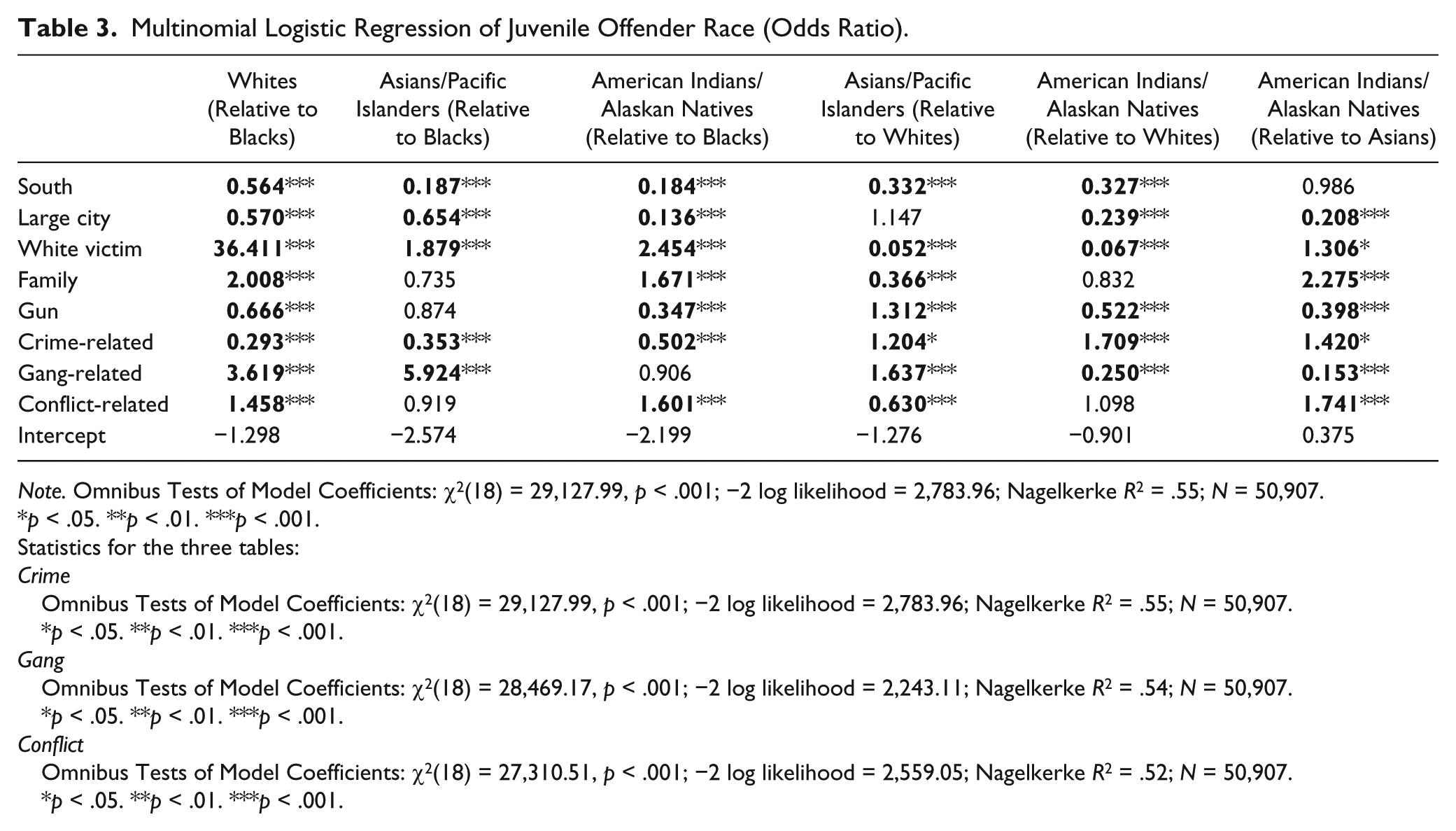
Note. Omnibus Tests of Model Coefficients: χ2(18) = 29,127.99, p < .001; −2 log likelihood = 2,783.96; Nagelkerke R2 = .55; N = 50,907.
p < .05. **p < .01. ***p < .001.
Statistics for the three tables:
Crime
Omnibus Tests of Model Coefficients: χ2(18) = 29,127.99, p < .001; −2 log likelihood = 2,783.96; Nagelkerke R2 = .55; N = 50,907.
p < .05. **p < .01. ***p < .001.
Gang
Omnibus Tests of Model Coefficients: χ2(18) = 28,469.17, p < .001; −2 log likelihood = 2,243.11; Nagelkerke R2 = .54; N = 50,907.
p < .05. **p < .01. ***p < .001.
Conflict
Omnibus Tests of Model Coefficients: χ2(18) = 27,310.51, p < .001; −2 log likelihood = 2,559.05; Nagelkerke R2 = .52; N = 50,907.
p < .05. **p < .01. ***p < .001.
An examination of the results of the multinomial logistic regression analyses of juvenile offender race reveals that all eight independent variables significantly differentiated White juvenile homicide arrestees from Black JHOs. JHOs who killed a White victim were 36 times more likely to be White than Black, and those who killed a family member were twice as likely to be White as Black. Gang-related juvenile homicides were almost 3.5 times as likely to involve a White offender than a Black offender, and conflict-related juvenile homicides were about 1.5 times more likely to involve a White offender than to involve a Black offender. Conversely, crime-related juvenile homicide incidents were 70% less likely to involve a White offender than a Black offender. In addition, juvenile homicides committed in large cities and those committed in the South were 33% and 43%, respectively, less likely to involve a White offender than a Black offender. Finally, juvenile murders involving a gun were 33% less likely to be committed by a White offender than by a Black offender.
Significant effects for five of these eight exogenous variables differentiated Asian/Pacific Islander JHOs from Black JHOs. For instance, gang-related juvenile homicides were nearly 6 times more likely to involve Asian/Pacific Islanders than to involve Black offenders. Conversely, crime-related juvenile homicides were 65% less likely to involve Asian/Pacific Islanders as offenders than to involve Blacks. White victims were 1.9 times more likely to be killed by Asian/Pacific Islander JHOs than by Black JHOs. Both the region of the country and large city variables also differentiated Asian/Pacific Islander JHOs from Black JHOs; juvenile homicides committed in the South were 81% less likely to involve Asian/Pacific Islander offenders than Black offenders, and juvenile homicides committed in large cities were 35% less likely to involve Asian/Pacific Islanders than Blacks.
Seven significant differences emerged when attempting to distinguish between American Indian/Alaskan Native JHOs and Black JHOs. For instance, White victims of juvenile homicides were 2.5 times more likely to involve American Indian/Alaskan Native juvenile offenders than to involve Black juvenile offenders. In addition, juvenile homicides involving family members were 1.7 times more likely to involve American Indian/Alaskan Native offenders relative to Black offenders. Conversely, juvenile homicides committed in large cities were 86% less likely to involve American Indian/Alaskan Native juvenile offenders than Black JHOs; likewise, juvenile homicides in the South were 82% less likely to involve American Indian/Alaskan Native JHOs compared with Black JHOs. Juvenile homicides committed with guns were 65% less likely to involve American Indian/Alaskan Native offenders than to involve Black offenders. Finally, while conflict-related juvenile homicides were 1.7 times more likely to involve American Indian/Alaskan Native JHOs than to involve Black JHOs, crime-related juvenile homicides were half as likely to involve American Indian/Alaskan Native juvenile offenders as Black juvenile offenders.
Seven of the eight variables significantly differentiated Asian/Pacific Islander JHOs from White JHOs. Gang-related and crime-related juvenile homicides were, respectively, 1.6 and 1.2 times more likely to involve Asian/Pacific Islander offenders than to involve White offenders. Conversely, conflict-related juvenile homicides were 37% less likely to involve Asian/Pacific Islander relative to White JHOs. Juvenile homicides involving guns were 1.3 times more likely to involve Asian/Pacific Islander than White JHOs. Finally, juvenile killings of White victims, juvenile killings of family members, and juvenile homicides that occur in the South were, respectively, 95%, 63%, and 67% less likely to involve Asian/Pacific Islander compared with White JHOs.
Six of these eight variables significantly differentiated American Indian/Alaskan Native JHOs from White JHOs. Crime-related juvenile homicides were 1.7 times more likely to involve American Indian/Alaskan Native compared with White JHOs; conversely, gang-related juvenile homicides were 75% less likely to involve American Indian/Alaskan Native than White JHOs. White-victim juvenile homicides were 93% less likely to involve American Indian/Alaskan Native relative to White JHOs. Finally, juvenile homicides committed in large cities in the South or with a gun were, respectively, 76%, 67%, and 48% less likely to involve American Indian/Alaskan Native compared with White juvenile offenders.
Finally, significant distinctions between American Indian/Alaskan Native JHOs and Asian/Pacific Islander JHOs were found among seven of the eight variables. Juvenile killings of a family member were about 2.3 times more likely to involve American Indian offenders relative to Asians and Pacific Islanders. White victims of juvenile homicides were 1.3 times more likely to involve American Indian/Alaskan Native JHOs than to involve Asian/Pacific Islander JHOs. Conflict-related juvenile homicides and crime-related juvenile homicides were 1.7 and 1.4 times, respectively, more likely to involve American Indian/Alaskan Native JHOs than to involve Asian/Pacific Islander JHOs. However, gang-related juvenile homicides were 85% less likely to involve American Indian/Alaskan Native than Asian/Pacific Islander offenders. Gun-involved juvenile homicides and juvenile homicides committed in large cities were 60% and 79% less likely, respectively, to involve American Indian/Alaskan Native JHOs than to involve Asian/Pacific Islander JHOs.
Conclusion
This study used 37 years of data from the SHRs in an effort to determine whether racial differences existed among juveniles arrested for murder in the United States. To the best of the authors’ knowledge, this study was the first to use nationally representative data to examine the characteristics of Asian/Pacific Islander and American Indian/Alaskan Native JHOs in depth. This research investigated whether the characteristics of offenders, incidents, victims, weapons, and circumstances varied by the race of the juvenile killer. In the first set of analyses, we focused on seven offender and offense characteristics. Not surprisingly, given the large data set, significant findings abounded with respect to the variables tested, clearly indicating that the racial groups differed from one another. The strength of four of the relationships, however, was so weak as to be meaningless. In contrast, two of the effect sizes of the seven relationships examined were small (location arrested and period) and one was medium (region arrested). We noted interesting racial patterns in the data and described them.
In the second set, analyses were limited to cases involving single victims, given the limitations of the SHR data set in linking more than one victim to offenders. We examined the relationships between offender race and seven other variables: victim age, victim sex, victim race, victim–offender relationship, weapon of choice, circumstance, and offender count. The relationships between offender race and these victim-related variables were all significant. Three of these relationships (victim’s age, victim’s sex, and offender count) were so weak as to be meaningless. Four had meaningful effect sizes. Three of these effect sizes pertaining to offender race and victim–offender relationship, weapon used, and circumstance, however, were small.
The relationship between offender race and victim race, in contrast, was large and not as predictable as one would think (Cramer’s V = .552). This finding was among the most important in the study as it revealed considerable variation in the race of the victims killed by juveniles across the racial groups. While 90% of White JHOs killed White victims, only 76% of Black juveniles killed within their racial group. The percentages of intraracial killings are lower for Asian/Pacific Islanders at 57% and lowest for American Indians/Alaskan Natives at 45%.
In the third set of analyses, multivariate analysis was used to determine if certain variables were predictive of the race of the JHO. The eight dichotomous variables entered into the multinomial logistic regression analysis were based on the bivariate analyses. Of the 48 comparisons made across the racial groups, 40 significant differences emerged. Clearly some variables do distinguish racial groups of JHOs in a predictive way, notably South, large city, White victim, family member, gun and type of homicide circumstance (crime-, gang-, or conflict-related).
Regression analysis found that American Indian/Alaskan Native and Asian/Pacific Islander juveniles involved in murder could be distinguished from White and Black JHOs. Gang-related juvenile homicides were much more likely to involve A/PIs than Blacks, Whites, or AI/ANs. Juvenile killers of White victims were also more likely to be A/PI JHOs than to be Black JHOs. In addition, gun-involved juvenile homicides were much more likely to involve A/PI JHOs than either White or AI/AN JHOs. In contrast, juvenile homicides of White victims, family members, and those arising from conflict-related circumstances were much more likely to involve American Indian/Alaskan Native JHOs than either Black or Asian JHOs.
The Present Findings in Relation to the Literature
The findings appear to be in line with some prior research on homicide and violence, particularly when the bivariate analyses are examined closely. First, as discussed above, Asian/Pacific Islander and American Indian/Native American homicide victims were significantly much less likely to be targeted by JHOs of their own race compared with White and Black homicide victims. This finding is to be expected from a simple social structure/demographic form of explanation (see Blau, 1977). Interracial homicides committed by minority offenders are demographically more likely when the size of the majority population greatly exceeds that of the minority population. A similar finding was reported by Greenfeld and Smith (1999), using 20 years of general homicide victimization data. A possible explanation for this finding is that A/PI and AI/AN may reside in less segregated communities, compared with Whites and Blacks, thus exposing them to juvenile offenders of different racial backgrounds.
Second, American Indian/Alaskan Natives JHOs examined in this study were significantly more likely to kill with a knife and during a conflict-related situation than JHOs in the other three racial groups. In an examination of a sample of 30 adult American Indian homicide offenders, Bachman (1991) reported that the majority of offenders in the sample killed with a knife (40%) and as a result of an interpersonal conflict (67%). The proliferation of knife and conflict-related homicides among American Indians may be attributed to frustration that stems from the structural disadvantage faced by many American Indians, as well as the strong culture of honor in Native American communities (Bachman, 1991; Lanier, 2010).
A similar explanation might account for the gun-related homicides associated with Black youth. Black JHOs tend to reside in urban neighborhoods characterized by severe disadvantage and poverty (see, for example, Krivo & Peterson, 1996), and some research has shown that fears of victimization increase the availability of firearms in these types of neighborhoods (Vacha & McLaughlin, 2004). Accordingly, homicides committed by Black JHOs are more likely to involve firearms.
Finally, Asian/Pacific Islander juveniles were significantly more likely to be involved in homicide in the post-epidemic era (1994-2012) than JHOs in the other three groups, as reported in Table 1. The exponential increase in the percentage of A/PI juveniles who committed homicide during the 1990s and 2000s may be partially related to the large waves of migrants who arrived in the United States in the mid- and late-1970s from war-torn Southeast Asia (Kim, 2016). Spencer and Le (2006), for example, reported that Asian youth who were raised by refugee parents were more likely to engage in serious violence (aggravated assault, rape, robbery, and gang-related fighting) than their counterparts who were not raised by refugees. This finding may be attributed to difficulties experienced by refugees in properly monitoring their children due to their traumatic past and consequent mental health issues (Nicholson, 1997). Moreover, prior research has found that children of immigrants are more likely to engage in violence than first-generation immigrants (Sampson, Morenoff, & Raudenbush, 2005). However, this explanation is understandably speculative. To reach more definitive conclusions regarding the reasons for the increase of youth involvement in homicide among Asians and Pacific Islanders, this category of JHOs needs to be further disaggregated by national origin.
Implications of the Findings
One could argue that given the plethora of relationships tested, race does not appear to be very discriminating. The data do reveal more similarities across racial groups than differences. We interpret these findings positively as they indicate that in some respects, such as offender age and sex, offender race does not matter. In addition, the number of victims killed, the number of offenders involved, the type of homicide situation, and the age and sex of the victim are not meaningfully related to the race of the juvenile. These findings suggest that the reasons juveniles kill are not heavily determined by their racial group membership. Rather, other factors are influencing their behavior and poor decision making. Two long-term research studies in Pittsburg and Chicago, for example, identified psychological and sociological variables related to youth involvement in murder (see Loeber & Farrington, 2011; Zagar, Busch, Grove, Hughes, & Arbit, 2009).
Notably, the lack of substantive racial differences found among many offender and victim variables does not lend support to the notion of “superpredators,” who have been stereotypically portrayed as Black youth. Dissemination of these findings is imperative to counter common assumptions about race and violence that are often held by the general public in light of media reports. In addition, the racial invariance observed for most of the correlates of juvenile homicides suggests that neither race-specific theoretical explanations for juvenile homicide nor race-specific policies and interventions are necessary.
At the same time, we did find significant and meaningful differences with respect to region of the country, location, victim race and victim–offender relation, weapon used, and crime circumstance that could be used in investigating homicides. For example, if a killing by a juvenile occurs in the South, it is more likely that the offender is Black than White, A/PI, or AI/AN. At the same time, it is more likely that this killer is White than A/PI or AI/AN. These findings are consistent with a southern subculture of violence thesis to which both Blacks and Whites have much longer histories of exposure (Butterfield, 1995). If a homicide believed to be committed by juveniles is gang-related, it is far more likely to involve an Asian/Pacific Islander than a Black, White, or American Indian/Alaskan Native. Accordingly, law enforcement would be wise to look for A/PI youth, but only if the killing is in an area of the country that has a significant Asian/Pacific Islander population. This finding is particularly illuminating because it is in sharp contrast to the frequently held belief that if juveniles are involved in a gang-related killing, they are likely to be Black youth.
The data with respect to crime-related killings can be useful to police taking other factors into account. For example, if the killing by juveniles is a by-product of another crime such as robbery, it is less likely to be committed by White, A/PI, and AI/AN JHOs than by a Black JHO, but more likely to be committed by an AI/AN than a White or A/PI JHO. Accordingly, depending on the geographic region or location, police might look for a Black or AI/AN youth. As previously mentioned, Black and AI/AN youth are more likely to live in disadvantaged communities than White and Asian youth, which may explain their higher chance of involvement in homicides that stem largely from instrumental crimes. Moreover, this finding is relevant to the subculture of violence hypothesis, which contends that youth in disadvantaged minority communities are particularly prone to commit serious and lethal violence due to adopting values that promote the use of violence (see Anderson, 2000; McGloin, Schreck, Stewart, & Ousey, 2011; Stewart & Simons, 2006; Wolfgang & Ferracuti, 1967). One method of combating crime-related homicides would be to revitalize socioeconomically deprived communities, to reduce the incentive to commit economic crimes and weaken the effect of violent subcultures.
Limitations of the Data and Directions for Future Research
We recommend that future research be conducted in four areas: (a) multiple victim homicides committed by juveniles; (b) correlates of juvenile homicide within the individual periods that include the pre-epidemic, epidemic, and post-epidemic periods; (c) broadening the racial analyses from simply White and Black JHOs, if possible, to include Hispanic and White and Black non-Hispanic JHOs; and (d) more in-depth analysis of JHOs’ social histories, levels of functioning, motivational pathways, and their crime scene behavior (see Adjorlolo & Chan, 2017). As discussed previously, we excluded homicide incidents involving multiple victims in the bivariate analyses involving the relationship between race and victim and offense characteristics, and also in the regression analysis due to the construction of the SHR data set. This decision resulted in the loss of 3.6% (n = 2,003) of JHO cases. It is unknown whether the racial differences observed in single-victim incidents would apply in multiple victim cases. Further research in this area is warranted.
This study found significant racial difference in the percentages of JHOs when the 37-year time frame was divided into the pre-epidemic, epidemic, and post-epidemic periods. The percentages of White juveniles and American Indian/Alaskan Native juveniles arrested for murder in the pre-epidemic period (1976-1983) were significantly higher than the percentages of Black JHOs and Asian JHOs. Notably, the percentage of Asian/Pacific Islander juveniles arrested during this time period was significantly and noticeably much lower than those of the other three racial groups.
Interestingly, the percentage of Black juveniles arrested for murder in the epidemic period (1984-1993), however, surpassed the percentages of all three of the remaining groups. It was, perhaps, this proportionate increase in homicide arrests that lent initial support to the superpredator theory.
Juvenile arrests for homicide in the post-epidemic period indicated, in sharp contrast to earlier periods, that the involvement of Asian and Pacific Islander in murder has dramatically changed. The percentage of A/PI youth arrested from 1994 to 2012 significantly surpassed those of all three of the remaining racial groups. Also, noteworthy, the percentages of AI/AN JHOs and Black JHOs during this period were significantly higher than the percentage of White juveniles arrested for murder.
These changes in arrest patterns suggest that juvenile homicide may be changing over time. Interestingly, the proportion of the U.S. population identified as White has declined from 87.5% in 1970 to 72.4% in 2010. During the same period, there have been noticeable increases in the percentages of the population in the United States identified as Black (from 11.1%-12.6%) and as Asian/Pacific Islander (from about 1.4%-5.0%; U.S. Census Bureau, n.d.-b).
Given the study design, it was not feasible to analyze the descriptor, victim, offense, and case-related variables and to develop regression models for each of the three time periods. We recommend that future studies investigate the demographic correlates, racial differences, and the regression model results to see if the findings in this study hold for White, Black, American Indian/Alaskan Native, and Asian/Pacific Islander JHOs when examined across the three individual time frames. An analysis of the three time periods would be very helpful in determining if racial patterns change over the 37-year time period.
The SHR data set is limited to basic victim and offender demographic data (age, race, gender) and incident-related data (e.g., victim and offender counts, victim–offender relationship, homicide circumstance, and weapon used). As noted earlier, this data set does not include information on ethnicity, which is a significant limitation, particularly in light of the increasing Hispanic population in the United States from 4.5% in 1970 to 16.3% in 2010 (U.S. Census Bureau, n.d.-b). Hispanics have been found to be engaged in violence at a higher rate than non-Hispanic Whites, and at a lower rate than non-Hispanic Blacks in prior research (Steffensmeier, Feldmeyer, Harris, & Ulmer, 2011). Accordingly, comparing Hispanic JHOs with JHOs of other racial/ethnic groups would be an interesting endeavor for future scholarly investigations.
The database also does not contain many variables that would likely be helpful in understanding these juveniles and the pathways that might have played a role in their arrest for murder, such as psychological factors (e.g., mental health history, drug abuse history, executive function, psychiatric diagnosis), sociological factors (e.g., family structure, household income, unemployment, history of childhood maltreatment), and legal factors (e.g., prior arrest history, prior dispositional history). Studies that have included variables such as these could serve as blueprints for a national database of juvenile homicide arrestees (see Loeber & Farrington, 2011; Zagar et al., 2009). This suggestion may seem grandiose but could be accomplished, particularly now that arrests of juveniles have decreased to far less than a 1,000 cases nationally per year. The Murder Study in England serves as an excellent model for an intensive research project that moved beyond an existing national database to gather more information about the murders, the circumstances under which they occur, and the individuals involved, especially the lives of the offenders and their interactions with the victims (see Dobash & Dobash, 2015). As a result of this effort, greater understanding of the dynamics that lead to murder has been achieved, bringing with it renewed hope for empirically based intervention and prevention efforts.
Footnotes
Acknowledgements
The authors express their appreciation to Dr. Wesley Jennings for his assistance in the data analysis plan.
Authors’ Note
An earlier version of this article was presented at the American Society of Criminology annual meeting, November 2015, Washington, D.C.
Declaration of Conflicting Interests
The author(s) declared no potential conflicts of interest with respect to the research, authorship, and/or publication of this article.
Funding
The author(s) received no financial support for the research, authorship, and/or publication of this article.