




Abstract
Scholars have identified dating violence as a public health issue among adolescents. Yet, minimal research has detailed adolescents’ perceptions of dating violence, specifically gender differences in perceptions. Research suggests that in order for dating violence prevention and intervention to be effective, services need to be delivered in a manner that is understood by adolescents. Therefore, this study used a qualitative phenomenology study to investigate adolescents’ perceptions of dating violence, including gender differences in adolescents’ perceptions. Thirty adolescents between the ages of 14 and 19 from a Midwest public high school participated in focus groups. Focus group participants were asked semistructured interview questions regarding the definition of dating violence, risk and protective factors for dating violence, support for victims and perpetrators, and prevention efforts. Data were analyzed using qualitative content analysis methods, and common themes were identified. Adolescents’ language revealed gender differences in perceptions toward dating violence. Males perceive dating violence through action, perpetration, and physical consequences. Females discuss dating violence by relating to the victim and the victim’s emotions. Although gender differences existed in participants’ perceptions, both males and females explained that dating violence is more often perpetrated by females, despite the view from society that males are more likely to perpetrate dating violence. Findings suggest that schools, practitioners, and policy makers are not meeting the needs of adolescents in regard to dating violence prevention and intervention. Prevention and intervention efforts could be improved by delivering education and services using language that adolescents find relevant. Findings also suggest that adolescents may benefit from prevention and intervention with gender specific components.
Keywords
Introduction
Adolescent dating violence (ADV), a specific form of intimate partner violence (IPV), is a serious public health concern. Between 10% and 40% of adolescents have experienced physical or sexual dating violence and up to 70% have experienced psychological dating violence (Centers for Disease Control and Prevention [CDC], 2016; Halpern, Spriggs, Martin, & Kupper, 2009; Kann et al., 2014; Stonard et al., 2014). The consequences of ADV are wide-ranging and severe. Physical health consequences include substance use, risky sexual behaviors, and physical fighting (Banyard & Cross, 2008; Coker, Smith, Bethea, King, & McKeown, 2000). Psychological consequences include suicidal thoughts, depression, and anxiety (Ellis, Crooks, & Wolfe, 2009). Many adolescents who experience dating violence also struggle with their academics, drop out of school, or skip school to avoid their partner (Ball & Rosenbluth, 2008; Banyard & Cross, 2008).
Moreover, experiencing dating violence as an adolescent increases the risk for IPV later in life. Long-term consequences of IPV include various health issues, such as chronic pain, heart disease, hypertension, and psychological distress (Vives-Cases, Ruiz-Cantero, Escriba-Aguir, & Miralles, 2011). As a result of these consequences, IPV costs the United States US$6 billion annually in health expenses and lost productivity of victims (Black et al., 2011; CDC, 2003).
Overall, the high prevalence rates and detrimental short- and long-term consequences of ADV emphasize the need for further research to inform prevention and intervention. Scholars suggest that effective ADV prevention and intervention will ensue when the adolescent perspective is incorporated into efforts (Lal, 1995; Plunkett, Henry, Robinson, Behnke, & Falcon, 2007). Therefore, the aim of this study is to explore the adolescent perspective of ADV.
Symbolic Interaction Theory and ADV
The symbolic interaction theory is grounded in the notion of shared meaning (i.e., symbols) between individuals. Meaning is ascribed to events or phenomenon and develops as a result of individual experiences and interactions with others. Language reflects the meaning humans assign to events and phenomenon (Aksan, Kısac, Aydın, & Demirbuken, 2009; Blumer, 1969). The symbolic interaction theory suggests that in order for ADV prevention and intervention to be effective, education delivery should be relevant to adolescents and include the meanings adolescents ascribe to ADV (Sears, Byers, Whelan, & Saint-Pierre, 2006). Specifically, researchers and practitioners must comprehend how adolescents understand, perceive, and communicate ADV and apply these conversational expressions to education delivery (Lal, 1995). Common concepts that refer to ADV, such as “emotional abuse,” “harassment,” and “social isolation” (Katz, Arias, & Beach, 2000), may not be accurately interpreted by adolescents. If adolescents do not understand the messages that professionals are conveying about ADV, then protection against the issue may not be achieved (Lal, 1995).
Furthermore, understanding the adolescent language is essential, as it relates to both risks and protective factors. For instance, Krizek, Hecht, and Miller (1993) found that adolescents’ language toward drug use is indicative of engagement in drug use. The authors recommend the adolescent language be incorporated into drug prevention programs to dissuade the onset of behaviors. Language is essential to prevention programs, as curriculum targets perceptions and norms of risky behaviors, which creates the opportunity to change attitudes and behavior before the detrimental activity begins (Ajzen, 1985; Peterson et al., 2018; Weisz & Black, 2001). Even though previous research has emphasized the importance of using the adolescent language when offering ADV services (Olson, Rickert, & Davidson, 2004), few studies have examined adolescents’ language toward ADV. Overall, the Symbolic Interaction Theory implies that successful prevention and intervention will occur when the adolescent language is integrated into efforts (Chaiklin, 1979; Lal, 1995; Plunkett et al., 2007).
Gender Differences and ADV
The gender dynamic is an additional consideration for ADV prevention and intervention, as gender differences are engrained in adolescent relationships. Males and females are socialized for different roles with romantic partners, and despite gradual changes toward gender equality, adolescent interactions continue to emphasize male dominance (Hawley, Little, & Card, 2008; Katz, Kuffel, & Coblentz, 2002). Traditional views of roles in intimate relationships tend to be the strongest during adolescence when both boys and girls are still attempting to establish and determine expectations for their gender (Feiring, 1999; Hill & Lynch, 1983).
Historically, research has suggested that females are more likely to be victimized by ADV (Bergman, 1992). However, recent research suggests that males are victimized by ADV as frequently as females (Cascardi & Avery-Leaf, 2015; Reidy et al., 2016). Girls are often more likely to use verbal ADV, whereas boys report using violence to exert control over their partner (Cascardi & Avery-Leaf, 2015). In addition, motives for perpetrating ADV often differ between males and females. Girls are more likely to use violent self-defense tactics as a response to boyfriends’ abusive behaviors, and boys are more likely to terrorize and perpetrate violent ADV against girls as a method of control (Foshee, Bauman, Linder, Rice, & Wilcher, 2007).
In addition to gender differences in ADV experiences, research has identified gender differences in perceptions toward ADV. Molidor and Tolman (1998) reported gender differences in how adolescents comprehend the causes of ADV. Males perceived their experiences of ADV victimization to be a result of making unwanted sexual advances toward their female partner (i.e., females use ADV to defend themselves against unwanted sex). In contrast, females perceived their experiences of ADV victimization to be a result of refusing their male partners’ sexual advances (i.e., ADV used as punishment for denying sex). In addition, Molidor and Tolman explain that adolescent females perceive ADV to have severe physical and psychological consequences, whereas adolescent males were more likely to perceive ADV as harmless. Previous research on ADV gender differences, including findings from Molidor and Tolman, suggest the need to further explore gender differences in adolescents’ conversational terms and language toward ADV.
Purpose
Overall, the purpose of this qualitative study is to explore ADV through the eyes of the adolescent. Minimal research has assessed the adolescent language toward ADV, including gender differences in adolescents’ language. Moreover, most IPV research has focused on married couples or college-age students (Braithwaite & Fincham, 2014; Kaukinen, 2014). Findings from these studies should not be generalized to ADV, as adolescent intimate relationships occur during a developmental stage unique to adulthood (O’Keeffe, Brockopp, & Chew, 1986). Findings from this research may aid practitioners, educators, and policy makers in incorporating the adolescent perspective into ADV prevention and intervention efforts. This study addressed two research questions:
Method
Scholars of ADV research typically use a quantitative design (e.g., Halpern et al., 2009), which often lacks the capacity to collect a detailed perspective from participants. This study used a qualitative phenomenology design to assess the adolescent language toward ADV. Contrary to quantitative research, qualitative research often provides a deeper understanding of how people make sense of a phenomenon and how they communicate their experiences. Qualitative research serves to discover meaning and understanding, where the researcher collects rich and descriptive data (Merrium, 2009). Specifically, the phenomenological approach explores how a group of individuals perceive and experience a phenomenon, such as ADV (Moustakas, 1994; Patton, 2002). Qualitative methods also allow the researcher to expand comprehension by clarifying information with participants, collecting both verbal and nonverbal information, and further exploring unanticipated responses (Merrium, 2009). This phenomenological study used a focus group method, which enabled the collection of extensive data through interview questions in a group setting (Creswell, 2013). Focus groups allowed participants to make further remarks on others’ responses, in addition to making their own original comments to the interview questions (Patton, 2002).
Participants
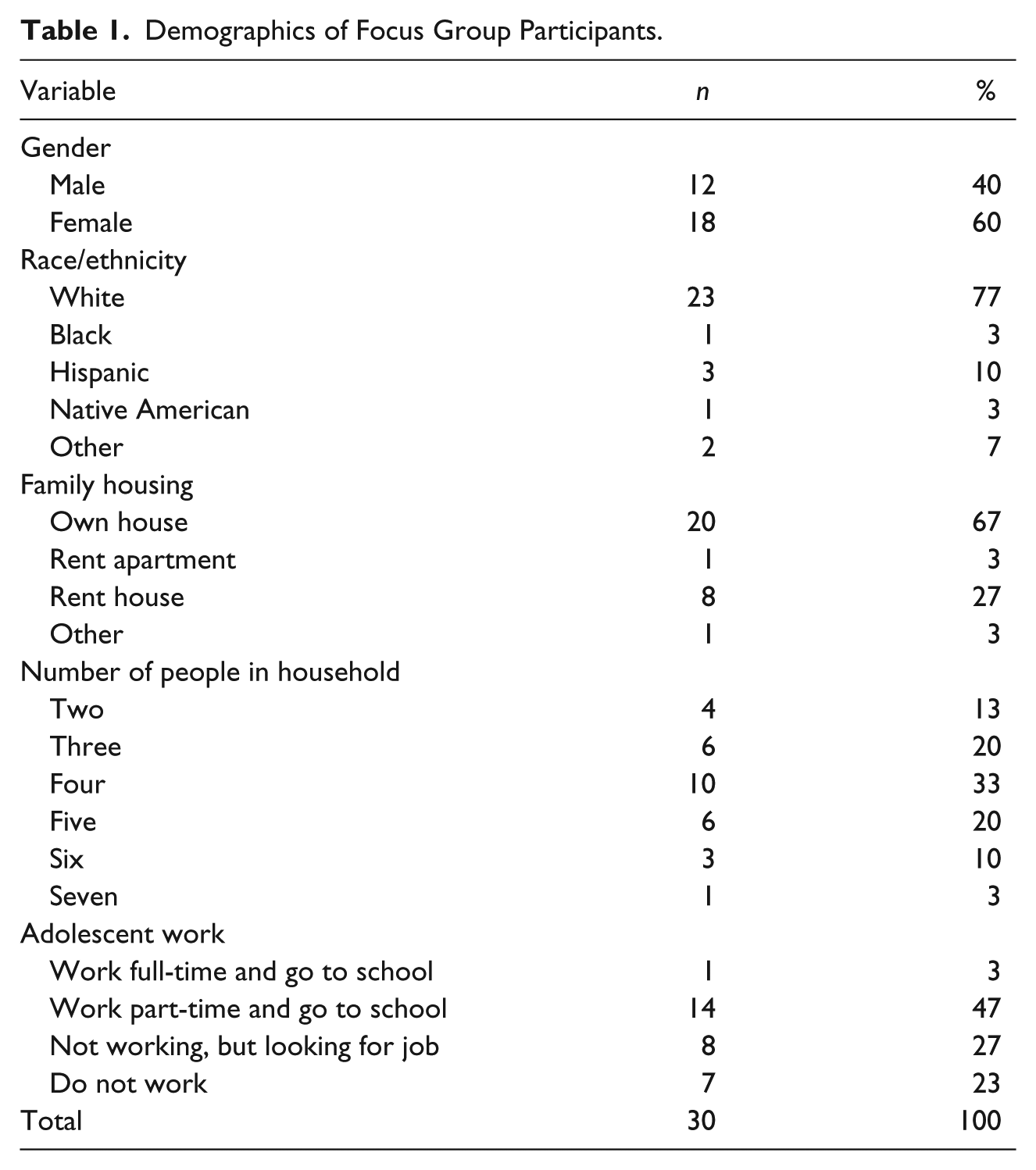
Participants were 30 high school students (60% female) in a midsized, Midwestern city. Participants ranged in age from 14 to 19, with a mean age of 16.8. The majority of participants identified as Caucasian (76%). Most adolescents lived in owned houses (66%), and the sizes of adolescents’ families varied. Almost half of adolescents held a part-time job while attending high school (46%). Traditional socioeconomic status (SES) information (i.e., income) was not collected from participants, as research reports the challenges of gathering reliable SES data from adolescents (e.g., Wardle, Robb, & Johnson, 2002). Demographics of participants can be viewed in Table 1.
Demographics of Focus Group Participants.
Procedure
This study received Institutional Review Board approval prior to participant recruitment and data collection. The focus groups included a facilitator and a recorder, both of whom attended an 8-hr training session on conducting focus groups prior to interaction with participants. The facilitator visited classrooms identified by school counselors to recruit participants. The facilitator explained details of the study and provided an informational letter, parental consent, and youth assent form to interested students.
Participants were divided into five focus groups by age and gender. Groups included young males (ages 14-16), young females (ages 14-16), older males (ages 17-19), and two groups of older females (ages 17-19). The second focus group of older females was conducted due to small attendance of the first focus group. Each group included 6 to 10 students, with the exception of the first older female focus group. The focus groups were asked a series of 24 questions related to the definition of dating violence, risk and protective factors for perpetration of dating violence, support for both victims and perpetrators, and prevention efforts and techniques. The questions were semistructured due to the serious nature of dating violence and the need to ensure consistency across the focus groups. Focus group questions can be viewed in the appendix. Each focus group session lasted between 1½ and 2 hr. All sessions were audio recorded.
Data Analysis
The audiotapes from each focus group were transcribed. A descriptive phenomenological approach guided data analysis, as this method concentrates on participants’ language to communicate the findings. The use of a descriptive phenomenological approach ensured that findings stemmed from adolescents’ experiences of ADV and less from how ADV is already interpreted by society (Sandelowski, 2000; Shosha, 2012). Qualitative content analysis techniques were used to analyze the language of each gender under the predetermined categories of definitions, risks, and protection against ADV. Qualitative content analysis is used for recorded communication to identify meanings and is the appropriate method to study messages and themes within the context of focus groups (Altheide, 1987; Lombard, Snyder, Duch, & Bracken, 2002). MAXQDA, software for qualitative data analysis, was used as an aid in organizing and analyzing the data (Kuckartz, 2001). This software allows researchers to upload documents for text analysis and to visually connect themes across documents.
After data were transcribed and uploaded into MAXQDA, in vivo coding was used to label repeated words and phrases spoken by participants. This method of coding ensures that codes generated from the research resemble participants’ language. In vivo coding is often useful when researching adolescents, as coding with their language enhances the overall understanding of the studied phenomenon (Saldaña, 2009). MAXQDA assisted in identifying the most repeated words and patterns of language under the three predetermined categories. The quotes under the three categories were then organized into themes. Themes (e.g., stress) were not determined prior to analysis, but were identified under each category by combining similar in vivo codes (Strauss & Corbin, 1990).
The final step was to identify broad language patterns that emerged from the statements made in the focus groups. Each category was carefully examined to formulate meaning from the extracted phrases and statements. Patterns were identified by examining the repeated words and phrases for embedded meaning. All emergent themes and patterns were integrated into a comprehensive description of each category (i.e., definition, risk, and protection) in terms of the language patterns males and females used to describe the category.
To assess credibility of these data, codes and themes, as well as the research process, were reviewed, reflected upon, and compared by the two researchers (Krippendorff, 2004; Lincoln & Guba, 1985). In addition to collecting focus group data, the trained recorder documented field notes during the focus group sessions. This additional source of data was compared with the focus group transcripts during coding as a strategy to obtain consistent data (Merrium, 2009). Overall, the two researchers determined that findings were appropriate based on the collected data. As instructed by Merrium (2009), credibility for qualitative research should be understood as the extent to which reported findings are consistent with the data. In addition, patterns in language were consistent across focus groups, which further suggests credibility.
Results
Focus group discussions illustrated specific language and meanings adolescents associate with ADV definitions, risk factors, and protection. Adolescents identified specific factors they believe are associated with ADV risk or protection. Adolescents also included specific recommendations for ADV education based on their language regarding the three main categories.
Defining Dating Violence
Scholars and professionals tend to define dating violence using technical language, such as “emotional violence within a dating relationship” or “rape, attempted rape, and other forms of sexual coercion,” meanings that adolescents may not fully understand (CDC, 2016; Rickert, Wiemann, Vaughan, & White, 2004). Findings from this study reveal that adolescents use more action- and emotion-oriented phrases to describe dating violence. For some, dating violence meant being “beaten,” or “slapped,” as the focus was on physical abuse. For other participants, dating violence extended beyond the physical component and included being “threatened,” “controlled,” or “called names.”
Male participants portrayed their understanding of dating violence with the act itself and physical consequences. For example, one male participant explained, “When people think about dating violence, they mostly think of physical violence. They think of a bruised up girl and, like, maybe some stitches or something.” Another male also used action-oriented words when discussing dating violence: “Um, it could be, you know, forcing somebody to do something they don’t want to do, yelling at them, the emotional abuse, physical abuse, verbal abuse, you know, um, like anything that’s not right.” Males tended to use words related to perpetration, such as “hit,” “beat,” “slap,” “control,” “blackmail,” and “take advantage of.” Males did not mention dating violence being deeper than the act itself. Words associated with feelings, such as “trapped” or “fearful” were seldom discussed among the male participants.
Female participants defined dating violence in terms of how a victim feels, as the theme of helplessness was embedded in their language. The females used words like “fearful” and “forced” to refer to dating violence experiences. This wording suggests that females recognize the victims’ emotional pain caused by dating violence. One female participant described dating violence as follows: It’s the sense of feeling trapped. I mean, all that stuff can happen to you and you know, it’s not just a switch you can turn on and say, “I don’t want to be with you because of dating violence.” It’s like, “I don’t know what to do. I don’t know how to get through this. I just feel completely inferior, and I’m just completely screwed.”
Rather than using the language to describe what happened to the victim (e.g., being hit), this participant discussed how it might feel to be abused. In general, when female participants did mention the perpetration of dating violence, they still shifted to how victims feel. For example, one female mentioned the act of name-calling, but immediately reverted to how the abuse made her feel: My ex-boyfriend would call me names and like all of that in front of my friends, and I would just have to hide it and act like everything was okay. Like I would act happy when I really wasn’t. It just kind of sucks that I would go through that every five minutes; I would have to act like everything was okay and it wasn’t okay. I just played the role.
In this case, the participant understood the abuse as name-calling, but the meaning she attached to the abuse was feeling trapped and degraded.
Overall, adolescents’ conceptualization of dating violence was embedded in their language, with gender differences manifesting. Previous research has examined adolescents’ definitions of ADV. However, distinct gender differences in language have not been reported (Yonas, O’Campo, Burke, Peak, & Gielen, 2005). Males discussed dating violence more directly, describing it through action, perpetration, and physical consequences. Males rarely related to dating violence in terms of the victims’ feelings, rather they focused on the actions of the perpetrators. However, females perceived dating violence as a more complex concept, relating to the victim and the victim’s emotions.
Risk Factors
Adolescents acknowledged ADV risk factors for perpetration and victimization that are consistent in the literature. Common themes identified by male adolescents include substance use, stress, and anger management. For example, males acknowledged that ADV is more likely to occur when at least one member of the party has been using alcohol, a claim that is supported by research (Baker, 2016). One male explained how alcohol might affect one’s reaction to a situation and elicit violence: Like say, sober, if I found my girl cheating on me, I would probably run up there and be like peace, you’re outta here . . . but a good like six or seven drinks in somebody’s body, in the same situation, you’d grab that person . . . drag them across the room and, you know, knock ’em, because alcohol makes you do stupid things like that.
Males tended to refer to alcohol as a justification for dating violence perpetration. They discussed how dating violence is more likely to happen when the perpetrator has been drinking alcohol, especially when society tends to excuse perpetrators who were drunk. Even though males explained that alcohol is oftentimes associated with ADV, they were reluctant to mention that alcohol is not a justification for ADV.
Furthermore, males identified stress and anger as risk factors, using language like “they snap,” “too much,” and “can’t handle it [stress].” Males expressed concern that the typical adolescent often lacks the ability to manage stress and anger effectively, which can lead to ADV perpetration. They agreed that a stigma exists against males expressing emotion, causing males to hold in their accumulated stress. When they do release their stress, it ends up being inflicted on their partner in the form of violence. Many males emphasized that perpetrators may be distressed by a factor other than the victim. Something may have occurred in the perpetrator’s personal life, such as getting fired from a job, which may cause him to take his anger out on his partner. Embedded in the males’ language is the view that perpetrators do not effectively deal with their emotions and lack necessary coping skills. In general, males discussed ADV risk factors in terms of choices one could make and control in their lives.
In contrast, females identified risk factor themes of having a difficult family life, experiencing child abuse, and witnessing family violence, factors that have also been identified by researchers (Vagi et al., 2013). Females explained how abuse in the family could create a model for abusive behaviors and increase the likelihood for a child to become an ADV victim or perpetrator. One female even suggested that witnessing violence anywhere could be a potential risk: If they grew up with it [family violence], or like, not even grew up with it in their own family, but just saw it in friends’ families, just seeing the friends’ families being abused just makes it more likely for it to happen.
Females also expressed a concern that a “lack of friends as a child” or “growing up alone” may cause an adolescent to have attachment issues and not want to leave a violent dating partner. They explained that for many young people who do not have supportive relationships with family or friends, any attention, positive or negative, from a dating partner could prevent a victim from leaving a violent relationship.
Although adolescents acknowledged risk factors that are present in the literature, males and females used distinct patterns of language to define these risks. Males view individual factors as risks for dating violence. In particular, they frequently mentioned aspects of a person’s life that can be controlled (i.e., substance use, stress). However, females view family and social factors as risks for dating violence, aspects that often cannot be controlled (i.e., child abuse, harmful home life). In addition, males focused their conversation on the risk factors for perpetration, as opposed to females who concentrated on risk factors for victimization. Even though gender differences existed in perceptions of risk factors, both genders acknowledged that females, despite society’s tendency to portray the perpetrator as male, frequently perpetrate ADV. Both males and females acknowledged the public misconception related to the risk of ADV perpetration. Adolescents of both genders explained that in many instances, the girl is more often the aggressor in adolescent relationships.
Protective Factors
Similar to risk factors, adolescents acknowledged general protective factors that are consistent with research. However, participants provided specific examples in their own language of ways these protective factors would exhibit in adolescents’ lives. Themes related to adolescent involvement, family involvement, and prevention programs. Many males discussed protective factors in terms of having “stress outlets,” such as “lifting weights,” “participating in sports,” and “being involved in school.” Males indicated that involvement in school and the community would help “keep adolescents out of trouble.” For instance, one male explained, “Being involved means you’re not out making stupid decisions and stuff, so I do sports for that reason, and it like, helps you in a way.” Males indicated that if youth remained involved in school and sports, they could be deterred from making bad decisions, such as perpetrating ADV.
Similarly, many males identified youth programs, such as school clubs or after-school programs, as a form of protection against ADV. They expressed that youth programs help males work on particular skills, such as communication, that may limit the chance of ADV perpetration. Males also suggested that youth programs provide an environment for adolescents to openly discuss their life challenges or stress, an alternative to engaging in ADV.
Females discussed protective factors in terms of mentoring relationships, such as family, peers, teachers, and community members. For instance, one female explained, If you have like a good, stable family, regardless if it’s just one parent or two, then you’re going to learn from that and be like, oh, okay, this is obviously how it’s supposed to be . . . I’m supposed to be open with this person and be honest and just respect them, and like, have them depend on me but yet I can depend on them type of thing.
This female’s statement encompasses the pattern of language used by many females regarding protective factors. Females focused much less on their physical environment as protection, but rather acknowledged the importance of the people in their lives who provide a context for the standards one should expect in their own relationships. Phrases like “someone who has gone through the same thing can teach you,” “learning that this [healthy relationship] is how it’s supposed to be,” or “model parents” were used to describe these people. Females used language such as “willing to talk to you” and “give you their opinion” to indicate that these people play a role in prevention.
Finally, females suggested anyone who strengthens their self-confidence, such as siblings, parents, counselors, friends, or educators, can help prevent dating violence. Phrases used by females include “someone who will listen,” “my mom and I are so close . . . that makes me confident,” and “they [friends] just let me talk about stuff out loud.” Females’ language suggests that family and other supporters can help prevent victimization by inspiring an adolescent’s confidence to leave a potentially harmful relationship.
Overall, males comprehended protective factors in terms of their environment. Males explained the need for active involvement in their community and school to make healthy decisions. Females discussed protective factors in terms of people. Females explained that healthy relationships with adults and peers might serve as a protection against dating violence. Research tends to focus on protection for adolescents as a unit (Fernet, Hébert, & Paradis, 2016; Schumacher & Smith-Slep, 2004), without distinguishing protective factors that may be more beneficial for one gender over the other.
Despite these gender differences, both males and females expressed a need for ADV education, as many adolescents have a misunderstanding of behaviors that constitute ADV. Many adolescents explained that the only form of dating violence they had learned about was physical. Many participants had minimal knowledge of other dating violence behaviors, such as psychological violence or stalking, prior to participating in the study’s focus group.
Adolescents also requested that dating violence be discussed, openly and honestly, by both adolescents and adults. Adolescents asked that dating violence awareness be incorporated into the high school’s learning agenda. For example, one female explained, We need relationship classes, because there are so many messed up relationships, but the only thing I ever learned in school is safe sex, that’s all I ever learned. I never learned anything about relationships. I mean, there’s so much that goes into a relationship, there’s so much physical. It could honestly be a class, like mentally and psychology-wise, like factors like that.
Males and females requested relationship education that specifically relates to the following: What is a healthy relationship? What does a healthy relationship actually look like? How can I tell if I’m in a harmful relationship? What do I do if I think I am involved in a dating violence situation?
Adolescents emphasized the need for schools to provide ADV information and increase the awareness of dating violence. Specifically, they highlighted the need for comprehensive education that goes deeper than merely defining ADV.
Discussion
This study aimed to give adolescents a voice on ADV. Findings raise the question of whether adolescents benefit from ADV education that is delivered using practitioners’ complex language. Future prevention and education programs should consider incorporating more direct language and providing examples to ensure students understand the extent of ADV. Specifically, professionals working with adolescents should consider using action- and emotion-oriented language to reach both males and females. Overall, prevention efforts should reflect the lived experiences of adolescents, not merely the professional’s view of the issue.
Participants’ language revealed that adolescents are aware of the risk and protective factors related to ADV, yet they use their own language to refer to these factors. For instance, instead of describing risk factors of “emotional symptoms” or “exposure to family violence” (Niolon et al., 2015), adolescents used informal language like “build up of emotions” and “hard home life.” When referring to protective factors, professionals use language like “females’ mother relationship” (Cleveland, Herrera, & Stuewig, 2003) and “two-adult household” (East & Hokoda, 2015) compared with adolescents’ language of “my mom and I are so close” and “parents who get along.” Although ADV curriculum usage is increasing, common ADV education programs often do not emphasize protective factors. Instead, programs emphasize protection for victims after the ADV has occurred. In addition, many curriculums tend to not reference protection against ADV perpetration, only victimization (Loveisrespect, 2013). ADV prevalence rates suggest education programs should reassess methods for conveying information on protective factors.
Males’ language indicated that addressing alcohol and stress problems could, potentially, prevent ADV from occurring. This finding is critical to professionals in that the subissues of ADV need to be acknowledged and managed, as one issue cannot be solved without addressing the other. With the appropriate prevention efforts, adolescents may choose not to drink, which may, ultimately, prevent a violent situation. In addition, adolescents’ language portrayed a need for coping skills, which should be further addressed by practitioners and researchers, as adolescent stress has been found to be associated with ADV perpetration (Rosenfield, Jouriles, Mueller, & McDonald, 2013). Overall, adolescents understand the challenges common during their developmental stage, ranging from stress and anger to ADV. Findings suggest education that focuses on alerting adolescents to these challenges does not reach far enough. Programs should provide age-appropriate, practical advice on how to address these challenges.
Furthermore, findings from this study support previous research claiming that ADV prevention programs should include a gender specific component (B. M. Black, Tolman, Callahan, Saunders, & Weisz, 2008). Females in this study would benefit from learning how to seek support from others, as they identified people and relationships as protective factors. On the other hand, males may benefit more from learning how to relieve stress and regulate emotions, as males indicated a need for an emotional outlet. Males and females both acknowledged research-identified risk and protective factors. However, there was a gender divide in this understanding. Education programs should ensure females are able to recognize factors identified by the males, and males are able to acknowledge factors identified by females.
Although many gender differences were identified in the findings, both male and female adolescents acknowledged that girls perpetrate ADV more often than boys. This finding contradicts traditional research on IPV that classifies females as victims and males as perpetrators (Offenhauer & Buchalter, 2013; Romans, Forte, Cohen, Du Mont, & Hyman, 2007). Recent IPV research has taken an egalitarian approach and discovered more equal rates of IPV perpetration among males and females (Cascardi & Avery-Leaf, 2015; Reidy et al., 2016).). However, it remains unclear why the adolescents in this study view females as the aggressor more often than males. Scholars should further explore this perception and why it exists among adolescents.
Overall, adolescents related to ADV collectively, diverging from the rest of society’s perspective of ADV. Rather than teaming up against each other (i.e., male vs. female), adolescents have the mentality that “society” is a distant, unrelated factor to ADV. They discussed society as being unaware of the issues of today’s adolescents who are involved in ADV. Even though the adolescents expressed a need for more education on dating violence and healthy relationships, many states still do not have mandatory dating violence school curriculum or specific guidelines for addressing the issue (National Council on State Legislatures, 2016). This lack of education is concerning considering the high rates of ADV. The adolescents’ expressed need for accurate and comprehensive dating violence education should encourage schools to evaluate their curriculum.
It should be acknowledged that the focus group aspect may have affected adolescents’ willingness to openly discuss ADV. Nevertheless, focus group sizes were still manageable and small enough to ensure all participants had an opportunity to contribute. However, the focus group aspect may have affected group cohesion. Future research should continue to focus on the adolescent language and perceptions to develop successful ADV prevention and intervention programs. Future research should also examine how adolescents’ ages and ethnicities affect their language related to ADV.
Footnotes
Appendix
Declaration of Conflicting Interests
The author(s) declared no potential conflicts of interest with respect to the research, authorship, and/or publication of this article.
Funding
The author(s) received no financial support for the research, authorship, and/or publication of this article.