



Abstract
This research examines group-level perceptions of transformational leadership (TFL) as negative longitudinal predictors of witnessing person-related (e.g., insults/affronts) and work-related (e.g., negation/intentional work overload) acts of incivility at work. Witnessing workplace incivility was also postulated to negatively predict employee need satisfaction. Data were collected among production employees in different Canadian plants of a major manufacturing company (N = 344) who worked for 42 different managers (Mgroup size = 9.76). Two waves of data collection occurred 1 year apart. Results from multilevel analyses showed that workgroups where managers were perceived to engage in more frequent TFL behaviors reported reduced levels of person- and work-related incivility 1 year later. However, group-level incivility did not predict change in group-level need satisfaction 1 year later. At the individual level, results showed that witnessing higher levels of person-related incivility than one’s colleagues predicted reduced satisfaction of the need for relatedness 1 year later. These longitudinal findings build upon previous literature by identifying TFL as a potential managerial strategy to reduce incivility in workgroups over time. They also show that mere exposure to workplace misbehavior still affects employees’ adjustment, suggesting that every effort to reduce deviance in workplaces is worthwhile.
Keywords
Workplaces can be thriving environments where employees and supervisors work together to achieve common organizational goals. Yet, some employees and supervisors are also known to engage in offensive or disrespectful behaviors that negatively affect the working experience (Bennett & Robinson, 2003). High-quality leadership from supervisors acts as an important determinant of positive employee experiences, through its impact on optimal employee and workgroup functioning (Avolio & Yammarino, 2013). Accordingly, recent multilevel investigations have looked at how supervisor leadership behaviors relate to deviance in workgroups (Brown & Treviño, 2006; Mayer, Kuenzi, Greenbaum, Bardes, & Salvador, 2009). However, many aspects of this association remain to be clarified, which is the objective of the present study. More precisely, the present study focuses on the role of supervisors’ leadership behaviors on the emergence of incivility in the workplace, and examines the effect of witnessing incivility on employees. Arguably, workplace incivility is one of the most common form of workplace deviance (Aquino & Thau, 2009; Cortina, Magley, Williams, & Langhout, 2001), and is described as “low intensity deviant behavior with ambiguous intent to harm the target, in violation of workplace norms for mutual respect. Uncivil behaviors are characteristically rude and discourteous, displaying a lack of regard for others” (Andersson & Pearson, 1999, p. 457). Two types of workplace incivility are distinguished for the purpose of this research, namely, person-related incivility (e.g., insulting, criticizing, and giving the evil eye) and work-related incivility (e.g., overloading someone with work, hoarding information, and ignoring demands; Dagenais-Desmarais & Courcy, 2014). This categorization was proposed by Einarsen (1999) to allow for a more refined investigation of workplace deviance, where differences in the determinants and outcomes of person- and work-related acts of incivility could be documented.
While victims of incivility suffer important consequences, ranging from reduced job satisfaction and lower physical and mental health to increased job stress and turnover intentions (Cortina et al., 2001; Lim, Cortina, & Magley, 2008), incivility may additionally affect employees who are indirectly exposed to these acts as witnesses (i.e., bystanders). At the workgroup level, the consequences of workplace incivility include lower levels of relationship satisfaction with coworkers and supervisors (Lim et al., 2008); whereas, at the organizational level, they include lower levels of commitment and productivity in employees, as well as higher levels of absenteeism and turnover (Lewis & Malecha, 2011; Lim et al., 2008; Sliter, Sliter, & Jex, 2012). Past research on individual witnesses of workplace incivility is scarce, but suggests that bystanders may experience negative emotions as a result of their exposure (Miner & Eischeid, 2012). Additional research focusing on harsher types of misbehavior has found that vicarious experiences of aggression and bullying at work were associated with lower levels of mental health, less affective commitment to the organization, and higher turnover (Bentley et al., 2012; Dupré, Dawe, & Barling, 2014). Given the consequences and costs associated with workplace incivility and the relative paucity of research focusing on witnesses of these acts, research on the antecedents and consequences of witnessing incivility is warranted. The present study focuses on workgroup and individual effects of supervisors’ leadership style on the emergence of workplace incivility. The impact of witnessing incivility on need satisfaction will also be investigated.
Transformational Leadership and Incivility
Research suggests that work environments may play a potentially important role in the onset of incivility. For instance, organizations that support their employees tend to be characterized by lower levels of incivility (Miner, Settles, Pratt-Hyatt, & Brady, 2012). Studies also suggest that managerial leadership styles could be related to workplace incivility, with previous research showing that positive leadership styles (e.g., constructive) are associated with lower levels of workplace deviance (Lee & Jensen, 2014). The present study extends this line of research through a specific focus on transformational leadership (TFL; Bass & Avolio, 1994). This specific leadership style was selected because of the widespread agreement in the organizational research community that TFL is an important managerial characteristic fostering positive outcomes for employees (Avolio & Yammarino, 2013).
TFL encompasses five interrelated elements: (a) attributed idealized influence, consisting of followers’ attributions about the character of the leader as someone to be respected and admired; (b) behavioral idealized influence, consisting of articulating values and behaving ethically; (c) inspirational motivation, consisting of providing meaning and challenge to followers through articulating a vision and acting optimistically and enthusiastically; (d) individualized consideration, consisting of paying attention to individual needs and continuously facilitating individual development through coaching and mentoring; and (e) intellectual stimulation, consisting of encouraging creativity and innovation, and promoting rationality and problem solving (Bass & Avolio, 1994). Contingent reward is typically considered as a sixth component of TFL because of its focus on nonmaterial rewards, such as assistance and positive feedback, and because it is more closely related to TFL than to other leadership styles (Antonakis, Avolio, & Sivasubramaniam, 2003; Avolio, Bass, & Jung, 1999; Judge & Piccolo, 2004).
TFL has been shown to be associated with more positive consequences than other leadership styles, such as transactional (i.e., monitoring employees’ actions and attainment of performance goals) and laissez-faire leadership (i.e., avoidance of engaging in leadership-like action; DeGroot, Kiker, & Cross, 2000; Lowe, Kroeck, & Sivasubramaniam, 1996). Among the positive consequences of TFL is a reduction of various forms of deviance in the workplace (Astrauskaite, Notelaers, Medisauskaite, & Kern, 2015; Brown & Treviño, 2006; Cemaloglu, 2011; Lee & Jensen, 2014; Nielsen, 2013). Specifically, Brown and Treviño (2006) showed in multilevel analyses that leadership was associated with higher levels of value congruence, which in turn predicted lower levels of deviance. Lee and Jensen (2014) further showed that leadership was related to decreased incidence of workplace incivility through its positive impact on fairness perceptions.
By showing a stable negative association between TFL and workplace deviance, these studies suggest that TFL reduces incivility at the workgroup level, thus also decreasing indirect exposure at the individual level. However, to achieve a proper disaggregation of the components of this relation occurring at the individual (Level 1, or L1) versus workgroup (Level 2, or L2) levels, multilevel analyses are required (Marsh et al., 2012; Morin, Marsh, Nagengast, & Scalas, 2014). Achieving a proper disaggregation of these effects is crucial given that the constructs of TFL and incivility do not represent the same reality whether they are assessed at the individual or workgroup level. More specifically, L2 effects refer to the relations between actual leadership (TFL) behaviors (employees’ shared perceptions of the supervisor’s behaviors) and the prevalence of incivility occurring at the workgroup level, which arguably represents the key question of interest. In contrast, L1 associations reflect the effects of interindividual differences in perceptions of the workgroup supervisor’s leadership behaviors (i.e., deviations from the group mean) on individual exposure to incivility. So far, only limited research has relied on proper multilevel analyses to study workplace deviance (e.g., Brown & Treviño, 2006; Mayer et al., 2009), none of which has specifically considered workplace incivility. Furthermore, because all these studies are cross-sectional, doubts remain regarding the directionality of the observed associations between TFL and workplace deviance. In other words, cross-sectional research makes it impossible to clearly differentiate whether TFL helps to reduce workplace deviance, whether more frequent workplace deviance negatively affects leadership styles, or both. Additional research that goes beyond single-level cross-sectional analyses is, thus, required to further examine the relations between TFL and incivility.
To properly disaggregate workgroup and individual effects, the current study relies on a multilevel path-analytic approach to assessing relations between managerial TFL and employee exposure, as witnesses, to two distinct types of workplace incivility (person and work related). Most multilevel leadership research has measured leadership by either asking leaders to rate themselves or asking followers to rate their leaders. Our research falls in the second category, and, therefore, focuses on perceptions that followers have of their leader. When group members are specifically asked to rate an L2 construct (as it is the case in the present study with TFL; i.e., please rate the frequency at which your supervisor enacts the following behaviors), the L2 variable is labeled a climate construct (Marsh et al., 2012; Morin et al., 2014). In contrast, when group members are asked to rate their own individual experiences, which are then aggregated at the group level (as it is the case in the present study with witnessing incivility and need satisfaction), such L2 variables are called contextual constructs (Marsh et al., 2012; Morin et al., 2014). A climate construct represents shared employee’s perceptions of the L2 construct (thereby providing a more direct representation of actual leadership behaviors), whereas a contextual construct represents the aggregate of followers’ individual experiences. For instance, conceptualizing incivility at the workgroup level is not necessarily about a shared perception (i.e., some employees can be oblivious to subtle acts of incivility happening near them), but rather about a shared group dynamic emerging from cumulative individual experiences. For climate constructs, associations are especially meaningful at L2 and less so at L1, where they represent the effects of interindividual differences (L1) in perceptions of the L2 construct (relative to group averages). For contextual constructs, associations at L1 are readily interpretable and represent the effects of each individual’s unique experience on an individual outcome. At L2, associations involving contextual constructs represent how between-group differences in group aggregates predict group outcomes, above and beyond individual experiences.
In addition to studying associations between TFL and incivility in a multilevel setting, a 1-year longitudinal design was adopted, allowing us to test the relations between TFL and changes over time in person- and work-related incivility, both at the workgroup and the individual level. We postulate that TFL will yield negative relations to incivility at the workgroup level (L2), reflecting how actual leadership behaviors reduce the prevalence of incivility within the workgroup (L2). In contrast, interindividual differences in workers’ perception of how their supervisor generally adopts TFL behaviors should have little effect on their likelihood of witnessing incivility in their workgroup. Thus, we do not expect interindividual differences in perceptions of TFL (L1) to be related to personal experiences of witnessing incivility in the workgroup. Finally, at either level, we do not expect any differential impact of TFL on person-related versus work-related incivility.
Incivility and Need Satisfaction
In addition to testing the individual and workgroup component of TFL as a potential antecedent of workplace incivility, the present study was designed to further investigate the outcomes of this form of workplace deviance. Research on bullying, another harsher type of workplace deviance that involves repeated acts of incivility and aggression over an extended period of time (Nielsen, 2013),suggests that a key mechanism underlying the negative impact of deviance on psychological health is need thwarting (Trépanier, Fernet, & Austin, 2013). Following this lead, this study investigates the relations between exposure to acts of incivility in the workplace as a witness and the satisfaction of basic psychological needs for autonomy, competence, and relatedness. According to self-determination theory (SDT; Gagné & Deci, 2005), these three basic psychological needs are critical for individuals’ well-being, motivation, and positive functioning. The need for autonomy represents the need to personally endorse our behaviors and to have a sense of volition in what we do. The need for relatedness represents the necessity to meaningfully connect with people around us, whereas the need for competence represents the need to feel that our behaviors have a significant impact on our environment (Ryan & Deci, 2000).
As is the case with bullying victimization (Trépanier et al., 2013), exposure as a witness to both person- and work-related incivility is likely to reduce employees’ autonomy because exposure to these negative behaviors should restrict their ability to make choices and limit their sense of volition at work, for instance, for fear of being ridiculed or excessively monitored. Similarly, when employees witness group members being ridiculed and ignored, they are likely to internalize the idea that meaningful and supportive relationships are harder to develop in their workgroup (Hershcovis & Barling, 2010), thereby reducing their sense of relatedness at work. Finally, exposure to criticisms, humiliating comments, and work overload, even if directed at colleagues rather than at oneself, should convey the idea that standing out from the group (such as by demonstrating high levels of performance) is risky, which may limit employees’ desire to demonstrate, and ultimately experience, competence (Hershcovis & Barling, 2010).
In light of the aforementioned rationale regarding the possible relations between witnessing acts of incivility in the workplace and the satisfaction of the basic needs for autonomy, relatedness, and competence, these relations are expected to occur at the individual level (L1). Because group averages reflect perceptions of incivility that are not necessarily shared by every member of the group, and because it is highly unlikely that nonexposed employees would suffer as a result of incivility occurring in their workgroup outside of their knowledge, or that exposed employees would suffer less from incivility if their colleagues do not witness it, we do not expect similar relations to occur at the workgroup level (L2).
These relations will be investigated while controlling for the potential effect of TFL on need satisfaction given that TFL itself has been shown to predict need satisfaction (Kovjanic, Schuh, Jonas, Van Quaquebeke, & van Dick, 2012).
Transformational Leadership and Need Satisfaction
As noted, previous cross-sectional studies have shown that TFL perceptions are significantly related to employee need satisfaction (Hetland, Hetland, Andreassen, Pallesen, & Notelaers, 2011; Kovjanic, Schuh, & Jonas, 2013; Kovjanic et al., 2012). These studies have argued that transformational leaders should foster perceptions of autonomy among the employees placed under their supervision because these leaders communicate consideration and respect for each employee’s unique perspective. Also, because transformational leaders promote highly attractive goals (i.e., inspirational motivation), employees should be more likely to internalize these goals, claim them as their own, and thus experience autonomy (Deci, Eghrari, Patrick, & Leone, 1994). Previous studies also suggest that TFL should foster relatedness in followers by creating high-quality leader–subordinate relationships (Wang, Law, Hackett, Wang, & Chen, 2005) and by emphasizing workgroup cooperation and cohesiveness (Jung & Sosik, 2002). Finally, because transformational leaders provide regular feedback (Kirkpatrick & Locke, 1996) and support training initiatives, TFL should be associated with employees’ feelings of professional efficacy and competence (Hetland, Sandal, & Johnsen, 2007).
However, previous studies looking at relations between TFL and need satisfaction have only used single-level cross-sectional analyses, making the directionality of the associations, and their proper disaggregation across levels, uncertain. A final goal of this study is, thus, to take advantage of the present longitudinal multilevel design to reexamine the relations between TFL and need satisfaction over a 1-year period as they occur at the employee (L1) and workgroup (L2) levels. Achieving a proper multilevel disaggregation of these effects tests whether shared perceptions of TFL behaviors (a climate L2 construct) relate to group aggregates of psychological need satisfaction (a contextual L2 construct). It also tests whether interindividual differences (L1) in perceptions of TFL behaviors relate to need satisfaction among individual employees, reflecting the potential effects of differential leader–follower relationships on followers’ need satisfaction. Given that TFL has been shown to have positive effects on workgroups and that interindividual differences in TFL may account for individual experiences of need satisfaction, positive associations between TFL and need satisfaction are expected at both levels.
Method
Sample and Procedure
Three different Canadian branches (one of which was unionized) of an international manufacturing company were approached to participate in this project. The work environment in the production department, where recruitment took place, was described by company executives as one that was hostile, with many anecdotal instances of incivility in production workgroups. The surveys were administered to employees on site by the research team in paper-and-pencil format (with union agreement for the unionized branch). This was a two-wave data collection with a 1-year time lag. Participation was voluntary and confidential. Of the original sample of 370 employees, 24 employees rating 22 managers were removed from the original dataset for not meeting the requirement in multilevel modeling of at least three employees rating each manager (Morin et al., 2014). Two participants were also removed for having more than one manager, leading to an effective dataset of 344 employees with usable responses. Of these, 283 participants completed Time 1 questionnaires and 273 completed Time 2 questionnaires. The full sample of 344 employees was used in analyses, relying on full information maximum likelihood (FIML) estimation to handle missing data, which is judged to be superior to listwise deletion for longitudinal research (Enders, 2010; Graham, 2009; Morin, Meyer, Bélanger, Boudrias, Gagné, & Parker, 2016.
In the sample, some employees (N = 69) changed manager from T1 to T2. To reflect this reality and given the limitations of current multilevel analyses, their data were split. One line of observation indicated that the employee was with manager A at T1, but that this dyad was “missing” at T2, whereas another line of observation indicated that the employee was with manager B at T2, but that this dyad was “missing” at T1. The final sample was, thus, 410 observations (Nemployees = 344) forming 42 clusters, representing workgroups working under one manager (Mcluster size = 9.76, SDcluster size= 7.70, range = 3-36). Participants had a mean age of 42.09 years (SD = 10.11 years) and their highest completed degree of education was a high school diploma (N = 152), a postsecondary/undergraduate college diploma (N = 137), or a master’s or doctoral degree (N = 11). Participants from the plant located in the province of Quebec completed their questionnaires in French (N = 212, 75.7% male), whereas participants from the other two plants completed their questionnaires in English (N = 132, no gender information collected in this subsample).
Measures
Transformational leadership
At Time 1, followers completed the TFL subscales from the Multifactor Leadership Questionnaire (MLQ) Form 5x (Bass & Avolio, 1995), which included the following four-item subscales answered on a 1 (not at all) to 5 (frequently, if not always) scale: (a) attributed idealized influence, (b) behavioral idealized influence, (c) inspirational motivation, (d) intellectual stimulation, (e) individualized consideration, and (f) contingent reward. The items followed a stem asking employees to rate their supervisor’s behaviors in relation to the workgroup in general to capture employees’ shared perceptions created by TFL supervisor behaviors (Kuenzi & Schminke, 2009).The MLQ was used with the authorization of Mind Garden and sample items can be obtained from this company. As mentioned in the introduction and following Avolio et al.’s (1999) specifications, these subscales were grouped to assess an overarching TFL construct (see the online supplements for details).
Observations of incivility
At both times, participants reported their observations of person- and work-related incivility enacted by members of their workgroup (e.g., supervisors, colleagues). The items in these subscales were selected from Courcy’s (2002) Workplace Aggression Scale, which was validated in a French Canadian context and contains a very wide range of misbehavior at work in different subscales (Bedi, Courcy, Paquet, & Harvey, 2013; Courcy, Morin, & Madore, 2019; Courcy & Savoie, 2004). More specifically, we retained items from Courcy’s (2002) “Interpersonal affront” subscale for person-related incivility (five items; e.g., “Make sarcastic, mean or condescending remarks”) and from the “Negation” (e.g., “Not answering someone’s legitimate demands”) and “Overload” (e.g., “Unnecessarily overload someone with work”) subscales for work-related incivility (six items). In this study, participants were asked to describe, in the last 6 months, how frequently they witnessed the described behaviors in their workgroup using a 1 (never) to 6 (every day) scale.
Psychological need satisfaction
At both times, psychological need satisfaction was assessed using the Work-Related Basic Need Satisfaction Scale (Van den Broeck, Vansteenkiste, De Witte, Soenens, & Lens, 2010). This scale assessed satisfaction of the needs for autonomy (five items), relatedness (six items), and competence (four items) on a 1 (totally disagree) to 5 (totally agree) scale.
Plan of Analysis
Because autoregressive multilevel models such as those estimated in this study are extremely complex, these models are sometimes associated with convergence problems when a fully latent approach is used. This was the case in this study and others (Kam, Morin, Meyer, & Topolnytsky, 2016; Morin, Meyer, Creusier, & Biétry, 2016. To circumvent this limitation, we relied on factor scores for all constructs, saved from preliminary measurement models fully reported in the online supplements 1 . The key advantage of factor scores, when compared with more traditional (mean or sum) scale scores is that, by giving more weight to items presenting lower levels of measurement errors, they provide a partial control for measurement errors, making them a stronger alternative than scale scores (Morin, Meyer, Creusier, et al., 2016), particularly when using modern approaches to their estimation such as the regression approach implemented in Mplus (Skrondal & Laake, 2001). An added advantage of factor scores is that they can be saved from a model of longitudinal invariance (Millsap, 2011), ensuring comparability of the results over time points. This is the approach taken in the present study.
The main multilevel model was thus estimated using the factor scores saved from preliminary measurement models with the robust maximum likelihood (MLR) estimator available in Mplus 7.2 (Muthén & Muthén, 2014). This model includes global TFL levels, person- and work-related incivility, and satisfaction of the needs for autonomy, competence, and relatedness both at the individual (L1) and workgroup (L2) levels. Autoregressive paths, explicitly controlling for the stability of each construct over time, were modeled between repeated measures (e.g., all variables at T1 predicted the same variable at T2), and predictive paths from TFL to incivility and need satisfaction, as well as from incivility to need satisfaction were also estimated at both levels. Standardized coefficients, as well as effect size indicators comparable with Cohen’s d(Cohen, 1988), were calculated from formulas provided by Marsh and colleagues for climate and contextual effects (Marsh et al.,2012, 2009; Morin et al., 2014), based on a group-mean centering of L1 ratings and using the multivariate delta method (Raykov & Marcoulides, 2004) implemented in Mplus via the MODEL CONSTRAINT function.
Results
Table 1 presents the latent variable correlations taken from the final retained measurement model described in the online supplements and used to save the factor scores for the main analyses, as well as composite reliabilities and intraclass correlation coefficients (ICCs). Composite reliability coefficients, calculated from model-based omega coefficients (Morin et al., 2014), supported the reliability of the constructs. However, reliabilities for autonomy measures were lower than for other measures, reinforcing the need to rely on a method providing at least a partial control for measurement errors such as the one used in this study (i.e., factor scores). The ICCs represent the amount of variability present at the group level relative to the individual level, such that higher coefficients correspond to higher variability at the group level. It should ideally be at least around .1 but is seldom larger than .3 (Hedges & Hedberg, 2007; Lüdtke et al., 2008, 2011). Here, ICC varied from .143 to .391 (M = .221), stressing the need to examine relations occurring at both levels.
Latent Variable Correlations From the Final Strictly Invariant Measurement Model.

Note. Stability coefficients are represented in bold. TFL = transformational leadership; PI = person-related incivility; WI = work-related incivility; AUT = autonomy need satisfaction; REL = relatedness need satisfaction; COM = competence need satisfaction; T1 = Time 1; T2 = Time 2; ω = omega coefficient of composite reliability; ICC = intraclass correlation coefficient.
p < .05. **p < .01.
Examining latent correlations, stability coefficients first show that all constructs presented a high level of temporal stability (i.e., test–retest reliability) over a 1-year period (r = .600-.773, M = .687). Second, both cross-sectional and longitudinal correlations generally showed significant associations between TFL, incivility, and need satisfaction (|r| = .046-.745, M = .326 and |r| = .006-.680, M = .287, for cross-sectional and longitudinal correlations, respectively). These associations showed that TFL at Time 1 was negatively related to witnessing incivility in the workplace at Time 2, and positively related to Time 2 measures of autonomy and relatedness, but not competence. Furthermore, witnessing incivility was generally associated with lower levels of need satisfaction when measured at the same time point, whereas longitudinal associations showed that Time 1 incivility was only associated with Time 2 autonomy. Although informative, a key limitation of these preliminary correlations is that they conflate the L1 and L2 components of these relations and they do not control for the longitudinal stability of each construct.
Figure 1 presents the main multilevel model and Table 2 presents unstandardized regression coefficients (b), standardized regression coefficients (β), and effect sizes indicators for all relations estimated in the model. A first noteworthy observation is that employees’ ratings of their personal exposure to incivility in the workplace and levels of need satisfaction are very stable over time (with standardized autoregressive coefficients ranging from β = .539 to .836) at the individual level (L1), which is fully in line with the previously discussed correlations. In contrast, average group-level (L2) exposure to incivility and need satisfaction appear to be far less stable, as illustrated by small and mainly nonsignificant autoregressive coefficients.
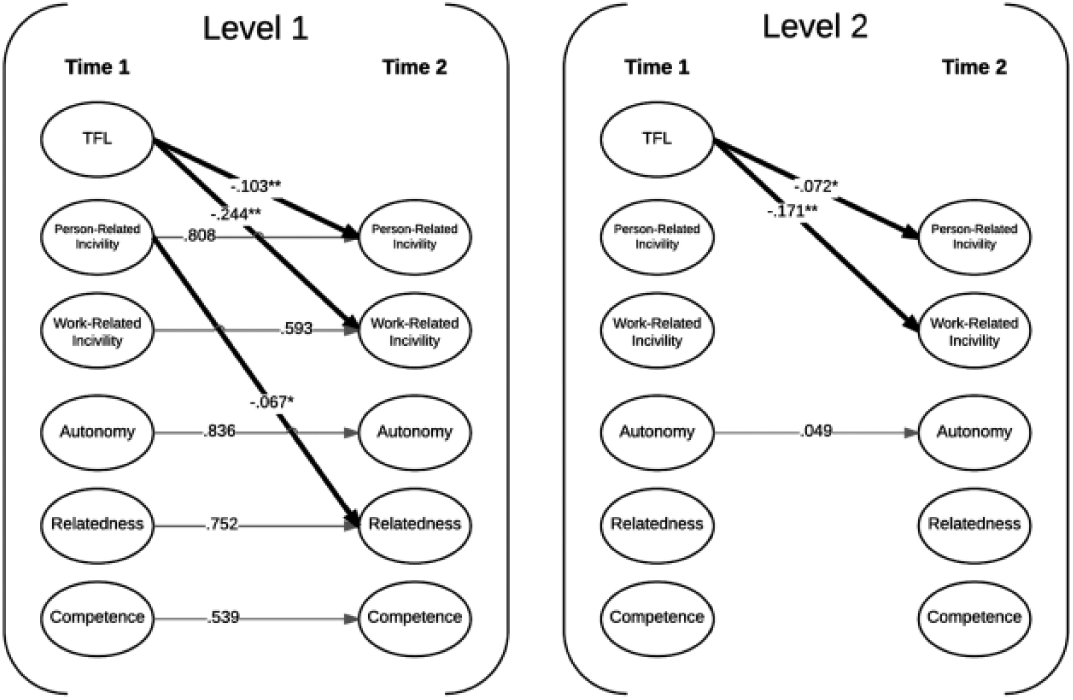
Significant associations in the main multilevel analyses.
Results From the Main Multilevel Analyses.
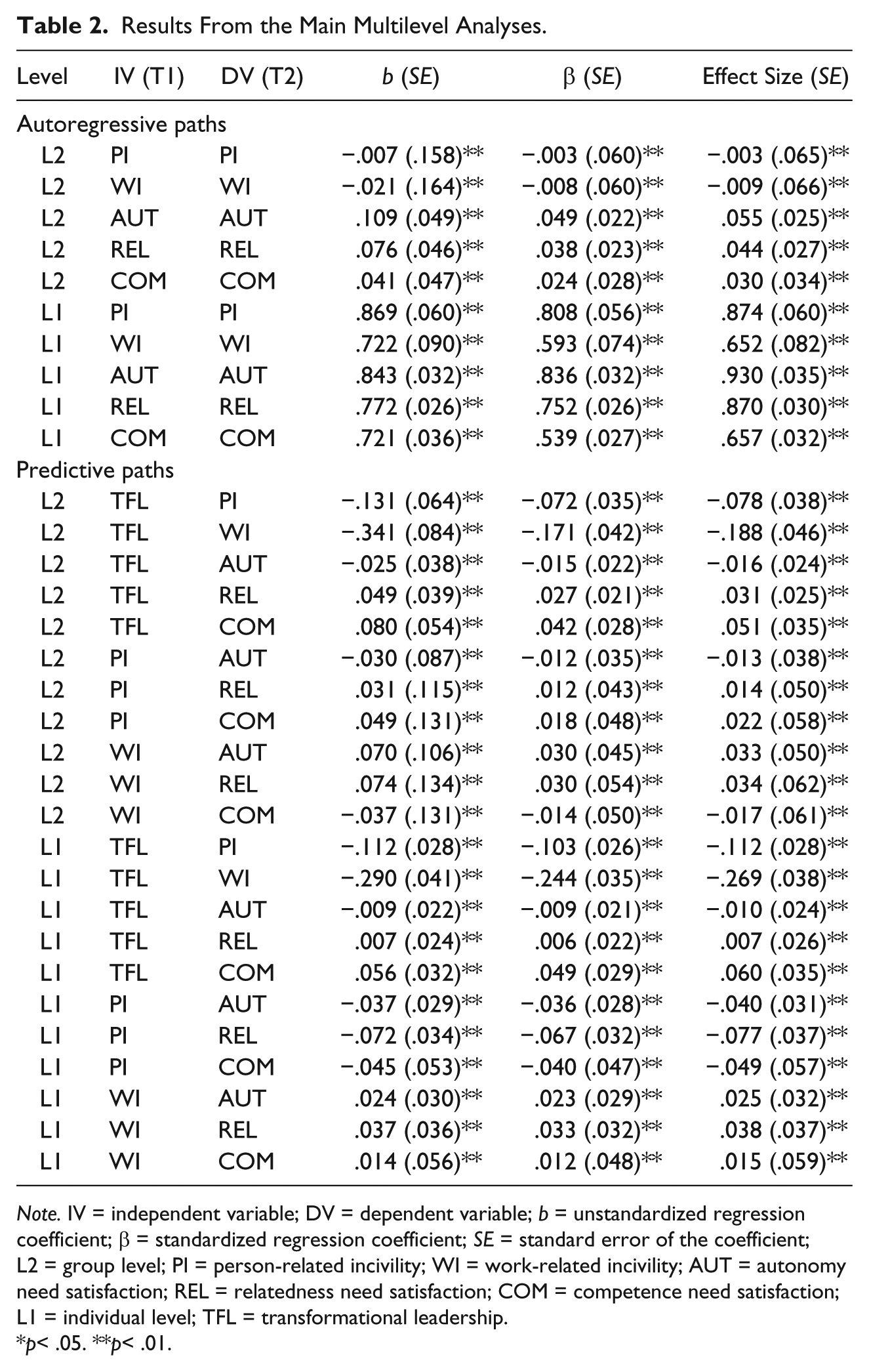
Note. IV = independent variable; DV = dependent variable; b = unstandardized regression coefficient; β = standardized regression coefficient; SE = standard error of the coefficient; L2 = group level; PI = person-related incivility; WI = work-related incivility; AUT = autonomy need satisfaction; REL = relatedness need satisfaction; COM = competence need satisfaction; L1 = individual level; TFL = transformational leadership.
p< .05. **p< .01.
In terms of predictive relationships, group-level (L2) results showed that TFL negatively predicted witnessing both forms of incivility at Time 2 while controlling for initial levels of incivility exposure (β = −.072 and −.171 for person- and work-related incivility, respectively), thereby supporting Hypothesis 1. Contrary to our expectations, individual-level (L1) results showed that interindividual differences in TFL perceptions negatively predicted individual exposure to both forms of incivility at Time 2 (β = −.103 and −.244 for person- and work-related incivility, respectively), rather than an absence of effect. Furthermore, witnessing person-related incivility negatively predicted relatedness at L1 (β = −.067, p = .036), but not at L2. No such relation existed for work-related incivility either at L1 or at L2. Witnessing either form of incivility failed to predict changes in autonomy and competence, either at L1 or at L2. Taken together, these results provide only partial support to Hypothesis 2. Finally, although we expected individual- (L1) and group-level (L2) TFL to be associated with higher levels of need satisfaction, results did not show a significant relation between TFL and need satisfaction at either level. Hypotheses 3a and 3b were, thus, not supported. 2
In terms of the associations between the variables of interest and demographic variables, results showed that age was generally associated with more experiences of TFL at Time 1 (β = .238, p = .003) and autonomy at both measurement times (βs = .452 and .452, ps < .001), as well as with fewer instances of witnessing incivility at both measurement times (βs from −.464 to −.352, ps < .001). In addition, being a woman was associated with fewer instances of witnessing person-related incivility at both measurement times (βs = −.426 and −.453, ps < .001) but had inconsistent, but negative, associations with witnessing work-related incivility (β = −.327, p = .035, for T1; β = −.180, p = .125, for T2). More educated participants did not differ from their less educated counterparts with regard to this study’s variables (ps = .099-.907).
Discussion
The goal of the present study was to explore the associations between managerial TFL and change in perceptions of incivility at work as well as their relative relations to change in the satisfaction of employees’ basic needs for autonomy, relatedness, and competence. More specifically, we aimed to (a) achieve a proper disaggregation of these relations as they occur at the individual and the workgroup level relying on a multilevel approach to the analyses, (b) test for the directionality of these longitudinal associations, and (c) detail the experience of witnesses of workplace incivility. Results first showed that workgroups where managers were perceived as transformational leaders showed decreasing levels of person- and work-related incivility over a 1-year period. With this result, our study provides support for the idea that engaging in TFL behaviors may be a successful way for managers to reduce, over time, the level of incivility occurring in their workgroup. Whereas previous research found that some types of leadership behaviors predicted reduced levels of deviance at the group level (some even using subscales of the same instrument as the one used in this study, the MLQ; Brown & Treviño, 2006), the current study is, to our knowledge, the first to show this multilevel association using all the components of TFL covered by the MLQ. This is due to the use of modern data analytic strategies allowing for a proper statistical capture of complex multidimensional constructs in scales that perform poorly in traditional CFA (Howard, Gagné, Morin, & Forest, 2018; Morin, Marsh, & Nagengast, 2013).
Beyond group-level effects, individual employees perceiving their supervisors as displaying higher levels of TFL relative to the group average also tended to witness decreasing levels of incivility over time in their workgroups. If it is the case that transformational leaders nurture employees’ trust and group cohesiveness (Pillai & Williams, 2004; Podsakoff, MacKenzie, Moorman, & Fetter, 1990), individual-level results may suggest that employees who perceive higher levels of TFL behaviors might develop a higher threshold for considering their colleagues’ behaviors as uncivil or rude, presumably because they trust that their colleagues would not engage in such acts of deviance purposefully. Lower sensitivity to incivility could also increase group harmony in times of stress by reducing the effects of more benign instances of incivility. In contrast, when employees perceive leaders to adopt less than optimal managerial styles, they could develop higher sensitivity to negative behaviors from their leader, which would enable them to react more quickly and effectively to shield themselves from these behaviors. This higher sensitivity could in turn generalize to various forms of negative behaviors in the workplace, thereby increasing employee’s sensitivity to incivility among colleagues. It is also possible, however, that some individuals are simply more likely to perceive others’ behaviors in a more negative light (less TFL and more incivility), which could account for the negative L1 association between these variables. More research is needed to understand the function and importance of this finding in work contexts. In sum, in line with cross-sectional results obtained in previous studies (Lee & Jensen, 2014), a negative relation was observed between TFL and workplace incivility at L2 and L1.
The present study also showed that witnessing acts of person-related incivility predicts a longitudinal decrease in the satisfaction of employees’ need for relatedness. This suggests that exposure to insults and affronts conveys the idea that meaningful and supportive relationships are harder to develop in one’s workgroup. Despite incivility being arguably among the least harmful forms of workplace deviance, and even though witnessing incivility is likely to have a more limited impact on one’s well-being when compared with being the victim of incivility or of more extreme forms of deviance, our results show that employees still suffer from such exposure. Whereas previous research showed that being a victim of incivility had negative consequences (Lim et al., 2008), the present results add to the broader literature on deviance at work in showing that merely witnessing incivility can reduce relatedness need satisfaction.
One should note, however, that no relation was found between witnessing incivility and changes in satisfaction of the needs for autonomy and competence. Although we anticipated that exposure to person- and work-related acts of incivility directed at colleagues may potentially limit employees’ sense of volition and reduce employees’ desire or opportunity to demonstrate high levels of competencies at work, the current results suggest that this is not the case. A possible explanation for the absence of association between incivility and competence may come from the fact that employee’s feelings of competence are known to be mostly predicted by their own levels of successful accomplishments at work (e.g., work performance; Van den Broeck et al., 2010), which are themselves less likely to be affected by exposure to incivility directed at others who may not perform in the same way. Similarly, employees who observe acts of incivility may attribute them to a wide variety of causes completely unrelated to work performance (e.g., personality, conflict, union pressure and organizational politics), which would have no influence on their sense of competence.
Still at the individual employee level, our results also yielded different associations between witnessing different forms of incivility and need satisfaction. Whereas being a bystander to person-related incivility predicted reduced satisfaction of the need for relatedness, this relation was not observed for work-related incivility. It is possible that bystanders of work-related incivility do not always attribute this form of incivility to negative intentions; ignoring a colleague’s legitimate demands or overloading someone may sometimes be caused by the perpetrator’s own work overload or stress. Work-related incivility may then at times be taken less seriously, which would in turn reduce its long-term association with need satisfaction. In contrast, being a bystander to person-related incivility should be interpreted as more threatening to potential relationships that one can form with other colleagues. Finally, whereas the relation between person-related incivility and employees’ relatedness need satisfaction was observed at the individual level, no relation between exposure to incivility and need satisfaction was observed at the workgroup level. This result suggests that employees may need to be aware that incivility is occurring in their workgroup, for this incivility to affect the degree to which they feel that their psychological needs are met at work. As previously mentioned, group averages reflect instances of incivility that have not necessarily been witnessed by all employees.
Relations between witnessing workplace person-related incivility and need satisfaction were examined while controlling for potential effects of TFL. However, contrary to expectations, relations between TFL and changes in employees’ individual or workgroup levels of psychological need satisfaction were not significant. Previous studies (Hetland et al., 2011; Kovjanic et al., 2013, 2012) had documented a positive link between TFL and need satisfaction using single-level analyses. In the present study, TFL also predicted the satisfaction of employees’ need for autonomy and relatedness when zero-order single-level correlations were estimated. However, when the longitudinal stability of employees’ psychological need satisfaction as well as initial levels of workplace incivility were controlled and multilevel effects were disaggregated, there was no evidence that TFL predicted changes in need satisfaction, either at the workgroup (L2) or individual (L1) level. Thus, neither did workgroups collectively report an increase in levels of need satisfaction as a function of supervisors’ TFL, nor did employees perceiving more or less TFL relative to their group mean display any change over time in their personal levels of need satisfaction. While reinforcing the need to rely on proper multilevel longitudinal methodologies in organizational research, these results call for additional research on the generally accepted assertion that transformational leadership maximizes need satisfaction among employees (Hetland et al., 2011), and that the benefits of TFL on other outcomes are mediated in part by the effects of TFL on need satisfaction (Kovjanic et al., 2012). Still, the current results revealed significant cross-sectional relations between TFL and need satisfaction, which suggest that associations between TFL and need satisfaction may be more complex than expected. For example, it is possible that TFL has a positive effect on need satisfaction but that this effect mainly occurs when new employees enter a workgroup. Once relationship patterns between employees and the manager are well established, these effects may stabilize, such that TFL may not predict additional change in need satisfaction over time. The present study relied on a relatively long time frame (1 year) and included employees from a wide range of tenure levels. It is, thus, possible that effects of TFL on need satisfaction had already occurred at the time of the study. Future research focusing on new employees and using short and longer time frames could shed light on the exact association between TFL and need satisfaction. TFL and need satisfaction could also be related because they may share common determinants. Given that such determinants would likely be situated within the work environment, future research relying on similar multilevel methods would be needed to properly investigate potential L2 and L1 correlates of both leadership behaviors and employees’ need satisfaction.
Finally, results showed that younger and male employees witnessed more instances of incivility at both measurement times compared with older and female employees. However, it is important to keep in mind that no gender information was collected in two of the three branches, thus limiting the extent to which the conclusions can be expected to generalize to the other branches. It is not clear whether the aforementioned associations are representative of systematic differences in experiences or, rather, differences in perceptions. To understand how diversity in employees’ age, gender, ethnicity, and other characteristics shapes their experiences and interactions in different work settings, future studies should include measures of potential psychological mechanisms that could explain the differences observed in the experience of various groups of employees.
Limitations and Future Research
Our results somewhat differed from what could be expected based on previous research. However, comparisons with previous studies may prove difficult because these studies have not always (a) properly disaggregated effects occurring at the group, versus individual, level; (b) predicted changes over time in incivility and need satisfaction; (c) considered the implications of incivility or deviance for witnesses; and (d) examined the relative impact of different forms of incivility. By addressing these gaps in previous research evidence, the current study, thus, provides a new, and possibly more robust, perspective on the relations among TFL, need satisfaction, and witnessing incivility at work. However, the present study still presents some noteworthy limitations to which we now turn our attention.
First, because TFL was only assessed at T1, it is not possible to examine whether greater occurrence of incivility in the workgroup may affect supervisors’ ability to engage in TFL. It is indeed likely that TFL behaviors are easier to practice in workgroups characterized by low levels of incivility, and that a greater focus on transactional leadership behaviors (centered on performance management and close monitoring) might occur when managers deal with more deviant workgroups. However, managers may also feel a stronger need to engage in TFL in highly deviant workgroups as a way to smooth over interpersonal tensions and bring members together through the development of a shared and stimulating vision of the future. Indeed, some research suggests that TFL is particularly needed in times of crisis, and occurrence of incivility in a workgroup could be considered as a type of crisis (Bass & Riggio, 2006).
Second, even if TFL had been measured at Time 2, the present design could not establish causal inferences regarding the effect of TFL on workplace incivility, or the effects of incivility on need satisfaction. To properly test causation, future research could attempt to manipulate levels of TFL (e.g., by training a group of leaders and not training a control group) to test whether it would impact the magnitude of workplace incivility in their workgroups. Although ethical issues must be considered before manipulating levels of incivility, it would also be possible to indirectly expose participants to various levels of person- and work-related incivility in laboratory experiments to evaluate how they behave following exposure. Experimental testing of the efficacy of incivility prevention programs could finally provide a very rich opportunity to test possible causal relations between incivility and outcome variables.
Third, only two time points were included in this study and, therefore, mediation could not be properly investigated. Although no direct association between TFL and change in need satisfaction was observed, an indirect association between TFL and need satisfaction could still be observed through reduced incivility or other mediators. It may be that by reducing incivility in a workgroup, TFL promotes a safer work environment that, over time, foster employees’ need satisfaction. Future research should investigate whether TFL affects the workplace through its effect on incivility or deviance.
Fourth, although our results detail associations between TFL and workplace incivility, it would be informative to understand whether these relations also hold for other forms of leadership. For example, a previous study showed that toxic leadership was associated with higher levels of incivility and lower levels of satisfaction and commitment (Gallus, Walsh, Marinus, Gouge, & Antolic, 2013). Future research looking at other forms of leadership (e.g., laisser-faire, authentic, transactional) while using rigorous longitudinal multilevel designs would help achieve a broader picture of the relations between leadership style and workplace misbehavior.
Fifth, witnessing incivility was assessed without distinguishing the nature of the perpetrator (e.g., supervisors, colleagues). Although this did not allow for a detailed investigation of the possibly distinct consequences associated with witnessing uncivil acts coming from individuals occupying distinct roles within the organizational hierarchy, our results can still be assumed to provide an initially complete picture of the global effects of exposure to incivility in the workplace. Still, it would be interesting for future research to take this possibly important distinction into account.
Finally, part of this data collection took place in a particular context. Specifically, the blue-collar workers of the largest branch of the participating organization were unionized under one of the largest Canadian unions valued at more than US$10 billion. Allegations regarding possible ties to organized crime had also been voiced and union representatives at this location were known to intimidate union members into engaging in counterproductive work behaviors and to encourage group intimidation of management. As a result, managers could have had little power to discipline employees. This particular context in about half of our sample (the two other branches were not unionized) brings interesting insight to this research. When uncivil behavior is pervasive and when unions back people at the source of the problem, to a certain degree, TFL may be one of the few resorts for reducing workplace incivility. Future research in diverse workplace settings will help us better understand how to act upon workplace deviance.
Conclusion
The present results suggest that reduced levels of person- and work-related incivility in the workplace are among the positive effects of TFL. Given that TFL has been shown to be particularly beneficial in times of crisis because of its capacity to “repair” bonds between employees, managers, and the organization (Bass & Riggio, 2006), our results suggest that training managers to engage in TFL could prevent or curtail incivility in the workplace. The present study also highlights the need for workplace incivility prevention strategies by demonstrating the risks posed by incivility even to simple bystanders.
Footnotes
Declaration of Conflicting Interests
The author(s) declared no potential conflicts of interest with respect to the research, authorship, and/or publication of this article.
Funding
The author(s) disclosed receipt of the following financial support for the research, authorship, and/or publication of this article: This research was supported in part by grants from the Society for Human Resource Management and from the Social Sciences and Humanities Research Council (SSHRC) of Canada to the second author and by scholarships from SSHRC and from the Endeavour Program of the Australian Department of Education and Training to the first author.
Notes
Author Biographies
References
Supplementary Material
Please find the following supplemental material available below.
For Open Access articles published under a Creative Commons License, all supplemental material carries the same license as the article it is associated with.
For non-Open Access articles published, all supplemental material carries a non-exclusive license, and permission requests for re-use of supplemental material or any part of supplemental material shall be sent directly to the copyright owner as specified in the copyright notice associated with the article.
