




Abstract
Same-sex intimate partner violence (IPV) lacks mainstream news media coverage. News media report on those stories that are most prominent, and these stories are often shaped and presented within a White, heterosexual, upper-class, male framework. This framework largely ignores or misrepresents those that do not fit these characteristics, resulting in a gap in research and coverage of same-sex IPV. This article explores whether U.S. newspapers cover same-sex IPV, how often, and how same-sex couple violence is portrayed in newspapers when covered. Twenty-five newspaper articles published from 2005 to 2015, 10 years prior to the U.S. Supreme Court decision that legalized same-sex marriage, were located and analyzed. Findings indicate sparse newspaper coverage of IPV in same-sex couples. Ten articles highlight the lack of coverage and knowledge related to same-sex couple IPV. Eighteen articles address same-sex IPV as a social issue and highlight resource concerns, police involvement, and heteronormativity and heterosexism. Sixteen articles depict specific instances of IPV in same-sex couples. The overall lack of coverage and how same-sex IPV is covered remains problematic and limited. More mainstream and accurate coverage is needed to effectively address this social issue. Limitations and directions for future research are also discussed.
Keywords
Introduction
The issue of intimate partner violence (IPV) lacks mainstream news media coverage (Bullock & Cubert, 2002; Carlyle, Slater, & Chakroff, 2008). IPV is “physical violence, sexual violence, stalking, and psychological aggression by a current or former intimate partner and can occur between heterosexual or same-sex couples,” according to the Centers for Disease Control and Prevention. It is also considered to be a preventable public health issue that continues to affect many Americans (Centers for Disease Control and Prevention [CDC], 2016). If IPV stories are reported in news media, they tend to involve sensational characteristics such as a murder or the involvement of celebrities (Meyers, 1997), or the coverage reinforces the violence as an isolated incident unrelated to a broader social problem and pattern of abuse (Bullock & Cubert, 2002). In addition, these stories almost exclusively involve heterosexual couples (Meyers, 1997), with coverage frequently focused on men perpetuating violence against women (Carlyle, Scarduzio, & Slater, 2014).
On the surface, news reports can appear neutral and objective; however, upon closer examination, this is far from the truth. The news media report on those issues that are most prominent, commonly referred to as what is newsworthy (Meyers, 1997). Furthermore, media outlets, such as newspapers, serve as critical agents in news creation (Molotch & Lester, 1974). Along with news stories having that “it” factor of newsworthiness to be broadcast, these reports are often shaped by reporters’ perspectives and regularly reflect the dominant discourse of hegemonic masculinity. Hegemonic masculinity is the cultural ideal or expression of dominant masculinity and is embedded within a particular social context (Connell & Messerschmidt, 2005; Hinote & Webber, 2012). Hegemonic masculinity also legitimizes and sanctions the existing gender hierarchy (Campbell, 2000). Thus, news reports are reflective of and presented within a White, heterosexual, upper-class, male framework (Bullock, 2007; Bullock & Cubert, 2002; Meyers, 1997). This framework often overlooks or misrepresents those who do not fit these characteristics. Consequently, same-sex IPV news coverage is nearly invisible within mainstream news media.
This research explores how same-sex IPV is depicted in newspaper media, because despite their recent decline in circulation, newspapers continue to be important sources for gathering news and information (Franklin, 2008). We examine the frequency of published stories in American newspapers that focus on IPV in same-sex relationships, from 2005 to 2015, 10 years prior to the U.S. Supreme Court decision that legalized same-sex marriage (Liptak, 2015). We further examine how same-sex IPV is discussed in the sampled articles, and analyze how those articles depict specific instances of same-sex IPV. Twenty-five articles from U.S. newspapers were identified for analysis. This low number demonstrates the dearth of newspaper coverage regarding violence in same-sex relationships. Analyzing newspaper media for coverage of same-sex IPV provides a window into mainstream ideas about this issue. We contend that the lack of newspaper coverage about same-sex IPV reflects and perpetuates a devaluing of this social issue. 1
Literature Review
Same-Sex IPV
Violence within intimate partner relationships is no new phenomenon. However, the study of IPV as a social issue as well as laws regarding this type of behavior are relatively new, even more so for same-sex IPV (Messinger, 2011). Equality and social recognition for same-sex couples continues to trail when compared with heterosexuals. Because same-sex couples have previously been given less attention in general, violence within same-sex couples has also received less attention by researchers in comparison with heterosexual couple violence. Even though violence can occur regardless of what type of intimate relationship someone is in, same-sex couples face the burden of homophobia that often delegitimizes their relationships. This can lead individuals in same-sex couples to present themselves in an idyllic way so that they can “provide a respectable image in a society often bent on devaluing and marginalizing” these types of relationships (Carrington, 1999, p. 709). Same-sex couples may fear that if they admit that sometimes their relationships are violent and abusive, this provides “ammunition” for anti-LGB (Lesbian, Gay, Bisexual) forces to further demonize these relationships. This marginalization of same-sex couples may lead them to fear or avoid reporting IPV, resulting in an overall underreporting of violence and, in turn, less news media coverage. Gauging the frequency of same-sex IPV is challenging, as this has received less research attention in comparison with heterosexual IPV (Burke & Follingstad, 1999; Murray, Mobley, Buford, & Seaman-DeJohn, 2006-2007). Some evidence suggests that rates and types of same-sex IPV are similar to those in heterosexual couples (Frankland & Brown, 2014; Gosselin, 2010; Hattery & Smith, 2012), while other studies indicate that IPV is higher among same-sex couples (Burke & Follingstad, 1999; Messinger, 2011). According to the CDC’s 2010 National Intimate Partner and Sexual Violence Survey (NISVS), LGB individuals have “equal or higher prevalence of experiencing IPV, sexual violence, and stalking when compared to heterosexuals” (Walters, Chen, & Breiding, 2013, p. 1). Burke and Follingstad (1999, p. 508) reviewed 19 studies that focus on same-sex IPV, and conclude that, research suggests that lesbians and gay men are just as likely to abuse their partners as heterosexual men, although it is unknown whether the severity of abuse is comparable between these two groups. Risk markers and correlates of intimate violence in same-sex relationships are notably similar to those associated with heterosexual partner abuse.
Pattavina, Hirschel, Buzawa, Faggiani, and Bentley (2007) find that violence in same-sex couples is comparable with heterosexual couples in terms of severity. These studies typically fail to address additional barriers that gay and lesbian individuals may face when reporting violence, which could lead to more underreporting and further muddle our understanding of the rates of IPV within same-sex couples. Some of the unique challenges faced by victims of IPV within a same-sex couple include issues of internalized homophobia and outing (Gosselin, 2010), lack of knowledge by law enforcement (Pattavina et al., 2007) and the medical community (Ard & Makadon, 2011), victim perception of police, along with previous police response (Guadalupe-Diaz, 2016), and few resources for those who are experiencing same-sex IPV (Pattavina et al., 2007). We know that IPV is underreported among heterosexual couples in general and perhaps even more so among same-sex couples (Gregory, 2014), due to these additional barriers.
Same-Sex Couple News Media Portrayal
Although same-sex couples have seen some equality gains such as more visibility in news media (Calzo & Ward, 2009) and the legalization of same-sex marriage (Bernstein, 2015), the acceptance and equality in other realms for same-sex couples has proven to be a long and fairly slow process. Although strides have been made in the gay rights movement and negative views on same-sex relationships have decreased (Ghaziani, Taylor, & Stone, 2016), same-sex equality still remains controversial to many groups. Legal issues along with stigma or other beliefs about homosexuality make it challenging for same-sex couples to gain equality. In addition, heteronormativity impedes same-sex couple equality. The social context in which heterosexuality is the norm and dominates other forms of sexuality and is thought to be “not only a normative sexual practice, but also a normal way of life” (Jackson, 2006, p. 107) contributes to gay and lesbian marginalization in general. And newspapers report on issues within this environment.
Recently, news media coverage has focused on marriage equality as the primary same-sex issue (Rodriguez & Blumell, 2014) but has largely ignored same-sex IPV. Rodriguez and Blumell (2014) found that marriage equality is typically framed in the context of equality and human rights or morality as a threat to traditional marriage and family. According to Li and Liu (2010), news media can affect public opinion and policy regarding the issues of same-sex marriage, and we believe that the same concern exists for same-sex IPV. Carlyle et al. (2008) conducted a study of 395 newspaper articles from 2002 to 2003 to examine how IPV is reported. Their study of newspaper media reporting on IPV in the United States over 2 years found no reported occurrences of same-sex violence (Carlyle et al., 2008). Lindsay-Brisbin, DePrince, and Welton-Mitchell (2014) examined 187 newspaper articles in the state of Colorado published in 2008, finding no articles reporting on domestic violence within same-sex couples. Likewise, Lloyd and Ramon (2017) found no articles including violence among same-sex couples in their study of two U.K. newspapers. Taylor (2009) finds only one article that discussed violence in a same-sex couple in a study of a specific Florida newspaper over the span of 5 years. Overall, the general consensus is that same-sex couple violence is grossly underrepresented in mainstream newspaper coverage. Moreover, previous studies of IPV have focused on heterosexual couples. Therefore, our study fills a significant gap in the research and contributes a crucial perspective on IPV.
Framing and Agenda Setting
Mainstream news media can have a large influence on beliefs people have about the world as well as their values on social issues. The news media is an important socialization agent, especially for topics that may be more controversial such as same-sex couple specific issues. The representation of these topics in news media outlets may be the only exposure some individuals have because they may lack direct experience with same-sex couples or have the issue ignored by parents and peers due to its controversial nature (Calzo & Ward, 2009). Studies examining news frames reveal that how the news is framed affects how and if people think about a particular issue (Bullock, 2007; Bullock & Cubert, 2002; Entman, 1993). Bullock and Cubert (2002) claim that “news coverage can be framed to give distinctly different views of social problems, influencing how audience members see their world, its problems, and the solutions to those problems” (p. 475). Entman (1993) explains that the framing of news stories communicates the promotion of certain topics and issues by making them more prominent in comparison with other issues even while those ignored are as critical as the ones included. In her study of how domestic violence fatalities were framed in Utah newspapers, Bullock (2007) finds that these stories are framed in three different ways: a fact-oriented police frame, individuals involved are characteristically different from other people, and how deaths affect more than just the victim and perpetuator. Bullock (2007) concludes that these frames essentially individualize domestic violence cases and fail to recognize the broader societal landscape in which these incidents take place. Overall, the framing of news stories can affect how the public views issues or if they view them as important, along with influencing how policy makers think about these issues (Bullock, 2007). Therefore, “news coverage can help determine how society views and responds to domestic violence” (Bullock & Cubert, 2002, p. 476).
News media outlets may provide their audiences with a particular agenda that reinforces various stereotypes and myths regarding certain issues. McCombs and Shaw (1993, p. 62) indicate that “agenda setting is considerably more than the classical assertion that the news tells us what to think about; the news also tells us how to think about it.” McCombs (1997) further notes that if news coverage portrays the same patterns over time, these come to be considered as public-agenda priorities; the overall impact that this news agenda has on public opinion is considered “agenda setting.” Despite their recent decline, newspapers continue to be prominent agenda-setters in regard to news media (Weaver, McCombs, & Shaw, 2004). Consequently, news media, such as newspapers, have the ability to set the agenda because they select stories to report on (McCombs, 1997). Agenda-setting by media can affect how prominent an issue is with the audience, which can, in turn, affect how and if they think about it along with possibly influencing action (Bullock, 2007). All of these things, taken together, highlight the importance of examining how news media cover IPV in same-sex relationships.
Method and Sample
To investigate how IPV is reported and covered in current news media accounts, we conducted a qualitative content analysis of newspaper articles in mainstream media outlets that specifically addresses the issue of same-sex couple violence. Content analysis is a method for systematically analyzing and interpreting a variety of communication (Berg, 2012). Li and Liu (2010, p. 79) state that “content analysis is the most efficient way to detect fairness and balance of news coverage.” Our aim was to determine if same-sex IPV is reported in newspapers, and then to better understand the social meanings embedded within newspaper coverage on this important issue (Hesse-Biber & Leavy, 2006). To locate articles, the first author searched LexisNexis, an online database that gives access to a variety of newspapers. The search terms included same-sex couples and domestic violence, with dates ranging from January 1, 2005 through March 18, 2015 and were limited to include newspapers only, as research indicates that mainstream newspapers continue to be prominent agenda-setters (Weaver et al., 2004). This type of search relies on LexisNexis to supply articles addressing topics related to the search terms provided, which gave a broad starting point for identifying newspaper articles. This initial search resulted in 626 articles. Next, the sample was narrowed to include only those articles published in the United States because our focus is on U.S. media coverage. The climate surrounding same-sex issues may vary in other countries, which could affect how such issues are covered in the media. Also, seven duplicate articles were removed, resulting in 304 articles. The first author then read through each of these articles and limited the sample to only those that specifically discussed or described same-sex couple violence.
It is important to note that the initial search terms brought up all newspaper articles that included topics related to domestic violence and same-sex couples; however, this did not guarantee that the focus of the article was on same-sex IPV. Fifty articles focused on same-sex couples in regard to marriage and were excluded from analysis. Ninety-five articles addressed either same-sex couples and/or domestic violence, but not in the same context. For example, an article may mention same-sex marriage and then say that marriage license fees help fund domestic violence programs. Because these articles did not explicitly focus on same-sex IPV as the primary news story, they were excluded from the sample. Also, during part of the search time period, two political issues were prominent: The Violence Against Women Act and the North Carolina Amendment One Bill. There were 34 articles that focused on the Violence Against Women Act, discussing that the Act would expand protection rights to same-sex couples, so these were eliminated from analysis. Forty-two articles about the North Carolina Amendment One concentrated mainly on how the Bill could possibly complicate domestic violence issues for heterosexual couples. While these were both important issues, the explicit focus of the articles was not discussing IPV within same-sex couples; therefore, they were excluded from analysis. Thirty-two of the articles discussed basic rights for same-sex couples (i.e., health benefits for partners) and again made mention that this should extend to domestic violence, but did not focus on the issue in detail. In addition, there were 26 articles that mentioned same-sex couple violence occurring. For example, if an article defined IPV and stated that it occurs in same-sex couples but offered no more detail, it was eliminated. In these cases, the information related to same-sex couple violence was so vague and limited, devoting only one or two sentences to the issue of same-sex couple violence, that the article was not useful for analysis. These sampling measures resulted in a total of 25 newspaper articles for our analysis. These samplings procedures are summed up in Table 1.
Sampling Procedures.
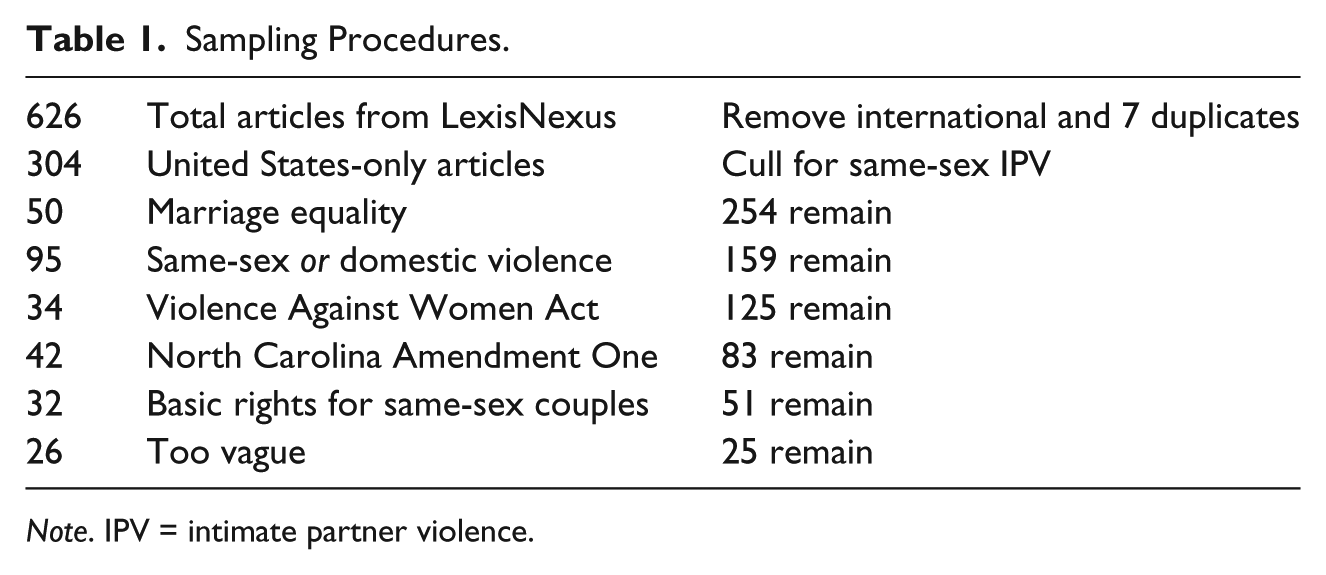
Note. IPV = intimate partner violence.
The first author conducted an initial open coding of all 25 articles to identify broad themes. Subsequently, the second author read each article to identify broad themes as well. Upon comparison of broad themes, both authors identified similar categories for analysis. Then, the first author re-read all articles and axial coded each article in depth within these broad categories to further refine and add more specificity to codes (Berg, 2012; Hesse-Biber & Leavy, 2006). Each author separately read the axially coded articles to capture quotes and descriptions about how same-sex couple violence is depicted in these various newspaper articles. While coding, we also wrote theoretical notes that reflected links between articles and themes we were seeing (Strauss, 1987). After both authors separately completed the content analysis, we discussed our themes, and arrived at agreement on broad themes, specific coding, and what quotes to use as examples. A reference list of all articles can be found in the appendix. Results of these analyses are discussed below.
Results
Three main themes emerged from this research. First, there is scarce coverage of same-sex IPV within newspapers. The few articles that exist generally frame same-sex IPV in comparison with heterosexual couple violence, but acknowledge that our understanding and research regarding the issue is lacking. The articles often conclude that more research is needed to improve our understanding of IPV within same-sex relationships. Second, the few articles that recognized and described same-sex violence did so in a way that calls for more attention to this social issue. These articles focused on resource concerns, police involvement in instances of same-sex IPV, and overall heteronormativity and heterosexist ideas that continue to affect our society. Last, some articles did offer descriptions of specific instances of same-sex IPV. Lesbian couple violence was commonly depicted in more violent and extreme ways than gay male couple violence, which often results in this type of violence being considered exotic and further devalued.
Lack of Newspaper Coverage for Same-Sex IPV and Limited Knowledge of It
Our search resulted in 25 articles over a 10-year period in U.S. newspapers, which confirms the lack of coverage in mainstream news media. This aligns with previous research that shows media coverage on same-sex couples is limited (Li & Liu, 2010). We see this lack of newspaper coverage of same-sex IPV as an example of how this issue is regarded as inconsequential. Not reporting on this issue is problematic, as it perpetuates invisibility of same-sex IPV and suggests that it does not exist. Acting as if a problem does not exist leaves very little hope of anything changing. The need for more research, acknowledgment, and understanding is clearly imperative.
Related to general infrequency of coverage, there is some recognition that same-sex IPV is not necessarily regarded as a serious social problem. For example, an article titled “Domestic Abuse a Reality in Gay Relationships” (2006) from the Inside Bay Area newspaper makes this statement: The issue of domestic violence among gay couples has been more closeted than gayness itself. Unrecognized by police officers and social workers who address the issue among heterosexual couples, the problem was also frequently denied or trivialized within the gay community . . . The issue even received short shrift in academic psychological studies. Either it was seen as less serious than domestic abuse among heterosexual or the victims were viewed with less empathy.
If this issue is considered unimportant in society in general, that can lead to underreporting or less interest in a subject, as newspapers are seeking to cover subjects of interest to the public.
Solid data on this issue are also a concern. We found that 10 of the 25 articles identified lack of research on same-sex IPV as problematic. For example, Inside Bay Area on October 17, 2006 states, According to “Domestic Violence in Gay Couples”, statistics on the problem have been collected only in the past 20 years. Though the numbers are still considered somewhat sketchy, they suggest the incidence of abuse is about the same among straight couples. (“Domestic Abuse a Reality in Gay Relationships,” 2006)
Another article from Contra Costa Times repeats this idea by claiming, Although the topic is not widely discussed, abuse is just as prevalent in the gay and lesbian community as it is among heterosexuals—involving 25 percent to 30 percent of the population, according to several studies. (Fernandez & Webby, 2012)
Newspapers describe limited availability about information related to same-sex IPV, which might have a bearing on their coverage of it. With this, readers can be left with vague and confusing information. These examples indicate that research and information may be limited in regard to same-sex IPV; however, it appears as if newspapers are either not aware of or not utilizing existing research because a variety of studies focusing on this topic do exist.
There were some articles that acknowledged same-sex IPV as more challenging to address and research, which can result in misleading statistics. Some articles made the distinction that the underreporting of same-sex couple violence suggests that these rates may be higher. On May 2, 2014, an article from the Denver Post claims, As the nation more openly embraces same sex couples, our statistics lag far behind. A 2013 report by the U.S. Centers for Disease Control concluded that while “little is known about the national prevalence of intimate partner violence, sexual violence, and stalking among lesbian, gay, and bisexual women and men in the United States,” gays appear nearly twice as likely to be victims of gay violence as their straight peers. (Peck, 2014)
Another article furthers this claim by stating, “Experts say as difficult as it is to report and deal with domestic violence involving straight couples, the abuse is even harder to identify, report and remedy when it involves gays and lesbians” (Fernandez & Webby, 2012). These examples indicate that more research and attention needs to be paid to this issue.
Lack of coverage undermines the legitimacy that same-sex IPV is a social problem like any other family violence issue. And by ignoring it, valuable opportunities are missed to bring attention to the issue as well as provide resources for those that are experiencing violence within a same-sex couple. Same-sex couples continue to strive for not only legal but societal acknowledgment and equality for their relationships, and the lack of coverage and knowledge of IPV is a measure of continued marginalization, signifying that barriers to equality still exist. Overall, we found scarce reporting on same-sex couple IPV, which we see as related to a disregard of the problem, in general, that perpetuates invisibility and reproduces inequality.
Acknowledging and Advocating About Same-Sex Couple Violence
Although overall coverage was limited, 18 of the articles specifically focused on acknowledging the existence of violence within same-sex couples in attempts to raise awareness. These articles mainly focused on resource issues regarding same-sex IPV, police response and involvement in instances of IPV in same-sex couples, and heteronormative assumptions as well as heterosexism that continue to persist. Although some of these articles also described specific instances of violence among these couples, the main discussion in the articles emphasized a general awareness of same-sex IPV.
The coverage described lack of resources available to victims experiencing violence within a same-sex couple. For example, one article says, “Representatives of the LGBT [Lesbian, Gay, Bisexual, Transgender] community said the rate of domestic violence is as high among same-sex couples as it is for heterosexual couples but there are fewer resources available” (“Study Sought on Response to Violence,” 2008). Another article that echoes this idea focuses on the death of a gay male and his aunt’s response: Manion [aunt] believes her nephew’s tragic death could have been avoided if more resources were available for victims of violence in gay and lesbian relationships . . . “The resources aren’t there”, Manion said. (Dopart, 2007)
Newspaper articles have the opportunity to provide information on possible resource options, but many failed to do so. Two articles did offer specific resources to help those who are experiencing IPV within their same-sex couple. For example, this article from Florida provides these resources: In addition to Aid to Victims of Domestic Abuse in Palm Beach County [domestic violence social service], the Fort Lauderdale based Gay and Lesbian Center of South Florida has a special program designed to help abuse victims. Called Ending Abuse of Gays and Lesbians Everywhere, or EAGLE, the program deals specifically with same-sex domestic violence and has monthly educational meetings . . . South Florida has several domestic violence crisis lines for those who need help. Each agency serves both men and women who are seeking aid from abusive situations. Gay and Lesbian Community Center of South Florida 954-761-1133 and Aid to Victims of Domestic Abuse Palm Beach County 800-355-8547. (Haas, 2008)
This was one of the two examples where specific resource information was noted in the article. The overall lack of attention given to available resources not only promotes the invisibility of same-sex IPV but also ignores valuable opportunities for providing ways to reduce it. Furthermore, the lack of recognition regarding same-sex couple violence likely shapes available resources because if a problem seemingly does not exist, then it is more difficult to marshal resources to combat it. Newspapers have the opportunity to acknowledge the issue and describe available resources (even if limited), which gives legitimacy to the problem and supports those involved, yet this is not the common pattern.
Of the 17 articles that examined police response, the descriptions demonstrate inadequate police reaction to same-sex violence. Most articles criticized police lack of knowledge when dealing with same-sex couple violence. An article from a Californian newspaper provides this statement: A recent nationwide survey showed dramatically increasing numbers of reported misarrests and police misconduct in cases of gay and lesbian domestic violence. (Fernandez & Webby, 2012)
Another example echoes this idea: Many officers choose not to take action in cases of domestic violence involving LGBT couples, officials said, because of a lack of familiarity with the problem. (“Study Sought on Response to Violence,” 2008)
Misconduct as well as lack of familiarity on the part of the police demonstrates how police fail to recognize the complexities of same-sex IPV. Police may report on incidents of same-sex couple violence as violence just between friends, not indicating that the two people were in a relationship, and it was an incident of IPV. Lack of understanding of same-sex IPV within a context that assumes heterosexuality may lead police to arrest both abuser and victim, which can further victimize those individuals experiencing the violence. For example, With heterosexual couples, experts say the physical size difference between men and women often lead police to conclude the woman is the victim. Although that is not always the case, of course, it is an undeniable factor. For homosexual couples, it can be difficult to sort out the facts of an assault. Some incidents end with both parties being treated the same, according to Beth Leventhal, executive director of The Network/La Red, an organization that advocates against partner abuse for non-heterosexual individuals. “By and large, same-sex domestic abuse, and bisexual and transgender, goes widely unrecognized and is handled inappropriately,” she told the Times. (Cheers & Jeers, 2011)
Heteronormativity plays out through the expectation that women are victims in IPV, so when police encounter two women in a domestic dispute, they may struggle with understanding who is the aggressor and who is the victim. These articles point to the need for more police training in handling situations that involve same-sex couple violence.
Same-sex couples often lack institutional support as revealed through the absence of laws and policies that might provide protection from IPV. For example, an article from New York claims, Under a bill that will be introduced in the City Council next week, victims abused by a domestic partner or live-in girlfriend or boyfriend would be allowed to seek a civil order of protection from a Family Court. State law currently allows victims of domestic violence to seek protection in Family Court if they are married to, divorced from, related by blood to, or a parent to the same child as the abuser. (Rauh, 2008)
While the Obergefell case established that states must issue marriage licenses to same-sex couples, this decision does not prevent overall discrimination against them (Temple Law Newsroom, 2015). Some current laws may specifically exclude same-sex partners from their domestic abuse laws (Pattavina et al., 2007), and marriage equality does not necessarily change that. Same-sex relationships deserve the same legal protection regarding domestic violence but overall, same-sex couples continue to struggle for the same rights and protections as those in heterosexual relationships.
Depiction of Specific Instances of IPV
Sixteen of the 25 articles specifically depicted instances of violence that occurred within a same-sex relationship. Our analysis revealed that violence within a gay couple and violence within a lesbian couple were represented almost the same number of times. Eight articles described violence in a gay couple and seven within lesbian couples, and various types of violence were discussed. These articles characterize a wide range of violence including physical, emotional, sexual, and psychological. In our sample, lesbian couple violence was portrayed in more violent and extreme instances compared with that of gay male couple violence. For example, an article specifically focusing on same-sex IPV begins with this statement: David spilled his story to the other men seated around him, revealing how his boyfriend—angry about leaving the heater on too long—had punched him so hard that his eye socket shattered. (Fernandez & Webby, 2012)
The article later goes on to reference an incident of violence related to being part of a lesbian couple: On Dec. 30, a 40-year-old Kaiser nurse was arrested on suspicion of hacking to death her 65-year-old mother-in-law, Yvonne Kirk, with a machete. Authorities say that Sagal Sadiq was enraged that her wife was breaking up with her. (Fernandez & Webby, 2012)
This example shows the woman being more violent and extreme as she engaged in murdering her mother-in-law, which is related to her same-sex marriage breakup. Overall, four different articles discussed violence in a lesbian couple that was taken to extreme measures; two of the articles report on a woman shooting her partner, which ultimately caused her death (Fisher, 2012; Harrison, 2007), another describes a woman chasing her partner down the street with a knife (Parascandola, Kemp, & Badia, 2011), whereas another tells of a woman who kills her partner’s mother with a machete (referenced above; Fernandez & Webby, 2012), and there is also reference to a lesbian murder suicide. Although there were three articles that discussed the death of a gay man due to partner violence, these articles only made reference to the death in passing and did not describe the details in the same extremes as those articles discussing lesbian violence and death did. News articles seem to portray lesbian women in a stereotypical masculine way and depict them as being doubly deviant by being not only a lesbian but also physically violent, which strays from traditional gender roles for women. For example, an article titled “Ex-Cop hit with 7 yrs. in gal shoot” describes the following violent incident between two women: A former cop and niece of ex-Mets shortstop Shawon Dunston, who shot her girlfriend twice with her off-duty weapon during a nasty domestic dustup was sentenced Wednesday to seven years in prison . . . a jury convicted her of shooting her domestic partner in the chest and thigh during a knockdown, drag-out domestic brawl. (Fisher, 2012)
Here, the abuser is depicted as masculine based on their connection to being a cop and related to an athlete, which implies a larger build and more strength. In turn, this depiction could shape how society views lesbians and violence within a lesbian relationship. For example, violence may be viewed as being limited to include only severe physical acts committed by women of a larger masculine build (as Dunston was described as a former cop). This viewing can be inaccurate as it continues to situate violence within a patriarchal framework and can ignore other causes and perpetrators of violence.
In addition, our analysis of the articles focusing on lesbian couple violence highlights how this type of violence is often made to seem exotic or unusual, which further devalues the seriousness of the issue. For example, one article discusses a county sheriff being sued because of his differential treatment of an instance of lesbian couple violence. The article states that “the sheriff ignored the plaintiff’s request for help on at least two occasions, made disparaging remarks about lesbians, and told her she was a joke at the courthouse” (“Sheriff Can Be Sued for Ignoring Lesbian’s Protective Order Rules, 10th Circuit,” 2008). Another article that discusses one woman killing her partner’s mother claims that “this death was unusual because of the gender of the suspect” (Webby & Fernandez, 2012). Furthermore, an article from the Portland Press Herald that centers on lesbian women in abusive relationships states that, When the victim finally reported the abuse—after 10 years—she found little support because her ordeal didn’t fit the stereotype of domestic abuse . . . Often victims of abuse think they are suffering alone, particularly in communities where the problem isn’t discussed openly because the belief is that women wouldn’t abuse each other. (Hench, 2009)
The limited news coverage we see underscores the existence of same-sex IPV, yet frames the occurrences as unusual or out of the ordinary. Perhaps because violence by women violates expected gender behaviors, when it does occur, it is taken less seriously by authorities. News coverage has the opportunity to provide legitimacy in showing that violence within lesbian couples does occur. However, covering this violence without portraying it as exceptional is critical to validating same-sex IPV.
Articles focusing on particular instances of same-sex IPV offered possible explanations as to why violence occurs. Potential causes of violence were offered in four articles, all within a heteronormative framework. For example, In some ways, domestic abuse is similar regardless of a couple’s sexual orientation. One member in a relationship seeks to control the other and resorts to verbal, emotional and physical abuse to assert that control. Victims feel isolated and blame themselves. (Hench, 2009)
Commenting on similarity to violence in heterosexual relationships may solidify the violence as real and problematic. As noted above, same-sex partners or spouses who have been perpetrators or victims of IPV face unique challenges compared with their heterosexual counterparts. Although problematic, showing similarities between heterosexual and same-sex IPV has potential to improve our understanding of same-sex IPV. Overall, these articles made a comparison of same-sex couple violence with that in heterosexual couples. This could be viewed as an attempt to somewhat legitimize and normalize same-sex relationships by indicating that they have similar experiences as heterosexual couples. However, this still highlights the heterosexist and heteronormative nature of U.S. society if heterosexual is still considered the norm.
Implications
Li and Liu (2010, p. 74) claim that “studies on media coverage of homosexual issues found little attention was paid to homosexual issues in news media,” which was supported in this study. In total, 25 newspaper articles were analyzed to determine how same-sex couple violence was portrayed in mainstream U.S. newspaper coverage. We found that there is very little newspaper reporting on incidents of same-sex couple violence. When the media do not report on an issue, such as same-sex IPV, it renders this issue invisible, and media consumers may not even know to think about such an issue. In addition, there is less existing research on this topic when compared with heterosexual couple violence; therefore, newspapers may have an unclear understanding of same-sex IPV and less access to information to report on. Our findings highlight the distinct need for more attention to be paid to same-sex IPV within newspaper media. Where same-sex couple violence was covered, the emphasis was on lack of resources, police response, and victims’ perception of police, all framed by heteronormative assumptions. Furthermore, most articles failed to provide specific resources for victims of same-sex IPV, which mirrors the findings of Lindsay-Brisbin et al. (2014).
The few articles that offered specific instances of same-sex IPV represented lesbian violence as more violent and extreme than that of gay male couples. Covering lesbian violence in this way clashes with traditional notions of gender expectations, and illustrating lesbians in stereotypically masculine ways keeps IPV within a patriarchal context. Some articles used terminology that promotes lesbian violence as exotic or unusual, which diminishes the severity of it and perpetuates invisibility of lesbian IPV. Last, in some cases, same-sex couple violence was characterized in similar ways as heterosexual couple violence by discussing power, control, and various types of violence. These examples demonstrate that couple violence occurs regardless of sexual orientation, which has been well documented by other studies (Burke & Follingstad, 1999; Messinger, 2011; Pattavina et al., 2007).
Overall, our study highlights that a lack of newspaper coverage for same-sex IPV exists. We believe the lack of coverage reflects an absence of considering same-sex IPV as an important social issue. Furthermore, the dearth of coverage, or the way it is covered, serves to minimize this issue by maintaining invisibility. If it is not on the agenda and framed in a way that illustrates its importance, the audience may not think about this issue, may think about it inaccurately, or may fail to take action. In addition to affecting how the general audience may view same-sex IPV, newspaper coverage, or lack thereof, can also affect how policy makers think about and respond to such an issue. Bullock (2007, p. 41) concludes in her research on newspaper portrayals of domestic violence fatalities in Utah that “media can express alternative ideas about domestic violence and draw attention to it as a broader social issue.” More mainstream news media coverage of IPV in same-sex relationships has the potential to get more people interested and concerned about this issue; in essence the news media can put it on the agenda and frame it in a way to show its significance.
Providing more mainstream and accurate news media coverage of same-sex IPV can possibly have positive effects for individuals who may be experiencing violence within their same-sex relationship. For example, victims may be more likely to reach out for police help if the issue is more mainstream. More mainstream coverage conveys the message that it is not just an individual problem or just a “straight” problem and that there are resources out there that can help. In addition, in providing further mainstream coverage, the media have the opportunity to dispel myths related to IPV and same-sex IPV in particular. Research indicates that gender stereotyping of victims and perpetuators continues to persist, and individuals who are viewed as more masculine or male may not be believed as victims, which causes police to arrest the wrong person (Guadalupe-Diaz, 2016). Police may lack adequate training to deal with same-sex IPV (Pattavina et al., 2007), which can lead to them reporting it incorrectly or in victims being less likely to report because the police may not respond to their needs as a victim. Therefore, our research also raises concerns about adequate police training to effectively handle and respond to same-sex IPV. Overall, newspapers have the opportunity to provide accurate descriptions and highlight that anyone can be affected by this issue, but our findings suggest this is rarely the case.
Limitations and Future Research
The few articles available prevent a broader analysis of themes. The search terms used to locate articles for analysis possibly limited us in locating more articles. Future research could use a variety of search terms in attempts to identify and analyze more articles. Although previous research has shown that violence occurs in same-sex couples at the same or even higher rates when compared with heterosexual couples, it receives less attention in these types of media outlets. This may be because other gay rights issues, such as marriage equality, are receiving more attention in the media, resulting in few articles addressing same-sex IPV. Our research examined U.S. newspaper articles only, so expanding outside of the United States may yield more data to be analyzed. We did not analyze blogs, or other sources that are solely online; therefore, future research should explore other media outside of mainstream newspapers.
Conclusion
In sum, same-sex IPV lacks adequate newspaper coverage. Mainstream newspaper coverage overlooks it or represents it in limiting ways. Situating same-sex IPV within a heterosexual framework fails to recognize the severity of the issue. Concerns of outing, police response, lack of support and resources, as well as legal policies and procedures that are discriminatory all contribute to gay and lesbian individuals’ reluctance to discuss and reach out for help. These issues need to be addressed in media outlets, such as newspapers, to not only provide awareness to the general public but also to give information to those who may be in a violent relationship. Overall focusing on a social issue such as same-sex IPV is important for all of society, and evaluating news media coverage of an issue provides a lens through which to see its depiction. It is important to realize that it is not just a “gay issue,” just as heterosexual domestic violence is no longer just a “family issue.”
Footnotes
Appendix
Author Biographies
Authors’ Note
Readers are requested to contact the corresponding author for further information about the newspaper articles.
Declaration of Conflicting Interests
The author(s) declared no potential conflicts of interest with respect to the research, authorship, and/or publication of this article.
Funding
The author(s) received no financial support for the research, authorship, and/or publication of this article.