



Abstract
Coping strategies may play an important role in how youth respond to exposure to community violence (ECV) and, in turn, influence the impact of violence exposure on their psychosocial functioning. Unfortunately, the research on coping with ECV has not revealed consistent results, suggesting that the uncontrollable and chronic nature of ECV in low-income, urban communities may require stressor-specific coping strategies. Recent qualitative research identified four types of coping that are specific to ECV for African American adolescents. However, additional quantitative research is needed to understand the adaptiveness of these strategies for African American youth. As such, the current study examined the factor structure of the Coping with Community Violence (CWCV) scale, a measure designed to specifically assess ECV-specific coping strategies, in a sample of 594 African American adolescents (Mage = 15.85, SD = 1.42). Furthermore, to demonstrate the predictive validity of the CWCV measure, the current study examined the moderating role of these ECV-specific coping strategies in the association between ECV and externalizing behaviors. Results from a confirmatory factor analysis revealed that a three-factor model that included getting through coping, getting away coping, and getting along coping demonstrated a good fit to the data. Moderation analyses demonstrated that getting through coping and getting away coping interacted with ECV to predict externalizing behaviors, but the results differed by participant gender. Results are discussed in regard to unique context of ECV as it relates to coping and psychosocial behavior in African American adolescents affected by violence exposure.
Introduction
Although the overall trajectory for community violence has been declining in the United States since the 1990s, violence is still the leading cause of mortality among African American youth between 10 and 24 years old (Thomas, Woodburn, Thompson, & Leff, 2011). As exposure to community violence (ECV) increases, youth may begin to respond by engaging in aggressive or violent behaviors as a way to remain safe in these environments (Garbarino, Dubrow, Kostelny, & Pardo, 1992). Conversely, youth who cope with community violence from a position of strength can deal with such challenges more effectively (Garbarino, 2001). While studies have examined general forms of coping as a possible protective factor in the relationship between exposure and externalizing behaviors, results from the coping literature are mixed, and the inconsistency in findings makes intervention efforts difficult. To understand the effect of community violence on the lives of youth, it may be necessary to examine coping strategies that are specific to the unique characteristics of community violence. Recent qualitative research has identified four types of coping strategies that may be specific to ECV (Voisin, Bird, Hardestry, & Shiu, 2011); however, quantitative research is needed to understand the adaptiveness of these strategies for African American adolescents exposed to community violence. The purpose of the current study was to examine the factor structure and predictive validity of an instrument specifically created to assess coping strategies related to ECV. Examining more specific forms of coping may better inform prevention and intervention efforts to aid youth and adolescents in dealing with this chronic and uncontrollable stressor in their lives.
ECV Among Youth of Color in Urban Communities
While research findings suggest that violence exposure affects youth from all backgrounds (e.g., Finkelhor, Turner, Ormrod, & Hamby, 2009), research consistently demonstrates that a subset of adolescents, particularly youth of color in neighborhoods with high levels of poverty and crime, are more likely to be exposed to community violence. Indeed, an overwhelming majority of research shows that ECV is disproportionately prevalent among African American and Latino youth compared with White youth, even while controlling for income level (Buka, Stichick, Birdthistle, & Earls, 2001; Stein, Jaycox, Kataoka, Rhodes, & Vestal, 2003). In general, between 50% and 96% of youth in urban communities have reported witnessing community violence in their lifetimes (e.g., Bell & Jenkins, 1993; Fowler, Tompsett, Braciszewski, Jacques-Tiura, & Baltes, 2009).
The rates are concerning, as research has consistently demonstrated the link between ECV and aggressive behaviors among children, adolescents, and young adults in both cross-sectional and longitudinal studies (Fowler et al., 2009). The relationship between ECV and externalizing behaviors exists even when controlling for prior antisocial behavior and prior aggression (Lynch, 2003) or prior levels of delinquency (Pearce, Jones, Schwab-Stone, & Ruchkin, 2003). While ECV has also been found to be linked to internalizing symptoms, the link between ECV and externalizing behaviors is stronger (Fowler et al., 2009). Externalizing behaviors are broadly defined as behavioral problems that may include aggressive behavior, delinquency, and/or other measures of acting out (Fowler et al., 2009). More specifically, aggressive behaviors may include bullying, fighting, temper tantrums, and cruelty; whereas delinquent behaviors may include lying, stealing, truancy, and vandalism (Barnow, Lucht, & Freyberger, 2005; Fergusson, Horwood, & Lynsky, 1994). Although aggressive and delinquent behaviors may be related and are sometimes used interchangeably in the literature, these terms do not represent the same types of behaviors or clinical entities (Achenbach, Howell, McConaughy, & Stanger, 1995), and different risk factors have also been associated with the two (e.g., Barnow et al., 2005). Although ECV is associated with internalizing behaviors, the strong, positive association between ECV and externalizing behaviors can have particularly detrimental consequences for males of color in low-income, urban communities, as delinquent and aggressive behaviors reduce the probability of high school completion, and increase the probability of violent victimization, more dangerous means of self-protective (e.g., carrying a weapon), and incarceration later in life (Aizer & Doyle, 2015; Reese, Vera, Thompson, & Reyes, 2001; Spano, Rivera, & Bolland, 2010). Research is warranted to identify the factors that may be protective against the negative effects of ECV, as well as to gain a more nuanced view of externalizing outcomes.
Coping Strategies Used With Stressors and ECV
Coping mechanisms play a substantial role in how youth experience, respond to, and report violent or stressful events in their lives (Aisenberg & Herrenkohl, 2008). Although adolescents’ coping strategies could be an important target for intervention to foster resilience, research on coping with ECV has not revealed consistent results. Within the general coping literature, avoidant coping involves behavioral, cognitive, or emotional activities oriented away from a stressor and is considered to be maladaptive because individuals are not actively confronting their stressors. In contrast, active or problem-focused coping strategies are behavioral, cognitive, or emotional activities oriented toward a stressor, and are thought to be beneficial because individuals are directly engaging with their stressor (Herman-Stabl, Stemmler, & Petersen, 1995). Indeed, avoidant coping strategies have been shown to be protective against ECV in some studies (e.g., Edlynn, Gaylord-Harden, Richards, & Miller, 2008; Rosario, Salzinger, Feldman, & Ng-Mak, 2003) but a vulnerability factor for ECV in other findings (e.g., Dempsey, 2002; Dempsey, Overstreet, & Moely, 2000; Scarpa & Haden, 2006). Prior research shows that active or problem-focused coping has a beneficial impact on many stressful events, but a number of studies demonstrate that active coping may not be helpful for ECV (Dempsey et al., 2000; Edlynn et al., 2008; Rosario et al., 2003; Scarpa & Haden, 2006).
Given the mixed findings within the coping literature, the protective functions of these more general types of coping (such as active or avoidant coping) may be affected by contextual factors, such as the uncontrollable nature of community violence (Edlynn et al., 2008). Thus, there is a need to examine the types of coping strategies that have developed specifically in response to ECV in the daily lives of youth. Furthermore, it is important to determine whether these context-specific coping methods are actually adaptive and helpful in preventing aggressive behaviors that may perpetuate the cycle of violence.
Coping Strategies Specific to ECV
Using a grounded theory approach, Voisin and colleagues (2011) conducted a qualitative study to gather recent information on how 32 African American adolescents living in a high-violence neighborhood in Chicago coped with community violence. Coping strategies mentioned by participants were grouped into four domains (Voisin, Bird, Hardestry, & Shiu, 2011): First, the most common strategy used was “Getting Through,” which included acceptance of community conditions or engagement in positive behaviors to get out of the community (e.g., “accepted that the community is plagued with crime,” or they tried to “do well in school in hopes of being able to leave the community.”). Second, “Getting Along” included self-defense techniques that utilize associations with the “right persons,” who can offer protection, such as prominent community members or even gang members. Third, “Getting Away” included avoidance coping strategies. This strategy was more commonly employed by girls than by boys, and it involved avoiding situations where violence might occur. Finally, “Getting Back” included confrontational coping strategies that involved learning to fight or defend oneself. This strategy was only discussed by boys, and it was the least used coping strategy.
In contrast to the research on general coping strategies in youth, little is known about these contextually relevant strategies that youth may use specifically to cope with community violence. Based on the findings of Voisin and colleagues’ (2011) qualitative study, the Coping with Community Violence (CWCV) scale was developed by Gaylord-Harden and Voisin (2012) to quantitatively assess the four domains described by Voisin and colleagues: Getting Through, Getting Along, Getting Away, and Getting Back. Quantitative research is needed to verify the proposed four-factor structure of the CWCV scale, as well as examine how these four factors of coping may help understand the variability in ECV and externalizing outcomes of ECV.
Adolescents who grow up in communities with chronic and uncontrollable violence but show higher levels of future orientation may be less likely to be involved in risky or violent behavior during adolescence (Stoddard, Zimmerman, & Bauermeister, 2011). Thus, a coping strategy such as Getting Through, which emphasizes the future and is described as actively engaging in positive behaviors to eventually leave the community, could potentially decrease the likelihood that youth will respond to violence exposure with aggressive behaviors. Similarly, by using Getting Away to actively avoid locations where community violence might occur or using Getting Along to associate with the “right persons” who could offer protection, adolescents may actually reduce the risk of experiencing ECV and protect against negative outcomes. These types of future-oriented coping strategies could be considered “motivational capital” for youth, thus they may provide an incentive for prosocial behavior, as opposed to risky or externalizing behaviors (Clinkinbeard & Zohra, 2012). Given that both aggressive and delinquent behaviors may decrease the chance of positive future outcomes, youth who use future-oriented coping strategies may try to evade those types of behaviors. Hence, it is likely that Getting Through, Getting Away, and Getting Along coping may similarly affect both types of externalizing behaviors by dampening their effects in the face of ECV. In contrast, confrontational strategies, such as Getting Back, may increase delinquent outcomes (Rosario et al., 2003).
It is possible that these relationships may differ by gender and the specific externalizing outcome in question. Interestingly, while male and female adolescents report exposure to the same types of community violence, research consistently demonstrates that males are more likely to witness community violence than females (Salzinger, Feldman, Stockhammer, & Hood, 2002). Consistent with the “code of the street,” males may respond to community violence with the use of violence to keep themselves and their families safe in an inner-city environment (Anderson, 1999). Indeed, some studies have also shown that gender is significantly correlated with delinquency but not aggression (Barnow et al., 2005). Thus, males may be using coping strategies such as Getting Back or Getting Along with the “right persons” as a source of protection. However, as described in Voisin and colleagues’ qualitative study on CWCV (Voisin, Bird, Hardestry, & Shiu, 2011), compared with males, females avoid situations where violence might occur more frequently. Due to the use of Getting Away, female may engage in lower levels of externalizing behaviors but experience more internalizing symptoms. All in all, because youth may develop unique coping strategies in response to a particular stressor, adaptive coping skills can be further taught and enhanced to reduce future ECV and to avoid the development of externalizing behaviors and additional violence exposure.
Current Study
As a means of confirming the utility of the CWCV, the primary objective of the current study was to extend beyond prior literature by quantitatively examining the structure of an instrument specifically created to assess coping strategies related to ECV. Given the specific contextual factors that affect African American youth, we hypothesized that a four-factor structure of CWCV would be supported within a sample of African American youth. The secondary objective of the current study was to examine the predictive validity of the CWCV by determining whether these domains of coping specific to ECV moderated the relationship between ECV and two types of externalizing behaviors: aggressive behaviors and delinquent behaviors. Given the complexities of coping strategies, more differentiated terms were used to label these processes. It was hypothesized that there would be a protective-stabilizing effect for coping, which occurs when an attribute confers stability in outcomes despite increasing risk (Luthar, Cicchetti, & Becker, 2000). In other words, high levels of Getting Through, Getting Along, and Getting Away coping will confer stability in levels of externalizing behaviors, despite increasing risk of ECV. In addition, it was hypothesized that there would be a protective but reactive effect for coping, which occurs when an attribute generally confers advantages, but less so when stress levels are high (Luthar et al., 2000). In other words, getting back coping will be protective at low levels of ECV but not at high levels of ECV. Furthermore, because coping is expected to occur in the context of a particular stressor, there were no specific hypotheses regarding the main effects of the four types of coping strategies.
Method
Participants
Data from the current study were derived from an archival dataset obtained from the Resilience Project (Voisin, Elsaesser, Kim, Patel, & Cantara, 2016), which collected data in a large Midwestern city between December 2013 and June 2014. The overall project examined the indirect relationship between ECV and HIV risk via psychological distress, school achievement, and negative peer group associations in African American adolescents. There were a total of 638 participants who participated in the overall study, and 594 of these participants had complete data on the variables of interest in the current study. Missing items may have been due to participants feeling uncomfortable responding to certain items, or they may have felt that some items were not applicable to them. Among the 594 participants who were included in the current study, 46.0% were male, 53.8% were female, and 0.2% did not respond, and the mean age was 15.85 years old (SD = 1.42, range = 12-22 years). Participants were high school students, and 32.9% were freshmen, 27.7% were sophomores, 18.3% were juniors, 21.1% were seniors. Participants who were included in the current study are not significantly different from excluded participants on gender, age, grade, or any of the variables of interest in the current study.
Procedure
A total of nine recruitment sites were targeted by the Resilience Project (three high schools, one youth church group, two community youth programs, and three public venues frequented by youth such as parks, fast food outlets, and movie theaters). The majority of participants were recruited in school and community programs (88%), and the rest in churches (9%) and public venues (4%). Participants were recruited from low-income African American communities, where the average yearly median incomes ranged from US$24,049 to US$35,946, with the city average being US$43,628. Communities were predominantly classified as racially and socioeconomically homogeneous. A total of 88% of participants who were recruited completed the study.
The original study was approved by a university institutional review board. Permission was obtained from principals and leaders of church groups and youth programs to recruit for the study. Flyers describing the study were posted at each of the locations, and the study was introduced to all potential participants by research assistants. Youth recruited from schools, community programs, and churches were provided with a detailed letter describing the study along with parental consent forms. Youth recruited in public venues were only asked to participate if a parent was present to offer consent. Active parental consent and youth assent were obtained for all participants in the study. Trained research assistants supervised all participants taking the self-administered survey. Those recruited from schools, community programs, and churches were administered the survey in those respective locations. The few individuals who were recruited in public venues (e.g., parks and fast food venues) were administered the questionnaires in quiet spaces at or near those venues.
Measures
Demographics
Information was collected on a variety of demographic variables, including age, gender, race, and grade level.
Exposure to community violence
Lifetime ECV was assessed by utilizing a subset of items derived from the Exposure to Violence Probe used in prior studies (e.g., Stein, Walker, Hazen, & Forde, 1997). In particular, seven items measured the frequency of witnessing or personally experiencing violent acts over the lifetime (e.g., close relative or friend died violently). Items were rated on a 7-point scale (“0 times” to “more than 6 times”), and a composite score for ECV was calculated by summing up the seven items. Consistent with other studies (Voisin, Neilands, & Hunnicutt, 2011, α = .73), the composite score included both witnessing and victimization. Cronbach’s alpha for the current sample was acceptable (α = .87).
Coping specific to community violence
The CWCV scale (Gaylord-Harden & Voisin, 2012) was developed as a result of the findings of Voisin, Bird, Hardestry, and Shiu’s (2011) qualitative study, which explored specific approaches to coping with ECV. From the interviews, all the coping strategies were categorized and four domains emerged. The CWCV contained 29 items that were combined to form four factors based on those four domains: Getting Through (e.g., I try to work hard in school, so that I can get out of my community.), Getting Along (e.g., I try to get to know as many people as possible in my community.), Getting Away (e.g., I try to avoid places where violence may happen.), and Getting Back (e.g., I fight back if someone attacks me.). After completing the ECV measure (above), participants were prompted to think of all the stressful events they reported in their community and to circle the answer that best matches the ways they tried to manage with such violence. Each item inquired how often participants behaved or felt a certain way about problems related to violence in their community on a 4-point scale (from “never” to “very often”). Each factor score was determined by calculating the mean of the items that comprise each factor. The final internal consistency estimates for the four factors were as follows: Getting Through: .75, Getting Along: .78, Getting Away: .64, and Getting Back: .43.
Aggressive behaviors
Aggressive behaviors were assessed using the Illinois Bully Scale (Espelage & Holt, 2001), which contained 18 items that inquired about the frequency of engaging in or being a victim of peer and relational aggressive behaviors in the last 30 days (e.g., I upset other students for the fun of it.) on a 5-point scale (never, 1 or 2 times, 3 or 4 times, 5 or 6 times, and 7 or more times). A composite aggressive behaviors score was calculated by summing the responses for the 14 items that inquired about the frequency of engaging in aggressive behaviors. Items assessing the frequency of being a victim of peer and relational aggressive behaviors were excluded from the composite score. Cronbach’s alpha for the current sample was acceptable (α = .90). Due to positive skewness of the composite scores, logarithmic transformations were used in analyses.
Delinquent behaviors
Delinquent behaviors were measured with a revised version of an instrument assessing delinquency in a prior study (α = .79; Chen, Voisin, & Jacobson, 2013). For the current study, 10 items inquired about the frequency of illegal, norm-violating, and aggressive behaviors in the last 12 months (e.g., Used a knife or gun or some other thing [such as a bat, pipe, razor, taser, mace] to get something from a person). Responses were rated on a 6-point scale (0 times, 1 to 2 times, 3 to 5 times, 6 to 8 times, 9 to 11 times, and 12 or more times), and a composite delinquent behaviors score was calculated by summing the responses for all 10 items. Cronbach’s alpha for the current dataset was acceptable (α = .90). Due to positive skewness of the composite scores, logarithmic transformations were used in analyses.
Results
Examining a Four-Factor Structure of Coping
For the primary objective, to examine whether a four-factor structure of CWCV would be supported within the current sample of African American youth, the current study utilized Mplus Version 6.12 (Muthén & Muthén, 1998-2011) to conduct a confirmatory factor analysis (CFA) of the four factors of the CWCV. Following established psychometric procedures (Brockway, Carlson, Jones, & Bryant, 2002), the dataset was divided into two random gender-stratified subsamples of equal size with equivalent proportions of males and females. One random half (n = 297) was used as the validation sample to test the four-factor structure of the CWCV, whereas the second random half (n = 297) was used to cross-validate the final model.
A first-order CFA was conducted on the first random half of the sample to determine the fit of the four hypothesized domains of the CWCV and the observed data. Using a maximum-likelihood approach, several fit statistics were consulted when evaluating fit for the model, including the χ2 index, the standardized root mean square residual (SRMR), the comparative fit index (CFI), and the root mean square error of approximation (RMSEA). Specifically, a combination of at least two of the following cut-off scores will be used for the current study: SRMR < 0.08, CFI > 0.95, or RMSEA < 0.06 (Hu & Bentler, 1999). The getting through factor included nine items, the getting along factor was composed of seven items, the getting away factor included seven items, and the getting back factor was composed of six items. The four coping factors were allowed to correlate with one another. To test the model, each item was allowed to load on only one factor, and one item loading on each factor was fixed to 1.0. The remaining factor loadings, residual variances, and correlations among latent factors were freely estimated.
Initial results indicated that the 29 items on the CWCV did not fit within a four-factor structure, χ2(371) = 1,413.35, p < .001; RMSEA = 0.097; CFI = 0.59; SRMR = 0.11. Based on the nonsignificant standardized loading estimates, Items 9 (I have carried a weapon to defend myself), 12 (I try not to fight back if someone attacks me), and 17 (I try to run away if someone tries to attack me) were dropped from the CFA analyses. Fit was slightly improved but remained unacceptable, χ2(293) = 1,182.24, p < .001; RMSEA = 0.10; CFI = 0.63; SRMR = 0.10.
Fit indices may be affected by the number of indicators per factor ratio, so good fit may be more difficult to achieve with the number of items on the CWCV (Ding, Velicer, & Harlow, 1995). However, item parceling may be able to reduce the impact of idiosyncratic features of the items on the CWCV as a means of simplifying the interpretation of model parameters (Bandalos & Finney, 2001). Item parceling involves summing or averaging two or more items, and then using the sum or average as the basic unit of analysis in the CFA. Other coping development studies have used item parceling methods to test first-order coping models with youth (e.g., Ayers, Sandier, West, & Roosa, 1996). Item parceling increases reliability and creates more normally distributed data, which allows the data to conform more closely to the assumptions of common normal-theory-based estimation methods (Bandalos & Finney, 2001). Furthermore, solutions based on parcels reduce the size of the covariance matrixes and reduce error variance, thereby increasing power and yielding more efficient estimates of model parameters than do solutions based on the same number of items (Bandalos & Finney, 2001).
For the current study, items with low standardized loading estimates from the initial CFA models were dropped before creating the individual subscales. Subscales were created within each of the factors by taking the mean score of items based on similarity in wording and functional differences in the descriptions according to existing coping theories. For the getting through factor, subscales included getting out of community (Items 1, 6, 8, and 13) and accepting violence (Items 7 and 14). Subscales for the getting along factor included associating with protectors (Items 2, 10, and 26) and knowing community members (Items 16, 18, and 21). With regard to the getting away factor, subscales included general avoidance (Items 17 and 25) and avoiding violence (Items 3 and 23). Finally, for the getting back factor, subscales included fighting back (Items 5 and 12) and defending self (Items 15 and 28; refer to Table 1 for the corresponding items).
Items on Each of the Modified Subscales on the Coping With Community Violence Scale.

As such, consistent with the development of other coping measures (e.g., Ayers et al., 1996), the eight subscales (observed variables) were used to replicate the hypothesized four-factor model on the CWCV within the first random half of the overall sample. To test the model, each variable was allowed to load only on one factor, and one variable loading in each factor was fixed to 1.0. The remaining factor loadings, residual variances, and correlations among latent factors were freely estimated. Results indicated that the subscales did not fit within a four-factor structure, χ2(14) = 81.85, p < .001; RMSEA = 0.13; CFI = 0.89; SRMR = 0.06.
Due to low Cronbach’s alpha, a three-factor model was tested by dropping the subscales associated with the getting back factor. The six subscales associated with the getting through, getting along, and getting away factors obtained acceptable fit within the first random half of the sample, χ2(6) = 22.42, p < .001; RMSEA = 0.09; CFI = 0.96; SRMR = 0.03. The second random half of the sample was used as a confirmatory sample for the three-factor model. Confirming cross-sample generalizability, the six subscales associated with the three factors also revealed good fit to the data, χ2(6) = 13.35, p = .004; RMSEA = 0.06; CFI = 0.98; SRMR = 0.03. The final three-factor model and items retained for each subscale are presented in Figure 1 and Table 1. The subsequent analyses for the remaining hypotheses were conducted with these modified subscales (Table 1).
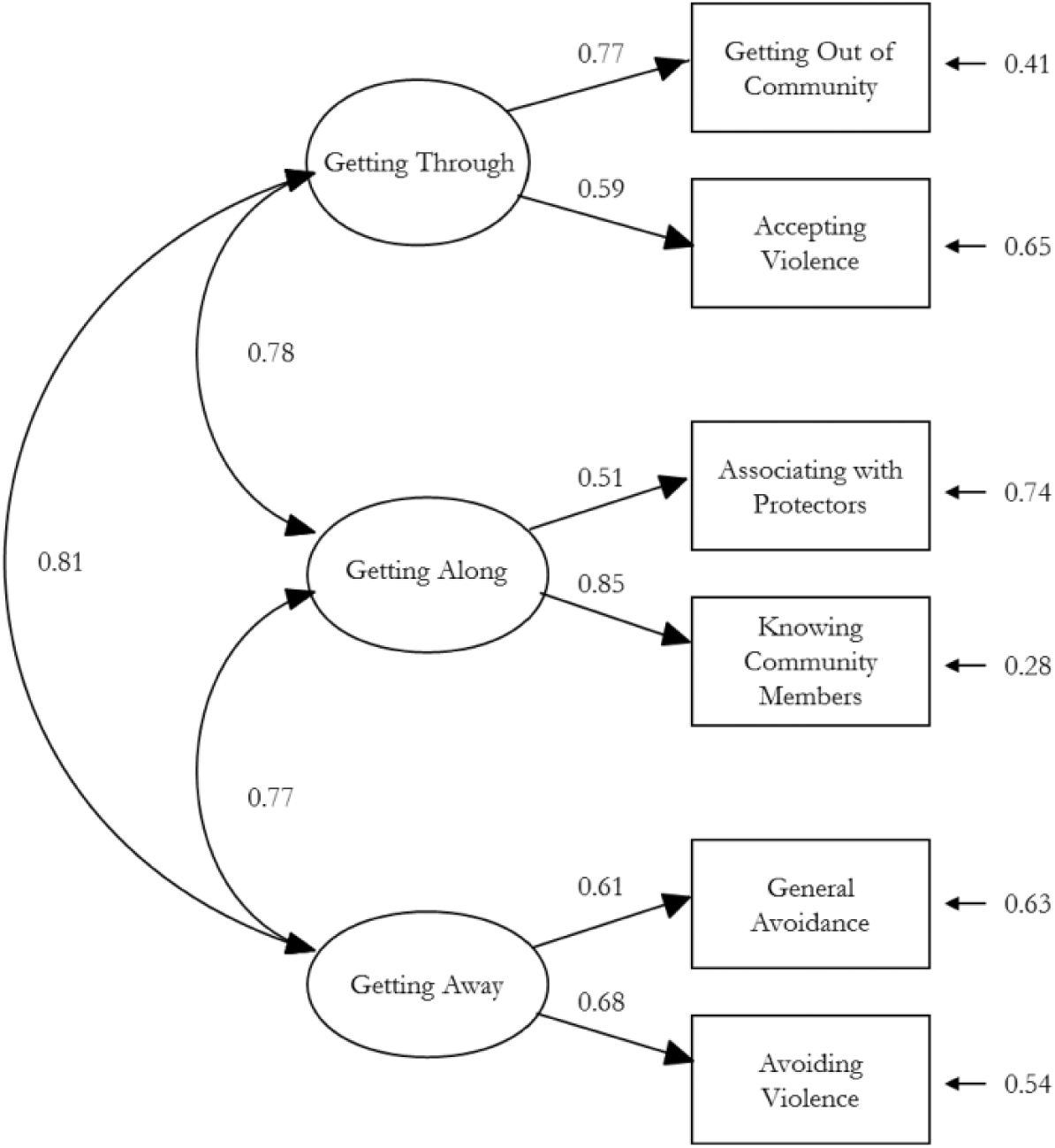
Final model with the factors and item loadings for the CWCV subscales.
Descriptive Analyses With Study Variables
Means, standard deviations, and correlations for all study variables are presented in Table 2. For the analyses, gender was coded 0 if participants self-identified as male and 1 if participants self-identified as female. Compared with females, t tests (equal variances not assumed) revealed that males were exposed to significantly greater levels of community violence, t(533.67) = 3.75, p < .001, and males engaged in significantly more delinquent behaviors, t(494.54) = 4.62, p < .001. In addition, females used significantly more getting away coping, t(590) = −2.36, p = .024. The t tests indicated that males and females did not significantly differ on aggressive behaviors or the other coping factors. Given these significant gender differences and similar findings in prior research, gender was added as an additional interaction term in subsequent analyses.
Means, Standard Deviations, and Pearson’s Correlations Among the Main Study Variables for the Overall Sample.
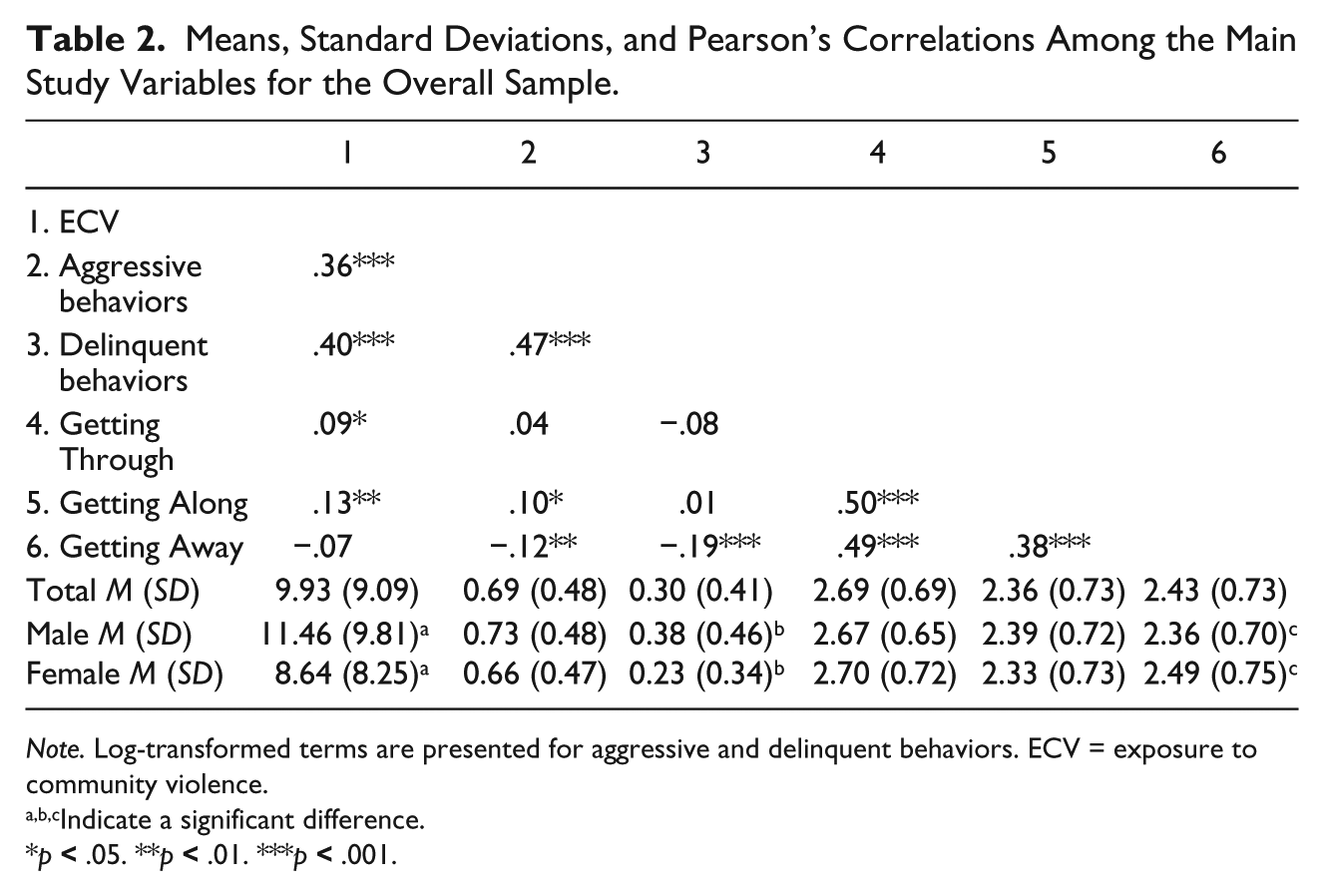
Note. Log-transformed terms are presented for aggressive and delinquent behaviors. ECV = exposure to community violence.
Indicate a significant difference.
p
In terms of the seven types of ECV, most participants experienced each of the events at least once. A total of 71.3% had a close relative or friend robbed or attacked (M = 2.49). A total of 67.7% had a close relative or friend seriously injured due to violence (M = 2.66). A total of 65.8% had a close relative or friend die violently (M = 2.68). A total of 54.3% saw someone being beaten (M = 2.67). A total of 44.4% witnessed a gun-related incident (M = 2.85). A total of 38.2% were a victim of violence (M = 2.64). Finally, a total of 36.9% saw a dead body not at a funeral (M = 2.56). The range for all violence exposure items was 0 to 6.
Coping Specific to Community Violence as a Moderator
For the secondary objective, to determine whether these domains of coping specific to ECV moderated the relationship between ECV and the two types of externalizing behaviors, moderation analyses were conducted with hierarchical linear regression on SPSS. Two models were tested—one for aggressive behavior as the outcome and the other for delinquent behavior as the outcome. Rather than assessing the effects of each of the coping strategies in individual models, they were entered into a single model to estimate the effects of an individual coping strategy on outcomes while holding the effects of other variables constant. Given the significant correlations among the coping strategies (see Table 1), these models will determine whether the interaction effects are significant above and beyond the other coping strategies.
For all of the analyses, grade level and recruitment site were entered into Step 1 of the models to control for their possible effects. ECV, gender, and the three coping factors were simultaneously entered into Step 2 of the models. Two-way interaction terms were created for each of the coping factors, gender, and violence exposure by multiplying each of the centered variables with each other (e.g., Getting Through × ECV). These 10 two-way interaction terms were simultaneously added into Step 3 of the models. Finally, three-way interaction terms were created by multiplying each of the centered variables for the three coping factors with ECV and gender (e.g., Getting Through × ECV × Gender). The 3 three-way interaction terms were entered into Step 4 of the models. Given the poor fit with the getting back coping factor, the moderating role of getting back coping was not examined.
Prediction of delinquent behavior
There was a significant three-way interaction between ECV, gender, and getting away coping in the prediction of delinquent behaviors. To determine the specific nature of the effects, follow-up analyses were used to calculate high (+1 SD) and low (−1 SD) levels of the significant variables. Simple slope analyses revealed that the getting away and ECV interaction was significant for both females, β = −.17, p = .002, as well as for males, β = .12, p = .04, but the direction of the effect differed. For females, ECV was significantly associated with more delinquent behaviors at low levels of getting away coping, β = .49, p < .001, but not at high levels of getting away coping, β = .15, p = .06. For males, ECV was associated with even more delinquent behaviors at high levels of getting away coping, β = .55, p < .001, compared with low levels of getting away coping, β = .32, p < .001. Figure 2 illustrates the simple slope analyses depicting the relationship between ECV and delinquent behaviors at high and low levels of getting away coping for both males and females.
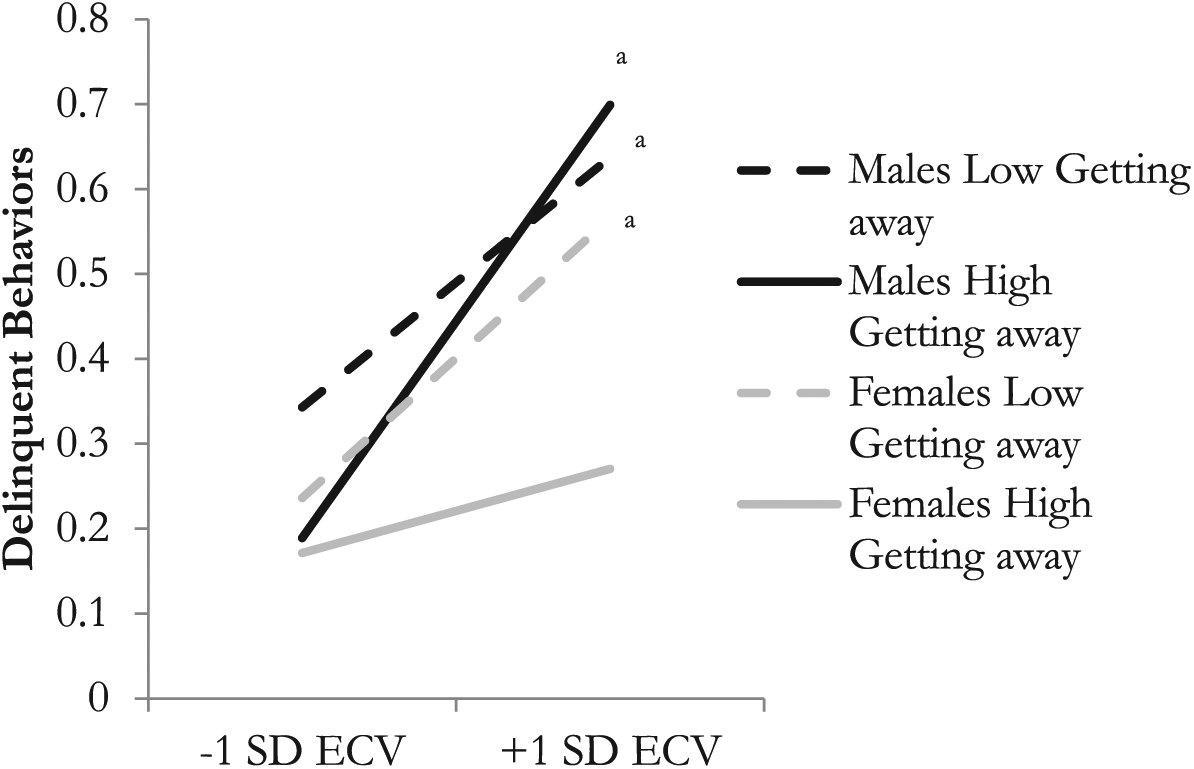
Simple slope analyses depicting the relationship between ECV and delinquent behaviors at high and low levels of getting away coping.
Results revealed a significant interaction between ECV and getting through coping in the prediction of delinquent behaviors (Table 3). Simple slope analyses revealed that higher levels of ECV were significantly associated with more delinquent behaviors at both high (β = .31, p < .001) and low levels (β = .53, p < .001) of getting through coping. Figure 3 illustrates the simple slope analyses depicting the relationship between ECV and delinquent behaviors at high and low levels of getting through coping. Finally, there was a significant interaction between ECV and gender in the prediction of delinquent behaviors (Table 3). Again, simple slope analyses revealed that ECV and delinquent behaviors were positively associated for both males (β = .45, p < .001) and females (β = .30, p < .001) at high levels of ECV.
Final Models Examining the Three Types of Coping and Gender as Moderators in the Relationship Between (a) ECV and Aggressive Behaviors and (b) ECV and Delinquent Behaviors, While Controlling for Recruitment Site and Grade Level.

Note. Predictor variables are centered. ECV = exposure to community violence.
p < .05. **p < .01. ***p < .001.

Simple slope analyses depicting the relationship between ECV and delinquent behaviors at high and low levels of getting through coping.
Prediction of aggressive behavior
Interpretation of the results for aggressive behaviors was similar to that of the results for delinquent behaviors. As shown in Table 3, there was a significant three-way interaction between ECV, gender, and getting away coping in the prediction of aggressive behaviors. Follow-up analyses revealed that the getting away and ECV interaction was only significant for females, β = −.29, p < .001, but not for males, β = .05, p = .39. Simple slope analyses revealed that higher levels of ECV were significantly associated with higher levels of aggressive behaviors at low levels of getting away coping, β = .65, p < .001. However, at high levels of getting away, the relationship between ECV and aggressive behaviors was not significant, β = .07, p = .91. Results also revealed a significant ECV and getting through coping interaction in the prediction of aggressive behaviors (Table 3). Simple slope analyses revealed that the slopes for both high getting through coping and low getting through coping were significant. However, ECV was associated with even more aggressive behaviors when participants had levels of low getting through coping, β = .52, p < .001, compared with high levels of getting through coping, β = .25, p < .001.
Discussion
Given the inconsistent findings within the coping literature for African American youth exposed to community violence, the overall purpose of the current study was to examine coping strategies specific to the context of ECV. Specifically, the current study sought to examine the fit of a four-factor model of coping with ECV in the current data as well as to determine whether the four domains of coping moderated the relationship between ECV and externalizing behaviors.
In contrast to our hypothesis, the four-factor model of the CWCV based on 29 items did not fit the current data. Subsequent modifications did not yield good fit indices for the four-factor model. Based on the modifications suggested by Mplus Version 6.12 (Muthén & Muthén, 1998-2011), it appeared that a few items could potentially load onto more than one factor. For example, “I try to associate with people who are not involved in violence” and “I try to make sure that a lot of people know me in my community” were on the getting along factor, which includes items that assess participants’ attempts to associate with individuals who could offer protection from ECV. However, the modification tests suggest that these two items could load onto the getting through factor as well. Getting through coping is defined as an acceptance of community conditions and engagement in positive behaviors to leave the community. The two items listed above could also be considered positive and active behaviors that may support efforts to leave the community. In other words, youth may associate with people who are not involved in violence because they perceive relationships with these individuals as supportive of their positive behaviors, and not to reduce their own ECV. Thus, although getting through coping and getting along coping were intended to represent conceptually distinct forms of coping, items from the two subscales may be tapping into a common strategy that is not reflected in the proposed four-factor model of coping with ECV.
Despite unacceptable fit statistics for the four-factor structure, acceptable fit was achieved through the use of item parceling to create a three-factor model comprised of six subscales. In addition, the remaining items on each subscale were consistent with theories of coping. For example, when comparing the items that were dropped with the items that were retained from the Getting Through subscale, it appeared that there were two conceptually dissimilar sets of items. The first set (e.g., “I express my feelings about the violence in a poem, song, or rap”) seemed to reflect an expression of feelings, whereas the second set (e.g., “I try to work hard in school, so that I can get out of my community”) addressed behavioral goals. Expression of feelings may reflect a more passive method of coping by managing one’s emotional reaction to acceptance of ECV, whereas behavioral goals may reflect a more active technique of preventing additional ECV.
Interestingly, the getting back factor had to be dropped from the model. This may be due to the types of items that were included on the Getting Back subscale. In the current subscale, most of the items described reactive types of confrontational strategies (e.g., I fight back if someone attacks me). It is possible that some youth use more preemptive forms of confrontation that were not probed with the current items on the CWCV (e.g., I learned how to fight to protect myself). Examples may include carrying a weapon to threaten others, joining a gang, or engaging in normatively “antisocial” behaviors to gain respect from others (Rosario et al., 2003). As such, future directions may include additional qualitative discussions with youth to expand the types and number of items included on the Getting Back subscale to reflect more preemptive forms of confrontation and protection.
While beyond the scope of this study to revise the CWCV, it may be necessary to reevaluate the items on the measure. Given that the creation of the CWCV was based on information obtained from a qualitative study, it could be useful to obtain further feedback from youth residing in low-income, urban communities regarding the items on the CWCV. It is possible that different items may need to be added to strengthen each subscale. For example, it may be helpful to obtain ideas to modify the wording for items on the Getting Through subscale, or create more distinct item sets for the Getting Through and Getting Along subscales to avoid potential overlap.
Predictive Validity of CWCV
Results demonstrated partial support for our predictions regarding the secondary objective. Specifically, there appeared to be a protective-reactive effect of getting through coping on the relationship between ECV and both aggressive and delinquent behaviors (Luthar et al., 2000). In other words, getting through coping was generally advantageous but less so at high levels of ECV. In line with predictions, at low levels of getting through coping, more ECV was associated with more aggressive or delinquent behaviors. However, in contrast to predictions, at high levels of getting through coping, more ECV was also associated with more aggressive and delinquent behaviors. Getting through coping was adaptive in the sense that youth engaged in fewer aggressive and delinquent behaviors at high levels of getting through coping compared with low levels of getting through coping. If adolescents are actively considering the future to get out of the community, results indicated that they may actually end up engaging in fewer aggressive behaviors than their peers who may not be thinking about their future. As found in previous research, youth who are raised in high-risk environments, but who sustain hope and positive expectations for the future, are less likely to experience psychosocial problems than those who do not engage in future planning (McCabe & Barnett, 2000). It is possible that future orientation may be a key factor when youth are using getting through coping to handle ECV. Yet, getting through coping was less adaptive at high levels of ECV. There is a possibility that getting through coping may proactively minimize ECV. Proactive coping occurs before the need to actually cope with a stressor, so it is generally concerned with preparing for stressors that may occur (Kliewer et al., 2006). As such, getting through coping may not be as beneficial when one is already experiencing high levels of ECV. Thus, this may explain why getting through coping demonstrated a protective-reactive effect at high levels of ECV, rather than a protective-stabilizing effect.
In contrast to predictions, there was a vulnerable-reactive effect of getting away coping on the relationship between ECV and delinquent behaviors for males (Luthar et al., 2000). At high levels of getting away, higher levels of ECV were associated with higher levels of delinquent behaviors than at low levels of getting away. It is possible that the use of adaptive coping to protect against delinquent behaviors may be undermined at high levels of ECV for males because they may be overwhelmed by this uncontrollable form of stress (Scarpa, Haden, & Hurley, 2006). As such, getting away coping is more adaptive in protecting against delinquent behaviors at low levels of ECV for males. For youth who engage in high levels of getting away coping at high levels of ECV, getting away coping may increase the likelihood that these individuals are perceived as timid or fearful by their peers (Anderson, 1999). As a result, they may develop delinquent behaviors as a means of appearing tough to protect themselves or their family members from high levels of violent victimization (Stewart, Schreck, & Simons, 2006). In contrast, the interaction between getting away coping and ECV was not significant for males in the prediction of aggressive behaviors. More severe externalizing behaviors, such as delinquency, may be more influenced by gender and coping, while the aggressive behaviors assessed in the current study may reflect behaviors that are associated with more normative beliefs about aggression (Guerra, Huesmann, & Spindler, 2003). Hence, as opposed to delinquent behaviors, males’ use of coping may not demonstrate the same effect on these types of normative, aggressive beliefs and behaviors. In addition, the vulnerable-reactive effect could suggest a reciprocal association between ECV and delinquency, such that youth who engage in high levels of delinquent behaviors may eventually end up being exposed to more violence, despite trying to avoid exposure. Of note, other research studies have found a protective effect of avoidant coping on anxiety (Edlynn et al., 2008). When considered in conjunction with the findings from the current study, it appears that the protective effects of avoidant-type coping are specific to certain outcomes for males. Future studies should examine these ideas within a longitudinal study as a means of determining how these concepts relate to one another over time.
The effects of getting away coping for females differed sharply from the effects for males. In line with predictions, there appeared to be a protective-stabilizing effect of getting away coping on the relationship between ECV and aggressive or delinquent behaviors (Luthar et al., 2000). Specifically, at high levels of getting away coping, levels of aggressive or delinquent behaviors were stable despite increasing risk of ECV. However, at low levels of getting away coping, higher levels of ECV were significantly associated with higher levels of both aggressive and delinquent behaviors. In other words, increasing levels of ECV may not overwhelm females in the same way that it may overwhelm males, so females may still demonstrate adaptive methods of coping. However, female youth may demonstrate other forms of distress, such as depressive symptomology (Fitzpatrick, 1993).
Taken together, past literature has found avoidant coping to be a protective factor in some studies but a vulnerability factor in other studies (e.g., Dempsey, 2002; Rosario et al., 2003). Results from the current study suggest that part of this difference may be due to gender. Consistent with prior studies, males were exposed to higher levels of community violence than females in the current study (e.g., Stein et al., 2003). Consequently, it could be more difficult for males to avoid violence, and it could be even more challenging to avoid violence without appearing inadequate in front of peers (Anderson, 1999). However, some females may experience more physical vulnerability than males because of their smaller stature and socialized gender roles (Hill, 2002), so avoidant-type coping may protect females from severe forms of violence (Voisin, Bird, Hardestry, & Shiu, 2011). Overall, gender norms may make it more acceptable for females to avoid violence, which may bring about an increased utility of getting away coping for females. Further research should examine the specific mechanisms through which these coping strategies work for both males and females.
Results suggested that getting along coping was not found to moderate the relationship between ECV and externalizing behaviors for either males or females. Once again, items on the Getting Along subscale do not differentiate between participants who may be associating with those who are gang affiliated or those who are not involved in violence. As such, this could have been a potential confound that could have affected the results, as the effects of possible gang affiliation may have negated any effects of affiliation with nonviolence-involved individuals. In addition, youth who are getting along via gang affiliation may be engaging in a form of delinquent behavior in itself, so this type of coping may operate as a vulnerability factor rather than a protective factor.
Limitations and Strengths
Limitations of the current study should be noted: First, the study focused on a sample of African American adolescents from an urban, low-income environment. As such, the findings may not be applicable to other racial/ethnic groups or African American youth from more affluent or rural communities. Furthermore, those who chose to participate in the study may have differed from those who declined to participate on characteristics or behaviors not assessed in the study. For example, those with the greatest number of externalizing problems may have declined to participate, which may lead to a slight underestimation of the effects reported in the current study. Due to the low percentage of missing data, this is likely not a significant concern but should be considered. In addition, the current measure of ECV was not as comprehensive as some other measures of ECV. Nevertheless, the measure utilized in the current study included frequently endorsed community violence events and have been used in previous studies with this population (Voisin, Bird, Hardestry, & Shiu, 2011). Of note, we were unable to control for exposure to family or domestic violence. Thus, it is possible that some of the items in the current study (e.g., “Has a close relative or friend been seriously injured because of violence?” or “Have you seen someone being beaten?”) may have inadvertently tapped into exposure to family or domestic violence and not solely ECV. The current study did not explicitly inquire about sexual violence, which may potentially underrepresent violent experiences particularly among females in the study. Although the survey specifically prompted participants to think about community-related violence, some participants may have misinterpreted the items if they were thinking about other violence-related events. It is possible that the coping strategies assessed in the current study may not be relevant for these other types of violence, as they are specific to broader community-based events. As such, there is a possibility of the coping strategies being underreported. It would be essential for further studies to directly assess the effects of these other types of violence as well.
In light of these limitations, the current study has several strengths. To our knowledge, the current study is one of the first quantitative examinations of how youth specifically cope with ECV versus other types of violence. The CFA procedures also benefited from a sample of youth that included both males and females. Furthermore, this study was able to assess the utility of a CWCV measure by examining both its factor structure and its predictive validity. In particular, the current study specifically focused on two different types of externalizing behaviors to gain a deeper understanding of its links with ECV and coping.
Implications and Conclusions
As previously mentioned, items on the CWCV were derived from a qualitative study examining the types of strategies African American youth noted that they used in response to ECV. Although a four-factor structure identified in qualitative research was not supported in quantitative analyses, a three-factor model demonstrated a good fit with the data. The items on the CWCV could be modified and further tested to improve the factor structure of the measure. As such, additional qualitative research may be warranted. Also, the current study demonstrated that certain types of coping (e.g., getting away coping) may interact with both ECV and gender to predict externalizing outcomes. Coping strategies specific to community violence may be a complex but important area of research. While studies with more general forms of coping have yielded inconsistent results, future studies should determine whether these violence-specific coping strategies may generate more uniform outcomes across studies. In particular, to further assess the predictive validity of the CWCV, it would be beneficial to determine how these coping strategies may be linked to internalizing behaviors or trauma-related symptoms. For example, getting away coping may be linked to higher levels of internalizing symptoms and reflect potential maladaptive levels of anxiety. Furthermore, low levels of getting along coping may be linked to high levels of internalizing symptoms and reflect a lack of social engagement. Future research should further tease apart nuances in how African American youth cope and examine whether these coping strategies may affect a host of developmental outcomes.
Footnotes
Declaration of Conflicting Interests
The author(s) declared no potential conflicts of interest with respect to the research, authorship, and/or publication of this article.
Funding
The author(s) disclosed receipt of the following financial support for the research, authorship, and/or publication of this article: Funding for this study was provided by the Center for Health Administration Studies and the STI/HIV Intervention Network at the University of Chicago.