



Abstract
Bully-victims are often found to be the most high-risk group involved in bullying, yet limited prior research has explored differences among bully-victims. This study aims to fill that gap by exploring within-group differences of youth involved in both bullying perpetration and victimization. In a nationally representative sample of 165 youth ages 5 to 17, four bully-victim types were created using cutoff points based on the amount of perpetration and victimization reported: high bully-victims (n = 38), aggression predominant bully-victims (n = 67), victimization predominant bully-victims (n = 23), and moderate bully-victims (n = 37). Analyses revealed distinct differences among the groups, particularly relating to traumatic symptoms, types of bullying involvement, and nonvictimization adversity. The findings confirm that there is heterogeneity among bully-victims. The most substantial difference was found between the high group and the moderate group, with the high group significantly more likely to report depression (p < .05) and anxiety symptoms (p < .05), and more than two times more likely to experience past-year adversity than the moderate group. The findings from this study indicate that youth involved in high amounts of both perpetration and victimization are considerably more at risk of traumatic symptoms and nonvictimization adversity than youth involved in fewer bullying behaviors. These findings can be used to inform both research and practice, particularly in regard to targeted evidence-based interventions that meet the unique needs of each type.
Keywords
Bullying is a widespread issue that affects approximately 28% of children and adolescents every year (National Center for Education Statistics, 2014). In recent years, the research on bullying has expanded greatly, particularly surrounding bully-victims, youth involved in both perpetration and victimization. Throughout this article, perpetration and victimization will refer specifically to the peer level, unless otherwise specified. The current study examined differences among bully-victims based on the amount of perpetration and victimization they reported in the second wave of the National Survey of Children’s Exposure to Violence (NatsCEV; Finkelhor, Shattuck, Turner, & Hamby, 2014). The purpose of this research was to investigate the heterogeneity of youth involved in both perpetration and victimization to determine whether there are distinct bully-victim types. Prior research tends to focus on bully-victims as one homogeneous group, whereas this research aims to fill this gap by exploring within-group differences among bully-victims. In this article, involvement in bullying refers to the whole construct of bullying, encompassing both perpetration and victimization.
Bully-Victims in the Literature
Much of the literature on bully-victims compares them with pure bullies and pure victims, and has found them to be more high risk than both groups. The research shows that bully-victims suffer from more emotional and behavioral disorders (Schwartz, 2000; Schwartz, Dodge, Pettit, & Bates, 1997); have more behavior problems (Dukes, Stein, & Zane, 2009; Haynie et al., 2001; Stein, Dukes, & Jasmin, 2007), more behavioral misconduct (Haynie et al., 2001), more depressive symptoms (Haynie et al., 2001; Toblin, Schwartz, Gorman, & Abou-ezzeddine, 2005), and lower self-esteem (Dukes et al., 2009). Consistently, they are found to be the most dysfunctional (Dukes et al., 2009) and at risk (Stein et al., 2007) of all youth involved in bullying. In addition, they have been found to have higher rates of emotional dysregulation and hyperactivity (Toblin et al., 2005), as well as psychiatric symptoms (Sourander et al., 2016). Among peers, bully-victims are often perceived as social outcasts and tend to provoke negative reactions (Juvonen, Graham, & Schuster, 2003). They are less likely to report having significant peer relationships (O’Brennan, Bradshaw, & Sawyer, 2009) and more likely to report having difficulty socializing with peers (Schwartz, Proctor, & Chien, 2001). Bully-victims tend to report more loneliness (Georgiou & Stavrinides, 2008; Toblin et al., 2005), which is consistent with other research that finds them to be more socially isolated and with fewer friends (Smokowski & Kopasz, 2005) than others involved in bullying (Unnever, 2005).
Bully-victims are more likely to be boys (Goldweber, Waasdorp, & Bradshaw, 2013; O’Brennan et al., 2009; Solberg, Olweus, & Endersen, 2007; Sourander et al., 2016; Stein et al., 2007; Yang & Salmivalli, 2013) and tend to be older than others involved in bullying (Stein et al., 2007). For example, Holt and Espelage (2007) found that the rate of bully-victims peaked at eighth grade and decreased through 12th grade, which is consistent with Stein and colleagues (2007) who found that the average age of bully-victims is approximately 14.6 years old. In regard to race and ethnicity, nonwhite students are more likely to be categorized as bullies or bully-victims (Holt & Espelage, 2007), and youth from urban communities are more likely to be categorized as bully-victims (Goldweber et al., 2013).
Trauma Theory
Bully-victims are more likely to be exposed to violence and extreme discipline in the home compared with pure bullies (Schwartz et al., 1997). They are more likely to be treated harshly by parents, have a chaotic home life (Unnever, 2005), experience more nonpeer victimization (Holt, Finkelhor, & Kantor, 2007; Schwartz et al., 1997), and are more likely to be abused in the home than by others involved in bullying (Tippet & Wolke, 2014; Unnever, 2005). These findings suggest that bully-victims are more likely to have experienced trauma in their lives. Trauma theory is a cognitive model that focuses on the ways in which traumatic experiences and subsequent traumatic stress affect cognitive processes, behavior regulation, and coping strategies (Alisic, Jongmans, van Wesel, & Kleber, 2011; Chemtob, Roitblat, Hamada, Carlson, & Twentyman, 1988; Ehlers & Clark, 2000). There has been limited research in which trauma theory has been applied to bullying behaviors; however, it can be used to understand how youth who experience trauma (in the form of peer or nonpeer victimization) might become a bully-victim. The primary mechanism in the theory is that overactivation in certain parts of the brain due to trauma can make kids more reactive, and therefore more aggressive. Emotionally dysregulated youth have less control modulating emotions, which can lead to anger outbursts or other inappropriate behavioral reactions (Onchwari & Keengwe, 2011). For example, Langevin, Hébert, and Cossette (2015) found that youth who had less emotion regulation exhibited more internalized and externalized behavior problems as a result of sexual abuse. Previous research also indicates a relationship between bullying, delinquency, and traumatic victimization. Cuevas, Finkelhor, Turner, and Ormrod (2007) found that traumatic stress in the form of victimization (both peer and nonpeer) was likely to lead to aggression, bullying, and delinquent behaviors, as well as worsening mental health symptoms. In addition, the theory posits that the ability to distinguish between real and imaginary threats is compromised by trauma, which may make it harder for these individuals to protect themselves against future victimization, potentially leading to a cycle of victimization and aggression (Chemtob et al., 1988; Ehlers & Clark, 2000).
This theory provides a general framework that can be used to explore bully-victim status, in that traumatic experiences can lead to emotional dysregulation and increased aggressive behavior among youth. For example, traumatized youth may engage in perpetration and experience impaired social competence and cognition simultaneously, which may reduce their ability to avoid further victimization. This theory was used as a framework for this study, specifically in the development of hypotheses regarding level of bullying involvement and its relationship with traumatic and adverse experiences. According to this theory, youth who experienced more traumatic life events will be likely to engage in more bullying behaviors than those who experienced fewer traumatic life events. Understanding bully-victims through trauma theory can also inform treatment and prevention. Studies have examined the use of trauma-focused cognitive therapy with those suffering from posttraumatic stress disorder (PTSD), due to various different types of traumatic events. The results show that early treatment with cognitive therapy is able to reduce or eliminate symptoms of PTSD, as well as symptoms of depression, anxiety, and overall functioning (Kleim & Kroger, 2013; Meiser-Stedman et al., 2017). This suggests that bully-victims, as youth who are likely to have experienced trauma, might be good candidates for cognitive therapy, and this might be a way of reducing their involvement in bullying behaviors.
Current Study
Previous research has identified and examined the three primary groups involved in bullying, with bully-victims identified as substantially more at risk, particularly in terms of nonpeer victimization (Holt et al., 2007), social support (Unnever, 2005), and mental health problems (Sourander et al., 2016), yet little research to date has examined how these risk factors might vary among bully-victims. The only study that looked at subgroups of bully-victims was a latent class analysis by Giang and Graham (2008). The purpose of their study was to examine latent classes of all youth involved in bullying, not just bully-victims; however, they found two subgroups of bully-victims based on peer nominations of bully and victim status: highly aggressive aggressive victims and highly victimized aggressive victims. They found that the highly victimized aggressive victims scored significantly higher on loneliness and rejection, and significantly lower on “coolness” than the highly aggressive aggressive victims. Giang and Graham’s (2008) findings indicated that there are significant differences on social adjustment and psychological factors among bully-victims based on whether they are victimized more or perpetrate more. The current study expands on their findings and fills a gap in the literature by breaking down bully-victims into four categories based on their involvement in perpetration and victimization, and examining variation among these categories.
To do this, four groups of bully-victims were created based on cutoff points determined by the number of perpetration and victimization types participants reported within the past-year. Using previous research and trauma theory (Alisic et al., 2011; Chemtob et al., 1988; Ehlers & Clark, 2000) as a guide, four general hypotheses were developed regarding the characteristics of each group: (a) the group that was involved in high levels of perpetration and high levels of victimization (high bully-victims, n = 38) will be the most high risk and emotionally dysregulated group; (b) the group that reported high victimization and lower perpetration (victimization predominant bully-victims, n = 67) will be high risk and emotionally dysregulated, though less so than the high group; (c) the group that reported high perpetration and lower victimization (aggression predominant bully-victims, n = 23) will report fewer trauma symptoms; (d) the group that reported lower victimization and lower perpetration (moderate bully-victims, n = 37) will have the lowest risk compared with the other bully-victim groups.
Method
This study used data from the second wave of the NatsCEV II collected via telephone survey during 2011 (Finkelhor et al., 2014). The survey is a nationally representative sample of 0- to 17-year-olds designed to collect data on a wide range of childhood victimization characteristics. The entire NatsCEV II sample size was 4,503; however, the current study focused on a subsample of 165 children and adolescents ages 5 to 17, determined using cutoff points based on the amount of perpetration and victimization reported. The NatsCEV used random digit dialing (RDD) and a trained interviewer spoke with the adult in the house briefly to obtain basic demographic information before focusing on the experience of the child with the most recent birthday. If that child was below 10 years old, then the primary caregiver would complete the interview for the child. If the child was more than 10 years old, then the interviewer would gain consent to interview that child. The Institutional Review Board at the University of New Hampshire approved all aspects of this study. Participants were informed that they would have complete confidentiality. When there was a situation where the participant disclosed a situation of serious threat or ongoing victimization, an approved protocol was followed for helping the child and family.
Measures
Bully-victim variables
To determine which participants fell into the bully-victim category, five bullying perpetration and six bullying victimization indicators were selected, the bullying perpetration indicators included destruction of property, getting in a physical fight, severely injuring someone, chasing or grabbing others, and socially excluding others. The inclusion of these specific indicators was based on their inclusion in several other bullying measures (Hamburger, Basile, & Vivolo, 2011). Each indicator corresponded to a specific type of perpetration (physical, verbal, or relational) committed within the past year. The six victimization indicators included getting attacked by others, being hit by peers, genital assault, name calling, rumor spreading, and social exclusion. Genital assault was included in victimization measure because previous research suggests that physical bullying among younger adolescent and preadolescent youth is often targeted toward the genital area (Finkelhor & Wolak, 1995). Including genital assault in the bullying measure addresses a unique form of physical bullying that has pronounced psychological side effects, specifically in the form of trauma symptoms (Finkelhor & Wolak, 1995), and is frequently excluded from research on victimization (Finkelhor, Ormrod, Turner, & Hamby, 2005). Like the perpetration indicators, each victimization indicator corresponded to a type of bullying victimization committed within the past year. The answer choices for both the perpetration and the victimization indicators were as follows: yes, no, not sure, and refused, which were dichotomized into yes (1) and no (0).
The five perpetration indicators were recoded into one perpetration variable, coded 1 through 5, and the six victimization indicators were recoded into one victimization variable, coded 1 through 6. These new variables were used to determine a cutoff point for the bully-victim groups. Using previous research as a model (Demaray & Malecki, 2003; Haynie et al., 2001; Holt et al., 2007), endorsing two or more of the victimization indicators accounts for approximately the top 20th percentile of the entire sample endorsing victimization, and two or more of the perpetration indicators accounts for approximately the top 20th percentile of the full sample endorsing the perpetration questions. 1 As such, only participants who endorsed two or more perpetration variables and two or more victimization variables were included in the bully-victim subsample. Focusing on the top 20% of youth involved in perpetration and victimization in the sample increased the likelihood that all participants in this study were involved in repeated bullying incidences as both the victim and the perpetrator, which is consistent with the Olweus (1993) definition of bullying.
The bully-victim variable was created by combining the recoded victimization and perpetration variables, which yielded four groups differentiated by the amount of perpetration and victimization participants reported. The groups were named using terms that best describe their association with victimization and perpetration. Previous research (Chester et al., 2015; Molcho et al., 2009; Pickett et al., 2013; Solberg et al., 2007) demonstrates that three or more incidences of victimization or perpetration constitute a high frequency of bullying involvement and not just occasional or short-lived involvement, as such this was used as the cutoff point for the different categories. Figure 1 shows how the four groups relate to each other, with the x-axis representing perpetration and the y-axis representing victimization. High bully-victims were characterized by three or more perpetration and three or more victimization indicators (n = 38). Victimization predominant bully-victims were characterized by three or more victimization and two perpetration indicators (n = 67). Aggression predominant bully-victims were characterized by three or more perpetration and two victimization indicators (n = 23). Moderate bully-victims were characterized by two perpetration and two victimization indicators (n = 37).

Bully-victim types.
Demographic variables
The demographic variables used in this analysis were gender, age, race, and household income. Gender was dichotomized into male (58%) and female (41%). Age was recoded into three groups: 5 to 9 (35%), 10 to 13 (27%), and 14 to 17 (38%) for some of the analysis, whereas age in years (5-17) was used in the multivariate analysis. Race and ethnicity were recoded into White/Other (non-Hispanic; 75%), 2 Black (non-Hispanic; 12%), and Hispanic (any race; 13%). Household income was recoded into less than US$50,000 (38%), US$50,000 to US$100,000 (39%), and more than US$100,000 (23%).
Lifetime nonpeer victimization
There were multiple indicators regarding prior nonpeer victimization, and this study used the aggregated variables. They were any exposure to family violence (lifetime; 54%), any sexual assault (lifetime; 17%), any sexual victimization (lifetime; 36%), and any maltreatment (lifetime; 62%).
Nonvictimization adversity
In addition to prior nonpeer victimization, this study examined lifetime (M = 4.11, SD= 2.62) and past-year adversity (M = 1.56, SD = 1.72), which refers to nonvictimization-based adversity. These measures were scored based on the responses to a number of lifetime and past-year adversity questions, such as experiencing the death of family member, car accident, and homelessness. Both lifetime and past-year adversity were summary measures.
Number of good friends
The question, “How many really good friends (does your child/do you) have?” was used to determine the number of good friends a participant had (M = 8.64, SD = 16.47). The responses were in numerical format.
Any diagnosis
Participants were asked whether or not they had ever received a mental health diagnosis, with nine specific answer choices, including PTSD, Attention Deficit Hyperactivity Disorder, and Oppositional Defiant Disorder/Conduct Disorder. The Any Diagnosis variable was created by recoding and combining the nine specific diagnosis variables into one “Any diagnosis” variable that was coded 1 = yes (38%).
Trauma Symptom Checklist
The Trauma Symptom Checklist (TSC) has two separate versions: the TSC for Children (TSCC) and the TSC for Young Children (TSCY). The TSCC is for children ages 8 to 17 and the TSCY is for children ages 3 to 12. This study used the TSCC for youth ages 10 to 17 and the TSCY for ages 5 to 9. To make composite scales, the scores were converted into Z scores and merged on five of the subscales. The TSC includes five subscales: anger (M = 1.17, SD = 1.27), anxiety (M = .68, SD = 1.18), depression (M = .93, SD = 1.28), dissociation (M = .86, SD= 1.22), and PTSD (M = .94, SD = 1.19). The questions are based on experiences in the last month and the response options for each question on the TSC are as follows: never, sometimes, often, very often, not sure, and refused.
Statistical Analysis
Frequencies and univariate descriptive statistics were run on all the variables in the analysis for the whole sample of bully-victims (N = 165) using SPSS version 23. Bivariate statistics included chi-square tests for independence on the four bully-victim groups with all the other categorical variables used in the analysis, including the 11 perpetration and victimization variables used to create the bully-victim groups. Pairwise cross-tabulations with chi-square were also used to examine differences between bully-victims groups. Analysis of variance was used to examine between-group differences among the bully-victim types for number of good friends, lifetime adversity and past-year adversity, with Scheffe post hoc tests. Analysis of covariance was used to explore the differences among the four bully-victim types on the five TSC subscales. The continuous age variable and the dichotomized dummy variable for gender (with male = 1) were used as covariates. Pairwise comparisons were used to examine differences between each pair of bully-victim types. A multinomial logistic regression was conducted to investigate predictors based on the characteristics used in the analysis, with the moderate group as the reference group. All variables that were found to be statistically significant in descriptive analyses, as well as some demographic information and the TSC subscales, were included in the logistic regression. Due to high intercorrelation among the internalizing categories of the TSC subscales (anxiety, depression, dissociation, and PTSD), those four were combined for the multivariate analysis.
Results
Perpetration and Victimization
Table 1 contains a chi-square analysis and the distributions of the six victimization and the five perpetration indicators for the four bully-victim types. These 11 indicators were used to determine the overall bully-victim group (N = 165), as well as the four bully-victim types. There were no significant differences on group physical victimization or peer/sibling physical victimization. There were significant differences among the four groups on four types of victimization: genital assault victimization (χ² = 15.531, p = .01), name calling/threatening (χ² = 36.841, p < .001), rumor spreading (χ² = 18.428, p < .001), and social exclusion (χ² = 27.771, p < .001).
Perpetration and Victimization Involvement as a Percentage by Bully-Victim Type (N = 165).
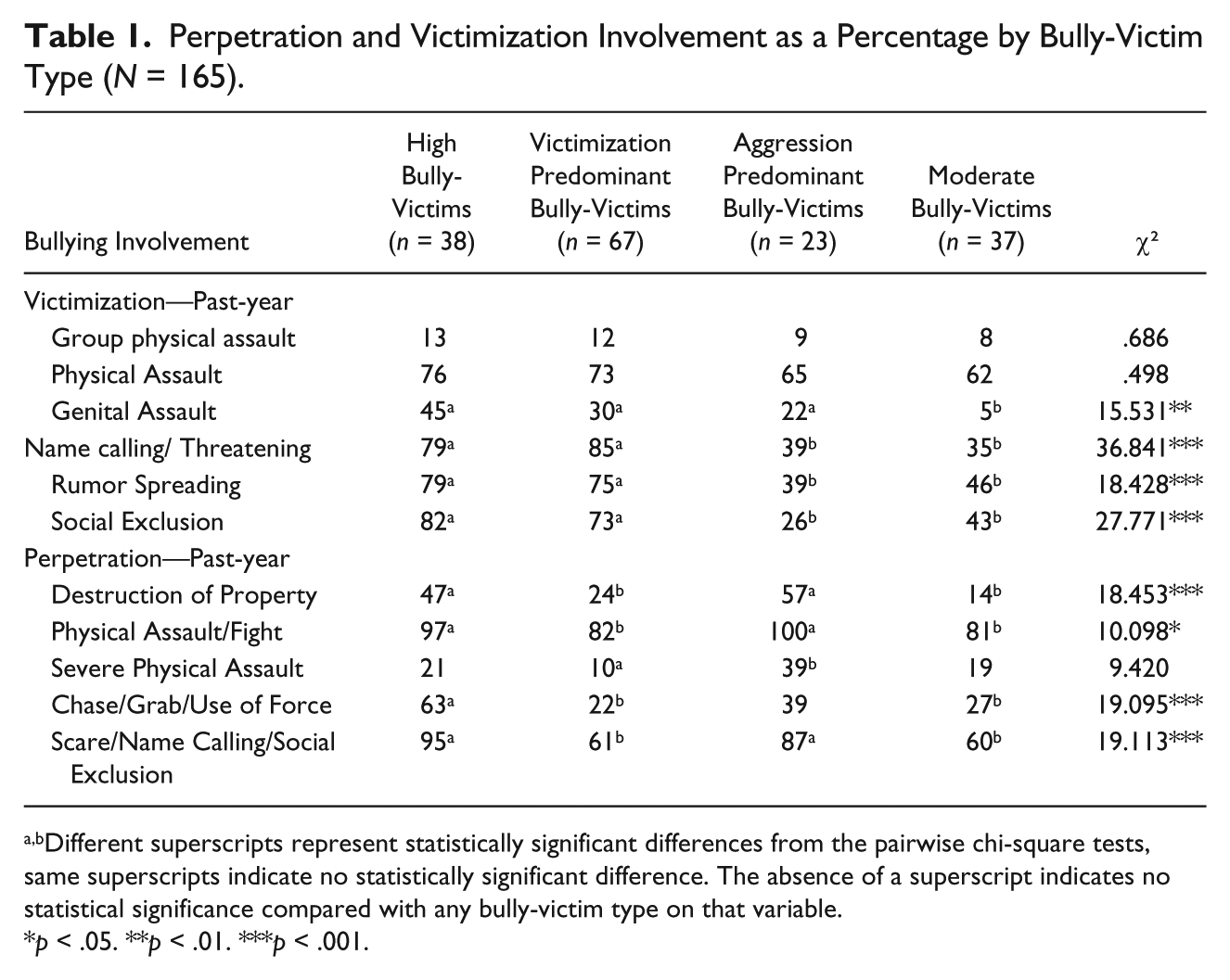
Different superscripts represent statistically significant differences from the pairwise chi-square tests, same superscripts indicate no statistically significant difference. The absence of a superscript indicates no statistical significance compared with any bully-victim type on that variable.
p < .05. **p < .01. ***p < .001.
Among the perpetration indicators, destruction of property (χ² = 18.453, p < .001), physical assault/fighting (χ² = 10.098, p < .05), chasing/grabbing/using force (χ² = 19.095, p < .001), and scaring/name calling/social exclusion (χ² = 19.113, p < .001) were all statistically significant. Severe physical assault was not statistically significant overall, but according to the pairwise chi-square test, the aggression predominant bully-victims were significantly more likely to perpetrate severe physical assault than the victimization predominant group.
Demographic Characteristics and Other Features
Table 2 contains demographic information and other features of the bully-victim types. There were no significant differences among the groups on age, gender, and household income. Race/ethnicity was statistically significant among the groups (χ² = 15.899, p < .05), with the majority of each group reporting White or Other (non-Hispanic); however, a larger percentage of Black (non-Hispanic) participants were in the moderate group (27%) compared with the other three groups. There were no significant differences among the groups on lifetime exposure to family violence, lifetime sexual victimization, and lifetime maltreatment; however, a substantial percentage of each group reported experiencing these types of nonpeer victimization in their lifetimes, supporting previous research that bully-victims are likely to report nonpeer victimization.
Demographic Information and Other Features of Bully-Victim Sample by Bully-Victim Type (N = 165).

Different superscripts represent statistically significant differences from the Scheffe post hoc test, same superscripts indicate no statistically significant difference. The absence of a superscript indicates no statistical significance compared with any bully-victim type on that variable.
p < .05. **p < .01. ***p < .001.
Number of good friends, lifetime adversity, and past-year adversity (Table 2) were analyzed using an analysis of variance. Number of good friends was found to be statistically significant (F = 2.908, p < .05), with the aggression predominant group (M = 14.96, SD = 27.46) reporting a significantly higher average number of good friends than the victimization predominant group (M = 4.93, SD = 3.74). Past-year adversity was significant (F = 4.06, p < .01), with the high group (M = 2.24, SD = 2.2) reporting a significantly higher past-year adversity score than the moderate group (M = .89, SD = 1.33).
TSC Subscales
An analysis of covariance was conducted for the five TSC subscales: anger, anxiety, depression, dissociation, and PTSD (Table 3). Age and gender were used as covariates to remove their influence on the dependent variables. Only two of the five subscales were found to be statistically significant: anxiety (F = 2.639, p < .05) and depression (F = 2.921, p < .05). Pairwise comparisons showed that on the anxiety subscale the high group (M = 1.02, SD = 1.28) had significantly higher mean scores than the moderate group (M = .35, SD = 1.06). This contrast between the group that experienced the most bullying involvement and the group that experienced the least (among the bully-victims) was repeated for the depression subscale, with the high group (M = 1.19, SD = 1.05) and the victimization predominant group (M = 1.11, SD= 1.43) both significantly different from the moderate group (M = .53, SD = 1.16).
Means and Standard Deviations of Trauma Symptom Checklist Subscales Scores by Bully-Victim Type (N = 165).

Note. PTSD = Posttraumatic Stress Disorder.
Different superscripts represent statistically significant differences from the post hoc test, same superscripts indicate no statistically significant difference. The absence of a superscript indicates no statistical significance compared to any B-V type on that variable.
p < .05. **p < .01. ***p < .001.
Predicting Typologies
A multinomial logistic regression was conducted to examine predictors for the four bully-victim types, with the moderate group as the reference group (Table 4). The only significant relative risk ratios were for past-year adversity and the combined internalizing subscales from the TSC. According to the relative risk ratios, the high group was 2.137 times more likely to experience past-year adversity than the moderate group (B = .779), and 1.197 times more likely to experience internalizing traumatic symptoms, such as depression, PTSD, anxiety, and dissociation than the moderate group (B = .179). In addition, the victimization predominant group was 1.638 times more likely to experience past-year adversity than the moderate group (B = .493), and 1.174 times more likely to experience internalizing symptoms (B = .161).
RRR of Belonging to Each Bully-Victim Type Compared With the Moderate Bully-Victim Type (n = 37) (N = 165).

Note. RRR = Relative Risk Ratios; TSC = Trauma Symptom Checklist.
To identify reference group for categorical variables.
TSC subscales of depression, anxiety, dissociation, and PTSD were combined for this variable.
p < .05. **p < .01. ***p < .001.
Discussion
This study confirmed that bully-victims are a diverse group, with some experiencing more risk characteristics than others. The findings were mostly consistent with trauma theory, in that youth that experienced more adverse life events and trauma symptoms were more likely to be in the bully-victim groups that reported more bullying involvement, such as the high group. However, this did not hold true for nonpeer victimization, as there were no statistically significant differences in nonpeer victimization among the groups.
High bully-victims experienced more traumatic symptoms (specifically anxiety and depression) and were more likely to experience past-year adversity than the other three groups. These findings supported the hypotheses that the high group would be the most high risk, and likely, the most emotionally dysregulated of all the bully-victim types. This group of bully-victims needs considerable attention for both prevention and intervention, as they appear to be more high risk than the other three groups. The victimization predominant bully-victims reported the fewest number of good friends, reported significant depression symptoms compared with the aggression predominant and moderate groups, and were significantly more likely to experience past-year adversity and internalizing trauma symptoms. This finding is consistent with the findings from Giang and Graham (2008), who found that highly victimized aggressive victims, like the victimization predominant bully-victims in this study, had significantly lower scores on social “coolness” and experienced more social rejection and negative psychological symptoms than the highly aggressive aggressive victims. In addition, research indicates that there are multiple pathways that can explain the relationship between peer victimization, few friends, and depressive symptoms (Hemphill et al., 2011; Hodges, Malone, & Perry, 1997). For the victimization predominant bully-victims, it is possible that this clustering of symptoms and characteristics might result in a cycle of social isolation, peer victimization, and symptoms of depression.
The aggression predominant bully-victims reported the highest number of good friends and the most past-year adversity. The friendship–protection hypothesis states that quality friendships can be protective against victimization (Kendrick, Jutengren, & Stattin, 2012), which might hold true for this group, and that despite family violence, maltreatment, and past-year adversity, they experience fewer traumatic symptoms than bully-victims with fewer friends. The findings for this group are consistent with prior research that demonstrates that bullies tend to have fewer psychological issues compared with more highly victimized youth, due to higher social status among peers (Juvonen et al., 2003). Due to this, it is not surprising that aggression predominant bully-victims in this study reported more good friends and fewer psychological symptoms compared with bully-victims who experienced more victimization. The finding that higher amounts of perpetration might result in more friends and potentially higher social status is important for schools to consider when approaching an issue such as bullying. If students tend to reward other students with greater popularity as a result of bullying perpetration, then prevention programs need to be designed in such a way that they reduce or remove this potential incentive. In addition, it is important that schools identify this group of bully-victims because they appear to be more likely than the other bully-victims to inflict severe injury on their victims.
The moderate group reported the least past-year adversity, and significantly lower scores on several of the TSC subscales. Due to the way the cutoff points were defined, the youth in the moderate group reported only two perpetrations and two victimizations within the past year, which can be considered occasional bullying involvement (Chester et al., 2015; Molcho et al., 2009; Pickett et al., 2013; Solberg et al., 2007). This suggests that youth who are only occasionally involved in perpetration and victimization are not as at-risk as youth who experience more chronic bullying involvement. However, research does suggest that negative effects of even occasionally bullying can persist into adulthood (Takizawa, Maughan, & Arseneault, 2014), which illustrates the importance of including the moderate group as a category of bully-victims.
In general, the findings of this study suggest that the more bullying involvement (not only largely victimization, but also perpetration to some extent), the more likely youth are to have traumatic symptoms and to have experienced more negative life events. The findings from this research study confirm that there is important diversity within the group of youth who experience both perpetration and victimization, particularly related to trauma symptoms and adversity. In addition, the distinction between youth who engaged in more perpetration versus those who experienced more victimization suggests the need for different interventions that address the needs of each type more specifically.
Specific Interventions
The findings of this study, informed by trauma theory, suggest that programs that incorporate trauma-based therapeutic techniques might be most effective at reaching bully-victims, particularly high and victimization predominant bully-victims, such as trauma-focused cognitive behavioral therapy (TF-CBT) and cognitive behavioral intervention for trauma in schools (CBITS). TF-CBT has been shown to reduce traumatic symptoms and behavioral problems in youth that have experienced trauma, as well as in youth who are experiencing ongoing traumas (Cohen, Mannarino, & Murray, 2011), such as high and victimization predominant bully-victims. Both TF-CBT and CBITS help youth develop skills and cognitive processes to manage the feelings, emotions, and behaviors associated with traumatic experiences (Cohen et al., 2011). According to trauma theory, if some bully-victims are aggressive due to difficulties dealing with the trauma of victimization, then therapeutic interventions that target dealing with the trauma, such as TF-CBT and CBITS, should help to reduce aggressive behavior, and thus involvement in bullying perpetration.
In addition to CBITS, school authorities can also utilize information about bully-victims and trauma, and can apply it to how they approach bullying prevention and bystander mobilization within their schools. For example, Blitz and Lee (2015) found that school climate is an important contributor to victimization, and suggests that schools need to focus on changing school climate as a key component in bullying prevention. They suggest that educating school staff about trauma-based cognitive processes and the impact of traumatic stress can help initiate change within the school climate. They also found that educating students, teachers, and families about trauma could help them react to bullying situations within the school. Other research has also demonstrated the importance of improving school climate as a way to improve the harm of bullying victimization (Juvonen, Schacter, Sainio, & Salmivalli, 2016).
Limitations
There were several limitations in this research study. The data were cross-sectional, which means there is no way to determine how youth became involved in bullying. Another limitation is that for the participants below age 10 parents answered the questions, whereas those older than 10 answered the questions themselves. As parents only know what their children or the school reports to them, this could have affected the findings. An additional limitation of note is the way the four bully-victim groups were created. Although creating cutoff points is common in the bullying literature and is used in much of the research on bullying, it is not a systematic way to assign group membership. Finally, the survey was self-report (for those more than age 10 and guardian self-report below age 10). Although self-report is informative, it can also lead to participant biases, such as social desirability bias or “present state bias” (Turner, Finkelhor, Hamby, & Shattuck, 2013). Another potential complication with self-report is the risk of underreporting, where a participant might not feel comfortable admitting to some of the more personal questions, of which this survey contained many. In addition, it is possible that some of the most serious bully-victims might not have been willing to participate in the study.
Future Directions
Future research on bully-victims might explore the different pathways that lead to the different bully-victim types through longitudinal research. This would provide considerable information to schools, parents, and mental health professionals about what to look for in particular students to prevent students from becoming so heavily involved in bullying. Another future direction would be to see if different grouping strategies (rather than cutoff points), such as latent class analysis, would produce different bully-victim types.
Future research that explores how trauma-informed bullying prevention programs affect high and victimization predominant bully-victims would be valuable in assessing how different types of bully-victims respond to trauma-focused prevention programs. Exploring how changes in school climate might reduce bullying involvement, as well as trauma symptoms and aggressive behaviors among distinct types of bully-victims would also be a direction for future research.
Conclusion
Three major conclusions can be made from this exploratory study on bully-victim types. First, level and type of bullying involvement matters, particularly regarding traumatic symptoms. There were clear differences in traumatic symptoms between the high bully-victim and the moderate bully-victim groups. Out of all four bully-victim types, these two were the most different. Second, and crucial to the original research question, is that bully-victims are not a homogeneous group. Although they represent a small proportion of youth involved in bullying (4% of NatsCEV II sample), there is variation in the type of youth involved. Third, bully-victims, in general, are a substantially high-risk group of youth who have experienced considerable adversity and nonpeer victimization. This conclusion is both consistent with prior research and critically important for schools and mental health professionals. As a whole, bully-victims are a group of youth that schools and mental health professionals need to look out for, as even the most well-adjusted bully-victims had high rates of nonpeer victimization. This study revealed distinct differences among bully-victims that can be utilized in future research on bully-victims.
Footnotes
Acknowledgements
The author would like to thank David Finkelhor, Heather Turner, and Karen Van Gundy for their invaluable assistance in helping her complete this research.
Declaration of Conflicting Interests
The author(s) declared no potential conflicts of interest with respect to the research, authorship, and/or publication of this article.
Funding
The author(s) received no financial support for the research, authorship, and/or publication of this article.