



Abstract
Violence victimization, such as physical, sexual, and emotional abuse, has been linked with hallucinations. How abuse-related distress manifests is dependent on a host of factors, including gender, ethnicity, and societal inequality. Cultural betrayal trauma theory may provide insight into hallucinatory experiences for Latinos in the United States, as it is a contextualized framework that identifies societal trauma (e.g., discrimination) as a contributor to the harm of within-group interpersonal violence victimization in minority populations. Though men may experience higher rates of hallucinations, there is little work on gender differences in the predictive power of violence victimization on hallucinations, particularly in Latino populations. Therefore, with cultural betrayal trauma theory as a guide, the purpose of the current exploratory study is to examine gender differences in the association of ethno-cultural betrayal trauma (within-group violence victimization) on tactile, visual, and auditory hallucinations in a sample of Latino undergraduate students at a predominantly White university in the United States. Participants (N = 80) completed online self-report measures on ethno-cultural betrayal trauma and hallucinatory experiences. Sizable proportions of the sample reported experiencing ethno-cultural betrayal trauma and tactile, visual, and auditory hallucinations. Controlling for between-group trauma, the link between ethno-cultural betrayal trauma and tactile, visual, and auditory hallucinations was moderated by male gender. With cultural betrayal trauma theory as its framework, these preliminary results suggest that gender differences in hallucinatory experiences may be affected by the way trauma-related distress is expressed in Latino undergraduate students in the United States.
Interpersonal violence victimization, such as physical, sexual, and emotional abuse, has been linked with hallucinations (Read & Bentall, 2012). How trauma-related distress manifests is dependent on a host of factors, including gender, ethnicity, and societal inequality (e.g., Brown, 2008; Bryant-Davis, 2005). Discrimination at college harms Latino undergraduates (Hwang & Goto, 2008; Lopez, 2005), creating an unsafe context that may impact mental health related to violence victimization. Cultural betrayal trauma theory (CBTT; Gómez, 2012, 2015a, 2015b, 2016a, 2017a, 2017c) may provide insight into mental health for Latinos, as it is a contextualized framework that identifies societal inequality as a contributor to the harm of within-group violence victimization in minority populations.
CBTT and Hallucinations
As a theory from a minority perspective, CBTT (e.g., Gómez, 2012) incorporates societal inequality into the framework for understanding outcomes of within-group violence victimization in minority populations, while being sensitive to within- and between-group differences and other considerations (Table 1). According to CBTT, some minorities develop (intra)cultural trust, similar to racial loyalty (e.g., Lopez, 2005), as a protective mechanism against societal trauma, such as racism. Thus, violence perpetrated by persons of the same minority group (e.g., the same ethnicity) is indicative of a cultural betrayal, as it is a violation of this (intra)cultural trust (Figure 1). In CBTT (Gómez, 2017a), outcomes of within-group violence victimization, termed cultural betrayal trauma, are predicted to be diverse and include hallucinations (Figure 2).
CBTT: Frequently Asked Questions.

Source. Adapted from ©Jennifer M. Gómez, 2016a, reprinted with permission.
Note. BTT = betrayal trauma theory, CBTT = cultural betrayal trauma theory.

Interpersonal, societal, and cultural betrayal trauma.

Cultural betrayal trauma theory flowchart.
Several studies (Gómez, 2017a, 2017b, 2017c; Gómez & Freyd, 2017b) provide empirical evidence in diverse minority populations for the harmful role of cultural betrayal in trauma. Specifically, Gómez and Freyd (2017b) compared the impact of within-group sexual violence on outcomes between diverse minorities and majority members. They found that there was a moderation of minority status, with the link between within-group violence and outcomes (e.g., depression, sleep disturbances) being stronger for minorities. These findings suggest that within-group violence may be disproportionately harmful for minorities, potentially due to cultural betrayal in trauma. In another study with Asian/Asian American/Pacific Islander college students, within-group trauma was linked with hallucinations and other outcomes while controlling for between-group trauma (Gómez, 2017a). These findings further provide evidence for CBTT by suggesting that, unlike between-group trauma, within-group trauma may have an implicit cultural betrayal that contributes to outcomes. The salience of anti-Latino sentiment currently in the United States (e.g., via proposed legislation; see Shear & Davis, 2017) may make ethno-cultural betrayal trauma particularly toxic to Latinos’ mental health.
Hallucinations are extrasensory perceptions that are tactile (e.g., feeling things on or in the body that are not there), visual (e.g., seeing things that are not there), and auditory (e.g., hearing things that are not there) (Ohayon, 2000). Though typically conceptualized as indicative of severe psychopathology (for a discussion, see Johns, Nazroo, Bebbington, & Kuipers, 2002), hallucinatory experiences are present in nonclinical populations (e.g., Beavan, Read, & Cartwright, 2011; Ohayon, 2000) and have been linked with violence victimization in nonclinical populations (e.g., Daalman et al., 2012; Gómez & Freyd, 2017a; Gómez, Kaehler, & Freyd, 2014; Morrison & Petersen, 2003). Thus, while hallucinations are relatively common and not necessarily indicative of psychosis, hallucinations may still be a form of trauma-related psychological distress. Moreover, hallucinatory experiences may have different meanings across ethnic groups (e.g., Johns et al., 2002) based on discrimination, environmental adversity, and culture (DeVylder et al., 2013). Some culturally determined meanings of hallucinatory experiences are derived from supernatural, spiritual, and/or religious beliefs (Earl et al., 2015). Therefore, explicitly focusing on hallucinations as an important outcome of cultural betrayal trauma can add to the literature on trauma-related hallucinations in nonclinical samples (Daalman et al., 2012) through utilizing a contextualized framework to incorporate underrepresented Latinos into this literature.
Latinos, Mental Health, and Intersectionality Theory
Some research suggests that as many as 30% of college students suffer from mental health problems (e.g., Hunt & Eisenberg, 2010). Moreover, the majority of these difficulties arise in adolescence and early adulthood (Hunt & Eisenberg, 2010; Kessler et al., 2005). Latinos’ mental health in predominantly White universities further may be impacted by discrimination (Hwang & Goto, 2008; Lopez, 2005). Intersectional approaches (Crenshaw, 1989, 1991) that examine mental health across multiple identities (e.g., ethnicity and gender) likely better benefit individuals across various communities (Bauer, 2014) while reducing the oppressive nature of one-dimensionalizing complex individuals (see Anzaldúa & Keating, 2013, for a discussion).
With Latinos underrepresented in the literature, research suggests that whereas women are more vulnerable to some forms of violence victimization (Goldberg & Freyd, 2006; Gómez, Becker-Blease, & Freyd, 2015; Gómez, Rosenthal, Smith, & Freyd, 2015; Gracie et al., 2007; Tang & Freyd, 2012), men have higher rates of hallucinations (Johns, Nazroo, Bebbington, & Kuipers, 1998; Tien, 1991). The reasons for this gender difference are unclear. Thus, examining how the associations between violence victimization and hallucinations may vary by gender can help elucidate the differential experiences of trauma and mental health among Latinos. Doing so within a college population capitalizes on the critical time of emerging mental health problems in late adolescence/early adulthood (Hunt & Eisenberg, 2010; Kessler et al., 2005).
Purpose of the Study
CBTT (e.g., Gómez, 2017a) is a theoretical framework that incorporates aspects of the sociocultural context into the examination of within-group violence victimization in minority populations. Violence victimization (Porter & McQuiller Williams, 2011) and mental health problems (Hunt & Eisenberg, 2010; Kessler et al., 2005) are relatively prevalent among late adolescents and emerging adults, with Latino college students facing additional stressors of discrimination on college campuses (e.g., Lopez, 2005), perhaps particularly at predominantly White universities. Though the research on the link between violence victimization and hallucinations is growing (e.g., Gómez & Freyd, 2017a; Read, Van Os, Morrison, & Ross, 2005), Latinos are underrepresented in this literature. Examining the role of gender in the association between violence victimization and hallucinations among Latinos can further specify findings (see Bauer, 2014, for a discussion on intersectionality and population health research). Therefore, with CBTT (e.g., Gómez, 2017a) as a guide, the purpose of the current exploratory study is to examine gender differences in the association of ethno-cultural betrayal trauma (within-minority ethnic group interpersonal violence victimization) on tactile, visual, and auditory hallucinations in a sample of Latino undergraduate students at a predominantly White university.
Method
These data are part of a larger data collection on CBTT in ethnic minority populations (N = 296; Gómez, 2016b); the current study includes only participants who identified as Latino to examine CBTT in this population specifically.
Participants and Procedure
Participants (N = 80) were Latino undergraduate students attending a predominantly White university in the United States (76.25% reported the United States as nation of origin). The university Institutional Review Board (IRB) approved the current study. Participants were prescreened for ethnic minority status, with eligible potential participants choosing the current study based on study characteristics (e.g., duration of the study) without information on study content. Therefore, participants did not self-select into the current study based on interest or experience with violence victimization or hallucinations. Following informed consent, participants completed the 60-min online study at a location of their own choosing. Participants received course credit for their participation and, without penalty, could decline to answer any question or withdraw from the study. Only participants who identified their race and/or ethnicity as Hispanic/Latino American were included in the current study. The sample was 63% women (n = 50) and 37% men (n = 30). Women (M = 19.33 years, SD = 1.71) were significantly younger—t(38.43) = 2.12, p = .04—than men (M = 20.77 years, SD = 3.45). Finally, the majority of the total sample identified with Catholicism (46%) or another Christian denomination (16%), with 35% of participants identifying as agnostic, atheist, or not religious and 3% declining to answer.
Measures
Ethno-cultural betrayal trauma: Brief Betrayal Trauma Survey (BBTS)
For the current study, 12 items were used from the BBTS (Goldberg & Freyd, 2006) that were modified to assess for lifetime experience of physical, sexual, or emotional abuse that is perpetrated by someone of the same ethnicity (ethno-cultural betrayal trauma) or a different ethnicity (between-group trauma). A sample item is “You were deliberately attacked so severely as to result in marks, bruises, blood, broken bones, or broken teeth by someone of your same ethnicity with whom you were very close.” Responses were on a Likert-type scale, from 1 = never to 6 = more than 100 times. Because the BBTS assesses for experiencing separate events, as opposed to an underlying construct, a measure of internal consistency would not be appropriate. The BBTS is considered a reliable measure of victimization (Goldberg & Freyd, 2006). For descriptive analyses, I created mean variables of between-group trauma and ethno-cultural betrayal trauma. For descriptive and inferential analyses, I created a dichotomous variable, with 1 = any abuse reported and 0 = no abuse reported.
Hallucinations: Composite International Diagnostic Interview (CIDI) and Ohayon
Tactile, visual, and auditory hallucinations were assessed using six items total, with three items from the CIDI, “Beliefs and Experiences Module” (World Health Organization, 1990) and three items from Ohayon (2000). Two items assessed each type of hallucination (tactile, visual, and auditory). A sample item is “Have you ever had the experience of hearing things other people could not hear, such as noises or a voice?” Responses were on a Likert-type scale from 1 = never to 5 = almost always. For descriptive analyses, I created four dichotomous variables (hallucinations [total], tactile hallucinations, visual hallucinations, and auditory hallucinations), with 1 = any hallucinations and 0 = no hallucinations. For descriptive and inferential analyses, I created four mean variables for analyses—hallucinations [total] (α = .85), tactile hallucinations (α = .72), visual hallucinations (α = .73), and auditory hallucinations (α = .62). Because test reliability is a function of unidimensionality of items and test length (Tavakol & Dennick, 2011), all subscales were used in analyses.
Results
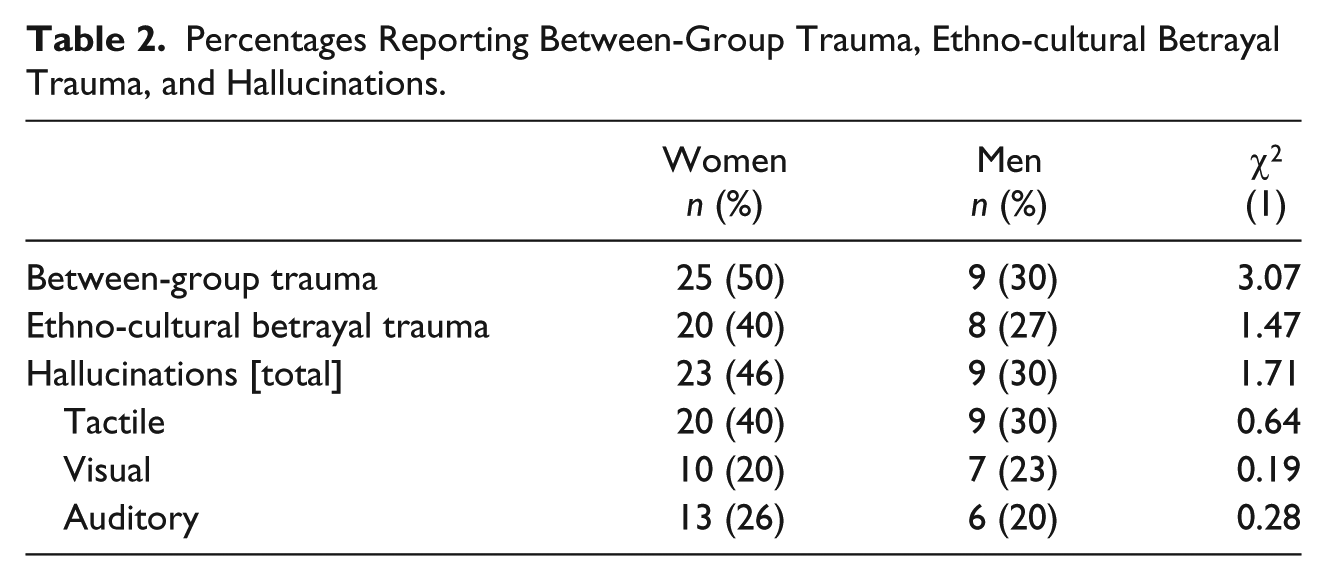
In this small sample of Latino undergraduate students, a sizable minority of women and men reported experiencing any between-group trauma (M = 1.13, SD = .31), ethno-cultural betrayal trauma (M = 1.10, SD = .29), and hallucinations (total: M = 1.26, SD = .43; tactile: M = 1.38, SD = .63; visual: M = 1.20, SD = .44; and auditory: M = 1.25, SD = .52) (Table 2). I ran analyses of covariance (ANCOVAs) on the total sample to examine how ethno-cultural betrayal trauma, gender, and the interaction between ethno-cultural betrayal trauma and gender would be associated with hallucinations [total], tactile hallucinations, visual hallucinations, and auditory hallucinations (Table 3). As expected, controlling for between-group trauma, ethno-cultural betrayal trauma was significantly related to all measured hallucinatory experiences. Furthermore, there was a main effect of (male) gender on hallucinations [total], visual hallucinations, and auditory hallucinations. Finally, controlling for between-group trauma, the interaction between ethno-cultural betrayal trauma and gender was associated with hallucinations [total], tactile hallucinations, visual hallucinations, and auditory hallucinations. Specifically, ANCOVAs for men and women separately revealed that the links between ethno-cultural betrayal trauma and hallucinations [total], tactile hallucinations, visual hallucinations, and auditory hallucinations were present for men but not women (Table 4). The findings from these preliminary analyses on Latino undergraduate students suggest that controlling for between-group trauma, the relationships between ethno-cultural betrayal trauma and different types of hallucinations vary as a function of gender.
Percentages Reporting Between-Group Trauma, Ethno-cultural Betrayal Trauma, and Hallucinations.
Ethno-cultural Betrayal Trauma: Controlling For Between-Group Trauma, Analyses of Covariance (ANCOVAs) Assessing the Association of Ethno-cultural Betrayal Trauma, Gender, and the Interaction of Ethno-cultural Betrayal Trauma and Gender on Hallucinations.
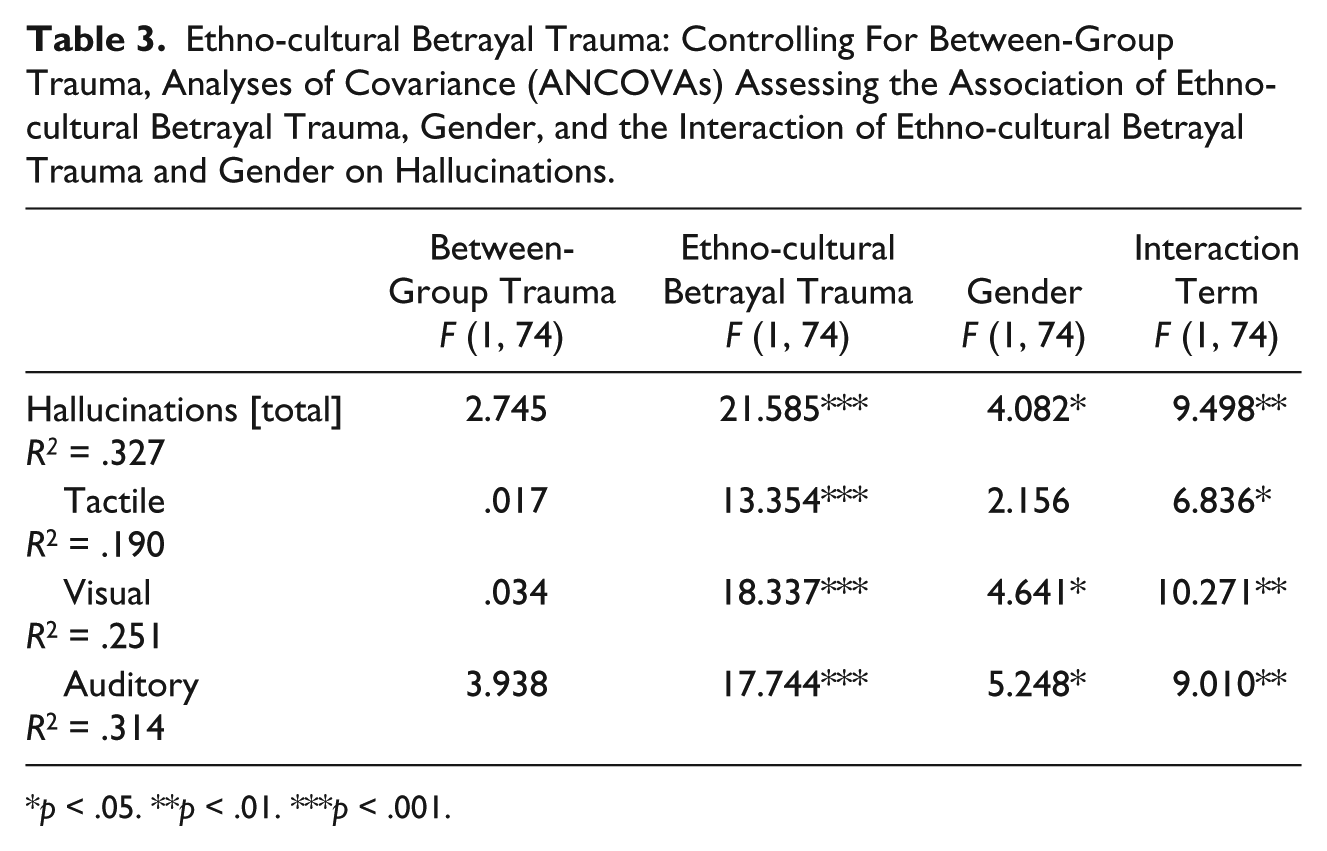
p < .05. **p < .01. ***p < .001.
Ethno-cultural Betrayal Trauma: Controlling for Between-Group Trauma, Analysis of Co-Variance (ANCOVA) Assessing Main Effects Separately for Women and Men.

p < .05. **p < .01. ***p < .001.
Discussion
The current exploratory study was guided by CBTT (e.g., Gómez, 2017a), which incorporates societal inequality into how within-group violence victimization outcomes are understood. The purpose of the current study was to examine gender differences in the link between ethno-cultural betrayal trauma (also known as within-group violence victimization) and hallucinations in a sample of Latino college students attending a predominantly White university in the United States. The prevalence of hallucinations in this sample (40%) is similar to the rates found in a sample of Asian/Asian American/Pacific Islanders (42%; Gómez, 2017a), as well as general population estimates in various European countries (38.7%; Ohayon, 2000). Data from nine countries suggest that some hallucinations (e.g., auditory hallucinations) are normative in general populations, with prevalence rates as high as 84% (Beavan et al., 2011).
As expected, when controlling for between-group trauma, ethno-cultural betrayal trauma was significantly related to hallucinations [total] and tactile, visual, and auditory hallucinations separately. In addition to contributing to the literature linking violence victimization and hallucinations (e.g., Gómez & Freyd, 2017a; Gómez, Kaehler, & Freyd, 2014; Gracie et al., 2007; Read et al., 2005), these findings provide evidence for CBTT (e.g., Gómez, 2017a), as they suggest that the identity of the perpetrator(s) as an in-group minority member(s) adds a dimension of harm that cannot fully be explained by the trauma itself. Furthermore, when controlling for between-group trauma, these associations were moderated by gender, with ethno-cultural betrayal trauma being linked with all measured hallucinatory experiences: hallucinations [total], and tactile, visual, and auditory hallucinations for men, but not women. Examinations of gender differences in the link between violence victimization and hallucinations has been sparse, particularly in Latino college student populations, who are subject to additional stressors, such as discrimination (Hwang & Goto, 2008; Lopez, 2005). Thus, these preliminary results add to the literature by suggesting that higher rates of hallucinatory experiences among men (e.g., Johns et al., 1998; Tien, 1991) may be affected by the way abuse-related psychological distress is expressed.
Understanding predictors of hallucinations in nonclinical populations has implications for persons who struggle with more extreme forms of psychological distress (e.g., Johns et al., 2002). Furthermore, examining hallucinatory experiences in college may be particularly beneficial as mental health problems tend to arise in early adulthood (Hunt & Eisenberg, 2010; Kessler et al., 2005). Though the findings cannot be generalized to all Latinos or all ethnic minority groups, the current study has preliminary implications for Latino undergraduate students as a community of interest.
By conceptualizing the impact of ethno-cultural betrayal trauma as being affected by societal inequality, the current study contextualizes how violence victimization, psychological distress, and posttraumatic growth can be understood in minority populations specifically. For instance, in using a CBTT lens, abuse-related hallucinations are not understood as occurring in isolation but are contextualized within experiences related to minority status (e.g., discrimination) and cultural values (e.g., DeVylder et al., 2013). Thus, future studies that build on this exploratory work can have implications for clinical interventions; individuals who have experienced ethno-cultural betrayal trauma may benefit from therapy that privileges cultural competency related to gender norms and ethnicity, as issues related to oppression and societal expectations are important in healing from violence victimization (Brown, 2008; Bryant-Davis, 2005; Gómez, Lewis, Noll, Smidt, & Birrell, 2016). Furthermore, hallucinatory experiences for Latinos specifically should be further examined as such experiences may indicate psychological distress (e.g., negative command hallucinations), protective factors (e.g., comfort), or both, as the meaning of posttraumatic outcomes varies as a function of culture, minority status, ethnicity, and processing of abuse (e.g., Brown, 2008; Bryant-Davis, 2005; DeVylder et al., 2013; Johns et al., 2002).
Limitations and Future Directions
There is much room for future research to build upon the current study. First, this study was exploratory with the potential for inflated Type I error due to multiple comparisons; thus, future researchers should attempt to replicate the findings using corrections to alpha levels as warranted. Next, though this study utilized CBTT (e.g., Gómez, 2012) as a guiding framework for examining violence victimization, gender, and hallucinations among Latino college students, understanding the impact of ethnicity, culture, and minority status on mental health requires directly assessing systemic discrimination, perception of discrimination, socioeconomic status (SES), cultural values, levels of (intra)cultural trust, and other factors. In addition, investigating other aspects of the context surrounding violence, such as relationship with the perpetrator (e.g., betrayal trauma theory; Freyd, 1997) and harmful institutional actions and inactions (e.g., institutional betrayal; Smith & Freyd, 2014), could further elucidate the complexity of the aftermath of violence victimization. Specifically, close relationship with the perpetrator could be confounded with within-group ethnicity; therefore, future studies should attempt to disentangle the differential impact of each.
Furthermore, given that (a) religion plays a role in how individuals conceptualize experiences of hallucinations (Earl et al., 2015) and violence (Brown, 2008; Bryant-Davis, 2005) and (b) the majority of the sample reported faith in Christianity, future qualitative and quantitative studies could examine the role that religion and spirituality have in the experience and meaning-making of trauma-related hallucinatory experiences. Finally, though there is theoretical and empirical evidence to suggest that violence victimization predicts hallucinations (Evans, Reid, Preston, Palmier-Claus, & Sellwood, 2015; Gómez, 2017a; Gómez & Freyd, 2017a; Gómez, Kaehler, & Freyd, 2014; Read & Bentall, 2012; Read et al., 2005), temporal precedence could not be established with the cross-sectional design. Therefore, future studies should assess the effect of the link between ethno-cultural betrayal trauma and hallucinations longitudinally.
Concluding Thoughts
Though it is limited in scope and depth, the current preliminary study nevertheless provides insight into the role of minority status, gender, and violence victimization on mental health; specifically, the findings provide a foundation for future work on CBTT, hallucinations, and mental health in Latinos in the United States to build upon. Thus, in demonstrating that the link between ethno-cultural betrayal trauma and hallucinatory experiences is dependent on gender in a sample of Latino undergraduates, lines of empirical inquiry and clinical intervention can incorporate these and other aspects of diversity and the societal context into conceptualizations of trauma healing and mental health across diverse populations.
Footnotes
Declaration of Conflicting Interests
The author(s) declared no potential conflicts of interest with respect to the research, authorship, and/or publication of this article.
Funding
The author(s) disclosed receipt of the following financial support for the research, authorship, and/or publication of this article: This research was supported by The National Academies of Sciences, Engineering, and Medicine through the Ford Foundation Dissertation Fellowship.
Author Biography
 ).
).