




Abstract
The present study examined the relationships between psychopathic traits, gender, and sexual coercion perpetration in the specific context of intimate partner relationships. Community-dwelling adult men and women with recent criminal or substance-use histories (N = 300) completed self-report measures of psychopathic personality traits (interpersonal, affective, lifestyle, and antisocial facets), sexual coercion perpetrated within their most recent relationship, and other relevant behaviors including physical intimate partner violence perpetration and sexual coercion victimization. Results of regression analyses showed that the relationship between psychopathic trait facets and sexual coercion was moderated by gender, with effects varying based on level of coercion severity. Specifically, women who showed high levels of interpersonal psychopathic traits (superficial charm, social dominance) were more likely to engage in any sexual coercion and minor severity sexual coercion than women with low levels of interpersonal traits. For severe coercion, women who showed low levels of affective psychopathic traits (coldness, lack of empathy) or high levels of antisocial psychopathic traits (aggressiveness, criminality) were more likely to be sexually coercive than other women. Relationships between the four psychopathic trait facets and sexual coercion were more modest and nonsignificant for men at any level of coercion severity. Results are discussed in the context of sociocultural factors that may influence the role of psychopathic traits on sexual coercion as a function of gender and relationship contexts, including traditional sexual scripts, the cultural role of women as sexual gatekeepers, and beliefs about token resistance.
Intimate partner violence (IPV), the perpetration of physical, psychological, or sexual aggression against a relationship partner, is a significant and widespread problem. IPV victimization is associated with severe consequences, including posttraumatic stress disorder (PTSD) and mood symptoms, physical illness and injury, and financial loss (National Coalition Against Domestic Violence [NCADV], 2015). IPV has significant negative outcomes for perpetrators as well, most prominently incarceration and other forms of legal involvement (Holtzworth-Munroe & Stuart, 1994). Although evidence suggests that both men and women perpetrate IPV, gender differences appear to exist in the associated personality traits and health outcomes surrounding these behaviors.
Although substantial work has examined relevant correlates and impact of gender on physical IPV, much less is known about sexual IPV in women and men. Evidence suggests that both men and (to a much lesser degree) women engage in the perpetration of sexual coercion, defined as behaviors employed to elicit sex from an unwilling partner, ranging from verbal manipulation to physical force (Schatzel-Murphy, Harris, Knight, & Milburn, 2009; Struckman-Johnson, Struckman-Johnson, & Anderson, 2003). However, research suggests that there are potentially important gender differences in the correlates of sexual coercion (Hill, 2003; Schatzel-Murphy et al., 2009; Struckman-Johnson et al., 2003; Zurbriggen, 2000). While there is a wealth of information available on the personality characteristics of men who coerce (Camilleri & Quinsey, 2009; Gidycz, Warkentin, & Orchowski, 2007; Malamuth, Heavey, & Linz, 1996), less is known about female coercers, especially within the specific context of intimate relationships.
There is strong evidence that psychopathic traits (a particular set of personality features that include callousness, superficial charm, impulsivity, and antisociality) may be important to understanding both physical violence and sexual coercion (Hare, 1995; Kosson, Kelly, & White, 1997; Mager, Bresin, & Verona, 2014). Despite this evidence, only a handful of studies have examined the role of psychopathic traits in female-perpetrated sexual coercion (Bouffard, Bouffard, & Miller, 2016; Muñoz Centifanti, Thomson, & Kwok, 2016; Miller, Bouffard, & DeHaan, 2017; Muñoz, Khan, & Cordwell, 2011). In addition, existing work has not fully taken advantage of the multidimensional nature of psychopathy by identifying specific trait facets that are particularly important. To improve our understanding of intersections between gender, psychopathy, and sexual coercion, we examined potential gender differences in the contributions of psychopathic traits at the facet level (i.e., interpersonal, affective, impulsive lifestyle, and antisocial) to sexual coercion perpetration within intimate relationships in a community-dwelling sample of individuals with criminal and substance-use histories.
IPV and Gender
Although both men and women have been shown to perpetrate IPV, there are important differences to note in understanding the motivations for IPV in men and women. Male-perpetrated IPV appears to be characterized by more severe injuries for the victim and higher levels of violence and coercive control (Anderson, 2002; Hamberger & Larsen, 2015; Johnson, 2006). Conversely, female-perpetrated IPV appears to be less injurious, and may be proportionally more likely to arise from self-defense motives (Archer, 2000; Johnson, 2006). It is important to note, however, that both men and women perpetrate for a variety of reasons, including self-defense, emotion regulation, and the desire to exert control (Archer, 2000; Johnson, 2006).
Evidence suggests that both men and women can engage at some level in the perpetration of sexual coercion although rates in women are much lower, especially for more severe forms of sexual coercion (Schatzel-Murphy et al., 2009; Struckman-Johnson et al., 2003). While few studies have directly compared men and women, available work suggests statistical models characterizing male-perpetrated coercion show poor fit to female data (Bouffard et al., 2016; Schatzel-Murphy, 2011). Relative to women, male coercers are proportionally more likely to engage in high severity force tactics, be driven by motivations of sexual power and dominance, and exhibit callous and socially domineering traits (DeGue & DiLillo, 2004; Knight & Sims-Knight, 2003; Malamuth et al., 1996; Struckman-Johnson et al., 2003). Given the overlap between these characteristics and psychopathic traits, it is likely that gender differences extend to the relationship between psychopathic traits and sexual coercion.
Psychopathy, Gender, and Sexual Coercion
Psychopathy is most commonly considered a heterogeneous personality construct composed of two major factors and four underlying facets: Factor 1, which captures the interpersonal and affective facets (i.e., superficial charm, conning, manipulation, lack of empathy, and shallow emotions), and Factor 2, which captures the impulsive lifestyle and antisocial facets (i.e., irresponsibility, impulsivity, early behavior problems, and criminal versatility). Psychopathic traits have been linked to both IPV (Marshall & Holtzworth-Munroe, 2010) and sexual coercion (Camilleri & Quinsey, 2009; Bouffard et al., 2016), making them relevant to the discussion of gender and sexual coercion within relationships.
Psychopathic traits have been associated with sexual coercion across a variety of severity levels in both men and women (Camilleri & Quinsey, 2009; Muñoz Centifanti et al., 2016; Harris, Rice, Hilton, Lalumiére, & Quinsey, 2007; Knight & Guay, 2006; Kosson et al., 1997; Muñoz et al., 2011). Evidence suggests that although both psychopathy factors relate to coercion, interpersonal and affective Factor 1 traits seem to be especially important. In one of the earliest studies to examine trait-level associations between psychopathy and sexual coercion, Kosson and colleagues (1997) found both factors were positively associated with coercion in a sample of male undergraduates. Factor 1, however, explained a significantly higher proportion of the variance in coercion than did Factor 2. Although they did not include measures of psychopathic traits specifically, Bernat, Calhoun, and Adams (1999) found a positive relationship between traits relevant to Factor 1 (i.e., callousness) and college men’s response to sexually coercive vignettes. In a male community sample, Knight and Sims-Knight’s (2003) addition of traits reflecting the affective aspects of Factor 1 significantly improved the fit of Malamuth and colleagues’ (1996) two-path model of sexual coercion, which mostly focused on antisocial processes. Taken together, these findings suggest that Factor 1 provides incremental contributions above general antisocial and violent tendencies (Factor 2) in explaining risk of coercion perpetration in men.
Psychopathy, however, presents differently in men and women, which may affect its relationships with sexual coercion. Women tend to manifest psychopathy in more gender-congruent behaviors and contexts relative to men (Verona & Vitale, 2006). In addition, psychopathy in women is typically rated by others as involving more seduction and manipulation, whereas male psychopathy is typically characterized as more violent (Kreis & Cooke, 2011). These gender differences in psychopathy have been observed in the enactment of physical IPV. Mager and colleagues (2014) found that although both factors were associated with physical IPV perpetration for both genders, Factor 1 was more strongly associated with IPV perpetration for men than for women. Since Factor 1 is more strongly linked to instrumentality and controlled violence (Walsh, Swogger, & Kosson, 2009; Woodworth & Porter, 2002), these findings lend support to conceptualizations of IPV that place greater importance on dominance and control for male perpetration (e.g. Johnson, 2006).
Unfortunately, only two studies have directly examined the unique contributions of both psychopathy factors on sexual coercion in men and women (Muñoz Centifanti et al., 2016; Muñoz et al., 2011). Muñoz and colleagues (2011) found no gender differences in overall relationships between sexual coercion and psychopathic traits among college students, with Factor 1 being most strongly associated with perpetration for both genders. However, gender effects emerged for severe coercion, with Factor 1 nonsignificantly related for men and positively related for women, suggesting that gender differences in the psychopathy–coercion relationships may be affected by tactic severity. An additional study by Muñoz Centifanti and colleagues (2016) failed to find evidence of gender differences in the psychopathic trait–coercion relationship among a community sample.
Other work has instead implicated stress regulation or the need for emotional connection as a key factor in women’s coercion (Hill, 2003; Zurbriggen, 2000), as opposed to the sexual dominance and power associated with male coercion (Brousseau, Hébert, & Bergeron, 2012; Malamuth et al., 1996). This suggests there may be differences in the relationships between psychopathic traits and coercion between genders. This is especially likely considering Factor 1 is more related to dominance and power (Walsh et al., 2009; Woodworth & Porter, 2002), whereas Factor 2 is associated with poor emotion regulation and lack of behavioral control (Patrick, 1994; Patrick, 1995; Verona, Patrick, & Joiner, 2001). As such, investigation of the relationships between gender, sexual coercion, and psychopathic traits may benefit from moving to a more granular level of analysis by examining specific psychopathic traits. In particular, considering the four-facet model’s Interpersonal, Affective, Lifestyle, and Antisocial facets separately may be useful.
Several studies have found the Interpersonal facet (e.g., charm, manipulation), rather than the Affective facet (e.g., callousness, lack of empathy), to be uniquely associated with instrumental violence including IPV (Laurell, Belfrage, & Hellström, 2010; Walsh et al., 2009). These results are not monolithic, however. Swogger, Walsh, and Kosson (2007) found no effects for the Interpersonal facet but rather found that higher scores on the Affective facet distinguished IPV perpetrators from nonperpetrators in a correctional sample of men. Regardless, these results highlighting the Interpersonal facet would seem to provide theoretical support to models emphasizing the controlling, instrumental nature of male-perpetrated physical IPV (Johnson, 2006). Only one study has examined individual psychopathic facets in relation to sexual coercion. Marcus and Norris (2014) found that traits related to both Interpersonal and Affective facets (boldness and meanness), and traits related to the Impulsive Lifestyle facet (disinhibition) were all positively related to acceptability of manipulative sexually violent behavior in a male community sample. Importantly, these relationships were qualified by an interaction where men who were high in both traits were more likely to rate sexually manipulative behavior as acceptable relative to men high on either trait alone. This latter finding indicates some level of social potency or fearlessness may be necessary to propel disinhibited men to coerce. Although these studies provide important information, no research currently exists examining facet-level relationships with sexual coercion in women.
Present Study
The present study aims to address gaps in the literature in regard to psychopathic traits and gender in a community-dwelling sample of individuals with substance-use and aggression histories. The first aim was to examine relationships between psychopathic trait facets and perpetration of sexual coercion against intimate relationship partners. Based on previous work with the two-factor psychopathy model and IPV (e.g., Kosson et al., 1997; Mager et al., 2014), we hypothesized that all four facets would be positively associated with sexual coercion of relationship partners. The second aim was to identify gender differences in psychopathy facet relationships with coercion. The literature portrays male-perpetrated IPV and sexual coercion as more instrumental and dominance/control driven, and female IPV and sexual coercion as more impulsive or emotionally driven (Hill, 2003; Zurbriggen, 2000). Thus, we hypothesized that the Interpersonal facet would be more strongly related to coercion for men, and the Lifestyle facet more strongly related to coercion for women. However, based on the limited research so far, we expect that these associations may differ further based on the severity of perpetration (Muñoz et al., 2011).
Method
Participants
Participants were part of a larger longitudinal study involving 318 community-dwelling, justice-involved individuals from the Midwest (135 female, 42%) with histories of illicit drug use and/or violence. All analyses presented in the present study are based on data collected at baseline only. Participants were recruited through newspaper ads, community flyers, substance-use treatment or parole/probation facilities, or other means (such as word of mouth). Participants ranged from 18 to 62 years of age, with a mean of 34.80 years (SD = 11.94), and the majority identified as either African American or Caucasian. See Table 1 for detailed demographic and recruitment information. In terms of relationship status, approximately half the participants were single and slightly more than a third of participants were married or living with a partner. There were no significant gender differences on any of the demographic variables except number of incarcerations (see Table 1).
Demographics.

Note. ≤HS = HS diploma or less, >HS = some college or more; cohabitating = married or living together; public ad = newspaper ad or community flyer. HS = high school; GED = general educational development; SUD = substance-use disorder treatment.
*p < .05.
After providing informed consent, participants underwent psychodiagnostic and psychopathy interviews. Participants then completed self-report measures of violence and aggression including sexual coercion, as well as additional self-report scales not relevant to the present study. Following completion of the visit, participants were compensated with US$35 to US$40.
Measures
Psychopathic traits
Psychopathic traits were assessed using the Psychopathy Checklist: Screening Version (PCL: SV; Hart, Cox, & Hare, 1995). Both a life history interview and examination of public records were used to determine PCL: SV scores. Interviews were conducted by trained advanced undergraduate and graduate students under the supervision of a PhD-level licensed clinician with expertise in psychopathy assessment. The PCL: SV consists of 12 items scored either 0 (absent), 1 (possibly present or present to a minor degree), or 2 (definitely present). Following standard procedure, scores were summed to create four-facet-level scores (Interpersonal, Affective, Lifestyle, and Antisocial). Facet 1 (Interpersonal) consists of three criteria assessing a manipulative, conniving, and superficially charming interpersonal style. Facet 2 (Affective) contains three criteria capturing lack of empathy, callousness, and emotional coldness. Facet 3 (Lifestyle) uses three criteria to asses for impulsivity, lack of responsibility, and parasitic lifestyle. Finally, Facet 4 (Antisocial) taps aggressive, antisocial, and criminal behavior with three criteria (Cleckley, 1976; Hare, 2003). A total of 183 interviews were rated by a second rater (57.4% of cases) to determine reliability. Interrater reliability in the sample was excellent, with intraclass correlation coefficients of 0.94 for the Interpersonal facet, 0.92 for the Affective facet, 0.94 for the Lifestyle facet, and 0.97 for the Antisocial facet.
Sexual coercion
Coercion perpetration and victimization were assessed using the sexual coercion subscale of the Conflict Tactics Scale (CTS2; Straus, Hamby, Boney-McCoy, & Sugarman, 1996). The CTS2 is a 78-item self-report measure that assesses frequency of various violent behaviors perpetrated or experienced in participants’ most recent relationship. For each behavior, participants first rated how often they themselves perpetrated the behavior and then how often their partner perpetrated the behavior against them in the past year. Items are scored on a scale from 0 (never) to 6 (more than 20 times), and then converted to a midpoint scoring system (e.g., “3-5 times” is rescored to “4”) as per Straus and colleagues’ (1996) recommendation. The CTS2 also allows participants to endorse having perpetrated or experienced a particular behavior at some point outside of the past year. Thus, subscale scores could be analyzed as both a continuous past year frequency score or dichotomous lifetime score (yes or not ever). To maximize power and maintain greater variability in the dependent variable, all regression analyses were performed using the past year frequency scoring system. The sexual subscale can be further divided into minor (three items) and severe (four items) perpetration scores to allow for more fine-grained analysis. Internal consistency in the sample was good, with Cronbach’s alpha values of α = .85 for both past year total perpetration and total victimization, α = .70 for past year minor perpetration, and α = .87 for past year severe perpetration.
Physical IPV perpetration
To adjust for variance in the dependent variable due to more general violence, past year frequency of physical IPV perpetration was calculated from the CTS physical subscale and included in all analyses. Internal consistency was excellent (α = .92).
Data Analysis
The main dependent variables (minor, severe, and total past year coercion perpetration) contained a high proportion of zero responses and were significantly skewed and overdispersed. Thus, zero-inflated negative binomial (ZINB) models were used in all regression analyses (Aims 1 and 2). ZINB models are employed when the data conforms to a negative binomial distribution, and zero values may be produced by two separate processes—in the present case, participants received a zero value if they selected either “never” or “yes but not in the past year” for perpetration items. ZINB models contain two simultaneous components: one that adjusts the model based on variables that may explain the excessive zero values (i.e., didn’t have opportunity in the last year) and one that predicts the count variable (i.e., frequency of having engaged in coercion in the past year; Atkins & Gallop, 2007; Long, 1997). Both the negative binomial part of the model (to examine continuous relationships between the independent variables and frequency of past year coercion perpetration) and the zero-inflated part of the model (which adjusts the count model based on variables that may reasonably be expected to be associated with differences in the process of generating zeros) are included.
In this particular case, individuals were assumed to be unable to coerce while in a controlled environment (leading perhaps to perpetrators in that group responding “yes but not in the past year” when they would have otherwise been actively coercing, therefore adding “excess” zeros, which inflate the overall zero count). Thus, number of incarcerations and inpatient substance treatment stays (34.91% of the sample reported at least one period of inpatient treatment) were included in the zero model. Because age is also theoretically associated with the zero generation process (i.e., younger participants have had less time and fewer relationship opportunities to coerce), this was also included in the zero model. For an in-depth discussion of zero-inflated models, see Long (1997). In terms of the negative binomial portion of the model, covariates (physical IPV perpetration and coercion victimization), gender, all four psychopathy facets, and all Facet-by-Gender interactions were included in the model. No demographic variables were correlated with past year coercion perpetration and were, therefore, not included in analyses. Odds ratios (OR; for categorical predictors) and incidence rate ratios (IRR; for continuous predictors) are listed as effect sizes.
All independent variables were assessed for outliers prior to inclusion in the model, and outliers were then restricted to the value equal to three standard deviations above or below the mean. All independent variables were then grand mean centered. Gender was coded 0 for women and 1 for men.
Results
Descriptive Statistics and Correlations
Of the 318 participants, 14 were missing inpatient treatment data, and four additional participants were missing data for the Antisocial facet of the PCL: SV. As such, the final sample for Aims 1 and 2 included 300 participants.
In terms of prevalence of coercion, 120 (40.00%) participants reported any past year coercion victimization, and 110 (36.66%) reported any past year coercion perpetration. The majority of participants reporting past year victimization also reported past year perpetration (n = 95, 79.17%). Table 2 contains descriptive data for variables included in regression analyses. The mean frequency of minor, severe, and total coercion perpetration in the past year did not differ across gender; however, women reported marginally higher mean frequency of coercion victimization and significantly more physical IPV perpetration in the past year. Finally, men scored higher than women on all PCL: SV facets.
Descriptive Statistics and Correlations Among Key Variables.
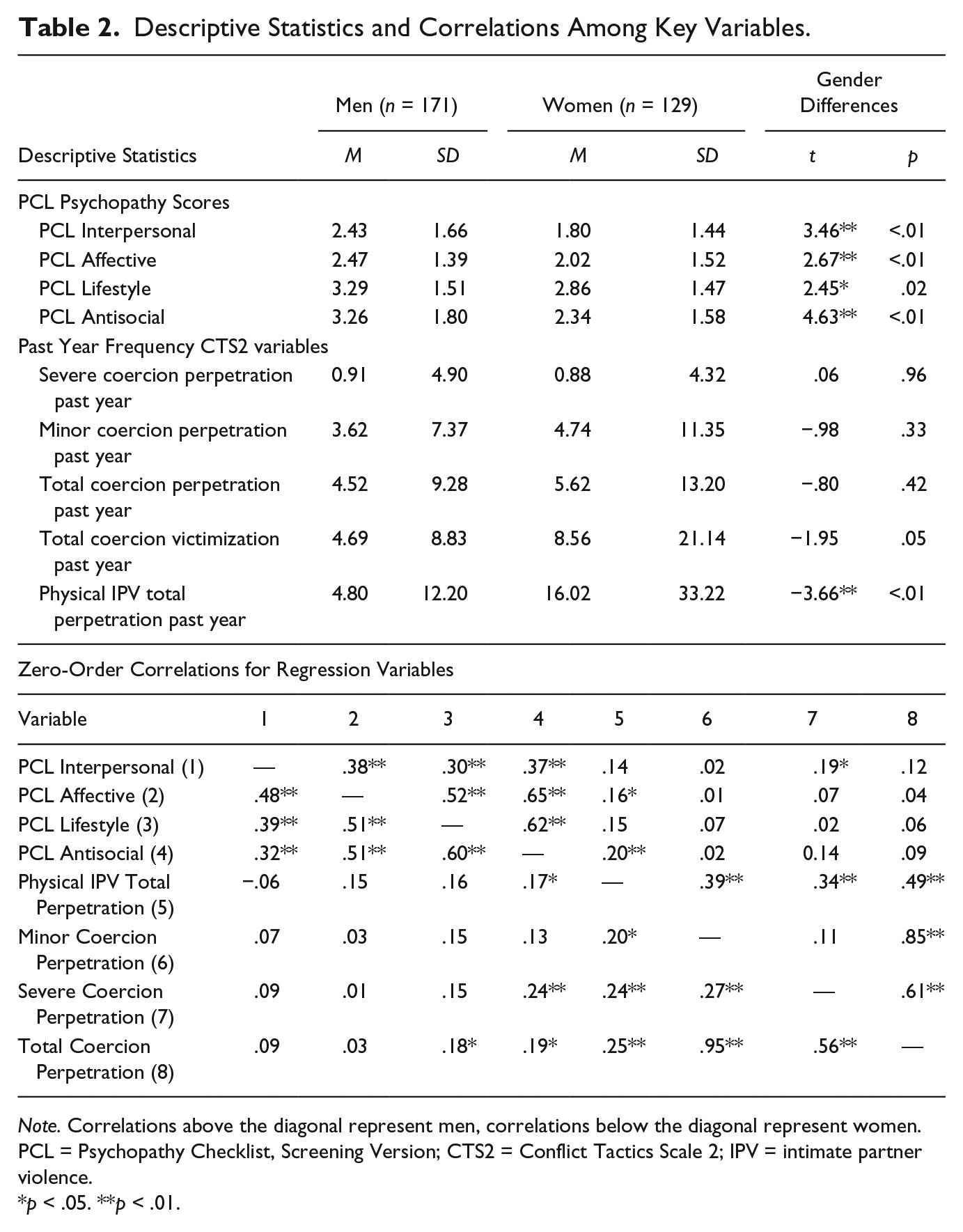
Note. Correlations above the diagonal represent men, correlations below the diagonal represent women. PCL = Psychopathy Checklist, Screening Version; CTS2 = Conflict Tactics Scale 2; IPV = intimate partner violence.
p < .05. **p < .01.
Zero-order correlations for psychopathy and aggression variables used in Aim 1 analyses also can be found in Table 2. For women, the correlations between total coercion and the Lifestyle and Antisocial facets, and severe coercion and Antisocial facet were significant. By contrast, in men, only the correlation between the Interpersonal facet and total coercion was significant.
Main Analyses
Results of the zero-inflated and negative binomial models run separately for total, minor, and severe coercion perpetration, are shown in Table 3. Contrary to prediction, those who reported multiple incarcerations were less likely to report excessive zeros than those with fewer or no incarcerations (very small effect size; OR = 0.41). For severe coercion, number of inpatient substance treatment stays was significantly associated with higher likelihood of excess zeros, as expected.
Regression Results for Psychopathy Facet × Gender Interactions.

Note: SUD tx = substance-use disorder treatment. OR = odds ratio; IRR = incidence rate ratios; IPV = intimate partner violence.
p < .05. **p < .01.
The negative binomial portions of the models showed evidence of gender moderation at all coercion severity levels. Graphs of psychopathy facet interactions for all severity levels are shown in Figure 1. For total coercion, a positive main effect for the Interpersonal facet emerged; however, this relationship was qualified by an Interpersonal Facet-by-Gender interaction. Contrary to our gender hypotheses, Interpersonal facet scores were more strongly positively associated in women (b = .40, IRR = 1.50), than in men (b = .12, IRR = 1.13).
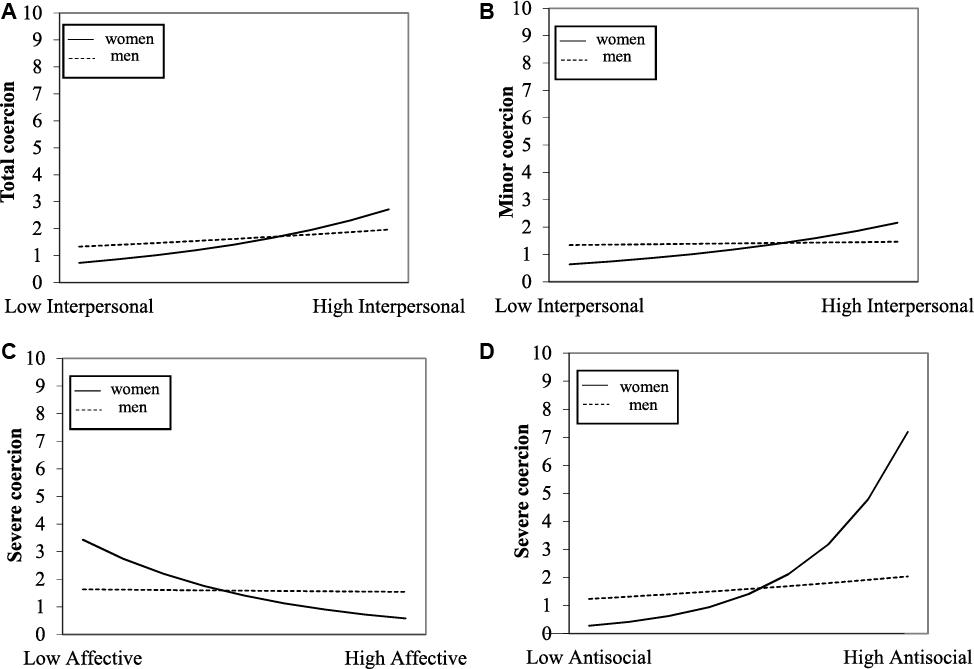
Facet-by-Gender interactions for total, minor, and severe coercion.
For minor coercion, the Interpersonal facet, qualified by an Interpersonal-by-Gender interaction, was related to minor coercion. As in the total coercion model, Interpersonal scores were significantly positively associated with minor coercion in women (b = .38, IRR = 1.45) and unassociated in men (b = .03, IRR = 1.03). Unexpectedly, minor coercion was negatively associated with the Antisocial facet.
For severe coercion, no main effects of psychopathy facets emerged, with two significant interactions, Affective by gender and Antisocial by gender. First, the Affective facet was more strongly negatively related to coercion in women (b = −.62, IRR = 0.54), than in men (b = −.02, IRR = 0.98). In contrast, the Antisocial facet was more strongly positively related to severe coercion in women (b = .94, IRR = 2.56), than in men (b = .16, IRR = 1.17).
In sum, for women especially, total and minor coercion were associated with higher Interpersonal traits and severe coercion associated with lower Affective traits and higher Antisocial traits. All main and interaction effect sizes were very small to small. The significant simple effects within gender were small in magnitude.
Discussion
This article is the first to directly compare men and women on facet-level psychopathic correlates of relationship partner sexual coercion. By expanding our understanding of the role specific psychopathic traits play in both male and female coercion, our results add to the growing literature on female coercers, a population that has historically been overlooked. Importantly, our study provides a significant contribution by focusing on coercion occurring within a particular relational context, which provides specificity in our understanding of sexual coercion within intimate relationships as opposed to in undefined contexts or across contexts.
As expected, we observed the full spectrum of coercion in both men and women; however, women reported more frequent victimization as is typical in the literature (NCADV, 2015). Importantly, relationships with coercion emerged for some psychopathy facets but not others and were moderated by gender. Finally, results varied slightly based on level of severity, although low endorsement of severe tactics in the sample limits the scope of conclusions that may be drawn in for those tactics.
Although our hypothesis that all four psychopathy facets would be positively related to coercion was not supported, we did find significant, albeit small, relationships between both Interpersonal and Antisocial facets and coercion depending on the severity of coercion perpetrated. For total and minor coercion, a positive Interpersonal–coercion relationship emerged, whereas severe coercion was related to the Antisocial facet; however, both of these effects were moderated by gender (see below). Surprisingly, the Antisocial facet was negatively related to minor coercion. Together, these results suggest that minor tactics involving exclusively verbal manipulation may require the greater charm, manipulation, and dominance associated with Interpersonal traits, whereas tactics using physical force or direct threats may be a manifestation of more generalized antisocial tendencies, especially in women. However, the emergence of this relationship even when controlling for physical IPV indicates specificity beyond general aggressiveness. While these main effects begin to shed light on facet-level psychopathy effects on coercion, analysis of gender differences within these findings allows for a more nuanced theoretical consideration of the data.
Contrary to our gender hypotheses, Interpersonal traits were positively associated with total and minor coercion in women but showed less robust association in men. The latter is consistent with work by Muñoz and colleagues (2011), who found that Factor 1 traits were associated with coercion in women but not men. Our study also found that Antisocial traits were positively associated with severe coercion in women only. In fact, across levels of severity, the psychopathic facet–coercion relationships was more pronounced for women than for men. This may point to the relative deviance of female sexual coercion compared with male sexual coercion. That is, in American culture, there is a widely held perception that it is easier for heterosexual women to obtain consensual sex than heterosexual men, with women traditionally acting as sexual gatekeepers (Clark & Hatfield, 1989; McCormick, 1979; Peplau, 1983). As such, female-perpetrated coercion is considered a more deviant behavior than male-perpetrated coercion, which is unfortunately expected and even condoned to some degree by traditional sexual scripts (Muehlenhard & Rodgers, 1998). This cultural interpretation may help explain the finding that women high on Interpersonal traits are more likely to engage in verbal/manipulation forms of coercion than are women without these traits. Because verbal forms of coercion may be more “expected” among men (i.e., the need to overcome “token” resistance; Muehlenhard & Rodgers, 1998), Interpersonal traits may be less useful in differentiating male verbal coercers from noncoercers, because men may coerce regardless of their level of Interpersonal traits. Women with higher Interpersonal psychopathic traits, however, may be more likely to coerce than women with lower levels of these traits, relying on verbal manipulation to do so.
In terms of severe coercion, findings that Affective traits were negatively associated and Antisocial traits positively associated with coercion in women partially support theories of female coercion as a response to emotional dysregulation and distress, as hypothesized (e.g., Yost & Zurbriggen, 2006). Affective traits, defined by lack of empathy and reduced vulnerability to emotional distress, may buffer against the emotional dysregulation potentially motivating severe coercion in women. As previously noted, it is also possible that use of severe coercion by women represents a more extreme form of antisocial behavior than severe coercion men, explaining the Antisocial-by-Gender interaction. However, due to low endorsement of severe coercion (especially in women), some caution must be exercised in drawing conclusions from these findings. Besides limits on statistical power, low endorsement suggests that we likely failed to capture the full range of sexually coercive behaviors. Thus, the findings should be replicated in domestic violence or sex offender samples with higher rates of severe coercion to verify the generalizability of the results.
Limitations, Strengths, and Future Directions
Although our study provides important contributions in the study of relationships between psychopathic traits, gender, and sexual coercion, there are limitations that must be discussed. Effect sizes were generally small, and psychopathic traits represent only one part of a larger suite of factors that lead to coercion. Methodologically, our use of the CTS2 offers less coverage of the full spectrum of sexual coercion than other instruments such as the Post-Refusal Sexual Persistence Scale (Struckman-Johnson et al., 2003) or the Sexual Experiences Survey (Koss et al., 2006). Although the CTS2 provides behavioral descriptions of various forms of sexual coercion, it does not include “arousal” tactics designed to obtain sex through flirtatious or arousing words and behaviors, or “intoxication” tactics involving incapacitation by drugs or alcohol (Struckman-Johnson et al., 2003). As such, the generalizability of our findings to these types of behavior is somewhat limited. Furthermore, some researchers have suggested that the CTS2 does not adequately capture potential gender asymmetry within physical perpetration and, as such, may be less than ideal for cross-gender comparison of IPV behaviors (see Hamby, 2017 for a discussion). As in all self-report survey research, issues of participant biases, item interpretation, and defensive responding must be considered. A more specific concern is the issue of single-informant reporting. Studies of couples consistently show poor to moderate concordance in IPV reporting (Marshall, Panuzio, Makin-Byrd, Taft, & Holtzworth-Munroe, 2011), and as such, the validity of data obtained from one partner alone is less than optimal. Finally, our sample consisted of a somewhat specialized group of individuals (justice-involved but not incarcerated men and women with substance-use histories) and as such may not be representative of the general population. At the same time, given the strong connection between substance use and IPV, it seemed important to examine psychopathy–coercion relationships in this particular sample of substance-using individuals in the community.
In spite of these limitations, the study possessed significant strengths that provide important and meaningful contributions to the broader literature on both psychopathic traits and sexual coercion. One particular strength is the study’s focus on psychopathy–coercion relationships specifically in the context of intimate relationships, which has not been previously considered. Our findings that did not conform to existing theoretical models potentially suggest that particular context is important, and that coercion in relationships may be different than coercion of strangers or acquaintances. In addition, using facet-level psychopathic trait measures to examine relationships between psychopathy, gender, and sexual coercion is novel, and gives greater insight to which specific traits are important rather than relying on heterogeneous clusters. Indeed, we isolated the Interpersonal facet of Factor 1 and the Antisocial facet of Factor 2 as particularly relevant.
While these findings bring deeper understanding to the risk factors involved in coercion, they also serve as a jumping off point for further exploration. Given the influence of heteronormative beliefs and gendered sexual scripts on coercion (e.g., Eaton & Matamala, 2014), one potentially fruitful avenue to pursue is examination of gender role/relationship beliefs as potential moderators of the psychopathy–coercion relationship. It is possible that high adherence to traditional sexual scripts may amplify the psychopathy–coercion relationship. As noted above, we recommend future work explore the ways in which beliefs about token resistance, male sexual voracity, and female sexual value may help explain why Interpersonal and Antisocial traits characterize female but not male coercers within intimate relationships. Another potential next step in light of the methodological limitations of single-informant data may be to examine bidirectional coercion in dyads. The overlap between coercion victimization and perpetration in this study and in the larger literature bears further study, and may help parse how psychopathic traits may engender and maintain mutually coercive relationships.
In sum, our results suggest that not only does gender moderate the relationships between psychopathic traits and coercion but that these traits also appear to be more influential for women than for men in the context of intimate relationship sexual coercion. Women who were more conniving, socially dominant, and superficially charming were more likely than their peers to perpetrate minor forms and total coercion, and women who were low on callousness and high on antisocial, aggressive traits were more likely to engage in severe, physical forms of coercion than were men. Men, however, were equally likely to perpetrate all forms of coercion regardless of the level of psychopathic traits. These gendered findings have implications for sexual coercion theories in the larger literature. For instance, Affective traits may serve as a protective factor for severe perpetration in women in particular, possibly because women’s severe perpetration is more strongly driven by resentment and emotional dysregulation. Among men, questions are raised about the role of sociocultural beliefs around sex and gender that may motivate male sexual coercion in relationships, questions that deserve further scrutiny in the psychopathy literature.
Footnotes
Declaration of Conflicting Interests
The author(s) declared no potential conflicts of interest with respect to the research, authorship, and/or publication of this article.
Funding
The author(s) received no financial support for the research, authorship, and/or publication of this article.
