




Abstract
Legal responses to intimate partner violence (IPV) can determine whether and how those exposed to IPV seek help. Understanding the victim’s perspective is essential to developing policy and practice standards, as well as informing professionals working in policing and the justice system. In this survey study, we utilized a subset of 2,831 people who reported experiencing IPV to examine (a) rates of reporting to the police; (b) experiences with, and perceived helpfulness of, police; (c) rates of involvement with the criminal and family law systems, including protection orders; and (d) experiences with, and perceived helpfulness of, the justice system. Data were analyzed using descriptive statistics for closed-ended survey questions and content analysis of text responses. More than 35% of victims reported a violent incident to the police, and perceptions of helpfulness were mixed. Fewer victims were involved with the criminal and family law systems, and their satisfaction also varied. Text responses provided insight into possible reasons for the variability found in experiences, for example, the proposed role of victim and system expectations, and respondents’ perception that getting help depends on “being lucky” with the officials encountered.
Intimate partner violence (IPV 1 ) is a serious social and legal issue; perpetration of IPV is a crime in North America. No longer regarded as a private matter relegated to the confines of the home, the criminalization of IPV serves the purpose of demonstrating its moral intolerability, and ideally, acting as a deterrent to perpetration (Hoyle & Sanders, 2000). Criminalization also represents a critical change in understanding IPV as appropriate for legal and public intervention, shifting some of the onus off of the victim to handle the abuse alone (Dawson & Hotton, 2014; O’Leary-Kelly, Lean, Reeves, & Randel, 2008). For more than 30 years, the Canadian federal government has mandated the implementation of mandatory charges and sentencing provisions for offenses related to physical and sexual violence within intimate partner relationships (Dawson & Hotton, 2014; Tutty et al., 2008). While the policies are federal, the administration of them is provincial/territorial, resulting in a range of experiences for victims depending on the region in which they live (Tutty et al., 2008). In addition, research in Canada has revealed that mandatory charging practices are not always applied consistently (Dawson & Hotton, 2014; Tutty et al., 2008). The police and justice system response is crucial in supporting IPV victims (Goodman & Epstein, 2008; Hoyle & Sanders, 2000). However, there is a relative paucity of research examining IPV victims’ accounts of their experiences. The present paper addresses this gap.
Experiences With Police
A victim’s first contact with the justice system is often through the police (Tutty et al., 2008). In Canada, victims of IPV account for 27% of all victims of violent crime reported to police, and the vast majority are women (Statistics Canada, 2016). Nevertheless, IPV is often underreported. According to the 2014 Canadian General Social Survey, 70% of victims of IPV did not report an incident of spousal violence to the police (Statistics Canada, 2016). Of the incidents of IPV that were reported, 19% of victims self-reported the violence, with the remainder being reported to police in some other way, for example, by a family member or neighbor (Statistics Canada, 2016).
Many factors influence a police officer’s response to IPV. In Canada, federal policy was implemented three decades ago to lay charges in all cases of IPV where ‘‘facts and circumstances warrant this action’’ (Jaffe, Wolfe, Telford, & Austin, 1986, p. 38). With this, officers have the discretion to decide whether charges will be laid, based on reasonable and probable grounds. Following this policy implementation, charging rates increased significantly, along with increased victim satisfaction with police (Jaffe et al., 1986). Beyond this, research into police charging practices identified that there are legal (e.g., injury, type of offense) and extralegal (e.g., gender, relationship status, incident location) variables that influence a police officer’s decision to lay a charge (Dawson & Hotton, 2014). However, there have also been contradictory findings in respect to extralegal variables increasing the odds of arrests. For instance, past research has found both lower (Lee, Zhang, & Hoover, 2013) and increased likelihood of charges being laid for non-Caucasian victims of IPV (Hamilton & Worthen, 2011).
The decision to report IPV to police can be complex (Felson, Messner, Hoskin, & Deane, 2002; Hirschel & Hutchison, 2003) and influenced by factors such as gender, the need for protection, and the severity of the violence (Bonomi, Holt, Martin, & Thompson, 2006; Felson et al., 2002; Hirschel & Hutchison, 2003; Sinha, 2013; Statistics Canada, 2016; Ursel, 1998). National incidence studies in Canada and the United States indicate that police were often contacted when the victim experienced more severe forms of violence (Bonomi et al., 2006; Felson et al., 2002; Sinha, 2013). Male victims are less likely to report an incident of spousal violence to the police than are female victims, likely due in part to the violence being less severe for male victims (Sinha, 2013; Statistics Canada, 2016) but perhaps also due to the additional stigma of IPV that men may face (Tsui, Cheung, & Leung, 2010). Specific reasons IPV victims may choose not to report to the police have been identified in the literature and include privacy concerns, fear of reprisal, fear of the perpetrator, desire to protect perpetrator, and beliefs about poor police response (Bradford & Bruce, 2004; Buzawa & Buzawa, 2003; Felson et al., 2002; Fleury, Sullivan, Bybee, & Davidson, 1998; Statistics Canada, 2016; Wolf, Ly, Hobart, & Kernic, 2003).
Research suggests that IPV victims’ satisfaction with police varies (Coulter, Kuehnle, Byers, & Alfonso, 1999; Jaffe et al., 1986; Statistics Canada, 2016). In studies in North America and the United Kingdom, rates of satisfaction have ranged from 60% to 80% (Buzawa & Austin, 1993; Buzawa & Buzawa, 2003; Jaffe & Burris, 1984; Lewis, Dobash, Dobash, & Cavanagh, 2000; Martin, 1997; Stephens & Sinden, 2000). Utilizing focus groups, Gillis and colleagues (2006) found that many female victims were dissatisfied with some aspects of the police response, with many taking particular issue with how they were treated by the police (i.e., insensitive, impersonal, dismissive, minimizing, etc.), despite being satisfied with the way the situation was handled overall. In Canada, according to the 2014 General Social Survey, 65% of IPV victims who reported to the police were satisfied with the response (Statistics Canada, 2016). More than one third (37%) reported a “very high” level of satisfaction with the way police handled their situation, and satisfaction has remained stable over the past 10 years (Statistics Canada, 2016).
Supportive responses from police, including concern, sympathy, and understanding contribute to victims’ feelings of satisfaction (Martin, 1997; Stephens & Sinden, 2000). Unsupportive and unsympathetic treatment by police often leaves victims feeling unhappy; inaction (e.g., lack of arrest or charging) is also a major reason for victim dissatisfaction (Geller, 1991; Lloyd, 2000; MacLeod, 1987; Russell & Light, 2006; Wolf et al., 2003). Research in this area has identified that a lack of awareness about the dynamics of IPV by police officers often led to victim blaming and accounted for variability in response from officer to officer (Harris et al., 2001; Russell & Light, 2006). Finally, there is also evidence that a match between a victim’s expectations (e.g., whether or not they want an arrest to be made) and the police response to the IPV results in greater victim satisfaction (Buzawa & Austin, 1993; Russell & Light, 2006). Overall, however, qualitative research on IPV victims’ satisfaction with police is scant and is needed to give voice to victims’ experiences.
Experiences With the Justice System
Despite improvements in the justice system response to IPV over the last three decades, there are a number of barriers for victims seeking legal support (Bell, Perez, Goodman, & Dutton, 2011; Epstein & Goodman, 2013). Difficulties interacting with lawyers in cases of IPV have been highlighted, including victims of IPV finding it challenging to divulge detailed information to their counsel and confusion due to lawyers using complex legal jargon (Barron, 1990; Burton, 2008). Furthermore, financial constraints can limit access to services and are seen as one of the major barriers for IPV victims to seek and follow through with legal assistance (Fugate, Landis, Riordan, Naureckas, & Engel, 2005).
Research on the court system also shows that victims of IPV are likely to be dissatisfied with various aspects of the legal process (Tutty et al., 2008). For instance, women may feel re-victimized and, more broadly, lacking in any control over the process (Buzawa & Buzawa, 2003). This is caused in part by long waiting times, disrespectful prosecutors and/or judges, and lawyers who provide little information to their clients (Buzawa & Buzawa, 2003; Tutty et al., 2008).
Overall, research that has explicitly examined IPV victims’ satisfaction with the legal process is limited (Bell et al., 2011; Epstein & Goodman, 2013; Fleury-Steiner, Bybee, Sullivan, Belknap, & Melton, 2006). One study of 242 victims in the United States found that 42% reported the criminal justice system did not help them in any way (Weisz, 2002). Justice systems can be complex, and many victims feel they are expected to navigate things on their own (Epstein & Goodman, 2013). As a consequence, confusion, frustration, and anxiety are often at the center of victims’ experiences with the justice system, which, for many, leads to difficulty in completing the process (Bennett, Goodman, & Dutton, 1999; Erez & Belknap, 1998; Landau, 2000; Tutty et al., 2008; Weisz, Black, & Nahan, 2005). Worse, in some cases, victims’ experiences with the justice system have been found to be humiliating and detrimental to their well-being (Tutty et al., 2008; Weisz et al., 2005). The little qualitative evidence available highlights the overall negative experiences victims have had with the justice system, with some victims reporting insensitive and dismissive responses from court personnel, as well as an overall difficulty in securing the issuance or enforcement of legal protection (Bennett et al., 1999; Erez & Belknap, 1998; Fischer & Rose, 1995; Gillis et al., 2006; Landau, 2000; Levy, Ross, & Guthrie, 2008).
The Current Research
Previous analyses of the justice system response to IPV have resulted in changes in policy and practice, increasing the emphasis of perpetrator accountability along with victim safety (Tutty et al., 2008). To continue making system improvements and ensure that IPV victims receive appropriate and effective responses, it is crucial to understand victim experiences and perspectives when they utilize these formal support systems—an understudied area (Tutty et al., 2008). The purpose of this article is to better understand IPV victims’ experiences with the police and justice system, by examining (a) rates of reporting to the police; (b) victims’ self-reported experiences with, and perceived helpfulness of, the police; (c) rates of involvement with the criminal and family law systems, including protection orders; and (d) victims’ self-reported experiences with, and perceived helpfulness of, the justice system. When possible, gender differences in experiences are examined.
Method
Overview
The present study utilized a subset of data from the first pan-Canadian survey on IPV and the workplace. This survey was conducted by researchers at Western University in collaboration with the Canadian Labor Congress (CLC) and was available online across Canada in both official languages (French and English) for 6 months in 2013-2014. Any individual aged 15 years and older, regardless of their experience of IPV or work status, was eligible to participate. Recruitment was through mass media, including significant press attention at survey launch, and the extensive networks of the CLC and its affiliates, including distribution of recruitment emails through union member lists—the intent was to distribute the survey as widely as possible to ensure a representative sample, despite the lack of a population-based sampling approach. Web URL (uniform resource locator) and QR (quick response) codes were provided in the email, and on all publicly available recruitment materials, which linked directly to the survey. All materials used the slogan “Can work be safe when home isn’t?” and noted the partnership between the CLC and Western University. Further methodological details are reported elsewhere (Wathen, MacGregor, & MacQuarrie, 2015).
Measures
Demographic characteristics
Respondents answered various closed-ended demographic questions including gender, age, sexual orientation, income, ethnicity, and employment status.
IPV experiences
IPV was defined in the survey as:
any form of physical, sexual, emotional or psychological abuse, including financial control, stalking, and harassment. It occurs between opposite- or same-sex intimate partners, who may or may not be married, common law, or living together. It can also continue to happen after a relationship has ended.
Respondents responded “yes” or “no” to three questions: (a) whether they were currently experiencing IPV, (b) whether they had experienced IPV in the past 12 months, and (c) whether they had experienced IPV more than 12 months ago. For the purpose of current analyses, respondents were coded as either having experienced IPV in their lifetime (i.e., any of the above) or not.
Experiences with the police
Respondents were asked to respond “yes” or “no” to whether they had ever reported the violence to the police. Those who responded “yes” to this question were provided with the additional question, “How helpful were the police,” and prompted to select their response from a list (e.g., “very helpful,” “somewhat helpful,” “not at all helpful,” “don’t know/not sure”). Respondents were also provided space (i.e., text box) to elaborate on their experiences with the police in their own words.
Experiences with the justice system
Further questions were provided that examined respondents’ experiences pertaining to aspects of the justice system. This included questions about accessing certain areas of the family law system (e.g., court, mediation, lawyer negotiations, collaborative law) and the criminal law system, as well as obtaining protection orders. If respondents indicated having experience with any aspects of the justice system (i.e., criminal, mediation, protection order, etc.), they were provided a further question on the helpfulness of each one they had contact with and prompted to select their response from a list (e.g., “very helpful,” “somewhat helpful,” “not at all helpful,” “don’t know/not sure”). Finally, respondents were provided space to elaborate on their experiences with “police, protection orders, or the family or criminal law systems.”
Data Analysis
Closed-ended questions were analyzed using descriptive statistics in SPSS V.22. When possible, chi-square tests were conducted to examine gender differences between women and men; unfortunately, the small number of trans/other gender respondents prevented inclusion of this group in statistical analyses.
While it should be noted that our survey methodology does not allow for fully qualitative data collection and analysis, we did attempt to use the open-ended (free text) responses provided by many of the respondents to better understand their experiences of police and legal services. To this end, inductive thematic analysis at the semantic level was undertaken (Braun & Clarke, 2006). Braun and Clarke (2006) describe this approach to analysis as highly flexible, and not necessarily bounded by theoretical considerations, which fits well with the type of textual data available from our survey. Following Braun and Clarke, three authors (M.D.S., L.O., J.C.D.M.) independently read through all text responses several times, and each developed an initial set of codes reflecting the broad themes beginning to emerge in the data. They then met to compare and consolidate their initial codes and finalize the coding guide. Two authors (M.D.S., L.O.) used the guide to independently code responses, then compared and consolidated their independent codes into one final coded document. Any discrepancies between the coded responses were resolved through discussion, and when a decision could not be reached, a third author (J.C.D.M.) was consulted. In addition, all responses received a closed code of either “positive,” “negative,” “mixed” (i.e., response had both positive and negative elements), unclear (i.e., could not determine positivity/negativity), and irrelevant (i.e., no mention of experiences with the police or justice system). The same process described above was followed, and these codes were used to achieve an overall understanding of people’s experience, representing specific identified themes. Frequencies for open and closed codes were computed using Microsoft Excel and SPSS V.22.
Results
In this section, we report first the sample characteristics, then experiences reported by the subsample of IPV victims with police, and then with the justice system services. Within each section, we summarize the data from the closed-ended survey questions, then the analysis of the open-ended text responses, organized thematically. We end the section by highlighting themes that cross-cut experiences with police and the justice system.
Sample Characteristics
From the total sample (n = 8,429), most people completed the survey in English (n = 7,675, 95.4%; French responses were translated for analysis), and 33.6% (n = 2,831) of respondents reported experiencing IPV in their lifetime. For the purpose of this study, this subsample was used for analyses (Table 1).
Sample Characteristics.

Note. Variance in percentages and totals reflect missing cases. IPV = intimate partner violence; LGBTQ = lesbian, gay, bisexual, transgender, queer.
The most commonly listed ethnic origins were British, European, and North American.
Experiences With the Police
Overall, 35.9% (n = 1,016) had reported IPV to the police (57.5%, n = 1,628 had not; 6.6%, n = 187 did not respond). Women were more likely to report violence to police (40.3%, n = 941) than men (23.0%, n = 62), χ2 = 30.42, p < .001. Among those who reported to the police, most found them to be somewhat or very helpful (see Figure 1). There was no gender difference between men and women in how helpful they found police, χ2 = 5.94, p = .11.
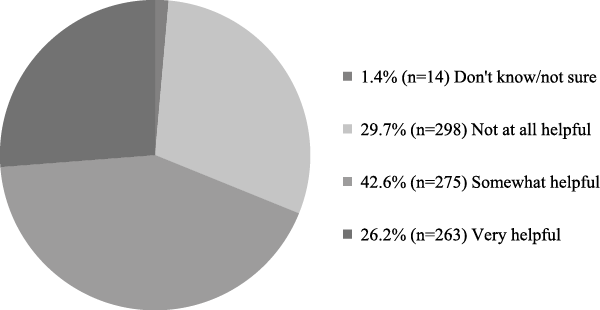
Helpfulness of the police when reporting IPV.
Of the 683 respondents who provided an open-ended response elaborating on their experience with police, the largest portion (43.6%, n = 298) of the responses were coded as “negative” overall (see Figure 2). A further 14.2% (n = 95) of responses were found to be a mixture of both positive and negative in describing their experience with police when reporting IPV.
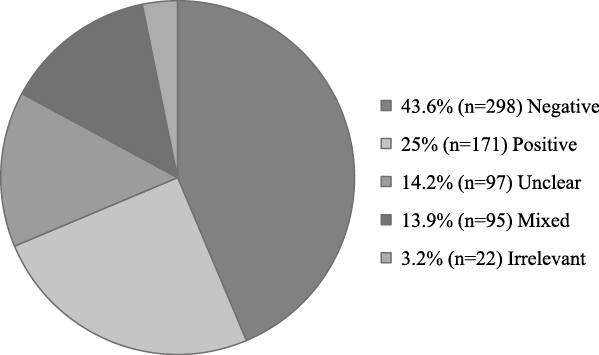
Closed codes for open responses elaborating on experience with police.
Experiences with police contact
When examining the themes present in the open-ended responses on police contact, one of the most common was being “supported” by the police (23.0%, n = 157). Here, respondents reported that they received support from a police officer or described the police as helpful, sympathetic, and handled their situation appropriately. For example,
When I called the police, they were there right away I felt they were looking out for myself and children even after he was removed I had a few times that I had to call and they were right there.
Similarly, there were a number of respondents (10.3%, n = 70) who commented that the police also provided resources (e.g., options, information, next steps explained, etc.). While a number of respondents reported that the perpetrator was spoken to/warned by the police (7.3%, n = 50), or was arrested and/or charged (15.4%, n = 105),
The RCMP [Canadian Federal Police] were extremely helpful and I believed they were genuinely concerned for my well-being. When they were called to my home, they stayed with me until a friend arrived. They called the next day and did a follow-up. They explained my rights and my options and helped me to make the best decisions. They also spoke to my spouse and let him know what would happen if he were to become aggressive again. I am very impressed by the support I received.
Other less common themes of a supportive nature from the police included the abuser (8.9%, n = 61) or victim (2.8%, n = 19) being removed from the household, and police providing transportation for the victim (4.1%, n = 28).
However, a number of respondents indicated experiencing unsympathetic or unhelpful contact with police (13.8%, n = 94). In some instances, victims were discouraged from following through with the charges:
It seemed as if they were warning me of what would happen or could happen if this continued, yet weren’t directing me to any resources that could help facilitate change, there wasn’t enough “proof” and though I was very young and in a province [where] I knew no one, they seemed to think I had the financial and emotional resources and knew the steps to walk away.
A further 11.9% (n = 81) described the police as insensitive or blameful (9.7%, n = 66). Others described examples of “inaction” by the police (18.3%, n = 125), for instance,
Attempted to get police assistance to end harassment via phone calls, texts, and constant drive-bys. I was told they couldn’t do anything. I know that’s wrong, but I gave up simply from sheer exhaustion with the situation. I reported being abused by a previous boyfriend and sexually assaulted. I had waited about 8 months to report it out of fear, and the police said I waited too long, and that perhaps once I have children I could teach them how to better handle these types of situations. I was horrified.
Similar to the above quotes, 12.6% (n = 86) of respondents indicated that police minimized their experience of violence, or perceived the investigations to be left incomplete (e.g., police did not follow up; 3.1%, n = 21), for instance,
I called them for help when my ex was trying to break into my home with a rifle, threatening to shoot me. They arrived and patrolled the area without any success. When they returned, they asked for his last known address so they could investigate and warn him, and that was the last I heard from them.
Experiences With the Justice System
Protection orders
In total, 17.0% (n = 480) of respondents had obtained a protection order when dealing with an abusive partner (76.0%, n = 2,152 had not; 7.0%, n = 199 did not respond). Women were significantly more likely to have obtained a protection order (19.5%, n = 454) compared with men (5.3%, n = 14), χ2 = 32.63, p < .001.
Perceptions of the helpfulness of protection orders were mixed, although the largest proportion found it to be “somewhat helpful” (40.5%, n = 190; 27.7%, n = 130 “very helpful”; 24.9%, n = 117 “not at all helpful”). The following is a quote that illustrates the variable helpfulness of protection orders from one of the respondents who provided text comments:
Owing to a breach of a protection order, for two years that order was made very powerful, and my family was able to heal significantly. However, at the end of the two years, we had changed residence, schools, and workplaces. If we wanted the order extended, we would have had to reveal all of that information about our new lives to the offender, which defeated the purpose of renewing the order, so that was the end of our legal protections.
Other comments related to specific struggles with protection orders (e.g., lack of enforcement or difficulty obtaining one) also emerged throughout the open-ended responses (15.2%, n = 77).
Criminal law system
Of the total sample, 19.7% (n = 559) indicated that they had dealt with the criminal law system (73.6%, n = 2,084 had not; 6.6%, n = 188 did not respond). Women were significantly more likely (22.0%, n = 512) than men (12.7%, n = 34) to have been involved with the criminal law system as a result of IPV (χ2 = 12.28, p < .001). Participant reports of the helpfulness of the criminal law system were mixed, with most finding it to be “somewhat helpful” or “not at all helpful” (see Figure. 3). A number of respondents provided additional comments that directly illustrate how knowledge about the criminal justice system can be beneficial, for example,
Women need to understand their rights under the law and be able to articulate these to police—otherwise they may be just told there is nothing that can be done. Legal information was very helpful to me in informing police that I knew the law, knew how the criminal’s behavior violated that law and expected them to provide the protection and follow-up I had a right to under that law.
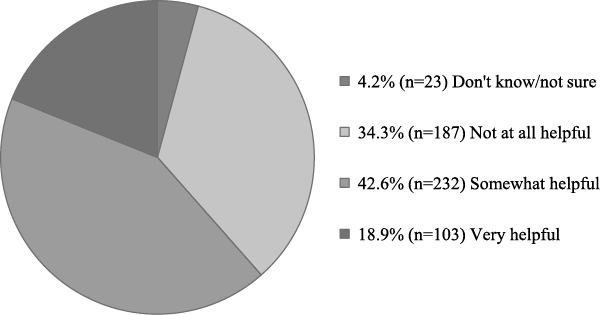
Helpfulness of the criminal law system when dealing with IPV.
Others commented on inadequacies of the criminal law system, for example,
The criminal court through the Crown Attorney dropped the assault charges and by agreement in which I was never consulted, he plead guilty to uttering death threats . . . I got protection order, but given his love of weapons and ability to access one, and his threat to kill me that way, it didn’t feel like a piece of paper is much use in stopping a bullet. It does, however, allow the police to take action. Building courage to escape such a situation [means you] must accept that the danger lasts long after the police and courts are involved and that one has to be at the point of wanting to be free so badly, that you don’t care if you die trying . . . .
This quote demonstrates the complexity of leaving a violent relationship. While the justice system is in place to formally support and protect citizens, victims of IPV often cannot rely solely on the system. Some feel they must take responsibility for their own safety (Bennett et al., 1999; Epstein & Goodman, 2013), demonstrating the limitations of the present measures available to protect IPV victims, particularly within the criminal justice system.
Family law system
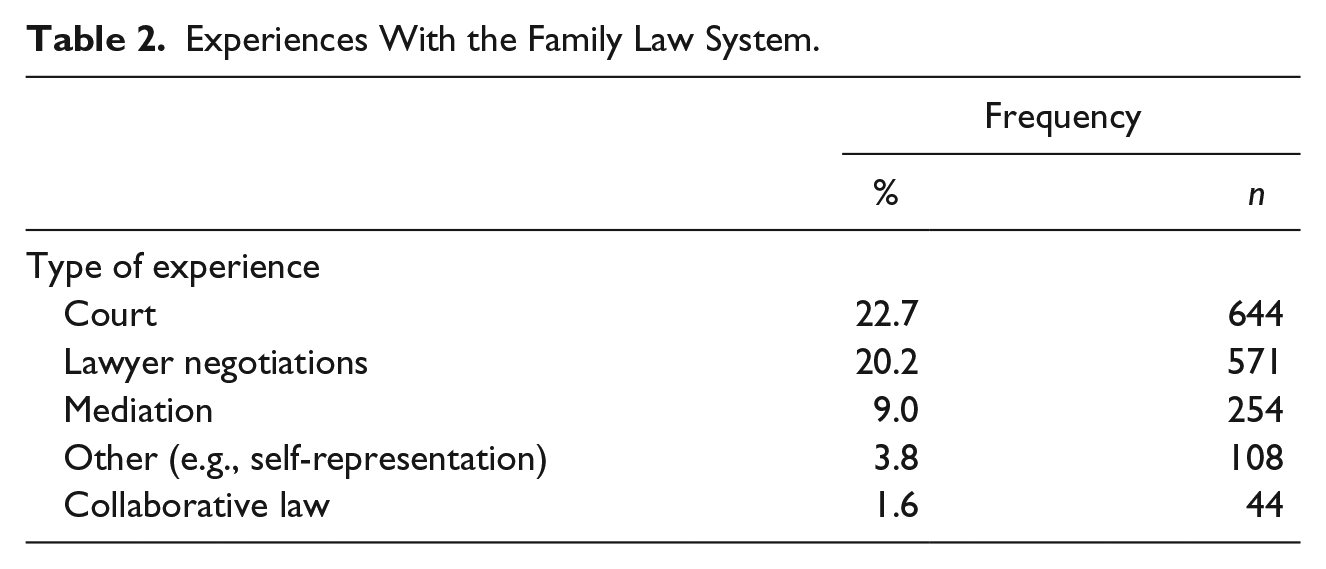
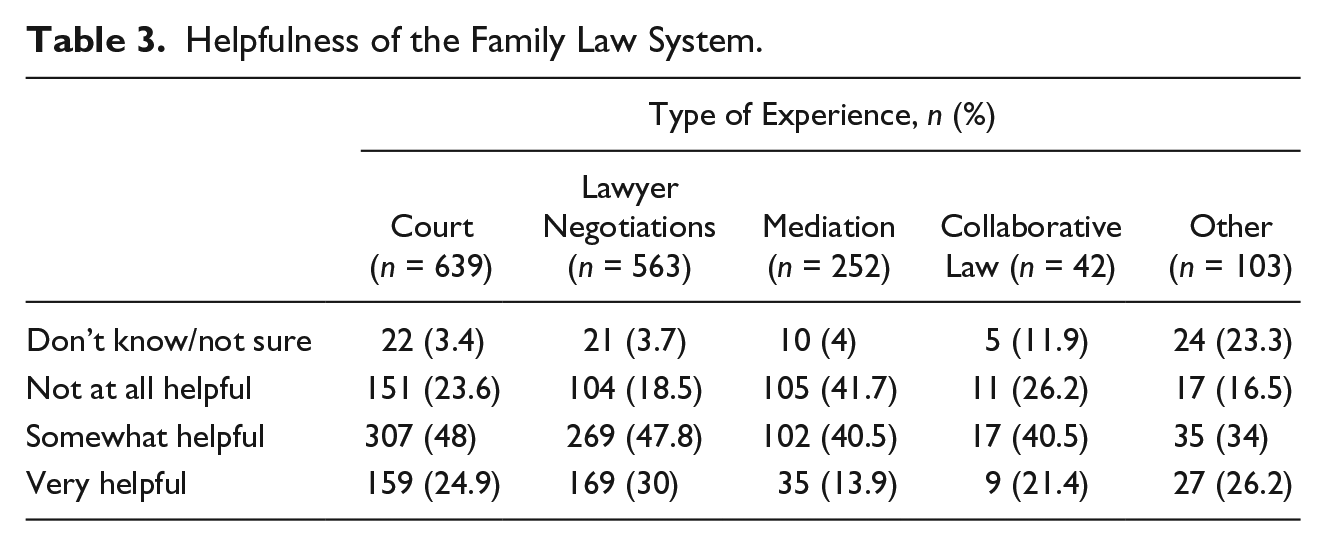
Overall, 35.0% (n = 991) of respondents indicated that they had used the family law system to deal with separation issues (i.e., custody, access, property division, support, etc.; 58.0%, n = 1,642 had not; 7.0%, n = 198 did not respond). Women (38.5%, n = 894) were significantly more likely than men (31.3%, n = 84) to use the family law system (χ2 = 5.17, p = .023), and among those who used it, 39.9% (n = 395) indicated having only used one aspect of family law. The remaining 60.1% (n = 596) had contact with two or more aspects of the system (Table 2). Overall, respondents found lawyer negotiations and court to be most helpful, whereas mediation was the least helpful (Table 3).
Experiences With the Family Law System.
Helpfulness of the Family Law System.
Perceptions of the justice system
Of the 508 respondents who provided a text response expanding on their experience with protection orders, and the family or criminal law systems, the majority (53.2%, n = 270) were coded as “negative.” Of these, one of the most common was “system difficulties” (22.2%, n = 113), where respondents reported finding the system to be overwhelming, confusing, frustrating, or difficult to navigate:
Family court system is intimidating and without money to buy legal representation, your interests are not protected and left to navigate the legal system on your own (unless you are on welfare and qualify for legal aid, are wealthy or have family willing to pay your legal fees). Your abusive partner can use family court system to victimize you, that is, drag out/delay court dates, stalk/intimidate you at court, etc.
Another concern that emerged was a perception of the justice system as unjust and unable to defend the rights of victims (17.5%, n = 89), which included comments about it failing them in some way, or was generally discouraged by the system:
Woefully inadequate. Perpetuating patterns of abuse by making escape from abuse so unattainable. Criminal justice system is inherently flawed when it comes to online stalking and harassment and affords too many rights to the accused in court proceedings.
A number of responses (10.2%, n = 52) also emphasized the high financial cost of going through the system and the impact of the resulting financial strain:
Three years I have been working within the court system, spending more than $50,000 . . . I only make approx. $20,000/year. He is on his fourth lawyer, and so I have to go to another case conference to get to a trial . . . I feel I have lost a close relationship with my 18-year-old son due to previous partner “turning him against me” . . . I was told I could stop this manipulation, slander of my character but it would cost me too much money. My lawyer was excellent, but my spouse’s lawyer did not respond to requests and deal with an uncontested arrangement. Delay, delay, delay. This extended the financial consequences for all of us.
However, 12.2% (n = 62) of the open-ended responses regarding experiences with the justice system were coded as generally positive. Here, positive themes included respondents commenting on the supportive experiences with lawyers and/or judges (4.9%, n = 25), or more broadly with the justice system (8.9%, n = 45). Generally, these respondents felt not only supported but also safer as a result of their involvement with the justice system. For example,
The probation officer was available to me and kept me in the loop when and as needed. A sheriff was present in the courtroom during the Judicial Case Conference, as the protection order was still in place. During family court (my spouse was requesting financial support), the judge was fair and firm. My lawyer was very supportive and helped me over the space of 3 years to become free of my abuser.
Cross-Cutting Themes: Experiences With Police and the Justice System
Several common underlying themes emerged in the analysis of respondent experiences with either/both of the police and the justice system, as follows.
Variability of response
A prominent theme evident in the comments was how variable, not only between individuals but also within a respondent’s experiences, the police and justice systems’ responses were. Comments were considered variable when there were both positive and negative experiences identified with certain aspects of both systems (i.e., police, judge, lawyer, outcomes, process, etc.). For example,
The police were understanding and helpful; however, when escalated to court, the presiding judge said that he believed both my story and the lie my partner told so could not rule in favor of either.
Unfortunately, the quote below also demonstrates that interacting with one supportive person who validated the person’s concerns could not make up for the difficulty of her overall experience with the justice system and led her to conclude she would not report again:
. . . Most of the officers minimized the harassment I was experiencing. Eventually, I talked to one who did see that it was a serious situation. She apologized for me being ignored previously. The trial was difficult and traumatic. Although I understand the need to examine the victim, I found it excruciating and terrifying to testify and to have to face my ex again. Quite frankly, I doubt that, if it happened again, I would ever report a similar situation.
Overall, the varied experiences with the system highlight the intricacies of accessing formal supports, and how mandated high-level policies (i.e., provincial and/or federal) do not always translate to more effective service from individual actors in the system. In addition, these comments identified the importance of coming into contact with the right people within the systems.
“It really depends”—getting the right person and the role of “luck”
It was evident that the contact with various professionals was not always positive, and many respondents commented on the importance of a specific professional with whom they interacted. Respondents often identified an element of “luck” when they encountered a supportive and helpful person. For instance, a number of people noted that that they experienced the helpfulness of police seemed to be related to the happenstance of who was responding to the call:
I just stumbled upon the right people, including women cops—at every level, from going to the police station to report, through the Partner Violence Unit—I got incredibly lucky and it saved my life. My kids and I had to leave our house and hide in a safe house for over a week, and in that time I got incredible support from the detective assigned to my case, victim services, and others. I am so grateful to all these people. Depending on the police officer, I felt that some were being supportive while others talked down to me and gave me the feeling that I was bothering them and wasting their time. I have dealt repeatedly with the police, and it really depends on the officer you get. Some truly understand domestic violence, but most do not.
Respondents also identified having specific issues related to professionals working in the justice system (i.e., lawyers, judges, etc.), which directly affected their experiences. Similar to the above experiences with police, some respondents highlighted being fortunate to come across the right persons within the justice system who were both supportive and understood the dynamics of IPV:
They are the ones within this entire system . . . including lawyers, judges, child protection, and violence against women who really “got it.” They were very supportive to me . . . however, the legal process was not helpful to my family. I was fortunate to have one of only a couple of female judges at the time. She put me on the stand and asked only one or two questions and said I’ve read your reasons for divorce, and it looks like you’ve already been through so much I won’t put you through any more, I have no other questions to ask you.
In addition, a number of respondents indicated that there was a need to be persistent for police to take action, for instance, “I had to talk with five different officers at different times before I was taken seriously. Eventually, my ex was arrested and convicted of criminal harassment.” These comments highlight the lack of consistency in police responsiveness to victims of IPV. Likewise, these comments support previous findings that a victims’ experience with police response can vary depending on the officer victims come into contact with (Buzawa & Austin, 1993; Coulter et al., 1999; Stephens & Sinden, 2000).
Structural barriers—not “fitting” the system’s conception of an “IPV victim”
One interesting theme that arose from respondents’ comments was that the systems were not structured to meet their needs (e.g., male victims, those in same-sex relationships, newcomers to Canada). For example,
Not enough services to help abused men/husbands. Everything is geared to women because men are supposed to “man-up.” The quarrel with my wife, an immigrant, unfamiliar with the possible severity of the charges that could have resulted (in her country, police openly take bribes, and, probably, the male side would be supported, not the female’s—Cameroon). It is largely because of the police handling of the investigation of the incident that I feel it unsafe to continue my marriage . . . my wife has a quick to rise and violent temper! Likely there would be another quarrel, and if so, in the moment, my wife could dream up more serious charges! They judge a great deal based on perceived socioeconomic status. At the time, my partner worked for a low-income housing, and he lived on site. I believe the police judged differently because they were responding to an address of “welfare bums.”
These comments further highlight the difficulties that marginalized populations often face when dealing with the justice system. While these barriers are often hidden, these comments provide some insight into how victims experience, and often struggle, when trying to utilize systems that are meant to be just regardless of a person’s background or identity. It should also be noted that these systems can be confusing and opaque to those who do have ample resources:
The family law system is confusing and intimidating, even for the very educated with lots of resources. I cannot imagine trying to negotiate it in other circumstances. It’s also very difficult to find funding for courts and lawyers—you either have to be very well off or very poor. The in-between have to figure it out for themselves.
Potential harms of seeking help from police or the justice system
Finally, and most problematic, many respondent comments brought to light a number of potential harms of engaging police and/or the justice system. Many indicated that contrary to these interventions de-escalating or stopping the abuse, it continued, or even escalated. For example,
Police released him from custody right away, which actually aggravated the situation because he was angry, so I had to find a way to get along with him rather than just break up, . . . Restraining orders kept aggravating the situation, each time more severe beatings/harassment. Called 911, changed my mind because I was scared. They didn’t provide me any alternatives. No one helped, and the next morning I had to go and pick him up at the jail, and it got worse.
Likewise, respondents commented that their abusive partner used their influence/power during the process or were able to manipulate/circumvent the justice system:
He is manipulative. He would do things that were just on this side of the law . . . nothing chargeable . . . it was frightening . . . 13 years later, it still is frightening . . . . As he is a police officer, he continues to act as if he believes only certain parts of the court order apply to him. The family court system is not set up to deal with domestic violence. The abuse I endured while married continued through the legal system, which facilitated his control and pursuit of me. . . . Without consistency of judges through the legal process, the abuser can continue to weave semi-truths with lies and present as a caring father whereas consistency of experience with the two parties may reveal a different story.
Furthermore, a noteworthy number of respondents described police as being supportive of the abuser, for instance,
They square out denied me assistance. Justified the offender’s actions, minimized them, and went so far as to say he wouldn’t get charged for assaults against myself and children I had to protect at the risk to my personal safety. They obviously were prejudiced, intolerant, indifferent, and incompetent . . . .
These experiences align with previous research that has found accessing the formal help system can be difficult and even detrimental to a victim’s well-being (Weisz et al., 2005). They also highlight the continued gaps in the system that is intended to support victims of violence.
Discussion
The present study brings deeper understanding to Canadian IPV victims’ experiences with police services, as well as the public safety and justice systems more broadly. To the authors’ knowledge, this study presents one of the largest samples of IPV victims’ self-reported experiences with the police and justice system reported in the literature. Overall, 35.9% of victims had reported IPV to police, which is fairly consistent with previous findings (Statistics Canada, 2016). Also consistent with previous findings, respondents’ perceptions of police helpfulness varied, although most, in the closed-ended questions, reported that the police were “somewhat helpful” (Coulter et al., 1999; Gillis et al., 2006; Jaffe et al., 1986; Statistics Canada, 2016). While responses to the open-ended question about police experiences were most often negative, feeling supported by the police was the most common theme for this question, overall. This aligns well with a previous finding that despite overall satisfaction, many victims are often unhappy with some aspect of the police response (Gillis et al., 2006). Perhaps part of this discrepancy was due to low expectations that victims have regarding police responsiveness to IPV. As a result of lower expectations, victims may perceive any help from the police to be more positive than it actually was. Such an explanation may account for a number of respondents reporting a varied experience with the police or stating being “lucky” to have come into contact with a certain, “good” police officer.
Experiences with using the family law system were also fairly common (35%); fewer victims had experience with the criminal law system (18.7%). Overall, victims’ perceptions of helpfulness of the justice system when dealing with IPV were also variable, which is similar to prior studies (Bennett et al., 1999; Erez & Belknap, 1998; Fischer & Rose, 1995; Gillis et al., 2006; Landau, 2000; Levy et al., 2008), and some parts of the justice system were more helpful (e.g., lawyer negotiations, court processes) than others (e.g., mediation). Responses to the second open-ended question regarding protection orders and the justice system highlight the great range of experiences, but perhaps most clearly illustrate the myriad, substantial, and at times shocking challenges faced by many IPV victims when accessing these services. Consistent with prior research, difficulty with navigating the system and feeling overwhelmed, frustrated, or confused were the most common themes for victims (Bennett et al., 1999; Gillis et al., 2006).
Common across respondent experiences with both the police and the justice system were, as above, the variability of responses, and the notion of “luck” (see the following), as well as difficulties with structural barriers, including not fitting the system’s conceptualization of a “victim.” As noted in previous literature, seeking help is also potentially risky, with a number of potential harms described by respondents. For instance, previous studies have found that involving justice system actors can lead to retaliatory violence from an abuser (Erez & Belknap, 1998a, 1998b; Singer, 1988; Wolf et al., 2003). Overall, both the previous literature and the present study identified the increased risk and other difficulties that victims can face when becoming involved with the justice system; these, understandably, can be significant barriers to help-seeking.
Perhaps the most surprising finding in this analysis was the notion that being “lucky” is a key driver in a safe and helpful response to IPV. As articulated by many respondents, coming across the “right” officer, lawyer, or judge could “make all the difference.” This type of finding has been noted elsewhere in the literature, with a number of studies showing that victim satisfaction with police response is dramatically associated with police behaviors and treatment (Bennett et al., 1999; Buzawa & Austin, 1993; Coulter et al., 1999; Hamilton & Coates, 1993; Russell & Light, 2006; Stephens & Sinden, 2000); however, we’re not aware of other work that so clearly frames what should be taken-for-granted as a safe and respectful response as “luck.” This further emphasizes the key role that expectations may play in whether, when, and how IPV victims seek, or do not seek, help from the police and justice systems.
Limitations
Limitations to this study include a nonrandom sampling approach that led to overrepresentation of women, those in unionized employment, and respondents from some provinces (i.e., Ontario and British Columbia). While sampling bias is an issue for all self-report surveys, the size of our data set and the consistency of our lifetime IPV prevalence rate with previous national rates (i.e., Rodgers, 1994; Statistics Canada, 2016) lend credibility to our findings. Furthermore, our survey approach, with an emphasis on open-ended questions, not only provided an avenue to deepen the understanding of the quantitative data and to draw comparisons between our findings and previous research but also, importantly, provided a rich understanding of victims’ experiences in their own words. Nevertheless, our research does not fully address the complexities of engaging with the police or the justice system for IPV, for example, the decision process involved or timing of events. Similarly, the present study cannot tell us the actual “effectiveness” of police and justice system responses in terms of improving outcomes for those exposed to IPV.
Future Research
Future research should address the experiences of transgender and male victims with police and the justice system. Similarly, future research should explicitly examine the impact that victims’ demographic, ethnic, and overall intersection of identities has on the responses of police and justice system to IPV. Our analysis of textual responses revealed varied supportiveness from police officers, judges, and lawyers, including many inappropriate responses such as victim blaming. This suggests that many key actors in the system have a lack of understanding of the dynamics and impacts of IPV. More research is needed to understand how training or education about IPV affects police and judiciary responses to victims.
Implications
This research contributes to the advancement of victim-sensitive responses by the justice system that take into account safety and well-being while providing required legal protections. The fact that the majority of victims in this study found the police and justice system response to be at least somewhat helpful highlights that these formal systems play an important role in ensuring victim safety and perpetrator accountability. Nevertheless, the possibility that accessing such services may be re-traumatizing for victims emphasizes the need for system improvement. Negative responses by police may have very real consequences for victim safety, well-being, and willingness to seek help in the future (Erez, 2002). Several factors could account for the variability in perceived helpfulness of police and justice system actions, including individual-level training, knowledge and attitudes, organizational practices, and, importantly, victim expectations. Based on the varied responses of police recounted by our respondents, it is evident that although federal policy has influenced police response, departmental and individual interpretation and action are key. It is crucial that jurisdictions continue to educate professionals on the dynamics of IPV and how to be supportive to victims when they seek help from formal systems of support. Likewise, the numerous difficulties faced by victims in navigating the court system suggest the need for greater awareness of the dynamics of IPV among key actors (e.g., judges), and more straightforward processes that are user-friendly and responsive to the needs of victims.
Conclusion
Experiences with the police, in terms of both immediate response and as a gateway to other public safety/criminal justice remedies, and various aspects of the justice system, have the potential to affect the lives of IPV victims for better or for worse. When effective, they can have a vital role in ensuring safety for the victim and accountability for the perpetrator; when ineffective, they can do significant harm. In our Canadian data, we found that victims’ expectations can guide their decisions regarding seeking help, and we argue, victims should be able to rely on much more than being “lucky” to get the help that they need.
Footnotes
Acknowledgements
We would like to acknowledge the contributions that the Canadian Union of Public Employees (CUPE), the Canadian Union of Postal Workers (CUPW), and the Canadian Labor Congress (CLC) made to translation of the survey, translation of responses, and study recruitment, respectively.
Declaration of Conflicting Interests
The author(s) declared no potential conflicts of interest with respect to the research, authorship, and/or publication of this article.
Funding
The author(s) disclosed receipt of the following financial support for the research, authorship, and/or publication of this article: This research has been a collaborative effort between the Center for Research and Education on Violence Against Women and Children (M.D.S., L.O., B.J.M., C.N.W.), Western University’s Faculty of Information and Media Studies (C.N.W., J.C.D.M.), and the Canadian Labor Congress (CLC). Support was provided by the Canadian Institutes of Health Research–funded Preventing Violence Across the Lifespan (PreVAiL) Research Network (C.N.W.; Grant ID: RDG99326) and the Social Sciences and Humanities Research Council of Canada (B.J.M., C.N.W.; Grant ID: 89020130102).