




Abstract
Using the empirical powers of theories of intersectionality, the study investigates the association between students’ demographics (such as gender identity, race, ethnicity, age, and socioeconomic status) and sexual violence victimization. An anonymous survey was employed to collect data from a cluster random sample of 966 students attending face-to-face courses at a midsize urban nonresidential campus. The empirical findings suggest that being older and female are the only statistically significant factors in the analysis. As the first attempt to focus on students attending nonresidential programs in the United States, the study presents implications for policy and program implementation to include issues pertinent to students’ diversity to better respond to students’ risk of victimization.
Introduction
Sexual assault on campus has become a major concern for many colleges and universities in the United States. Recent estimates indicate that one out of every four women experience some form of sexual victimization while in college (Cantor et al., 2015). Among the consequences of sexual victimization are substance abuse disorders, eating disorders, depression, and suicide attempts (Campbell, Dworkin, & Cabral, 2009; Jordan, 2014; Messman-Moore, Long, & Siegfried, 2000). Sexual victimization can also affect future victimization (Messman-Moore & Long, 2003; Messman-Moore et al., 2000; Noll, Horowitz, Bonanno, Trickett, & Putnam, 2003) and increase the chance of perpetration of violence later in life (McMahon et al., 2015), with victims often showing a propensity to become abusive. In addition, there is evidence that sexual violence can significantly impair one’s cognitive abilities (Hall et al., 2014), reducing students’ opportunities for success during and after college (Jordan, 2014).
A growing body of literature focuses on the issue of sexual violence among college students, but extant studies present many limitations. First, these studies mostly focus on residential campus communities, in spite of the fact that the majority of U.S. college and university students attend nonresidential programs (Horn, Nevill, & Griffith, 2006; National Center for Education Statistics [NCES], 2015). Second, response rates vary greatly across studies with rates between 9.4% and 86% (Cantor et al., 2015; Gardella et al., 2014; Krebs et al., 2007), limiting our ability to draw comparisons across schools and generalize findings.
Drawing upon the empirical guidelines of intersectionality theories, this study investigates college students’ experiences of sexual violence and it addresses the following research question:
An anonymous survey was used to collect data from a cluster random sample of 966 students at an urban nonresidential/commuter campus of a major Midwest university during Spring 2014. Sexual victimization in the study is any form of sexual violence that resulted in either attempted or completed sexual acts.
Prior Studies
Extant studies on student sexual victimization clearly indicate that we are facing a real problem in many U.S. colleges and universities. Estimates of victimization vary depending on the empirical approach used for the data collection, the definition of sexual violence, and the time frame considered for the investigation, that is, whether experiences of sexual violence are considered as lifetime experiences or while in college.
Definitions of Sexual Violence in Research
Current research on student sexual victimization prioritizes the impact of sexual violence among other forms of victimization, such as partner violence, property violence, and physical violence (Rennison & Addington, 2014). However, scientists use different definitions of sexual violence, resulting in a broad range of victimization rates across studies. Studies employing more comprehensive definitions of sexual violence that include any form of nonconsensual contact or any incident in which consent was forced upon the victim tend to show higher estimates of victimization. Instead, studies with more conservative definitions of sexual violence, which tend to focus primarily on coercion, tend to show lower rates of student victimization (Cantor et al., 2015). Using a modified version of the Sexual Experiences Survey (Testa, VanZile-Tamsen, Livingston, & Koss, 2004), Tyler, Schmitz, and Adams (2015) found that 55% of women and 39% of men attending sociology and psychology courses at a large Midwestern university had experienced some form of sexual violence during the year prior to the study. The College Sexual Assault (CSA) study found that when “any unwanted sexual contact” involving force or incapacitation was included in the definition of sexual violence, rates of victimization were as high as 19.8% among women (Krebs et al., 2007). Using the same definition, the Association of American Universities’ (AAU’s) study found that 23.1% of women in the sample experienced victimization while in college (Cantor et al., 2015), whereas the MIT Community Attitudes on Sexual Assault (CASA) study found that 17% of all undergraduate women and roughly 5% of undergraduate men experienced victimization. When the definition of sexual violence was limited to “penetration by force and incapacitation” (with incapacitation most often due to use of alcohol or drugs), rates of self-reported victimization were lower for both the CSA and the AAU studies, respectively, 14.3% and 11.3% (Cantor et al., 2015; Krebs et al., 2007). In addition, when studies did not include “incapacitation,” victimization rates for forced sex dropped to 2.9% (Cantor et al., 2015).
Time Frame in the Study of Sexual Violence
Estimates of sexual violence also vary depending on the time frame used to assess participants’ victimization. The highest rates of sexual violence come from studies that explore students’ lifetime experiences, whereas the lowest rates of victimization result from studies that only focus on more recent experiences, within the last 6 months or during the academic year in which the study was completed (Rennison & Addington, 2014). For instance, estimates from the National College Woman’s Sexual Violence (NCWSV) Survey (Fisher et al., 2000) found that 2.8% of participants in the study were victims of either completed or attempted rape during the academic year in which participants completed the survey. Fisher, Daigle, and Cullen (2010) found that 1.7% of female college students had been victims of rape and 1.3% experienced attempted rape during the academic year in which the study was conducted. Gidycz, Hanson, and Layman (1995) found much higher rates of victimization (10%) among female college students when asking about their experiences during the 6 months prior to the administration of the survey. Focusing on lifetime experiences, Koss, Gidycz, and Wisniewski (1987) found that 15.4% of female students in the sample had experienced rape at a younger age (with some victims reporting victimization as young as 14 years of age). Ten years later, Kann and collaborators (1998) published the Center for Control Disease and Prevention’s estimates of college sexual violence, disclosing that 13.1% of women attending college experienced rape at some point in their life. Kilpatrick, Resnick, Ruggiero, Conoscenti, and McCauley (2007) estimated that 11.5% of the 2,000 female college students surveyed had been victims of rape during their lifetime. Krebs et al. (2011) found that 13.9% of women attending historically Black colleges and universities (HBCU) had been victims of rape during their lifetime.
Demographics
Research on student sexual violence mostly focuses on the victimization of women. In the past, studies highlighted the fact that men are more likely than women to experience victimization for all types of violence except sexual violence (Sinozich & Langton, 2014). Although both men and women in college face the risk of sexual violence, the risk appears greater among women than among men (Cantor et al., 2015). In general, sexual victimization is the primary form of violence that affects young women, both college and noncollege women (Rennison & Addington, 2014). Female students are more likely than their male peers to report sexual victimization of any type (Cantor et al., 2015). Gardella et al. (2014) found that rates of sexual violence among female students were 4 times as high as those of male students. In the AAU study (Cantor et al., 2015), rates of sexual violence among female students were more than 3 times as high as those of male students. Students who identify as gender and sexual minorities are also more likely to report victimization. In the AAU study, gender and sexual minority students were the group with the highest rates of self-reported victimization (about 28%; Cantor et al., 2015). These findings confirm the evidence from victimization studies not specifically focusing on college populations that rates of sexual harassment, sexual violence, and hate crime victimization are generally higher among sexual minorities than among heterosexuals (Black et al., 2011; Herek, 2009; Rothman, Exner, & Baughman, 2011). Even within a growing body of literature on sexual violence, the victimization of gender and sexual minorities appears to be understudied.
With respect to the race of the victim, several studies fail to provide evidence that sexual violence victimization varies across racial or ethnic groups in college (Kalof, Eby, Matheson, & Kroska, 2001; Mustaine & Tewksbury, 2002). Cantor et al. (2015) found that whereas Asian students had a lower risk of victimization for any type of sexual contact when compared with White students (37.9% vs. 51.3%), no differences were found across other racial groups. Conversely, Gross, Winslett, Roberts, and Gohm (2006) found that African American women were more likely than White women to experience rape. Comparisons of students’ victimization rates across racial groups are limited for several reasons. In part, this might be due to the low numbers of ethnic and racial minorities at non-HBCU in the United States (Krebs, Lindquist, & Barrick, 2010). Furthermore, some quantitative empirical studies show that although race and other demographic variables are directly correlated to sexual violence, these variables tend to lose their statistical significance when situational variables (e.g., partying and drinking) are added to the analysis (Mustaine & Tewksbury, 2002). Researchers also point out that experiences of sexual violence vary across racial groups when other demographics, such as gender identity, sexual orientation, and socioeconomic status are considered (Sigurvinsdottir & Ullman, 2016). For instance, in a sample of Black female students, Krebs et al. (2011) found that sexual minority students were more likely to experience sexual violence than heterosexual students. As Sigurvinsdottir and Ullman (2016) point out, it is important to create empirical models that include the interaction between sexual orientation and race. This is especially relevant as research evidence shows that Black sexual minorities experience a more problematic recovery than other groups of victims following sexual violence (Sigurvinsdottir & Ullman, 2016).
Studies consistently found that age (being young) contributes to a higher risk of experiencing sexual violence (Lonsway & Fitzgerald, 1994). Estimates by Cantor et al. (2015) indicate that younger students (especially freshmen) face the highest victimization risk (16.9%) while in college. While being young might be the single most important risk factor in the analysis of women’s victimization in general (Mustaine & Tewksbury, 2002), studies that compared both college and noncollege women found that being in college actually reduced the risk of victimization. Using National Crime Victimization Survey (NCVS) data (1995-2011), Rennison and Addington (2014) found that 8% of the noncollege group and 6.1% of the college group reported rape and/or sexual assault. Sinozich and Langton (2014) found that girls’ rates of sexual violence (rape and sexual assault) among nonstudents were 1.2 times higher than among students, with estimates indicating that 7.6 per 1,000 among nonstudents and 6.1 per 1,000 among students in the sample experienced victimization. This comparison seems to warrant further reflections. As student populations become increasingly more diverse (Jordan, 2014), it seems plausible to ask whether differences in rates of victimization between college and noncollege women will even out over time.
This review of the literature highlights that gender identity (being female) and age (being young) significantly increase the odds of sexual violence victimization for college students; however, very little is known about the effect of other demographics. The contrasting findings about the role of race and the limited information about the victimization of sexual minority students in quantitative studies raise important questions about the ability of some statistical models to capture the effect of demographics in studies of sexual violence. In addition, current studies primarily focus on students attending residential campuses, and no data are available about sexual violence among students attending nonresidential/commuter colleges or online programs (Rennison & Addington, 2014). One of the major limitations of this exclusive focus on students attending residential campuses is that it undermines the effect that diversity might have on students’ victimization, especially socioeconomic diversity. However, students attending residential colleges tend to be wealthier than students in nonresidential colleges (Gianoutsos, 2011). Assessing how students from a diverse pool of economic and racial backgrounds experience sexual violence is important to our understanding of this social problem. Prevention and intervention measures, as much as antidiscrimination laws, must take into consideration how various aspects of one’s identity play a role in creating a nexus of opportunities for victimization. This study contributes to the existing body of literature on sexual violence by investigating the influence of demographics on the victimization of college students attending classes at a nonresidential campus. To construct an empirical model for the analysis, this study follows the empirical powers of theories of intersectionality.
The Empirical Powers of Intersectionality
Theories of intersectionality (Crenshaw, 1991; McCall, 2005; Sokoloff & Dupont, 2005) uniquely offer support to design an empirical framework to explore the effect of demographics on student sexual violence victimization. To date, student sexual violence research has failed to interview antidiscrimination laws on the relevance of demographics, such as gender identity, sexual orientation, race, and socioeconomic status. The legislative body developed within the last decade to prevent, punish, and deter student victimization only vaguely addresses the complexity of students’ identities and their ability to avoid predators within institutions of higher education. Responding to the call for action that primarily comes from activists in large residential campuses of the United States might mean prioritizing the needs of wealthier and more resourceful students. When the call for action comes from the privileged, we need to find opportunities to discuss the situation of those who might be experiencing sexual violence in addition to other forms of oppression that are intrinsic to the complexity of their identities (Crenshaw, 1989). By focusing on a broader pool of students, attending programs at nonresidential colleges/universities might mean to become more inclusive and more aware of the diversity of our newest generations of students. By considering the power of interacting identities to understand victimization, intersectionality allows us to raise questions that can challenge existing laws and current programs to allocate more resources for students from disadvantaged backgrounds. Unfortunately, current studies on students’ experiences of sexual violence often use an inductive approach with no specific theoretical framework. Studies that employ the descriptive powers of intersectionality theories are needed to understand the complex effect that demographics and personal experiences might have on sexual violence victimization.
Although some intersectionality theorists suggest all women have complex identities, regardless of their personal background (Zach, 2005, as cited in Nash, 2008), contemporary interpretations of intersectionality challenge researchers to include other dimensions in the analysis of oppression, such as race, sexual orientation, class/socioeconomic status, nationality (Nash, 2008). This appears to be of particular relevance when analyzing sexual violence. When it comes to sexual violence, women (and girls) are often blamed for their victimization. Whereas rules of socialization are tacitly established within the boundaries of patriarchal values and male dominance, women are often accused of provoking sexual violence with their behaviors and appearance (Burt, 1980). Within the intersectionality framework, women are not a homogeneous group. Even when women’s lives are explored within a particular racial group, their experiences might differ from one another. Other factors might influence their experiences, and the realities of their lives cannot be understood in disconnect from the processes that determined them. Finally, comparing people of different gender identities and sexual orientations would also help us understand the problem more in depth.
Studying sexual violence becomes particularly difficult within a quantitative analytical framework. McCall (2005) considers three possible approaches to the study of social experiences within the intersectionality framework: anticategorical, intracategorical, and intercategorical approaches. The anticategorical and intracategorical approaches focus on the idea that one’s identities are inseparable from the context in which experiences occur and can be efficiently addressed through qualitative methods of research. The intercategorical approach allows for the analysis of experiences across groups providing a supportive framework to research designs that employ quantitative methods. However, the intercategorical approach also suggests investigating group interactions to understand how identities overlap across predefined categories. Although intersectionality allows for an analysis of experiences within a categorized framework, it rejects the idea that individuals can be placed within homogeneous categories. This study employs an empirical model that uses the intercategorical intersectionality approach by embracing the idea of “interactions” across groups.
Method
Data for the analysis come from an anonymous survey on victimization that employed a sample of undergraduate students attending face-to-face courses at one of the regional/commuter campuses of a major Midwest university. Anonymous surveys can be especially useful to measure sexual violence because they allow participants to disclose a form of victimization that is most often unreported (Gardella et al., 2014). The unit of analysis for the study is the individual student.
Sampling Procedures
At the time the sample was drawn, the targeted population was estimated to be approximately 5,000 students, as per the list of active courses provided by the campus registrar. Considering a 99% confidence interval, we estimated a margin of error of 3.7% when targeting 46 courses randomly selected using a computerized randomization process. The total enrollment for the courses included 1,847 students for a response rate of 52.47%. However, because several of the large courses included in the sample are part of the general education required courses that all students must complete, it is possible that several students were simultaneously enrolled in at least two of the courses included in the random sample. For this reason, students were explicitly asked not to replicate their response if they had already completed the survey when attending another class. Computing the exact representation of students in the sample is almost impossible in this case. Although this represents a limitation of cluster random sampling procedures, these sampling practices are common in educational settings (Fraenkel, Wallen, & Hyun, 1993) and in data collections that involve individuals who are hard to reach through simple random sampling procedures (Maxfield & Babbie, 2014).
The campus institutional review board (IRB) approved the study as exempt protocol because of the complete anonymity that the data collection procedures granted to participants. Eight research assistants were trained to administer the survey in the classroom. Classroom visits were scheduled ahead of time with each instructor. As indicated in the IRB protocol, students who were in attendance the day the research assistants visited the classroom received both verbal and written information about the voluntary nature of the study, their right to withdraw at any time, the anonymity of the procedures, and lack of compensation for participation. In addition, students were encouraged to seek help via the campus’ counseling center in the event they experienced discomfort while completing the survey. Contact information for the counseling center was distributed both verbally and in writing and was printed in bold font on both front and back pages of the survey.
To guarantee anonymity, paper copies of the survey were distributed to all in attendance. Participants were instructed to fold the survey in three parts before inserting it in a sealed box with a narrow opening. Once the surveys were collected, the research assistants delivered the sealed box to the research supervisor. All the surveys were dumped into a large bin and reshuffled to avoid creating a serial order that would jeopardize anonymity. Later, responses were entered in an online database prior to the analysis of data.
The total sample of respondents (N = 966) in the present study represent roughly 19% of all the students enrolled in traditional classroom courses at the targeted campus. The campus is a commuter/nonresidential campus and no housing accommodation is available to students either on or off campus.
Variables
The dependent variable for the study is students’ sexual violence victimization. Participants’ experiences with sexual violence were investigated through the Sexual Experiences Survey instrument originally developed by Koss et al. (2006).
The independent variables in the study include demographic characteristics, such as gender identity, race, ethnicity, and socioeconomic status. In addition, age was included as a control variable. All demographic characteristics were measured by using the 2010 U.S. Census survey questions.
Gender identity in the survey included the categories male, female, and other; in addition, a text entry allowed participants to specify their choice of the category “other.” Because only three participants identified themselves as “other,” the three cases were eliminated from the analysis and considered as missing. The decision to eliminate the three cases from the analysis was made for two reasons. First, the small sample size for the category “other” would reduce the statistical power of the statistical model employed for the multivariate analysis. Second, due to the sensitive nature of the study, we wanted to eliminate any opportunity for participant identification, which would be possible when measuring gender identity in association with the variable sexual violence (Table A1 in the appendix). The variable gender identity included in the analysis was recoded as male (0) and female (1).
The original data files also included information about students’ sexual orientation. In total, 169 women and 16 men who identified as heterosexual reported at least one experience of sexual violence, four men and nine women who identified as nonheterosexual, and three participants who identified as other nonheterosexual reported at least one experience of sexual violence. Missing cases in the variable sexual orientation were high, with more than 24% of participants skipping the question. When considered in association with the dependent variable sexual violence, the variable sexual orientation presented more than 34% of missing cases, which would limit the empirical model’s ability to obtain statistical significance. For this reason, the variable sexual orientation was not included in the multivariate analysis.
Participants’ ethnicity and race were measured using two separate variables. The variable ethnicity was recoded as non-Hispanic/Latino (0) and Hispanic/Latino (1). In the original data files, the breakdown of the variable race included the categories Black, Native American, Asian, Hawaiian, and White. Due to the small sample size of the categories Native American (1.1%), Asian (3.5%), and Hawaiian (0.4%), the variable race was recoded as non-White (0) and White (1).
In addition to gender identity and race, a measure of participants’ socioeconomic status was employed in the analysis. Following the latest Census report in income and poverty among U.S. families, the variable socioeconomic status was computed by combining three different indicators: household income, number of adults living in household, and number of kids living in household (DeNavas-Walt, Proctor, & Smith, 2015). The original household income variable in the data set was comprised of nine categories of income ranging from “less than US$30,000” to “US$100,000 or more” (see Table A3 in the appendix). The original variables for kids living in the household and adults living in the household were continuous (see Table A4 in appendix). To compute the variable socioeconomic status, the cutoff of the variable income was set at less than US$70,000 (DeNavas-Walt et al., 2015). The cutoff for the variables kids living in the household and adults living in the household were set at 4 or more. The computed variable socioeconomic status is a dichotomy with low socioeconomic status (0) and mid–high socioeconomic status (1). The variable age is a continuous variable that measures the participant’s age in years.
Missing Cases
Missing cases in the sample were low, with most variables included in the analysis showing between 0.1% and 4.0% of missing cases. However, one of the demographic variables included in the analysis, the variable race, shows the highest number of missing cases (10.8%). A preliminary analysis of the missing cases indicated that many students skipped the question on race after entering their answer in the question about ethnicity.
In addition to the variable race, one of variables included in the sexual violence index, “forced into sex play,” presents a large number of missing cases (10.5%). The preliminary analysis indicated that no particular pattern is present among the missing cases. It is possible that several students skipped this question because of the similarities in the wording of another question in the sex experiences questionnaire. A test was conducted to verify whether excluding this item from the sexual violence index (dependent variable) would improve the statistical power of the multivariate regression model; however, ordinary least squares (OLS) fitness tests indicate that the missing cases are unlikely to bias the results of the analysis (Table A5 in the appendix). Because of the large sample size (N = 966), we deemed replacing the missing cases for the variables race and the sexual violence index unnecessary.
Empirical Model
Using the methodological powers offered by theories of intersectionality, the study employed a parsimonious model designed to emphasize the relevance of demographic characteristics (gender identity, race, ethnicity, socioeconomic status, controlling for age) in the analysis of students’ experiences of sexual violence. Three interaction variables were added to the empirical model to investigate whether the interaction of the participant’s complex identities tend to create a nexus of opportunity for victimization. The interaction variables are (a) gender identity × race, (b) gender identity × socioeconomic status, and (c) gender identity × ethnicity. Because each one of the variables included in the interaction term is a dichotomy, interpreting the effect of interaction variables in the analysis is straightforward.
After developing a descriptive analysis of all the variables included in the analysis, a multivariate linear regression model (OLS) was employed for the multivariate analysis. To investigate both the direct correlation of each independent variable and the joint effect of groups of variables on the outcome variable, sex violence victimization, variables included in the multivariate analysis were arranged in clusters. In the first cluster, only the demographic variables were included: gender identity, race, ethnicity, socioeconomic status, and age (as a control variable). In the second cluster, one interaction variable was added (gender identity × race). In the third cluster, the interaction variable, gender identity × ethnicity, was included. Finally, in the third cluster, the interaction variable, gender identity × socioeconomic status, was added. To avoid multicollinearity in the model, only one interaction term was included in the analysis per each cluster.
Results
The descriptive statistics show that among the 966 respondents, 70.6% were female, 22.5% were of racial groups other than White Caucasian, and 21.1% were of Hispanic/Latino ethnic descent. About 15% of participants reported a low socioeconomic status, computed as a combination of low income and number of people (both adults and children) living in the household. The mean age in the sample of respondents was 25 years.
Tables 1 and 2 summarize the sample characteristics.
Sample Characteristics—Dichotomous Variables Included in the Analysis (N = 966).

Note. The table displays participants’ demographics across the sample. Binary variables only. SES = socioeconomic status.
In the survey, students reported being White, Black, Native American, Asian, and Hawaiian. However, because of the low number of frequencies in the Native American, Asian, and Hawaiian categories, these groups were combined with the group Black. The new group was then renamed as non-White group to represent all racial minorities in the study.
Sample Characteristics—Continuous Variables Included in the Analysis (N = 966).

Note. The table displays the means for the dependent variable sexual violence index and age. Continuous variables only.
The descriptive analysis also indicates that the mean for the variable sexual violence index was 0.84 across the 839 respondents. More specifically, the average across the different types of victimization among males was 2.6%, whereas the average among females was 9.7%.
Table 3 summarizes the frequencies for the dependent variable participant’s sexual experiences.
Descriptive Statistics for the Dependent Variable Sexual Experiences Index (N = 966).
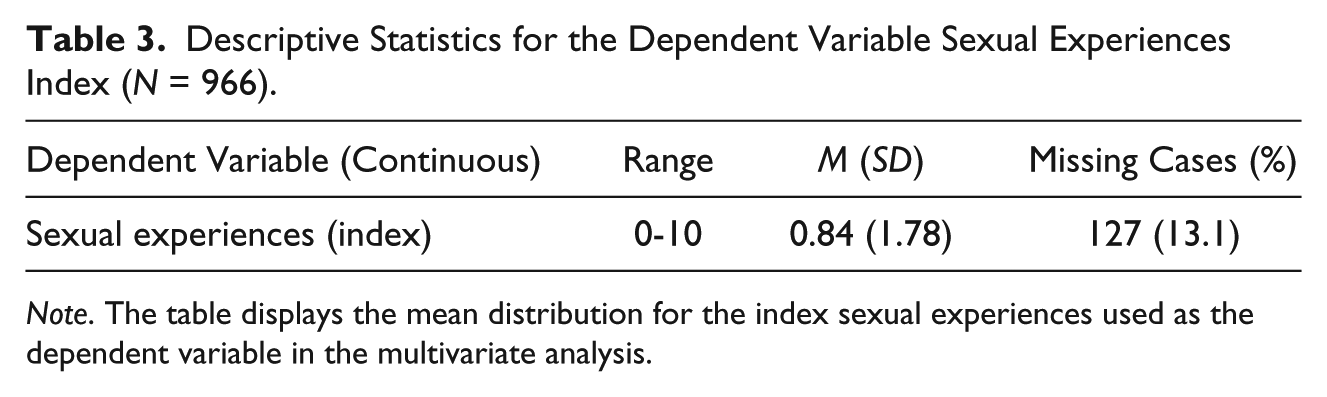
Note. The table displays the mean distribution for the index sexual experiences used as the dependent variable in the multivariate analysis.
In addition, Table A1 in the appendix displays the frequencies across the 10 items of the sex experiences questionnaire before the sexual violence index was computed for the multivariate analysis. It is particularly relevant to notice that 1.1% of the men and 7.2% of the women in the sample experienced forced penetration during their lifetime, with differences statistically significant (with χ2 = 14.3, p < .001). Similarly, 5.2% of the men and 11.2% of the women experienced unwanted sexual intercourse while intoxicated (with χ2 = 8.1, p < .01). In addition, Table A2 reports on the students who experienced at least one incident of sexual violence in their lifetime. More than one fourth of all students (28.0% of students in the sample) reported at least one experience of sexual violence during their lifetime. Among men, 10.5% reported at least one experience of sexual violence. Rates of victimization were much higher among women, with 34.9% reporting at least one incident of sexual violence during their lifetime. Differences in rates of victimization between men and women in the sample are statistically significant, with chi-square test = 55.924, df = 10, and p < .001.
A parsimonious linear regression model was used to explore the association between sexual violence and demographic characteristics (gender identity, race, ethnicity, socioeconomic status, controlling for age).
Table 4 summarizes the findings of the regression analysis.
Multivariate Regression Analysis—Ordinary Least Square Regression Models (N = 966).

Note. The dependent variable in the analysis is participants’ experiences of sexual violence. Degrees of freedom show that missing cases for the regression models are consistently 229 (23.7% of the total sample of 966).
Probability value significance levels are indicated as *p ≤ .05. **p ≤ .01. ***p ≤ .001.
The findings from the linear regression analysis indicate that in Model 1, where only demographic characteristics are included, the independent variable gender identity and the control variable age are the only variables significantly associated with the outcome sexual violence. Gender identity (female) and age (being older) are both statistically significant with p < .001. The diagnostics for Model 1 indicate that the regression explains roughly 7.6% of the variance. As the number of regressors is very small (with only three independent variables and one control variable) both the R test and the R2 tend to be very low. This seems logical as the R2 value is influenced by both the number of variables in the model and the statistical significance of each variable. However, the fitness test (model F test) indicates that the regression is statistically significant with p < .001 and the model is a better fit than an intercept-only model.
Model 2 includes all the variables used for Model 1 plus the interaction term gender identity × race. The purpose of the interaction term is to explore whether either female participants or male participants in either non-White or White racial groups are more/less likely to experience sexual violence. However, the analysis shows that being female is the single most important factor in the regression analysis, and female students of any racial affiliation tend to experience higher rates of sexual violence than their male peers. The interaction term is not statistically significant in Model 2. In Model 3, where the interaction term gender identity × ethnicity is added, only the control variable age is statistically significant (p < .001). Similarly, in Model 4, where the interaction term gender identity × socioeconomic status is added, none of the independent variables in the analysis is statistically significant and the control variable age is statistically significant (p < .001). The multivariate analysis suggests that gender identity (being a female student) is the most important factor in the analysis, controlling for age. The control variable age indicates that older students are more likely to report sexual violence victimization. Because sexual violence experiences were explored within the lifetime framework, the results of the analysis are intuitive. This is also the reason why age was included in the analysis as a control variable.
Discussion and Suggestions for Future Research
Numerous studies on the issue of sexual violence among college students have been published during the last four decades. These studies primarily focus on female students attending residential colleges and universities (Cantor et al., 2015; Koss, 1988; Krebs et al., 2011; Rennison & Addington, 2014), despite the evidence that the vast majority of all U.S. college and university students attend nonresidential programs (Horn et al., 2006; NCES, 2015). In addition, these studies only marginally discuss the role of demographic characteristics, such as gender identity, sexual orientation, race, ethnicity, and socioeconomic status, failing to explore the effect that campus diversity might have on students’ exposure to sexual violence.
This study explored the research question: Do demographic factors, such as gender identity, race, ethnicity, age, and socioeconomic status (considered independently, jointly, or in interaction with one another) increase or decrease student victimization? The study used data collected from a cluster random sample of 966 students at a midsize nonresidential urban university in the Midwest region of the United States. The empirical models employed for the analysis used the methodological powers of theories of intersectionality to develop an intercategorical approach (Crenshaw, 1991; McCall, 2005; Sokoloff & Dupont, 2005).
Rates of victimization in the sample were comparable with those of other studies that used similar definitions of sexual violence and explored sexual violence victimization using a lifetime recall (Cantor et al., 2015; Gidycz et al., 1995). This might suggest that living outside campus can be as dangerous as living on campus for many students attending colleges and universities. Overall, 28% of the students reported experiencing at least one of the incidents of sexual violence included in the questionnaire. Rates were much higher for women (34.9%) than for men (10.5%).
The empirical powers of theories of intersectionality suggested to include demographic variables, such as gender identity, race, ethnicity, and socioeconomic status, considered jointly (in clusters) and in interaction with one another. Sexual violence experiences in the study were measured from a lifetime perspective. For this reason, the variable age was included as a control variable. Four clustered models were designed for the empirical analysis with each cluster representing a different set of variables (demographics and interaction terms). Using a multivariate regression, the analysis of clusters revealed that although demographics significantly contributed to the explanation of the variance, interaction terms were not statistically significant in the analysis. The results of the empirical analysis indicate that being female is the only statistically significant factor in the analysis of students’ sexual violence victimization, when controlling for age, supporting more traditional theories of intersectionality (Zach, 2005, as cited in Nash, 2008).
The variable age indicates that older students were also more likely to report lifetime experiences with sexual violence. This might seem intuitive. However, as the average age in the sample was 25 years, this study’s findings reveal the gut-wrenching reality that many U.S. students, especially female students, tend to experience sexual violence very early in life. Because these findings are consistent with research that focuses on women in general (military, college and noncollege women; Rennison & Addington, 2014; Skinner et al., 2000), it is important to identify early intervention programs that focus on sex education, violence awareness, and self-defense.
Although this study uses data from only one location, limiting the analysis to self-reports of students attending the same university, it provides evidence of sexual assault experiences among students attending a nonresidential campus, a missing link in the current body of literature on student sexual violence victimization. This is certainly a strength of this study, but research is needed to directly compare students attending residential campuses and students attending nonresidential/commuter campuses.
This study presents several limitations. First, due to a low number of responses, the variable sexual orientation was not included in the analysis. This is especially limiting in a study that draws upon the intersectionality theoretical framework to explore the influence of demographics on students’ experiences of sexual violence. Similarly, due to the limited sample size, several racial categories had to be combined into a unique group of racial minorities (non-White), and the category “other” for the gender identity variable was eliminated. These empirical difficulties in the analysis of demographics weakened our study and should serve us as a reminder that it might be appropriate to oversample gender, sexual, and racial minorities in studies of sexual violence, a suggestion also presented by Kalof and collaborators in an earlier study conducted at a large residential university (Kalof et al., 2001).
No question on disability was included in the original survey employed for the data collection; consequently, an investigation on the association between student disability and victimization could not be considered. This oversight certainly weakened the study’s ability to represent all students and discuss the evidence that certain demographic characteristics and personal experiences increase students’ exposure to sexual violence. This limitation suggests that future studies need to consider the importance of disabilities in association with sexual violence victimization among college students.
Future studies need to continue investigating how students’ sociocultural background contributes to their victimizations. Social environments where a rape culture is accepted among young people with girls and women becoming objectified for their sexuality might be more likely to produce sexual victimization. Questions that focus on views of women’s expressions and behaviors are necessary to measure the extent to which young women become “objectified” because of their sexuality. In addition, questions about gender roles would help measure expectations for women’s integration in society as a more general form of sexism. Refining investigations into the cultural backgrounds of students who experienced sexual violence might allow us to provide evidence that antidiscrimination laws and prevention programs must fully address issues of diversity in association with sexual violence victimization. Although the implementation of prevention and intervention programs on campus is a relatively recent phenomenon, we also need to investigate whether these programs are helpful to all students and whether they can provide students with the necessary support based also on their cultural background/personal experiences. At the same time, there is hope that more research evidence will help refine current policies to make them more inclusive and address the needs of students from the most disadvantaged backgrounds.
Footnotes
Appendix
Acknowledgements
The author is grateful to the following students and faculty who provided invaluable support and help throughout the data collection: Dr. Tanice Foltz, Dr. Barbara Peat, and all eight research assistants of the Student Victimization Team, especially Larissa Dragu, Arnettra Baker, Tim Callaway, and Amanda Marie Board.
Declaration of Conflicting Interests
The author(s) declared no potential conflicts of interest with respect to the research, authorship, and/or publication of this article.
Funding
The author(s) disclosed receipt of the following financial support for the research, authorship, and/or publication of this article: A small research grant sponsored by Indiana University Northwest funded the data collection.
