




Abstract
Although dating violence is prevalent among college students, little is known about how both attachment style and participation in risky behaviors contribute to this pattern of violence. To address this literature gap, we examine the role of poor parenting, child abuse, attachment style, and risky sexual and drug use behaviors on dating violence perpetration among 1,432 college students (51% female). Path analysis results revealed that females were more likely to report greater attachment anxiety but lower attachment avoidance compared with males. Correlates of attachment anxiety included child physical abuse, witnessing parental violence, and poorer maternal relationship quality whereas attachment avoidant behavior was linked to more physical abuse and poorer maternal relationship quality. Females were more likely to perpetrate dating violence as were those with greater attachment anxiety and lower attachment avoidance. Other correlates of dating violence perpetration included sexual and drug risk behaviors. Finally, distal factors (i.e., more child physical abuse and poorer maternal relationship quality) also were associated with dating violence perpetration. Study implications are also discussed.
Introduction
Dating violence is widespread in college student dating relationships, and it can include physical or sexual violence, threats of violence, and psychological aggression (Barnett, Miller-Perrin, & Perrin, 2005). It is estimated that more than one third of U.S. college students report dating violence (Stappenbeck & Fromme, 2010), and dating violence perpetration was found to range from 17% to 45% in a 17-country study of 33 universities (Straus, 2004). Dating violence has numerous negative outcomes including poor mental health (DeMaris & Kaukinen, 2005), re-victimization (Gómez, 2011), and problematic drug use (Exner-Cortens, Eckenrode, & Rothman, 2013).
Correlates of dating violence include those associated with adverse childhood experiences (Dube et al., 2001), such as child physical and/or sexual abuse (Foshee, Benefield, Ennett, Bauman, & Suchindran, 2004; Herrenkohl et al., 2004), witnessing family violence/aggression (Jouriles, McDonald, Mueller, & Grych, 2012), and having poor relationship quality with one’s mother (Cleveland, Herrera, & Stuewig, 2003). In addition, several problem behaviors such as heavy drinking (Stappenbeck & Fromme, 2010), drug use (McNaughton Reyes, Foshee, Bauer, & Ennett, 2012), sexual risk taking (Alleyne, Coleman-Cowger, Crown, Gibbons, & Vines, 2011; Schiff & Zeira, 2005), and attachment anxiety (Lee, Reese-Weber, & Kahn, 2014) have been found to be both directly associated with dating violence and mediating mechanisms through which family factors are linked to dating violence (Madan Morris, Murg, & Windle, 2015).
Although prior studies have examined many of these correlates individually, research has not looked at these risk factors simultaneously. Relatedly, the majority of the literature does not examine both attachment style and risk-taking behaviors. As such, a more complete understanding of these risk factors and their association with dating violence perpetration is needed. To address these literature gaps, we use path analysis to examine the role of poor parenting, child abuse, attachment style, and risky sexual and drug use behaviors on dating violence perpetration among U.S. college students.
Correlates of Dating Violence
Although some college students engage in numerous risky behaviors, alcohol use and its relationship with dating violence has been studied most frequently (Shorey, Stuart, & Cornelius, 2011; Tyler, Schmitz, Ray, & Simons, 2017) while drug use and risky sexual behavior (Gover, Kaukinen, & Fox, 2008; Sutton & Simons, 2015) have been studied to a lesser extent. All three risk-taking behaviors, however, have been shown to be associated with dating violence perpetration (Foran & O’Leary, 2008; Nabors, 2010; Shorey et al., 2011; Tyler et al., 2017). Much of the literature examining alcohol use and dating violence focuses on the relationship between alcohol and aggression, as well as alcohol’s effect on the quality of relationships (Foran & O’Leary, 2008; Shorey et al., 2011). However, these perspectives do not consider a possible mechanism for heavy drinking. Attachment literature and risk-taking literature posit that less secure attachment styles and negative or abusive early family experiences are associated with risk-taking behaviors (Golder, Gillmore, Spieker, & Morrison, 2005; Oshri, Sutton, Clay-Warner, & Miller, 2015; Young, 2013), especially heavy drinking (Clark, De Bellis, Lynch, Cornelius, & Martin, 2003; Kilpatrick et al., 2003). For example, greater familial conflict is associated with an increase in risk-taking behaviors (Feldstein & Miller, 2006; Igra & Irwin, 1996). In addition, parent–child relationships marked by emotional distance, non-responsiveness, and greater conflict are associated with more risk-taking behaviors (Baumrind, 1991; Huebner & Howell, 2003). Conversely, research shows that positive mother–child relationships are associated with lower rates of dating violence perpetration (Cleveland et al., 2003).
Research also shows that individuals with secure attachment have relationships of higher quality in adulthood than those with insecure attachment (Lee et al., 2014). Those with insecure attachment styles often have more difficulty managing conflict with their dating partners (Creasey & Hesson-McInnis, 2001; Lee et al., 2014) and have more negative experiences during separation from their partners (Fraley & Shaver, 1998). Anxious attachment is an especially important correlate of dating violence, with many studies showing a positive association between the two (Bookwala & Zdaniuk, 1998; Lee et al., 2014; Rapoza & Baker, 2008). In terms of attachment avoidance, however, studies show mixed results. Some studies have found a positive association between attachment avoidance and dating violence, especially when the attachment styles of dating partners are mismatched (Doumas, Pearson, Elgin, & McKinley, 2008), while other studies have found no association (Bookwala & Zdaniuk, 1998; Rapoza & Baker, 2008) or a negative association (Lee et al., 2014).
Theoretical Frameworks—Potential Modes of Intergenerational Transmission
Various theoretical perspectives including social learning theory, the background situational model of dating violence, and the antisocial orientation perspective have been used to understand how family violence is linked to young adult relationship violence. Social learning theory holds that violence directed at others is learned from one’s social environment through the process of observational learning (Bandura, 1977). Children exposed to violence in their family may later imitate the behavior they have observed, especially if they witness its positive outcomes (e.g., compliance). Gelles (1997) argued that children who grow up in violent homes learn the techniques of being violent and the justifications for this behavior. Owens and Straus (1975) also hold that children exposed to interpersonal violence at a young age, either as victims or perpetrators, report greater approval of interpersonal violence as adults. Moreover, early exposure to distinctive types of family violence and abuse are related to the development of unique forms of aggression in later life (Bevan & Higgins, 2002; Straus, Douglas, & Medeiros, 2013).
Similarly, the background situational model of dating violence suggests that those who are more accepting of dating aggression are more likely to engage in dating violence perpetration (Foshee, Bauman, & Linder, 1999; McNaughton Reyes, Foshee, Niolon, Reidy, & Hall, 2016). This level of acceptance is not only restricted to exposure to violence within the home but may also be a result of being a victim of interpersonal violence as a child (Owens & Straus, 1975). As such, witnessing parental violence may lead children to view aggression as a normative aspect of relationships, and increase their tolerance for it and likelihood of using it to establish compliance (Foshee et al., 1999). Previous work supports this notion of intergenerational violence, or the creation of expectations or norms related to interpersonal relationships based on experiences in childhood (Straus & Gelles, 1990). Research finds that experiencing child abuse or neglect is associated with perpetration (Widom, Czaja, & Dutton, 2014) within intimate relationships, and this normalization of violence is linked to experiencing violence in future dating relationships (McNaughton Reyes et al., 2016).
In addition, the antisocial orientation perspective (L. G. Simons, Burt, & Simons, 2008; R. L. Simons, Lin, & Gordon, 1998) suggests that children exposed to poor parenting, such as physical abuse, are at greater risk for dating violence through delinquent behavior and substance use. Therefore, a general pattern of antisocial behavior is passed from parents to their children, and because the children’s antisocial tendencies persist throughout the life span, this affects the probability that they will engage in dating violence. Others have also found support for this model in that maltreated children are likely to demonstrate antisocial behavior and violence as adults (Park, Smith, & Ireland, 2012). Based on an antisocial orientation perspective, it is also important to consider risk-taking behaviors when examining the association between child abuse and dating violence perpetration (L. G. Simons et al., 2008).
Attachment Theory and Dating Violence
In addition to the intergenerational transmission modes of violence discussed above, attachment theory is also useful for understanding early relationships with parents and its link to dating violence. Attachment theory posits that the parent–child relationship gives the child a framework for interacting with others. This framework persists into adolescence and adulthood, where it affects the expectations of dating relationships (Hazan & Shaver, 1987). Children who experienced nurturing care while growing up learn a model of interpersonal relationships and a positive model of the self that views themselves and others as worthy of love and affection (Bartholomew & Horowitz, 1991; Bowlby, 1988; Lee et al., 2014). These individuals would be deemed as having “secure” attachment. Conversely, children who experience harsh parenting or child abuse while growing up develop relationships that are hostile and distrusting, in addition to developing a negative self-concept of oneself and of others (Bartholomew & Horowitz, 1991; L. G. Simons et al., 2008). In much of the literature, this is referred to as insecure attachment, which is split into two categories: anxious and avoidant (Brennan, Clark, & Shaver, 1998; Fraley & Waller, 1998). Individuals who have higher levels of attachment anxiety are afraid of being abandoned, rejected, or unloved by their romantic partners and they worry about the personal availability of their dating partners (Brennan et al., 1998; Fraley & Waller, 1998; Lee et al., 2014). On the contrary, attachment avoidance holds that certain individuals are uncomfortable when a partner is too attached or too close to them, or when they feel that they depend too much on their partner. Attachment avoidance is characterized by one distancing themselves from others or concealing strong feelings out of worry associated with being too close to other people, especially their dating partners (Brennan et al., 1998; Fraley & Waller, 1998; Lee et al., 2014). Based on these theories, we examine the role of poor parenting, child abuse, attachment style, and risky sexual and drug use behaviors on dating violence perpetration among U.S. college students.
Hypotheses
Based on the above theoretical perspectives, we hypothesized the following:
We also include respondents’ gender as many of the hypothesized relationships are expected to vary for males and females, with females being more likely to perpetrate dating violence than males (Gover et al., 2008; Luthra & Gidycz, 2006).
Method
Study Site and Participants
Data were gathered in the 2013-2014 academic year at two large public universities in the United States, one in the Midwest and one in the Southeast. Both universities are public land-grant institutions with undergraduate enrollment ranging from 20,000 to 25,000 students. Racial composition at both locations was approximately 80% White. The combined sample consisted of 1,482 undergraduate college students, including 778 (52.5%) from the Southeast and 704 (47.5%) from the Midwest. The sample was split between males (48.8%) and females (51.2%). The majority of respondents were White (80%), followed by Black/African American (7.3%), Hispanic or Latino (3.6%), Asian (6.6%), and 2.4% identified their race as “other.”
Procedure
Undergraduate students enrolled in social science courses completed a paper and pencil survey of attitudes and experiences about dating, sexuality, and substance use. Every student was eligible to participate. Students were informed that their participation was voluntary and their responses were anonymous. They had the option of filling out the survey for course credit. If they did not wish to complete the survey, they were given another option. Students were told that if they chose not to fill out the survey or do the alternative extra credit assignment, it would not affect their course grade. Approximately 98% of all students in attendance across both institutions completed the survey while the remaining students opted for the alternative assignment. The institutional review board at both institutions approved this study for their respective location.
Measures
Dependent variable
Dating violence perpetration (adapted from Straus, Hamby, Boney-McCoy, & Sugarman, 1996) included five items from the Revised Conflict Tactics Scale (CTS2), which asked respondents, “During the past 12 months, how many times have you done each of the following to a current or former partner”: (a) threw something that could hurt, (b) kicked your partner, (c) punched or hit your partner with something that could hurt, (d) choked your partner, and (e) insulted or swore at your partner (0 = never to 4 = more than 10 times). All items loaded on a single factor (α = .65). Due to skewness, this variable was dichotomized (0 = never; 1 = at least once).
Independent variables
Child physical abuse included four items adapted from the Parent–Child Conflict Tactics Scale (PC-CTS; Straus, Hamby, Finkelhor, Moore, & Runyan, 1998). Respondents were asked, for example, whether a parent/caregiver had ever shoved or grabbed them in anger (0 = never to 4 = frequently or always). Items were summed and then the variable was logged (due to skewness), whereby a higher score indicates more physical abuse (α = .82).
Witnessing parental violence was measured using questions that asked whether one parent or caregiver did any of the following toward another parent or caregiver: (a) pushing, shoving, or grabbing; (b) throwing an object at the other person in anger; (c) threaten to hit the other person; and (d) hitting or punching the other person using their hand, fist, or another object. Due to skewness, this variable was dichotomized (0 = never; 1 = at least once).
Maternal relationship quality included six items that asked respondents what their relationship with their mother was like when they were growing up at home. For example, how often did your mother/female caregiver “listen carefully to your point of view” and “criticize you or your ideas” (1 = always to 5 = never). Certain items were reverse coded and then a mean scale was created such that a higher score indicates a more positive relationship with their mother (α = .80).
Attachment anxiety was measured using four items from the Experiences in Close Relationships–Revised Questionnaire (Fraley, Waller, & Brennan, 2000) such as “I worry that romantic partners won’t care about me as much as I care about them” and “I worry about being abandoned or rejected by my partner” (1 = strongly disagree to 5 = strongly agree). A mean scale was created such that a higher score indicates more attachment anxiety (α = .82).
Attachment avoidance was assessed using four items (adapted from Fraley et al., 2000) such as “I don’t like showing a partner how I feel deep down” and “I avoid sharing personal feelings with romantic partners” (1 = strongly disagree to 5 = strongly agree). A mean scale was created such that a higher score indicates more attachment avoidance (α = .84).
Heavy drinking included two items (adapted from Testa, Livingston, & Leonard, 2003), which asked respondents, “During the past 12 months, ‘how many times have you gotten drunk on alcohol’ and ‘how many times have you consumed five or more (if you’re a man)/four or more (if you’re a woman) drinks in a single sitting’” (0 = never to 5 = 5 or more days per week). The two items were averaged such that a higher score indicates more frequent heavy drinking (Testa et al., 2003). The correlation between the two items was .87.
Sexual risk behavior included three items, which asked (a) how old they were the first time they had sexual intercourse (1 = less than 14 years old to 5 = never experienced sexual intercourse); (b) the number of people they have had sexual intercourse with (vaginal or anal penetration; 1 = none to 5 = 10 or more); and (c) how often they use condoms during sexual intercourse (1 = always to 3 = never, 4 = never had sexual intercourse). Item 1 was recoded such that a higher score indicates earlier sexual initiation. In addition, respondents who reported never having sex for Item 3 were coded as “1.” The three items were standardized and then a mean scale was created where a higher score indicates riskier sexual behavior (α = .71).
Drug risk behavior included two items, which asked respondents how often they ever smoked marijuana and how often they ever used prescription drugs (e.g., Adderall) that were not prescribed for them or used them in a way other than how the doctor prescribed their use (0 = never to 4 = more than 10 times). A mean scale was created where a higher score indicates more frequent lifetime drug risk behavior. The correlation between the two items was .65.
Gender was self-reported and was coded as 0 = male and 1 = female.
Data analytic strategy
We ran bivariate correlations for all study variables (see Table 1). Next, we estimated a fully recursive path model using the maximum likelihood estimator in Mplus 7.4 (Muthén & Muthén, 2017) to simultaneously examine the pathways to dating violence perpetration. We report standardized beta coefficients (β), and the model controls for campus location. Fifty cases (3.4%) were dropped due to missing data on the study variables. Thus, the sample size for our final analyses included 1,432 cases.
Bivariate Correlations for All Study Variables.
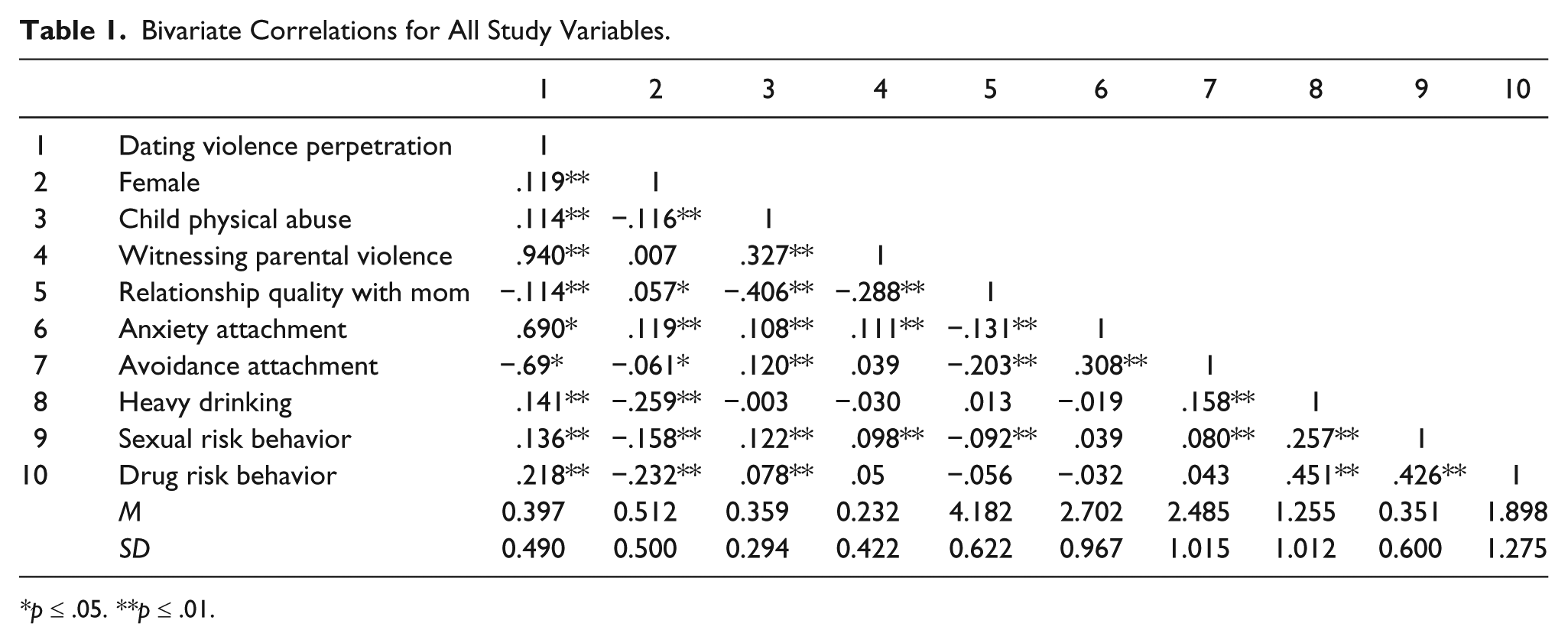
p ≤ .05. **p ≤ .01.
Results
Although not the focus of this article, the path model controls for campus location, and we report all significant differences (see Table 2). Results for the path analysis (only significant paths given) shown in Figure 1 revealed that females were significantly more likely to report greater attachment anxiety (β = .12; p < .01) compared with males. Those who experienced more child physical abuse (β = .07; p < .05), those who witnessed parental violence (β = .07; p < .05), and those with poorer maternal relationship quality (β = –.08; p < .01) were more likely to report greater attachment anxiety. Females reported lower attachment avoidance (β = –.05; p < .05) compared with males while those who experienced more physical abuse (β = .06; p < .05) and poorer maternal relationship quality (β =–.18; p < .01) also reported higher attachment avoidance.
Full Model Results for Dating Violence Perpetration.

Note. Standardized coefficients shown.
Higher risk for students at the Midwest campus compared with the Southeast campus for dating violence perpetration.
Higher risk for students at the Southeast campus compared with the Midwest campus for dating violence perpetration.
p ≤ .05. **p ≤ .01.
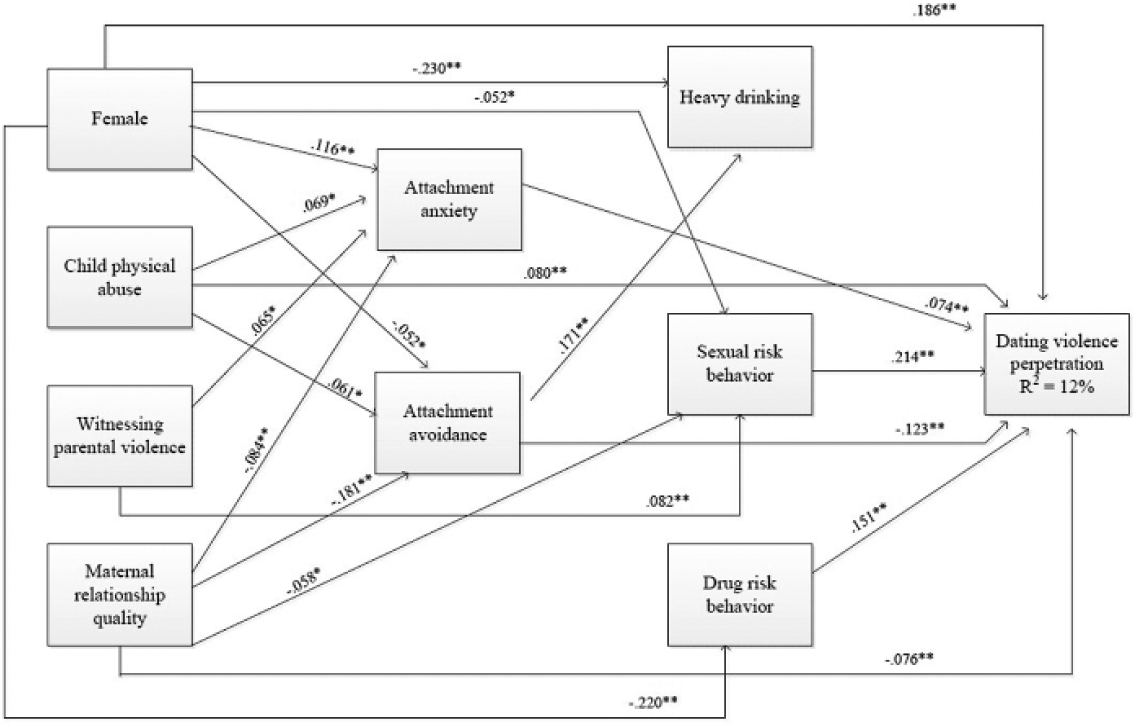
Correlates of dating violence perpetration (only significant paths shown).
Males (β = –.23; p < .01) and those with higher attachment avoidance (β = .17; p < .01) were more likely to report heavy drinking. In addition, females reported lower rates of risky sexual behavior (β = –.05; p < .05) compared with males whereas those who witnessed parental violence (β = .08; p < .01) and those who had a poorer maternal relationship quality while growing up (β = –.06; p < .05) were more likely to engage in more sexual risk behavior. In terms of drug use, females engaged in significantly less drug use compared with males (β = –.22; p < .01).
Regarding dating violence perpetration, females were significantly more likely to perpetrate dating violence compared with their male counterparts (β = .19; p < .01). In addition, those with greater attachment anxiety (β = .07; p < .01) were more likely to perpetrate dating violence as were those with lower attachment avoidance (β = –.12; p < .01). Moreover, those who participated in more sexual risk behavior (β = .21; p < .01) and more drug risk behavior (β = .15; p < .01) were also more likely to perpetrate dating violence. Finally, those who experienced more child physical abuse (β = .08; p < .01) and those who had poorer maternal relationship quality (β = –.08; p < .01) were also more likely to perpetrate dating violence. The model explained 12% of the variance in dating violence perpetration.
Indirect Effects
The indirect effect results (see Table 2) revealed that two variables including gender and witnessing parental violence had a significant indirect effect on dating violence perpetration. Specifically, females who have higher levels of attachment anxiety were more likely to perpetrate dating violence. In addition, males who engaged in more drug risk behavior were more likely to perpetrate dating violence. Finally, those students who witnessed family violence engaged in more sexual risk behavior and were more likely to perpetrate dating violence.
Discussion
Our findings from the first part of our model are generally consistent with attachment theory (Bowlby, 1988) such that poor parenting and insecure attachment early in life lead to avoidant and anxious attachment styles, which subsequently affects relationships with dating partners. Our model also supports a social learning interpretation (Bandura, 1977) such that children who grow up in violent homes learn the techniques of being violent and continue to model this behavior in future dating relationships. In addition, children who witness parental violence and have poorer maternal relationship quality are at greater risk for dating violence perpetration through drug use and sexual risk-taking behaviors. Therefore, a general pattern of antisocial behavior is passed from parents to their children and because the children’s antisocial tendencies persist throughout the life span, this affects the probability that they will engage in dating violence (L. G. Simons et al., 2008; R. L. Simons et al., 1998).
The purpose of our study was to investigate the role of poor parenting, child abuse, attachment style, and risky sexual and drug use behaviors with dating violence perpetration among male and female college students. We find that child physical abuse, witnessing parental violence, and having poorer maternal relationship quality while growing up are associated with attachment anxiety whereas attachment avoidant behavior was linked to more physical abuse and poorer maternal relationship quality. Females were more likely to perpetrate dating violence as were those with greater attachment anxiety and lower attachment avoidance. Other correlates of dating violence perpetration included more sexual and drug risk behaviors. Overall, experiencing more child physical abuse and having poorer maternal relationship quality while growing up continue to impact dating violence perpetration among young people attending college.
Consistent with previous research (Bowlby, 1988; Lee et al., 2014; L. G. Simons et al., 2008) and in line with our first hypothesis, poor parenting, including more child physical abuse, witnessing parental violence, and poorer maternal relationship quality were all associated with attachment anxiety (insecure attachment). Those who grow up with insecure attachment to their parents tend to worry more about being abandoned, rejected, or unloved by their romantic partners (Brennan et al., 1998; Fraley & Waller, 1998; Lee et al., 2014) and, thus, are more likely to engage in anxious and avoidant behaviors.
Although past findings reveal that children from families who experienced high levels of family conflict and physical abuse were more likely to engage in substance use (Clark et al., 2003; Kilpatrick et al., 2003), we did not find support for either relationship. One possible explanation for this might be due to the fact that a large proportion of college students already engage in heavy drinking and drug risk behavior (Johnston, O’Malley, Bachman, Schulenberg, & Miech, 2016); thus, there is little variance. We did, however, find an association between witnessing parental violence and poorer maternal relationship quality with sexual risk behavior. This finding is consistent with previous studies (Baumrind, 1991; Huebner & Howell, 2003) such that children who grow up with poorer maternal relationship quality (e.g., a mother who is emotionally distant and non-responsive) may be less likely to communicate with parents and thus have fewer conversations about sexual activity. As a result, these individuals are at greater risk of engaging in more sexual risk behaviors as young adults.
Consistent with our third hypothesis and past research (Lee et al., 2014; L. G. Simons et al., 2008; Widom et al., 2014), child physical abuse was positively associated with dating violence perpetration. Those who were victims of violence growing up may later imitate the behavior as they have learned justifications for it (Gelles, 1997). This early exposure to family abuse has also been linked to the development of unique forms of aggression in later life (Bevan & Higgins, 2002; Straus et al., 2013) including dating violence perpetration (Lee et al., 2014). Also consistent with Hypothesis 3, we find a significant relationship between maternal relationship quality and dating violence perpetration. Those students who had a strong relationship with their mother while growing up are less likely to be perpetrators of dating violence. This finding supports prior research that shows maternal relationship quality has a protective effect against dating violence (Cleveland et al., 2003). Possible explanations for this effect could be an improved understanding of appropriate and inappropriate dating behavior as a result of improved communication between parent and child.
Contrary to our fourth hypothesis and past findings (Golder et al., 2005; Young, 2013), we did not find a significant relationship between either attachment anxiety or attachment avoidance and risky behaviors, with one exception: attachment avoidance was positively associated with heavy drinking. One possible explanation for the lack of support for this hypothesis could be a result of the high percentage of college students who partake in risky behaviors. Moreover, the highest risk for drinking is generally found among those in young adulthood (Schulenberg et al., 2017), which is consistent with the age of college students. Thus, the combination of both the age of college students and the college environment likely increases the risk for engaging in risk laden behaviors. In terms of the significant relationship between attachment avoidance and heavy drinking, it is possible that those with avoidant attachment styles use alcohol to alleviate their discomfort with forming close relationships, either by relying on alcohol as a social lubricant or to distance themselves from social experiences.
In line with Hypothesis 5 and consistent with prior research (Lee et al., 2014), we find a negative relationship between attachment avoidance and dating violence perpetration. One possible explanation is that, because these individuals do not feel very close with their dating partners in the first place, they may be more likely to break off their relationships before conflicts arise, or may not be emotionally connected to their relationships enough to experience hostility toward their partner.
Consistent with our fifth hypothesis, attachment anxiety was positively correlated with dating violence perpetration, suggesting that those who have an anxious attachment style may resort to violent tactics to prevent “losing” their partners to other individuals and activities. Because those with anxious attachment styles fear being unloved or rejected, perceived loss in their partner’s availability could trigger acts of dating violence perpetration.
Our final hypothesis was partially supported such that those who engage in more sexual and drug risk behaviors are more likely to use violence against a dating partner, which is consistent with prior research (L. G. Simons et al., 2008; Tyler et al., 2017). This finding provides support for the antisocial orientation perspective, which holds that risky behaviors are a component of a larger repertoire of antisocial behaviors. Moreover, parents who perpetrate violence against one another and have poorer relationship quality with their offspring are at greater risk of passing down this general pattern of antisocial behavior to their children (L. G. Simons et al., 2008). In addition, because antisocial tendencies persist throughout the life span, this increases the chances that their offspring will engage in dating violence.
Limitations
This study is not without limitations. First, all of the information comes from self-reports, which leaves the potential for underreporting or misreporting due to the sensitive nature of the questions or the reference periods used. Second, all data come from the same time period, so we cannot make inferences about causal ordering with regard to risk behaviors and dating violence experiences. Third, heavy drinking was assessed within the past 12 months whereas sexual risk behavior and drug risk behavior included lifetime measures, which may account for the lack of a significant relationship between heavy drinking and dating violence. Finally, because students were not randomly selected, we cannot generalize our findings to all undergraduate students enrolled in social science courses in the Midwest and Southeast.
Conclusion
Notwithstanding, our article makes several meaningful contributions to the literature. First, we simultaneously included measures of both attachment and problem behaviors as previous research has generally examined them separately. Thus, the current results provide a more comprehensive understanding of risk factors for dating violence perpetration. Second, we included several adverse childhood experiences in our model, which enabled us to examine dating violence from multiple frameworks simultaneously without relying on a single theoretical explanation of dating violence perpetration. Third, we find that childhood experiences including child physical abuse, poorer maternal relationship quality, and witnessing parental violence continue to directly and/or indirectly impact these young people in their current dating relationships. Moreover, these early adverse experiences in the home set the stage for subsequent negative attachment styles, which also influence young adults in current dating relationships. Despite these negative risks for dating violence, we also find that those who reported higher maternal relationship quality while growing up are less likely to perpetrate dating violence. Thus, strong supportive ties not only with family members but with other social network members (e.g., peers, classmates, colleagues) may serve as a protective factor and be one additional component for preventing dating violence.
The current findings reiterate the importance of examining adverse childhood experiences when investigating dating violence perpetration. Future dating violence prevention programs may emphasize the importance of recognizing both secure and insecure attachment styles as a way of avoiding dating violence. Moreover, it may be beneficial for dating violence prevention programs to work toward introducing a more secure model of attachment that emphasizes a positive self-concept of oneself and of others as research has previously found that children who experience poor attachment (e.g., harsh parenting or child abuse) while growing up develop a negative self-concept of oneself and of others (Bartholomew & Horowitz, 1991; L. G. Simons et al., 2008), which increases the risk for dating violence. Practitioners should also take attachment into account when working with populations at-risk for dating violence perpetration, such as those in the 18 to 25 year old age range, as well as those who have previously perpetrated dating violence. By engaging in therapeutic work to introduce a more positive, secure model of adult attachment, practitioners may be able to prevent or significantly reduce further acts of dating violence. Although the current study focuses on college students, it may be beneficial for prevention programs to begin at an earlier age, such as in early adolescence (12-14 years of age), especially to reduce the risk of problem behaviors associated with dating violence perpetration. Finally, programs that seek to prevent dating violence should emphasize more open communication between parents and their children. This is especially relevant given that current study findings show that those who have a more positive maternal relationship are less likely to perpetrate dating violence.
Footnotes
Declaration of Conflicting Interests
The author(s) declared no potential conflicts of interest with respect to the research, authorship, and/or publication of this article.
Funding
The author(s) received no financial support for the research, authorship, and/or publication of this article.