




Abstract
Much of the literature on rape, victim blaming, and rape myth acceptance is focused on the United States, and there is a general dearth of such scholarly activity in other countries. This article offers insights on university students’ perspectives in two new country contexts—India and the United Kingdom. A total of 693 students contributed to the data collection for this study. Rape myth acceptance was fairly low for both countries, however, students in India were more likely to endorse rape myths. Several demographic characteristics were significant for rape myth acceptance in each country. This study makes an important contribution to the extant literature to address paucity of knowledge and promote understandings to help develop country-specific and appropriate policy, practice, and education and awareness programs. In particular, the study provides novel comparative findings on rape myth acceptance in new country contexts to help advance academic thinking in this area of work.
Keywords
Introduction
Annual reported incidents involving female victims of rape in India, during 2016, stand at 38,947—an increase of 56% since the 2012 high-profile and brutal rape and murder case of “Nirbhaya” in Delhi (Dutta & Sircar, 2013; National Crime Records Bureau, 2017). In the United Kingdom, the number of police recorded rapes, between October 2016 and September 2017, amounted to 48,773 (Office for National Statistics, 2018). While these are the reported annual figures, it has been estimated that only 15% to 20% of the rape incidents are brought to the attention of the police (Barn & Kumari, 2015; Ministry of Justice, 2013). Scholars have pointed to low rates of rape reporting and its association with Rape Myth Acceptance (RMA; Hayes, Lorenz, & Bell, 2013). Scholarly literature on rape also identifies the importance of myths and stereotypes that generate hostility toward rape victims. Such myths and stereotypes are “defined as prejudicial, stereotyped, or false beliefs about rape, rape victims, and rapists” (Burt, 1980, p. 217). Crucially, such widely held false beliefs are said to trivialize, deny, and even justify sexual violence against women (Franiuk, Seefelt, Cepress, & Vandello, 2008; Lonsway & Fitzgerald, 1995).
Research and anecdotal evidence into the crime of rape continues to suggest the persistence, and powerful impact of the existence of rape myths. Such myths may exist at a number of different levels in society from individual beliefs to how systems perceive and respond to victims and perpetrators (Smith & Skinner, 2012; Stern, 2010). In both the United Kingdom and in India, much of the focus of extant literature has been on the criminal justice system and support and provision for the victims (Baxi, 2014; Westmorland & Gangoli, 2012). Within such largely qualitative literature in these countries, there is some evidence of the existence of rape myths that question victim credibility and attribute blame onto the victim (Barn & Kumari, 2015; Ellison & Munro, 2009). Popular rape myths focus on victim’s clothing, alcohol consumption, and so forth, and serve to portray the victim as socially transgressive, personally responsible, promiscuous, and a liar. Similarly, the perpetrators are generally portrayed as belonging to a lower strata of society, as sexually starved, as biologically predisposed to have sex, and as men who are misled by women’s sexual signals (Mehta, 2016).
Some researchers have asserted that rape myths can create cultural norms that may perpetuate sexual violence against women (Burt, 1980). Research carried out in the United States suggests that men are more likely to demonstrate high levels of RMA (Aronowitz, Lambert, & Davidoff, 2012). In the United Kingdom and India, the paucity of academic research has prevented the development of nuanced understandings of rape myths among different sections of the population. Moreover, while there is growing emphasis on education and awareness around sexual consent, particularly among young people, there is a dearth of understanding about the persistence of rape myths among different sections of society (Barn & Kumari, 2015; Coy, Kelly, Elvines, Garner, & Kanyeredzi, 2013).
The colonial history between India and the United Kingdom presents interesting dynamics in which to explore RMA. Although there have been some changes over the last few decades, Indian laws governing sexual assault are deeply embedded in the British colonial legacy of the 1860 Indian Penal Code. And, although sexual violence has emerged into the public discourse of both countries, it is India that is more often conceptualized as an unsafe and dangerous space for women and girls (Durham, 2015; Roychowdhury, 2013). Furthermore, as perceptions of sexual violence and culpability for sexual assault are inherently tied to cultural and gendered norms, there may be differences between the countries. Therefore, the purpose of this study is to examine RMA in the United Kingdom and India. In doing so, the article presents both within- and between-country comparisons to offer an understanding of RMA. Furthermore, we explore whether country-specific cultural factors affect the endorsement of rape myths. The following literature review begins with the United States before moving onto India and the United Kingdom (our two research sites), and helps contextualize contemporary understandings of RMA.
Literature Review
RMA in the United States
The vast majority of the scholarly literature on key characteristics and factors in RMA has emerged in the United States (Bohner, Eyssel, Pina, Siebler, & Viki, 2009; Hayes & Levett, 2010; Lonsway & Fitzgerald, 1995; Payne, Lonsway, & Fitzgerald, 1999). These rape myths serve to attribute culpability to the victim while mitigating culpability for the perpetrator. For example, Carmody and Washington (2001) found that a very small proportion of participants thought that women secretly desire to be raped, yet Aronowitz et al. (2012) found that a substantial portion of college students thought that a woman is partially responsible for becoming a victim of sexual assault if she was intoxicated. With regard to excusing perpetration, McMahon (2010) found the highest overall rape myth endorsement among college students were for perceptions that sometimes rape happens unintentionally (e.g., “rape happens when a guy’s sex drive gets out of control”).
In addition to exploring variation in the types of myths endorsed, much of this research has focused on identifying demographic characteristics associated with RMA. One of the most consistent findings in this body of research is that men endorse rape myths more strongly than women (Lonsway & Fitzgerald, 1994; McMahon, 2010; Suarez & Gadalla, 2010). This is perhaps unsurprising as RMA is related to other prejudicial attitudes such as sexism, racism, and homophobia (K. B. Anderson, Cooper, & Okamura, 1997; Suarez & Gadalla, 2010). As most studies use college student samples, little research has been conducted with regard to age. However, Lonsway and Fitzgerald (1994) suggested that age is an important factor to consider. Whereas K. B. Anderson et al. (1997) suggested that older individuals may endorse more rape myths as they are more likely to hold traditional gender roles, other research suggests that age is negatively related to RMA as individuals’ social networks and life experiences expand (Powers, Leili, Hagman, & Cohn, 2015). This is paralleled in research regarding perceptions of intimate partner and sexual violence as adolescents and younger adults are more likely to hold problematic attitudes compared with college samples (e.g., V. N. Anderson, Simpson-Taylor, & Herrmann, 2004). In a meta-analysis of RMA correlates, Suarez and Gadalla (2010) suggested that minorities may have moderately higher RMA. However, research has not thoroughly explored the mechanisms underlying these differences.
Less often is RMA examined cross-nationally or cross-culturally. The majority of research that has been conducted using an international perspective has concentrated on Asian cultures with a focus on China and Japan. These studies indicate that Asian students may be more likely than White students from the United States/Canada to assign culpability to female victims of sexual assault (Kennedy & Gorzalka, 2002; Lee, Pomeroy, Yoo, & Rheinboldt, 2005; Mori, Bernat, Glenn, Selle, & Zarate, 1995; Vonderhaar & Carmody, 2015). This research often also finds meaningful gender differences in that men are more likely to endorse rape myths (e.g., Xue et al., 2019). Expanding discussion of rape myths to other country contexts not only highlights variation in endorsement that may be related to macro-level structural and cultural factors, but also allows for the exploration of other demographic characteristics (e.g., caste in India) that may affect RMA. Such knowledge can be used to tailor programs aimed at combating rape myths to specific country contexts. For example, many college campus–based sexual violence programs in the United States focus on the role of alcohol in assigning culpability to female victims. However, alcohol and the culture of binge-drinking may not be a salient aspect of college students’ lives in all countries and therefore students may have stronger (or weaker) opinions surrounding those situations. By identifying rape myths that elicit stronger adherence, education and advocacy efforts can more appropriately address these attitudes.
RMA in the United Kingdom and India
There is limited empirical evidence on the prevalence of rape myths surrounding female rape victims in India and the United Kingdom. Two recent studies using samples of students in India find that RMA is rather common (Chudasama et al., 2013; Safri, 2015). For example, Chudasama and colleagues (2013) reported that approximately a quarter of the sample reported rape supportive attitudes (i.e., acceptance of rape myths that view the victim as blameworthy), and both studies report no significant association for sex or residential status on attitudes. However, it is important to note that although informative, these studies are limited to small select samples that may preclude generalizability. Furthermore, both are largely descriptive in nature and therefore meaningful structural and demographic variation in attitudes cannot be ascertained.
In their cross-national study of rape supportive attitudes in four countries, namely, India, Kuwait, Japan, and the United States, Nayak, Byrne, Martin, and Abraham (2003) concluded that students in India, Japan, and Kuwait held more negative views regarding victims of sexual violence compared with students in the United States. Furthermore, they find consistent support for gender differences in attitudes as men in all countries were more likely to endorse problematic attitudes compared with women. Similarly, a recent study involving 637 students from the United States, Japan, and India suggests that Indian students were most likely to endorse rape myths (Stephens et al., 2016). The overarching explanation of these studies is that gender roles, and more restrictive cultural norms found in non-Westernized cultures, may explain these negative attitudes about violence against women. However, due to the nature of these studies (cross-cultural comparison with relatively small samples), they are unable to isolate how these attitudes may differ within each country context. Furthermore, they examined sexual violence attitudes as a unidimensional construct. It is possible that the exploration of different types of rape myths may reveal nuances in these attitudes. The current study builds on this research by employing a larger sample size that allows for multivariate analyses of the unique factors within each country that contribute to rape myth adherence as well as comparing between countries controlling for common correlates. Furthermore, India is compared with a Westernized country with which it shares a historical context (the United Kingdom) and from where many laws governing sexual violence are derived.
Interestingly, in the United Kingdom, with the exception of some limited work into RMA and female victims, there has been a greater recent research focus on male rape than female rape (Abdullah-Khan, 2008; Coxell, King, Mezey & Kell 2000; Coxell & King 2010; Mezey & King, 2000). Moreover, a recent critique of RMA literature argues that definitions of rape myths have failed to acknowledge male victims of serious assault (Maxwell & Scott, 2014). Although this article is focused on female victims of rape, who are in the majority, it is important to acknowledge that men can also be victims of rape, and women may well be perpetrators (Davies, Gilston, & Rogers, 2012). On the whole, the U.K. RMA literature has turned its attention to media portrayals and its impact, as well as engaging with a critique of the RMA methodological framework (Gurnham, 2016; O’Hara, 2012; Reece, 2014).
In her analysis of three rape cases in the United Kingdom and the United States, O’Hara (2012) documented the propensity of mainstream media to perpetuate rape myths that contribute to images of “monster rapists,” “virginal victims,” or “promiscuous women.” In a forensic analysis of 124 newspaper articles related to three rape incidents, the author suggests that the “impact of the attacks on the victims was largely overlooked, which had the effect of trivialising the crime” (O’Hara, 2012, p. 256). Although such literature promotes our understanding of the impact of rape myths in the perpetuation of patriarchal power structures, and the gender justice gap, other recent scholarship has questioned the authority of the RMA literature (Gurnham, 2016; Reece, 2014).
In the last few years, both India and the United Kingdom have witnessed the persistent media reporting of two high-profile rape cases (notably, Nirbhaya and Ched Evans, respectively), which have contributed to a national discourse around victim blaming, sexual consent, and women’s right to the protection of the law (Dutta & Sircar, 2013; Gormley, 2016). The Nirbhaya case of stranger rape and murder of a young woman by multiple perpetrators led to mass protests in India that challenged the criminal justice system and resulted in the conviction of all six rapists. The Ched Evans case involving the rape of an intoxicated young woman by an international soccer player led to a conviction and a subsequent acquittal. Questions were raised in both countries about appropriate punishment, rehabilitation, safety and security of women from rapists, and responsibility on the part of women. The Nirbhaya case has resulted in the strengthening of antirape legislation, numerous blogs, academic papers, television (TV) documentaries/plays, and a specific government fund (Nirbhaya) earmarked for the promotion of safety and security of women and girls. The Ched Evans case has had considerable discussion in the media, but the acquittal of the soccer player has been questioned by a feminist movement about the legality of focusing on the victim’s past sexual history. Incidentally, it was this focus on past history in the court that is said to have resulted to the acquittal of Ched Evans. Although previous sexual history is permissible in rare circumstances under section 41 of the Youth and criminal Evidence Act, 1999, the U.K. government has now announced a review of the use of rape complainants’ sexual history in court cases (Walker, 2016).
Both cases served as a backdrop to the exposure of victim blaming and rape mythology in society. Moreover, mainstream and social media have revealed deeply held assumptions about victim culpability and victim blaming in both country contexts. It is estimated that eight out of 10 rape incidents remain unreported in both India and the United Kingdom. Given the colonial history between India and the United Kingdom, there has been some criticism that suggests that while India is conceptualized as an unsafe and dangerous space for women and girls, the same view is less likely to be held for the United Kingdom (Durham, 2015; Roychowdhury, 2013). Crucially, the process of urbanization is currently underway in India, while girls and women have been living in urban spaces in the United Kingdom for longer. The entry of women into further and higher education, and the labor market, is also relatively new in India in comparison with the United Kingdom. Arguably, the change in social and gendered norms could be conceptualized as leading to a change in attitudes regarding sexual equality, the role of women, and perceptions of rape victims and perpetrators. In the absence of academic research, the need to learn about the nature and extent of RMA has also been identified (Barn, Barn, & Raimondi, Forthcoming; Gurnham, 2016; Kumari & Barn, 2017). A comparative study into RMA involving a student population could shed important light on the current values and beliefs in both countries.
Current Study
The extant empirical literature into rape myths underscores the importance of extending studies of RMA beyond the United States to explore the unique cross-cultural variation between countries. To that end, this study offers new insights about two country contexts where there has been much recent debate and discussion about rape and victim blaming, but little empirical research in this area, and in doing so, we included both within- and between-country analyses. The United Kingdom and India are compared to examine cross-cultural variation in the types of rape myths endorsed. Previous studies in these countries have yet to offer such understandings into contemporary thinking among young adults. With regard to within-country explorations of RMA, this study builds on extant literature by including covariates that have been found to exert an impact in U.S. samples and ones that may be unique to each country including caste, religion, ethnicity, gender, age, and education.
Method
Sample
Characteristic sample details are provided in Table 1. The sample comprised 693 university students: 461 from India and 232 from the United Kingdom. There was a higher proportion of women (274 from India and 164 from the United Kingdom) and undergraduate students in both countries. Approximately, 9% of the same were missing on demographic information. Overall, approximately 66% of the sample were undergraduate students with the majority of the graduate students pursuing master’s degrees (29% of the overall sample). Although the range was wider in the United Kingdom (18-61 [the United Kingdom] vs. 17-25 [India]), the mean age of the students was approximately 21. In addition to the above mentioned characteristics, information was collected on a number of demographic and cultural characteristics specific to each country. In India, these included mother tongue, religion, and caste. As shown, the sample was predominately Hindi speaking (70%) and Hindu (59%). A small minority reported belonging to a scheduled caste/scheduled tribe (13%). In the United Kingdom, comparable characteristics included race and religion. The majority of the sample was White (59%). Religion was fairly diverse with 37% reporting being Christians and almost a quarter reporting non-Christian religion.
Sample Characteristics.
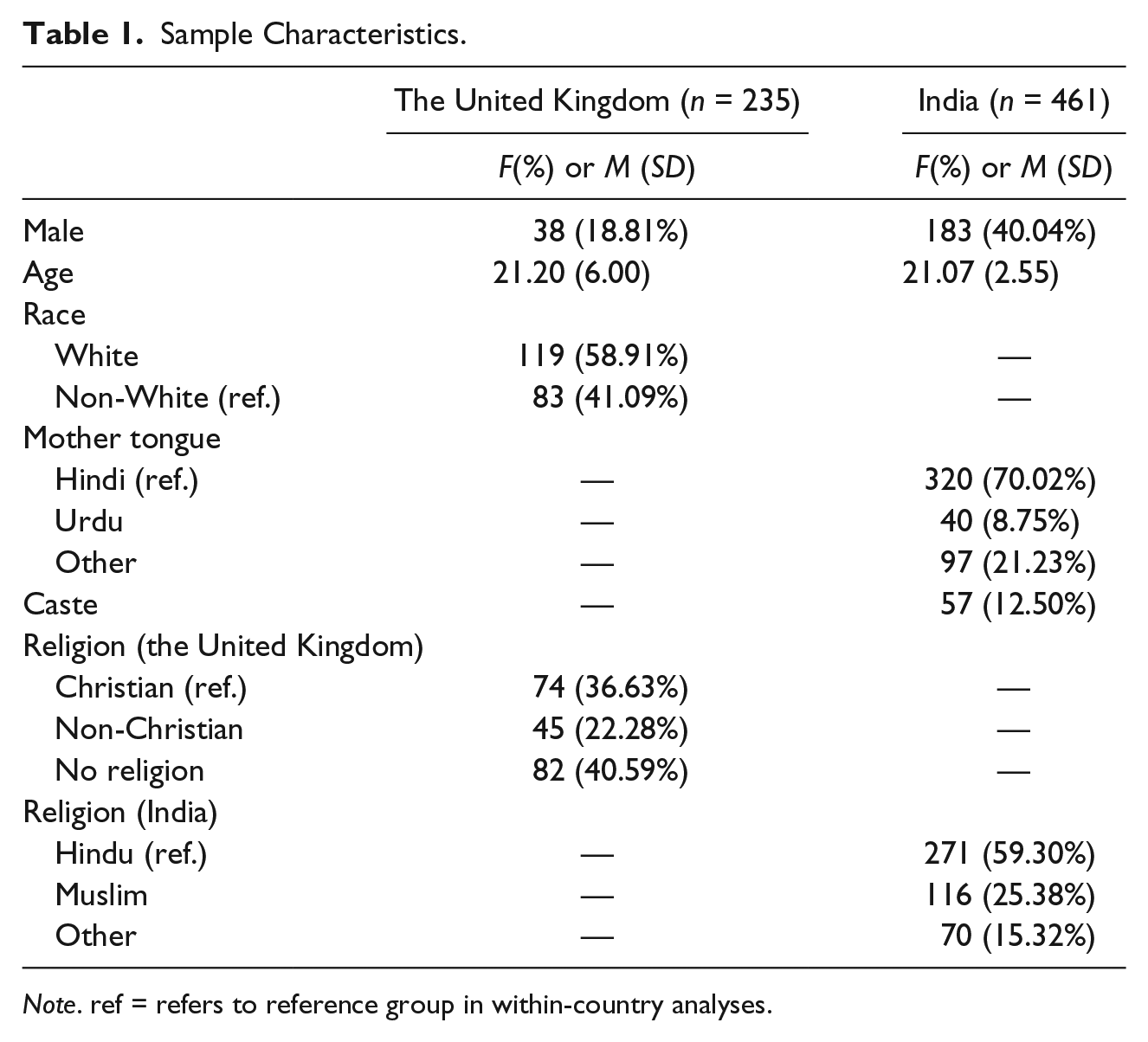
Note. ref = refers to reference group in within-country analyses.
RMA
RMA was measured with 19 questions included in the Illinois Rape Myth Acceptance Scale–Short Form (IRMA-SF; McMahon & Farmer, 2011; Payne et al., 1999). This survey is a widely used measure of RMA with repeated demonstrable validity and reliability. These questions measure several facets of rape myths such as that women are culpable because of their behavior (e.g., “If a girl is raped while she is drunk, she is at least somewhat responsible for letting things get out of control”) and that men are not fully responsible for their behavior (e.g., “guys don’t usually intend to force sex on a girl, but sometimes they get too sexually carried away”). In addition, the scale includes items that measure the idea that women lie about being raped (e.g., “a lot of girls lead guys on and then cry rape”) or that sexual violence is not as detrimental as reported (e.g., “girls exaggerate how much rape affects them”). These items appear on a 5-point Likert-type scale ranging from strongly disagree to strongly agree. These items are averaged together to provide an overall score of RMA. The scale had demonstrable reliability in both countries with a Cronbach’s alpha of .90 in the United Kingdom and .90 in India.
Procedure
The survey was conducted during 2015-2016 in India and the United Kingdom. Students located in two universities in London, and three universities in Delhi contributed to the data collection. A pilot exercise, in the form of small group discussions, helped establish the suitability of the IRMA scale, its linguistic relevance for the U.K. and the Indian context, and English language proficiency of the participants in India. The survey was issued in English in both settings, and it was administered online via university departments, and face-to-face in a paper survey, in both countries. In spite of its obvious anonymity, the online survey proved to be less popular as a method of data collection. The vast majority of the respondents (80%), in both countries, completed the survey in a classroom setting. The option to have face-to-face interaction with the researchers may have ensured a higher rate of completion for the paper survey. In line with the researchers’ university ethics guidelines, participants were reassured of anonymity, confidentiality, informed consent, right to withdraw, and secure storage of data (Iphofen, 2009).
Analytic Strategy
The analysis proceeded in three stages. First, descriptive statistics regarding acceptance of the various rape myths included in the scale were explored. Mean differences between the United Kingdom and India were assessed using two sample t tests with unequal variances. Second, using ordinary least squares (OLS), the overall RMA score was regressed on country with common correlates between the countries included as controls. These control variables included gender, age, and religion (Christian, Hindu, Other). Finally, the same analytic strategy was used for within-country models to examine country-specific correlates that may provide cultural context to RMA. For the United Kingdom, these variables included gender, age, race, and religion (Christian, non-Christian, no religion). For India, these variables included gender, age, religion (Hindu, Muslim, Other), mother tongue (Hindi, Urdu, Other), and caste. Some of the participants were missing data on the demographic characteristics. Missing data were handled through listwise deletion.
Results
Table 2 displays item-specific RMA scores as well as mean differences between countries. Given the number of comparisons, a Bonferroni corrected p value of .0026 was used. As shown, overall RMA was fairly low, with most average scores being in the disagree or strongly disagree range. The myth that elicited the highest endorsement in the U.K. sample pertained to whether women are culpable if they are “sexually provocative” (M = 2.39, SD = 1.20), whereas the highest endorsement among Indian students pertained to sexual assault occurring as a result of men’s sex drive (M = 2.72, SD = 1.32). The two items that elicited the lowest agreement for both countries were that sexual assault must involve a weapon (the United Kingdom: M = 1.14, SD = 0.41; India: M = 1.43, SD = 0.82) and that women desire to be assaulted (the United Kingdom: M = 1.18, SD = 0.49; India: M = 1.39, SD = 0.82).
Mean Differences in Rape Myth Acceptance: The United Kingdom and India.
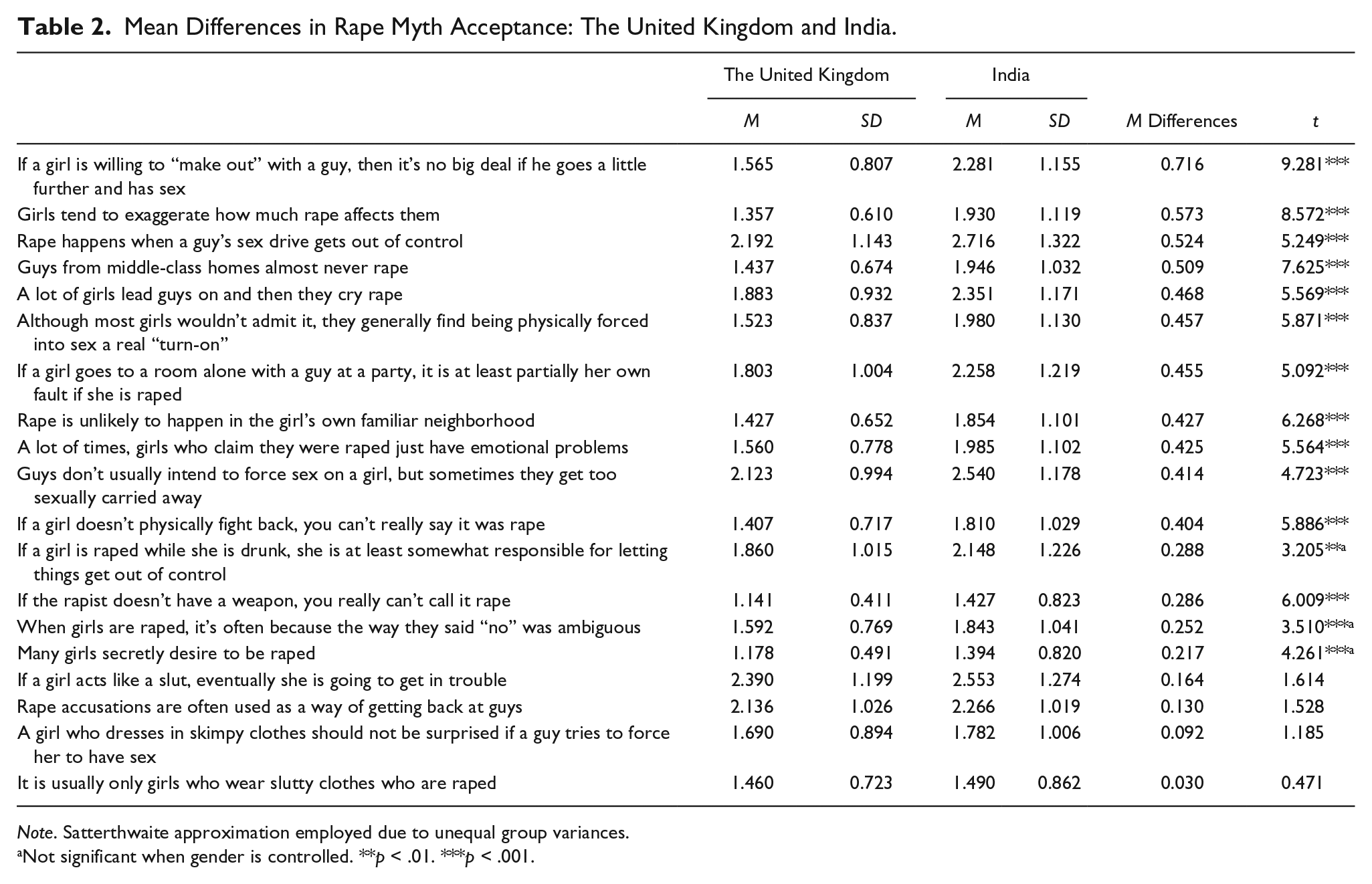
Note. Satterthwaite approximation employed due to unequal group variances.
Not significant when gender is controlled. **p < .01. ***p < .001.
With regard to the differences between countries, Indian students fairly consistently endorsed rape myths more than U.K. students with 15 out of the 19 items being statistically different between the countries. Given the gender distribution between the two countries, sensitivity analyses using regression analyses controlling for gender were conducted. As shown in Table 2, three of the significant 15 comparisons become nonsignificant when gender is included. The largest of these significant differences pertained to the perception that it is acceptable for a man to push for intercourse if a woman is willing to engage in any sexual activity (i.e., “making out”). The mean difference between the two countries on this item was 0.72. However, the majority of the significant differences were less in magnitude, typically between 0.4 and 0.5 of a point. The type of myth that seemed to elicit the most agreement between the countries (i.e., the difference in the mean scores was the smallest) pertained to the culpability of women based on their clothing. Two items that measure this perception were not statistically significant between the two countries.
Regression analysis suggests that the difference in RMA between the two countries persisted once relevant demographic characteristics are included. As shown in Table 3, Indian students endorsed rape myths more than their U.K. counterparts (b = 0.16, p < .05). Overall, men endorsed rape myths more than women and this was the strongest effect with regard to magnitude (b = 0.35, p < .001). Conversely, older students were less likely to endorse rape myths as were students who were not Christian or Hindu.
Rape Myth Acceptance as a Function of Country and Correlates.
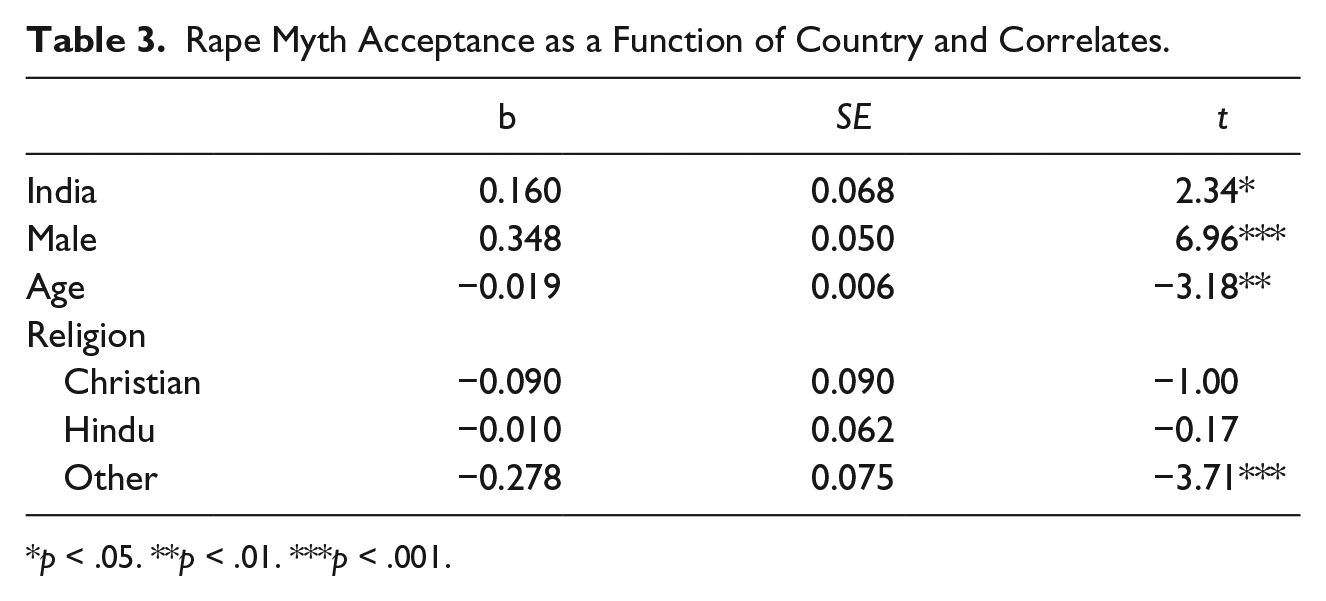
p < .05. **p < .01. ***p < .001.
To explore whether country-specific correlates exerted a meaningful impact on RMA, within-country analyses were employed and those results appear in Table 4. For the United Kingdom, male students were more likely to endorse rape myths (b = 0.21, p < .05) and White students and those who identified as being nonreligious (compared with Christian) were less likely to endorse rape myths (b = −0.27, p < .01, and b = −0.16, p < .05, respectively).
Within-Country Correlates of Rape Myth Acceptance.
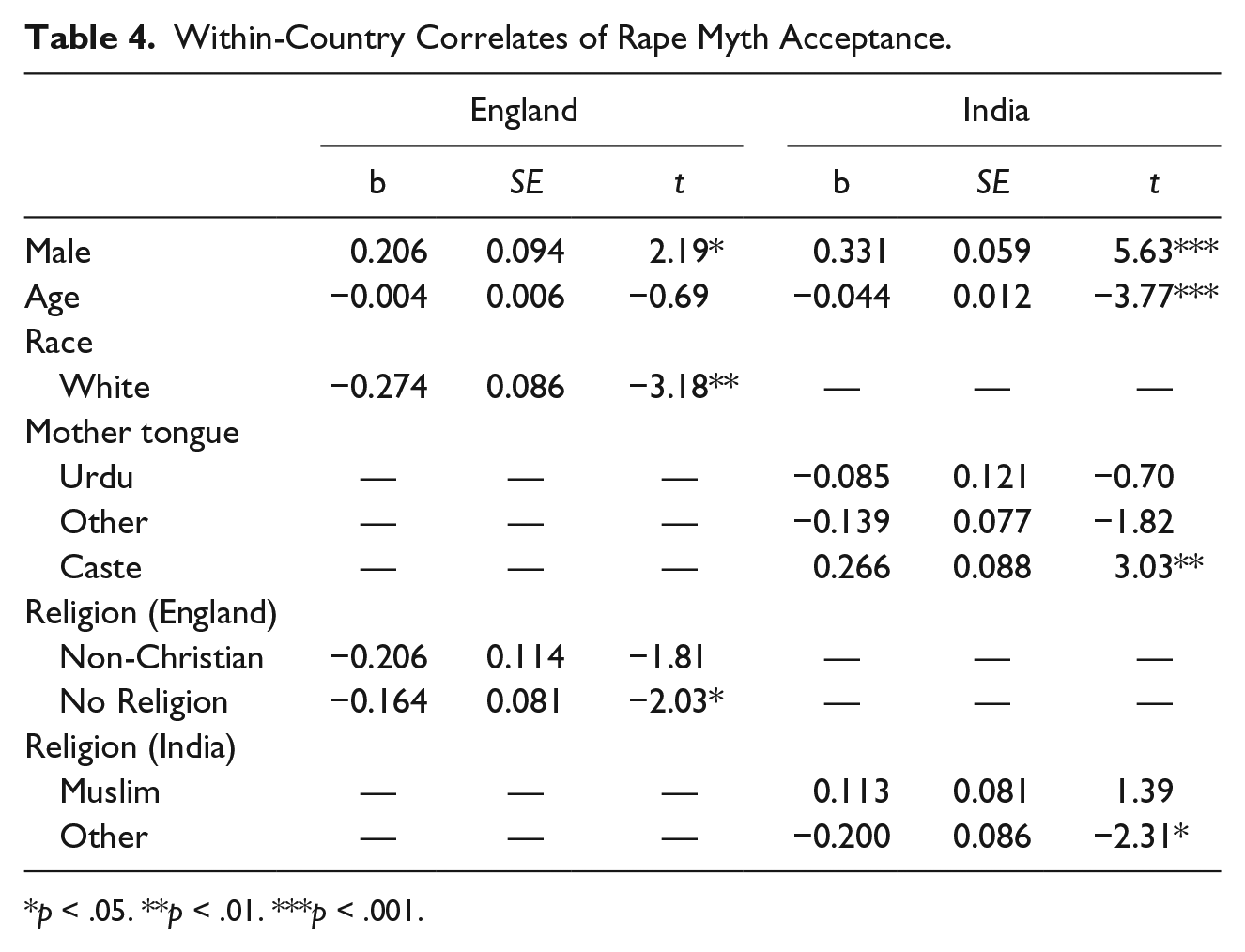
p < .05. **p < .01. ***p < .001.
In India, gender was significant with men being more likely to endorse rape myths (b = 0.33, p < .001). Those who identified as belonging to a scheduled/tribal caste were more likely to endorse rape myths (b = 0.27, p < .01). Similar to the United Kingdom, age was inversely related to RMA such that older students were less likely to endorse those beliefs (b = −0.04, p < .001).
Discussion
The overall purpose of this study was to contribute to the literature on RMA in India and the United Kingdom. Our findings show that RMA was fairly low for both countries. The low acceptance rate in both countries may be explained by the fact that both groups of respondents were similar by virtue of their student background. One could argue that the progressive elements of university education, and persistent media reporting of high-profile rape cases around sexual consent (mentioned above), may have predisposed young people to less orthodox and more liberal thinking. There may be substantial variation within the countries with regard to RMA. This may be particularly true of India with its enormous regional, ethnic, religious, caste, and linguistic diversity. Therefore, we would anticipate RMA to be higher in community samples of individuals living in rural settings with little or no access to education and where gendered norms may be far more regressive. Future research should aim to explore how RMA functions within different parts of each country.
Despite the relatively low endorsement in both countries, both on individual items and overall, Indian students indicate higher RMA. In regard to within-country comparisons, men endorsed rape myths more than women. This finding is consistent with previous research in India, which has identified such a gender disparity (Chudasama et al., 2013; Safri, 2015). In a socially conservative society such as India, the majority of marriages are still arranged by the parents/wider family (Panda, 2016). In spite of this, however, premarital relationships are not uncommon, but remain subject to disapproval and a negative social gaze. Moreover, it seems that greater social blame is held for the female, and particularly the female victim, in cases of sexual violence. It is the female transgressive nature that is held to be provocative and responsible while the male perpetrator is regarded as someone with a sense of entitlement, or as “biologically predisposed,” especially if the woman is perceived to have given initial agreement and consent by showing willingness to “make out.” It is important to point out, however, that our findings show that the rape myth that elicited the highest endorsement in the U.K. sample pertained to whether women are culpable if they are “sexually provocative,” whereas the highest endorsement among Indian students pertained to sexual assault occurring as a result of men’s sex drive. And both are problematic beliefs. The act of rape is also trivialized by failing to understand the emotional and psychological impact on the female victim. In a framework of victim blaming, the aftermath of rape is considered overly exaggerated and a state that the victim should simply accept. One explanation for such strong beliefs may reside in media portrayals of recent high-profile rape cases in both the United Kingdom and India and the impact of these on public perception (O’Hara, 2012). In these cases discussed above, the female victim’s previous sexual history became the central focus, resulting in the overturning of a rape conviction in the United Kingdom (Walker, 2016), while the male perpetrators’ crime, in the Indian context, was located in their hypersexuality in their brutal treatment of the female victim (Mehta, 2016). Thus, the recent media portrayals of “promiscuous women” in the United Kingdom and “monster rapists” in India may well have influenced perceptions among our sample (O’Hara, 2012).
Overall, the greater likelihood of RMA endorsement by Indian students may be understood within the framework of existing gender roles, gender inequity, male dominance, and restrictive cultural norms (Nayak et al., 2003). India, as an emerging modern economy, is experiencing vast change through the processes of globalization, neoliberalism, urbanization, and women’s entry into the labor market and public spaces. The greater visibility of women in former “male spaces” is not only challenging gender roles and male dominance, but female “Western” lifestyles are also being equated with an invitation to rape (Butcher, 2018). Male resistance to such processes is likely to strengthen patriarchal beliefs about a woman’s place. Indeed, beliefs that continue to perceive men as biologically predisposed to have sex with no regard for women’s feelings and emotions, and which attribute blame on women victims of sexual violence, perpetuate an ideology of violence and continue to uphold systems and structures of gender oppression. In a country such as India, with its many social divisions, including caste, class, religion, and region, the impact of hierarchical power structures and social influences also need to be understood to appreciate the experiences of female victims of sexual violence at different levels in society. In other words, some female victims may be seen as more blameworthy than others. Future research could explore attitudes toward female victims from diverse backgrounds including caste, religion, social class, and age.
In addition to a greater propensity among male respondents to endorse rape myths in India, our study indicates other differences on the basis of age, caste, and religion. In our India sample, we also asked our respondents to tell us whether they were registered as belonging to a scheduled/tribal caste. Our analysis shows that those who reported belonging to these groups were more likely to endorse rape myths. Given that only 12% of our sample were from this grouping, further research is needed to understand this difference. Speculation about social class, education, or urban/rural differences would be unhelpful at this stage; however, a specific focus on caste in future research could reveal important insights. Moreover, future research, involving larger samples of diverse populations on the axes of religion, caste, and social class, among university student and nonstudent groups, could make a useful contribution to our understanding of rape myths in India.
In line with previous literature on rape myths, our findings suggest that age in both countries was inversely related to RMA in that older respondents were less likely to endorse rape myths. This is consistent with prior literature (e.g., Powers et al., 2015) and suggests that future research should examine how age serves to temper misconceptions regarding sexual violence.
Overall, given the largely middle-class background of study respondents, it is not surprising that many respondents believe that perpetrators of rape are from among the lower classes. Moreover, the idea that own locality is safer is also endorsed. Research evidence shows that media portrayals of rape victims and perpetrators are not only powerful but they also serve to depict stereotypical ideas of victims and perpetrators (O’Hara, 2012). The 2012 Nirbhaya rape case in Delhi is a classic example of this. Here, the young woman was raped not in her “own” neighborhood, and the perpetrators were from a lower socioeconomic background. The emphasis on such aspects, in an atypical rape case, runs the risk of perpetuating fears and apprehensions about the crime of rape. Thus, beliefs such as “own locality is safer,” and that “guys from nice middle-class homes almost always never rape” become embedded in the popular discourse.
Although they were items that were endorsed the least, our findings show that some respondents, in both countries, adhered to clothing myths such as “skimpy, and “slutty” clothes leading to rape. Scholarly research has helped promote our understanding of such thinking within the context of attribution theory where women who transgress traditional gender norms by wearing provocative clothes are regarded as worthy of punishment (Grubb & Turner, 2012). Such views serve to restrict women’s sense of agency, autonomy, and freedom and result in victim blaming (Begum & Barn, Forthcoming).
In the U.K. sample, race was related to endorsement where White students endorsed rape myths less than minority respondents. These findings echo previous research carried out in the United States, which has documented the propensity of racial minorities to endorse rape myths to a greater degree than their White counterparts (Giacopassi & Dull, 1986; Mori et al., 1995; Suarez & Gadalla, 2010). Whether such differences may be attributed to gender roles, restrictive cultural norms, or lack of education about sexual violence is unclear. For example, while cross-cultural differences between the United States and other countries might be explained as a consequence of education and awareness (particularly given that federally funded universities in the United States are required to provide rape prevention programs), such an explanation is less convincing in our study. While there is a move toward this in the United Kingdom, neither the U.K. nor Indian universities currently have mandatory rape prevention programs. The differences found between the United Kingdom and India are therefore much more likely to be located in social and cultural experiences. Studies employing qualitative research methods to tease out the ways in which gender roles, and cultural norms, operate within the patriarchal belief systems in these countries, and how these are related to RMA, could make an important contribution to the literature in this area.
Policy Recommendations
In addition to making an academic contribution to the literature, RMA research has the potential for social, cultural, and policy implications. First, the helping professions, involving health, social work, and criminal justice, have much to gain from a better understanding of RMA. A competent and skilled workforce that is better able to understand victims and perpetrators may help reduce RMA, deter crime, and provide better help and support. Second, our findings point to the need for education and awareness. In both India and the United Kingdom, there is currently little or no provision for systematic programs for education and awareness around sexual consent within universities or in other arenas. In India, the government Nirbhaya fund was set up following the horrific rape incident of 2012. Given that the sole purpose of this fund is to work toward promoting the safety and security of women and girls, creative and innovative ways of utilizing this resource could be an important development. We would argue that projects that focus on education and awareness to challenge rape myths could be given a priority (Vadgama, Khutwad, Damle, & Patil, 2015). In the United Kingdom, following the example of Oxford and Cambridge, a few universities have begun to hold induction workshops on sexual consent. In line with the National Union of Students (2011), we suggest that a cross-institutional policy be developed to raise awareness of rape myths and to challenge negative attitudes and stereotypes. Such initiatives could benefit from becoming mandatory to help raise understanding and awareness of rape myths across the higher education sector (Lewis, Marine, & Kenney, 2018). There is some research evidence to suggest the efficacy of a rigorously designed and implemented sexual assault resistance program in decreasing the occurrence of rape, attempted rape, and other victimization experiences (Senn et al., 2015). This is an encouraging finding, from a Canadian study, which requires further replication in diverse contexts.
Limitations
Although this U.K./India comparison is novel and adds to the extant literature, there are a number of limitations to this study. First, the study is based on measures of RMA that have been developed and largely validated using U.S. populations. Further research is needed to help test and strengthen the validation of these measures. Crucially, while the basic principles of reliability and validity of the well-established social psychological measures of IRMA are widely recognized (Conaghan & Russell, 2014; Krahé, 2013), it is important to engage in critical scholarship that challenges the premise of research constructs in this area (Gurnham, 2016; Reece, 2014). Second, the study is based on cross-sectional data that do not lend themselves to causal relationships. Third, the sample is rather narrow as it is only focused on a university student population. A study of similarly aged young people who did not go to university would be useful in understanding the pervasiveness of RMA among this group. Crucially, not only is our student sample not representative of other groups in the general population, but it is also not representative of students elsewhere in the United Kingdom and India.
Despite these limitations, and in the absence of key literature in this area, our study provides novel comparative findings on RMA among college students in the United Kingdom and India. The study therefore makes an important contribution to the extant literature to address this paucity of knowledge and understanding to help develop country-specific and appropriate policy, practice, and education and awareness programs.
Footnotes
Declaration of Conflicting Interests
The author(s) declared no potential conflicts of interest with respect to the research, authorship, and/or publication of this article.
Funding
The author(s) received no financial support for the research, authorship, and/or publication of this article.