




Abstract
Despite extensive descriptive work on intimate partner violence (IPV) among Latina and Caribbean immigrant women (LCIW), culturally appropriate interventions for primary and secondary prevention of IPV for this population remain lacking. Developing culturally appropriate and effective prevention interventions for abused LCIW requires a more nuanced understanding regarding the dynamics of cultural values, immigration status, and manifestations of IPV. The purposes of this study were to examine LCIW’s experiences of domestic violence, using a gender stereotype framework, and to describe how ascribing to gender stereotypes perpetuates and normalizes experiences of abuse. Thirty semistructured individual interviews were conducted with LCIW (a) who were at least 18 years old and (b) who had experienced abuse from an intimate partner within the last 2 years. Overall, women described themselves as communal—being caretakers, submissive, and dependent on men. From their perspective, they described their male abusers as being controlling, angry, and violent. The risk for experiencing violence increased when women defied their prescriptive gender roles by seeking employment and by developing their social networks and activities. Substance abuse and alcohol misuse also compounded their partners’ abusive behaviors. Despite some women experiencing more abuse after migration to the United States, coming to the United States exposed them to other opportunities and ways of being a woman, which facilitated an awareness about their abuse and was a motivator for help-seeking and ending abuse. Our findings highlight the importance of addressing traditional gender stereotypes for secondary prevention of IPV.
Introduction
Intimate partner violence (IPV) remains a major public health problem that disproportionately affects women. For many abused women, IPV is cyclic—such that there are recurrent periods of abuse and nonabuse within the intimate relationship (Childress, 2013; Nicolaidis & Touhouliotis, 2006). Immigrant women are particularly vulnerable to chronic IPV, though the data are mixed about whether they experience higher rates of IPV. Immigrant women do, however, experience even greater challenges accessing formal support to overcome (stop the violence or leave the relationship) IPV relative to women of other racial/ethnic groups (Ingram, 2007; Reina, Lohman, & Maldonado, 2014). These challenges are frequently interconnected and complicated by sociopolitical, language, and sociocultural barriers, including gender stereotypes. For purposes of this article, we focus on Latina immigrant women from Mexico, Latin America, and the Caribbean.
Barriers to Help-Seeking
Immigration status is not only a suggested risk factor for IPV among Latinas but also a barrier for women to safely leave their abusive partners. Immigration laws can influence gender inequities by contributing to legal dependency where the woman’s legal status is tied to her spouse (Erez, Adelman, & Gregory, 2008). Women in such scenarios who experience any form of IPV may be more reluctant to seek help or to report the abuse for fear of exportation (Montalvo-Liendo, Wardell, Engebretson, & Reininger, 2009). Furthermore, in cases when women were ready to disclose the IPV or leave the relationship, English literacy and understanding the U.S. social, health, and legal systems can serve as significant barriers for safety. As such, Latina immigrants experiencing IPV need innovative interventions to help end abuse.
Gender roles and stereotypes have been consistently identified as predictors of IPV among Latina populations (Bent-Goodley, 2007; Moreno, 2007) and may pose even greater risk for Latina and Caribbean immigrant women (LCIW) who have migrated to the United States. These gender roles are often manifested through cultural values that prescribe ideal behavior. Some of these values include marianismo, the value that women should maintain virginity until marriage, should avoid talking and learning about sex, and leave sex decision-making to the male partner/husband; machismo, the belief that men are the decision-makers, providers, and protectors of the home; simpatía, the belief that a woman should not be confrontational and rather always aim to maintain harmonious relationships with her partner and family members; and familismo, the belief of loyalty and respect for the family, in considering the family when making decisions about one’s life (Faulkner & Mansfield, 2002). Latinas who are experiencing IPV and ascribe to these cultural values are posited to be more likely to not seek formal assistance and services, may be more accepting of the abuse, and opt to resolve the problem within the family (Vidales, 2010).
Despite extensive descriptive work on IPV among immigrant Latina women, culturally appropriate interventions for primary and secondary prevention of IPV for this population remain lacking. From a health services perspective, primary and secondary prevention interventions include building awareness about IPV and helping women recognize when they are being abused (Moreno, 2007). Developing culturally appropriate and effective prevention interventions for abused Latina immigrant women requires a more nuanced understanding about the dynamics of cultural values, immigration status, and manifestations of IPV.
Theoretical Framework
We use the gender stereotype framework (Lameiras, Fernández, & Castro, 2013) and the ambivalent sexism theory (Glick & Fiske, 1996) to illustrate how cultural values and gender stereotypes contribute to expressions of IPV. Within patriarchal systems, masculinity and femininity often follow the dichotomy of “agency-independence” (self-assertive, confident) versus “expressiveness-dependence” (sensitive to other’s feelings, kind; Bem, 1974; Spence & Helmreich, 1980). This dichotomy represents the dimensions of the Stereotype Content Model—“competence” and “warmth”—developed by Fisk and others (Fiske, Xu, Cuddy, & Glick, 1999). In the stereotype content model, the authors argue that a paternalistic prejudice is expressed toward those who are perceived as warm and incompetent (i.e., traditional women), and an envious prejudice toward those perceived as competent but not warm (i.e., successful businessmen).
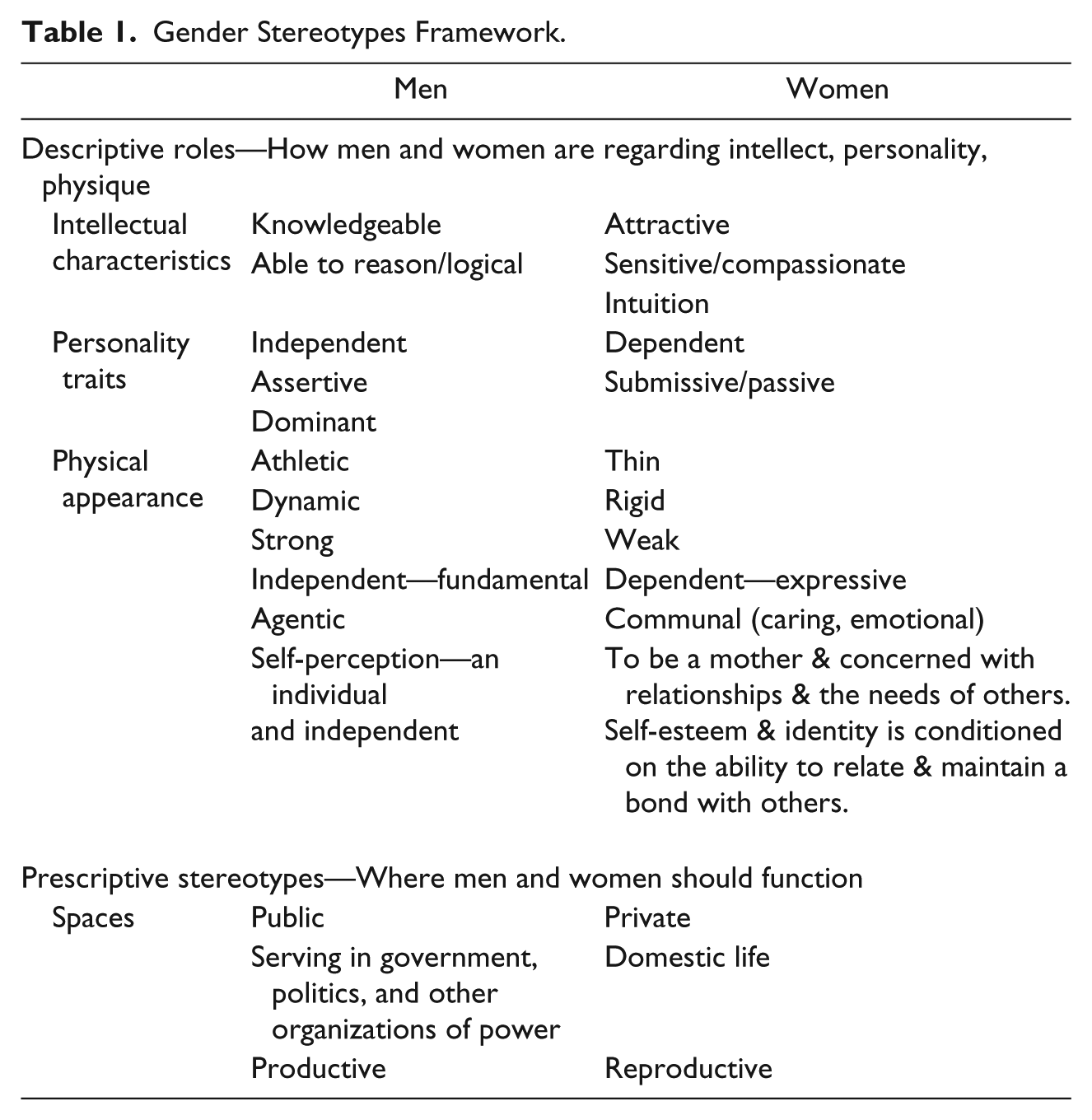
Lameiras et al. (2013) build on this prior work to categorize gender stereotypes into two categories: descriptive and prescriptive characteristics (Table 1). Descriptive gender stereotypes refer to intellectual and personality characteristics of men and women. Men are described as agentic—knowledgeable and able to reason, independent, aggressive, and strong. Women, on the other hand, are described as communal—sensitive, compassionate, submissive, emotional, and dependent. Prescriptive gender stereotypes refer to how men and women should function: the roles men and women should have including appropriate occupations. Lameiras et al. (2013) argue that the prescriptive roles stem from the descriptive stereotypes such that men’s agentic characteristics make them suitable for functioning in public spaces and being productive (i.e., being a breadwinner), and women are best suited for reproduction and a domestic life. Glick and Fiske (1996) then describe the attitudes toward women and men based on these stereotypes in the Ambivalent Sexism Theory, according to which, society has benevolent sexism (positive attitudes toward women in traditional roles such as being nice, focusing on family) and hostile sexism (negative attitudes toward women who exhibit agentic characteristics). Ambivalent sexism and gender stereotypes have been examined in college students in relation to attitudes toward domestic violence (Bermúdez, Sharp, & Taniguchi, 2015; Vandello & Cohen, 2003); however, we are unaware of these frameworks being examined with women’s actual experiences with domestic violence.
Gender Stereotypes Framework.
Study Purpose
Overlapping the gender stereotypes are the cultural values (such as marianismo and machismo), which implicitly prescribe roles for Latina men and women. Other studies that have examined the relationship between gender roles and IPV among Latino populations highlight issues of changes in relationship power dynamics and alcohol misuse as predictors of IPV(Neff, Holamon, & Schluter, 1995; Perilla, Bakeman, & Norris, 1994). While findings from these quantitative studies reveal potential predictors of IPV, the study designs limit opportunities for more in-depth understanding about the extent to which LCIW ascribe to cultural values and gender roles and how ascribing to these values and norms may impact their perceptions and response to IPV. Understanding this relationship may inform framing messages to support primary and secondary prevention interventions for at-risk and abused immigrant Latina women. The purposes of this qualitative study were to examine LCIW’s experiences of domestic violence, using a gender stereotype framework, and to describe how ascribing to gender stereotypes perpetuate and normalize experiences of abuse. Furthermore, we examine the impact of the immigration process on challenging traditional gender roles.
Method
Data Source and Procedures
The interviews used for this analysis were conducted as part of a larger study aim to gain perspectives on cultural risk and protective factors for IPV among immigrant women from around the world living in the United States. This formative information would then be used to adapt a lethality assessment to be more culturally appropriate for immigrant women experiencing IPV. This was a multisite study involving organizations (social services, shelters) serving immigrant and refugee survivors of IPV in Massachusetts, New York, Minnesota, Virginia, Arizona, California, and Washington, DC. The selected sites were chosen based on their extensive experience serving immigrant and refugee survivors of IPV. Women who were at least 18 years old, self-identified as Latina, and who experienced abuse from an intimate partner within the past 2 years were eligible to participate in the study. Eligible women self-selected to participate in the study. Interviews were conducted from September 2016 to January 2017 by trained research staff onsite and an interpreter in the respective service organizations. All but two interviews were conducted with Spanish interpreters because many interviewees were not fluent in English. Interviews lasted approximately 1 hr and participants were compensated US$25 for participation in the interview and US$10 for travel. We recruited up to 30 women in anticipation of reaching saturation with this sample size. Approval for this study was obtained from the Johns Hopkins University Institutional Review Boards at the home institutions of the study investigators, and all other partner sites.
Data Collection and Recording
Based on the study aims, an interview guide was developed by the research team to facilitate discussions with the survivors. The interview guide included questions about current relationship status, gender role expectations, and perceptions about abuse including risk and protective factors. The interview guide started with very general demographic questions, “How old are you?” “How many children do you have?” and then transitioned into questions about current living status and history of abuse, such as “What actions would you consider abusive by your partner/husband?” and “What actions would you consider serious enough to leave your partner/husband?”
Data Analysis
All interviews were audio-recorded and transcribed verbatim by a third party. The transcripts were entered into QSR NVivo 10 software to support the coding and collocation of quotes. After preliminary readings of the interviews by the authors, a directed content analysis using the gender stereotypes framework (see Table 1) was selected to analyze the data (Hsieh & Shannon, 2005). Qualitative content analysis is a method used to systematically classify text into categories of similar meaning. We selected this method to both validate the contribution of gender stereotypes and ambivalent sexism to IPV and to demonstrate how the process of immigration can alter prescriptive roles, and how both contribute to as well as stop abuse.
Two coauthors and a research assistant developed predetermined codes based on the characteristics outlined in the gender stereotypes framework (e.g., “dependent,” “assertive,” “dominant”). We collocated text representing each code within a document and then reviewed the quotes selected by all coders. We discussed areas of disagreement, and if consensus could not be reached, the text was removed for the selected category. We developed new codes for text that could not be coded using predetermined codes (e.g., witnessing domestic violence—childhood); these codes were later determined to represent subcategories of existing codes (e.g., prescriptive stereotypes).
Results
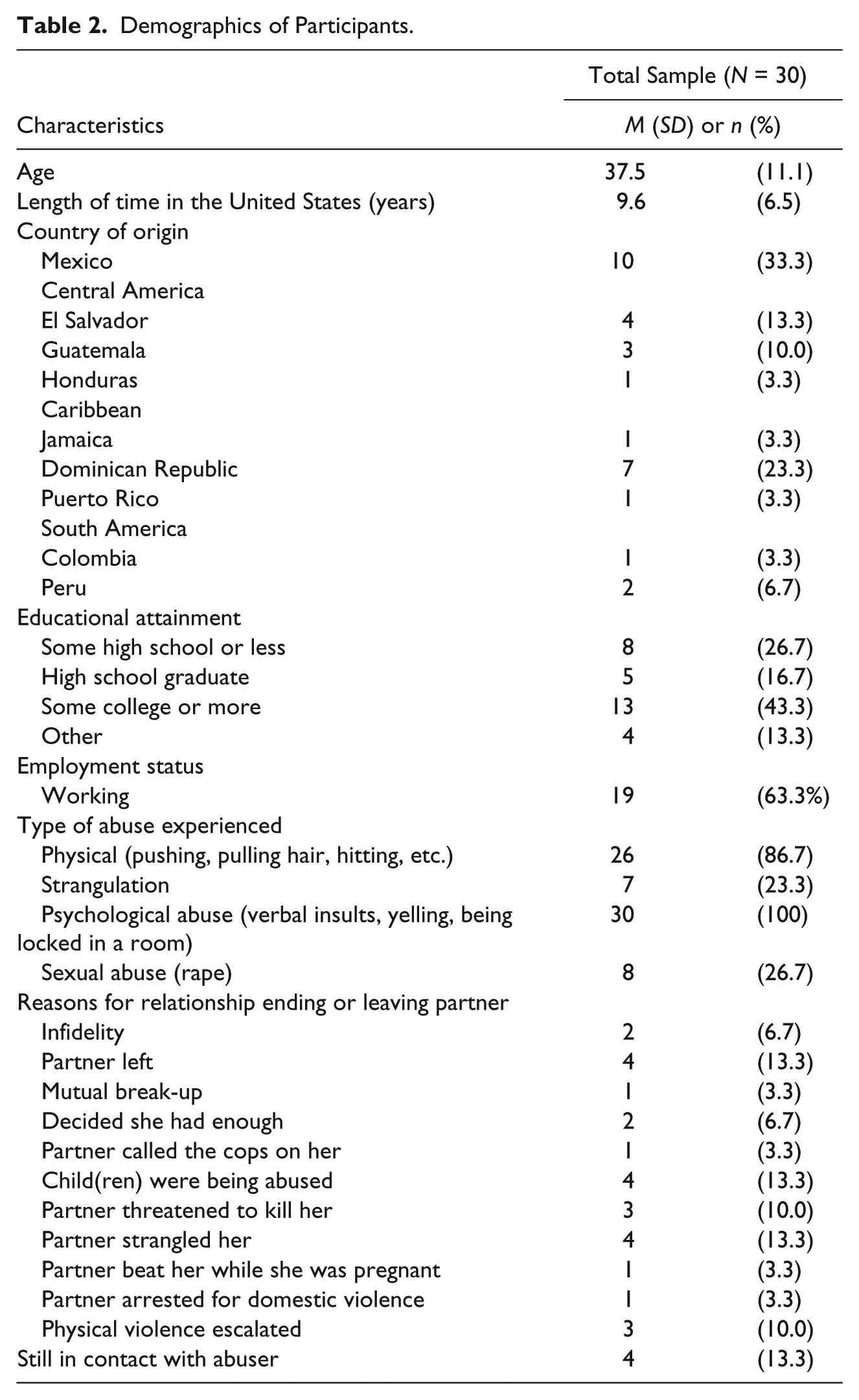
Although all the women were from Latin America and the Caribbean, there was diversity in the sample (Table 2). Notably, there was variation in the level of education, with most women having completed high school and having some college education. All but four women had children. Most the women were employed, primarily in service areas such as housekeeping, food preparation, and nail care. All women had left their abusers, with a few still in contact with them for purposes of coparenting. All forms of abuse emerged from the women’s stories (Table 2). All women reported some form of psychological abuse—from verbal insults to being locked in a room. Most women had experienced a form of physical abuse—being slammed against a wall, pushed, or being cut with a knife. Fewer women reported strangulation and rape. Reasons for leaving their partners ranged from one day deciding that she had had enough, to her partner strangling her.
Demographics of Participants.
Overall, women described themselves as communal—being caretakers, submissive, and dependent on men. From their perspective, they described their male abusers as being controlling, angry, and violent. The risk for experiencing violence increased when the women defied their prescriptive gender roles by seeking employment and developing their social networks and activities. In addition, for most women, coming to the United States exposed them to other opportunities and ways of being a woman; this exposure facilitated an awareness about their abuse and was a motivator to seek help and end the abuse. Participants quotes end with their native region and a number to demonstrate the range of comments coming from different participants.
Feminine Identity Following Gender Stereotypes
Descriptive gender characteristics
When asked to describe expectations of women in their culture, participants shared; for example, “You have to put up with everything, whatever they say. Whatever they do. Whatever they say. That’s how they bring you up” (Caribbean, 6). Many also shared that they were completely dependent on their partners and could not envision themselves living independent of their abuser. Some women also recognized that being dependent on their partners was an expectation or desire of the former abuser, particularly when children were involved. For example, some women shared,
Well, actually, that’s what he wanted. He wanted me to depend on him totally. (Central American, 7)
A Mexican woman expressed her dependency and fear of leaving due to having five children of various ages.
It’s true. I see myself in this situation. I understand the problem that I’m in. I know that there’s help, but I’m afraid. I have 5 children: 13, 12, 10, 6 and 5. I think. “Where am I going to go with five children?” I want to get better. I want to move ahead, more forward, but I feel that if I-that if I don’t depend on someone else’s help, I’m not gonna be okay. Sometime whatever they do to me. I need them. (Mexican, 1)
Along with being dependent of a partner, women also expressed their fear of being alone, particularly later in life once their children were grown.
I was scared. Sometimes, you’re scared, because you live with them, and you’re afraid to live alone, ’cause you think you can’t live alone. (Caribbean, 5) . . . sometimes you don’t wanna be left alone, and people are afraid of being alone, because you think sometimes if you’re with a man, you’re gonna have company for the rest of your life, because the kids grow up, and then they leave, and them they have their own families, and then we’re left alone. (Central American, 7)
Prescriptive gender characteristics
The prescriptive characteristics for women were clearly identified by the women as being in the home, a “good wife,” cooking, cleaning, taking care of the family, and most importantly, her partner. One women shared, “They bring you up so that you can be in charge of the house so you’ll be a good wife” (Caribbean, 6). A woman’s ability to perform the domestic activities of cleaning and cooking was connected to her perceived value, including from the perspective of other men.
When my daughter was gonna marry her husband, he said to the boyfriend, before they got married, he said, “Do you know who you’re gonna marry? That girl doesn’t know how to do anything. She’s not worth anything. You need a girl that knows how to cook for you.” (Central American, 7)
Taking care of children was also not only a prescriptive role, but one that was also descriptive such that women were explicit about motherhood as a part of their identity.
I’ve always been a hard-working woman. I’m a woman that’s always at home with my children. No one can ever say that I was out there doing something . . . (Caribbean, 4)
This identity of motherhood was also the driver and motivator for women to move forward and improve their lives.
I know I have to work, because I have a baby. I wanna study. I wanna do well. It’s not just for me. It’s more for my baby. I’m trying to do well. That’s why I’m here. I’m trying to better myself. (Caribbean, 6)
This identity of being a mother was not only the impetus for women leaving their abusive partners but also a reason for remaining in the relationship. Some women described wanting to leave but believed that this would upset their children. For other women, the women acted to leave once their partners began to physically abuse the children despite the abuses they experienced themselves. One women shared how her son motivated her to leave.
My son, that’s 15 years old, said, “Okay, Mom. No more. Let’s leave.” I think if it wasn’t for that, then I’d probably still be with him. I wouldn’t have left him if it wasn’t like that. (Central American, 7)
Another woman reported leaving with her children when the police and child protective services responded to a domestic violence call. The social worker reported that she had to remove the children from the home, and gave the mother a choice. She said, “I have to take your kids.” She said, “I’m gonna make this question only once. Do you wanna go with your children or do you wanna stay?” (Mexican, 2). The mother made the choice to leave with her children.
Masculine Identity
Descriptive characteristics
Controlling–possessive–jealous, these were characteristics women associated with their partners that were also reinforcing of descriptive roles for women; characteristics also associated with an aggressive and violent personality. One woman shared her definition of control:
Control and power that a person has over you is when you have to tell them everything. If they’re not in agreement, then you can’t go. They don’t give you permission. Afterwards, there will be problems. (Caribbean, 5)
Women described partner controlling behaviors that resulted in being isolated—not being able to be in contact with family or friends.
If he says you can’t go out, you can’t go out. (Caribbean, 5) He wouldn’t let me visit my family. (Caribbean, 6) I couldn’t go out anywhere. If I went to see a friend-if I was at a friend’s house for three hours, he’d be outside waiting for me. He wouldn’t give me any space. (Caribbean, 4)
Women also talked about being locked in the house and having their clothes thrown out so that they could not get dressed to leave the home.
My baby’s father would throw my clothes out, because he’d say I don’t need the clothes. He said all I needed to do was always stay home and wait for him to come home. (Caribbean, 6)
This woman also described not being able to use the phone:
One thing that’s here, he wouldn’t let me talk to anybody on the phone. There was a phone like that one. If he wasn’t there, the phone had to be disconnected. If he was in the house, I’d always have to put the phone on speaker, even if it was my mom. It didn’t matter who it was. He always had to hear what we were talking about. I feel like every person should have some space, even if you have a partner. (Caribbean, 6)
Even when leaving the home was necessary to keep up with responsibilities of being a mother, it still resulted in conflict.
I would have to get up early, take my children to school and go to work and pick up my children with the babysitters. I would have to stop and get food. If I had appointments with the doctor, and sometimes you don’t get home at the time that I am supposed to be home. That was a reason for him to be angry. (Mexican, 1)
Women also described their partners as being not only controlling but also possessive and jealous. In fact, some women identified these characteristics as being culturally acceptable in their countries of origin. “Usually, Dominican men-the Dominican culture, they’re jealous. They are jealous and they are possessive” (Caribbean, 2). They also identified jealousy as a risk factor for intimate partner homicide among women, “Most of the men that kill over there, it’s because they’re jealous. It’s because they’re jealous. That’s why they kill” (Caribbean, 4).
Despite the men being the ones to exhibit the jealous behaviors, women shared that their partners would project and instead accuse the women of being jealous. This occurred especially when the men’s conduct created feelings of distrust; they would then accuse their female partners of being jealous and use this as a justification for being abusive.
When he worked, he’d stay at work and he’d never tell me. He’d wake up and work the next day, and he wouldn’t even tell me that he slept there, so I’d have to call his boss. I’d have to find out through the person at work, and he would just say, “Oh no, he just stayed here working.” Then he started hitting me because I’d try to find out where he was. I thought that was normal. When he’d come home, I’d ask him, “Hey, wait a second. Why didn’t you tell me that you were there, that you decided to stay there working?” Then he said. “You’re just being jealous. You’re being jealous.” And then he would hit me. (Central American, 7)
Violent and angry personality
All the different forms of violence that the survivors experienced—physical, psychological, and sexual—were laden with intense anger toward their partners. Most of the women described their partners as always being angry and getting angry about everything. The anger and violent behavior was frequently expressed in their partners’ conduct. “He would get angry about everything. . . . He was always angry” (Mexican, 2).
Women described violent behavior against objects or physical spaces, such has hitting walls and throwing glasses.
He would break things . . . he would throw everything. He would break chairs. He would break them. He made me panic, because I always thought he was gonna throw something at me, because at the beginning, he would hit me. (Central American, 7) I didn’t like the way he would throw things around and break things. He was violent, and that was dangerous. (Caribbean, 2)
Violent behavior was also directed at women in the form of physical violence.
He would choke me. He would cover my face with a pillow. Once he put tape on my mouth so I wouldn’t scream. He would cover my nose. He would take my clothes off, and he would jump on top of me. That would make me very scared that he would kill me. (Mexican, 2) The last time he hit me, he broke all the red veins in my face. He wanted to throw me down the stairs. (Caribbean, 6)
Women also described insults, scorn, and humiliations that they perceived as more harmful than the physical violence and left them feeling “marked” for life.
That he told me in my face, “I don’t love you. You’re too fat. I don’t feel anything for you.” The worst thing was that he was with me, that he was with me because he needed someone to cook, to clean, to clean his clothes. Just to take care of him, so like a maid. That he was only with her because of that. (Caribbean, 2) [John] humiliated me, especially verbally. I feel that [John] did more damage to me with his words than ever. (Caribbean, 5) He mistreated me and he humiliated me, too. It really marked me for life, because after him, I haven’t-t had a boyfriend. I’m really afraid to have a relationship with somebody because I’m afraid the same thing’s going to happen. (Caribbean, 6)
Also, almost all the women described instances of rape or, as they phrased it, being “forced to have sex” with their partners.
I didn’t want to have sex . . . but just the threatening that he would call immigration on me, I just go ahead and do it. Even when I’m so tired. I be cleaning the house all day, cooking, washing, and then in the night, I have to go have sex with him. (Mexican, 2) He obligated me to have sex with him just because I was living with him . . . The last time he abused me, that he obligated me to have sex with him and he mistreated me . . . when he obliged me to have sex with him, the last time, I was pregnant. (Caribbean, 6)
The aggressive/violent behaviors were also often exacerbated by substance abuse.
He used to like to drink. I noticed that when he would get intoxicated, he would lose consciousness. Then he started using illicit substances. Smoking. I was afraid that in one of those moments, him being under the influence, that something would happen to me while he was under the influence. (Caribbean, 2)
Prescriptive characteristics
Unlike the stereotype of women being the caretakers and homemakers, the stereotype of men being the breadwinners and providers of the home was less defined in this study. One woman shared that in her country (El Salvador), it is the expectation that “the man is the one that always has to work and sustain the house” (Central American, 5). However, women in this study generally described their partners as not being interested in their family life or being providers; for example,
He doesn’t take care of me. He doesn’t do anything for me. If I say, “Let’s do this for the kids”, he’ll just answer, “You do it yourself.” If I tell him to please do something for the kids, he’ll say, “I can’t.” (Caribbean, 8)
Other women commented about their partners not wanting to work or provide for the home.
He doesn’t keep a job. Also, he doesn’t like to work. (Mexican, 7) He doesn’t leave any money and he expects food on the table. (Mexican, 4)
In fact, from the women’s perspective, rather than being a provider, their partners were often financially abusive and taking money from the women.
He wanted to know about the money I was making. (Mexican, 1) Then, he would take my money. (Mexican, 2) It got to a point where he would be askin’ me for money daily. He stole money from me, from my purse. (Caribbean, 2) Sometimes, he would look at my personal papers. He would take my bank card, and he would take my money out. He knew how to sign the way I sign, One day, I was gonna pay for rent, and he had taken the money out. (Caribbean, 5)
One woman even shared that once she started working, her partner stopped working and she was left to pay the bills. Also, a woman who was providing for herself and her children used male characteristics to describe herself because she was being the provider.
I consider myself a very strong woman because I’ve always worked very hard. I was a single mother with three children. I’ve always had two jobs. I’ve worked like a man. (Caribbean, 7)
Experiencing Abuse When Not Meeting the Gender Stereotype
Many women described their partners’ anger intensifying; the women experienced abuse whenever they started to focus on themselves and tried to improve themselves. Whether they made efforts to look more physically attractive or improve their level of education, there was a backlash from their partners.
If I would wear make-up or get dressed up, it was a reason why he would get really mad. If I wanted to go to school, take classes—English classes, computers—he would be very mad, because he would tell me that wouldn’t be good for me. . . . If class would last three or four weeks, he wouldn’t talk to me during that time even if we were in the same home. He would say that that was not good for me. (Mexican, 1) Whenever I got prepared for an interview at a job, he would say that I didn’t speak enough English and that I wouldn’t get the job because I didn’t know enough English. (Mexican, 8)
This negative response was reported even when the women wanted to learn how to drive. “He didn’t each me to drive.” (Caribbean, 1).
When women were working, and contributing to the home, some experienced psychological abuse. One woman described how her husband belittled her contributions:
I would buy my clothes and my daughters’ clothes. I think that was a lot of help in the house. He would always say that my money was worthless. (Mexican, 4).
Another woman shared that her husband’s abusiveness increased when she was unable to become pregnant. He would say to her, “You’re not good for anything. You can’t get pregnant. You’re not good for nothing” (Caribbean, 2).
I Thought It Was Normal
Many women described that they initially thought that the abuse they experienced was “normal,” or something that was part of being married. In a few cases, women attributed the acceptance of the abuse to what they had seen growing up or social norms. When asked about family and community expectations for women, one participant said, “They expect that you just stay in your situation of being abused. Just let yourself be abused” (Caribbean, 3).
Similarly, another woman shared,
I felt like I had to just put up with it, because that’s what I saw in my country, as if it was normal. My mom always said that you had to just put up with it, because you can’t be living with one person and then with another person. (Caribbean, 5)
One woman described how she began to consciously accept the abuse:
I just thought my life was gonna end up being like that forever. You just learn to live like that. You feel like you have no choice. I just thought my life was gonna end up being like that forever. You just learn to live like that. You feel like you have no choice. (Central American, 6)
There were also situations in which women were unaware that some of the behaviors they were experiencing were not normal. In response to questions about identifying “warning signs” or “red flags” in abusive relationships, women acknowledged that they were unaware of what abuse is.
We don’t really know to see the symptoms. We don’t really know what the symptoms are first. (Caribbean, 3) . . . because frankly, a lot of times we don’t realize it, what that is actually domestic violence. We think that’s normal, because he had a hard day, or he’s mad at work. I used to think that that was normal. (Central American, 7)
Impact of Immigration Experience
Although not explicit, migrating to the United States impacted some women’s experiences with domestic violence. For some women, abuse escalated on migrating to the United States with their partners. For example, one women shared that while living with her partner in Mexico, “He would drink, but he wouldn’t get aggressive. He would get aggressive toward others. . . . He would come home and break things. He didn’t throw things at me.” Once in the United States, she described how he became angrier, abused alcohol more, and the abuse escalated.
He started drinking again. I don’t remember why we started having problems. The only thing I remember was he was very angry once he entered our room, and he pushed me to the floor. He picked me up by my hair. The abuse escalated from there. Until my son was born, he was a few months old. There was sexual abuse at home. It was like a person that I didn’t know was raping me. A stranger.
Other women described similar experiences ranging from their partners “changing”—being less affectionate and interested in family, to becoming more controlling and physically violent.
Despite negative changes in their relationships, all women reported outweighing benefits of migrating to the United States from their countries of origin. For many women, it was an opportunity to see another way of life and other ways of being a woman; as a result, they felt empowered to change their abusive situations. One woman shared,
I’ve seen that other women have not put up with abuse and I see women here that are more liberal. (Mexican, 1) In this country I’ve liked it much more, because the woman can actually develop herself. She has the freedom to say what she wants and what she doesn’t. She can study if she wants to. She can work. She can have a normal life. (Caribbean, 8)
Women also became more attuned to their self-worth, value, and felt more empowered.
One of the factors that has helped me is to bother yourself to know your worth and to know that you’re important. That you were not born to be abused. That you were born to get up and work, and the wives are not-as wives we’re not there to be abused by any form, verbally, psychically, emotionally. We are there to be a support to them. (Caribbean, 2).
Discussion
The goal of this study was to examine LCIW’s experiences of domestic violence juxtaposed to the gender stereotype framework and the theory of ambivalent sexism. We learned that the more women ascribed to gender stereotypes, the more they endured the abuse. For many women, abuse also worsened on migration to the United States and when they attempted to become more independent either through advancing their education or working. Despite these challenges, living in the United States exposed these immigrant women not only to other opportunities for improving their lives (e.g., education, work) but also to resources that could facilitate safely leaving their abusers. Prior research has also shown that as women’s financial contributions to the household increase, so does their victimization (Perilla et al., 1994). Our findings reveal another component of this narrative which is the personal growth that women experience through migration to the United States that also facilitates ending the abuse.
Findings from this study aligned with the theory of gender stereotypes and ambivalent sexism theory (Glick & Fiske, 1996). When asked to describe gender expectations in their countries of origin, many women described characteristics identified in the gender stereotype framework. Women described themselves as being submissive and dependent on their partners. Many internalized this role to the degree that they believed enduring their abuse was part of their role. At the same time, women who wanted more opportunities for themselves—to learn English, earn an income—in other words, those who started exhibiting characteristics associated with men, experienced various forms of abuse from their partners and were discouraged from self-improvement and their ambitions. In other words, they were more likely to experience hostile sexism. Among Latino males, Bermúdez et al. (2015) also found an association between hostile sexism and greater credence in traditional gender roles—believing that women should stay at home and that guys only hit their girls when they deserve it; there was no data on reports of actual perpetuation of violence in Bermúdez’s study.
Benevolent sexism—the other component in the ambivalent sexism theory—refers to women being treated well for adhering to traditional gender roles. However, our participants did not discuss any details which suggested they were treated well for “adhering to traditional gender roles.” Instead, women with greater credence in traditional gender roles seemed to be more willing to endure the abuse. Our participants whose identity was tied to being a “good woman”—taking care of the children and the home—likely also ascribed to the idea of familismo—prioritizing the needs of the family over those of the individual—and therefore endure the abuse for the purposes of keeping the family together.
These findings underscore partial infidelity to traditional gender norms among Latina and Caribbean immigrant men regarding their descriptive roles. Whether consciously or not, being a partner and/or mother was an important role that our participants worked hard to fulfill. Like findings from previous work (Perilla et al., 1994) women’s efforts to move beyond their traditional roles were met with some form of violence from their partners. Yet their partners were often not living up to the expectation of being a protector and breadwinner for the family. Although, women complained about their partners not meeting these expectations, the men never experienced the hostility and retaliation that the women described for being “more than” a partner and/or mother. This increase in male-to-female abuse when women “break” gender stereotypes suggests a potentially earlier risk factor (compared to when one is trying to leave the relationship) for severe violence for immigrant women. Therefore, service providers working with women who may be experiencing abuse should also be attuned to these more nuanced risk factors for severe violence and consider this issue of navigating gender stereotypes when developing a safety plan.
Implicit in our participants’ stories was the frustration and anger of their partners. Almost, all the women described their partners as being angry and often resorting to abusing substances, mainly alcohol and sometimes other illegal drugs. Many women attributed much of their partner’s violent behaviors to alcohol misuse and/or drug use. Other researchers (Ames, Cunradi, Duke, & Todd, 2013; Field & Caetano, 2005) have also found alcohol misuse to be associated with IPV. The anger and substance abuse may also stem in part from the stresses and vulnerabilities one may feel when migrating to a new environment. Part of the stressors and feelings of vulnerability may have been from not being able to fulfill their roles as breadwinners (Davis & Chavez, 1985). In his writings about “manhood” and codes of conduct, Peter Wilson (1969) presents the notion of reputation and respectability. Respectability refers to codes of conduct and etiquette for men, such as being able to provide for one’s family. Reputation refers to the proof of wealth and worth for being a respectable man. For many of the men described by our participants, when in their countries of origin, they lived in economies in which their jobs fulfilled their reputation and respectability. Immigration status likely challenged these men’s opportunities for earning an income that would support their families, challenging both their reputations and respectability. Perpetrating acts of violence may have been for some men an effort to regain a sense of control or respectability. We do not consider issues of reputation and respectability as reasons for abuse, rather factors to consider when working with perpetrators of IPV.
Another potential contributor to male-perpetrated violence is premigration exposure to political violence, such as violent acts (kidnapped, detained, beaten) committed by police or other authority groups (Gupta et al., 2009). Gupta et al. (2009) found that immigrant men who had been exposed to political violence in their countries of origin were more likely to report perpetuating any type of IPV.
The narrative from our participants suggests that the immigration experience was more positively transformative for women compared with their male partners, most of whom were also immigrants. Our participants were not exempt from the challenges one may experience being in a new culture: not knowing the main language and in some cases, being undocumented. At the same time, women revealed positive aspects of their migration. Exposure to “American” culture enlightened many of the women about alternative feminine identities: mother and employed, independent, and so forth. Contrary to their countries of origin, where male-to-female abuse was not criminalized and somewhat “normalized,” being in the United States also helped sensitize women to the fact that partner abuse is not normal and a crime. As a result, some women felt empowered to seek help for the abuse they were experiencing and to leave their abusive partners.
Practice Implications
Immigration status and acculturation add an additional layer of complexity to our understanding of IPV perpetration and prevention. Our findings present some practice implications when working with immigrant women experiencing IPV. Given the importance of family, working with both partners in the relationship is essential. Both the women and the men described in this study needed support reconciling traditional gender roles, their identities pertaining to these gender roles, and their immigration and socioeconomic status—all of which are intertwined.
In a previous study, reconstructing traditional gender norms and attitudes at the community level successfully reduced IPV perpetration and victimization among Ugandan men and women who participated in a cluster randomized controlled trial (Abramsky et al., 2016). In addition to family-based interventions, there is a need for community programs serving immigrant Latinos to support job training so that both men and women can maximize their potential for themselves and their families. As researchers and practitioners continue to develop interventions for both victims and perpetrators, considering the underlying issues of employment and gender identity within these interventions may be effective for primary and secondary prevention of IPV (Fulu, Jewkes, Roselli, & Garcia-Moreno, 2013).
Finally, like other studies, our findings also highlight the coexistence of alcohol misuse and IPV (Gilchrist, Radcliffe, Noto, & d’Oliveira, 2017; I. M. Wilson, Graham, & Taft, 2017). While we know that alcohol misuse does not cause IPV, alcohol is frequently involved in cases of male-to-female IPV and is associated with IPV severity. This may be another issue to address with women experiencing IPV. In addition to addressing the issue of alcoholism within a family-based intervention, women may simultaneously need guidance on safety strategies when dealing with an intoxicated partner.
Limitations
We note several limitations with this study. The data represent findings primarily from a convenience sample of women who had left their abusers. As such, the data may be more reflective of immigrant women experiencing more extreme forms of violence. Also, almost all women were Spanish-dominant (i.e., less acculturated to the United States), further complicating their vulnerability and management of abuse. These findings may not be generalizable to other immigrant women who enter the United States with mastery of the English language and greater ability to assimilate into the mainstream. Finally, our study was conducted from the perspectives of women. Additional studies should gauge the perspectives of Latino immigrant men in the context of gender stereotypes to maximize the effectiveness of shifting culturally supported gender norms.
Conclusion
The goal of this study was to use the theory of gender stereotypes to illustrate expressions of IPV among LCIW. The data fit the theory and helped illustrate how for some women, assuming behaviors that do not meet their circumscribed gender role expectations may be a risk factor for abuse. This risk for abuse may be increased, particularly with men who are unable to meet expectations of being a breadwinner and who misuse alcohol. These findings have practice implications for health care workers serving immigrant families coming from communities that espouse traditional gender roles. More research is needed to identify how to best support such families navigate essential changes in traditional gender roles as well as primary and secondary prevention of IPV, particularly for those who wish to remain with their partners.
Footnotes
Declaration of Conflicting Interests
The author(s) declared no potential conflicts of interest with respect to the research, authorship, and/or publication of this article.
Funding
The author(s) disclosed receipt of the following financial support for the research, authorship, and/or publication of this article: This study was funded by the Eunice Kennedy Shriver National Institute of Child Health and Human Development (5R01HD08117903).