




Abstract
Previous research has demonstrated that nonoffending mothers are held at fault when their child is sexually abused and this fault is directly linked to a decrease in help-seeking behavior. It is unclear, however, whether similar fault is applied to nonoffending fathers, as little such research on fathers exists. What does exist is marked by methodological limitations. Using an experimental vignette design, 154 participants were randomly assigned to read one of two hypothetical abuse scenarios (i.e., nonoffending mother or nonoffending father) depicting the sexual abuse of a female child by an adult male perpetrator. Participants rated levels of fault attributions assigned to either parent and then provided open-ended responses outlining their reasons for their attribution ratings. Quantitatively, both mothers and fathers were assigned similar amounts of fault for the sexual abuse. Thematic analysis of participants’ justifications for their assigned fault attributions revealed both mothers and fathers are subject to similar expectations that either increase or decrease assigned fault, with the exception of one theme, Disbursement, in which participants distributed fault away from fathers toward others (e.g., the nonoffending mother). By understanding parent blaming and the reasons behind parent blaming attributions, future research can work to improve these attitudes.
The majority of previous research on parent blame and child sexual abuse (CSA) centers around mothers (L. Davies & Krane, 1996; M. Davies, Patel, & Rogers, 2013; Ehrmin, 1996; Fong & Walsh-Bowers, 1998; Ford, Schindler, & Medway, 2001; Harding, Zinzow, Burns, & Jackson, 2010; Reidy & Hochstadt, 1993) and has inevitably developed from the historical and cultural expectations of mothers. It is argued that mother blame occurs because of sexist societal beliefs related to women as mothers, including a socially constructed view of being a “good” mother (L. Davies & Krane, 1996). When these standards are not met, mother blaming occurs (L. Davies & Krane, 1996). With regard to CSA, recent research has identified mother characteristics that are believed to influence attributions of fault assigned to her, including the expectation she has intuitive knowledge of negative events her child experiences (Zagrodney & Cummings, 2020), who she trusts to look after her child (Toews, Cummings, & Zagrodney, 2019; Zagrodney & Cummings, 2020), and the types of activities she engages in outside the home (Toews et al., 2019). However, no equivalent research has been conducted examining potential father fault for CSA. That is, it remains unclear whether or not nonoffending fathers are also held at fault for CSA, what variables might influence this attribution of fault, or how father and mother fault might compare.
The purpose of this study was to assess potential fault attributions and justifications for those attributions via a comparison of nonoffending mothers and fathers. Participants were randomly assigned to one of two vignettes depicting CSA that described either the mother or the father of the CSA victim. Participants then provided quantitative ratings of fault attributions and open-ended responses explaining those attributions. Given that fathers are increasingly expected to play a role in child care responsibilities (Chesley, 2011), it stands to reason that like mothers, they might be held responsible when their children experience trauma. Because worry about blame might negatively impact help-seeking (discussed below), it is imperative to understand how such fault is assigned and justified.
Sexual assault is the second most prevalent type of violent crime committed against children (Statistics Canada, 2008). Although results of CSA rates consistently vary, a conservative estimate based on research by Pereda, Guilera, Forns, and Gómez-Benito (2009) indicates that approximately 20% of women and just below 10% of men, internationally, have been sexually abused before the age of 18 years. After a child experiences sexual abuse, a host of negative symptoms are often experienced by the child victim. While examining the relationship between CSA and developmental outcomes over 30 years, Fergusson, McLeod, and Horwood (2013) found that CSA was linked to increased rates of depression, anxiety, suicidal ideation, suicide attempt, alcohol dependence, and illicit drug use. Moreover, once children who had been abused reached 30 years of age, the authors found that CSA was associated with higher rates of posttraumatic stress disorder symptoms, decreased self-esteem, decreased life satisfaction, increase in medical contacts for physical health problems, and an increase in welfare dependence. These negative consequences associated with childhood sexual abuse increased as the severity of abuse increased (Fergusson et al., 2013). In addition, children who have been sexually abused have also been shown to withdraw from life events (e.g., family activities), have decreased performance at school, and take on certain adult mannerisms post abuse (e.g., looking after siblings, preferring the company of adults; Lakey & Roman, 2014).
While examining mother blame experiences, Jackson and Mannix (2004) discovered that blame toward mothers was directly related to reduced help-seeking behaviors. If mothers are too afraid to seek help, especially after CSA, this may leave the mother and child without support. Although no research to our knowledge has examined fathers’ help-seeking behaviors after CSA, it stands to reason that if fathers are also blamed for CSA, they too may express less help-seeking behaviors for fear of being blamed. Reduced help-seeking by both mothers and fathers can leave both children and parents without support and resources needed after CSA. Thus, it is important for researchers to clarify fault attributions assigned to both parents, as well as justifications for those attributions. If children receive help, their negative outcomes are likely to be minimized by effective intervention; however, children do not receive as much help when parents worry about being blamed.
This bias toward holding mothers responsible for the negative experiences of their children is also illustrated in a corresponding lack of empirical research on the potential responsibilities of fathers. Fathers, when compared with mothers, have been neglected in a wide variety of research domains including developmental, clinical child, and adolescent research (Phares, 1992; Phares & Compas, 1992; Phares, Lopez, Fields, Kamboukos, & Duhig, 2005). Not only does previous research in these areas leave fathers out of research designs completely, but on the rare occasion when they are included, it is rare for researchers to analyze fathers separately from mothers (Phares et al., 2005). More specifically, in a review of major clinical child and adolescent research journals, it was found that while 48% of research studies exclusively involved mothers, only 1% exclusively involved fathers. The other 51% of studies involved both fathers and mothers and analyzed them separately (26%) or did not analyze them separately/did not differentiate between “parents” (25%; Phares & Compas, 1992). More recent research on parents and developmental psychopathology, again, demonstrates that this trend has been maintained. Phares and colleagues (2005) found that father-only research was still underrepresented in clinical and health-related journals (2.4%) and even less represented in pediatric and health journals (0.6%). Phares and Compas (1992) have previously argued that the large gap in the literature comparing mothers and fathers would not be expected unless bias was operating in the research inclusion process.
Methodological limitations also lead to a lack of understanding of the separate role of mothers and fathers in the CSA literature. It is rare for researchers to examine father blame independently from mother blame. That is, there are few examinations of attributions toward a father, who was not a perpetrator of the sexual abuse, separately from attributions toward the mother. For example, several researchers have examined mother blame only and commonly identify the father as the perpetrator in the abuse scenario (Ford et al., 2001; Harding et al., 2010). Other researchers examined both mother and father blame together, asking participants to first rate one parent and then the other (Back & Lips, 1998; Waterman & Foss-Goodman, 1984). Furthermore, several research studies have examined “family blame” or “parental blame” without specifying the target of the attributions (e.g., mother or father; Hestick & Perrino, 2009; Rogers, Davies, Anderson, & Potton, 2011; Rogers, Wczasek, & Davies, 2011; Zinzow, Seth, Jackson, Niehaus, & Fitzgerald, 2010). There are multiple ways by which these methodological choices limit our understanding of fault attributions.
First, these methodological limitations on parent attribution research seem to possess the same inclusion bias that Phares and Compas (1992) noted in developmental, clinical child, and adolescent research, examining primarily mothers or not analyzing mothers and fathers separately. Second, these approaches likely result in confounded ratings when each participant is asked to rate blame for first one parent and then the other (i.e., the rating they assign the first parent influences their rating of the second) or asked to rate blame for the parents together (i.e., purposefully confounding attributions). More specifically, it is possible that when a participant is asked to assign blame for each parent, social desirability may play a role in their assignment. For example, the participant might not want to place an increased level of blame on one parent over the other or might place a restricted level of blame overall, given that blame is to be dispersed between parents. Furthermore, when combining mother and father blame into a “parent” or “family” category, this method likely encourages the examination of mothers alone, given that mothers are still considered primary caregivers (i.e., when participants rate parents they still might think of mothers, as Garey and Arendell [2001] suggest). By uncritically looking at “parents” in CSA cases, researchers might be inadvertently contributing to the process of mother blaming and adding to the oppression that is already occurring in a gender stratified society (Garey & Arendell, 2001).
Previous research demonstrates that fathers do have an influence on their child’s development across multiple domains including socioemotional well-being (Adamsons & Johnson, 2013), academics (Adamsons & Johnson, 2013; Flouri, Buchanan, & Bream, 2002; Kim & Hill, 2015), self-esteem (Allgood, Beckert, & Peterson, 2012), and mental health (Amato & Rivera, 1999; Booth, Scott, & King, 2010). Given this developmental influence and the increasing expectation that fathers will be involved in child care (Chesley, 2011), it can be expected that fathers, like mothers, might also be held at fault for the negative experiences of their children. With very little research examining fathers in CSA cases and limited new research on mother blame, the bulk of the literature remains in the social context of the 1980s and 1990s, a time when unexamined assumptions about the sexes reigned (Phares, 1992). As a result, our assumptions about mothers and fathers based on previous research might no longer be accurate. Moreover, given that the bulk of research on mother blaming is extremely outdated, it is also imperative to provide more recent examinations of mother blame in CSA and to understand how these attributions compare in relation to fathers. This research is important, in part, due to the negative consequences that accompany CSA and parent blaming in CSA cases.
Current Study
Considering that a significant portion of mother blaming research was done over two decades ago, the lack of father blame research in general, and the previously mentioned methodological limitations (i.e., examination of “family blame” instead of each parent, assessing blame assigned simultaneously across parents, relying on within-subjects measurement of blame) in parental attribution research in CSA, it is important to provide current examinations of both mother and father blame attributions and to examine these attributions separately. In this study, we address these limitations by examining participant ratings of mother and father blame, independently, in response to a CSA vignette. We used both quantitative ratings of fault and qualitative analyses of participants’ self-reported reasoning for attribution ratings. This was done to assess beliefs of fault after CSA in an attempt to better understand current thoughts and attitudes toward both mothers and fathers and to better understand contextual information that might impact parent blaming attitudes. Given that mothers are still seen as primary caregivers, we anticipated that quantitative ratings of fault for CSA assigned to them would be higher than fathers, although we still expected fathers to be held at fault.
Method
Participants
Participants who completed the study were 154 undergraduate psychology majors, recruited from a Western Canadian university. This sample was 71.4% women, 27.9% men, and 0.6% preferred not to answer. On average, participants were 19.63 years old (SD = 2.75), and ethnicity of participants was self-reported as Caucasian (67.5%), Asian (9.1%), African American (4.5%), Aboriginal (3.9%), Hispanic (1.3%), and Other (13.6%).
Measures and Materials
Demographics
Participants were first asked to complete a demographic information form. Specifically, participants were asked to report their gender, age, and ethnicity for the purposes of describing the overall sample.
CSA vignette
Participants were presented with an adaptation of the CSA vignette used by Waterman and Foss-Goodman (1984). Each vignette depicted a situation where a 35-year-old male perpetrator (i.e., the child’s uncle) sexually abused a female child. In cases of CSA, female children are more commonly the victims of sexual assault as compared with male children (Pereda et al., 2009); therefore, a female victim was used in the current vignette. Furthermore, CSA is most likely to be perpetrated by an adult male in the home that the child knows (Fontanella, Harrington, & Zuravin, 2001). Moreover, a 35-year-old male perpetrator was used in the original vignette by Waterman and Foss-Goodman (1984) that was adapted for this study. To reduce as many potential confounds as possible, other variables that have been shown to influence attributions (e.g., child age, child gender, and response to CSA) were purposefully left out of the vignette as contextual factors have been shown to impact blame attributions in CSA cases (Back & Lips, 1998; Graham, Rogers, & Davies, 2007; Waterman & Foss-Goodman, 1984). To avoid participants rating parents together (i.e., considering mother fault when asked to rate fathers and vice versa) each parent was presented as a single parent in the vignette. Two versions of the vignette were created, one depicting the mother as the only parent in the scenario and one depicting only the father (i.e., parent gender was the only difference between vignettes). Participants were randomly assigned to one vignette condition (mother or father). The vignette was worded as follows: Mary’s [mother/father] was a single [mother/father]. While Mary’s [mother/father] was out one day, Mary was left home alone with her 35-year-old uncle. Her uncle asked her if she liked to play games. When Mary said yes, he told her that they were going to play a new kind of game and led her into the bedroom. Her uncle made her lie down on the bed and he began rubbing Mary’s body with his hands while they were both dressed. He continued rubbing Mary’s body and undressed her. Shortly after, her uncle undressed and made Mary lie on top of him while he fondled her buttocks. Her uncle continued fondling Mary’s genitals while she was told to touch his penis. Mary’s uncle ejaculated while rubbing himself against Mary. Mary’s uncle told Mary not to tell anyone what happened, that it would be their little secret.
Parent fault questionnaire
Participants completed four items regarding aspects of fault for the CSA attributed to the parent described in the vignette: measuring blame, responsibility, cause, and prevention. Specifically, participants were asked the following: (a) “how much blame do you place on the mother/father for the sexual abuse of the child”; and (b) “how much responsibility do you place on the mother/father for the sexual abuse of the child.” These subscales were each rated on a scale ranging from 1 (none at all) to 5 (complete). Then, participants responded to the following statements: (c) “I feel the mother/father caused the sexual abuse of the child”; and (d) “I feel the mother/father could have prevented the sexual abuse of the child.” These subscales were each rated on a scale ranging from 1 (disagree strongly) to 5 (completely agree). Cronbach’s alpha for these subscales indicated a high level of internal consistency (α = .89 for mothers and α = .84 for fathers) and as such, these subscales were summed to create an overall parent fault score, with a possible range of 4 to 20.
Open-ended explanations of attributions
Participants were also asked to explain, in their own words, their reasons for their attributions. Specifically, why they did or did not place blame, responsibility, cause, and prevention on the parent in the CSA scenario.
Procedure
Participants viewed an invitation to the study online through a participant recruitment website. This invitation outlined the purpose and procedures of the study. It was recommended that individuals not participate in the study if information regarding the sexual abuse of a child would cause them any undue distress. Those who were interested clicked on the study link provided and reviewed the informed consent form. Implied informed consent was given when the participant continued through the survey. Participants then completed the demographic questionnaire, read the vignette they were randomly assigned to (mother or father), responded to the quantitative ratings of fault, and then provided open-ended explanations of their fault attributions. Participants were asked to answer all questions to the best of their ability and were informed that there would be no penalty for leaving questions blank or quitting the study altogether. After all questions had been answered, participants were debriefed via an online debriefing form.
Results
Quantitative Comparisons of Mother and Father Fault for CSA
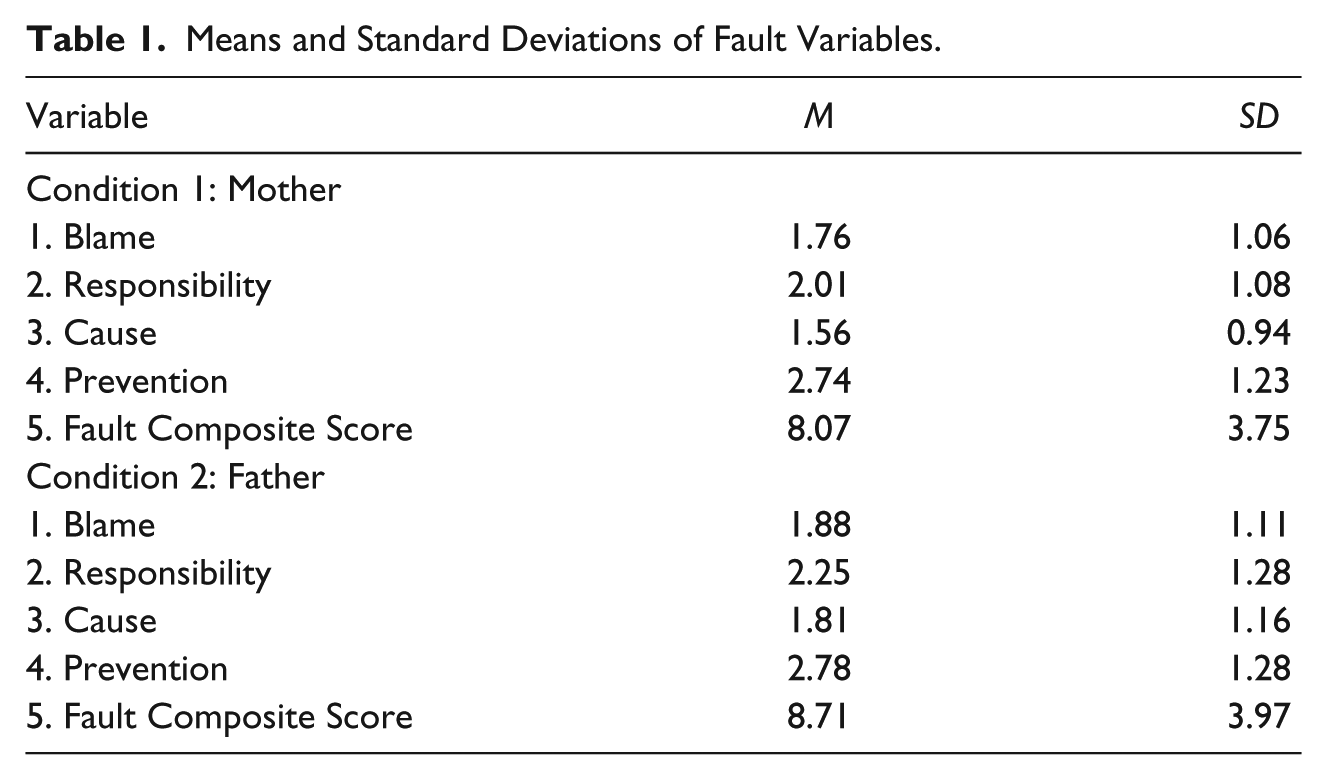
Averages and standard deviations of the four fault subscales (i.e., blame, responsibility, cause, and prevention) and the overall fault scores are located in Table 1. As shown, similar ratings occurred for all four dependent variables for each condition and overall fault attributions were relatively low. A multivariate analysis of variance (MANOVA) was used to compare blame, responsibility, cause, and prevention for mother and father vignettes. We found no significant difference between any of these dependent variables by condition (mother or father); Pillai’s Trace = .024, F(4, 149) = .910, p = .46. In addition, there was no significant difference in overall fault scores between the mother and father conditions, t(152) = −1.02, p = .31. That is, there were no significant differences in amount of blame, responsibility, cause, prevention, or overall parent fault between mothers and fathers of the CSA victim described in the vignette. Our hypothesis that mothers would be held at higher fault was not supported.
Means and Standard Deviations of Fault Variables.
Thematic Analysis of Open-Ended Responses Regarding Attributions
We used Braun and Clarke’s (2006) method of thematic analysis to compile overarching themes of how participants make (or do not make) attributions regarding blame, responsibility, cause, and prevention for CSA and what contributes to these attributions (or lack thereof). We approached our data using an inductive approach, given the lack of previous research in this area. That is, we did not begin our analyses with preexisting theory or hypotheses, and themes were, instead, linked to the data themselves. Phases 1 and 2 of analysis involved carefully reading through the data and generating initial codes. We decided that codes could be placed in multiple themes. In Phase 3, coded data were grouped into similar patterns so the codes could be viewed in aggregate to identify themes that ran throughout the codes. In Phase 4, we began reviewing themes to refine them and confirm that all codes were accounted for. At this point, themes were combined or eliminated. In Phase 5, themes were named and the meaning behind each theme was clarified. Following that, we did a detailed analysis for each theme, to indicate how each theme fits with the study as a whole.
Participants provided a total of 560 open-ended responses. Once data analysis was underway, it became clear that all four blame attributions (i.e., cause, responsibility, blame, and prevention), within each condition, had similar themes. In other words, participants’ explanations for their ratings of blame, responsibility, cause, and prevention were similar to one another within each condition (i.e., mother or father), consistent with our previously reported Cronbach’s alpha. Based on this, responses for the dependent variables were combined within each condition (mother or father) and analyzed together. Furthermore, when comparing the vignette conditions, the results of the thematic analysis indicated that participant fault attributions were similar for both mothers and fathers. More specifically, eight of the nine themes were found in both the mother and father open-ended response data sets. The only difference was the theme of Disbursement of Blame, which only arose in the father condition. All nine themes are outlined and described below (see Table 2 for summary).
Summary of Thematic Analysis Results.

Themes that increased parent fault
First, a number of themes were identified that broadly related to increased parent fault. That is, these attributions were used to justify why parents should be held at fault for their child’s CSA.
Parental responsibilities
The theme of Parental Responsibilities was categorized by responses that indicated both mothers and fathers have inherent responsibilities when it comes to taking care of their children (e.g., responsibility for child safety, protection, and well-being). Example responses from participants included the following: “A father is responsible for the safety of their children”; “He is Mary’s father, therefore he is responsible for whatever happens to her good or bad”; “All mothers are responsible to protect their children from harm,” “Mother is responsible for child’s well-being. . ..” Thus, given the responsibilities that go along with being a parent, both mothers and fathers were seen as not fulfilling these responsibilities and thus at fault for CSA experienced by their child.
Shouldn’t trust others
According to participants who used this attribution to assign fault, parents should be very careful who they trust with their child—If a chosen (i.e., trusted) caregiver harms a child in their care, then parents are held at fault for their misplaced trust in that caregiver. Some participants raised the expectation that parents not trust any alternative caregivers by always taking the child with them. For example, participants reported, “He shouldn’t have left the kid alone with her uncle, no matter how much he trusts him . . .”; “As he should not let the child go”; “Because he actually could have by not going out with the child’s mother and not let the uncle watch over the little girl he could have watched her more close than he was, don’t trust anyone”; “I agree she could have prevented it [a] little bit. If she were to keep an eye on the child at all times or made sure there was more than one adult with her besides the uncle”; and “She could have prevented it if she stayed at home with the child. Or took the child with her.”
Covert knowledge
The theme of Covert Knowledge encompassed the idea that a parent “should have known” about either the uncle’s propensity for CSA or that the CSA had occurred, despite not having concrete or overt knowledge of this. Responses included the following: “She probably could see there was something off about her brother”; “He should have known the kind of brother he has and past history of his [brother], should have given him clues that he should not leave his daughter [with] a bad brother”; “Father should have been aware of her uncle”; “It is her job to know what is happening even when she is not in the house. . .”; “He should have known better”; and “She should know what is going on and could have prevented [it]. . ..” There is the expectation that parents should be able to see covert signs, to sense, or be aware of clues and suspicious actions. If and when abuse occurs, parents are then held responsible for not having this covert knowledge or not acting on the covert knowledge to prevent/stop the abuse.
Education
There was an expectation, for both mothers and fathers, that a parent should be educating their child about CSA to either prevent or stop CSA. Thus, when CSA occurs, there is an assumption that a parent was not educating their child appropriately and fault is assigned. Participants indicated that this expectation of education includes both information on CSA as a preventive and protective measure (e.g., appropriate versus inappropriate touch) as well as an expectation for positive communication more generally: “She didn’t cause it but indirectly, the lack of communication between mother and daughter played a role in causing sexual abuse”; “The mother could have educated and told her what to do in these situations”; “Mother is responsible to educate her child about bad and good touch”; “I think the father could have took time to teach Mary what her red zones and green zones and where she can be touched and not touched. I think the father could have taught Mary that if she is uncomfortable that she should try to get out of the situation”; and “. . . I feel that Mary’s father could have taught her more about being in uncomfortable situations.”
Themes that decreased parent fault
Second, a number of themes were identified that broadly related to decreased parent fault. That is, these attributions were used to justify why parents should not be held at fault for their child’s CSA.
Trusted others
One such theme centered around the idea that parents should be able to trust the person they leave in charge of their child. More specifically, there was an assumption that parents tend to leave children with trusted adults and that when they do, this trust should be honored. Thus, when abuse occurs (i.e., that trust is violated), the parent is not responsible. For example, participants indicated, “The father had no influence over the uncle’s actions, and he left the child with a trusted adult. . .”; “. . . The mother trusted the uncle with the child and the uncle took advantage of that trust. . .”; and “How would the mother know the uncle was going to do that. She trusted him, which most people would.”
Lack of overt knowledge
Some participants’ responses indicated that when parents do not have overt knowledge of the abuse, or could not have known any other information, they should not be held at fault for CSA. For example, participant responses within this theme included the following: “He couldn’t have known what the Uncle was like”; “He should find trustworthy guardians, but has no way of knowing a relative is perverted”; “If the mother was unaware of the situation, then she should not be held responsible”; and “The mother could not be [held] responsible for what happened, either. She did not knowingly let the uncle do these things to her daughter. She couldn’t have known that’s what would happen.” When parents are considered to have no knowledge of the abuse, especially if there was no way they could have known, then parents were not found to be at fault for it.
Physical act
Participants indicated that because the mother or father did not physically sexually abuse the child, fault was reduced. That is, fault should be attributed to the perpetrator of the CSA only. Example responses given by participants that fell into the theme of Physical Act included the following: “Because it wasn’t the mothers fault. It was clearly the uncle who perpetrated the assault”; “I don’t think it was the fathers fault, unless he was also sexually abusing her but I didn’t see any indications”; and “Because she did not actually sexually abuse the daughter.” This theme provides support for the idea that the person at fault, or most at fault, is the perpetrator of the act of abuse and that nonperpetrators should not be held responsible.
Physically present
Participants in both the mother and father groups provided responses that indicated mothers and fathers were found to be less at fault for the CSA because they were not home. However, there was some variability in responses within this theme by parent gender. That is, for participants in the father condition, there was a consensus that because the father was not home during the time of abuse he was not at fault for it: “The father had no control over what the uncle had done while he was away”; and “Because he had nothing to do with this, he wasn’t at the house.” In the mother group, the majority of participants also provided responses indicating that because the mother was not home at the time of abuse, she was not at fault. For example, the majority of participants indicated similar responses to the father group such as, “She wasn’t even around when the sexual abuse happened so how could she have caused it?” “It was in no way the mothers fault since she was not there to prevent it”; and “The mother was not there so she was not a part of the abuse at all. She can’t cause the abuse when she wasn’t a part of it.”
However, it should be noted that a small minority of participants in the mother condition indicated that the mother not being at home should increase fault attributions. These participants believed the mother should have been home or would have been able to stop the abuse if she had stayed home. Example responses, in the minority, included the following: “Of course she could have prevented it if she was at home. . .” and “It is her job to know what is happening even when she is not in the house. . ..” As mentioned, no participants held the view that not being at home increased fault attributed to the father.
Disbursement of fault
Although the previous nine themes were mostly consistent in both the mother and father conditions (with the exception of lack of discussion of fathers not being home), the theme Disbursement of Fault emerged in the father condition only. Responses falling in this theme tended to disburse the fault for the abuse away from the father by indicating that other people were also responsible or that others were also at fault for the CSA. Example responses in the father group included the following: “Could equally be mother”; “I blamed the father a moderate amount although he is not the only one to blame. The mother could be someone to blame as well or other family members, there are many other factors involved”; and “I don’t disagree or agree because the father could be to blame but also other people could be to blame. I do not stereotype toward the fault of the father.” This discrepancy between themes in the mother and father conditions indicates that unlike considerations of blame toward a mother, when participants are asked about fathers specifically, independently of mothers, a more common approach to father fault attributions is to also consider others to be at fault, including the mother of the child, even though she is not explicitly mentioned in the vignette.
Discussion
The purpose of the current study was to compare rates of fault attributed to nonoffending mothers and fathers, independently, in response to CSA and to examine participant explanations of why they chose to either find or not find each parent at fault in a CSA scenario. This approach equally emphasizes attributions toward both mothers and fathers and addresses the methodological limitations of previous work in this area. We did so by combining quantitative analyses with a thematic analysis of open-ended responses explaining attributions of fault. Quantitatively, the results indicated that there was no significant difference between rates of fault between mothers and fathers. Overall, fault attributions assigned to both parents were low. Moreover, our qualitative analyses showed that participants in both conditions (mother and father) indicated similar reasons why parents were held at fault or not held at fault for CSA, with very few exceptions. Participant responses fell into nine themes in total. Eight of these themes were the same for both mothers and fathers, whereas the ninth theme was specific to reasons for fault attributions for fathers only. Four themes related to increased fault assigned to parents: Parental Responsibilities, Shouldn’t Trust Others, Covert Knowledge, and Education. In contrast, four themes related to decreased fault assigned to parents: Trusted Others, Lack of Overt Knowledge, Physical Act, and Physically Present. One theme, Disbursement of Fault, was reported only in the father condition and indicated a reduction in fault toward the father.
Disbursement of Fault Assigned to Fathers
The theme Disbursement of Fault was found as a main theme in only the father condition. Responses consistent with this theme did apply fault to the father but also explicitly mentioned that the father was not the only individual who participants assigned fault. This included responses that explicitly mentioned others who were held at fault, in addition to the father. Thus, reduced or disbursed fault, rather than “full fault,” was assigned to the father. That is, in this study of parental fault where mothers and fathers have been assessed separately, some participants seemed hesitant to fully assign fault for CSA and/or found it important to state they would spread blame among multiple individuals when considering a father’s potential fault. One potential explanation for this finding might be that despite changing dynamics of modern families and the changing role fathers play in child care (e.g., increase in child care responsibilities; Chesley, 2011; Statistics Canada, 2014), fathers are still not considered to be the “primary” parent who is solely responsible when negative events happen to his children. It is interesting to note, however, that this hesitancy to fully assign fault was not present for mothers. Our results indicated that participants either held or did not hold mothers at fault. Or, in other words, no participant responses disbursed fault assigned to mothers. This could reflect that mothers are still generally seen as primarily responsible for the events that occur to their children (Jackson & Mannix, 2004).
Interestingly, a number of participant responses in this theme explicitly mentioned the mother, despite the fact that the mother was not mentioned in the father condition vignette. Without being prompted, participants were including the mother in their responses to state that she should also be assigned fault for the CSA depicted in the vignette. Even when asked about father fault, participants were reporting that fault should also be assigned to the mother. This further supports the idea that mothers are considered primarily responsible for the negative events experienced by their children and supports Garey and Arendell’s (2001) suggestion that when participants are asked to consider parents, they still respond by considering mothers.
Unfortunately, our data cannot provide clarification regarding these possible interpretations. Furthermore, it is also possible that unmeasured variables or perceptions of the participants regarding details not explicitly stated in the vignette influenced their disbursement of blame away from the father. For example, previous research on mothers has identified a number of variables influencing blame, including her prior relationship with the child (Toews et al., 2019) and whether or not the parent believes the child’s allegation of CSA or supports the child afterward (Elliott & Carnes, 2001). Believing is particularly salient in situations such as that depicted in the vignette where a close family member is the CSA perpetrator (i.e., it can be more difficult to believe a family member is capable of CSA; Elliott & Carnes, 2001), although it is important to note that Elliott and Carnes (2001) found that the majority of mothers do believe their child’s allegation of CSA, often within the first hour of reporting. It will be crucial for future research on father fault to probe and assess participants’ thought processes regarding disbursement of fault to further understand this theme to understand why and how they disburse it.
Similarities in Mother and Father Attributions
Previous research examining fault attributions following CSA have, as previously discussed, primarily focused on mothers (M. Davies et al., 2013; Ford et al., 2001; Harding et al., 2010), which is consistent with a comparative lack of research on fathers generally (Phares, 1992; Phares & Compas, 1992; Phares et al., 2005). Some research has attempted to study parents as a unit (Hestick & Perrino, 2009; Rogers, Davies, et al., 2011; Rogers, Wezasek, et al., 2011; Zinzow et al., 2010) or used within-subjects designs to assess one parent first and then the other (Back & Lips, 1998; Waterman & Foss-Goodman, 1984). In contrast, our research utilized a between-subjects design to separately assess mother and father fault attributions, allowing us to truly examine these attributions independently of the other parent. Interestingly, both our quantitative and our qualitative analyses indicate that, overall, mothers and fathers are not held to different levels of fault following CSA and that participant explanations for these attributions (either increasing or decreasing fault) are relatively similar for mothers and fathers, with eight of our nine themes applying to both.
Overall, our results indicate that both mothers and fathers are both held to similar levels of fault and have similar expectations placed on them in relation to the child’s safety, well-being, choice of child caregivers, expectations for knowledge about their children, and responsibility for educating their child about CSA. When these responsibilities are not met, and a child is harmed, fault is attributed to the parents. This likely reflects a change in family dynamics over the last few decades with modern families seeing fathers play a larger role in child care responsibilities (Chesley, 2011). Therefore, it stands to reason that expectations of fathers, given their increased role in their child’s life, would also be similar to expectations of mothers who have traditionally held the role of primary caregiver. Previously, researchers have argued that mothers specifically, as primary caregivers, have certain expectations that, when not met, can lead to mother blaming attitudes (L. Davies & Krane, 1996). This too could be a possibility for fathers who are primary caregivers and is supported by the current results.
Consistency With Previous Research
Overall, our results mostly replicate previous, yet outdated, work examining attributions of fault for mothers but also extend these results to fathers. For example, Zagrodney and Cummings (2020) also reported themes related to overt and covert knowledge, trust/mistrust, and a focus on who the actual perpetrator was of the CSA when considering increasing and decreasing mother blame. However, the current study also extends these themes to fathers. Previous research has also identified education as being of importance to participants when assigning fault attributions, again for mothers. Toews and colleagues (2019) found that participants’ attributions were impacted by the education, or lack of education, about CSA that a mother gives to her child. Participants expressed the need for education to ensure that children know how to deal with sexual abuse because sexual abuse is common, if not expected. If the mother is not proactive in preparing her child, through education about CSA, she is more deserving of blame.
Potentially Contradictory Themes
Although Trusted Others (expressing the belief that parents should be able to trust the person they leave their child with and are not at fault if CSA occurs) seems to be in conflict with Shouldn’t Trust Others (parents shouldn’t trust other people with their child), it is possible that each of these themes focus on different constructs. Specifically, Trusted Others might be tapping into expectations of parents that occur before abuse, whereas Shouldn’t Trust Others might be tapping into expectations of parents after abuse. For example, in Trusted Others, there is an expectation placed on parents to find a trusted person before leaving the child alone. Once someone is chosen as trustworthy, there is an expectation that they are trusted and thus, the parents are not at fault. However, in the theme of Shouldn’t Trust Others, the meaning behind the expectation might be that if CSA has already occurred, the person watching the child wasn’t trusted/shouldn’t have been trusted and thus, should not have been left with the child. No previous research has examined fault attributions at various stages of CSA (e.g., before, during, and after the abuse). However, our results indicate that it could be possible that expectations of parents differ for different stages of an abuse scenario that might differently influence fault attributions. Future research in this area is warranted.
It seems that interpretation of the themes of Lack of Overt Knowledge (i.e., the parent would have no way of knowing about the abuse) and Covert Knowledge (i.e., the parent should have known or been able to “sense” the abuse) could be at odds. On one hand, some participants believe that without overt knowledge of the abuse, the parent is not at fault. On the other hand, there also seems to be this expectation that parents are able to pick up on warning signs, or be able to “sense” or “see” abuse, without overt knowledge. However, although it is only speculation, it is also possible that there is an underlying assumption within the theme of Covert Knowledge, specifically, that there are covert signs to be seen in some cases.
Working under this assumption, the themes of Lack of Overt Knowledge and Covert Knowledge may be complementary. When signs exist, then yes, parents would be at fault. They would have been able to turn an initial sensory ability, to “sense” abuse, into more concrete information (e.g., overt knowledge) by looking for warning signs. This is consistent with Coohey and O’Leary’s (2008) application of Crittenden’s cognitive theory of information processing to CSA situations, in which mothers must be made aware of the abuse to take steps to protect their child. Coohey and O’Leary (2008) also reported, consistent with Physical Act, that blaming the perpetrator of the CSA was predictive of mothers taking steps to protect their child following CSA. However, it is also possible there are situations when initial covert knowledge is not possible, and thus, no blame would occur. The idea that a parent can do everything in their power to know about abuse (e.g., be on alert for Covert Knowledge) and yet have no idea of the abuse (Lack of Overt Knowledge) is not mutually exclusive. More specifically, parents can be held to the expectation that they do their research and take precautions in a way that would increase knowledge about abuse or potential abuse but still miss the information. However, future research will need to explore this theory to better examine and gain a more in-depth understanding of specific expectations of parents and what this means for fault attributions when these expectations are met.
Implications
One of the main implications of the current research is evidence of at least some shift toward equal expectations of parents in CSA fault attributions. As outlined above, the focus of previous research has primarily been on the expectations of mothers. Jackson and Mannix (2004) argue that the mother is held responsible for the well-being of their children beginning with the child’s conception and this responsibility endures through the child’s entire life, into adulthood. Even more recent research demonstrates that mothers are still held to unrealistic standards. Mothers are expected to “never trust anyone” with their child (Toews et al., 2019; Zagrodney & Cummings, 2020) and thus, if CSA occurs, mothers are to blame. Furthermore, mothers should only participate in extracurricular activities that are for the betterment of the child or the family. Mother blame attributions are also impacted by the reputation she has with other people; if the mother is seen as responsible and safe, she is not to blame (Toews et al., 2019). Coakley (2006) argues that one of the major changes in parenting expectations (for both the mother and father) in the recent past is that parents are now expected to know where their child is 24 hr of the day. This change in expectation has brought with it a change to the function of families. Specifically, Coakley (2006) notes that it is now expected and common that children are consistently supervised and this has been brought forth by an increase in child activities such as afterschool clubs and organized sports. Moreover, as fathers begin to find more value in staying at home with their child, this increased involvement works to reduce gender differences in parenting (Chesley, 2011). Our results indicate that as expectations for both parents become similar, so too does the possibility for equal fault attributions when CSA occurs, as indicated by the similarities in themes across gender. However, our results regarding Disbursement of Blame demonstrate that assigning fault is still not “equal” across genders.
A second implication of our results, as with mothers, is that fault attributions might be a barrier to help-seeking behaviors for fathers, given that almost no differences were found in such attributions between the mother and father conditions. Previous research has demonstrated that when mothers are blamed for CSA, this fear of blame is linked to a reduction in help-seeking behavior (Jackson & Mannix, 2004), having serious consequences for both the mother and victimized child. Thus, if fault attributions are also assigned to fathers, it stands to reason that fathers might also worry about being blamed and not seek help. To our knowledge, no research has examined father help-seeking after CSA. It will be important for future research to closely examine the experiences of nonoffending fathers, help-seeking behavior, and their needs for resources, as this might be an important avenue of familial support after CSA that is being overlooked.
Strengths, Limitations, and Future Research
As previously discussed, the main advantage of our study was its independent measurement of mother and father fault for CSA, using a between-subjects design to avoid carryover effects. In addition, our complementary quantitative and qualitative examinations allow us to compare and contrast these sources of information. One limitation of our experimental results is that participants assigned relatively low fault attributions across both parents, raising the possibility that the lack of statistically significant differences is due to low ratings and lack of variability. However, our qualitative results indicated that both mothers and fathers are generally held to equivalent expectations regarding fault for CSA. This speaks to the importance of multimethod assessment of variables such as parent fault. More in-depth investigation would help to better understand the complexities of this topic. Furthermore, although extraneous variables that have been shown to impact fault attributions in CSA were purposely left out of the current vignette, it is still possible that participants assumed certain variables about the CSA scenario that were absent (e.g., child age, parent belief, prior relationship between parent and child) and were influenced by these assumptions. Future research would benefit from the use of more complex vignettes with manipulation of additional variables.
Another potential limitation to the present study is the sample of undergraduate students that was used. Although undergraduate samples are commonly used in CSA research (Back & Lips, 1998; Harding et al., 2010; Waterman & Foss-Goodman, 1984), undergraduate samples are a specific subset of the population, and thus, the results of this study might not be generalizable to the population at large or preclude demographic characteristics that might influence ratings of parental fault, such as whether or not the participants themselves are parents. Replicating this study with a community-based sample or a specific sample of parents is an important next step. More specifically, given the homogeneity in our sample’s ethnic diversity, we were unable to draw conclusions regarding the impact of such diversity on these results. Future studies should consider replicating this research with other populations to gain a better understanding of the generalizability of the results.
Future research should also examine parent fault attributions among professional groups such as psychologists, social workers, psychiatrists, and other professionals that are typically associated with CSA. Previous research has identified the tendency to blame mothers among such professional groups (Ford et al., 2001; Reidy & Hochstadt, 1993). However, no research to our knowledge has examined fault attributions toward mothers and fathers among professionals, independently. By understanding parent fault in CSA, future research can work to decrease these attributions and thus increase the accessibility of services. In addition, as outlined above in the themes of Trusted Others and Shouldn’t Trust Others, it is unclear whether participants are responding to expectations of parents occurring before, during, or after CSA occurs. Future research needs to examine fault attributions within these different time periods to better understand expectations of parents.
Conclusion
In conclusion, although previous research examining fault for CSA has focused primarily on nonoffending mothers, our results indicate that similar expectations apply to nonoffending fathers. Quantitatively, participants assign similar levels of blame, cause, responsibility, prevention, and overall fault to both mothers and fathers of CSA victims. Furthermore, our thematic analysis of participants’ justifications of their attributions indicates similar expectations influence increases or decreases in assigned fault, regardless of parent gender. That is, participants assign fault when considering parents’ responsibilities for child care, when they believe parents should not trust other caregivers, when participants expect mothers and fathers to have covert knowledge of negative events that impact their children, and when it is expected both parents educate children about potential trauma. Likewise, similar justifications are given for alleviating fault: that parents should be able to trust chosen care providers, that explicit knowledge of trauma is required to be responsible for its outcomes, that only perpetrators of CSA are ultimately responsible for it, and that not being present at the time of CSA precludes being held at fault for it. The only difference between participants’ views of mothers’ and fathers’ fault for CSA was when participants disbursed fault away from fathers to include others, including mothers—even when not mentioned in the vignette—as responsible for CSA. This is consistent with previous findings that considerations of “parents” are often really a consideration of mothers (Garey & Arendell, 2001). Overall, however, our results show that expectations for nonoffending parents of CSA victims are much more similar than different.
Footnotes
Acknowledgments
The authors would like to thank Caitlin Faas for her assistance with this article.
Declaration of Conflicting Interests
The author(s) declared no potential conflicts of interest with respect to the research, authorship, and/or publication of this article.
Funding
The author(s) disclosed receipt of the following financial support for the research, authorship, and/or publication of this article: This project was supported by a Saskatchewan Health Research Foundation Establishment Grant and a Social Sciences & Humanities Research Council of Canada Insight Development Grant, both awarded to the second author.