



Abstract
There is consistent evidence that attitudes are important in understanding how people react and behave toward victims and perpetrators of intimate partner violence against women. Researchers have typically measured these attitudes through self-reports. However, explicit measures are prone to socially desirable responding. The overall objective of our research is to provide multimethod measures of public attitudes (explicit and implicit) toward intimate partner violence against women. An opportunity sample of 190 Psychology undergraduates (32 men and 158 women) took part in this study and completed two self-reports: the Inventory of Distorted Thoughts about Women and Violence, and the Inventory of Beliefs about Wife Beating. In addition, they completed a personalized Implicit Association Test, the Gender Violence Implicit Association Test. This study provides evidence of the best way to apply the Gender Violence Implicit Association Test (with feedback) and the best procedure for estimating the Implicit Association Test effect (built-in error penalty). The findings are also consistent with previous research and exhibit a significant disparity between explicit and implicit measures of attitudes toward intimate partner violence against women. These findings, although still preliminary, provide interesting information that affirms the need to incorporate implicit measures of attitudes toward intimate partner violence against women into research on this social problem.
Keywords
Introduction
Physical and sexual violence is a social and public health problem of epidemic proportions, which affects more than one third of all women globally (Devries et al., 2013; European Union Agency for Fundamental Rights [FRA], 2014; Stockl et al., 2013). One of the most common forms of violence targeting women is perpetrated by a current or former intimate partner (Ellsberg, Jansen, Heise, Watts, & Garcia-Moreno, 2008; Garcia-Moreno, Jansen, Ellsberg, Heise, & Watts, 2006), referred to as intimate partner violence against women (IPVAW; Gracia, Rodriguez, & Lila, 2015; Martin-Fernandez, Gracia, Marco, Vargas, Santirso, & Lila, 2018; Rodriguez & Khalil, 2017; Uthman, Moradi, & Lawoko, 2010, 2011).
Previous research has shown that attitudes can be important predictors of behavior (Glasman & Albarracin, 2006) and, more specifically, important determinants of a variety of violent behaviors. When it comes to IPVAW, there is consistent evidence of three important implications of attitudes relating to this violence (Flood & Pease, 2009; Gracia & Lila, 2015; Gracia et al., 2015; Gracia & Tomás, 2014; Heise & Kotsadam, 2015; Wang, 2016): (a) Attitudes have a fundamental and a causal relationship to the perpetration of violence against women. Specifically, there is a consistent relationship between men’s adherence to sexist, patriarchal, and sexually hostile attitudes and their use of this violence (Capaldi, Knoble, Shortt, & Kim, 2012; Fulu, Jewkes & Garcia-Moreno, 2013; Jewkes, Flood, & Lang, 2015; Puente, Ubillos, Echeburua, & Paez, 2016). (b) Women’s responses to this victimization (to blame themselves for the assault, to report it to the police, to experience negative psychological and emotional effects) are shaped by their own attitudes (Harris, Firestone, & Vega, 2005; Puente et al., 2016) and those of others around them (Kingsnorth & MacIntosh, 2004). (c) Attitudes play a role in the formal and informal responses to IPVAW adopted by family members, friends, or professionals (Gracia, Garcia, & Lila, 2014). In fact, attitudes and responses regarding this violence play a role in shaping the social climate in which the violence occurs, a social climate that can contribute to either perpetuating or reducing the levels of violence in the society (Flood & Pease, 2009; Gracia et al., 2015). In summary, a social environment that accepts or even supports this violence in some circumstances contributes to creating a climate of tolerance that makes it easier for perpetrators to persist in their violent behavior and makes it more difficult for female victims to report the violence they suffer.
Two different approaches have been used to generally assess attitudes (Gawronski & Bodenhausen, 2006). First, prior research has assessed attitudes with traditional methods, such as self-reports. The success of these methods is partly due to their ease of administration, cost-effectiveness, and ability to provide rich sources of information for attitudes that are frequently referenced by an individual (Paulhus & Vazire, 2007). However, given that explicit self-report methods are prone to socially desirable responding, it is plausible that an effect derived from responses to self-report measures may underrepresent the relationship between attitudes and behavior (Fazio & Olson, 2003; Nosek, 2005; Ryan, 2013; Scott & Straus, 2007), supporting the need for alternative methods of attitude assessment. For this reason, and to counteract this situation, some researchers have used implicit methods of assessment. While explicit methods require a direct response to an item on a questionnaire, implicit methods measure attitudes at an indirect level and provide another way to index attitudes related to specific behaviors. However, the issue of congruency or noncongruency of implicit and explicit measures is highly complex and is considered differently in diverse theoretical approaches. Moreover, research has, in general, found minimal relationships between both types of measures (Echebarria, 2013; Fazio & Olson, 2003).
The implicit measures of attitudes, and Implicit Association Test (IAT) in particular, have emerged dramatically over the past decade and been applied to several areas of social cognition (Payne & Gawronski, 2010). The IAT (Greenwald, McGhee, & Schwartz, 1998) is a latency-based computer task that pairs a bipolar target category (e.g., violence vs. nonviolence) with a bipolar evaluative attribute (e.g., negative vs. positive) on the same keystroke over the course of many trials. The fundamental principle is that when two concepts that are strongly associated (e.g., “violence” and “negative”) share the same key, the reaction time (RT) is less than when this is not the case (e.g., “violence” and “positive”). In summary, the IAT is a measure of implicit cognition that assesses the strength of cognitive associations by comparing RTs to different pairings of concepts. It is also considered a valid measure of implicit processing in that the psychological attributes of the individual are inferred from the speed with which the participants respond to stimuli in the categorization task (De Houwer, Teige-Mocigemba, Spruyt, & Moors, 2009).
These implicit measures, such as the IAT, have been used to assess attitudes and to try to predict violent behaviors in different types of violence, such as rape (Süssenbach, Albrechet, & Bohner, 2017), sexualized violence (Larue et al., 2014), or dating violence (Lee, Begun, DePrince, & Chu, 2016), and among different violent perpetrators (Bluemke et al., 2017; Simane-Vigante, Plotka, & Blumenau, 2015). In addition, they have been used to predict treatment outcomes in sexual and intimate partner offenders (Eckhardt & Crane, 2014).
In terms of IPVAW, researchers have typically measured attitudes with explicit measures by having people complete self-report questionnaires (Gracia & Lila, 2015; Gracia et al., 2015), while only a few studies have used IAT measures to assess attitudes toward intimate partner violence. For instance, Robertson and Murachver (2007) examined offenders’ attitudes toward violence using an IAT measure in a sample of 39 participants incarcerated for intimate partner violence, as well as 133 nonincarcerated participants who served as a comparison group. The incarcerated sample had significantly more positive attitudes toward violence, measured by IAT. However, the attitudes in both sample groups toward violence were more similar when measured explicitly. In fact, one of their conclusions was that the disparity between measures exemplified the need to include implicit measures when assessing attitudes that are not publicly accepted. In a sample of 50 men from an IPVAW intervention program and 40 nonviolent men from the community used as a comparison, Eckhardt, Samper, Suhr, and Holtzworth-Munroe (2012) obtained similar results by using three IAT measures to examine attitudes toward women, violence, and the associations between gender and violence. They found that offenders had significantly more positive attitudes toward violence, measured by IAT, as well as stronger associations between women and violence. In contrast, no significant differences were found between samples on the self-report attitudes measurement. These authors suggest that self-report measures to assess violence-related attitudes among IPVAW offenders are limited by their tendency to defend themselves, to deny or minimize their violent behavior, and to disguise their inclination to use violence. In a Spanish context, IAT has been used in some research by Cantera et al. (Cantera & Gamero, 2012; Cantera & Blanch, 2010) to assess the degree of social attachment of certain stereotypes about gender (men as providers and females as caregivers) and violence (violent men, peaceful women), framed in the context of a debate on the extent and limits of a gender approach when it comes to understanding and preventing intimate partner violence. More recently, Gracia et al. (2015) developed a new analogue visual task assessing acceptability of physical violence toward women in intimate relationships and observed that perpetrators scored significantly higher in this acceptability than undergraduate students.
In short, most studies examining the predictive validity of measures for public attitudes toward IPVAW have not included both implicit and explicit measures jointly. Consequently, the general objective of our research is to provide multimethod measures for public attitudes toward IPVAW (explicit and implicit). To achieve this goal, the first step would be to have a valid and reliable measurement tool. Our hypothesis is that these implicit measures, neutralizing the effects of social desirability and the response control of the subjects, will allow for more adequate assessments. This article presents preliminary results obtained in a pilot study from the designed multimethod measures.
It is important to note that in the Spanish context, IPVAW is deemed gender violence (see Ferrer & Bosch, 2014). Accordingly, the preamble to the Act on Comprehensive Protection Measures against Gender Violence (Organic Act 1/2004 dated December 28) points out that IPVAW is a social problem and a form of gender-based violence. In addition, and unlike what occurs in other international contexts, gender violence is limited to acts perpetrated by men against women in an intimate relationship (i.e., it calls gender violence to IPVAW). Although the decision to use this name gave rise to a major controversy in Spain (Puleo, 2008), it has been maintained ever since. In line with this practice, our experimental work uses the term gender violence to refer to IPVAW and to define the target category of the designed IAT.
Method
Participants
An opportunity sample of 190 Psychology undergraduates from two Spanish universities took part in this study—32 men (18.8%) and 158 women (83.2%)—with an average age of 20.01 years (SD = 4.41; range: 18-30). Of these, 60.5% studied some topic related to IPVAW and 55.3% participated in at least one noncurricular activity related to IPVAW; 93 participants (48.9%) reported that they had a partner, and 96 (50.5%) had no partner.
Measures
The Inventory of Distorted Thoughts about Women and Violence (IPDMV in the Spanish acronym, Echeburua & Fernandez-Montalvo, 1998; adapted version of Ferrer, Bosch, Ramis, Torrens, & Navarro, 2006) comprises 24 items, with a 4-point response scale and four dimensions: the inferiority of women compared with men (seven items, α = .88), blaming female victims of abuse (eight items, α = .66), violence as an appropriate problem-solving strategy (five items, α =.70), and minimization of IPVAW as a problem and exoneration of the abuser (four items, α = .52). Higher scores indicate higher levels of distorted thoughts.
The Inventory of Beliefs about Wife Beating (IBWB, Saunders, Lynch, Grayson, & Linz, 1987; Spanish version of Expósito & Ruiz, 2010) is a 30-item self-report scale designed to assess participants’ explicit attitudes toward wife beating, which comprises five dimensions: wife beating is justified (12 items, α = .86), wife gains from beating (seven items, α = .78), help should be given (five items, α = .73), offender should be punished (three items, α = .61), and offender is responsible (four items, α = .62). Some of these subscales have been recently used in Spanish populations with similar psychometric indicators (e.g., Gracia et al., 2015; Valor-Segura, Expósito, Moya, & López, 2014). The response format was adapted into a 4-point scale, with scores from the latter three dimensions being reversed so that higher scores indicate a greater justification of abuse.
Despite the relatively low reliability of some of the above-mentioned subscales (and, particularly, in the minimization of IPVAW as a problem and exoneration of the abuser IPDMV’s scale), they can be considered appropriate enough for the purpose of the present study because even values around .50 can be acceptable in some cases, such as basic research studies (Ferrer et al., 2006; Guilford, 1954; Schmitt, 1996).
The Gender Violence Implicit Association Test (GV-IAT; Ferrer-Perez, Sanchez-Prada, Delgado-Alvarez, & Bosch-Fiol, 2018) is a form of personalized IAT (the GV-IAT), used as an implicit measure of public attitudes toward IPVAW. The target categories were Gender Violence versus Non-Gender Violence, and the attribute categories were Good versus Bad. Six words from each of the aforementioned categories were used as stimuli: (a) Attack, Force, Humiliate, Hit, Torture, and Infringe for the category Gender Violence; (b) Support, Collaborate, Cooperate, Empathize, Respect, and Tolerate for the category Non-Gender Violence; (c) Wonderful, Excellent, Phenomenal, Best, Positive, and Optimum for the category Good; (d) Horrible, Terrible, Disastrous, Worst, Negative, and Appalling for the category Bad. Stimuli were displayed on a 20-inch screen with a PC running OpenSesame v.3.1.6 (Mathôt, Schreij, & Theeuwes, 2012) on Windows 8. Participants completed the GV-IAT task in seven blocks (Greenwald, Nosek, & Banaji, 2003), from which three were considered practice trials (B1-B2 included 24 trials; B5 included 48 trials) and four were the critical blocks (B3-B6 included 24 trials; B4-B7 included 48 trials).
Procedure
The study was approved by the Bioethics Committee of one of the participating universities, and experimental sessions took place in the labs at each university. Upon arrival, participants were asked to read over the study description and consent form. After providing their informed consent to voluntary participation in the study, the participants completed the IAT and, thereafter, the two questionnaires.
During the IAT blocks, stimuli were presented in the middle of the screen with a black background. In each trial, participants had to press a computer key (left or right) as quickly as possible to sort the stimulus into one of the two (target or attribute) categories displayed on the left and right side of the screen. The presentation order for stimuli was randomly controlled across participants, and the position on the screen of target categories was counterbalanced (half times left; half times right).
For exploratory purposes, according to the literature review, two frequently used IAT procedures were tested (Nosek, Bar-Anan, Sriram, Jordan, & Greenwald, 2014; Nosek, Greenwald, & Banaji, 2007): the typical IAT procedure (with feedback), and the personalized IAT procedure (without feedback). The typical IAT procedure (Greenwald et al., 1998) includes the provision of immediate feedback when the participant has made an error (at which point the user is forced to enter the correct choice before advancing to the next trial). This feedback might suggest that there is a normatively correct response (Olson & Fazio, 2004). These factors might increase the accessibility of normative information relevant to solving the mapping problem posed by the IAT, leaving attitudes as only one of several potential types of associations that influence performance on the mapping tasks. For these reasons, Olson and Fazio (2004) developed a personalized IAT, which among different characteristics did not include error feedback (participants did not receive feedback, and the IAT went on, even after an erroneous response, with no correction required). Participants were randomly assigned to one of these two IAT conditions: 79 women and 10 men to the condition with feedback, and 79 women and 22 men to the condition without feedback.
D-Scores Algorithm
The fundamental principle of the IAT is that the RT is less when two concepts are strongly associated than when this is not the case. Based on those response latencies, Greenwald et al. (2003) proposed the D score as an estimate of the IAT effect, whose interpretation is similar to Cohen’s d. The optimization of reliability and validity of this algorithm has received much attention in IAT research (e.g. Blanton, Jaccard, & Burrows, 2015; Fazio & Olson, 2003; Glashouwer, Smulders, de Jong, Roefs, & Wiers, 2013; Greenwald et al., 2003; Nosek et al., 2014; Nosek et al., 2007). Taking into account the authors’ recommendations, D scores were calculated as follows: (1) Use data from Blocks 3, 4, 6, and 7; (2) eliminate trials with latencies >10,000 ms; (3) eliminate subjects for whom more than 10% of trials have latencies <300 ms; (4) compute one standard deviation for all trials in Blocks 3 and 6, and another standard deviation for all trials in Blocks 4 and 7; (5) compute means for trials in each of the four blocks (Blocks 3, 4, 6, 7); (6) compute two difference scores (one between 3 and 6 and the other between 4 and 7), subtracting what is intended to represent the high (positive) end of the measure from the block containing associations representing the low end; (7) divide each difference score by its associated standard deviation from Step 4; and (8) average the two quotients from Step 7. (Nosek et al., 2007, p. 273)
Regarding the topic of error latencies treatment, a deeply discussed issue in the IAT literature, two procedures recommended in the literature were implemented for exploratory purposes: (a) replacing each error latency with the mean of correct latencies for the respective block, adding a 600-ms error penalty (Nosek et al., 2007), and (b) integrating a “built-in penalty” in error latencies by computing the accumulated time of the wrong response and the time spent in correcting that first response (Greenwald et al., 2003; Nosek et al., 2014; Richetin, Costantini, Perugini, & Schönbrodt, 2015). The first procedure was applied to IATs both with and without feedback; the latter, as per its definition, was applicable only to the condition with feedback.
Results
Implicit Measures
Positive D scores in GV-IAT indicate implicit rejection of gender violence: The higher the values, the stronger the rejection (Ferrer-Perez et al., 2018). According to the scores obtained in the two IAT procedures tested (without feedback and with feedback), the former being calculated by the two algorithms tested (error penalty and built-in error penalty), participants were classified into four levels of rejection, according to D intervals highlighted by collaborators of the Harvard Project Implicit (Ayala & Martinez, 2013; see Table 1).
Frequency Distribution of IAT Effects.
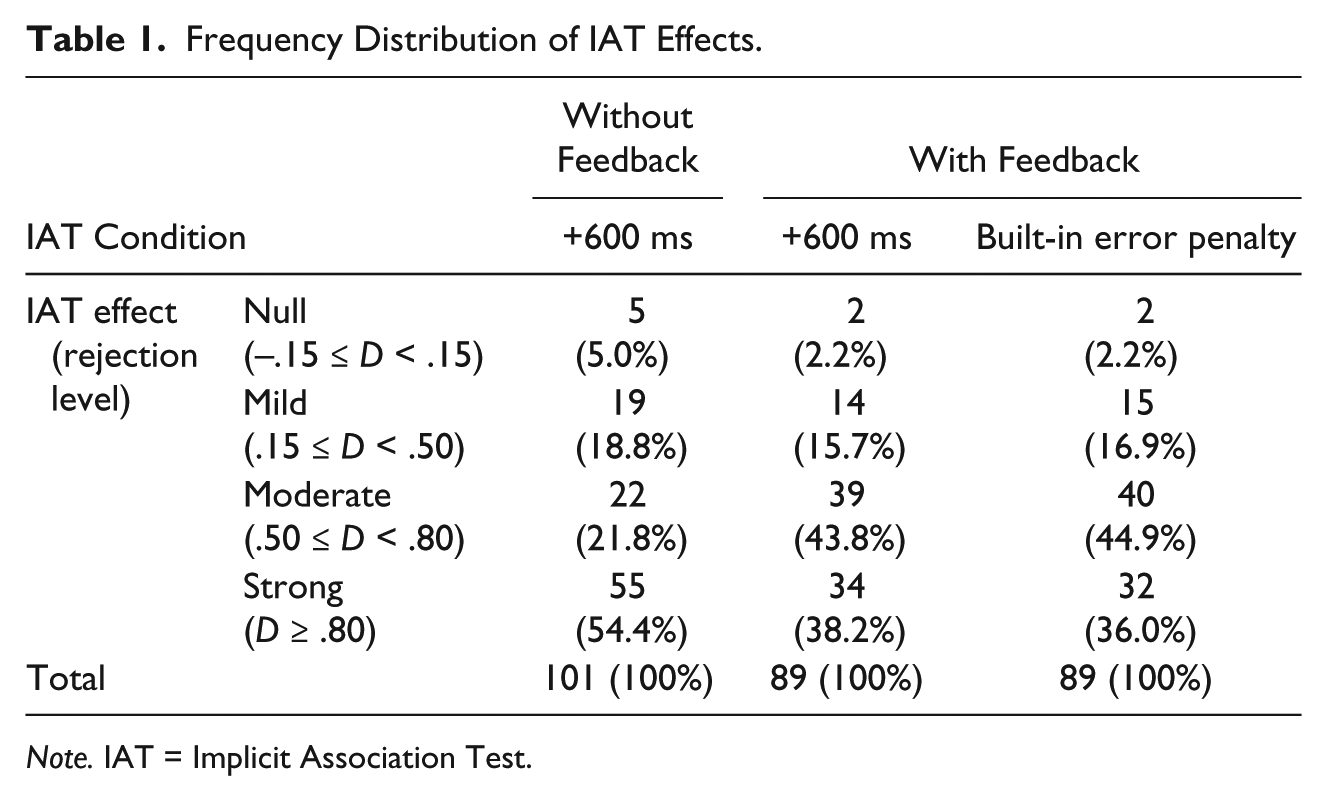
Note. IAT = Implicit Association Test.
The results obtained showed that the classification by categories varies according to the IAT application condition (without feedback vs. with feedback), but not according to the D-scores algorithm used. In the condition without feedback, the strong IAT effect (54.4% of participants showing strong rejection) was overestimated compared with the condition with feedback, which provided similar distributions to both algorithms. These results coincide in “using the IAT, in which respondents are not required to correct errors, is not recommended practice” (Nosek et al., 2014, p. 18). Therefore, these results provide evidence of the best way to apply the GV-IAT. Consequently, the comparisons between implicit and explicit measures were performed using D scores from the condition with feedback, including built-in error penalty—the most recommended procedure to maximize validity (Greenwald et al., 2003).
Explicit Measures Versus Implicit Measures
To classify participants by their explicit rejection of gender violence, four categories were established: scores ≤2 (disagreement) were categorized as strong rejection, scores between 2 and 2.5 (near-disagreement) as moderate rejection, scores between 2.5 and 3 (near-agreement) as mild rejection, and scores ≥3 (agreement) as null rejection.
The explicit measures yielded high percentages of strong rejection, except in the IBWB dimension offender is (not) responsible (Table 2; 40.4%) and in the IPDMV dimension minimizing violence and exoneration of the abuser (Table 3; 29.2%). These measures described a sample with a strong explicit rejection of gender violence (88.8% of respondents in the IPDMV; 96.3% in the IBWB). In contrast, the implicit measure reduced strong rejection to 36%.
Implicit and Explicit Measures of Gender Violence Rejection (IBWB).
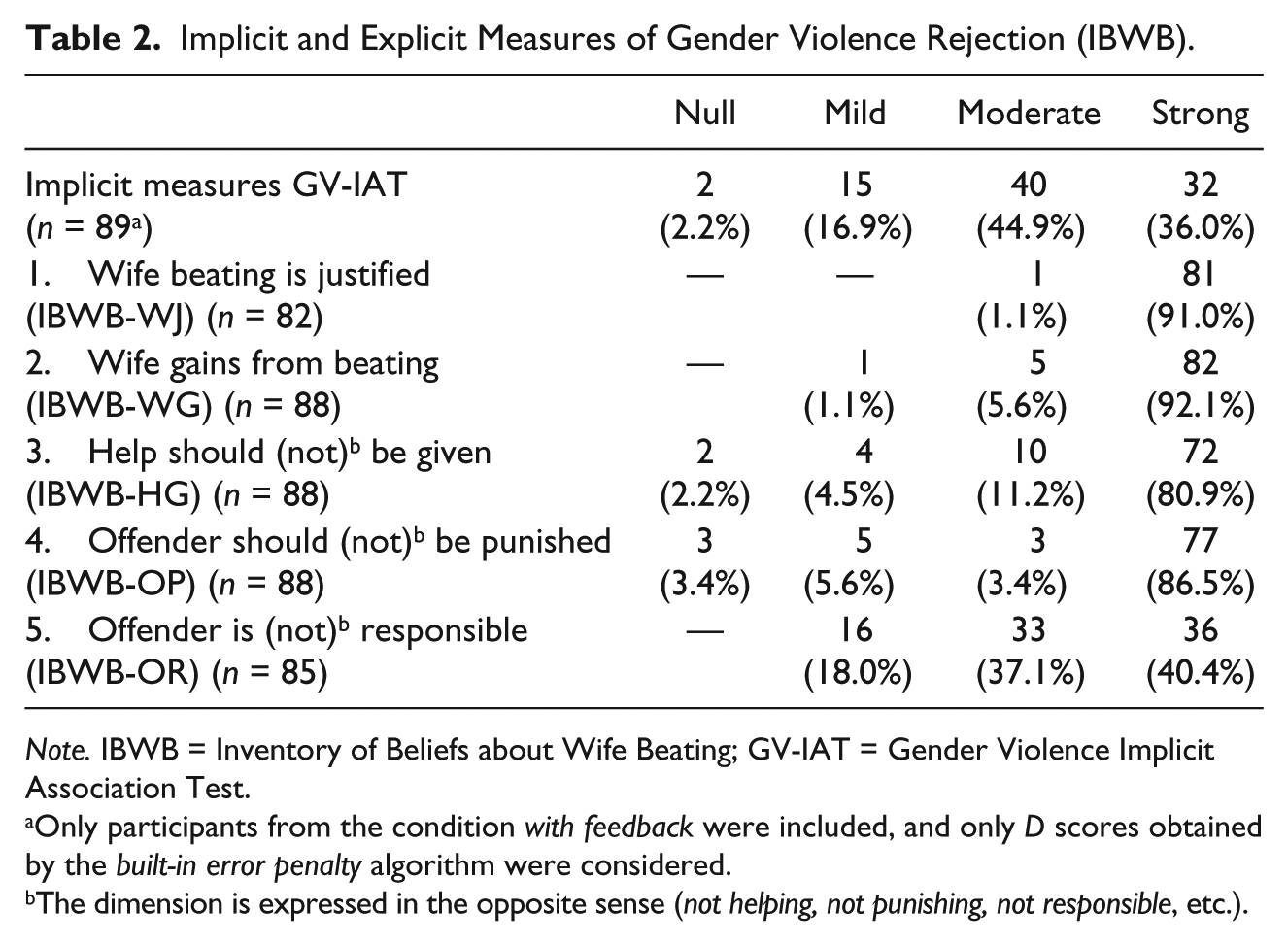
Note. IBWB = Inventory of Beliefs about Wife Beating; GV-IAT = Gender Violence Implicit Association Test.
Only participants from the condition with feedback were included, and only D scores obtained by the built-in error penalty algorithm were considered.
The dimension is expressed in the opposite sense (not helping, not punishing, not responsible, etc.).
Implicit and Explicit Measures of Gender Violence Rejection (IPDMV).

Note. IPDMV = Inventory of Distorted Thoughts about Women and Violence; GV-IAT = Gender Violence Implicit Association Test.
Only participants from the condition with feedback were included, and only D scores obtained by the built-in error penalty algorithm were considered.
The chi-square test shows no significant relationship between the participants’ classification by implicit measures and their classification by explicit measures, as shown in Table 4. The independence between the implicit and explicit dimensions evaluated suggests that they are different constructs (Nosek et al., 2014; Nosek & Smyth, 2007).
Relation Between Implicit and Explicit Measures of Gender Violence Rejection (χ2).

Note. IBWB = Inventory of Beliefs about Wife Beating; IPDMV = Inventory of Distorted Thoughts about Women and Violence; GV-IAT = Gender Violence Implicit Association Test; WJ = wife beating is justified; df = degrees of freedom; IW = inferiority of women compared with men; WG = wife gains from beating; BW = blaming women victims of abuse; HG = help should (not) be given; VP = violence as problem-solving strategy; OP = offender should (not) be punished; MA = minimization and exoneration of abuser; OR = offender is (not) responsible.
Focusing only on the sample segment with strong explicit rejection to IPVAW (79 of a sample of 82 when the rejection is measured by IPDMV and 77 of a sample of 79 when it is measured by IBWB), Figure 1 shows that the distribution to the implicit rejection for these two subsamples is identical in both cases: null in 2.5% (n = 2 in IPDMV and IBWB), mild in 16.5% (n = 13 in IPDMV and IBWB), moderate in about 42% (n = 33 in IPDMV and n = 32 in IBWB), and strong only in about 39% (n = 31 in IPDMV and n = 30 in IBWB).
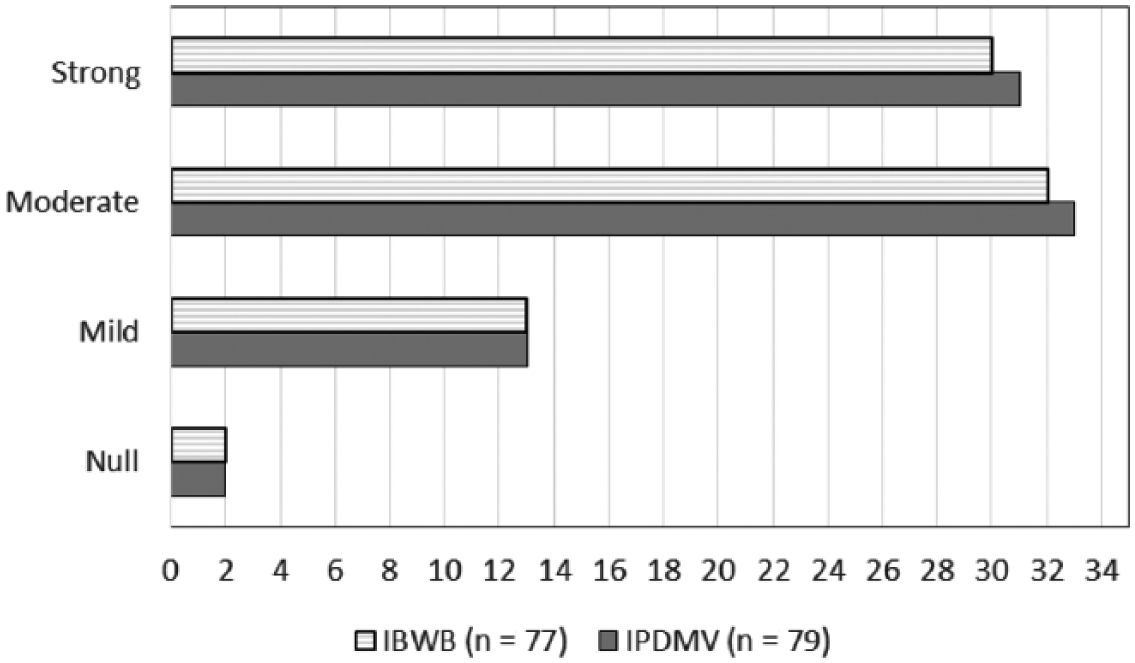
Implicit rejection of gender violence in subjects with strong explicit rejection.
Differences by Sex, Knowledge, and Activities
The effect of sex, previous knowledge about IPVAW, and participation in extracurricular activities related to IPVAW were analyzed using the nonparametric Mann–Whitney U test for independent samples, due to the small size of some groups. Table 5 shows that the variables sex and participation in extracurricular activities have no significant effects, in either the implicit or the explicit measures, whereas the variable previous knowledge about IPVAW has a significant effect only in one explicit measure (the help should (not) be given in IBWB’s scale).
Comparison by Sex, Knowledge and Activities (Mann–Whitney Test).

Note. GV-IAT = Gender Violence Implicit Association Test; IBWB = Inventory of Beliefs about Wife Beating; WJ = wife beating is justified; WG: wife gains from beating; HG = help should (not) be given; OP = offender should (not) be punished; OR = offender is (not) responsible; IPDMV = Inventory of Distorted Thoughts about Women and Violence; IW = inferiority of women compared with men; BW = blaming women victims of abuse; VP = violence as problem-solving strategy; MA = minimization and exoneration of abuser.
Values in bold mean that IPVAW has a significant effect in an explicit measure.
The dimension is expressed in the opposite sense (not helping, not punishing, not responsible, etc.).
Discussion
The study of attitudes toward IPVAW is a popular topic that has been widely researched. Implicit assessment methodologies (e.g., the IAT) have been developed because explicit attitudes have been deemed highly sensitive to the effects of social desirability (Nosek, 2005). In particular, IAT is considered a valid measure of implicit processing in the sense that the psychological attributes of the individual are inferred from the speed at which the participants respond to stimuli in the categorization task.
In this context, the aim of this research is to contribute in the application of a form of personalized IAT (the GV-IAT) to the study of public attitudes toward IPVAW. The results of this pilot study achieved the objectives set out: First, they provide evidence on the best condition for applying GV-IAT (with feedback) and the best procedure for estimating the IAT effect (built-in error penalty); in addition, these findings are consistent with previous research on implicit measures of attitudes toward IPVAW (i.e., Eckhardt & Crane, 2014; Gracia et al., 2015; Robertson & Murachver, 2007). Similarly, we observed a significant disparity between explicit and implicit measures of these attitudes. In this vein, our results provide conclusive evidence of the need to incorporate implicit measures in research into this social problem and an encouraging proposal of a tool to assess them.
With regard to the sense of the observed disparity, although a very large majority of the sample studied shows an explicit rejection of IPVAW (between 88.8% and 96.3%, according to the self-report used), the proportion of rejection reduces to just under half when it is measured implicitly.
Researchers such as Echebarria (2013) suggest that the low correspondence between implicit and explicit measures of attitudes may be due to methodological factors. Specifically, it could be explained by a question of structural fit, as the demands placed on the respondents by both types of measures are entirely different. The Motivation and Opportunity as Determinants (MODE) theoretical model (Fazio, 1990; Olson & Fazio, 2009) supports this reasoning, proposing the existence of a single-attitude construct (Bohner & Dickel, 2011) which can manifest as behavior through spontaneous or deliberative processes. This model seeks to explain when there is a correspondence between attitudes and behaviors and when there is not; it suggests that the consistency of attitudes and behaviors depends on processing capacities and motivation and proposes that attitudes are only one of the various determinants of behaviors. The presence of other factors such as social norms against the expression of certain opinions (e.g., tolerance to IPVAW), the desire to project a specific self-image, the need to be accepted by others, and the amount of personal experience with a particular domain also contribute to shaping behaviors. In these situations (prototypical context of explicit measures), MODE predicts a low correspondence between attitudes and behaviors, as the situational forces are strong enough to inhibit the expression of attitudes. In other situations (as well as the prototypical context of implicit measures), there are no constraints on the overt expression of attitudes (ambiguity, presence of others with similar attitudes, noncontroversial topics etc.), and there is a stronger correspondence between attitudes and behaviors (Greenwald, Poehlman, Uhlmann, & Banaji, 2009; Nosek, 2005; Nosek, Banaji, & Greenwald, 2002). In short, one could argue that implicit measures are generally unbiased by motivational influences, whereas explicit self-reports are often influenced by social desirability concerns (Fazio & Olson, 2003; Nosek, 2005).
Another important point to note is that previous studies have frequently indicated several factors influencing attitudes toward IPVAW, including age, gender, education, residency, economic status, or patriarchal gender role (Gracia & Lila, 2015). For instance, some surveys and reviews in developing countries have suggested that men are more likely than women to approve of behaviors associated with IPVAW (Ferrer & Bosch, 2014; Flood & Pease, 2009), and that younger people tend to justify IPVAW more often than their elders (Waltermaurer, 2012). Wang (2016) reviews these factors and concludes that education might be the most crucial factor and may decrease the risk of accepting or justifying IPVAW.
The results of this study show that variables such as sex, previous knowledge about IPVAW, or involvement in IPVAW-related activities do not have a significant effect on either implicit or explicit measures of attitudes toward IPVAW (only the variable previous knowledge has some effect in the help should (not) be given in the IBWB scale). However, the sample studied is highly homogeneous (made up exclusively of undergraduates, most of them women and young). This homogeneity is precisely one of the limitations of this work. It is therefore necessary to continue working with broader and much more diverse samples (in terms of their composition by sex, age, level of education, status, and so on, and, particularly, in terms of a broader sample of men) to obtain more conclusive results. Other limitations include the absence of broader psychometric evidence on the Spanish use of IBWB; the narrow reliability of the minimization of IPVAW as a problem and exoneration of the abuser in the IPDMV scale and the offender is responsible in the IBWB scale; and the need of an in-depth discussion on the best algorithm for calculating D scores, as well as their interpretation. Further research should address all of these limitations.
As we stated earlier, the majority of research about IPAW attitudes and the factors influencing them has used explicit measures (Gracia & Lila, 2015; Gracia et al., 2015). Nevertheless, given the potential biases and risks associated with using explicit attitude measures, this assessment may not be completely accurate (Fazio & Olson, 2003; Gracia et al., 2015; Nosek, 2005). The combined use of explicit and implicit attitude assessment could potentially lead to a more accurate measurement of attitudes toward IPVAW. Moreover, and despite their limitations, the current preliminary findings contribute to the body of literature by providing conclusive information on the need to incorporate implicit measures of IPVAW attitudes into research on this important social problem. In fact, the use of implicit measures to assess attitudes may provide new assessment approaches and a step forward in the study of attitudes toward IPVAW in community samples, professionals, victims, and also perpetrators. Particularly, the use of these implicit measures in batterer intervention programs, which may be more sensitive than self-reported measures that are susceptible to social desirability, may provide new assessment tools for treatment providers (Gracia et al., 2015; Martin-Fernandez et al., 2018).
Footnotes
Declaration of Conflicting Interests
The author(s) declared no potential conflicts of interest with respect to the research, authorship, and/or publication of this article.
Funding
The author(s) disclosed receipt of the following financial support for the research, authorship, and/or publication of this article: This work has been financed by the Spanish State Research Agency (Agencia Española de Investigación, AEI) and the European Regional Development Fund (Fondo Europeo de Desarrollo Regional, FEDER) through the Research Project FEM2015-63912-P (AEI/FEDER, UE).
