




Abstract
The purpose of the present study was to examine what motivates college students to put themselves in harm’s way and help their peers in risky situations involving sexual assault and dating violence. College students reported on the frequency of witnessing a wide range of potentially dangerous incidents, whether or not they intervened, why they chose to intervene, what their relationship was to the victim, and reactions to their intervention. A sample of 182 (59.5% female) college students (Mage = 19.3 years) participated. We coded and analyzed narrative responses to the question regarding what influenced their decision to get involved. For female students, relationship to the victim, and, for males, the severity of the situation, were key motivational factors for bystander involvement. Some students reported positive feelings while others reported negative feelings directly related to their involvement. Tapping into the motivations underlying college students’ helping behavior will be particularly informative for those designing and implementing bystander intervention programs on college campuses. A better understanding of bystander behavior will not only improve bystander intervention programs but it will also put students in the best position to make informed and responsible choices when faced with a difficult situation.
Over the past decade, there has been an increasing need to understand and examine elements of sexual assault and dating violence on college campuses. Studies have shown that more than 1 in 10 students experience some form of dating violence or sexual assault (Cantor et al., 2015). The passing of the Campus Sexual Violence Elimination Act in 2013 provided a mandate for college campuses to provide programs aimed at raising awareness of sexual violence. Many schools have started implementing bystander programs which emphasize the collective responsibility of all students on campus to change cultural norms, increase awareness, and actively help prevent future incidents of sexual assault and dating violence (Banyard, Plante, & Moynihan, 2004). Bystander education programs teach students to recognize signs of sexual assault and dating violence while also outlining appropriate steps-of-action when an individual intervenes, reports, or discusses sexual assault and dating violence (Coker et al, 2016). A primary goal of bystander education is to increase helping behavior. Thus, understanding what motivates college students to intervene would be particularly valuable to those designing and implementing bystander education. However, another important goal is to promote favorable outcomes, both for the victim or potential victim and for the bystander. Vicarious trauma may be a potential outcome for a bystander who becomes involved in particularly risky or traumatic situations (Witte, Casper, Hackman, & Mulla, 2017). Examination of the bystander literature reveals a number of areas of research that would benefit programs aimed at reducing campus violence. In an effort to address gaps in the bystander intervention literature, we examined underlying motivations for intervening and reactions to intervening.
Researchers, advocates, and government agencies have substantial evidence documenting the pervasiveness of sexual assault and dating violence. A recent survey of nine college campuses revealed a range of 12% to 38% of undergraduate women reported experiencing a sexual assault since beginning college (Bureau of Justice, 2016). In another sample of 330 college women, more than 40% reported experiencing abusive dating behavior through physical violence, sexual assault, or controlling behavior (Knowledge Networks, 2011). Some progress has been made, but further bystander education is a critical component to stemming the tide of increases in sexual and dating violence on college campuses.
Recent studies have begun to demonstrate positive effects of bystander intervention programs, such as reducing instances of sexual harassment, stalking, and psychological dating violence (Coker et al., 2016). In addition, campus-based bystander behavior trainings have led to a reduction of rape myth acceptance scores and an increase in the likelihood of bystander intervention behavior (Coker et al., 2011). In spite of the notable progress, incidents on college campuses largely go unreported. The Campus Climate Survey reported that across nine college campuses, less than one fifth of sexual battery incidents were actually reported to an official university or law enforcement representative (Bureau of Justice, 2016). An important next step toward increasing bystander behavior in an effort to stop sexual and intimate partner violence on college campuses is to identify what factors influence college students’ decision to intervene. Reviewing the early bystander intervention literature will help to provide some context for our aim of understanding what motivates bystander behavior.
Review of the Early Bystander Intervention Literature
Researchers have been interested in bystander behavior for several decades. Early investigators of bystander behavior focused on emergency situations such as medical emergencies (i.e., someone having a heart attack) and identified a process whereby an individual contemplates whether or not to help during an emergency. Being a bystander then necessitates a critical evaluation of how to appropriately intervene. Early explanations of a bystander’s choice to intervene rested largely on unexamined inferences. However, after creating an experimental situation reconstructing a well-known historical situation when no bystanders intervened, Darley and Latané (1968) concluded, “If people understand the situational forces that can make them hesitate to intervene, they may better overcome them” (p. 383). A possible antecedent to a bystander taking action is a prior commitment to engage in an emergency before a situation even arises (Moriarty, 1975). This, in essence, would be such a decision that takes the complexity of the choice to do so out of the present moment and, in turn, would allow the individual to insert himself or herself as a proactive, helpful bystander. Thus, the theory of bystander action involves (a) noticing an event, (b) interpreting the event as an emergency, (c) deciding whether one feels personally responsible to act, and then (d) taking some type of action (Latane & Darley, 1969).
Later developments examined the role of priming individuals with information about bystander intervention and how that may translate into a greater likelihood of intervention. In a controlled study, those who were provided information about bystander intervention in emergencies were quicker to assist than those who received no information (Rayko, 1977). From this study, the genesis of public education about bystander intervention emerged in that “. . . individuals who have received relevant information do help faster than those who have not” (p. 303).
Recent bystander research has moved toward training college students to recognize and intervene in potential incidents of sexual and dating violence. Current bystander intervention programs have evolved from the knowledge gained from earlier efforts to understand the process of intervening. The bystander intervention model, based on the theory of bystander action, involves the same process of noticing, interpreting, and deciding whether or not to take responsibility. College bystander intervention programs, based on the bystander intervention model (Latane & Darley, 1969), attempt to increase this sense of responsibility by involving individuals within a community (students on a college campus) in the prevention of sexual and intimate partner violence by assigning individuals a role “bystander” which is believed to influence their perception of personal responsibility.
Motivations of Bystander Involvement
The literature points to some common factors that influence a bystander’s decision to take action. An early synthesis of the bystander intervention literature suggested that gender roles have implications for bystander intervention, specifically that men tend to view intervention as an opportunity for a short-term, courageous behavior whereas women are more likely to view intervention as a long-term, caring endeavor (Eagly & Crowley, 1986). Also, in the literature two common themes emerge that highlight the importance of group cohesiveness (Rutkowski, Gruder, & Romer, 1983) and common identity (Levine & Crowther, 2008), including aspects of gender, (Levine & Crowther, 2008), values (Banyard, 2011), and culture (Banyard, 2011; Levine, Cassidy, Brazier, & Reicher, 2002). That is, the likelihood of intervening increases when a victim is perceived to be part of an in-group vs. an out-group (Levine et al., 2002), for example, when one’s own gender matches the gender majority of the group as compared to one being a gender minority (Levine & Crowther, 2008). Thus, groups exhibiting high cohesiveness or who perceive a common identity have been shown to demonstrate a greater likelihood of helping when needed (Levine & Crowther, 2008; Rutkowski et al., 1983).
An important distinction can be made, however, between groups that are distinguishable by close, interpersonal relationships (i.e., friendships) and those that are a result of social category membership (i.e., social identity). An increase of group size consisting of friends, among whom helping behavior is valued, and a similarity in gender identity, increases the likelihood of intervention due in part to the strong psychological, social relations, and group identification (Levine & Crowther, 2008). When asked to imagine other bystanders as friends, an individual, regardless of group size, has been shown to increase their likelihood of intervening. Yet in instances when the other bystanders were imagined to be a part of a more general social group, the likelihood of intervening decreased (Levine & Crowther, 2008). Similarly, in a sample of college students, relational distance to the victim or perpetrator was the greatest predictor as to whether the student would intervene directly or indirectly in cases of sexual assault and interpersonal violence (Palmer, Nicksa, & McMahon, 2018). Women were more likely to intervene in instances of interpersonal violence, whereas men were more likely to intervene in cases of sexual assault. Notably missing in the literature is an exploration of bystander involvement specifically involving samples of racial, ethnic, and contextual diversity. Strong evidence of this omission in the bystander intervention literature is provided in a recent meta-analytic review of bystander intervention research (Fischer et al., 2011). In their quantitative synthesis including 53 articles, more than 7,700 participants, and 105 independent effect sizes, neither race nor ethnicity is addressed.
Reactions to Intervening
Historically, witnessing a distressing incident but not necessarily intervening has been associated with distress symptoms for the bystanders (Latane & Darley, 1969). In response to actually intervening, new evidence has begun to emerge suggesting potential risks as well as benefits for those who intervene (or not) in particularly risky situations (e.g., breaking up a fight; Witte et al., 2017). One need not be a direct victim to be harmed. Indeed, the mental health fields as well as the first responder literature have recognized the potential risk of vicarious trauma when becoming involved in crisis situations (Rhineberger-Dunn, Mack, & Baker, 2016; Rzeszutek, Partyka, & Go’ab, 2015; Wies & Coy, 2013). It should be noted, however, those who work in the helping professions are likely to be aware of the potential risks to the self and are provided with resources to take steps to attenuate the deleterious effects of vicarious trauma.
Bystanders, on the contrary, are laypersons who likely weigh a number of factors when deciding to intervene, one of which may include possible injury or safety of self (Hamby, Weber, Grych, & Banyard, 2016). Evaluating whether or not to intervene may involve a cost–benefit analysis weighing the severity of the situation in addition to relationship distance to the victim, and in some cases to the offender (Bennett & Banyard, 2016). But bystanders may not be fully aware of the possible psychological risks of intervening. Indeed, even discussing a friend’s rape trauma has been linked to residual distress (Branch & Richards, 2013). It is reasonable then to expect that some bystanders who intervene in impending or past incidents of sexual assault or dating violence will have mixed reactions to intervening and may also develop symptoms.
The current trend across U.S. colleges and universities is to train students to intervene in a variety of situations, some of which may be potentially risky and dangerous (e.g., saying something to someone who is grabbing or pushing an intimate partner). Even further, bystander intervention programs strive to create a culture whereby intervening is expected, but this expectation for involvement may be premature given the lack of understanding of the potential risks or benefits of getting involved. Currently, many bystander intervention programs do not focus on informing bystanders of the potential risks, nor do they place a heavy emphasis on providing education or resources for bystanders who may have a negative reaction in response to their involvement.
We have only begun to explore the well-being of bystanders, those college students who engage in the very behavior which bystander training advocates. One study that has looked at trauma and depressive symptoms in a sample of college students who reported on their own bystander behavior reported mixed findings (Witte et al., 2017). Many bystanders who intervened felt good about their decision to intervene, but both witnessing and intervening in risky events were (marginally significantly) related to traumatic stress symptoms. Bystander programs would benefit from knowing the outcomes of bystander interventions to fully address these issues during student training sessions. Given the potential risks of intervening in dangerous situations, it is unclear what motivates college students to put themselves in harm’s way.
Goals of the Current Study
Given the current climate of sexual and dating violence on college campuses and recent evidence pointing to potential risks and benefits of intervening in such situations (Witte et al., 2017), we sought to gain a more nuanced understanding of the motivations underlying intervening behavior. We asked college students to report on the frequency of witnessing a wide range of potentially dangerous incidents, whether or not they intervened in the witnessed incidents, why they chose to intervene, and what their relationship was to the victim. We also queried students about how they felt about their intervention—positive, negative, or neutral. To our knowledge, this is the first study to explore the reasons college students intervene in risky situations. Based on prior research (Palmer et al., 2018), we hypothesized that one of the most common motivational factors supporting the decision to intervene would be the bystander’s relationship to the victim/potential victim. We suspected that bystanders would be motivated to help in risky situations involving friends, but one’s decision to get involve or not get involved could lead to different reactions depending on the situation and potentially who was involved.
Tapping into the motivations underlying college students’ intervening behavior, potential gender differences in witnessing and intervening, and differential involvement when the potential victim is a friend versus as stranger will be particularly informative for those designing and implementing bystander intervention programs on college campuses. A better understanding of bystander behavior will not only improve bystander intervention programs, but it will also put students in the best position to make informed and responsible choices when faced with a difficult situation.
Method
Participants
The current study is a follow-up study to a related project in which participants reported on witnessing and intervening in risky situations and how their actions affected their mental health (Witte et al., 2017). The current study was designed to specifically examine why college students intervene in potentially risky incidents, and how they feel about intervening or not intervening. A sample of 182 (59.5% female) early emerging adults (Mage = 19.3; SD = 1.14) from a large state university in the southeastern United States were recruited from introductory psychology classes. Although we did not gather specific data regarding race and ethnicity in this follow-up study, the same recruitment strategy and participant pool were used within a few months of the original study in which participants identified as primarily Caucasian (87%), followed by African American (11%), and other (2%). Participants provided the data via an anonymous online (Qualtrics) questionnaire outside of class but for which they received extra credit for their participation. The data were collected in the spring of 2015, well after the students participated in a mandatory bystander intervention program at the beginning of the 2014-2015 academic year. At this institution, completion of EverFi’s Haven—Understanding Sexual Assault is required of all freshmen upon arrival on campus. All study procedures were approved by the institutional review board.
Measures
Risky bystander interventions
Participants responded to a list of 19 risky situations involving sexual assault and/or dating violence. Participants were instructed to indicate whether they witnessed each risky situation, if so, whether or not they intervened (i.e., “I did not get involved” vs. “I got involved”), whether the potential victim was a friend or a stranger, and whether they had a positive, negative, or neutral reaction to intervening. For students who intervened, they were also asked when the incident occurred with response options ranging from less than 1 month ago, 2 to 4 months ago, 6 months ago, 6 to 12 months ago, and more than 12 months ago. These 19 items were taken from the “risky situation” factor based on results of a factor analysis of 98 possible bystander behaviors toward friends or strangers (Banyard, Moynihan, Cares, & Warner, 2014). See Table 1 for scale items.
Witnessing and Intervening in Incidents of Potential Sexual Assault and Intimate Partner Violence (N = 182).

Reasons for intervening
Participants who witnessed and intervened in any of the incidents were asked to provide open-ended narrative responses as to what influenced their decision to get involved.
Data Analysis
Those who witnessed and intervened in any of the potentially risky incidents were asked to provide a narrative response to explain what motivated them to get involved. We used thematic content analysis to code the narrative responses. Each narrative response was coded by the first author and a graduate research assistant using a constant comparative method (Glaser, 1965) to identify broadband themes of reasons for intervening. The constant comparative method allows for themes to emerge from the existing data. The first author read each response, identified broad themes, and took notes throughout the process. This was done multiple times until the first author was confident that all possible reasons for intervening were identified. Operational definitions were generated for each of the themes. The first author then described the coding scheme to a graduate research assistant, providing the labels of each theme, the operational definitions, and hypothetical examples of each theme. The graduate researach assistant then independently coded each narrative response. Both coders were able to identify one broad theme per response. Agreement was high (92.3%) between the two coders. When discrepancies occurred, the coders discussed the discrepancy until agreement was met.
We examined the frequency of male and female participants witnessing each incident and the frequency of intervening based on the motivational reason for intervening. Finally, we examined participants reactions related to intervening by examining frequencies of positive, negative, and neutral reactions based on the motivational category.
Results
The majority of college students (81.9%) witnessed at least one of the wide range of sexual assault and dating violence incidents as recent as the past 6 months. The majority of the incidents that were witnessed by participants involved strangers (see Table 1). A much smaller proportion actually got involved and intervened in at least one incident (33.9% of the sample intervened in at least one incident; see Table 1).
Bystander Motivation
We were especially interested in investigating the motivation for intervening in potentially risky incidents. To answer this research question, we coded and analyzed the narrative responses about what influenced the college students’ decision to get involved. Some of the participants did not provide a response or the response was not codable (6.5%).
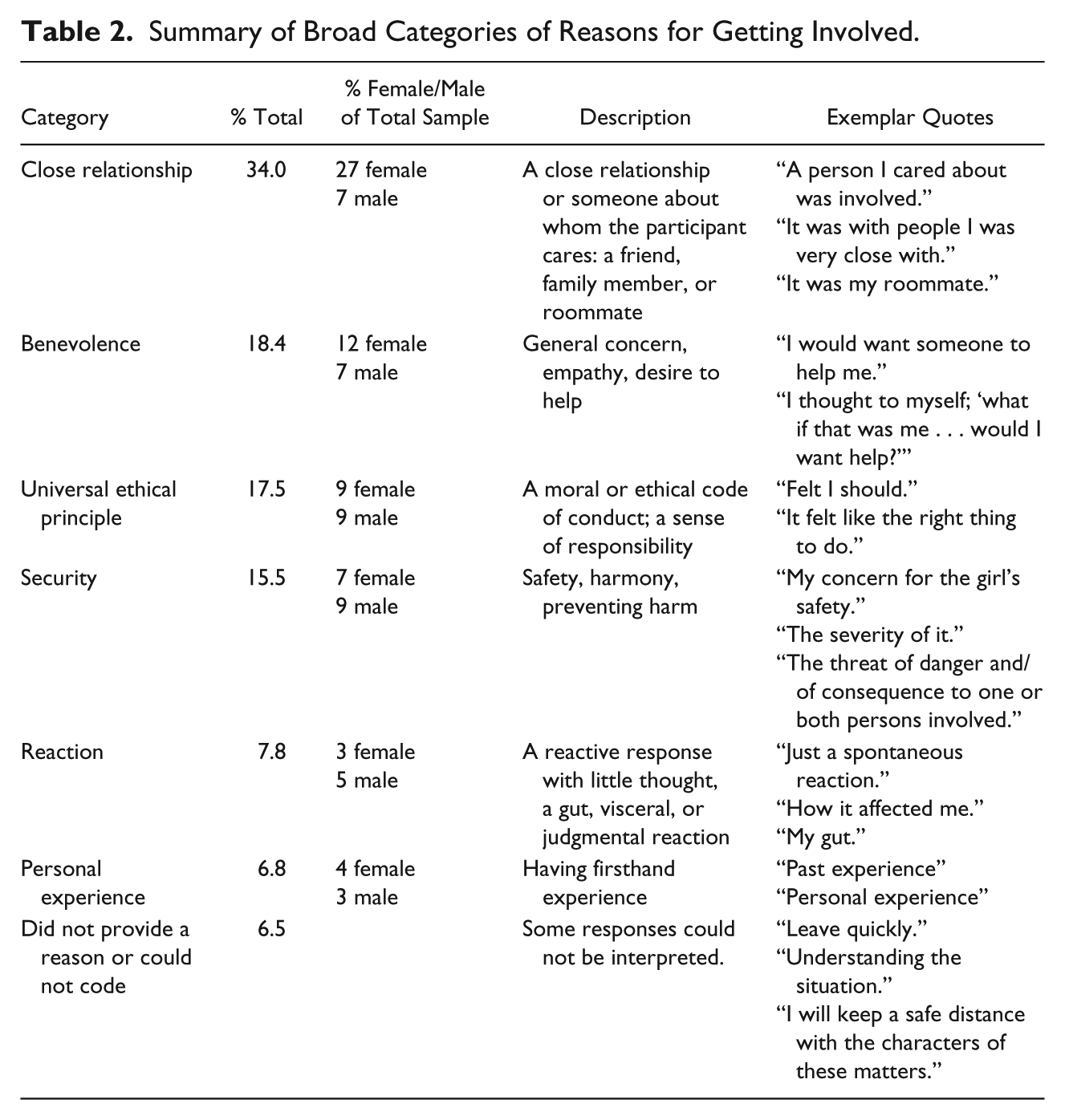
Table 2 provides a summary of the narrative responses of the reasons for helping in risky situations, the operational definition for each theme that emerged from the thematic content analysis, and exemplar quotes for each theme. Of the participants who provided a reason for their helping behavior, the majority intervened because at least one person involved was someone close to the participant (34.0%), a close friend, relative, or roommate. This was evidenced by a student who responded, “The thought that someone I cared about was in danger.” Benevolence (18.4%) involved a general sense of empathy or desire to help and included responses like “I know that someone needed help” and “general empathy.” Universal ethical principle (17.5%) was the third most common theme for intervening. For example, one participant stated “that it was wrong,” and another simply said “my morals.” Security (15.5%) was another theme illustrated in responses such as the following: “I just wanted to make sure they were level headed about the situation and get perspective about what was going on. I wanted to make sure things didn’t escalate.” A few of the students (7.8%) were influenced by how the incident or situation affected them. These responses involve somewhat of an automatic or visceral response: “How it affected me.” Another indicated that it was somewhat of an unexplained reaction to the event: “Just a spontaneous reaction.” Finally, personal experience with a similar situation was the reason (6.8%) intervened and this theme included responses that simply stated “past experience” and “personal experience.”
Summary of Broad Categories of Reasons for Getting Involved.
Gender, Witnessing, and Intervening
Across all 19 incidents, females were more likely to report having witnessed an incident whether it was a friend or a stranger who was involved. When we examined only those who witnessed a friend involved in these types of incidents, results were split; males were more likely than females to have witnessed a friend involved in seven of the 19 items whether or not they got involved. Females were more likely than males to have witnessed a friend in seven out of the 19 incidents, whether they got involved or not, and the remaining five, males and females were equally likely to witness a friend’s involvement. Perhaps the most notable differences between the male and female participants is the percentage of males and females who intervened when it was a friend involved in these types of incidents.
For female participants, they were more likely than males to intervene if a friend was involve in 14 out of the 19 incidents. Males, on the contrary, intervened more than females in four of the 19 incidents if it was a friend involved. Males and females were equally likely for one of the incidents. Three out of the four items for which males intervened more than females when it involved a friend were high-risk incidents and included potential physical or sexual violence. These items included the following: when they saw someone being shoved or pushed by their boyfriend/girlfriend; when they heard someone talking about using physical force with their boyfriend/girlfriend; and when they heard someone talking about forcing someone to have sex with them. Taken together, females are more likely to know (to witness) when their friends are in potentially risky and dangerous situations, and they are more likely to intervene; however, males did report intervening when a friend was involved in a particularly serious physical or sexual abuse type of incident.
Table 3 shows the number of male and female students who witnessed each of the incidents and the number of students who actually intervened across each motivational reason for assisting in the incident. Overall, females were more likely to help across all of the motivational themes with the exception of having a gut or visceral reaction to the incident. Far fewer male students (range from 7 to 32) compared with female students (range from 19 to 60) reported witnessing at least one of the range of risky incidents. When looking at the proportion of males and females who intervened when they witnessed one of these incidents reveals that the proportion of males ranged from 0 to as high as 53% and the proportion of females who helped ranged from 8% to 50%. These proportions of those who intervened suggest that although male students witness far fewer risky incidents, when they do, they are just as likely to help as female students. Where male and female students differ most notably is in the motivation underlying their helping behavior.
Number of Participants Witnessing and Intervening in Incidents of Potential Sexual Assault and Intimate Partner Violence.
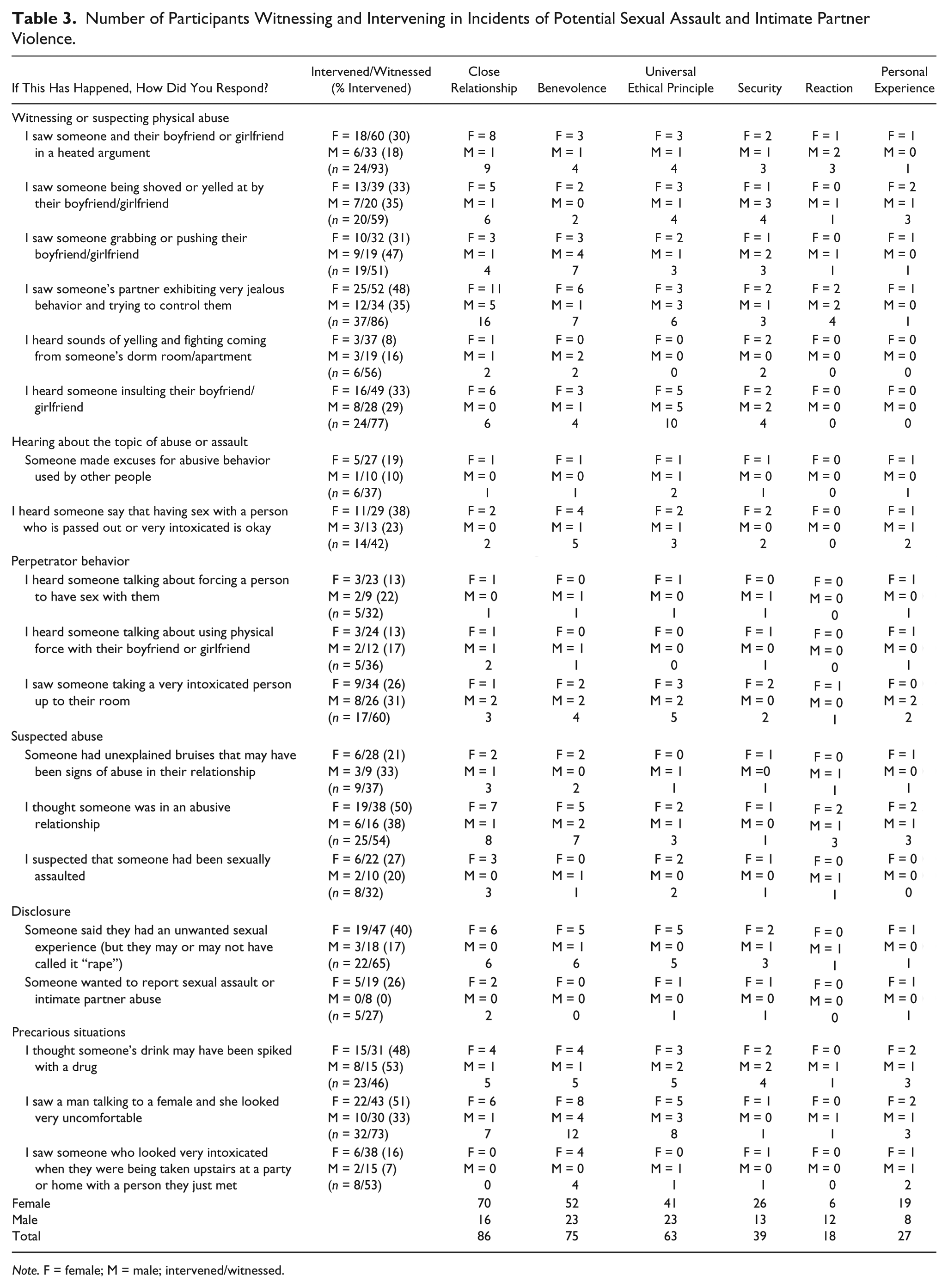
Note. F = female; M = male; intervened/witnessed.
Reactions to Intervening Based on Motivation
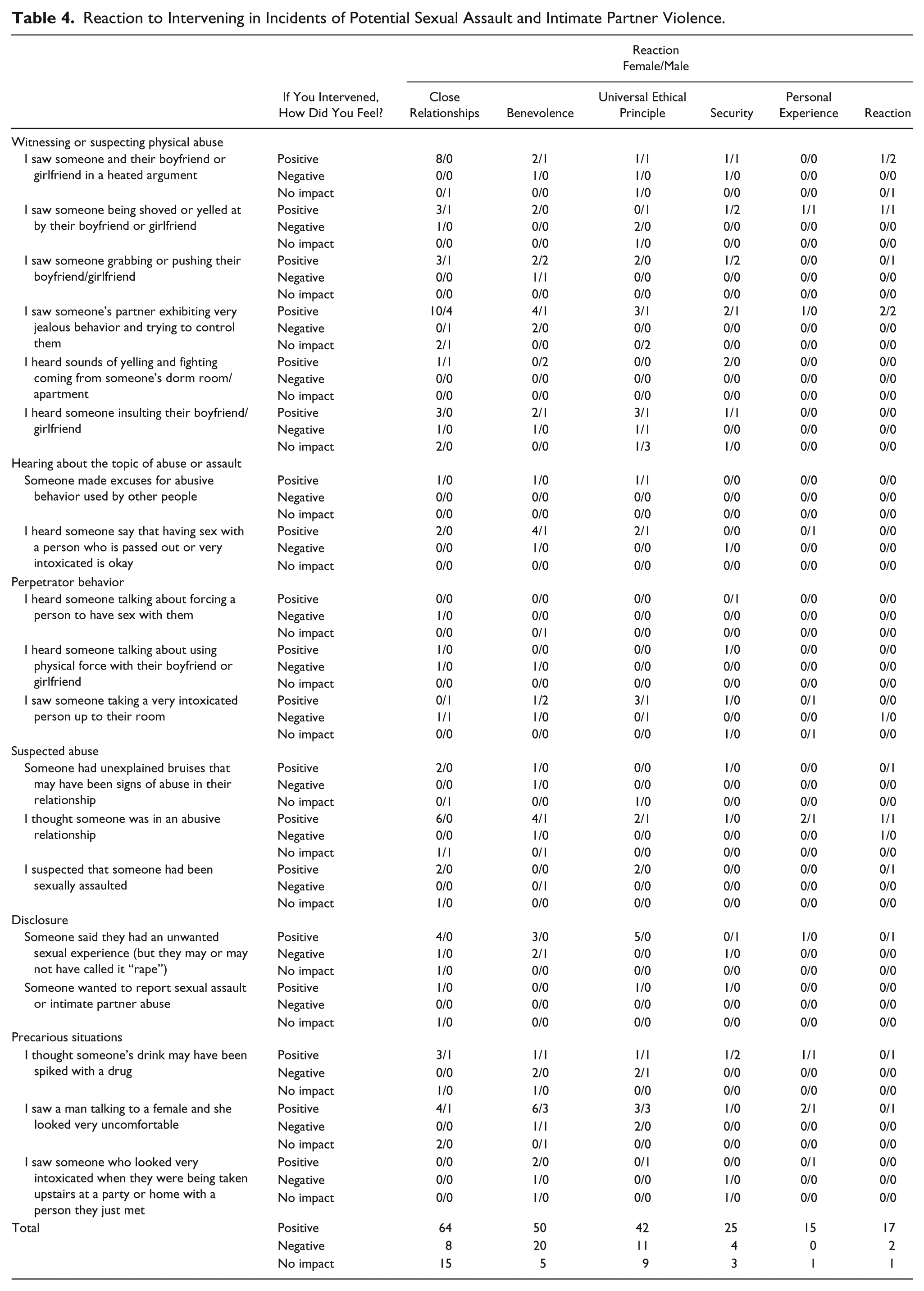
Table 4 shows the reaction toward intervening for male and female students based on the motivation for intervening. Participants were asked to report how they felt about their chosen response: positively, negatively, or neutral. The findings are mixed in that both male and female students had positive reactions toward responding to some incidents, some students reported negative feelings, and others had no reaction. The range of reactions varied across the full range of incidents and across all of the motivations for intervening. Out of the 19 different incidents, there were only three incidents where no participants reported a negative response to helping. They included “I heard sounds of yelling and fighting coming from someone’s dorm room/apartment” “Someone made excuses for abusive behavior used by other people” and “Someone wanted to report sexual assault or intimate partner abuse.” When comparing across motivational category, the highest counts for positive reactions were found for students motivated by having a close relationship to those involved. Alternatively, the highest counts for negative reactions were found for students’ motivated by benevolence.
Reaction to Intervening in Incidents of Potential Sexual Assault and Intimate Partner Violence.
Discussion
This is the first study to assess motivational reasons behind bystander interventions in risky situations involving sexual assault and dating violence in college and consequences of such interventions. A large number of college students reported having witnessed a wide range of risky incidents involving sexual assault and/or dating violence (81.9%). It is alarming when considering the percentage of this sample who reported witnessing the types of incidents that we assessed. The majority of incidents involved intimate partners getting in heated arguments, acting jealous and controlling, with some going so far as to involve actual physical contact (hitting and pushing). Perhaps more alarming is the percentage of participants who have witnessed an intoxicated person being taken to someone’s room (by someone they just met), of someone disclosing that they had an unwanted sexual experience, and overhearing a likely perpetrator talking about potentially forcing someone to have sex with them. According to the Knowledge Networks (2011), 40% of college women reported experiencing some form of intimate partner violence. In the current study, more than 80% of college students reported having witnessed some type of potentially dangerous incident. Furthermore, in 2013, colleges and universities were given a mandate to provide some type of bystander education.
In the current sample, the rates of bystander involvement were much lower than the percent of witnessing and ranged from 0% to 57%. We found that those who chose to intervene did so for a variety of reasons (Table 2). The most common reason provided in the narrative responses was that it was someone close to the participant (close relationship). Among the narratives, it was clear that a personal relationship that the bystander had with those involved was an important motivating factor underlying the intervening behavior. This supports prior research indicating that friendship with a potential victim increases the likelihood of intervening (Palmer et al., 2018; Pronk, Goossens, Olthof, de Mey, & Willemen, 2013). Following a close relationship with the potential victim, three additional themes emerged with similar frequencies. Participants reported getting involved due to a more general concern or empathy (Benevolence), followed by a moral or ethical sense of responsibility (Universal Ethical Principle), and finally for security reasons (Security). Only a handful of participants reported that they intervened because of the immediate reaction they had to the situation (reaction) or because they had some prior experience that was similar (personal experience).
When separating the sample by gender, women and men had similar rates of witnessing friends’ involvement in the 19 different incidents, but women were more likely to intervene in 14 out of the 19 incidents when it was a friend involved. The narrative responses related to motivations to intervene in risky situations differed by gender as well. While women were primarily motivated by helping those close to them, men were motivated by security and a sense of responsibility. Taken together, the types of incidents in which college students are most likely to intervene involve people about whom they care and for whose safety they fear.
Participant Reactions to Bystander Behavior
Intervening in potentially risky or dangerous incidents is what bystander intervention programs are designed to promote. While it is important to educate the public, and college students in particular, about how and when to intervene in situations of interpersonal and sexual violence, it is also important to fully understand the potential risks involved when we put ourselves in harm’s way. This sample of college students reported a mixture of positive, negative, and neutral reactions to their involvement; however, there were 214 reports of positive reactions compared with 45 negative and 34 neutral reactions. The majority of the positive reactions were those who reported the reason for intervening involved someone close to them. This sounds promising; however, if there is even a slight risk of an adverse effect on bystanders, it is important for those creating and implementing the trainings to be aware of this risk and they should address this in the training. We found evidence in this sample that some college bystanders reported having a negative reaction as a direct result of helping across all of the motivational themes for intervening with the exception of “personal experience.” Not only do college students need to be made aware of this, they need to have access to resources to help them cope with any lingering deleterious effects.
Implications for Bystander Intervention
This study informs intervention efforts in three important ways. First, we identified key factors that motivate bystanders to intervene, with the most common motivational factors being friendship to the victim and severity of the incident. From this study, we learned that relationship to the potential victim motivates female students whereas safety issues are more likely to motivate male students. These differences in motivation align with prior research suggesting that women are more likely to view intervention as a long-term, caring endeavor whereas men tend to view intervention as an opportunity for a short-term, courageous behavior (Eagly & Crowley, 1986). Tapping into what motivates college students to intervene when they witness a potentially dangerous situation, and more specifically, the nuanced gender differences, could be a particularly valuable aspect of bystander education and can be woven into basic educational curricula. Second, we discovered that intervening in potentially dangerous situations can lead to positive, negative, and sometimes neutral reactions. Finally, just as basic researchers have an ethical responsibility to inform human subjects of any potential risks or benefits to participating in a study, educators and administrators too have an ethical responsibility to inform students of the risks and benefits of intervening in potentially risky incidents, which bystander education advocates.
Given what we know about vicarious traumatization in the counseling and first responder literatures, and now in the college bystander literature (Witte et al., 2017), college students who intervene in risky situations may have mixed reactions to their response. Those who design and implement bystander programs on college campuses must consider the risks as well as the benefits of intervening. Furthermore, if one aim of bystander intervention is to increase bystander involvement, understanding the motivation underlying the behavior could aid in this endeavor. But increasing bystander behavior must go hand-in-hand with increasing college students’ awareness of the signs of negative reactions, not only in the victim but in themselves as well. This study found the most likely reason college students chose to step up and intervene in dangerous situations and put themselves in harm’s way was because it was someone close to them (i.e., a friend, a roommate, etc.) and the safety of those involved making it even more important that college students receive information about the potential benefits of intervening but also the risks. We have a responsibility to fully inform college students of implications of getting involved and not getting involved.
Finally, resources and support must be available, not only to victims but to bystanders as well. As universities continue to provide bystander intervention training initiatives aimed at stopping dating violence and sexual assaults on college campuses, specialized offices are beginning to emerge that provide a range of support and resources to students. These resources are mostly for those who have experienced instances of dating violence and sexual assault; however, our results suggest that it may be prudent for these offices and university counseling centers to also begin exploring what resources and support may be most beneficial to the bystanders involved in the reporting of such cases.
The current study must be considered within the parameters of its limitations. First, we asked participants to retrospectively report on witnessing and intervening in 19 specific incidents. The reliability of memories when using retrospective reports can be challenged; however, we would argue that witnessing the types of incidents about which we inquired would not easily be forgotten, and the majority reported witnessing the incidents within the past 6 months. Relatedly, although the online structure of the survey provided open-ended text boxes within which participants provided narrative responses to the question about their motivation to intervene, they could also opt not to respond, which was the case for some participants. Future researchers should consider face-to-face or even phone interviews in an effort to explore this question on a much deeper level. Finally, as is the case with the vast majority of bystander intervention research, the current sample consisted of primarily White college students; therefore, these findings cannot be generalized to other racial or ethnic groups. Bystander intervention research would benefit from the inclusion of diverse samples across different cultural contexts.
Conclusion
The aim of the current study was to examine why it is that college students put themselves in harm’s way to help in potentially dangerous situations of sexual assault and dating violence. College campuses across the country are implementing bystander programs advocating for college students to intervene when witnessing potentially dangerous situations (Banyard et al., 2004). This study identified the underlying reasons that college students do just that, intervene in risky situations. Relationship to the victim and the severity of the situation were the key motivational factors for female and male bystander involvement, respectively. While understanding motivational factors will be useful in designing and implementing bystander programs, it is also important to be cognizant of the potential undesirable effects of intervening so that awareness of and resources for these undesirable effects are integrated into bystander programming.
Footnotes
Declaration of Conflicting Interests
The author(s) declared no potential conflicts of interest with respect to the research, authorship, and/or publication of this article.
Funding
The author(s) received no financial support for the research, authorship, and/or publication of this article.